




Abstract
The multinational corporation, Dow Chemical, became the first-ever “Official Carbon Partner” of the Olympic Games in 2017, promising to offset the emissions generated by the staging of the Games and associated activities. This article critically analyzes the Partnership's promotional campaign, comprised of rhetorical claims that such “game-changing” collaborations are “redefining the role of business in society” in responding to the climate emergency. This particular campaign built green goodwill for a global sports mega-event and a corporation whose core business is converting fossil fuels into plastics. We highlight that this Partnership's carbon offsetting schemes appear to fail both parties’ additionality standards. We interpret this partnership as a historically significant example in the broader corporate effort to propogate a collaborative eco-capitalist imaginary that redefines corporations as partners fully aligned with state and third-sector projects to mitigate climate change.
Keywords
Since the 1990s, the International Olympic Committee (IOC) has responded to critics of its environmental impacts by attempting to incorporate sustainability at the heart of the Olympic ethos (Aragón-Pérez, 2017). Despite continued accusations of greenwashing (Boykoff, 2021; Boykoff & Gaffney, 2020; Miller, 2018), the IOC claims that the Olympic Games will be “climate positive” (i.e., beyond neutral) by 2030 and that the IOC's internal operations will be so from 2024 (IOC, 2021). Notably, the IOC long relied on the multinational chemical company, Dow, for its carbon mitigation and offsetting programs. Such programs sit alongside Dow's continuing partnerships in sports such as golf, motor-racing and winter sports (Dow, 2024). In addition to being one of the world's largest petrochemical companies with annual revenues of more than US$40 billion, Dow also offers carbon emissions measurement and offsetting programs to a range of “carbon partners” beyond the sports industry (Dow, 2020). Extending from existing critiques of carbon-offsetting activities (Haya et al., 2020; Lohmann, 2010; Watt, 2021) and the encroachment of consumer culture on the Olympic Games (Smart, 2018), this article analyses and critiques the practices and communications that comprise what Dow and the Olympics call their “Carbon Partnership.”
The Dow–Olympic partnership has been linked to Dow's official status as a Worldwide Olympic Partner in The Olympic Program (TOP). Initiated following the commercial success of the 1984 Summer Olympics in Los Angeles, TOP is one of the most transformational sponsorship and marketing programs in the history of international sport and media (Tomlinson, 2009). It offers select corporations exclusive worldwide rights to associate themselves with Olympic symbols and ideals. We analyze the programs undertaken through the Carbon Partnership and the campaign that promotes it. At the heart of the campaign is a discourse involving the key terms beyond business-as-usual, collaboration, innovation, catalysis, and legacy. Tracing this discourse across social media, company reports, promotional materials, and executive speeches, we show how it contributes to an ingenious campaign to win green goodwill for a carbon-intensive sports mega-event and a multinational company whose core business is converting fossil fuel into plastics (Badkar, 2016). Using the theoretical lens of a social imaginary, we show how the Dow–Olympic partnership is part of a growing ideological project aiming to reposition global corporations as reformed, “good actors” in environmental politics.
This article contributes to scholarship on the fast-growing class of collaborations between business, nongovernmental organizations (NGOs) and/or states termed “cross-sector sustainability partnerships” (CSSPs) (Clarke & MacDonald, 2019; Colaner et al., 2018; Pedersen et al., 2020; Rey-Garcia et al., 2020). Such partnerships are promoted by the UN Global Compact, World Business Council for Sustainable Development, the Organization for Economic Co-operation and Development (OECD) and other influential representatives of global business. The Dow–Olympic Carbon Partnership illustrates how CSSPs can win green goodwill for their corporate partners without constraining their carbon-intensive commercial activities. As explained below, the IOC has claimed it is minimizing its carbon footprint by receiving carbon credits that Dow purportedly earns through emissions-reduction efforts. Dow publicly promotes itself as a leader in sustainability transformation by trumpeting this program.
This mutually beneficial arrangement also enables the IOC to promote the “fundamentally incongruent” notion that the Olympic Games are a sustainable mega-event (VanWynsberghe et al., 2021, p. 13). Moreover, it signals the emergence of a new promotional master-narrative that seeks to reframe the role of business in society. According to this collaborative eco-capitalist imaginary, any fundamental conflict between corporate interests, environmental sustainability, and the public good has been overcome. Consumers, business giants and global media sport can be harmoniously united in the pursuit of common social, commercial and ecological objectives. The popularity of the Olympics as a hypercommodified sporting spectacle functions, at different times and in different ways, as both cover and promotional platform for this collaborative imaginary. The result is the further legitimation of ecological modernization as the primary frame for action by global capital in addressing the challenge of climate change (cf. Millington et al., 2018; Murphy, 2017; Wilson & Millington, 2020a, 2020b). In the following sections, drawing on the “game-changing” (Dow, 2020) discourse of the Dow–Olympic partnership's own public relations and marketing campaigns, we show how the partnership has created novel narratives and visions—a new social imaginary—of collaborative eco-capitalism that grants global corporations new legitimacy in the face of ecological crises. We will first turn to the theoretical underpinnings of this claim.
Social Imaginaries and the Environment
As Charles Taylor describes them, social imaginaries contain the deep normative notions and images that orient people toward each other and to the world (Taylor, 2004, p. 171). They are a form of social theory composed of images, narratives rather than rational precepts. Their immediacy affords them a crucial role in “priming” interpretation and guiding action. They do not propagate “false consciousness” ideology but rather a heuristic version of reality that is at least half-true—their crucial function is in selecting which half. Various theorists have developed and applied the notion of social imaginaries to questions of environment and society. The science and technology studies scholar, Sheila Jasanoff, for example, develops the concept of “sociotechnical imaginaries.” These are collectively held, institutionally stabilised, and publicly performed visions of desirable futures, animated by shared understandings of forms of social life and social order attainable through, and supportive of, advances in science and technology. (Jasanoff, 2015a, p. 4)
In constructing a cultural political economy of climate change, Levy and Spicer (2013) reconstructed four competing “climate imaginaries,” one of which is the “techno-market imaginary.” The other three are “fossil-fuels forever,” “climate apocalypse,” and “sustainable lifestyles.” The techno-market imaginary is composed of advanced clean energy technologies and market mechanisms such as carbon trading (Levy & Spicer, 2013, p. 664). The privileged group within this imaginary, the corporate sector, drives sustainability transition through creative entrepreneurship and technological innovation. The neoliberal and market-focused features of this imaginary co-exist uneasily alongside its Keynesian dimensions, which are associated with the Green New Deal and massive state investment in industry (Levy & Spicer, 2013, pp. 664–665). Many environmentalists who subscribe to an ecologically centered set of ethics and politics view heavy reliance on technological solutions and market-based incentives as an unsatisfactory response to climate change. Nevertheless, this approach is embraced enthusiastically by many policymakers and leaders of financial and low-carbon industries who believe it can somehow overcome the tensions between environmental and economic concerns under the conditions of late capitalism.
Environmental imaginaries are not ideal-type abstractions. According to Levy and Spicer (2013, p. 672), these imaginaries are articulated with, and to, social, economic, and technological structures. The ascension of the technomarket imaginary in the 2000s was the outcome of a “virtuous circle” involving the falling costs of clean energy, recognition of the need to respond urgently to climate change, and associated positive media coverage. The recession of the late 2000s, however, saw prominent green energy firms bankrupted, government subsidies for renewable energy generation wound back, and intensifying international competition in the renewables sector. The resurgence of the fossil fuels forever imaginary then followed, as unemployment and economic insecurity surged and climate denial found a new home in populist movements such as the Tea Party in the United States (Levy & Spicer, 2013, pp. 671–674). The championing of fossils fuels and climate change denial that accelerated under the Presidency of Donald Trump then intensified a malignant environmental legacy that also extended to sport (Millington & Wilson, 2017). It is the rootedness of imaginaries in lived political, economic, social and material conditions that explains the continuing dominance of the fossil fuels forever imaginary.
Considerable attention has been devoted to the role of the state in promoting sociotechnical imaginaries. How global corporations foster imaginaries that accord with their interests has attracted relatively scant attention (e.g., see Haupt, 2021; Sadowski & Bendor, 2019; Smith, 2015), despite the vast resources and influence at their disposal. Our analysis addresses this gap, with particular emphasis on how CSSPs between multinational corporations and NGOs often adopt the language of the latter while serving the interests of the former. Such partnerships gained currency following a series of postglobal financial crisis developments that promoted the value of cross-sector collaboration, especially those associated with the United Nations Global Compact and the Rio +20 conference in 2012 (Accenture Strategy, 2019). The resulting collaborative eco-capitalist imaginary contains important elements of the technomarket imaginary such as innovation, but introduces a specific focus on the programs, dynamics and discourses that flow from formal co-operation between industry, government and civil-society actors. Alongside other noted examples of resource-intensive corporations promoting their sustainability leadership and partnership credentials (e.g., Millington et al., 2021), the case of Dow and the Olympics’ Carbon Partnership is a key example in the history of sport and corporate environmentalism (Glasson, 2024). It combines Dow's multinational operations, promotional resources and contentious environmental record over many decades with the IOC's storied history, worldwide media reach and pretensions to being a global civil society actor in forums such as the United Nations (where it has Permanent Observer Status) (Beacom, 2012; Delmas & Blass, 2010; Lober, 1996).
Method
Recognizing the historical and political significance of the partnership between Dow and the IOC, this study is based on qualitative discourse analysis of the Carbon Partnership's public communications between 2014 and 2021. These communications were subject to a process of discourse analysis that involved the hermeneutic identification of terms and meanings that circulate through texts, and ways in which these terms and meanings blend, coalesce and shift over time to produce dominant frames and explanatory legitimacy (Smith & Howe, 2015). We approached these materials from a constructivist perspective that views discourses as constitutive, rather than merely reflective, of the objects they speak (Dryzek, 2005; Foucault, 1972, p. 54). This approach is appropriate given the mediatized and uncertain nature of climate change and its social and political responses. The complexity and uncertainty of ecological matters renders their representation constantly contested as sites of cultural–political conflict (Kelly, 2017, p. 40). It is uncovering the waging of these conflicts in the source materials that focused our analysis. Primary materials analyzed are speeches, interviews, corporate reports, social media, and marketing communications. Materials were sourced from Dow and IOC websites, social media profiles, promotional documents, and advertisements. Additional materials were collected by a combination of search engine and Boolean key word searches (e.g., Olympic, Dow, sustainability, carbon, partnership, etc.) in databases such as ProQuest and Factiva. Contextual materials for the partnership and the various programs it involves are sourced from general news and trade-press reports.
Carbon Partner
Dow Chemical Company is a world-leading supplier of plastics, chemicals and agricultural products. Founded in the U.S. state of Michigan in 1897, it now operates in over 150 countries. As well as producing adhesives, building materials, packaging, and insecticides among a vast range of outputs, it is notable for a long line of products that have been the subjects of controversy and lawsuits. It produced mustard gas, napalm, and Agent Orange for the U.S. military (Britannica, 2024). Its silicone breast-implant joint venture was bankrupted following an overwhelming number of lawsuits from women claiming multiple health problems. The company is also notorious for evading responsibility for the 50,000 people killed or injured through a series of highly toxic leaks from its subsidiary Union Carbide plant in Bhopal, India (Dow purchased Union Carbide, including its assets and liabilities, in 2001; Edwards, 2023).
Dow's connection with the Olympic Games began in 1980 by supplying products to Games venues. The company became one of the exclusive worldwide TOP Partners in 2010 as the Official Chemistry Company and was later named the IOC's Official Carbon Partner in 2017. The redescription of the partnership stemmed from Dow's association with sustainability efforts for the 2014 Olympic Games in Sochi and the 2016 Games in Rio de Janeiro. The focus of the partnership is on an advanced Climate Solutions Framework that enables Dow to “offset” carbon emissions from the IOC's operations (Dow, 2016a).
Dow and the Olympic Games describe their partnership as an “unprecedented,” “game-changing” collaboration aimed at blending science, innovation, and the platform of sports to leave “a positive climate legacy” (Dow, 2016b, p. 6). The IOC claims to be bringing the Olympics towards zero emissions. Dow, in turn, is given license to use the Olympics in its marketing and acknowledges the value of the partnership in four ways: increased brand awareness, revenue and impact, employee loyalty, and furthering sustainability (Piccolrovazzi, 2010). Dow also stresses the power of the Olympics to “accelerate implementation” of sustainable technologies and practices: “We can provide solutions to many different sectors and we can help drive behavior change through the Olympic Movement” (Piccolrovazzi, cited in Campelli, 2016).
Questions surround the offsetting program at the heart of the Carbon Partnership. For instance, the 2016 Rio Games produced an estimated 4.5 million tons of carbon dioxide equivalents (CO2e). Only one-tenth of this CO2e is attributed directly to Games operations, which is mitigated by purchasing verified offsets from international offset markets. Another one-third of Games-related emissions are from construction and the remainder—over half the total—is from spectators’ travel-related and consumption-related activities (Dow, 2016b, p. 8). Dow offsets the latter category through a mechanism based on its “Climate Solutions Framework” that calculates potential CO2e reductions achieved when Dow makes carbon reductions in its own operations or by agreements with third parties across the world (Dow, 2016a). The low verifiability of these CO2e reductions (which are projections into a 10-year horizon against business-as-usual) also means they cannot be converted into tradeable offsets. These projected emissions reductions are credited to the Olympic Games by balancing or mitigating “societal sphere” emissions such as spectator travel (Dow, 2016b).
Dow's overall design of the IOC's carbon reduction program is described as a “breakthrough approach to carbon mitigation for events” (Dow, 2016b, p. 8). This so-called breakthrough is based on Dow implementing “innovative energy-efficient and low-carbon projects” that are unconnected to the Olympics and the Games. Dow even appears to contravene its own standards in attributing CO2e reductions from some of these projects (Dow, 2016b, p. 12). Examples include the Biomass Santa Vitória Cogeneration project and the Aratu Biomass Cogeneration project, which are both in Brazil. As articulated repeatedly by Dow, the key requirements of such projects are that of “additionality” and going “beyond business-as-usual (BBAU)” conditions (Dow, 2016b, p. 12). The integrity of carbon offsetting “relies wholly on the concept of additionality,” as it must be shown that these projects would not have been undertaken anyway before they are claimable for CO2e reporting purposes (Maslin & Lewis, 2021). Yet, news that Dow would be converting the Aratu plant to biomass cogeneration was reported in the trade press in 2010 (Gibson, 2011; Nastu, 2010).
The case of the Biomass Santa Vitória Cogeneration Project demonstrates a curious interpretation of additionality and BBAU. Dow and Energias Renovaveis do Brasil built a biomass combustion plant to produce steam and electricity to power Dow's ethanol production factory and feed excess electricity back into the local grid. Along with a reforestation program undertaken in partnership with The Nature Conservancy, the project credits went directly to mitigating spectator emissions from the 2016 Rio Olympics (Dow, 2020). However, reports suggest that Dow originally embarked on the project in 2007, two years before Rio de Janeiro was even announced as the host of the summer Olympiad by the IOC, and seven years prior to the Rio 2016 Organizing Committee contracting Dow as its Carbon Partner (Biofuels Digest, 2011). According to Dow, the fact the project was already underway prior to the awarding of the Games does not discredit its use for offsetting carbon emissions generated by the Games: While these projects were planned ahead of Dow's commitment to Rio 2016 as the Official Carbon Partner, the decisions made in these projects were clearly beyond business as usual. (Dow, 2016b, p. 27)
Furthermore, the IOC's own Carbon Footprint Methodology explicitly prohibits claiming carbon saving initiatives for the Games that were “pre-planned and funded from entirely different sources” (IOC, 2018, p. 18).
There are clearly questions to answer about Dow's additionality and BBAU standards and the credibility of the IOC's carbon-reduction claims. Yet, both parties boldly proclaim the Partnership as a “game-changing” development that brings collaboration and innovation together to catalyze a sustainable legacy. Having long served as “corporate camouflage” for greenwashing, the Olympics remain an extraordinarily powerful platform to sell images and narratives of progress to worldwide audiences (Boykoff, 2014; Gruneau, 2017; Hutchins et al., 2021; Miller, 2018). We now turn our attention to these claims.
Redefining the Role of Business in Society
The Carbon Partnership promotes a coherent narrative that strings together five major elements in consistent fashion. These elements—beyond business-as-usual, collaboration, innovation, catalysis, and legacy—buttress the grand, overarching claim that the partnership is “redefining the role of business in society” (Dow, 2016a). The Partnership is promoted as a “model for others” that will “inspire a legacy” of sustainability “solutions” for generations to come. Reverberating off each other and repetitively cast as solutions to the current climate impasse, these elements are the core building blocks of an emergent imaginary of collaborative eco-capitalism.
A typical example demonstrating the Carbon Partnership promotional formula reads: Global, large-scale sporting events such as the Olympic Games have a significant carbon impact. However, by employing low-carbon technologies and behavioural practices, the Olympics Movement can leave a positive and lasting legacy while also delivering low-carbon Games. (Dow, 2016b, p. 8)
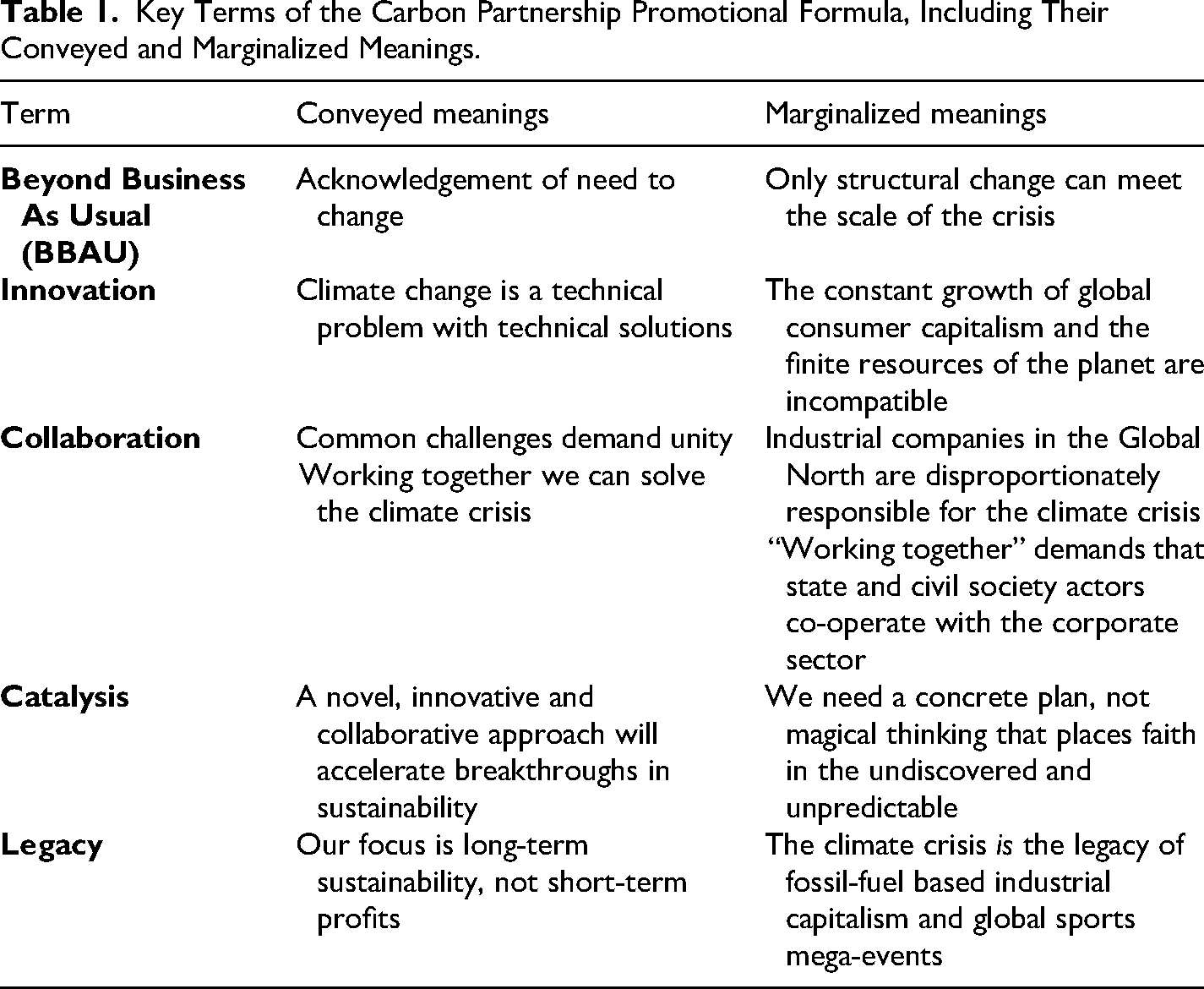
This formula—an adaptable master-narrative for the Carbon Partnership—is reproduced across company reports, social media, leaders’ speeches, and even the online biographies of key staff. The cultural and political function of this master-narrative recasts how global business presents itself in relation to the climate crisis. Once seen as environmental villains, profit-driven industrial giants like Dow are reimagined as heroes of sustainability. This effort is based around three novel discursive shifts. First, while previously ignored or offered only faint lip service, the reality and scale of the climate crisis is now clearly acknowledged. The professed recognition of the scale of the crisis and the need to move BBAU contributes to Dow's perceived ethos. Second, the need for a fundamentally new approach to the environment by business and industry is conceded. Third, the solution offered is that multinational corporations will enter “collaborative” partnerships with the likes of the IOC to usher in a new era of harmonious reconciliation between technology, nature and society. Table 1 outlines the five major elements of the Partnership's promotional formula, including their conveyed and marginalized meanings. Subsequently, each term is analyzed in depth.
Key Terms of the Carbon Partnership Promotional Formula, Including Their Conveyed and Marginalized Meanings.
Beyond Business-as-Usual
BBAU is “revolutionary” in the way it neatly aligns the needs of Dow and the Olympics while appealing to public sentiment. It is a significant shift in corporate environmental communication strategy because it implies acknowledgement that business-as-usual is no way to proceed. Thus, Dow and the Olympics recognize the reality of climate crisis and the severity of its effects. Previously, corporations devoted vast resources to publicly minimizing the importance of environmental issues and downplaying the need for action (Beder, 2011). In the collaborative eco-capitalist imaginary, the problem is acknowledged but instead treated as an opportunity. At the same time, alternative solutions to this problem are sidelined, including government regulation, small-scale production or fundamental social change.
The CEO of Dow, Jim Fitterling, asserts that Dow is “redefining the role of business in society” by striving to go BBAU: Just as the Olympic Games challenges athletes to go beyond what they thought was possible, our partnership with the IOC has inspired us to push beyond business-as-usual. (Fitterling, 2020)
The collaboration with the IOC is positioned as novel and inspiring. As previously explained, BBAU is a technical term in carbon offsetting. But it is exploited in the campaign to highlight the novelty of the Carbon Partnership and draws directly and indirectly on sporting metaphors. Cognate terms such as “game-changing,” “transformational,” “unprecedented,” and “breakthrough” appear frequently. Significantly, a sustainable future is only realizable through the types of capabilities made possible by the Partnership and their focus on “state of the art” technology and science. Fitterling states: … the IOC is providing the global sports platform that helps raise visibility. As a result, these projects go well beyond balancing the IOC's operational carbon footprint. They also accelerate the adoption of state-of-the-art technologies. Technologies that are delivering verifiable and long-lasting carbon reductions. Achievements like this demonstrate that a sustainable future is attainable, but only if we keep working together on science-based, and technology-based solutions. (Fitterling, 2020)
The revolutionary dimensions of the Carbon Partnership narrative are aimed at convincing greenwashing-weary publics that a new approach to climate change will deliver lasting change. In the words of Max Boykoff (2019), it is merely another “quixotic silver bullet” that aspires to “fix” the complex problem of climate change (p. 215). But, as with all such approaches, it falls short of the multidimensional scientific, economic, experiential, emotional and esthetic approaches required to achieve progress towards meaningful climate change communication and action (Boykoff, 2019).
Innovation
Dow organises its sustainability focus around innovation, partnering with suppliers, communities, civil society and governments for change, providing smart solutions while ensuring its infrastructure has a positive impact and its operations are a model for others. (IOC, 2012, p. 83)
The Carbon Partnership's formula takes advantage of—and recodes—Dow's long-established corporate identity and its association with the quasi-magical power of innovation. A term used repeatedly throughout promotional materials, Dow is a shining example of that peculiarly “American” knack for innovation with a pantheon stretching back even to the Founding Fathers—those innovators of republican democracy—through Benjamin Franklin, Thomas Edison, Bill Gates, Steve Jobs, Mark Zuckerberg, Elon Musk, and so on. Innovation in addressing the climate crisis evokes progress, which sits at the “centre of an incredibly powerful semantic constellation” (Esteva, 1992, p. 8). The romantic and commendatory overtones of innovation (Olsen, in Godin, 2015, p. 212) complement the mythical appeal and transcendent qualities of the Olympic motto (citius, altius, fortius; faster, higher, stronger) and the Fundamental Principles of Olympism (Carrington, 2004). Sparkling with the promise of capitalist modernity, the invocation of innovation in the Carbon Partnerhip borrows from an “imaginary of progress” that is achievable through collaborative scientific and technical innovation (Jasanoff, 2015b, p. 328). Innovation in this case enjoys almost exclusively positive connotations (Segercrantz et al., 2017). It ignores the incompatibility of constant economic growth through innovation with the need to quickly and substantially reduce carbon emissions to address climate change (Lewis, 2013).
Collaboration
To implement carbon mitigation projects, Dow teams work on the ground to start new dialogues, exchange knowledge and collaborate with industry leaders within a region to introduce low-carbon technologies and educate stakeholders. (Dow, 2020)
In the collaborative eco-capitalist imaginary, commercial and contractual relationships are relabeled as examples of universal co-operation in the face of environmental challenges. Dow is a profit-driven public company that seeks to increase shareholder value by increasing revenue streams and driving down costs. It renarrates this commercial orthodoxy as “collaboration,” altruistic “engagement” with “partners,” and “sharing” knowledge and technology, thereby affording its sales and marketing programs a higher purpose. Indeed, the campaign only occasionally uses sales and marketing language, preferring to communicate how its teams “start new dialogues, exchange knowledge and collaborate with industry leaders” to “educate stakeholders” (Dow, 2020, p. 22).
Dow's collaborative rhetoric and the Principles of Olympism function to reinforce and extend each other, especially given the IOC's official commitment to social responsibility, friendship, and mutual understanding through sport (IOC, 2019). Dow's communicative resources benefit from the IOC's promotion of Olympism as a universal inspiration for co-operation among humankind and a salve for ideological, socioeconomic, and political tensions (see Pound, 1993; Rogge, 2007). Dow's motivations are similarly cast as an effort to share solutions to the existential threat of climate change with the world: Just as we all share the consequences of climate change, we believe that it is crucial for us to share the knowledge, learnings and best practices in working together on developing and leading carbon-reduction programs. (Dow, 2020)
This rhetoric of co-operation and collaboration is arguably less about unity and sharing and more about enabling commercial transactions and market expansion, all the while de-emphasizing suggestions that government intervention and/or industry regulation might be solutions to the climate crisis. Local communities, national science foundations/organizations, NGOs, publics and academia are not mentioned as potential partners in any of Dow's collaborations. Similarly, the ideals of harmonious development and solidarity promised by the Olympics conspicuously ignore the negative impacts of the large-scale construction, securitization and militarization programs that make the Games possible. As Olympiad after Olympiad has shown, the damage caused by these programs is felt and experienced in local communities, civic society, democratic systems, and the environment (Boykoff, 2014, 2020; Miller, 2018).
Catalysis
By combining the power of sport and science, Dow, with its carbon partners, is catalyzing action on climate change. (Dow, 2020)
It is fitting that a giant chemical corporation—or, as Dow prefers to describe itself, a material science company (see Fitterling, 2019)—employs the metaphor of catalysis. Literally the acceleration of a chemical reaction, catalysis connotes exciting and unpredictable results. It is the source of the “unprecedented” changes promised by Dow and the IOC's “game-changing” Carbon Partnership. Notably, the IOC justified its existence in “catalytic” terms even prior to the Dow partnership. Sport “must play the role of catalyst in our society” and its “crucial social impact” must be supported, according to former IOC President Jacques Rogge (IOC, 2004).
In chemistry, catalysts are potentially hazardous substances and processes (Carson & Mumford, 2002, p. 150). In corporate environmentalist discourse, by contrast, catalysis appears a univocally positive phenomenon. Ernesto Laclau (1996) defines an empty signifier as one that is tendentially hollowed out, rather than one that has no literal meaning at all. In the case of Carbon Partnership between Dow and the Olympics, this lack of content is a strength that serves crucial discursive functions. Mix sport, science, collaboration, and innovation in order to catalyze sustainability. This promotional alchemy fuses collaboration with the “adoption of low-carbon technologies” or “climate action” or “progress” or “energy efficiency” or “sustainable development” or “emissions reductions” or “long-term changes in market practices” (Dow, 2016a). Attention is drawn to the legacy of these activities.
Catalysis asks the audience to focus not on the present situation, but the sustainable future that is being inspired and promoted by Dow and the IOC. Momentum toward this future is constantly reinforced yet driven by vague actions and unspecified targets. Constituted as a trajectory or structure of feeling infused by the language of scientific innovation, this undefined causality is the bridge between the acknowledged climate crisis of the present and the ecological sustainability that only collaborative innovation can deliver in the future (cf. Williams, 1961).
Legacy
Legacy is the capstone that brings together the previous four elements and assures the public that the IOC and Dow are part of the solution to climate change. The prominence and use of legacy in the Dow-IOC discourse is inspired by its significant position in Olympic discourse, standing for transformations with both symbolic and tangible outcomes (Preuss, 2007). Legacy was introduced into the IOC Charter in 1999 and was the theme of an IOC Symposium in 2002 (IOC, 2002). It is also an area in which IOC officials continue to demonstrate an acute sensitivity to criticism (Owen, 2020). Based on extensive ethnography among IOC officials, anthropologist and historian John MacAloon describes the “magical properties of today's highly fetishized legacy talk in Olympic circles” (MacAloon, 2008, p. 2061). The term's rapidly attained hegemony unites the disparate factions, functions and nations of the Olympic community behind an overarching focus on the Games’ claimed contributions to cities, nations, and the world, and the positive benefits they leave behind for anyone who hosts and experiences them.
Legacy signifies the long-term benefits of the Olympics that putatively balance the short-term costs of hosting the Games, including their environmental impacts. Discussing the Carbon Partnership, IOC President Thomas Bach declares that “the goal has long evolved beyond balancing an event's direct carbon footprint to enabling a positive and lasting legacy in the journey towards a more sustainable future” (Dow Chemical, 2018, p. 7). The legacy at stake in the Carbon Partnership is both reputational and business oriented. Both Dow and the IOC want to bolster their sustainability credentials while growing business opportunities and the visibility of their respective products. This requires matching the Olympic Movement's fixation on legacy with Dow's determination to create “a positive low-carbon legacy globally” (Dow, 2020, p. 13). Placed in the context of the collaborative eco-capitalist imaginary, legacy helps to “offset” the troubling realities of carbon-intensive global capitalism and replaces them with a longed-for Edenic future.
Conclusion: Elective Affinities and Collaborative Greenwashing
Dow and the IOC are not alone in promoting the social imaginary of collaborative eco-capitalism. The United Nations Global Compact, a self-described “business-led multi-stakeholder coalition,” speaks a similar language of collaboration, catalysis, and innovation. Their mission statement claims that “[by] catalyzing action, partnerships and collaboration, we make transforming the world possible—and achievable—for organizations large and small, anywhere around the globe” (Our Mission | UN Global Compact, n.d.). Elsewhere they state, “Responsible business practices, combined with collaboration and innovation, can bring about powerful change in markets and societies—proving that principles and profits go hand in hand” (Why Join | UN Global Compact, n.d.). In its Green Growth manifesto, the OECD similarly describes partnerships as “catalysers of market opportunities” (OECD, 2011, p. 97). The World Business Council for Sustainable Development's (WBCSD) report, Vision 2050: Time to Transform, continues this trend by promoting opportunities for “multi-stakeholder collaboration” involving businesses, governments, cities, civil society organizations, community groups, and international institutions (WBCSD, 2021).
The role of the Olympics in the construction of this collaborative eco-capitalist imaginary is linked to its niche in the field of global corporate sponsorship, sport, and consumer culture (Smart, 2018). Our analysis supports the claim of Close et al. that contemporary Olympism and market capitalism enjoy a “general, all-encompassing elective affinity” (Close et al., 2006, p. 82). The Olympic Movement and the interests of social elites at all levels converge with the “ideals and tendencies of modern market capitalism” (2006, p. 82). Social and political elites, whether from aristocratic or capitalistic systems, commingle in Olympic circles (Kayne, 2020). Moreover, collaboration between major corporations, media and the Games has “catalyzed” the super-sized growth and commodification of the Games as a spectacle over the past 35 years (Billings et al., 2017; Sugden & Tomlinson, 2011).
While Dow and the IOC are vastly different organizations, they face the same legitimacy challenges posed by climate change due to the carbon-intensive nature of their operations and global footprints. Both seek to present themselves as ecologically attuned despite questionable carbon offsetting projects. Both focus on a positive future, rather than the troubling present and their complicity in the climate crisis. Both employ the same inclusive, socially progressive rhetoric that characterizes corporate-speak which is, at once, hollowed out and adaptable. Both organizations seek to depoliticize environmental problems by defining the problem in technocratic terms and the solutions as ready-made: science and technology, collaboration and innovation. At the microlevel, social imaginaries prestructure how the world is perceived. To operate, they must speak a certain “truth”—corporations are indeed changing, very slowly. But their ideological effect is to disproportionately foreground this one aspect so that it defines their very being.
The end game for Dow and the IOC, we argue, is to do what is described: “redefine the role of business in society” at a time when the challenges of climate change are producing altered normative horizons for social action, politics, and business (Beck, 2016). Mobilized through the terms BBAU, innovation, collaboration, catalysis, and legacy, this redefinition underpins the most urgent contribution of the Carbon Partnership—to legitimate their combined efforts as a serious and long-term response to climate change. It is not the purpose of this article to take issue with the fundamental compatibility (Gammerlsaeter and Loland, 2023) or otherwise (VanWynsberghe et al., 2021, p. 13) of global mega-events and environmental sustainability. Rather, it is to demonstrate how corporate environmentalism requires new tools to analyze and critique.
Defined by its scale and global promotion, the Carbon Partnership critiqued in this article is not only a novel development in corporation reputation management, but a demonstration of how global corporations continue to function as ideological nodes for the system that sustains them—despite the system's long-term unsustainability. By adopting a collaborative program, borrowing the noncorporate actor's values and goodwill and promoting a broader collaborative eco-capitalist imaginary, the role of business can be “redefined”—without challenging core business. It is a stark warning of how global corporate and media actors are positioning themselves to financially survive and thrive on an unstable planet characterized by mass species extinctions, extreme weather events and rising temperatures. What is truly BBAU in this Partnership is not the vaunted corporate ecological awakening it promises, but the redefinition of corporate interest as general interest.
Footnotes
Declaration of Conflicting Interests
The authors declared no potential conflicts of interest with respect to the research, authorship, and/or publication of this article.
Funding
The authors disclosed receipt of the following financial support for the research, authorship, and/or publication of this article: Research and analysis informing this article was supported by the Australian Research Council Discovery program (Project ID: DP200103360).
