




Abstract
There is no shortage of sociological research that explores the successes and failures of various sport-related social movements. However, a more capacious approach to understanding the significance of sport-related social movements, their imaginative actions and collective labor, and their impacts on social change, is one that shifts its focus away from binary categories of “success” and “failure”. In this paper, we explore the formation of the short-lived Edmonton Community Benefits Coalition, which emerged in 2016 to oppose the lack of a legally binding Community Benefits Agreement associated with a new publicly financed National Hockey League arena in Edmonton’s gentrifying city center, an area of spatially concentrated racialized poverty. Drawing from our ethnographic research, we examine how coalition members engaged in the collective labor of building solidarity, including the collaborative development of political strategies, while recognizing that the odds of successfully penetrating neoliberal capital and municipal governance were virtually impossible. Finally, given that the coalition ultimately “failed” to secure more significant institutional impacts, we offer an analysis of how this failure engendered several effects, including the cultivation of new relationships and political strategies in the ongoing struggle against gentrification and its related displacements in Edmonton, Alberta.
Introduction
In early September 2016, Rogers Place officially opened in Edmonton, Alberta. The state-of-the-art, city-owned hockey arena was publicly financed for a total of $613.7 million. The construction of Rogers Place was intended both to secure the long-term financial stability and profitability of the National Hockey League’s (NHL) Edmonton Oilers and to revitalize Edmonton’s city center, 2 an area of spatially concentrated racialized poverty. The signing of the arena deal in 2013 was the culmination of one of the most acrimonious municipal debates in decades. In the end, the citizens of Edmonton will heavily subsidize the team’s billionaire owner, Daryl Katz, one of the richest men in Canada, for a total of 35 years as he continues to reap private profit at the public’s expense. There are many controversial agreements in this arena development deal (Scherer, Mills & McCulloch, 2019). In this paper, we focus on one of them: the lack of an extensive, collaboratively developed, and legally binding Community Benefits Agreement (CBA).
A “relatively recent addition to the lexicon of urban development” (deMause & Cagan, 2008, p. 286), CBAs have become increasingly common elements of arena and stadium development projects, especially in the United States. 3 CBAs are legally enforceable, stand-alone contracts pertaining to a specific urban development project that are often negotiated by community groups and private developers, although they regularly include municipalities as signatories as part of the broader project collectivity. They are intended to provide redistributive benefits and/or mitigations in exchange for community support of, or non-opposition to, an urban development project (Gross, 2007/2008), and are generally pro-actively negotiated by community groups prior to development occurring—when they have leverage to bargain for investments in their neighborhoods.
CBAs are not intended to prevent the revalorization of land altogether, but to ensure that pre-existing residents, institutions, and businesses play an ongoing role in the transformation of their communities, while also benefiting from the development along with developers. Crucially, they are also designed to minimize the displacement of existing residents and businesses because of the potential loss of housing and gentrification/increases in land values and include various “behavioral promises” by the developer, including reducing traffic nuisances during construction. They also include the provision of “spatial benefits” like public facilities and community centers, parks, and affordable housing, and “non-spatial benefits,” such as opportunities for local residents through hiring programs with living wage-jobs, job training, and education programs/study funds. CBAs can be actively adjusted if they include mechanisms for evaluation and accountability for both community groups and the developer(s).
In what follows, we detail the efforts of the Edmonton Community Benefits Coalition (ECBC), a small group of activists, to (ultimately unsuccessfully) ameliorate the lack of a legally binding CBA associated with the development of Rogers Place in Edmonton’s city center. In doing so, we explore the establishment and political actions of the quickly formed and short-lived coalition as a living, spontaneous, and creative entity of collective labor and imagination. Drawing from our ethnographic research, 4 we detail the group’s tactics, processes, and strategies, while considering a series of related questions. What were the conditions and sets of relations that allowed the ECBC to form quickly in only a matter of weeks? How did coalition members engage in the collective labor of building solidarity between different actors? How did coalition members develop and hone their political strategies and arguments, recognizing that the chances of successfully penetrating neoliberal capital and municipal governance were slim to none?
Finally, and perhaps most crucially, if the ECBC “failed” in its efforts to secure more significant institutional impacts and measurable political outcomes, what other effects, including potential creative and emancipatory/egalitarian ones, were produced? How, in other words, might this “failure” be understood as productive? In what follows, we’ll explore these interrelated issues through the work and research of the ECBC as its members sought to collaboratively develop tactics and strategies to publicly oppose the lack of a legally binding CBA and the inadequacies of a Local Advisory Committee (LAC). These efforts also attempted to resist the gentrification of the city center as part of the continuation of a much broader historical corporate-civic agenda set on perpetrating a new round of racialized displacement in a city defined by a history of serial dispossession. 5
Talking Back
On Tuesday, August 23, 2016, just over two weeks before the grand opening of Rogers Place, three members of the newly formed ECBC appeared at City Hall in Edmonton, Alberta. The ECBC members used their appearance to protest the lack of a legally binding CBA associated with the building of Rogers Place. On that day in August, city council was scheduled to review and approve the “Good Neighbour Program,” developed in concert with the work of the arena’s LAC. The LAC’s membership consisted of city-appointed members, Oilers executives, community league presidents, and several non-profit agency representatives. Alongside the existing, ersatz non-binding Edmonton Arena CBA—a single-page document contained within the broader master agreement between the City of Edmonton and the Katz Group—this program and committee were symbolic signals to citizens that the Oilers franchise was, indeed, intending to be a good neighbor in the city-center community, and that the new arena and its surrounding entertainment district (Ice District, developed by the Katz Group) would benefit the “community as a whole.” But the entire city-center community was not set to benefit from the opening of Rogers Place and the development of Ice District. For instance, only weeks earlier, on August 1, the residents of the MacDonald Lofts had been informed by the building’s property manager that rents were set to increase substantially. MacDonald Lofts was a subsidized apartment complex sheltering some of those who are most ill-served by the housing system in central Edmonton. The heritage-protected building was located kitty corner to the new arena, and both residents and housing workers were concerned that this development foreshadowed mass evictions.
In their address to council, the ECBC members noted that the existing CBA associated with Rogers Place provided city-center residents with few tangible and measurable benefits, 6 while the meetings of the city-controlled LAC were largely deployed as opportunities for city staff and Oilers executives to provide brief updates on construction and parking issues, and to promote uncritical nostrums about downtown revitalization. The coalition members explained that the city and the Oilers representatives on the LAC were uninterested in addressing the local community representatives’ more substantive questions about more tangible civic benefits, such as the provision of affordable housing and a commitment that jobs at Rogers Place would pay a living wage, amongst others. In addition, they drew council’s attention to the broader concerns LAC members had raised—about gentrification, racialized displacement, and heightened policing in Edmonton’s city center—noting that these pressing issues were being excluded from the official minutes of those meetings. In voicing their concerns, ECBC members succeeded in drawing some public attention to various issues with the Edmonton Arena CBA and its associated LAC. Concomitantly, it also disrupted the narrative of municipal harmony that both the City of Edmonton and the Katz Group had intended to promote in advance of the opening of Rogers Place.
In a small incremental victory, council voted to send the issue to Executive Committee the following Tuesday to allow further commentary from citizens. 7 And, a week later, over ten members of the ECBC—Indigenous and settler activists, artists, scholars, newcomers, non-profit workers, local union representatives, and city-center residents, including someone living in the MacDonald Lofts building—joined in resisting the lack of a legally binding CBA and to the gentrification of the city center by appearing before Executive Committee. Their supporters and other coalition members filled many of the seats in the large public meeting room. City staff were also invited to rebut these concerns. Executives from the Oilers did not participate in the proceedings and refused to comment on the issues in subsequent media coverage. Those in attendance were permitted to address the membership of the city’s Executive Committee, chaired by Mayor Don Iveson, for approximately 3–5 min each, after which members of Executive Committee were invited to pose their own questions and comments to their interlocutors. Together, ECBC members condemned the existing Edmonton Arena CBA, while also critiquing the structure of the LAC. They also sharply criticized the City of Edmonton’s decision to subsidize the billionaire owner of the Oilers while other more pressing needs for city-center residents had gone unaddressed for decades, especially for houseless people, who in Edmonton, as in other Western Canadian cities, are disproportionately Indigenous.
While the discussions that day were productive, several of the councilors on Executive Committee and the mayor himself had voted in favor of the final master agreement between the City of Edmonton and the Oilers; the master agreement was signed in 2013 after a series of controversial negotiations conducted behind closed doors, and it included the weak Edmonton Arena CBA. Many of these elected officials were predictably defensive and dismissive in their responses to the concerns of their constituents and recognized that they possessed no leverage whatsoever to reopen the master agreement with the Oilers to alter the terms of the CBA. Nor was there any political appetite to revisit the divisive arena debate, especially just a few weeks prior to the ceremonial opening of Rogers Place. ECBC members had anticipated these developments, and rather than making a host of unreasonable demands—a tactic that would have damaged the coalition’s credibility—coalition speakers made two requests: that the LAC’s terms of reference be revised, and that the City of Edmonton negotiate with the Katz Group for the provision of a living wage for all jobs at Rogers Place, a city-owned facility. By the end of the meeting, the ECBC had managed to secure only the former modest outcome; Executive Committee instructed the LAC to revise its terms of reference at its next meeting on November 14, 2016 (Bellefontaine, 2016).
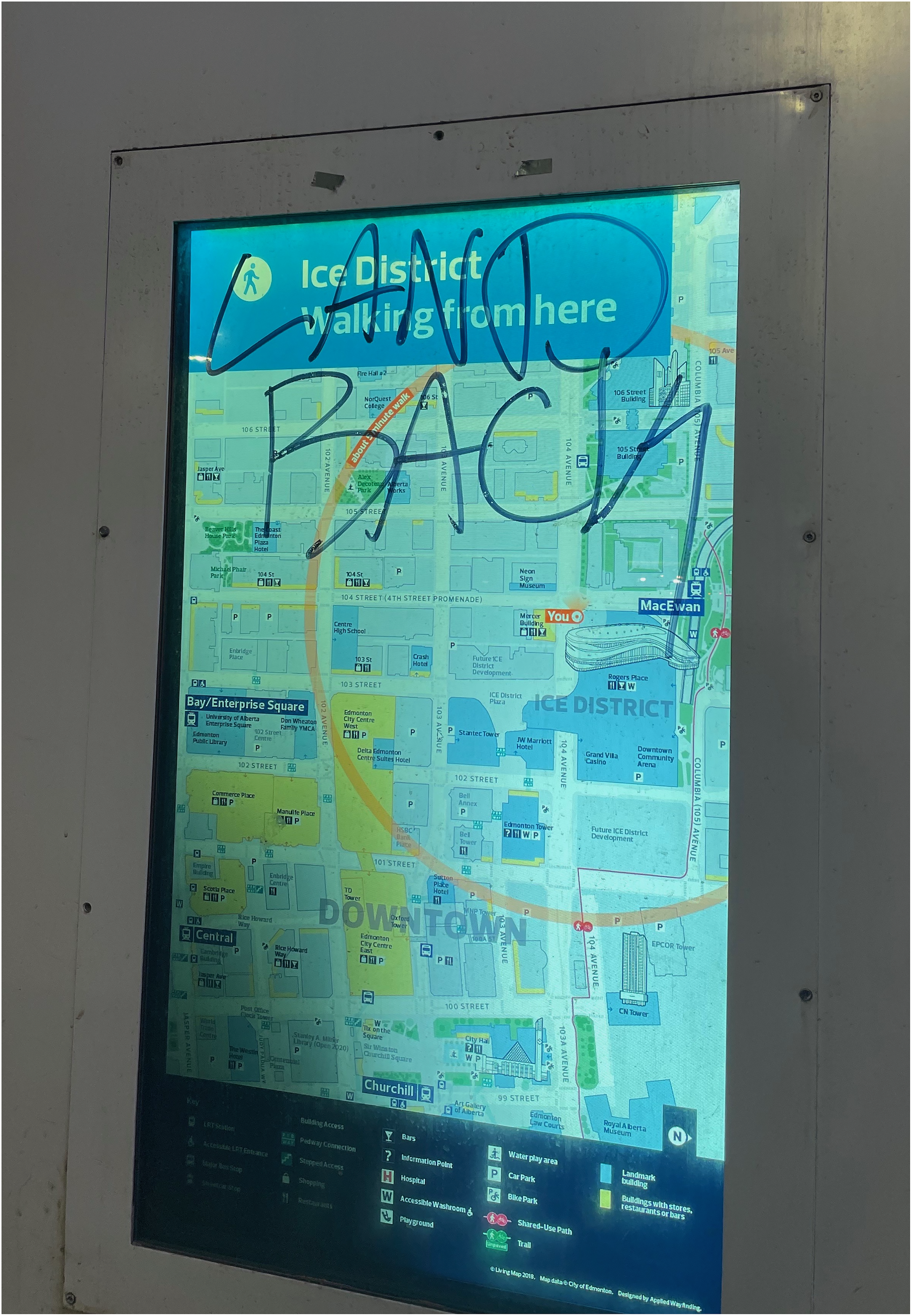
Map of Ice District (Land Back).
Scholarly Context
Scholars have recently explored the successes and failures of various sport-related social movements that have opposed sport mega-events like the Olympic Games (Boykoff, 2013; 2020; Dempsey & Zimbalist, 2017; Giulianotti, Armstrong, Hales & Hobbs, 2015; Harvey, Horne, Safai, Darnell & Courchense-O’Neill, 2013; Lenskyj, 2008), and, to a lesser extent, the successes and failures of grassroots groups that have formed to oppose the use of public funds to build facilities for major-league sport franchises (Scherer, 2016; Silver, 1996; Saito, 2012). Most of this research focuses on temporally defined political issues and on measurable outcomes (both positive and negative) akin to the ones the ECBC was seeking (e.g., institutional impact at City Hall). However, even when striving to act in solidarity with sport-related social movements, it rarely attends to the “multiple effects produced by movements that are non-institutional and non-instrumental in nature” (Haiven & Khasnabish, 2013, p. 479). As Haiven and Khasnabish (2013, p. 479) have noted, Attending to these movements as effects of the relations that constitute them leads the critical analytical eye away from their most ossified, obvious remnants like policy change or electoral impacts, and instead foregrounds struggle as a product of collective encounters between activists, organizers, allies, opponents, and the broader public.
In following this approach, sport-related social resistances can be engaged as living entities and spaces of “encounter, possibility, contestation, and conflict” (ibid), while other definitions of success—the cultivation of new relationships, new subjectivities, and new-found dignity—can be explored, amplified, and highlighted.
An alternative, more capacious way of understanding the significance of sport-related social movements, their imaginative actions and collective labor, and their impacts on social change, is one that shifts its focus away from binary categories of “success” and “failure.” Along these lines and drawing from Jack Halberstam’s The queer art of failure (2011), Haiven and Khasnabish (2013) have invited social movement scholars to reimagine definitions of “success” and “failure,” especially when “success” is almost always defined within the terms of dominant structures and institutions and in relation to normative values. Indeed, they invite us to consider whether “failure” can be a liberatory and productive practice. Organized collective actions “typically dwell in the ‘hiatus’ between ‘not-success’ and ‘not-failure’” (Haiven & Khasnabish, 2013, p. 473). These interluding moments are recurrently at the heart of most social movement energies, a space of productive tension, where radical imaginations are fired and multiple movements and solidarities come together and overlap.
Early Days and Formation
The roots of the ECBC date back to an initial conversation on July 11, 2016, between Stacy, 8 an activist and resident of Central McDougall, a lower-income and ethnically diverse community located immediately to the north of Rogers Place; Robert and Dave, two longstanding, well-known staff members of a nearby city-center non-profit organization; and Jay. The meeting had been organized after an earlier conversation between Stacy and Rylan about the arena development and its uneven impacts. Stacy was concerned about the lack of genuine consultation by the City of Edmonton and the Oilers with the residents of surrounding communities, and she wanted to do something about it. These pre-existing relationships—between activists, non-profit workers, scholars, and community members—would be at the heart of the formation of the ECBC.
During the meeting, Stacy underscored the insurmountable struggles faced by a group of residents in Central McDougall in their attempts to secure modest resources from the City of Edmonton (Fieldnotes, July 11, 2016). These were not lavish requests, simply small asks for various community amenities, including practical needs like a storage unit for recreation equipment. For many residents of Central McDougall, the ease with which the City of Edmonton had dedicated hundreds of millions of dollars to build a new hockey arena to subsidize the business interests of the Edmonton Oilers was a sharp and painful reminder of how little the community’s needs mattered to those in power, bluntly illustrating the inherent inequalities of the neoliberal city. These sentiments resonated with Robert and Dave; as they noted, the City of Edmonton’s commitment to end homelessness in a decade 9 —a commitment made in 2009—was faltering thanks to insufficient resources and a lack of political will at all levels of government. They also underlined that the targeting of the city center and its surrounding communities for gentrification had been stressful and polarizing in other ways for many residents (Fieldnotes, July 11, 2016). Houseless people, for example, feared that social services agencies would be forced to move, that familiar spaces and safe hubs would vanish, and that they would have to leave their communities. For those of us in conversation on that day, an obvious question remained: How could city-center residents influence the ongoing development of their communities in the face of an impending wave of gentrification that was being actively encouraged by both the City of Edmonton and the Katz Group?
Stacy’s decision to contact Rylan was propitious. Since May 2015, he had been attending the quarterly meetings of the LAC associated with the arena development as a representative of two non-profit agencies; Dave had also attended those meetings, too, on behalf of his non-profit employer. As Rylan and Dave had both observed, the lavishly catered meetings of the LAC were controlled by high-ranking employees from the City of Edmonton who had determined the committee’s membership and its terms of reference, the latter in conjunction with the Oilers. And, while the LAC’s membership reflected a diverse range of city-center organizations—non-profits, community leagues, and various business associations, as well as executives from the Oilers—meetings were not open to members of the public.
Perhaps most importantly, though, the LAC’s remit was purely an advisory one; its diverse membership thus had little power to influence proceedings, which were little more than a series of top-down information-sharing sessions during which the City of Edmonton and the Oilers informed attendees of the changes that were already underway in their communities. They were merely consulting community “stakeholders,” by now a vacuous trope of neoliberal decision making. For example, executives from the City of Edmonton and the Oilers provided updates on security, parking, construction, and possible benefits such as limited job opportunities and the availability of public ice-skating times at the community rink attached to Rogers Place. However, other types of more challenging questions and conversations that had been raised by committee members—about securing a commitment for a living wage for jobs at Rogers Place, affordable housing initiatives, and how to help racialized and less affluent city-center communities address the negative impacts associated with the new arena development—were downplayed by executives from the city and the Oilers.
Indeed, the two-hour LAC meetings were structured by civic officials to leave little time to discuss other questions and issues raised by committee members: these issues were then tabled to be addressed at the following meeting. And, at the next meeting, this pattern would be repeated. The minutes of the meetings also failed to document the repeated raising of these important concerns, and the repeated thwarting of meaningful conversations about them. Moreover, since the LAC’s inception, none of its minutes had been made public despite a stated commitment by the City of Edmonton to do so. All these issues were confirmed by Rylan and Dave and several of their co-workers in the non-profit sector who had served on the LAC. Several of their colleagues had become so despondent and cynical about the committee’s proceedings that they had simply stopped attending the meetings; likewise, many representatives of city-center community leagues were perplexed about the LAC’s operations and mandate. This is a reminder, as Sara Ahmed (2012) has persuasively argued, that institutional commitments to inclusion and diversity are often symbolic and do little to challenge or alter unequal power relations, especially in relation to institutional whiteness and the protection of property and capital. The City of Edmonton and the Edmonton Oilers both reap multiple benefits and privileges from these interlocking systems, and they were invested in maximizing their profits.
Frustrations with the LAC process initiated another early discussion that proved both energizing and productive for all. It was agreed that a larger meeting needed to be held to discuss how residents could potentially mobilize in response to these issues. Crucially, Stacy, Rylan, and Robert were well connected with other city-center community groups, including other activists, and began to approach their contacts to gauge whether there was an appetite for a broader series of discussions over these issues. 10 Rylan was also set to start a PhD at the University of Alberta with Jay and Judy; they had received a grant to explore the uneven impacts of the arena development on city-center communities and had recently hired Rylan to work on it. This connection was another way that the diverse membership of the ECBC was developed. They received supportive responses and subsequently organized a public meeting to take place a few weeks later at MacEwan University, located immediately to the west of Rogers Place. The event was promoted widely on Facebook and other social media.
On the evening of August 3, 2016, a group of nearly 40 people met at MacEwan University to talk about the impacts of the arena development on city-center communities and the possibility of forming a grassroots coalition. Jay gave a presentation about the history of the arena deal, while an Executive Director (ED) of a city-center non-profit organization spoke about the deficiencies of the existing Edmonton Arena CBA and the unwillingness of the City of Edmonton to pursue a more inclusive, far-reaching, and legally binding agreement. As this ED noted, over the course of the arena debate between 2011 and 2013, he and other leaders of city-center non-profit organizations had encouraged individual councilors and senior administrators to develop a more traditional and stringent quid pro quo agreement with the Katz Group (Fieldnotes, August 3, 2016). This would have ensured a more equitable distribution of benefits for city-center residents, especially given the amount of public funds that were being proposed to be dedicated to the new arena. However, while their arguments and advocacy work found currency with a small number of councilors, their efforts were ultimately ignored by municipal administrators, who were themselves engaged in closed-door negotiations with the Katz Group––another trademark of urban neoliberal governance.
As the ED underlined, moreover, the City of Edmonton had spent hundreds of thousands of dollars on the production of various arena-related reports (primarily focussing on economic and financial issues) and legal assessments (Fieldnotes, August 3, 2016). Notably, the City of Edmonton had not commissioned a single social-impact assessment or seriously considered the human costs associated with the arena development and ensuing gentrification downtown. As we shall see, this failure was not necessarily surprising given historical precedents. This information was of particular concern to all of those in attendance that evening, especially to several artists who had already been evicted from their city-center studio spaces and to several residents of the nearby MacDonald Lofts who had come to the meeting. In summing up, the ED paraphrased a response that he had overheard a senior municipal politician make when asked by someone about what would happen to the social service agency after the new arena was built: “Oh, don’t worry about them, they’ll disappear.” 11
At the strategic behest of this ED, the non-profit organization had, in fact, recently purchased its current building. This was only possible thanks to the generosity of the building’s former owner, who had been offered a greater amount of money from other well-known developers who aspired to redevelop the land. However, the former owner had been sympathetic to the work and aspirations of the non-profit organization and had ultimately agreed to a lower sale price, allowing the executive director to secure an affordable mortgage and purchase the building (the agency had operated from the building since 1995). This was especially important because the non-profit organization was set to face higher municipal property tax bills thanks to the anticipated increase in land values around Rogers Place. Had he been unable to complete this purchase at an affordable price, the non-profit organization would likely have been forced to relocate along with the largely urban Indigenous community it serves. This latter point was of salience for another person in attendance who identified as an Indigenous knowledge-giver and who worked at the same non-profit organization; he argued that the arena development and the broader gentrification of the city center represented nothing more than the current iteration of the historical cycle of Indigenous dispossession (Fieldnotes, August 3, 2016). Erasure is one of the hallmark priorities of the structure of settler colonialism, 12 and it here takes its form both materially (attempting to force agency relocations due to increased costs) and symbolically (politicians asserting that urban Indigenous people will also just disappear from the city center, along with the non-profit agencies that serve them).
By the end of the open-house meeting, then, there was a tangible level of enthusiasm to continue with a public-education process about these interrelated issues and to form a coalition to advocate for a more inclusive series of discussions with the City of Edmonton and the Oilers around community benefits over the duration of the 35-year agreement between both parties. A list of contacts with email addresses was created, and those in attendance were asked to indicate if they wanted to be part of the coalition’s democratic working group, which would meet regularly in the weeks to come and would relay information to, and seek feedback from, the broader coalition via social media and public open houses. By the end of the evening, the ECBC had been formed, a reminder that movements can form and mobilize quickly, have overlapping membership, and are cross-cut by a social commons constituted by relationships and individuals, sometimes colleagues, sometimes neighbours, sometimes lovers, sometimes rivals. Radical social movements, then, are both the products and the producers of culture at the crossroads of not-success and not-failure, an ecology of persistence. (Haiven & Khasnabish, 2013, p. 488)
As we outline in our conclusion, a line of persistence follows from the emergence of the ECBC to other actions in later years supporting the city-center community in Edmonton.
Relationality, Encounter, Dialogue
The membership of the working group was always fluid, and a revolving group of people attended the first series of meetings: city-center residents, scholars, students, Indigenous and settler activists, and non-profit workers, many of whom were familiar with each other. The first meeting of the working group took place at a city-center restaurant on the evening of August 12, 2016, with eight ECBC members in attendance. 13 Working group members committed to a collaborative discussion process that sought to generate consensus on the issues the coalition would focus on and the strategies and tactics the coalition would develop. ECBC working group members quickly concentrated their concerns on the uneven impacts associated with the arena development on pre-existing residents, especially in light of the impending rent increase and possible eviction of the tenants of the MacDonald Lofts building (Fieldnotes, August 12, 2016).
The first two authors brought a set of skills and knowledges to the working group. We were able to provide a review of the history of earlier debates over the construction of new, publicly funded sports facilities for major-league sports franchises in Edmonton, discussing the actions and tactics of groups that had organized to oppose these developments. In 1970, for example, against the backdrop of a divisive debate that culminated in a plebiscite, citizens voted against a proposal for the city to borrow money to begin construction of the Omniplex development in downtown Edmonton, a massive structure that would have included a football field, arena, and convention center (Cobb, 2015). However, just a few years later, after funding had been secured from other levels of government for Edmonton to host the 1978 Commonwealth Games, the publicly funded Northlands Coliseum, home to the Edmonton Oilers, opened in 1974, just 5km northeast of Rogers Place. Commonwealth Stadium, which would become the new home of the Edmonton Football Club of the Canadian Football League, now called the Elks, opened four years later, in 1978.
There had been substantive opposition to the cost of the Commonwealth Games, but its boosters had heeded important political lessons following the failed plebiscite over the Omniplex development. They mounted a coordinated and highly organized promotional campaign that overwhelmed the efforts of an inexperienced opposition group, securing victory in a subsequent plebiscite for the city to raise its share of the cost of the Games through debentures (Chivers, 1976). Following the plebiscite, though, another grassroots opposition group, Action Edmonton, formed; on this occasion, citizens came together to oppose the proposed sites for the construction of various sports facilities. A petition signed by 1,600 people objected to the planned location of Commonwealth Stadium and the impacts the facility would have on the surrounding working class and ethnically diverse communities of Cromdale and Parkdale, in particular. 14 However, despite having commissioned two social-impact studies that were due in February 1975, council simply reconfirmed the site in January, without having reviewed the reports. Once they came in, both social-impact studies underlined a host of substantive negative effects associated with the construction of the stadium, including, according to one report, the potential loss of approximately 1,500 housing units and the displacement of 6,000 residents (Chivers, 1976).
This inauspicious history was only further reinforced for ECBC members when they reviewed the more recent efforts of Voices for Democracy (VFD), a different kind of grassroots group created in early 2011 that had formed to oppose the use of public resources to build Rogers Place. 15 In forming the group, VFD members aspired to create “a forum through which citizens could attempt to influence the [arena] debate, especially through the engagement of elected representatives” (Scherer, 2016, p. 42). VFD conducted a two-year campaign during which its members learned important lessons about mobilizing and about local politics. The group emphasised traditional strategies and mechanisms—presenting evidence at public forums, conducting telephone polls—and developed a conventional public education campaign with informative pamphlets and billboard advertisements. VFD also developed its own website and social media pages but was unable to overcome the booster narrative—that the publicly financed arena would be good for Edmonton and its downtown—being spun by the professional sports lobby, developers, and their media allies. It was also unable to surmount the arena debate’s restrictive political opportunity structure, and recent changes to the provincial Municipal Government Act made the triggering of plebiscites a challenging, even insurmountable, proposition. As a result, instead of a binding municipal plebiscite, like those that occurred in the 1970s, the final arena agreement in 2013 was simply subjected to a vote by council, dominated by arena boosters, including the arena’s main political champion, Mayor Stephen Mandel, himself a former developer.
While VFD’s membership was representative of the breadth of the conventional political spectrum, its leadership group consisted of mostly white, middle-aged, middle-class professional men (Scherer, 2016), a fact that may have worked against the group as it tried to cultivate a diversity of supporters. On the other hand, ECBC working group members were younger and came from both working- and-middle-class backgrounds; they also largely leaned to the left of the political spectrum. Still, while the ECBC working group was characterized by greater racial and ethnic diversity—greater still in the broader coalition itself—those who attended the initial meetings were predominantly white, middle-class men who possessed cultural and economic capital, especially those in academia and in the non-profit sector.
Working group members understood that the coalition needed to cultivate a broader and more diverse membership that included members of city-center communities, including houseless and Indigenous residents, as well as newcomers. Those in attendance recognized that, while formal meetings were important, they could also be intimidating forums, especially for those for whom English was a second language. They also recognized that the timing of meetings, especially those scheduled during the working day, represented a barrier for many working families (Fieldnotes, August 12, 2016). Meetings were therefore consciously scheduled at various times and days. City-center organized leisure events like softball games (featuring the Inner City Sluggers) and hip-hop events and music festivals, like Heart of the City, proved to be important places where connections with diverse community members could be made. The connections made at these events functioned as informal advisory groups, an important source of community input. For example, ECBC members partnered with the Society of Northern Alberta Print-Artists (SNAP) for a screen-printing workshop at the All Nations Festival for newcomers. Community input resulted in canvas drawstring bags being chosen over shirts, which were provided by the ECBC along with a stencil design and silkscreen supplies. Participants learned how to silkscreen, discussed issues with ECBC volunteers, and received a bag. Rylan had a relationship to David Shepherd, the New Democratic Party Member of the Legislative Assembly (MLA) for the downtown core. This connection allowed ECBC to set up an information table about the arena deal and the CBA at the Edmonton Center Back-to-School BBQ. ECBC volunteers gave out canvas bags and information on more than just arena developments and discussed community issues with BBQ attendees.
Beyond these outreach efforts, working group members had important discussions about relationality and about power relations within the coalition itself, especially between settler and Indigenous coalition members. Steve, for example, made it clear that he would not allow his middle-class settler counterparts—especially those in the non-profit sector whose work and benevolence he had contested on other occasions and with whom he had challenging relationships—to sit comfortably throughout coalition meetings, engaging in abstract discussions about issues that were occurring on Indigenous land and affecting a distinctly Indigenous community (Fieldnotes, August 12, 2016). For Steve, the ability to speak dispassionately about these matters, and about the history of Indigenous dispossession and inter-generational trauma, was simply a sign of settler privilege. His demand that the settler coalition members understand his right to have heated debates and engage in unsettling conversations was one of his unassailable terms of participation. Importantly, Steve would also use his own relations to invite Elders to future coalition meetings, including Chief Calvin Bruneau (Papaschase Cree), who provided historical context about Indigenous dispossession, encouraging the coalition to foreground this recurring history in its collective work, learning, and praxis.
At the time, the coalition members discussed and debated the broad goals of the group in as participative a way as possible. The outcome of these deliberations is emphasized by the fieldnotes from the meeting on August 12, 2016, which underlined the collective goals been initially developed by the working group: We are looking for a mutually beneficial direct relationship between local communities and organizations and the Katz Group. The idea of reciprocity is important. The approach should be two-pronged: an arena-CBA [that] addresses the current development and a package of benefits to accompany it, and, relatedly, a second-wave CBA to negotiate benefits tied to future developments with Ice District.
As those in attendance recognized, these objectives would be difficult to fulfill without a diverse representation of community voices, including community leagues and formal organizations, and also informal community-based gatherings and advocacy groups: “Without a strong movement of citizens, we are not likely to make much headway with the city or the Katz Group” (Fieldnotes, August 12, 2016). Recognizing that a sophisticated social media presence was required to interact with a younger demographic, the working group also established a Facebook page and a Twitter handle. Fortunately, one of the members of the working group had considerable experience in media production; the group’s Facebook page and social media accounts were also regularly updated with pertinent information that was collectively produced by coalition members.
The working group deliberated at length over various political strategies, including the possibility of marking the grand opening of Rogers Place (on September 10, 2016) with a public protest. However, it was decided that this course of action would likely be unsuccessful in cultivating public support. Speaking ill of the new arena in a hockey-dominated city like Edmonton was tantamount to treason, and any political message would likely be drowned out by discussions and critiques of the tactic itself (Scherer & Davidson, 2011). Indeed, broader shifts in attitudes toward civil disobedience have occurred since the 1960s, and these have created new challenges for dissenters (Phillips, 1999). These include low public tolerance of those whose dissent creates any type of inconvenience for the public, including from demonstrations, strikes, blockades, and picket lines. Along these lines, a greater fear for ECBC members was simply the potential of violence against protesters, especially if they disrupted the public flow of hockey fans and traffic to a celebratory event of Oilers idolatry.
At this mid-August meeting, ECBC members in attendance recognized that city council was set to receive a report on the “Good Neighbour Program” at the end of August, and that other types of political actions, including speaking at the meeting, could potentially draw supportive attention and media coverage to the ECBC and its concerns about the Edmonton arena CBA and the LAC, especially if the intervention was coordinated with a social media campaign. Working group members unanimously supported this course of action.
ECBC Learning and Research
With the upcoming council meeting only weeks away, working group members decided to continue to focus on matters of organization and on education, first within the coalition, and then outside of it. Many members of the broader coalition, for example, had communicated to the working group that they were unfamiliar with both the arena financing agreement and the existing Edmonton Arena CBA, and with CBAs in general. As a result, Jay, Rylan, and Dave led a series of public meetings to review and discuss the academic literature on CBAs, and to discuss the most significant sport-related precedents. 16 ECBC working-group members quickly focused on preparing readable summaries of the history and uses of CBAs, as well as the limitations 17 of these agreements, and began to review various sport-related CBAs that had been implemented across the US. These summaries and notes were then posted on the ECBC Facebook page, while a number of open-house discussions were held in the latter half of August 2016 in fulfillment of the ECBC’s public education remit. This research, moreover, would help the coalition further debate and refine its tactics and strategies in advance of the upcoming council meeting.
In reviewing various sport-related CBAs, working group members focused on disseminating information about the LA Live CBA, largely considered the gold standard of its type (Saito, 2012; Saito & Truong, 2015; Salkin & Lavine, 2007/2008). 18 In 2001, after months of negotiations with the Figueroa Corridor Coalition for Economic Justice—an extensive community coalition of well-resourced unions, 21 community organizations, and over 300 residents—AEG agreed to a legally binding CBA in exchange for “the coalition’s support during the entitlement process in which projects go through public hearings and are reviewed by commissions and the council to ensure that they meet city ordinances and design standards” (Saito, 2012, p. 130). As the ECBC working group noted in its summary, the LA Live CBA contained a number of important provisions, including contributions from AEG to significant amounts of affordable housing and childcare facilities (through a combination of interest-free loans, forgivable loans, and grants to community housing corporations); a $1-million contribution to park and recreation centers; a contribution of $460,569 (from the developer Williams & Dame) to the Figueroa Corridor Community Land Trust; a targeted local hiring and job training program; and, finally, a commitment that at least 70% of jobs created would comply with the living wage ordinance of the City of Los Angeles, an important precedent for a corporation to provide public support.
Next, the ECBC working group provided a comparative summary of the Edmonton Arena CBA and made this information public on the group’s Facebook page. Unlike the LA Live CBA—an extensive, stand-alone, legally binding document—the Edmonton Arena CBA was a one-page attachment (Schedule D) subsumed within the broader 35-year Master Arena Agreement that had been signed in 2013. The juxtaposition for readers was stark: the Edmonton arena CBA contained no provisions for affordable housing for the surrounding communities; no contribution(s) to social service agencies; no commitment to a binding job-creation strategy for residents or an education fund; no commitment to the provision of a living wage for jobs at Rogers Place; no contribution to parks and recreation facilities, other than the provision of a few community ice times at the community rink; no provision of daycare facilities; and, finally, no revenue sharing with the community. The ECBC’s communication strategy further emphasized that, unlike its LA counterpart, the Edmonton Arena CBA was non-binding, unmeasurable, and unenforceable, and lacked significant behavioral promises and spatial/non-spatial benefits for city-center residents. 19 The Edmonton Arena CBA simply encouraged the Oilers to “use their best efforts to encourage job training and employment programs” for city-center residents, and to continue to engage in existing charitable activities through affiliated organizations such as the Edmonton Oilers Community Foundation, thereby reinscribing the status quo.
Given that such a significant and well-known precedent existed in Los Angeles, as well as other more recently crafted CBAs in cities across North America, working group members invited readers to consider an obvious set of questions: Why was the City of Edmonton’s CBA with the Katz Group so dissimilar? Why had Administration and city council been unwilling, or unable, to pursue a more robust and legally binding CBA throughout its earlier negotiations with the Oilers? Why had Administration not performed a social-impact assessment akin to those that had been commissioned in the 1970s? Why had there been no community involvement in crafting the terms of the existing Edmonton Arena CBA? And, most importantly, what could be done about it? 20
In trying to come to terms with these questions, working group members reviewed publicly available documents pertaining to the development of the Edmonton Arena CBA. As they discovered, no social impact-assessment had been commissioned, while the political terrain for the CBA had been fully prepared by Administration at the commencement of its closed-door negotiations with the Katz Group over the terms of the arena agreement. For example, according to municipal documents, at the beginning of its negotiations with the Katz Group in 2011, a more traditional CBA had already been discounted by Administration. Indeed, municipal bureaucrats had concluded that a stand-alone, legally binding CBA was unrequired simply because the arena was to be built on an empty, unused gravel parking lot, and there would subsequently be no loss of housing/expropriations: Circumstances which typically lead to an agreement of this type are driven by expropriations and displacement which affect a distinct community. A CBA is typically used as a legal instrument to help address and mitigate these impacts. The proposed downtown arena site in Edmonton is…currently unoccupied.
…The conditions and benefits related to the development of the downtown arena district in Edmonton are different than the conditions and benefits typically addressed in CBAs. For this reason Administration proposes incorporating a community benefits component into the negotiated agreement with the Katz Group instead of developing a separate CBA. (City of Edmonton, 2011, emphasis added)
Having just reviewed the burgeoning literature on CBAs, though, the ECBC working group recognized that this assessment was skewed, if not entirely inaccurate. While Rogers Place was, indeed, constructed on a vacant lot, a host of other nearby community spaces and hubs needed and used by city-center residents, like the Greyhound Bus Station and the Baccarat Casino, were targeted for demolition to make way for the upmarket amenities being planned by the Katz Group. Moreover, as working group members understood all too well, social service agencies that operated on land immediately surrounding the new arena development had significant concerns about the impacts of these developments, especially the anticipated impacts of increases in land values and rents, most notably for the residents of the MacDonald Lofts building. Working group members also noted that the arguments above also ignored the widely enshrined belief in the development of CBAs that communities should be compensated for the impacts of the development (for traffic, parking, and noise issues, etc.), and that the community should share in some of the profits while being protected from harmful impacts, especially those associated with gentrification.
In the absence of genuine community involvement in its development, working group members came to the only conclusion they could: the existing Edmonton Arena CBA had been created to prepare the terrain for urban gentrification in a way that reinforced a host of intersecting histories, including established patterns associated with settler colonialism. The ideology of urbs nullius—that urban land is fallow, legally vacant, unoccupied, untamed, and empty of Indigenous rights to land and self-determination—remained dominant and enshrined in public documents like the one noted above (Coulthard, 2014). Moreover, the social use values of the land upon which the arena and the broader amenities of Ice District were built—as well as the pre-existing relationships between city-center residents who used those urban spaces to socialize, to camp, to create community relations, and to feel safe—counted for naught. And, as noted earlier, clearly some politicians on city council were invested in supporting Indigenous erasure from the urban core. Working group members concluded that gentrification and racialized displacement were intended outcomes of the development as the City of Edmonton looked to spur more investment and bring new consumers and investors downtown. Indeed, the economic logic of this arena deal relied on increasing city-center property values and the resulting increase in tax revenue, which would pay for a sizeable amount of the City of Edmonton’s arena debt through a Community Revitalization Levy. 21 This analysis exposed the settler colonial logic of “possession/expulsion,” “improvement/replacement,” and Indigenous erasure that lies at the historical and contemporary heart of land development in Edmonton. The establishment of a weak CBA that does little if anything to promote the flourishing of pre-existing community members, businesses, and institutions functions as a symptom of this ongoing structure.
Nonetheless, and even against impenetrable corporate and civic systems, ECBC members decided that the existing Edmonton Arena CBA needed to be publicly opposed. In appearing before Executive Committee, speakers could draw public attention to the uneven impacts of the arena development on city-center communities and to the LAC’s lack of interest in genuinely addressing these issues. Coalition members also understood that they could use their appearance at Executive Committee to productively promote CBAs as legitimate policy mechanisms, especially at the municipal level. The members made their case for only two concessions: that the city attempt to negotiate with the Katz Group to ensure that all jobs at Rogers Place, a city-owned facility, pay a living wage, and that the LAC be instructed to revise its terms of reference to allow for genuine dialogue and consultation with city-center communities. ECBC members, to be sure, disabused themselves of the belief that they would receive a warm reception at Executive Committee, and anticipated only the latter outcome: the odds that the Katz Group would agree to pay a living wage for jobs at Rogers Place were minimal, and the city possessed no leverage to force them to do so. Even so, coalition members decided that it was important to publicly advocate for a living wage; indeed, for other City of Edmonton-funded programs that hired staff, such as Boyle Street Community Services’ Downtown Proud, the payment of a living wage was a stated requirement. With that, the work had been done, and the stage had been set for coalition members to appear before Executive Committee.
The Art of Failing?
For over a year after their appearance before Executive Committee, ECBC members continued to cultivate relationships while engaging in various outreach efforts; the group’s social media presence grew, especially its Facebook page membership. And, while the group received balanced media coverage after speaking at Executive Committee (Bellefontaine, 2016; Stolte, 2016), it also received invective on social media, while a column by an arena booster in the Edmonton Journal (Staples, 2016) misrepresented several of the ECBC’s positions. This “discursive delegitimation” was an attempt to neutralize the potential impact of the arguments of the coalition (Nepstad & Kenney, 2018). However, only weeks later, the concerns of ECBC members were fully relegitimated: in November 2016, the Katz Group purchased the MacDonald Lofts building, serving all tenants with a relocation notice. 22
Following this development, ECBC members had to make important calculations in determining the extent to which they wished to remain involved in this type of collective and time-consuming labor, and the extent to which they wanted to continue to engage in a type of public opposition that often brings with it professional consequences. Two ECBC members continued to serve on the LAC, but soon withdrew their involvement following only superficial changes to its terms of reference. Others took new positions in the non-profit sector, while some ECBC members moved out of Edmonton in pursuit of new opportunities. Most, though, simply concluded that working with the city (and the Katz Group) to address issues of poverty, houselessness, and gentrification would largely be an exercise in futility: any opposition would be incorporated into the service of these dominant public and private interest groups. And, even if a new CBA was eventually secured in a subsequent stage of the development of Ice District, it would likely be a band-aid that could not undo the decades of displacement and dispossession that are at the heart of Edmonton’s history and its contemporary moment.
As we articulate at the beginning of this paper, the work of this quickly formed and short-lived grassroots coalition could be read as a failure; substantive changes to how the City of Edmonton or the Oilers attend to community-identified needs in the wake of the construction of Rogers Place in Edmonton, through either a revised CBA or other provisions, were not made. However, other interesting and creative alliances formed between people previously known and unknown to one another, and new ways of thinking, strategizing, and mobilizing evolved from these experiences. ECBC members, in other words, found themselves located in the productive hiatus between “not-success” and “not-failure” that characterizes much social movement work (Haiven & Khasnabish, 2013). It is to these productive aftereffects of ECBC participation that we conclude the paper.
Four years later, during the COVID-19 pandemic, a radically different kind of social movement emerged in resistance to the effects of revanchist corporate-civic gentrification in city-center Edmonton; the increasingly untenable degree of houselessness in the urban core; and the ongoing colonial violence in the municipal neglect of these issues. Overnight on July 24, 2020, a teepee was erected and a sacred fire lit on a triangular patch of grass on the Rossdale Flats, just south of downtown Edmonton. Within ten days, 170 tents were pitched, providing shelter and community for more than 300 people: “Camp Pekiwewin is an anti-police violence, prayer, and relief camp with a harm reduction approach for houseless people/people who sleep rough, led by Indigenous 2spirit, women and femme folks working in solidarity with Black, LGBTQ2S and settler allies” (Mihkwâw, 2020). Underlining the generative possibilities of hiatus between “not-success” and “not-failure,” and the types of relationships that can be cultivated during these moments, two former ECBC members (including Rylan) were part of the organizing collective that co-created this space of respite and care for city-center residents as an act of activist mutual aid, and community and solidarity building. Several other former ECBC members supported Pekiwewin in myriad ways, including providing donations, participating in fundraisers, and advocating for the unsanctioned encampment with community groups, social organizations, and the broader public.
For over three months, this alternative space operated outside of the dominant systems and values of corporate capital and municipal governance. And for some former ECBC members, the lessons learned about how these systems refuse to make meaningful social justice change through the “failure” of the ECBC as a sport-related resistive coalition, prompted a productive period of critical reflection about traditional activist work in a hostile Western Canadian prairie city, one that spurred a different kind of hiatus between “not success” and “not failure.” By engaging a different vision and set of mutual aid practices outside of municipal governance and related non-profit-industrial complex apparatuses, Camp Pekiwewin “worked” for a while: the last residents were evicted by police and municipal workers in November 2020. 23 In response to Camp Pekiwewin, the City of Edmonton opened a temporary winter shelter, which it subsequently closed in April 2021 without the provision of additional support, despite increasing numbers of houseless individuals during the COVID-19 pandemic. At the same time, though, new resistances to these developments continue to form and will emerge once again out of this latest hiatus. The ongoing struggle against gentrification and its related historical displacements in Edmonton, in other words, continues to be characterized by a series of layered and creative resistances, with productive hiatuses of “not success” and “not failure” in between.
Footnotes
Declaration of Conflicting Interests
The author(s) declared no potential conflicts of interest with respect to the research, authorship, and/or publication of this article.
Funding
This research was supported by a Sport Participation Research Initiative grant from the Social Sciences and Humanities Research Council.
