




Abstract
On September 1, 2016, San Francisco 49ers quarterback Colin Kaepernick kneeled for the playing of the national anthem arguing that he was “not going to stand up to show pride in a flag for a country that oppresses black people and people of color,” noting that “this is bigger than football and it would be selfish . . . to look the other way. There are bodies in the street and people getting paid leave and getting away with murder.” Kaepernick received a tremendous amount of backlash for this action, and many White fans/media pundits accused him of disrespecting the flag and U.S. military. This act took place during the very contentious presidential election in the United States between eventual winner Donald Trump and Hillary Clinton. During this election, the Trump campaign mobilized discourses of White nationalism, and even employed alt-right member Steve Bannon as Trump’s chief advisor for a period. The Trump campaign capitalized on a set of White backlash politics that had been growing since the 1990s, and the reactions to Kaepernick’s protest cannot be separated from this larger context. In this article, we critically read internet memes of Colin Kaepernick to gain insight into the relationship between race, gender, and the nation during the rise of Donald Trump to the U.S. presidency.
On September 1, 2016, San Francisco 49ers quarterback Colin Kaepernick kneeled in protest of police brutality and structural racism during the pregame rendition of the Star-Spangled Banner at his team’s final preseason game. In this simple act, Kaepernick violated perceived norms of professional sport while also entangling himself within a complex racialized and gendered U.S. cultural moment. For many Americans, sport is perceived as a politics-free site where racial harmony can be achieved (Carrington, 2010; Chaplin & Montez de Oca, 2019). In addition, for many White U.S. citizens, the calling out of racism and racial injustice is itself seen as a racist act (Bonilla-Silva, 2010). Kaepernick’s status as a Black male also adds to the perceived violation of sport and social norms because Black athletes who speak out against social injustices within the perceived apolitical confines of sport are often vilified and labeled as a threat to the nation (Jackson, 2014; Kaufman & Wolff, 2010). Kaepernick’s perceived violation of the status quo is also exacerbated by post-9/11 U.S. politics, the rise of Donald Trump, and the emergence of the U.S. alt-right.
After 9/11, cultural spaces like sport were sites for hyper-nationalistic performances of patriotism. Sport broadcasts from war-zones, giant U.S. flags unfurled at sporting events, and military appreciation nights helped manufacture consent for the War on Terror and render any individual who critiques U.S. policy as a threat to the nation (Bloodsworth-Lugo & Lugo-Lugo, 2010; Giroux, 2003; Schimmel, 2017; Silk, 2013; Silk & Falcous, 2005). Hence, some popular press outlets framing Kaepernick and his protest as a threat to the norms and values of the United States by connecting Kaepernick to stereotypical discourse of Black masculinity (Boykoff & Carrington, 2019; Chaplin & Montez de Oca, 2019; Montez de Oca & Suh, 2019). In the process, White masculinity and an adherence to national institutions are celebrated. These racialized and gendered discourses of the nation have continued in Trump’s America.
The rise of Donald Trump and his brand of White nationalist politics stem from several complex cultural factors such as White, patriarchal, jingoistic embodiment of U.S. nationalism, a White backlash to the Barack Obama’s two terms, and the emergence of fragmented and deregulated forms of media centering narratives of White male victimization (Carrington, 2009; Falcous et al., 2019; Kusz, 2007; Kusz, 2019; Maskovsky, 2017; Silk, 2013). The emerging alt-right in the United States also takes credit for playing a role in Trump’s ascension to the White House particularly through their usage of social media such as internet memes to foster attention to the campaign (Hawley, 2017; Mina, 2019; Woods & Hahner, 2019). Yet, we do not equate Donald Trump with the alt-right in America. Rather following Falcous et al. (2019), we contend that Trump and the alt-right “intersect along multiple vectors and at times diverge” (p. 604). Of importance to this article is the intersections between Trump, the alt-right, and broader discourses of race, gender, and nation.
While Kaepernick was explicitly calling out the damaging impact of White supremacy on bodies of Black Americans, the discursive efforts of the Trump campaign through an embracement of jingoistic U.S. nationalism (e.g., “Make America Great Again”) and rejection of so-called Politically Correct (PC) culture sought a return to a perceived time where racial and gendered hierarchies were not under attack (Maskovsky, 2017). While the alt-right consists of many diverging political and ideological viewpoints, here is a point of convergence with Trump.
Basic tenets of the fractured group reject notions of equality and are in favor of patriarchy, anti-immigration, ending of political correctness, and supporting White identity politics (Hawley, 2017). It is within this complex conjunctural moment that we seek to examine the meanings of Kaepernick’s protest.
In this article, we critically read internet memes responding to Colin Kaepernick’s protest to gain larger insight into the relationship between race, gender, and nation during the rise of Donald Trump (McDonald & Birrell, 1999). Memes are commonly associated with still images borrowed from popular culture or current events. These images are then remixed through visual alterations or through the usage of text to provide commentary (Huntington, 2016). In memes, complex historical, political, cultural meanings and processes are distilled into easily digestible—but still deceptively complicated—visual images (with captions) that are then “liked” and/or “shared” with a simple click or a swipe of the finger. In the case of Donald Trump, his campaign and alt-right supporters are credited with using memes to convey their narrow definitions of American citizenship and propel him, his allies, and his beliefs into the White House (Beran, 2019; Milo, 2016; Nuzzi, 2017; Woods & Hahner, 2019). We contend that memes were similarly used as an avenue for the general public to construct and disseminate responses to the protest of Colin Kaepernick.
We argue that the memes examined in this essay facilitate an identification with a form of U.S. patriotism and citizenship that centers a White heterosexual masculinity as the embodiment, defender, and moral compasses of the nation. We contend this construction of U.S. identity is mobilized through the following themes: labeling and mocking Kaepernick’s protest as PC culture gone awry, feminizing and classifying Kaepernick as gay, and by framing him as a terrorist. In doing so, the creators of these memes construct PC culture, femininity, homosexuality, Blackness, and Islam as threats to the norms and values of the nation. Our examination of sport media via internet memes allows for an exploration of two important tools of the playbook of Donald Trump and the loosely affiliated alt-right, sport and memes.
Falcous et al. (2019) argue that as the alt-right increasingly sees culture as a site of contestation over social values, sport is increasingly becoming a space for a re-articulation of a form of politics centering White, Western, and heterosexual men (see also Kusz, 2019). For example, alt-right media outlets such as Breitbart Sports are using their coverage of sport to convey a hard right agenda, while perpetuating the belief that the cultural space of sport is under attack by liberal policies and politically correct culture (Falcous et al., 2019), a framing that positions conservatives as the real victims within the current political climate by positioning liberals or those that advocate for the rights of racial minorities, women, or the lesbian, gay, bisexual, transgender, and queer/questioning (LGBTQ) community as the instigators of bigotry in the United States (Falcous et al., 2019). Memes are also a critical part of this larger ideological construction that positions liberals and liberal ideas as threats to the culture and stability of the United States.
For instance, the conservative activist organization Turning Point USA has received funding to both train right-wingers in the production of memes and to produce memes criticizing big government (Mencimer, 2019). Construction of these memes emphasizes humor, irony, and satire to help spread conservative ideas that also promote ideological messages of White supremacy, Islamophobia, and misogyny (see Figure 1). The rhetorical strategy of humor and irony enables the group to strategically distance themselves from the more explicit rhetoric of hate groups and message boards committed to these ideological standpoints (Wilson, 2017). This strategy is key to both recruitment and spread of their message.
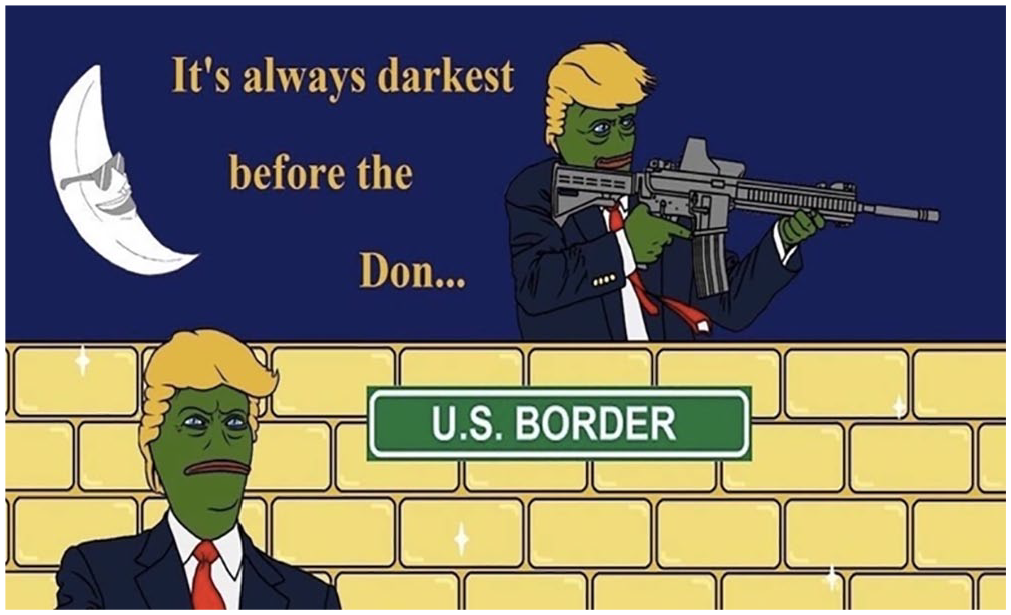
An example of a pro-Donald Trump alt-right meme.
In regard to recruitment, individuals who already hold the bigoted views of the alt-right are hailed into collective sense of identity, while the humor is critical for the recruitment of individuals whose knowledge of politics and political ideology is not fully formed (Wilson, 2017). In addition, ironic humor or satire is often used to derail and provoke emotional responses in conversations with members of the left. In what is often referred to as trolling (see Figure 2), alt-right members will inject memes into conversations across social media sites such as Twitter to disrupt and manipulate discourses associated with the left and political correctness (Lamerichs et al., 2018). The memetic strategy of the alt-right is an example of what Lisa Nakamura (2008) calls digital racial formations.
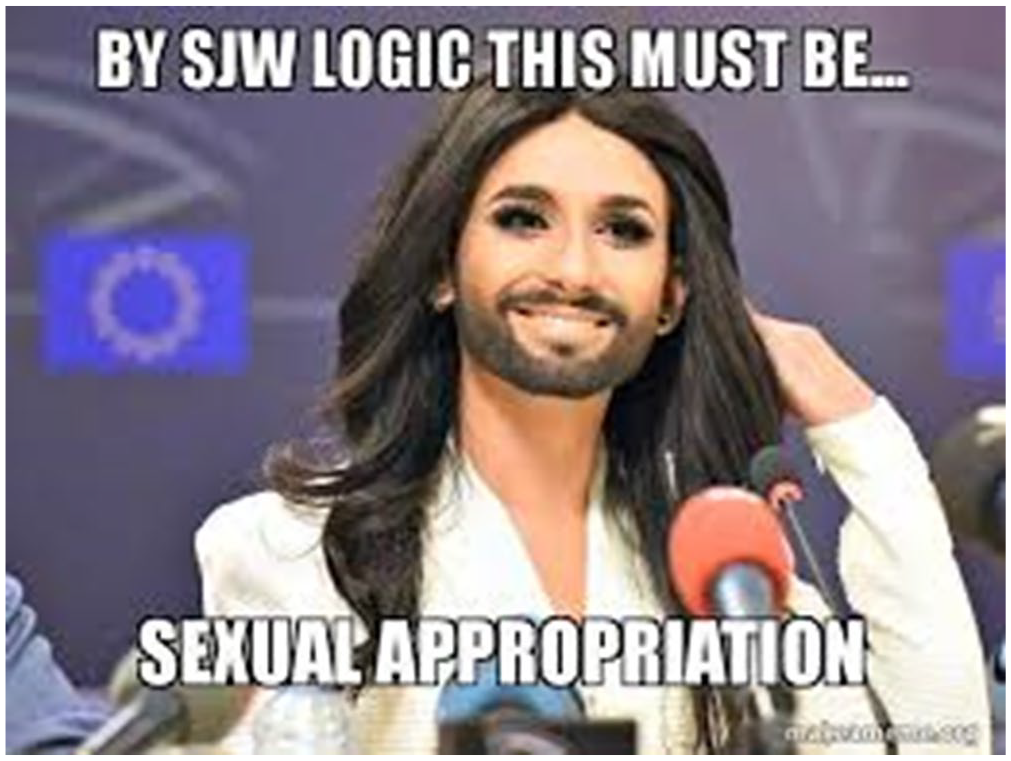
An example of an alt-right meme.
Digital racial formations refers to visual images of the body created within online formats within specific historical contexts that create understandings of race. The visual aesthetics of internet artifacts such as memes allow individuals to represent and deploy racialized and gendered bodies, and the visual deployment of bodies are a protocol for the production of a particular set of racial formations (Nakamura, 2008). This is to say memes engage with discourses of race and gender outside of the digital world, while these same discourses are concurrently reorganized within internet culture. Consequently, the anti-Kaepernick memes we examine reveal a way in which meanings of racialized, sexualized, and gendered meanings of nation are constructed on digital platforms, and the dissemination of these digital artifacts hail other individuals that identify with this specific form of U.S. patriotism in Donald Trump’s America
The meanings and implications of Kaepernick’s protest have not gone unexamined in the sport studies field. In providing valuable insight into long-standing tensions between politics, nationalism, patriotism, citizenship, meanings of race/racism, and sport, scholars have used his protest to discuss the importance of a publicly engaged sport sociology (Newman, 2019; Walton-Fisette, 2018), examine White undergraduate students’ perspectives of race and activism in sport (Chaplin & Montez de Oca, 2019), and consider the traditional media’s coverage of athlete activism (Boykoff & Carrington, 2019; Montez de Oca & Suh, 2019). By focusing on memes, we seek to add to this growing body of literature on Colin Kaepernick, while also contributing to the rise of scholarship examining how sport plays a role in the creation and dissemination of the politics of the alt-right (Falcous et al., 2019; Kusz, 2019). In what follows, we provide a larger discussion of post-9/11 America and sport, followed by an outline of memetic culture, before moving into our larger analysis of internet memes featuring Colin Kaepernick.
Post-9/11 America and Sport
Sport has historically functioned as a site that has played a central role in the making and remaking of race, or as Ben Carrington (2010) writes, “sport helps to make race make sense and sport then works to reshape race” (p. 66). In relation to Black masculinity, knowledge construction of the Black athlete developed from colonial fears of the loss of White male hegemony and sport is where colonial fears and fantasies of control, domination, and desire of the Black body are manifested (Carrington, 2010; St Louis, 2003). Black athletes that speak out against racism, challenge authority, or speak out against cultural norms are also frequently labeled as bad Blacks (Collins, 2004; Cunningham, 2009). These athletes who speak out represent a Black body that is not subservient, reigniting those colonialist fears of the rebelling against White male dominance and the institutions meant to uphold White patriarchal supremacy.
Hence, Kaepernick joins a list of athletes that includes Tommie Smith and John Carlos, Mahmoud Abdul-Rauf, and Toni Smith vilified not only because of their political beliefs, but because they protested within the confines of sport during the U.S. national anthem (Jackson, 2014; Zirin, 2016). Through such actions, these athletes violate patriarchal patriotism, or an identification with the “nation that demands respect for and adherence to institutions of authority, especially masculine institutions” (Chaplin & Montez de Oca, 2019, p. 4), an ethos intensified by the rise in jingoistic expressions of U.S. nationalism in both sport and general society and Kaepernick’s status as a Black athlete (Jackson, 2014). These narrow and ultra-nationalistic expressions of U.S. nationalism can also be read as a form of White backlash politics.
White backlash politics refers to a moral panic by Whites that perceive public assistance to non-Whites is achieved at the expense of White Americans, which results in Whites attempting to hoard societal resources and disparaging non-Whites (Hughey, 2014). Of importance to this article are White backlash to the events of 9/11 and the end of two terms of former president Barrack Obama. After the events of 9/11/, issues of diversity, political correctness, and globalization were often blamed by conservatives for producing a soft and weakened United States paving the way for the attack (Kusz, 2007), a framing that connotes Whiteness and masculinity to the safety of the nation. Similarly, former president Barrack Obama’s two terms in office was characterized by many Whites as un-American racial other taking “control of a nation for and by whites” (Hughey, 2014, p. 78). Sport, of course, is not sheltered from these larger racialized and gendered discourses of the nation.
For Kyle Kusz (2007), the events of September 11 opened a space for re-securing a normative position for White masculinity as the expression of the nation, a form of White nationalism expressed through media framing of White men such as former NFL player, Pat Tillman, as everyday (common) men that take a strong stance in curtailing threats to the nation (Kusz, 2007). In the case of Tillman, this framing is juxtaposed against Black male athletes framed as materialistic and selfish, a comparison that positions White men as the embodiment of the nation and devoid of privilege (Kusz, 2007). Similarly, Hawzen and Newman (2017) argue that construction of White athletes like Tim Tebow as disadvantaged and marginalized within the popular press is emblematic of the racial backlash to the election of former president Barrack Obama. The Trump era converges with these larger discourses, but what sets the Trump era apart is that many of these ideological battles are happening on social media.
Social Media, Internet Memes, Sport, and Racism
Internet memes as we recognize them now first emerged on early-21st-century internet message boards as a “homemade culture” made out of combining visual references to various pieces of popular culture (Beran, 2019, p. xv). Used to celebrate sport or other forms of culture, make political commentary, communicate emotions, create dialogue about other forms of culture, and for general humor, memes have become a central component of modern life (DeCook, 2018; Mina, 2019). Thus, the examination of internet culture offers insight into new ways of constructing identity and communicating. Sport studies scholars have examined intersections of internet culture, sports, and the formation of identities internet culture, with scholars focusing on issues of gender identity (Smith, 2011), national identity (Norman, 2012), and racial identity and racism (Cleland, 2014; Farrington et al., 2016), but the study of memes remains underdeveloped within sport scholarship (see Dickerson, 2016; Lucas & Hodler, 2018; Sutera, 2013).
Jessie Daniels (2013) notes, “race and racism persist online in ways that are both new and unique to the internet, alongside vestiges of centuries-old forms that reverberate both offline and on” (p. 696) (see also Bonilla & Rosa, 2015; Brock, 2009; Jackson, 2016; Jackson & Foucault Welles, 2015; Nakamura, 2008). The alt-right have become adept at this process (Milo, 2016; Nuzzi, 2017; Woods & Hahner, 2019). The message board sites 4chan and Reddit are often credited as the places where the creators and disseminators of memes meant to support Trump’s bid to the White House started (Beran, 2019; Woods & Hahner, 2019). Perhaps the most famous of memes from this period feature the alt-rights adaption of an already popular meme, Pepe the Frog.
Pepe the Frog is a creation of Matt Furie and was a character in Furie’s comic Boy’s Club (Swinyard, 2019). The image would quickly turn into a meme on the former popular social networking site, MySpace, and would eventually be adapted by the alt-right. The images shown in Figure 3 are representative of the ways the alt-right began to adapt the image of Pepe the Frog (Mina, 2019; Nuzzi, 2017), with the merger between the alt-right’s memes and Candidate Trump coming to fruition on Donald Trump’s twitter account on October 13, 2015 (Woods & Hahner, 2019). While the image in Figure 3 has no direct references to racist ideology, the adapted green face of Trump works to symbolically (with irony and humor) connote an in-group connection with the alt-right. The larger racial connotations of the usage of Pepe the Frog can be seen in Figure 4.
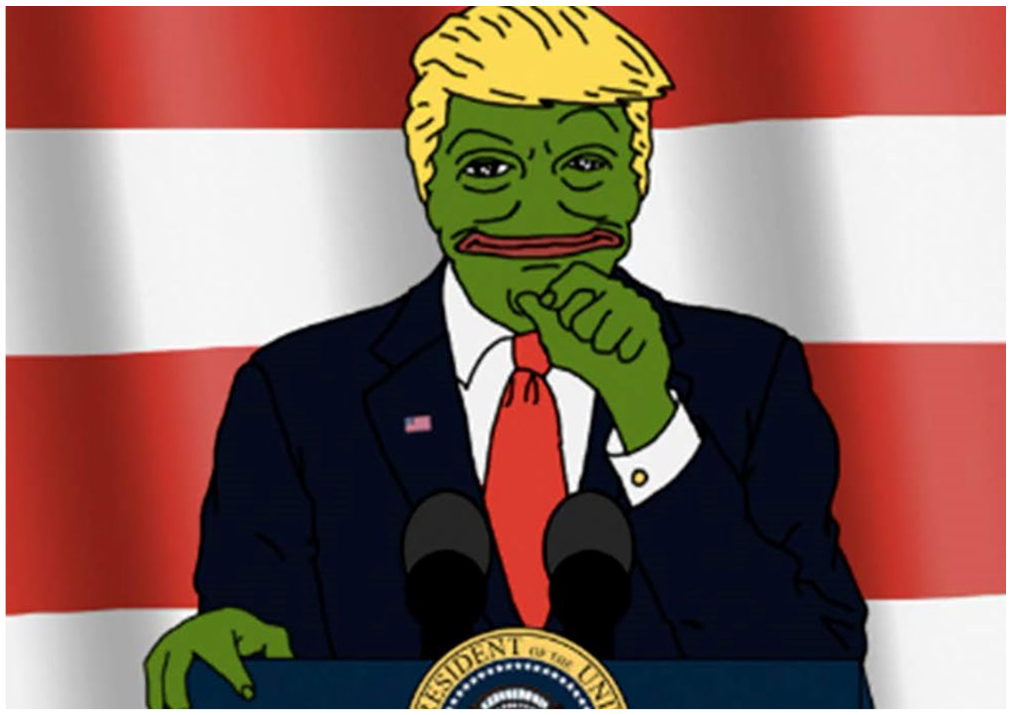
A meme merging Donald Trump and Pepe the Frog.
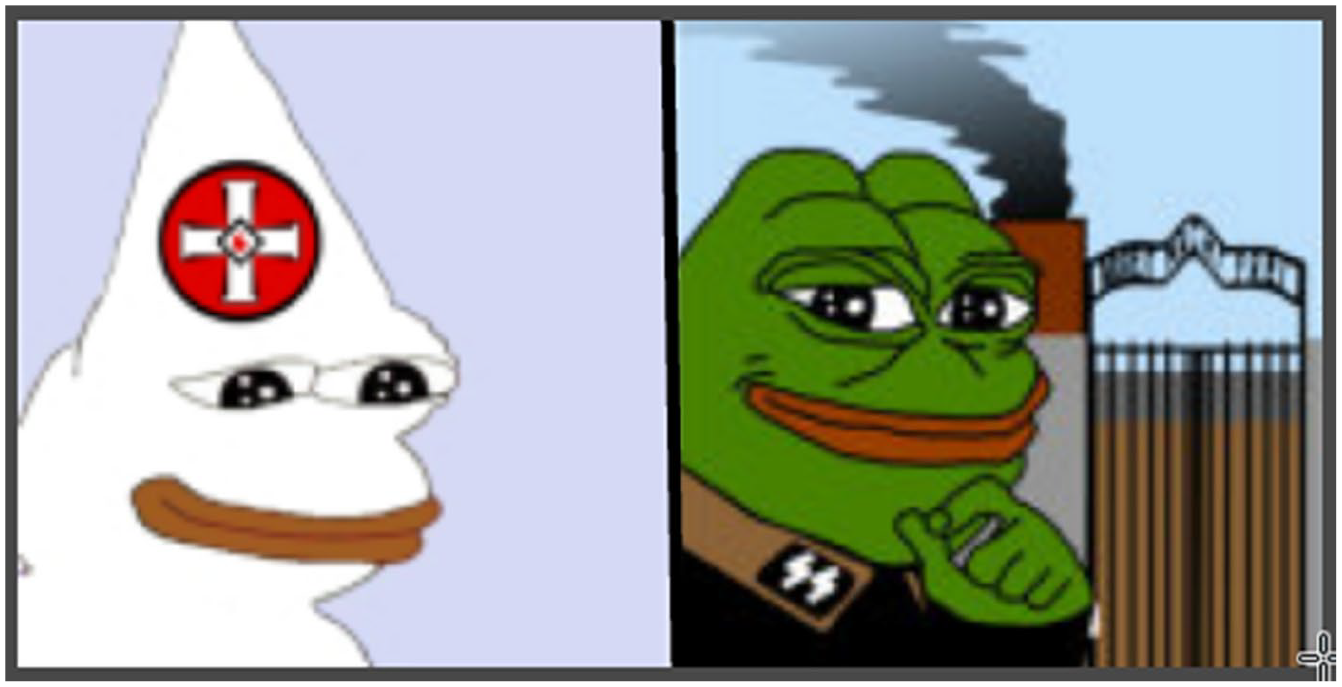
A meme depicting Pepe the Frog as a symbol of White Supremacy.
It is the intent of these meme creators to use such explicit and offensive humor in an effort to provoke a response, while the sheer brashness and usage of humor allows those that create and share these memes to deflect and make fun of anyone taking them seriously (Greene, 2019). As mentioned previously, this strategy serves multiple purposes. It helps foster recruitment (Mencimer, 2019), the shock value is meant to provoke a response that could lead to popular press coverage sending a message to alt-right supporters that their ideas have made it into the mainstream, and it is a way to disparage and antagonize women, racial minorities, and progressive agendas (Woods & Hahner, 2019). It is also a way to express White, heterosexual, men’s anxieties about their place in the national imaginary by mocking what is perceived as a threat to their privileged status. In our following analysis, we demonstrate how sporting memes are embedded within the alt-right’s ideological battle.
Reading Memes: Methodology
As casual fans of the NFL and social media participants, we quickly noticed the ubiquity of internet memes responding to Kaepernick’s peaceful protest throughout the 2016 NFL season (see Figure 5). We continued to see similar memes even after Kaepernick opted out of his final contract year in the 2017 offseason. During a political rally in the fall of 2017, President Trump reignited the subject by calling for any “son of a b—h” who kneeled during the national anthem to be fired for “disrespect[ing] our flag” (Seifert, 2017). In this dehumanizing speech, the President implied that the peaceful protests were un-American acts that should result in job loss. His performance seemed to act as a signal to his supporters and other NFL fans—who were already well-versed in communicating via memes—to take to social media once again and shape political and popular discourse via memes as we noted that the proliferation of memes continued after NFL owners and players reacted the following Sunday with league-wide performances of unity.
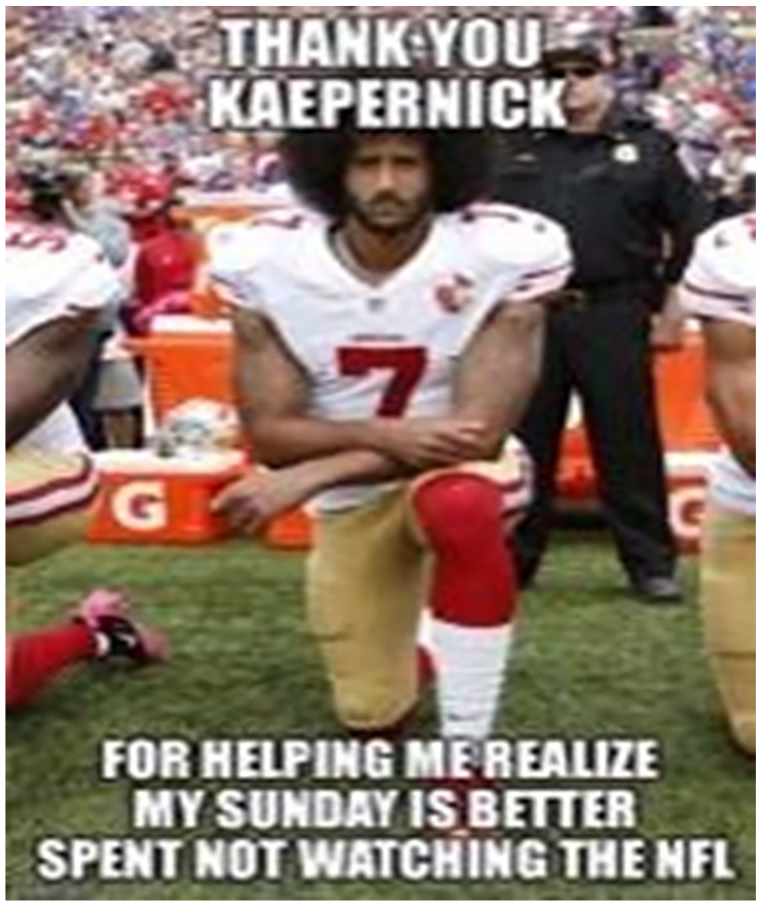
An example of a meme showing a negative reaction to Kaepernick’s protest.
In the winter of 2017, we began the task of collecting memes. A meme’s livelihood is dependent on the circulation and recirculation by producers and consumers (Shifman, 2014), which makes tracking down its origin difficult. Woods and Hahner (2019) point to this un-attributable recirculation as a primary reason for studying memes, the work of memes is important precisely because these images can be disarticulated from their creators, who may or may not espouse a particular political point of view, who nevertheless fashion memes that impact public culture in rather important ways. (p. 5)
With this challenge in mind, the ubiquity of anti-Kaepernick memes in our personal media diets and on non-NFL-affiliated sites made us believe that we were onto something.
The critical study of internet memes and sport is still in its early stages, as such, we followed other scholars (Dickerson, 2016; Shifman, 2014; Yoon, 2016) by utilizing large interactive meme depositories such as knowyourmemes.com, and memecenter.com using the search terms “Colin Kaepernick”; “Kaepernick national anthem”; and “Kaepernick protest.” The search ended when it proved a challenge to find any new memes, and we were left with 127 discrete but interconnected memes.
Our analytical approach was influenced primarily by Dickerson’s analysis of racialized masculinities in NHL-NBA memes (2016) and an analysis of #antifitspo memes by Lucas and Hodler (2018). In our analysis of the memes, we draw from cultural studies and sport studies scholarship and use discursive and textual analysis to examine the “ideological implications of . . . memes” (Lucas & Hodler, 2018, p. 238). In particular, we read these memes to explore “structures of dominance expressed” around meanings of race, gender, sexuality, and patriotism in the medium of the memes (Birrell & McDonald, 2000, p. 4). More specifically, reading the memes in this manner allows us to examine how these lines of power intersect, while also drawing connections between sport and the larger social world (McDonald & Birrell, 1999).
In effort to understand how meme creators used the digital to tell a narrative of race, gender, sport, and nation necessitated an exploration of intertextuality. Intertextuality, as Susan Birrell (2007) argues, “asserts that all texts are interconnected and any given text derives its meanings from the meanings that adhere to it from readers’ previous encounters with other texts” (p. 11). This emphasis allows for an understanding of how memes create meaning not only through the imagery of the meme, but also through their references to meanings created by other cultural artifacts (Yoon, 2016). Thus, through the initial organization of our data we were able to see how the memes collected referenced, challenged, and built on current discourses of race, gender, and U.S. citizenship.
Many memes within our data explicitly referenced Whiteness, patriotism, Kaepernick’s talent, his finances, the military, his masculinity, as well as politically correct culture. The focus on intertextuality helped us gain insight into how the meanings, identities, and ideologies present within these memes are articulated within the larger historical, social, and political context (Hall, 1996). Thus, by beginning to draw connections between the Kaepernick protest and broader issues of anti-political correctness, racism, and misogyny within post-9/11 America and the rise of Donald Trump we were able to construct the context in which to make sense of these memes (Andrews, 2002). From this stand point, we constructed the following themes out of the memes we found: Whiteness and then end of PC culture; the feminization of the nation; and the positioning of Kaepernick as a terrorist. In the subsequent sections, we present a subset of memes that exemplify each theme. We concentrate on three to four memes in each section to provide adequate space to develop a deep and critical analysis.
All of the individual memes we discuss are representative of a larger subset. For example, Figure 6 is just one of several memes that immention PC culture. Our decision to use one meme to illustrate a broader trend is predicated on how individuals use these digital artifacts. As the cultural significance of memes lies in their ability to be quickly replicated and circulated via social networking sites (Greene, 2019; Woods & Hahner, 2019). In this regard, it is then to be expected that meme creators will take a broader idea like Kaepernick as symbol of all that is wrong with PC culture and remix that concept into another meme. In what follows, we focus on the narratives and intertextuality of a subset of memes collected to illustrate how memes of Kaepernick perpetuate a digital nationalistic project centering White, Western, heterosexual men.
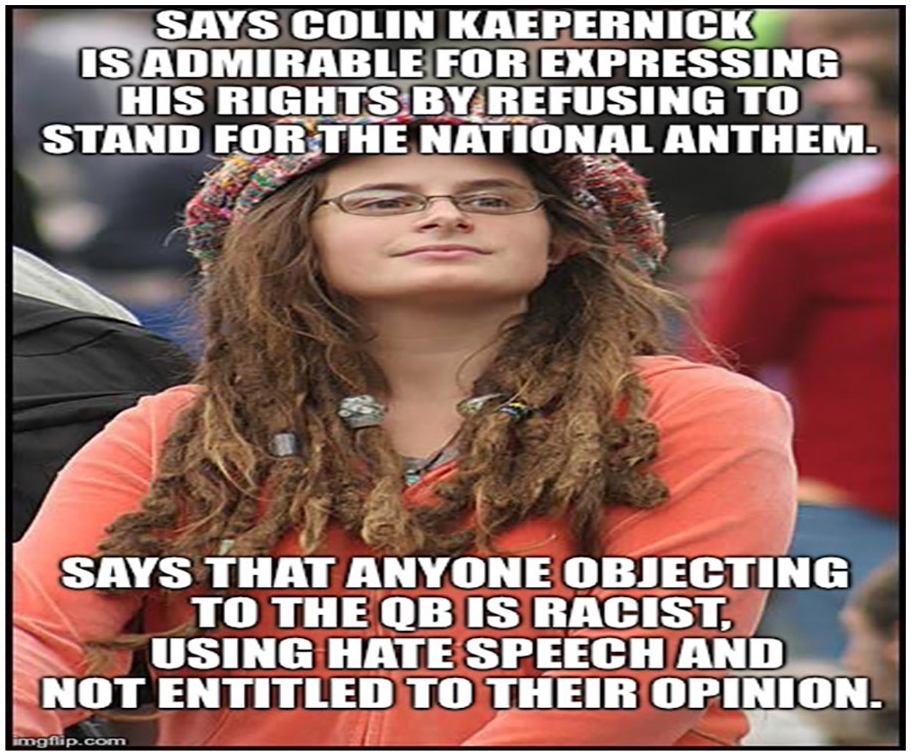
A meme about liberal ideology & PC culture.
Whiteness and the End of PC Culture
The current alt-right movement within the United States is at odds with progressive culture and policy aimed at making society more equitable. Discussing race and fighting against racism, feminism, immigration, political correctness, and the perceived erasure of Whiteness are some unifying factors within this multifaceted movement (DeCook, 2018). Sport is a battleground for the perpetuation of these ideas. Donald Trump has routinely glorified White male athletes while disparaging the character of Black players speaking out against injustices via Twitter (Kusz, 2019), while right-wing websites like Breitbart have characterized Kaepernick’s protest as emblematic of the soft and liberally tainted discourse infecting U.S. colleges and society more broadly (Falcous et al., 2019).The memes in this section work similarly in that they enable an identification with a social world that has rejected politically correct culture by framing the support of his message as a product of a leftist agenda, rejecting the existence of racial oppression, and emphasizing Kaepernick’s economic status.
In Figure 6, an image of a young White woman with dreadlocks is framed with the following text: “Says Colin Kaepernick is admirable for expressing his rights by refusing to stand for the national anthem. Says that anyone objecting to the QB is racist. Using hate speech and not entitled to their opinion.” This meme is an embodiment of the alt-right’s online strategy which seeks to mock what they perceive as liberal performative politics (Beran, 2019; Greene, 2019). More so, the political culture of the left is feminized and mocked in efforts to call attention to the Trumpian belief that liberals are too “politically correct” and police language and thought. The usage of this woman and the feminization of liberal ideas are of critical importance, as the alt-right seeks to attract those who feel like their White cultural worlds have been attacked by liberals (Maskovsky, 2017). Both the meme’s anonymous woman and Kaepernick are thus situated as the real threats to the nation by pandering to the (unfounded) needs of marginalized groups and not White (men’s) concerns.
Moreover, Trump’s anti-PC rhetoric frames the left and PC culture as inhibiting discussions that could move society forward, beyond past racist transgressions—which is ironic for a political project rooted in a return to the greatness of the past (e.g., Make American Great Again). The mocking of leftist PC culture can also be seen in Figure 7. In this meme, Kaepernick is tackled by former Green Bay Packer Clay Matthews above the caption: “Here’s a photo of Colin Kaepernick being oppressed by white people.” This meme, which is representative of several others, downplays systemic racism by placing the notion of oppression within the highly structured NFL football games, with its agreed-upon rules regulating everything from classifications of contact between players to clothing specifics—enforced by objective referees. Based on these standardized structures, the game is perceived to be a fair and egalitarian contest where players who succeed (or fail) earn that outcome. Its usage of football players as oppressors implicitly calls upon notions of a level-playing field that discursively minimizes the existence of racism. Furthermore, this meme also acts as a response to the critique on Whiteness put forth by Kaepernick. By having a White player tackle Kaepernick while mocking the existence of institutional racism, visually and verbally the threat to Whiteness is subverted through the centering of White masculinity.
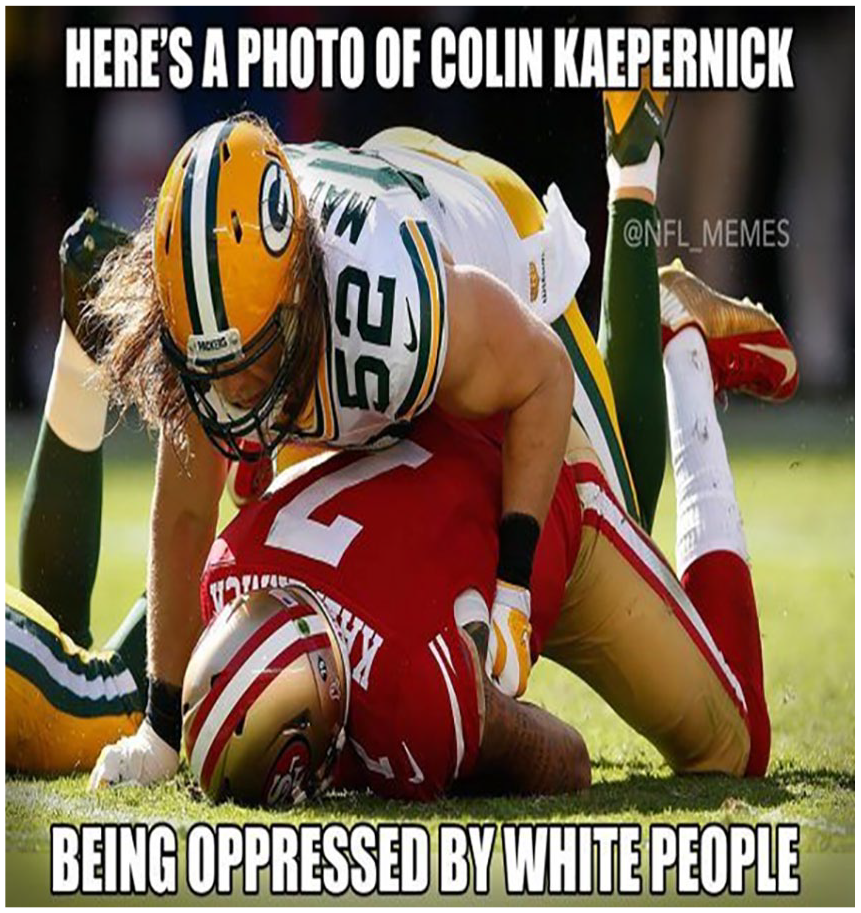
Institutional racism reduced to a performative act within sport.
Continuing in a similar construction of Whiteness, meme creators and sharers utilize the White family that adopted Kaepernick, who was born to a White mother and a Black father, shortly after his birth (Johnson, 2016). In Figure 8, Kaepernick is presumably standing alongside his White adoptive family, with text “Says he is oppressed by white people with this white family.” The meme presents somewhat of an inversion of the “some of my best friends are black” trope, which works as a discursive buffer between a person or statement and racism (Bonilla-Silva, 2010). The presence of Kaepernick’s brown body amid his White family within a traditional family portrait accentuates suggests that the presence of “good” White people in Kaepernick’s upbringing means that he could not feasibly be racially oppressed. Hence, not only is the support of Kaepernick a liberal agenda, the oppression of Black bodies the equivalent of being sacked within an NFL game, but Whiteness has actually provided Kaepernick with an opportunity for a stable family structure and (visually) rendered his claims of (structural) racism as hypocritical through a reference to an aspect of individual life.
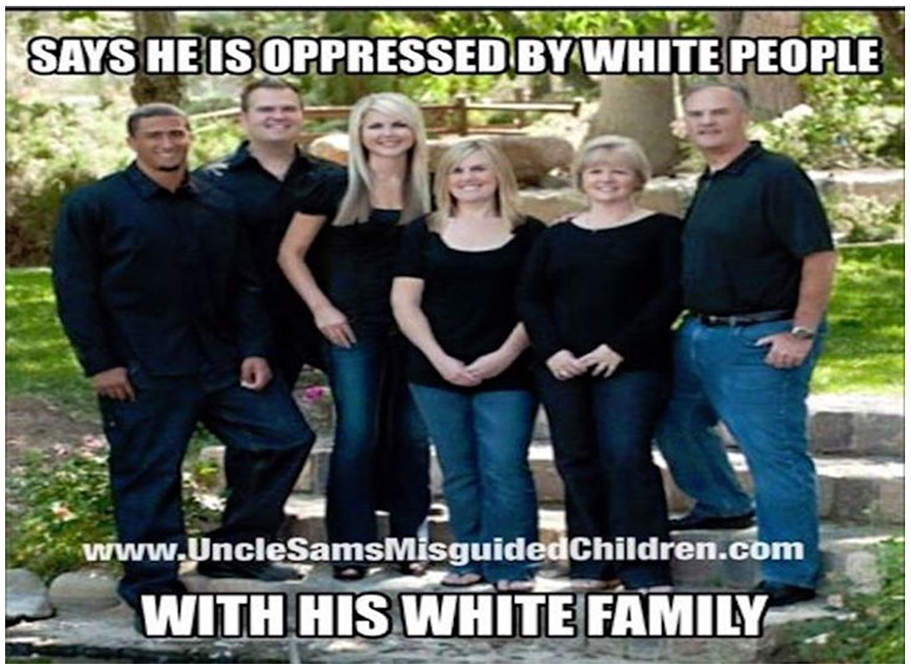
A meme about whiteness supposedly saving Kaepernick.
Attempts to subvert larger discussions of the existence of the racial oppression Kaepernick discusses is also done through drawing attention to his economic capital (see Figure 9). Kaepernick’s status as a well-compensated Black NFL quarterback is deployed to signal him as a spoiled and out-of-touch Black man. In 1995–1996, when former professional basketball player Mahmoud Abdul-Rauf remained in the locker room during the national anthem as a protest, the popular press also used his economic status to imply that oppression does not exist due to his economic status (Jackson, 2014). Besides implying that racial oppression cannot exist because of Kaepernick being rich, the visual aesthetics of Kaepernick posing in front of a fancy sports car while kissing his bicep helps to accentuate a perceived fallacy of structural inequality in the United States. Instead the nation is a provider of opportunity for Black men, not an oppressor (Jackson, 2014). Together all of the memes in this section work to delegitimize Kaepernick’s protest, and more broadly the liberal and politically correct discourses his protest is in conversation with.
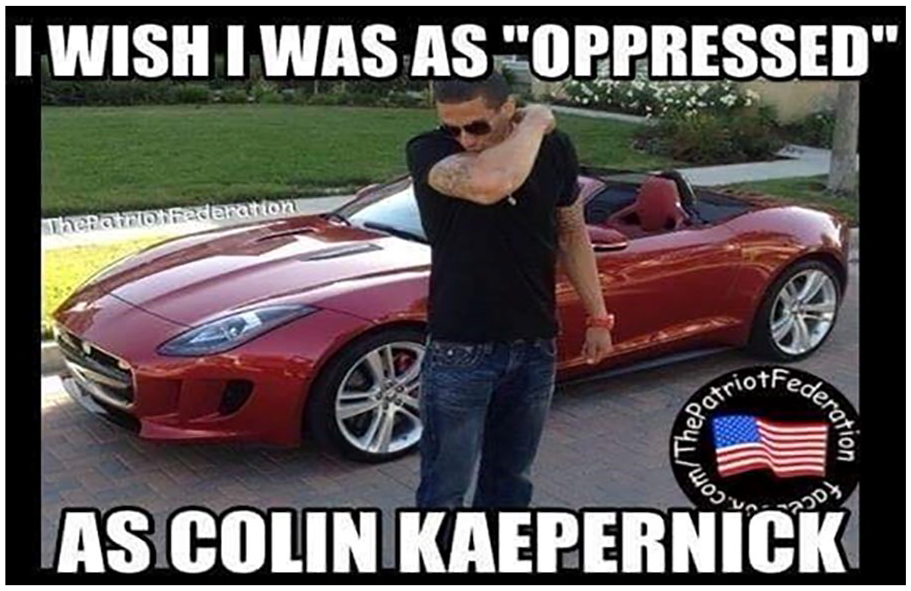
A meme denying racism due to Kaepernick’s relative economic status.
The Feminization of the Nation
The memes in this section feminize Kaepernick, label him as gay, and challenge Kaepernick’s masculinity. In doing so, Kaepernick and his protest are ensnared with larger discourses about the anxieties of White masculinity in a world where racial minorities, women, and the LGBTQ community are gaining more rights. More specifically, just like in the last section, the discourses of these memes tap into narratives where liberals and liberal policies are framed as soft hence the right’s consistent framing of people pushing social justice measures as “snowflakes” (Hawley, 2017). Utilizing Kaepernick to demonize femininity and homosexuality through racialized, gendered, and homophobic discourse results in the antithesis of these identity markers White, masculine, and heterosexual situated as the norms within sport and larger society.
Historically and contemporarily, sport functions ideologically as a place to promote dominant norms of masculinity and position sport as natural for boys and men, while simultaneously marking girls and women as outsiders within its realm (Birrell & Theberge, 1994). Some memes make this point directly through the feminization of Kaepernick. Figure 10 shows a cartoon version of Kaepernick sitting down at a urinal framed by overlaying text: “Kaepernick always seems to be sitting down while everyone else is standing. You can’t fix stupid!” Such a depiction feminizes Kaepernick and positions him as not intelligent enough to understand how to use a urinal. Feminizing Kaepernick communicates his incongruity within the hyper-masculine space of professional American football, while also emphasizing the long-held stereotype of Black men as athletically gifted but not intelligent. The usage of gender and race to belittle Kaepernick begins the process to reinforce White masculinity as the norm.
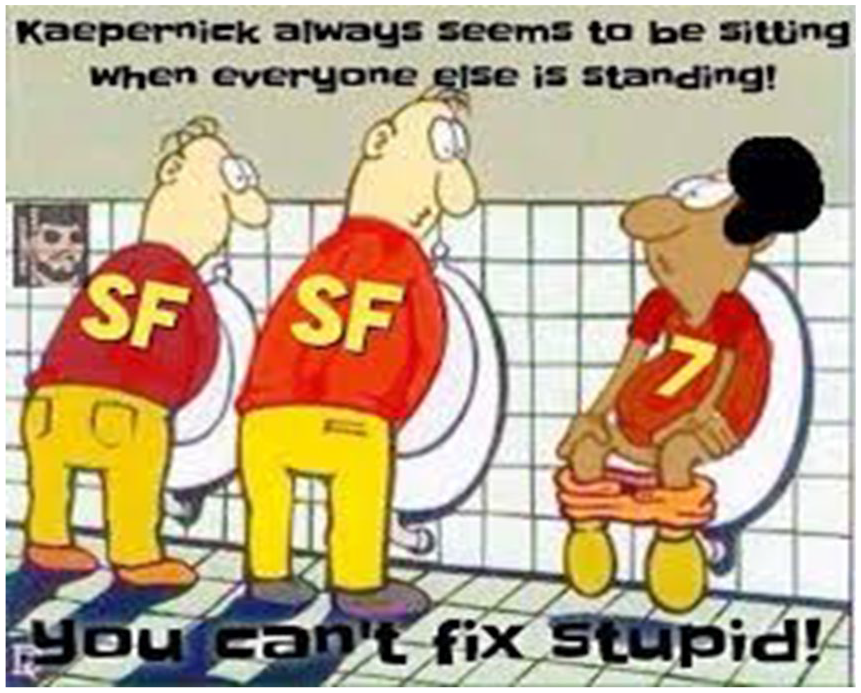
A meme depicting Kaepernick as both unintelligent and feminine.
Figure 11 continues this process by again emphasizing the alleged homosexuality of Colin Kaepernick. Brian Pronger (1999) uses the anus and phallus to theorize gender and sexuality within competitive sport, arguing that those who protect their goals, hoops, and so on (anus), and attack and penetrate (phallus) their opponents’ goals, hoop, and so on are the winners. This meme falls into such a patriarchal framework of desiring to do the penetrating and resisting the feminized act of being penetrated by highlighting Kaepernick’s naked body and (homo)sexualizes and feminizes him by portraying his buttock as open for penetration.
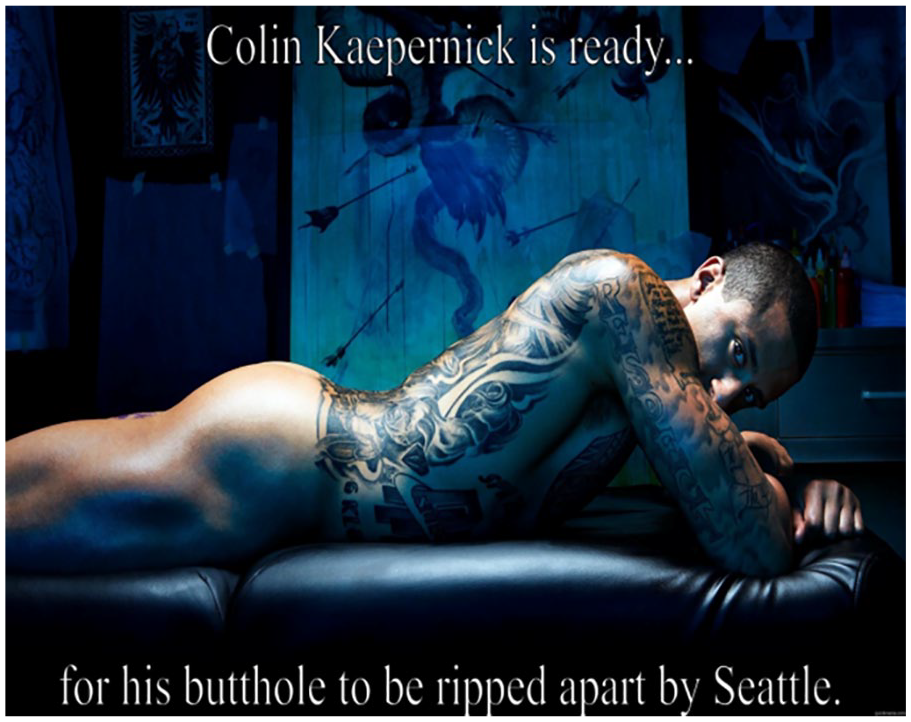
A meme demonstrating how homophobia is linked to Kaepernick.
The feminized and gay Kaepernick opens himself up to be penetrated, and has thus failed in hegemonic constructions of race, gender, and sexuality. Dismissive discourses on the right associate people, like Kaepernick, who protest against sexism, racism, and other forms of inequality as feminine and, more importantly, as “soft” and susceptible to penetration (Duncan, 2017). In a discursive strategy that situates toughness and masculinity as essential for the integrity of the nation, “soft” protesters therefore make the nation vulnerable. As such, Kaepernick is feminine by protesting in a sporting space and protestors are feminine because they fail to adhere to a post-9/11 patriarchal patriotism that commands acritical respect for the United States’ symbols and institutions (Chaplin & Montez de Oca, 2019). The importance of being masculine and not feminine within the United States is furthered through discussions of his athletic talent.
For instance, Figure 12 claims that Kaepernick should be deported because he lacks athletic skill not because of his protest. Hegemonic forms of masculinity are detrimental to gender equity, performances of masculinity that valorize athleticism, strength, and dominance are highly valued within the sporting world (Messner, 2002). In this meme, Kaepernick’s failing athleticism relegates him in the societal gender hierarchy. In addition, historical discourses that have reduced the Black body to its physical capabilities and more specifically “natural” athletic talent (Carrington, 2010) also mean he has also failed to adhere to racialized norms. The visual presence of President Donald Trump and the textual overlay situate these gendered and racialized failings within the context of national belonging.
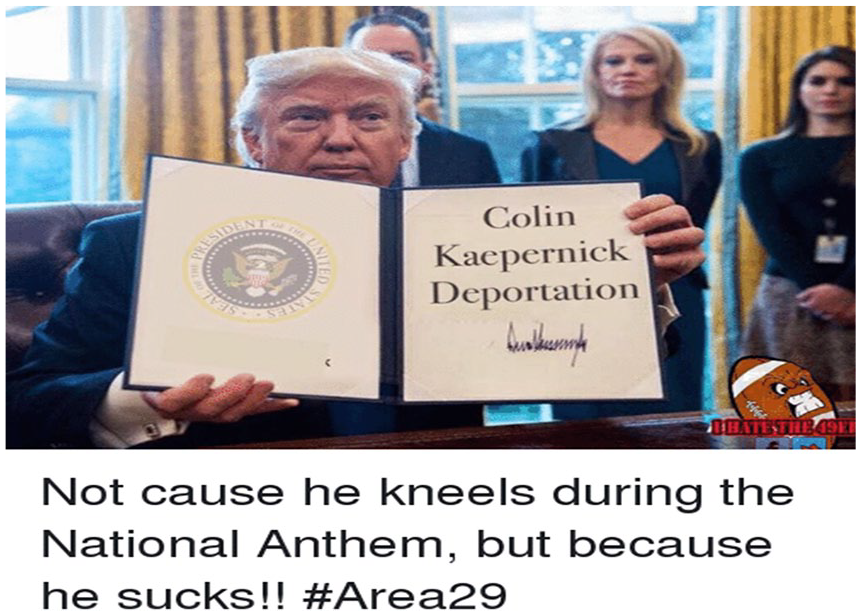
A meme linking Kaepernick to failed masculinity and questionable citizenship.
This image cannot be separated from Trump’s constant demonization of non-White immigrants—which is often connected to larger discourses of White supremacy (Bobo, 2017). As such, this image situates Kaepernick within larger discourses of race and U.S. citizenship. Yet, the text explicitly states that he should be deported due to lack of talent and not his political stance, thus positioning him as an undesirable body within larger discourses of White supremacy through his lack of athletic talent or failure at hegemonic masculinity (Bonilla-Silva, 2010). The explicit connection between performances of perceived masculine skills (sport) and the racialized immigration rhetoric of Donald Trump works to secure those who are feminine and racialized as outsiders within the national imaginary.
Colin Kaepernick the Terrorist
In each of the previous sections, visual and textual elements of the memes were entwined with larger discourses of the feminization of U.S. society, sport, and the delusion of “soft” liberal politics and PC culture. In this section this narrative continues through the construction of Kaepernick as one of the most stereotypical threats to U.S. morals, stability, and interests in the post-9/11 and Trump era, the terrorist. The terrorist is also an image that is often racialized, emasculated, and homosexualized (King, 2009). In this section, feminization, Blackness, and homosexuality are connected to anti-Americanness through linking Kaepernick to terrorism, former president Barack Obama, and comparing Kaepernick and his achievements to military veterans. As a result, Whiteness, hypermasculinity, heterosexuality, and the military are positioned as integral to the foundation and integrity of the nation.
A central way this is done is through situating Kaepernick as a product of Barrack Obama’s America. Obama is utilized as a cultural text to emphasize the un-Americanness of Kaepernick. Figure 13 features Obama, with his hands at his sides, and three other people, with their hands over their hearts, on a stage with an American flag backdrop. The text on the image reads “I wonder where Colin Kaepernick learned to disrespect America?.” Initially, the floating flag and the differing eye-lines of the people indicate the image’s obvious edited creation. Drawing upon popular discourse equating protest during the national anthem to being disrespectful to the flag and nation, the meme constructs a discursive bridge between Kaepernick, Obama, and anti-Americanness. In a subtle act that positions White masculine adherence to performative national acts as the most important, it is noteworthy that all the figures performing patriotism correctly are White, and the second largest person in this image is the White man who is both bigger and in front of the two White women in the meme.
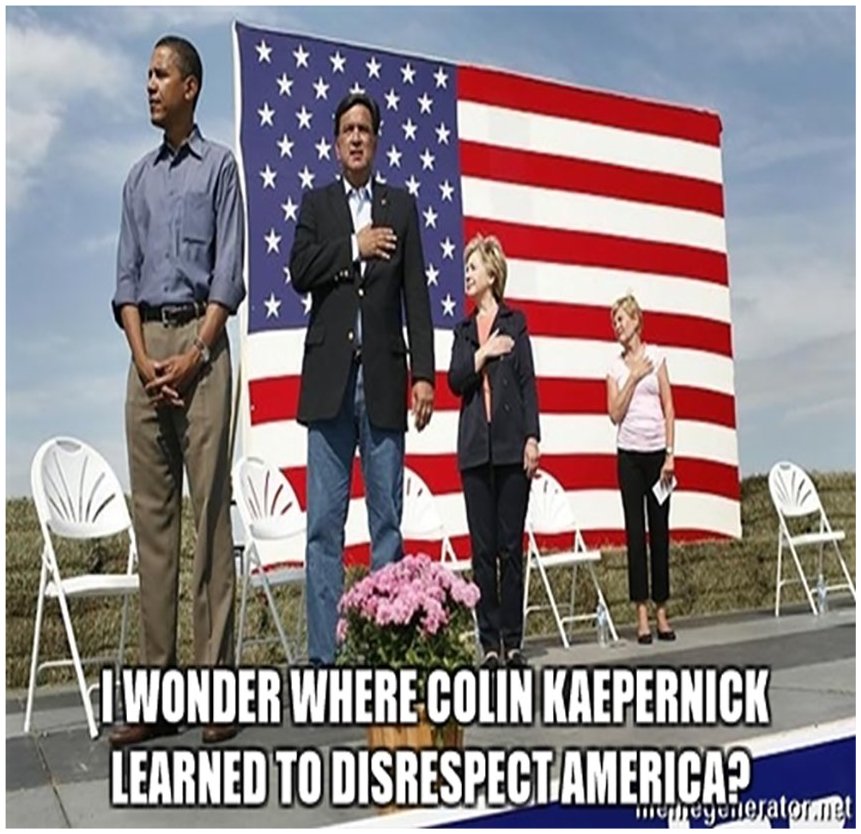
A meme where President Barrack Obama’s “disrespect” for the US is a model for Kaepernick.
Racialized and religious discourses were frequently used to question Obama’s allegiance and connection to the nation. Whether it was by highlighting his middle name (Hussein), questioning his birth certificate legitimacy, labeling him as a Muslim, portraying him as a terrorist sympathizer, and/or by constructing him as a Black nationalist, Obama was frequently racialized to highlight his supposed lack of American-ness or questionable patriotism (Carrington, 2009). Similar dis-identifying discourses are mapped onto Kaepernick by connecting him to the former President. Furthermore, Kaepernick is ensnared within White backlash discourses to Obama that perpetuated the former president, as a threat to the cultural and structural foundations of America through his Blackness and perceived anti-Americanness (Hughey, 2014), a point made more explicitly through the depiction of Kaepernick as a terrorist.
After 9/11, the redeployment of Orientalist tropes helped to conflate anyone that appeared Middle Eastern, Arab, or Muslim as a terrorist (Volpp, 2002). Consequently, skin tone, religious symbols, and Islamic dress become the signifiers of terrorism and un-Americanism. Furthermore, the current alt-right movement perpetuates the belief that Islam, feminism, multiculturalism, immigration, and globalization are responsible for the slow destruction of Western civilization (DeCook, 2018). In Figure 14, a photoshopped Kaepernick appears with a turban and a beard situated next to and in similar garb, Osama bin Laden. Kaepernick is neither Middle Eastern, Arab, nor Muslim, but his brown skin connects him visually to bin Laden, thus rendering him a terrorist. The visual also directly equates Kaepernick with two of the largest perceived threats to the stability of Western civilization and American hegemony, Islam and Osama bin Laden.
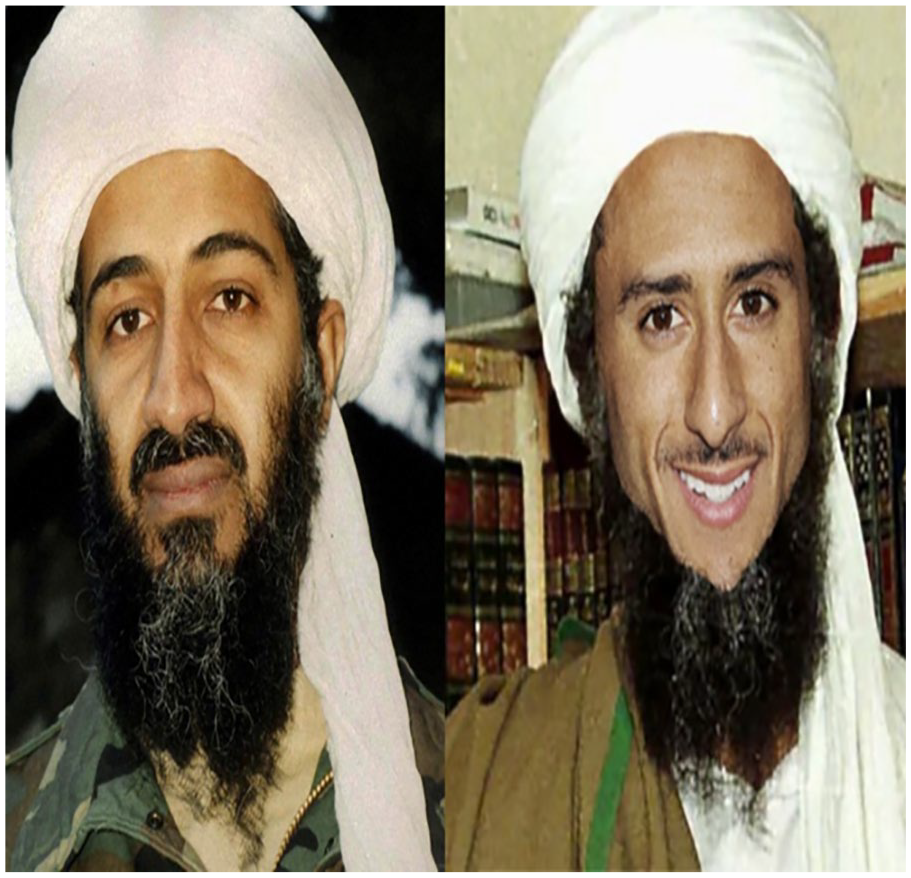
A meme equating Colin Kaepernick to Osama bin Laden.
Previously mentioned memes that established Kaepernick outside of hegemonic masculinity also help to situate him within the broader racialized, gendered, and sexualized discourses of terrorism. The terrorist is emasculated, deviant, perverted, and racialized and, therefore, the patriot is masculine, heterosexual, and White (Puar & Rai, 2002). This point is evident in Figure 15, where a character from the cartoon South Park is shown holding a doll wearing a “Make America Great Again” hat and the text “Show me on this doll, where Colin Kaepernick hurt you.” The fact that the doll wears a hat signifying Donald Trump’s campaign makes this segment of the population victims at the hand of Colin Kaepernick.
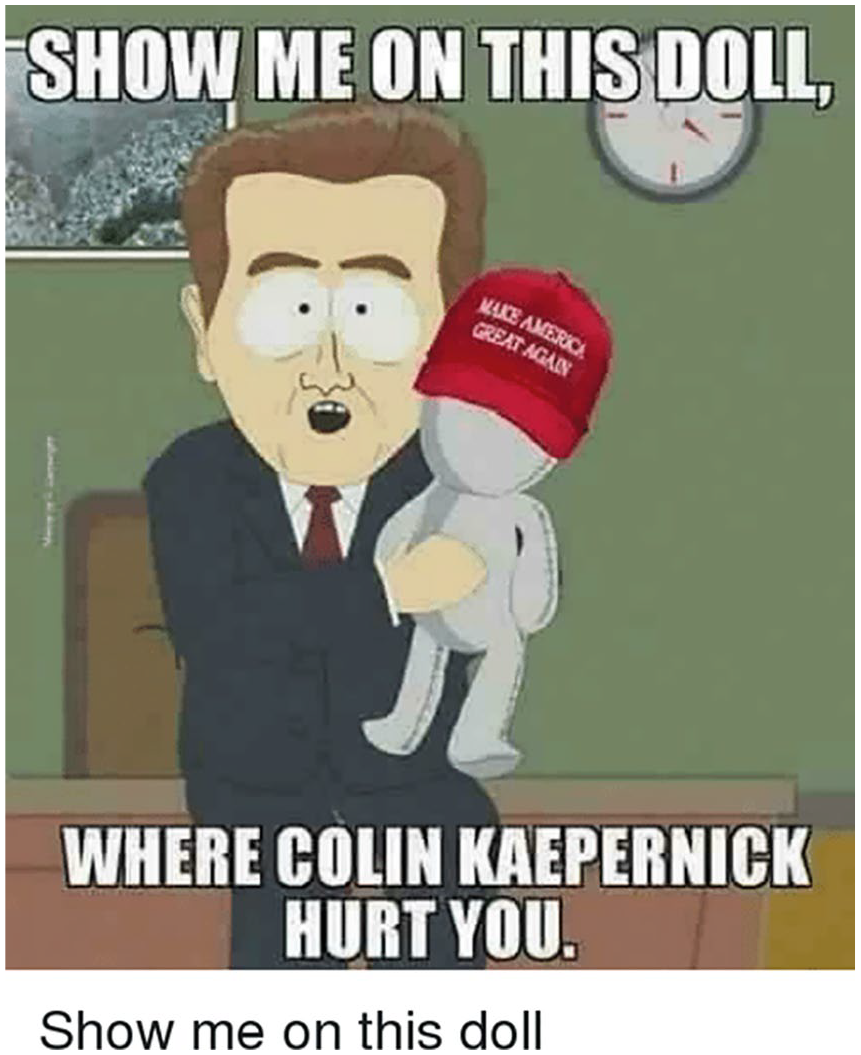
A meme uses images from South Park to depict Kaepernick as a sexual predator.
Mary Bloodsworth-Lugo and Carmen Lugo-Lugo (2010) argue that the Bush Administration’s immediate post-9/11 political discourse conflated terrorism and supporters of same-sex marriage as existential threats to American values and “racialized and [homo]sexualized bodies were positioned as threats to the security of the nation” (p. 0193723520950537iii). South Park’s repeated associations of terrorists like Osama bin Laden with failed masculinity and (homo)sexual and bodily perversity exemplifies this larger political discourse (Puar, 2007). Kaepernick becomes entwined with this discourse as he is constructed as a sexual pervert. More specifically, visual depiction of the doll call upon cultural texts (like television shows, movies, and PSAs) where children acknowledge being victims of inappropriate sexual contact through pointing at parts of the doll where they were touched. A connotation that situates Kaepernick and his ideas as not simply a violation of America, but rather by drawing on a cultural text that places the victim as a child exacerbates the perverse and existential threat to White, male, heterosexuality.
The notion that Kaepernick and his protest are an existential threat is perhaps most pronounced through memes that invoke images of soldiers. Since the events of 9/11, the NFL has entwined itself with the military perpetuating the uncritical acceptance of U.S. military interventions (Fischer, 2014; Schimmel, 2017) and fostering a connection between Whiteness, morality, and the nation through the celebration of White masculine heroes (Kusz, 2007). This explicit discursive framing is seen in Figure 16.
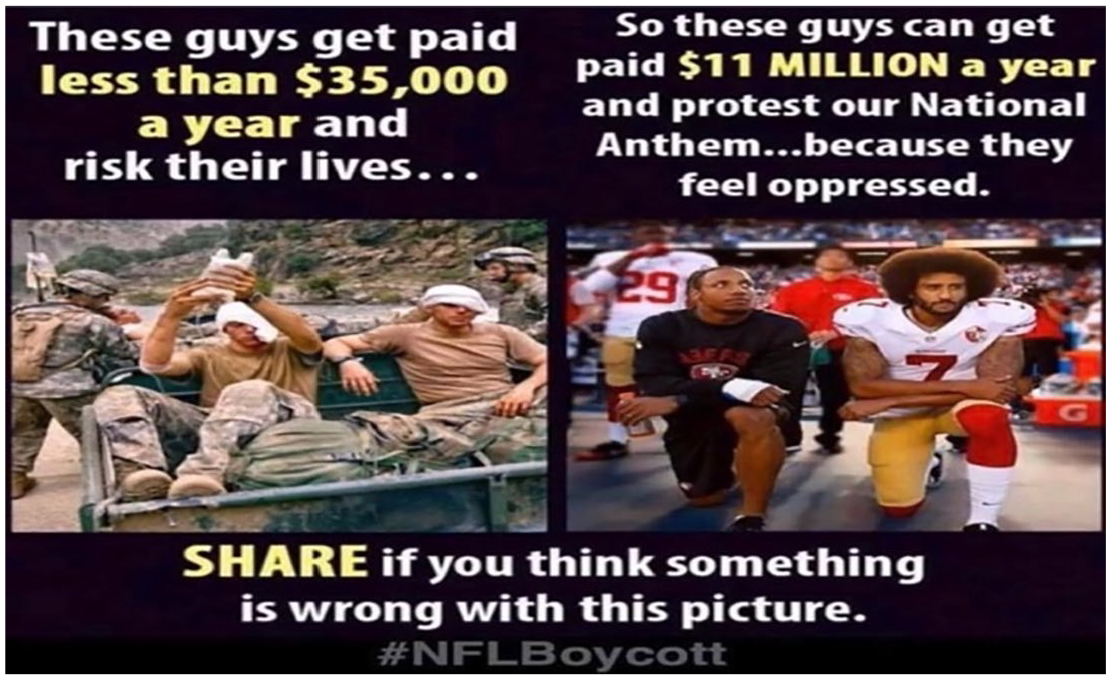
A meme juxtaposes images of US military with Kaepernick & teammate Eric Reid protesting to show that US military are the real heroes.
In this meme, an image of Kaepernick and teammate Eric Reid kneeling during the national anthem is set directly beside an image of wounded soldiers. The visual contrast of the White soldiers and the Black football players visually recalls ideological understandings of the selfish Black athlete compared with the average everyday White man protecting the nation (Kusz, 2007), a connotation made more poignant through the usage of wounded soldiers to secure ideological connotations of the self-less and morally superior soldier. The textual assertion of the pay differential between them and millionaire athletes further equates Whiteness, morality, and militarization to appropriate U.S. citizenship and patriotism (Bloodsworth-Lugo & Lugo-Lugo, 2010; Butterworth, 2017). In addition, reminding the reader that “these guys” “protest our National Anthem” suggests that the national anthem and nation is the property of White American men and not highly paid professional Black athletes.
We read this as another form of White backlash politics, where White men are seen as selflessly sacrificing their bodies for the nation only for the ultimate accolades of a hero to be applied to the undeserving Colin Kaepernick. This juxtaposition is entwined with the larger discursive framework that perceives social gains made by racial minorities and women as disadvantageous to White men (Hughey, 2014), a perception emphasized by framing White men as more deserving of Kaepernick’s high salary and national citizenship. Unsurprisingly, some memes we collected compared Kaepernick to an ultimate symbol of post-9/11 White masculine U.S. nationalism, Pat Tillman.
In September 2018, as part of their new campaign in honor of the 30th anniversary of their “Just Do It” slogan, Nike released an advertisement with Colin Kaepernick with the slogan “Believe in something. Even if it means sacrificing everything.” over a Black and White close-up image of his face (Figure 17). Predictably, the advertisement was polarizing, as can be seen in Figure 18, a meme that used the same Black-and-White color scheme and the same slogan. But, in this meme, Kaepernick’s face was replaced with two popular images of a uniformed Pat Tillman. The first image is of Tillman running helmetless in his Arizona Cardinals #40 jersey, hair flying and mouth open in a yell and the other is a formal portrait of him in his Army uniform in front of a U.S. flag. Tillman was celebrated for “giving up” his paying NFL-career after 9/11, in 2002, to fight for his country (see Kusz, 2007). After Tillman’s death in 2004, the friendly fire circumstances of his death were concealed initially, and his funeral was televised to propagandize the War on Terror against his family’s wishes.
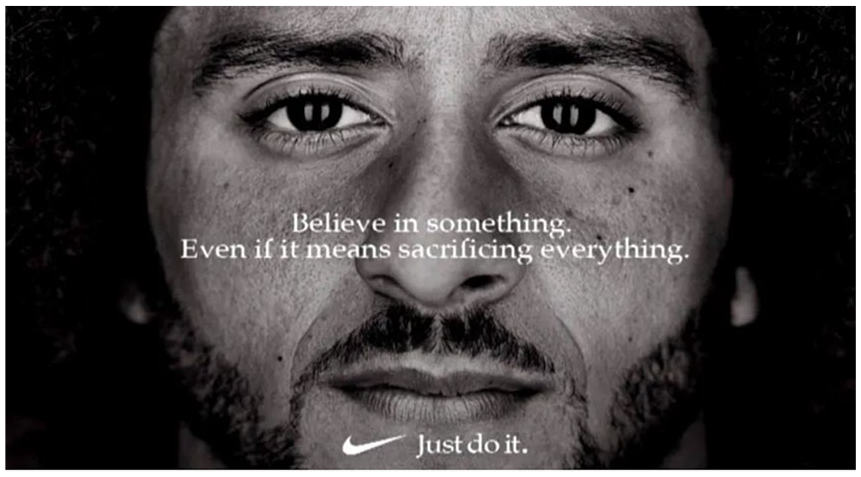
Nike’s Kaepernick ad, which became the basis for memes.
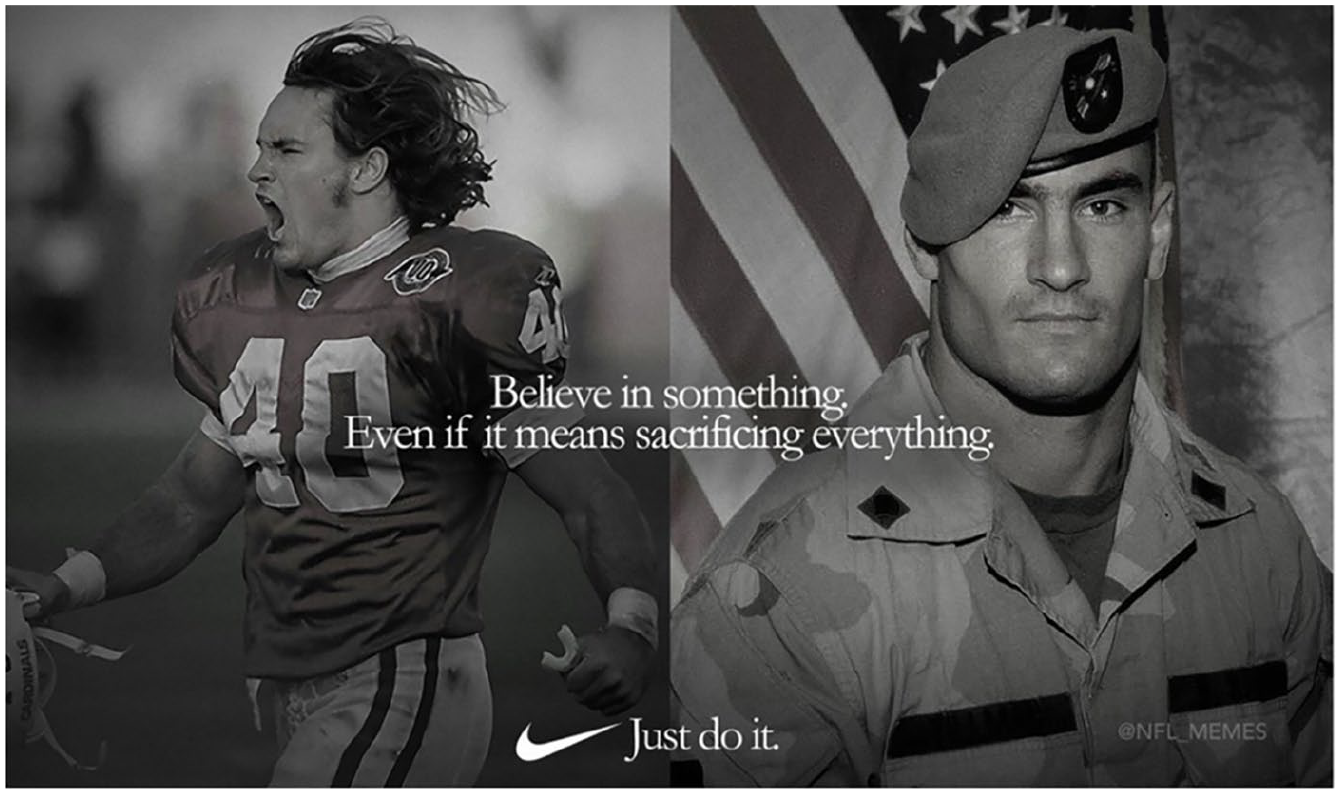
A meme remixes popular images of the late Pat Tillman with the Nike Kaepernick ad.
This meme with Tillman’s image serves multiple ideological purposes. Its use of the Black-and-White schematic and the same slogan evokes Kaepernick and juxtaposes his “sacrifice” (of a job) with Tillman’s “sacrifice” (his life). It is meant to delegitimize Kaepernick’s protest because his sacrifice is minimal in comparison with Tillman’s and to highlight who the “real heroes” are. Consequently, it recenters White masculinity as idealized version of American national identity and citizenship and also renders Blackness and critiques of the nation as outliers of national citizenship.
Conclusion
Since the initial protest and the digitized responses we have discussed, much has changed for Colin Kaepernick. He has been forced into retirement from the NFL, his activism with the Know Your Rights campaign has continued, the aforementioned 2018 Nike commercial was released, and he endured a public controversial tryout to return to the NFL. In November 2019, he participated in a workout in front of seven team representatives, and the recorded workout was sent to all 32 teams. Kaepernick remains unsigned. A month later, in December, Nike released “The Airforce 1 x Colin Kaepernick” shoe featuring the likeness of Kaepernick on the heel of the shoe and “08/14/16” imprinted on the bottom of the sneaker to commemorate the day he first refused to stand for the national anthem. Despite the volatile reactions to the protest, the shoe sold out online within minutes (Bote, 2019). While Kaepernick’s activism continues and his NFL fate remains uncertain, his likeness and political ideology are still imperative in memetic discourses within the Trump era.
As we write this conclusion during the spring of 2020, we are months away from the November 2020 U.S. presidential election and in the height of a global health pandemic that has led to stay-at-home policies across the United States and the world. During this crisis, conservative organizations have supported protests across the United States calling social distancing policies unconstitutional and also have utilized social media for dissemination of their political messages (Vogel et al., 2020). Donald Trump praised these efforts on social media even as journalists have correctly pointed out the contradiction in praising these protestors as freedom fighters, while he demonized Colin Kaepernick and other players that participated in protests against racial inequality (Modiano, 2020). Meme-creators and meme-sharers have used likenesses of Kaepernick to visually illustrate this hypocrisy (see Figures 19 and 20).
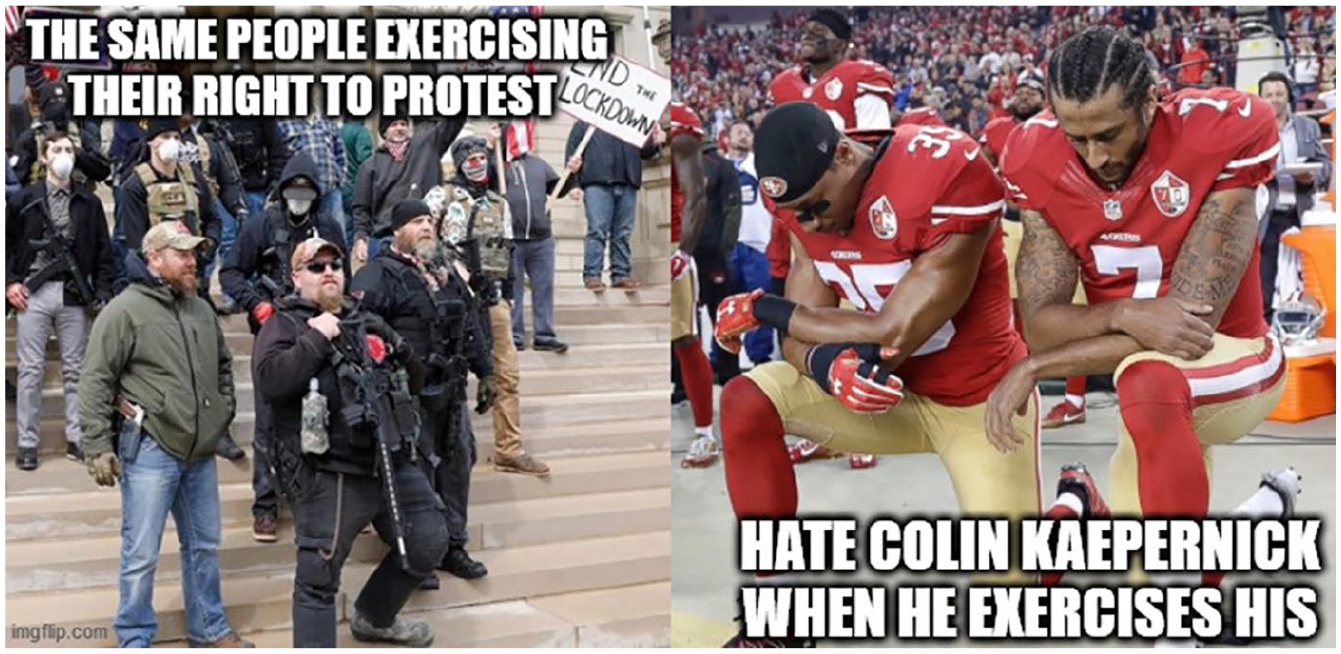
A meme comparing anti-lockdown protestors to Kaepernick.
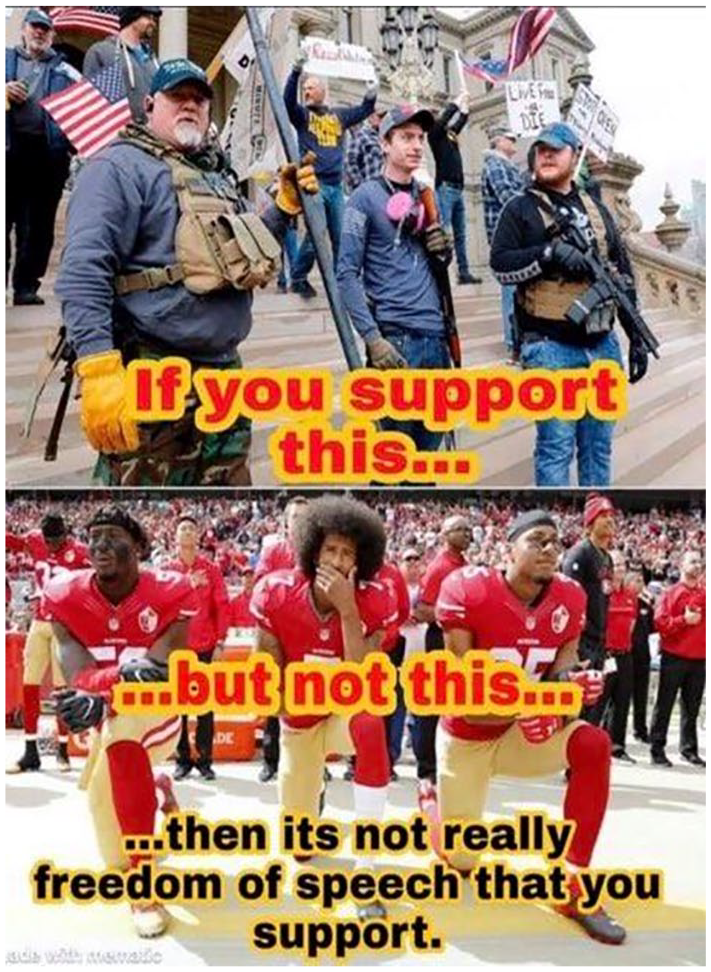
A meme comparing anti-lockdown protestors to Kaepernick II.
Since 2016, Kaepernick has been a focal point for memetic constructions of racialized, sexualized, and gendered meanings of America. Our analysis of anti-Kaepernick memes illustrates how America is articulated as a White patriarchal heterosexual nation, while the memes contrasting COVID-19 protestors with him enable a form of U.S. patriotism and protest to resist the aforementioned vision of the United States. As such, Kaepernick’s seemingly ever-presence in internet culture exemplifies how debates of race, gender, and the nation are rearticulated into digital racial formations via memes (Nakamura, 2008). As seen in Figures 19 and 20, a protest during the height of a pandemic, backed by right-wing organizations and performed by predominantly White Americans, is visually reconfigured to call attention to how race and gender impact who is allowed to exercise their rights to protest and have their injustices heard.
Memes borrow, build off of, and/or remix narratives, symbols, and depictions in shareable visual depictions (Dickerson, 2016; Milo, 2016; Nuzzi, 2017). Similar to how sport itself is often a medium “used to provide the short-circuit signs” to reproduce cultural meanings (St Louis, 2003, p. 76), memes turn complex cultural, historical, and social processes into simplistic and easy-to-digest visual morsels. The reemergence of Kaepernick memes signals the importance of studying memes particularly as both memes and sport media have become cultural battlegrounds for president Donald Trump and the loosely affiliated alt-right (Falcous et al., 2019; Kusz, 2019). As memes become a more prevalent and salient part of sport media participatory culture and the public acknowledgment of the interrelationships of sports and politics heightens, our analysis can be a guide for future critical sport scholars to take memes seriously as the potent aspect of political and public discourse that they are.
Footnotes
Declaration of Conflicting Interests
The author(s) declared no potential conflicts of interest with respect to the research, authorship, and/or publication of this article.
Funding
The author(s) received no financial support for the research, authorship, and/or publication of this article.
