




Abstract
At a cost of often more than US$10 billion, mega-events such as the Olympic Games and the FIFA Men’s World Cup are the single most transformative urban project in many host cities for decades. This article develops an analytical matrix for comparing the impacts of these events on cities and proposes a case survey method to apply this matrix to six recent sports mega-events: the Olympic Games in Vancouver, London, Sochi, and Rio de Janeiro and the FIFA Men’s World Cups in South Africa and Brazil. We find that for the events in our sample, it is not so much the event itself, but the political and economic contexts that most influence impacts. Cities in democracies with more market-led economies experienced fewer adverse impacts and were better able to use the event for urban development than those in less democratic countries with more state-led economies. None of the cities, however, was able to avoid negative impacts.
Introduction
Over the past decades, mega-events such as the Olympic Games and the FIFA Men’s World Cup (hereafter, FIFA World Cup) have become an important force in global urban development. 1 These “ambulatory occasions of a fixed duration that attract a large number of visitors, have large mediated reach, come with large costs and have large impacts on the built environment and the population” (Müller, 2015b, p. 629) have reshaped cities from Rio to Rostov and from Sydney to Sochi. Mega-events do not just trigger the construction of new sports venues and transport lines, but they reconfigure urban governance arrangements and strategic development plans, impacting cities (and citizens) at large. For many cities, hosting a mega-event is now the single largest undertaking in urban development. The capital cost of material interventions in the city—upgrading or building new sports venues, roads, railway lines, airports, conference centers, security systems, and hotels—often runs to more than US$10 billion and is several times the operational cost of putting on the event itself (Flyvbjerg & Stewart, 2012; Gold & Gold, 2016).
Whereas cities in North America, Western Europe, and Japan were the traditional hosts of mega-events until the early 2000s, emerging economies such as Russia, China, Brazil, and South Africa have not just joined their ranks but have become the dominant players: In the 10 years from 2013 to 2022, Japan is the only host of the Olympics or the FIFA World Cup that is not an emerging economy. The period between 1992 and 2022 has seen or will see the Olympic Games or FIFA World Cup in Australasia (Olympic Games Sydney 2000), Africa (FIFA World Cup South Africa 2010), Eastern Europe (Russia 2018) and the Middle East (FIFA World Cup Qatar 2022), and the first Olympic Games in South America (Rio de Janeiro 2016). In this sense, mega-events have gone truly global. They transform cities around the globe, leaving spatial and architectural markers that were previously limited to the Global North.
This article takes the globalization of mega-events as a starting point to examine the significance of these events in shaping urban development by analyzing their impacts in a sample of cities around the world. It is particularly interested in the commonalities and differences of impacts. In other words, which impacts occur globally and which are specific to certain cities or countries? For this purpose, it works with six cases of mega-events that exhibit significant variation of the political, economic, and urban contexts in which they occurred: the Olympic Games in Vancouver (2010), London (2012), Sochi (2014), and Rio de Janeiro (2016) and the FIFA World Cups in South Africa (2010) and Brazil (2014).
In working toward such systematization of urban impacts, the article advances the existing literature in three central ways. First, it identifies patterns across mega-events in a comparative study where the dominant scholarship has been single case studies, with only few studies of multiple mega-event host cities (Gold & Gold, 2016; Roche, 2006). Second, addressing the difficulties of developing workable comparative methodologies in the face of often poor or inconsistent data availability, it proposes an approach that is based on the systematic analysis of secondary literature through a case survey method, discussing its strengths and weaknesses. Third and last, it expands on the comparative urban dimension of the critical sociological analysis of mega-events that has been burgeoning in recent years (Gruneau & Horne, 2016; Roche, 2017; Rojek, 2013; Spracklen & Lamond, 2016).
Mega-Events and Cities: A Need for Comparative Studies
Although the first studies of the urban dimension of mega-events date to the early 1990s (e.g., Hiller, 1990), it has only been since the late 1990s that studies of the urban impacts of mega-events have become more common. The vast majority of this research has focused on the Olympic Games, where particularly the Summer Games represent the single most transformative and most complex intervention in one city (Essex & Chalkley, 1998; Gold & Gold, 2016; Kassens-Noor, 2012; Poynter, Viehoff, & Li, 2015; Viehoff & Poynter, 2016). Most studies of the urban dimension of mega-events have focused on single cases, often investigating one particular aspect of urban transformation. As important as individual case studies are for building empirical evidence, they are limited when it comes to capturing the global nature of the urban impacts of mega-events and the potential variation of impact patterns across countries and cities in a systematic fashion.
Research comparing the urban dimension of several mega-events, however, is scarce. Long (2015) diagnoses that the extant literature often provides “little analysis beyond description” and Roche (2006) urges scholars to take on more comparative analytical research of mega-event impacts. The few studies that consider multiple events proceed chronologically, event by event (Chalkley & Essex, 1999; Essex & Chalkley, 1998; Gold & Gold, 2016; Liao & Pitts, 2006). They commonly provide a short assessment of the major changes induced by each edition of the event, mostly the Summer Games, foregrounding the event itself but not so much the patterns across them. Where explicit comparative work is undertaken, it often has a regional focus (Burbank, Andranovich, & Heying, 2001, on the United States; Maharaj, 2015, on the Global South) or deals with one particular sector, such as transport (Kassens-Noor, 2012).
Further developing comparative research is not only warranted because it builds a more systematic picture of the urban impacts of mega-events around the world. It also is better able to do justice to the ways in which the territorial outcomes of mega-events in particular cities are bound into global flows of policies, knowledge, models, and people who articulate themselves in best practices, benchmarks, or the hiring of managers and consultants with previous experience in the planning of mega-events (Allen & Cochrane, 2014; Cook & Ward, 2011; Lauermann, 2014). The much-hyped “Barcelona model” is probably the best-known example of how planning knowledge from one mega-event host city has been packaged and exported to other locations and Olympic hosts such as Rio de Janeiro (González, 2011). Sports mega-events are therefore highly relational interventions into cities that always reference places elsewhere, suggesting comparative research as a useful strategy. We acknowledge that comparative research across very different geographic, economic, and cultural contexts is fraught with complexities, lacunae, and contradictions. It is also true that the outcomes of these events unfold in uneven spatiotemporal rhythms and that the epistemological condition of a mega-event reduces the relevance of summative evaluations. Nonetheless, we offer this study as an important step toward developing a comparative analytical framework of iterative mega-events that will continue to impact cities across the globe.
Comparative Research Design: Case Selection and Analytical Matrix
To establish whether there are impacts in host cities that occur across the globe and are not just specific to one city or to one type of mega-event, we propose an ordinal cross-case comparison (Mahoney, 2000) using the case survey method (Yin & Heald, 1975) with a “most different cities” research design (Robinson, 2011, p. 9). This allows us to see which impacts remained constant across very diverse cities, which changed and what may be the potential factors driving the impacts.
For the purpose of selecting most different cases, we introduced two sources of variation into our case selection. The first source of variation was the type of mega-event, where we analyzed both the Olympic Games and the FIFA World Cup. The urban impact of the Olympic Games is typically more profound than that of the FIFA World Cup, because they are concentrated in one city and occur over a shorter time period. As a result, they have much higher infrastructure requirements and capital costs, while they are less well able to spread loads over time. Because the Olympic Games have many competitions, they also have to accommodate, transport, and keep secure a much larger number of athletes, officials, and spectators—all in one city.
The second source of variation was the country and city in which mega-events occur. We selected six cases, a reasonable number for case-oriented cross-case comparison (Khan & VanWynsberghe, 2008). Four cases from the Olympic Games and two from the FIFA World Cup: the Olympic Games in Vancouver (2010), London (2012), Sochi (2014), and Rio de Janeiro (2016) and the FIFA World Cups in South Africa (2010) and Brazil (2014). The cases are all drawn from the same time period (2010-2016) to minimize time-related influences (e.g., growing size of mega-events, changing macroeconomic situation). They cover a range of political and economic contexts as well as urban development models (see also Table 2). Canada and the United Kingdom are democracies with market-led economies and a strong presence of neoliberal policies in urban development (Jessop, 2002). Brazil and South Africa are flawed democracies (a term used by the Democracy Index of the Economist Intelligence Unit, 2015) with mixed economies and an increasing degree of neoliberalization in urban development, while still retaining a strong interventionist role of the state (Gaffney, 2010; Steinbrink, Haferburg, & Ley, 2011). Russia is an authoritarian regime with a mostly state-led economy and strong central-state intervention in urban development (Golubchikov, Badyina, & Makhrova, 2014). We chose to examine both the FIFA World Cup in Brazil and the Rio 2016 Olympic Games to see whether hosting two different mega-events in the same country leads to significantly different impacts.
For our analytical matrix (Table 1), we defined 10 types of urban impacts, each of which is justified in the following sections:
Entrepreneurial urbanism
Public risk-taking
Legal exception
Displacement
Public participation
Symbolic politics
Material transformation
Event as catalyst
Redevelopment
Underutilized infrastructure
With these 10 categories, the article covers both mega-events’ impacts on urban politics, that is, how these events intervene in processes of planning, decision making, and contestation in a city, and on the built environment, that is, how these events change material structures.
Comparing the Urban Impacts of Mega-Events: An Analytical Matrix.
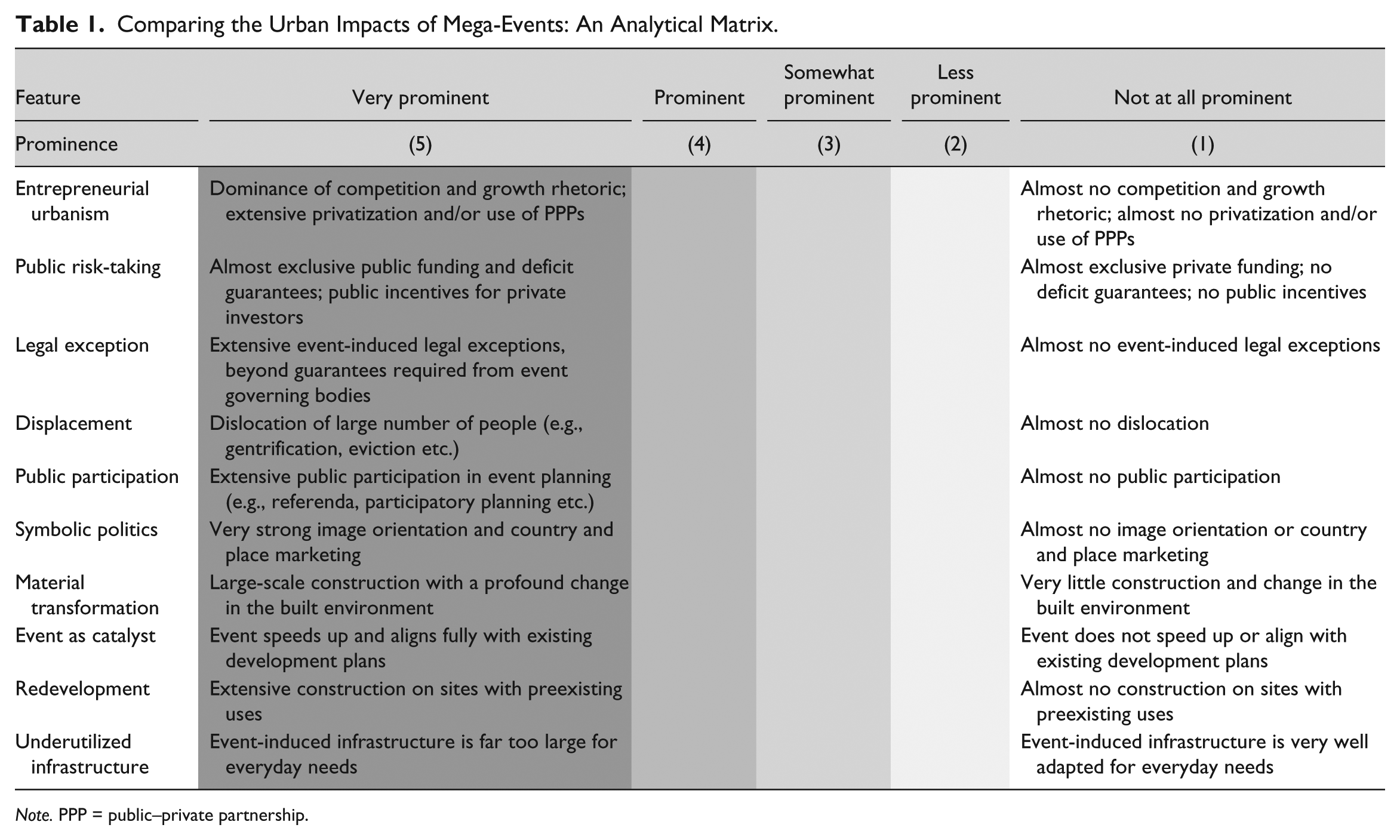
Note. PPP = public–private partnership.
For populating the matrix for each of the six cases, we drew on the case survey method, originally developed by Yin and Heald (1975) for a similar research problem: to understand the impacts of urban decentralization. The case survey method is a systematic, reliable method for aggregating large amounts of qualitative data emerging from case studies on the same topic. It is part of a suite of methods that draw on existing studies to identify patterns and relationships that do not emerge by analyzing cases individually and is thus a form of meta-analysis (Dixon-Woods, Agarwal, Jones, Young, & Sutton, 2005; Larsson, 1993). Its advantage lies in the synthesis of a large number of high-quality, in-depth studies that enables some degree of generalization and in its reliability and thus replicability. Its limitations are the reliance on preexisting studies, which determine what data on what aspects are available, and the reduction of the richness of data to few selected aspects of interest to a particular research question (Larsson, 1993).
The case survey method codes existing case studies according to a number of predefined outcomes (Yin & Heald, 1975), in our case, the 10 types of urban impacts. In so doing, it translates qualitative data into quantitative data. For our study, the prominence of each impact for each case was coded on a 5-point scale, as shown in Table 1. Following Yin and Heald (1975), each author coded the impacts independently and a third coder was asked to do the same to enhance reliability. The three coders, each of which had broad familiarity with the case studies through previous field research, examined the results of each of the coded impacts and in cases where their coding diverged, discussed the pertinent literature to arrive at a consensus score. This methodology may introduce different results for different coders; however, by focusing on the literatures associated with each code, we were able to maximize replicability and reduce divergence.
The principal source used for the coding was the published academic literature, which is common for the case survey method (Larsson, 1993). This was complemented with official reports and releases and news coverage where those provided additional information. All coders had access to the same literature base; sources are documented in the following sections.
Once the matrix was populated, we drew on John Stuart Mill’s (1843) “method of concomitant variation,” which is typically used for ordinal cross-case analysis (Mahoney, 2000), to understand which factors are associated with certain outcomes. For our setup, the method of concomitant variation allowed us to establish whether it is the type of event or rather the political-economic context that drive impacts. If we find that the prominence of impacts varies in tandem with political-economic contexts, we can infer that these contexts are associated with impacts. The same applies, mutatis mutandis, to the type of event.
Impacts
Entrepreneurial Urbanism
Mega-events are frequently seen as a means of gaining a competitive edge in interurban competition for scarce funding, investment, and attention (Burbank et al., 2001). As such, they can accelerate policies of privatization, return-on-investment thinking, and the retrenchment of the welfare state in promoting urban entrepreneurialism (Lauermann & Davidson, 2013).
Among our case studies, the entrepreneurial rationale was nowhere as pronounced as in Rio de Janeiro, where a succession of events (2007 Pan American Games, 2014 FIFA World Cup, 2016 Olympic Games) led to the privatization of sports and transport infrastructure, with concomitant price hikes for users. It also accelerated the opening up of favelas to upgrading and private investment in a process of accumulation by dispossession (Freeman, 2012).
In Vancouver, London, and South Africa, mega-events also perpetuated and facilitated entrepreneurial regimes if not quite in the same radical way as in Brazil. In Vancouver and London, public–private partnerships (PPPs) were a popular delivery model through which governments funneled public money to private corporations and encouraged state-led privatization (Raco, 2014; Siemiatycki, 2006). Programs of social inclusion to be realized through the mega-events aimed at the formation of entrepreneurial individuals, thus diffusing neoliberal policies (VanWynsberghe, Surborg, & Wyly, 2013). In South Africa, the FIFA World Cup tied into rhetoric of redistribution through economic growth and world city aspirations. It hurried privatization and commercialization in South African host cities, draining resources from programs that were meant to redress the legacies of apartheid (Cottle, 2011; Steinbrink et al., 2011).
Sochi, however, is an outlier. Neither was entrepreneurial rhetoric very prominent in the preparation for the mega-event (a great power narrative dominated) nor did privatization or the private sector play an important role (Müller, 2011). The Russian federal state directed the planning, procured the funding, and delivered most of the infrastructure, reflecting the strong centralization of command and control in Russia (Müller, 2014).
Public Risk-Taking
Mega-events are inherently risky undertakings. The most salient risks for event organizers include disruptions to the events, for example, through terrorism, social unrest, or organizational and technological failures; image risk, for example, through exposure of democratic deficits or incompetent management to international audiences; and financial risk as a consequence of building the infrastructure and hosting the event (Jennings, 2012). This section examines financial risk and the degree to which the public underwrites it.
Despite the predominance of neoliberal policies and entrepreneurial rhetoric in most cases in the sample, the public bore the largest part of the financial risk, either by paying for the costs outright or by underwriting the risks for projects. In each case, too, there occurred a significant cost overrun, underscoring the salience of financial risk associated with mega-events. Perhaps the most egregious case was the FIFA World Cup in South Africa, where stadiums cost 10 times more than estimated (Taal, 2011, p. 87), but the Olympic Games in Vancouver and London (Flyvbjerg & Stewart, 2012), Sochi (Müller, 2014), and Rio as well as the 2014 FIFA World Cup (Gaffney, 2015) also suffered from cost overruns. Where private investment was responsible for delivering part of the requirements for a mega-event, public funding often had to step in to bail out bankrupt investors or remove the risk for private investors, for example, by committing to significant ex-ante investments in infrastructure (Scherer, 2011; Smith, 2014).
Legal Exception
To accomplish the myriad tasks associated with organizing a mega-event under time pressure, local, regional, and national governments often introduce event-related legislation. A number of scholars have pointed to these “laws of exception” as a defining characteristic of mega-events, facilitating expropriation, extraordinary security measures, and expedited planning approval processes (Coaffee, 2015; Sánchez & Broudehoux, 2013).
The events in Russia and Brazil were marked by this state of exception to the utmost degree. The hosts not only complied with the extensive IOC and FIFA requirements that mandate special legislation in the areas of brand protection, marketing rights, security, labor, indemnity, and taxation, among others; they also went far beyond those requirements. Russia, for example, seized the opportunity to pass an Olympic bill that allowed construction of recreational infrastructure in protected areas and facilitated expropriation for Olympic construction (Müller, 2015a). Brazil’s Lei Geral da Copa for the 2014 FIFA World Cup created specific conditions for cities to debt-finance infrastructure projects while also allowing for generous corporate tax-breaks (de Oliveira, 2015).
South Africa and London, too, made extensive revisions to legal provisions if not quite as far-reaching as those in Russia and Brazil. With its Special Measures Act, South Africa suspended some constitutional rights, such as freedom of speech, during the event. Also, at the request of FIFA, it introduced a special court system, the World Cup courts, which engaged in expedited trials of World Cup–related crimes outside the regular judicial system (Tang, 2013). For the Olympic Games in London, authorities endowed the Olympic Delivery Agency with special authority, combining “the functions of a local council, planning authority, transport executive, trading standards office and police service” (James & Osborn, 2011, p. 416), thus razing the division of powers.
Although Vancouver experienced many dynamics similar to those in London, the Olympic Games there exhibited one key difference: Legal exceptions were challenged and modified. This happened with the omnibus Olympics bylaw that the city passed in 2009, which was to curtail freedom of expression and grant unprecedented powers to police and security officers. An nongovernmental organization (NGO) contested this bylaw, achieving that lawmakers removed much of the infringement of civil rights that the earlier version contained and made almost all measures temporary (Jones, 2010).
Public Participation
Public participation in urban planning and development is now de rigueur in many countries and sometimes even legally enshrined in the planning process. It is even more important for projects at the scale of mega-events, which often affect the entire city. However, in just one of our cases, Vancouver, was there a plebiscite on whether or not to host the mega-event. In 2003, Vancouverites voted 64% in favor of hosting the 2010 Winter Games (VanWynsberghe et al., 2013). Vancouver also made legal provisions for Aboriginal participation in Games planning and staging (Silver, Meletis, & Vadi, 2012) and held public hearings for the planning of some venues. Although not organizing a referendum, London launched a concerted participatory planning effort in which the Boroughs engaged in extensive public consultation such as discussing urban regeneration plans (Newman, 2007, p. 257).
In the other four cases, formal public participation was extremely limited or altogether absent. In South Africa, the FIFA World Cup disenfranchised citizens from participation at the local level, which had been introduced in previous planning reforms, and shifted decision-making power to higher levels of government (Haferburg, 2011). A similar dynamic was evident in Sochi, where the central government administered Olympic planning in a hierarchical fashion, sidestepping the local level (Müller, 2011). In Brazil, the only participatory form for Rio 2016 was established 5 years after the Games were awarded, and even then, it was limited to the agenda set by the organizing committee. No meaningful dialogue with event organizers and civil society occurred in the lead-up to the 2014 World Cup (Gaffney, 2015). And while it is true that participation does not require an invitation or a ticket to an event, the prevalence of protest movements and the salience of counter hegemonic narratives in the years leading up to the events are not sufficiently frequent or intense phenomenon across the selected events to make for relevant comparison. Indeed, protests can be considered a form of forcing participation; yet, the public protests related to the South African, Brazilian, and Russian World Cups do not have explicit connections to the urban phenomena being considered here.
Displacement
Since at least 1988, large-scale displacement of residents has been a persistent feature of the mega-events (Davis, 2011; Gaffney, 2015; Maharaj, 2015; Shin & Li, 2013). In addition to forced residential displacement, for example, through expropriation or forced removals, issues of population redistribution through market-mechanisms are often effects of hosting mega-events. The multiple processes of gentrification that occur in Olympic host cities can be state-led either through deliberate policies that stimulate flows of capital into targeted metropolitan zones, or through the absence of public policies that guarantee the right to affordable housing (Hiller, 2006, p. 321).
Displacement was most pronounced for the two mega-events in Brazil, where both gentrification and forceful relocation were rampant. In Rio de Janeiro, one study claims that as many as 22,059 families (approximately 77,000 people) have been removed in the city of Rio de Janeiro during the period 2009-2015 (Comitê Popular, 2015). In South Africa, the World Cup led to the demolition of informal settlements in several of the host cities and extensive upgrading processes as a result of beautification initiatives for the event (Maharaj, 2011; Newton, 2009; Steinbrink et al., 2011).
Displacement in London and Sochi was also prominent, if not quite on the same scale. In Sochi, organizers of the Winter Games in Sochi resettled about 800 people for the construction of the coastal cluster of venues, causing extensive disputes about adequate compensation (Wurster, 2015). In London, several hundred households suffered forced removals as part of Olympics-induced regeneration activities (Watt, 2013). Several hundred small businesses, too, were removed from the site of the Olympic Village (Raco & Tunney, 2010). Both Vancouver and London did not meet affordable housing and housing protection targets for Olympic developments, adding to indirect pressures on housing, such as rising rents as part of redevelopment (Pentifallo & VanWynsberghe, 2015; Watt, 2013).
Symbolic Politics
Symbolic politics is one of the key motivations to bid for a mega-event. Mega-events present a chance “to signal important changes of direction, ‘reframe’ dominant narratives about the host, and/or reinforce key messages about what the host has become/is becoming” (Black, 2007, p. 262). Within this paradigm, events acquire central importance for place marketing and branding.
This importance of image and branding is perhaps most evident in the Olympic Games in Rio, for which organizers and city officials engaged in an elaborate effort of staging the city for global consumption. In addition to spending more than all of the other host city candidates combined, Brazilian efforts to woo the International Olympic Committee were part of a broader push for global recognition that included seeking a permanent seat on the UN security council. Then-president Lula da Silva declared that Brazil had been granted its “international citizenship” upon capturing the 2016 Olympic Games (Zirin, 2016).
The Russian and South African governments, too, placed strong emphasis on the events’ capacities to enhance the international standing and reputation, not just of individual cities, but of the country as a whole as modern, technologically advanced and open for business. In South Africa, futuristic arenas were meant to “show off our technical capabilities and project management skills and capture the world’s imagination . . . to build Brand South Africa” (quoted in Alegi, 2008, p. 400). Organizers of the Olympic Games in Sochi adopted the URL “sochi2014.ru” as a logo and the slogan “Sochi 2014—Gateway to the Future,” both designed to underscore Russia’s status as a technologically advanced nation (Müller, 2011).
The Winter Games 2010, too, were meant to carry a strong symbolic message to a global audience, but, in contrast to the events in Russia and South Africa, this message was more about the city of Vancouver than about Canada as a country. Visual representations were carefully crafted to embody “pristine urban nature, multicultural social harmony, and vibrant local cultures of sport” (McCallum, Spencer, & Wyly, 2005, p. 24) and appeal to the desires of leisure and business tourists as much as to potential lifestyle migrants. Among all cases, the idea of promoting the city on the global stage was least prominent in London. This may have been because of London’s already preeminent status as a global tourist destination and business center, where, as Shoval (2002, p. 594) claims, any further image gains were going to be less significant from the start.
Material Transformation
The ever-growing size of mega-events has turned them into mega-construction projects in their own right. The capital budgets for infrastructure improvement—anything from new stadia to fiber optic cables and power stations—may range in the tens of billions of U.S. dollars (Flyvbjerg & Stewart, 2012) and create entire new neighborhoods or even cities.
Sochi experienced the most incisive transformation of the cities in our sample. Not only were all sports facilities built from scratch, but the Russian government also poured several dozens of billions of dollars into road, rail, and energy infrastructure. A whole new town grew around the winter sports resort in the mountains (Müller, 2014).
The preparation for the 2016 Rio Olympics also spawned a deep transformation of the city’s built environment that reached well beyond the sports infrastructure. It led to the construction of four new bus rapid transit lines, the building of two new Olympic parks, a metro line extension, the extensive construction of offices and upmarket apartments, and the bulldozing of several favelas to build Olympic infrastructure (Alves dos Santos Junior, Gaffney, & de Queiroz Ribeiro, 2015).
In Vancouver and London, material transformations were somewhat prominent, though more localized than in Sochi and Rio, where they encompassed the entire city. The most salient aspect in London was the creation of the Olympic park in Stratford and its function as a nucleus for property development (Poynter et al., 2015). Although the impact on the built environment was concentrated in one area of the city in London, in Vancouver, material interventions were more dispersed, but smaller in scale. They included the construction of the Olympic village in the center of the city, a rail connection to the airport, and a few new venues throughout the city and the mountain location in Whistler (VanWynsberghe, 2014).
Since the World Cup events are distributed over several cities, the interventions in the built environment of host cities generally were smaller than for the Olympic Games. As a consequence, World Cup–related interventions in South Africa and Brazil did not approach the scale of the Olympic Games.
Event as Catalyst
For cities, one of the key attractions of hosting mega-events is the promise of a catalytic effect on urban development. Preuss (2004), for example, claims that an Olympic Games “accelerates [a city’s] infrastructural development by up to 10 years” (p. 234). Some authors have found, however, that mega-events act not so much as a catalyst of existing plans but rather direct policy makers’ attention to new plans (Kassens-Noor, 2012).
There is mixed evidence regarding the catalytic role of the Olympic Games in Vancouver, London, and Sochi. In each case, the event did accelerate and help make more concrete some existing plans for urban development and, crucially, managed to attract extra resources from federal and/or provincial governments that would not have been available otherwise. The rationale and success in harnessing the Olympic Games as a catalyst was perhaps most explicit in London. The 2012 Olympic Games tied into an existing urban redevelopment program in East London and enlisted the financial support of the national government for an accelerated redevelopment of the Lower Lea Valley (Poynter, 2009). In Vancouver, the event sped up the rail connection between the airport and the city center, the improvement of an important highway between Vancouver and the mountains and the extension of the convention center (VanWynsberghe, 2014), all of which had been on the books before the event (Chan, 2013). Interventions, however, were more piecemeal and lacked the overall alignment with a master plan as in London. Sochi, too, made use of the Olympic Games to ensure the delivery of a comprehensive federal target program for infrastructural upgrades in the area that the government had put in place before the bid (Müller, 2014). In each of these three cases, however, the events also added new items to the urban development bill, most notably sports facilities, thus working not just as a catalyst but also diverting funding into new projects.
For Rio, on the contrary, the Olympic Games introduced fundamental changes into urban development plans and redirected large-scale investment flows. In particular, the development of the city’s metro line was altered to meet event-specific agendas at tremendous cost. The association of the Porto Maravilha PPP with the Olympic Games was another fundamental shift in urban planning. Indeed, the changes to Rio’s existing urban plans were such that the mayor pushed through a new master plan in 2011 to better align mega-event planning with official public policy (Alves dos Santos Junior et al., 2015).
In the case of the two World Cups, initial hopes ran high to harness them as catalysts for development. Both for South Africa and for Brazil, however, these hopes were disappointed, as investments concentrated on the stadia and the airports, failing to make noticeable contributions to urban development at large. “Brazil has lost a great opportunity with the World Cup,” Rio’s mayor Eduardo Paes said, “FIFA asked for stadiums and Brazil has only delivered stadiums” (quoted in BBC, 2013). Brazilian authorities did not deliver close to 80% of the planned public transport projects (Amora, 2015).
The World Cup in South Africa failed to make good on promises to include and deliver growth to poor people. The event instead diverted almost half of the budget into stadium construction, and the distribution of resources was heavily skewed in favor of the wealthy, as in the case of the relocation of the stadium in Cape Town to the affluent neighborhood of Green Point (Maharaj, 2011).
Redevelopment
The redevelopment of brownfield or disadvantaged urban areas figures as a key rationale in bidding for mega-events. The IOC even explicitly encourages the use of the Olympic Games for redevelopment: “As well as regenerating existing urban areas, the Games can provide the catalyst for the construction of new urban areas on industrial wasteland, disused docks or derelict railway yards” (IOC, 2012, p. 40). Linking urban redevelopment to hosting events has become so common as an urban strategy that scholars increasingly consider event-led regeneration a category in its own right (Smith, 2012).
Our cases vary considerably in the degree to which urban redevelopment was an aim of hosting the event. On one side, there are London and Rio de Janeiro, where redevelopment plans were a central motivation to host the event. London claimed that only the Olympics had the capacity to “transform one of the most underdeveloped areas of the country for generations to come” (London Bidding Committee, 2004, p. 3), portraying the Lower Lea Valley as a marginal, underused area ripe for redevelopment (Raco & Tunney, 2010). Rio de Janeiro engaged in a large-scale pacification and resettlement campaign of favelas, informal settlements, to prepare for hosting the World Cup and the Olympic Games (Freeman, 2012; Gaffney, 2016). It also started the largest redevelopment project in the history of the city in the historic port area (Sánchez & Broudehoux, 2013).
On the other side, there are the Olympics in Sochi and the World Cup in South Africa, where the principal rationale was to create new structures, often on greenfield land, rather than to repurpose brownfield areas or upgrade disadvantaged neighborhoods (Maharaj, 2011; Müller, 2014). The extensive construction of new sports venues, buildings, and public transport links dominated the budgets in these two cases.
The remaining two cases—Vancouver and the World Cup in Brazil—fall somewhere in the middle of the spectrum. Each had both a significant redevelopment and a significant new-build component. Vancouver used the Olympic Village to redevelop industrial waterfront wasteland, but also added new infrastructure, such as the railway link to the airport (VanWynsberghe, 2014). The World Cup in Brazil, finally, allowed for the expansion of real-estate vectors in São Paulo, Recife, and Natal through infrastructure development and new-stadium construction (Gaffney, 2015).
Underutilized Infrastructure
The concentrated demand of hundreds of thousands of visitors during an event puts considerable pressure on infrastructure in cities. This is why host cities usually need to sign hosting agreements with the IOC or FIFA in which they commit to providing certain capacities, for example, a set number of hotel rooms in certain categories or a minimum airport passenger throughput. Frequently, however, this infrastructure turns out to be too large or obsolete for postevent use, turning into so-called “white elephants” (Alm, Solberg, Storm, & Jakobsen, 2014).
Vancouver and London had the lowest shares of underutilized infrastructure in our sample. Nonsports infrastructure, such as housing and transport, generally met with public demand. Most new sports venues in the two cities are sought after, but remain subsidized, partly very heavily, such as the Olympic Stadium in London (Clark, 2014).
Sochi represents almost the radical opposite. Its most expensive project—a combined road-rail link from the sea to the mountains for more than US$10 billion—sees hardly any use of the railway line, with just six trains per day in each direction. Hotel capacities are underutilized most of the year, which forced some new hotels to stop operating altogether barely 1 year after the event (Müller, 2014).
Although it may be too early to judge for Rio de Janeiro, the large-scale federal subsidies for four and five star hotel accommodation may not be met by effective consumer demand. The development of centers of athletic excellence for a number of sports that are not widely practiced in Brazil (track cycling, canoeing, tennis) may result in a series of smaller white elephants.
The picture is also rather bleak for the two World Cups. The main infrastructural projects in South African and Brazilian host cities included new or upgraded stadiums and some improvements in transport infrastructure. The capacities for most stadiums far exceed the number of spectators. The majority of World Cup stadiums in South Africa cannot cover their operating costs, with some even lacking permanent tenants (York, 2014). In Brazil, too, stadiums are either used far below capacity or do not have anchor tenants, such as in Brasilia, Cuiabá, Manaus, and Natal (Garcia-Navarro, 2015).
Comparative Discussion
Compiling our findings in Table 2 allows us to draw a number of conclusions. First and most important, the prominence of impacts varied considerably between the six cases. The prominence of entrepreneurial urbanism, public participation, and underutilized infrastructure was particularly variable, whereas only public risk-taking was very prominent across the board. These results caution against a priori equating the hosting of mega-events with certain impacts, whether it is urban entrepreneurialism, undemocratic planning, or the construction of white elephants. Subsuming all mega-event planning under, say, neoliberal governance would ignore the rather different planning models of nonmarket economies such as Russia, but it would also skirt over the substantial variation within market economies (e.g., Raco, 2014).
Prominence of Urban Impacts of Mega-Events Across Six Case Studies.
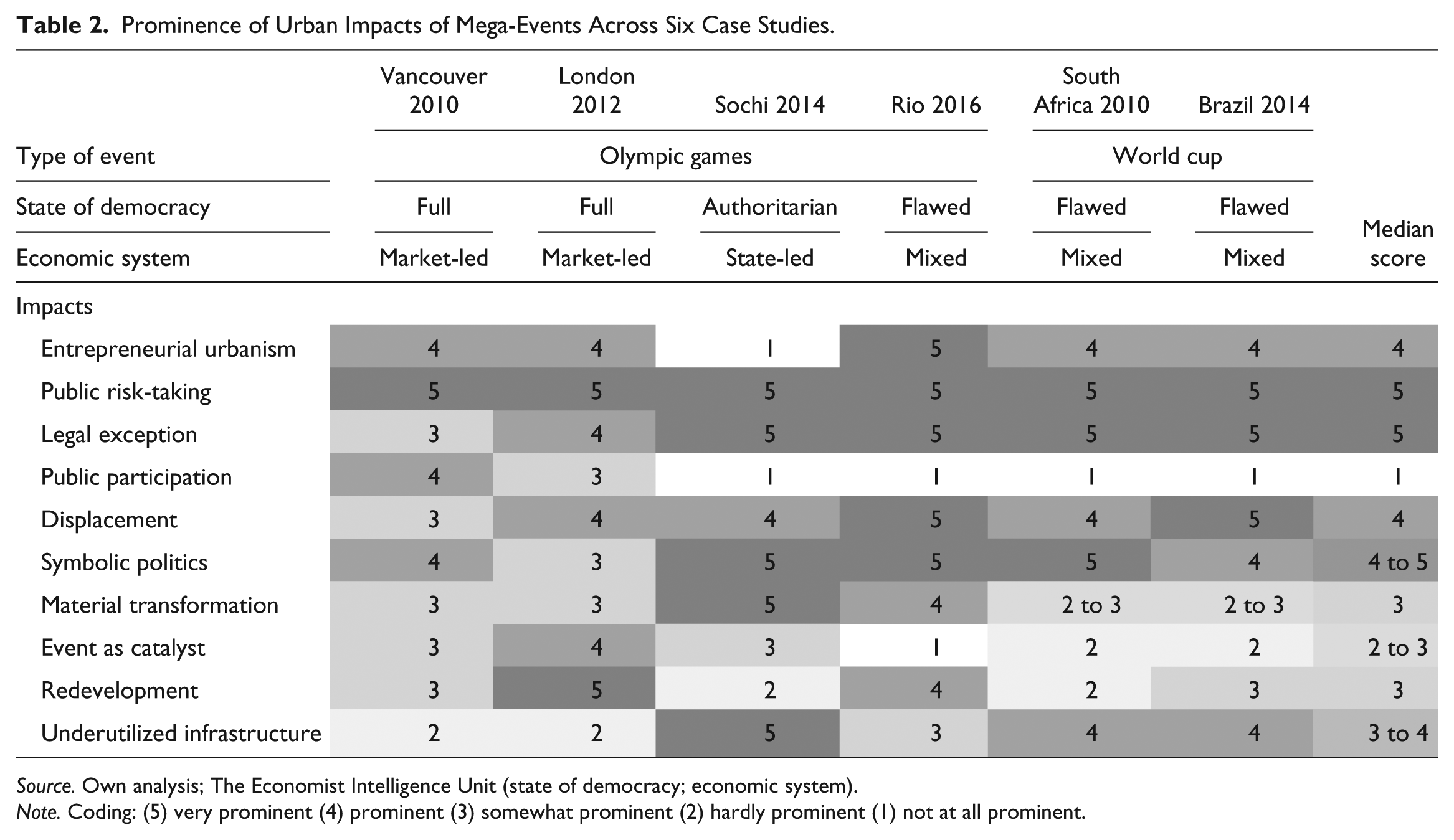
Source. Own analysis; The Economist Intelligence Unit (state of democracy; economic system).
Note. Coding: (5) very prominent (4) prominent (3) somewhat prominent (2) hardly prominent (1) not at all prominent.
Second, impacts did not depend much on the type of event, that is, on whether a city hosted the Olympic Games or the World Cup. If the type of event were mostly responsible for the impacts of mega-events, we would see much less variation among cases of the same type. This is surprising insofar as the two types of event place rather different demands on hosts. Although there is growing evidence to suggest that institutional governance frameworks, (re)articulations of the state, and global flows impact development outcomes, with sports mega-events, the impacts are invariably mega.
Third, the variance in the scores suggests that the drivers behind impacts were not so much the IOC and FIFA, but that much depends on the political and economic context of the host. If the event governing bodies such as the IOC and FIFA were mostly responsible for the impacts, we would see much less variation between cases. One reason for this is that much of the planning and development for urban interventions is undertaken by local organizing committees which liaise with FIFA, the IOC, and International Federations regarding the requirements for sport, media, and hospitality venues—but not for the broad range of urban interventions pursued by cities as part of hosting. Managers at FIFA and the IOC frequently express dismay at their lack of ability to limit expenditures in the local context and their ability to intervene can be restricted by political, cultural, and organizational contingencies. It is only where we see little variation, such as in the degree of public risk-taking, that we can assume that event governing bodies are the primary forces behind an impact, in this case by requiring government guarantees from hosts.
Fourth, mega-events in less democratic hosts with a stronger role of the state in the economy (Russia, Brazil, South Africa) experienced more negative impacts. Although not historically consistent (i.e., Montreal 1976), host cities with market-led democracies (Canada, UK) in our sample, on the contrary, were less likely to experience a strong rule of exception and extensive displacement of people, were better able to use the event as a catalyst and to ensure adequate postevent utilization of the infrastructure. These hosts are more likely to have a system of checks and balances in place that establishes public accountability of mega-event organizers and moderates the negative fallout from events, which could be one potential explanation for this observation. In the Russian and Brazilian examples, the events were used as opportunities for the redistribution of public resources maintain a political economy of construction-associated graft and patronage. The significance of state paternalism in a political and administrative context greatly increased the negative impacts of the events whereas in cities and countries with more robust systems of checks and balances, these consequences were not as salient.
Conclusion
The FIFA World Cup and Olympic Games may be phenomena with global reach, but our study suggests that their impacts on cities are diverse, moderated primarily by cities’ political and economic contexts. This finding is important insofar as the formal requirements of hosting mega-events and many of the actors organizing the event remain the same from event to event, which would suggest more uniform impacts. In the debate whether mega-events are agents of homogenization, propagating similar policy models and white elephants across the globe (Boykoff, 2014; Hall, 2006; Lauermann & Davidson, 2013), or whether they are appropriated very differently in different contexts (Kassens-Noor, 2012; Müller & Pickles, 2015; Tomlinson, 2010), this research gives support to the latter proposition. As a consequence of this diversity of impacts, scholars, event organizers, and the public alike need to be careful not to generalize from the impacts of one event to others.
The greatest differences between the cases in our sample occurred between events hosted in less democratic, more state-led economies and those in more democratic, more market-led economies. More democratic, market-led hosts were better able to mitigate negative impacts from mega-events such as displacement, a suspension of the rule of law or underutilized infrastructure after the event, and to better harness potentially useful effects, for example, turning the event into a catalyst for urban development. Less democratic, more state-led economies, on the contrary, experienced considerably more negative effects. Overall, however, each host experienced at least some significant negative impacts, such as public risk-taking or legal exception.
The analytical matrix we propose in this article can be applied to compare the impacts of mega-events across different hosts and different types of events. Further research is required, however, to assess its suitability for a broader range of cases, refine it where necessary, and address its limitations. For example, our study has examined but a small number of very recent events and a limited sample of types of events on the basis of secondary material. Results might be different when we go back further in time, when we look at events that tend to be smaller, such as the Commonwealth, Pan American, or Asian Games, or when primary material is the basis of analysis.
Footnotes
Acknowledgements
We would like to thank audiences at the “Doing Global Urban Research” workshop at Loughborough in September 2015 and at the Urban Research Group at Universitat de Barcelona in May 2016 for their constructive criticism as well as Sven Daniel Wolfe for acting as the third coder.
Declaration of Conflicting Interests
The author(s) declared no potential conflicts of interest with respect to the research, authorship, and/or publication of this article.
Funding
The author(s) disclosed receipt of the following financial support for the research, authorship, and/or publication of this article: This work was supported by a Swiss National Science Professorship under Grant No. PP00P1_144699.
Notes
Author Biographies
