




Abstract
This article analyzes timing and imaging systems used as sports decision aids (SDAs). Evidence of athletic performance in the form of timing and imaging data is the product of distinct interactions between humans, technology, and the live environment. As such, sports decisions are fallible. Yet the measurement of athletic performance is often presented as irrefutable thanks to enhanced technological precision. As this article shows, there are limits to the accuracy of timing and imaging systems as they are deployed in the physical environment, but such limits are rarely acknowledged in the public and professional discourse surrounding elite-level sport. To address this issue, the article analyses three sporting decisions: the 100 m butterfly race between Michael Phelps and Milorad Cavic at the 2008 Beijing Olympics; the third-place tie between Jeneba Tarmoh and Alysson Felix at the 2012 U.S. Olympic Trials; and the gold medal tie between skiers Tina Maze and Dominique Gisin at the 2014 Olympic games. The article examines the professional and public discourse surrounding each event as well as the regulations governing timing and imaging data in each sport to stress the situatedness and fallibility of SDAs. The article identifies limits to the accuracy of timing and imaging systems as they are deployed in the physical environment and calls on sports regulating bodies to clearly articulate the capabilities and limitations of timing and imaging systems in the production of evidence.
At the time of this writing, the International Association of Athletics Federations (IAAF) World Championships are underway in Beijing, China. At that competition, on Sunday, August 23, 2015, the 20-year-old Canadian sprinter Andre De Grasse tied for third place and a bronze medal in the men’s 100 m. De Grasse tied with American Trayvon Bromell in 9.92 s. Usain Bolt won the race in 9.79 with Justin Gatlin in second with 9.80. Behind De Grasse and Bromell, American Mike Rodgers took fifth place with a time of 9.94 and three men—Tyson Gay, Asafa Powell, and Jimmy Vicaut—ran in 10 s exactly. There is a total difference of 31/100ths of a second between these eight finishers. As such, for most intents and purposes they are equally fast; however, in the world of elite-level sport, differences in hundredths of seconds routinely separate those who finish races from those who become world champions and national heroes.
Had De Grasse run 0.01 of a second slower, he would have been in fourth place, 0.02 slower and he would have tied for fifth. The difference between a bronze medal at a world championship and fifth place is difficult to precisely quantify, but there are significant amounts of cultural capital and financial remuneration at stake. This is aptly summarized in the title of a cbcsports.ca story, posted the day after the 100 m final: “Andre De Grasse facing a 7-figure decision after worlds bronze” (Ewing, 2015). The story notes that, following the tremendous performance at Beijing, De Grasse faced a decision between finishing his final year of school at the University of Southern California or beginning a professional track career. Turning pro means hundreds of thousands of dollars in sponsorship and endorsement deals. Kris Mychasiew from Sprint Management is cited in the cbcsports.ca story noting that De Grasse could sign contracts as a pro in 2016 to make as much as USD $1.4 million dollars annually. All this because of hundredths of a second.
Events like the IAAF World Championships rely on highly advanced timing and imaging systems to determine athlete placing. And as noted above, such placing has significant and lasting material and cultural ramifications beyond the immediate competition in question. Yet, despite the ubiquity and importance of timing and imaging systems in professional sport, their use has received little critical attention. Controversial decisions, blown calls, and the like receive healthy debate in the popular press; however, there is little academic work that critically addresses timing and imaging systems used in elite-level sport. Dyer (2015) offers a brief overview of peer-reviewed literature that addresses controversial uses of technology in sport, but most of this is focused on performance-enhancement technologies such as equipment and prostheses (especially in relation to Oscar Pistorius). Nafziger (2004) addresses the legal frameworks and potential sources of litigation associated with the adoption of video-replay and similar decision aids in sport. Nlandu (2012) examines false claims of infallibility in the discourse surrounding goal-line technology in soccer, ultimately arguing against their use. And Steen (2011) argues that the increased use of decision review systems in sport will lead to greater credibility and fairness in decision making.
The most thorough, significant, and sustained critical examination of the juridical use of technology in sport is found in the work of Collins (2010) and Collins and Evans (2008, 2011). Using Hawk-Eye as their primary object of analysis, the authors have called for greater critical analysis of sports decision aids (SDAs). Their work analyzes the predictive algorithms of Hawk-Eye as applied in both tennis and cricket to make transparent that SDAs are not infallible. Rather, such technologies include “measurement error” and so cannot provide fully determinate answers in sporting events. For Collins and Evans, this leads to public misunderstandings of SDAs.
This article is part of a larger project to critically evaluate visual evidence in sport, and specifically finish-line systems. I adopt Collins and Evans’s term of “sports decisions aids” to describe these systems and, like them, I am interested in opening up critical analysis of their use. I am interested in a range of issues surrounding SDAs, including how decisions are made, how decision-making authority is distributed, and in the accuracy (actual, professed, and perceived) of the systems that are used. To address the topic, the article focuses on three specific events: the 100 m butterfly gold medal at the 2008 Beijing Olympics between Michael Phelps and Milorad Cavic, the third-place tie in the 100 m between sprinters Jeneba Tarmoh and Alysson Felix at the 2012 U.S. Olympic Trials, and the gold-medal tie between skiers Tina Maze and Dominique Gisin in the women’s downhill at the 2014 Sochi Olympics.
Because a central point of the article is that the use of SDAs is highly idiosyncratic, any number of recent sports decisions could serve as sites of analysis. The events could equally well have come from bobsleigh, rowing, speed skating, cross country skiing, or any other of a number of sports. The choice of events here is nonetheless purposeful. I chose to focus on relatively recent events to foreground the discussion on key contemporary issues associated with SDAs rather than making historical claims about their use across time. In addition, the three events represent three distinct sports—swimming, running, and skiing—and so allow for an analysis of the differential treatment of imaging and timing systems in sport rather than attempting to make universal claims about their use or confining focus to a specific sport or specific timing and imaging system. In this way, the three events chosen are meant less as representative examples of a field of practice than they are entry points through which to analyze the intersection of humans, machines, and the natural environment in making sports decisions.
The article begins by recounting the three events and the professional and popular discourse—what Cartwright (1998) calls the “cultural narratives”—that developed around each. To do so I examined news sources through LexisNexis in Canada, the United States, and the United Kingdom to address how the events were portrayed and discussed in Western, English-language media. I also examined the press releases and related documents of timing and imaging companies that produced the data for the events, as well as the rules, regulations, promotional materials, and communications of the governing sports federations. Uncovering the cultural narratives that developed around each event helps to reveal central assumptions and claims that underlie the use of SDAs, which are the subject of the second half of this article.
The Three Events
In what was his record-tying seventh gold medal at the 2008 Beijing Games, Michael Phelps beat Milorad Cavic by 0.01 of a second in the 100 m butterfly 50:58 to 50:59 (Bell, 2008; Boswell, 2008; Coffey, 2008; Cole, 2008; Kaufman, 2008; Maki, 2008; Reid, 2008). Under the regulations of the Fédération Internationale de Natation (FINA), placing is determined when athletes hit a touch pad placed at the end of each lane and connected to a digital timing system. The specific system in Beijing was provided by Omega, the official timers of the Beijing Games as well as 23 prior Olympic Games. The narrative that emerged from the Phelps/Cavic decision was one that foregrounded the infallibility of the timing system. Accounts of the race in the media firmly separated what the eye saw and what the timing system proved. For example, writing for the Montreal Gazette, Cam Cole (2008) opens his story noting, “A photo finish. A 1/100th of a second margin. A race he appeared to lose in real time, on replay, even in super slow-motion. But the timer evidently doesn’t lie . . .” Michelle Kaufman (2008) writes that “Even Michael Phelps couldn’t believe his eyes” and that he had to consult the scoreboard to see who had won the race. She further pointed to the difference between what one could see and what the timing system proved: “To the naked eye, it was nearly impossible to tell who won. And from some camera angles, it appeared Cavic had the gold. But the electronic clock read Phelps 50.58, Cavic 50.59.”
Few commentators picked up in any significant way on the issue of the timing. Thomas Boswell (2008) addresses some of the issue in the Washington Post, noting that FINA examined replays run at 1/10,000th of a second, and he quotes Ben Ekumbo from FINA as noting, “There are no doubts: It was very clear that the Serbian swimmer touched second.” In a prelude to a rematch, approximately 1 year later, Cavic came out as critical of the decision noting that he touched first but did not touch hard enough to activate the sensor. Cavic claimed, “I did touch the wall first, but I didn’t activate the wall first,” concluding that “this is FINA and Omega’s problem” (Crouse, 2009). For its part, Omega issued a Press Release in 2008 under the title “Great Moments” explaining the technology used at the Beijing Games and noting that their timing and imaging systems provide rankings “which are beyond doubt and dispute.” The Press Release put the issue of human and non-human capacities in stark relief, noting that a key feature of their timing and imaging system is that “there is no human intervention between the athlete and the measurement of his or her performance.”
Human intervention was at the heart of the issue in the 2012 third place tie between Jeneba Tarmoh and Alysson Felix at the U.S. Olympic Trials. Under the guidelines of USA Track & Field (USATF, 2012a), placing is determined according to when each runner’s torso first crosses the finish line. Cameras capturing 3,000 and 5,000 frames per second could not clearly show which of Tarmoh and Felix crossed in third place and so the presiding photo finish judge, Roger Jennings, used a method he refers to as interpolation to plot the forward most points of Tarmoh’s and Felix’s torsos. Following this, Jennings declared that Tarmoh had crossed ahead of Felix by 1/1000th of a second, 10.067 to 10.068. However, approximately 45 min later, this decision was overturned by Jennings and the chief race official, Bob Podkaminer, and third place was declared a dead heat.
The Tarmoh/Felix dead heat received extensive press coverage due to the highly anomalous nature of the case (Borden, 2012; “An Exclusive Interview,” 2012; Gregory, 2012a, 2012b; Layden, 2012a, 2012b; Memmott, 2012; Pilon, 2012a, 2012b, 2012c; Pilon & Belson, 2012). Ties in track and field and other sports are not uncommon and in most cases are easily accommodated. However, under the guidelines of the USATF, the Olympic team is selected based on the top three finishers of each event at the Trials. Therefore, the third place tie between Tarmoh and Felix could not stand as the third, and final place on the U.S. Olympic team had to be determined.
There were two main narratives that emerged around the Tarmoh/Felix dead heat. One focused on the lack of USATF procedures for determining placing in the event of a tie. Tim Layden (2012a) of Sports Illustrated refers to the lack of procedures as “unconscionable,” and in Time, Sean Gregory (2012a) points to the often extensive rules for tie-breaks in other professional sports, decrying the complete absence of such rules in the USATF. He summarizes, “Somehow, USATF did not have procedures in place to immediately break the deadlock.” A USATF Press Release (Branham, 2012) issued the same day of the women’s 100 m race, June 23, gave a short explanation of the dead heat and noted that “officials are meeting to decide on procedures for determining who will be named to the third position on the Olympic Team . . .” And a follow-up Press Release (USATF, 2012b) the following day provided procedures that were thoroughly critiqued in the press.
The second narrative to emerge, and the one that is more germane to this essay, focused on the role of human intervention in the results, specifically the reversal of the photo finish judge’s initial decision. Bob Podkaminer, the chief official presiding over the meet, announced that the final decision had been made based on what could be seen in the photo finish images rather than what could be interpreted from those images by the photo finish judge, Roger Jennings. And a Press Release issued by the USATF (Branham, 2012) noted that the photo finish image “was then analyzed by timers and referees and unanimously ruled to be a dead heat based on visual evidence.” Yet, in post-race interviews, Jennings noted that, while he agreed with the final decision, he still would have placed Tarmoh in third and Felix in fourth. Ultimately, as with the Phelps and Cavic decision, the placings of Tarmoh and Felix were justified through recourse to non-intervention—that is, officials sided with what was perceived as the “visual evidence” inherent in the automated image and not with Jennings’s interpretation of that image. 1
My third and final example is the tie for gold in the women’s downhill at the 2014 Sochi Olympic Games between Dominique Gisin of Switzerland and Tina Maze from Slovenia (Brady, 2014; Caple, 2014; Gibson, 2014; Moore, 2014; O’Connor, 2014). Under Fédération Internationale de Ski (FIS) rules, placing is determined according to the net time of racers taken from the moment they cross the starting gate to when they trigger a beam connected by sets of photocells at the finish line. Gisin and Maze covered the approximately 2.7 km (1.7 miles) long course in 1:41:57, the decision again based on timing to the hundredths of a second. The dominant narrative that emerged in the coverage of this event was that this was a feel good moment in the Games. Maze’s often-cited remarks that “two happy faces” were better than one became a shorthand for the event, as did photos of the two with hands joined and raised on the Olympic podium. The question of timing and how two skiers could tie over such a distance was alluded to in many accounts but was only brought up for a serious discussion in a few cases.
In cases where the tie was discussed commentators pointed to a distinction between what was technologically possible with the timing system and what was permissible under FIS regulations. This curious distinction is set up most dramatically by Bill Pennington (2014) in the New York Times:
In a glass-enclosed timing booth perched at the top of the grandstand next to the finish, the times for Maze and Gisin were measured and recorded to the 10,000th of a second: four digits to the right of the decimal point, not just two. As Daniel Baumat, vice president of Swiss Timing, the company that administers the timed results for the Olympic Games and many other sports, said late Wednesday: “There is a more precise number, to the 10,000th. But the rule is to report to the hundredths. We follow the rule.”
Peter Hurzeler (Fendrich, 2014) from Omega also highlighted the difference noting that the Omega timing system can calculate to the millionths of a second but that FIS does not accept such precise measurement. And an unauthored piece in the Irish Times (“It’s a Double Gold,” 2014) picks up on the same issue but goes further, quoting from Daniel Baumat, Vice President of Swiss Timing, who noted that an actual winner was determined: “Still, in the timing control booth, three people—the head timer, a backup timer and a computer operator—saw who won the race according to the timing data.” Baumat added, “No one, including FIS, was informed of the actual winner. That is forbidden.” Finally, the former American ski racer, Peekaboo Street, who was working for Fox Sports at the event had the most emphatic response, demanding to know times to the thousandth: “If it’s gauge-able, let us have it,” she is quoted as saying, adding, “Give it to me. Give me that thousandth” (Chadband, 2014).
The events described above are three from a vast set of possible examples of the use of SDAs in elite-level sport. They are representative in so much as they highlight the often idiosyncratic nature of sports decisions (within and between sports) and the many parameters at work in producing timing and imaging-based evidence. Here I want to call attention to two dominant themes that emerge from the examples: the relationship of humans and machines in making sports decisions; and the precision (actual, professed, and perceived) of such systems as they record results to the 0.01, 0.001, 0.0001, and even 0.000001 (millionth) of a second. To do this, I first briefly outline the timing regulations governing each of the three sports in question.
Timing Regulations: Humans and Machines Make Decisions
The particular and often peculiar relationships between human officials and electronic timing and imaging equipment that was foregrounded in the events described above is also manifest in the regulations governing swimming, athletics, and alpine ski racing. Under FINA regulations, races can be timed and officiated manually, semi-automatically (electronic systems with start and stop buttons depressed by officials), or automatically. Most major swimming races, including the Olympic Games, use fully automatic timing. The rules governing timing outline the relationship between automated and human timekeepers in which the former is privileged. Rule SW 11.1 (FINA, 2012) reads,
The operation of Automatic Officiating Equipment shall be under the supervision of appointed officials. Times recorded by Automatic Equipment shall be used to determine the winner, all placing and the time applicable to each lane. The placing and times so determined shall have precedence over the decisions of timekeepers. In the event that a break-down of the Automatic Equipment occurs or that it is clearly indicated that there has been a failure of the Equipment, or that a swimmer has failed to activate the Equipment, the recordings of timekeepers shall be official. (p. 169)
As this rule makes clear, ultimate evidential authority rests with the timing system. The human official serves as a “back-up” in the event that the electronic system fails.
USATF rules are similar to those of FINA in that manual, semi-automated, and fully automated timing and imaging systems are permissible. And like FINA, the USATF expresses a strong preference for fully automated systems; however, the ultimate result of automation—the photo finish image—still requires the interpretation of a human judge. This is summarized in Rule 126 on Judges:
When an approved imaging device is properly functioning at the finish of an event, the image must be referred to the Photo Finish Judges for the primary determination of the order of finish. In the absence of such a device, the primary determination of the order of the finish shall be made by the Judges at the finish. (USATF, 2012a, p. 49)
Therefore, in slight contrast to FINA’s more fully automatic system, USATF rules effectively merge the electronic system with the human in determining placing.
The timing and imaging systems for alpine ski races, as set out in FIS guidelines, are considerably more nuanced and thorough than those of FINA and the USATF. This is because, unlike FINA and USATF, the FIS has a specialized and designated “Timing Working Group” to oversee, assess, and ultimately create policies and regulations toward “the correct evaluation of human performance through fundamental timekeeping concepts” (FIS, 2014b, p. 35). FIS guidelines require that both fully automatic electronic timing as well has hand timing be used in all major competitions. Rule 611.2 notes that “For all events in the FIS calendar, electronic timers, start gates and photocells homologated by the FIS must be used” (FIS, 2014a, p. 51). The FIS requires two separately wired systems be used with System A as the default and System B as the backup. And Rule 611.2.2 specifies that hand timing must also be used: “Manual (hand) timing, completely separate and independent of the electronic timing, must be used for all competitions listed in the FIS calendar” (p. 52). As with FINA, the mandatory inclusion of hand timing devices is primarily for “back-up” purposes in case both of the electronic systems fail.
In all three events of swimming, athletics, and alpine skiing, evidence in the form of timing and imaging is the result of a combination of human and machine. Automation plays a central role in each case, though in athletics the human official plays a particularly important role as the photo finish image must be interpreted by a recognized judge. As such the production of evidence in sporting contests aligns with the types of practices identified in social studies of science on the social construction of scientific fact (Bloor, 1976; Collins, 1985; Latour, 1987; Latour & Woolgar, 1979; Lynch & Woolgar, 1988). A particularly fruitful parallel in relation to SDAs can be found in Daston and Galison’s (1992, 2010) work on objectivity. With scientific atlases from the 18th to 21st centuries as their primary subject of study, Daston and Galison trace the often nuanced relationships of scientists, the images they make and which make up their professions, and the technologies and people which enable the production of scientific images. The result is what the authors refer to as “collective empiricism” (p. 48).
Daston and Galison’s work on objectivity is particularly useful in thinking through SDAs because it helps to foreground the interplay of humans, machines, and the natural world in making sports decisions. In terms of contemporary sporting competitions, decision making corresponds with Daston and Galison’s epistemic virtues of mechanical objectivity and trained judgment. More specifically, when looking at each of the three sporting events addressed in this article, timing and imaging systems used by FIS, USATF, and FINA bring together the automated image and timing data with the trained judgment of race officials, timekeepers, and other personnel to produce evidence in the form of athlete placing. Importantly, and true to Daston and Galison’s framework: they do so to different degrees and in different ways.
The epistemic virtue of mechanical objectivity underlies the Cavic/Phelps race both in terms of the regulations governing swimming as well as the professional and public discourse that surrounded the event. Stories frequently cited the “timing system” as correcting what the naked eye perceived: that Cavic had won. Mechanical objectivity was also at the heart of the Tarmoh/Felix dead heat but the epistemic virtue of trained judgment was equally important. The visual evidence of the photo finish cameras could only be read and made sense of through the careful intervention and non-intervention of the photo finish Judge, Roger Jennings, and the chief race official, Bob Podkaminer. And finally, in the case of the Gisin/Maze double gold medal, human intervention again played a key role but this time in the form of the Federation rather than an individual judge or official. Those accounts in the media that picked up on the timing system noted that a winner was recorded by the timing system but that the Federation stipulated that results only be recorded to the hundredth of a second.
Reading these three sporting events through Daston and Galison’s analysis of objectivity helps to highlight one of the authors’ central claims: that objectivity is not a transhistorical, universal given but that it is something that is built in the day-to-day practices of the lab or, in the cases discussed here, the pool, the track, and the mountain. Understanding objectivity and evidence as mutable and as socially constructed helps to open up SDAs to new questions surrounding the processes through which decisions are made as well as the accuracy of such decisions.
The Limits of Technological Precision: Hundredths of a Second and Beyond
In each of the events addressed here, and with slightly nuanced exception, athlete placing is determined by timing and imaging to the hundredth of a second. And as demonstrated in the public and professional discourse surrounding each event, there is at least a moderate amount of confusion in relation to this practice. Therefore, it is important to take up the question of why each of these sports determines placing based on the hundredth of a second. The regulations of FINA, USATF, and FIS, all clearly stipulate the requirements for timing and imaging systems and generally coalesce at the level of the hundredth of a second. For example, FINA’s Rule SW 11.2 sets out its policy, also noting the result in terms of ties:
When Automatic Equipment is used, the results shall be recorded only to 1/100 of a second. When timing to 1/1000 of a second is available, the third digit shall not be recorded or used to determine time or placement. In the event of equal times, all swimmers who have recorded the same time at 1/100 of a second shall be accorded the same placing. Times displayed on the electronic scoreboard should show only to 1/100 of a second. (p. 169)
This FINA rule is particularly clear in noting that in both recording and public display (via scoreboard), swimming races are to be timed to the hundredth of a second. And the language is equally clear that any timing beyond hundredths is not to be taken into consideration or used in determining placing. And this was the case in the Cavic/Phelps race as times were recorded and decisions made to the hundredth of a second with no recourse to more precise numbers to justify the decision.
Like FINA, USATF determines placing based on the hundredth; however, unlike FINA, in athletics times are recorded to the thousandth. As identified in Rule 165 Subsection 11 a,
Fully automatic timing for races on the track up to and including 10,000 meters shall be read to 0.001 of a second, when possible. When the last digit is zero, that digit shall be dropped and the official time recorded in hundredths of seconds. Otherwise, the time shall be rounded to the next longer hundredth of a second and so recorded. When the fully automatic timing device cannot be read to 0.001 of a second, it shall be read and recorded in hundredths of seconds, rounded up to the next longer hundredth when the time is between hundredths indicators. (p. 80)
In this way, runners with times of 10.001 and 10.009 both receive a time of 10.01, the 8/1000ths of seconds that separate them is erased. However, and as found in Rule 167, the thousandth of a second is used to determine placing in the event of ties:
In determining whether there has been a tie for a qualifying position for the next round based on time, the Photo Finish Judge shall consider the actual time recorded by the competitors without regard to the rule that the time should be read to the next longer 1/100th of a second. (p. 89)
This being the case, the runner with a time of 10.001 would win over the competitor with 10.009. This was the case in the initial read of the Tarmoh/Felix decision with Tarmoh awarded third place in a time of 10.067 to Felix’s 10.068.
And finally, FIS races are timed to the thousandth with results recorded to the hundredth of a second. As such, FIS rules parallel those of USATF; however, FIS stipulates that times are recorded to at least the thousandth of a second, meaning that times can be recorded to the ten thousandths of a second or beyond. Rule 611.2.1 notes that
All time of day times must be immediately and automatically sequentially recorded on printed strips to at least the 1/1000th (0.001) precision. Both systems must allow for the calculation of net times by the mathematical comparison of each competitor’s start time to finish time. The final result for each skier’s run is then expressed to 1/100th (0.01) precision by truncating the calculated net time on course. (p. 51)
Where in USATF rules truncating times involves rounding up to the next nearest hundredth, in FIS competitions, truncation is done by deleting any digits beyond the hundredth column so that a skier with a time of 1:21:011 and a skier with a time of 1:21:019 will both receive times of 1:21:01 (FIS, 2014b, p. 26). In relation to the Gisin/Maze tie, the thousandth column was not communicated so that both received a time of 1:41:57.
As discussed above, and as summarized in Table 1, regulations governing swimming, athletics, and downhill skiing all stipulate that placing is determined to the hundredth of a second. However, each regulating body has slightly differing policies regarding the precision of the equipment used and what, if anything, is done with data that is recorded to the thousandth of a second or beyond. FINA is the most straightforward, with timing and decision making done at the level of 0.01 of a second, regardless of the capabilities of the timing and imaging equipment to deliver more precise numbers. USATF records time to the 0.001 of a second but determines placing based to 0.01 of a second. FIS not only records times to at least 0.001 of a second but also determines placing to 0.01. And when dealing with timing data beyond 0.01 of a second, FINA does not record it, USATF rounds up to the next longest 0.01 of a second, and FIS simply eliminates all digits beyond the hundredth column. The end result is a set of procedures that are often confusing and, in some cases, seem contradictory.
Timing Regulations.
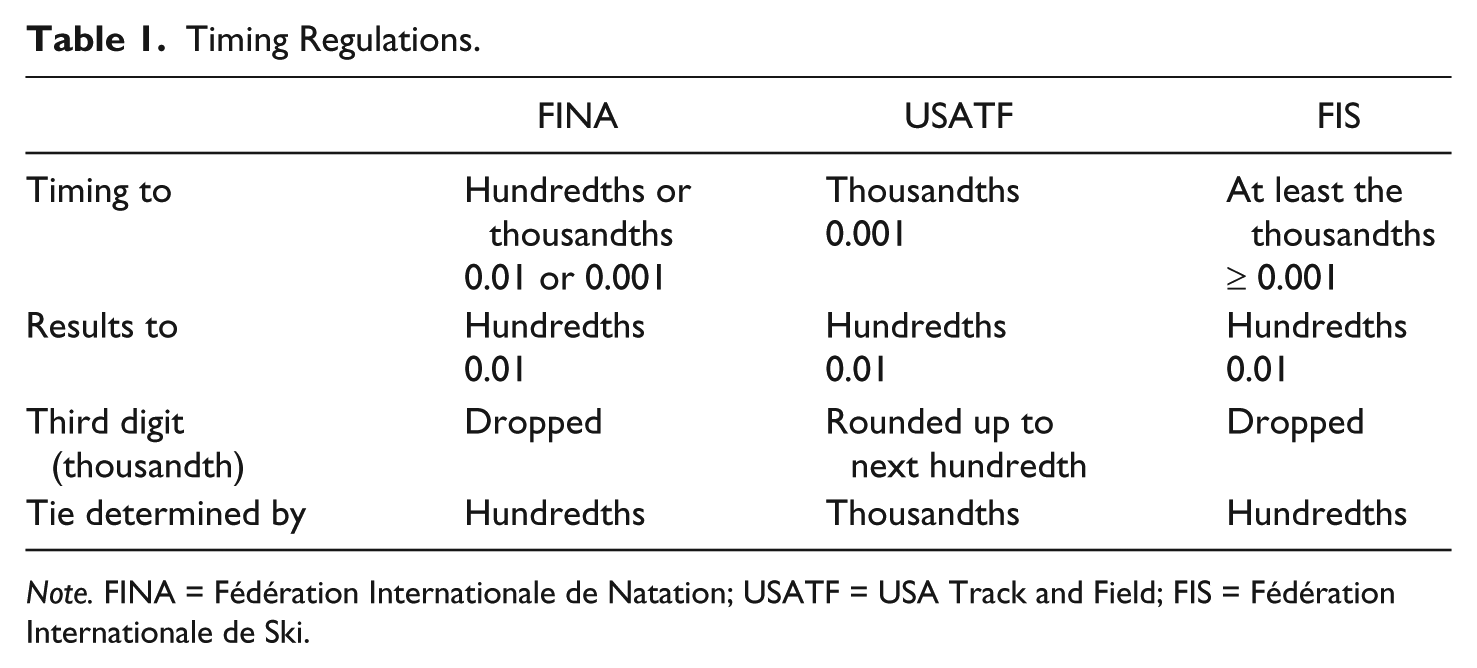
Note. FINA = Fédération Internationale de Natation; USATF = USA Track and Field; FIS = Fédération Internationale de Ski.
The confusion within the differing regulations was also manifest in the public and professional discourse surrounding the three events, most notably in the Gisin and Maze tie. Recall that a theme in the commentary surrounding the race distinguished between times recorded to the 0.0001 (ten thousandth) of a second, Omega’s ability to record to 0.000001 (millionth) of a second, and FIS regulations that results be recorded to 0.01 (hundredth) of a second. This lead some commentators to argue that one of the two skiers had actually won the race (according to timing done to the 0.0001 of a second), but that this result was not allowed by FIS policy. This insinuates that the FIS policy is flawed and that the more precise timing data were accurate. By contrast, in what follows, I argue that claims by Omega and others for timing beyond 0.01 of a second can and do lead to public and professional misunderstandings of the capabilities of timing and imaging systems. And I further argue that the FIS policy to time to the hundredth is not flawed, but that the policy and regulating body could and should do more to make the rationale for timing transparent.
Measurement Error and Dimensional Tolerances
Given the speeds with which athletes travel, the closeness of race results, and the tremendous amounts of money, national pride, and cultural capital involved in sports competition, timing and imaging systems have to be able to capture highly precise data across different, and sometimes difficult, environmental conditions. Omega—the most prominent company in the field—boasts that their new Quantum timer captures data down to the millionth of a second. And Lynx System Developers’ EtherLynx PRO Photo-Finish Camera captures up to 10,000 frames (technically slices) per second. However, what I stress here is that there are limits to the precision of such timing and imaging systems as they are used in the natural world. Advanced timing and imaging systems capture information beyond what can be guaranteed in the live environment. In an interview with Giles Norton (personal communication, July 31, 2013) of Lynx Systems Developers Inc., he explained that measuring to the thousandth or beyond cannot be guaranteed in athletic events due to the allowable differences in the measurement of the track. Norton clarified the issue by discussing swimming, noting that the difference between first and second place could come down to the difference in the thickness of paint on the pool walls. The end result of this is that the differences revealed by timing and imaging systems operating in the hundredths, thousandths, or millionths of a second are not necessarily evidence of differences in athletic performance but might instead indicate differences in the physical configuration of the event venue.
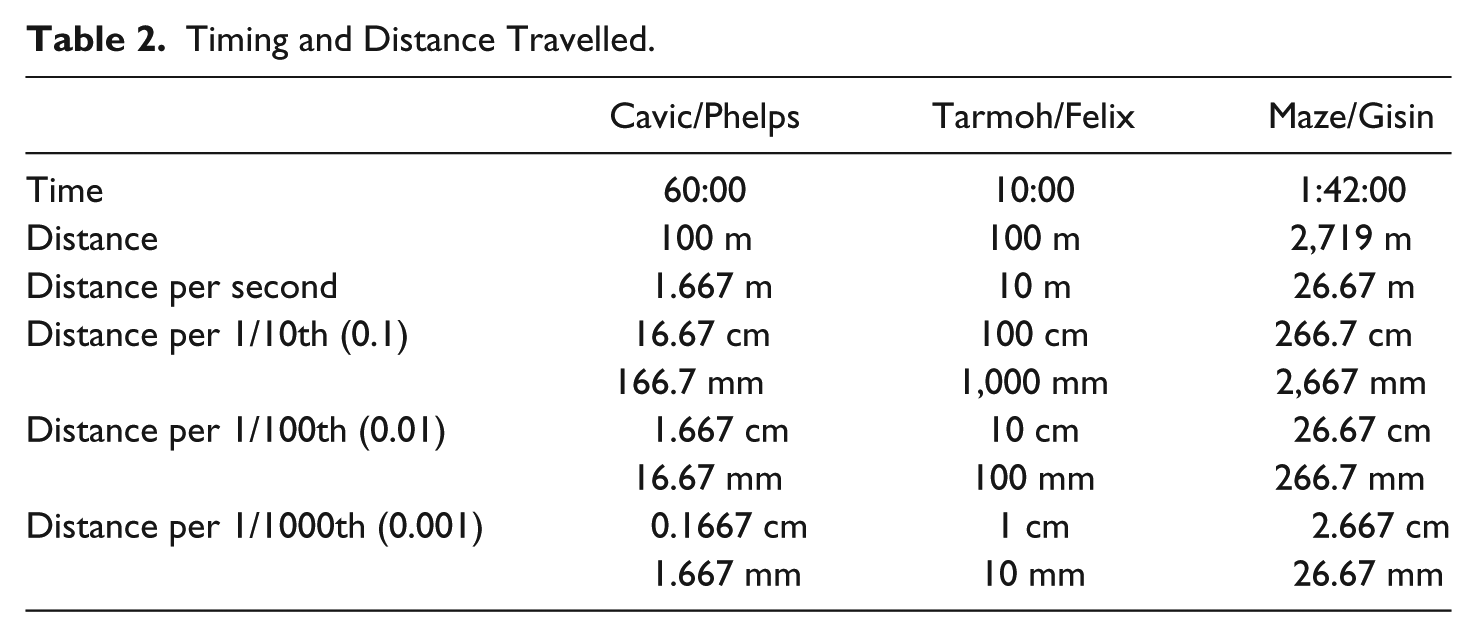
To understand the issue more completely, it is important to outline the speed and distance that athletes travel as well as the “dimensional tolerances” of individual sporting venues. Table 2 presents the time and distance travelled for each of the events analyzed in this article. Times are shown in whole seconds for ease of explanation. In relation to the Cavic/Phelps race, at 0.01 of a second, the swimmers travel a distance of 1.667 cm (16.67 mm), and at the level of 0.001 of a second, they travel 0.1667 cm (1.667 mm). FINA regulations governing the physical configuration of event venues (in this case the pool) provide for a dimensional tolerance of 30 mm between the end walls of a given lane. As identified in FR 2.2.1,
Against the nominal length of 50.0 meters, a tolerance of plus 0.03 metre in each lane minus 0.00 metre on both end walls at all points from 0.3 metre above to 0.8 metre below the surface of the water is allowed. (p. 368)
Timing and Distance Travelled.
Therefore, any two lanes in a swimming pool and any two straight lines within a single lane can range in length from 50.00 m to 50.03 m, meaning that any two measurements can differ in length by 30 mm.
This issue of dimensional tolerance further problematizes the Cavic/Phelps decision and FINA events more broadly. Returning to Table 2, timing to 0.01 of a second captures 16 mm of athletes’ movement and timing to 0.001 of a second captures 1.6 mm. This means that at the level of 0.01 of a second or beyond, the differences captured by the timing system exceeds what can be guaranteed in the physical configuration of the pool. Differences in athlete placing at that level of precision can be due to allowable differences in the length of each lane rather than the distance travelled by the swimmers. Timing to a tenth of a second (which is not permitted in FINA regulations) is therefore a more accurate measure of athlete performance. Timing to 0.1 s captures 166.7 mm which far exceeds the dimensional tolerances of the pool. At that level of precision, differences in placing can confidently be attributed to the differences between swimmers covering the race distance. The issue is further complicated when the distance of the race exceeds 50 m, as was the case with Cavic and Phelps. That race was 100 m, meaning that the allowable differences in lane length would double so that one racer might swim 100.00 m and the other 100.06.
For the physical configuration of running tracks, the USATF follows the guidelines prescribed by the IAAF. The IAAF requires that track measurements be accurate to within ± 0.01 m, or 10 mm. As shown in Table 2, in 0.01 of a second, athletes cover 100 mm, which is 10 times the allowable difference in the track’s configuration. At that level of precision, placing can accurately be attributed to athlete performance. However, at 0.001 of a second, runners cover 10 mm, which matches exactly the allowable differences in the physical measurement of the track. Therefore, at 0.001 of a second or beyond, differences between runners cannot confidently be attributed to differences in performance but could instead be due to allowable differences in the physical configuration of the track.
The issue of dimensional tolerances is different in alpine ski racing for at least two reasons. First, with the exception of parallel events, athletes do not race beside one another as in swimming and athletics, but race individually down the mountain. Times are recorded at the start when the athlete trips a wand at the starting gate and again at the finish when they break a beam of light between photocell receptors. The start and finish line systems are connected directly by cable, and there are two, independently wired systems attached to the start and finish gate. A second difference is that the distance travelled by skiers will vary considerably more than in a 100 m swimming or running race. A skier’s finishing time is directly dependent on the “line” that they take down the course in a way that is fundamentally different from that of swimmers and sprinters. This means that the issue in alpine skiing is less one of dimensional tolerances than it is a question of an agreed-upon threshold used to determine placing. This threshold is pointed to in a comment by the Communications Manager of FIS, Jenny Wiedeke, following the Gisin/Maze tie (Pennington, 2014). Speaking specifically to the FIS regulation to time to the hundredth and not thousandth, Wiedeke noted, “When you start getting into such small numbers you cannot guarantee the integrity of that number. It’s an outdoor sport in a winter climate; a piece of flesh could be the difference.” Wiedeke’s reference to a “piece of flesh” separating competitors is a slight exaggeration. As shown in Table 2, at 0.01 of a second Maze and Gisin cover 26.67 cm and at 0.001 they cover 2.667 cm. Although 2.667 cm is clearly thicker than a “piece of flesh,” the difference between Gisin and Maze at that level is extremely slight given the distance and variable conditions of the racecourse. What is missing, however, from both FIS regulations and in their comments following the Gisin/Maze tie is a clearer, more full explanation for why racers are timed to 0.01 and not 0.001 or beyond.
The issue of dimensional tolerance as outlined above and the differential application of timing and imaging systems in swimming, athletics, and alpine ski racing brings to light a central argument of this essay: that there are distinct limits to the use of timing and imaging systems as evidence in sport. Furthermore, and as manifest in the cultural narratives surrounding the three events, there is public and professional misunderstanding and miscommunication regarding the accuracy of these systems. Whether in swimming, athletics, or alpine ski racing, there is a threshold of precision beyond which the timing and imaging data cannot accurately be said to represent differences in athlete performance.
Conclusion
This essay opened by noting the lack of critical attention given to SDAs and specifically to timing and imaging systems. The importance of accurately recording and placing athletes in sporting events hardly needs restating. Yet as is apparent in the three events analyzed here, there is considerable difference in the use of timing and imaging data across swimming, athletics, and ski racing, and there are considerable differences of opinion regarding the capabilities of such systems in these sports. By way of concluding, I turn to a primary recommendation in the work of Collins and Evans on Hawk-Eye, namely, that the measurement errors inherent in any technological system should be made clear and transparent in its use. In their more recent essay on the topic (Collins & Evans, 2011), the authors applaud the use of Hawk-Eye in cricket for meeting this goal, but are critical of its use in tennis because it is presented as making fully determinate decisions (the ball is in or out). For the authors, this results in something akin to a “CSI effect” in professional sport where the technology is presented as being infallible and ridding the game of (human) error.
In a similar way, I argue that the processes for decision making in swimming, athletics, and alpine ski racing (and in other sports by extension) should be made clear and transparent. The regulations governing timing and imaging systems in each discipline should make clear the reasons for timing to tenths, hundredths, thousandths, or beyond with specific reference to the issue of dimensional tolerance and the limits of technological precision in a live environment. Importantly, the capabilities and limitations of timing and imaging systems should be made clear not just in the regulations of sport governing bodies but, following an earlier recommendation by Collins and Evans (2008) to the broader viewing public. On this second recommendation, however, I am considerably more skeptical.
Clarifying the capabilities of timing and imaging systems in the regulations of FINA, USATF, and FIS is a relatively simple task. The FIS Timing Working Group is an example in this regard. Their 2014 Timing Booklet for Alpine Skiing far surpasses the guidelines of other sports in its thoroughness and nuance; yet, it could do more to explain—in layman’s terms—the rationale for timing to .01 of a second. There is no explicit statement in any of the regulations governing swimming, track and field, or alpine skiing that provides a rationale for the level of precision used. A simple, concise statement noting the threshold beyond which timing is no longer accurate in determining placing would go a long way to prevent confusion in the professional and public communities that interact with SDAs. Without such a statement and with counter-statements put forward by timing and imaging companies, skiing and other professional sports fall prey to the “CSI effect” described by Collins and Evans.
The second recommendation—to communicate the limits of SDAs to the public—is considerably more complex. As Jhally (1984) so clearly outlines in his notion of the “sports/media complex,” by the 1970s, sports, commerce, and television broadcasting had developed a fully symbiotic relationship with each depending on the other for survival in the highly competitive, for-profit sports entertainment industry (see also Rowe, 1999; Wenner, 1989, 1998; Whannel, 1992). Omega, Lynx Systems Developers, Seiko, and other timing and imaging providers vie for lucrative contracts and so must advertise their equipment as being more accurate and more precise than their competitors. And broadcasters must produce the best sports entertainment package they can to increase market share and sell advertising space to corporate sponsors. Hence, the Omega Press Release (“Great Moments,” 2008) following the Beijing Games in which they note that their equipment provides results “which are beyond doubt and dispute.” And hence, Peekaboo Street’s remarks as a Fox Sports reporter following the Gisin/Maze tie, where she demanded to know who really won. Referring to the people in the timing booth, Street emphatically noted, “I want to get that person and just like beat it out of ’em” (Svrluga, 2014). Understood within the framework of the sports/media complex, Omega’s remark is good for business and Street’s is good for television. However, both obfuscate the reality that there are limits to the precision and accuracy of timing and imaging technology when used as SDAs.
Shortly after the conclusion of the 2015 IAAF World Championships in Beijing, Andre De Grasse announced that he would forego turning professional and finish his degree at the University of Southern California (Canadian Broadcasting Corporation [CBC], 2015; Doorey, 2015). Citing his relative newness to the sport as well as his and his mother’s desire that he finish school, De Grasse took a calculated risk, choosing to run for his University rather than as a professional. A story on CBC (2015) by the Canadian Press identified the risk quite bluntly: “Returning to USC could cost De Grasse, whose star power is at a high after an unexpected 2015 season . . . An injury or a disappointing showing in the NCAA could diminish his immediate earning potential.” However, shortly after this announcement, De Grasse revised his decision, choosing to sign with Puma and turn professional (Henry, 2015). De Grasse received USD $11.25 million from Puma with more than $4 million guaranteed (were he to get injured and not run again). De Grasse was clear on what changed his mind: “Puma gave me an offer I couldn’t refuse” (Henry, 2015). In a world where earning potential is measured in hundredths and thousandths of a second it is all the more important to make clear what is being measured, how it is being measured, and the limitations inherent in the process. To do so may not be as good for business or entertainment, but it is good for sport.
Footnotes
Declaration of Conflicting Interests
The author(s) declared no potential conflicts of interest with respect to the research, authorship, and/or publication of this article.
Funding
The author(s) disclosed receipt of the following financial support for the research, authorship, and/or publication of this article: This research was supported by the Social Sciences and Humanities Research Council of Canada.