




Abstract

To the Editor,
I read with interest the recent letter by Dr Ken Schafer outlining the challenges posed by toxicologic pathology practice in the post-pandemic world. 1 I agree with Dr Schafer that the increased social isolation resulting from COVID-related lockdowns and a growing trend to remote work by contract research organizations (CROs) and product development firms (agrochemical, biopharmaceutical, cell and gene therapy, medical device, and similar companies) greatly complicate the efforts of individuals entering the profession to undertake an organized, comprehensive apprenticeship (formal or de facto) in toxicologic pathology.
In this regard, “apprenticeship” connotes an extended period of mentored on-the-job study and practice to gain familiarity with pathology knowledge and skills not taught systematically in academic pathology training programs. 2 Such concepts include, but are not limited to, high-throughput tissue collection and processing, harmonized diagnostic nomenclature, regulatory guidance (for many product classes), and basic principles of pharmacokinetics, toxicology, and risk assessment. Historically, these apprenticeships involved on-site placement of the new pathologist at a facility staffed with several other pathologists possessing different but overlapping subject matter expertise and levels of experience in toxicologic pathology. In this setting, rapid and substantial professional development was assured given the wealth of mentoring opportunities like weekly slide conferences (at a multiheaded microscope) to review lesions and their pathogeneses, monthly journal clubs to discuss important publications or regulatory guidelines, a jaunt to the office next door to obtain a quick second opinion from a more experienced pathologist about an unusual finding, or an occasional bull session over brats and brews to share career-building tips. The inevitable outcome of such personal interactions was the emergence of a well-rounded “journeyman” scientist capable of independently performing many toxicologic pathology tasks proficiently, including (in due course) pathology peer review.
In lieu of on-site training, videoconferences with screen-sharing are a partial solution to the reduced availability of face-to-face mentoring opportunities. Journal clubs and slide conferences are amenable to this format, and “walking to the office next door” can be as easy as an email or phone call to arrange a brief online exchange. However, such events are most effective if a cadre of more seasoned pathologists are able to participate, which is simple to achieve for large companies (even if spread across many international sites) but may be very difficult to attain for small firms (especially start-ups) with a single pathologist (who is often fairly junior to fit the usual start-up budget). As Dr Schafer noted, “individuals working remotely often do not know what they do not know” (italics in original). 1 This unintentional ignorance does need to be addressed, and toxicologic pathologists with knowledge of what should be known by a proficient practitioner will clearly need to lead the way.
I see two obvious near-term solutions to support individuals who need mentoring but have limited access to an internal team of more experienced pathologists. The first can be initiated at the level of the entire toxicologic pathology community, working through various professional associations. For example, global societies of toxicologic pathology might develop mentoring programs in which new pathologists are matched with one or more senior practitioners for regular (e.g., monthly or quarterly) telephone calls or videoconferences to share core concepts, review unusual findings, and/or provide career counseling. Mentoring programs have been tested recently by the American College of Veterinary Pathologists (ACVP) and International Academy of Toxicologic Pathology (IATP) and have achieved enough success that they are likely to continue. The advantage of such arrangements is that the interests of both participants are matched, so the advice offered by the mentor is well-targeted to the needs of the mentee. The disadvantages are that (1) the amount of mentoring often is comparatively low compared with traditional opportunities available by face-to-face opportunities at large firms and that (2) any questions raised by the mentee regarding proprietary concerns generally cannot be discussed because such society-driven (rather than company-managed) mentoring arrangements typically involve cross-company rather than intra-company interactions.
The second solution, and in my view the one that is most likely to foster professional development in the brave new world of remote working, is for individuals newly engaged in the toxicologic pathology profession to commit to following a regular program of disciplined self-study. As stated by author Louis L’Amour, . . . all education is self-education. A teacher is only a guide, to point out the way, and no school, no matter how excellent, can give you education. What you receive is like the outlines in a child’s coloring book. You must fill in the colors yourself.
Over my 30-year career, I have learned that the resources listed in Table 1 comprise an effective minimum core curriculum for novices seeking to build a foundation of baseline knowledge in the toxicologic pathology field. Indeed, I consider these materials to be so helpful to my daily practice that as a young pathologist I invested my own funds to collect those not provided by my institution so that I could keep electronic and/or hard copies of them in my office as references (accessing electronic versions to search for concepts with which I was less familiar and hard copies to permit easy annotation for the topics that informed my regular tasks). These resources require an understanding of general and systemic pathology principles (such as that obtained through a medical or veterinary medical residency and/or pathology graduate degree) as the underpinning on which to erect a mental map of new toxicologic pathology knowledge. A dedicated perusal of some or all of these resources will over time allow remote workers to reduce the extent of their “do not know” void in toxicologic pathology. This self-education will also enhance the value of other continuing education opportunities (e.g., professional meetings, short courses, and webinars) by allowing pathologists to focus on integrating more advanced concepts rather than learning basic material.
Resources for self-directed learning in toxicologic pathology.
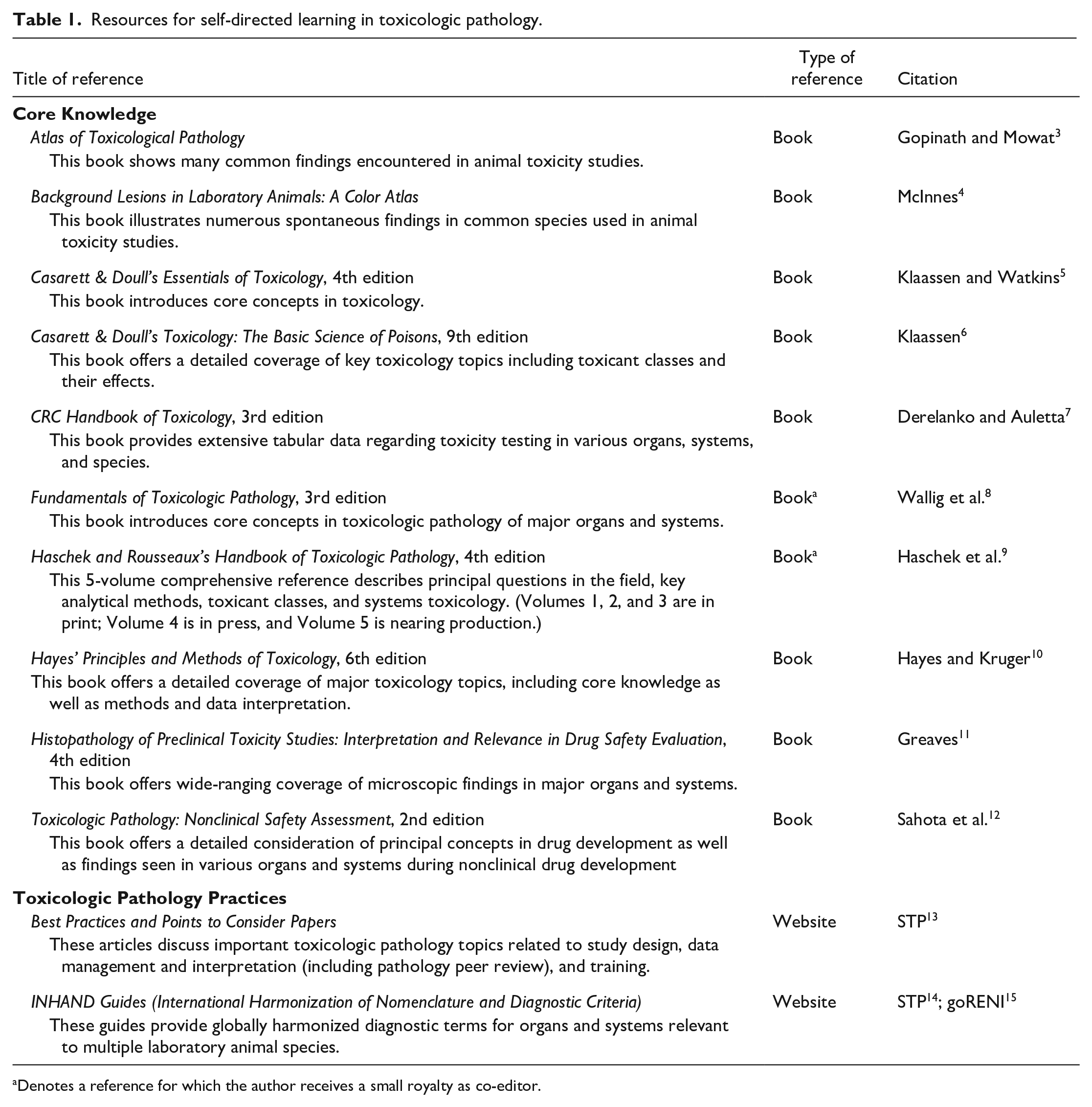
Denotes a reference for which the author receives a small royalty as co-editor.
Finally, I recognize that these remote mentoring and self-education suggestions are reasonable accommodations but do not constitute perfect substitutes for face-to-face mentoring interactions. In particular, I have found face-to-face mentoring to be crucial for instilling initial proficiency in such non-academic skills as understanding and using Good Laboratory Practice and performing pathology peer reviews. I back Dr Schafer’s assertion that the global toxicologic pathology community will be well rewarded if we can either define new means or reinvigorate traditional person-to-person relationships so that effective mentoring is regularly available to meet the learning needs of our new colleagues who are beginning their toxicologic pathology careers while confined to remote work sites.
Footnotes
Acknowledgements
The author thanks Dr Ken Schafer for reviewing this letter.
Author Contribution
The analysis, conclusions, and opinions expressed in this article are solely those of the author.
Declaration of Conflicting Interests

Funding
The author received no financial support for the research, authorship, and/or publication of this article.