




Abstract

You may have noticed a brightly colored donut with a central number when browsing the most cited or most read articles on our Toxicologic Pathology journal website (http://journals.sagepub.com/home/tpx, last accessed December 5, 2017) or when browsing articles associated with other websites. This measure of research impact is the Altmetric, short for alternative metrics, donut, and score. Briefly, it can provide information on web-driven scholarly interactions for the article you are interested in, including your own (Hirsch 2005; Melero 2015; Warren, Raison, and Dasgupta 2017). This score is intended to be complementary to traditional, citation-based metrics with most of the data derived from web-based social media feeds. Because it is updated in daily or real-time feeds, you can keep track of where articles are being shared and discussed among broader audiences. Compared to other measures of research impact, 2 main advantages of the Altmetric are the immediate availability of information on the reach and influence of an article and the ability to track how the attention changes over time.
If you select the Altmetric icon located near the title of an article (see Elmore [2007] as example), you will see information on the title, journal, month/year of publication, digital object identifier number, PubMed ID, author(s), and abstract. The donut is located at the top of the left column of the article metrics website for any specific journal article (see https://sage.altmetric.com/details/817961 as example, last accessed December 5, 2017). It may be in one or many colors, with a central number, which is the score. Below the donut is a blue question mark that you may select with this pop-up information about the score: “the Altmetric attention score for a research output provides an indicator of the amount of attention that it has received. The score is derived from an automated algorithm and represents a weighted count of the amount of attention that is picked up for a research output.” There is also a link that will tell you how the scores are calculated (About the Altmetric and the Altmetric Attention Score). Briefly, the Altmetric score represents a weighted count of the amount of attention for a research output from a variety of sources (Table 1). The colors of the Altmetric donut each represent a different source of attention (medium blue for LinkedIn, yellow for blogs, red for mainstream media sources, purple for policy documents, etc.), and the amount of each color will change depending on which sources a research output has received attention from (Figure 1; the donut and Altmetric attention score). There are 3 main factors used to calculate the Altmetric score: volume (how many times the article is mentioned), sources (where the mentions come from), and authors (of each mention; Table 2). Information on how each factor might affect the score is provided on the Altmetric Support website (help.altmetric.com; outputs and sources) and reproduced in Table 2.
Examples of Data Collection Sources for Altmetric Scores.a
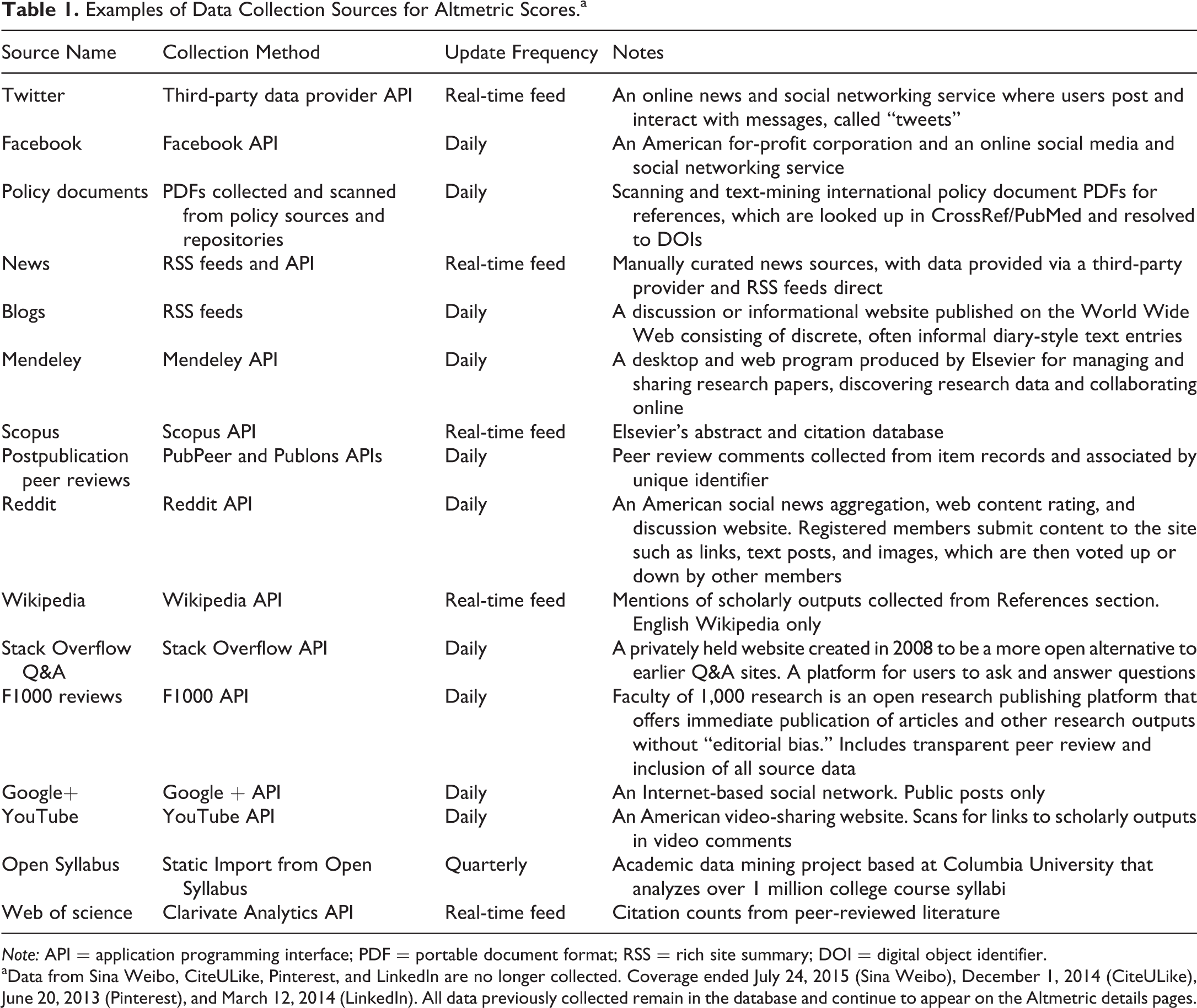
Note: API = application programming interface; PDF = portable document format; RSS = rich site summary; DOI = digital object identifier.
aData from Sina Weibo, CiteULike, Pinterest, and LinkedIn are no longer collected. Coverage ended July 24, 2015 (Sina Weibo), December 1, 2014 (CiteULike), June 20, 2013 (Pinterest), and March 12, 2014 (LinkedIn). All data previously collected remain in the database and continue to appear on the Altmetric details pages.
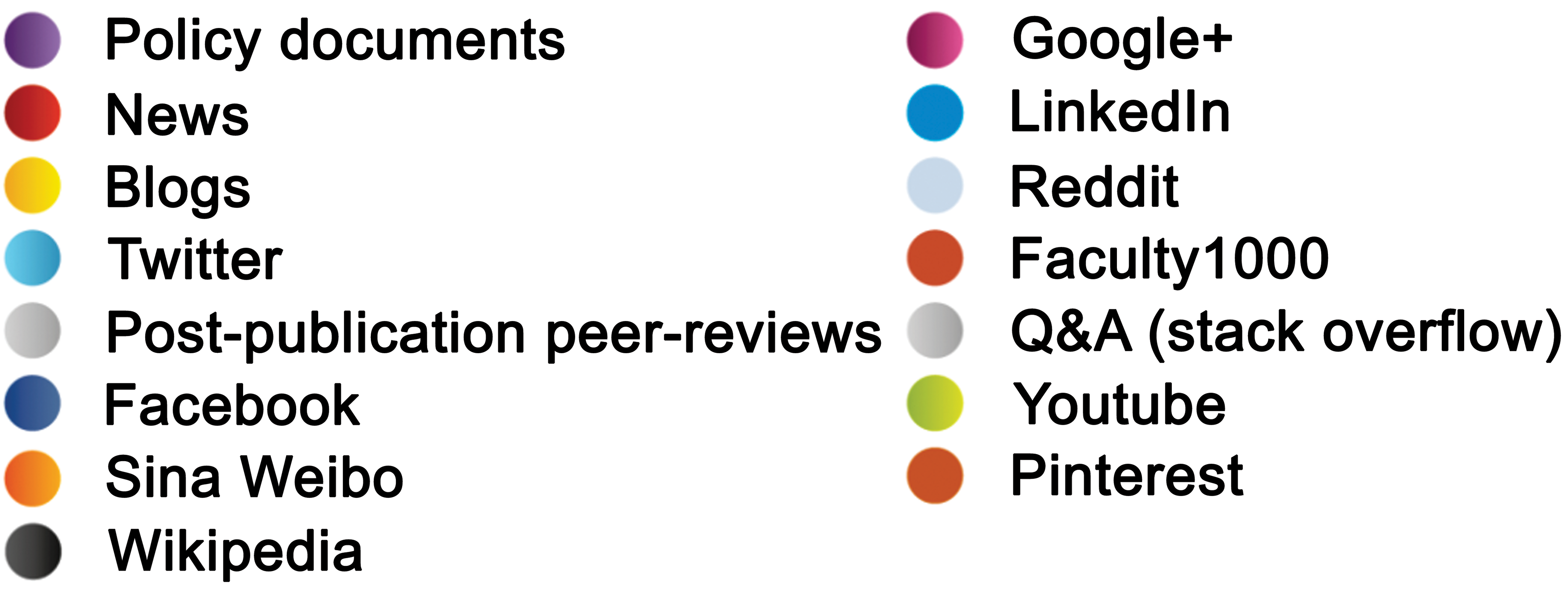
Colors of the Altmetric score each represent a different source. The amount of each color will change depending on which sources a research output has received attention from. Because the attention from many of the sources is real time or daily feeds, the colors of the donut and the score may change daily. Figure reproduced from https://www.altmetric.com/about-our-data/the-donut-and-score/ and last accessed December 5, 2017.
Three Main Factors Used to Calculate the Altmetric Score.
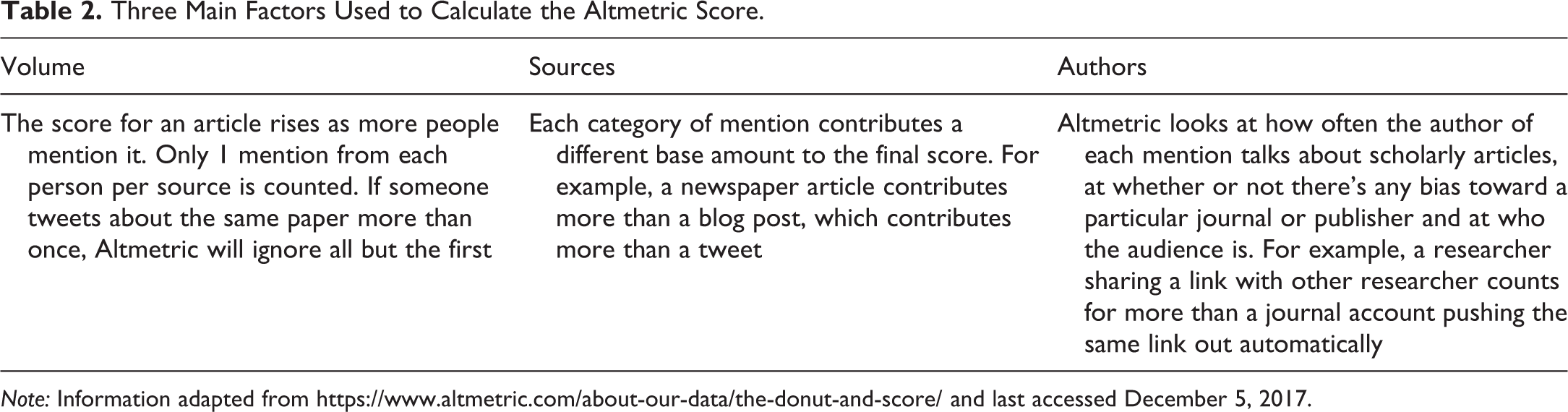
Note: Information adapted from https://www.altmetric.com/about-our-data/the-donut-and-score/ and last accessed December 5, 2017.
Also in the left column of the article metrics website, you will see additional information if you select the “more…” link such as where it ranks (in percentile) among all research outputs scored by Altmetric, how it ranks among outputs from this source, how the score ranks compared to outputs of the same age, and percentile among outputs of the same age and source. Below this information, you will see where the article has been mentioned (e.g., news outlets and blogs) and how many readers referenced the article on sites such as Mendeley and CiteULike.
At the top of the article metrics website, you can see the summary information for the article as well as tabs for information on blogs, Twitter, Facebook, Wikipedia, Google+, and so on, depending on which websites and social media outlets the article has been mentioned on. At the bottom of the page, there are 3 selections: Twitter Demographics, Mendeley Readers, and Attention Score in Context. Below Twitter demographics and Mendeley Readers, you will see additional information on readership statistics such as geographics and demographics. The map provides a visual for the geographic information. If you choose Attention Score in Context, you will see number of all research outputs, number of outputs from Toxicology Pathology, number of outputs of similar age, and number of outputs of similar age from Toxicologic Pathology. This may help you to understand if the level of attention is typical compared to similar articles. Below this information, you will find how many research outputs Altmetric has tracked across all sources so far and information about its ranking.
In the upper right-hand corner of the article metrics website, there are blue boxes that can be selected to view the article on the publishers’ website where you will be able to download the pdf (if available) and where you may select to receive e-mail reports in order to view new mentions of your research outputs in a given time frame (https://sage.altmetric.com/details/817961; last accessed December 5, 2017). You may choose how often you would like to receive reports and monitor trending outputs and attention across sources.
Finally, there are options at the top right-hand corner of the article metrics website to share via Twitter, Facebook, Google+, or e-mail. You may also embed the Altmetric badges in your website. The badge is simply the multicolored donut with the central Almetric score. The badges are free to use for academic repositories and individual researchers.
Who’s using the Altmetric tools and attention score? A 2015–2016 global survey on research tool usage with over 20,000 responses indicated that traditional metrics tools such as the impact factor and large citation bases are still the most often used by researchers (Zenodo 2018). However, librarians recommended the Altmetrics tool as much as the large citation-based tools. This may be because librarians are aware of the weaknesses of traditional metrics tools and thus more likely to explore alternatives. Use among researchers at various career stages differed in that the use of the impact factor increased for researchers farther along in their career compared to the postdoc group that most often used the Altmetric tool. This trend in use by postdocs may reflect a more social media savvy age-group, a willingness to explore new avenues and tools, and the need to demonstrate immediate impact of recent publications while acquiring a faculty or senior-level position in their institution.
So how to interpret the Almetric score? Importantly, the score is helpful to rank research outputs based on attention from various sources, but it can’t tell you anything about the quality of the article itself. It simply tracks attention, and attention can be good or bad. As an example, an article could be blogged about many times because of negative feedback. For research articles, some feel that if they get mentioned on social media, it’s because they relate to popular topics, not because they are examples of good research. Tweets may also not be considered a useful measure for the value of a serious research paper. However, social media can provide a measurement of early reaction to research because the time it takes to discuss such work on social media can be much less than the time it takes to acquire citation information. Also, social media can provide a more complete picture of the use of research than citation counts alone.
Altmetric scores may not be available for all articles and some articles may have scores that decrease. Altmetric started collecting data in the last half of 2011, so scores will be based on data from that time forward. Most older articles do not have scores unless they have mentions in recent years. Scores will typically increase over time but may decline if a social media user deletes a post or their profile.
Another issue to consider is that the attention score for journals varies. A good score for one journal might be a low one for another. As an example, an article in science or nature will typically score higher than one in Toxicologic Pathology because they have a larger readership and more people will be likely to share the article. But one benefit of the Almetric score is that someone with an article that has a particularly high score might wish to indicate such information in their curriculum vitae, performance review, or grant application. As an example, one could provide information such as “This item has received an Altmetric Attention Score of 7, putting it in the top 25% in terms of all research outputs scored by Altmetric and among the highest-scoring outputs from the Toxicologic Pathology journal (#18 of 178). A full summary of the attention score and record of all of the online mentions can be found here” (and include a link to the associated details page).
Finally, the Altmetric score provides nontraditional metrics that are considered an alternative to the more traditional h-index or Hirsch index, which is an author-level metric that measures both the productivity and citation impacts of the publications of a scientist or scholar (Hirsch 2005). It is argued that an article needs little social media attention to jump to the upper quartile of ranked papers. This suggests that there are not enough sources of altmetrics currently available to give a balanced picture of impact for the majority of papers. Also, there is the concern that likes and mentions can be bought. And when comparing the score of one article to another, both should be published in the same year and during a similar time within the year because articles may be mentioned predominately during the time period that they are first published. So, use and interpret the Altmetric score with care. It should be used in conjunction with impact factor, h-index, number of downloads, and citation counts to provide a more rounded picture of the article’s impact.
Footnotes
Declaration of Conflicting Interests
The author(s) declared no potential conflicts of interest with respect to the research, authorship, and/or publication of this article.
Funding
The author(s) disclosed receipt of the following financial support for the research, authorship, and/or publication of this article: This research was supported (in part) by the Intramural Research Program of the National Institutes of Health, National Institute of Environmental Health Sciences.
