




Abstract
Revision of the International Council for Harmonization (ICH) S1 guidance for rat carcinogenicity studies to be more selective of compounds requiring a 2-year rat carcinogenicity study has been proposed following extensive evaluation of rat carcinogenicity and chronic toxicity studies by industry and drug regulatory authorities. To inform the ICH S1 expert working group in their potential revision of ICH S1, a prospective evaluation study was initiated in 2013, in which sponsors would assess the pharmacologic and toxicologic findings present in the chronic toxicity studies and predict a positive or negative carcinogenicity outcome using a weight of evidence argument (a carcinogenicity assessment document [CAD]). The Scientific and Regulatory Policy Committee was asked by the Society of Toxicology Pathology (STP) executive committee to track these changes with ICH S1 and inform the STP membership of status changes. This commentary is intended to provide a brief summary of recent changes to the CAD guidance and highlight the importance of STP membership participation in the process of CAD submissions.
The International Council for Harmonization (ICH) S1 guidance is focused on the need to conduct carcinogenicity studies and the species and dose selection for carcinogenicity studies. Based on analysis of a substantial number of chronic rat toxicity and associated carcinogenicity studies by industry (Reddy et al. 2010; Sistare et al. 2011) and Drug Regulatory Agencies (DRAs; ICH 2012; ICH S1 2016a), there has been a proposal to revise the ICH S1 guidance for rat carcinogenicity studies to be more selective of compounds that require a 2-year rat carcinogenicity study. The rationale was that the analyses noted above suggested that, in many cases, there was limited benefit to human risk assessment derived from the rat carcinogenicity studies. In these cases, the overall weight of evidence assessment of the pharmacologic and toxicologic findings present in the chronic toxicity studies could predict a positive or negative carcinogenicity outcome. In order to test this hypothesis, a prospective evaluation study was initiated in 2013 to inform the ICH S1 expert working group (EWG) in their potential revision of ICH S1. In essence, sponsors were asked to prospectively predict the outcome of their rat carcinogenicity study in a carcinogenicity assessment document (CAD) and to use the available information to support placement of each compound into one of the risk categories as noted in Table 1.
CAD Risk Category Designations and Rationale.
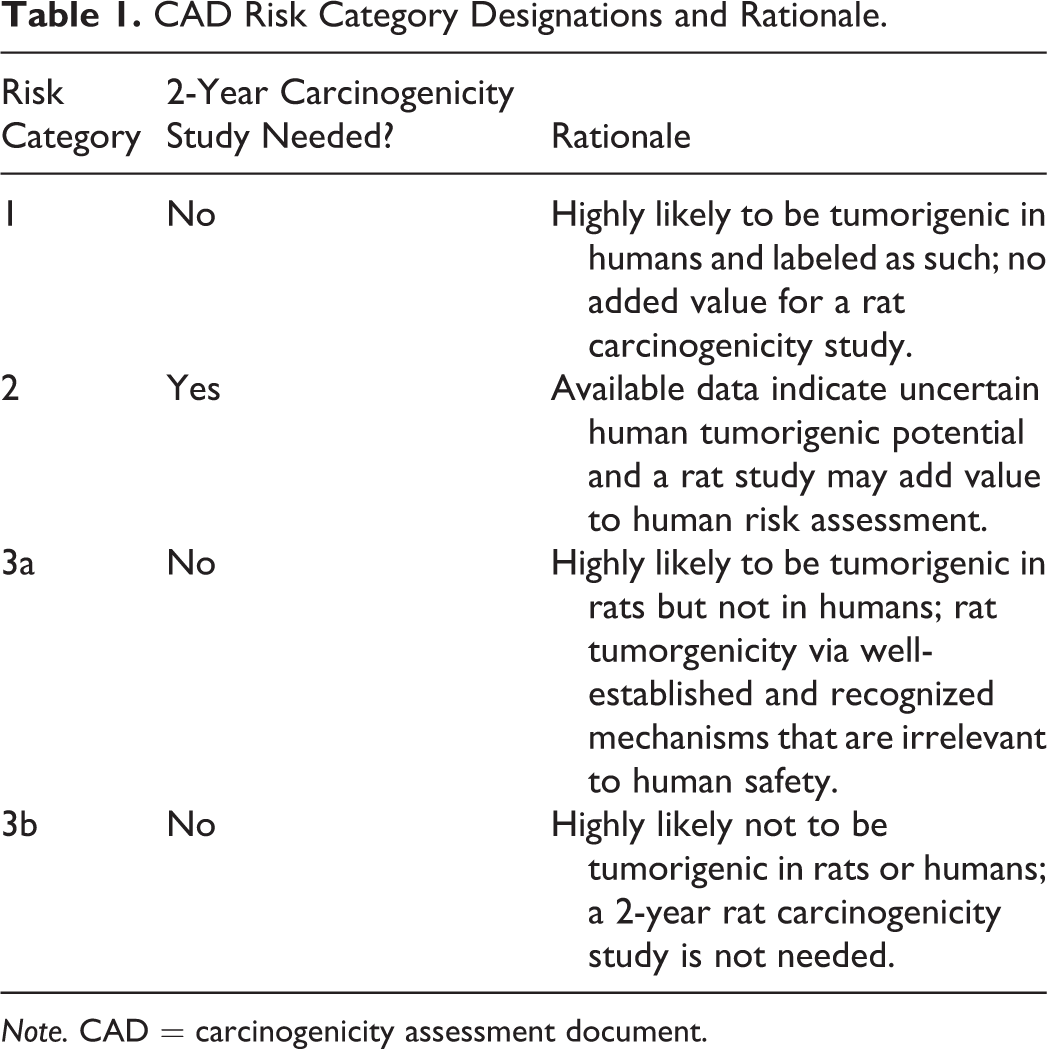
Note. CAD = carcinogenicity assessment document.
A well-defined set of end points as defined in the Regulatory Notice Document (RND; ICH S1 2016a) would be used in a weight of evidence argument for a given classification.
Examples of the types of end points to be used in the weight of evidence include: drug target, pharmacology, and tissue distribution in rats and humans; genetic toxicology results; histopathologic evaluation of repeated-dose rat toxicology studies and results of the chronic rat toxicity study; exposure margins in chronic rat toxicology studies; metabolic profile comparison of human and rat; evidence of hormonal perturbation or immune suppression; and results of a transgenic mouse study (if available) or other pertinent special studies or end points.
Although the original industry reports (Reddy et al. 2010; Sistare et al. 2011) and the RND and associated status updates and discussion have been published (ICH S1 2016a; ICH S1 2016b), the Scientific and Regulatory Policy Committee (SRPC) was asked by the Society of Toxicology Pathology (STP) executive committee to track these changes with ICH S1 and inform the STP membership of status changes. This commentary is intended to provide a brief summary of recent changes to the guidance and highlight the importance of STP membership participation in the process of CAD submissions.
In December 2015, the ICH S1 EWG met in Jacksonville, Florida, to discuss the status of the ongoing evaluation study to support the proposed revisions of ICH S1 guidance. Briefly, the EWG looked at the number of CADs submitted to DRAs by sponsors, the quality of the CAD submissions, and discrepancies between sponsor and DRA designations of the need for a carcinogenicity study based on the evidence provided in the CAD. At the December 2015 review, it was clear that the submission of CADs has been slower than expected. Therefore, the time line for decision-making for the ICH S1 guidance revision either had to be extended or the decisions by the health authorities would be made on a very limited data set, which ultimately was not acceptable. These EWG discussions resulted in a revised ICH S1 RND in January 2016. The recommendations and discussion from that meeting have been summarized in an ICH status report and a webinar by the IQ Consortium (ICH S1 2016b; IQ Webinar 2016). The overall assessment and recommendations are summarized below: The deadline for CAD submissions has been extended through December 2017. However, CAD documents can only be submitted up to 14 months into a 2-year rat carcinogenicity study. This represents a change from the previous RND, which allowed a CAD to be submitted up to 18 months into an ongoing carcinogenicity study. For assignment to category 3 classification, there must be agreement between the sponsor and at least 1 DRA. At least 20 CADs will need to be appropriately classified as category 3 to allow a reasonable assessment of the proposal. In addition, it was clarified that an executive summary of the study report plus tumor incidence tables must be submitted to the primary DRA responsible for the CAD review separate from the regulatory filing of the carcinogenicity study. This will ensure that sufficient and consistent information is provided to the DRAs for assessment of the study outcome.
Clearly, category 3 is the most important from a regulatory and drug development standpoint since this represents the potential future state where study waivers may be granted for compounds not expected to carry a carcinogenicity warning in the label. Not surprisingly, category 3 was also the source of most disagreement between sponsor and DRA category classifications.
In addition, there were a number of proposed recommendations from the EWG meeting for CAD authors that were summarized in the ICH Status Report (2016b) and IQ Webinar (2016). These recommendations on content and structure were an attempt to clarify the DRA expectations for CAD documents, specifically focusing on areas that were considered deficient in some CADs (discussion of metabolites, pharmacology, more comprehensive literature review, comparisons of similar compounds or concerns with first in class compounds, more rigorous hormonal evaluations and relevance to human risk, and inclusion of relevant nonrodent data to help position rodent findings). Furthermore, DRAs agreed to an additional step in the CAD review process where they can request missing information from sponsors to help clarify points of concern or uncertainty.
The potential revision of the ICH S1 guidance has many benefits including accelerating the speed of promising new drugs to patients, reduction in animal use, and decreased development costs. However, a statistically meaningful number of CADs, and in particular category 3 CADs, are needed to provide adequate support for such a change. To that end, the U.S. Food and Drug Administration (FDA) Carcinogenicity Assessment Committee (CAC) has been reminding sponsors about the CAD process when CAC documents (carcinogenicity protocol designs) are submitted to the agency. The generation of a CAD, in the near term, represents an extra time investment by both sponsors and DRAs in the writing and reviewing of these documents. While not required, the thoughtful generation and submission of CADs, along with rat carcinogenicity study data, are needed to enable, or appropriately reject, change in the ICH S1 guidance in a manner that is scientifically robust. Many in the STP have a critical role in contributions to the CAD, as well as a substantial role in the results and interpretation of rat carcinogenicity studies, and are encouraged to participate. Ultimately, the data may not support the revised guidance of ICH S1, but it would be unfortunate to have the ICH S1 revision rejected simply because there was an insufficient number of appropriate CAD submissions.
Footnotes
Acknowledgments
I would like to thank the reviewers from the SRPC, in particular Wendy Halpern, and Michael Graziano and Thomas Sanderson of Bristol-Myers Squibb for critical comments on this article.
Author Contribution
All authors (WP) contributed to conception or design, data acquisition, analysis, or interpretation; drafting the manuscript; and critically revising the manuscript. All authors gave final approval and agreed to be accountable for all aspects of work in ensuring that questions relating to the accuracy or integrity of any part of the work are appropriately investigated and resolved.
Declaration of Conflicting Interests
The author(s) declared no potential conflicts of interest with respect to the research, authorship, and/or publication of this article.
Funding
The author(s) received no financial support for the research, authorship, and/or publication of this article.