




Abstract
Toxicologists and pathologists worldwide will benefit from a new, website-based, and completely searchable Nonneoplastic Lesion Atlas just released by the U.S. National Toxicology Program (NTP). The atlas is a much-needed resource with thousands of high-quality, zoomable images and diagnostic guidelines for each rodent lesion. Liver, gallbladder, nervous system, bone marrow, lower urinary tract and skin lesion images, and diagnostic strategies are available now. More organ and biological systems will be added with a total of 22 chapters planned for the completed project. The atlas will be used by the NTP and its many pathology partners to standardize lesion diagnosis, terminology, and the way lesions are recorded. The goal is to improve our understanding of nonneoplastic lesions and the consistency and accuracy of their diagnosis between pathologists and laboratories. The atlas is also a useful training tool for pathology residents and can be used to bolster any organization’s own lesion databases. Researchers have free access to this online resource at www.ntp.niehs.nih.gov/nnl.
The purpose of the Nonneoplastic Lesion Atlas is to standardize the terminology, diagnostic strategy, and recording of nonneoplastic rodent lesions. These guidelines have been implemented for studies by National Toxicology Program (NTP) and its pathology partners and are now available to scientists worldwide as a searchable, website-based atlas available at http://ntp.niehs.nih.gov/nnl (Figure 1). The atlas provides several hundred stand-alone documents, one lesion per document, organized by system and organ. Thousands of high-quality images are available, which can be enlarged to show exquisite detail. The text provides useful information and specific recommendations for diagnosing nonneoplastic lesions along with supporting references. The Nonneoplastic Lesion Atlas was extensively reviewed by independent pathology experts.
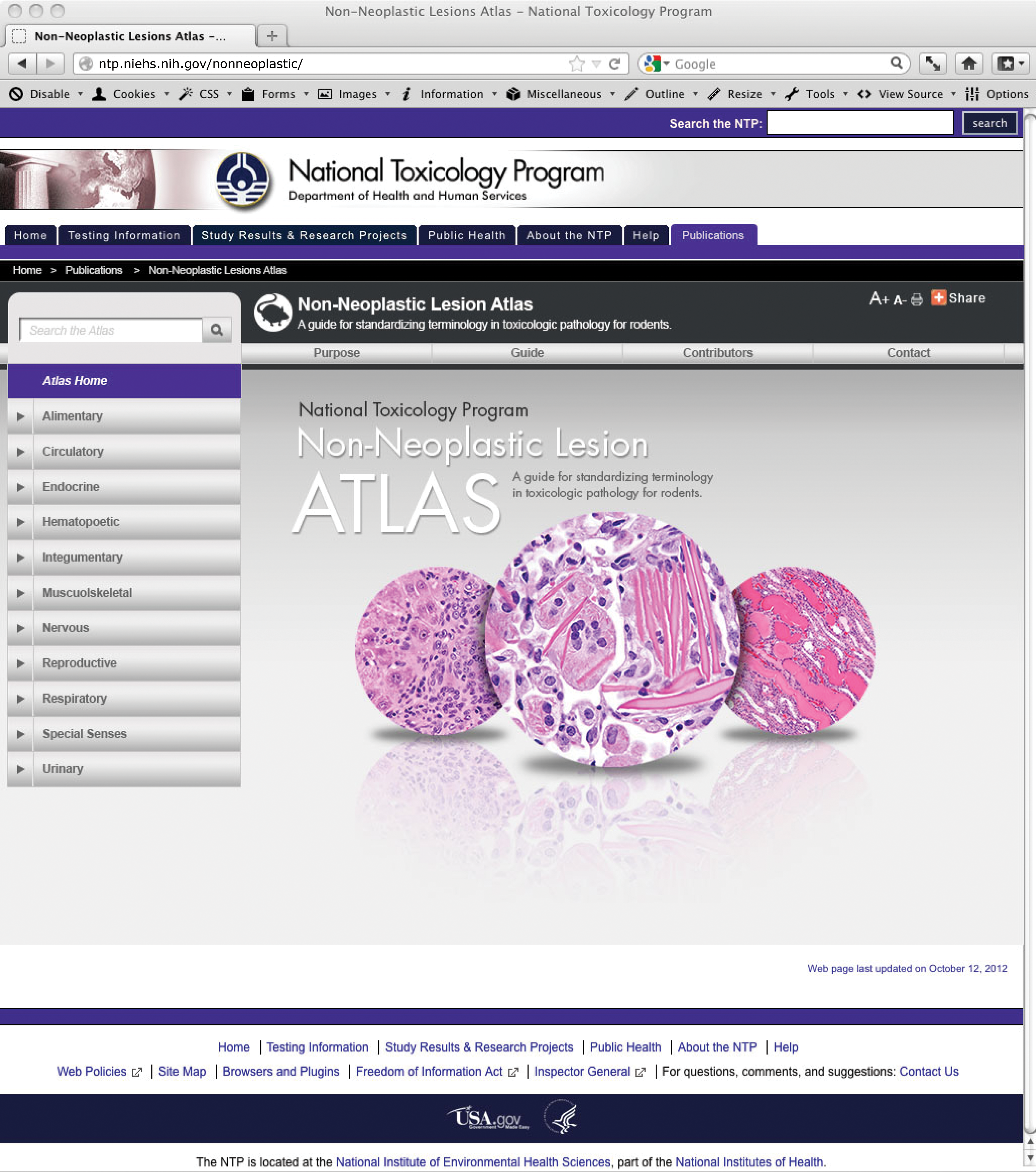
The home page of the NTP Nonneoplastic Lesion Atlas (www.ntp.niehs.nih.gov/nnl).
Diagnosing and recording nonneoplastic lesions can be challenging because terminology and diagnostic strategies vary between pathologists. There are often several nonneoplastic lesions present concurrently, particularly when they are treatment related. For example, inhalation studies on chemicals that target the epithelial lining of the respiratory tract often cause inflammation and epithelial degeneration or necrosis. Also, there may be adaptive changes, such as metaplasia and atrophy, or reparative changes, such as hyperplasia and fibrosis. Some pathologists prefer to record each nonneoplastic change individually. Other pathologists may diagnose the primary process (inflammation) and simply describe the secondary changes in the pathology narrative. Furthermore, it can be difficult to determine which lesions are the primary lesions. For example, inflammation can lead to necrosis, but necrosis can also lead to inflammation, and there may be differences in the opinion regarding which lesion should be recorded as the primary lesion. This is just one example of many potential sources of inconsistency in diagnosing nonneoplastic lesions. Capturing all the salient tissue changes without generating an overwhelming amount of data can be a formidable task. Pathologists working on NTP studies will refer to the atlas to determine which lesions should be recorded and which should be relegated to a description in the pathology narrative. Even so, the atlas allows pathologists the necessary diagnostic freedom to accurately capture lesions that are unique to a study.
An important goal of the atlas is to standardize the nonneoplastic lesion terminology for toxicological studies, especially those conducted on behalf of the NTP. In the past, there have been differences in the opinion regarding the terminology or subclassification of lesions. For example, accumulations of neutrophils within tissues have been recorded as acute inflammation, but they have also been recorded as suppurative inflammation. Similarly, the terms chronic and chronic-active inflammation and chronic and granulomatous inflammation have been used for similar lesions. This atlas will specify the terminology to be used for lesions seen in studies and will provide guidance on subclassifications.
The completed atlas will contain a total of 22 chapters, each focused on a particular organ or biological system. Improved consistency and organization of the NTP nonneoplastic lesion database will expedite and simplify database searches. This will facilitate data mining for retrospective studies, including comparison of chemical effects across species and strains, effects of different chemicals in the same species or strain, effects of the same chemical over different exposure durations such as acute versus subchronic versus chronic, or study types such as neurotoxicity studies versus immunotoxicity studies versus reproductive and developmental studies. A more consistent nonneoplastic lesion database will also allow for the generation of historical control data for nonneoplastic lesions, which will be very useful, considering the inherent variability in the incidence of background lesions.
Any toxicology or pathology laboratory may use the atlas to standardize their diagnostic strategy and improve their own nonneoplastic lesion databases. The atlas can also be used for training pathology residents, pathologists with little experience in toxicologic pathology, or anyone wishing to increase their knowledge of nonneoplastic rodent lesions. The vast array of high-quality images will help any scientist become familiar with background nonneoplastic lesions common to the rodent strain they are using or provide an opportunity to review images of lesions that they may encounter in their research.
This NTP atlas complements the International Harmonization of Nomenclature and Diagnostic Criteria for Lesions in Rats and Mice (INHAND) publications (Mann et al. 2012). Indeed, the NTP has made every effort to use the diagnostic terminology recommended in the INHAND documents. While the INHAND documents focus primarily on diagnostic terminology, the NTP atlas also makes recommendations on diagnostic strategy.
Every year, more people in the United States die of noncancer diseases than of cancer. In fact, according to a 2007 report, cardiovascular disease has surpassed cancer as the leading cause of death in the United States (Xu et al. 2010). Many nonneoplastic diseases have known associations with environmental or occupational exposures. For example, many forms of pulmonary fibrosis have been linked to occupational or environmental exposures to metals and other inorganic materials (e.g., vanadium, cobalt, nickel, beryllium, asbestos, and sulfur dioxide) or organic materials (e.g., cotton dust, grain dust, and wood dust; Beckett 2000). Vascular diseases have been correlated with exposure to particulate air pollution (Langrish et al. 2012), and environmental exposures to various chemicals, such as pesticides, have been implicated in the pathogenesis of neurodegenerative disorders (Kamel et al. 2012; Wang et al. 2011).
The National Institutes of Health actually funds more research on nonneoplastic diseases than on cancer (U.S. Department of Health and Human Services 2013). Many of the lesions seen in these human diseases have relevant counterparts in the toxicity and carcinogenicity studies conducted by the NTP. For example, C57BL/6 mice exposed to diacetyl (the toxic component of artificial butter flavoring) by inhalation developed bronchiolar lesions similar to bronchiolitis obliterans seen in humans occupationally exposed to artificial butter flavoring in popcorn (Morgan et al. 2008). Another example is vanadium pentoxide. F344/N rats exposed to vanadium pentoxide by inhalation developed pulmonary fibrosis, similar to occupationally exposed humans (National Toxicology Program 2002). These examples and many others illustrate the value of the NTP’s nonneoplastic lesion database and advocate its use in medical research.
As the field of toxicologic pathology advances, the NTP Nonneoplastic Lesion Atlas will be updated. This feature and the recommendations for diagnostic strategy make this atlas unique among toxicologic pathology tools and publications.
Footnotes
The author(s) declared no potential conflicts of interest with respect to the research, authorship, and/or publication of this article.
The author(s) disclosed receipt of the following financial support for the research, authorship, and/or publication of this article: This research was supported by the Division of the National Toxicology Program. of the NIH, National Institute of Environmental Health Sciences (NIEHS).
Abbreviations
Acknowledgments
The authors would like to thank Christine Flowers and Dr. Mary Wolfe for their review and edits for this article.