




Abstract
Air pollution has long been associated with health risks such as increased susceptibility to respiratory infections and potentiation of asthmatic-type responses. Experimental evidence in rodents indicates that air pollutants including diesel exhaust particles (DEPs), gases, and metals cause lung injury, inflammation, reduce aspects of host defense, and may potentiate allergic airway responses. Here we present evidence that diesel exhaust particles delivered by inhalation or aspiration can exacerbate allergic lung disease depending on the material’s chemical properties. Genomic analysis of mouse lungs following instillation or inhalation of DEPs shows an alteration spectrum of pathways associated with immune signaling, cell metabolism, and oxidative stress. Diesel exposure also may worsen respiratory infections through depression of protective immune responses. Here we show that mice exposed to diesel and co-infected with influenza had increased influenza virus titers as well as higher levels of lung injury and inflammation in association with increased Th2 cytokines, and a concomitant decrease in Th1 polarization. A simplified model explains how the potentiation of the Th2 arm of immunity by diesel exhaust results in increased allergic sensitization, whereas cell-mediated (protective) immunity against viral infections is simultaneously reduced.
Air pollution has long been regarded as a public health concern, and despite improvements in controlling emissions from anthropogenic sources such as power generation systems, mobile sources, and other industrial and domestic processes, the rising demand for these utilities with population growth both in the United States and abroad have, to some extent, countered advances in control technology through volume of scale (Giles et al. 2011; Wong et al. 2008). The literature is replete with contemporary examples of ambient air pollution causing increased morbidity and mortality from cardiopulmonary disease (Dockery 2009). Furthermore many urban areas in the United States still experience levels of air pollution that exceed the U.S. Environmental Protection Agency’s (EPA) national ambient air quality standards (NAAQS; Yip et al. 2011). The problem is even more severe in developing countries such as India, China, and parts of Africa, where population increases coupled with massive increases in demand for power and transportation have led to serious and constant air pollution problems (Anenberg et al. 2010; Gohlke et al. 2011). Coupled with the broad use of domestic biomass burning, the health impacts of combustion exposures are affecting larger and larger numbers of people (Ezzati and Kammen 2001).
Respiratory allergies and infections are the most common form of illness in the United States and Europe and account for more missed school and work days than any other disease (Chang et al. 2009). Furthermore, acute lower respiratory tract infection is the leading cause of childhood mortality worldwide (Nair et al. 2010). A substantial body of experimental work has clearly shown that airborne toxicants such as tobacco smoke, ozone, and other air pollutants can alter many aspects of the host defense network to either decrease resistance to infection or exacerbate respiratory allergies and asthma (reviewed in Gilmour et al. 2006; Kim et al. 2011). Exposure to air toxicants can suppress a number of key host defenses, including mucociliary clearance in the airways, pulmonary macrophage function, and development of specific immune responses such as IgG antibody production and cell-mediated immunity (Kim et al. 2011). In contrast, immune stimulation in the form of increased T-cell activity and IgE antibody formation has also has been shown to occur under some circumstances, resulting in increased incidence or severity of allergic lung disease (Gilmour et al. 2006). This article will provide some examples of how diesel particles as a prototypic air pollutant can alter immune responses to promote increases in both allergic and infectious lung disease.
It has long been known that pulmonary diseases such as hay fever, allergic asthma, and hypersensitivity pneumonitis are mediated by various arms of the immune system, and that avoidance of the offending antigen or pharmacological interventions with drugs designed to reduce or alter immune responses can alleviate symptoms. There are numerous cellular and molecular signaling pathways that operate both separately and in tandem to produce a rich array of antigen-specific immune responses ranging from different isotypes of specific antibody to a myriad of regulatory and effector T-cell types that control various pathological phenotypes (Strickland and Holt 2011). A common example of dichotomy within the immune system is the Th1–Th2 paradigm that firmly places one set of T-cells (Th2) in an IL-4–dependent process leading to increased type I hypersensitivity reactions and atopic asthma, which runs counter to the interferon γ–driven pathway that establishes resistance to intracellular pathogens and promotes so-called delayed-type hypersensitivity reactions. This example was first established in murine models of parasite infection and also showed that the pathways were antagonistic to each other, resulting in persistence of one phenotype over another (Coffman 2010).
Allergic (atopic) asthma in children is generally associated with the Th2 type of immune responses produced under the influence of key cytokines including IL 4, IL 5, and IL 13, and features IgE-mediated type hypersensitivity reactions to common aeroallergens and development of chronic T-cell–mediated disease (Strickland and Holt 2011). Numerous experimental studies have shown that exposure to air pollutants such as diesel exhaust, oxides of nitrogen, and ozone can, under some circumstances, potentiate these immune responses, leading to increased severity of allergic lung disease (Gilmour and Gowdy 2007). Although this effect is more difficult to parse out in epidemiological studies, it is quite clear that pre- or postnatal exposure to cigarette smoke increases the risk of children to developing allergic asthma (Gilmour et al. 2006). New studies are also emerging to confirm this effect with ambient air pollutants such as those found in “near-road” environments (Clark et al. 2010).
To begin to address this issue, we and others have examined a number of air pollutants to assess whether they can act as adjuvants to enhance allergic immune responses in experimental animals. Diesel exhaust particles have been shown, in many different exposure scenarios, to possess this activity, although the potency of effect is dependent on the underlying chemistry, which in turn is greatly influenced by the type and age of engine, fuel and lubricant composition, engine load and running conditions, presence of control technologies, and even method of sampling. Recently we compared the relative potency of three well-characterized diesel exhaust particles (DEP) in their ability to promote Th2 responses in the lung and examined early signaling processes in the lung tissue that were associated with the phenotypic readout of allergic lung disease (Stevens et al. 2009). On a comparative mass basis, one particle termed C-DEP (obtained from a compressor-driven diesel engine at the US EPA) increased immune responses and other indicators of allergic lung disease to a slightly greater degree than an historic automobile sample produced in Japan (A-DEP), and both of these samples had far greater effects than the National Institute of Standards Sample 1690 (N-DEP). Genomic analysis of lung tissue eighteen hours after particle exposure showed a tiered pattern of effects with all samples stimulating cytokine/cytokine receptor pathways, the C-DEP and A-DEP also increasing Th-2 related genes, and only the C-DEP increasing DNA fragmentation and oxidative stress pathways (Stevens et al. 2010). Interestingly, the sample with the greatest number of effects also had the highest amount of polyaromatic hydrocarbons (PAHs), which have been implicated in many diesel health effects, from cancer to potentiation of immune function. Although the oropharyngeal aspiration method of exposure in mice is useful for providing comparative information on different particles, inhalation studies with fresh C-DEP emissions confirmed that immune potentiation with similar genomic changes could also occur with this more relevant route of exposure (Stevens et al. 2008).
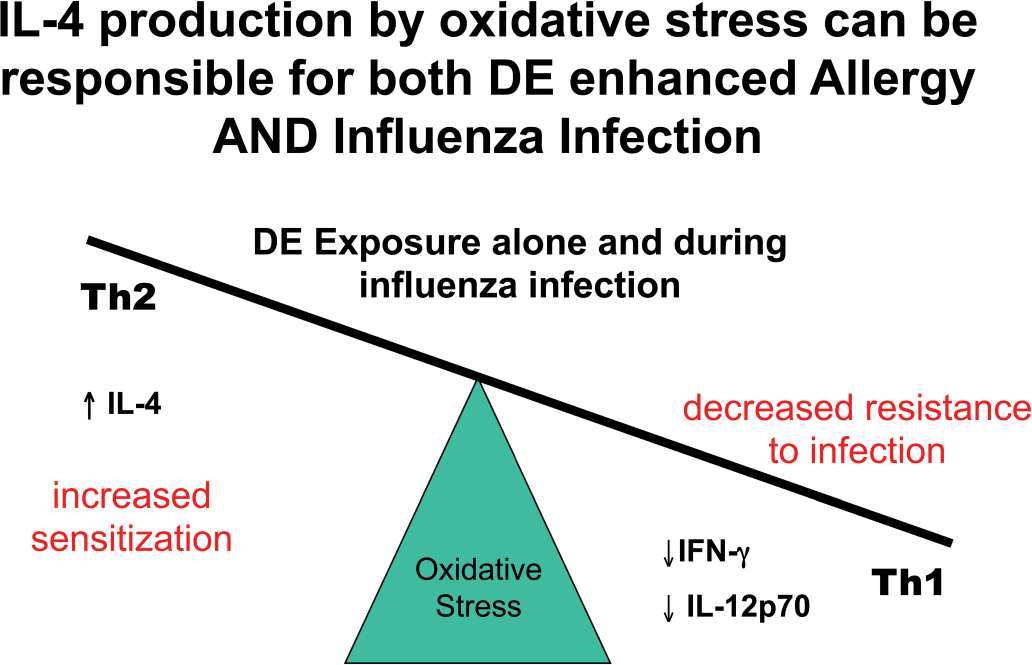
Air pollutant exposure has also been shown to reduce pulmonary defenses, resulting in increased incidence and severity of respiratory infections. This apparent paradox can be explained by the fact that when Th2 allergic-type immune responses are increased, there is a concomitant decrease in Th1 protective immunity to intracellular pathogens (Coffman 2010). Several previous studies had reported that exposure to diesel resulted in increased susceptibility to bacteria and viruses but did not assess immune signaling during infection (Gilmour and Gowdy 2007). To explore this effect, we examined the time course of influenza virus infection in mice exposed to filtered air or diesel exhaust and measured various aspects of immune function during this period. In this infection model, viral replication peaks between four and eight days and is associated with increased pulmonary inflammatory responses, higher levels of Th1 cytokines (interferon γ and IL12), and enhanced airway hyperreactivity to nonspecific agonists. Compared to air-exposed controls, virus titers, lung injury, inflammation, and pathology scores were significantly elevated in mice exposed to diesel in association with reduced Th-1 cytokines. In contrast, however, the Th2 cytokine Il-4 was increased with diesel exposure alone or in the context of virus infection (Gowdy et al. 2010). Furthermore, many of the diesel-enhanced effects could be reversed in mice pretreated with N-acetyl cysteine, suggesting that the immune polarization to a high-Th2, low-Th1 response was mediated through oxidative stress pathways.
Based on these results, it seems plausible that diesel exhaust particles, and perhaps other oxidant air pollutants that increase IL-4 production, can both reduce anti-viral immunity and promote the development of allergic airway disease. This simplified paradigm is presented in Figure 1, with the understanding that there are multiple pathways and regulatory molecules that can influence this balance. Given the significant influenza-related morbidity and mortality worldwide and the growing incidence of allergic asthma, such research provides greater understanding of the interactions between air pollutant exposure and immune regulation that may have an impact on the incidence and severity of both infectious and immune-mediated respiratory diseases.
Footnotes
The research described in this article has been reviewed by the National Health and Environmental Effects Research Laboratory, U.S. Environmental Protection Agency and approved for publication. Approval does not signify that the contents necessarily reflect the views and policies of the agency.
The author declared no potential conflicts of interest with respect to the research, authorship, and/or publication of this article.
The author received no financial support for the research, authorship, and/or publication of this article.