



Abstract
The debate on whether family caregiving is reciprocal or altruistic remains unresolved. This study examined how older adults’ care expectation is associated with their caregiving for different generations, focusing on direct and indirect reciprocity and altruistic giving. Using baseline data from the China Longitudinal Aging Social Survey (n = 11,511), we employed a multiple-indicator-multiple-cause model to examine multi-dimensional care expectation in relation to caregiving for their older parents, adult children, and grandchildren. Urban respondents who recently provide support to their adult children or grandchild reported a higher level of care expectation; caregiving for one’s own parents was associated with lower care expectation. A similar pattern was observed among rural respondents, but only for caregiving for adult children was statistically significant. Results suggest that caregiving for descendants is linked to reciprocal expectations, while caregiving for older parents is more altruistic. This study highlights the complex dynamics of intergenerational caregiving and expectations in rural and urban China.
Keywords
Introduction
Belief in receiving care and support from adult children in later life is rooted in norms of filial piety and is commonly regarded as a return for giving to adult children. The establishment of a social security system and shrinking family size in China has resulted in expectations that older people will be more independent in retirement and more willing to accept formal care services (Hu et al., 2020; Shi & Hu, 2020; Song et al., 2018). However, older Chinese adults give more to their family than ever before. Most are or have been a caregiver for their frail older parents and provided care and support for their adult children and grandchildren (Cong & Silverstein, 2011; Huo et al., 2018). For example, an increasing number of grandparents have migrated to live near their adult children to help with housework or childcare; they are described as “older floating population/floating grandparents (Lao-piao Zu)” (Qi, 2018; Wang & Lai, 2020).
Extensive research has investigated why people give in intergenerational relationships and examined the motivations for parental/adult children giving (Evandrou et al., 2018; Jiang & Fung, 2021; Lendon et al., 2014; Mazzotta & Parisi, 2020; Silverstein et al., 2002). Intergenerational exchange has normally been examined from a material or monetary giving and return or time-for-money exchange perspective (Lou, 2010; Lou et al., 2013; Mazzotta & Parisi, 2020). However, caregiving, as a special form of giving, requires additional resources and effort compared with or in addition to money transfer or companionship. Little research has investigated caregiving-receiving relationship from the perspective of intergenerational transfer.
This study explores whether older adults expect a reciprocal return when providing family care by involving the impact of caregiving itself and how it is differentiated by caregiving to different generations. Using a nationally representative Chinese dataset, we examined how older adults’ care expectation is associated with recent caregiving experiences for three generations, (a) caring for older parents; (b) helping adult children with housework; and (c) providing childcare for a grandchild. We defined care expectation as older adults’ perceptions of adult children’s filial responsibility, with priority given to being cared for by adult children among various forms of return. To better reflect this concept, we employed structural equation modeling (SEM) to construct a multi-dimensional latent variable for older adults’ care expectation.
Reciprocity and Altruism in Intergenerational Giving
Reciprocity is also known as an exchange relationship, explained by microeconomic exchange theory and social exchange theory (Silverstein et al., 2002), with many variations (Ugargol & Bailey, 2020). Although different disciplines provide slightly different perspectives, in the current context, reciprocity essentially describes a directly mutual giving and return interaction between two generations or parent-child relationships (Kohli & Künemund, 2003). The resources for exchange include financial and tangible physical assets, time, affection, and assistance. In an exchange relationship, giving and return are perceived as balanced rather than value equivalent (Gouldner, 1960) or transferred with different types of resources, such as time-for-money exchange (Lou, 2010; Lou et al., 2013; Mazzotta & Parisi, 2020). In addition, children’s return may depend on circumstances, such as their parents’ needs (Silverstein et al., 2002). According to the notion of reciprocity, older adults help their children or look after their grandchildren in the hope of receiving care in later life from the younger generations.
Altruistic behavior in intergenerational relationships refers to selfless giving or giving without expected return (Logan & Spitze, 1995). The potential benefit of giving derives from the giving itself rather than any return from others. In this context, giving to the younger generation is attributed to improving offspring’s well-being (Arrondel & Masson, 2006) rather than conditionally driven by reciprocity (Stark, 1995). Such altruistic behaviors are also explained by the motive of “the joy of giving” or “a warm glow” (Kohli & Künemund, 2003), labeled as “impure altruism” (Andreoni, 1989). According to some studies, older adults expressed altruistic preferences by prioritizing family resources for grandchildren rather than themselves (Cong & Silverstein, 2019) and reservations about their children’s abilities to care for them (Li et al., 2012). Although caregiving for older people can be very burdensome, less intensive care provision may increase the family caregiver’s and the care recipient’s well-being (Goodman, 2012).
We use the term “indirect reciprocity” to describe the benefits (return) from giving to the previous generation but receiving from the next generation. Cox & Stark (1996, 2005) proposed and developed the “demonstration effect,” described as “a mechanism by which children get socialized to accept a general normative pattern of obligation to help the elderly” (Kohli & Künemund, 2003, p. 128). In other words, people who look after their parents demonstrate to their offspring how older people should be treated (Stark, 1995; Ugargol & Bailey, 2020). Compared with direct reciprocity, indirect reciprocity stresses that an individual gains a return because of giving but not from the original recipient of the giving. We also distinguish indirect reciprocity from altruism or nonreciprocal motivation (Silverstein et al., 2002) because the giver expects a return from their giving, although this is not a mutual support relationship.
Conceptual Framework
The nature of the relationship between care expectation and caregiving reflects the giving-return relationship. Expecting care return when providing care stands for a reciprocal motivation; no expected return for caregiving suggests an altruistic motivation. In this study, we conceptualized the interaction between giving and return across generations using a framework of intergenerational relationships (Figure 1). First, the direct reciprocal relationship shows the dual giver and recipient role between two generations. The exchange process is explicit, although the amount or the content between giving and return may not be exactly equivalent, and the return may occur several years later. Second, the indirect reciprocal relationship is built on intergenerational transmission and demonstration effects across multiple generations. Here, giving is taken for granted by the previous generation and, consequently, return from the next generation is “promised” without any specific negotiation. Third, the altruistic relationship indicates no expected care return from caregiving; the giver is satisfied or fulfilled by the process of giving itself. Any generation can be an altruistic giver; whether or not they receive any return will be associated with their giving. Conceptual framework. G = generation; Gn = a certain generation. Arrow points to the direction of giving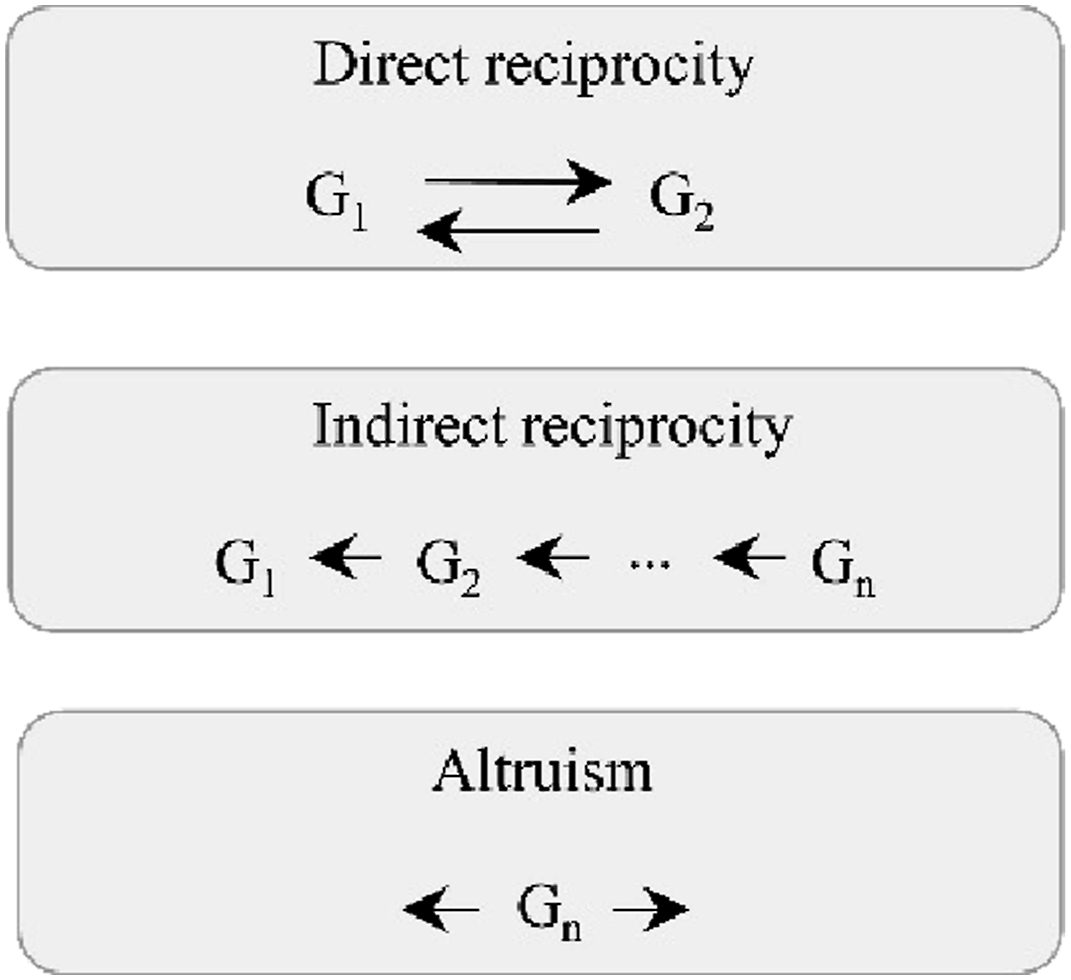
Filial Piety and Family Care Expectation in Modern China
Filial piety (孝道 xiàodào), a Confucian virtue emphasizing children’s obligation to respect, obey, and care for their aging parents, has long been a moral foundation of Chinese society (Cheung et al., 2020; Yu & Fang, 2022). Rooted in traditional norms of intergenerational reciprocity, it historically mandated co-residence, material support, and emotional devotion to elders (Feng, 2017). However, rapid modernization, urbanization, and socioeconomic shifts have profoundly reshaped its practice, leading to distinct rural-urban divides in care expectations (Feng, 2017).
In rural China, filial piety remains closely tied to direct family caregiving, with older adults maintaining strong expectations of support from children, due to traditional filial piety and limited availability of formal care services (Chen et al., 2024; Liu et al., 2024; L. Wu et al., 2024; Xia et al., 2020). Rural older adults often prioritize self-reliance while they are healthy, but expect to rely on their children for care as their abilities decline, with cohabitation or proximity to children seen as ideal (Chen et al., 2024; L. Wu et al., 2024).
In contrast, urban populations increasingly interpret filial piety more flexibly due to modernization and urbanization. The view of responsibility for takding care of older adults is shifting from a duty exclusively held by children to a shared model involving government support and personal self-reliance, particularly in urban areas (Liu et al., 2024; F. Wu, 2021; Leung et al., 2020). Urban older adults are more open to community-based or institutional care, and their willingness to rely on family is generally lower, influenced by higher education, better access to services, and changing social norms (Shi & Hu, 2020; Wang, Han, et al., 2022; Xia et al., 2020). Urban residents’ expectations are also shaped by factors like income, health status, and living arrangements, with those living alone or with higher education more likely to consider non-family care options (Wang, Guan, et al., 2022; Xia et al., 2020).
Family care expectation can also be modified by the perceived caregiving burden. Evidence from Hong Kong (a highly developed Chinese region) suggests that older people might modify their expectations regarding financial support from adult children if they are aware of the younger generation’s increasing family burden (Bai, 2018). Indeed, taking care of older adults with long-term care needs is often physically and emotionally taxing, and older adults who experience this burden firsthand may seek to avoid imposing similar strains on their own children. This tendency is particularly pronounced in urban areas, where higher living costs and competing demands exacerbate the challenges of intergenerational caregiving.
Overall, while family care remains important in both contexts, rural older adults have higher and more traditional expectations for family support, whereas urban older adults show greater acceptance of diverse care models and are more influenced by individual and socioeconomic factors.
Research Aims and Hypotheses
Using a nationally representative dataset in rural and urban China, we aim to understand how older adults’ care expectation can be differentiated by their recent caregiving experiences to three generations (i.e., grandchildren, adult children, and their older parents). Also, we investigated whether this association between caregiving and care expectation differed systematically between rural and urban older populations.
Based on our conceptual framework and the rural-urban disparity of filial expectation in China abovementioned, we proposed the following hypotheses.
Older people in both rural and urban areas who recently provided caregiving to grandchildren or adult children will report a significantly higher level of care expectation compared to non-caregiving counterparts.
Caregiving for descendants (adult children/grandchildren) reinforces expectations of future care in return, aligning with social exchange theory. It reflects universal norms of intergenerational exchange among urban and rural respondents, where giving time/housework strengthens bonds and future care expectations. This hypothesis reflects a direct reciprocal return from providing support to grandchildren or adult children.
Among rural older people, those who recently provided caregiving to their older parents will demonstrate stronger filial care expectations than non-caregiving counterparts.
Rural caregivers upholding upward caregiving (for parents) operate within stronger patrilineal norms, where demonstrating filial piety reinforces expectations of similar treatment from their own children. Also, limited formal care options in rural areas heighten reliance on familial reciprocity, making caregiving a normative “investment” in future support. This hypothesis reflects an indirect reciprocal return from demonstrating the importance of looking after older parents.
Conversely, urban older adults with recent caregiving experiences to their older parents will show lower level of care expectation than non-caregiving counterparts.
Urban caregivers experience stress from caregiving and housing constraints, leading to altruistic motives—they avoid burdening their children similarly. Also, exposure to formal care services during parent caregiving reduces reliance on familial support, weakening reciprocal expectations. This hypothesis reflects altruistic motivation without any expected return.
Operationalization of Care Expectation
Care expectation (i.e., expectation of care return) in the present study was used for how older adults perceived filial obligations or filial responsibility for care (de Valk & Schans, 2008; Finley et al., 1988). Expecting to receive care from offspring as a return can be reflected in multiple ways under the concept of filial responsibility expectation. Filial responsibility expectation was initially measured by Seelbach and colleagues using multi-dimensional questions (Sanders & Seelbach, 1981; Seelbach, 1977; Seelbach & Sauer, 1977) and developed in terms of older adults’ attitudes regarding adult children’s support, help, and residential proximity to parents. By distinguishing social norms and behavioral intentions, Peek et al. (1998) then explored the operational definition of specific and global expectations of older parents about receiving care from their adult children. A subsequent study explored expectations of filial piety according to various types of support, that is, care, respect, greeting, happiness, obedience, and financial assistance (Dong et al., 2014). Based on the above literature, we identified the following five aspects of filial responsibility expectation: (1) perception of responsibility to take care of aging parents, (2) reasons for raising a child, (3) attitudes toward the forms of return, (4) ascertaining older adults’ general attitudes about different scenarios, and (5) ascertaining older adults’ opinions about living with their adult children. In this study, we used a multiple-indicator-multiple-cause (MIMIC) model, which is a special form of SEM, to load a latent concept for care expectation from these five dimensions and further investigate the association between caregiving experience and care expectation.
Methods
Sample
We used data from the China Longitudinal Aging Social Survey (CLASS), a nationally representative dataset of individuals aged 60 years and older in China, using multi-stage sampling across 259 urban communities and 172 rural villages in 28 provinces, collected every 2 years. Although the CLASS is a longitudinal dataset, the biased distribution for some question, compounded by the natural attrition in the follow-up samples, renders it impossible for us to use a longitudinal dataset to investigate our research questions. Therefore, the CLASS baseline dataset (2014) was employed, which captured rich information on respondents’ demographics, physical and mental health status, social service utilization, socioeconomic status, retirement planning, social participation, attitudes toward aging, and intergenerational support. It is available on request from the National Survey Research Center at Renmin University and is increasingly used in studies on Chinese older people (Deng et al., 2022; Wang et al., 2022).
Given our research questions and data availability, the sample used in the current study was limited to respondents completing the baseline survey (n = 11,511) in 2014. Because of our study’s focus, we excluded individuals with no responses on any type of caregiving (n = 252) or care expectation (n = 44). To deal with missing values, we used full information maximum likelihood estimation when loading a latent dependent variable under the assumption of missing at random (Little & Rubin, 2014) and listwise deletion for explanatory variables in the final analytic model. Our final sample comprised 10,228 respondents stratified by rural-urban residence (urban residents: n = 6056, 59.2%; rural residents: n = 4172, 40.8%).
Measures
Dependent Variable: Care Expectation
Based on the components identified from the literature, we constructed a continuous latent variable for the level of care expectation with five indicators: Y1: Parents’ care is an adult child’s (vs others’) responsibility; Y2: Bringing up a child is for one’s future care; Y3: Caregiving as the most important demonstration of filial piety; Y4: Desire to be cared for by an adult child when one is sick; and Y5: Want to live in an adult child’s home in later life. We recoded the question for each indicator as a binary variable (0 = No, 1 = Yes). Details of each variable are listed in supplementary S_Table 1.
Key Predictors: Three Types of Caregiving
We constructed three variables for older adults’ care of grandchildren, adult children, or older parents, generated from the following three questions, “In the past 12 months, how long did you spend taking care of a grandchild born to this child?” (Caregiving for grandchildren); “In the past 12 months, how often did you help this child with housework?” (Caregiving for adult children), and “How many hours did you spend in taking care of your parents or parents-in-law in the past month?” (Caregiving for older parents). We recoded the questions above as three binary variables indicating whether they provided care for any of their adult child, grandchild, and parent (0 = no; 1 = yes).
A composite caregiving variable based on all caregiving questions was generated and coded as 0 = no intergenerational caregiving, 1 = caregiving for younger generations, 2 = caregiving for older parents, and 3 = caregiving for both younger and older generations. Younger generations refer to adult children and grandchildren, while older generation refers to participants’ older parents. This composite caregiving variable was used in sensitivity analyses.
Control Variables
We also considered other factors associated with care expectation, including sociodemographic characteristics, health status, enabling family resources, and intergenerational financial exchange (Jiang & Fung, 2021; Shi & Hu, 2020; Silverstein & Angelelli, 1998; Song et al., 2018). Sociodemographic characteristics were measured by gender (female = 0; male = 1), age (in years), and educational level (0 = no formal education; 1 = elementary-middle school; 2 = high school and above). Health status was measured by a binary variable for having a chronic disease (0 = no; 1 = yes) and a categorical variable for care need (1 = no care need; 2 = with care needs but not receiving care from offspring; 3 = with care needs and receiving care from offspring). Factors indicating enabling family resources included the number of living adult children, the distance from offspring’s home (1 = in the same neighborhood, 2 = in the same township, 3 = in the same district or county, 4 = in the same city, 5 = in the same province, 6 = other province in China, and 7 = overseas), and current living arrangement and marital status (1 = living alone; 2 = not living alone, without spouse; and 3 = not living alone, with spouse). Intergenerational financial exchange was also controlled by two binary variables using questions concerning whether respondents received material support (including cash, food, and gifts) from any adult child and whether the respondent provided material support for any adult child in the past 12 months (0 = no; 1 = yes).
Analysis
To evaluate the relationships between care expectation, care giving and controlling variables proposed in the conceptual framework, we developed a generalized structural equation model (GSEM) to derive and test relative coefficients of associations. The structural equation model consists of (1) a measurement model: that describes the relationship between abstract or latent concepts (care expectation) and measurements (indicators for care expectation), and (2) a structural model, where the latent concepts (care expectation) are related to predictors (care giving and control variables). In this analysis, a multiple-indicator-multiple-cause (MIMIC) model, a special form of GSEM, was employed to investigate the association between care expectation (latent concept) and caregiving experience. Similar model forms have been used in multiple applications in the fields of sociology, social care (Hwang & Sim, 2021), and applied statistics (Rabe-Hesketh & Skrondal, 2004). Figure 2 illustrates the structure of the MIMIC model. Models were fitted in Stata 15.1 using the GSEM command with the group option. Measurement invariance between communities was carefully tested. MIMIC model for the effects of three types of caregiving on care expectation. Latent variables are represented by ovals and observed variables are in rectangles; MIMIC: multiple-indicator-multiple-cause model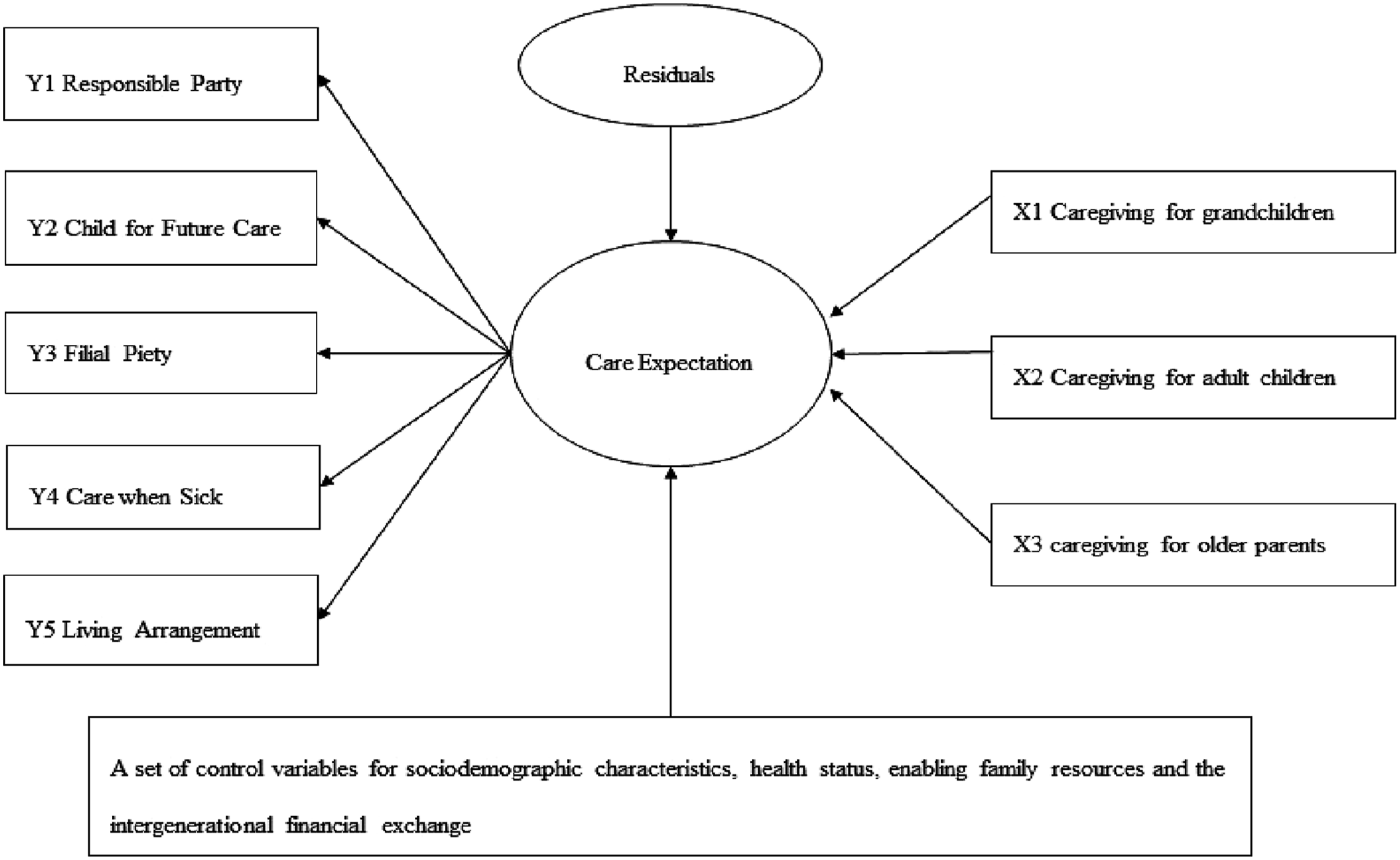
After recoding the value of variables Y1-5 to reflect the level of care expectation, we fitted a probit model to each measurement to load the continuous latent dependent variable (Bartholomew et al., 2008). To ensure the robustness of the derived care expectation construct to the choice of its measurements, we compared our configuration of five measurements against six variants with different constraints on the measurement structure and complexity. Models were compared using the Akaike information criterion (AIC), Bayesian information criterion (BIC), and likelihood-ratio tests.
To compare the differential association between caregiving experiences and care expectation between urban and rural respondents, we first evaluated whether the two groups perceived the underlying construct of care expectation in the same way (i.e., measurement invariance). This was tested using a stepwise approach; the model with all parameters freely estimated was compared with models with metric invariance (loadings constrained to be equal between communities) and with scalar invariance (loadings and intercepts both constrained to be equal between communities, i.e., strong invariance; Borsboom, 2006).
The structural model in our analysis was a regression model where the latent variable “care expectation” (continuous factor) was regressed on three types of care provision (key predictors) and a set of control variables. To allow for a comparison of effects between rural and urban respondents, we constrained the residual variance of the dependent variable to be equal for urban and rural residents. Interpretation of the coefficients in the structural model was the same as in standard linear regression models. A positive association between caregiving and care expectation would indicate a potential direct/indirect reciprocal relationship, while a negative or a weak association would infer an underlying altruistic relationship.
A sensitivity analysis was conducted to further compare the effect of differences in caregiving for different generations by using the composite caregiving variable rather than three separate caregiving variables (for different generations).
Results
Descriptive Statistics
Descriptive statistics of the analytic samples by rural and urban areas
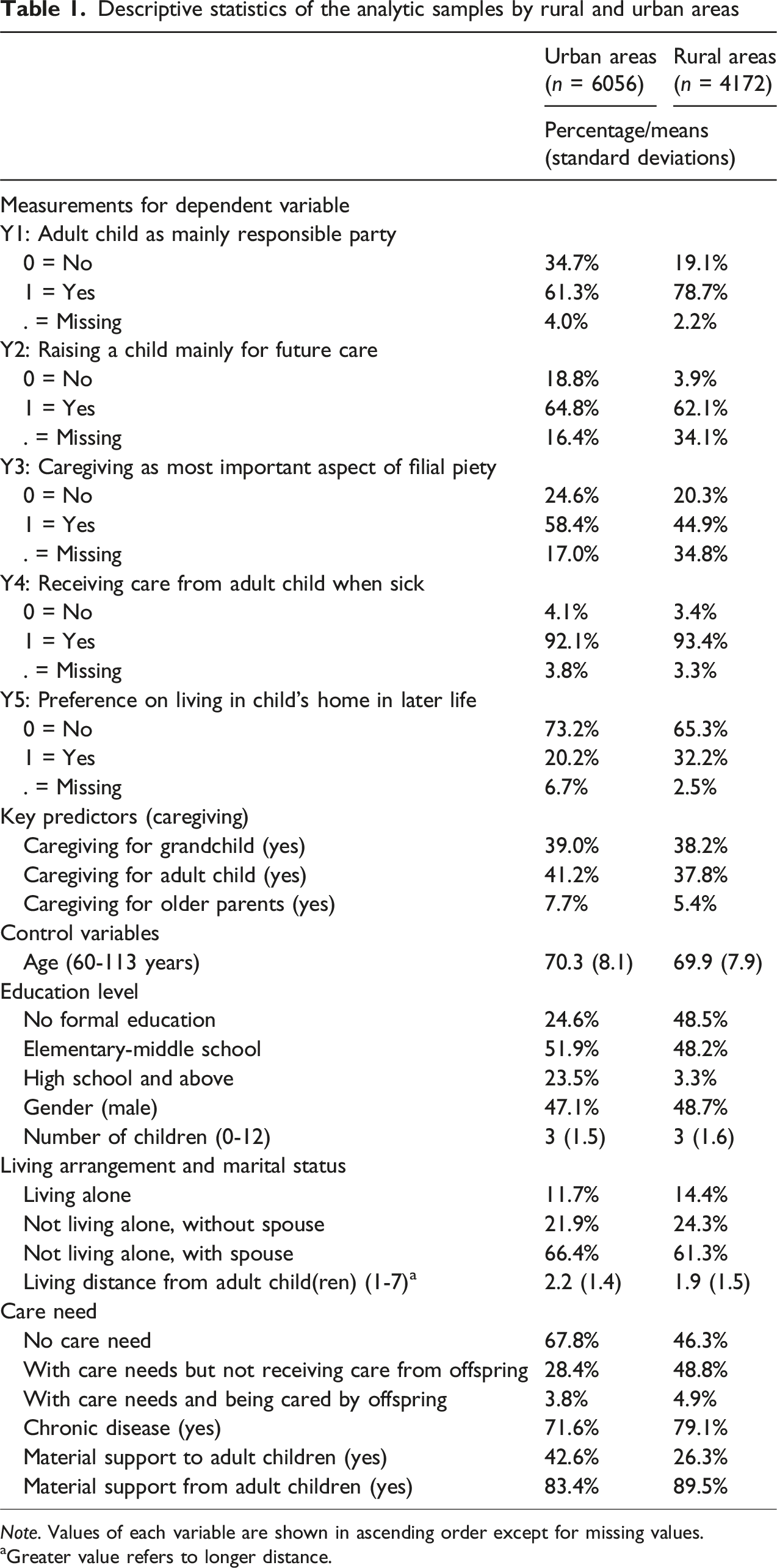
Note. Values of each variable are shown in ascending order except for missing values.
aGreater value refers to longer distance.
The Measurement Model of Care Expectation
Robustness of the measurement model for care expectation
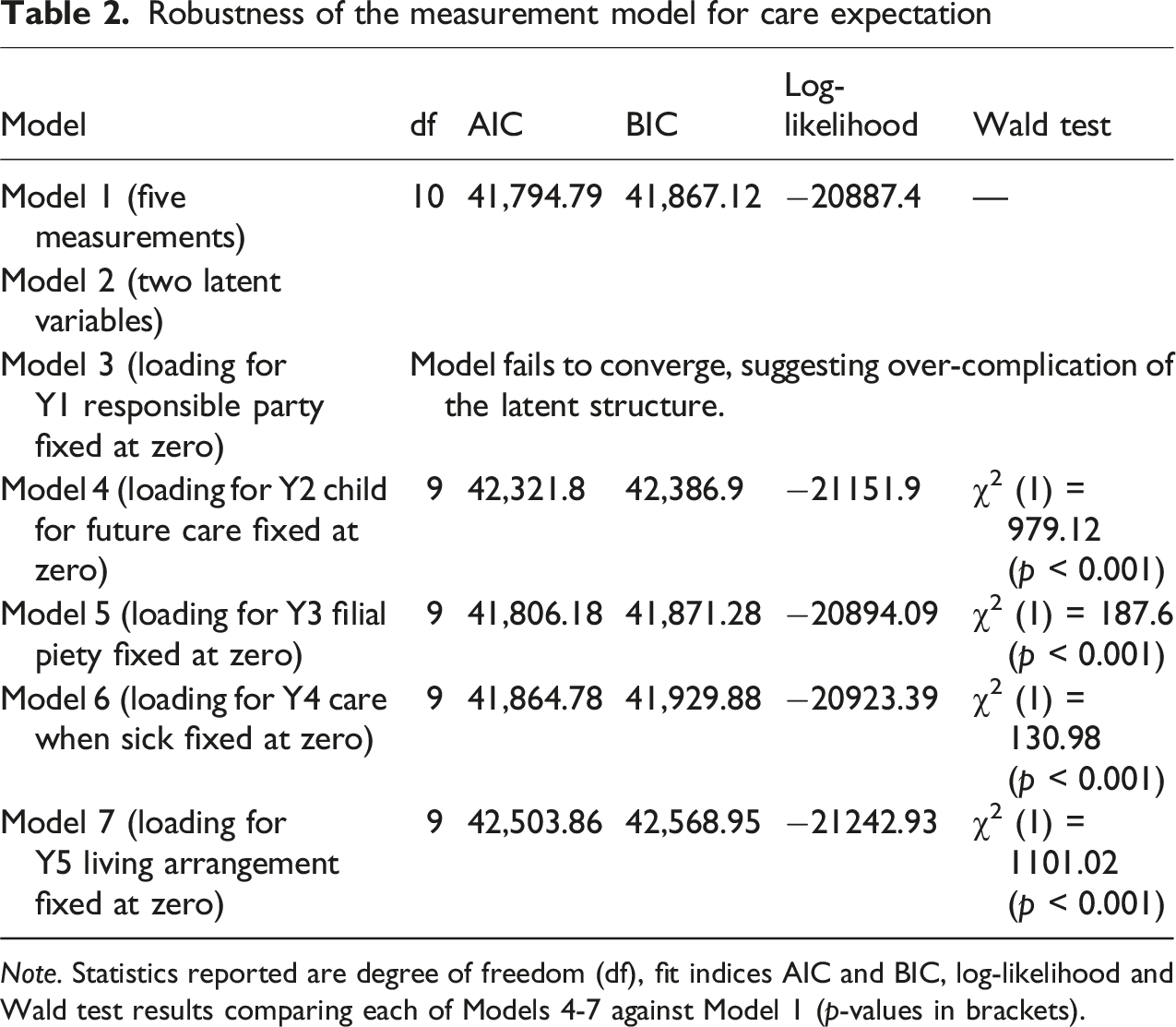
Note. Statistics reported are degree of freedom (df), fit indices AIC and BIC, log-likelihood and Wald test results comparing each of Models 4-7 against Model 1 (p-values in brackets).
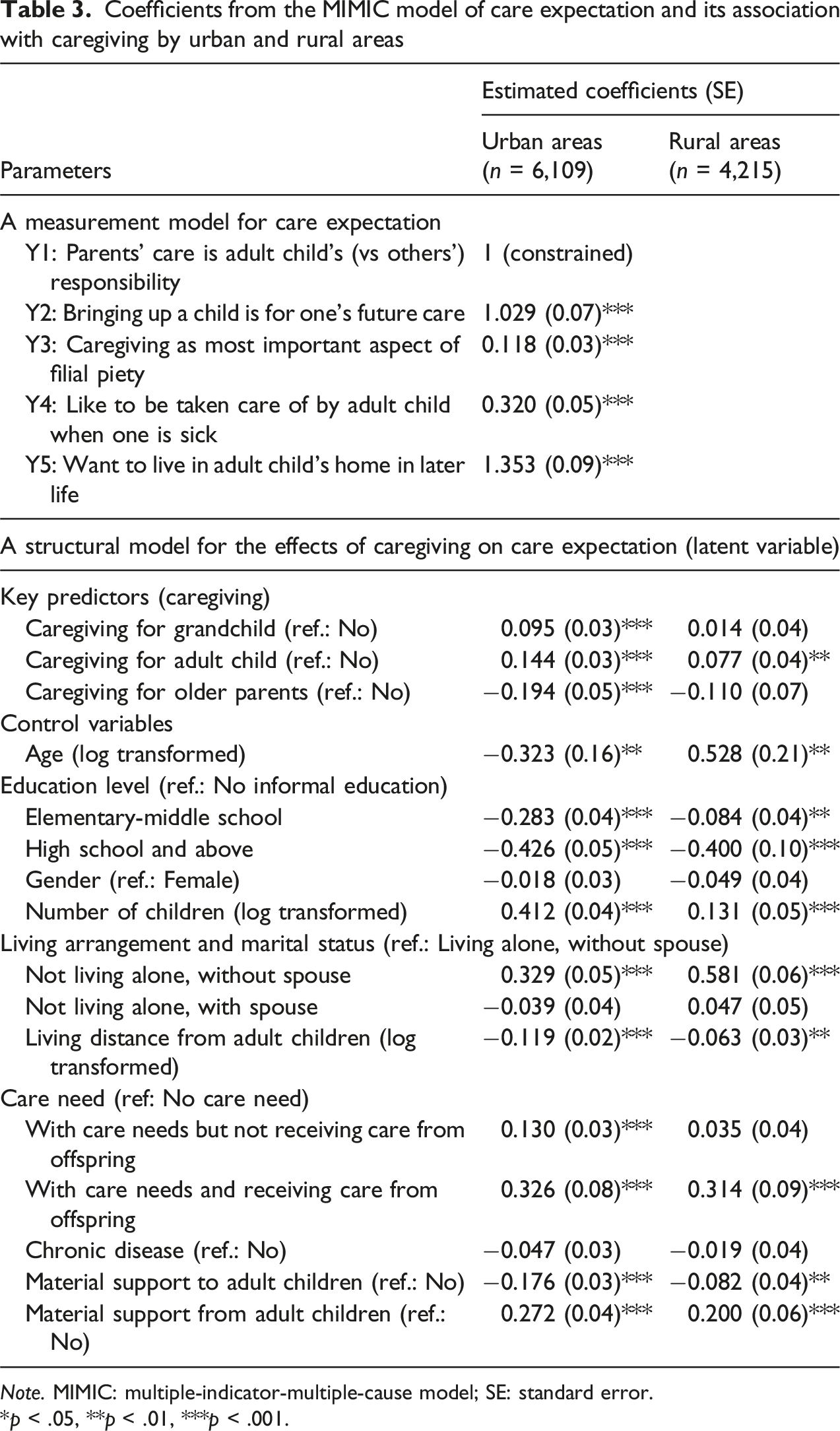
Coefficients from the MIMIC model of care expectation and its association with caregiving by urban and rural areas
Note. MIMIC: multiple-indicator-multiple-cause model; SE: standard error.
*p < .05, **p < .01, ***p < .001.
The Structural Model of the Association Between Caregiving and Care Expectation
Holding other factors constant in the MIMIC structural model (Table 3), urban respondents had a significantly higher care expectation if they provided care for grandchildren (β = 0.118) or helped adult children with housework (β = 0.090) in the last 12 months. However, those who cared for their older parents in the last month had a lower care expectation than those who did not (β = −0.162). Similar patterns were also observed among rural respondents, but the association was only statistically significant for those helping adult children with housework (β = 0.110).
Regarding the other predictors of care expectation, the patterns of the associations were very similar between urban and rural respondents, except for age (urban: β = −0.39; rural: β = 0.52) and gender (urban: β = 0.033; rural: β = −0.059). Respondents’ care expectation was negatively associated with education level (reference group: no formal education) and living distance from adult children. Variables representing enabling family resources showed a positive association with care expectation. For instance, respondents who had more children (urban: β = 0.465; rural: β = 0.146), single but living with kin (reference to living alone; urban: β = 0.328; rural: β = 0.469), or living closer to offspring (urban: β = -0.108; rural: β = −0.061) reported higher care expectation. Compared with those with no care needs, respondents with care needs, regardless of whether their current caregiver was their child, had higher care expectation. Material support from respondents to their adult children predicted lower care expectation (urban: β = −0.169; rural: β = −0.063), while material support from adult children to respondents predicted higher care expectation (urban: β = 0.248; rural: β = 0.212).
The sensitivity analysis using the composite caregiving variable showed consistent results (see Supplementary S_Table 3): compared with participants with no recent intergenerational caregiving, urban participants who recently provided care for younger generations have significantly higher level of care expectation (β = 0.147), while rural participants who provide care for their older parents have significantly lower level of care expectation (β = −0.255).
Discussion
This study expands our understanding of intergenerational relationships by examining the association between older adults’ care expectation and their caregiving experiences across multiple generations. Using nationally representative data, we employed structural equation modeling to construct a multi-dimensional latent variable for older adults’ care expectation and examine its association with caregiving experiences for different generations (i.e., taking care of older parents, helping adult children with housework, and looking after grandchildren). Theories on caregiving motivations were conceptualized with direct reciprocity (caregiving for offspring), indirect reciprocity (caregiving for older parents), and altruism (caregiving for any generation). In general, we found that care expectation was positively associated with caregiving for grandchildren or adult children but was negatively associated with caregiving for older parents. This pattern was significant among urban respondents, while a significantly higher level of care expectation was predicted only among rural respondents providing help for their adult children. The specific findings are as follows.
First, our results indicate the existence of direct reciprocity in intergenerational relationships among both rural and urban respondents, as care expectation level is positively associated with helping with housework for adult children (HP1). Extensive evidence has identified intergenerational exchange and found different types of resources in the giving-return relationship, such as a time-for-money exchange (Lou, 2010; Lou et al., 2013; Mazzotta & Parisi, 2020). After controlling the other covariates and material support exchange between respondents and their adult children, our study’s contribution is to identify a direct reciprocal relationship between recent caregiving and future care expectation from the perspective of caregivers. One plausible explanation is that caregiving for adult children maximizes family time and strengthens family bonds, which indicates a potential closeness in family relationship and distance between older adults and their adult children. The observed direct reciprocity in the intergenerational relationship also reflects the “mutual exchange” and “double-sided altruism” (Ugargol & Bailey, 2020).
Second, the SEM estimates revealed that caregiving for grandchildren by rural respondents was more likely altruism-oriented but reciprocity-oriented among urban respondents because the association between care expectation and caregiving for grandchildren was positive but only significantly among urban respondents (HP1). The reasons for this may be related to the rural-urban gaps in opportunity for social participation as there are more welfare facilities for older adults in urban areas to join (Lin & Wu, 2017). Urban respondents’ caregiving for grandchildren may mean high opportunity costs and concessions to or even sacrifice of their independent life, particularly for “older floating population/floating grandparents (Lao-piao zu)” (Qi, 2018; Wang & Lai, 2020). Previous research also describes this reciprocal motivation of giving as an “investment model” (Silverstein et al., 2002). In contrast, rural older adults providing care for grandchildren may benefit from fulfilled leisure time and strengthening affection ties with their offspring (Huo et al., 2018). Rural respondents’ altruistic “sacrifice” for their grandchildren suggests a more traditional norm for family solidarity in Chinese communities (Yarris, 2017).
Third, we also found that caregiving for one’s own older parents was altruistic rather than indirect reciprocity in both rural and urban areas (HP2&3). Following studies on the demonstration effect (Cox & Stark, 1996, 2005; Mitrut & Wolff, 2009; Ugargol & Bailey, 2020), we conceptualized the impact of caregiving for the older generation on the next generation as an indirect reciprocal relationship and examined that by the future care expectation of current older caregivers (i.e., older adults providing care for their older parents or parents-in-law). Surprisingly, those who recently provided care for their older parents reported a lower care expectation (significant for urban residents only). This suggests that their caregiving for their parents was not intended to show their children the expectation of receiving similar care in the future (demonstration effect). One plausible explanation is that respondents caring for older parents did not want future generations to experience the same challenging care burden they had borne. Previous studies have found that the increasing care burden of the younger generation modified older adults’ attitudes toward filial obligations and their expectations of financial support from the next generation (Bai, 2018; Cahill et al., 2009). Meanwhile, the increasing availability of formal care, particularly in urban areas, can provide a substitute resource for family support.
There are three major limitations to this study. First, the measures of the mixed effects among various types of family transfer are expected to be improved in future work. As previously mentioned, resources for transfer can include money, time, and affection. The exchange may not be equivalent and may include different inputs. The absence of indicators showing the level of affectional assistance and expectation may produce biases in estimating the magnitude of care expectation. However, a measurement model that loaded various forms of filial responsibility, including proactive greeting of older parents, was used to remedy the absence of affection in the model. In addition, bi-directional material transfer between respondents and their adult children was also controlled. Future research should aim to employ a better measurement of affectional effects and specify the interaction among various resources for transfer. Second, the cross-sectional design limited determining the causal direction of the relationship between caregiving and care expectation. The direction of the relationship between behavior/experience and expectation can be complex, possibly with iterative processes with changes in expectation that occur over a much finer timescale than can be captured in population surveys. In our study, the measurements we used in this study indicated recent caregiving experience and future care expectation to indicate a factually sequential order to achieve a robust association. Our current findings provide initial support for the existence of a relationship between caregiving behavior and care expectation across generations and can inform future study design (e.g., experimental, longitudinal) to test out the exact direction and nature of the relationship. Third, our study examined a short-term rather than life-course reciprocity (Leopold & Raab, 2011) that perceived among current older adults based on their recent caregiving experiences. In addition, participants who do not have living parents were not able to be identified due to the data limitation. The findings may not apply to future older generations given recent significant changes in China; Chinese people born in different eras have had very different life experiences in terms of socioeconomic development and population policy. Future studies will need to focus on the dynamic changes in the association between caregiving and expectation among different generations.
Despite these limitations, the findings of our study provide implications within a broader cultural and policy context. First, increasingly active grandparenting may reverse the direction of fading filial norms. It is not surprising that relaxing birth control policy (e.g., the third-child policy) combined with scarce childcare services means more Chinese grandparents help with childcare. According to our findings, this may result in a higher level of filial expectation, particularly in urban areas. Therefore, the norms of filial piety in China will be reaffirmed but adapted into a new context. From the policy perspective, caregiving as a form of productive aging can help plug society’s care gaps but may also shape the sociocultural context.
Second, families who need childcare help from grandparents may face more difficulties when these grandparents need care services. The need for childcare by grandparents indicates insufficient childcare support and pressure among the working-age population. When older parents expect care in return for providing grandchild care, it may intensify the future burden anticipated by their adult children. Following implementation of the third-child policy in China, while an increasing number of supporting childcare policies were proposed, employee benefits such as paid/unpaid leave or flexible working arrangements to facilitate better care of older parents should also be encouraged.
Third, a holistic and integrated solution is needed to address the demographic structural changes and the increasing care needs for children and older adults. Taking retirement policy as an example, retirees are the main resources for childcare and care for frail older adults. China’s 14th Five-Year Plan proposed phased increases in the statutory retirement age from 50 years for women and 60 years for men (The State Council, 2021), which will largely reduce current informal care provision. While the extended retirement age policy will increase the labor force in the formal labor market, its potential negative impact on informal caregiving needs to be addressed simultaneously.
Supplemental Material
Supplemental material - Do Older Adults Expect Reciprocity When Providing Family Support to Different Generations? Evidence From a Nationally Representative Sample of Rural and Urban China
Supplemental material for Do Older Adults Expect Reciprocity When Providing Family Support to Different Generations? Evidence From a Nationally Representative Sample of Rural and Urban China by Cheng Shi, Yajing Zhu, Terry Yat-Sang Lum and Gloria Hoi Yan Wong in Journal of Family Issues
Footnotes
Acknowledgments
We thank Professor Peng Du at Renmin University of China and Dr. Bo Hu and Ms Nicola Brimblecombe at London School of Economics and Political Science for their generous support. We are also grateful to the National Survey Research Center at Renmin University of China for providing the CLASS baseline data.

Ethical Considerations
Ethical approval was not required for our study as we used a secondary data from the China Longitudinal Aging Social Survey (CLASS), a nationally representative dataset of individuals aged 60 years and older in China.
Author Contributions
C. Shi and Y. Zhu are joint first authors. C. Shi planned the study, supported statistical analyses, and wrote the paper. Y. Zhu performed statistical analyses and contributed to the planning and writing of the paper. T. Y. S. Lum contributed to interpreting the findings and revised the manuscript. G. H. Y. Wong supervised the study, interpreted the findings, and revised the manuscript. All authors reviewed the manuscript.
Funding
The authors disclosed receipt of the following financial support for the research, authorship, and/or publication of this article: This study was supported by the Hong Kong Research Impact Fund of the Research Grants Council (Project Reference number: R7017-18), as part of the “Tools to Inform Policy: Chinese Communities Actions in Response to Dementia” (TIP-CARD) project. CS receives funding from Lingnan University Faculty Research Grant (reference number: GSFRG/22/8). The funding body was not involved in the study design, the collection, analysis and interpretation of the data, the writing of the report, or the decision to submit the paper for publication.
Declaration of Conflicting Interests
The authors declared the following potential conflicts of interest with respect to the research, authorship, and/or publication of this article: Y. Zhu is a full-time employee of F. Hoffmann-La Roche Ltd; this employment is not in any way connected to the manuscript preparation.
Supplemental Material
Supplemental material is available online.
References
Supplementary Material
Please find the following supplemental material available below.
For Open Access articles published under a Creative Commons License, all supplemental material carries the same license as the article it is associated with.
For non-Open Access articles published, all supplemental material carries a non-exclusive license, and permission requests for re-use of supplemental material or any part of supplemental material shall be sent directly to the copyright owner as specified in the copyright notice associated with the article.
