




Abstract
Article explores how young adults in Lithuania who experienced transnational family life during childhood narrate adulthood through the lens of the ‘linked lives’ perspective. Drawing on in-depth qualitative interviews with individuals aged 18 to 35, the study employs a methodological approach that combines timelining and visual mapping to capture the subjective significance of life events. The findings reveal how experiences of parental migration are remembered, interpreted, and woven into personal narratives of adulthood. Participants reflect on their past through three main narrative forms – linear, fragmented, and projective – each illustrating ways of integrating childhood experiences into their current life trajectories. Narratives highlight how intergenerational ties and socio-historical contexts shape individual understandings of adulthood. This study contributes to sociological understandings of adulthood in the context of transnational family histories. Young people do not passively inherit family legacies, but actively engage with them in constructing alternative or continuity-based life paths.
Introduction
Following the restoration of independence in 1990 and Lithuania’s accession to the European Union in 2004, living in different countries has become an increasingly common reality of family life. This shift has given rise to new forms of childhood experience, marked by parental migration and geographical separation (Juozeliūnienė & Budginaitė, 2016). 1 Within this evolving context, researchers have begun to explore the category of the ‘transnational child’ and implications of growing up across borders. This study contributes to that discussion by asking: how do young adults reflect on and integrate their transnational childhood experiences into their narratives about their subsequent life trajectories and transition to adulthood?
Transnational life experiences during childhood are often associated with reflections on an accelerated sense of adulthood, even within the broader context of delayed transitions to adulthood (Martinkėnė & Kraniauskienė, 2023). However, the contextual nature of these experiences plays a crucial role in shaping the specific trajectories of young adults’ life courses. This includes the ‘linked lives’ dimension and broader historical, geographical, economic and political contexts. Alongside individual agency, these elements – central to the life course paradigm (Elder et al., 2003) – underscore the uniqueness of each individual’s life course. It is considered that time is subjectively experienced through significant life events spanning from childhood to adulthood, with these experiences being intrinsically tied to the surrounding context.
This article adopts a life course perspective informed by the concept of ‘linked lives’ (Elder et al., 2003). It examines how significant events are narrated and interpreted in the light of familial, historical, and social contexts, and how these interpretations inform the way young people envision their lives. Central to this inquiry is the understanding that narratives are not objective records of cause and effect, but are constructed accounts shaped by individual agency, relational histories and broader social conditions. The study draws on qualitative in-depth life story interviews with young adults, combining timelining and visual mapping methods to gather the narratives about significant life events. By attending to the temporal and relational structures of these narratives, the article highlights how young adults position themselves within – and sometimes against – family patterns and cultural scripts inherited from their past and their transnational childhood experiences.
The article is structured into four sections. The first section outlines the key theoretical concepts and research methodology. The second and third sections explore the contextual nature of transnational life experiences, the role of the ‘linked lives’ in shaping distinct life course narratives and reveals how transnational childhood experiences are articulated through distinct narratives about adulthood trajectories. Finally, the fourth section presents the conclusions.
Theoretical Ideas and Research Methodology
A person’s life course and family life history are deeply interconnected, characterised by reciprocal and dynamic interactions. This understanding led researchers in the 1990s to integrate the concepts of individual life course and family development into a unified theoretical framework known as the family life course (Van Winkle, 2017; Gilligan et al., 2018; Bengtson & Allen, 1993). Combining sociological and psychological theories, this framework emphasises the role of historical and social contexts, along with the importance of individual time and personal development (Settersten, 2015). Within this perspective, the concept of ‘linked lives’ and the influence of social, economic, political and historical contexts on life course events become particularly significant.
In examining adulthood, scholars highlight the relevance of both traditional normative/demographic markers – such as completing school, starting a first job, or leaving the parental home – and subjective markers of adulthood. The subjective markers include a person’s readiness to take on responsibilities, a sense of accountability, the capacity for decision-making, and the ability to manage one’s life (Arnett, 2004; Blatterer, 2007, 2010; Chesters et al., 2019; Nugin, 2010; Spéder et al., 2013). They reflect individual agency and the processual nature of adulthood as a socially constructed experience shaped by significant life events. However, as Settersten (2015) argues, this emphasis on individual agency often underplays the significance of ‘linked lives’ – that is, how family and social context shape young people’s life trajectories. It is therefore important to examine how young adults with transnational childhood experiences reflect on their past and narrate their transitions to adulthood within the broader context of family migration.
While the value of a life course perspective for studying transnational experiences is recognised, existing research has largely focused on the transition to adulthood among migrant children living abroad, rather than on the life course of children who remained in their country of origin. Several studies from other contexts have addressed this gap by examining how transnational childhoods affect the subsequent life trajectories those who stay behind. For example, Dreby (2010) demonstrates that the Mexican children assume early responsibilities that form their path to adulthood; Hoang et al. (2015) show how children in South Asia actively shape their development through resistance, resilience, and reworking under the constraints of parental migration; and Mazzucato and Schans (2011) emphasise the long-term impact of transnational dynamics on young people’s life trajectories. This study builds on this literature and extends it by analysing how young people in Lithuania reflect on their transnational childhoods in a context shaped by rapid socio-economic change and East-West mobility.
Drawing on resilience theory and life course theory, the interplay between family and individual resilience in the face of stressful situations emerges as a focal point of the analysis. In this study, on the one hand, transnational family life during childhood due to parental migration is viewed as a challenging environment intertwined with personal development and the dynamics of family life as a whole (Daines et al., 2021). From a life course perspective, individuals exposed to adversity develop protective strategies at both individual and social-environmental levels to mitigate risks and navigate challenges (Hiebel et al., 2021). On the other hand, while potentially challenging, a transnational lifestyle may also foster resilience in young adults, influencing their life course decisions. For example, some strive to avoid repeating the unsuccessful trajectories of their parents, while others seek to emulate positive aspects of transnational experience.
To explore how individuals with transnational childhood experience adulthood, this study examines their life course narratives to show how participants interpret key turning points, linking past experiences to broader life course trajectories. They reveal subjective meanings assigned to transnational experiences and the interplay between individual readiness, significant life events, family dynamics, and social contexts. By analysing these narratives, the article considers how young adults attribute meaning to their transnational childhoods and how these meanings shape the timing and nature of transitions into adulthood.
Accordingly, the analysis places particular emphasis on the concept of ‘time’ – a fundamental element in the life course perspective. Time underscores both the dynamism of life and the individuality of life stories as they unfold across different stages (Brockmeier, 2000; Murray, 1999). The article also draws on two core aspects of the life course paradigm (Elder et al., 2003) that influence specific life course events: (1) ‘linked lives’ and (2) historical, geographical, cultural and political context. ‘Linked lives’ refers to the social environment that structures and shapes in unique ways individual roles and relationships, influencing the timing and nature of life course transitions. This analysis also builds on the concept of ‘multiple time clocks’ (Bengtson & Allen, 1993), which links significant life events to transitions across life stages and highlights the involvement of significant others in these transitions. In addition, the role of individual agency is integrated to offer a more comprehensive understanding of life course trajectories, capturing the dynamic interplay between personal choices and broader familial and social influences.
The experience of transnational family life is reflected in the distinct ways young adults narrate their life course trajectories. These narratives are shaped by three dimensions, highlighting significant life events across different stages and revealing how participants connect their evolving sense of maturity to their experiences over time (Figure 1). Contextuality of the adult life course scenario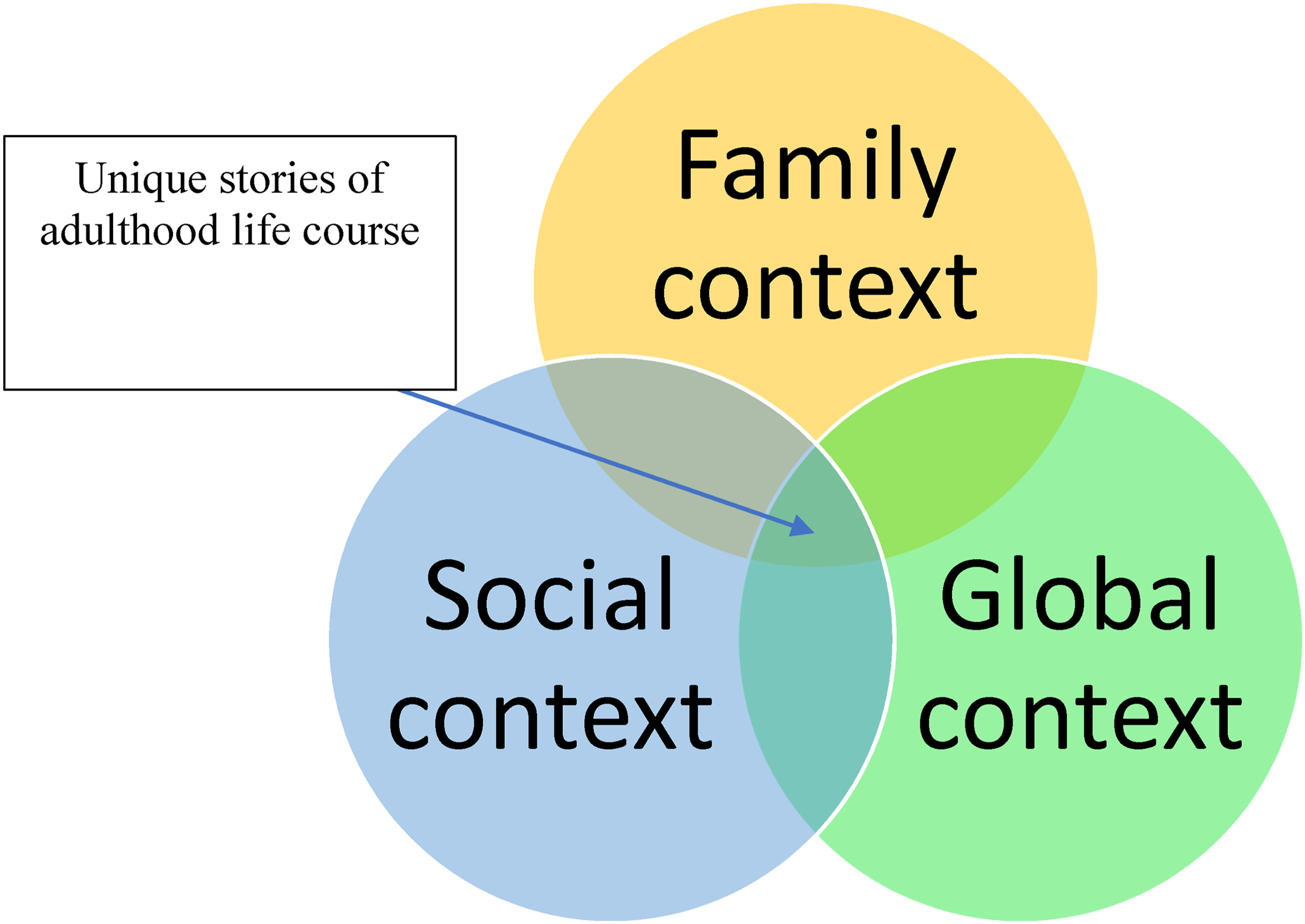
Many researchers have highlighted the importance of time in studying life stories, employing methods such as time planning, life grids, event calendars, and memory books (Bagnoli, 2009; Martyn & Belli, 2002; Thomson & Holland, 2005; Wilson et al., 2007). To uncover the nuances of life course trajectories among young adults with transnational childhood experiences, this study combined the time planning method (Sheridan et al., 2011) with visual mapping (Juozeliūnienė, 2014). This approach enabled participants to trace and rank significant life events by their perceived importance within a life course perspective.
Rather than adhering to a linear understanding of time, this approach emphasised the relational positioning and subjective importance of life events in shaping the participants’ trajectories. The integration of visual representations with verbal narratives offered rich insights into both past and present life events (Gauntlett, 2007; Sheridan et al., 2011). The visual element deepened the data collection and encouraged participants’ reflection, revealing connections, details and contexts that might otherwise remain unspoken.
The research process unfolded in four stages. First, participants created a list of significant life events from childhood to the present, using a format of their choice (e.g. columns, rows, numbered or unnumbered, etc.). Second, they transcribed each listed event onto separate pieces of paper. Third, they arranged these pieces on a white sheet around a circle symbolising themselves, positioning the events according to their significance to their current life stage. Fourth, an in-depth interview was conducted, during which participants elaborated on each event, discussing its meaning, context, and factors contributing to its occurrence.
Interviews followed four elements of the life course paradigm (Elder et al., 2003): • Timing: the significance of when the event occurred in the participant’s life course. • Linked lives: the influence of relationships and social connections. • Broader historical, economic, political, and geographic conditions surrounding the event. • Agency: the participant’s capacity to shape their life trajectory and their understanding of adulthood through decision-making, planning and goal setting.
In total, 18 in-depth interviews were conducted with participants aged 18 to 35 (15 women and 3 men), all of whom had experienced transnational life during childhood. A mixed sampling strategy – combining convenience and snowball sampling – was used to identify participants who met the selection criteria and to extend recruitment through relevant social networks. All interviews were conducted by the first author at locations chosen by the participants in various Lithuanian cities. Prior to each interview, participants provided informed consent.
The sample included seven participants from mother-away families, seven from father-away families, and four from families in where both parents had migrated. The interviews were audio-recorded, transcribed, and anonymised through the use of pseudonyms. In accordance with ethical research practices, audio recordings were deleted, and the anonymised transcripts and visual maps were securely stored in a protected research archive at the institution of the first author.
The transcriptions were analysed using the MAXQDA Analytics Pro 2022 software, employing a thematic analysis approach. The data analysis process involved identifying meaningful thematic patterns, categorising them, and developing code trees, which led to the identification of three distinct life story narrative types: linear, fragmented, and projective. These narratives will be discussed in detail following the discussion on the socio-historical contexts shaping participants transnational experiences.
Contextuality of Transnational Life Experiences
The study identifies two key structural contexts that shaped the emergence of transnational life experiences among participants: Lithuania’s accession to the European Union in 2004 and the global economic crisis that began in 2008.
Lithuania’s EU membership enabled citizens to work legally in other member states. For many families, this opportunity served as a survival strategy and pathway to economic improvement. Within this context, most transnational families began to take shape: At first, a lot of things revolved around money. I kind of felt like I was always trying to make money. It wasn’t like we were starving, no, not in that sense. But I knew I couldn’t afford to buy what I wanted. It wasn’t anything big – maybe a new pair of jeans, I don’t know. But it felt like I really, really had to limit myself, and I wanted to get out of that situation as soon as possible. <...> I also saw how my mother worked at school and then sewed clothes for others at home. In short, she tried to make money however she could. And it seemed to me that this was just how it hand to be. Now, it’s hard to step away from juggling fifteen different activities. But that context probably helped me the most. The political [changes] helped, too – when we joined the European Union. Little by little, everything started to improve. In that sense, none of this would have happened otherwise, because I simply wouldn’t have been able to travel so much. But I was little, so it all seemed almost natural [to me], like that’s how things were supposed to be. My brother and sister saw more because they went abroad for the first time as adults, while I was still a child. (Gitana)
Gitana’s narrative shows how EU membership both enabled her parental labour mobility and provided education opportunities abroad for her and her siblings. This framing of mobility and transnational family life as a ‘natural flow’ highlights how structural shifts became internalised without family biographies. Differences in life stage between siblings also shaped how each interpreted these transitions, illustrating the relational dimension of mobility and intergenerational experience.
A second structural turning point identified by participants was the 2008 global economic crisis. As the crisis deepened and financial insecurity spread, some families were pushed into long-distance living arrangements. As Osvaldas stated: ‘when crisis hit, someone had to do something, probably’. For families like Rusne’s family, parental migration functioned as a strategy to address immediate financial pressures: Maybe my mother’s decision to go abroad could be linked to the rise in real estate prices and various other things. In reality, my mother had, well, fallen into a significant debt – she simply couldn’t pay it off, and those debts then dragged on for a long time. She had bought a house during a major crisis when prices were very high, and she decided to take out a loan anyway. She purchased a three-room apartment, in fact, she couldn’t afford to support herself. This [situation] had an impact on her decision to leave and on our financial instability, namely our family’s... This is probably an example that shows just how crucial the financial aspect really is in life. (Rusne)
Here, Rusne links migration directly to broader economic context. Small towns in Lithuania were especially vulnerable during the crisis, experiencing significant depopulation and economic hardships. In families with a single caregiver, these pressures were often more acute, as another research participant, Gerda, recalls: It was, in fact, a crisis. It was hard. My mother raised me alone, and there wasn’t much money. There was enough to get by – we didn’t have loans or anything – but it was just difficult, it wasn’t easy. My mother worked as a simple worker, a hairdresser, in a small town. There was a time when there was... <…> that [town], which probably has about 15,000 inhabitants – I’m not even sure – suddenly had about 20 hairdressers. Just full [of them]. And then the crisis [came]. <…> well, those [established] hairdressers still had their regular clients, but it just wasn’t enough anymore. Well, it just followed from that … money became scarce, and my mother decided to leave. It probably seemed like the right thing to do [at the time] – to leave for two months and then come back for two months, right? Maybe it didn’t feel right to her, I don’t know. We never talked about it. I think it was hard for her. It couldn’t have been easy. My mother is good, and we were in touch all the time. Well, I think the circumstances that led to this were simply a lack of money. (Gerda)
From the perspective of the young adults in this study, parental emigration during the economic crisis was significant for its prolonged nature. Families that adopted a long-distance living arrangement often faced enduring challenges and complex implications associated with a sustained transnational lifestyle. As Vilte reflects: I think that maybe my parents’ emigration was prolonged because of that... economic crisis. And anyway, my family’s financial situation wasn’t good because... yeah, because of that crisis and lack of... financial literacy. (Vilte)
Vilte’s narrative illustrates how structural factors, such as financial instability, not only initiated migration but also prolonged it. She later connects this prolonged absence to a broader cultural sense of scarcity and pressure to secure a better future. For her, this context shaped her attitude to life and ambition to have a better life: In Lithuania, people are generally very career-oriented, with high standards for themselves and others. Of course, our results show that it is true – we have achieved a lot in our careers, and many great businesses have been founded. But I think that all this stems more from that... sense of lack than from an abundance of wanting to share with others or to create something for the world. It comes more the perspective of ‘how can I protect myself, how can I feel important’. And as if... I think that each of us has connections with alcoholism, another addiction, workaholism, or even self-loathing, which I believe many of us have observed in our parents or grandparents. This is a very strong cultural and social context, I think, and it drives the desire to secure a better future for ourselves. That’s how it’s born. (Vilte)
Together, these narratives demonstrate that the life courses of young people are deeply embedded in macro-level socio-economic conditions. For many Lithuanian youths, childhoods shaped by parental migration were closely tied Lithuania’s accession to the EU and the global economic crisis of 2008. Although transnational experiences in childhood presented emotional and structural challenges, they also opened up valuable opportunities in adulthood. Participants retrospectively describe these experiences as contributing to a broader worldview and shaping how they envision their future life trajectories – an aspect explored in the next section.
‘Linked Lives’ and the Importance of Social Context
The experience of transnational family life shapes the unique life stories of young adults by highlighting key events across various stages of their life course. These events not only mark significant transitions but also contribute to individual’s developing sense of maturity and identity. Bengtson & Allen (1993), in their research on family life, introduced the concept of ‘multiple times clocks’, emphasising that significant life events are linked to transitions between life stages and are often conditioned by the presence or absence of significant others. Building on this approach, it is crucial to examine not only young people’s individual readiness for adulthood but also the ways in which transitions are embedded in broader family and social contexts. These dynamics are frequently reflected in participants’ narratives revealing their understanding adulthood and reflecting on their own life trajectories.
The study identified three distinct types of narratives among young adults with transnational childhood experiences: linear, fragmented, and projective (see Figures 2 – 4 below). Example of a linear life course narrative (Vilte)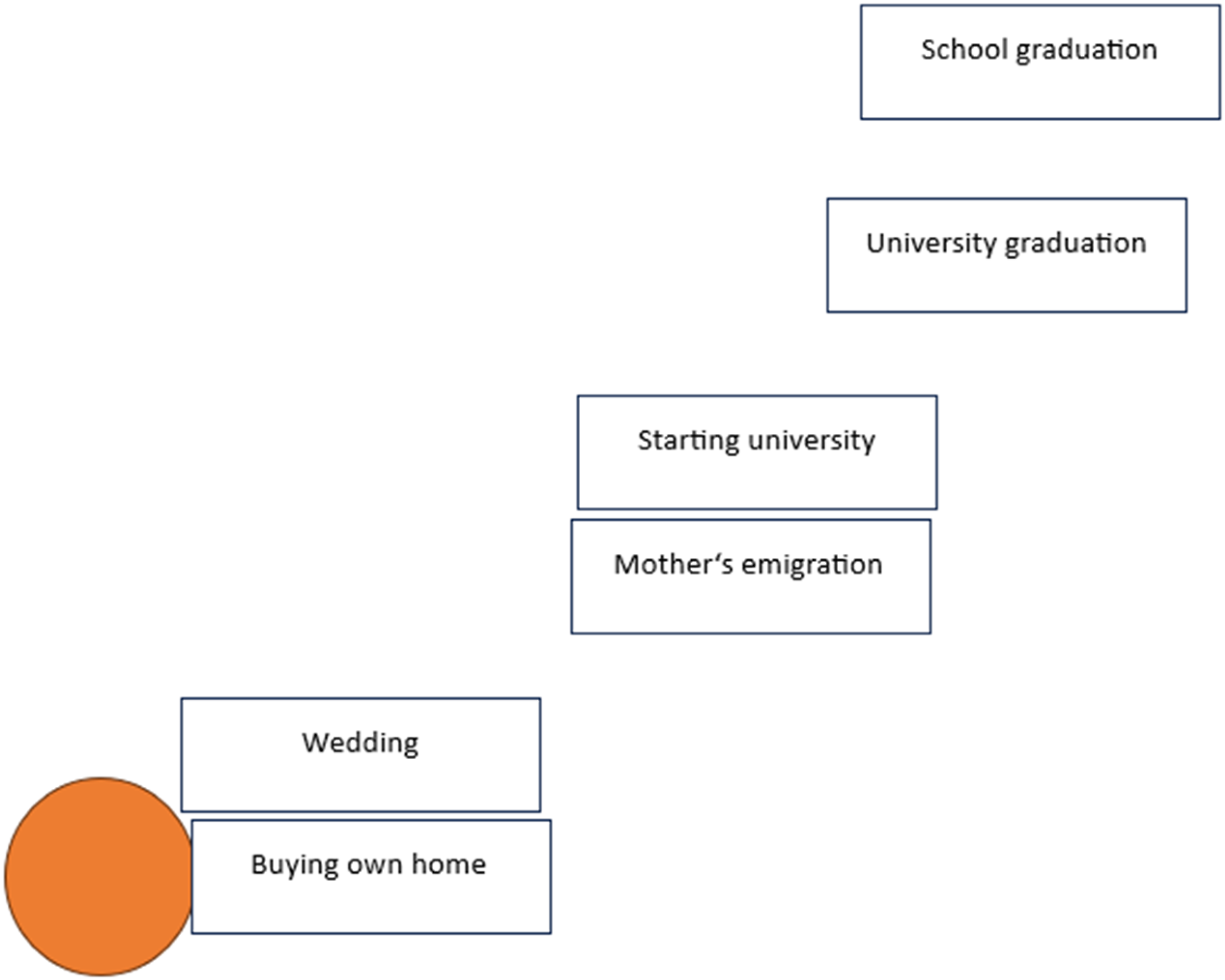
Linear Life Course Narrative: A Cohesive Life Story Embedded in Family History
A linear life course narrative is characterised by a coherent and consistent sequence of significant past events, where each episode is perceived as logically connected to the next. Together, these events form an orderly progression of experiences that support a cohesive life story.
Young adults who adopt this narrative style to describe their life course often incorporate the significant life experiences of other family members into reflections on their own choices. Living apart from one or both parents during childhood is typically framed as a formative experience that instils values such as responsibility, gratitude, anti-consumerism, and perfectionism: When both parents were in emigration while I was still in high school, they both worked – probably since I was in 10th grade, when I was about 15 years old – they went to Iceland to work together. We lived part of the time with my grandmother and part of the time alone, so... I think that this strong sense of responsibility started early. I was always so careful; my brother was so adventurous and so crazy, but I was always the responsible child, very protective of what we had, appreciating every item and everything that our parents gave us. They raised us to really think about whether we truly needed something before buying it. <...> I think that this is also related to the fact that my dad – although I really loved him at that time and still do in that sense – used criticism as his motivational tool. <...> It’s the same with perfectionism. If the house is perfectly tidy, that’s how it should be. If something isn’t perfect, then, well, something’s wrong. (Vilte)
Vilte’s narrative demonstrates how a linear narrative weaves transnational experiences into the development of personal values and identity. Through indirect influences – such as parental behaviour or expectations – children internalise broader family patterns that become embedded in their own life projects. These inherited values anchor the linear life course narrative of young adults as they navigate and construct their own lives.
Participants also frequently drew connections to the broader family history, particularly to the experiences of parents and grandparents. For example, migration patterns were sometimes narrated as intergenerational scripts that shaped interviewees’ own trajectories: Here, unless I understand it this way, my grandmother, my mother’s parents, also divorced. Going abroad means both parents had gone abroad, my father even to the same country. After that, coming to live in [this city] means my mother, his, my mother... My grandmother left for another city and my mother was supposed to move to another city, but she didn’t. There was also such pressure that she had to do it. Changing high school – my mother also changed high school. And graduation, well, everyone graduated. (Meda)
This account illustrates how patterns of mobility, relationship transitions, and educational decisions are perceived as recurring across generations. It shows how transnational experiences embed within family life, as young adults narrate their life trajectories linking them to their parents’ and grandparents’ life trajectories. This intergenerational interconnectedness – captured by the concept of ‘linked lives’ – establishes a kind of inherited pattern, in which mobility decisions are reproduced across family generations, shaping both the collective family narrative and the individual’s life course.
Research participants adhering to linear life course narrative describe the mobility decisions of previous generations as having a direct impact on their own life choices. Parents’ decisions to migrate are often mentioned as reference points in shaping interviewees’ considerations of pursuing opportunities abroad and forming the basis of their personal life trajectories. Transnational life is not only perceived as a source of opportunity but also emerges as a central narrative theme closely tied to pivotal changes in participants’ lives. For instance, Gerda reflects on how her mother’s migration significantly influenced her own life choices and trajectory: I say I was a very complex as teenager, but I always had ambitions – I wanted things. However, I don’t think I could have achieved them if I had stayed in Lithuania. It all started with my mother going abroad; her decision led me to go abroad as well. That essentially became the foundation of my life and the biggest changes I’ve experienced. (Gerda)
In the linear life course narrative, experiences are shaped not only by intergenerational influences – such as those of parents or grandparents – but also by relationships within the same generation and the broader extended family. For example, Gitana reflects not only on the influence of her older siblings, but also emphasises the impact of her uncle’s successful migration story, which broadened her sense of what was possible and exposed her to new life opportunities: I don’t know where it came from. Maybe it’s an example of my brother and sister. There’s quite a big age difference between us – they were already at university and so on. I watched what they were doing, and it was interesting to me. Maybe things would have been different without them. <...> My uncle, my mother’s younger brother, was also a big example to me. He’s twenty years older than me and was always someone I looked up to. Everything he did seemed beautiful to me. It felt like he had an ideal life. He was the first Erasmus generation – he went abroad to study, and I thought like, wow, he’s studying abroad <...> He was an example to me that you could live a beautiful, peaceful life. Because things weren’t peaceful and beautiful for us (Gitana)
Overall, the linear narrative underscores the importance of the family and social context in shaping life trajectories. It emphasises the recurrence of family history events as influential elements in the formation of the life course. In these narratives, transnational childhood experiences are framed as valuable resources, offering young adults both the opportunity to experience life abroad and the means to craft a distinct life story that integrates the choices and experiences of previous generations and extended kin. Personal and parental migration decisions are not perceived as isolated events, but rather as part of continuous pattern of mobility – both internal and international – embedded within the family’s history.
Fragmented Life Course Narrative: Disruptions and Disconnected Life Stages
A fragmented life course narrative is characterised by significant past events that lack a coherent structure or interconnected sequence, often centring on moments of intense disruption. These isolated events carry substantial emotional weight and are typically rooted in personal experiences of abrupt change – such as the sudden departure of one or both parents for work abroad, unexpected relocations, or experiences of loss and illnesses (see Figure 3). This narrative type reflects the discontinuity and emotional complexity of such events, emphasising the challenges and instabilities faced by individuals with transnational childhood experiences. Example of a fragmented life story (Magda)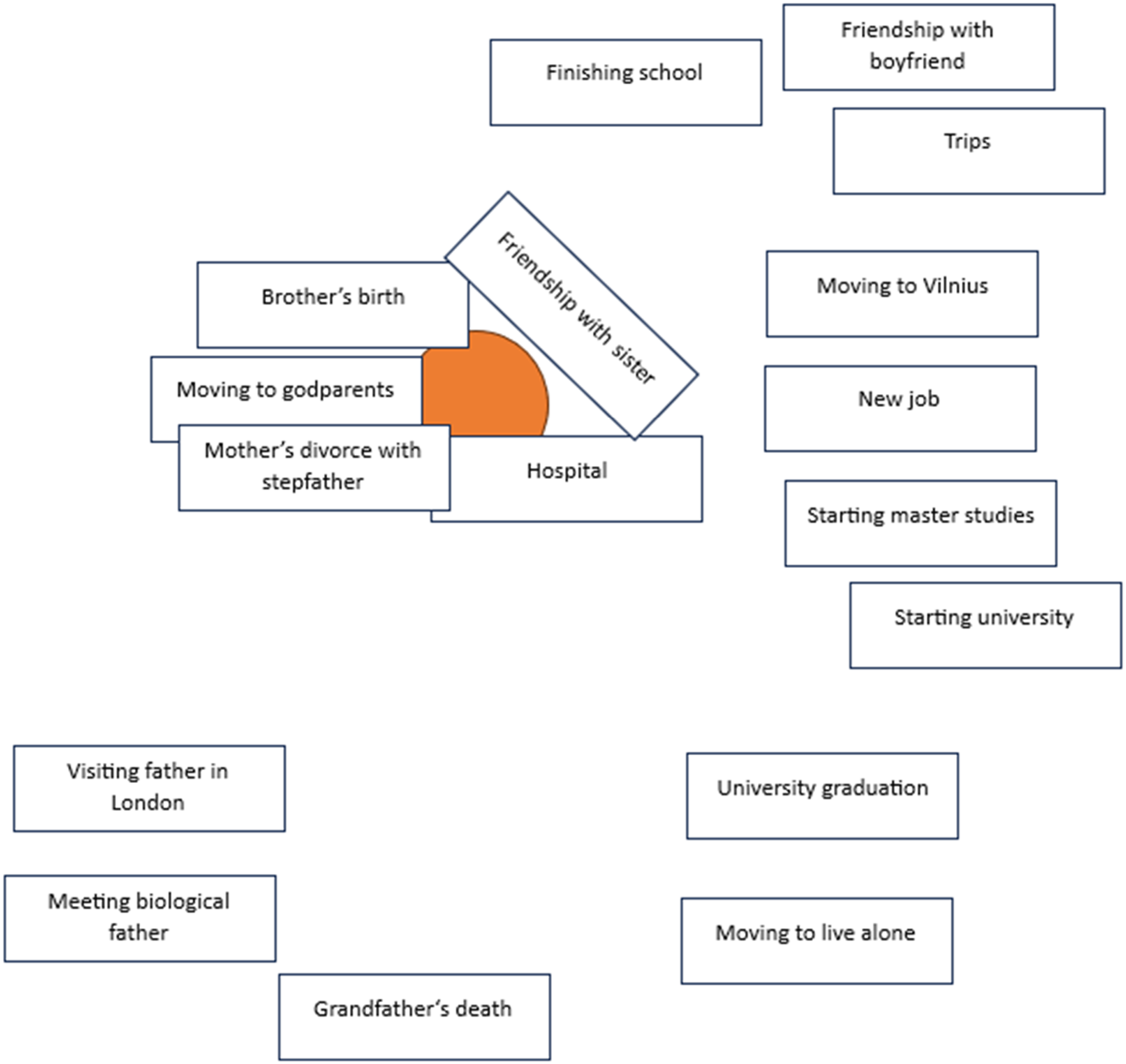
A fragmented life course narrative is notable when impactful events are presented without an overarching or coherent sequence. These events are noted their transformative impact, often marking abrupt shifts in individual trajectory. Participants describe these events as marking defined stages in their lives, highlighting a segmented and discontinuous perception of life course among some individuals with transnational childhood experiences: I would probably say that it is also connected to my father’s – or rather, my parents’ – divorce. My father went abroad. My sister was born and, as I think I mentioned, I was 7 years old. Around the time I was 10 or 11 years old, a very independent stage of my life began because my mother had to work a lot. <...> Not having a childhood, being burdened with many responsibilities, is something I still feel very strongly. <...> Because of that, it is sometimes very difficult [for me] to accept help from others. From young age I had to make those decisions on my own. That sense of authority, as my friends call it, is something that’s very hard to let go of. It’s probably the same independent life that began [when I was] 12. Of course, my mother, brother and sister were around. Then, when [I was] about 18 years old I went off to study, that’s when everything really [changed]... When both parents were abroad, you could say I was left alone in Lithuania. That’s when the most independent life began. So, [I would] probably say that I’ve had two stages [of independence]: one starting at age of 12, and another [beginning] at 18. (Rusne)
Rusne’s story illustrates how a collection of distinct life experiences shaped her sense of responsibility, perception of choice, and views on family dynamics. Key family events – such as parental divorce and emigration – are narrated as requiring her to assume responsibilities early, effectively accelerating her transition into adulthood. These experiences are described as dividing her life into disconnected, self-contained stages, each contributing to her psychosocial maturity.
In such contexts, the responsibilities undertaken are often perceived as inevitable and externally imposed rather than freely chosen. This theme is also evident in Magda’s account. As her narrative reveals, the circumstances of transnational life are remembered as offering little space for alternative paths, compelling her to take on adult roles at an early age: Conditions. Living conditions. If I hadn’t stepped up, I wouldn’t have eaten, my sister wouldn’t have eaten, my brother wouldn’t have been looked after – everything would have just fallen apart. It was simply the circumstances that forced [me to take action]. I wouldn’t have chosen to do everything on my own. (Magda)
A fragmented life course narrative, such as Rusne’s and Magda’s, often emerged in cases where participants felt compelled to assume caregiving roles during childhood – particularly for younger siblings – as a result of parental migration. In many instances, the eldest child took on the role of a surrogate parent, which not only accelerated their transition to adulthood but also later fostered a desire to emotionally distance themselves from that period of life.
These narratives frequently portray certain family members as episodic or peripheral figures, with communication either disrupted or discouraged by the circumstances of transnational living. This dynamic is clearly reflected in Magda’s account: Oh, oh. Now I communicate [with her], and she appeared [in my life] before my father [did]. I don’t know, but she took care of me from childhood, and at first, I didn’t really understand which side [of the family] that grandmother was from – she was just ‘grandmother’ to me. Later, we started communicating more, but there was a time when my mother didn’t let me stay in touch with her while I was still a child. For some reason, she thought I didn’t need to communicate with either my father or my grandmother. So, for a while, she disappeared from my life, because my mother wouldn’t let me call her or anything. But eventually, she reappeared. (Magda)
The concept of ‘linked lives’ underscores the significance of maintaining familial connections despite physical separation. Magda’s narrative illustrates how such connections can be disrupted by changes in family structure, particularly following divorce and parental emigration. During childhood, it may become difficult to make sense of who belongs to the family are and why certain relationships were present only at specific life stages but absent at others. As young adults, participants view these disruptions as formative experiences that contributed to the development of fragmented life course narratives. Within these narratives, life is segmented into distinct stages, each defined by shifting responsibilities, altered communication patterns, and varying degrees of emotional closeness. This segmentation often makes it difficult to weave these experiences into a coherent life story.
Projective Life Course Narratives: A Desire for Stability and a Better Future
In a projective life course narrative, significant life events are framed within a trajectory where anticipation and imagined futures play a central role. These narratives are marked by forward-looking perspectives and an emphasis on planning, as participants connect past experiences to their envisioned futures (see Figure 4). A defining feature of this type of narrative is the expressed desire to live differently from one’s parents. Having grown up in transnational family contexts, young adults reflect not only on what they experienced, but also on how they do not wish to live – an insight that motivates them to actively shape alternative life paths in adulthood. Example of a projective life story (Rusne)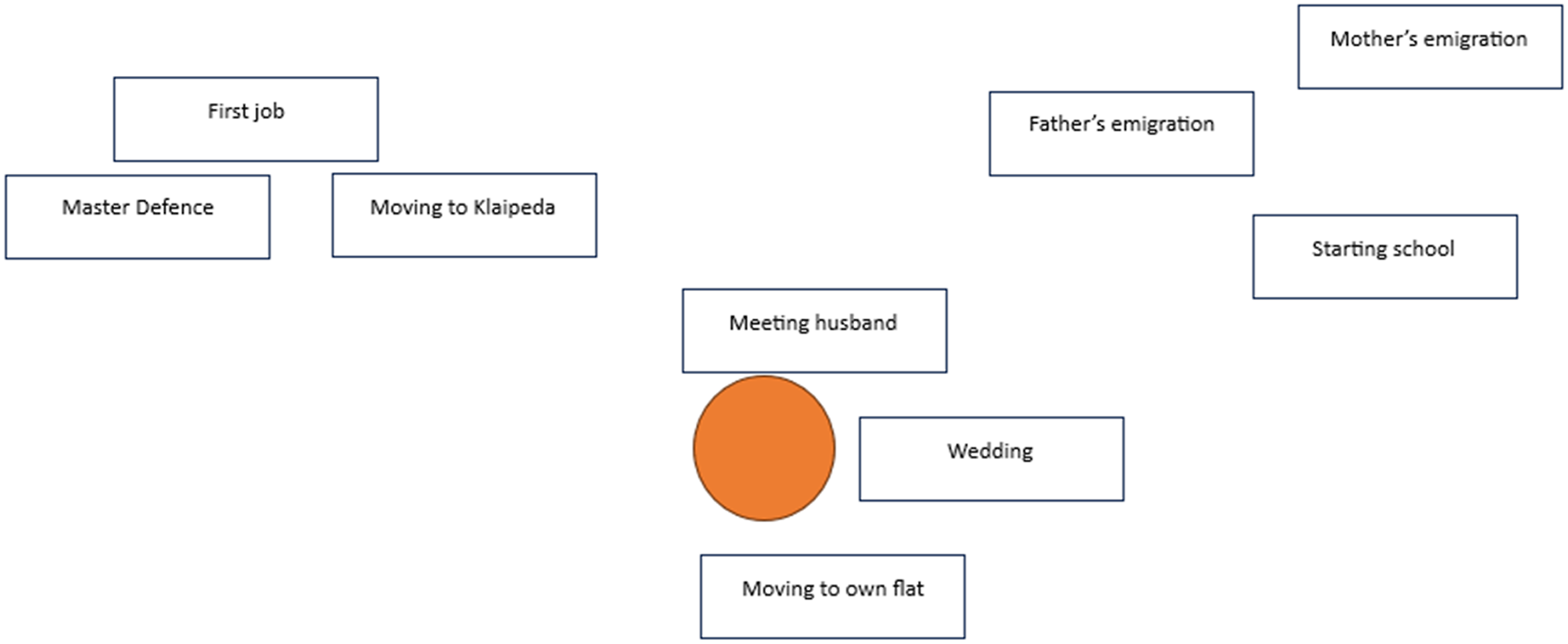
For some research participants, this aspiration to live differently is rooted in the economic hardships that prompted their parents’ emigration. Having experienced financial instability during childhood, they express a strong desire to adopt a more cautious and responsible approach to financial planning in adulthood. For instance, Osvaldas reflects on how his family’s past struggles have shaped his mindset and informed his decisions aimed at building a more stable and secure future: When my mother left, as I mentioned, it was during the economic crisis and the like, and I just... At the time, I didn’t understand it, but now I can say for sure that my parents had significant debts, even after my mother left. At one point she was cheated – they didn’t pay her salary for a while. <...> it was a difficult... difficult financial situation, and I decided that... I don’t know... I would never go into debt. I resolved to always have at least some amount saved, to have a cushion for a ‘rainy day’ – what I now see, I don’t know, as a basic financial literacy. That’s it, simple things like that. Because, well, no matter how cliché it sounds, money doesn’t buy happiness, but it does provide comfort – at least a sense of security. (Osvaldas)
Osvaldas’ experiences illustrate how his family’s financial vulnerability during this childhood motivated him to prioritise financial security and long-term preparedness. For him, financial literacy and planning are not only practical tools but essential strategies for achieving stability and avoiding hardships he witnessed growing up. This outlook fosters a strong sense of personal responsibility and independence, grounded in the recognition that familial support may not always be available, and that stability must often be self-constructed. A similar perspective is echoed in the account of another interviewee, Gintaras: The fact that our family was very poor… well, anyway, you get the idea that they won’t give you money for education. They won’t provide you any kind of... stability, right? In a sense, you have to create it yourself. (Gintaras)
Narratives of both Osvaldas and Gintaras demonstrate how past financial struggles – particularly those that prompted parental migration – are closely tied to participants’ reflections on adopting a more proactive and responsible approach to planning and decision-making in adulthood. Their life stories are structured around a clear determination to construct life models that differ significantly from those of their parents.
The contrast between parental and personal life models is also evident in participants’ views on parenthood. Many link the challenges of their transnational childhood – such as early independence and the premature assumption of responsibilities – to a strong desire to provide a different kind of childhood for their (future) children. The inability to fully enjoy their own formative years motivates participants to prioritise emotional security, stability, and care in their vision of parenting. This intention reflects a conscious effort to break the cycle of hardship and to redefine the meaning of parental responsibility in more nurturing and intentional terms: I don’t really plan my life that way, but I have all sorts of, uh, dreams. I dream of having my own children and raising them in a completely different way than I was raised. And yes, uh, sometimes I think that, because my childhood ended quite early and there were all sorts of, uh, terrible things, then I can... and I, for example, sometimes felt heartache that I didn’t get to fully experience childhood. Sometimes like... this strange feeling would come over me – a feeling of wanting someone to take care of me. <...> I can’t do that to myself anymore, but when I have children, I’ll be able to do everything differently. That’s how I imagine the future. (Magda)
These reflections reveal that transnational childhoods shape views on family and childbearing decisions. This theme is particularly salient in the narratives of female participants, many of whom express a strong desire to distance themselves from the hardships they observed during their own upbringing. For some, this intension translates into planning for fewer children, with the goal of providing greater emotional and material support. As Luka explains, she does not wish to repeat her mother’s experiences and would prefer to have fewer children to ensure she can offer them more: I didn’t want to suffer like my mother did – I always wanted to live better. Maybe it’s connected to that. So, well, I didn’t want to repeat [her life]. <...> For example, my mother had three children, and I only have one. You want to somehow give more and live differently. <...> It looked like my mother was giving up, and my grandmother used to blame my father for having children so young. I also had Ema young. And I thought ‘Jesus, I’m going to end up living like my mother – it’s going to be so hard for me too’. And yes, I didn't want to live that way. (Luka)
Projective life course narratives often express a strong desire for family stability, rooted in the instability and uncertainty experienced during participants’ childhoods. Rusne, for instance, recognises that building a stable family life requires both personal independence and clearly defined priorities. These lessons she draws from observing the behaviour of her parents and extended kin during childhood serve a foundation for planning a different kind future – one intentionally shaped in contrast to the past: Yes, my greatest value, though, is family – having a strong family. Since I didn’t have one myself, it seems like everything, well, revolves around family. I understand that to have a stable family, you need to be stable yourself, know your priorities, and be independent. That’s probably where ... <…> I try to be an independent person and know what I want so that the person next to me and my future children will feel safe. <...> I often take an example from how my mother and other adults behaved when I was growing up. <…> I often compare [these examples], and it helps me to set my own priorities. (Rusne)
In projective life course narratives, family history is often perceived through a critical lens, motivating participants to strive for improved futures in both their family and professional lives. Observing their parents’ struggles, shortcomings, and limited opportunities serves as a powerful impetus for young adults to pursue higher aspirations and to avoid repeating the same patterns. This dynamic is clearly illustrated in Gintaras’ story: My parents didn’t have a higher education, so I grew up with the message in my childhood, in my family, that you need a higher education; otherwise, you’ll end up like them. That’s where my family history is connects – not to live the life they lived, in that sense, but to keep doing better. (Gintaras)
The experiences of the research participants discussed in this section demonstrate that projective life course narratives are shaped by a drive toward self-sufficiency and a prioritisation of family as a core value. While the ‘linked lives’ perspective emphasises intergenerational continuity, participants often frame their transnational childhoods as reference points for what they hope to avoid. These narratives articulate a strong desire for independence, stability and a secure family environment – qualities lacking in their early lives. Ultimately, they reflect aspirations for a secure future for themselves and their (future) families.
Conclusions
This study examined the complexity of adulthood as a stage in the life course through the lens of the ‘linked lives’ perspective, focussing on young adults in Lithuania who experienced transnational life during childhood. It employed an innovative methodological approach, combining timelining and visual mapping to elicit in-depth life story narratives.
The findings demonstrate that young adults’ life trajectories are shaped not only by their readiness to assume adult roles, but also by the family and social contexts in which key life events unfold. These contexts shape how transitions are navigated and how adulthood is understood. Viewed through the ‘linked lives’ perspective, reflections on transnational childhoods become an integral part of life course narratives, where familial ties, relational histories, and intergenerational dynamics continue to inform identity, decisions, and aspirations. This perspective complements the notion of individual agency by emphasising how personal trajectories are embedded in – and often shaped by – relational and socio-cultural contexts.
Experiences of growing up apart from parents are reflected in diverse life course narratives, as articulated through linear, fragmented, and projective forms. Linear life course narratives emphasise a coherent progression of significant life events situated within broader family history. In these accounts, transnational childhoods are framed as valuable resources – offering opportunities to explore life abroad and construct distinct personal narratives connected to prior generations.
Fragmented life course narratives highlight a sequence of significant events lacking coherent structure. Individual life stages in these accounts are marked by abrupt shifts in responsibilities, relationships, and experiences. The accumulation of such disruptions makes it difficult for participants to weave these significant events into a cohesive continuous life story.
Projective life course narratives are forward-looking and defined by a desire to live differently from one’s parents – an impulse that, in participants’ view, motivates them to forge alternative life paths in adulthood. These stories centre on aspirations for independence, stability, and the creation of a supportive family environment – qualities perceived as missing in their own childhoods – alongside ambitions for personal growth, achievement, and a better future for themselves and their (future) families.
While the ‘linked lives’ perspective emphasises the interdependence of parents’ and children’s trajectories – often highlighting how positive experiences are inherited and repeated – transnational childhoods here often serve as reference points for what participants seek to avoid. Rather than adopting inherited scripts, these young adults aim to rewrite them. Future research on the life courses of ‘transnational children’ could examine how these experiences are transmitted, reinterpreted, and either replicated or resisted across multiple generations.
Footnotes

Ethical Considerations
Research ethics approval granted by Research Ethics Committee of Klaipeda University (Protocol number 2025-01-27 Nr. MTEK-02).
Funding
The authors disclosed receipt of the following financial support for the research of this article: the qualitative research was supported by the Lithuanian Research Council in the framework of a project ‘The Impact of Lithuanian Families’ Transnational Living Experience on Adulthood: Case Study of Adult Children’ (Grant No. S-PD-22-017).
Declaration of Conflicting Interests
The authors declared no potential conflicts of interest with respect to the research, authorship, and/or publication of this article.