



Abstract
Coming from a family system theoretical perspective we asked to what extent selected child characteristics (age and gender of the child, position in the sibling order, biological/non-biological child, child health status) influence paternal involvement. Additionally, spillover effects in the mother’s commitment and the father’s partnership satisfaction were of interest. Cross-sectional survey data from the “Growing up in Germany” survey from 2019 were used, containing information on n = 1,404 fathers and their partners and n = 2,664 children (aged 3 to 17). In hybrid multilevel models, we distinguished between- and within-level effects. The results confirm discriminatory behaviors for the children in a family. While mothers were very strongly committed to younger children regardless of gender, fathers focused their commitment preferentially on their biological children and their sons. However, their commitment to the respective child correlated positively with the commitment of their partner as well as the perceived partnership satisfaction.
How Child and Partnership Characteristics Influence Paternal Involvement
Involved fatherhood is of major interest for family research since the 1980s and for family policy as well as for professionals who work with families since the beginning of this century. Studies that deal with father involvement regularly compare parents, couples, or households with different characteristics. For instance, Macon et al. (2017) find that the employment constellation as well as attitudes towards gender ideologies influence whether fathers spend more time with their children. In detail, fathers who are more engaged in childcare tend to have a reduced work commitment (Evertsson, 2014). On the other hand, mothers with more engaged partners in childcare are more likely to engage in employment shortly after childbirth and during early adolescence (Norman et al., 2023).
In contrast, some conceptual papers emphasize the relevance of child characteristics, such as their age or gender, to explain paternal involvement (Lamb & Lewis, 2010; Norman, 2017). These child related approaches draw attention to the fact that the engagement of fathers can vary not only between fathers but also within one father treating each of his children differently. However, research on paternal involvement yet missed to analyze the importance of within-family variance and its relevant predictors empirically. This is even more interesting as fathers’ involvement towards their children changed massively since these first conceptual and empirical papers as they participate more in parental leave times nowadays, they show more direct engagement in day-to-day child related chores but also live more frequently as stepfathers in complex family structure. In this study, we this want to fill this gap and investigate if modern fathers substantially vary their involvement regarding their children. If they do so, we further analyze characteristics of the children and family relations father–child relations are embedded in (spillover effects) to predict within-family differences of paternal involvement relying on Family Systems Theory and existing research on Parental Differential Treatment (PDT). Finally, we compare the results of the fathers with those of the mothers from the same families to highlight specific features of the father–child dyad. To answer our research question, we use multi-actor survey data from the survey “Growing up in Germany” (short: AID:A) and estimate the influencing factors of each child and the father’s partners on fathers’ engagement in multilevel analyses. We use father’s responses as the dependent variable and estimate the effects of child and relationship characteristics on within-family differences of paternal involvement to reveal differential treatment. Thus, our analysis benefits from measures that originally do not compare children with each other or may be biased by retrospective evaluations of PDT by adult children.
Father Involvement as a Multidimensional Construct
The concept of involved paternity reflects that fathers today still differ greatly in their engagement in the upbringing of their children (Lamb et al., 1985; Palkovitz, 2019). The intensity of this involvement can be measured, firstly, by the direct interactions between father and child (e.g., playing together or caring activities). This first dimension does not only subsume the time fathers spend with their children in total, but focuses on more strongly engaged activities. Secondly, the concept considers the availability of the father to the child outside of direct interactions, and, thirdly, if fathers take responsibility in the fathering role, that is, being a contact person for third parties (e.g., towards state institutions) and arranging resources for the child. For example, Norman and Elliot (2015) measure paternal involvement in childcare (engagement) and housework (responsibility) activities like feeding, changing nappies, cooking, and cleaning. Against the background of family science research, Pleck (2010b) reflects on the approach of Lamb and colleagues and suggests some extensions of this concept. Taking the suggestion of Palkovitz (1997) to extend this threefold operationalization, Pleck sees the affective-physical expression of responsiveness and emotional warmth as a relevant, additional part of involved fatherhood. Also, there is the degree of control that fathers exercise over the behavior of their children so that both concepts together enable a connection to the educational styles according to Baumrind (2005). Accordingly, Hawkins et al. (2002) presented the “Inventory of Father Involvement,” which also includes indicators like school engagement, support for autonomy development, and joint conversations. For instance, a recent study on paternal involvement with infants considers warmth and attunement as well as negative emotions of distress and frustration besides direct and indirect care activities and responsibility (Cole et al., 2021). On the other hand, Pleck differentiates Lamb’s dimension of responsibility by including not only the idea of the father as a contact person but also the identification of the child’s needs on the father’s initiative and the father’s organization of goods and services in the child’s interest. In the following study, we rely on the multidimensional approach measuring paternal involvement as a latent construct using indicators for distinct subdimensions (see methods section).
Involved Fatherhood in Germany—the Context
To provide a context for our analysis, we first give some information about the division of labor within the family and the involvement of fathers in child-related tasks in Germany. (West-)Germany has had a moderately conservative familial welfare regimen for decades (Adler et al., 2015). A series of familizing family policies such as poorly paid, long parental leave and an underdeveloped childcare infrastructure as well as a tax system that supports a single earner model, amongst others (Goldacker et al., 2022; Lohmann & Zagel, 2016), accompanied by norms regarding the mothers best suited to care for her child(ren) during the first years led to a strong male-breadwinner norm until the end of the last century (Trappe et al., 2015). Since the beginning of the 2000s or rather 2010s a major shift towards defamilizing family policies such as the introduction of better paid parental leave with an explicit partner share as well as the expansion of public childcare lead to a higher labor force participation of mothers (Barth et al., 2020) and a higher proportion of fathers that take parental leave times (21% in 2008 compared to 46% in 2021; Statistisches Bundesamt, 2024a). Part-time-work, on the other hand, is still very common amongst mothers (67 %) but very seldom amongst fathers (9%) (Statistisches Bundesamt, 2024b). This limits the time fathers are available for their children on weekdays and forces them to allocate their time investment with each of their children. Because of a very well-established norm of the two-child family (Bujard et al., 2019), 75% of all children in Germany have at least one sibling (Statistisches Bundesamt, 2022). However, larger families are quite rare; and only 13% of all German families have three or more children (Statistisches Bundesamt, 2023). According to Recksiedler et al. (2024), around 74% of all families with underaged children in Germany live in a biological nuclear family, 17% are single-parent-families. A further 8% of all families are stepfamilies, wherein 78% there also is a NRP still existent; in 22% of all stepfamilies the NRP is unknown or deceased. It is worth taking a look at some measures of paternal involvement after separation and divorce. The authors can also show that there is a high degree of variability in how present the external biological father is in the lives of his children, ranging from 22% having no contact to 12% spending between 8 and 15 nights with the NRP. In a European comparison of the prevalence of joint physical custody, Germany would thus be at the lower end of the scale (Bundesministerium für Familie et al., 2025). This is partly because of a political framework which still favors the residential model more than asymmetrical forms of shared residence and care after separation and divorce as well as very traditional gender role concepts that favor the mothers as remaining the resident parent in post-separation families instead of the fathers.
Theoretical Framework and Empirical State of the Art: Why Would Fathers Treat Their Children Differently?
Family System Theory (Cox & Paley, 2003) describes families as social systems including all family members and the relationships between them. Moreover, family members are assumed to depend on each other reciprocally. From this point of view, father involvement cannot be viewed in isolation, but rather as part of the overall family relationship structure. It can therefore be assumed that father involvement varies within one family with each of the children and their individual characteristics. Although Western societies have a long tradition that children are mostly treated alike when it comes to privileges and responsibilities (Parsons, 1942; cf. Suitor et al., 2008; Tucker et al., 2003), studies on parenting regularly find that parents treat their children unequally. Parental differential treatment (PDT), thus, describes how children from the same family have different experiences with their parents and within their family as a non-shared environment (Feinberg & Hetherington, 2001). The theoretical approaches to explain and predict PDT, though, can vary for certain characteristics.
Gender
One approach to explaining PDT is based on the idea that it is easier for parents of the same gender as their offspring to teach them gender-role-conforming behavior (Aldous et al., 1998; Harris & Morgan, 1991). From the perspective of Doing Gender (C. West & Zimmerman, 1987), parents perform gender roles through gender-specific parenting styles in (at least) two ways. First, as women in western societies like Germany are typically accounted for child-rearing (Schmidt et al., 2024), mothers perform the female gender role when taking care of children. Contrarily, fathers focus on a breadwinner role (Christiansen & Palkovitz, 2001; Kühhirt, 2012; Miller, 2017; Nitsche & Grunow, 2018) and perform the male gender role when they do so. Even when fathers are more engaged in child care activities, previous research shows that fathers often engage in a male fashion, for instance, when playing with their children (Liu et al., 2024) or by evaluating child behavior gender-specifically (Mesman & Groeneveld, 2018). Second, “[d]oing gender means creating differences between girls and boys” (C. West & Zimmerman, 1987, p. 137). That is, parents perform gender when they teach gender roles to their children (Herbaut et al., 2024; Hofferth et al., 2012; Palkovitz et al., 2014). Therefore, fathers and mothers do not simply control and sanction (in)appropriate gender-specific behavior of their children. They also serve as role models for their children to learn how to display gender. It seems reasonable to assume that it is easier for parents of the same gender as their offspring to teach them gender-role-conforming behavior (Aldous et al., 1998; Harris & Morgan, 1991). In an older literature review, Siegal (1987) summarizes that fathers make stronger differences between sons and daughters than mothers. Especially, fathers discipline sons more than daughters and are physically more involvement with them. In a more recent study, Atzaba-Poria and Pike (2008) point to gender differences when they report that fathers discipline their sons more than their daughters while the authors find no differences regarding emotional warmth. Tucker et al. (2003) report sex-typed behavior for fathers’ temporal involvement favoring sons over daughters. Poonam and Punia (2012) underline the importance of gender for parental differential treatment when they show that differential parenting often occurs when the children within a family have opposite sexes. While mothers spend more time with their adolescent daughters, fathers spend more time with their adolescent sons.
Age
From a developmental psychology perspective and in line with Family Development Theory (Duvall, 1971), it can be assumed that parent–child interaction changes as children get older (Parke, 2000, 2002) and parent–child interactions change from more routinized care activities to a more interactive quality time (Walper & Lien, 2018). While it was long assumed that fathers would only become more involved in promoting their children’s independence in later childhood and early adolescence (Seiffge-Krenke & Irmer, 2004), the “new fathers” are expected to become intensively involved in early childhood. The first months of life are considered formative for the father–child relationship and are predictive of later involvement (Bünning, 2015; Evertsson et al., 2018). Time-intensive and maternally connoted care activities become less important; paternally connoted activities such as play, teaching, and achievement-oriented activities, as well as “accessibility” for conversation, become more important for older children and adolescents (Norman, 2017; Yeung et al., 2001). Walper and Lien (2018) can differentiate more strongly by type of activity based on the 2012/13 time budget data, but can only look at fathers of children under the age of 12 based on the data. They find the strongest “decline” in paternal involvement in the area of “routine activities” (e.g., supervision and personal care), but an increase in importance in the area of “conversations with the child/children.” According to Aldous et al. (1998), fathers are even more active than mothers when it comes to “talking about worries, etc.”—fathers are most active here with older sons. German qualitative studies also see the strength of father–child interaction in adolescence in the exchange of opinions and communication, but the father–child relationship as something that, unlike the given relationship with the mother, must first be actively established (Baumgarten, 2012). Ashbourne and Daly (2012) show that family time together becomes less natural overall during adolescence and must be consciously and interactively established by parents and children. The qualitative longitudinal study by Schmidt et al. (2019) indicates a clear variability in parental roles, in which fathers can also be highly active at times, but then also very absent again. Shirani and Henwood (2010) also report that fathers perceive the opportunities to be involved during pregnancy and breastfeeding as limited, but recognize and use opportunities for themselves as the child grows up. Based on the current state of research, we can therefore expect variability in paternal involvement, which is particularly dependent on the age of the children.
(Non-) Biological Child
Research on blended families in recent years has demonstrated that the formation of a new family from previous partnerships with children initiates numerous transformation processes within all family subsystems (Anderson & Greene, 2013; Sweeney, 2010). A particular challenge arises from the simultaneous existence of established relationships between biological parents and children—and possibly siblings—on one hand, drawing upon shared experiences, rituals, and values, and the newly developing relationships of the parental couple and the non-biological parent–child—and sibling—relationships, which are still in the process of establishing their experiential and practical basis (Dupuis, 2010). For non-biological parents, reconciling their role expectations and those of other family members regarding social parenthood toward their children can be challenging. The inequalities in relationships may manifest in interdependences of various family relationships (Arránz Becker, 2015; Arránz Becker et al., 2013; Hornstra et al., 2020; Leeuw & Kalmijn, 2020), possibly leading to boundaries within the blended family, such as the children distancing themselves from the non-biological parent. The movement of children between multiple households can further complicate the formation of a shared family culture and boundary management, especially when conflicts exist between biological parents or between the nonresidential biological parent and the residential step-parent, creating loyalty conflicts for the children facilitating aversion against the new partner(s) of their biological parent(s) (Braithwaite et al., 2001; Martin-Uzzi & Duval-Tsioles, 2013; Michaels, 2006; Schrodt, 2010). In a study on parental differential treatment between biological and non-biological children, Segal et al. (2015) found limited support for the hypothesis that parents favor their biological children. Although parents reported more unfavorable traits for their adopted than for their biological children, they reported an equal number of favorable traits for both types of their children.
Health
Singer and Weinstein (2000) investigated differential treatment and summarized that differential treatment occurs mostly when families experience conflicts and stress like health or material problems. Regarding health problems, economic family research offers two prominent models describing why parents tend to treat children with different (health) endowments differently. From the perspective of human capital maximization, Becker and Tomes (1976) argue that parents would invest more in better-endowed children as they could expect higher child outcomes from these children. Alternatively, Behrman et al. (1982) find a compensating strategy where parents invest more resources in less endowed children to meet their individual needs and give them more equal opportunities to develop future human capital. While Tifferet et al. (2007) find that mothers of children with diagnosed chronic disease from an Israeli sample are more engaged in emotional and direct care the more severe the disease of their child is rated. Rosales-Rueda (2014) finds lower parental investments in children with mental conditions compared to their healthy siblings, but no difference when children have a physical condition. Other recent studies find no such associations (e.g., Bharadwaj et al., 2018; Terskaya, 2023). For instance, Lynch & Brooks (2013) analyze data from the Early Childhood Longitudinal Study revealing that stronger parenting quality towards children with low birth weight as an indicator for less health endowment disappears when controlling for family attributes like ethnicity or socio-economic status or in twin fixed-effect models. In a study on Roma mothers, Čvorović (2020) discovered that children with higher birth weight receive breastfeeding and vaccination more likely. However, the author finds no difference in the frequency of mother–child interactions between children with lower and higher birth weights.
Mother–Child Relationship as a Moderator of Differential Paternal Involvement
Partnership is considered to be an extremely relevant moderator of father–child interaction and relationship (spillover effect; Barnett et al., 2008). While maternal involvement is considered to be largely independent of relationship quality, research on the Fathering Vulnerability Hypothesis (Cummings et al., 2010) shows that a good couple relationship increases the child-related involvement of fathers (Cowan & Cowan, 1987). In particular, coparenting, that is, the cooperation of the parents in raising the children, and the perceived satisfaction with the partnership are empirically relevant parameters (Belsky et al., 1996). Following the argument of “maternal gatekeeping” (Allen & Hawkins, 1999; Fagan & Barnett, 2003; Miller, 2017), a benevolent and supportive attitude on the part of mothers is a prerequisite for paternal involvement. However, Barnett et al. (2008) find limited support for the spillover hypothesis as the positive correlation between fathers’ and mothers’ sensitive parenting behavior is, indeed, moderated by the subjective perception of their couple relationship quality. The analysis did not support the spillover hypothesis for negative parenting behavior. Likewise, the results of a recent meta-analysis by Jensen et al. (2021) indicate higher levels of parental differential treatment when less marital positivity and more marital negativity were observed. However, they report mainly small effect sizes that are moderated by measurement type, and the domain differential treatment is reported on.
Partner Relationship as a Moderator of Differential Paternal Involvement
Focusing on the father–child relationship, family system theory would expect a second spillover effect between the father–child and the mother–child relationship. Empirical evidence shows a strong effect of maternal employment involvement: greater employment involvement on the part of mothers goes hand in hand with greater child-related and housework-related paternal involvement (Norman, 2017). This would suggest that fathers compensate for mothers’ reduced work-related commitment. However, Walper and Lien (2018) find only limited confirmation of such a compensation hypothesis and rather assume a synchronization, that is, a mutual reinforcement of parental commitment and thus a culture of committed parenthood in families with active fathers. Thus, the second spillover is supposed to relate the father’s and mother’s parenting behavior and relationship with their children positively to each other meaning that more engaged fathers live with more engaged mothers and vice versa, even when fathers perform engagement differently or are less engaged on average compared to mothers.
The Current Study
Based on the previous studies and coming from a family system theoretical approach (Cox & Paley, 2003), we expect to identify parental differential treatment when analyzing father involvement for fathers with multiple children. In detail, we expect differential involvement when the children of a father differ in age and birth order, gender, and type of father–child relationship.
From the perspective of gender role stereotypical socialization processes, we expect fathers to be more engaged in the relationship with their sons.
Fathers are more involved in relationships with their sons than with their daughters.
From a (family-)developmental perspective, we would assume that paternal involvement depends on the age and birth order position of the child.
Fathers are more involved in relationships with (a) younger children and (b) children who were born second or later.
In line with the research on blended families, we anticipate that relationships of fathers and their non-biological children face many obstacles during the process of constitution of the blended family giving space to differences compared to relationships with biological children.
Fathers are more involved in relationships with their biological children than with their non-biological children.
Testing the compensation strategy, we suggest that parents make differences more strongly when they experience stressful circumstances, that is, a child is suffering from sickness or being disabled.
Fathers are more involved in relationships with (a) disabled children and (b) children with lower health.
Finally, according to the spillover hypotheses, we expect that the relationship between a father and a child is affected by the relationship of the mother with the same child as well as by the relationship of both parents to each other.
Fathers are more involved in a relationship with a child when their partner is more involved in a relationship with the same child.
The association of hypothesis 5 is moderated by the quality of the couple relationship of both parents positively.
Data
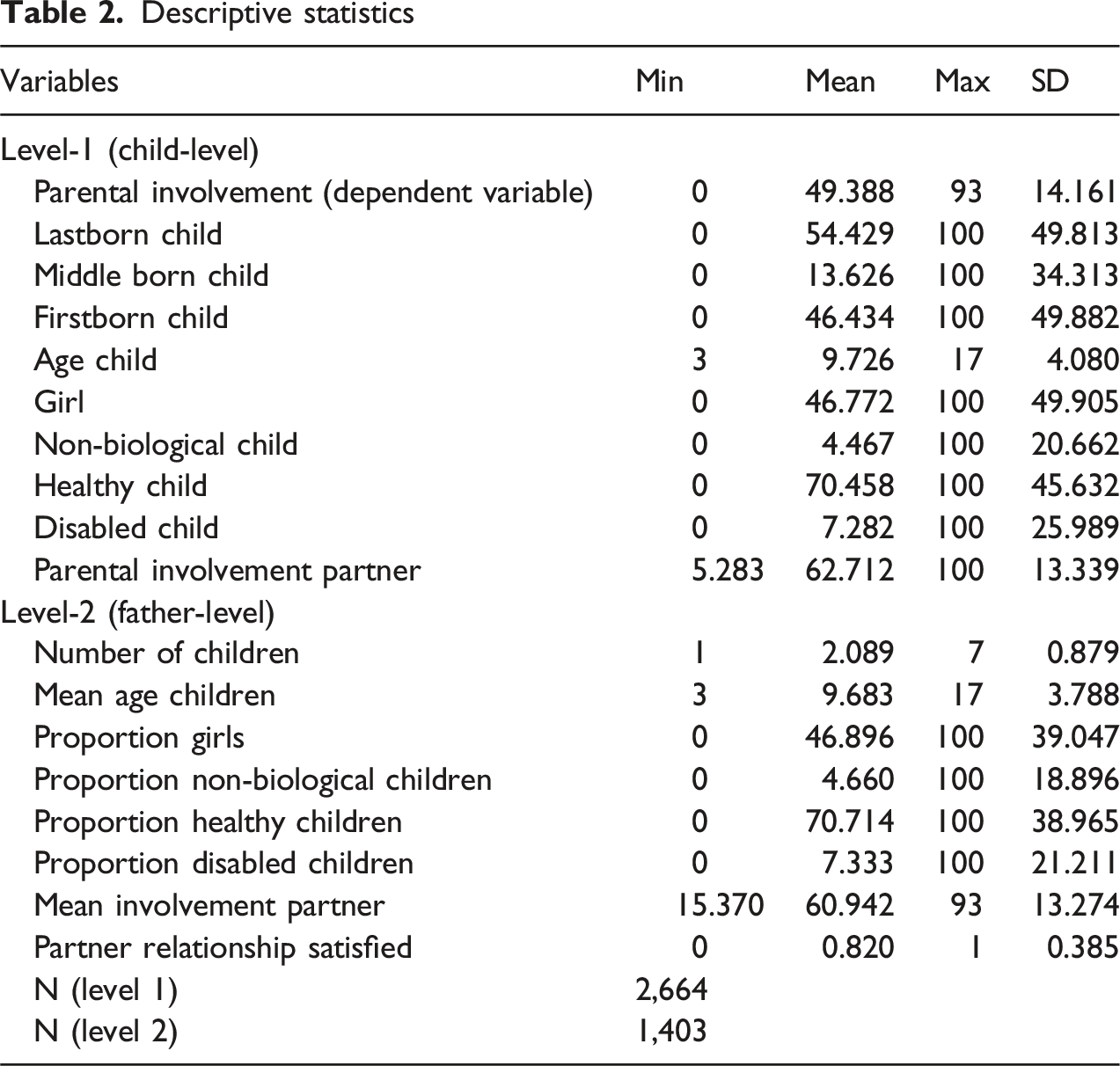
In the following, we report how we determined our sample size, all data exclusions (if any), all manipulations, and all measures in the study. Our analysis employs cross-sectional survey data from the 2019 wave of the German AID: A family panel (Kuger et al., 2020). The data collection procedure was coordinated with the data protection officers of the German Youth Institute (DJI) and Infas. In total, a register-based random sample of more than 6,000 households across Germany with at least one member in the age range from birth to 32 was surveyed on the living conditions of children, youth, young adults, and parents primarily using personal interviews (CAPI). Children older than 8 years were asked to give some information themselves on, for instance, their health status and life satisfaction. Parents provided the same information to their children younger than 9 years. In the following analysis, we use a subsample of 1,765 fathers having children from 3 to 17 years of age living in the same household who themselves and their partner provided information on the relationship to all their respective children regarding parenting practices as well as shared activities, emotional warmth, and closeness, as well as on the relationship with their partner living in the same household. This results in a total sample size of 3,392 father–child relationships. Additionally, one parent (mostly the mother) provided information on the relationships of all household members including biological and social parent–child relationships and basic household member characteristics like date of birth or biological gender. After deleting cases with missing values mostly on the partner’s involvement (n = 237 fathers) and the health status of the children (n = 95 fathers), our sample for the analysis comprises 1,403 fathers and their partners, as well as their 2,664 children. While we only analyze fathers and children from couple households, 24% of the fathers live with one child, the majority 51% with two, and a further 24% with three or more children in the same household. In total, 7% of fathers live with non-biological children of their current partner, and non-biological father–child relationships account for 4.5% of all father–child relationships in the sample. In our sample, families with non-biological father–child relationships typically (79%) consist of children from a former relationship with the new partner of the father and, possibly, biological children of both, the father and his new partner. In contrast, the biological children of the father from former relationships, if any, do not live in the same household. In an additional share of about 13.5% of these families, the father lives with his biological children and possibly new common children with his new partner, while a further 7.5% live with biological and non-biological children from previous relationships of himself and his new partner and possibly new common children. Compared to the male German population with age from 35 to 54 in 2019 (Eurostat, 2022), the sample is biased towards more educated fathers as 4.6% (compared to 12.5%) have a low educational background (ISCED categories 0 and 1) while 51.5% (54.5%) have a medium (ISCED 3 and 4), and 40.7% (32.8%) a high (ISCED 5 to 8) educational background. For the analysis, we apply household-based design and calibration weights to correct the sample for differing inclusion probabilities due to the sampling strategy and selective unit-non-response that results in the education bias of the sample.
Measures and Methods
Involvement
Following Lamb et al. (1985) and subsequent papers on paternal involvement (Palkovitz, 1997; Pleck, 2010b), we measure involvement as a latent multi-dimensional concept using interaction frequency, responsiveness to the child, and care as sub-dimensions. To measure interaction frequency, we use statements about how frequently fathers share activities with their children (0 = never, 1 = less often than once or twice a month, 2 = once or twice a month, 3 = once or twice a week, 4 = several times a week, 5 = daily). Therefore, we focus on painting/crafting, telling stories, doing sports, making music, doing cultural activities, and going on a trip together explicitly indicating shared analog activities. Additionally, we consider watching TV, playing video games, and going on the internet together as shared activities with mass or digital media. We measure responsiveness to the child using the frequency of fathers talking to their children about experiences and (negative) feelings the children have made (0 = never, 1 = rarely, 2 = sometimes, 3 = often, 4 = very often, 5 = (almost) always). For the responsibility sub-dimension, we use the school-based school involvement of fathers, for example, how frequently are fathers taking responsibility for their children in front of family external institutions (0 = never, 1 = rarely, 2 = sometimes, 3 = often, 4 = very often, 5 = (almost) always). Parents answer these questions for every child under 18 years separately. Additionally, we consider the parental involvement of the fathers’ partners as an important factor that predicts paternal involvement.
Child Characteristics
To analyze if parents treat their children differently according to parental involvement, we compare parent–child relationships regarding the age of the respective child in years, the child’s birth order position (firstborn versus middle child [reference category] versus lastborn), biological gender, and health. Considering health, parents of children under 9 years of age rated the health of their child while older children rated their health status by themselves on a six-point scale (0 = very bad, 5 = very well). As the distribution of the responses is strongly skewed towards very healthy children (about 70% of all children were rated as very heathy), we dichotomize the scale at its median resulting in children rated as very well (= 5) being assigned a 1 and children rated as less healthy (< 5) being assigned a 0. Following the same principle, parents of younger children and older children rated if they had a physical or psychological handicap (e.g., deafness, low vision, mental or learning handicap, autism). Furthermore, we consider if parent and child are biologically or socially related. Social parent–child relationships refer to step-, adoptive, and foster parents/children.
Parent Couple Relationship
To test if parents’ couple relationship influences whether parents treat their children differently, we consider the parent’s satisfaction with the relationship with their respective partner. Fathers and mothers rated how satisfied they are with the relationship with their respective partners separately on a 6-point scale (0 = not satisfied at all, 5 = very satisfied). As the distribution of the responses is strongly skewed towards very satisfied partner relationships (about 82% of fathers rated to be satisfied or very satisfied with their partner relationship), we dichotomized the scale at its median resulting in couples rated as satisfied or very satisfied (≥ 4) being assigned a 1 and couples rated as less satisfied (< 4) being assigned a 0.
Controls
Finally, we control for the total number of children under 18 years living in the same household as the respondents of the analyzed parent–child relation.
Analysis
Our analysis consists of two major steps. First, a confirmatory factor analysis helps to create our dependent variable of parental involvement. Second, a multilevel analysis allows one to differentiate paternal involvement between fathers (how do fathers from different families vary in their parental involvement) from within-father differences (how does the parental involvement of one father differ with each of his children which stands for how differently a father treats his children). Both steps shall be depicted here in detail for a better understanding of our results, which solely focus on the multilevel analysis.
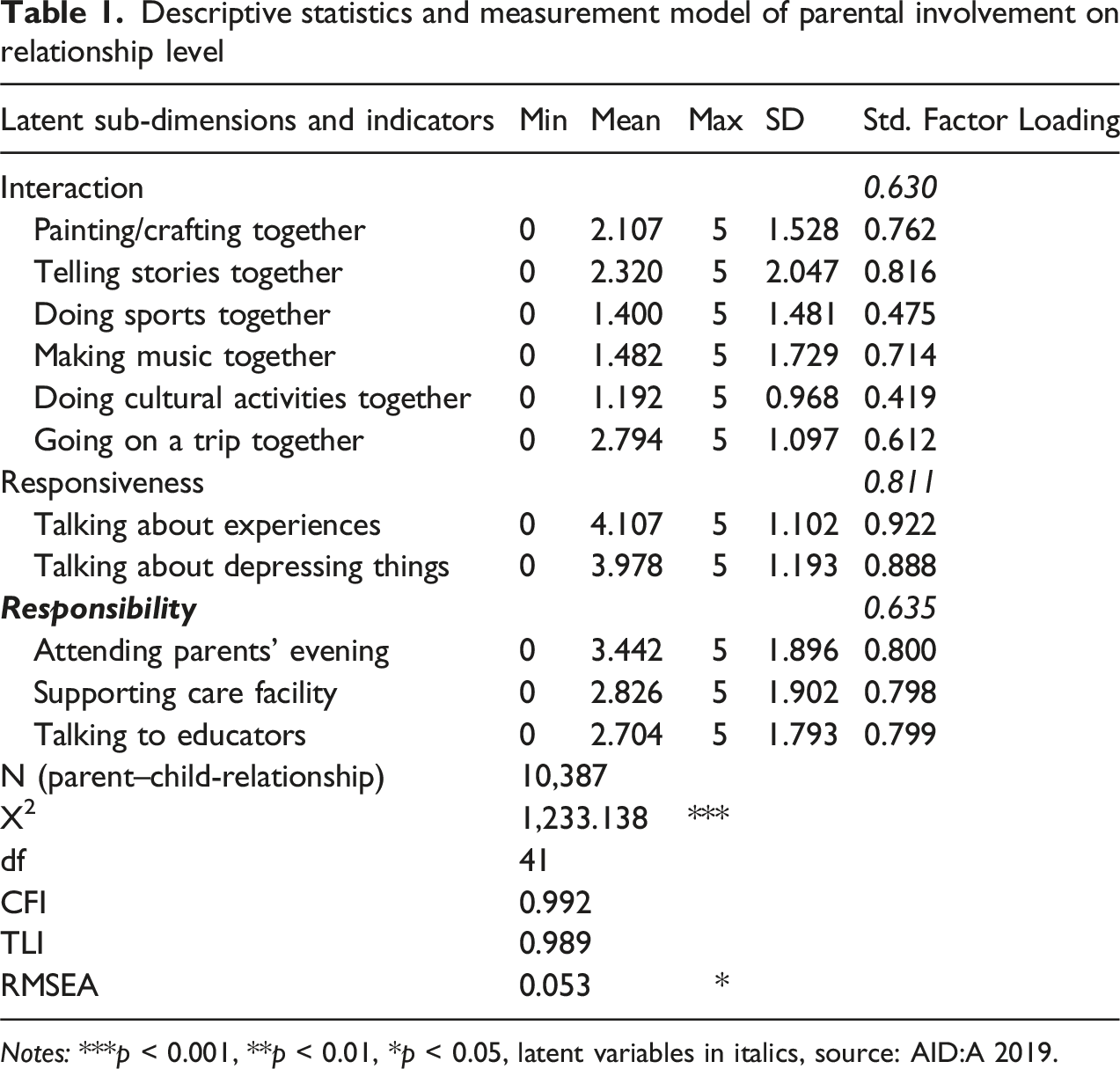
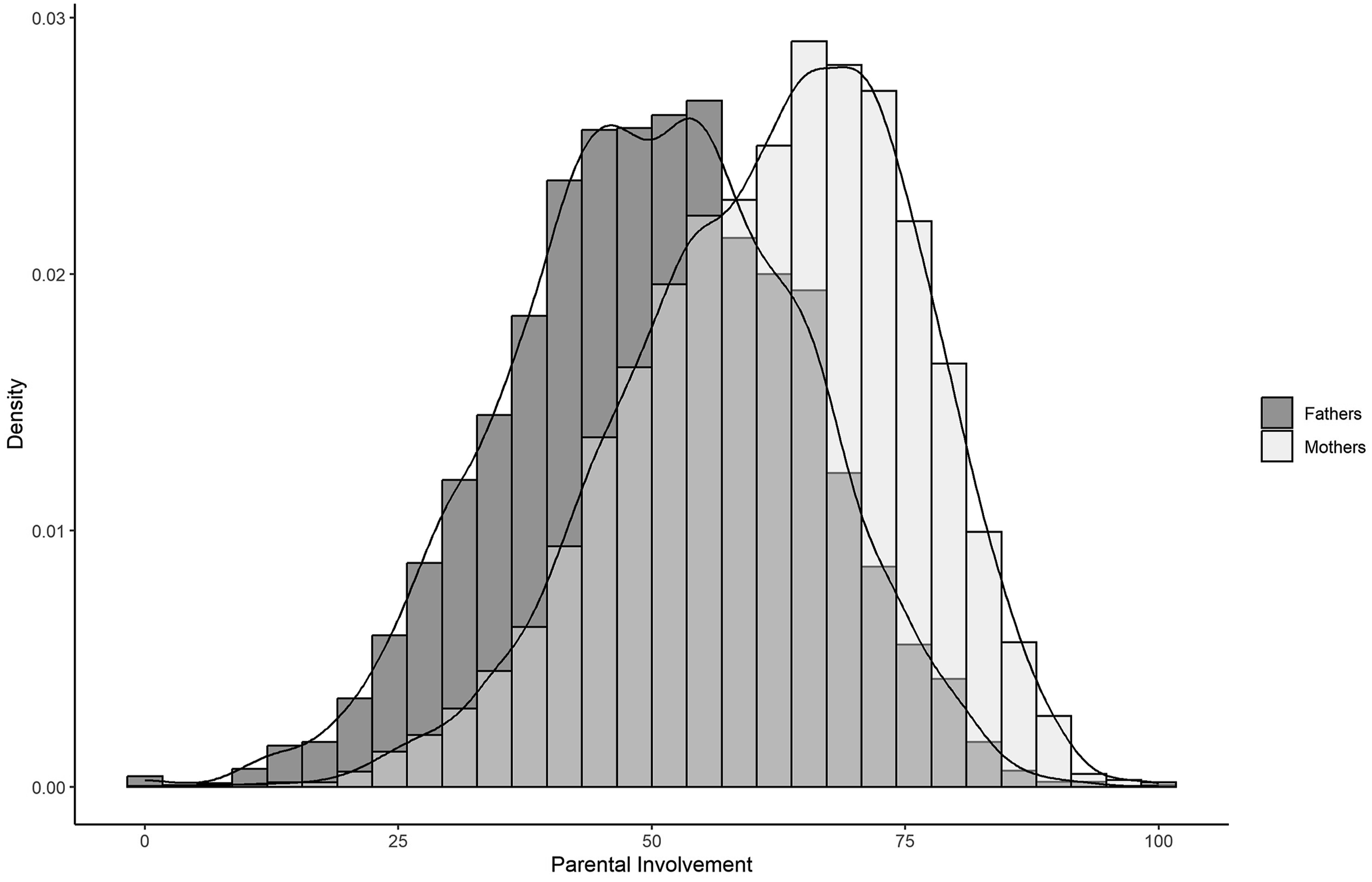
In the first step of the analysis, using confirmatory factor analysis (CFA), we estimate not only the fathers’ but also the mothers’ parental involvement with each of their respective children simultaneously to allow for direct comparisons of fathers’ and mothers’ involvement in one measurement model in the following step, the multilevel regression analysis. In the CFA, we allow the indicator variables to be ordinal instead of metric (Rhemtulla et al., 2012). We report Standardized Root Mean Square Residual (SRMR) and Root Mean Square Error of Approximation (RMSEA) as absolute goodness-of-fit as well as Tucker–Lewis Index (TLI) and the Comparative Fit Index (CFI) as relative badness-of-fit indices (S. G. West et al., 2015). To carry out the analyses we use the lavaan package (beta Version 0.6.15: Rosseel, 2012) for R (R Core Team, 2020). The results of the confirmatory factor analysis, with which we estimate the latent factor of parental involvement, are shown in (Figure 1 and Table 1). Following our assumptions, higher parental involvement is not only characterized by more frequent joint activities of parents with their children: More involved parents also talk more frequently with their children about their experiences and are also visible to third parties, as they appear in educational contexts and, for example, exchange information with educators. With CFI and TLI far beyond the usual goodness-of-fit cutoff criterion of 0.950 and RMSEA close to the badness-of-fit cutoff criterion of 0.050 (the confidence interval of the RMSEA estimator comprises values from 0.050 to 0.055), the confirmatory model has a high overall model fit, as the non-metric data structure is adequately taken into account. Figure 2 shows the distribution of the predicted values from the model for the cases used in the estimation process. The values are normalized (unity-based) and multiplied with 100 to range from 0 (smallest predicted value) to 100 (largest predicted value) for better interpretability while the original value distribution is maintained. Confirmatory factor analysis to estimate parental involvement (standardized factor loadings; estimated thresholds and variances omitted) Descriptive statistics and measurement model of parental involvement on relationship level Notes: ***p < 0.001, **p < 0.01, *p < 0.05, latent variables in italics, source: AID:A 2019. Histogram of the predicted values for parental involvement by fathers and mothers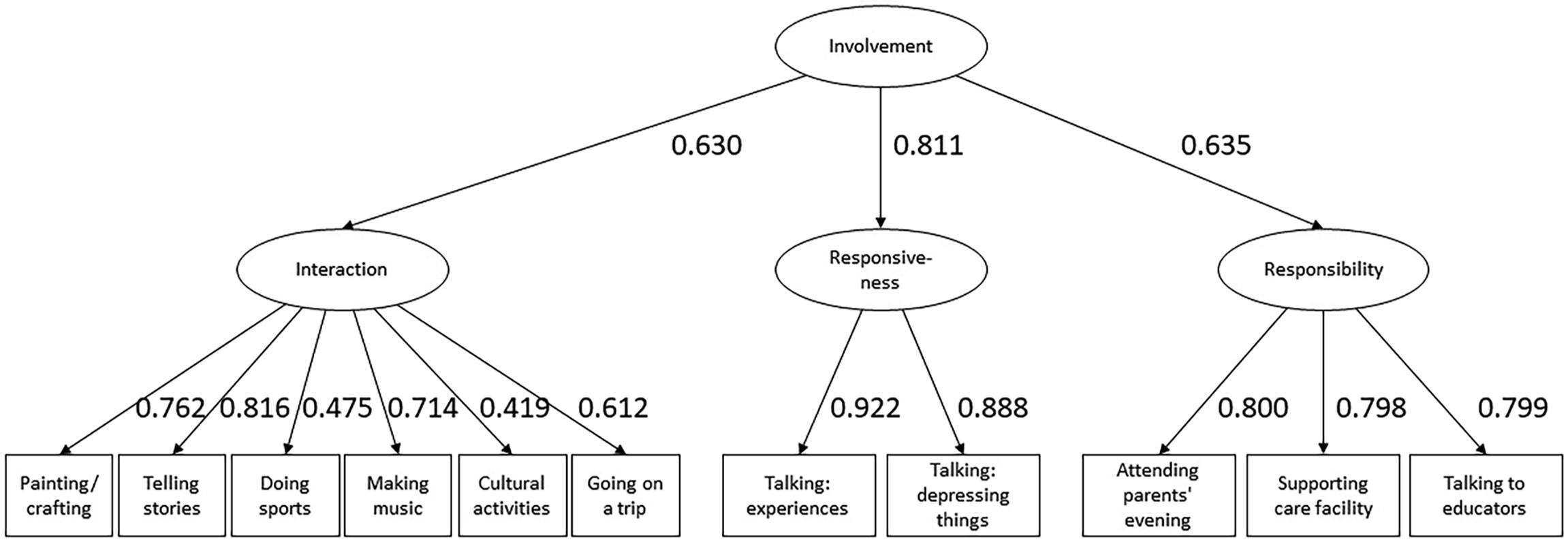
Descriptive statistics
Results
Within-Family Variance
Hybrid multilevel linear regression on child-specific paternal involvement
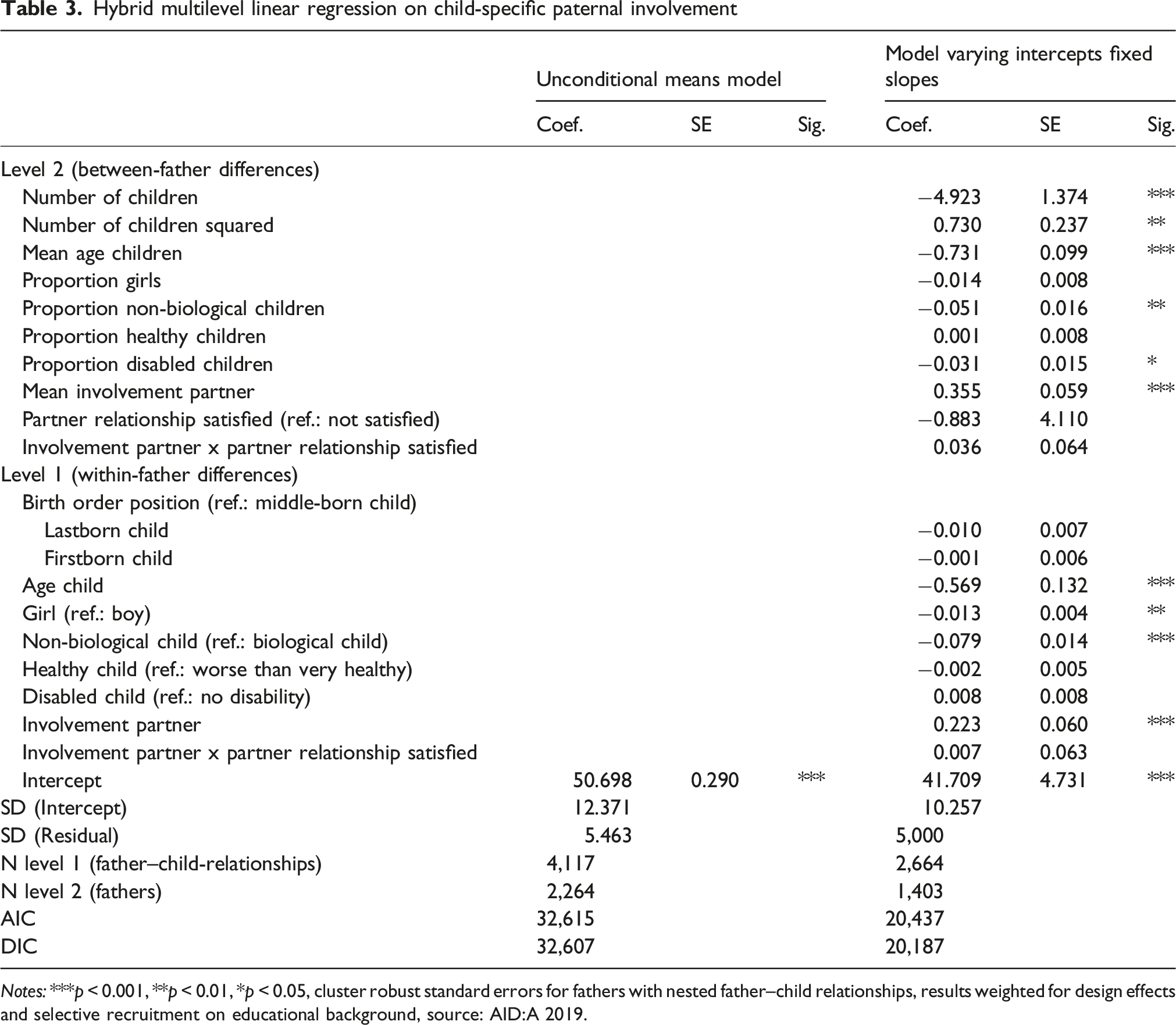
Notes: ***p < 0.001, **p < 0.01, *p < 0.05, cluster robust standard errors for fathers with nested father–child relationships, results weighted for design effects and selective recruitment on educational background, source: AID:A 2019.
Predicting Paternal Involvement
With the varying intercepts fixed slopes model, we now examine predictors for differences between fathers as level-2 units and within fathers but between each of his children as level-1 units. Regarding differences between fathers, we find that the fathers’ involvement is lower the more children they have. However, the involvement does not decrease linearly but rather reaches its minimum at about four children.
Fathers with a higher percentage of daughters among their children do not differ in their overall involvement compared to fathers with a lower girls ratio. Contrarily, within one family fathers tend to be less involved with their daughters compared to their sons (supporting Hypothesis 1), which corresponds to numerous findings (Atzaba-Poria & Pike, 2008; Poonam & Punia, 2012; Tucker et al., 2003) on the relevance of gender. The higher involvement for their sons only shows when fathers have children of both sexes, sons and daughters. That indicates that fathers differentiate their involvement only when they have children of different sexes. However, mothers are more involved with their daughters (see Table A1 for the supplementary analysis on mothers involvement) and are also overall more involved with all their children, the higher the proportion of daughters among all their children. Thus, the gender of the children seems to be even more important for mothers than for fathers while both, mothers and fathers, are similarly more involved with children of the same sex.
Regarding differences within fathers, the results suggest that fathers do not treat their children differently according to their birth order position, that is, they do neither focus on their lastborn nor their firstborn child compared to children born in a middle position (contradicting Hypothesis 2b). Contrarily, fathers with on average older children (according to their chronological age) are less involved with all of their children than fathers with younger children (relative age effect; supporting Hypothesis 2a). The size of the between and the within effects of age on paternal involvement are quite similar. This means that the reduced involvement of fathers with every year their children get older on average is compensated almost completely by an increase in involvement for the younger children. Thus, fathers appear to treat every child equally applying an age-specific level of involvement. Compared to fathers, mothers also differentiate their involvement according to the age of their children. Both effects are more pronounced in mothers than in fathers but also similar in size revealing the same mechanism.
Additionally, fathers tend to be less involved, the larger the proportion of non-biological children and children with disabilities they have among all their children. Also within one family, fathers are less involved with their non-biological children compared to their biological children as well (supporting Hypothesis 3).
Beyond the characteristics of their children, fathers are on average more involved with their children when their partner is, on average more involved with their children as well (supporting Hypothesis 5). This correlation also holds on the within-father level, that is, fathers and their partners tend to be aligned in their involvement with a certain child. However, we find no difference in the effect of maternal involvement on parental involvement moderated by the satisfaction of the fathers with their respective partners (contradicting Hypothesis 6).
Finally, we find that fathers with more or less healthy children as well as children with and without disabilities do not differ in their involvement in general (contradicting Hypothesis 4). On the between level, fathers tend to have a generally lower and mothers a generally higher involvement, the larger the proportion of children with disabilities among all their children.
Robustness Check
With the varying slopes model, we checked whether the results of the varying intercept model with fixed slopes can be reproduced if we allow the slope estimators (level-1 characteristics and parental involvement within fathers) to vary between the fathers (level-2 units). Since fathers as level-2 units usually have only one to four children and thus only a small group size for varying slopes, it is not surprising that the results of the varying slopes model largely agree with those of the varying intercepts and fixed slopes model. Therefore, marginal differences due to slight shifts in the point estimates are not meaningful.
Discussion
In this study, we analyzed how fathers treat their individual children differently related to their respective characteristics using German survey data on families with minor children. Our results implicate that, first, fathers’ involvement differs substantially between their children according to child characteristics (Lamb, 2010; Norman, 2017) that have been relevant predictors of parental differential treatment in earlier studies on other dimensions of parenting. Compared to the frequently conducted between-family comparisons in research on paternal involvement, this result highlights that fatherhood is also variable in terms of the engagement directed toward each individual child. Consequently, modern, engaged fatherhood should always be analyzed in relation to the question of which child actually benefits from it, rather than solely focusing on which fathers become more or less engaged. Intrafamilial variations should therefore play a more central role in future research on paternal involvement, for example, by examining their interactions with family characteristics that vary only between different families.
Secondly, fathers in our sample are more involved with their sons than with their daughters when they have both while mothers are oppositely more involved with their daughters. This result meets the expected difference in paternal involvement already known from previous research than focuses primarily on time use and physical interactions of fathers with their children (Poonam & Punia, 2012; Siegal, 1987; Tucker et al., 2003). However, this finding does not mean that fathers are in general less interested in their daughters as other studies underline that fathers show similar emotional warmth towards their daughters compared to their sons (Atzaba-Poria & Pike, 2008). In this vein, we find no differences in the level of involvement between fathers only having sons and fathers only having daughters. This shows that our measurement of paternal involvement tends to represent the physical aspects of involvement more strongly than affectionate components and delineates how paternal involvement is characterized gender-specifically (Herbaut et al., 2024; Hofferth et al., 2012; Palkovitz et al., 2014) as part of father’s practice of doing gender (C. West & Zimmerman, 1987).
Thirdly, within one family, fathers differentiate their involvement regarding the age of their children, but not due to their birth order position. In line with this finding and contradicting our Hypothesis 2b, the sibling order does not influence paternal involvement in a way that the last-born child would receive the highest engagement of the father. This finding relates well to an ongoing scientific debate that earlier findings on birth order effects (e. g. in personality psychology) are caused by methodologically mis-specified analyses and can be excluded using multilevel fixed effects regression analysis as we perform them in this study (Damian & Roberts, 2015). Rather, the greater their age difference from their older siblings is, the more engagement a child receives from their father. On the between level, fathers with younger children are, on average, more involved than fathers with older children. Although we cannot analyze longitudinal changes in paternal involvement over time with our dataset, we regard this difference as biographical changes, according to which fathers, whose children are already older, reduce their engagement. This result is in line with the Family Development Theory (Duvall, 1971) assuming that dense interactions become less important when children become more independent in later childhood and early adolescence (Poonam & Punia, 2012). Further research could continue to fill this desiderate using panel data on paternal involvement and distinguish age, cohort, and periodic effects.
Fourthly, we suspect that the lower involvement of stepfathers comes about because they often share their responsibility for their non-biological children with the children’s biological fathers, for example, when they live temporarily with their biological fathers as part of shared care arrangements (Anderson & Greene, 2013; Sweeney, 2010). Children tend to choose a favorite between their biological and social fathers (i.e., to substitute one for the other) (Hornstra et al., 2020). Since the stepfather’s relationship with the child depends on the child’s relationship with the biological father (Leeuw & Kalmijn, 2020), the differential involvement effect (cf. Arránz Becker et al., 2013) might represent the counterpart to the children’s substitution effect: on average, fathers differentiate between their biological and non-biological children, just as non-biological children differentiate between their biological and non-biological fathers. The absence of this effect among mothers could be related to the fact that mother–child relationships also deteriorate with new partnerships (another substitution effect) (Arránz Becker, 2015). As a result, under the same stepparenting mechanisms assumed for fathers, mothers’ biological children might also experience a distancing in the relationship, which is reflected in the mothers’ involvement. On the between level, fathers also show a generally lower involvement the higher the proportion of non-biological children among all their children.
Fifthly, within one family, neither fathers nor mothers differentiate their involvement according to the health status of their children. This result contradicts most clearly the idea that fathers (and mothers) use their involvement as a compensatory investment to offset the (health) disadvantages of their children who are more burdened by illness or disability (Singer & Weinstein, 2000). Rather, parents in our study behave neutrally towards the health-related differences between their children. While some studies on parental investments also find no differential parental behavior between siblings (Bharadwaj et al., 2018; Terskaya, 2023), Rosales-Rueda (2014) finds lower parental investments in children with mental conditions compared to their healthy siblings, but no difference when children have a physical condition. Unfortunately, our case numbers do not allow do differentiate between various types of health problems. However, on the between level, fathers tend to have a generally lower and mothers a generally higher involvement, the larger the proportion of children with disabilities among all their children. This could reflect gender-specific differences pointing to mothers as on average primarily responsible for intensive caring resulting in higher risks of mothers have health problems themselves compared to fathers (Brekke & Alecu, 2023; Olsson & Hwang, 2001).
Finally, within families, our results support the assumption from the Family System Theory (Cox & Paley, 2003) that father–child and mother–child relationships depend on each other. Fathers and mothers converge in their involvement for each child individually, that is, which child they are jointly more or less involved with. On the between level, this cooperative orientation is also reflected in all children, so that fathers and mothers agree in their mean involvement to a large extent (Pleck, 2010a; Schmidt et al., 2015, 2019). However, our results do not correspond to the Fathering Vulnerability Hypothesis (Cummings et al., 2010), neither for fathers nor for mothers, as partnership satisfaction does not moderate the effect of maternal on paternal involvement. Further tests revealed that partnership satisfaction does not moderate paternal involvement in any model specification supporting the results of Jensen et al. (2021) who assume the importance of parental relationship satisfaction to be weak if any. We further tested if fathers’ and mothers’ (agreement on) traditional or egalitarian gender roles would be a better measurement of the cooperation of the parents in raising the children (Belsky et al., 1996) but found these predictors not to be relevant as long as we controlled for the involvement of the respective partner. A reason for these results could be that, according to the Theory of Marriage (Becker, 1973), partner selection is already biased toward concordant social background facilitating more homogeneous expectations regarding parenting ideals and practices right at the beginning of partnership. Thus, controlling for partner involvement would leave no further statistical relevance of these predictors to explain father involvement.
Our results shed light on the complexities of paternal involvement and support the thesis that it makes sense to consider differences in father involvement not only between fathers of different families but also within families in terms of involvement with different children. Although we employ a cross-sectional analysis, the multilevel design of our study using family fixed effects allows us to rule out father-related characteristics to bias our estimates for child and relationship predictors. Additionally, predictors like child gender and (non-)biological father–child relation are time-constant, thus, reducing the risk of reverse causality. However, like all research, ours also has its limitations. For example, at 24%, only a small proportion of our fathers live with more than two children. Although the dominance of two-child families (51% in our sample) is typical of modern families in Germany, it would be desirable to have more variance here for the analysis of within-family differences. The proportion of non-biological children is also rather low at 4.5%; further analyses with more cases and greater variance on the variables of interest would therefore be desirable for the future. To test for different parenting strategies of fathers’ future research could consider additional child characteristics like educational endowment or personality. Finally, qualitative approaches could shed light on the attitudes and rationalities of parents that guide the differential treatment of fathers and mothers.
Footnotes
Ethical Considerations
Ethical review and approval was not required for the study on human participants in accordance with the local legislation and institutional requirements.
Consent to Participate
Written informed consent to participate in this study was provided by the participants’ legal guardian/next of kin.
Author Contributions
Conceptualization, T.E. and C.Z-E.; methodology, T.E.; software, T.E.; validation, T.E. and C.Z.-E.; formal analysis, T.E.; investigation, T.E. and C.Z-E.; data curation, T.E.; writing—original draft preparation, T.E. and C.Z-E.; writing—review and editing, T.E. and C.Z.-E.; visualization, T.E.; supervision, C.Z.-E.; project administration, C.Z.-E. All authors have read and agreed to the published version of the manuscript.
Funding
The authors disclosed receipt of the following financial support for the research, authorship, and/or publication of this article: This study was funded by the German Youth Institute (DJI).
Declaration of conflicting interests
The authors declared no potential conflicts of interest with respect to the research, authorship, and/or publication of this article.
Data Availability Statement
Data (Kuger et al., 2020) are publicly available for scientific use at: https://surveys.dji.de or  . The study analysis code is available upon request from the corresponding author.
Appendix
Hybrid multilevel linear regression on child-specific maternal involvement Notes: ***p < 0.001, **p < 0.01, *p < 0.05, cluster robust standard errors for mothers with nested mother–child relationships, results weighted for design effects and selective recruitment on educational background, source: AID: A 2019.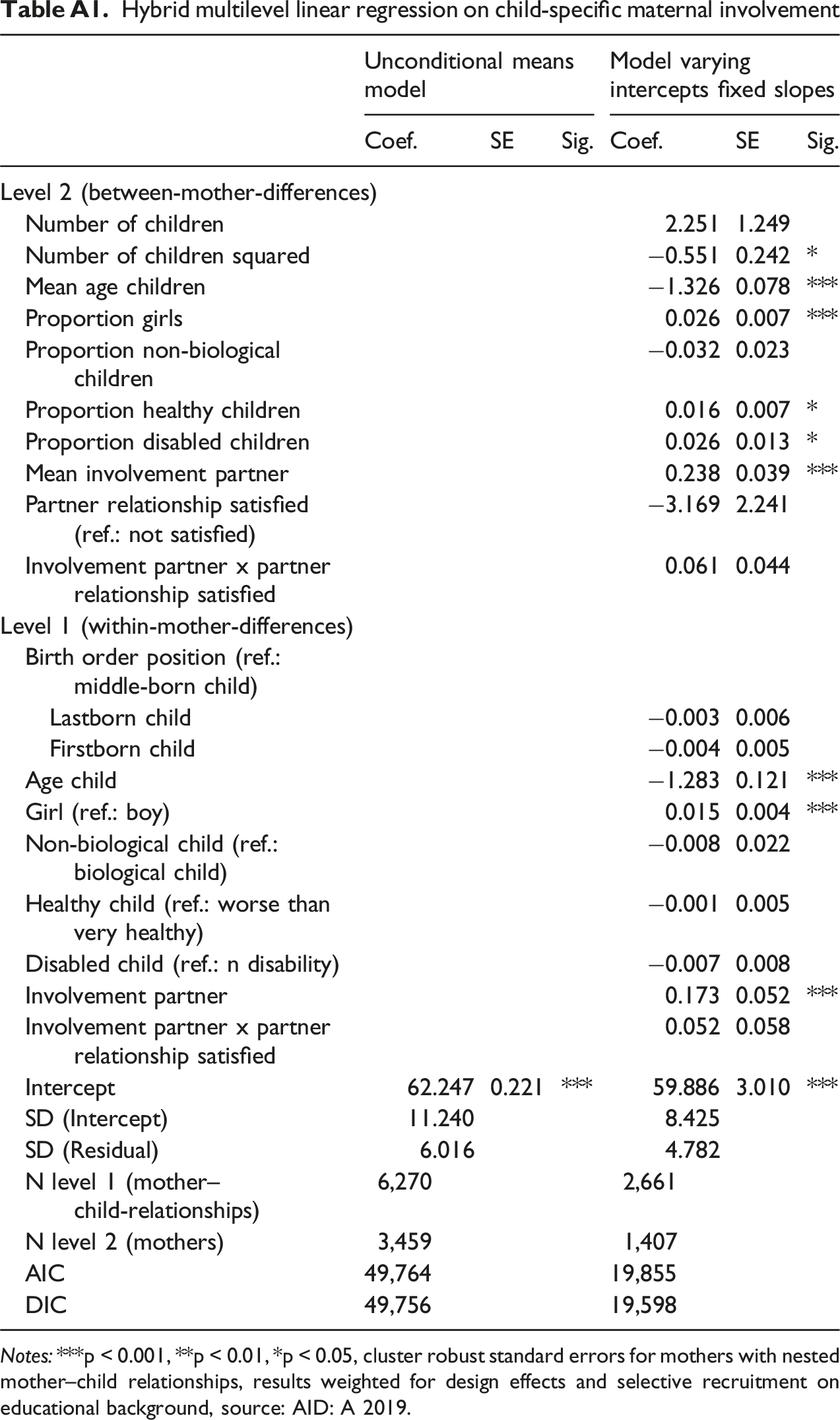
Unconditional means model
Model varying intercepts fixed slopes
Coef.
SE
Sig.
Coef.
SE
Sig.
Level 2 (between-mother-differences)
Number of children
2.251
1.249
Number of children squared
−0.551
0.242
*
Mean age children
−1.326
0.078
***
Proportion girls
0.026
0.007
***
Proportion non-biological children
−0.032
0.023
Proportion healthy children
0.016
0.007
*
Proportion disabled children
0.026
0.013
*
Mean involvement partner
0.238
0.039
***
Partner relationship satisfied (ref.: not satisfied)
−3.169
2.241
Involvement partner x partner relationship satisfied
0.061
0.044
Level 1 (within-mother-differences)
Birth order position (ref.: middle-born child)
Lastborn child
−0.003
0.006
Firstborn child
−0.004
0.005
Age child
−1.283
0.121
***
Girl (ref.: boy)
0.015
0.004
***
Non-biological child (ref.: biological child)
−0.008
0.022
Healthy child (ref.: worse than very healthy)
−0.001
0.005
Disabled child (ref.: n disability)
−0.007
0.008
Involvement partner
0.173
0.052
***
Involvement partner x partner relationship satisfied
0.052
0.058
Intercept
62.247
0.221
***
59.886
3.010
***
SD (Intercept)
11.240
8.425
SD (Residual)
6.016
4.782
N level 1 (mother–child-relationships)
6,270
2,661
N level 2 (mothers)
3,459
1,407
AIC
49,764
19,855
DIC
49,756
19,598