



Abstract
This study examines the roles of community belonging and family resilience in shaping subjective well-being (SWB) among displaced residents of kibbutzim in Israel during the October 7, 2023, crisis. Forced displacement disrupts stability, daily routines, and psychosocial well-being, emphasizing the need for supportive social and familial frameworks. Utilizing a quantitative, cross-sectional methodology, the study collected data from 1,112 displaced residents across 35 kibbutzim using validated scales: the Sense of Community Index for community belonging, the Family Resilience Assessment Scale for family resilience, and the Personal Wellbeing Index–Adult for subjective well-being. Regression and mediation analyses revealed that community belonging and family resilience significantly predicted SWB, with family resilience partially mediating the relationship. However, no interaction effect between the two factors was found, indicating they function as distinct yet complementary mechanisms. The findings highlight the unique sociocultural structures of kibbutzim, which play a critical role in maintaining psychosocial stability during crises.
Keywords
Introduction
Displacement and internal migration are two complex phenomena that can significantly impact people’s lives, particularly in the contexts of family, employment, education, and health. While both migration and displacement are critical processes with long-term consequences, migration is often seen as a more planned and calculated process (Voznyak et al., 2023). In contrast, displacement occurs rapidly and is often the result of external constraints, such as drastic and sometimes negative changes in quality of life and personal, local, and community security. Emergency situations caused by climate conditions, natural disasters like fires, violent conflicts, or other crisis events can lead to forced displacement (Voznyak et al., 2023). The central and significant difference between displacement and migration lies in the forced nature of displacement and the accompanying uncertainty. While migration allows an individual to plan their actions, displacement leaves the individual in a state of lack of control, with no option to choose their new location. Studies show that forced displacement leads to a significant decline in life satisfaction and mental well-being, especially when it is accompanied by the loss of supportive social networks (Henderson & Hildreth, 2011; LaJoie et al., 2010). Decisions during displacement are influenced by factors such as the availability of transportation, open migration routes, family and social connections, and the state or government’s ability to provide support in finding new housing.
The Israeli case of the evacuation of kibbutzim in October 2023 presents a unique pattern of community displacement. Following the Mega Mass Casualty Event, which involved terrorist attacks on rural settlements and an increased fear of terrorist activity on the northern border, the Israeli government decided to evacuate settlements close to conflict lines. According to a study published by the Institute for National Security Studies (The Institute for National Security Studies, 2023) and data from the National Emergency Management Authority (NEMA), as of November 1, 2023, approximately 253,000 residents were evacuated or fled their homes. Of these, about 94,000 relocated to other communities, around 88,000 were housed in hotels, and roughly 70,000 evacuated independently. This is the largest civilian evacuation ever carried out in Israel since the establishment of the state. According to data from the Knesset Research and Information Center (2023), approximately 143,000 people were recognized as eligible for evacuation from their homes, including about 68,000 from the north and about 74,500 from the south. In the north, the evacuation was due to concerns about Hezbollah guerrilla infiltration, and in the south, due to Hamas forces entering from Gaza (Jaffe et al., 2024). Citizens were compelled to leave their homes immediately and find temporary housing. Government initiatives facilitated accommodations in hotels and hostels converted into evacuation centers, while many individuals across Israel volunteered to host displaced families in their homes.
Unique Aspects of Forced Displacement in Israel
While previous research on forced displacement focused primarily on the geographical dispersion of communities, such as following natural disasters (Brodar et al., 2020; DeYoung et al., 2019; Peek et al., 2011), the current case presents a unique pattern of organized multi-community relocation. Some communities were evacuated together and remained as an organic community in the same location, while others dispersed to different places. This situation allows, for the first time, to examine the combined role of family resilience and community belonging in coping with forced displacement, especially in the context of rural communities characterized by a unique social structure integrating multigenerational families and strong community support systems.
To understand the deeper meaning of this displacement, it is essential to recognize the history and unique structure of the communities that were displaced. Initially, villages in Israel were based on values related to community life. These settlements were mostly established as cooperatives, on an ideological basis, and organized within political settlement movements as part of the settlement policy in border and peripheral areas, particularly near the country’s borders, as a means of protecting those borders (Shamai et al., 2012). Pooling resources in some agricultural production, marketing of produce, and later industrial activity helped build strong communities for their members in daily life. In their early years, these communities were even considered the elite in the young country (Etzioni-Halevy, 1981; Golan, 1997). This unique settlement structure developed into a social system with distinct characteristics. The rural community is characterized by a geographical location in the periphery, strong social capital, intergenerational ties, and cooperation based on physical proximity and shared values (Flora & Flora, 2018). These communities provide a complementary social framework for the families living in them and contribute to individual and family resilience (Maslovskaia et al., 2021). Throughout history, the rural community has been characterized by economic and social interactions between families, which contributed to its stability and survival ability. Vera-Sanso (2007) noted that this community structure provides a support system based on cooperation, allowing families to cope with the challenges of rural life.
The Role of Family Resilience
The unique social characteristics of the rural community are reflected in the unique family structure that developed within it. Many families are multigenerational (Woods, 2014), family units combining two or more generations living together or in close geographical proximity, sharing resources, and providing mutual support (Gray, 1998). This family structure has been common for many years in rural areas as part of the historical social structure related to land ownership (Gray, 1998) and the need for combined efforts and labor which the family structure enabled without unnecessary economic expenditures and by maximizing family resources. This family structure is not only an economic unit but also a social framework that provides emotional and practical mutual support. Family resilience is defined as the ability of families to cope with, adapt to, and recover from negative events while maintaining the well-being of the individuals and the family system (Neubauer et al., 2021; Walsh, 2016).
According to Woods (2014), family farms in rural areas demonstrate a model of economic autonomy based on independent and family-based agriculture. This structure allowed families to cope with changing economic challenges and maintain multilevel family resilience, where each generation contributes to the family’s economic and social continuity. Barnett et al. (2016) emphasized the multifunctionality of the rural family, which functions not only as an agricultural unit but also as a social system that provides essential services such as transportation and health care, thus significantly contributing to both family and community resilience. One of the major challenges in recent years has been changes in the employment structure and rural agriculture. Gray (1998) described the constant tension between the older generation seeking to preserve agricultural traditions, and the younger generation adopting new economic and technological approaches. These tensions are also reflected in family relationships, particularly regarding grandchildren’s education and family farm management (Kekeh et al., 2024). The unique social characteristics of the rural community are reflected in its unique family structure, which creates a social and emotional support network that strengthens family resilience, especially considering geographical isolation (Lozynskyy & Zubyk, 2022). The contribution of multigenerational families extends beyond the economic aspect and is reflected in the enrichment of the social capital of the entire rural community. Flora and Flora (2018) emphasized the importance of family and community resilience for individual well-being in times of social, economic, and demographic crisis (Hayslip et al., 2018). In the modern kibbutz, the multigenerational family is integrated into a cooperative system that balances family needs with community commitments (Donovan et al., 2015; Greenberg et al., 2016), serving as a source of stability during periods of change (Ben-Rafael & Topel, 2020).
Forced Displacement of a Community
To understand the consequences of displacement on the people of these communities and their well-being, three central theoretical concepts and their interactions need to be examined: subjective well-being (SWB), family resilience, and community belonging. Subjective Well-Being (SWB), , is a state of complete physical, mental, and social well-being, and not merely the absence of disease or weakness. Studies show that forced displacement significantly impacts individual and community well-being. In her study, Shenaar-Golan (2016) highlighted the role of hope as a predictor of subjective well-being, especially in populations experiencing stress or displacement, and pointed to the need for cultivating psychological resources in these contexts. LaJoie et al. (2010) pointed to the long-term psychological impacts of displacement among Hurricane Katrina evacuees, emphasizing the critical role of community cohesion in maintaining mental well-being after a disaster. Similarly, DeYoung et al. (2019), in their study of refugees from Cambodia and Laos in disaster-prone coastal areas, found that a sense of community and social support are crucial components in building resilience and preparedness. However, as the researchers point out, there is still a gap in understanding how community dynamics shape subjective well-being over time, particularly in prolonged displacement situations. These findings emphasize the importance of preserving supportive social frameworks during forced displacement. Displaced persons experiencing the loss of these frameworks report a significant decline in their mental well-being, whereas the ability to maintain social and family ties during displacement has been found to be a protective factor in maintaining higher subjective well-being.
These concepts take on special meaning in the context of the unique social structure of the rural community, which integrates multigenerational families and close community ties. In terms of Putnam's (2000) theory, this structure generates two types of social capital: “bonding capital” created through internal family ties that provides stability in the face of everyday challenges and “bridging capital” arising from intergenerational community ties that contribute to broader social and employment integration. The significance of multigenerational families extends beyond the narrow family aspect. Maslovskaia et al. (2021) described how the multigenerational structure creates a two-dimensional network: horizontal ties between individuals and similar groups and vertical intergenerational ties across age and roles. This integration creates a social foundation that allows for the preservation of local identity and culture, as emphasized by Galand (2017) in his research on the contribution of intergenerational ties to community resilience.
Community Belonging
Community Belonging, defined as the individual’s sense of connection and attachment to the community (McMillan & Chavis, 1986), holds special meaning in rural areas. It is grounded in the economic and social interactions between families (Galand, 2017) and is strengthened through the multigenerational structure that allows for the intergenerational transmission of values and traditions. Theoretically, the connection between family resilience and community belonging in rural areas has been examined in two parallel strands: family resilience studies focused on the internal structure of multigenerational families (Walsh, 2016; Woods, 2014) and community belonging studies focused on the community level (Flora & Flora, 2018). The current study offers, for the first time, a model combining these two strands, examining their joint functioning in crisis situations, based on the findings of Barnett et al. (2016) regarding the multifunctionality of the rural family as a social system that provides essential services to the community.
Challenges of the Community in Times of Crisis
In crisis and displacement situations, the relationship between community belonging and family resilience takes on special significance. Shenaar-Golan (2016) found that the interaction between community support and family resilience is a key factor in coping with collective trauma. The family provides the primary framework for coping, while the community offers a broader support network that strengthens family coping capacity. In cases of community evacuation, the ability to preserve both frameworks—the family and the community—may be a decisive factor in maintaining individual well-being. Rural communities in Israel have faced significant challenges in recent decades. The process of urbanization, where young people leave rural areas for employment opportunities in urban centers, has led to economic, social, and demographic crises (Ben-Rafael & Topel, 2020; Lozynskyy & Zubyk, 2022). In response, some settlements have undergone economic privatization of production and community services and have begun absorbing new populations, mainly young families. Among the newcomers were members of the community who returned due to the opportunity to engage in professions learned in the city, along with others seeking a community-oriented lifestyle (Greenberg et al., 2016). These revitalization processes led to a reduction in the average age and a renewal of community life. Li (2023) and Hartel et al. (2014) noted that these changes require the development of new approaches to strengthening community resilience, while Keller and Owens (2020) emphasized that traditional values like family support and level of religiosity remain central among rural youth and serve as a foundation for community preservation. These revitalization processes were abruptly interrupted on October 7, with the evacuation of the settlements and communities.
In this coping process, the kibbutz represents a unique model of integrating multigenerational family structures with a cooperative community system. Ben-Rafael and Topel (2020) described how the modern kibbutz structure balances family needs with community commitments, creating three integrated circles: the nuclear family, the extended multigenerational family, and the broader kibbutz community (Donovan et al., 2015; Greenberg et al., 2016). This unique structure allows for the first time to examine how family resilience and community belonging function as an integrated system, especially in times of crisis.
Experience in Israel teaches the importance of community coping with displacement. Research on preserving community identity in displacement situations emphasizes the dual challenge of maintaining cultural continuity while adapting to new realities. While most research on community evacuation deals with the geographical dispersion of the community after natural disasters (LaJoie et al., 2010) or refugee communities in disaster areas (DeYoung et al., 2019), studies have found that a sense of community and social support, as well as the preservation of social structures and community organizations during evacuation, play a key role in coping with trauma and maintaining mental well-being. In Israel during the 1948 War, thousands of Israelis, mostly women and children, were evacuated from their homes in border settlements—kibbutzim, moshavim, and cities—for a period of several months. Some communities like Kibbutz Kfar Etzion were rebuilt elsewhere as Misgav Am, and others were renewed (Levinovsky, 2007). In the Yom Kippur War of October 1973, children and women were evacuated from the Golan Heights, for example, but returned to their homes after a month (Shamai et al., 2012). The organizational, psychological, and ideological insights from these studies emphasized the attachment versus disillusionment with myth and symbols (Levinovsky, 2007).
The theoretical review points to three central processes influencing subjective well-being in displacement situations: (a) the role of community belonging as an initial support resource, (b) the importance of family resilience as a coping mechanism, and (c) the unique interaction between these two factors in the social structure of the kibbutz. The studies reviewed indicate that community belonging and family resilience each contribute separately to individual well-being (LaJoie et al., 2010; Walsh, 2016), but the combined effect of these factors in a situation of organized community displacement has not yet been examined. The case of the evacuation of kibbutzim on October 7, 2023, provides a unique opportunity to test these hypotheses. First, the social structure of the kibbutz, which integrates multigenerational families with a cooperative community framework (Ben-Rafael & Topel, 2020), allows for the examination of the combined effect of these two resources on individual well-being. Second, the fact that some communities remained united in the evacuation site while others dispersed allows for assessing the relative contribution of preserving the community framework versus family resilience. Based on this theoretical framework, the study proposes to test five hypotheses focusing on the relationships between variables: the direct effect of community belonging and family resilience on subjective well-being, the role of family resilience as a mediator, and the interaction between these two resources. Testing these hypotheses will contribute to understanding the mechanisms through which communities and multigenerational families help individuals cope with forced displacement. Figure 1 illustrates the study’s conceptual framework. Conceptual framework of the study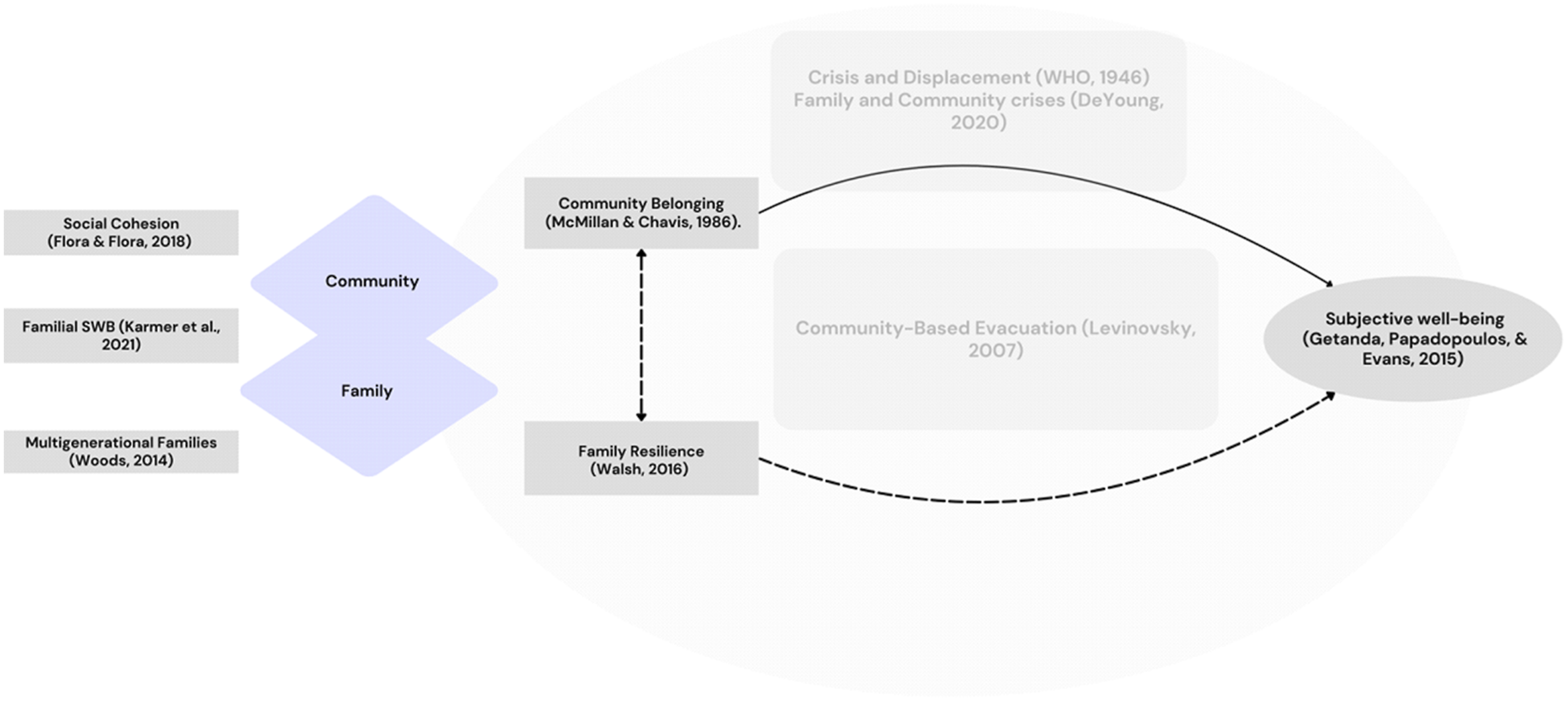
Main Research Question
What are the roles of community belonging and family resilience in shaping subjective well-being (SWB) among displaced kibbutz residents?
Hypotheses
1. Community belonging and family resilience will be significant predictors of subjective well-being (SWB) among displaced kibbutz residents. 2. Community belonging will be positively associated with subjective well-being (SWB) among displaced kibbutz residents. 3. Family resilience will be positively associated with subjective well-being (SWB) among displaced kibbutz residents. 4. Family resilience will mediate the relationship between community belonging and subjective well-being (SWB), such that community belonging will indirectly influence subjective well-being through family resilience. 5. The interaction between family resilience and community belonging will predict subjective well-being (SWB) among displaced kibbutz residents, such that the effect of community belonging on subjective well-being will be stronger at higher levels of family resilience.
Methodology
This study aimed to explore the roles of community belonging and family resilience in shaping subjective well-being among displaced kibbutz residents. A quantitative approach was used to measure and analyze these relationships systematically. Quantitative methodologies are commonly used for systematically measuring and analyzing relationships between variables, providing a framework for generating insights that can often be generalized (Bryman, 2016). This chapter outlines the study’s design.
Research Design
A cross-sectional research design was adopted, utilizing survey data collected from displaced kibbutz residents following their evacuation. This design allowed for the analysis of associations between community belonging, family resilience, and subjective well-being at a specific point in time. The decision to use a quantitative approach was guided by the need to quantify psychosocial variables and provide evidence to support the study’s hypotheses.
Measures and Operationalization of Theoretical Constructs
This study operationalized three theoretical constructs—subjective well-being, family resilience, and community belonging—to systematically measure their relationships and effects. Each construct was assessed using validated scales with demonstrated relevance to the study’s population and context. This approach ensures that the measures align with the theoretical framework while providing reliable data for analysis.
Subjective Well-Being
Subjective well-being was assessed using the Personal Wellbeing Index–Adult (PWI-A), developed by Cummins and Lau (2005). This scale measures subjective well-being across seven domains: standard of living, health, achievements in life, personal relationships, safety, community connectedness, and future security. The original 11-point Likert scale was modified to a 5-point scale (1 = strongly dissatisfied, 5 = strongly satisfied) for clarity and accessibility, and items were adapted to the kibbutz context. For instance, the question on community connectedness was revised to: “How satisfied are you with feeling part of your community in kibbutz life?”
The PWI-A is recognized for its reliability and cross-cultural applicability, as validated by Cummins and Lau (2005). Additionally, Tomyn et al. (2018) provided further evidence of its psychometric equivalence for diverse populations, reinforcing its suitability for both adolescents and adults. These characteristics, along with its strong reliability (Cronbach’s alpha = 0.86) and adaptability to sociocultural nuances, make the PWI-A a robust operationalization of subjective well-being in this study.
Family Resilience
Family resilience was assessed using the Family Resilience Assessment Scale (FRAS), originally developed by Sixbey (2005) and based on Walsh’s (2006) theoretical framework. This scale evaluates resilience through three domains: belief systems, organizational patterns, and communication processes. For this study, the organizational patterns domain was excluded to focus on belief systems and communication processes, as these were deemed most relevant to the study’s emphasis on interpersonal and cognitive resilience factors. Participants rated items such as “Our family can adapt to difficult situations” on a 5-point Likert scale (1 = strongly disagree, 5 = strongly agree), with higher scores indicating greater family resilience.
Sixbey’s (2005) work in developing the FRAS validated its utility in identifying family resilience constructs across varied contexts. The FRAS has been applied in studies focused on families navigating crises, offering insights into adaptability and coping mechanisms. In this study, the belief systems dimension demonstrated a Cronbach’s alpha of 0.87, and the communication processes dimension yielded an alpha of 0.91, affirming the scale’s internal consistency. By aligning with Walsh’s (2006) emphasis on belief systems and communication processes, the FRAS effectively operationalizes family resilience in the context of displaced kibbutz populations.
Community Belonging
Community belonging was assessed using the Sense of Community Index (SCI), initially developed by McMillan and Chavis (1986) and refined by Long and Perkins (2003). The SCI evaluates emotional and social connections to the community, including shared values, mutual influence, and emotional ties. For this study, the SCI was contextualized for kibbutz life, with items such as: “To what extent do you feel that members of the kibbutz share common values with you?” Responses were rated on a 5-point Likert scale (1 = strongly disagree, 5 = strongly agree).
Long and Perkins (2003) validated the SCI’s factor structure and developed a brief version, demonstrating its applicability across communal settings. Shamai et al. (2012) further adapted the SCI for use in kibbutz populations, ensuring its relevance to the unique sociocultural dynamics of these communities. The adapted SCI achieved a Cronbach’s alpha of 0.89 in this study, affirming its internal consistency and reliability. Its focus on shared values and emotional ties aligns closely with McMillan and Chavis’s (1986) theoretical framework, making it an effective operationalization of community belonging.
Data Collection
Data were collected using structured questionnaires designed to align with the study’s objectives. The questionnaires included closed-ended and scaled-response items for quantitative data, along with optional open-ended questions to gather additional qualitative insights. Distributed through digital platforms, the questionnaires ensured broad accessibility and minimized barriers to participation. Coordinators provided clear instructions and assistance to participants when needed, enhancing data accuracy and reliability.
Ethical Considerations
Participants were fully informed about the study’s purpose, procedures, and potential risks or benefits before providing informed consent. All responses were anonymized during data recording, with secure systems employed to protect confidentiality and adhere to data protection standards. The study received approval from the relevant institutional ethics committee, strictly following ethical guidelines. Participants were also made aware of their right to withdraw at any stage without repercussions, ensuring their autonomy and fostering trust throughout the research process.
Data Analysis
Statistical analyses were conducted using SPSS Version 29 to explore the relationships between key variables and their effects on subjective well-being. Descriptive statistics summarized demographic characteristics and scale variables, while regression analyses assessed the predictive effects of community belonging and family resilience on subjective well-being.
Study Population
Descriptive Statistics for Study Variables
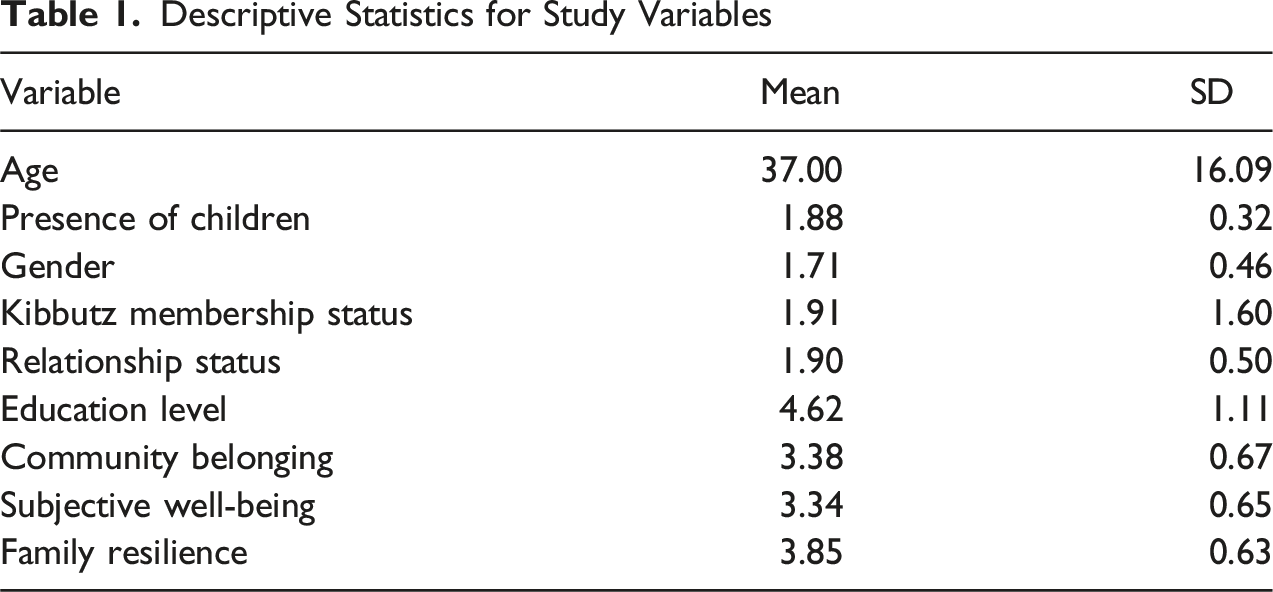
Participants’ kibbutz membership status was diverse, with 789 individuals (71.0%, SD = 0.25) reporting full kibbutz membership, 114 (10.3%, SD = 0.10) as residents in an expansion neighborhood, 83 (7.5%, SD = 0.15) renting homes without membership candidacy, 56 (5.0%, SD = 0.08) as economically self-sufficient members, 42 (3.8%, SD = 0.07) as candidates for kibbutz membership, and 28 (2.5%, SD = 0.06) as kibbutz natives in youth programs. No missing data were reported for kibbutz membership. Missing data such as demographic details were addressed through pairwise deletion during analyses, ensuring that all available data contributed to the statistical models. This approach minimizes bias while retaining a robust sample size. However, the potential for bias due to systematic differences in missing responses remains a consideration.
Results
Statistical analyses were conducted to test the study’s hypotheses. Descriptive statistics summarized demographic characteristics and the distributions of key variables. Regression and mediation analyses were employed to assess the relationships among community belonging, family resilience, and subjective well-being (SWB). Thirty-five kibbutz communities from both the northern and southern districts in Israel were examined. These kibbutzim were the most affected by the events of October 7.
Results by Hypotheses
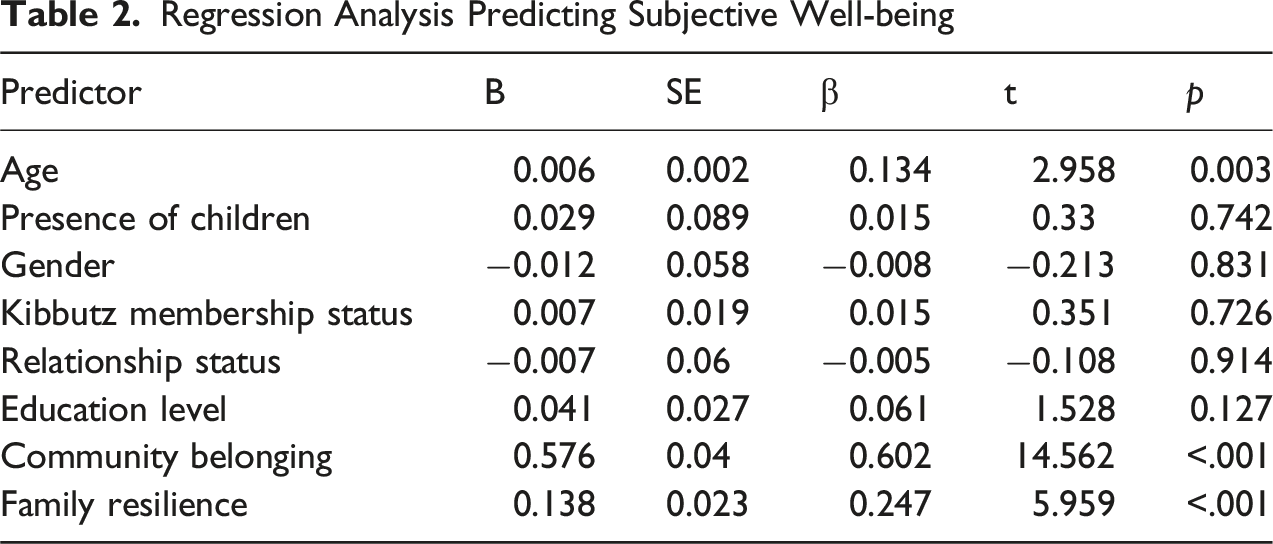
Regression analysis demonstrated that both community belonging and family resilience were significant predictors of subjective well-being among displaced kibbutz residents. Specifically, community belonging showed a strong positive effect (B = 0.576, standardized β = 0.602, p < .001), as did family resilience (B = 0.138, standardized β = 0.247, p < .001). Together, these variables explained 52.6% of the variance in subjective well-being (R2 = 0.526). Additionally, age showed a positive but weaker association with subjective well-being (B = 0.006, standardized β = 0.134, p = .003). These findings affirm the hypothesis that both factors play a critical role in predicting subjective well-being. Results can be seen in Table 2.
Regression Analysis Predicting Subjective Well-being
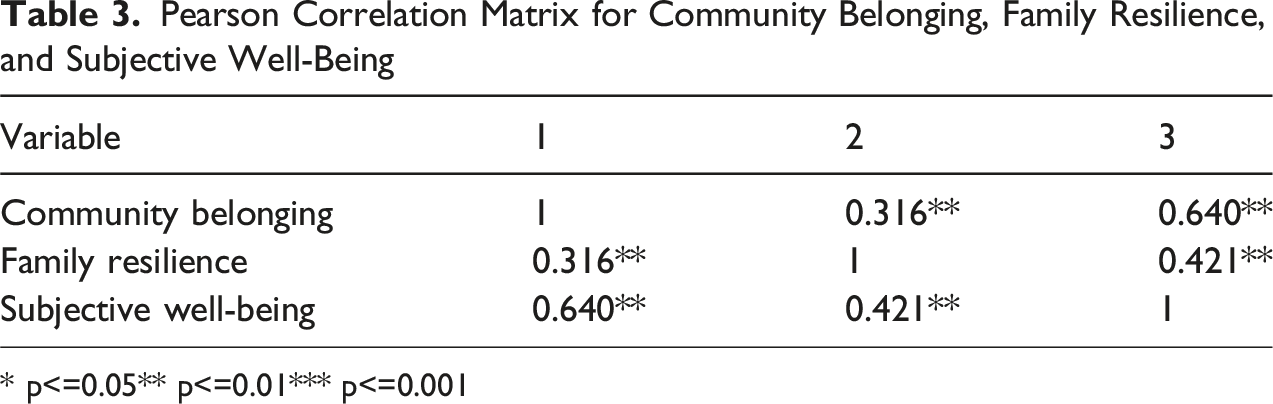
Correlation analysis as seen in Table 3 indicated a significant positive relationship between community belonging and subjective well-being (r = .655, p < .001). Participants with higher levels of community belonging reported greater subjective well-being, supporting this hypothesis. These results align with theoretical frameworks emphasizing the role of social connections in fostering well-being, particularly during times of displacement.
Pearson Correlation Matrix for Community Belonging, Family Resilience, and Subjective Well-Being
* p<=0.05** p<=0.01*** p<=0.001
Correlation analysis as seen in Table 3 also confirmed a significant positive association between family resilience and subjective well-being (r = .419, p < .001). This supports the hypothesis that family resilience contributes directly to subjective well-being by providing emotional and structural stability during crises. These findings underscore the critical role of strong familial support systems in maintaining psychological stability.
Mediation analysis, conducted using PROCESS macro as seen on Figure 2, revealed that family resilience partially mediated the relationship between community belonging and subjective well-being. Y was inputted as the dependent variable (subjective well-being), X as the independent variable (community belonging), and M as the mediator (family resilience). The indirect effect of community belonging on subjective well-being through family resilience was significant (Effect = 0.0801, BootSE = 0.0186, BootLLCI = 0.0461, BootULCI = 0.1188). Family resilience accounted for 8.4% of the relationship between community belonging and subjective well-being. The direct effect of community belonging on subjective well-being remained substantial (Effect = 0.5722, SE = 0.0395, t = 14.4688, p < .001), indicating that while mediation exists, a strong direct relationship persists. The model explained 52.3% of the variance in subjective well-being (χ2 = 0.5228). Among the covariates, age showed a small but significant effect (β = 0.115, p = .0089), while other factors, such as gender and presence of children, did not significantly influence the mediation pathway.
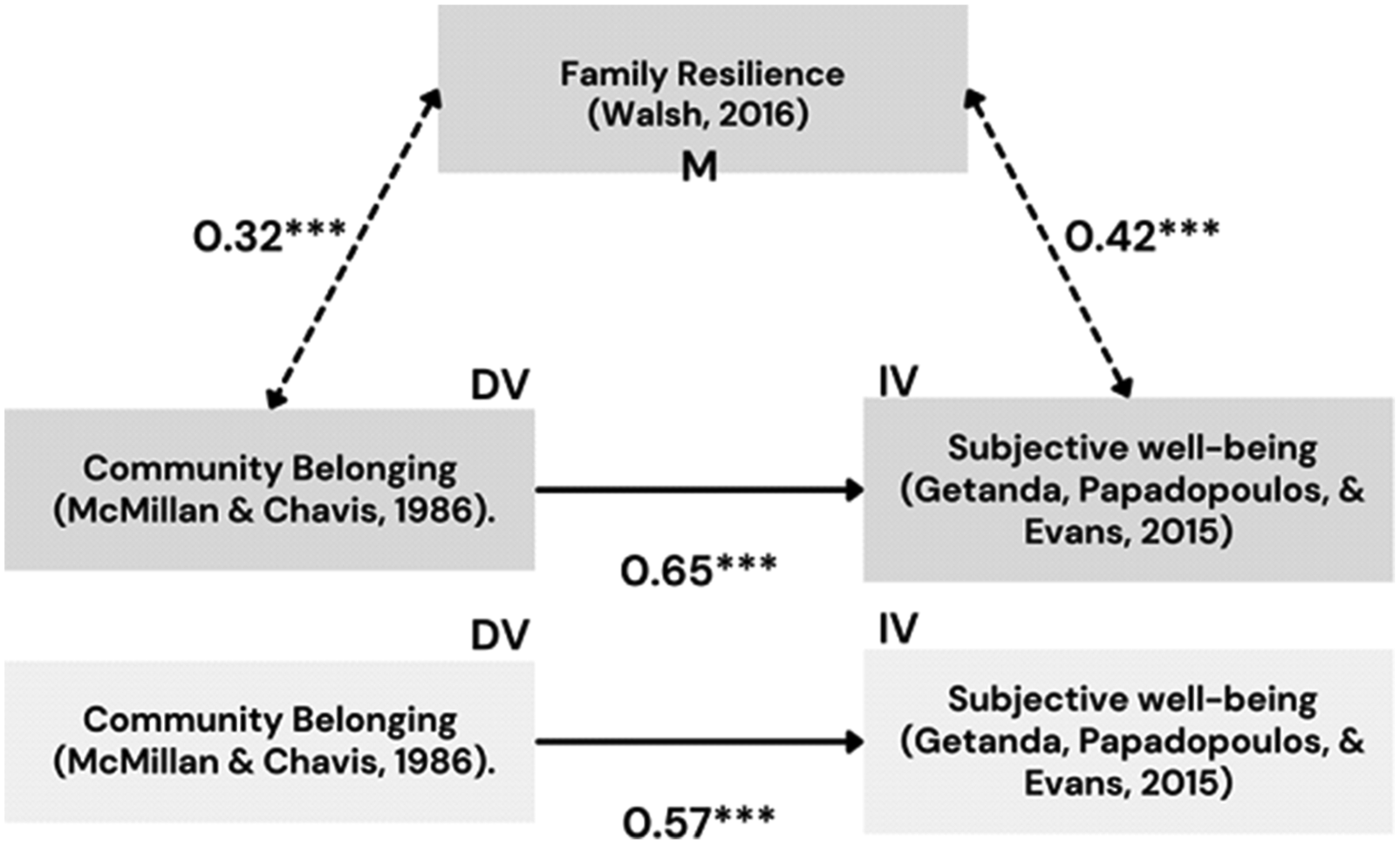
Mediation analysis of study variables
The analysis did not find significant support for an interaction effect between family resilience and community belonging in predicting subjective well-being (p > .05). This suggests that the relationship between community belonging, and subjective well-being operates independently of family resilience levels. While both factors are important, their combined influence may not amplify subjective well-being as hypothesized. Further research could explore whether other moderating variables, such as individual coping strategies or external social support, influence this relationship.
Discussion
The findings of the current study highlight the crucial roles of community belonging and family resilience in subjective well-being (SWB) among forcibly displaced kibbutz residents. Forced displacement, particularly during crises, significantly impacts individuals’ sense of stability and control over their lives. It involves the loss of a familiar environment, drastic changes to daily routines, and prolonged uncertainty. These results align with Getanda et al. (2015), who described the decline in SWB as a result of detachment, insecurity, and helplessness stemming from unfamiliar surroundings. The imposed reality in the new environment affects personal security levels, linked to concerns about access to basic services and resources, such as food, health, welfare, and community support (Tassang et al., 2023).
Research Hypotheses
Community belonging and family resilience will significantly predict subjective well-being. The findings support this hypothesis, showing that community belonging and family resilience are significant predictors of SWB. This finding underscores the importance of social and familial resources in coping with crises, particularly in populations residing in closed and organized communities such as kibbutzim. The implication that community belonging and family resilience together explain a significant portion of the variance in SWB among displaced kibbutz residents aligns with the theoretical perspectives of researchers (DeYoung et al., 2019; Flora & Flora, 2018; LaJoie et al., 2010) regarding the unique structure of rural communities. According to this perspective, rural communities function as social systems characterized by strong social capital and intergenerational ties, based on physical proximity and shared values. Our findings extend this understanding to crisis situations, demonstrating that the relative strength of community belonging reflects the unique social structure of the kibbutz. As noted by Barnett et al. (2016), rural families function as social systems providing essential services. However, in kibbutzim, as our findings reveal, the community plays an even more dominant role. This is particularly evident during crises, where organized evacuation and the preservation of community frameworks allow continuity of social support systems despite changes in physical space. These findings reinforce the combined contribution of family and community to social resilience (Maslovskaia et al., 2021; Walsh, 2016), illustrating how this integration manifests during forced displacement. These findings also align with the role of hope in SWB, as demonstrated by Shenaar-Golan (2016), adding that personal and familial SWB are influenced by attachment to a permanent place, home, and family, reflecting differences between displaced individuals and those who remained in their homes.
Community belonging will positively influence subjective well-being. The findings strongly support the hypothesis that community belonging is positively associated with subjective well-being. The significant correlation between community belonging and SWB underscores the central role of social connections in fostering well-being, particularly in contexts of displacement. This result aligns with previous research emphasizing that a sense of belonging contributes to emotional security, identity preservation, and overall life satisfaction, even during adverse circumstances (Diener et al., 1985; Hombrados-Mendieta et al., 2019; McMillan & Chavis, 1986). In the unique context of this study, the organized evacuation process and maintenance of community cohesion likely mitigated feelings of alienation, enabling individuals to preserve critical aspects of their psychosocial stability. These findings underscore the importance of strategies that sustain community ties during crises, affirming theoretical frameworks that position social cohesion as a fundamental determinant of well-being in high-stress scenarios (Flora & Flora, 2018; LaJoie et al., 2010).
Family resilience will positively influence subjective well-being. The findings of this study reveal that family resilience is significantly and positively associated with SWB, supporting the hypothesis that strong familial systems contribute to psychological stability during displacement. Walsh (2006) frames family resilience as a dynamic process rooted in belief systems, communication, and adaptability, which are vital in fostering well-being amid crisis. This is particularly evident in cooperative or rural contexts, where multigenerational family units serve as both practical and emotional support networks (Flora & Flora, 2018).
Family resilience will mediate the relationship between community belonging and subjective well-being. The mediation analysis revealed that family resilience partially mediates the relationship between community belonging and SWB. These findings resonate with Ungar’s (2010) ecological model of resilience, which highlights how family systems mediate between external community resources and individual well-being, particularly in high-stress environments. The interconnectedness of family and community systems in rural or semi-communal settings, such as kibbutzim, exemplifies this principle. As Hayslip et al. (2018) emphasized, extended multigenerational families are pivotal in integrating horizontal (peer-level) and vertical (cross-generational) relationships which contribute to the dual protective effects of community belonging and family resilience. Furthermore, the structured evacuation of kibbutz residents maintained familial and community ties, mitigating psychological harm. These findings suggest that strengthening both community and family-level interventions can enhance well-being during crises. The importance of multigenerational family structures, as discussed by Maslovskaia et al. (2021), lies in their capacity to foster resilience through shared resources and collective emotional support, particularly during upheaval. This research extends existing frameworks by illustrating the mediating role of family resilience in rural and semi-communal societies during forced displacement.
The interaction between family resilience and community belonging will predict subjective well-being. The findings did not support this hypothesis, as no significant interaction was found between the two variables (p > .05). It appears that community belonging and family resilience operate independently. Nevertheless, each variable contributes significantly to SWB separately, underscoring the need to nurture both resources simultaneously, particularly in prolonged crises. At the community level, these findings align with Paṿin (2007), who highlighted the close-knit connections and accumulated social capital in small communities for coping with economic and social crises. The absence of a significant interaction between family resilience and community belonging challenges the theoretical notion of a synergistic combination between family and community in rural spaces that amplifies social capital (Flora & Flora, 2018; Maslovskaia et al., 2021; Vera-Sanso, 2007). Our findings suggest that in crises such as forced displacement, the relative independence of family and community systems may be advantageous. This insight aligns with Barnett et al. (2016) and Woods (2014), who emphasized the importance of rural family autonomy in daily life, as well as with previous findings (Hartel et al., 2014; Paṿin, 2007) on how rural communities mobilize their social capital during crises requiring adaptation to drastic changes. In this study, the unique structure of the modern kibbutz, combining collective values with family autonomy, allows both systems—family and community—to function as separate yet complementary sources of support, enhancing overall resilience.
Broader Implications
The findings emphasize the vulnerability of individuals without family support during displacement, underscoring the need for targeted interventions to address this gap. They also redefine the concept of the “local community” by highlighting the enduring significance of close-knit relationships in rural settings, where traditional community structures remain vital. Multigenerational family structures play an essential role in enhancing SWB, both as independent units and as integral components of the community.
Conclusions
This study highlights the unique structure of rural communities in Israel, which integrate collective values with family autonomy to create complementary systems that enhance resilience during crises. The findings demonstrate the critical roles of community belonging and family resilience in sustaining subjective well-being (SWB) among displaced residents. The organized evacuation during the October 7, 2023, crisis preserved familial and community frameworks, enabling individuals to maintain psychosocial stability despite significant upheaval. Multigenerational family structures emerged as vital for fostering emotional security and social capital, both independently and as integral components of the community. While community belonging and family resilience functioned as separate predictors of SWB, their combined influence underscores the importance of targeted interventions that strengthen both systems in times of crisis.
Study Limitations
This study has several limitations that should be considered. First, its focus on kibbutzim, while valuable for understanding community belonging and family resilience within these unique rural social systems, excludes other rural communities, such as moshavim, which differ in their organizational structures and cultural practices. This limits the generalizability of the findings to other rural or urban settings with less tightly knit community frameworks.
Second, the study employed a quantitative approach, which, while effective for identifying relationships between variables, does not capture the nuanced lived experiences and coping mechanisms of displaced individuals. Qualitative methods such as in-depth interviews or ethnographic studies could provide richer insights into the personal and collective dynamics at play during forced displacement.
Finally, the study was conducted in the context of a specific crisis—the October 7, 2023, evacuation following violent attacks in Israel. This unique context may limit the applicability of the findings to other crises, such as natural disasters or economic displacements, which may involve different stressors and social dynamics. Future research should address these gaps by exploring a broader range of rural communities and integrating qualitative methodologies to enhance understanding.
Footnotes

Ethical Considerations
This study was approved by the Ethics Committee of Tel-Hai Academic College (approval number #02-02-25).
Consent to Participate
All participants provided written informed consent prior to participating in the study.
Author Contributions
All authors contributed equally to this study.
Funding
The authors received no financial support for the research, authorship, and/or publication of this article.
Declaration of Conflicting Interests
The authors declared no potential conflicts of interest with respect to the research, authorship, and/or publication of this article.
Data Availability Statement
Data from interviews that do not disclose the identity of the interviewee are available from the corresponding author upon reasonable request.