



Abstract
Father involvement is essential for child development and family well-being, with active engagement linked to fewer behavioral issues and better educational and social skills. However, research in the Asian context is less extensive than that in Western countries. This study examines Asian fathers’ perspectives on their involvement and the factors that influence it. A systematic review of seven databases included 39 papers. Participants were Asian fathers with at least one child living in a two-parent family, aged 18 to 60 years. The results showed that fathers’ involvement varied by level, time, and activity, with an average of 24 min to 4.75 h daily. Playing is the most frequently reported activity in which fathers were involved, while individual factors as the most assessed determinant affecting father involvement. Several emerging trends in extra-familial and cultural determinants need to be explored.
Introduction
Interest in fatherhood has been growing in recent years, leading to an expansion in the quantity and diversity of fatherhood research (Schoppe-Sullivan & Fagan, 2020). One noteworthy area of fatherhood research focuses on the father’s role, which refers broadly to the day-to-day behavior of enacting the paternal responsibilities as a father (Day et al., 2005). Society’s view of fathers has shifted from primary providers to emotional and nurturing supporters (Lamb, 2000; Rohner & Veneziano, 2001).
Father involvement plays a crucial role in shaping child developmental outcomes (Diniz et al., 2021; Marsiglio et al., 2000; Rollè et al., 2019; Sarkadi et al., 2008). Marsiglio et al. (2000) reviewed earlier studies from the 1990s about father involvement and found significant associations with child outcomes including improved academic success, lower levels of externalizing or internalizing behavior problems, and higher positive social behavior. Recent reviews confirm fatherly involvement benefits cognitive (Rollè et al., 2019; Sarkadi et al., 2008), socio-emotional, and behavioral development (Diniz et al., 2021; Sarkadi et al., 2008).
Given the significant influence of father involvement, it is important to understand how fathers are involved in parenting their children and what influences their involvement. Existing systematic reviews on father involvement are often limited to Western contexts (Diniz et al., 2021; Sanjaya et al., 2022), lacking examination across diverse socioeconomic and cultural settings, particularly in Asia. Cultural norms in Asia influence fathers’ involvement, which may differ from findings in predominantly white middle-class Western samples prevalent in English-language studies (Flouri, 2005). To broaden our understanding of father involvement in the Asian context, this study aims to provide a systematic review of how Asian fathers are engaged in parenting their children and identify the determinants of father involvement in Asian families.
The Models of Father Involvement
Among many theoretical perspectives that have been used to guide the research on father involvement, Lamb et al. (1985) proposed one of the most widely used models. In this model, father involvement is conceptualized and operationalized as “the time” that fathers spend with children that encompasses three primary dimensions (Lamb et al., 1985; Pleck, 1997), namely, (1) engagement, which refers to fathers’ direct interactions with the child through caretaking and shared activities, such as feeding the child or playing with them, (2) accessibility/availability which refers to the father’s potential interactions by being accessible to the child, such as a father reading on the couch while his child plays nearby, and (3) responsibility, defined as the role of the father which meets the child’s welfare needs in an indirect manner, such as arranging childcare or scheduling medical appointments (Lamb et al., 1985). Lamb et al. (1985) emphasized that it is essential to distinguish the father’s involvement from breadwinning and participating in the housework, which although are undeniably essential parental functions are more generic; instead, they argue involvement should focus on the amount of time spent in activities involving a child.
Palkovitz (Hawkins & Palkovitz, 1999; Palkovitz, 1997) criticized Lamb et al.’s (1985) conceptualization of father involvement as overly emphasizing time spent. Even though Lamb et al.’s model offered conceptual advancement in that era, the definition leaves many ambiguities and does not consider a comprehensive perspective on involvement. Due to changes in policy and social attitudes about parenting roles, certain aspects of roles and behaviors have changed over time (Volling & Palkovitz, 2021). Palkovitz argued that father involvement is a multidimensional construct that should include affective, cognitive, and behavioral components. Furthermore, Palkovitz (Palkovitz, 2002; Christiansen & Palkovitz, 2001) asserts that the father’s role as a provider should be considered as a form of involvement since providing is central to many fathers’ identity; this is a key distinction from the earlier work by Lamb et al. (1985). Palkovitz (1997) offered 15 theoretical components, which in further research, Hawkins et al. (2002) distinguished into nine dimensions of father involvement (i.e., discipline and teaching responsibility, school encouragement, mother support, providing, time and talking together, praise and affection, developing talents, reading and homework support, and attentiveness).
The present study adopts Lamb et al.’s (1985) model and Hawkins et al.’s model (Hawkins & Palkovitz, 1999) as frameworks. Lamb et al.’s model was used to draw a basic concept of father involvement, while broader concept from Hawkins and Palkovitz may encompass changes in father involvement across different periods.
Determinants of Father Involvement
Since father involvement positively impacts children, it is crucial to understand the motives and factors that increase father engagement. By understanding the determinants of father involvement, practitioners, policymakers, and educators can develop strategies to encourage and support father involvement which may lead to enhanced child outcomes. Several conceptual frameworks assert that father involvement is influenced by multiple determinants (Doherty et al., 1998; Lamb et al., 1985; Parke, 2000; Pleck, 1997; Pleck & Masciadrelli, 2004; Volling & Belsky, 1991). According to Lamb and Pleck (Lamb et al., 1985; Pleck, 1997; Pleck & Masciadrelli, 2004), father involvement was determined by motivation, skills and self-confidence, social support, and institutional practices (e.g., workplace policies, childcare providers, and health care providers). Volling and Belsky (1991) proposed that determinants influence father involvement at multiple levels, including characteristics of fathers (e.g., personality and coping style), characteristics of the infant (e.g., temperament), and the aspects of the social context in which fatherhood occurs (e.g., marital relationship and occupational experience).
In addition to individual and familial determinants, Doherty et al. (1998) and Parke (1996, 2000) proposed broader contextual factors. Doherty et al. (1998) expanded the scope, including economic factors, race or ethnicity resources and challenges, and cultural expectations, while Parke (1996, 2000) introduced additional factors as determinants of father involvement, such as extra-familial influences (i.e., informal support systems and institutional or formal influences) and cultural influences (i.e., childhood cultures of boys and girls, attitudes concerning father/mother gender role, and ethnicity-related family values and beliefs). Present study uses Parke’s (1996; 2000) framework because of the model’s ability to systematize the complex and multi-level determinants of fathering.
Father Involvement in Asia
Research indicates that father involvement varies across cultures (Roopnarine, 2015). Cultural backgrounds affect fathers’ views on parenthood and their paternal behavior (Bornstein, 2012; Seward & Stanley-Stevens, 2014). Understanding fathers’ cultural affiliations offers insights into attitudes and behaviors associated with specific roles tied to their social status (Seward & Stanley-Stevens, 2014). Recently, father involvement has gained recognition in Asia, where traditional gender roles designated fathers as primary providers, limiting their time with children due to long work hours (Ho & Lam, 2019; Yeung, 2013). However, social, economic, and cultural shifts in the late 20th century have transformed fathers’ roles in Asian families (Ho & Lam, 2019; Quah, 2008). Asian women transitioned from a one-role approach (household management and child caregiver) to a two-role approach (to both home and work commitments) (Quah, 2008). These changes influence fathers’ caregiving and educational involvement with their children (Ho & Lam, 2019).
Fathers from diverse cultural backgrounds are constantly changing as they are influenced by historical and current events and cultural evolution over generations, centuries, and even millennia, which continue to influence the father’s role (Shwalb et al., 2010, 2012). For example, Confucianism, passed down through generations as a traditional value in Chinese families (Li, 2021; Li & Lamb, 2012; Shwalb et al., 2010), has been embraced for centuries in countries such as Taiwan, Vietnam, Korea, Japan, China, and Singapore (Yeung, 2013). Confucian values also emphasize academic success as a significant achievement (Shwalb et al., 2010). Reflecting this principle, the views believe that the primary responsibility of Chinese fathers is to pay attention to their children’s education and training, but not to focus on leisure and physical activities (Chuang & Fagan, 2021). Meanwhile, in regions such as India, Bangladesh, and Malaysia, fathering is culturally seen as a patriarchy (Seward & Stanley-Stevens, 2014). Fathering in India, Bangladesh, and Malaysia is similar in the areas of the complementary influences of culture, extended families with strong patriarchal systems, and religion. For example, in India, fathers may maintain emotional distance and avoid the emotional expression to uphold their authoritative role (Chaudhary, 2013).
To understand father involvement among various regions or countries, comparative studies within regions need to be conducted (Seward & Stanley-Stevens, 2014). However, studies of father involvement across different countries have presented challenges (Yeh et al., 2021). Although some studies have compared different aspects of father involvement across cultures, they only recruited a limited number of participants and most of them only included two countries to be compared (Yeh et al., 2021). Therefore, there is a need for broader studies within specific regions to provide a more comprehensive understanding of father involvement.
Present Study
Previous systematic reviews have focused on the impact of father involvement on early childhood outcomes (Rollè et al., 2019; Sarkadi et al., 2008) and factors influencing father involvement (Sanjaya et al., 2022). Diniz et al. (2021) systematically reviewed psychosocial determinants and influences of father involvement during early childhood and found most studies focused on determinants related to direct care activities without more description of how fathers are involved in those activities. The most recent review in the field (Diniz et al., 2023) expanded the research on definitions of father involvement and the multidimensional role of father involvement but did not examine determinants. Even though some reviews have focused on father involvement and others have focused on determinants, no review has simultaneously examined both involvement and determinants. Analyzing both aspects provides a holistic understanding of fathers’ involvement and may identify patterns over time or across different contexts that can provide valuable insight.
Furthermore, prior reviews (Diniz et al., 2021, 2023; Sanjaya et al., 2022) have synthesized findings from a wide range of studies, including some different cultural contexts and demographic groups. However, the majority of reviews have predominantly featured studies from Western backgrounds, which limits their relevance to non-Western and non-middle-class family settings, meaning a large percentage of fathers have not been recognized in the research. This highlights a gap in our understanding of how fathers are involved in their families and what the determinants of father involvement in Asian families are. Sanjaya et al. (2022) noted many differences in the concept of family identity in non-Western cultures in terms of patriarchy and communal families that may shape how fathers are involved in their families. In consequence, research in Asian contexts about father involvement and its determinants is needed.
This systematic review aimed to investigate father involvement in an Asian-specific context, focusing on how fathers are involved in parenting their children and identifying the determinants of father involvement in Asian families. Given the distinct experiences of Asian fathers compared to their Western counterparts, this study offers the first to examine both involvement and determinants in an Asian context.
Method
This study used a systematic review methodology following PRISMA guidelines (PRISMA; Page et al., 2021). The protocol was pre-registered at Prospero.
Eligibility Criteria
Studies needed to meet the following inclusion/exclusion criteria: (1) Type of studies. Studies could be qualitative or quantitative studies. Studies published in peer-reviewed journals in either English or Indonesian. (2) Types of participants. Inclusion criteria for participants were that (1) fathers at least 18 years old, (2) fathers who had at least one child aged 0–12 years, and (3) fathers lived in Asia and were part of a two-parent family of Asian origin. The exclusion criteria were studies with fathers of children with a disability or developmental delay, or chronic disease as reported by parent or professional. (3) Types of outcome measures. Studies were only included if direct father report was an outcome measure. The father involvement framework proposes involvement through interaction or participation in activities with the child, being accessible and available to the child, and assuming financial responsibility for the child. Father involvement can also be conceptualized as positive engagement, warmth and responsiveness, control, indirect care, and initiative-taking and monitoring.
Search Strategy
This systematic review used multiple databases, including PsycINFO, Web of Science, PubMed, Scopus, CINAHL database, Sociological Abstract, and Garuda (the major Indonesian research database). The search terms used were a combination between word and MeSH terms (father*OR paternal OR dad*) AND (Asia* OR “Asia”) AND (Involve* OR Engage* OR interact* OR respons* OR avail* OR “Child rearing” [MeSH] OR “paternal behavior” [MeSH]). The combination of these terms was searched for in the title, abstract, and keywords.
Study Selection
Search results from all seven databases were merged in Covidence, and duplicate records were eliminated. Titles and abstracts were filtered to eliminate irrelevant articles according to inclusion and exclusion criteria. The full texts of articles that passed the initial screening were further reviewed for inclusion. The result of the studies was evaluated by two reviewers using the Mixed Methods Appraisal Tool (MMAT) 2018 version (Hong et al., 2018).
Data Extraction and Analysis
Data extraction was completed using the following domains: study design, sample size and sample characteristics, country and context, and primary findings in terms of father involvement and its determinants.
Results
Study Selection
The searches were conducted in August 2022 and updated in August 2024, resulting in 11,456 records in English and 981 in Indonesian. As illustrated in Figure 1, from the initial 12,437 articles, 3407 were removed as duplicates. The remaining 9030 were screened according to the established inclusion criteria by the first author based on title and abstract, resulting in 220 articles for the next stage. The first author and two independent reviewers assessed the full-text articles, and 39 articles met all inclusion criteria. Within a period of August 2022 to August 2024, the COVID pandemic occurred. There were six articles that focused on father involvement during COVID. However, we decided to exclude such articles as they examined a special circumstance that may not reflect general father involvement. Disagreements were resolved by consensus, and conflicted results were resolved by the second and third authors. We found eight related articles through article reference lists. After assessing those eight articles, only four were eligible for inclusion. In total, 39 articles were included. PRISMA flow diagram for search result.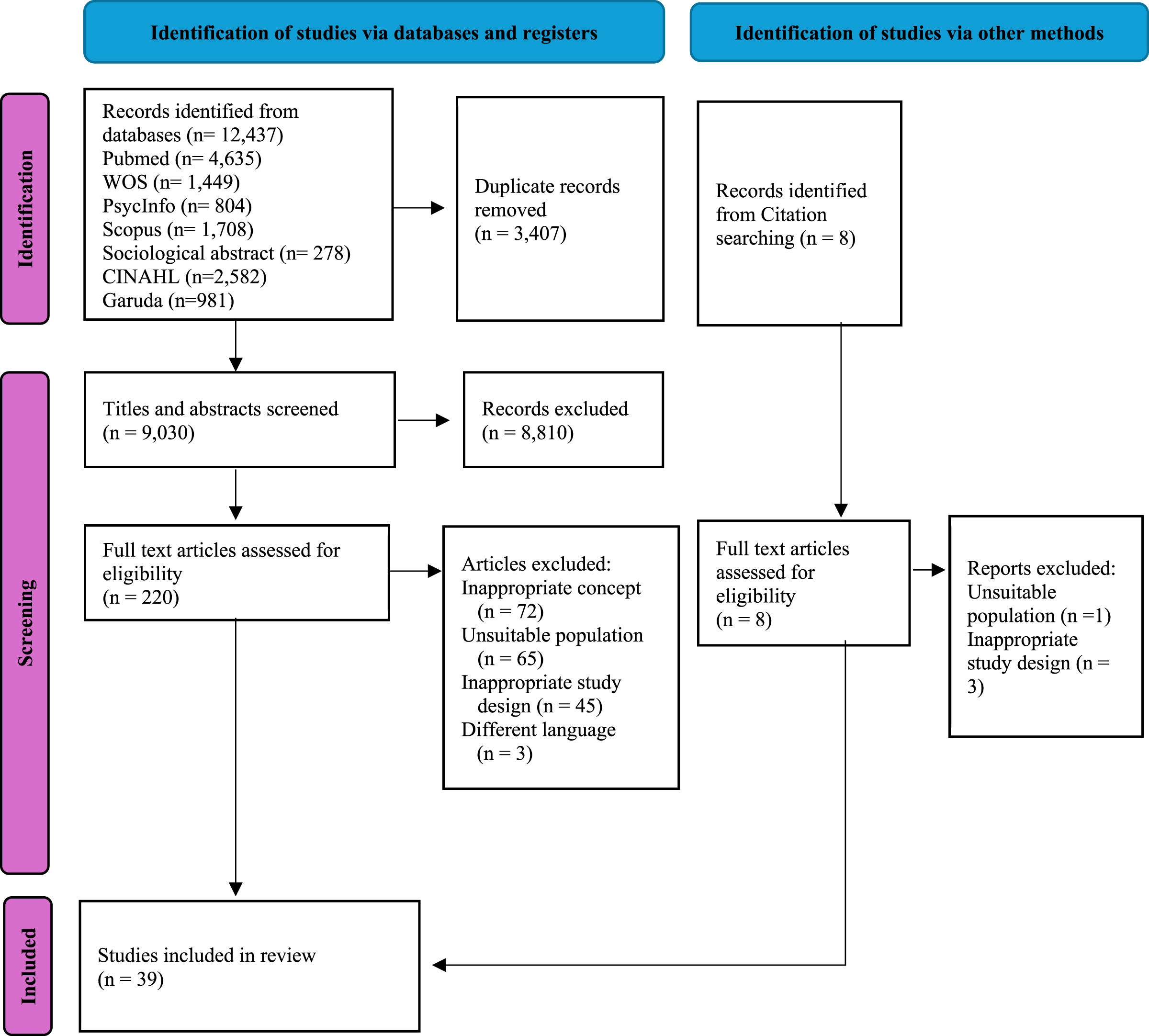
General Description of the Included Studies
Thirty-nine studies examined fathers’ experiences from sixteen Asian countries, of which nine studies were conducted in Indonesia, five studies were from India, four studies were from Korea, three studies were undertaken in Malaysia, Japan, and China, two studies were each from Hong Kong, Taiwan, and Singapore, and one each from Iran, Israel, Pakistan, Tajikistan, Thailand, Turkey, and Qatar. Studies were published between 1989 and 2024. Except for one study involving two countries, Malaysia and India (Roopnarine et al., 1989), all studies examined data from a single country. Indonesia had the most studies included, mainly because this systematic review used an Indonesian database as a part of the search strategy.
Twenty-three studies used quantitative methods, fifteen used qualitative methods, and only one utilized mixed method. Most quantitative studies relied on cross-sectional design self-report surveys, and only one was longitudinal. Most qualitative studies used in-depth interviews and semi-structured interviews, with one study including focus group discussions in addition to interviews. Six studies used data from prior studies, for example, from a national survey (Lari & Al-Emadi, 2022; Park, 2021).
In this review, 18,038 fathers participated in total, with ages ranging from 18 to 60 years. Eighteen studies only involved fathers as their participants, while thirteen studies involved fathers and mothers as couples or as non-married partners. One study involved fathers, mothers, and children as participants (Li, 2021), and one study involved father and children as participants (Goel & Mishra, 2024). However, when a study described father involvement reported by mothers and other family members, we only included the father’s report. Twenty-five studies examined 6-year-old and below children, nine studies had school-age children (6- to 12-year-olds), and five studies had 0- to 12-year-old children.
Regarding socioeconomic status, most fathers possessed a high school education or higher and held full-time employment. Ten studies indicated that many fathers lived in extended families, while the remaining studies did not provide this information. These extended families typically included their parents, parents-in-law, or unmarried siblings. Additionally, two studies revealed that some participants had a domestic helper who lived with them (Kwok et al., 2013; Kwok & Li, 2015). Even though not living with them, two other studies also noted the presence of nannies or babysitter to help with childcare (Lari & Al-Emadi, 2022; Wang & Keizer, 2024).
Characteristics of Studies Included in the Review.

Father Involvement in Asian Families
Several studies measured the level of involvement of fathers. The studies in Hong Kong discovered that fathers’ involvement was high (Kwok et al., 2013; Kwok & Li, 2015), while fathers in Korea (Chung, 2014) and Japan (Ishii-Kuntz, 2013) were moderately involved in parenting. In the study of Indian fathers, 60% of participants were moderately involved, 22.3% of participants had low involvement, and 17.7% were highly involved (Saraff & Srivastava, 2010). However, the findings in Indonesia are inconsistent. Fathers in Indonesia can be highly involved (Dannisworo & Amalia, 2019; Fajriati & Kumalasari, 2021), moderately involved (Nugrahani et al., 2021; Wahyuni, 2020), or minimally involved (Asy’ari & Ariyanto, 2019). Furthermore, studies also compared the level of involvement of fathers to that of mothers. Israeli (Kulik & Ramon, 2021), Indian (Roopnarine et al., 1989), and Malaysian fathers (Hossain et al., 2005, 2007; Roopnarine et al., 1989) were less involved in childcare compared to their spouses.
Some studies assessed father involvement using the time the father spent with children although their assessment strategies were different which limits direct comparisons. It was found that Indonesian fathers spent the most time with their children (4.75 h) (Dannisworo & Amalia, 2019). In comparison, Indian fathers spent 2.8 hours per day (Saraff & Srivastava, 2010), Malaysian fathers spent 0.63 h–2.77 hours per day in childcare, that is, cleaning the child, feeding, and playing (Hossain et al., 2005), and Israeli fathers involved 1.96 hours per day in childcare for doing activities such as social, educational, and recreational activities (Kulik & Ramon, 2021). In a longitudinal study, Korean fathers reported increasing involvement from 24 min in 1999 to 36 min in 2014 (Park, 2021).
Eighteen studies highlighted father involvement in play and leisure activities (Bussa et al., 2018; Chen, 2013; Chung, 2014; Gupta & Srivastava, 2021; Ho et al., 2011; Hossain et al., 2005, 2007; Ishii-Kuntz, 2013; Ishii-Kuntz et al., 2004; Jeong et al., 2018; Kasymova & Billings, 2018; Lari & Al-Emadi, 2022; Lee et al., 2004; Li, 2021; Park, 2021; Rima et al., 2016; Roopnarine et al., 1989; Saraff & Srivastava, 2010). Three studies found that fathers were more involved in playing activities than other childcare activities, such as bathing and feeding (Chung, 2014; Hossain et al., 2005, 2007). Play activities between fathers and infants included peek-a-boo, hide-and-seek, and object-mediated play (Roopnarine et al., 1989), while fathers of preschoolers were involved in playing interaction activities or playing with their children physically (Lee et al., 2004). Fathers of school-aged children were involved in outdoor activities or outdoor games and sports, such as playing marbles, cricket, and physical play or exploration (Chen, 2013; Ho et al., 2011; Kasymova & Billings, 2018; Lee et al., 2004; Li, 2021). Fathers were also involved in indoor activities such as watching movies and cartoons, drawing, and dancing (Kasymova & Billings, 2018).
Eleven studies described father involvement in direct care behaviors like feeding, bathing, changing diapers, and putting children to sleep, with varying levels across studies and countries. Japanese fathers spent the most time having dinner and bathing their children compared to other activities (Ishii-Kuntz et al., 2004). Indian and Malaysian fathers were less involved in childcare tasks such as feeding, changing diapers, putting the baby to bed, bathing, or dressing the child than mothers (Roopnarine et al., 1989; Saraff & Srivastava, 2010). In Indonesia and Tajikistan, fathers were involved in general caregiving such as taking a bath, feeding, childcare, changing diapers, and cooking when their spouses were at work or busy with household duties (Bussa et al., 2018; Kasymova & Billings, 2018). The pattern of involvement in direct care behavior was also observed among new fathers. New fathers in Thailand supported their wives by bathing and changing their newborns’ diapers (Sansiriphun et al., 2015), similar to Singaporean fathers involved in infant care (Shorey et al., 2018). Conversely, new fathers in Iran viewed child-rearing as a feminine task and began participating in activities like changing clothes when the child was older (Eskandari et al., 2017).
Eleven studies showed that fathers were also involved in teaching and disciplining their children (e.g., Bussa et al., 2018; Goel & Mishra, 2024; Ho et al., 2011). Teaching could be transferring knowledge from father to their children, such as religious teaching (Jeong et al., 2018; Sari et al., 2023), values and way of living (Goel & Mishra, 2024), moral and behavioral principles (Ho et al., 2011; Kasymova & Billings, 2018; Li, 2021), and discipline (Ho et al., 2011; Kasymova & Billings, 2018; Kwok et al., 2013; Lee et al., 2004; Li, 2021; Roopnarine et al., 1989; Saraff & Srivastava, 2010). Even though fathers in many countries reported their disciplinarian responsibilities, Hong Kong fathers reported teaching and discipline as the lowest involvement activities compared to other activities, such as showing affection and praise (Kwok et al., 2013). Fathers of school-aged children were more involved in guidance on discipline activity than fathers of preschool-aged children (Lee et al., 2004). Four studies discussed father involvement as a role model (Gupta & Srivastava, 2021; Ho et al., 2011; Kasymova & Billings, 2018; Wang & Keizer, 2024).
Eight studies showed that fathers were involved in academic or educational settings (Bussa et al., 2018; Chung, 2014; Ho et al., 2011; Kasymova & Billings, 2018; Li, 2021; Park, 2021; Rima et al., 2016; Saraff & Srivastava, 2010). Guiding, supervising, and helping children to do their homework seems to be a common activity that fathers do in Asia (Ho et al., 2011; Kasymova & Billings, 2018; Li, 2021; Park, 2021; Rima et al., 2016; Saraff & Srivastava, 2010). Besides helping with homework, Taiwanese fathers were involved in various educational activities, such as participating in school-related activities (e.g., joining Parent–Teacher Association) and maintaining communication with teachers (Ho et al., 2011). Indonesian fathers also got involved by providing school needs such as uniforms, books, and stationery (Bussa et al., 2018). In Korea, fathers allocated their time to reading a book to their children (Chung, 2014). Fathers in Indonesia, Tajikistan, and India usually take their children to school and pick them up (Bussa et al., 2018; Kasymova & Billings, 2018; Saraff & Srivastava, 2010). However, according to Ishii-Kuntz et al. (2004), Japanese fathers spent the least amount of time taking or dropping off their children at daycares or kindergarten compared to other child-rearing activities.
Father involvement was also assessed based on how they get involved in emotional support and social activities. Fathers in some countries were likely to provide positive communication and support to the children or the mother. Two studies examined positive communication and socialization as involvement activities fathers most frequently engage in (Chen, 2013; Asy’ari & Ariyanto, 2019). Positive communication was measured by the frequency of positive parent–child communication activities, such as talking about their or their child’s emotions. At the same time, socialization was analyzed based on actions such as taking children to special social events and spending time with them during bedtime (Chen, 2013). Hong Kong fathers show affection and praise to their children (Kwok et al., 2013), while Chinese fathers use non-verbal expressions, such as instrumental support or physical intimacy (Li, 2021). Indonesian fathers also interpreted caregiving as giving affection to children daily (Bussa et al., 2018). Fathers did not just provide emotional support to the child but also to the mother. Pakistani fathers supported their partners by providing encouragement, being sensitive and responsive to their partner’s psychosocial health and emotional needs, discussing matters, and problem-solving together (Jeong et al., 2018).
The father’s role as the breadwinner was frequently expressed explicitly and implicitly in studies. Terms such as economic provision, financial provider, providing money, and providing instrumental support were commonly used while fathers are also reported becoming involved in their child’s life (Bussa et al., 2018; Goel & Mishra, 2024; Gupta & Srivastava, 2021; Ho et al., 2011; Jeong et al., 2018; Kasymova & Billings, 2018; Kwok et al., 2013; Li, 2021; Saraff & Srivastava, 2010). Hong Kong fathers were reported to have the highest involvement in the family’s basic needs and financial support relative to other forms of involvement (Kwok et al., 2013). Although some studies did not measure the role of fathers as breadwinners, by looking at the fathers’ workplace and wage status as variables, some studies implicitly see fathers as breadwinners (Ishii-Kuntz, 2013; Ishii-Kuntz et al., 2004; Suppal & Roopnarine, 1999).
Determinants of Father Involvement
Individual Determinants
Individual determinants include individual characteristics of fathers that influence their involvement in parenting or childcare, such as social background, psychological aspects, and experience. The role of age on father involvement was examined in Japan (Ishii-Kuntz, 2013), Hong Kong (Kwok et al., 2013), India (Saraff & Srivastava, 2010), and Indonesia (Muslihatun & Santi, 2022). Overall, older fathers were more involved in parenting than younger ones. In Japan, older fathers spent most of time with their children compared to younger fathers (Ishii-Kuntz, 2013). Older fathers in Hong Kong and India were also more involved in child-rearing than younger fathers (Kwok et al., 2013). Those findings are consistent with the study by Muslihatun and Santi (2022), who found that younger fathers tend to be less involved in childcare activities.
Education impacts father involvement in Pakistan (Jeong et al., 2018), Taiwan (Ho et al., 2011), Indonesia (Bussa et al., 2018), India (Saraff & Srivastava, 2010), Tajikistan (Kasymova & Billings, 2018), and Qatar (Lari & Al-Emadi, 2022). Studies indicate that educated fathers are more engaged in parenting (Bussa et al., 2018; Jeong et al., 2018; Saraff & Srivastava, 2010) and advocate for childcare involvement beyond physical interaction (Bussa et al., 2018). However, fathers still in education show lower involvement due to study commitments (Kasymova & Billings, 2018). Contrarily, Lari and Al-Emadi (2022) reported that education level does not affect paternal involvement.
Father’s identification, beliefs about the fathering role, and fathering self-efficacy were identified as crucial factors in father involvement. Fathers who perceived their identity as fathers as important were more involved with their children (Goel & Mishra, 2024; Ishii-Kuntz, 2013; Ko et al., 2022; Kuscul & Adamsons, 2022). Fathers who believed in the importance of their role in children’s development and exhibited confidence in parenting tasks were more involved in childcare (Ishii-Kuntz, 2013; Kwok et al., 2013; Kwok & Li, 2015; Kwok & Li, 2015; Liu et al., 2002; Muslihatun & Santi, 2022; Shorey et al., 2018; Shorey et al., 2019; Wahyuni, 2020). Conversely, lack of knowledge and confidence in childcare hindered fathers’ involvement (Hososaka et al., 2024; Saraff & Srivastava, 2010).
Father’s ideology about gender and gender roles was also investigated widely in Asian studies (Chung, 2014; Dannisworo & Amalia, 2019; Eskandari et al., 2017; Ishii-Kuntz, 2013; Ishii-Kuntz et al., 2004; Saraff & Srivastava, 2010). Overall, fathers with less traditional gender role ideology were more involved in parenting. In South Korean and Chinese multicultural families, culturally considerate and less traditional men in terms of family ideology were more likely to perform childcare (Chung, 2014). Fathering role and gender ideology were significant predictors of paternal involvement among Japanese fathers who tended to be egalitarian (Ishii-Kuntz, 2013; Ishii-Kuntz et al., 2004). Fathers with traditional gender role attitudes in households where the mother is the main provider experienced lower satisfaction with the parent–child relationship and a lower sense of closeness to their children (Kulik & Ramon, 2021). Fathers with less traditional attitudes exhibited a higher level of involvement in childcare than fathers with a more traditional attitude toward gender roles (Saraff & Srivastava, 2021). However, Iranian first-time fathers believed that child-rearing was a feminine task, and the involvement of the father makes the woman lazy and impairs the child-rearing process (Eskandari et al., 2017).
Although some inconsistencies were found, common determinants included the father’s psychological well-being (Dannisworo & Amalia, 2019), stress (Kwok & Li, 2015), and depression (Shorey et al., 2018). Better psychological well-being correlated with more childcare involvement (Dannisworo & Amalia, 2019). Paternal depression significantly reduced involvement in Singaporean first-time fathers (Shorey et al., 2018). However, Kwok and Li (2015) found that fathering stress was not significantly associated with father involvement.
Fathers’ willingness to be involved in parenting was a commonly examined factor. Willingness is a main factor that makes father more likely to be involved in early childhood care (Bussa et al., 2018; Muslihatun & Santi, 2022). A desire to be a role model motivates fathers to participate more in their child’s life, providing a positive and ideal paternal figure (Gupta & Srivastava, 2021; Ho et al., 2011; Kasymova & Billings, 2018) and serving as a gender role model (Kasymova & Billings, 2018; Wang & Keizer, 2024). Fathers driven by responsibility, awareness of children’s needs, and affection are more engaged in parenting (Bussa et al., 2018; Goel & Mishra, 2024; Rima et al., 2016; Sari et al., 2023). Interaction with their children, such as carrying them and putting them to sleep, motivated their involvement (Shorey et al., 2018). Religious beliefs also play a role, as some fathers view children as gifts from God and feel accountable for their upbringing in the afterlife (Goel & Mishra, 2024; Sari et al., 2023).
Experience of fathering also influenced father involvement, such as the parenting style the father himself received as a child (Ho et al., 2011; Sari et al., 2023), fathering received by the individual fathers (Saraff & Srivastava, 2010; Shorey et al., 2018; Wang & Keizer, 2024), and prior experience with child-rearing among fathers who had more than one child (Shorey et al., 2018). Men who experienced low involvement from their fathers often replicated this behavior, spending less time with their children (Saraff & Srivastava, 2010). Conversely, some fathers sought to compensate for their lack of paternal involvement by being more engaged with their own children (Goel & Mishra, 2024; Sari et al., 2023; Wang & Keizer, 2024).
Familial Determinants
The review uncovered multiple familial level determinants that play pivotal roles in shaping father involvement, including other family members’ characteristics in a nuclear family, such as children and the mother, and family relationships, such as dyadic father–child relationships and triadic father–mother–child relationships. Children’s characteristics, such as age, gender, and number, were underscored in several studies. Fathers were more likely to participate in childcare when their children were still young (Asy’ari & Ariyanto, 2019; Ishii-Kuntz, 2013). This was clear among Japanese fathers who get involved only when the children are still young (Ishii-Kuntz, 2013; Ishii-Kuntz et al., 2004). Indonesian fathers with 2- to 4-year-old children were more involved than fathers with children aged 5–12 years (Asy’ari & Ariyanto, 2019).
On the other hand, the age of the children may inhibit the father’s involvement in parenting tasks. Pakistani fathers became more engaged as the children grew older because they believed that younger children should be with their mothers and be closest to their mothers (Jeong et al., 2018). Similarly, Indian fathers were more involved with older children (Saraff & Srivastava, 2010). The child’s gender also influenced paternal involvement, though findings were mixed. Indian fathers preferred engaging with daughters over sons (Saraff & Srivastava, 2010), while Tajik fathers were more involved with sons (Kasymova & Billings, 2018). Another Indian study found no significant association between child gender or family structure and paternal involvement (Suppal & Roopnarine, 1999). The number of children also impacted involvement; fathers with more children were generally less involved (Kulik & Ramon, 2021); however, in Japan, fathers with more children were more involved (Ishii-Kuntz et al., 2004).
Several studies delved into wife characteristics and their relationships with their husband. South Korean husbands with Chinese wives were more likely to get involved in childcare when their wives were less adapted to Korean culture (Chung, 2014). In Japan, husbands whose wives were employed were more involved in childcare (Ishii-Kuntz et al., 2004). The studies in India found that maternal employment status and the difference in income between husband and wife were unrelated to paternal involvement (Saraff & Srivastava, 2010; Suppal & Roopnarine, 1999). Similarly, a study in Israel revealed no correlation between the wives’ income and their husbands’ involvement in childcare (Kulik & Ramon, 2021). While in Turkey, even though maternal education and employment were not significantly associated with father’s caregiving and nurturing behavior, some father’s gender role belief (i.e., equality of sons and daughters and division of labor at home) mediated the associations (Kuscul & Adamsons, 2022).
Feedback and support from their wife and the perception of the father about their wives’ role in parenting were important for the father’s involvement. The father’s involvement in child-rearing was influenced by encouraging feedback from the child and wife regarding the father’s involvement (Eskandari et al., 2017). Fathers who perceived their wives as a more competent party in parenting treated their wives as a primary guide in their effort to be involved in parenting (Goel & Mishra, 2024), while those who viewed their wives as the main caregivers remained in a subordinate role (Hososaka et al., 2024). Wives who expected their husbands to be more engaged in parenting encouraged them to increase their involvement (Ho et al., 2011; Saraff & Srivastava, 2010; Sari et al., 2023), known as maternal gate opening (Liu et al., 2002). Conversely, breastfeeding mothers often kept fathers from newborn care, assuming fathers’ lack of expertise (Shorey et al., 2018). Spousal capital, like parenting alliance, spousal support, and marital satisfaction, was positively associated with father involvement. The indirect effects of spousal capital on father involvement were significant via fathering self-efficacy and fathers’ belief about the paternal role (Kwok & Li, 2015). Co-parenting techniques and consistency were also significant factors (Chen, 2013). Marital satisfaction was a significant positive predictor of father involvement (Kwok et al., 2013; Wahyuni, 2020), with higher satisfaction correlating with greater participation in child-rearing. Marital satisfaction both moderated the effect of fathering efficacy and reduced the negative impact of low fathering efficacy on father involvement (Kwok et al., 2013).
Extra-Familial Determinants
Extra-familial determinants contain aspects related to informal support systems (extended family, relationship with relatives, social network, community) and institutional or formal influences (work–family relationship, hospital, and health care delivery systems). Extended families, relatives, and peer groups also influenced father involvement (Goel & Mishra, 2024; Hososaka et al., 2024; Muslihatun & Santi, 2022; Saraff & Srivastava, 2010). The residential context of the family plays a crucial role in determining father involvement. For instance, fathers residing in extended families or living with parents or in-laws were found to be less likely to participate in their child’s care (Muslihatun & Santi, 2022; Saraff & Srivastava, 2010). Nannies and babysitters were also associated with lower father involvement in childcare (Lari & Al-Emadi, 2022). In contrast, Chinese fathers reported that with the support and guidance of grandmothers and newborn-nannies, almost all respondents were participating in routine caregiving activities that have traditionally been considered the domain of women (Wang & Keizer, 2024). Neighborhoods encourage paternal involvement when fathers observe peer participation in parenting (Rima et al., 2016). Fathers with peers who have positive attitudes toward paternal involvement tend to emulate this behavior (Saraff & Srivastava, 2010).Moreover, Japanese fathers reported their involvement was inhibited by society when other men were absent in parenting in communities dominated by women (Hososaka et al., 2024).
In a broader context, some studies showed that work hindered father involvement because of the amount of time spent working (Eskandari et al., 2017; Ho et al., 2011; Ishii-Kuntz et al., 2004; Jeong et al., 2018; Ko et al., 2022; Shorey et al., 2018). Work overtime (Kasymova & Billings, 2018; Saraff & Srivastava, 2010), work away from home (Jeong et al., 2018), and policies such as no opportunities to take parental leave (Hososaka et al., 2024) also inhibited father involvement. Related to the workplace, father-friendly environments and workplace accommodation of parental needs increased the father’s involvement in childcare. Such conditions can reduce job stress which is associated with paternal involvement (Ishii-Kuntz, 2013; Ko et al., 2022). However, other studies have found that work did not influence father involvement (Dannisworo & Amalia, 2019).
Cultural Determinants
Culture determinants contain childhood culture of boys and girls, attitudes concerning fathers/mothers gender roles, and ethnicity related family values and beliefs. Only one study explicitly assessed culture as a determinant of father involvement and found that culturally, societal gender norms and gender inequalities shape parenting roles (Jeong et al., 2018). When wives are restricted from leaving the house and pursuing education, fathers should be responsible for their children’s education and fulfill the needs of children who require mobility (Jeong et al., 2018). Two studies expanded their research to include media influences but found different things (Ho et al., 2011; Saraff & Srivastava, 2010). Ho et al. (2011) revealed that explicit messages from popular media about socially acceptable roles for fathers influenced higher father involvement. On the other hand, Saraff and Srivastava (2010) found that exposure on the television and mass media was not a significant predictor of father involvement in India.
Discussion
This review provides a synthesis of research focusing on the nature and determinants of father involvement in Asian contexts. Thirty-nine studies were included in the synthesis from 16 Asian countries. Given that there are 48 countries in Asia, this is still a limited portrayal of Asian fathers. However, from the existing data, the nuance of Asian culture can be depicted, such as fathers living in extended families and the presence of domestic helpers. Regarding study design, cross-sectional studies were most common, with only one longitudinal study (Shorey et al., 2019). This result was the opposite of the previous review (Diniz et al., 2021), which found more longitudinal studies (51.2%). Diniz et al.’s study focused on Western studies where more robust longitudinal studies might be more common. Father involvement research is in its infancy in Asia, and fewer longitudinal approaches to research are available in these contexts.
Father involvement was portrayed by level, time, and activity. The overall interpretation of this review suggests that the level of father involvement is inconsistent across Asian countries. Asian fathers spend anywhere between 24 min and 4.75 hours per day with their children. Playing is the most frequently reported activity in which fathers were involved, followed by direct care activities, teaching and discipline, academic or education, emotional support, and instrumental providence. Furthermore, the determinants of father involvement were examined based on individual, familial, extra-familial, context, and cultural determinants (Parke, 1996, 2000), the review findings indicated that individual and familial determinants were the most assessed in Asian countries, and extra-familial factors emerged as potential determinants. However, there were only limited studies that assessed context and cultural determinants.
Father Involvement Across Asia
Overall, not all studies provided statistical data; therefore, the level of father involvement could not be compared across countries directly. Nine studies indicated variability in father involvement both between and within countries. For instance, fathers in Hong Kong were highly involved in childcare (Kwok & Li, 2015), while those in Korea (Chung, 2014), Japan (Ishii-Kuntz, 2013), and India (Saraff & Srivastava, 2010) showed moderate involvement. Rather than strictly comparing between countries, this level should be understood in the context of how involvement is defined and measured in one study compared to other studies. Furthermore, even among studies within the same country, there were variations of involvement shown by fathers, for example, in Indonesian studies as observed by Asy’ari and Ariyanto (2019), Dannisworo and Amalia (2019), Fajriati and Kumalasari (2021), Nugrahani et al. (2021), and Wahyuni (2020). The variability between and within countries may result from different methodologies and the variability of participants. Statistical calculations cannot be compared between and within countries due to differences in measurement instruments. For example, Kwok and Li (2015) used the Inventory of Father Involvement (IFI-26) to assess Hong Kong fathers in activities like discipline and school encouragement, while Chung (2014) used three items to measure Korean fathers’ involvement in care, education, and play. Variability in participant demographics and study contexts also affect results, such as the focus on cross-cultural marriages in South Korea (Chung, 2014) versus workplace context in Japan (Ishii-Kuntz, 2013). This variability limits the generalization of findings across populations.
The daily time Asian fathers spent with their children varied from around 24 min to 4.75 h daily. Dotti Sani and Treas (2016) found that fathers in eleven Western countries spent 59 min daily on childcare in 2012. The results from this review show that fathers’ time spent with their children is comparable to that in Western countries. Even though father–child time in some countries might be higher, the studies should be treated carefully. How the time was measured should be considered. Indonesian fathers, for example, were assessed by only estimating the time they spent with their children (Dannisworo & Amalia, 2019). At the same time, Western studies used time diaries (Dotti Sani & Treas, 2016), which may be more reliable. Time diaries are less susceptible to the influences of gender and social desirability and, therefore, appear to be a suitable method for measuring father involvement (Wical & Doherty, 2005).
In addition, the time discrepancy may provide information on changing patterns. For example, fathers spent 2.77 h in time playing with infants per day in 2005 and spent 4.75 h daily in 2019 (Dannisworo & Amalia, 2019; Hossain et al., 2005). Even though the time seems to be increasing, we cannot simply say that the time that Asian fathers spend with their child is increasing, mainly because the results come from different countries, Indonesia (Dannisworo & Amalia, 2019) and Malaysia (Hossain et al., 2005). Studies from eleven Western countries estimated that the average time the fathers spent on childcare in 1965 was about 16 min, and it increased to 59 min in 2012, and longitudinal data (Dotti Sani & Treas, 2016) showing that father involvement has increased over time. In the current review, a similar trend was shown by the Korean study (Park, 2021), that examined father involvement across multiple time points. To clarify trends in paternal time with children, longitudinal studies are needed.
Most fathers were more involved in indoor and outdoor play than childcare activities such as cleaning or feeding the child. This appeared consistent across children’s developmental ages. They identified more as playmates than caregivers, aligning with Diniz et al. (2023) and many previous Western studies (e.g., Lewis & Lamb, 2003; McBride & Mills, 1993). Play, defined as parent–child engagement in child-centered activities for pleasure (McBride & Mills, 1993), reflects the engagement concept by Lamb et al. (1985). This level of involvement in play contrasts with traditional Chinese values as Chuang and Fagan (2021) stated previously, in which fathers prioritize academic success and view the fathers’ primary role as guiding their children in education and training rather than engaging in leisure or physical activities. This contrast indicates that Asian father involvement is influenced by more than just Confucian values the Chinese heritage, showing a diverse and dynamic cultural landscape in Asia.
The other direct interaction in line with Lamb et al.’s (1985) father involvement model is direct care behavior, such as eating dinner together, bathing, feeding, and other related care–care activities. Furthermore, fathers in many countries were also involved in academic and teaching activities such as helping to do homework, reading books, and taking their children to and from school. These behaviors also align with Hawkins et al.’s (2002) model, where activities such as school encouragement, reading, and homework support are included. In this review, teaching activities were related to both academics and teaching the child about religion, morals, and behavior. Religion and gender role modelling is a theme that arose not only in the activities but also in the determinants of father involvement.
Another issue that also came up in many studies was the breadwinner role. Despite the debate about whether economic provision should be counted as involvement, fathers reported their breadwinner roles as one responsibility to their families. The result shows consistency with the traditional father’s role as breadwinner, which has been widely known for decades (Lamb, 2000; Puhlman & Pasley, 2016). Moreover, this finding shows the multidimensionality of the father’s role that could not be captured by Diniz et al.’s (2021) review since they excluded studies that only looked at the father’s involvement as a financial provider to the child. Furthermore, the factors captured in this review are due to the design of several source studies that used the Inventory of Father Involvement (IFI) scale (Hawkins et al., 2002). This scale was developed based on Palkovitz’s paradigm, which indicates that the father’s role as a provider should be considered as a form of involvement since providing is central to many fathers’ identity (Christiansen & Palkovitz, 2001).
The level of father involvement is also portrayed by the type of activities they did with their children. Irrespective of the countries, mothers were seen as the main caregivers, performing the more significant amount and variety of caregiving activities, and fathers’ participation was more selective, and they were either complementary or support systems. Even though we do not have data about the mother’s role, the studies that compared these two indicated that when fathers get involved, they typically report lower levels than their wives (Hossain et al., 2005; Kulik & Ramon, 2021; Lari & Al-Emadi, 2022; Suppal & Roopnarine, 1999), related to the perspective that childcare is still interpreted as a traditionally female task (Eskandari et al., 2017; Saraff & Srivastava, 2010).
Determinants of Father Involvement
Twenty-eight studies examined individual factors, and twenty-one studies examined familial factors. Father’s individual characteristics, such as age, education, belief, self-efficacy, and other psychological factors, were mainly examined in the Asian population. Most notably, the fathers’ ideology about gender and belief in the fathering role were investigated widely. Examining individual factors as a dominant trend acknowledges that each father has a unique background, experiences, and needs as a parent. It is important to continue investigating individual factors affecting a father’s parenting involvement. However, expanding the research focus is essential to consider other factors that may influence fathers’ involvement.
Familial factors consisting of child factors such as age, gender, and number, as well as mother or wife factors such as maternal employment status, co-parenting, and marital satisfaction, were the determinants that were also frequently studied. Some studies revealed that mothers have a role in encouraging or hindering the father’s involvement in the family. As we limited this study to only include fathers as participants, we only have the fathers’ perspective and not the mothers’. Despite saying they want their husbands to be more involved, many mothers struggle to allow their husbands to participate (Parke, 1996), which may lead to differences in the report of father involvement between mothers and fathers.
Extra-familial factors started to emerge in the fifteen studies, underscoring the lack of focus on cultural and contextual factors. The role of friends and other supportive figures such as grandparents, extended family, and domestic helpers as informal support systems cannot be neglected whether they support or hinder the father’s involvement. Extended family households were commonly portrayed in Asian countries as a part of culture (Quah, 2008) and collectivism (Chen, 2013). Meanwhile, in the four studies (10%) that mentioned domestic helpers, the role of domestic helpers and nannies in parenting was either to encourage or weaken the father involvement. Several determinants related to the father’s role as breadwinner were studied, such as the father’s working hours, job stress, and workplace. However, only one study discussed how workplace environments influence father involvement (Ishii-Kuntz, 2013). Because fatherhood is closely linked to work, it remains essential for future studies to address research in the workplace to promote the emergence of policies related to enhanced father involvement in the workplace. In a broader context, hospital and health care delivery systems were uncommonly studied in the Asian context. Both studies (Shorey et al., 2018, 2019) revealed the critical roles of professional health care and antenatal classes in increasing fathers’ skills in infant care.
The emerging trend of popular media as a cultural messenger that shapes gender norms and expectations was examined in two studies (Ho et al., 2011; Saraff & Srivastava, 2010). Due to inconsistent findings on whether the media influenced father involvement, future studies need to be conducted in this area. Recent media forms, such as the internet and social media, require extensive study. Cultural influences, though incorporated into study backgrounds, were not widely examined as determinants of father behavior. Only one study specifically addressed culture’s role in father involvement (Jeong et al., 2018). Culture was not measured specifically, but studies did measure something that might be influenced by culture, for example, patriarchy culture portrait through equality beliefs between women and men (Kuscul & Adamsons, 2022), gender role expectations (Saraff & Srivastava, 2010), or gender ideology (Ishii-Kuntz et al., 2004).
Father involvement is an emerging concept across Asia. Research indicates that a father’s engagement is not solely influenced by individual factors but also encompasses familial, extra-familial, and cultural dimensions. Individual factors such as a father’s lack of parenting knowledge, traditional gender ideologies, limited closeness with his own father, and intergenerational experiences regarding the paternal role in his family are all shaped by broader familial, societal, and cultural contexts. Predominant cultural norms that view fathers mainly as breadwinners contribute to societal perceptions that fathers need not be involved in child-rearing. This results in a lack of supportive policies and facilities, such as father-friendly childcare options in public spaces. Cultures that primarily see mothers as caregivers often limit fathers’ involvement in socially female-dominated caregiving settings, further deterring their participation. Therefore, support from spouses, peers, extended family, organizations, and government policies is crucial to normalize and enhance fathers’ roles in parenting.
Conclusion, Limitations, and Future Directions
The current study expands on prior systematic research on father involvement that is primarily focused on Western countries. In summary, research on father involvement across nations in Asia indicates patterns of father involvement can be seen in levels of involvement, time spent, and types of activities in which they are involved. Results highlighted that multiple determinants influence father involvement in Asian families. We identified individual factors such as age, education, belief, self-efficacy, fathers’ ideology about gender, and belief in fathering role as the most assessed determinant affecting father involvement. However, comprehensive studies incorporating the effect of multiple determinants on father involvement are needed. Moreover, several emerging trends in extra-familial and cultural determinants need to be explored.
Limitations of the included studies are important to consider based on the findings. First, although father involvement is influenced by specific cultures in each Asian country, the studies did not specifically examine cultural contexts. Future research can explore cultural influences. Second, individual and familial factors were widely examined in the studies included in this review. In contrast, extra-familial determinants such as peer, extended family, work environment, job stress, and context and cultural determinants such as religiosity, culture, and role of media were largely unexamined. Lastly, not all countries provided data on the time fathers spent with their children, particularly longitudinal data. Developing regular measurements of father involvement is essential for better understanding and tracking.
This review has some limitations. First, all participants were fathers in two-parent families, reflecting the common family structure in Asian contexts where cultural traditions typically involve legally married parents (Quah, 2008). Future research could examine atypical families, such as widowed or divorced fathers. Second, the inclusion criteria focused on fathers with children without disabilities to reflect typical family dynamics, limiting generalizability. Future studies can explore fathers with disabled children for greater inclusivity. Despite these limitations, the study strengthens the literature by highlighting Asian fathers’ perspectives in parenting, addressing a gap predominantly centered on Western contexts. By incorporating data from 16 Asian countries, the study offers a comprehensive scope on fatherhood in the region. Additionally, the research integrates quantitative and qualitative studies to provide a holistic understanding.
Overall, results of this study show useful findings that can be used as a basis for policies and programs to support fathers’ involvement in parenting. For example, findings suggest the necessity of intergenerational values and extra-familial support to enhance paternal engagement. Consequently, interventions should not only target fathers but also include fatherhood education for male youth to prepare them as future engaged fathers, promoting education across generations. Understanding individual factors that influence paternal involvement allows practitioners and researchers to design more effective interventions. For example, recognizing fathers’ limitations in childcare and their stress in handling infants can lead to more inclusive antenatal classes. Additionally, by considering the factor that hinders fathers’ involvement is the absence of other men parenting in the community, communities could consider ways to have fathers more visible through programs that involve a group of fathers. While further research is warranted, mass media can potentially serve as a channel for promoting paternal parenting practice and fostering a culture of paternal involvement in childcare.
Footnotes
Acknowledgments
The authors would like to thank Indonesia Endowment Fund for Education (LPDP) for the research funds support. The authors would like to express their sincere gratitude to Unita Werdi Rahajeng and Olifa Asmara, who have contributed as external reviewers in the screening process, as well as Dilyana and Erly in the organization process.
Declaration of Conflicting Interests
The authors declared no potential conflicts of interest with respect to the research, authorship, and/or publication of this article.
Disclosure of Interest Statement
The Parenting and Family Support Centre is partly funded by royalties stemming from published resources of the Triple P – Positive Parenting Program, which is developed and owned by The University of Queensland (UQ). Royalties are also distributed to the Faculty of Health and Behavioural Sciences at UQ and contributory authors of published Triple P resources. Triple P International (TPI) Pty Ltd is a private company licensed by Uniquest Pty Ltd on behalf of UQ, to publish and disseminate Triple P worldwide. The authors of this report have no share or ownership of TPI. Prof Morawska receives royalties from TPI. TPI had no involvement in the study design, collection, analysis or interpretation of data, or writing of this report. Prof Morawska and A/Prof Haslam are employees at UQ. Ari Pratiwi is a PhD student at UQ.
Funding
The authors disclosed receipt of the following financial support for the research, authorship, and/or publication of this article: This research was funded by Indonesia Endowment Fund for Education (known as LPDP) as part of first author’s PhD scholarship.
