




Abstract
How can we understand ‘what works’ for families in increasingly precarious times? Who should be involved in determining what matters – and what helps? These questions are addressed in the context of the National Evaluation of A Better Start (ABS), a ten-year programme in England funded by The National Lottery Community Fund. Aiming to improve the life chances of children aged 0–4 years, partnerships in five geographical areas share common priorities, but each area develops a locally embedded place-based approach with a strong emphasis on partnership with local parents, caregivers and communities. Focusing on one component of the National Evaluation, we consider how a family-centred qualitative longitudinal approach democratises understanding of ‘what works’: scaffolding engagement and foregrounding perspectives that might otherwise be missed, marginalised or problematised. Through interviews with 25 families spanning two years, the analysis illuminates the interdependent causal pathways through which non-standardised support can contribute to family lives.
Introduction
Across diverse policy fields and global contexts, evaluation literature is replete with debate about approaches to understanding ‘what works’. Lewis (2007) noted that, while the value of qualitative methods for evaluation is relatively well established within realist evaluation models (following Pawson and Tilley 1997), the use of qualitative longitudinal approaches to evaluation is less well-established. Almost 20 years later, remarkably little has changed. This article addresses methodological learning from qualitative longitudinal (QL) interviews conducted within a complex evaluation of early childhood and family support in England. We examine the value of a flexible and inclusive methodological approach for studying family support, shining light on the ethico-political complexities entailed in supporting interdependent family lives in times of political austerity. Our analysis underscores the ethical and epistemic benefits of democratising understandings of evidence, offering a critical challenge to the epistemological dominance of positivistic approaches to evaluation in family services across global contexts.
It is well-established that so-called ‘gold standard’ quasi/experimental 1 methodological approaches to evaluation have limited utility for understanding complex non-linear causal pathways to impact within diverse and dynamic contexts (e.g., Abimbola 2023; Rhodes and Lancaster 2019). In England, Fitzsimons and McCracken’s (2020) overview of 50 evaluations commissioned for the Department for Education’s Children’s Social Care Innovation Programme provides a powerful example of this challenge. Despite an expectation that evaluators would incorporate quasi/experimental designs wherever possible, this was rarely feasible in practice due to the evolving nature of programme plans and the shifting contexts of implementation over the evaluation period. Skivington et al.’s (2021, p. 3) updated UK Medical Research Council guidance on complex interventions cautions that ‘research restricted to an efficacy or effectiveness perspective’ may not address decision-makers’ needs – for example, in determining the most important things to be done within a given time, setting and context. They argue that a ‘wider range and combination of research perspectives and methods, which answer questions beyond efficacy and effectiveness, need to be used by researchers and supported by funders’ (op.cit.: 3). Yet their advice prompts a further question: who are the decision-makers that hold the power to determine ‘what works’?
A growing body of international scholarship raises critical questions about epistemic justice in health and welfare provision and evaluation (e.g., Abimbola et al., 2024; Bortolotti 2025; Carel and Kidd 2021). Writing about the dominance of quasi/experimental designs in research with vulnerable, disadvantaged and marginalised populations, Abimbola (2023, p. 340) warns of the ethico-political problems that arise from ‘any method or approach to inquiry or use of knowledge that flattens complex realities or averages out nuances. They silence or leave out what matters most to marginalised knowers’.
Restricted understandings of evidence contribute to the narrowing of approaches to family support, through the privileging in evidence-based policy of discrete, short-term interventions that can be subjected to the methodological requirements of quasi/experimental designs, meta-analyses and systematic reviews. In English policy, this reductive tendency was exemplified in the Allen Review’s (2011) specification of the ‘top 19’ approaches to early intervention; to make the list, programmes had to be subjected to at least one RCT or two quasi-experimental studies and show ‘a positive impact on an Allen Review outcome’ (p120). Despite comprehensive critiques (e.g., Featherstone et al., 2014), the Allen Review had massive policy influence in the UK, framing help for families within a medicalised (pseudo)neuroscientific discourse of ‘treatment’. This evidence-based policy narrative actively facilitates the politics of austerity by justifying the retrenchment of the welfare state through an increased emphasis on families’ private responsibilities (Cooper 2017). As Lorey (2022, p. 128) explains, this ‘moralist understanding of freedom as self-responsibility enables a demeaning of precarization, poverty and dependence on minimized social welfare as being solely self-inflicted’. Consequently, family ‘intervention’ can be recognised as a tool for neoliberal governmentality, whereby evidence of ‘effectiveness’ serves to legitimise a linear temporal logic of credit and investment that ‘grafts a present full of deprivation onto the promise of becoming a worthy and respected citizen some day in the future’ (Lorey 2022, p. 133).
Across varied fields of government and across diverse nation states, the history of social policy is marked by a politicised imaginary of the ‘ordinary’, deserving family and the stigmatised ‘other’, reinforced by a dichotomy between mainstream and problem-oriented family studies (e.g. McCarthy et al., 2019). Those with the greatest resources are often portrayed as ‘ordinary’, establishing hegemonic benchmarks for ‘appropriate’ and ‘supportive’ parenting (Dermott and Pomati 2016, p. 138), entrenching a policy discourse whereby ‘doing the right thing [has been] replaced with fixing the right people’ (Featherstone et al., 2014, p. 65).
What happens when support is imagined differently – when the emphasis is on mitigating intersectional structural inequalities and supporting diverse families with regard to their own priorities and aspirations? Then, how should one determine ‘what works’? What does effectiveness mean, when services are deliberately not standardised, but designed to adapt accessibly to time, place and space and to respond sensitively to families’ varied and dynamic needs and preferences? When the nature and uptake of support is deliberately highly variable and situated within complex, flexible and changeable systems, ‘gold standard’ quasi/experimental designs are ill-suited to evaluating the complicated realities of the phenomena being studied (Greenhalgh and Papoutsi 2018).
The National Evaluation of Sure Start (NESS) in England 2 illustrates the challenges of evidencing the effectiveness of universally accessible, tailored and dynamic programmes of support. ‘The ethos of flexibility and responsiveness to clients […] was integral to the Sure Start vision’ (Anning et al., 2007, p. 4), and this – along with the construction of Sure Start as ‘a locally-based open access neighbourhood centre’ (Smith et al., 2018, p. 20) – created inherent methodological complexities for evaluation. The National Evaluation cautiously concluded that the programme had only ‘limited and small effects […] and adverse effects on the most disadvantaged families’ (Belsky et al., 2006, p. 1478). Yet, Rutter (2006, p. 138) argued that the National Evaluation was inconclusive simply ‘because there is no such thing as Sure Start in the sense of a defined programme with a definable intervention strategy’. The apparent lack of evidence of benefits within the timeframe available for NESS undoubtedly contributed to political arguments for the closure of universal Sure Start provision (see Lloyd and Harrington 2012; Smith et al., 2018).
Yet Sure Start as a national programme was effective, if not in ways that were easily measurable over the timeframe of the National Evaluation. Barnes' (2007) analysis of community-level changes documented multiple challenges with missing data but also found that the presence of Sure Start Local Programmes had increased identification of Special Educational Needs or Disabilities (SEND) and eligibility for benefits, as well as referrals to social services. This finding provides a helpful reminder that ‘preventive’ or ‘early intervention’ programmes can lead to increased use of services precisely because provision is effective in identifying and responding to needs that would otherwise be unmet.
More recently, Anderberg and Olympiou’s (2023, p. 973) long-term analysis concluded that Sure Start saved children’s lives, identifying safeguarding risks for ‘a substantial number of children who would have not been, by any means, of marginal concern’. Positive long-term findings have also been documented in relation to child health, school attainment and risk of involvement in crime (e.g., Cattan et al., 2021; Carneiro et al., 2024a,b). Carneiro et al.’s (2024b, p. 6) analysis estimates that the financial return on investment in Sure Start is ‘equivalent to £500 million (in today’s prices) of savings per cohort attending at the time’.
The National Evaluation of Sure Start exemplifies the potential political consequences of the knowledge we create as researchers. Our work may exacerbate governmental precarisation, being used to justify certain forms of service provision in a wider landscape of austerity, or to rationalise decisions about targeting of services by informing judgements about who is amenable to, deserving or worthy of help (Boddy 2023; Pearce and Raman 2014). Highlighting these problems does not, of course, diminish the need for evaluation – nor does it lessen the importance of understanding what helps families (or fails to do so), or why support may be absent, unavailable, inappropriate, or inaccessible. But researchers have an ethical responsibility to engage with dynamic and situated complexity and to democratise understandings of ‘what works’ – recognising the epistemic risks of contributing to precarisation if we do not. These understandings underpinned our approach to learning from families in the National Evaluation of A Better Start.
The National Evaluation of a Better Start
A Better Start (ABS) is the ten-year (2015–2025), £215 million programme set-up by The National Lottery Community Fund (The Fund), the largest community funder in the UK 3 . The overarching aim of the programme is to improve the life chances of children aged 0–4 years: funding local partnerships in five ABS partnerships across England – in Blackpool, Bradford, Lambeth, Nottingham, and Southend-on-Sea – and testing new ways of making support and services for families stronger. ABS is not Sure Start – it is quite different in its design and commissioning – but as a programme of early childhood support it is also deliberately adaptable, designed to recognise that one size does not fit all. All five local areas have common priorities in terms of outcome domains (children’s diet and nutrition, language and communication, and social and emotional skills; and local systems change). But each area develops a locally embedded place-based approach, with strong emphasis on partnership with local parents, caregivers and communities to shape local programme design and delivery, additionally informed by ongoing learning from local evaluation.
The vision of ABS is rooted in continuous learning and adaptation, deliberately democratic and diverse, contextually sensitive and neither static nor standardised. This framing has distinctive implications for evaluation design. Understanding ‘what works’ demands a reflexive and responsive approach: to understand the impact on complex families within complex systems operating in complex contexts, anticipating that families, systems and contexts change over time.
The National Evaluation contributes to this dynamic picture. Spanning five years (2021–2026), the evaluation is both formative and summative, providing emerging evidence for The Fund and ABS partnerships to support continuous learning and improvement over the programme’s lifetime (McKaskill et al., 2024; Munro et al., 2023; Munro et al., 2025). Skivington et al.’s (2021) warning about the limited utility of a summative end-point assessment of efficacy is highly relevant. The evaluation spans four connected objectives (Box 1), generating multi-faceted data, brought together using principles of contribution analysis (Mayne 2019) to build a mosaic of quantitative and qualitative evidence. Across the project timeline, the approach is shaped by ongoing guidance: from an academic advisory group and from two expert stakeholder panels, one of parents/carers and one of practitioners, who advise the evaluation on everything from research design to dissemination, providing feedback on analytic interpretations and implications for policy and practice (Munro et al., 2023).Box 1. Objectives of the National Evaluation of a Better Start
The remainder of this article focuses on qualitative longitudinal (QL) interviews with families conducted for Objective 3: • documenting the value of centring families’ expertise on ‘what works’ in their lives; and • examining the affordances of QL methods for understanding the diverse ways in programmes such as ABS – deliberately complex, responsive, and dynamic – can contribute to early childhoods and family lives in contexts of precarity and political austerity.
Learning from Diverse Families
Objective 3 is designed to build an ethically sensitive and contextually situated understanding of the contribution of ABS to family lives over time
4
. Families are interviewed twice a year over a three-year period (see Figure 1): four rounds of annual in-person data collection with each family/household, complemented by three rounds of interim telephone interviews with the primary caregiver, conducted approximately six months after the in-person interview. The approach corresponds with Neale’s (2016, p. 6) definition of qualitative longitudinal research (QLR), ‘charting dynamic processes as they occur’ through ‘small-scale, in-depth studies of individuals or small collectives, tracking them intensively over relatively modest time frames to generate rich, situated, biographical data’ (op.cit., p. 9). Interviews with families.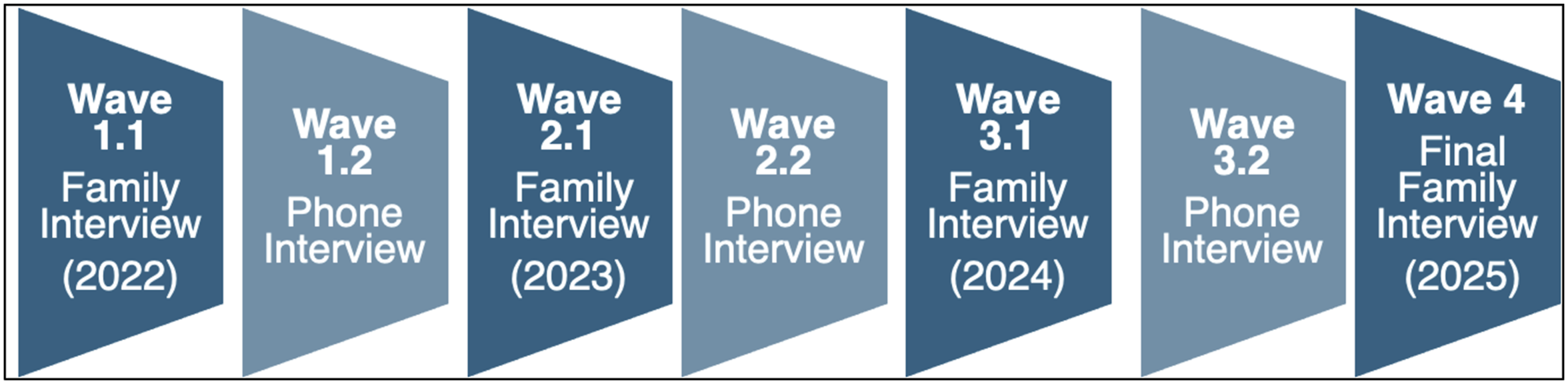
Sample Identification and Engagement
The aim in sampling was to achieve what Gobo (2004) describes as social rather than statistical representativeness, designed to capture complex experiences and relations between variables, especially within populations that are known to be diverse. For the evaluation of a programme such as ABS – designed with the understanding that one size does not fit all – the diversity of family characteristics and circumstances is important for understanding both the nature of their involvement with ABS, and the difference that ABS makes within their lives. We sought to construct a sample of 25 families who would be emblematic of a variety of characteristics and patterns of experience, enabling distinctive insights without being statistically representative in any direct way (Thomson 2009). QL designs depend on maintaining participants’ engagement, which could pose an additional challenge to representativeness or diversity of experience. How to ensure that we did not only study families who were highly involved and committed to the programme? To achieve social representativeness, the evaluation needed to engage and retain families who had negative or simply limited experience of ABS.
In line with established good practice in QLR with so-called ‘seldom heard’ or marginalised communities (Thomson et al., 2024), our sampling strategy centred relational work, beginning with consultation to establish the approach. Team members visited ABS group activities, seeking informal advice from parents/carers; we then discussed strategies with the National Evaluation’s Parent/Carer and Practitioner Panels. Finally, we worked with staff in each Partnership area. They shared information with parents/carers (leaflets in community languages and a project webpage with a short accessible video 5 ) and identified 10 families per area who consented to inclusion in a preliminary sampling frame: families with a child aged 0–12 months or 24–36 months; diverse engagement with ABS provision 6 ; and variation in ethnicity, household structure and family characteristics.
With families’ consent, each Partnership area provided an anonymised summary in relation to these criteria, and a potential national sample of 25 was selected from the 50 families, encompassing diversity across the five ABS Partnership areas. Families were then contacted again by ABS staff, and with consent, contact details of the 25 selected families were shared with our team 7 . The final sample included varied family sizes (1-7 children) and structures (sole-parent, two-parent, and complex/multi-generational households); variation in ethnicity and home languages (14/25 identified as white British); and varying levels of involvement with ABS provision (low, medium and high). ABS involvement was a diverse category, depending on the local context of provision and variations in patterns of use. For example, a family categorised as ‘highly involved’ could be working closely with one service, such as family mentoring, or participating in multiple activities, or roles such as volunteering.
ABS is targeted in neighbourhoods with high levels of relative deprivation and a high proportion of families were managing complex and often challenging circumstances. At the time of our Wave 1.1 interviews in 2022, almost half (12/25) described significant economic and/or housing insecurity. Subsequent data collection documents persistent poverty and precarity across diverse family structures and circumstances. Complex physical and mental health challenges were common among parents/carers (16 families at Wave 1.1), as was having a child with SEND (7 families at Wave 1.1). Four families discussed language barriers, and two had experienced insecure visa status (ongoing for one family); two other families have refugee status. Considered as a whole, these characteristics indicate that the sampling strategy was effective in engaging families with diverse backgrounds and complex support needs.
Maintaining Engagement
Why would busy families, often leading challenging lives, choose to spend time taking part in research or evaluation? Our research depends on a situated approach, centring ethics beyond procedural requirements. We deploy well-established strategies to maintain sample engagement, endeavouring to ensure that participation is enjoyable and rooted in a consistent relationship with the same researcher (AL).
We provide thank you vouchers – and reflecting price inflation over the course of the research, the value of these has increased over time 8 . Between interviews, we keep in occasional contact by text. Sometimes this is initiated by the parent/carer sharing news, and sometimes by the researcher – updating on plans for fieldwork or following up on something shared at a previous research contact (e.g., messaging a family to check whether they had accessed support). Unsurprisingly in a study of young families, babies are born, and when we hear of a new arrival, we send a small gift of an age-appropriate toy. Children also receive birthday and ‘happy holidays’ cards. The National Evaluation produces an annual report (see McKaskill et al., 2024; Munro et al., 2023; Munro et al., 2025) and the learning from Objective 3 is shared in an annual newsletter, translated into community languages. These research practices are tokens of value (Luttrell 2020), showing that we hold families in mind in between fieldwork encounters and demonstrating our recognition that the evaluation cannot succeed without them. Relational continuity – the consistency of the researcher and maintenance of contact between interviews – helps mitigate the risk that research might feel extractive, or, worse, replicate the disruptions families may have encountered in other relationships with professionals.
At the time of writing, in early 2025, rates of ongoing sample engagement remain high. As in any longitudinal study, not every participant is able to contribute to every round of data collection. Of the 25 families in the initial sample, 24 took part in Wave 2.1 annual in-person data collection (summer 2023) and 21 in Wave 3.1 (summer 2024). Two families who were unavailable at Wave 3.1 interviews re-joined the sample at Wave 3.2, and four new families joined at Wave 3.1 – two replacements for families who withdrew and two selected to enhance sample diversity in one area 9 – so in total, 25 families took part at Wave 3. As these numbers indicate, the approach allows that contact may ebb and flow over time, while inclusive, respectful and relational working practices sustain long-term engagement.
Generating Data
Each annual in-person interview is centred on a conversation with the primary carer, addressing topics such as family characteristics and circumstances; child wellbeing and development; formal and informal support including experiences with ABS over time; and everyday family practices. Interviews topics are revised each year as appropriate for the longitudinal aims of the work; for example, the most recent in-person interviews (Wave 3.1) included discrete questions for families of children who have aged out of the programme, about ABS endings and transitions into school.
In-person interviews incorporate creative and activity-based methods, deployed adaptably in line with families’ circumstances and preferences and any relevant ethical sensitivities. At the first interview, each family was given (to keep) a University-branded cotton bag, containing washable coloured pens, paper, coloured stickers and a sketch pad, and a low-cost digital camera. Each year, families are asked to create a map of significant people and places in their everyday lives (highlighting likes and dislikes with stickers) and to take photos that help show what is important to them
10
. Following Luttrell (2020), we seek to learn from ‘collaborative seeing’, bringing family members’ perspectives together in dialogue and in line with the principles of a Photovoice approach that, puts cameras in the hands of people who don’t usually have a voice in policy making, including children and young people, and enables them to record and reflect on concerns as well as strengths in domains of everyday life. (Luttrell 2020, p. 40)
Adaptability and inclusivity are central to a respectful family-centred approach. In-person interviews take place in the family home whenever possible, involving everyone in the household who wishes to take part. This practice means research participants can vary over the course of the study. In data collection thus far, adult participants have most often included mothers, but fathers, grandmothers and maternal aunts have taken part at different times and children are present for most interviews. Creative activities scaffold inclusion, even for family members who are not a central focus for the research. Seeking to make the research interesting and enjoyable, the design allows children to join in (rather than being asked to keep quiet while the adults talk). Mapping and photography are employed flexibly, depending on who is present, to enable the inclusion of children’s perspectives even if very young; cameras are presented as a shared resource for the family. Over time, families may not always choose to keep taking photos or to keep using the digital camera provided at the first visit. Parents/carers sometimes prefer to share photographs from their phones, but study cameras have distinctive value as they can be given to the child/ren to use as they wish (as a parent’s phone cannot). Professional interpreters support the research when needed or desired by families: joining three-way phone calls to set up interviews and for the mid-year telephone interviews; and in person during face-to-face interviews. 11
Collaborative Seeing
Luttrell’s (2020) concept of ‘collaborative seeing’ 12 – highlighting the imperative to ask ‘whose way of seeing is this?’ – informs the family-centred approach. Children’s involvement varies in line with their age and motivation to take part; some contribute actively to conversations or activities, but not always. Creating space for different contributions means that everyone who wants to participate – including older children or adults who are outside of the core focus for ABS – can shape the formation of the family data corpus.
This point is illustrated by data from the first interviews conducted with a two-parent family. The three children (aged 2–7 years) were present at Wave 1.1; while the youngest drew separately (using the paper and pens we provided), the two oldest led on creating the family map, marking important places including their mosque and where they play football, as well as their local park, school, and an ABS setting that their mother and youngest sibling visit regularly. The extract below shows how the children’s talk during the map-making activity prompts discussion of ABS: Child: She [youngest] goes to - Child: - There’s a nursery next to our school (.) Mother: [Name of setting] […] It’s not a nursery, it’s just like a children’s centre. Researcher: So, does she go (.) so she goes with you, or do you drop her off? Mother: No, yeah, go with me. […] Yeah, [name of local ABS] service, yeah. Researcher: And what (.) what do you like using there at [local ABS]? The children’s centre? (children talking as they work on the map) Mother: I volunteer as the digital champion, we have system in […] maybe like ehm (.) maybe they wants to (.) they are looking for a nursery […] [or in] case of they have anything with that in council, we are [helping with that] system as well. Researcher: So, helping people with forms and things that they …? Mother: Not with forms (.) it’s with the computer […] Child: I need some gold stars [for the map] because - Mother: - They come. […] and also [we] tell them what we are doing in [ABS setting] that they are not aware of or (.) we tell them that oh they are (.) they are doing something in [ABS], maybe like a cook-a-long session. If they don’t how to registrate. […] It’s good, we assist people (.) And also with that you meet new friends as well.
The mother went on to describe activities at the ABS setting, whilst keeping the older children to task on the map, ‘We don’t have time, continue, continue!’. Her direction indicates how the shared activities can help parents/carers manage research participation with young children at home, keeping them involved while maintaining space to think and talk.
The family also used the camera to document aspects of everyday life that they felt were relevant to share (examples in Figure 2). Some photographs showcase places documented on the map – such as the park they see from their flat – while multiple pictures from an ABS daytrip mark it as a highlight of the summer. Other images document the quotidian challenges of life on a low income (Hall, 2019), for example, shopping around for affordable groceries and making repairs to the ‘the damp and the cracks’ in their privately rented two-bedroom apartment. The mother explained that they have been waiting for re-housing for 10 years, ‘hoping to move because this is temporary accommodation, we pay a lot of money you know, it’s not a council flat’. The pictures reveal the children experimenting with the camera, including with a short video of their Quranic studies in Arabic, filming the computer screen as they learn the Surah Al-Adiyat with the sound of their mother’s encouragement in the background. The family are trilingual, and their small film acts as a reminder to us as researchers to consider support for multilingualism in ABS work on early language learning. A selection of family photos* (Wave 1 family interview). * Some images cropped for confidentiality.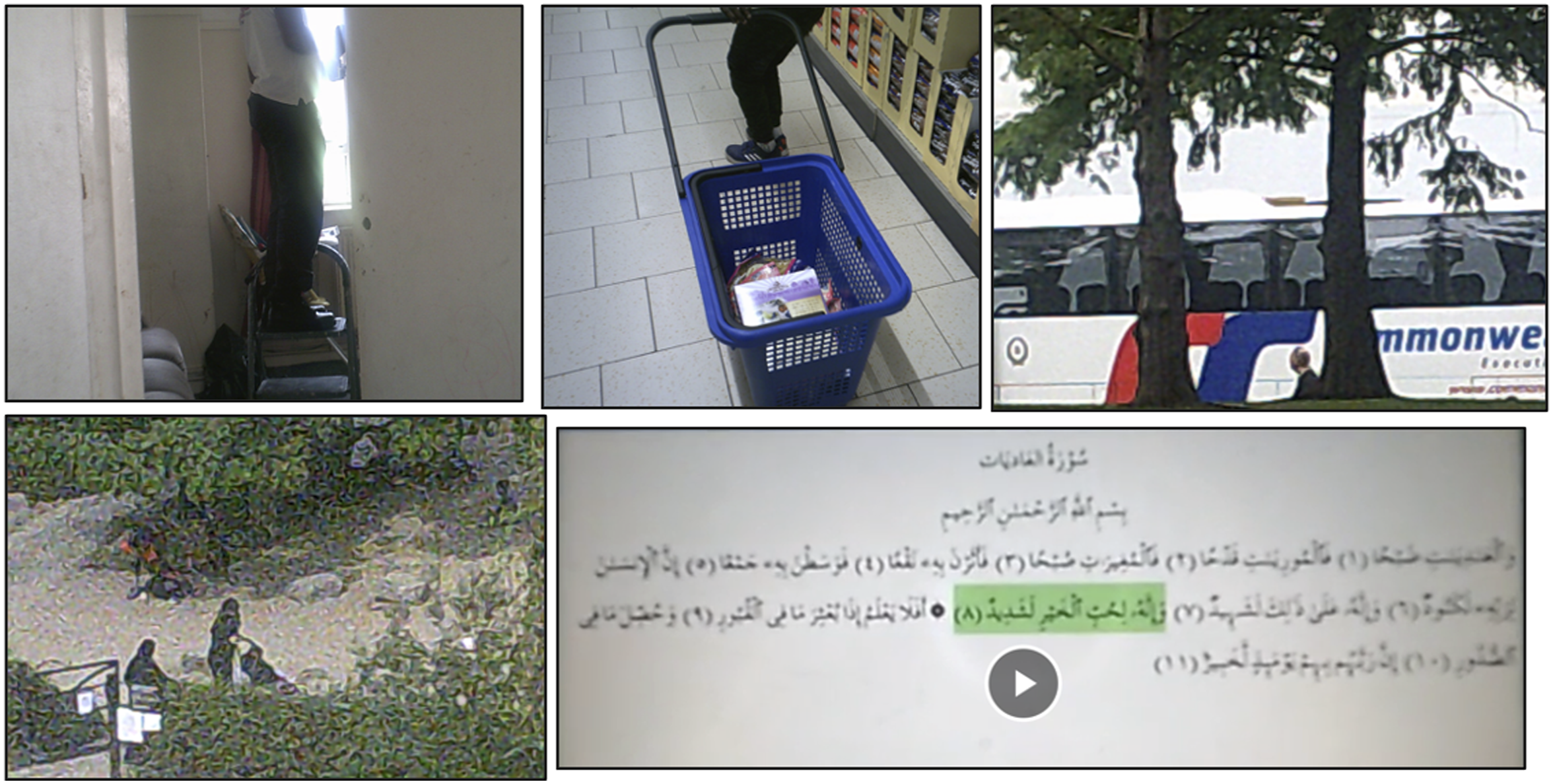
Across data sources and over time, common themes and priorities recur. This can be understood as ‘triangulation’ – in the sense that multiple methods afford a deeper understanding, ‘combining knowledge and experiences […] for a fuller picture of the issue under study’, rather than seeking validation of an imagined ‘master reality’ (Flick 2018, p. 21). Synergies across data sources reflect another key facet of the approach: the methods afford control to family members, including children, in directing the interview conversation. In this sense, the recurrence of themes across map, photos and interviews can be recognised as a form of narrative repetition, emphasising and guiding the researcher’s attention as family members communicate what they see as important. Their data afford nuanced insight into strengths and challenges in their lives, providing a situated understanding of the ABS contribution.
Complexity and Interdependence
In creating space for collaborative seeing – allowing children to be heard and attending to multiple perspectives – the methodological approach enables an analytic understanding of ‘what works’ that reaches beyond the mother-child dyad to understand how ABS support fits into the negotiated contingencies of family practices. In this way, the analysis uncovers points of dis/connection between programmatic and family level priorities, revealing how and why some facets of support might be more or less helpful or relevant for a family and so illuminating the potential benefits of tailored and flexible approaches.
The contingencies of relational interdependence are exemplified by data gathered with another family: a mother with two children, the older of whom (above the ABS age range) has complex SEND. Across all her interviews, the mother has been consistently positive about ABS provision, providing numerous examples of opportunities and support that have helped her family, and explaining what this means for her as a single parent on a low income, living in poor quality privately rented housing with limited informal support. Childhood diet and nutrition – an ABS priority outcome area – was clearly important for this mother, although her concern was framed by intersecting challenges. The older child has highly restricted food preferences and the mother was also concerned for her own dietary health; she had been referred to a dietician but said that affordability was a barrier to her own healthy eating. Her interviews repeatedly documented food poverty and fuel insecurity. Photos at Wave 1.1 (examples in Figure 3) showed her adapting her cooking when her Gas Card (a pre-payment card that controls the gas supply for heating and the cooker hob) was not working: Mother: That’s fish and mushrooms because my gas had gone! And I had to use the oven instead of the hob! So, to cook the mushrooms! […] I got my gas card out, I put the gas on (.) and then when I come back it didn’t (.) I don’t know why it didn’t go on. So, I thought, oh great, I’m going to have to go back [to the shop where she pre-pays the gas card] because it was probably (.) they’ve not done it properly. So, I just did it like that. […] Researcher: How often do you have to fill up the gas? Mother: Ehhh [sighs] oh, about once a week. Cooking fish and mushrooms without the hob.
O’Connell et al.’s (2019) research on families and food poverty highlights the intersection of relational, financial and time pressures for families and the implications for negotiated food practices within families, including parents’ expectations and capacity to let children experiment with food. Given the intersectional challenges faced by the family discussed above, didactic approaches to improving the mother’s nutritional knowledge might understandably feel less helpful than concrete financial support that she can use to address her own priorities. In her first interview, discussing a standardised ABS weaning course, she commented, ‘I haven’t really had to use it’. She did not express any direct criticisms, but this brevity contrasts with her consistently detailed praise of other ABS provision. At Wave 2.2, she spoke at length about the £17 per month in Healthy Start money that she uses to ‘get loads of fruit and veg. […] And I just try and order as much healthy food as I can’. She emphasised the significant time, effort and thoughtfulness she dedicates to managing the household budget to ensure both children are fed healthily, making clear that the critical barrier is not lack of nutritional understanding. Her narratives over time illuminate the usefulness of a family-centred qualitative longitudinal approach for understanding ‘what works’, or not – and why – amidst the ‘juggling, juggling all the time’ of interconnected lives.
Sequence and Specificity
Marchal et al.’s (2013:126) critique of ‘realist RCTs’ points out that while experimental evaluation designs are considered to be the ‘gold standard’ for causal investigation, they focus primarily on probabilistic assumptions of attribution, and so often fail to generate ‘more detailed understandings of the contexts in which particular mechanisms generate particular outcomes’. These observations resonate with Østergaard and Thomson’s (2020) arguments for moving beyond a ‘black box’ logic of causality that attributes agency to variables, towards a narrative logic that is oriented to sequence and specificity, making it possible to ‘access and integrate the missing understanding that is imagined to be inside the “black box”’ (op.cit.: 434). Qualitative longitudinal data – including material prompted or generated by children – has distinctive value for understanding sequence and specificity in change over time. The examples below illustrate this analytic potential, shining light on causal mechanisms that may facilitate change or pose barriers for families.
Figure 4 shows maps created across three annual waves of interviews by school-aged children in one large family (with children ranging from three years old to early adulthood). The maps document their involvement with ABS and their daily life, whilst revealing a wider context of precarisation. As before, gold stars highlight favoured places and red spots mark things that were not liked. Detailed maps at Waves 1 and 2 show the family embedded in the local community, where they were placed as refugees after arriving in the UK several years ago. Along with these maps, their interviews and photographs at that time documented their appreciation of ABS activities and of a local women’s group, as well as local parks, school and the family allotment (which appears on both maps – the small, repeated shapes are vegetables). The contrast with the Wave 3 map, created in the summer of 2024 by one of the children (a 10-year-old girl) is stark. A family’s maps over time.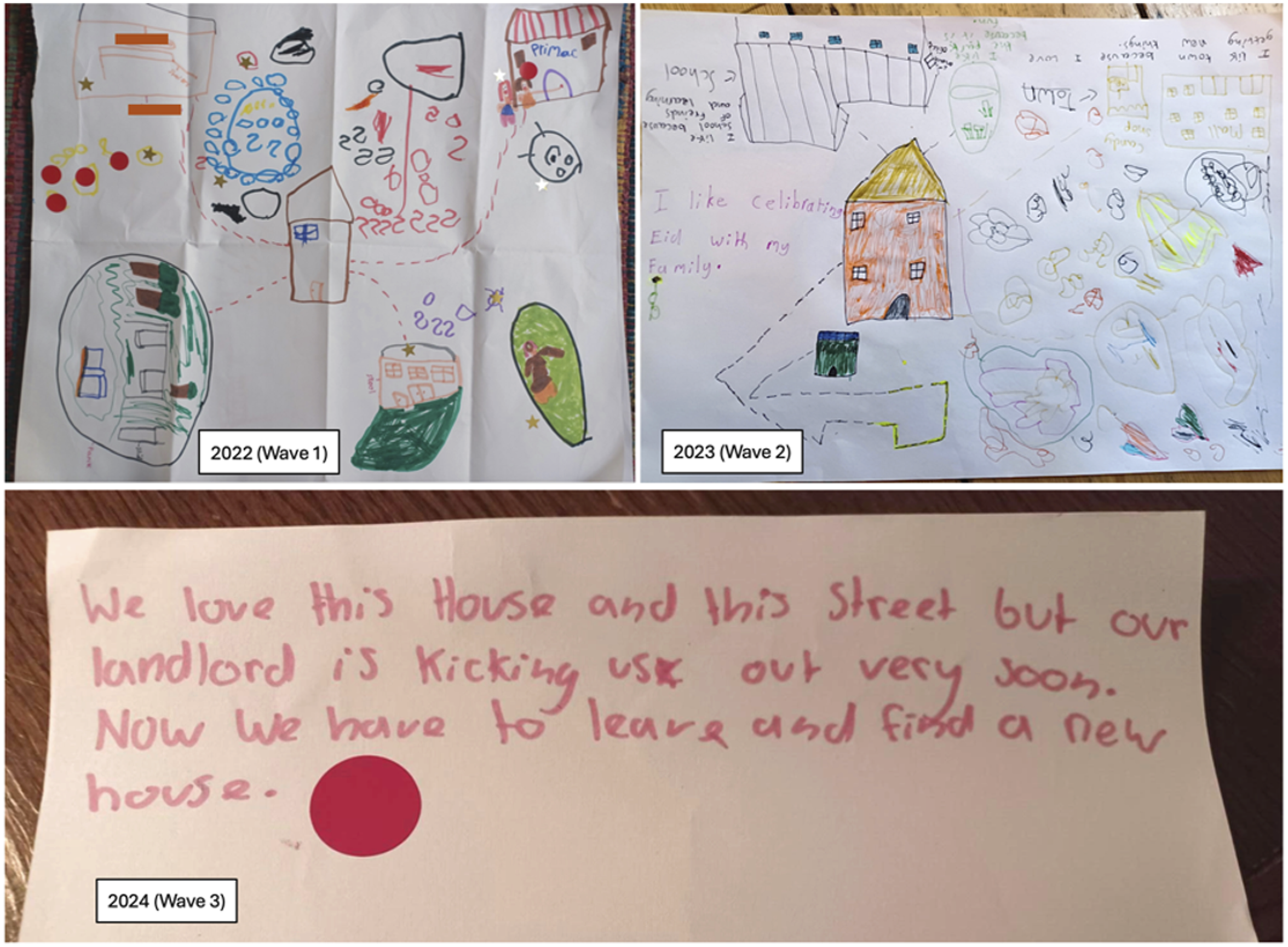
At the time of this Wave 3.1 interview, the family no longer had children in the ABS age range (0–4 years). Speaking via an interpreter, the mother gave a detailed account of intersecting housing and financial precarity, explaining that they could neither afford to contest the landlord’s plans for eviction nor to pay the rent supplement that would be necessary to secure housing that the local authority would offer for a family of their size. Their situation was exacerbated by other rising costs (including for the much-loved allotment) and the limited and variable income afforded by the father’s part-time work. The mother reflected that ‘We [are] going round with our mind all over the place’. Her daughter, asked about what she’d written for the mapping task, summed it up in a single word, immediately echoed, in English, by her mother: ‘Sad’. The mother still attended a local women’s group and described this as ‘the only time of my happiness’.
This example illustrates two key insights afforded by the method. Again, the family data reveal the value of collaborative seeing – in this case, for understanding the shared experience and impacts of family precarity, as parent and child build a collective narrative in the interview. Second, the methodological approach illuminates how the intersectional nature of precarity creates barriers to support and positive impact over time. Meaningful understanding of ‘effectiveness’ depends on attention to sequence and specificity, especially at times of intensifying precarisation in family lives.
A counter example from another family provides insights into the effectiveness of support that is sustained over time and adaptive to changing circumstances. When first interviewed, this large two-parent family had two children in the ABS target age range, one with a significant developmental disability. They had received regular one-to-one home-based support via ABS for several years. Although the mother had attended group activities when her older children were in the ABS age range, she had not done this with the younger children. At Wave 1.1., she attributed this to worries about the potential response to her disabled child: So, I thought, what if I go there and I can’t, you know what I mean, do both children? Because you get some people looking at you, don’t you. That’s what I always thought of. [R: Yeah, yeah, what if you go to a group and (.)] Yeah, and say she’s on one.
Interviewed a year later (Wave 2.2), the parents’ longstanding relationship had recently ended and the whole family was said to be struggling with this major change. Meanwhile, the mother and her youngest children had begun attending ABS groups with the support of her ABS worker:
Yeah, so I can do a lot more with [child] now. So, we’ve been going to play groups, where before I didn’t feel like I could go to playgroups because, taking two babies out was like, I felt. (.) Because [name] is still our [ABS support worker] and she’s really, really good. So, on a Thursday, she got me to go to one of her sessions in the morning with both babies, just so she’s there. […] And I went and it was like, it was the best thing I ever did. […] So that anxiety that I had of going and thinking, “Oh, someone’s watching me” like kind of thing. If [child with SEND] was to do a tantrum on the floor, I’ve still got [other child], do you know what I mean? Because she can’t talk and doing the tantrums and stuff, I thought like, “Oh someone’s watching me”, do you know what I mean? But, really, it’s just natural life.
By Wave 3.3, the most difficult aspects of life post-separation had settled down and the mother was now attending ABS groups without the worker’s support. She reflected on what this meant to her: I felt, at one stage I felt I couldn’t take these out because I couldn’t manage […] and I felt if I went there, someone would look at me, like “Oh my God, she can’t cope with them kids, kind of look”. And [ABS worker] was like, “I’ll come with you. […] I’ll meet you down there”. And I went down there, and you know what, it was the best thing I’ve ever done. […] Actually going down there and actually doing it, and all I needed was that little bit of support to say, you can do it, come on. [R: Just to get through the door, and then (.) And then since then you’ve been able to go?] Yeah, literally we just go.
The consistency of her narrative over time is noteworthy. In her choice of words and repetition that ‘it was the best thing I’ve ever done’, her emphasis defines an outcome for the family that she wants to be sure the researcher will remember and understand.
Marchal et al. (2013) challenge the positivist contention that realist evaluation methods address process rather than outcomes, arguing for methodological approaches that allows attention to both (and the intersection between the two). This is evident in the examples above, and in other qualitative longitudinal data illuminating how ABS provision fits into a wider network of professional support. In one family with three children, a mother explained at her first interview that the health visitor had suggested her youngest child’s delayed speech was attributable to spending too much time on a computer tablet. She explained: Yeah, well [child] wasn’t really talking much and because s/he was mostly on that […] then I got told it’s because of that. And then, so no, I do let [child] go on there but, then we put it away. You know like, and I think because I had my hands full when s/he was a bit younger. […] Then I thought, oh we need to focus on this. So now I give [child] it, but less time.
A year later, she described a sustained change in family practices, providing a detailed account of the child’s enthusiasm for books: That tablet is hidden. Yeah, one odd time it’s out. And then s/he’s more into books now. […] [continues with details of child’s favourite books] [R: So are they books that you had already?] Yeah, and s/he gets one in post [from ABS], doesn’t s/he? So I’m thinking now of putting a basket of books down here, because most of them are upstairs.
Her narratives show how complementary forms of professional support – the health visitor and the ABS book scheme – scaffold sustained shifts in family practices that support the child’s language development. In inserting the detail of ABS books being posted, she marks its significance: not the only thing that matters, but an enabling factor. Her narrative illuminates both process and outcome, demonstrating the sequence and specificity of ‘what works’ for her child and her family.
Conclusion
As a model of early childhood and family support, A Better Start is framed in terms of principles of equity and collaboration, aiming ‘to improve the life chances of babies and very young children by changing the way services are commissioned and delivered, involving parents as equal partners’ 13 . This conceptualisation prompts a critical imperative for the National Evaluation of ABS: ensuring that principles of equitable and respectful involvement are maintained in seeking to understand ‘what works’. Following Fine (2018, p. 72), we might conceptualise this as a need for ‘democratic knowledge production’, a term she uses to encompass traditions including critical, participatory, activist and indigenous research that are ‘engaged to contest the hegemonic academic hold on what is read as valid science and to widen the construct of “expertise”’.
To what extent can these democratic values be claimed for the evaluation discussed here? The work is designed according to the specifications of The National Lottery Community Fund – who are of course entitled to know whether their £215 million investment is achieving what was intended. Consultation with families is embedded throughout – in the governance frameworks for A Better Start as a programme, as well as in the National Evaluation Parents/Carers Panel. Qualitative longitudinal (QL) research with families is just one component of a multi-method design that includes quasi-experimental analysis of administrative data. But by situating families’ journeys with ABS as a core facet of contribution analysis, the approach ensures their expertise shapes evaluation learning.
Writing about epistemic justice in public health research and evaluation, Abimbola et al. (2024) document the ways in which unfair knowledge practices are fomented by the power dynamics that operate between ‘relatively privileged or powerful locations and actors [who] are at the physical or epistemic centre and less privileged or powerful locations and actors [who] are at the physical or epistemic periphery’ (op.cit.: 638). Their observations align with Lorey’s (2022) discussion of contemporary democracy. Drawing on Rousseau, she distinguishes between ‘the people’ and ‘the multitude’: the people who are entitled to have their views heard, ‘deemed capable of equality and collective political power’, and the multitude who sit outside frameworks for power and decision-making; heterogeneous in their precarity, they are the ‘indeterminate, vulnerable many’ (op.cit.: 30). These considerations are critical for family research and evaluation, because of the potential ethico-political consequences of the knowledge we produce as researchers. Do we reinforce the idea that robust evidence can only be achieved for interventions that can be subjected to quasi/experimental evaluation, while potentially justifying the erosion of less readily ‘measurable’ forms of support? How can we avoid individualising deficit framings of parents/carers and families, and instead build evidence about equitable approaches to support for people navigating the intersectional impacts of persistent precarity? Epistemic justice depends on knowledge practices that respect the diversity and expertise of the multitude, disrupting hegemonic understandings that are rooted in taken-for-granted privilege and unfair knowledge practices (Abimbola et al., 2024). Embedding inclusive and respectful qualitative longitudinal research within a multi-method evaluation design creates space at the epistemic centre of the endeavour, helping to foreground parents/carers’ and children’s perspectives, and so to democratise understandings of ‘what works’.
The analysis shared here also demonstrates the practical value of a family-centred qualitative longitudinal approach for substantive knowledge-building, providing a means of looking beyond what is easily measurable. By illuminating sequence and specificity in the causal mechanisms that shape change in family lives and practices, QL designs can help those involved with commissioning or delivering support to understand complex pathways and barriers to impact within the relatively short timescales and dynamic policy contexts in which evaluation studies are so often conducted. QL designs are well-equipped to respond to and interrogate dynamic policy contexts (Treanor et al., 2021); embedded adaptability protects the research when things, inevitably, change over time. The approach described here offers distinctive opportunities for understanding the dynamic multiplicity of experiences over time, and so for evaluating the diverse potential impacts of tailored and multi-faceted programmes of support. Variability, change and non-standardisation can be recognised as inherent facets of the contextual realities of policy, local contexts, service frameworks and systems, and family lives.
The capacity for ongoing understanding is a further advantage. Each annual round of qualitative data collection and analysis provides new insights that can be fed back to funders, practitioners and families as the work proceeds, while longitudinal evidence over time demonstrates whether early childhood support can make a sustained difference in the wider context of family lives and local systems. In its capacity to inform ongoing learning, this affordance of the QL method speaks to another facet of epistemic justice: merely describing participants’ social reality is not enough, without ‘productive work to help improve the material conditions of those in marginalized communities’ (Falbo 2022, p. 358).
Neale and Flowerdew (2003) describe QL research using the metaphor of moving from a still photograph to a movie camera. Embedding long-term family-centred work within a wider mosaic of longitudinal evidence, the design for the National Evaluation of A Better Start extends that metaphor, combining multiple lenses and viewpoints. Administrative data analysis (Objective 1 and 4) affords a ‘wide angle’ view, while professional stakeholder interviews (Objective 2, both cross-sectional and longitudinal) present a picture from a different stance. Each cross-sectional wave of QL work with families also provides the nuanced detail of a macro-zoom close-up as well as a moving picture over time. As Freeman (2024, p. 45) observes: by stepping back from the kinds of entrapping methodological procedures and theoretical structures most often employed in the discipline [of psychology] – we may be able to move closer to reality itself, the reality that precedes our definitions and categories, the reality that can’t be gotten around, the reality that, in its surplus, insists on our recognition of, and reverence for, its irreducible otherness.
Questions of power and the privilege afforded to different forms of knowledge still demand attention. But the approach reaches closer to a respectful and democratic engagement with the complex realities of ‘what works’ for families within a complex, non-standardised and dynamic programme of support.
Footnotes
Acknowledgements
The National Evaluation of A Better Start is conducted by a research partnership led by NatCen Social Research with partners from the National Children’s Bureau (NCB), Research in Practice, RSM and the University of Sussex. The views presented in this paper are those of the authors, and do not represent the wider evaluation team or funder, although we are grateful for their support. Thanks are foremost due to the families who have taken part in the work reported here, for their generosity with their time and experiences, and for allowing us to learn from their expertise.
Declaration of Conflicting Interests
The authors declared no potential conflicts of interest with respect to the research, authorship, and/or publication of this article.
Funding
The author(s) disclosed receipt of the following financial support for the research, authorship, and/or publication of this article: The National Evaluation of A Better Start is funded by The National Lottery Community Fund.
Ethical Approval
Ethics approval for was provided by the University of Sussex (ER/JMB55/11) for Objective 3 work with families as a whole, and additionally by the NSPCC (R/22/220) for Objective 3 activity in one ABS Partnership Area (where work is delivered in partnership with the NSPCC). In line with these ethics approvals, all those who have taken part in the work have provided written or audio-recorded consent (the latter where ethically appropriate depending on child age and participant literacy in English) for their participation in the evaluation and for the use of their anonymised data (transcripts and visual data) in reporting from the work.

Data Availability Statement
Given the sensitivity and potential identifiability of the dataset, the data reported here are not made available.