




Abstract
African immigrant parents face unique challenges when raising their children in a new sociocultural environment. Parenting approaches that they experienced as children may no longer be feasible in their new context and often require adaptation. Informed by transnationalism, this qualitative study explored the parenting values of African immigrants living in Alberta, Canada. Interviews were conducted with 32 African immigrant parents and 14 community leaders. Guided by a critical ethnographic approach, we collected and analyzed data to understand how these parents navigate parenting in a new context. Participants highlighted key challenges in parenting, including: 1) conflicts between African cultural and religious norms and Canadian culture; 2) struggles surrounding children’s identity, belonging, and value formation; and 3) the diminished role of elders in child-rearing. These findings offer important implications for public policy, education, immigration, and community services.
Background
Canada, a multicultured country with a long history of immigration, has approximately 23.0% of its population born in another country (Statistics Canada, 2021). Between 2016 and 2021, Africa was Canada’s second-largest source of immigrants and although African migrants constitute 15.6% of recent migrants to Canada, there is limited data on this population sector, especially regarding families experiences in parenting. While prior researchers have explored the experiences of European and Asian immigrants as a family unit in Canada (Kim, Zhang, et al., 2020; Moon & Ruiz-Casares, 2019), there is still a high need to unpack the relationships between migration and parenting as it relates to African immigrants. This represents a critical gap, as parenting styles, practices, and values can widely differ across cultures (Lansford, 2022).
Immigrant families often experience difficulty maintaining cultural harmony and family cohesion which are both essential for children’s well-being. Moreover, the clash between the values of a child’s background and those of Canadian culture can be a contributing factor to bullying, peer aggression, suicidal thoughts and attempts, and conflict between youth and their parents (Pottie et al., 2015). Children of ethnic minority immigrants in Canada are more likely to be in contact with child protection services, as compared to those of the general population, as the screening instruments for child maltreatment are based on risk and have high levels of false positives, leading to the risk of mislabeling parents for child maltreatment (Hassan et al., 2011; LeBrun et al., 2016; Pottie et al., 2015).
To move forward, Lebrun et al. (2016) suggests that future research must include more immigrant and refugee participants and to explore, from an exosystemic perspective, how migration and cultural factors shape culturally distinct parenting practices and the broader relationship between migration and parenting. We need to pay close attention to how parenting values are interpreted in the world of migration and the cultural variations around parenting. We found no literature on the values of African immigrants related to parenting in Canada and how they complement or act as a barrier in the integration of their children. As such, in undertaking this study, we aimed to explore the parenting values of African immigrants in Alberta, with the ultimate goal of gathering insights to inform community programming and guide strategies that promote the health and well-being of African immigrant children. The central research question is: What are the values of African immigrant parents in Alberta, and how do they complement or act as a barrier in the development of their children?
Theoretical Framework
This work is informed by transnationalism theory (Pries, 2022), which sheds light on how differences in identity and social determinants influence parenting and mental health promotion practices of African immigrant parents in Alberta across nation borders (Salami et al., 2020). Transnationalism gives us insight into how cultural values in migration contexts influence the family life of migrants in the nations they move to, and how those values shape their identity. Transnationalism offers a paradigm with which to cultivate a methodology to practice decolonizing forms of research. As parents attempt to manage the various impacts of the host culture, as well as the changes to family life in a new migration environment, this framework offers an understanding of these interactions. Furthermore, scientists have utilized this theory to explain and comprehend differences and distinctions within and between societies, which has proven useful in examining parental perspectives. The researcher questioned the parents concerning how they incorporate African and Canadian parenting values in their parenting practices and based on interviews of African immigrant parents, the investigators delved into the values of African immigrant parents in Alberta.
Methods
We used a critical ethnographic approach to both collect and analyze data for our qualitative study (Glaser & Strauss, 1967). Ethics approval was received from the University of Alberta Research Ethics Board (Pro00065932). Participants were recruited through a combination of purposive sampling and snowball sampling techniques. In line with the tenets of a critical ethnographic approach, the research team was deeply immersed within the community. African community leaders were selected from a magazine listing of community organizations and our internal inventory of community leaders. Snowball sampling enabled recruitment through African immigrant participants and through the networks of service organizations and agencies. Parents were recruited for the study through their existing networks in African churches and African grocery stores, as well as through ads and email messages. African immigrant parents, who met the criteria of having a child under the age of 18 years, were contacted and scheduled for an interview if they showed interest in participating. The participants were given ample time prior to the interview to review the informed consent form, ask questions about anything unclear and sign the form.
Sociodemographic Characteristics of Parents.
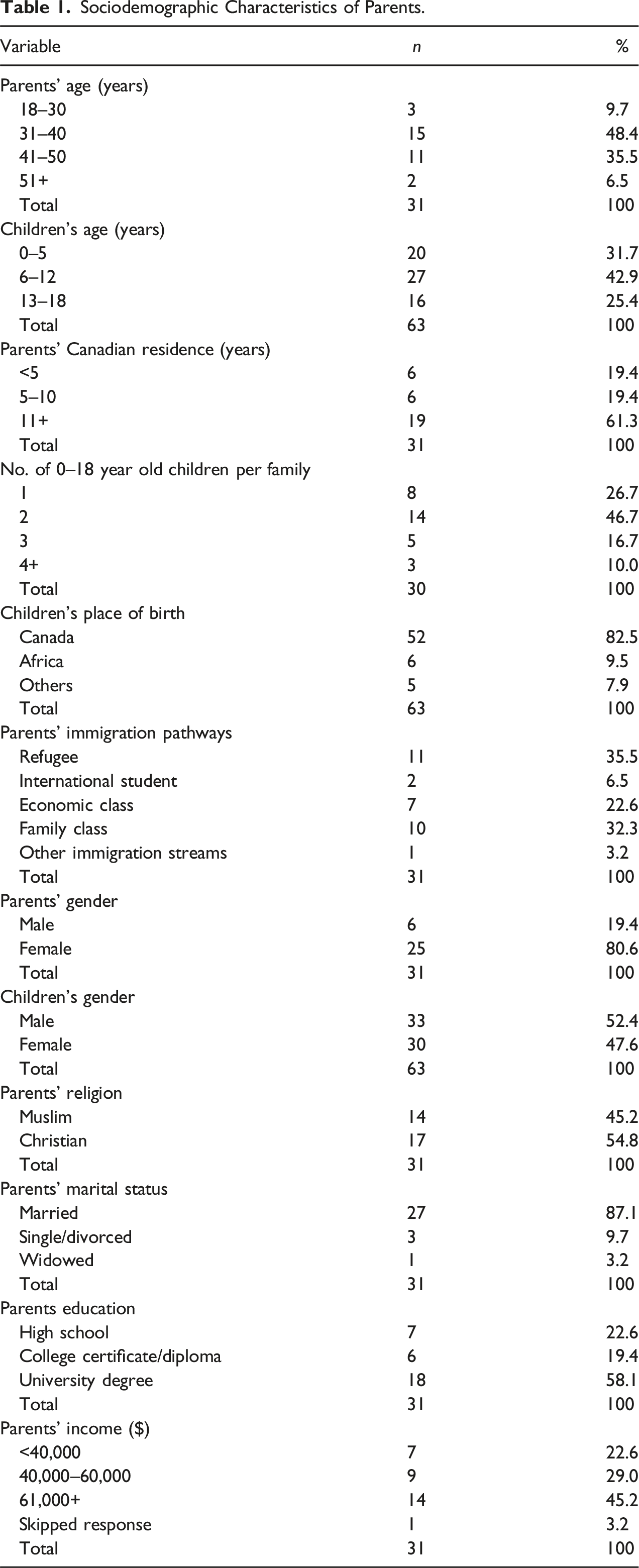
Interviews took place in the homes and places of business of the participants as well as the University of Alberta. Interviews ranged from 45 minutes to 2 hours and, were audio-recorded with the appropriate permissions and transcribed verbatim. After data collection, the reflections of the participants on the interview process and their own self-assessments were documented. The data was labeled and thoroughly analyzed using NVivo 11 data management software.
Results
In our analysis, we identified three primary areas of conflict that African parents experience while parenting in Canada: 1) the conflict between African culture and religious norms versus Canadian culture; 2) the conflict surrounding children’s identity, sense of belonging, and values as immigrants; and 3) the conflict surrounding the roles of elders in raising children. The study findings suggest that African immigrants face challenges incorporating the values of their native countries while parenting in Canada due to factors such as the contrast between collectivistic and individualistic parenting styles, the incompatible differences between cultural upbringing and current Canadian approaches, and parental financial stress. The majority of the participants focused their conversations on their typical parenting customs and not being able to utilize them in Canada, while a few discussed alternative practices that can blend traditional African values with Canadian parenting practices.
Cultural and Religious Conflicts
African immigrant parents who come from collectivist cultures, where the community plays a big role in child-rearing, have difficulties adapting to the more individualistic Canadian society, where the parents assume most of the responsibility. Many parents and community leaders emphasized that the transition was particularly challenging, and many referenced the African proverb ‘it takes a village to raise a child’ as they believed that raising children requires a collective effort. Nakita, Sana, and Jumai discuss the particular challenges of not being able to rely on neighbours, friends, and community members when raising children. You see, there’s a proverb, really: it takes a village to raise a kid, right? Because every now and then in African setting, you either have an aunt or an uncle or a neighbour that is always there, you know, to set the record straight, to get the child to navigate the system. You don’t always need to be there. But unlike here, yes, you have the larger community, but often the raising of your kid, more often than not, is done within your household. -Nakita
Sana points out that in collectivist societies, children have access to many positive influences, such as those from grandparents, friends, and extended family. By contrast in Canada, the responsibility of guiding the children falls primarily on the parents. [B]ack home we have like a sense of community where everybody – like the child is taking example from Grandmom, and like my family, my other family members. So, in here it’s just the two of us. Like he doesn’t see a lot of examples, like a lot of people he can, you know, relate to or he can take things from. […] they normally say it takes a village to raise a kid. Like in the back home, […] for example, if you are doing something wrong on the street, everybody’s like, “Hey, what are you doing?” Now the child will have this sense of, okay, you know, whatever you’re doing, everybody else is saying it’s wrong, so it’s not right. But in here it’s different. It’s just me, so it’s hard for me to kind of like – it’s hard for us as a parent, his dad and I, so it’s like we have to explain to him, and it’s – he doesn’t have that other external influence.
Jumai notes that although parenting may seem intuitive, it is often more difficult than it appears, and parents should avoid raising children alone as some challenges may go unnoticed. This is being addressed through parenting classes and groups that can support new parents in developing their skills. [M]y daughter, she belongs to this big group of African young mothers, and so they discuss about [their children]. […] And I know that as a community, […] the city through African Centre’s tried to put some [parenting skill classes] things in place. […] You know, how do you go and learn how to parent? That concept in itself is foreign to us from my community. These things are supposed to be intuitive. You have the best interest of the child. You can discipline them and it might appear cruel, but it’s really for the interest of the child. So this is how we’re schooled. […] But most of the times, it’s like it’s inculcated in us to know how to deal with our children. So we don’t – I don’t see that active seeking to know how to help a child, which has brought out another not very nice dimension, because of that belief. “Wake up, have breakfast, go to school,” because that’s what they did. But a kid would be suffering in school, being discriminated against or whatever, going through some kind of hardships. But they’re never given an opportunity at home to express that and say it, and be comforted and be nurtured to overcome that, so which is a pity. The idea that, “I’m self-sufficient as a parent,” can be a mistake. -Jumai
Our research also found that African immigrant parents experience difficulty in integrating their native cultural ideals with the values prevalent in Canada. A common challenge faced by African immigrant parents is the challenge of raising children in a context that differs from their own childhood environment, creating internal tensions between traditional parenting knowledge and the expectations of the current culture. One parent discusses feeling like they are at a “crossroads” in their parenting style: [I’m at] a crossroads, I’m at that intersection where my parenting style is informed by what I was raised[…] but also informed by the reality of the social setting [in] which I find myself, because the cultural and social values in Canada are very different from the social and cultural values from Cameroon, where I grew up. -Liya
One elder in the community highlighted parents' struggle to impart traditional values to their kids in a Western environment. The elder suggested that some parents have been unable to reconcile the differences between Canadian culture and the values of their home country when raising children: I see parents dealing with the kids, and it’s quite hard. It’s very, very hard for them. Yeah, because [of] the values with which they were brought up, they tend to think that is the values they should impact. And yet most of those values are very contrary to the environment in which we live. And so, the frustration comes if you have not schooled yourself properly to know how to navigate this, get the kids to understand their boundaries without breaking the law. -Hassan
Another community leader points out that there are principal values that Canadian and African parents share, such as the importance of respect for others and educational goals. Each system [Canadian and African] has its advantages[...] But I think for sure [that] every single parent tr[ies] to inculcate at least the value of respect to their kids. So I can see that when I visit some of them, yeah, they’re always respectful vis-à-vis me or vis-à-vis visitors. I think they mix them. Mix. They use them both. … no one forbids or prevents his kids or his kid to go to school. Almost all of them go to school. - Hamoodi
Similarly, another father believes that, regardless of cultural differences, values can be aligned, and it’s the parents’ responsibility to teach children the distinction between right and wrong. He also notes that some parents choose to take their children back to the homeland to ensure that they are raised with a deep understanding of their culture and values. As a parent, I don’t say, “Oh, that behaviour is Canadian.” No. It’s a bad behaviour, period. Instead of forcing the values or like insisting on something, why don’t you explain to them? Why don’t you make them understand? Why don’t you paint a better picture for them? Why don’t you carry them along, as opposed to, “Oh, you know, speak this language. Oh, you must dress this way.” It’s better if you try and talk to them intelligently, carry them along. Even sometimes, I know some people do take the kids back home. Not because they just want to dump there but so they don’t have the Canadian experience and grow up to be something else. Take them back home, give them a good experience of what is back home so they can actually appreciate what is there. -Mohammed
One parent believes that balancing their values with Canadian values is not challenging, especially because they were raised in Canada. They asserted that it’s important to explain to children why they don’t celebrate traditional Canadian holidays and why some values are different. I don’t think it’s that difficult [being an African immigrant parent in Canada], because I grew up here. So it made it a lot easier for me to adjust with my parenting skills. So it’s learning about the balance between being Canadian in society and my own cultural values[…]. [My cultural values are] my religion, my like, you know, just making sure that the kids understand why we don’t celebrate certain things that the Canadian culture celebrates, like Christmas or Halloween or Thanksgiving. And some of those values are different for my religion and my beliefs. So it’s just those sort of differentiations. -Zari
We also found a conflict in values between Western medical approaches and traditional cultural and religious healing practices for mental and physical health. Muna discusses the religious and Western approach to treating her mother’s cancer. [W]hen my mom was first diagnosed with cancer, people were telling her to, you know, to not take medication. You know, just trust Allah. Take – you know, read Koran and all that. And I was encouraging her. I said, “You know, you can do religion, and [...] you can still take advantage of modern medicine.” - Muna
Aleena mentions that mental health care is still subject to considerable stigma, with some families opting for a religious approach to addressing it and may even send their children back to the homeland to treat their mental illness with prayer. Mental health is stigma back home. Like not like – like kind of bad connotation, but people rarely talk about having like mental issue. For example, if you talk about – like if you are going through a depression [...] people might talk about it.[...]. So mental health is some kind of stigma, and rarely people talk about it, because you don’t have the sympathy of everybody. [...] The other thing people talked about is people with mental health sometimes within the community, instead of taking medications to help, they only – well, two or three people have told me that, you know, some of them, they just only rely on religion. [...] They don’t want to take medication. Even for children that have mental health. Like one person told me that the child was sent back home, and the only treatment that was being used was prayer, and not medication. -Aleena
Unathi believes that God plays a crucial role in maintaining her children’s mental health. She critiques the possible overreliance on medications and cautions against the risks associated with labelling someone as ‘mentally ill’. God. That is all the tool we have [to maintain children’s healthy mind]. I’m telling you, that’s all the tool we have. The kids – the Western society is science, science, science, science, right? What we believe the problem is [...] they will take him to a counsellor or a researcher. Before you know, the kid, the adult is taking 30 pills a day, and it doesn’t work. It doesn’t work. people with the city of Edmonton, and they were people, very normal, but because the counselor or whatever, the psychologist, has branded the person like this, finished. His life is over. You see, but in Africa where we come from, a human being, you don’t allow him to go to waste like that. We try and create a way. But here, once they brand you, forget it. Yeah. You will not see anything. - Unathi
Children’s Identity, Sense of Belonging, and Values
Parents felt a conflict of values when it came to their children, and felt fear about children losing their identity and struggling with a sense of belonging in Canada. One parent argues that parents must support their children through their feelings of alienation, otherwise, African kids may be less inspired to get an education and succeed. He states that African customs and spiritual beliefs have been lost in comparison to Chinese and Indian immigrant children, and parents can use culture as a resource for instilling values that could lead to success. [...] when they’re born here and they go to school, they are minorities and sometimes it’s a little hard to get kids to play with them. So it’s tough on the kids. And as a parent,[...] you have to be with them every step of the way […and] encourage them, give them the strength and the know-how. [Otherwise….] your kid will lose the self-confidence [...] and when they lose track, that’s when the motivation is gone. And when the motivation is gone, they don’t value education as we do. As a result, they don’t get even close to where their parents got academically. But on the other hand, if you do all the things I’ve mentioned properly, [...]the system is there for everybody. That’s when they will go far in life. I will give you a good example here: if you look at the Eastern race and the Chinese, they hold dear to their culture. The kids are taken to the Hindu temple,[...]. They speak their language to the kids. So they can still value their kids early in life. That way, they – it’s like they are born in India; they are not born in Africa – Canada. So they surge, they fly, and they get as far as they want. -Unathi
Parents are also worried about their children not fitting in with the traditions of their homeland because of their inability to speak the local language. Concerns existed with respect to transnational identity and relationships with relatives back home. One parent explained their worry about language and connections: Here I have to think a lot about language, which would not have been an issue back home, and think about, am I teaching her enough Somali? Is she going to be okay if I just speak Somali at home when she goes to daycare, when she goes to school? I think about not just the language, but their relationship with people back home. Like would my daughter know how to relate to my parents? Are they going to be able to relate to her? Will she fit in with her nieces – like with her cousins back home? -Hoodo
Another parent worries about raising a child in Canada will result in their child losing their sense of identity and becoming “all Canadian”: [I have fears] of the child getting lost, lost in Canada. Lost, in the sense that he loses his sense of identity, he loses the fact that he’s African, he loses the fact that he’s Nigerian, and he doesn’t even – he can’t relate back home. [... and only] relate[s] back home in the sense that, yeah, I come from Nigeria, and that’s all he knows. But he doesn’t speak the language, he doesn’t know the culture, he doesn’t understand the faith of the people, he can’t relate to other tribes. You know, basically he’s lost, because everything is here. I wouldn’t want that for my child. So you know, that’s – he’s all Canadian. I wouldn’t want that. I wouldn’t, because bad as Nigeria is there are good things in Nigeria that I would want him to know about. - Hanna
One parent took her children back to her homeland to immerse them and increase their knowledge of their language and cultural traditions. She further states that she encourages their own learning of language by practicing at home and supporting their inquiries. I took my boys back home in 2014 so that they can get better acquainted with their language and their culture, and just – yeah, so I did that for them. And they have a better understanding of the language and the culture now, but I don’t put too much emphasis on – like I don’t stress on it. Like I speak my language to them when I need to, and they understand it and they ask questions. “Oh, how do you say this?” And so it’s like giving them that encouragement of like letting them be like willing to learn and willing to participate on their own. -Fatima
Hafsa notes her children’s struggle with feeling ‘Canadian’ and wanting to fit in with their peers. She mentions the challenge of coming to a place with many diverse cultures and identities, where there are not as many people who understand their cultural roots. Hafsa’s children are also reluctant to have their parents visit the school, as they might look different from the other parents.
I fear of them integration. How do they – we try our best, but I could easily see identity issue. Sometimes I feel like they are trying very hard to be Canadian, but we tell them, “You’re already Canadian.” Even myself, who came a latecomer, I still think I’m Canadian. [Laughs] So we have more confidence than them; let me put it that way. It’s because we came from a place where everybody’s African, everybody’s like you. There’s a challenge, of course, but at least you have – you feel that you are part of a group. So, and they came here; the only person they have is you. And one thing I have said, when we used to go with them to the school, they don’t like that, because maybe we dress different. Maybe we look different. Maybe we even act weird sometimes. That’s what they – according to them. So they don’t want us to come to the school. - Hafsa
Parents had concerns about external influences that would shape their teenager’s sense of self in regards to their sexuality. A parent described their child’s classroom experiences and expressed worry about the government’s ruling on homosexuality and gender fluidity and worry that their child may end up engaging in same-sex activities. To tell you the truth, I am really scared of the growing, the way they perceive things, the way they think about things, the way we think you have trained them, and now peers from east and west that are not mannered or properly trained, they are the people that they are going to meet. For instance, a grade one student from my child’s school – they were twins, two boys. Now they decide to change one’s sex to a girl. It was sad when I heard this. That was one reason why I took him even from Catholic school. I know we are in this country, so I should not be that sad, but that is the reality. Then he comes home one day and said, “Mom, you won’t believe this.” And my son talks. And he said – can you imagine Seth is now called Sethiana? And I said, “Really?” He said, “Oh, they said he’s a girl now– my heart was just pounding. And then now they said there’s nothing called gender, that a male can use a female washroom. What is this? So the system is just upside down, which is very scary. To me as a parent – now even in these Christian schools, just recently I heard the NDP government is just breaking a policy that – because I look into this school system, and why not? That if a child decide to bring their own religion or their club, we shouldn’t prohibit them from doing that. We shouldn’t restrict them. So there was a guy in a school, one of the best Christian school in the city – not in Edmonton, but the small cities – now has formed a gay association in a Christian school, and it’s allowed. Honestly, when I heard that, I feel like I should take them back home to learn the manners there. Because there, that nonsense doesn’t work there. -Daliah
Additionally, another mom voiced her own opinion on sexuality, particularly when it comes to conversations about homosexuality with kids, expressing that while she is not against it, she would rather her daughter marry a man. She highlighted the difficulties inherent in providing children with sexual health education, especially when there are disparate beliefs among schools. This contributor outlines the effort they make to interact with their daughter regarding this matter. Homosexuality, I am the kind of person that accept all of those things. I do not have any problem with it. But it’s really difficult also to explain it to my daughter. Because as a heterosexual, … you want your child to be heterosexual as you are. But last time, for example, she came from school and she asked me why to have a child you have to be a man and a woman. She asked me that. I say, “Why are you asking me that?” She say, “Because I have a friend at school – I have a friend at school who has two moms. So how come? It’s possible for a mom and a mom to have a baby? Because you taught me -” and she asked me, like, “You told me that the baby come from God.” [Laughter] I say, “Yes, so it’s possible for two women.” I lied, because I said, “Yeah, it’s possible for two women to have baby.” She said, “Oh. But why did you marry Dad? Why did you – you didn’t take a woman to live with you?” I said, “Because I love Dad. I could love a woman, but I love Dad. That’s why I’m living with Dad.” She said, “Okay. So, I can marry a woman, then?” She asked me that. And I was like [Laughs], “Just go to take your backpack.” I don’t have an answer for these questions. [Laughter] I really didn’t know what I could say. Yeah. -Minata
Roles of Elders in Raising Children
Elders have traditionally played a vital role in raising children, with parents respecting and seeking their wisdom for guidance. However, the role of elders is not as emphasized in Canada and can be diminished. One parent discussed how the internet is replacing the grandparenting role in their child’s life : We tell them something; the internet is telling them something else. So, Google somehow became the grandparent that they ask whatever they want to know. And that’s not good. -Mariam
African parents in this study experienced stress due to the lack of support from elderly family members. This absence of grandparental support and ‘the village’ were believed to hinder the transfer of good morals and discipline to children in Canada. Parents identified how they occasionally consulted grandparents from the homeland to intervene in their children’s matters. By engaging in transnational practices such as this, migrant families and relatives are connected between sending and receiving societies. Regarding transnational parenting and the absence of grandparents, one parent made the following comment, drawing comparisons with Indian families in Canada: I have to, you know, secretly call the grandmother, or her auntie, who’s the sister to the dad, and tell them, you know, “This is what’s happening. Can you please intervene?” That is almost a weekly occurrence. You think if that grandmother or that relative was here, I would call back home? Or do you think I would be stressed even to that level? No. It would be just the grandmother. That is why the Indian community is having less risks or what we call bad behaviour for the – in the children, because for some reason they have their mother, the grandmother, the grandfather, and even the whole extended family living together under the same roof. Therefore, you’re being watched by all these people, and the child is getting knowledge, and discipline to some extent, also, from all these people. However, for us, mother, father may be fighting too much, even. The child is looking at all this happening, and it has impact on the child’s mental health as well. -Sandra
Parents often referred to missing the support and wisdom of elderly family members. Grandparents were meant to provide children with a representation of how family dynamics worked in their native lands. During the conversation, one parent talked about how in her home country a village could raise a child and reprimand them when needed, and how the child knew everyone in the community was a potential guardian: For example, if my child goes to school in Kenya, in a rural village, if my child misbehaves, any person – and I expect that – any person from that village or anybody who is identified with us, can always tell us exactly how that child is behaving, and I will not feel offended. The child too, will fear everyone. Not only the parents, but also everyone else. And we believe in Africa, knowledge is passed on to a child. So that knowledge is not only coming from me; it’s coming from a grandfather. It’s coming from, you know, a great-grandfather. It’s coming from the elders of the village. It is coming from all these – you know, it’s passing all these rules and then eventually landing on the child, and that’s manifested in the child’s behaviour. We do not see that here, unfortunately. -Ahmed
Family and religious elders are considered an important source of child discipline. Maintaining communication with elders and extended family, including fathers and aunts, is considered crucial. The community leader addressed the issue of elder respect by drawing a direct comparison to a professor emeritus: You will negotiate about a way to do something, but the aunt, being an elder, have the upper hand or have the last word. So you don’t say that if they say, “Don’t do this,” because this person is giving you instruction based upon her experience. In fact, when you go to university, we have a professor emeritus – why do you call him “emeritus?” These people have been a professor for 25 years. What is different from him and the one who just became a professor? Why do we value him? It’s the same system that an elder, an elder goes through rigorous training, okay? Then you become an elder. Now, in every religion we have the elders .-Ameen
One parent believes that children’s behaviour is a reflection of knowledge that is passed down through generations of wisdom. Consequently, bad behaviour is not just a poor reflection on the parents but a poor reflection of grandparents and great-grandparents: And we believe in Africa, knowledge is passed on to a child. So that knowledge is not only coming from me; it’s coming from a grandfather. It’s coming from, you know, a great-grandfather. It’s coming from the elders of the village. It’s coming from all these – you know, it’s passing all these rules and then eventually landing on the child, and that’s manifested in the child’s behaviour. -Noah
Ahmed and Aicha highlight the importance of having a strong community in Canada and the value of relying on elders in resolving relationships conflicts, sharing discipline strategies, and sharing general life experiences. Ahmed believes that, as an elder, he can support families by sharing the wisdom gained from his own life and value system. Like elders are always respected in our community. If there are elders who speak to a family, what is the problem? These elders are assumed, not because they’re old, but because they have a vast experience, or they have experiences and they’re informed. [Laughs] Without bragging, I could say that my life experiences, my having lived in Kenya all my adult life, and having come here, I bring – I am able to see certain value system. I’m able to tell someone, “No, that is good, but it’s not. It doesn’t enhance this.” I advocate that men should be respectful in a certain way and not do things the way they did at home, that a woman was there to be seen, not be heard. And women, just because here you can call the police, does not mean that that’s your best option. So how do we bring that together and secure the family unit where the kids feel secure. - Ahmed
As a first-time parent, Aicha also seeks advice from her elder brother and elders in the community for support and advice on disciplining her child. [...] I don’t live here by myself. We live as a community. I’ve got my elder brother here, who got married before. And then – so I am pretty much sometime I ask him how things are being done. So, because that’s my first child, you know, so I have to go and ask somebody who has done that before and then ask, “How are you doing the things?” So I get some idea from him. [...] And my brother, and a part of my community, because whenever we sit down and we have elder people there, they advise us about how things should be handled, and A, B, C, and all the things. So we got some information from them too. -Aicha
Discussion
This critical ethnographic study drew on knowledge from community elders and African parents purposefully interviewed in the context of their family homes to derive a holistic sense of values related to parenting. In the African context, the common saying that ‘it takes a village to raise a child simply refers to the social capital necessary to raise a successful child, which extends beyond the child’s biological parents (Reupert et al., 2022). Our study showed that many intergenerational relationships and village links are being disrupted by migration and that extended family supports, such as grandparents and aunts are much less accessible in the source country. The loss of these family ties decreases exposure to culture and language, which greatly impacts the socialization, enculturation, and identity formation of a child. Although not as connected, families who have been able to build community outside of their homeland have found some support and guidance within Canada.
We found that African parents are generally keen to retain their cultural and religious values in Canada. Parents try to instill confidence in their child when practicing their langauge and following their cultural traditions. Many African parents in Alberta prefer to identify with the culture of their home country (Okeke-Ihejirika et al., 2022). However, their children may struggle with feelings of belonging to either culture, leading them to hide certain parts of their identity, such as preventing their parents from wearing traditional clothing to school events. Parents have also discussed the conflict of religious values with Canadian values, some deciding to go back to their homeland to ingrain their values while others may try to navigate discussions with their children. Our research found that African parents strongly emphasize the need for their child to embrace their native morals and religion. Stewart et al. (2015) discusses how African refugee parents experience challenges with finding a balance between African and Canadian culture. The strict adherence to religion may stem from a desire to keep children rooted in African values. Evidence suggests that religiosity is a very important landscape of immigrants’ social lives and is a key component of their social capital and is positively related with children’s cultural assimilation to the host society (Hirschman, 2004; Shen, 2020).
Elders in the community played a significant role in handling family conflict. Families often preferred to handle discipline within the family, seeking advice from grandparents and other elders in the community. Some parents even reported that grandparents' support over the phone helps them with discipline at home when grandparents are not physically present. Evidence suggests that African parents have more trust in their extended family support systems for handling challenges with parenting rather than engaging with child and family welfare services (Apraku, 2018; Okeke-Ihejirika et al., 2022). Elders in the community may have a better understanding of the cultural and religious teachings that guide families decisions when raising children. Elders who have been in Canada for a significant period may also be able to support families in integrating those teachings within a Canadian society.
We propose that public policy should enable educational institutions to create community spaces for African school kids to cultivate and learn about African culture, through school activities, cultural days, culture exhibitions, age-specific community service activities that have been developed to honor African values. Immigration and advice programs for immigrants should include an overview of what to expect from parenthood in Canada. Counseling services designed to improve parent-child communication need to be targeted to African immigrant parents. Governments must develop community service plans which help parents confront discrimination and racism, support low-cost community led programs, and increase education and awareness of each of the migrations stages.
As children try to find their place in terms of identity and belonging, they must learn to find the balance between parents’ values and beliefs and the cultural norms of society around them. The re-establishment of family identity and instituting parental authority for immigrant parents is generally regarded as a difficult undertaking. The effectiveness of this process is highly dependent on the parenting values and practices that were in place in the family's home country, as well as how they interpret the parenting values of the new country relative to their original ones (De Haan, 2011; Deng & Marlowe, 2013).
Developing programs to integrate immigrants into the Canadian system is crucial. An example is the necessity to develop better communication channels between parents and children. Respect for elders and modesty are important values in African culture, shaping children’s behaviour. Hence, parents should be adequately prepared to discuss the information their children bring home from the Canadian school system, including opinion about diverse cultural practices and behaviours across communities. Society perceiving African parents as having inferior parently styles (Alaazi et al., 2020) can influence how children view and respect their authority, despite the expectation that parents’ guide them. Implementing programs through community-based organizations is crucial in addressing the damaging effects of discrimination and racism on African immigrants and their families.
This study has two major limitations. The first limitation is that “african immigrant parents” is a broad term that may suggest homogenous cultures and values. However, there are many diverse and unique cultures and traditions in Africa that cannot neatly be categorized in one group. It is important to note that nationality, religion, parental upbringing all play an important role in the value that parents hold deeply. The second limitation is that all of these interviews were conducted in English, and therefore only the African parents that are profecieint in English were able to be interviewed. It is possible that the English speaking parents that were interviewed may by systematically different than the non-english speakers. However, despite these limitations, this study has been able to gather diverse perspectives and value systems, helping to amplify the voices and concerns of African parents.
Conclusions
African immigrants come from a culture that emphasizes interdependence and togetherness between family members, however, this collective lifestyle becomes difficult to maintain in Canada due to a focus on individualism. Parents struggle with being separated from their support system, which forces them to adapt their usual parenting practices and either find support in a new community (if possible) or raise their children without the support. Consequently, this may create additional challenges such as financial loss, as many families benefit from the economic contribution of grandparents, who often provide unpaid childcare and household support. It is essential to review policy in order to provide additional assistance to African families reuniting with their extended family in Canada or further support community led programs (such as child care) to alleviate the additional challenges.
Community service workers and policymakers serving African immigrant families must have a greater understanding of African values to create the cultural awareness and competence needed to assist African families. Additionally, parents need to be educated on parenting strategies that are culturally balanced for the new context they are living in. African families can gain knowledge and experience from community service organizations, like language support and counseling on how to blend both Canadian and African value systems. Frontline workers can gain valuable insight by engaging with the elderly in African communities to improve services. A strengths-based approach to counseling that focuses on communication, respect, choice in sexuality, celebration of cultural and religious practices can promote psychosocial development in children. School programs that create a sense of belonging and emphasize African cultures and history, rather than only the negative historical stories of subjugation, racism and colonization, can encourage social development and acceptance.
Africans need to be represented in the policy sphere of education and social services to better understand and meet the needs of African families through the school system. A critical aspect of education for African kids is that they are exposed to different religious and cultural participation opportunities through the school systems. Parents need to support their children emotionally, engage actively with the school system, and be present and involved in their children’s educational programs and extracurricular activities. For example, parents can be given the opportunity to participate in schools to share their culture and family values during programs at school. This will effectively celebrate cultural diversity and encourage children to share, rather than hide their identities.
Footnotes
Declaration of Conflicting Interests
The authors declared no potential conflicts of interest with respect to the research, authorship, and/or publication of this article.
Funding
The author(s) disclosed receipt of the following financial support for the research, authorship, and/or publication of this article: MSI Foundation (885).
