




Abstract
This study highlights fatherlessness as a multifaceted phenomenon, emphasizing the need for careful consideration when assigning this label to children. The research employs framework analysis methodology to analyze qualitative data from semistructured interviews with 25 Black Jamaican mothers. The findings reveal two primary themes: deficiencies in fathering and diverse reasons for fatherlessness. Deficiencies in fathering include a lack of male presence or influence, a child’s feeling of fatherlessness, and inadequate fathering. The diverse reasons for fatherlessness include the irresponsible behaviors of parents, the dynamics of male‒female relationships, life events, a lack of role models, and poor social fathering. The study concludes that addressing socioeconomic factors, such as unemployment and a lack of education, is crucial for creating a supportive environment for families. Policymakers, community leaders, and social service providers are urged to collaborate in developing programs that promote positive father engagement and support social fathers and other male role models.
Keywords
Introduction
Research has shown that fathers and mothers make joint and unique contributions to the development of children (e.g., de Mendonça et al., 2019; Deneault et al., 2021; Weisberger & Ziv, 2023). Additionally, both mothers and fathers face similar and unique challenges to parenting (Green et al., 2024), but mothers often encounter the unique challenge of parenting without the support of their children’s biological fathers, who are more prevalently absent in some demographic and cultural contexts. This phenomenon is often referred to as fatherlessness on the basis of social and political discourses (see Philip & O’Brien, 2017), which continue to blame fatherlessness for many social ills. However, more recent research from the perspective of fathers has indicated that the term fatherlessness is problematic, requiring care when the label is assigned (Green et al., 2019). One main challenge in assigning the label of fatherlessness is associated with the use of household composition as a proxy for fatherlessness, with limited attention given to nonresidential fathering, social fathering, and fluidity in fathering. Furthermore, research has not explored the perspectives of mothers who may have grown up without the physical presence of their biological fathers in their residence and/or who are now raising their own children without the physical presence of their children’s biological fathers or a lack of adequate support. The present study seeks to fill this gap in the literature with a focus on how Black Jamaican mothers who parent in a context with a high prevalence of female-headed households and inadequate resources construct fatherlessness and possible reasons for this phenomenon.
Conceptualizing Fatherlessness
Fatherlessness often refers to the physical absence of fathers from the home of their children, regardless of the reason for their nonresidential status (Ashari, 2018). This conceptualization uses the physical absence of fathers from the homes of their children as a proxy for fatherlessness, fatherless homes, and a lack of father involvement (Mendle et al., 2009). While fatherlessness is narrowly defined as the physical absence of fathers from the lives of their children, research has shown that it is associated with earlier sexual maturation and increased risky sexual behaviors, especially for girls (DelPriore et al., 2017, 2021). However, this understanding of fathers’ absence continues to ignore that there can be physical presence without psychological engagement. To address this issue, father-love absence has been conceptualized to focus on the psychological aspects of father absence as reflected in fathers’ cognitive, affective, behavioral, and volitional qualities (Xiang & Zhou, 2023). Thus, there is a need to generate a more nuanced understanding of fatherlessness.
Complexities of Fathering
Green et al. (2019) reported that fathering is complex and multidimensional with universal and sociocultural features. From a universal understanding of fathering, fathers engage in behavioral (e.g., playing and providing), cognitive (e.g., thinking about and reasoning with children), and affective (e.g., showing warmth and love to children) ways with their children (Palkovitz et al., 2014). In addition to these universal domains, there are cultural aspects such as spirituality and the meanings associated with various paternal roles because of how cultural and social contexts shape experiences and perceptions of fathering (Green & Chuang, 2021). These factors should be taken into consideration when labeling children fatherless. For example, in some cultural contexts, an important consideration should be the function of social fathers, such as grandfathers, uncles, neighbors, mentors, and teachers, who are often ascribed significant roles and responsibilities. Specifically, these men may be involved in the lives of children and make important contributions that ameliorate the negative outcomes associated with the absence of biological fathers regardless of how absence is conceptualized (Madhavan et al., 2014). Additionally, children may subjectively regard social fathers as fathers even when their biological fathers are physically present (Green et al., 2019). Thus, fathering cannot be reduced to mere biological ties, as biological fathers may be absent for different reasons, as well as in various ways given the dynamics in the relationships between mothers and fathers over time.
Cultural Context of Fathering
Scholars have concluded that fathering is influenced by a variety of factors, such as family structure, cultural background, and socioeconomic status, which highlights the interconnectedness of systems that impact fathering (e.g., Green et al., 2019; Palkovitz & Hull, 2018). This understanding of fathering aligns with the bioecological perspective on development (Bronfenbrenner & Morris, 2006). From this perspective, microsystems involve immediate settings of the developing person and the bidirectional influences between person and settings, as well as settings on settings that impact the individual. For example, fathers influence children in the home, but this influence is also affected by other relationships in the home, such as the relationships between mothers and fathers. The breadwinner role is emphasized in Black Jamaican families, and fathers’ ability to provide economically impacts family dynamics in significant ways, especially when resources are scarce (Green & Chuang, 2021). Thus, fathers may be physically present but emotionally disengaged, resulting in inadequate fathering.
The mesosystem system involves interactions between microsystems involving developing persons (e.g., interactions between home and school). For example, the emphasis placed on economic provisions in the context of limited financial resources in Black Jamaican families may result in some fathers being unable to participate in school events involving their children. In this context, it is difficult for fathers to benefit from school-related resources that could support them in the challenges that they face as fathers (Green et al., 2024). Additionally, fathers might not be able to develop relationships with the fathers of their children’s peers and indirectly influence the homes of their children’s peers and friends.
The exosystem refers to interactions of microsystems involving the developing person and other systems in which the developing person is not directly involved but still influences the developing person (e.g., the interaction of the home of the child and the workplace of the child’s father) (Bronfenbrenner & Morris, 2006). For example, there is a high prevalence of female-headed households in Black Jamaican families, which may be driven by the need to prove masculinity and femininity through impregnation and childbirth, which may result in nonresidential fathering. When fathers are nonresidential, they often father at a distance, and coparenting dynamics can significantly affect fathering engagement because of the interplay between fathers’ roles and the broader family context of both fathers and their children (Lee et al., 2020).
The macrosystem refers to the overarching environmental influences on human development as codified in cultural, social, and economic contexts to shape individuals’ experiences and behaviors (Bronfenbrenner & Morris, 2006). As the macrosystem is operationalized in societal norms, values, beliefs, and ideologies, it influences the various microsystems, mesosystems, exosystems, and chronosystems of individuals. Scholars have tended to conceptualize the macrosystem as having distal effects on the developing person, but Rogers et al. (2021) asserted that the macrosystems also have direct influences on microsystems, which serve as active sites of cultural negotiation and transformation in which culture is a part of the proximal processes. This understanding of cultural influences aligns with Vygotsky’s (1978) sociocultural perspective, which regards development as a social process that is influenced by cultural tools and their dynamic interactions. For example, the roles, responsibilities, and expectations of fathers are continuously shaped by cultural narratives and social practices where the experiences of fathers in some sociocultural contexts are deeply embedded in socioeconomic and historical contexts, impacting paternal practices and identities (Dawson, 2023; Green & Chuang, 2021). These dynamic interactions continue over time and can either enhance or negatively impact fathering. For example, international migration can result in the physical absence of biological fathers in which their children experience nonresidential fathering, but children can reunite with fathers through migration or the return of fathers to their home countries. Thus, proximal processes that influence fathering or a lack of fathering are not only actively influenced by microsystems but also macrosystems such as culture and government in dynamic interactions over time, challenging a narrow understanding of fatherlessness.
Current Study
There has been a narrow construction of fatherlessness for decades that neglects the dynamic interactions of systems, including treating culture as a distal process rather than a proximal process that impacts fathering. Whereas studies have attempted to understand fatherlessness from the perspective of fathers (e.g., Dawson, 2023; Green et al., 2019; Lee et al., 2020), little is known about the experiences of mothers who parent in the context of a lack of support or inadequate involvement from the biological fathers of their own children and/or who experience a lack of fathering or inadequate fathering themselves. Additionally, attention to how macrosystems actively affect microsystems, mesosystems, exosystems, and chronosystems is often lost in the discussion of fatherlessness and its impacts. The present study attempts to bridge this gap in the literature with a focus on Black Jamaican mothers who parent in a context with a large proportion of female-headed households and a narrative about my mother who fathered me given the misnomer of the popular book titled my mother who fathered me (Clarke, 1999). In addition, this study applies the bioecological perspective to make sense of dynamic interactions to better understand the complexities of fatherlessness as a phenomenon. The main question of focus is as follows: how do Black Jamaican mothers construct fatherlessness and reasons for the phenomenon on the basis of personal experiences as children, personal experiences in parenting without adequate fathering, observations in the cultural context, and social discourses regarding the impact of fatherlessness?
Method
Research Design Overview
The study uses rigors of qualitative research design, as it is guided by a theoretical framework that includes epistemology, theoretical perspectives, methodology, and methods (Crotty, 1998). The study is embedded in constructivism/social constructionism epistemology, which values subjective experiences and multiple perspectives (Nichols, 2012). It also includes a framework analysis (FA) methodology to focus on how Black Jamaican mothers construct their understanding of fatherlessness and the reasons children experience the phenomenon. As a methodological framework for the analysis of qualitative data, FA is theoretically flexible (Parkinson et al., 2016). Another advantage of FA is that it facilitates comparisons while making the process less tedious and maintaining rigor. Moreover, its integration into NVivo (Midgley et al., 2015) provides a systematic model to manage and map data (Gale et al., 2013).
FA is a matrix-based method that has five sequential stages of data analysis (Ritchie & Spencer, 1994; Smith & Firth, 2011). It can be applied to semistructured interviews involving the five stages of data analysis: (a) becoming familiar with the data, (b) identifying categories in the dataset, (c) indexing the data on the basis of the categories identified, (d) charting data, including organization, classification, and summarization, and (e) mapping and interpreting, which includes analysis of summaries to decide on the main points to develop themes and subthemes to facilitate deeper insights from the data (Iliffe et al., 2015). Both social constructionism and bioecological theory guided the study. Social constructionist theory was used to pay attention to how mothers constructed their understanding of fatherlessness and reasons for the phenomenon (Falkheimer & Heide, 2006). In contrast, the bioecological perspective was used to highlight the impact of multiple systems on mothers’ perspectives about the phenomenon and possible reasons for the phenomenon (Bronfenbrenner & Morris, 2006).
Participants and Procedures
The present study is a part of a larger study on how Black Jamaican mothers and fathers socially construct their experiences of being parented and their own experiences as parents. In the present analysis, the focus is on how Black Jamaican mothers socially construct their understanding of fatherlessness as a phenomenon and the factors that contribute to fatherlessness. Purposive sampling, including both criterion and snowball sampling, guided the data collection (Hays & Singh, 2011). The inclusion criteria were as follows: (a) native Black Jamaican parents between 25 and 45 years of age, (b) living in Kingston and St. Andrew metropolitan areas of Jamaica, and (c) a biological parent of at least one child in middle childhood (ages 6–12). Participants were recruited through letters of explanation and promotional flyers distributed by partners such as community leaders, business operators, school principals, and religious leaders. Participants also assisted with recruitment, as the snowball technique was used, whereby persons who completed the interview provided opportunities for contact with potential participants by obtaining consent to share potential participants’ contact information with the recruiter or providing information to them to contact the recruiter. Additionally, the processes of recruiting and interviewing were performed simultaneously until sufficient interviews were conducted on the basis of the framework analysis methodology.
Overall, there was a potential participant pool of approximately 127 mothers. Many potential mothers did not meet the inclusion criteria (97), decided not to participate (3), or were unable to participate or withdraw during the interview (2). A final sample of 25 mothers was interviewed and given a small token of appreciation (approximately 10 Canadian dollars). The researchers conducted the present study as approved by the University of Guelph Research Ethics Board.
Sociodemographic Characteristics of Participants.
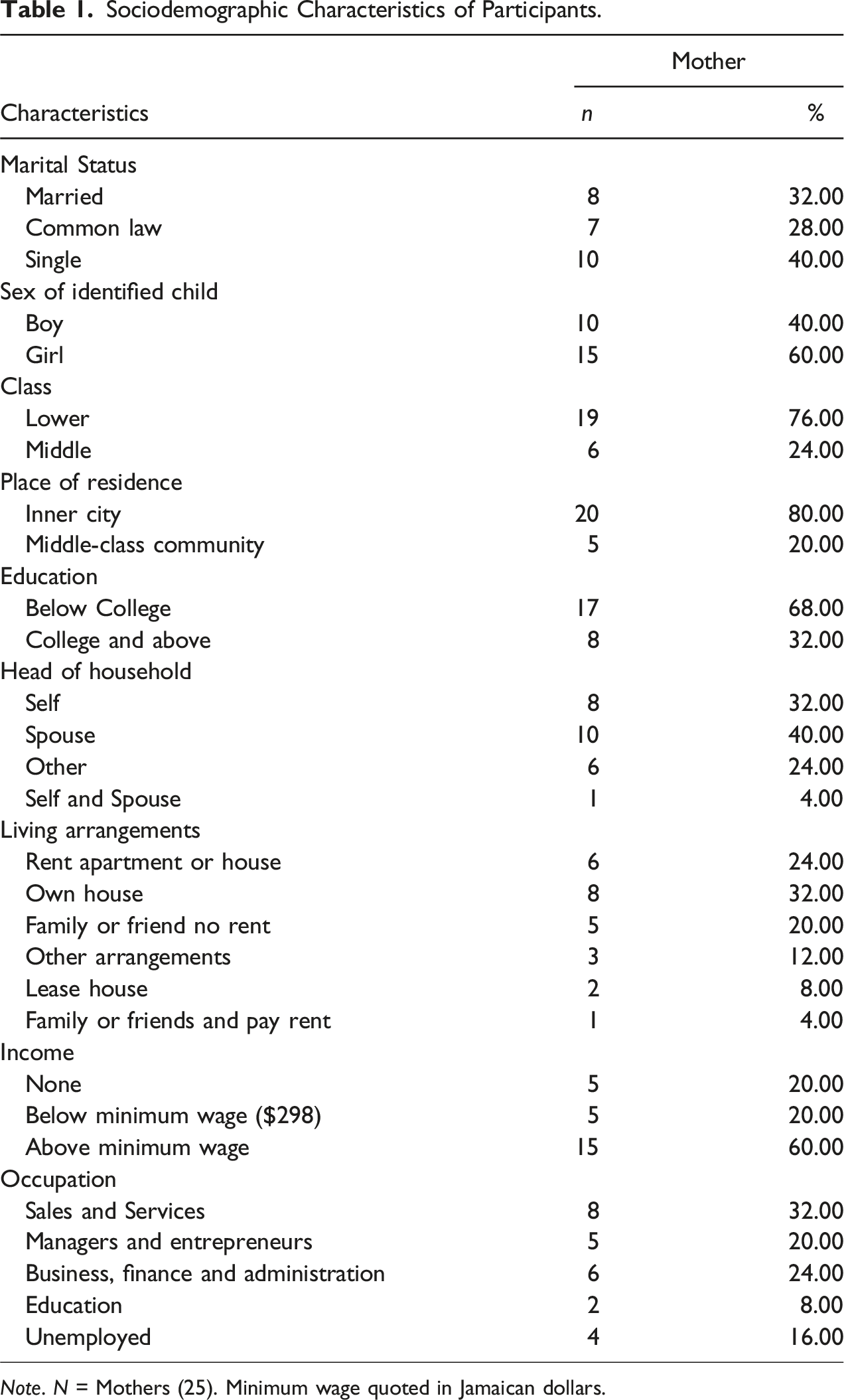
Note. N = Mothers (25). Minimum wage quoted in Jamaican dollars.
Interview Protocol
Individual semistructured interviews were conducted at homes (7), offices (12), workplaces (3), and other locations, such as children’s schools and spouses’ workplaces (3). Mothers were able to use English and/or the local dialect (Patois) because the field researcher is native to Jamaica and fluent in both. Before the interview, the interviewer provided relevant information about himself (e.g., familiarity with Jamaican culture and working with parents from several communities in Kingston and St. Andrew as a school counselor) to establish common ground regarding experiences in the Jamaican context.
The interviews were conducted in a preset manner on the basis of the approved protocol that was developed for the present study, including additional probing questions for clarification (e.g., “What do you mean by X?” and “Can you give me an example?”). The mothers were asked to provide additional thoughts one week after the interview on the basis of their reflections, but only one mother provided feedback. The protocol included 34 questions; however, in the present analysis, attention was given primarily to the following questions: “How would you define fatherlessness?”, “Why do you think that there is a significant number of children growing up fatherless?”, and “Why do you think that there is a significant number of children growing up in single-headed homes or broken homes?” All interviews were digitally recorded (M = 95.13 min, SD = 19.19, ranging from 68–145 min) and transcribed verbatim.
Analytic Strategy
Ritchie and Spencer’s (1994) five established stages of FA has been used in the current study. First, the research team immersed themselves in the data, including reviewing the data corpus, highlighting key categories and ideas, and paying attention to diverse ideas and concepts. Specifically, the lead researcher and a trained postundergraduate research assistant read and discussed the transcripts. The ideas that emerged included similarities and differences in the perspectives of the participants, generating 68 codes (e.g., reasons for fatherlessness).
Next, a thematic framework was identified through the connection of primary issues, concepts, and inductive ideas from the codes. The thematic framework was based on the categorization of codes and primary research questions (e.g., how do Black Jamaican mothers construct fatherlessness and reasons for the phenomenon based on personal experiences as children, personal experiences in parenting without adequate fathering, observations in the cultural context, and social discourses regarding the impact of fatherlessness?). Fifteen major categories were generated and used to code (or index) the data with criteria for each code and consensus regarding the concepts, criteria, labels, and definitions. Another research assistant read and coded one of the transcripts to ascertain its application to the thematic framework and codes. Adjustments were made to discrepancies in the categories, resulting in a final count of 13 major categories. Both research assistants then indexed six (24%) of the same transcripts, further verifying the reliability or dependability of the thematic framework. Additionally, the coded segments were analyzed, and discrepancies were discussed. A comparison of the coded transcripts resulted in kappa scores of .44 to .94 (98.11% to 99.29% agreement) for the indexed category involving fatherlessness, which is the focus of the current study.
The data were subsequently indexed, applying the thematic framework to the data in textual form with annotations in NVivo. The research assistants indexed all the transcripts, and the lead researcher reviewed the index. The data were subsequently charted via the framework matrix developed in NVivo, after which the research assistants read the charted data and created summaries. The summaries were reviewed and finalized by the lead researcher. Finally, the data were mapped and interpreted, which involved combining key characteristics with the dataset interpreted as the whole narrative. The participants’ perspectives on fatherlessness were highlighted when the data were mapped and interpreted.
Methodological Integrity
The American Psychological Associations’ reporting standards for qualitative research were used to facilitate fidelity and utility (Levitt et al., 2018). One important step involved the use of 25 semistructured interviews to meet the criteria for a substantial number of interviews based of FA methodology requirements. Another step was the use of a team of researchers with expertise in areas such as human development, fathering, parenting, and qualitative research methodology. The lead researcher served as the field researcher and had frequent consultation with the team throughout the research design, data collection, and analysis. The members of the research laboratory also provided feedback. Additionally, there was openness in adjusting the research questions and design (Willig, 2013). To maintain credibility or authenticity, evidence of processes, changes, or decisions was retained for auditing (Koch, 1994). For the interviews, the psychotherapy training of the lead researcher facilitated a client-centered approach whereby personal attitudes were bracketed during the interviews and analysis of the data. Additionally, the multiethnic research team facilitated attention to both emic and etic perspectives throughout the data analysis.
Finally, the research team used many strategies to facilitate giving voice to the participants, presenting their perspectives. The strategies included using a thematic framework, providing excerpts from the participants, and paying attention to diverse and unusual perspectives. Additionally, the dependability or reliability of the coding frame was examined in NVivo via kappa and percentage agreement, and claims were supported with attention to seeking consensus on the auditing process, in depth, thick descriptions of participants, and researcher reflexivity (e.g., bracketing and memoing).
Results
The mothers in the current study discussed their views on the concept of fatherlessness and their beliefs concerning the reasons for fatherlessness. The application of framework analysis to semistructured interviews with 25 mothers generated two primary themes. The first primary theme, deficiencies in fathering, was explicated in three secondary themes: (a) a lack of male presence or influence in a child’s life, (b) a child’s feeling that they do not have a father, and (c) inadequate fathering. The second primary theme, diverse reasons for fatherlessness, was discussed with attention to five secondary themes: (a) irresponsible behaviors of mothers and fathers, (b) dynamics in male–female relationships, (c) impacts of life events, (d) a lack of role models, and (e) a lack of good social fathering. Collectively, the themes adequately map Black Jamaican mothers’ constructions of fatherlessness and possible reasons for this phenomenon. In the sections that follow, the themes are discussed with quotes, for example, using the ID codes assigned to the mothers involved in the study.
Deficiencies in Fathering
The first overarching theme, deficiencies in fathering, refers to children not receiving the necessary benefits of having a male figure who provides support and guidance. This lack of benefits could result from diverse parenting contexts, such as the death of a father, the physical absence of a father, a lack of support from a father, and a father choosing to stay out of a child’s life. As one mother opined: You have fatherless, your father can die, you have fatherless, your father is not around you and you have fatherless that the father is, he just doesn’t want to support his child. He doesn’t want to go around the child or he distant himself from the child. (MIH14)
The focus is on recognizing that there are different levels of fathering and different kinds of male involvement in a child’s life, making fatherlessness a phenomenon that exists “when there is absolutely no fathering” (MTD11) from the perspective of some mothers. For other mothers, fatherlessness must be evaluated based on the quality of input from a male figure, including a biological and social father. One mother emphasized that “fatherlessness would mean basically the lack of positive male influence… So, it can be both biological, like a biological father or a mentor” (MSH16). This theme was explicated in three subthemes: (a) lack of male presence or influence in a child’s life, (b) child feeling that they have no father, and (c) inadequate fathering.
A Lack of Male Presence or Influence in a Child’s Life
The first secondary theme, a lack of male presence or influence in a child’s life, encompasses a parenting context in which a child does not have the presence and/or influence of a father or father figure in their life. In this parenting context, a biological or social father may not be physically present in a child’s life. Additionally, there is no one that the child subjectively recognizes and identifies as their father. As one mother reflected: Like the person, the father is not being in their life; like they do not have anybody to say that is my father, to say, that is my father, he supports me, he sends me to school, he takes care of me and stuff like that. The biological father, and you have the biological father, and you have the nonbiological father because you can look up to your uncle as your father or your brother as your father. Somebody who supports you, who sends you to school and makes sure that you have everything you need. So, you don’t have to have a biological father. You can have like another person who you call your father. (MTG17)
Although biological and social fathers were discussed in their views concerning fatherlessness, some participants emphasized the importance of the biological father. One mother remarked, “you don’t have any biological father around Yeah” (MMS18). In contrast, other mothers reasoned that fathering could be effective whether it is biological or social fathering. One mother disclosed that fathering does not have to be performed by “your biological father but the male figure that stands to father the child” (MTD11).
Moreover, the parenting context may involve the presence of a biological or a social father, but this does not mean that the child is fathered. Unfortunately, a father or father figure may be present or known by a child, but the child could still be fatherless. As one mother explained: When a father does not play his role or yeah basically when a father does not play his role. You know that he is there, you know that he is the father but still he doesn’t show any interest. He doesn’t say alright then; I am going to look for my child. He doesn’t say he is going to help his child with her homework; he doesn’t do anything at all. He is just a father, father figure, what every you want to be. (MTM04)
Another mother also stated that a social father may be present but has chosen not to be involved in the life of a child, as highlighted in the comment, “but because that child is not his, some men will decide not to support or help the child; they will say this is not my child or whatever, so I do not have to do anything for the child” (MSW05).
A Child’s Feeling that They Do not Have a Father
In this second subtheme, a child’s feeling that they do not have a father, attention is given to the subjective fathering experiences of children. This sheds light on the view that how children feel about being fathered determines the perceived impacts of male figure(s) in their lives. Therefore, the presence of a male does not equate to fathering, or the absence of a male figure automatically results in fatherlessness. One mother insisted that the feeling of being fatherless, especially in relation to one’s biological father, negatively impacts the way that one feels about oneself. She said, “sometimes when you are fatherless, you feel less than you should. ... even though you can have parents or other family members that try to fill in for the father, you can still feel fatherless” (MTV24). Additionally, when a child feels fatherless, it results in a search to fill the emptiness that they are experiencing, as do many questions concerning the lack of fathering. As one mother noted: Well, it is just a feeling that is empty where you are searching for love from somebody who is not giving it, or they don’t really seem like they care somehow. That’s about it. Meaning a person who is supposed to be your biological father. In addition, they are not there; they are just there behaving like you don’t exist or anything. So, you are just searching for that person; you have questions, wondering why he doesn’t love me; why doesn’t he do the things that are needed, why? There are a lot of questions. You are just walking around wondering if you are the problem or most of the time, they say it is the mother who is the problem you know? (MAS03)
Moreover, there is fluidity in the experience of being fathered. Therefore, it is possible that a child may have fluctuations in their feelings of being fatherless. One mother explained that one could be experiencing fathering and then the father stops, as highlighted in the comment that “it can be a stepfather that your parent used to talk to, and they are not around anymore and you used to look up to that person as your dad, and they are not there anymore” (MIH14). Additionally, this fluidity exists, as a male figure can come into a child’s life at some point in life, and the child looks up to that person as their father. One mother concluded: No if there is someone else, they are not fatherless because if you find someone that can be a father to your child you know that is very, as I would say, that would be very good, the father wouldn’t be missing none at all, so a person doesn’t have to be a biological father to be your father. (MAS03)
Relatedly, the biological father may come into a child’s life at a later stage of development, and he is accepted as father by the child. As one mother argued, “not being there, none at all. I have since met my father, and me and my father have a relationship because I try to put things behind me” (MSW19). Furthermore, the person who meets the expectations of a father is the one that the child will regard as their father. One mother reasoned: The biological, if the biological father is not playing his role, then he's just a father as it relates to biology, but the person the child calls father would have been the one who meets all the other areas, especially the social and the spiritual and emotional, that intangible component. (MFT02)
Inadequate Fathering
The final subtheme, inadequate fathering, refers to the input of a biological father in a child’s life, but their contributions do not provide the optimal level of support and guidance that the child needs. First, this may be associated with the lack of physical presence in the child’s life. As one mother expressed: Fatherlessness, well it is the, I would define it as the lack of the presence, of the father’s presence, the lack of consistent presence of a father in a child’s life. Consistent to the point where that father is able to be the first point of influence in the child’s life. Not allowing society or anyone else to step in and influence that child. So, the consistent presence of, the lack of consistent presence in a child’s life that would cause that child to resort to someone else or another medium to provide that level of guidance and support that should be there from a father. Presence in the terms of even here physically, being there sharing the child’s space, yeah that’s how I term presence not a phone call. Not a pick up at school but being there when I wake up, being there on my first birthday my second, third, fourth, fifth, being there when I come home late from school after practice and not what I should say and not being obedient and you scold me for it that kind of thing. Just always is there in good and in bad times. (MLW27)
Second, inadequate fathering may be associated with a lack of sufficient male involvement in a child’s daily life. Importantly, being in a child’s home does not mean that the child is receiving optimal fathering as one mother observed, “so you can have a father in the house and he’s not there. Why? A father who is in the house and not involved with his children, he’s not fulfilling his role as father fully” (MFT02). Similarly, another mother reasoned: A state in which a child does not have the love, support, and guidance from a male figure on a daily basis. That child has no contact with the desires and expectations of a male in their life. So, they are fatherless. So, you can have a father in the house, and he’s not there. Why? A father who is in the house and not involved with his children, he’s not fulfilling his role as father fully. (MFT02)
Additionally, inadequate fathering exists when a father is there financially but is not physically in the home of the child. One mother stated that “he [the biological father] might be there financially, but he is going to be in that home [of another family], so the girl [the mother] will have to grow with her child and then you have a single-headed home” (MTM04). Alternatively, the father may be in the home of the child physically but is not carrying out the expected functions of a father, making the child experience certain levels of fatherlessness. As articulated in the comment, “so, whether a male is in the family yes or no, it can still bring a feeling of fatherlessness because it’s based on what you do would actually consider you to be a father and the role that you play” (MSI10). Another mother added to this line of reasoning in her reflection: An absent father could mean that the father is not physically there as well as he is there and that he is not doing what he is supposed to be doing inside of that child’s life. He might be providing money or sending the child to the most prestigious school, but that in and of itself cannot suffice. He is not there to tell the child this is wrong behavior; this is not right behavior. He might be there but the mother most of the times; the mother is driving the car or steering the ship in the home. (MLW27)
Diverse Reasons for Fatherlessness
The second overarching theme, diverse reasons for fatherlessness, refers to how mothers account for their understanding of the factors that contribute to fatherlessness. According to these mothers, many factors create fatherlessness for children. These factors may be associated with fathers’ families of origin, a lack of role models, poor choices of men and women, and the intersection of several factors. As one mother discussed: There are some isolated ones of course where they grew up with their father but it’s just not what they want, so I cannot pinpoint one significant factor that I would say would contribute to children being. There are several…factors: lack of opportunity for some men if you’re uneducated it’s harder for you to be successful, and if you lack drive because there are men who are not well educated but they’re trade-driven, so I think it comes down to an individual responsibility and what you want to contribute to society. (MTC21)
Moreover, the lack of opportunity is associated with economic challenges. As one mother emphasized, employment-related issues can have far-reaching negative impacts on families. She remarked “because if there were more jobs provided for them, you wouldn’t have had so many fatherless kids, motherless kids, homeless kids, things would have been better” (MSW07). In further highlighting the complexity of factors, another mother asserted the following: One may be some females, as we would classify as a one-night stand, and they just get caught by getting pregnant. So, they don’t have nothing, any contact for that particular person. So, that child becomes fatherless; father is nowhere to be found. Other instances, yes, the mother can know the father, but the father just chooses not to play the role of a father. Another one can be he just decided not to own the child, so may be the child still gets his name or may be the mother might give the child her name, and may be when the child gets older, she will just explain the reason for the child having her name and who really is the child’s father, but the child is just not there. (MSI10)
This primary theme was further explicated in five subthemes: (a) irresponsible behaviors of mothers and fathers, (b) dynamics in male–female relationships, (c) impacts of life events, (d) a lack of good social fathers, and (e) a lack of role models.
Irresponsible Behaviors of Mothers and Fathers
The first subtheme, irresponsible behaviors of mothers and fathers, focuses on how fathers and mothers have operated in unacceptable ways that negatively affect their children. Fathers demonstrated irresponsible behaviors in many ways, such as not taking responsibility for their children, having negative influences in their lives, having too many women and children, and not allowing themselves to be involved in things that positively influence their lives. As one mother concluded, “you have some of them who don’t want any responsibilities, so they take off from early and meanwhile you have some of them who mix with the wrong set of crowds” (MCL08). Similarly, another mother remarked, “males tend to stray. The males, because when you look in the school, there are fewer males in the classes, there are fewer males in church. Everywhere that there is positivity there is less males, why? I don’t know” (MTD11). Moreover, it becomes even more complicated when men are not responsible with their sexual behaviors and the number of female partners that they have. As one mother reflected, “or sometimes they get too many kids, and they have too many women; they have too many women that they have to support. So, they do not have any time to support their children” (MSW12). Similarly, another mother said, “or just some men who feel that they should just have kids, here, there and everywhere. They just don’t take care of them, and they just go about their business” (MIH14). Importantly, their irresponsible behaviors also have negative repercussions for women, as one mother articulated: Some of the fathers don’t want to be responsible for their child. They don’t want to be a father; they just want to live free. ... They spoil us mothers by breeding us multiple times and then leaving us with all the children while they get to be free. They get to go and find ways to make life better for themselves while we have to stay with the children, burdening ourselves. (MTV24)
In contrast, mothers also demonstrated irresponsible behaviors in many ways, including not getting to know men properly before being involved with them sexually, not being responsible sexually, and being simultaneously involved with more than one male sexually. One mother chronicled the complexity of not knowing the background of the male, allowing things to get out of control in the context of partying, and having casual sex when one is already in a relationship with another male. As she noted, these circumstances can result in the mother not even knowing the real father of the child: I think it is because most of the time, the mother doesn’t really get to know the father’s background. And then sometimes you just go to a party and things get out of control and you don’t even know who is the child’s father because of certain type of life of living. Okay you go to a party and you meet this guy for the first time in your life, and you end up in bed with the person. You might never see that person ever again. So, that child, you got pregnant, and that child grows up not know who he/she father is. You yourself as the mother does not know who the father is because you can say that you slept with that man but at the end of the day, you had somebody else, right. When the child is born and if you see any differences in the appearance of the child and then you demand a DNA test, and it is not the gentleman that you are living with. At the end of the day, maybe you don’t even have a flashback and say I wonder if it is the man that I met at the party or what; you just end up with that child and you don’t know that child’s father (MSW07).
Similarly, another mother said, “sometimes what happens is that a woman might talk to more than one man, maybe two, sometimes three. It depends. Have a relationship with more than one or two men…having sexual intercourse with the person” (MCH06).
Dynamics in Male–Female Relationships
The second subtheme, dynamics in male–female relationships, refers to how issues between partners can affect the engagement of fathers with their children. These issues include a lack of trust, a female becoming involved with a man who has another family, a mother not assigning paternity to the right father, a mother deciding to leave an abusive relationship, a mother not allowing the father to be involved in the child’s life, and a father choosing not to be involved in the child’s life because he is not sexually involved with the mother of the child. One mother described the complexities of involvement with multiple partners: Say, for instance, she has two partners; she sleeps with the two partners and say for instance, the man might know that she has a different man out there and she is having intercourse with the two men. She got pregnant for one because you can’t pregnant for two men. So, she got pregnant for the man she lived with, for instance, she would have used protection with the outside man; he doesn’t know that. She doesn’t use protection with her right man. So, she gets pregnant now, but the man insists that the child is not his. So, you cannot tell a man he is wrong to say the child is not his because you don’t know what the woman has been doing. (MLM01)
A mother not assigning paternity to the right father is concerning. As noted in the comment, “some fathers don’t care, some died and sometimes the mother to be truth and in fact doesn’t give the child to the right father, maybe that is the reason why” (MIH14).
Another area of impact is the separation between mothers and fathers. In such circumstances, the father may decide not to be involved in the child’s life for several reasons. As one mother articulated: Because the mother and father have separated. Or the father has just decided that he is not going to shoulder any of his responsibilities, so he is gone. Or maybe, just maybe the father is already in a relationship or already has another home, so that young girl got pregnant for that father and so that’s just it. He has two sets of families, but he has to stick with one. So, the next one is going to grow up without a father. (MTM04)
The mothers also noted that because of separation, fathers are not involved in their children’s lives because they are not sexually involved with mothers of their children. As one mother passionately stated: If you and they are not having sex, then they are not going to look on the child. They are going to make you know that the man whom you are in a relationship with must take care of the children. They don’t care if the child is theirs.” (MAS03)
Moreover, mothers may choose to separate from fathers for good reasons, such as leaving an abusive relationship. One mother said, “some mothers are being abused by men and so they decide to just walk away from that situation even though some of them would really love for the father to be in their child’s life” (MSW05). Thus, the mother may prevent a father from being involved in a child’s life for many reasons, as noted in the comment: But I think we, society, let it seem that it is the mother, sometimes it is the mother’s fault that is the reason the father isn’t allowed to play that important role in their child’s life. Not giving them the opportunity to visit. I mean for those who are not together and for those who are not married. Yeah, giving the fathers time to visit their child. (MSW05)
In contrast to the other mothers, one mother mentioned that men sometimes do not want children and, women when try to trap them by having children with them. She said, “I guess some of the Black men would say they really didn’t want children, but you know the woman trapped them” (MTS20).
Impacts of Life Events
The third secondary theme, impacts of life events, refers to how various circumstances or issues in life affect the trajectories of fathering. For example, a father may be permanently separated from a child through death or forcefully separated because of being in prison or jail, as articulated in the remark, “so, when they should be with their child you hear that they are in jail or they are in prison or they are dead, you know?” (MCL08). Furthermore, fathers may be separated from their child because of distance due to migration, as reflected in the comment, “it is either they are away abroad, or they are not alive” (MSW05). Another mother added, “so you know that some of them, their father died and some of them went away even that, and they didn’t come back for their child” (MLM01).
A Lack of Role Model
The fourth subtheme, a lack of role model, refers to fathers not having the appropriate input from their biological fathers or other men in their lives. For these mothers, fathering was reinforced when children grew with both parents. One mother explained: I’m not sure because I think it differs based on culture and based on upbringing. Based on my experience and what I’ve seen, the men who have, who grew up with both parents and a strong father figure growing up with they tend to be the type of men who want to be around for their children, to contribute to their children’s life the same way their father did to theirs. So, most of the men that I know who don’t play a significant or any role in their children’s life are men who don’t, there was nobody around to teach them how to be a father. So, they don't know how to do it. (MTC21)
A Lack of Good Social Fathering
The final subtheme, a lack of social fathering, refers to children not having input from social fathers in their lives, especially when their biological fathers are not present or involved. For example, there may be a stepfather, but he does not impact the child’s life in meaningful ways. As one mother commented, “yes, or stepfather, because you have some stepfathers, they really don’t make any sense” (MCL08). Often, stepfathers do function the way that they should as they may be just focusing on biological ties as the basis for fathering. One mother remarked, “but because that child is not his, some men will decide not to support or help the child; they will say this is not my child or whatever, so I do not have to do anything for the child” (MSW05). Additionally, the mothers noted that society has changed, and this has negatively affected the input of other men in the lives of children in communities as reflected in the following remark: So, if the same structure that existed in our grandparents’ time, where the community was involved, even if the physical presence of the dad was there, the biological dad was not in there, there would be someone else who would fill in and that would somewhat make up for any gaps that a child or children might have. I believe so. (MFT02)
Discussion
The aim of the current study is to explore how Black Jamaican mothers construct their understanding of fatherlessness, involving nature and reasons for the phenomenon. Framework analysis generated two primary themes. The first primary theme, deficiencies in fathering, was delineated across three subthemes: (a) a lack of male presence or influence in a child’s life, (b) a child’s feeling that they do not have a father, and (c) inadequate fathering. The second primary theme, diverse reasons for fatherlessness, was discussed with attention to five secondary themes: (a) irresponsible behaviors of mothers and fathers, (b) dynamics in male–female relationships, (c) impacts of life events, (d) a lack of role model, and (e) a lack of good social fathering. These results captured the mothers’ construction of fatherlessness and reasons for the phenomenon. Although they discussed fatherlessness as a phenomenon that exists, they noted that it has many faces and is often complex to ascertain. Importantly, these results highlighted a continuum and fluidity in the phenomenon of fatherlessness. Additionally, the mothers shed light on contextual, personal, and complex reasons for the existence of fatherlessness, indicating that there are negative effects on mothers, fathers, children, and communities. Collectively, the results indicate that the role of the father is important for child development, making it necessary to address the factors that contribute to fatherlessness as a phenomenon experienced at different levels and in various ways by children.
Complexity and Fluidity of Fathering
Similar to Black Jamaican fathers’ perspectives on fatherlessness (Green et al., 2019), these Black Jamaican mothers revealed that fathering is complex and fluid. Consequently, care must be taken when applying the label of fatherlessness, as children can be fathered by both biological and social fathers, making it challenging to ascertain whether children are fatherless. The lack of physical presence of a biological father does not equate to fatherlessness, as meaningful input from social father(s) can compensate (Green & Chuang, 2021). Additionally, a biological father may be physically absent, but he is still involved in a child’s life in various ways (Culpin et al., 2015; Markowitz & Ryan, 2016; Zhang et al., 2020). Furthermore, social fathers, such as grandfathers, may mitigate the negative impacts of biological fathers’ absence on both cognitive and noncognitive skills in some cultural contexts (Radl et al., 2017). In the current study, the mothers highlighted that a lack of male presence or influence in a child’s life may be regarded as fatherlessness, but care must be taken to not conflate family structure and the physical absence of fathers as fatherlessness.
Moreover, it is important to consider the perspectives of children when applying the label of fatherlessness. As a previous study among Black Jamaican fathers revealed, it is possible for fathers to be present in the home, but their children do not believe that they are fathered and that fathers may be absent; however, children still experience various levels and types of fathering (Green et al., 2019). Additionally, children often receive significant input from other men in their lives, such as paternal and maternal uncles, grandfathers, neighbors, and educators, who serve as social parents whom children recognize or subjectively ascribe the title of fathers (Clowes et al., 2013). Moreover, nonresident fathers can make meaningful contributions to children’s well-being, including social and emotional, as well as behavioral adjustments and academic achievement (Adamsons et al., 2013). Importantly, both biological and social fathers contribute to children’s emotional well-being (Kesebonye & Amone-P’Olak, 2021). This underscores the subjective experience of fathering (Meuwissen & Englund, 2016), resulting in fluidity in fathering, as children can experience different types and levels of fathering over time (Green et al., 2019). Thus, while highlighting the important contributions of biological fathers, the role of social fathers should not be pathologized or undermined in the discussion of fathering or fatherlessness and the impacts on children, leading to social policy that promotes social fathering.
In the discussion of fatherlessness, inadequate fathering is often mislabeled as fatherlessness. As these mothers explained, fathers may be involved in their children’s lives, but they are not playing their role as they should. This finding is consistent with previous research among Black Jamaican fathers, which revealed that fathers often do not live up to their responsibilities to their children regardless of the reasons associated with them being absent (Green et al., 2019). Similarly, Ashari (2018) reported that the presence of fathers in the home may still be associated with psychological and emotional disengagement. Additionally, the biological essentialism beliefs that fathers hold affect their fathering behaviors (Ross-Plourde et al., 2022), and fathers’ subjective experiences of being fathered also influence their own fathering (Brown et al., 2018). Thus, social policies are needed to promote prenatal classes in the transition to fatherhood to influence appropriate fathering intentions.
Influences of Choices on Fatherlessness
The mothers discussed how poor choices of men and women can lead to fatherlessness. This finding is consistent with those of previous studies, which revealed that a lack of fathering can be affected by poor choices, such as premature sexual initiation, risky sexual practices (Pawlowski et al., 2024), and the abuse of substances such as alcohol and drugs (Flouri et al., 2015). As these mothers explained, both mothers and fathers often behave in irresponsible ways that negatively affect children’s experiences of fathering, which is further complicated by intergenerational patterns (Ručević & Ajduković, 2016). Therefore, Jamaican men and women need to be taught age-appropriate sexual decision-making skills, especially as they transition to adolescence and emerging adulthood.
Contextual Influences on Fatherlessness
The mothers acknowledged that fatherlessness cannot be understood without attention to bioecological factors. First, at the microsystem level, individual characteristics interact with the immediate settings and relationships of fathers, which may result in fatherlessness. The mothers explained that dynamics in the male–female relationship often created difficulties that resulted in fatherlessness. Unique to the Jamaican context is the tendency for men to stop fulfilling their obligations to their children when relationships end between fathers and the mothers of their children and when they are not sexually involved. Research has revealed that many children have little to no contact with their father after divorce (van Spijker et al., 2022), leading to negative impacts on children (Kalmijin, 2015). Similarly, research involving Black Jamaican fathers revealed that men often choose not to be involved in their children’s lives when they are not in a relationship with the mothers of their children (Green et al., 2019). The lack of continued relationships with children is influenced by factors such as mistrust, as new female or male partners tend to be concerned that the relationships between former partners are not just about the affairs of their children but also involve sexual engagement. This highlights how exosystems can negatively influence fathers’ involvement with their children. The exosystems are even more complex in the context of multiple partner fertility, as they affect the economic resources that fathers have available to care for their children (Guzzo et al., 2014; Kim et al., 2024). Thus, intervention programs are needed to support parents in how to navigate broken relationships in the best interest of their children.
Second, fatherlessness is influenced by the mesosystem, including interactions between family and neighborhoods. The mothers noted that life events, including negative influences in communities, death, and imprisonment, can affect fathers’ availability to their children. As these mothers observed, the negative influences in communities that impact fathers are exacerbated by a lack of role models and social fathering. This finding is consistent with previous research, which revealed that social fathers can serve as role models and father figures for children when biological fathers are absent and/or engage in inadequate fathering (Culpin et al., 2022; East et al., 2020; Green et al., 2019). However, in contrast to previous research that highlights how factors such as community barriers and social stigma result in many fathers disengaging from their fathering responsibilities after separation or divorce (see Petren & Ferraro, 2024), the present study sheds light on the possible negative impacts of communities on the ways in which fathers navigate fatherhood. Therefore, community resources that provide services to fathers should be a top priority for enhancing fathering (Tarrant et al., 2024).
Finally, the mothers mentioned that there are factors associated with the macrosystem that influence fathers’ availability to their children. Although previous studies have indicated that fathers face several barriers, such as a lack of economic resources and social support (e.g., Green et al., 2024; Russell et al., 2024), the present study highlights unique cultural influences. For example, the mothers mentioned that sometimes when a man is no longer in a relationship with the mother of his child, the man expects that the mother’s new intimate partner should take care of the child. This may be associated with the impacts of slavery and epigenetics given the disruptions and undermining of the role of fathers during slavery (Green & Chuang, 2021). There is also cultural pressure to prove femininity and masculinity through parenthood (Green et al., 2019). Additionally, macrosystems have been interacting with the chronosystem over time through the high prevalence of common-law unions and female-headed households. Moreover, as these mothers emphasized, women may have children for men to trap them in relationships. Thus, social policies are needed to create awareness of cultural impacts on fatherhood, as are resources to support fathers in embracing their paternal responsibilities.
Limitations and Future Directions
The current study generated a deeper understanding of fatherlessness from the perspective of Black Jamaican mothers, but there are several limitations. First, the study included mothers from a specific region in Jamaica and may not reflect the perspectives of mothers across other regions. Second, the study used self-reports through semistructured interviews, which may have created subjectivity bias in the views presented by the mothers. Data triangulation through focus group discussion and quantitative measures may present a more nuanced understanding of fatherlessness as a phenomenon. Third, it would have been useful to explore mothers’ perspectives on the impacts of fatherlessness on children and their mothers, as well as how they think fatherlessness should be addressed. This would add depth to their perspectives on fatherlessness as a phenomenon with more objectivity.
Future studies should consider longitudinal approaches to examine how the experiences and perceptions and impacts of different types and levels of fatherlessness evolve over time. Additionally, it would be beneficial to include the perspectives of children to generate a more comprehensive and nuanced understanding of the phenomenon. Investigating the role of social fathers and other male figures in different cultural contexts could also provide a deeper understanding of how fatherlessness is mitigated or exacerbated by community and cultural dynamics.
Conclusion
This study sheds light on the complex and multifaceted nature of fatherlessness from the perspective of Black Jamaican mothers, which warrants carefulness in assigning labels to children. An examination of the various factors that contribute to fatherlessness and the diverse ways and levels in which it may be experienced has provided a nuanced understanding of the phenomenon. The findings underscore the importance of considering cultural, social, and economic contexts when addressing fatherlessness. A holistic approach that involves multiple partners should be used to create a more supportive environment for children and families affected by fatherlessness despite the levels and types.
There needs to be targeted interventions such as support systems for single mothers and their children, which are essential to mitigate the possible negative impacts of fatherlessness and promote the well-being of all children. Policymakers, community leaders, and social service providers should work together to create programs that promote positive father engagement even in nonresidential contexts. Educational programs and campaigns that challenge the stigma and misunderstanding associated with fatherlessness are needed to promote the importance of diverse fathering roles with the aim of changing cultural practices and shifting societal perceptions. Additionally, providing resources and support for social fathers and other male role models can help fill the gap that might be left by biological fathers who are physically or psychologically absent or who engage in inadequate fathering. It is crucial to address the socioeconomic factors that contribute to fatherlessness, such as un(der)employment and a lack of access to education, to create a more supportive environment for families.
Footnotes
Declaration of Conflicting Interests
The author declared no potential conflicts of interest with respect to the research, authorship, and/or publication of this article.
Funding
The author disclosed receipt of the following financial support for the research, authorship, and/or publication of this article: This study was funded in part by a Provost Postdoctoral Fellowship at the University of Toronto.
Ethical Statement

Data Availability Statement
The data are available upon request. Materials are available upon request.