




Abstract
The coming out process for LGB individuals involves not just the disclosure of sexual orientation but also the emotional and social dynamics between these individuals and their parents. This study aimed to explore parents’ experiences in the coming out process of LGB individuals in Türkiye. A phenomenological design was utilized in this study. Semi-structured interviews were conducted with nine mothers of LGB children. Participants were recruited through an association—a support group for families of LGB individuals—in Türkiye. Data were analyzed using thematic analysis. Three main themes emerged from the interviews: (i) Emotional Reactions to Coming Out, (ii) Behaviors that Facilitate Acceptance, and (iii) The Consequences of Acceptance. The study highlights the complexity of parental experiences during their child’s coming out process. Understanding parental acceptance dynamics can inform interventions aimed at improving the mental health and well-being of LGB individuals and their families across various cultural contexts.
Introduction
The term “coming out” refers to the recognition of feelings of attraction towards those of the same sex, acting on such feelings, accepting oneself as a gay or lesbian, and disclosing this identity to others (Ryan et al., 2015). The coming out process is not only about disclosing one’s sexual identity but also involves a process of evolving and reconciling the experiences of both LGB children and their parents’ expectations (Alonzo & Buttitta, 2019). Furthermore, coming out to other LGB individuals can facilitate a sense of being valued, promote a positive sense of identity, and increase acceptance and endorsement for LGB youth (Matthews & Salazar, 2012).
Parents have essential roles in the psychosocial development of their children, especially during adolescence when sexuality and identity development are most evident. These roles continue throughout their children’s adulthood and lives (Bray & Stanton, 2012). Parents’ responses to individuals coming out can vary significantly based on cultural context. Cultural norms, values, and beliefs are crucial in shaping parental reactions to a person’s disclosure. Studies have shown that parental responses to individuals coming out can range from acceptance to rejection, and these reactions profoundly impact family relationships and the well-being of the individuals (Price & Prosek, 2020; Schmitz & Tyler, 2017). It has been reported that LGB individuals who have positive experiences with their parents in the coming out process feel a sense of integrity and coherence and feel more self-confident, free, and secure (Perrin-Wallqvist & Lindblom, 2015).
LGB family acceptance refers to the support, understanding, and acceptance provided by parents of LGB individuals who disclose (Cavallo & Bradley, 2018). Parental acceptance enables LGB individuals to express themselves, live their identities comfortably, and find emotional support. This process involves parents trying to understand the sexual orientation of LGB individuals, combating prejudices, and offering them love and support. Parental acceptance supports LGB individuals in leading a healthy family life, increasing their well-being, and creating a general atmosphere of tolerance and understanding (Ryan et al., 2015). This makes it easier for LGB individuals to integrate into society, build social relationships, and be accepted in their communities (Cavallo & Bradley, 2018). However, the research results in the last decade support the idea that parental reactions are much more diverse than simple rejection or acceptance. For example, D'Amico et al. (2015) have classified three main dimensions of parental reactions as parental support, parental struggles, and parental efforts to change their children’s sexual orientation. Jadwin-Cakmak et al. (2015) identified at least six reactions ranging from parental acceptance to rejection: immediate rejection, denial, individual acceptance but collective rejection, support without full acceptance, ambivalent acceptance, and full acceptance.
Studies that investigate the outcomes of acceptance or rejection of LGB individuals by their parents have risen over the past years. The majority of these studies have focused on the mental health of LGB individuals (Feinstein et al., 2014; Green et al., 2021; McConnell et al., 2016; Puckett et al., 2015; Vanbergen & Love, 2022). It has been shown that the mental health of LGB individuals whom their families reject due to their sexual orientation is negatively affected, and they tend to become homeless (McConnell et al., 2016; Ream & Peters, 2021). Based on the results of McConnell et al.'s (2016) five-and-a-half-year study with 232 LGB individuals investigating the effect of parental rejection on LGB individuals, LGB individuals with poor parental support were found to be at risk in terms of adverse mental health. The role of social support networks in the social adaptation of LGB young adults was investigated, and the importance of family acceptance and support was emphasized (Snapp et al., 2015). In addition, parental rejection (i.e., derogatory comments about the sexual orientation of LGB individuals, exclusion from family activities, and expulsion from home) has been associated with suicide risk, substance use, and depression in LGB individuals (McConnell et al., 2016). Due to leading to severe mental health outcomes such as suicidal ideation, it is important to address parental responses to coming out in studies (D'Amico et al., 2015).
While most studies addressed LGB individuals, some research targeted parents (Abreu et al., 2020; Gattamorta et al., 2019). The coming out process can also put significant pressure on parental relationships, cause inter-parental conflict, and exacerbate parental mental health problems (Willoughby et al., 2008). Parents generally face significant inner psychological challenges when their children come out. It is common for parents to experience a range of emotions, including sadness, denial, regret, depression, and guilt or shame during this process (Maslowe & Yarhouse, 2015). The current literature indicates that, while the initial reaction is negative among parents, the trajectory direction often leads parents to accept their LGB children over time (Gonzalez et al., 2013; Maslowe & Yarhouse, 2015). Factors such as media, social norms, misinformation, homophobia, parental education level, age, religion, marital values, and perspectives about gender roles can influence how parents react to, experience, and process coming out of their child (Baiocco et al., 2015). Parents’ negative reactions often stem from concerns about the child’s well-being, such as society’s perception of their child as LGB, the family’s perception of the child as an LGB, and the child’s mental and physical well-being (Conley, 2011; Wakeley & Tuason, 2011). More recent research suggests that this negative reaction trend may change and that positive reactions and experiences may increase among parents of LGB youth (Gonzalez et al., 2013; Grafsky, 2014).
All these research results reflect the significance of parental acceptance in LGB individuals. However, parents’ reactions to coming out of their children have yet to be thoroughly investigated and studied (Reczek, 2016).
In conclusion, the literature shows the critical role of family acceptance in terms of the mental health and well-being of LGB individuals. Understanding the complexity of family acceptance, cultural influences, and family experiences is crucial for developing effective interventions and support systems to improve the health and well-being of LGB individuals. Studies conducted with the families of LGB individuals could be more extensive in the literature. It is important to get an insight into this issue in a cultural context. This study aimed to examine the parents’ experiences in the coming out process of LGB individuals in Türkiye.
Method
Study Design
This study adopted a phenomenological design to examine the experiences of families who identify as LGB. The Consolidated Criteria for Reporting Qualitative Research (COREQ) checklist (Tong et al., 2007) was used to reporting of the study (see Supplemental Appendix 1).
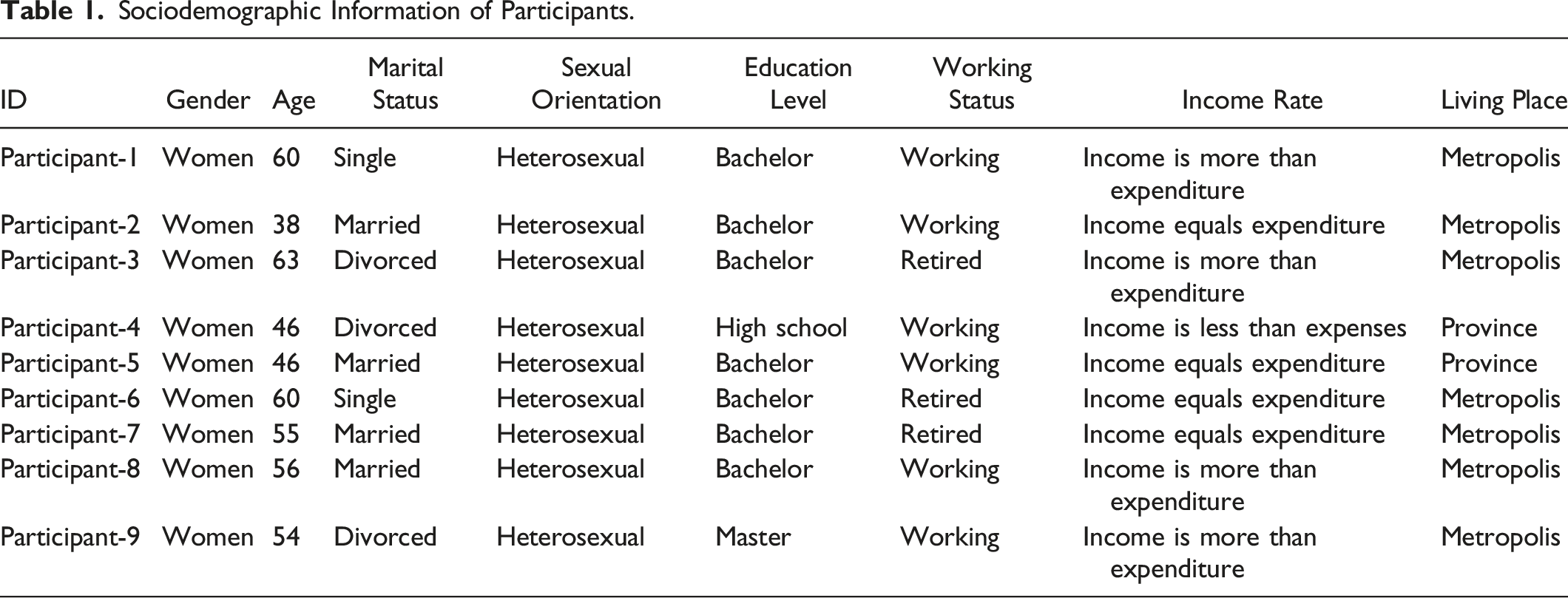
Participant and Recruitment
Sociodemographic Information of Participants.
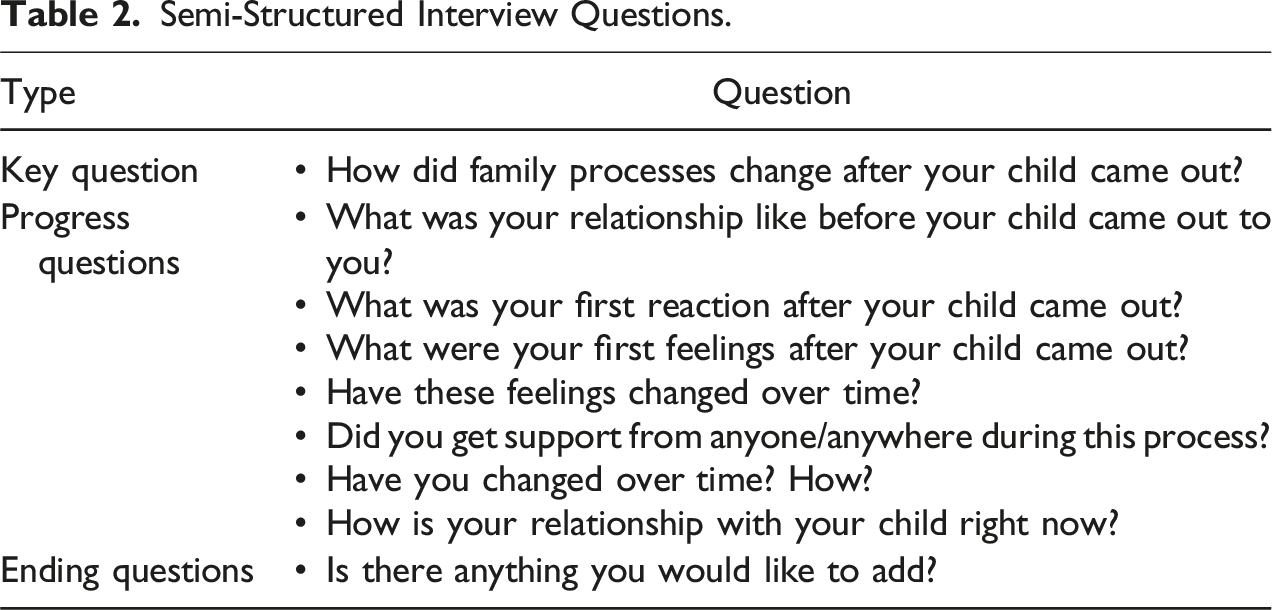
Data Collection
Semi-Structured Interview Questions.
Data Analysis
Data were analyzed based on Braun and Clarke’s (2006) theme analysis standards. Stages of thematic analysis are given below (Braun & Clarke, 2014): The researchers’ familiarity with the data was provided by reading the transcribed data repeatedly and noting initial ideas. The initial codes were generated by researchers with the essential features of the data systematically across all data sets, gathering the data relevant to each code. The codes were gathered under potential themes, collecting all data under possible themes to which they relate. The compatibility of the themes was checked with the coded data content (Level 1) and the entire data set (Level 2), composing the thematic “map” for the analysis. Clear identification and naming of each theme were made by definition and naming of themes to simplify the features of each theme. The report was prepared by selecting concrete, striking, and convincing examples of direct quotations, analyzing the coded data contents for the last time, re-associating the analysis results with the research question and the literature, and reporting the analysis in academic language. An experienced academician who was not on the research team reviewed the collected themes and codes, and the results showed that they overlapped.
Results
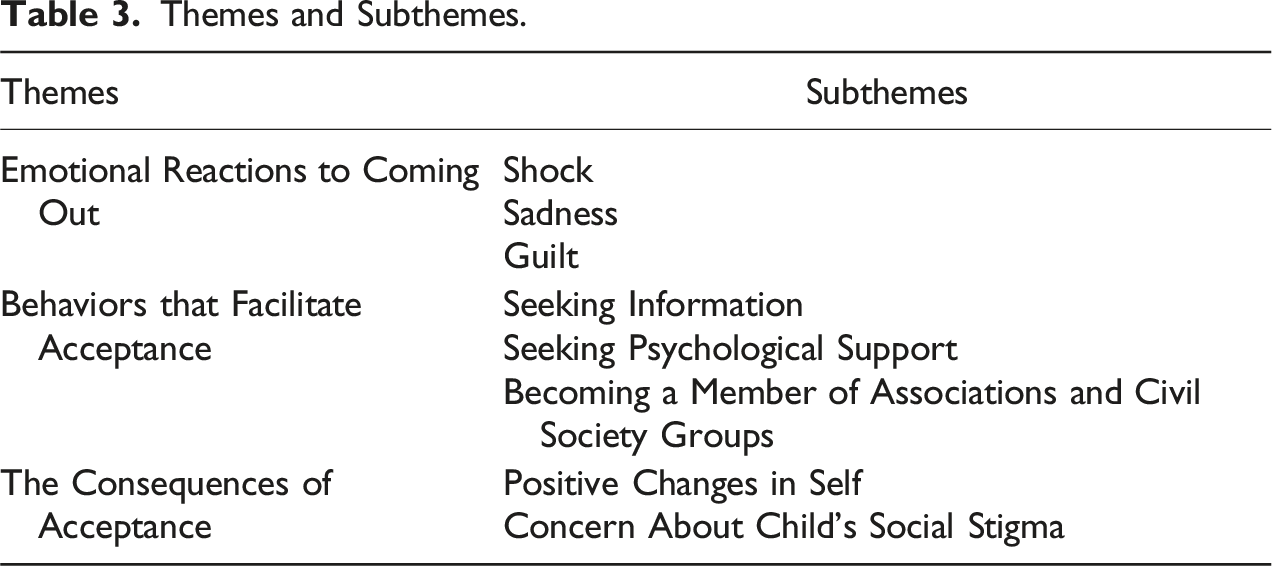
Themes and Subthemes.
Emotional Reactions to Coming Out: Exploring the Diverse Feelings and Psychological Responses of Parents During Their Child’s Coming Out Process
Throughout the interview, participants stated common emotions which formed subthemes such as Shock, Sadness, and Guilt. These emotional reactions highlight the complexity of parents’ feelings during this significant transition in their family’s dynamics.
Shock
The initial reaction for many parents was one of shock. This overwhelming feeling often left them momentarily at a loss for words and grappling with the unexpected nature of their child’s disclosure. I was frozen at the moment of coming out; I couldn't say anything. (Participant-5) It was really a shock to me. I was so afraid. I was in such a fright. I wasn't sure what to say. (Participant-8)
Sadness
Many mothers reported feelings of deep sadness, reflecting a profound emotional impact tied to their child’s coming out. This sadness often stemmed from a perceived loss of the future they had envisioned for their child. The greatest pain I had ever felt up until that moment. (Participant-3) My heart is broken, and I feel a tremendous amount of pain. (Participant-4)
Guilt
Guilt was another prevalent emotion among participants. Many mothers questioned their own actions and wondered if they had contributed to their child’s struggles, which can lead to a sense of isolation and self-blame. A bit of surprise, a bit of wondering if we did something wrong despite knowing everything. (Participant-7) I felt alone. I blamed myself. (Participant-3) I was scared. I wondered if it was because he saw his parents fighting all the time. (Participant-1) I blamed myself a lot. I wondered if I did something behaviorally that made my child like this. (Participant-2)
Behaviors That Facilitate Acceptance: Parental Actions and Their Impact on the Acceptance Process
Through the interviews, participant stated common experiences, and three subthemes were composed as Seeking Information, Seeking Psychological Support, and Becoming a Member of LGBTQ+ Associations and Civil Society Groups.
Seeking Information
After the coming out of their children, participants stated that they were engaging in information-seeking actions, which paths the way to the acceptance process. Mothers indicated appreciating and embracing their children when they get knowledge of their child’s sexual orientation. I immediately started asking about what this topic was online and from those around me. (Participant-5) …I've been on YouTube a lot. I've watched videos with different titles in England, Canada, USA, Switzerland, Europe, Ireland… So I made myself such a big mind map. (Participant-9) … Because I really didn't know anything. I mean, especially for example, LGBTQ+, they are such a big spectrum and color that as you learn, your perspective changes. Those stereotypes and prejudices are considerably reduced. (Participant-6)
Seeking Psychological Support
Participants also indicated they sought psychological support to help them process their emotions and reactions. Engaging with professionals provided them with coping strategies and reassurance. I consulted a psychiatrist. I requested help from a psychologist to find a solution. (Participant-3) …I interviewed with a therapist at that time, of course I got a great support. I think it was very helpful in terms of the acceptance phase. (Participant-8) …I mean, I was actually very relief to hear those basic concepts from the perspective of an expert. In general, mothers and families may feel that I raised them wrong or I did something wrong and this child became like this. Mostly there is this feeling…I was very relieved to learn that this situation is natural. (Participant-6)
Becoming a Member of LGBTQ+ Associations and Civil Society Groups
Participants found that joining civil society organizations and support groups was highly beneficial in navigating the acceptance process. These connections provided a sense of community and shared experiences. I met with LISTAG, and I can say it was very beneficial for my acceptance. (Participant-7) …I mean, I went to Listag's meetings, I went to the camp and met the mothers there, I hosted the children in my home, I organized parties and meetings. (Participant-9) When I contacted the association, I got a long way with them, because you don't know what to do. I mean, you are alone, there are not many people you can talk to, but the families there were really supportive in there and they supported us a lot. (Participant-2)
The Consequences of Acceptance: What Did Acceptance Change To?
Participants reported positive changes in themselves as a consequence of acceptance, as well as concerns about their children.
Positive Changes in Self: How Parents Transform and Grow Through the Process of Accepting Their Child’s Orientation?
Participants indicated they engaged in activism regarding LGBTQ+: “I carried the flag on the front lines.” (Participant-3) “We put on T-shirts with rainbows and participated in pride marches.” (Participant-1) Learned to be patient: “I learned to be patient during this process.” (Participant-5) “I think I've learned to be a little more patient towards my children.” (Participant-1) Strengthening bond with their children: “Our relationship improved a lot after my child came out, and it felt good to me.” (Participant-7) “… My child didn't share much with me before; after the disclosure, we shared more and more…” (Participant-1)
Concern About Child’s Social Stigma
Parents frequently express great concerns about their child’s well-being and safety in a potentially biased setting. These worries are an understandable reaction to the societal issues that LGBTQ+ people frequently encounter, such as discrimination, exclusion, and violence. I worry a lot about how they will live in this society and how they can protect themselves. (Participant-5) …Because we are worried about our children… If we become a conscious society, we can improve it, but unfortunately they have no safety in our country right now… (Participant-1) … cousins will bring their partners to family meetings. Would my child be there in the same state of comfort? Will he/she be in that happiness? I mean, there is the social dimension, the environment, and culture…How will my child be there? (Participant-2)
Discussion
This study aimed to examine the parent’s experiences in the coming out process of LGB individuals in Türkiye. This study is important for its first study addressing the parents of sexual minorities in the Turkish population. The three main themes emerged based on interviews: Emotional Reactions to Coming Out, Behaviors that Facilitate Acceptance, and The Consequences of Acceptance. These results are aligned with and differ from the existing literature.
The main point is that all participants were mothers, even if we were not limited to participants as mothers, and all mothers were in a state of acceptance. A notable study by Rosario et al. (2014) indicates that mothers of sexual minority children tend to show more comfort with their child’s sexual orientation than fathers. This difference may be linked to mother–child relationships’ emotional and relational aspects, which generally encourage more open communication and emotional support. The study also highlights that mothers’ attitudes may evolve over time, aligning with other research showing that parents generally become more accepting as they adapt to their child’s sexual orientation.
In this study, mothers explained their emotional reactions, such as shock, sadness, and guilt, after the disclosure of their child. The studies emphasized that emotional responses were the basis of the parental experience. Newcomb et al. (2018) emphasize that many parents deal with feelings of grief and concern, which can unintentionally convey negative attitudes about their child’s LGBTQ identity. Similarly, Mirković and Jerković (2021) found that mothers of LGBTQ children often reflect on their influence over their child’s sexuality and experience difficulty in accepting their child. These reflections can lead to an acceptance period where parents must align their expectations with their child’s orientation. Supporting this, in the current study, mothers experienced the acceptance period after the emotional responses. Shock, sadness, and guilt are the emotions of the grief cycle, and healthy grief results in acceptance. Mothers may have grieved the dreams they had for their children.
Also, the mothers indicated that when they get knowledge about LGB terminology and reveal misinformation, they are close to acceptance. Parental acceptance is a dynamic process influenced by different factors, including knowledge and understanding of LGB issues (Huang, 2022). Parents who engage in learning about their child’s sexual orientation tend to develop empathetic responses, which can facilitate open communication and strengthen the parent–child bond.
In the current study, mothers stated they have changed positively. Disclosure can also foster a sense of empowerment among LGBTQ parents. Gonzalez et al. (2012) found that many parents report positive aspects of having an LGBTQ child, including the development of critical thinking skills and a rejection of societal norms that stigmatize their child. This empowerment can lead to stronger family bonds and a more profound understanding of diversity within family structures. In line with this outcome, mothers said they learned to be more patient and activist in this study and indicated building strong bonds with their children.
Moreover, parents can promote acceptance by intentionally addressing homophobic attitudes and behaviors within their social networks. Campbell and Perales (2022) suggest that parents who advocate for their LGB children and actively oppose discrimination help foster a more inclusive family atmosphere. Such advocacy not only enhances the parent–child relationship but also serves as a model for the child, reinforcing positive behaviors and empowering them to confront prejudice. In this study, mothers became members of an LGB advocacy association and then became activists and improved their bond with their children. This dynamic has highlighted the importance of sustained support for both parents and children in this process.
Furthermore, stigma linked to sexual minorities can lead to the need for stigma management among parents as they navigate societal perceptions and expectations of their families (Goldberg, 2023). However, the process is not without its challenges. In contrast to the current study, some parents reported having a decline in their relationship with their child in post-disclosure, as highlighted by Goldberg & Sweeney (2019), who note that the coming out process can sometimes lead to conflict or distortion between parents and children (Goldberg & Sweeney, 2019).
Mothers in this study indicated their concern regarding social stigma. The results were in line with the study of Mirković and Jerković (2021). The mothers’ most common reaction in this study was fear for the child’s safety due to the hostile cultural and political context in which LGBTQ people live. The structural stigma towards sexual minority people differs in social context. With the coming out, social and environmental contexts may arise beyond the individual process, such as seen in those studies.
The results have shown the practical implications of working with mothers of LGB children in Türkiye. The implications highlighted the culturally sensitive support, which may differ in societal contexts, the importance of associations, supportive mechanisms, getting knowledge, and the grief cycle.
This study has several limitations. Firstly, the participants were only mothers willing and empowered enough to share their experiences. This means that the experiences of less accepting mothers were not included, which leads to a gap in exploring the whole spectrum of experiences to a child’s coming out. The second one is that since the sample comprised mothers living in a metropolis or province and having a working/retired status, the findings may not be generalizable to mothers from smaller towns and not working. The third one is that the study did not include fathers in the sample, which means the perspectives and experiences of co-parents remain unexplored. The findings are, therefore, limited to mothers’ viewpoints. The last one is that individuals who define themselves as transgender face unique challenges regarding mental health and gender-affirming surgery compared to LGB (Sharma et al., 2019). The parents of this population also face different challenges. Thus, we could not include transgender people’s families in this study. Future studies may address the experiences of transgender individuals’ parents.
Conclusion
This study explored important insights into mothers’ experiences in the coming out process of LGB individuals in Türkiye. These results highlighted the importance of ongoing advocacy and education to enhance acceptance. Ultimately, understanding the dynamics of parental acceptance can help shape effective interventions aimed at improving the mental health and well-being of LGB individuals and their families across different cultural contexts.
Supplemental Material
Supplemental Material - Parents’ Experiences in the Coming Out Process of LGB Individuals: A Focus on Mothers’ Journeys
Supplemental Material for Parents’ Experiences in the Coming Out Process of LGB Individuals: A Focus on Mothers’ Journeys by Seda Karakaya Çataldaş, Navruz Dokmuş, Ezgi Doğru, and Gazel Tarhane in Journal of Family Issues
Footnotes
Acknowledgments
We want to thank all the mothers who participated in this study and shared their valuable experiences.
Declaration of Conflicting Interests
The author(s) declared no potential conflicts of interest with respect to the research, authorship, and/or publication of this article.
Funding
The author(s) received no financial support for the research, authorship, and/or publication of this article.
Ethical Statement

Data Availability Statement
The data used in this study is available upon reasonable request from the corresponding author, Seda Karakaya Çataldaş.
Supplemental Material
Supplemental material for this article is available online.
References
Supplementary Material
Please find the following supplemental material available below.
For Open Access articles published under a Creative Commons License, all supplemental material carries the same license as the article it is associated with.
For non-Open Access articles published, all supplemental material carries a non-exclusive license, and permission requests for re-use of supplemental material or any part of supplemental material shall be sent directly to the copyright owner as specified in the copyright notice associated with the article.
