




Abstract
Stepfamilies are increasingly common and advancing research focused on the relational and interactional dynamics between stepparents and adolescents, particularly from the perspective of stepchildren, remains urgent. The current study employed qualitative methods to explore specific advice for new stepparents from stepchildren who experienced stepfamily formation during adolescence. Maximum variation sampling yielded a socio-demographically diverse sample of 18 emerging-adult participants who acquired and spent time living with a stepparent as they progressed through adolescence. Reflexive thematic analysis yielded the following six themes, reflecting detailed advice for new stepparents of adolescent stepchildren: prepare for the role, be real, be patient, don’t force it, carefully integrate (with six subthemes), and prioritize the adolescent (with three subthemes). The participants’ insights largely cohere with and augment extant literature, showcasing a holistic and comprehensive view of stepfamily issues and potential strategies to prevent or mitigate them. Practical implications and suggestions for future research are discussed.
Stepfamilies are an increasingly common family structure, which form when at least one adult in a new committed couple relationship brings a child or children from previous relationships (Ganong & Coleman, 2017). Researchers and practitioners have focused on stepfamilies for decades (Ganong & Coleman, 2018), in large part because of the unique demands that stepfamilies can experience. Common stepfamily-related demands include stepparent-stepchild tensions, disagreements between parents and stepparents about parenting approaches, coordination across complex caregiver networks that transcend single households, and efforts to cultivate a new family culture amid long-held patterns of interaction, among others (Papernow, 2013, 2018a).
Over time, increasing attention has been placed on identifying factors that promote stepfamily functioning and individual well-being in stepfamilies. On this front, research has highlighted stepparent-child relationship quality as a crucial correlate of various stepfamily and child outcomes. Indeed, stepparent-child relationship quality is positively associated with stepcouple relationship quality; parent-child relationship quality; and stepfamily expressiveness, harmony, and cohesion (Ganong, Jensen, Sanner, Russell, Coleman, & Chapman, 2019; Jensen, 2017; Jensen & Ganong, 2020, 2023). A recent meta-analysis also highlighted significant and robust associations between stepparent-child relationship quality and numerous indicators of children’s academic, psychological, and behavioral well-being (Jensen, 2022).
Given the demonstrable impact of stepparent-child relationship quality, a significant body of research has attended to factors that predict high-quality stepparent-child relationships. Importantly, a growing share of research in this area has centered the perspectives of children and youth by incorporating stepchild-reports of stepparent-child relationship quality. A recent synthesis of this literature highlighted correlates of stepparent-child relationship quality that fall into one of four categories: individual characteristics, family characteristics, features of (step)parent–child interactions, and stepcouple dynamics (Jensen & Howard, 2015). These domains of correlates highlight potential leverage points that could be targeted by interventions intended to cultivate high-quality stepparent-child relationships. Correlates related to stepparent-child interaction are relatively malleable, making them an especially attractive site for ongoing empirical exploration and intervention development.
Advancing research and intervention development focused on the relational and interactional dynamics between stepparents and adolescents is particularly promising and urgent. Indeed, increased focus on stepfamilies that form during a child’s adolescence is warranted on numerous fronts. For one, adolescents experience significant developmental changes across physical, cognitive, emotional, and social domains that can impact family processes (Berk, 2023). In terms of physical changes, adolescents progress through pubertal development and experience accelerated growth in the amygdala, the region of the brain enlisted for emotion processing. On the cognitive front, adolescents acquire significant cognitive capacities in the areas of abstract and critical thinking, which position adolescents for the deployment of criticism and idealism. With respect to social and emotional changes, common hallmarks of adolescence are the pursuit of autonomy, independence, and identity exploration; adolescents also tend to prioritize their social connections with friends and peers. Viewed together, the various developmental changes associated with adolescence can exacerbate the common demands associated with stepfamily life (just as they can in the context of any family structure).
Stepfamily formation involving adolescent children also can be challenging from a family-systems perspective. When adolescents experience stepfamily formation, they have a relatively clear picture of family life before and after that transition. Contrasts between pre- and post-stepfamily life can be stark, leaving adolescents with significantly more changes to which they must adjust relative to their counterparts who experience stepfamily formation as young children. Indeed, some children are so young when a stepfamily forms that the children have no memories related to the transition; for some young children, a stepparent may be one of the only caregivers they have ever known.
Despite the increasing attention being placed on stepfamilies formed with adolescent children, there remains a dearth of research focused on explicit insights adolescents have about how stepparents could or should approach their new role. Although there exist rich and practical compilations of insights about what works well in stepfamilies from the perspective of experienced practitioners (Browning & Artelt, 2012; Papernow, 2013, 2018a) and as indicated by stepfamily research (Ganong et al., 2025), there remain valuable opportunities to expand our understanding of what works well in stepfamilies from the perspectives of the youth involved.
To be sure, numerous researchers have attended thoughtfully and rigorously to the perspectives of young people who have connections with a stepparent. This research—both qualitative and quantitative—has yielded powerful insights about general patterns of stepparent-child relationship development, pathways to relatively positive relationships between stepparents and children, affinity-seeking strategies that stepparents employ to connect with new stepchildren, communication processes that undergird relational well-being between children and their stepparents, complex patterns of dyadic relationship quality in stepfamilies, and distinct patterns of stepparent-adolescent interaction, among other insights (Ganong et al., 1999, 2011; Jensen, 2017, 2019, 2021a; Jensen & Weller, 2019; Oliver-Backburn et al., 2022; Schrodt et al., 2007, 2008; Waldron et al., 2018, 2022). As a complement to this body of work, we stand to benefit from an overt, directed exploration of specific and detailed advice young people would offer new stepparents who acquire an adolescent stepchild. Consequently, the current study employed qualitative methods to seek an answer to the following research question: What specific advice for new stepparents do stepchildren have who experienced stepfamily formation during adolescence?
Direct advice to stepparents from the perspective of stepchildren who experienced stepfamily formation during adolescence might significantly augment extant practice-based insights and substantiate or extend past research featuring significant correlates of stepfamily functioning and the well-being of adolescent stepchildren. Moreover, given that one-third of youth are estimated to spend time living with a stepparent prior to reaching adulthood (Teachman & Tedrow, 2008), it seems prudent to seek insights about optimizing the stepparent role directly from individuals who experienced a relationship with a stepparent during their adolescent years.
Efforts to foreground the advice of young people from stepfamilies also might yield insights that could help stepfamilies navigate stepfamily formation as a form of ambiguous gain (Jensen, 2021b). Framed with respect to the Contextual Model of Family Stress (Boss et al., 2017), ambiguous gain can be defined as a situation of systemic relational acquisition, either physical or psychological, about which the facts are unclear (Jensen, 2021b). When applied directly to stepfamilies, stepfamily formation can be viewed as an ambiguous gain; marked by factual unclarity about the nature, purpose, or functions of various stepfamily relationships, particularly the stepparent-child relationship. The advice of young people for new stepparents might offer some measure of clarity for individuals navigating the transition to stepfamily life in the presence of one or more adolescent children.
Methods
Sample Recruitment and Characteristics
In alignment with the core study aim, the following eligibility criteria were applied to sample recruitment efforts: respondents must have (a) been between the ages of 18 and 25 (i.e., emerging adulthood) at the time of their interview, (b) been residing in the United States with an ability to speak English fluently, and (c) acquired and spent time living with a stepparent at the age of 10 or later. This last criterion was engineered to recruit participants who initiated and experienced a relationship with a resident stepparent as they were approaching and progressing through adolescence. In addition, the focus placed on emerging-adult respondents was intended to leverage respondents’ advancements in maturity and cognition as they reflected on the advice they would offer new stepparents with adolescent stepchildren (Berk, 2023).
Listservs associated with two undergraduate programs at a public university in the Southeast region of the United States were used to disperse study recruitment messages. In addition, a single-page study advertisement flyer was placed in the author’s campus building. To address common challenges associated with recruiting individuals who are or have been part of a stepfamily (Sanner et al., 2021), the following statement was included in all study advertisement materials: “Even if you would describe your stepparent as a ‘parent’ or not as family at all, your participation is still of value to this project.”
Potential participants were able to access a web-based screener survey from study advertisement materials by which they could confirm their eligibility, issue informed consent, provide sociodemographic information, and supply their email address as a method of contact for scheduling an in-depth interview. A $25 digital gift card was issued as a participation incentive. All study procedures were reviewed and approved by the Institutional Review Board of the author’s academic institution (IRB number: 24-0878).
The sociodemographic information provided by potential participants via the screener survey was used to implement maximum variation sampling, which enabled the assembly of a sample with varying perspectives with respect to gender identity, racial/ethnic identity, the biological sex of the resident stepparent, perceived family financial standing during adolescence, and household size (Suri, 2011). The final analytic sample was comprised of 18 emerging adults (age ranged between 18 and 23 years; average = 20.28 years; SD = 1.18 years), two-thirds (n = 12) of whom identified as women—17% (n = 3) identified as men, and 17% (n = 3) identified as non-binary. One-third (n = 6) of respondents identified as non-Hispanic (NH) White, 22% (n = 4) as NH Black/African American, 17% (n = 3) as NH Asian, 17% (n = 3) as Hispanic, 6% (n = 1) as American Indian/Alaskan Native, and 6% (n = 1) as Hispanic Black/African American. About 56% (n = 10) of respondents were connected to a stepfather versus a stepmother (44%; n = 8). Roughly 39% (n = 7) of respondents had a household size of four individuals; 33% (n = 6) had five, 17% (n = 3) had three, and 11% (n = 2) had six. About 56% (n = 10) and 61% (n = 11) of respondents reported having stepsiblings and half-siblings, respectively, during adolescence. Roughly 78% (n = 14) of respondents indicated having a non-resident parent during adolescence—17% (n = 3) did not and 6% (n = 1) were unsure. One-third (n = 6) of respondents described their family financial standing during adolescence as “average;” 28% (n = 5) indicated being “quite well off,” 22% (n = 4) indicated being “not very well off,” and the remaining 17% (n = 3) indicated being “not at all well off.”
Data Collection Procedures and Analysis
With reflexive thematic analysis as the orienting methodological approach (Terry & Hayfield, 2021), data were collected using in-depth, semi-structured interviews. All interviews were conducted in person in the author’s campus office. In the context of a larger project with multiple research questions, the interview guide prioritized a broad focus on the various ways that participants interacted with their resident stepparents during adolescence. Included toward the end of interview guide was the following specific prompt, to which the current study was anchored: “If you could give advice to all new stepparents who will be interacting with an adolescent stepchild, what advice would you give them?” Interviews had an average duration of 45 minutes and were audio recorded and transcribed in preparation for coding and analysis, resulting in 204 double-spaced pages of transcript data.
Each phase of reflexive thematic analysis was implemented as described by Terry and Hayfield (2021), namely, (a) data familiarization, (b) coding (semantic and latent), (c) initial theme generation, (d) developing and reviewing themes, and (e) naming and defining themes. During the familiarization phase, each interview transcript was reviewed in full prior to coding. Memoing was conducted throughout all project stages, including data collection and data analysis. Memos were used to capture (a) post-interview insights, (b) insights yielded from the data familiarization phase, (c) insights yielded from the coding phase, and (c) insights yielded amid theme development. MAXQDA was used to facilitate coding processes.
Results
Summary of Themes and Subthemes.
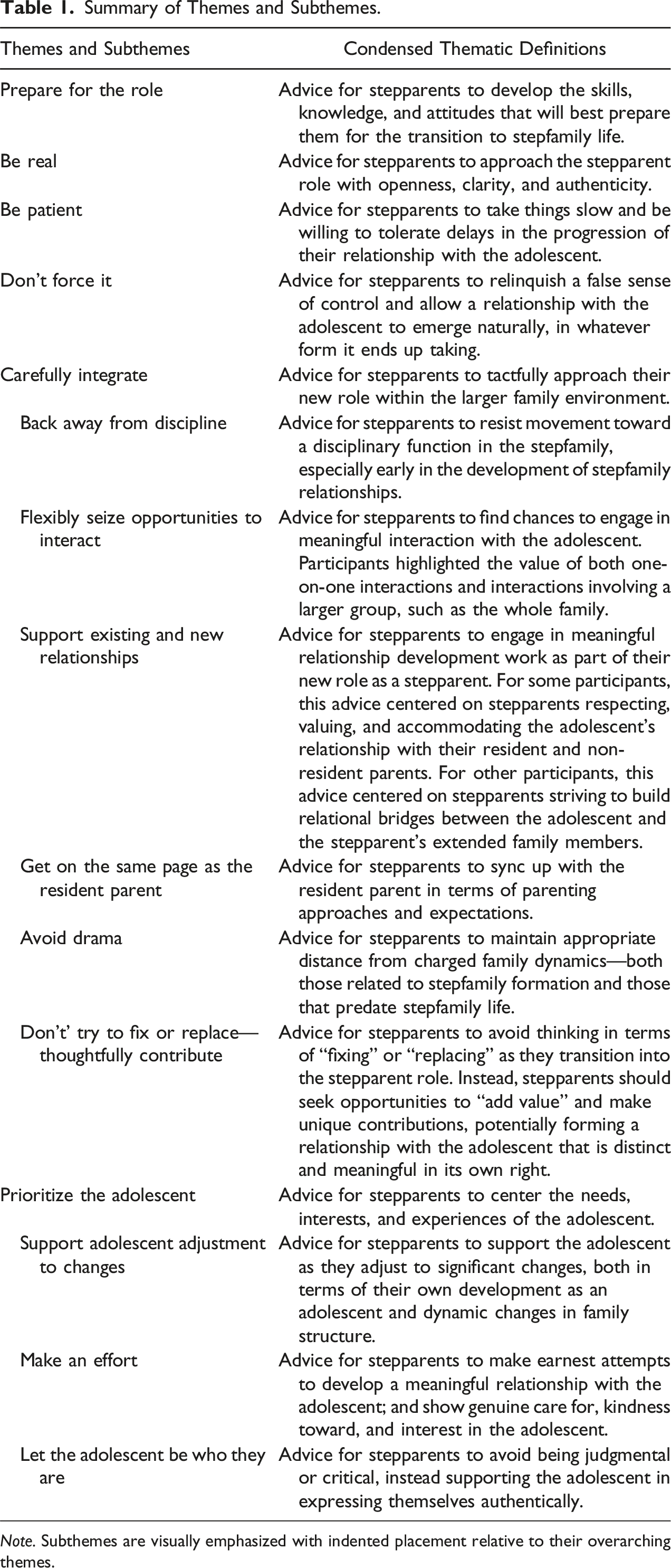
Note. Subthemes are visually emphasized with indented placement relative to their overarching themes.
Prepare for the Role
Prepare for the role reflects participants’ advice for stepparents to develop the skills, knowledge, and attitudes that will best prepare them for the transition to stepfamily life. Stepparents’ efforts on these fronts should include (a) anticipating challenges that are likely to emerge amid stepfamily formation, (b) developing emotional intelligence, (c) bolstering their capacity for emotion regulation, (d) thoughtful consideration of healthy and optimal parenting practices, and (e) acknowledging the weight of the stepparent role. Participants encouraged new stepparents to be mindful of how much influence they are going to have in an adolescent’s life, and to take that influence seriously. Some participants described the stepparent role as embodying a commitment—a commitment involving not only a new romantic partner but also any children involved. One participant noted that stepparents should view stepchildren as integral to their new couple relationship, not as incidental. Driving this point home, one participant (Interview 10) stated the following: “don’t become a stepparent if you don’t actually want to be the stepparent.”
In preparing for the stepparent role, another participant (Interview 11) stated the following: “Reflect on your own childhood and see what you wish would have been different in your life. See what you would want for yourself back then. Give that to your stepchild.” Thus, preparing for the stepparent role can include the stepparent critically reflecting on lessons learned from their past and striving to provide the adolescent with positive experiences. If needed, participants suggested that prospective stepparents should seek out professional support (e.g., therapy) in preparation for their new role as a stepparent.
Be Real
Be real reflects participants’ advice for stepparents to approach the stepparent role with openness, clarity, and authenticity. Participants highlighted the value of stepparents being themselves, letting the adolescent know who they really are as early as possible in the development of the stepparent-adolescent relationship. Such authenticity enables the adolescent to better sense who it is they will be connected to as a result of stepfamily formation—a seemingly critical process given that these relationships can be life-long. The following quote (Interview 4) illustrates this point well: Be yourself because I felt like that was also a big issue in the beginning, was I felt like [my stepmother] was…just kind of a fake version of herself trying to get me to like her…. But it’s like this person is going to be your family. We don’t have a choice in the matter. I would be spending so much of my life with her, and she’ll be in my life for the rest of it. So, I think it’s important to not try to be cooler or anything along those lines.
Participants also noted that new stepparents should be open and honest about their intentions—what they are (and are not) willing to do or be in the context of the larger family system. One participant (Interview 12) highlighted the value of such openness and honesty as follows: “I feel like having that transparent foundation will stop some of the issues that will inevitably come along if you don’t have that early transparency.” Participants also highlighted the value of stepparents being willing to self-disclose, especially when doing so could help the stepparent be more relatable to the adolescent.
Be Patient
Be patient reflects participants advice for stepparents to take things slow and be willing to tolerate delays in the progression of their relationship with the adolescent. Even if the circumstances surrounding stepfamily formation feel rushed (e.g., everyone moved in together quickly), stepparents should resist the temptation to rush the development of the stepparent-adolescent relationship. As one participant (Interview 4) noted, “we have years and years to navigate how we are with each other.” In the event the adolescent does seek to interact with the stepparent, participants suggested that stepparents should demonstrate patience by not overreacting, which could risk having the adolescent choose not to engage in the same way moving forward. The following participant quote (Interview 18) illustrates this point: I will say if [the adolescent does] come to you with something—say it’s early on in the relationship and you’re still trying to figure that out and they come to you with something and you’re surprised. You’re like, “Oh, wow. They’re coming to me for something that they would come to a parent for.” Take it in stride. Because I want to say the bigger the reaction, the more the child might be like, “Oh, whoa. You’re making kind of a big deal out of this. It’s kind of freaking me out. I’m going to not do that again.”
Some participants also emphasized the value of stepparents having patience with themselves, in addition to being patient with the adolescent and the development of the stepparent-adolescent relationship. Consider the following participant quote (Interview 14): Be patient with the child, and be patient with yourself because I think as the adult trying to come into a child's life like that, I think there’s a lot of pressure that they probably put on themselves of just like, “I want to make sure this kid feels like safe and loved and things like they should.” And that’s a lot to just come into, especially with someone that’s not necessarily your own, and you don’t want to mess up, and I think with all that combined, you get frustrated with yourself, and I think you don’t allow yourself to really slow down a bit. And so I would say patience with yourself. Allow yourself just like to go slow and allow patience with the kid because it might take time, but they will become receptive to you, hopefully. One can always hope, but I think there’s no need to rush or force anything.
Don’t Force It
Don’t force it reflects participants’ advice for stepparents to relinquish a false sense of control and allow a relationship with the adolescent to emerge naturally, in whatever form it ends up taking. On this front, participants noted the importance of facilitating the adolescent’s autonomy, enabling the adolescent to make choices and express their preferences. Consider the following participant quote (Interview 17): Don’t push. Really listen to what the adolescent wants from you and wants out of the relationship…. Whatever you want may not be what that adolescent wants, and you shouldn’t try to push something on them that they don’t want.
Even allowing the adolescent to choose what labels they want to use for their new stepparent was described as critical by participants. Importantly, the recommendation to facilitate adolescent autonomy is not intended to suggest that stepparents should avoid making any deliberate or overt investments in their relationship with the adolescent. Instead, participants used the following phrases in their advice to stepparents when approaching the adolescent: “don’t push it,” “let them warm up to you,” “the relationship is going to happen or it might not,” and “don’t try to force the relationship if it’s not there.” The following participant quote (Interview 18) also captures well the essence of this particular piece of advice: “In the end, it’s going to be the child that chooses how they see you or not. You can’t choose for them.”
Carefully Integrate
Carefully integrate, as an overarching theme, represents participants’ advice for stepparents to tactfully approach their new role within the larger family environment. The following six subthemes are subsumed under this overarching theme: (a) back away from discipline, (b) flexibly seize opportunities to interact, (c) support existing and new relationships, (d) get on the same page as the resident parent, (e) avoid drama, and (f) don’t try to fix or replace—thoughtfully contribute. Each of these subthemes are described in turn below.
Back Away From Discipline
Back away from discipline reflects participants’ advice for stepparents to resist movement toward a disciplinary function in the stepfamily, especially early in the development of stepfamily relationships—in the words of one participant (Interview 9): “Don’t go too strong on discipline. Don’t go too strong.” It is not guaranteed that having the stepparent possess a disciplinary function will ever be optimal for a stepfamily. At the very least, stepparents should wait significant amounts of time, ensuring they have a solid enough relationship with the adolescent for any reasonable discipline to be taken seriously. On this front, consider the following participant quote (Interview 4): Just use a lot of caution. It’s a very sensitive thing to have a new parent just come in randomly. I feel like with the disciplining, it takes time to get to a point where I respected [my stepmother] and acknowledged her relationship to me enough to listen to her as much as I listened to my dad.
Flexibly Seize Opportunities to Interact
Flexibly seize opportunities to interact reflects participants’ advice for stepparents to find chances to engage in meaningful interaction with the adolescent. Participants highlighted the value of both one-on-one interactions and interactions involving a larger group, such as the whole family. Which direction stepparents go on this front should cater to the needs and preferences of the adolescent at any given point in time.
Support Existing and New Relationships
Support existing and new relationships represents participants’ advice for stepparents to engage in meaningful relationship development work as part of their new role as a stepparent. For some participants, this advice centered on stepparents respecting, valuing, and accommodating the adolescent’s relationship with their resident and non-resident parents. For other participants, this advice centered on stepparents striving to build relational bridges between the adolescent and the stepparent’s extended family members. Not all participants indicated a desire to connect with their stepparent’s extended family, but among those participants who were interested, they noted that such connections generally were beneficial.
Get on the Same Page as the Resident Parent
Get on the same page as the resident parent reflects participants’ advice for stepparents to sync up with the resident parent in terms of parenting approaches and expectations. Stepparents and resident parents should openly communicate, sharing information about the adolescent’s interests and preferences and identifying optimal ways for the stepparent and adolescent to interaction with each other. One participant (Interview 12) captured the essence of this advice as follows: I feel like if you are going to integrate your homes, then you two need to be on the same page with your parenting styles, and you need to ensure that your two sets of children are on the same page with how their lives are going to change.
Avoid Drama
Avoid drama reflects participants’ advice for stepparents to maintain appropriate distance from charged family dynamics—both those related to stepfamily formation and those that predate stepfamily life. As one participant (Interview 8) stated: See if you can separate yourself from the dynamics that are going on between two parents, if there are two parents in the picture. I think, yeah, that was another thing that was helpful for me that I felt that [my stepmother] was not trying to step into the interactions or the dynamic between my parents, and she was not openly judgmental about it either.
Part of maintaining an appropriate distance from charged family dynamics can include the stepparent seeking to safeguard the adolescent from emergent family drama involving various caregivers. The following participant quote (Interview 12) illustrates this point: I also think it’s important to keep certain issues away from your children…. I feel like very early on, my dad and my mom and my stepmom, they were very, I guess, open with their relationship and what was going on and why they were having issues and things like that. And I feel like they talked about it so much in front of me, that’s why I was so confused. But I feel like if they would have had those conversations separately, I feel like I wouldn’t have to worry about those things.
Don’t Try to Fix or Replace—Thoughtfully Contribute
Don’t try to fix or replace—thoughtfully contribute reflects participants’ advice for stepparents to avoid thinking in terms of “fixing” or “replacing” as they transition into the stepparent role. Instead, stepparents should seek opportunities to “add value” and make unique contributions, potentially forming a relationship with the adolescent that is distinct and meaningful in its own right. Consider the following participant quote (Interview 7): You never know what your adolescent stepchild is coming from. You don’t know who that other parent was. That other parent might be the most important figure of their life or the most violent and abusive, or it could be a mixture of both. And it’s very important that you don’t step on the toes of the original biological parent and that you make memories in a relationship based off of a new form of parent instead of trying to replace the old or work too hard to erase old bad memories, and instead, just make new ones.
Stepparent’s thoughtful contributions also can attend to resident parents, as noted by one participant (Interview 16): “I guess just being helpful in supporting the biological parents goes a long way. I really, really accepted [my stepfather] when it became clear he cared so much for my mom and me by extension.” As a summarizing illustration for this subtheme, one participant (Interview 3) issued the following potent counsel to new stepparents: Everybody else shouldn’t be assimilating to you. You’re stepping into this family, and you kind of have to give credence to how important that role is…. And trying everything you can to not fix, not mend, not replace, but add to someone’s life.
Prioritize the Adolescent
Prioritize the adolescent, as an overarching theme, represents participants’ advice for stepparents to center the needs, interests, and experiences of the adolescent. The following three subthemes are subsumed under this overarching theme: (a) support adolescent adjustment to changes, (b) make an effort, and (c) let the adolescent be who they are. Each of these subthemes are described in turn below.
Support Adolescent Adjustment to Changes
Support adolescent adjustment to changes reflects participants’ advice for stepparents to support the adolescent as they adjust to significant changes, both in terms of their own development as an adolescent and any changes in family structure over time. Participants called attention to the fact that the adolescent is likely still adjusting to the divorce or separation of their parents. In describing this context, one participant (Interview 2) stated the following: “That’s a heartbreak. That’s a child’s first heartbreak if they didn’t have one before that.” The following participant quote (Interview 17) also is illuminating on this front: “just be thoughtful of [the adolescent’s] situation, especially if their parents just divorced. Things are really fresh. They’re going through a huge change and then another change with the stepparent entering their life.”
Stepparents should be mindful of the complex emotions the adolescent can experience in response to changes in the structure of their families—as one participant (Interview 5) stated: “It’s hard to adapt sometimes. You need to give [the adolescent] space, give them room.” With this general advice to support adolescent adjustment came some encouragement and reassurance, with one participant (Interview 1) stating the following: “…being understanding and knowing if [the adolescent is] upset by your presence, it’s probably not you. It’s probably more they’re just having a hard time with all of the life changes that adolescence brings.” Taken together, stepparents stand to benefit from holding empathy for the adolescent and working to support the adolescent in adjusting to changes—changes over which the adolescent likely has little to no control.
Make an Effort
Make an effort reflects participants’ advice for stepparents to make earnest attempts to develop a meaningful relationship with the adolescent; and show genuine care for, kindness toward, and interest in the adolescent. One participant highlighted the value of the stepparent engaging in some “mild background research,” whereby the stepparent seeks information from the resident parent about the adolescent, with the goal of better understanding how the stepparent can best approach or interact with the adolescent. Other participants emphasized the value of stepparents focusing on the adolescent’s interests, as illustrated by the following participant quote (Interview 15): I think being interested in what they want to do and not trying to force them to be interested in what you’re interested in…but also making the relationship about them because that’s really what it is. You’re a parent to a child, and it’s about the child developing properly.
Stepparents also should be “intentional about the time” they are spending with the adolescent and “active about forming that relationship,” while at the same time not being too forceful, as noted earlier. Indeed, one participant (Interview 15) stated the following: “If the kid wants to, you spend time with them and kind of get to see who they are. I think it’s just important if you want to build a real relationship.” One participant highlighted the value of stepparents listening to the adolescent’s favorite music, which can facilitate deeper understanding of the adolescent’s state of mind and preferences at a particular point in time. Stepparents also should consider opportunities to show sincere kindness to the adolescent. Consider the following example highlighted by one participant (Interview 16): He got me a really big gift card for my first birthday. And I was like, “This is entirely too much,” …and he’s like, “It’s okay. Got to make up for all the gifts I wasn’t there to give.” And I was like, “That’s very sweet.”
In this example, what mattered most was not necessarily the monetary value of the gift, but the level of thoughtfulness and good intentions undergirding it. As a concluding point, failure to make an effort on the stepparent’s part is likely to be noticed by the adolescent. Consider the following participant quote (Interview 17), which illustrates a scenario in which things have gone awry on this front: I feel like she didn’t show genuine interest. It would have been nice for someone to want to hear about my day and maintain eye contact with me and engage in conversation before just moving on to the next thing or just asking to check off the box.
Let the Adolescent Be Who They Are
Let the adolescent be who they are represents participants’ advice for stepparents to avoid being judgmental or critical, instead supporting the adolescent in expressing themselves authentically. The following participant quote (Interview 15) illustrates this advice well: I would just say reserve your judgment because it will make your relationship with [the adolescent] more difficult. They’re still growing…. My advice would be to let that kid be who they are, especially if you’re introduced to them as an adolescent and not as a young child. Even still, let young kids be who they are. But for adolescents, I would say let that kid experience life.
Discussion
Stepfamilies are an increasingly common family form and both researchers and practitioners are endeavoring to understand what works well in terms of promoting stepfamily functioning and well-being. To complement this growing literature (Browning & Artelt, 2012; Ganong et al., 2025; Papernow, 2013, 2018a) and be responsive to trends in family structural transitions experienced by many youth (Brown et al., 2016), the purpose of the current study was to explore direct points of advice for new stepparents from emerging adults who acquired and spent time living with a stepparent during adolescence. Foremost, the study findings highlight the considerable wisdom youth can offer when they are offered a formal platform to share it. The advice offered by participants thoughtfully attends to numerous intrapersonal and interpersonal processes and dynamics, multiple levels of the family system, and various stages of stepfamily development (e.g., pre-stepfamily formation, the initiation of stepfamily relationships, the ongoing development of stepfamily relationships). Taken together, the participants’ insights showcase a relatively holistic and comprehensive view of common stepfamily issues and potential strategies to prevent or mitigate them.
Moreover, numerous themes developed from the analysis of respondents’ advice cohere with and expand upon extant research and practice-based recommendations. For instance, stepfamily researchers and clinicians have highlighted the value of stepparents (a) backing away from parental discipline (Ganong & Sanner, 2023; Papernow, 2013), (b) prioritizing stepchildren by not viewing them as incidental or as a hindrance (Jensen et al., 2014), (c) not forcing a relationship with their stepchildren (Jensen, 2022), (d) getting on the same page as the resident parent with respect to parenting (Jensen & Shafer, 2013; Papernow, 2013), (e) making an effort to connect with their stepchildren (e.g., affinity-seeking, Ganong et al., 1999; Ganong, Jensen, Sanner, Russell, & Coleman, 2019), (f) supporting stepchildren’s connections with other family members (Browning & Artelt, 2012; Jensen & Shafer, 2013; Jensen et al., 2017), (g) seeking to make thoughtful contributions rather than trying to “fix” or “replace” (Jensen, 2019, 2021a), (h) preparing for their role (e.g., addressing attachment-related issues, adjusting attitudes and expectations; Jensen et al., 2014; Jensen et al., 2015; Ganong et al., 2020; Papernow, 2013), (i) being open and communicative (Pace et al., 2015), (j) flexibly seizing opportunities to interact or be involved with their stepchildren (Jensen & Pace, 2016), and (k) supporting stepchildren’s adjustment to changes (Papernow, 2013; Shafer et al., 2017).
The comprehensiveness of participants’ advice, coupled with strong connections to existing empirical and clinical literature, suggests that youth can possess keen insights about stepfamily dynamics. Consequently, there could be significant value in continually attending to the voices and experiences of stepchildren. Both researchers and practitioners should pursue opportunities to invite youth into important conversations or formal research about what works well in stepfamilies from the perspective of stepchildren. Youth may possess the very insights we need to contend with the ambiguity of stepfamily relationships and support stepfamilies optimally over time.
In terms of future research, additional studies could ascertain specific and detailed advice stepchildren might have related to various other topics germane to stepfamily formation and functioning. For instance, future research could explore stepchildren’s advice related to navigating the development of stepsibling relationships or the introduction of new half-siblings (Ganong et al., 2022; Sanner & Jensen, 2021; Sanner, Russell, Coleman, & Ganong, 2018). Also informative would be research focused on stepchildren’s advice for new stepgrandparents who will engage with an adolescent stepgrandchild (Chapman et al., 2016; Sanner et al., 2018). Given the limited research on the topic, future research also could attend to stepchildren’s advice for parents and stepparents who opt to end their couple relationship (Coleman et al., 2015). Although moving away from a focus on adolescent stepchildren, there might be value in attending to the advice young adult children have for new stepparents in the context of late-life stepfamily formation (Papernow, 2018b).
Any conclusions drawn from the current study should be tempered by some study limitations. For one, the current study was focused on stepchildren’s connections to a resident stepparent, or a stepparent who resided in the household where youth spent 50% or more of their time during adolescence. Future research could attend to stepchildren’s advice for non-resident stepparents, or stepparents who reside in a household in which youth do not spend a majority of their time. Second, two-thirds of the sample identified as women. There could be value in seeking study samples with greater balance in terms of gender identity. Relatedly, there also might be value in exploring whether stepchildren’s advice for stepparents is shaped by stepparent-child gender similarities or differences (e.g., adolescent girls connected to stepmothers vs. stepfathers; adolescent boys connected to stepfathers vs. stepmothers). Third, although participants reported notable variability in terms of racial/ethnic identity and perceived financial standing during adolescence, each participant was connected to an institution of higher education. Future research could seek to recruit diverse samples with respect to educational attainment and other background characteristics. Efforts on this front also should incorporate international perspectives, enabling the production of context- and culture-specific advice stepchildren might have for new stepparents (Sanner et al., 2024).
Footnotes
Declaration of Conflicting Interests
The author(s) declared no potential conflicts of interest with respect to the research, authorship, and/or publication of this article.
Funding
The author(s) disclosed receipt of the following financial support for the research, authorship, and/or publication of this article: This research received support from a Population Research Infrastructure Program (iPOP) award to the Carolina Population Center (P2C HD050924) at The University of North Carolina at Chapel Hill by the Population Dynamics Branch (PDB) of the Eunice Kennedy Shriver National Institute of Child Health and Human Development.
