



Abstract
Paternal childcare engagement is a focus of work–family policy debates yet there is little consensus about what engagement means and how it might be measured. Drawing on Lamb’s (1986) classification of paternal involvement, we run confirmatory factor analysis on a sample of two-parent households from the UK’s Millennium Cohort Study to derive latent paternal engagement measures at nine months, three, five, seven and eleven years old. Structural Equation Modelling is used to explore the relationship between the engagement measures and parents’ employment hours. Employment hours have a significant association with paternal childcare engagement in the early stages of a child’s life, but it is paternal engagement in the previous time period that has a far stronger effect at every age. Specifically, paternal engagement in the first year of parenthood is important for fostering ongoing engagement until the child is at least age eleven, and this positive effect builds over time.
Introduction
Paternal involvement in childcare has become a focus of international work–family policy debates. Evidence shows that it is associated with child wellbeing and development (e.g. Lamb, 1986), the father’s own wellbeing (e.g. Wilson & Prior, 2010), emotional connections with children (e.g. O’Brien, 2009), the mother’s employment post-birth (e.g. Norman, 2020) and other aspects of family life such as the stability of the parental relationship (e.g. Norman et al., 2018; Schober, 2012). Yet there continues to be little consensus about what ‘involvement’ means and how it might be measured. The term itself is variable and complex, which makes deriving a conceptually invariant measure over time difficult not least because the tasks that are necessary for raising a child change, as the child grows older.
Sociological research has increasingly used quantitative data and analysis to explore trends and patterns in fathering behaviour, which has aligned with the growth in international policy and organizational debates about how to support and encourage fathers to care for their children (e.g. see Eurofound, 2015; Commons Select Committee, 2017). Paternity or father-only parental leave is now accessible to fathers across most industrialized countries although some leave schemes, such as those provided by the Nordic countries, foster better take up amongst fathers compared to others (e.g. see Karu & Tremblay, 2018). Despite the increasing importance attributed to fathers’ caregiver roles within social policy, sociological, economic, and psychological debates, scholars, such as Morman and Floyd (2006), have noted, there is no agreed ‘quantitative tool’ for measuring paternal involvement even though such an indicator would create a benchmark for conceptual elaboration and provide the methodological means for assessing what it means to be an involved father. Norman and Elliot (2015) derived two quantitative measures of paternal involvement at nine months post-childbirth but acknowledged that the use of such measures was limited to understanding paternal involvement in the care of a baby. To date, there are no quantitative measures capturing paternal involvement in the later stages of parenthood, which makes tracking involvement over time challenging. Most studies exploring fathers’ childcare involvement focus on the immediate post-birth period, and they rarely use longitudinal data. We therefore know much less about later paternal involvement, which is equally as important (e.g. for a child’s wellbeing and development), and is likely to increase as the child becomes older, less dependent on her mother (e.g. through breastfeeding) and as a father’s parental confidence and skills develop.
To address this, we build on earlier analysis by using five sweeps of the UK’s Millennium Cohort Study (MCS) to derive five conceptually invariant latent measures of a type of paternal childcare involvement, that is, paternal ‘engagement’, based on (changing) observed measures that span a ten-year period post-birth. Paternal ‘engagement’ constitutes one of three types of involvement (alongside ‘accessibility’ and ‘responsibility’) according to Lamb’s (1986) classic and well-cited model (discussed further in the next section). We use confirmatory factor analysis on a sample of 5882 two-parent households who remain intact from when the child was nine months to eleven years old. In the interest of parsimony, we test whether it is possible to reduce the five measures into a singular, coherent construct of paternal involvement that remains stable across fathers over time, using goodness-of-fit tests to confirm model fit. We then test the construct validity of the latent engagement measures by running a Multiple Indicators Multiple Causes (MIMIC) Structural Equation Model. This also allows us to start to examine the structural relationships between paternal childcare involvement and mothers’ and fathers’ paid employment hours, which previous research, respectively, shows has a significant positive and negative association (e.g. Norman et al., 2014). The MIMIC model also tests the effect of prior paternal involvement given evidence shows paternal involvement during the first year of parenthood increases the probability of engagement at age three (Fagan & Norman, 2016). We explore whether the positive effect of early paternal involvement continues up to age eleven. Our findings show that parental employment hours have an association with paternal involvement at most ages in the way that we expect, but it is prior paternal involvement at the previous age (or survey time point) that has the strongest effect. This suggests that prior paternal engagement is more important than parental employment hours for fostering continued engagement over this period with the size of this positive effect building over time.
This paper makes two important contributions. First, we directly address research gaps identified by previous scholars (e.g. Morman & Floyd, 2006) by developing a methodologically valid, operational model of ‘paternal engagement’. This is done through a Structural Equation Modelling framework, which allows us to derive statistically robust quantitative measures of paternal engagement that are applicable across fathers over time. There are several advantages to using CFA to generate latent measures (see Mueller & Hancock, 2001) but most importantly, data reduction is achieved via a theory-based approach that has a robust statistical basis because measurement error is removed. The measures will be of particular benefit to those interested in the scholarship of fatherhood. For example, social scientists could use such measures to explore how specific fathering practices affect children’s development and behavioural outcomes. Family therapists might also test basic assumptions about fathering such as whether a present father is always better than an absent father, which could potentially support family oriented education, training, therapy and intervention for fathers and their children (Morman & Floyd, 2006).
Second, we make a substantive contribution to the literature by showing how father engagement and its effects develop over a much longer (ten-year) time period than has been previously possible in other research (e.g. Norman & Elliot, 2015). The analysis of rich, longitudinal data, provided by the MCS, allows us to track the development of parental engagement, for the same parents and children, in the same households, over time.
Theoretical Framework: What Is Paternal Involvement?
Lamb (1986) defined paternal involvement as a three-dimensional model. The first dimension of engagement incorporates the one-to-one interaction with a child; the second dimension of accessibility represents physical presence and availability for the child; and the final dimension of responsibility involves the anticipation of what the child needs and the subsequent planning and arrangement of that provision. Lamb’s three dimensions are sufficiently broad to capture a diverse set of practices and therefore relevant to all types of fathers and all ages of child, providing a useful way of summarizing the different ways in which fathers can be involved, particularly in the context of quantitative secondary data. Although Lamb’s definition has been modified and extended by other scholars (e.g. Dermott, 2008; Palkovitz, 1997; Pleck, 2010), it remains the most used and widely cited definition spanning the last three decades of sociological and psychological research (e.g. Cabrera, 2020; La Rossa, 1988; Miller, 2011; Pleck & Hofferth, 2008; Volling & Belsky, 1991).
Out of the three dimensions, paternal engagement has received the most attention in fatherhood research mainly because the other two are more difficult to investigate and measure with quantitative data. Engagement is a particularly important dimension in early childhood because it captures the father’s direct contact with his child through caretaking and shared activities and thus has been the main focus in work-family policy debates and reforms in the UK and across the developed world (e.g. see Commons Select Committee, 2017; OECD, 2016). In previous work, Norman and Elliot (2015) derived two latent measures of paternal engagement in childcare and housework when children were nine months old through confirmatory factor analysis on a sample of two-parent households from the 2000-01 UK’s Millennium Cohort Study (MCS). The latent measures broadly corresponded to two of Lamb’s (1986) dimensions with the first latent measure capturing paternal engagement in tasks pertaining to the care of a baby (e.g. nappy changing, feeding, getting up in the night and solo paternal care). The second measure captured the support activities, which provide a positive nurturing environment for the child (e.g. cooking, cleaning and doing the laundry), defined as indirect responsibility. The authors noted that different measures would be required for fathers with older children given some of the observed variables (e.g. nappy changing) would not apply. This observation assumes that the engagement construct changes, as children grow older, although the authors did not specifically test for this. In this paper, we build on Norman and Elliot’s (2015) analysis by using panel data from five sweeps of the MCS – covering a much longer post-birth period of ten years – to derive multiple measures of paternal engagement that correspond to the child’s age.
What Influences Paternal Engagement?
Fathers are now expected to play an integral role in the care and upbringing of their children so understanding what affects their engagement in childcare is key. State policies and welfare regimes are particularly important for supporting paternal engagement in childcare, and the cross-national variations in paternal engagement are partly due to the different cross-country reconciliation measures that are in place to support fathers. For example, paternity and father-only parental leave provide direct opportunities for fathers to engage with their children during the first or early years (e.g. see Karu & Tremblay, 2018; O’Brien, 2013) and evidence shows paternity or father-only parental leave can increase a father’s childcare involvement not just in the immediate but also over the longer-term (e.g. see Harvey & Tremblay, 2019; Almqvist & Duvander, 2014; Haas & Hwang, 1999). The Nordic countries are known as the pioneers for developing some of the most generous reconciliation measures for fathers, in the form of well-paid and non-transferable paternity or father-only parental leave (see Eydal and Rostgaard 2016). For example, leave schemes in Sweden, Iceland and Norway have generated some of the highest take-up rates (i.e. 80%+) of parental leave by fathers in Europe, and these countries are also considered the forerunners for gender equality more broadly (e.g. see Almqvist & Duvander, 2014; Brandth & Kvande, 2016; Koslowski et al., 2022). The Canadian province of Québec also offers generous leave entitlements for fathers (five weeks of paternity leave paid at 75% of average weekly earnings with the option to take a further 35 weeks of parental leave), resulting in similar take-up rates (i.e. 80% + of eligible fathers) (Harvey & Tremblay, 2019). Thus, the policy design of leave schemes is important. A well-remunerated and targeted period of fathers’ only leave is most effective because it underlines the importance of men’s childcare engagement and promotes parental leave take up (and a break from paid work) as an acceptable, viable and important right. High take-up rates of father-only parental leave in the Nordic countries contrast markedly with the much lower take-up rates amongst fathers in other countries such as the UK where ‘Shared Parental Leave’ is a family based (gender neutral) allocation that can be shared between parents and is low paid, resulting in around 4% of eligible fathers taking it up (Department for Business and Trade, 2023). Although some countries offer fathers individual rights to parental leave – such as Spain – take up is low (at about 11%) because it is unpaid (see Meil et al., 2022).
Decisions about take up of parental leave and the opportunities fathers have to engage with their children interact with other reconciliation measures, such as the availability and affordability of childcare facilities, access to flexible working and other work-time policies, workplace demands and household constraints – such as low income (e.g. see Tarrant, 2021) – all of which can either enable or hinder fathers’ childcare engagement. Long employment hours have been shown to have a negative association with fathers’ caregiver roles (e.g. see Norman et al., 2014), whereas mothers’ full-time employment hours have been shown to have a positive association (e.g. see Norman, 2020). Paternal engagement is also influenced by dominant ideologies of masculinity and fatherhood (e.g. see Miller, 2011) (and ideologies about femininity and ‘good motherhood’ (e.g. see Miller, 2009; Brooks & Hodkinson, 2021)), which traditionally support the man being the primary earner (who works full-time hours) and the mother being the primary carer (who works either part-time or not at all) (e.g. see Dermott, 2008). These gendered ideologies about fathering and mothering are also perpetuated by gender role attitudes where, for example, a significant proportion of the British population in 2018 still believed that women with a pre-school child should do most of the childcare. That is, just less than third (32%) believed mothers should only work part-time and fathers should work full-time, and just less than a fifth (19%) believed mothers should not work at all and the fathers work full-time (Curtice et al., 2019). Individual attributes also shape fathers’ roles in different and unique ways. For example, child characteristics, such as their age, gender and temperament, parental beliefs, preferences, motivations and confidence will affect paternal engagement, and this may all combine with parental relationship stresses (see Norman, 2017 for a review).
Thus, there are many influences that affect father engagement yet deriving robust quantitative measures of paternal engagement that capture a range of core fathering engagement activities in order to explore relationships with, for example, policy initiatives, organizational factors and individual attributes, on a larger scale, has not yet been achieved. This paper addresses this gap by deriving quantitative measures of paternal engagement so that some of these relationships can start to be tested in a more robust structural equation modelling framework, thus providing a basis for further development and analysis in this area.
Research Aim and Questions
There are two ways of conceptualizing paternal engagement. The first is that engagement comprises multiple childcare activities that change and adapt as the child grows older. Some types of activities become more regular or more meaningful as the child gets older (e.g. talking), whereas other activities stop altogether (e.g. engaging with a baby at the same time as changing a nappy). This suggests that paternal engagement is variable over time, adapting to the child’s age and needs. Engagement may also vary according to situational factors such as the mother’s employment status or hours, which earlier research showed to have a strong, positive association with levels of paternal engagement during the early post-birth period (e.g. see Norman, 2020). The second conceptualization is that there is one, overarching concept of engagement that remains stable across fathers over time. The presupposition here is that levels of paternal engagement may change as the child gets older but the construct of engagement itself is an underlying one and so remains the same. That is, if fathers are ‘engaged’, this engagement status remains stable and is unaffected by the demands and needs of the child at any point in time.
The first aim of this paper is to test whether it is possible to establish a coherent construct of paternal engagement that remains stable across fathers over time. A single and reliable quantitative measure of engagement is desirable because it simplifies a more complex measurement structure, enabling a more comprehensive and parsimonious examination of paternal engagement over time. The research questions are as follows:
Is there a singular underlying construct of paternal engagement, which is coherent over time? (RQ1) a. Can we extract singular latent concepts (or measures) of engagement for each cohort-age? b. Is it possible to reduce the age-specific latent concepts of paternal engagement into one overarching measure? The second aim is to test the construct validity of the engagement measures by exploring the structural relationships between engagement at each age and parental employment hours, and assessing whether engagement increases or builds over time as the child gets older. Construct validity is tested by exploring whether the measures behave in the way we expect based on what previous research shows, which uses the same data (i.e. Norman et al., 2014; Fagan & Norman, 2016). Namely, fathers’ employment hours are expected to have a negative association with paternal engagement, whereas maternal employment hours are expected to have a positive association. We expect paternal engagement to build over time as children get older and become less dependent on the mother, and fathering skills and confidence at parenting is likely to develop. Our second research question is therefore:
Do fathers’ and mothers’ employment hours, respectively, have a negative and positive relationship with paternal childcare engagement between nine months and eleven years post-birth, and (b) How important are employment hours relative to prior paternal engagement during the pre-school and early school stages of a child’s life? (RQ2)
Data
The data for this analysis were drawn from the first five sweeps of the Millennium Cohort Study (MCS) – a nationally representative survey following a cohort of children born around the year 2000 in the UK. The main respondent (usually the mother) and – where resident – the partner respondent (usually the father) were interviewed when the children were aged approximately nine months (2000–01), three (2003–04), five (2006–07), seven (2008) and eleven (2012) years old. The sample was filtered to include only two-parent (mother-father) married or cohabiting couples that were intact over the five sweeps of data in order to retain the same households in which all fathers responded in sweep one. This allowed us to capture and measure paternal engagement for the same group of fathers so that involvement trajectories could be tracked with the confounding impact of relationship breakdown removed. We only included households in which the father gave an interview at the first observation when the child was aged nine months old (in sweep one) so that engagement could be tracked from the immediate post-birth period. This subset of households represented just less than a third (31%) (n = 5882) of the original MCS sample. We ran Multiple Group Confirmatory Factor Analysis on some of the excluded households to establish whether the measurement models produced were plausibly the same across different groups of fathers.
Variables Measuring Fathers’ Childcare Contributions Across Five Sweeps of MCS Data.
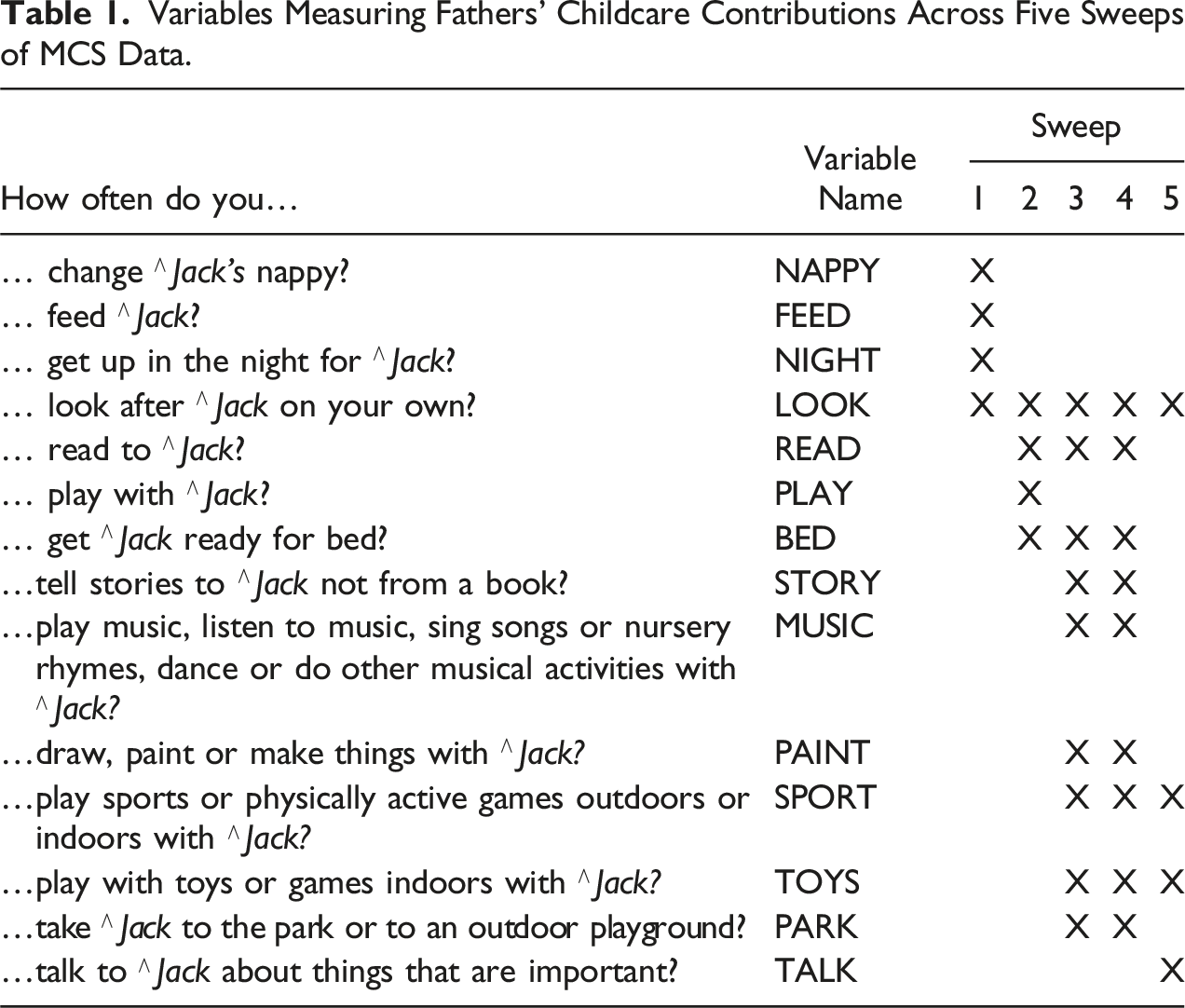
From sweep two (age 3) onwards, main and partner variables are identical, so missing cases were imputed from the equivalent main respondent (mother) variable where possible (e.g. if a mother said that she never changed the baby’s nappy, it was assumed that the father changed the baby’s nappy once a day or more). Following imputation, a small proportion of missing data remained in each variable (ranging from <1% to 6%) apart from (i) in the sweep one variables where no data was missing because non-responding fathers were filtered out (discussed above) and (ii) in three sweep two variables (LOOK, READ and PLAY) where there was 10.5% of missing data. Data remained missing in these variables because neither parent had responded to the question or, for a small minority of fathers (1–2%), the father had not taken part in the survey because they were ‘away’. The number of remaining missing cases was not problematic for our analyses as we used a robust weighted least square approach to account for the missing data.
Methods
We used Confirmatory Factor Analysis (CFA) with categorical indicators (a Graded Response Model) to test the theory that paternal engagement was reducible to five latent measures that correspond to the age of the child. CFA is a special case of structural equation modelling and focuses on modelling the relationship between observed indicators and underlying latent variables (or factors). It builds a measurement model from the patterns of relationships between variables, identifying intercorrelated variables and reducing many variables into a smaller number of latent factors. A series of first and second-order CFA models were run using Mplus 8 to test whether items loaded onto five factors of engagement (RQ 1a) or one overarching factor of engagement (RQ 1b). CFA models were run using weighted least squares means and variance adjusted (WLSMV) estimation (as this is a robust estimator, which does not assume normally distributed variables) with chi-square (χ2) difference tests to assess model fit. We referred to three goodness-of-fit tests to confirm the most appropriate factor solution given the instability of fit indices under different model conditions. The Bentler Comparative Fit Index (CFI), which compares the proposed model fit with a null or independence model where the latent variables are assumed to be uncorrelated; the Root Mean Square Error of Approximation (RMSEA), which uses the residual in the model to evaluate the fit between model and data; and the Standardized Root Mean Square Residual (SRMR), which is a measure of absolute fit, defined as the standardized difference between the observed correlation and the predicted correlation. We refer to Hu and Bentler’s (1999) recommended cut offs for the CFI (.95), RMSEA (.06) and SRMR (<.08) as indication of acceptable model fit but follow Browne and Cudeck’s (1992) thesis that acceptable model fit should be a matter of judgement if fit statistics are close to these cut offs. For example, they suggest RMSEA values in the range of .05–.08 indicate fair fit whilst MacCallum et al. (1996) suggest RMSEA values in the range of .08–.10 indicate mediocre fit. Key here is that fit indices are treated as an aid for interpretation rather than a strict threshold to be adhered to given they often provide conflicting information (e.g. see Lai & Green, 2016). The χ2 value hypothesizes that there is no difference between the residual matrix and the observed data matrix so a significant value indicates poor model fit. This was noted but did not form the basis for model rejection given its sensitivity to sample size.
To test the equivalence of the measured engagement construct across fathers, we ran multiple group confirmatory factor analysis (MGCFA) using two, independent groups of fathers that were excluded from our sample. MGCFA involves running simultaneous CFAs with separate variance-covariance matrices for each group where measurement invariance is tested by placing equality constraints on parameters in the groups. In each group, measurement invariance is tested at the (i) configural level – to indicate similar, but not identical, latent variables present in the groups; (ii) the metric level – to indicate that the same magnitude of loadings across groups for each respective item; and (iii) the scalar level – to indicate different groups have the same unit of measurement (factor loading) and the same origin (threshold/intercept). The latter is a requirement for comparing latent mean differences across groups (Chen et al., 2005; Widaman & Reise, 1997).
At the metric and scalar level, it is possible to use a χ2 difference test to confirm a statistically significant difference in model fit but its sensitivity to sample size often leads to conclusions of non-invariance when the decrease in fit is statistically significant but negligible for practical measurement purposes (Rutkowski & Svetina, 2014). We therefore evaluated measurement invariance by referring to differences in fit indices. We referred to Chen’s (2007) cut-off points for sample sizes that were >300 and broadly equal across groups where a change of a ≤ .01 in the CFI, paired with changes in the RMSEA of ≤.015 and SRMR of ≤.030 (at the metric level) or ≤.015 (at the scalar level) indicates invariance.
Measurement invariance in longitudinal models specifies whether relations between the underlying latent factors and their manifest indicators are invariant across occasions (Widaman et al., 2010). We were not able to statistically test the hypothesis of factorial invariance because the manifest indicators for the latent construct were not the same at each measurement occasion; however, goodness-of-fit tests indicated the presence of a single longitudinally invariant latent engagement construct over the five sweeps of data. We then used parental employment hours in a Multiple Indicators Multiple Causes (MIMIC) structural equation model to examine the structural relationships between paternal childcare engagement and mothers’ and fathers’ paid employment hours, which previous research, respectively, shows has a significant positive and negative association (e.g. Norman et al., 2014). The MIMIC model also tested the effect of prior paternal engagement given evidence shows paternal engagement during the first year of parenthood increased the probability of engagement at age three (Fagan & Norman, 2016).
Results
Confirmatory Factor Analysis: Deriving Five Measures of Engagement (RQ1)
Engagement at Nine Months (Sweep One)
Unstandardized and Standardized Loadings for CFA of Engagement at Nine Months.
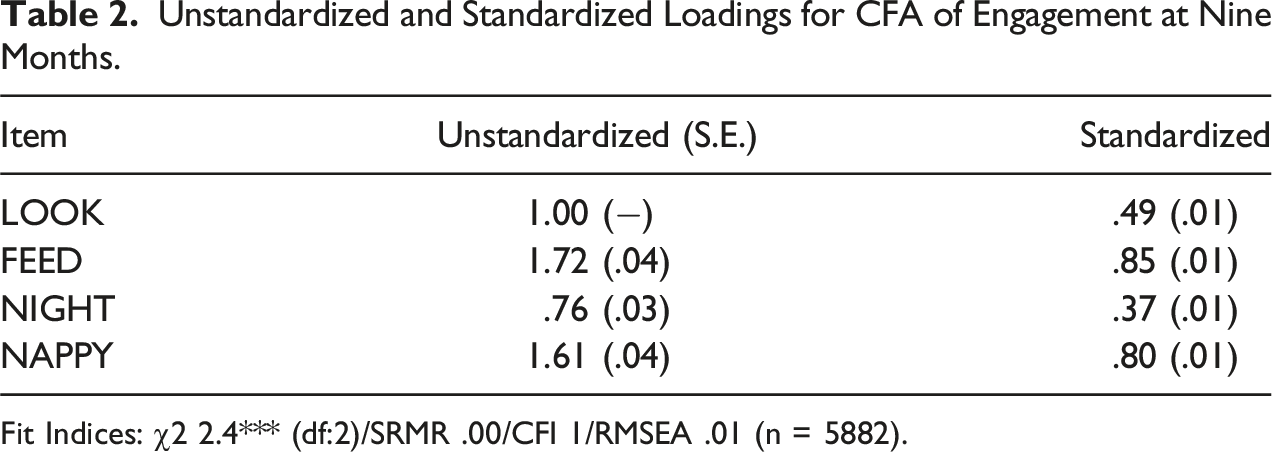
Fit Indices: χ2 2.4*** (df:2)/SRMR .00/CFI 1/RMSEA .01 (n = 5882).
Feeding the baby and changing nappies had higher loadings (.8) compared to the other childcare activities but we did not specify a two-factor model given this would lead to estimation problems.
Engagement at Three Years (Sweep Two)
Unstandardized and Standardized Loadings for CFA Model of Engagement at Age Three.
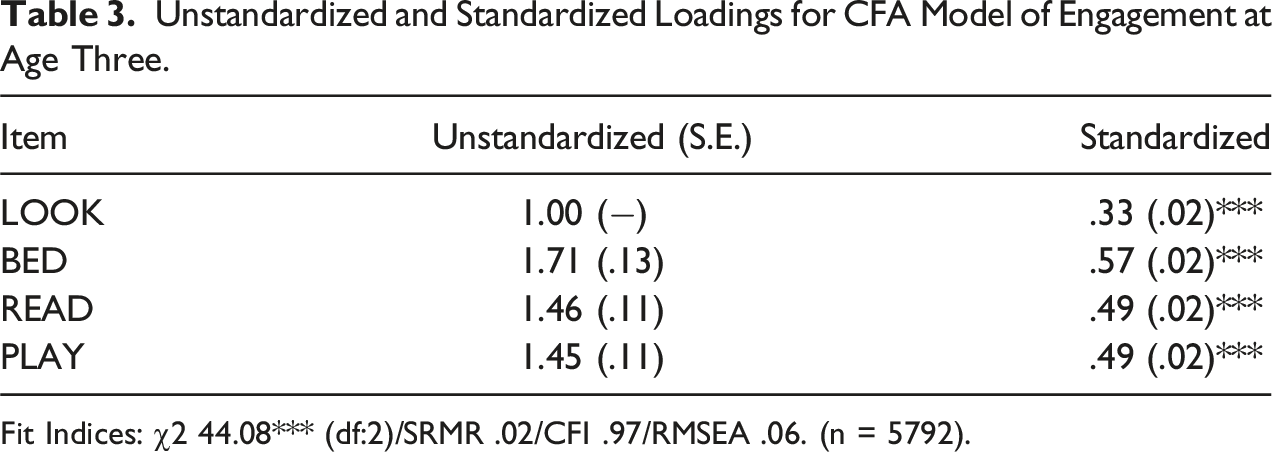
Fit Indices: χ2 44.08*** (df:2)/SRMR .02/CFI .97/RMSEA .06. (n = 5792).
For exploratory purposes, we re-ran the model excluding the LOOK variable because of its lower loading but this increased the number of missing data patterns to 10% (n = 614) (because the model could no longer impute missing information from LOOK) and it was only just identified. Given the inclusion of more indicators enhanced the quality of the construct, with all the loadings contributing to a well-defined factor, we retained the LOOK variable in the final sweep two model noting there was unique variability not captured by the factor.
Engagement at Ages Five (Sweep Three) and Seven (Sweep Four) Years Old
Unstandardized Loadings (Standard Errors) and Standardized Loadings for CFA Model of Paternal Engagement at Age Five and Seven.
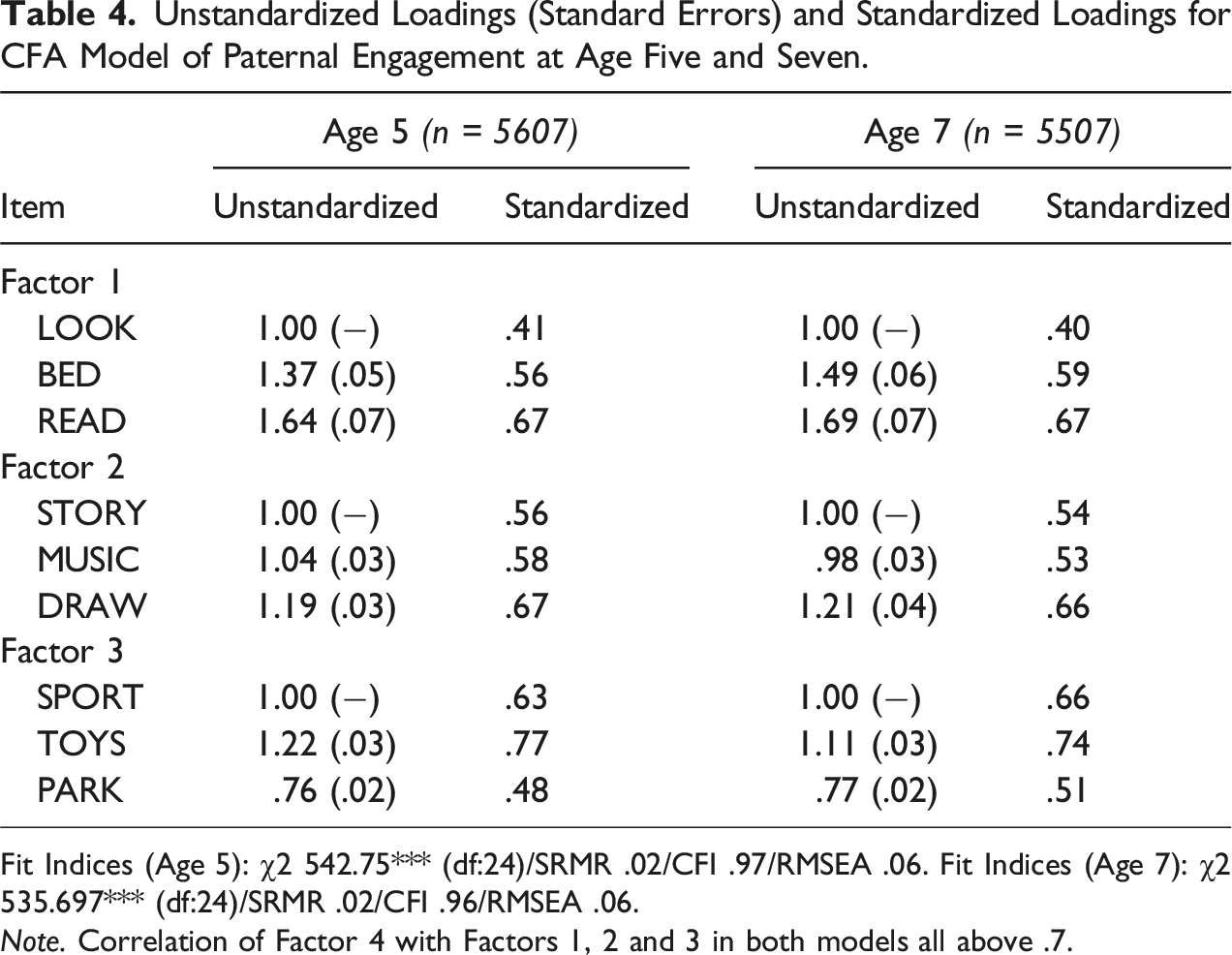
Fit Indices (Age 5): χ2 542.75*** (df:24)/SRMR .02/CFI .97/RMSEA .06. Fit Indices (Age 7): χ2 535.697*** (df:24)/SRMR .02/CFI .96/RMSEA .06. Note. Correlation of Factor 4 with Factors 1, 2 and 3 in both models all above .7.
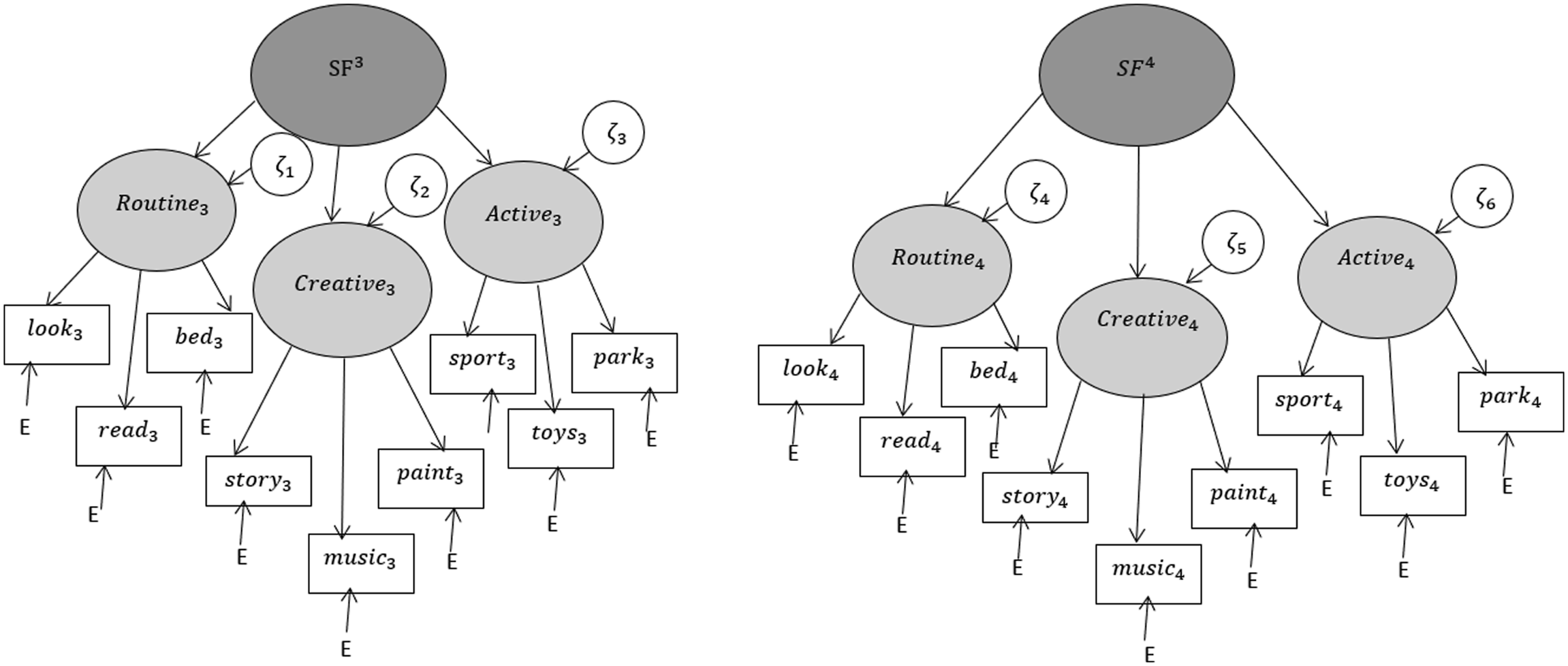
Second-order CFA model of paternal engagement at ages five and seven. SF = Second-order factor (paternal involvement at age five (sweep 3) (‘SF3’) and seven (sweep 4) (‘SF4’)). ROUTINE = First-order factor (core childcare activities: looking after the child alone, reading to the child and putting the child to bed). CREATIVE = First-order factor (creative indoor activities: telling stories, playing music, drawing and painting). ACTIVE = First-order factor (physically active activities: playing sports/outdoor games, playing with toys and going to the park).
These second-order models represented the hypothesis that the seemingly distinct, but related engagement constructs, which we defined as routine, creative and active tasks, could be accounted for by an underlying, higher order engagement construct, which would make a more parsimonious and interpretable model (Chen et al., 2005). Table 4 shows the parameter estimates for the model, which had excellent fit and with all factor loadings significant and above the standard .3 cut off.
Engagement at Eleven Years (Sweep Five)
Unstandardized and Standardized Loadings for CFA Model of Engagement at 11.
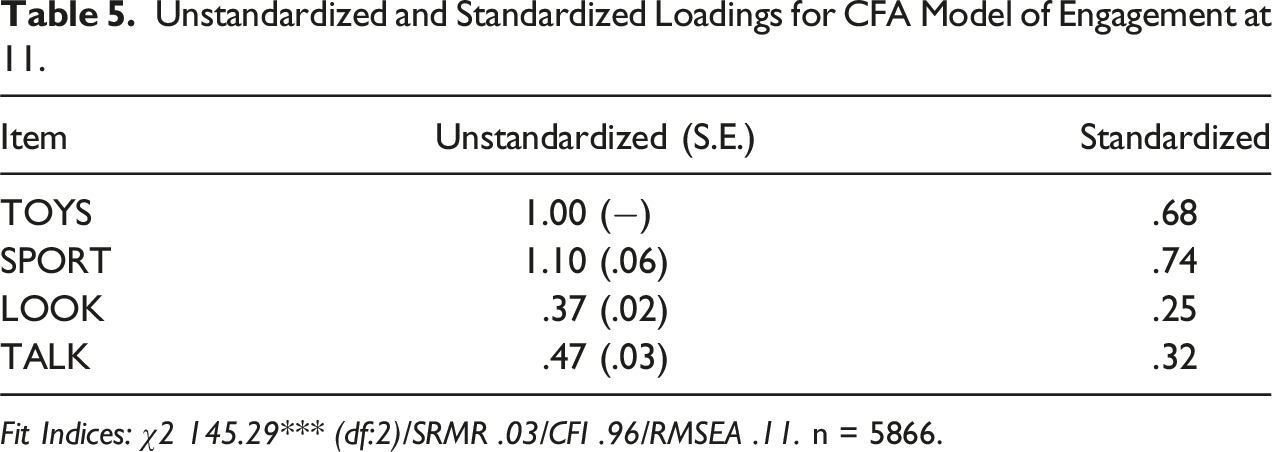
Fit Indices: χ2 145.29*** (df:2)/SRMR .03/CFI .96/RMSEA .11. n = 5866.
Despite the RMSEA falling just above the notional threshold (i.e. >.1), the CFI and SRMR indicated good model fit (i.e. >.95 and <.08), which might suggest low correlations amongst the indicators. The model was not rejected given the good CFI and SRMR because the RMSEA was likely to be inflated by the low degrees of freedom. Furthermore, all standardized factor loadings were significant and the standard cut-off (>.3) apart from looking after the child alone, which just fell just below this threshold. Specifying a three-factor solution that removed the LOOK indicator, however, produced a model that was only just identified so had no fit indices, and reduced the loading of TALK to <.3. We therefore retained the LOOK indicator given including more indicators only serves to enhance the quality of the construct. We noted that two variables (SPORT) and (TOYS) had higher loadings than (LOOK) and (TALK) and were in the same category of active activities as defined by the factors at ages five and seven. However, we did not specify a two-factor model given correlations between the sweep five indicators were all under .5, and a factor with only two manifest indicators would not be identified.
Testing Measurement Invariance through Multi-Group Confirmatory Factor Analysis
The results of the analysis thus far suggest there is age-specific paternal engagement in childcare, with five factors of engagement produced that correspond to each age of child. However, our analysis is conducted on a specific sample that comprises the same fathers within two-parent households that remain intact over the five sweeps of data. It is entirely possible that the factor structure interacted with the sample inclusion criteria and may therefore be different for other, excluded fathers or households. To assess the robustness of the factor structure, in respect of the inclusion criteria, we ran a multigroup confirmatory factor analysis (MGCFA) comparing whether the items comprising the engagement factors operated in an equivalent way across fathers that were excluded from our sample. This group of fathers were excluded from the sample because either the mother–father partnership was not intact over the five sweeps, the father or mother dropped out of the MCS survey at some point over the five sweep period, or because the father or mother respondent changed and it was not clear why. The sample size of this excluded group at nine months (sweep one) (n = 5076) and three years (sweep two) (n = 4372) was broadly similar to the sample size of households for this study, which is a prerequisite for generating accurate MGCFA results. We could only test the factor structures for sweeps one and two, respectively, because all of the excluded fathers had dropped out of the survey in later sweeps or were otherwise missing.
MGCFA Tests for Measurement Invariance of ‘Engagement’ at Nine Months.
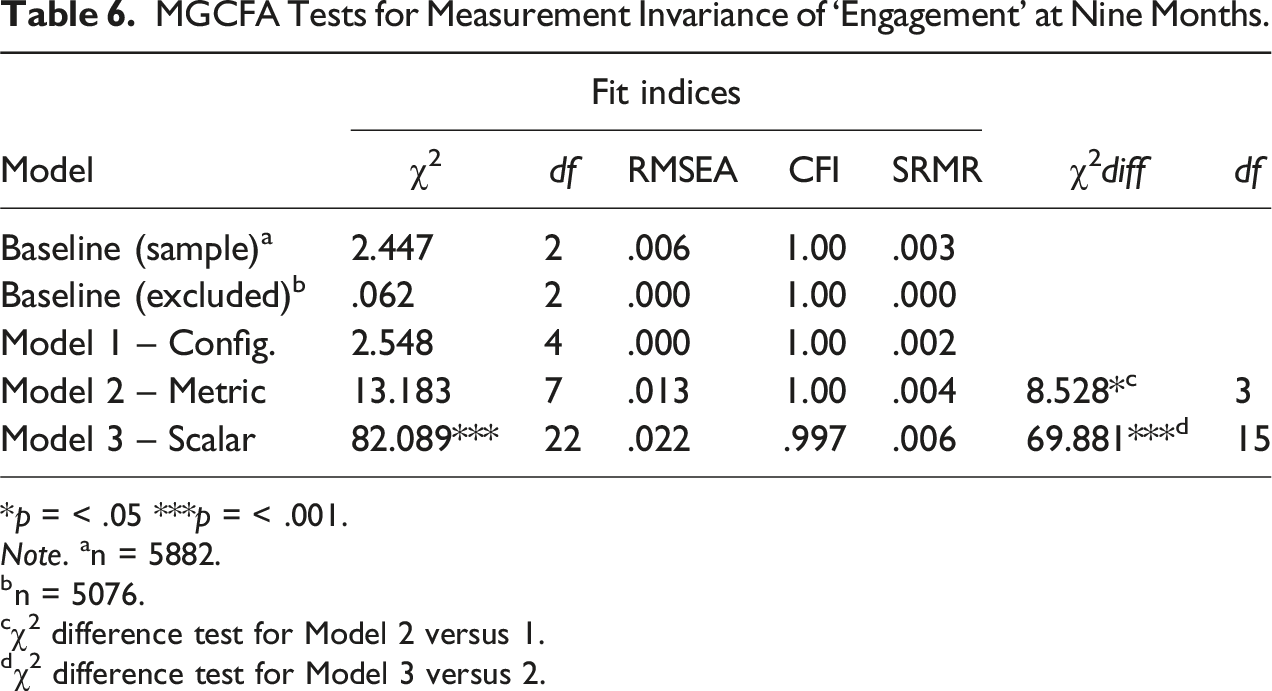
*p = < .05 ***p = < .001.
Note. an = 5882.
bn = 5076.
cχ2 difference test for Model 2 versus 1.
dχ2 difference test for Model 3 versus 2.
We ran MGCFA to test for measurement invariance of the sweep one engagement construct at the configural (same factor pattern/structure), metric (same factor loadings) and scalar (same item thresholds) levels with the results presented in Table 6. Model fit for the configural model was excellent across each group, which confirmed the same item factor structure across both groups of fathers. At the metric level, model fit was also excellent with changes to the fit indices below the minimum cut-offs recommended by Chen (2007) (i.e. <.01 change in CFI paired with <.015 change in RMSEA and <.010 change in SRMR). Although the χ2 difference value was significant (p =< .05), the fit indices remained stable between the configural and metric model confirming invariance at the metric level. At the scalar level, the χ2 difference value was significant (p < .05) but changes to the fit indices were minimal (<.01 change in CFI paired with <.015 change in RMSEA and <.015 change in SRMR), which fitted with Chen’s (2007) criteria and thus supported scalar invariance. In summary, the scores from the group of excluded fathers had the same unit of measurement (factor loading) and the same origin (threshold), which permitted factor means to be compared across groups. These steps were repeated for engagement at age three with scalar invariance supported. Thus, the engagement construct at age nine months and three years appeared to hold for the group of excluded fathers.
Confirmatory Factor Analysis: Deriving One Measure of Engagement (RQ2)
Unstandardized Loadings (Standard Errors) and Standardized Loadings for Second-Order CFA of Paternal Engagement.
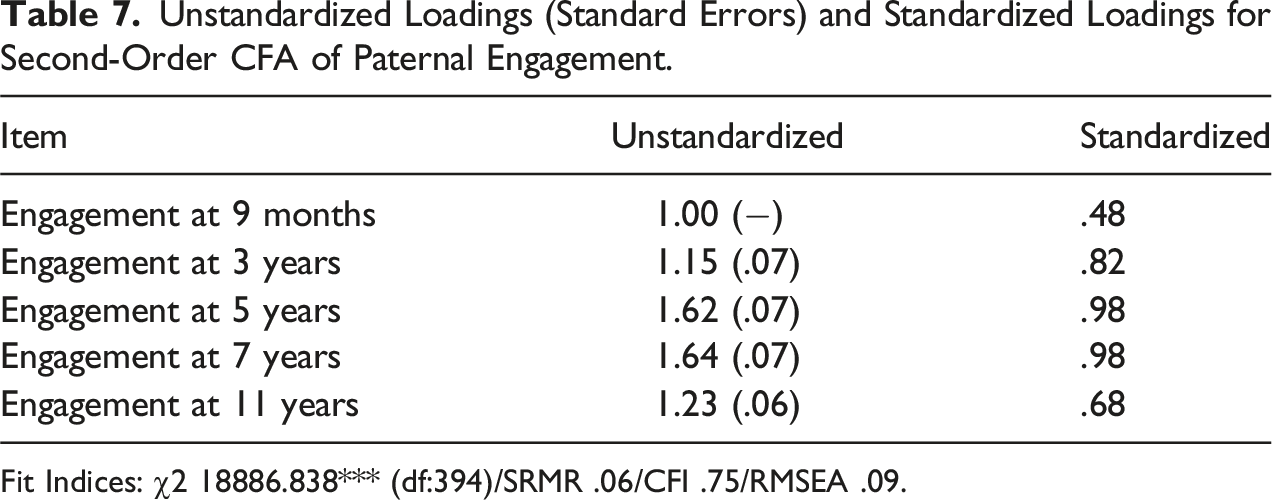
Fit Indices: χ2 18886.838*** (df:394)/SRMR .06/CFI .75/RMSEA .09.
Although the CFI was very low (<.95), the other indices indicated good to fair fit (SRMR <.08 and RMSEA <.1). The factor loadings for the engagement factors were all high at circa >.5, and the five latent factors were all positively correlated at a moderate to high level (.4 to .9). Taken together, this may indicate a plausibly well-fitting model, which provided some evidence of a broad coherent engagement construct over the five development stages. This suggested that although the measurement instruments included different items, and the measurements took place at different times, they produced similar orderings for fathers and can be broadly treated as capturing a longitudinally invariant latent construct. Although it was not possible to statistically test for longitudinal invariance, this conclusion makes substantive sense given the tasks required to take care of a child adapt to their age and needs with the manifest variables reflecting core engagement activities at that particular stage of development.
Exploring the Relationship Between Father Engagement and Parental Employment Hours
A Multiple Indicators, Multiple-Cause (MIMIC) structural equation model was run to test the construct validity of the engagement measures by examining the relationship between other measured variables (parental employment hours) and the latent engagement constructs. This model provided the first step in exploring and assessing whether the structural relationships behaved in the way that we expected, based on findings from previous research, that is: the fathers’ employment hours would have a negative association with their childcare engagement, whereas mothers’ employment hours would have a positive association (e.g. see Norman et al., 2014; Fagan & Norman, 2016). Given this was a path model, we also measured the effect of paternal engagement in the previous sweep from the age of three onwards. We note that this model does not present the entire picture so should be treated as a basis for building a more comprehensive analysis of what might affect paternal childcare engagement, as children grow older. The five paternal engagement factors were regressed onto two covariates – mothers’ and fathers’ employment hours – at each time point. Figure 2 shows a diagram of the MIMIC model with ellipses representing the latent factors, rectangles representing the covariates and single-headed arrows representing a regression. Path diagram summarizing a multiple-indicator multiple-cause (MIMIC) model exploring the structural relationships between fathers’ childcare engagement and parental employment hours at nine months, three, five, seven and eleven years old. Note. FE = Father engagement latent factors at nine months (9m), three years (3y), five years (5y), seven years (7y) and eleven years (11y); MH = Mothers’ employment hours; FH = Fathers’ employment hours at each of the above time points.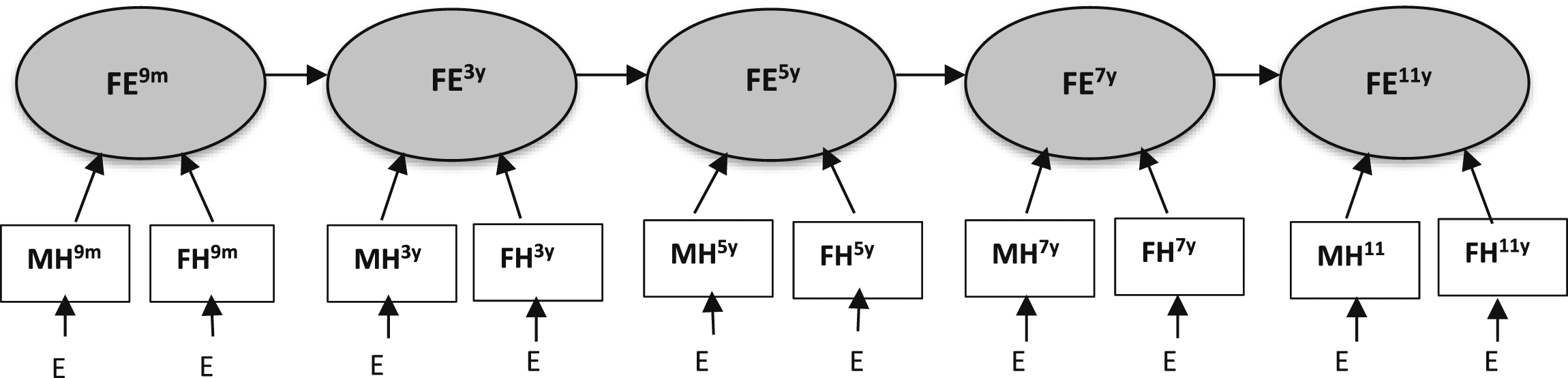
MIMIC Model (Unstandardized and Standardized Loadings) Estimating the Structural Relationship Between Fathers’ Engagement and Parental Employment Hours.
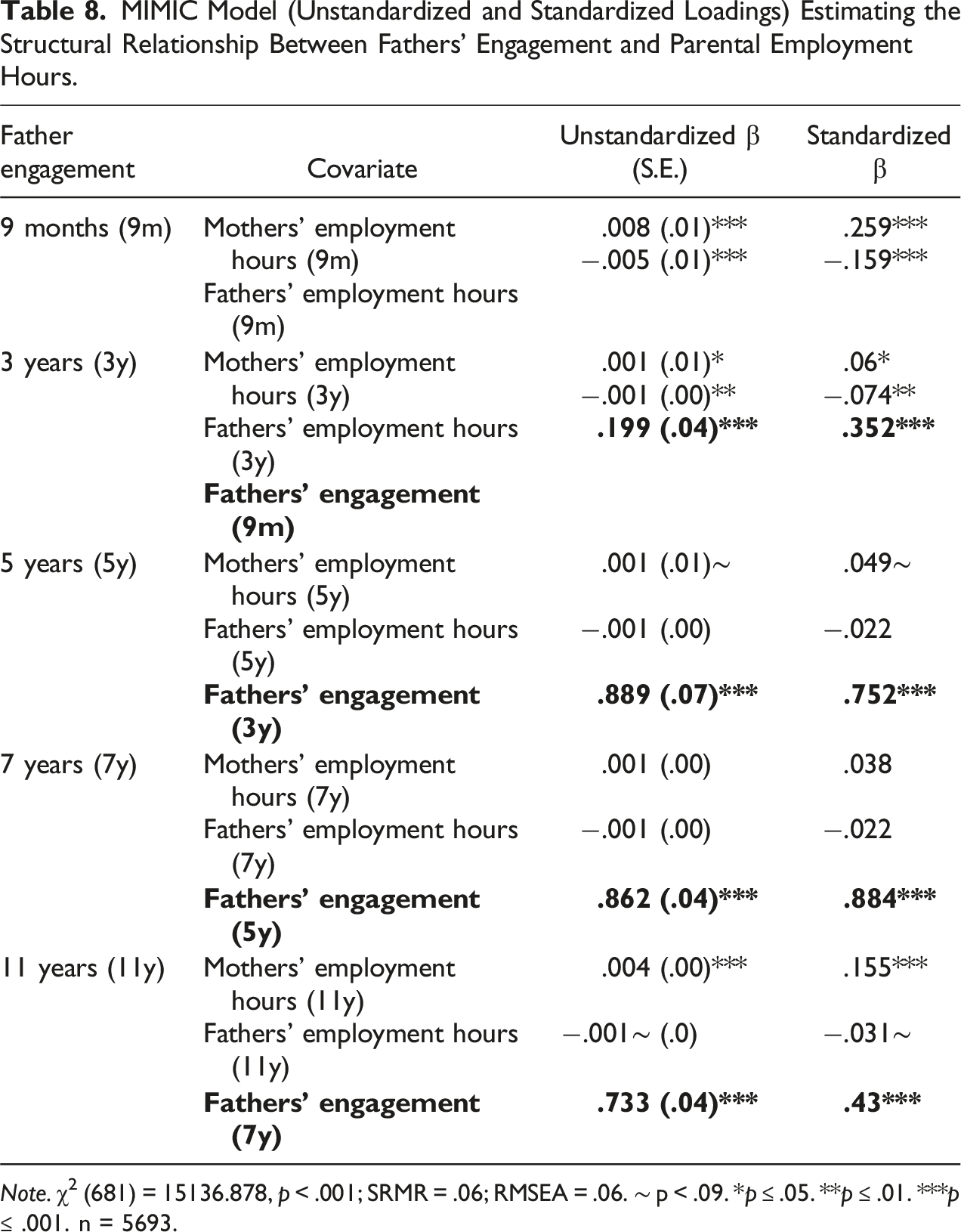
Note. χ2 (681) = 15136.878, p < .001; SRMR = .06; RMSEA = .06. ∼ p < .09. *p ≤ .05. **p ≤ .01. ***p ≤ .001. n = 5693.
At nine months, mothers’ employment hours had a significantly stronger association with father engagement compared to the fathers’ own employment hours although the effects from mothers’ (and fathers’) employment hours tapered off as the child grew older apart from at age eleven when the positive effect of maternal employment hours on paternal engagement increases. Indeed, both parents’ employment hours had the strongest association with paternal engagement at nine months, when children were most dependent and employment has to be organized around the demands of a child. The stronger effect from maternal as opposed to paternal employment hours aligns with previous research that found this to be a stronger predictor of fathers’ engagement in the pre-school period (e.g. Norman et al., 2014). This may suggest that when mothers were employed full-time, fathers at least partly substitute for the reduction in the mothers’ time with children. Similarly, this might explain the increase in the effect of maternal employment hours on paternal engagement at age eleven. That is, as children grow older and more independent, it might allow mothers to spend more time in paid work and thus increase the need for father engagement at these later ages. It may also reflect a mother’s relative power and resources, which provide her with greater bargaining power to negotiate a fairer division of childcare if she works longer hours (e.g. see Breen & Prince-Cooke, 2005). Further research is required to investigate the dynamics underlying these effects.
Summary and Conclusions
Paternal involvement is a polysemous and variable term making the quantification of it into a limited number of measures challenging. Yet the absence of a quantitative measure in social research has been noted by scholars such as Morman and Floyd (2006) who suggest that the development of a measure would provide an instrument for evaluating the characteristics associated with being an involved father. A quantitative measure would also allow for a more representative and comprehensive analysis of the wider social and economic conditions that shape paternal involvement during the early part of a child’s life. To address this, our paper derived five conceptually invariant latent measures of paternal engagement – one dimension of Lamb’s (1986) three-dimensional classification of involvement. Based on (changing) observed measures that span a ten-year period post-birth, engagement measures were derived using CFA with categorical indicators. We drew on Lamb’s theoretical framing to conceptualize the quantitative measures produced with the manifest indicators that made up the latent engagement measures all constituting activities that involved the father directly interacting with or taking care of the child.
Goodness-of-fit-tests confirmed model fit with χ2 difference testing of measurement invariance only noted because of its sensitivity to sample size. Multigroup CFA was run for fathers that were not included in our two-parent sample, which found that the engagement constructs, at least in the pre-school years, held across excluded groups. This suggested that the engagement construct at these ages may hold for fathers outside of our two (opposite sex) parent sample. We then produced a singular, overarching (second order) engagement latent factor that captured the five age-specific factors in order to simplify the more complex measurement structure. Model fit broadly confirmed that the underlying engagement construct was invariant over time, which fit with our substantive theory that the (changing) manifest indicators all captured core engagement activities for the particular stage of child development.
The final part of the paper used the engagement measures in a Multiple Indicators, Multiple Causes (MIMIC) SEM model, which we ran to explore the structural relationship between parental employment hours and paternal engagement at each age. The engagement construct appeared valid because the structural relationships behaved in the way we expected based on previous research that respectively showed a strong positive association with mothers’ and negative association with fathers’ employment hours (e.g. see Norman et al., 2014). Although the model showed parental employment hours, particularly those of the mother, to have a significant association at nine months and eleven years (and a very small, albeit significant, association with paternal engagement at age three), it was prior paternal childcare engagement, in the previous period, that had the strongest effect. Furthermore, the effect of paternal engagement appeared to build over time with the coefficient size for prior engagement being significantly stronger at each age apart from a dip between ages seven and eleven as children grow older and more independent. This suggested that between the ages of nine months and seven years old, the effect of paternal childcare engagement accumulates as the child grows older – an effect that was much stronger than the employment hours worked by either parent. This finding builds on Fagan and Norman’s (2016) research that found paternal involvement in the immediate post-birth period to be key for facilitating continued involvement until at least age three. Here we find that paternal engagement in the first year is not only important for engagement at age three, but also provides a foundation for ongoing engagement that builds to at least the age of eleven. This suggests that providing the conditions for enabling fathers to be engaged in their children’s care from the immediate post-birth period is important as it sets up a pattern of engagement that persists as the child grows older. This highlights the importance of paternity or father-only parental leave entitlements that are well remunerated and non-transferable because this provides fathers with the opportunity to engage with their children from the immediate post-birth period. It is this early paternal engagement, which our analysis suggests, is most important for ongoing paternal engagement as the child grows older. Indeed, this supports other research that shows a link between parental leave and fathers’ ongoing engagement (e.g. see Harvey & Tremblay, 2019; Almqvist & Duvander, 2014; Haas & Hwang, 1999). However, it is important that such leave entitlements are combined with other reconciliation measures to support fathers such as access to flexible work, curbs to long hours of paid work and good quality childcare (which primarily support the mothers’ return to employment), as well as a cultural acceptance of the father’s caregiver role.
Limitations
We note some limitations to the analysis. First, in line with broader critiques of quantitative analysis, we were bound by the available MCS data, which determined how we measured paternal engagement. At ages five and seven, the data was richer, capturing nine different childcare activities, whereas the data was more limited at the other ages because there were fewer measures, which might partly explain the poorer model fit indices for engagement at age eleven. Nevertheless, we feel that the data reflects the core, direct engagement activities necessary for the particular stage of child development. For example, ‘talking about things that are important’ is arguably one of the most fundamental aspects of engagement with a child at age eleven, whereas reading and playing generally becomes less frequent and meaningful at this time. As a child gets older, the other dimensions of Lamb’s involvement, such as accessibility (i.e. ‘being there’), are likely to become more important. Secondly, given the childcare activities change to adapt to the changing needs of the child as they grow older, it was impossible to statistically test for longitudinal measurement invariance. The second-order superfactor provided a reasonably good fit to the data, which allowed us to treat the underlying construct of engagement as conceptually invariant although we note that this cannot be statistically verified and so should be acknowledged if the measures are used to explore structural relationships with paternal engagement over this time period. Thirdly, our analysis is based on two, opposite-sex parent households that remain intact over the first eleven years of the child’s life. Paternal engagement will differ in other types of households such as those in which the father is not resident. Finally, our MIMIC model does not include other covariates that are likely to mediate the structural relationships between paternal engagement and parental employment hours – such as socio-economic class, whether there are other, younger children in the household, the father’s motivation to be involved and the child’s characteristics. Nevertheless, we present the model as a way of validating the engagement constructs as well as a foundation from which to develop the analysis. For example, the model could be developed to explore the potential causal pathways that lead to father engagement at different ages of the child’s life.
Footnotes
Acknowledgments
The authors would like to thank Professor Irena Grugulis at Leeds University Business School who provided valuable comments on an earlier draft of this paper.
Declaration of Conflicting Interests
The author(s) declared no potential conflicts of interest with respect to the research, authorship, and/or publication of this article.
Funding
The author(s) disclosed receipt of the following financial support for the research, authorship, and/or publication of this article: This article was supported by funding provided by the Economic and Social Research Council (U.K.) Secondary Data Analysis Initiative (Phase 3) scheme for the project ‘Which Fathers Are Involved in Looking After Their Children? Identifying the Conditions Associated with Paternal Involvement’ (ES/N011759/1).
