




Abstract
At the height of the Covid-19 pandemic, there was a shift from in-person to online schooling as the primary mode of instruction for children. This study examines racial/ethnic inequalities in children’s participation in online schooling at the height of the pandemic, and how their families adjusted to the process. The analysis was conducted using data from the 2022 Covid-19 in American Communities-2 study. The results indicate that the children of Black respondents were the most likely to report online schooling and non-enrollment as their primary modes of learning at the height of the pandemic. However, the outcomes were part of a broader pattern of disadvantage. The children of Black respondents also faced unique constraints by experiencing decreases in school supervision if a household member was infected with COVID-19. Additionally, the results showed that mothers supervised online schooling more frequently than other adults, except among Hispanics.
Introduction
Lockdown measures were extensively used to control the spread of new infections during the early phase of the covid pandemic. As a result, many schools adapted to these measures by shifting from the provision of in-person instruction to teaching students online. This process significantly transformed the educational experiences of children (Hoofman & Secord, 2021) and had major implications for their socioeconomic wellbeing (Baron et al., 2020; Rundle et al., 2020). Among the most notable of these was its potential contribution to increases in racial and ethnic inequalities in schooling (Hardy & Logan, 2020). For disadvantaged racial minorities (i.e., Blacks and Hispanics), these increases were observed in the larger context of a concentration of the pandemic’s most deleterious consequences in their communities (Hooper et al., 2020).
In this study, we attempt to contribute to the literature by investigating racial differences in children’s primary option for school attendance during the covid pandemic. Using data from the 2022 Covid-19 In American Communities-2 (CIAC-2) survey, our analysis aims to address three main objectives. First, it situates the examination of racial/ethnic inequalities in online schooling, especially those between Blacks, Hispanics, and Whites, within the broader context of the various options available to children during the shift from in-person schooling during the pandemic. Second, focusing on households where parents reported online learning as their children’s primary option of schooling, this study examines overall patterns of adult supervision provided to children and investigates whether there were racial differences in these patterns. Finally, the analysis concludes by examining how the supervision of children’s online schooling was shaped by pandemic-related influences (e.g., parental deaths from covid) as well as other household-level factors.
Background
Disruptions caused by the shift to online learning during the Covid-19 pandemic played a major role in transforming the schooling experiences of children. Several studies examining these disruptions have emphasized the importance of the risk and resilience framework for investigating their implications for children and families (Davidson et al., 2021; Prime et al., 2020). According to this perspective, children’s adjustment should be viewed as an outcome affected by distal factors, such as the social disruptions caused by the pandemic, and proximate factors such as family processes. While the former represents a major source of risk, the latter serves as a major source of resilience used to buffer against these risks. However, families are not immune from experiencing these risks themselves (Prime et al., 2020). Although they are conceptualized as proximate influences, they can also be affected by pandemic-related risk factors such as illness and death, which can negatively affect how well they can respond.
The responses of families were generally affected by disparities in the ways in which they were affected by the pandemic itself (Prime et al., 2020). Some of the most important determinants of this variability include exposure of racism and marginalization, which require more resilient responses from the families of disadvantaged racial minorities (i.e., Blacks and Hispanics). For similar reasons, the risks associated with schooling disruptions caused by the pandemic were also circumscribed by the race/ethnicity of children. Part of this was due to the fact that, even before the pandemic, children from disadvantaged racial/ethnic minority groups lived their lives in contexts defined by high levels of discrimination, racism, and systems of oppression that increase their vulnerability to shocks during periods of crisis (Coll et al., 1996).
Concerns about the racial dimensions of the risks associated with schooling disruptions have now emerged in several studies examining the consequences of the Covid-19 pandemic (Friedman et al., 2021; Slavin & Storey, 2020). Some of these argue, for example, that the socioeconomic disadvantage of Blacks and Hispanics made them less prepared than Whites to support children’s remote learning (Friedman et al., 2021; Slavin & Storey, 2020). Others indicate that the overall effect of this minority disadvantage was to increase in the racial achievement gap that has long been defined by lower levels of attainment among children of color compared to their White counterparts (Anderson, 2020).
These concerns have been expressed against the backdrop of research suggesting that Black and Hispanic children had some of the highest rates of enrollment in online schooling during the pandemic (e.g., Smith & Reeves, 2020). However, although there are some exceptions (e.g., Camp & Zamarro, 2021), much of the evidence for this is speculative. For example, one study offered this assessment based on spatial variations in covid transmission rates characterized by higher rates of transmission in urban areas than in suburbs (Smith & Reeves, 2020). It suggested that, because of long-established patterns of racial residential segregation, Black and Hispanic students were more likely than other students to live in school districts that could have shifted to online schooling because of a surge in local covid cases (Smith & Reeves, 2020). Other studies suggest that racial differences in online schooling may have emerged from the choices made by some racial/ethnic minorities. Accordingly, Black parents were shown to have preferred online rather than in-person schooling, because of its potential for limiting their children’s exposure to racism and bullying (Collins-Nelsen et al., 2021; Fernando, 2021).
While these racial differences are important, it is critical to note that the shift from in-person schooling did not necessarily imply that children automatically moved on to receiving high quality educational instruction online. In part, this is because online schooling was just one of several choices available to children who could no longer attend school in-person. One of these choices was to drop out of school (Spitzer et al., 2021). However, we know very little about whether enrollment disruptions that occurred during the lockdowns were highly differentiated by race. Another factor that could have undermined children’s education after the shift from in-person schooling was variation in the quality of instruction received by those who did participate in online schooling. This variation appears to have been circumscribed by race/ethnicity, given the fact that children in predominantly Black and Hispanic schools logged in to online classes less regularly compared to students in other schools (Dorn et al., 2020).
Variations in children’s access to quality online education were further driven by other related factors. For example, online schooling requires access to the internet. However, Black children were considerably less likely to have access to the internet compared to their Hispanic, Asian, and White counterparts (Friedman et al., 2021). Similarly, online learning may have also been most effective in families that can adequately supervise children’s learning from home. In the absence of the structured environment provided by in-person classrooms, this supervision was needed to ensure that children log in on time, participate in class sessions, and avoid distractions at home (Cooper et al., 2000). Although the importance of this kind of supervision is recognized in several studies (Cooper et al., 2000), it is not clear whether it was equally available in diverse family contexts.
As described in the risk and resilience framework (Prime et al., 2020), family processes are important sources of resilience that provide a buffer against the risks associated with the pandemic. Within families, however, much of the responsibility for responding to the needs associated with online learning during the lockdowns fell on parents (Novianti & Garzia, 2020). This was part of a larger range of new responsibilities parents took on during this period. We now know that these expanded responsibilities were addressed in processes associated with the same gendered patterns of household division of labor observed in previous studies (Zhou et al., 2020). Similar patterns have further been observed in previous studies on parental supervision of homework. Prior to the start of the pandemic, for example, research indicated that mothers were more likely to supervise homework compared to fathers (Balli et al., 1998).
Like gender, parental involvement in children’s homework is also differentiated by race. Among mothers, for example, previous research shows that Pacific Islanders, Blacks, and Hispanics have higher levels of involvement compared to other mothers, while for fathers, the highest levels of involvement have been found among Blacks (Hartlep & Ellis, 2010). Much of these disparities was explained by the higher use of tutors to supervise homework in White, higher-income families. But they also match previous work suggesting that Black fathers tend to be more involved in the lives of their children than other fathers (Ellerbe et al., 2018). Nevertheless, they underscore the fact that maternal and paternal participation in the supervision of children’s schooling may not have been ubiquitous across race.
Compared to homework, online schooling creates a different set of circumstances under which children’s learning is supervised by parents. While homework supplements material taught in class, online schooling during the pandemic focused on current class material and required consistent adult supervision. Despite this difference, available evidence suggests that mothers continued to play a major role on supervising children’s online schooling (Puspita, 2021). Systematic attempts to identify the full range of individuals who played similar roles are, however, limited. As a result, we know very little about how maternal and paternal contributions to children’s online learning differed from those of other household members.
As maintained by the risk and resilience framework (Prime et al., 2020), however, the ability of families to respond to children’s schooling disruption can be compromised by their own exposure to the risks and consequences of the pandemic. Some of this exposure was differentiated by gender. For example, emerging evidence indicates that women were more likely to work as essential workers during the pandemic, increase their participation in housework, and provide care for the sick (Zhou et al., 2020). At the same time, exposure was also differentiated by race/ethnicity in ways that created a different set of ecologies for Black and Hispanic children compared to those of their White peers. Blacks, for example, had some of the highest rates of Covid-19 infection (Mude et al., 2021), with high concentrations of the disease also observed in Hispanic neighborhoods (Figueroa et al., 2020). High rates of covid infection among Blacks (Mude et al., 2021) would suggest that the maternal role in the supervision of children’s online learning was the most at risk of being encumbered by the health consequences of the epidemic within Black households. In the same vein, because disadvantaged racial minorities experienced the brunt of the economic consequences of the pandemic (Chen et al., 2022), it is also possible that they would have had the fewest resources to develop resilient responses to support for their children’s online learning. More importantly, given the fact that epidemics have adverse developmental implications for children (Benner & Mistry, 2020), these disparities suggest that Black and Hispanic children are likely to have been particularly at risk for exposure to these long-term adverse implications.
Hypotheses
This study attempts to contribute to the literature by testing the three hypotheses:
Children in Black and Hispanic families were more likely to have online learning as their primary option of schooling compared to other children at the height of the pandemic.
Adult supervision of children’s online learning was more frequently provided by mothers than by fathers and other adults within families.
The health consequences of Covid-19 (infections and deaths) had a more adverse association with the supervision of children’s online schooling in the families of disadvantaged racial/ethnic minorities.
Data and Methods
We test these hypotheses using data from phase two of the Covid in American Communities (CIAC-2) survey. The survey was conducted online between March and April 2022 to examine the consequences of the Covid-19 pandemic in American communities. It targeted a sample of adults between the ages of 18 and 64 (N = 3429). Fielded nationally by Elite Research, LLC, the survey oversampled Blacks, Hispanics, as well as Asians, and had a response rate of 30%. Sample weights were, however, available for making the final sample representative of the U.S. population.
To understand the consequences of Covid-19, the CIAC-2 study collected information on a wide range of health behaviors, health perceptions, and social experiences among its respondents. For a subsample of respondents in families with school-age children above age 5 (N = 1570), data were collected on outcomes such as children’s schooling experiences, their Covid-19 diagnoses, and the identities of the primary people responsible for supervising their online schooling.
Our analysis uses two sets of dependent variables. The first is the primary schooling option available to children at the height of the pandemic. These options were derived from responses to the following question: “At the height of the pandemic, when schools were being closed down and people were working from home, what was the primary option for school attendance for children in your household?” No effort was made to influence respondents’ understanding of what was meant by “the height of the pandemic.” However, their understanding of this period could have been shaped by the surge in Covid-19 cases due to the Omicron variant, which was observed around the time of the survey (CDC, 2021). Respondents’ answers to the question were then used to create nominal variables identifying households in which children used one of the following four primary schooling options at the height of the pandemic; in-person schooling, online schooling, homeschooling, and non-enrollment.
The second dependent variable focuses on adults who specifically supervised children’s online schooling. These adults were asked to identify the frequency with which they supervised the online schooling of children in their households. We use their responses to create an ordinal variable that rates the frequency of supervision as follows: 1 – rarely, 2 – a couple of days a week, 3 – most days, and 4 – every school day.
Our main independent variables are race-ethnicity and the relationship to the child of the primary persons responsible for supervising children’s online learning. The race of respondents is measured using dummy variables that distinguished between those who self-identified as either non-Hispanic Blacks (N = 534), Hispanics (N = 262), non-Hispanic Whites (N = 467), or a residual category of other races (N = 288). The final category of other races included persons who identified themselves using either multiple racial categories (49.65%), as Asian (47.57%), or simply as other (2.78%). These groups were combined into one category because their small respective sizes did not provide sufficient cell sizes for reliably testing our hypotheses. Four indicators are used to identify the roles of primary persons responsible for the supervision of children’s online schooling as mothers, fathers, other adults, and a residual category of other.
Several variables are used as controls in the analysis including respondents’ age, marital status, gender, and whether they were foreign-born. The direct health consequences of Covid-19 infections within families are measured using two variables. The first is the number of children who had been diagnosed with Covid-19 within households, and the second is whether households had children who had lost a parent to Covid-19. Work status is identified by distinguishing between the outcomes of respondents who were either unemployed, worked from home, or worked outside the home at the height of the pandemic. Other control variables are used to account for differences in family income (1 = less than $25k, 2 = $25k–$49.99k, $50k or more), household size, educational attainment (1 = college graduate), and whether all children within households had access to computers. None of the variables used in the analysis had more than 1% of missing cases. As a result, we use listwise deletion to conduct our analysis (Myrtveit et al., 2001). After these deletions, the final sample consisted of 1551 respondents in households with children.
Our empirical analysis is conducted in three stages. In the first, multinomial logistic regression analysis is used to examine the association between race and the primary schooling option used by children at the height of the pandemic. Restricting the analysis to respondents who provided supervision for online schooling, the second stage uses ordered logistic regression models to examine differences in the frequency of supervision provided to children. In the third stage of the analysis, ordered logistic regression models are used to examine whether there are unique associations between the key predictors of the frequency of supervision provided to children among racial/ethnic groups. We also use these models to assess variations in the relationship between the supervision of children and the health consequences of Covid-19 across race. All regression models are estimated using sample weights, and their estimated coefficients were transformed into odds ratios to make them easy to interpret.
Results
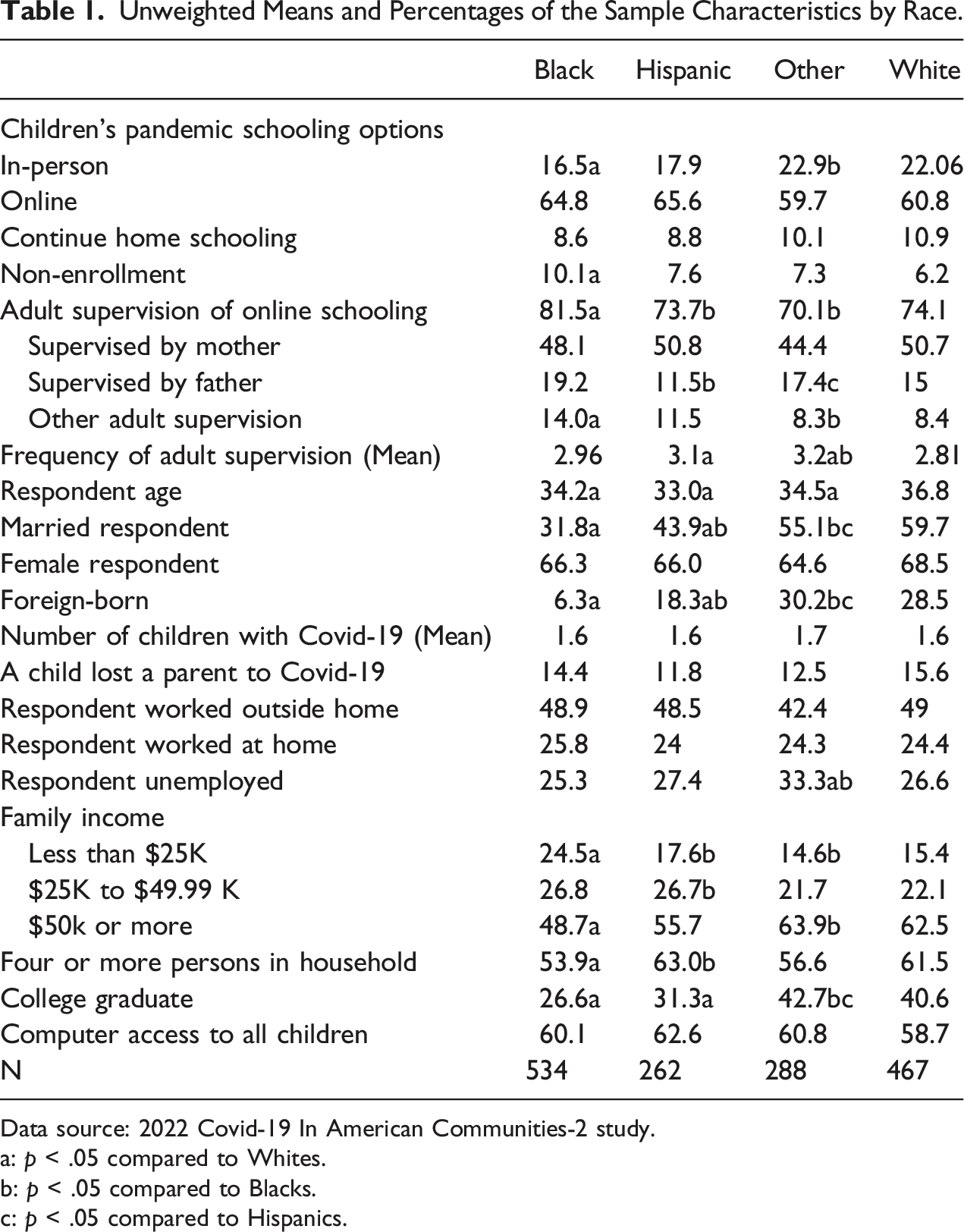
Unweighted Means and Percentages of the Sample Characteristics by Race.
Data source: 2022 Covid-19 In American Communities-2 study.
a: p < .05 compared to Whites.
b: p < .05 compared to Blacks.
c: p < .05 compared to Hispanics.
Our first impression of racial/ethnic differences in the primary modes of schooling used by children is provided in Table 1. These results show that children of Black respondents were significantly less likely to have been enrolled in in-person schooling at the height of the pandemic compared to children of White and other race individuals. Additionally, online learning was the primary mode of schooling available to the majority of children in each group. However, although Whites had lower levels of participation in online schooling compared to those of Blacks and Hispanics; these differences were not statistically significant.
Table 1 confirms that online schooling was not the only option available to children who did not participate in in-person schooling. One of these options was non-enrollment, and the results indicate that the children of Blacks were more likely than children of Whites to be non-enrolled at the height of the pandemic. Our data do not capture the specific timing of non-enrollment. As such, this finding should be seen as representing the outcomes of both children who dropped out during the pandemic and those who had already dropped out but who had limited opportunities for resuming their schooling during this period. Another schooling option available to children was homeschooling, which was more prevalent among Whites. However, the use of this option was not statistically different for Whites and the various non-White groups.
Additionally, Table 1 shows that most children who participated in online schooling were supervised by adults in their households; across race and levels of adult supervision of children were highest among Blacks. As expected, much of this adult supervision was provided by parents (62–67%). However, the only group-level statistical differences in parental supervision were those observed between Hispanic fathers on one hand and Black and other race fathers on the other. The results further indicate that supervision of online schooling provided by other adults was highest among Blacks (14%). Finally, on average, the frequency of supervision of online schooling was highest for children in Hispanic and other race families.
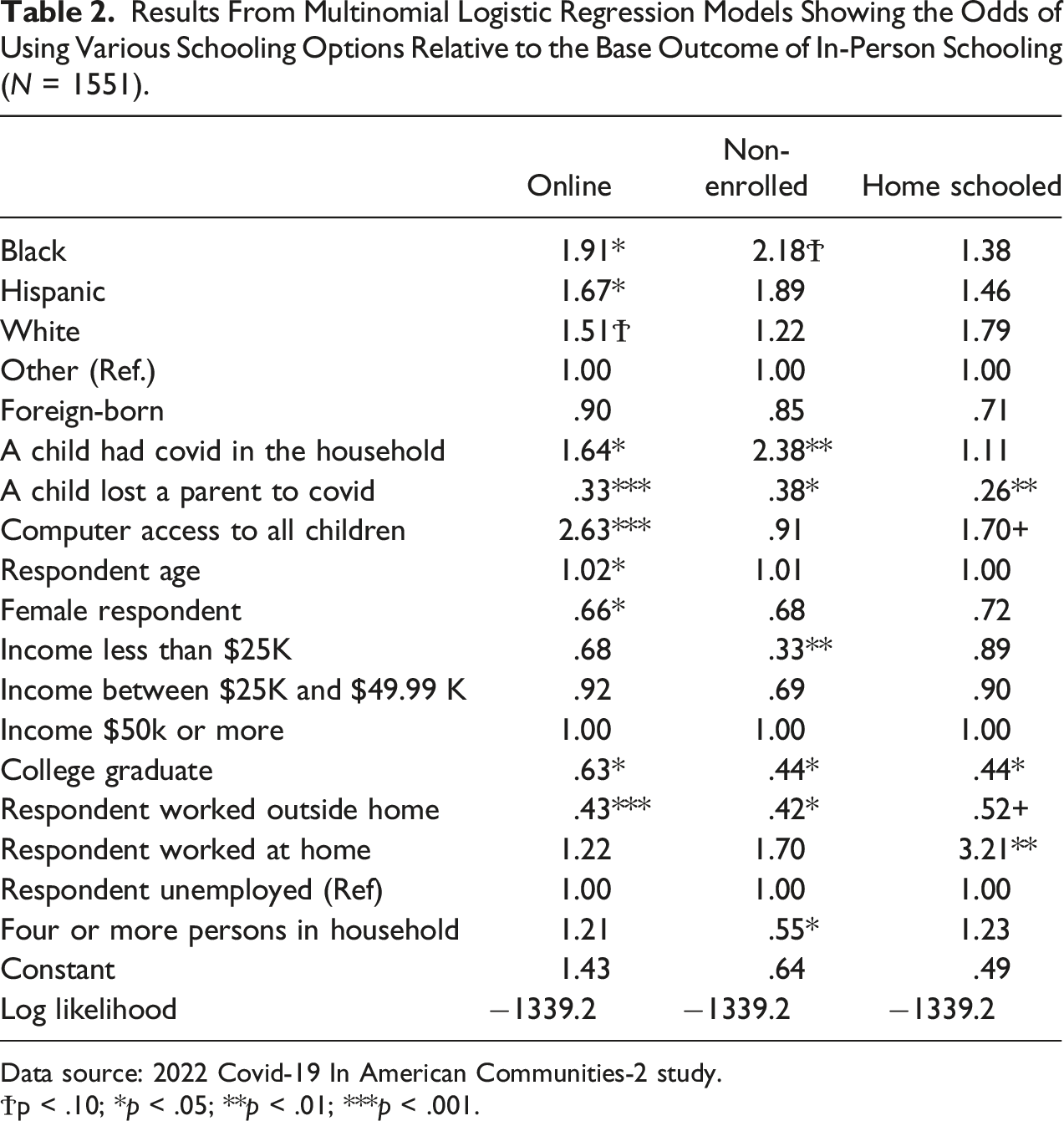
Results From Multinomial Logistic Regression Models Showing the Odds of Using Various Schooling Options Relative to the Base Outcome of In-Person Schooling (N = 1551).
Data source: 2022 Covid-19 In American Communities-2 study.
Ϯp < .10; *p < .05; **p < .01; ***p < .001.
With regard to other primary modes of schooling, the racial/ethnic disparities shown in Table 2 are less distinct. In terms of non-enrollment, the results show that Blacks were the only group with statistically significant outcomes in the analysis. They were more than twice likely to report being out of school as their primary schooling option compared to their other race peers and had the highest odds of reporting non-enrollment in the sample. The results also show that Hispanics had the second highest comparative odds of reporting non-enrollment as their primary schooling option, but these odds were not statistically significant. Similarly, no statistically significant racial/ethnic differences were observed in the odds of reporting homeschooling as the primary schooling option. However, the highest of reporting homeschooling as their primary option was found among Whites (p = .10).
More generally, Table 2 underscores the role of key household-level factors in shaping the primary schooling options used by children. For example, a Covid-19 diagnosis among children was associated with a 64% higher odds of reporting online schooling as the primary schooling option (p < .05) and more than double the odds of non-enrollment (p < .05). Additionally, children whose parents died from Covid-19 were about 67% less likely to report online schooling as their primary option (p < .001). Consistent with the risk and resilience framework, therefore, pandemic-related risks experienced by families in the form of deaths to parents, appear to have undermined their ability to provide a frequent response to the online schooling demands of their children. Indeed, this may also explain the negative association shown in Table 2 between homeschooling and parental deaths from Covid-19. Other influences of children’s primary options of schooling included access to computers, which was associated with substantially higher odds of reporting online schooling as the primary option (p < .001), and whether respondents worked from home. For example, Table 2 shows that working from home was positively associated with the odds of reporting homeschooling as the primary option. Specifically, respondents who worked from home were more than three times as likely to live in households where homeschooling was reported as the primary option compared to respondents who were unemployed (p < .01).
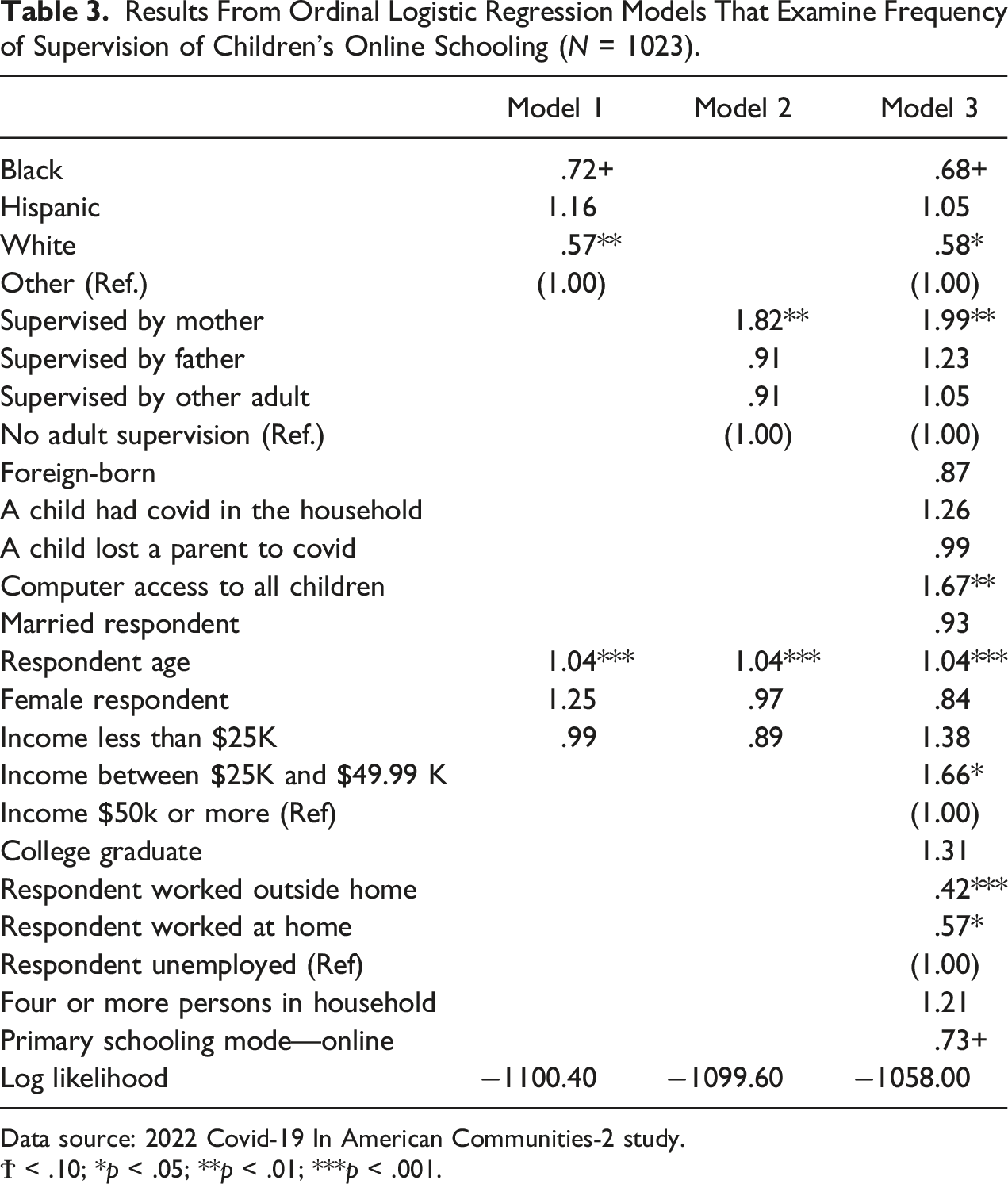
Results From Ordinal Logistic Regression Models That Examine Frequency of Supervision of Children’s Online Schooling (N = 1023).
Data source: 2022 Covid-19 In American Communities-2 study.
Ϯ < .10; *p < .05; **p < .01; ***p < .001.
Model 1 presents results from the ordered logistic regression analysis of racial/ethnic disparities in the frequency of supervision of children’s online schooling, net of demographic characteristics. Compared to the reference group, children in White families were 43% less likely to have received more frequent supervision of their online schooling (p < .05). Supplemental tests of all combinations of between-race differences in the odds of receiving more frequent schooling, however, indicated that the differences between Hispanics and Whites (Chi2 = 11.99; p < .01) and those between Hispanics and Blacks (Chi2 = 6.76; p < .01) were statistically significant. As such, Hispanic families provided more frequent online schooling supervision compared to White and Black families, which is consistent with what was observed in the preliminary results shown in Table 1.
Model 2 distinguishes between the odds of frequent supervision provided by key adults within families, net of demographic factors. In the process, it goes beyond previous studies that merely indicate that mothers were responsible for supervising children’s education during the pandemic by demonstrating that they did so with a greater frequency compared to all other groups of adults. Indeed, the frequency of maternal supervision of online learning was 82% higher compared to that of the reference group (p < .01). Furthermore, the analysis shows that the frequency of paternal supervision was not only comparatively lower, but also indistinguishable from that observed among other adults.
Model 3 shows what happens to racial/ethnic disparities as well as disparities among the main groups of adults after controlling for other factors. After controlling for these factors, children in both White (p < .05) and Black (p < .10) families become significantly less likely to receive frequent supervision for online schooling. Supplemental tests of between-race differences in the odds presented in Model 3 further showed that the children of Hispanics were still more frequently supervised compared to those of Blacks (Chi2 = 5.2; p < .05) and Whites (Chi2 = 8.41; p < .01). Model 3 further shows that the role of mothers in providing more frequent supervision is accentuated after accounting for other factors. Specifically, their relative odds increase from 82% in Model 2–99% in Model 3 (p < .01) implying that the maternal contributions observed in Model 2 were not explained by differences in the characteristics of households.
Additionally, Model 3 provides clarification about the relationship between other household characteristics and the odds of receiving frequent supervision within families. As expected, these odds were higher—by about 67%—in families where children had access to computers (p < .01), a critical requirement for online schooling. The odds were also higher in families with moderate incomes (i.e., between $25,000 and $49,999, p < .05) and with adults who were relatively older (p < .001). Notably, Model 3 captures important differences between the various adult employment outcomes and the frequency of supervision. The most important of these is that the highest frequency of supervision was not provided by adults who worked from home but by those who were unemployed. Compared to the unemployed, the former were 43% less likely to frequently supervise children (p < .05). In other words, unemployed adults appeared to have had more time to supervise children’s online learning compared to those who were employed.
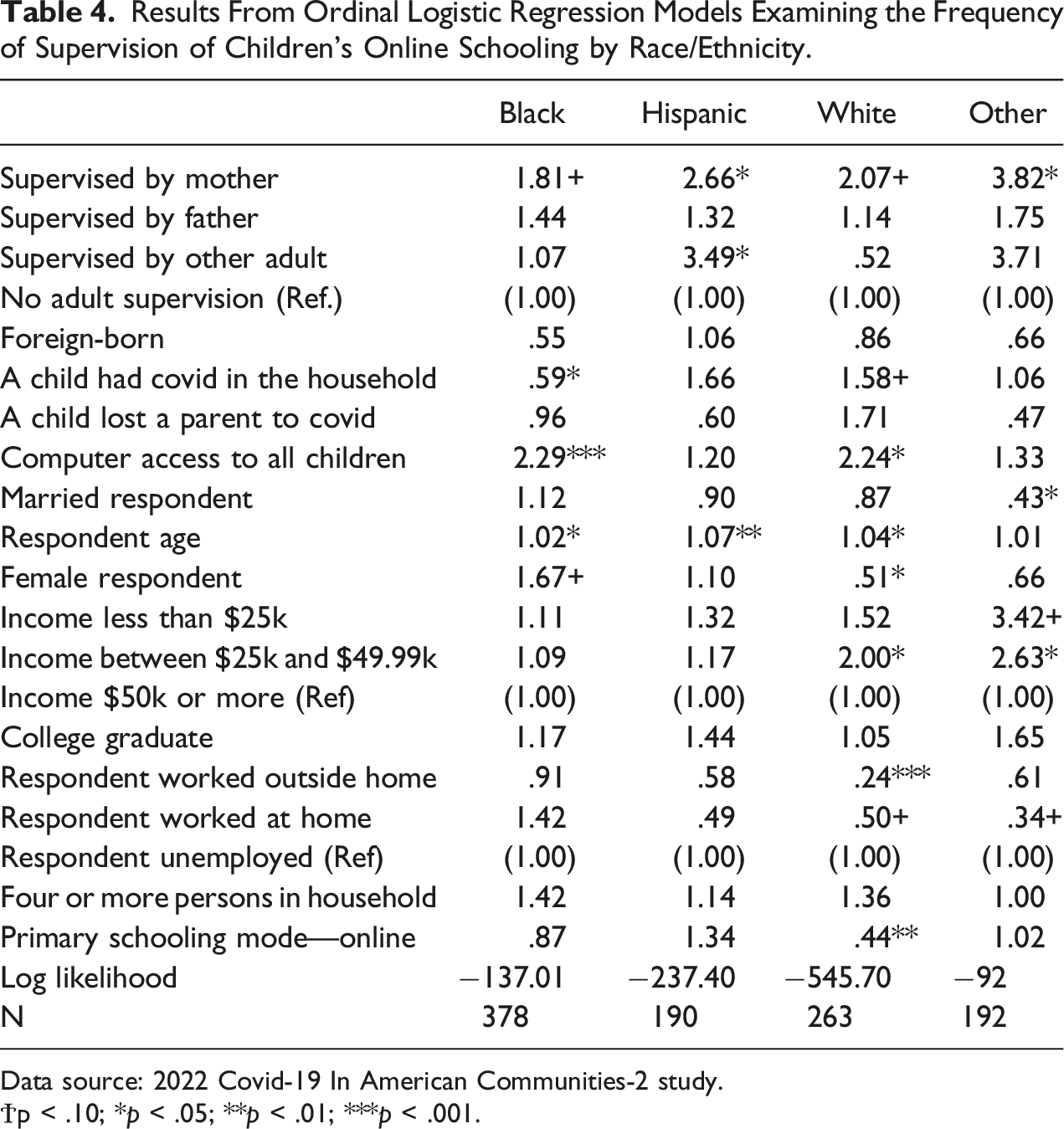
Results From Ordinal Logistic Regression Models Examining the Frequency of Supervision of Children’s Online Schooling by Race/Ethnicity.
Data source: 2022 Covid-19 In American Communities-2 study.
Ϯp < .10; *p < .05; **p < .01; ***p < .001.
To examine the third hypothesis, Table 4 further shows racial/ethnic differences in the association between the frequency of supervision and some of the direct health consequences of the pandemic. It shows that while the odds of being supervised frequently were lower when children lost parents to Covid-19 in Black, Hispanic, and other race families, these odds were not statistically significant. However, Covid-19 infections among children had a uniquely negative association with the frequency of supervision in Black families. In these contexts, these infections were associated with a 41% lower likelihood of frequent supervision (p < .05), suggesting that caring for sick children took away from the time available for supervising online learning. In White families, however, the reverse was true. Child Covid-19 diagnoses in these families were associated with a 58% higher likelihood of frequent supervision of children compared to White families with no such diagnoses (p < .10). The specific reasons for the contrasting relationships in Black and White families are unclear. We do know, however, that non-Whites usually have more severe Covid-19 symptoms compared to Whites (Bunsawat et al., 2022). As such, Black families may have devoted more time to the provision of care to infected family members versus supervising their children’s online schooling compared to White families.
Very few differences are observed in the relationship between adult employment outcomes and the frequency of supervision of online schooling. In Black and Hispanic families, for example, employment outcomes had statistically inconsequential implications for the frequency of supervision. However, employment outcomes were more consequential for the disparities observed in White and other race families. For example, working outside the home was uniquely associated with lower odds of supervision in White families (p < .001). However, in both White and other race families, working from home was similarly associated with lower odds of frequent supervision compared to unemployment (p < .10).
Other interesting patterns shown in Table 4 include the fact that having access to computers was associated with at least twice the odds of providing frequent supervision compared to having no computers in Black and White families. Additionally, net of parental roles and marital status, females were about 67% more likely to supervise children’s online schooling among Blacks (p < .10), which points to a broader role played by women, regardless of marital status, in the supervision of children in Black families.
Discussion and Conclusion
Recent studies have attempted to assess how the Covid-19 pandemic shaped children’s schooling, as part of a broader effort to demonstrate how the pandemic affected social life (Hoofman & Secord, 2021). As a result, we now know that the pandemic’s effect on temporary shifts from in-person to online schooling may have exacerbated racial/ethnic inequalities among children (Anderson, 2020). Building on these prior studies, our analysis has provided needed clarity on the significance of race for online learning as the primary option of school attendance at the height of the pandemic. We have shown, for example, that reports of online learning as the primary schooling option were differentiated by race, but so also was the experience of other schooling options. Moreover, our analysis captured racial/ethnic differences in the supervision of children and how this supervision was influenced by the health consequences of the pandemic. In the process of pursuing our objectives, we advanced research by making at least three specific contributions to the literature.
First, we confirmed that Blacks and Hispanics were the most likely to report online instruction as their primary option of schooling at the height of the pandemic, as reported in previous studies (Camp & Zamarro, 2021). Specifically, we show that the highest odds of reporting online schooling as the household’s primary option were found among Blacks, followed by Hispanics. Significantly, our analysis rules out household-level factors such as the effects of Covid-19 in families as the main explanation for this disparity. As such, it is still possible that the higher use of online schooling among Blacks may have been driven by their disproportionate representation in school districts located in areas with high rates of Covid-19 infection (Smith & Reeves, 2020). Similarly, their outcomes could reflect the fact that Black parents preferred online schooling rather than in-person schooling because the former limited their children’s exposure to racism and bullying (Collins-Nelsen et al., 2021). Our results also imply that framing children’s pandemic schooling options as a choice between in-person and online schooling understates the disadvantage experienced by racial/ethnic minorities during this period. As our results suggest, another option available to children was non-enrollment, which was observed to be highly prevalent among Blacks; this disadvantage was not explained by household-level factors.
Second, consistent with our second hypothesis, our analysis underscores the role played by mothers in providing the most frequent source of supervision for children’s online schooling at the height of the pandemic. In doing so, it shows that the role of parents in supporting children’s education at home was similar to the gender-differentiated roles observed within families prior to the pandemic (Balli et al., 1998). This disparity is significant because several studies indicate that online schooling demands more constant supervision to reduce children’s distractions (Cooper et al., 2000).
Based on these studies, therefore, we can infer that the supervisory role of mothers arguably played the most critical role in buffering children’s adjustment to the move to online schooling (Prime et al., 2020). This maternal role was somewhat ubiquitous across families. However, there was no such differentiation in the supervisory role played by fathers across racial/ethnic family contexts. Notably, among Hispanics, we did find evidence showing that adults other than mothers and fathers played the most frequent supervisory role to support children’s online learning.
Third, our analysis provides some support for our third hypothesis by suggesting that the health consequences of Covid-19 had more negative implications for the supervision of children in the families of racial/ethnic minorities compared to White families. However, these implications were only observed in Black families. Within these contexts, Covid-19 infections among children had a unique negative association with supervision of online learning. In other words, in line with studies on risk and resilience, at least among Blacks, the role of families in buffering the adjustment of children was itself affected by the adverse consequences of the epidemic. This finding, like those in other recent studies (Baron et al., 2020; Rundle et al., 2020), thus adds to the increasing body of work showing how the pandemic affected the lives of children.
More generally, our results show that there was a particularly high concentration of risk among Black and Hispanic children and their families during the pandemic that could have important developmental implications. Some of these consequences have been noted in studies using life course perspectives to understand the adverse effects of the Covid-19 pandemic on children (e.g., Benner & Mistry, 2020; Spiteri, 2021). This body of work indicates that societal shocks such as pandemics and recessions can represent developmental turning points that can lead to the accumulation of even more risks and disadvantages among children (Benner & Mistry, 2020). While these accumulations of risk are concerning when they occur in early childhood (Spiteri, 2021), they can also have negative implications for school-age children in early and late adolescence (Benner & Mistry, 2020). Our results, therefore, imply that the adverse developmental implications of the pandemic for children are likely to be more concentrated among Black and Hispanic children than among their counterparts who are White.
Overall, these findings have several implications for the development of policies and interventions to address the many consequences of the pandemic among children. Recent increases in the racial achievement gap among children provide a larger context for understanding the importance of giving more attention to the needs of Black and Hispanic children. Consistent with our observation of schooling disadvantages among these groups, new evidence from the National Assessment of Educational Progress (NAEP) confirms that Black and Hispanic children experienced the sharpest declines in test scores in the period that coincided with the Covid-19 lockdowns that occurred around the time of our survey (Urquhart, 2022). Careful attention also needs to be given to the long-term implications of Covid-19 in the families of disadvantaged racial minorities. For example, the unique negative association between child Covid-19 infections and the supervision of Black children raises significant concern about how well Black families will be able to adjust to the long-term side-effects of Covid-19 (i.e., long covid) among their children. Equally important is the fact that our analysis points to the need to look beyond traditional sources of adult support when designing policies to address the needs of children within families. In this regard, our results suggest that while the role of mothers continues to be important, non-parental sources can play an equally important role in meeting the supervision needs of children in the families of Hispanics.
Notwithstanding the significance of these findings, our analysis contained several limitations. The most obvious of these is that it was based on cross-sectional data, which limits our ability to identify true causal relationships and fully account for unobserved factors. Additionally, information on the outcomes of school-age children was based on adult responses about the schooling experiences children within families. No information was collected on the specific ages of school-age children, which limits our ability to account for developmental differences among them. The CIAC-2 data also lack information on school district characteristics, which precludes the examination of how localized differences in Covid-19 infection rates may have affected schooling choices. In some cases, families had the option of choosing between in-person and online schooling, but in other cases, the option was not available (Camp & Zamarro, 2021). Some of these choices may have been driven by geographic/state-level differences in policy responses to the pandemic
Footnotes
Declaration of Conflicting Interests
The author(s) declared no potential conflicts of interest with respect to the research, authorship, and/or publication of this article.
Funding
Eunice Kennedy Shriver National Institute of Child Health and Human Development, P2CHD042849.
