




Abstract
This systematic review of the literature examined the extent and nature of white parent’s ethic-racial socialization (ERS) of white children, the factors associated with white parents’ ERS, and the child outcomes of white parents’ ERS. It followed the Preferred Reporting Items for Systematic Reviews and Meta-Analyses guidelines. The review included 43 English-language works published between January 2000 and June 2021 and referenced in PsycINFO, PubMed, Web of Science, or Sociological Abstracts. It showed that white parents are engaged in ERS, employing many of the same strategies identified in research with parents of color as well as strategies identified as specific to white families. The review revealed child and parent factors related to ERS and child outcomes of ERS, including racial attitudes. In contrast with parents of color’s ERS, white parents’ ERS tends to teach strategies of advantage, preparing children to maintain their privilege. We offer recommendations for practice and future research.
Keywords
Introduction
White Americans occupy a privileged position in American society; they enjoy advantages in nearly every sector of society: education, housing, employment, health, etc., (Bowen Matthew, 2022; Brown, 2021). Whites are central to structural racism which produces and maintains this privilege (Feagin and Elias, 2013). Socialization operates as an “ideological apparatus” that supports racial inequities and contributes to their reproduction across generations (Feagin, 2006, p.43). Ethnic-racial socialization (ERS) involves verbal and nonverbal messages from parents to children on the meaning of race and ethnicity. Through these messages, children learn about themselves as members of an ethnic-racial group(s) as well as about people from other ethnic-racial groups. Until recently, scholars of ERS have focused primarily on children in families of color and how ERS may protect children from ethnic-racial discrimination, foster a positive sense of self, and promote positive outcomes (Umaña-Taylor and Hill, 2020). There is a need for research on ERS in white families, especially given that whites exhibit high rates of racial apathy (Forman, 2004), which is related to inaction on social justice (Lewis et al., 2019). Thus, greater understanding of whether and how white families engage in socialization can inform how whites may be better mobilized to address racial inequities.
Whites haven’t been examined as extensively as other groups in ERS research, and changing demographics in the United States mean that white children are more likely than in the past to encounter and interact with members of other ethnic-racial groups (Hagerman, 2018). Furthermore, recent events have raised the profile of race as a topic for discussion and action: the 2008 U.S. presidential election of Barack Obama, the 2013 founding of the Black Lives Matter movement, the 2016 U.S. Presidential election of Donald Trump, the 2017 Unite the Right white supremacist rally in Charlottesville, North Carolina, the 2020 nationwide mass protests of police murders, and the 2021 opposition to the use of “Critical Race Theory” in education. These and other events have sparked a national racial reckoning, prompting the discussion of race issues in the nation and in families (Freeman et al., 2022; Hagerman, 2018), and a backlash in the form of mobilized resistance to race-conscious practices in schools (Seaton, 2022). Prior research shows that white parents are less likely than parents of color to engage in ERS (Zucker and Patterson, 2018), but white parents are doing more than they did in the past and engaging in ERS in new ways (Freeman et al., 2022; Ferguson et al., 2022). Thus, it is important to document ERS in white families in today’s environment of increased race consciousness (Eveland & Nathanson, 2020).
Traditional approaches to ERS assess explicit socialization: the messages parents send to their children through discussion and conversation (Yasui, 2015). The most commonly used traditional measures include cultural socialization (teaching children about their ethnic-racial customs, histories, and traditions), preparation for bias (teaching children to recognize and cope with ethnic-racial prejudice and discrimination), promotion of mistrust (teaching children about the risk of discrimination by other ethnic-racial groups), and egalitarianism (teaching children that ethnic-racial groups are equal). While these strategies have largely been studied in families of color, research shows that these and related strategies (e.g., minimization of racism and anti-racism socialization) (Galán et al., 2022; Freeman et al., 2022; Ferguson et al., 2022) are employed in white families. Furthermore, newer approaches to ERS examine implicit socialization: the messages parents convey through their silence on ethnicity and race and through their actions, such as school and neighborhood choices and efforts to expose their child to diversity, such as through extracurricular activities, volunteering, or travel (Yasui, 2015). These approaches also distinguish between colorblind racial socialization (teaching children that race does not matter and should not receive attention) and color-conscious socialization (teaching children that different ethnic-racial groups have different experiences and challenges and diversity is valuable) (Hagan et al., 2023; Spanierman, 2022; Yasui, 2015). Thus, our review will assess the extent to which traditional and new approaches to ERS are employed in research on white families and what they reveal about explicit and implicit socialization in white families.
This study lays the foundation for future research by systematically reviewing the existing research. We fill gaps not addressed in the four prior literature reviews on ERS that we identified (Loyd and Gaither, 2018; Priest et al., 2014; Simon, 2021; Umaña-Taylor and Hill, 2020).
Priest et al. (2014) found that the majority of the existing studies focused on ERS in African American families and highlighted the need to examine how child and parent factors influenced the nature and impact of ERS. Loyd and Gaither (2018), focusing exclusively on ERS in white families, documented white parents’ avoidance of discussions of ethnicity-race with their children, especially at earlier child ages, and their often reluctant engagement in ERS as children grow and are exposed to racial-ethnic diversity and inter-group interactions in schools or the community. They found that white parents may employ colorblind racial socialization strategies that teach that race should not be discussed, acknowledged, or celebrated or color-conscious strategies, such as exposing their children to ethnic-racial diversity through school choice, that intend to teach, but do not always succeed in teaching, about diversity appreciation and racial justice. Umaña-Taylor and Hill (2020), focusing on the explosion of ERS research in the years between 2010 and 2020, highlighted how different ERS strategies relate to youth outcomes and how research on examining ERS in white families is needed. Simon’s (2021) scoping review focusing on how race predicted the content of ERS found that relative to families from other ethnic-racial groups, White American families were more likely to socialize in the form of egalitarianism, teaching their children that everyone is the same and possesses equal opportunities to succeed. These reviews were not systematic, included only psychological research, were published prior to recent historical developments, and/or focused narrowly on the effect of parent race on ERS.
Although not a formal literature review, Spanierman’s (2022) introduction to a special issue on whiteness in developmental science summarizes recent research on white ERS, reporting the three key findings as (1) whites engage in infrequent ERS, (2) when they discuss race, they transmit colorblind racial ideology, and (3) some white parents communicate implicit or explicit messages about systemic racism and white privilege. Building on this prior work, the present review is systematic, includes research from multiple disciplines, includes research published since the national racial reckoning, includes both qualitative and quantitative research, and examines white families only. It assesses the existing research on the extent and nature of white parents’ ERS and the factors associated with and child outcomes of white parents’ ERS.
Methods
Following the Preferred Reporting Items for Systematic Reviews and Meta-Analyses (PRISMA) (Liberati et al., 2009), the authors (one white, cisgender woman and two cisgender women of color) identified eligible publications and extracted the data from eligible publications. The search process and results are depicted in Figure 1. The works had to be published between January 2000 and June 2021, in English, and referenced in the databases PsycINFO, PubMed, Web of Science, or Sociological Abstracts. We used these search terms: (“ethnic socialization” OR “racial socialization” OR “ethnic-racial socialization” OR “racial-ethnic socialization” OR “cultural socialization” OR “preparation for bias” OR “promotion of mistrust” OR “mainstream socialization” OR “silent racial socialization” OR “racemute” OR “color conscious socialization” OR “colorblind socialization” OR “colorblind messaging” OR “minimization of racism” OR “egalitarianism” OR “anti-racism socialization” OR “anti-racist socialization”) AND (“white” OR “European American” OR “Caucasian”). We included published original empirical articles, books, book chapters, and dissertations/theses. We excluded reviews, protocols, and works that were unpublished. Flow of studies into the review.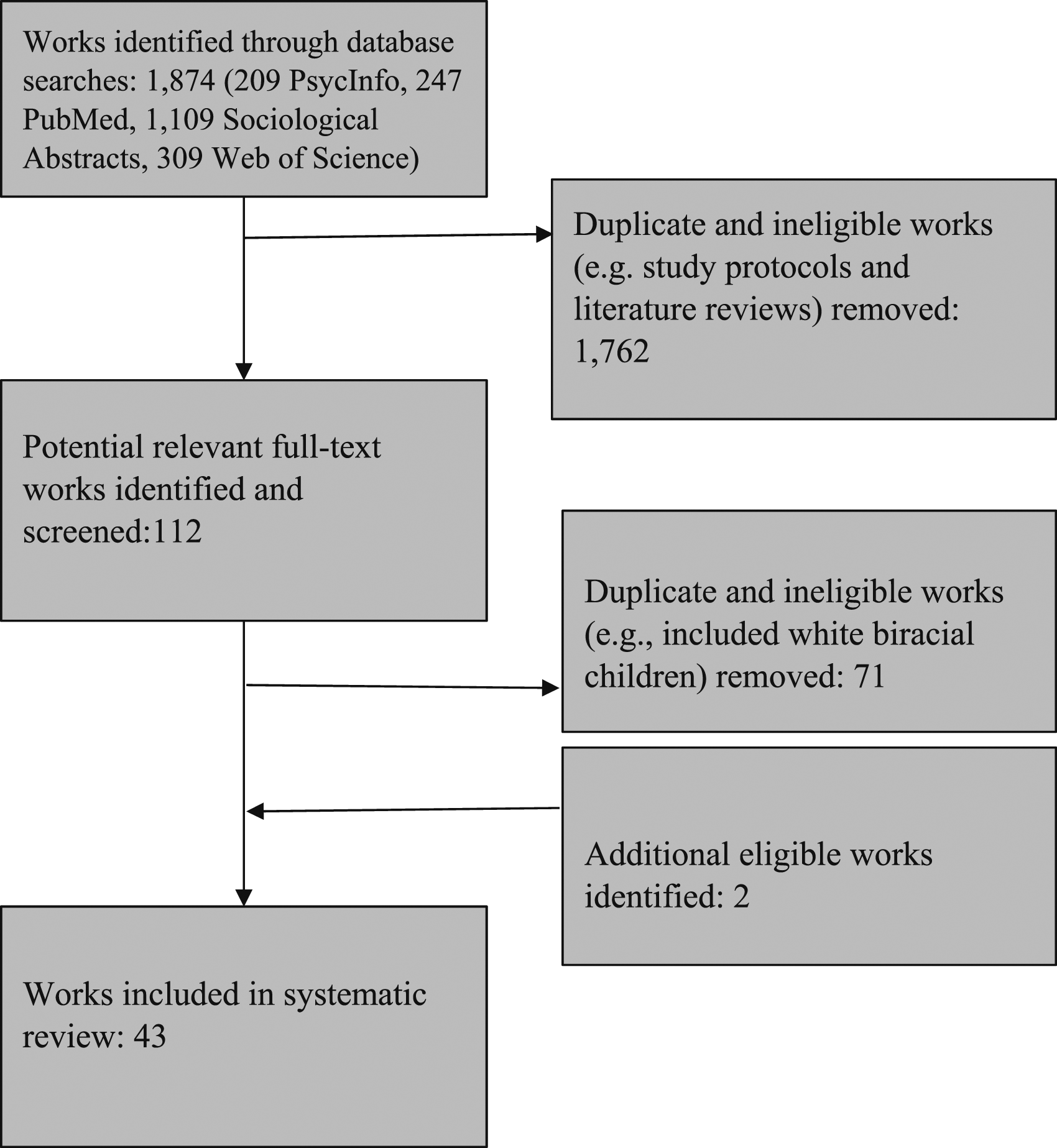
Although a substantial amount of research has examined transracial socialization, such as socialization of biracial children (e.g., Robinson-Wood et al., 2021; Rollins, 2019) or socialization by white parents of adoptive children of color (e.g., Langrehr et al., 2016; Zhang & Pinderhughes, 2019), relatively little research has examined white parents’ socialization of white children (Loyd and Gaither, 2018; Seaton, 2022). Furthermore, socialization about whites/whiteness is qualitatively different than other socialization, given whites’ dominant position in the U.S. racial hierarchy (Bowen Matthew, 2022; Brown, 2021). Therefore, the works selected for this review had to address ERS in white families, defined as white-only children and parents. Thus, white families excluded families in which either the child or parent was biracial or multiracial and transracial families (i.e., white parents with children of color or parents of color with white children). We included articles that also included other race children or parents but focused only on the results pertaining to white children and parents. We placed no restrictions on the age of focal children.
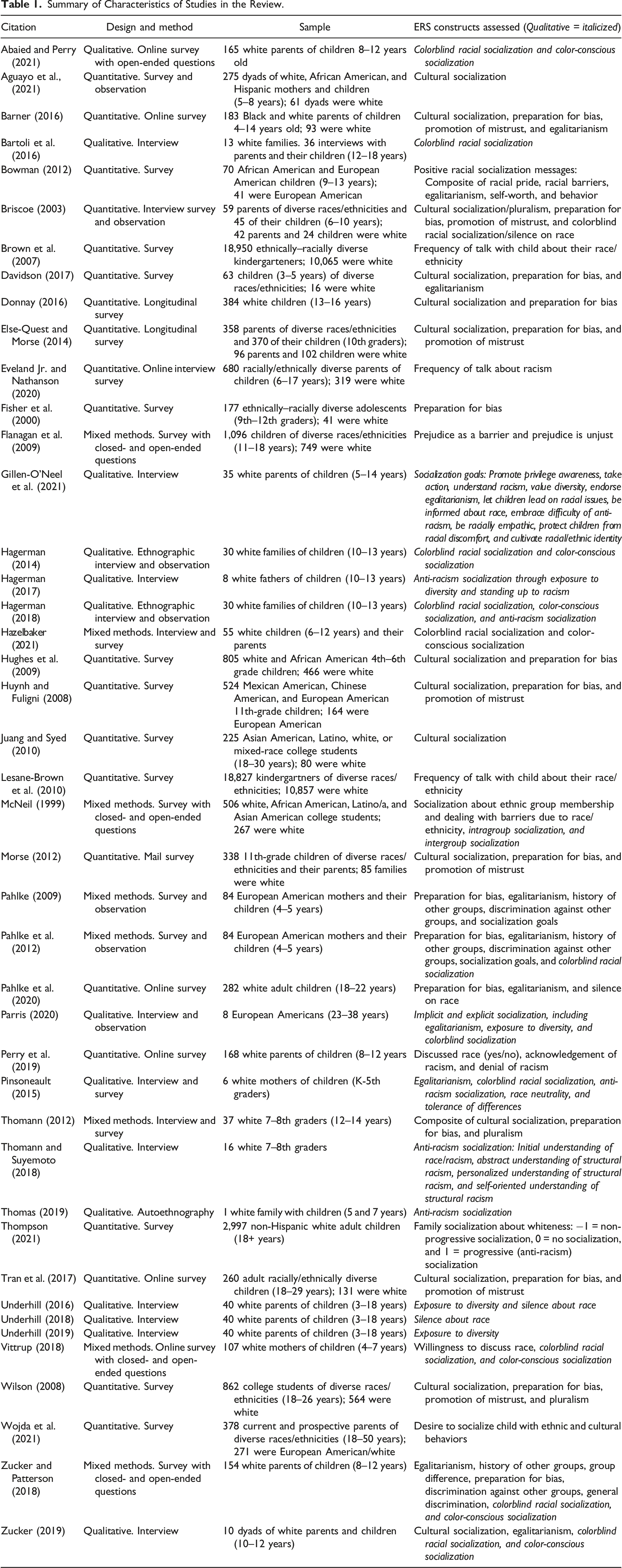
Summary of Characteristics of Studies in the Review.
Results
Table 1 summarizes each study’s features. Twenty-two studies were quantitative, thirteen were qualitative, and eight were mixed methods. A third were either dissertations (n = 13) or theses (n = 2). All studies were based on U.S. samples. All included whites in the sample; 19 had multiple racial groups, whereas 24 had whites only. Sixteen studies collected data from parents only, fifteen collected data from children only, and twelve collected data from both parents and children. Sixteen studies focused exclusively on children 12 years and under, five focused exclusively on teenage children, fourteen focused on children 0–18 years, and seven focused on emerging adults (18 years and older). One study of parents (Wojda et al., 2021) did not report child age.
ERS strategies and white parents’ engagement in ERS
Table 1 reports the ERS constructs used in the studies. Thirty-one studies employed quantitative measures of ERS. Of these, 14 studies examined cultural socialization, 15 studies examined preparation for bias, 7 studies examined promotion of mistrust, and 7 studies examined egalitarianism. Eleven studies captured colorblind racial socialization and seven captured color conscious socialization, and these were typically qualitative studies.
Colorblind racial socialization was identified in several ways. It involved encouragement to treat everyone the same (Vittrup, 2018; Parris, 2020) or neutralization of race: when racial events or topics are raised in conversation, parents frame the issue in terms other than race (Pinsoneault, 2015; Underhill, 2016, 2018). It involved value-based socialization messages in which parents teach their children to be good people, fair in interactions with others, and tolerant of differences, and racial differences are cast as equivalent to other forms of difference (Pinsoneault, 2015). It involved presenting an individual rather than structural understanding of race and racial inequality, and it did not typically involve discussion of power (Underhill, 2016, 2018; Vittrup, 2018). Finally, it manifested as silence on race when parents either explicitly tell children that race is an inappropriate topic for discussion or avoid discussing race, even when racial issues arise, implicitly communicating that race should not be given attention (Bartoli et al., 2016; Briscoe, 2003; Pahlke et al., 2020; Underhill, 2016, 2018; Zucker and Patterson, 2018). One exception here is that when silence on race is accompanied by parents’ nonverbal reactions conveying discomfort with ethnicity–race or dislike of specific ethnic-racial groups, children receive color-conscious messages (Parris, 2020).
Color-conscious socialization manifested in several ways. It involved teaching about discrimination and inequity, but mostly in a historical sense, or discussing skin color differences as ok (Vittrup, 2018; Zucker, 2019). It involved teaching egalitarianism (Gillen-O’Neel et al., 2021) or exposing the child to diversity (Parris, 2020; Underhill, 2016, 2019; Hagerman, 2018; Vittrup, 2018; Zucker, 2019), such as when parents explicitly choose places and activities characterized by ethnic-racial diversity with the goals of teaching their child that diversity is good and encouraging learning about other ethnic-racial groups and the establishment of inter-racial relationships. The choices could involve the neighborhood in which to live, the school their child will attend, extracurricular activities in which to enroll the child, parks to visit/play, etc. Parents typically did not accompany their choices with explicit messages explaining their choices (Vittrup, 2018). Like colorblind racial socialization, color-conscious socialization did not typically involve discussion of power (Vittrup, 2018). Anti-racism socialization, less studied (n = 6), teaches about structural racism and/or white privilege (Gillen-O’Neel et al., 2021; Hagerman, 2017, 2018; Thomann and Suyemoto, 2018; Thomas, 2019; Pinsoneault, 2015) and involves discussion of power and actions to address inequities.
White parents’ ERS may include mixed, vague, or inconsistent messaging. Parents may combine colorblind messages with color-conscious messages (Abaied and Perry, 2021) or provide vague descriptions of solutions to racism and actions that children can take to address it (Gillen-O’Neel et al., 2021; Pahlke, 2009). Hagerman (2018) found that some parents seeking to teach anti-racism inconsistently challenged hegemonic whiteness, reproducing the racist ideas they sought to challenge. Parents’ unclear messaging relates to their lack of familiarity with (Barner, 2016; Eveland and Nathanson, 2020; Pahlke, 2009; Perry et al., 2019) and uncertainty about discussing ethnic-racial issues (Hagerman, 2014, 2018; Underhill, 2016, 2019), their desire to avoid negative topics and emotions (Gillen-O’Neel et al., 2021; Hagerman, 2014, 2018, Underhill, 2016, 2019), and their structural privilege which makes conversations about ethnicity–race seem less urgent (Hagerman, 2018).
The reviewed studies show that white parents generally engage in low levels of ERS, especially when measured in traditional ways. Several studies document that when asked if they discuss ethnicity–race and/or racism with their children, some parents report that, for various reasons, they do not (Briscoe, 2003; Eveland and Nathanson, 2020; Hagerman, 2018; Lesane-Brown et al., 2010; Pahlke et al., 2012; Pahlke et al., 2020; Perry et al., 2019; Underhill, 2016, 2018; Vittrup, 2018). This approach, labeled as silence on race (Briscoe, 2003; Underhill, 2016, 2018) or racemute socialization (Pahlke et al., 2020), nonetheless operates to socialize children about ethnicity–race. For example, it may communicate that talk of race is dangerous (Hagerman, 2018; Underhill, 2018), irrelevant to white people, or unimportant generally (Briscoe, 2003). Conversely, some parents report that they engage in conversations about race with their children but then are unable to provide details about those conversations, suggesting that they may overestimate their engagement in explicit ERS (Vittrup, 2018; Zucker, 2019).
Given the diversity in study designs and samples, we cannot provide definitive rates of ERS. However, we can share some illustrative figures. Perry et al. (2019) found that 36% of the sample indicated that they had discussed race-related current events with their children, an amount that was high relative to those reported in previous studies (Pahlke et al., 2012). Underhill (2016, 2018) found that only 30% of parents were not silent on race-related events. Zucker and Patterson (2018) found that only 32.7% of parents reported actively encouraging discussions of race. Lesane-Brown and colleagues (2010) found that only 40% of white parents reported discussing ethnic/racial heritage with their children.
The relative level of ERS may be low, but, as suggested by other scholars (Eveland and Nathanson, 2020; Hagerman, 2018; Perry et al., 2019), white parents are engaging in ERS more than previously indicated by research using only traditional measures of (explicit) ERS. The reviewed studies document that white parents engage in both explicit and implicit ERS (Bartoli et al., 2016; Hagerman, 2018). Furthermore, both traditional and non-traditional explicit ERS strategies are in use in white families. We note that the review shows that white parents employ some of the same strategies that parents of color employ, even though the strategies have potentially different meanings and effects for white children. For example, the studies show that some white parents engage in preparation for bias, meaning they prepare their children to experience discrimination, despite the broad advantages whites enjoy in society (Bowen Matthew, 2022; Brown, 2021). Furthermore, the studies show that many white parents engage in cultural socialization; however, the quantitative measures of this strategy generally did not capture the very different potential meanings of parents’ messages: one should be proud of one’s ethnic culture versus one should be proud of the white race. The qualitative studies better captured the specific meanings of parents’ socialization, but as we’ll see in the section on the relation of ERS to child outcomes, parents’ socialization efforts did not always achieve their intended outcomes.
Even when parents engage in little ERS, they may nonetheless endorse the importance of ERS (Pahlke, 2009; Vittrup, 2018). Other factors, as we discuss below, are more likely to explain parents’ low level of ERS. Finally, regarding when and how ERS occurs, the review found that some parents initiate ERS while others wait for their children to prompt a discussion (Abaied and Perry, 2021; Underhill, 2016, 2018; Zucker, 2019). Some parents use current events as an avenue for opening dialogue about ethnicity-race (Abaied and Perry, 2021; Hagerman, 2018).
Child Factors Relating to Engagement in ERS
We identified five child factors: gender, age, inquiries about ethnicity–race, school diversity, and discrimination distress. First, according to Brown et al. (2007), parents reported more frequent discussions about race with girls than with boys. Second, consistent with research on parents of color’s ERS (Aguayo et al., 2021), eight studies documented that parents consider the child’s age when deciding whether to engage in explicit ERS (Abaied and Perry, 2021; Aguayo et al., 2021; Barner, 2016; Bartoli, et al., 2016; Gillen-O’Neel et al., 2021; Pinsoneault, 2015; Underhill, 2016, 2018; Vittrup, 2018). Despite evidence that children learn about race and perceive racial differences at a young age (Pahlke et al., 2012), many parents think that young children cannot understand race (Vittrup, 2018), race is not salient to young children (Aguayo et al., 2021; Pinsoneault, 2015), or discussions of race would be harmful to young children (Gillen-O’Neel et al., 2021; Underhill, 2016, 2018). They prefer to socialize children when they are older, such as in their teenage years. Teenage children are more likely than younger children to raise explicit questions about ethnicity–race (Bartoli et al., 2016; Aguayo et al., 2021), enabling parents to perceive they are ready for ERS. Third, children’s inquiries about ethnicity–race prompt some parents to engage in ERS (Gillen-O’Neel et al., 2021; Vittrup, 2018). Fourth, children who attend more ethnically–racially diverse schools receive more frequent discussions about race (Brown et al., 2007) and preparation for bias (Zucker and Patterson, 2018). Fifth, adolescents who experience greater distress due to perceived educational or institutional racial discrimination receive more preparation for bias (Fisher et al., 2000).
Parent Factors Relating to Engagement in ERS
We identified five areas of parent characteristics that relate to parents’ engagement in ERS: perceptions of the child, racial attitudes and experiences, preparation and readiness for ERS, parenting style and logic, and other parent factors.
Parents’ Perceptions of the Child
First, parents’ report of a warmer parent–child relationship was associated with more frequent discussions of race with the child (Brown et al., 2007). Second, parents’ perceptions of their child’s readiness for ethnic-racial socialization were related to their engagement in ERS. A parent’s desire to protect their child from discomfort may lead to opposite ERS outcomes. On the one hand, parents who perceive ERS as involving discomfort for the child or compromising the child’s “innocence” are less likely to engage in explicit ERS (Abaied and Perry, 2021; Hagerman, 2018), and if they engage in ERS, they are more likely to engage in colorblind racial socialization (Gillen-O’Neel et al., 2021). On the other hand, parents who themselves experience discomfort with race matters may want to protect their children from such discomfort. Thus, they engage in ERS to encourage their children to be comfortable with diversity (Underhill, 2016, 2019). ERS that is motivated to protect the child from discomfort is less likely to be anti-racist (Underhill, 2016, 2019).
Third, parents’ perceptions of their child’s racial bias also related to their engagement in ERS. Vittrup (2018) found that parents who perceive their children to be unbiased and thus not in need of ERS may be less likely to engage in ERS. However, parents’ perceptions may be based on poor evidence and inaccurate (Vittrup, 2018). Pahlke (2009) and Pahlke et al. (2012) found that mothers inaccurately predicted their children’s racial attitudes, raising the concern that parents may opt out of ERS and leave their children’s racial biases intact. Pinsoneault (2015) found that when mothers saw evidence of their children being good, fair, and tolerant, they concluded that explicit ERS was not necessary. Hazelbaker (2021) found that parents who were more comfortable with their child’s contact with diverse people reported more frequent color conscious socialization.
Parents’ Racial Attitudes and Experiences
Parents for whom race is of low salience feel little motivation to engage in ERS (Abaied and Perry, 2021; Underhill, 2016, 2018; Vittrup, 2018; Zucker and Patterson, 2018). Zucker and Patterson (2018) found that parents who highly endorsed white supremacy were less likely to present messages about egalitarianism, discrimination against other racial groups, and general discrimination and parents with a positive white identity were more likely to teach their child about discrimination against other groups, general discrimination, and group differences. They also found that parents with more biased racial attitudes were less likely to socialize about egalitarianism, the history of other groups, bias against other groups, or general racial discrimination and more likely to engage in color-conscious socialization emphasizing racial group differences. Perry et al. (2019) found that parents’ greater awareness of their own racial biases was associated with greater willingness to discuss race, increased color-conscious socialization, and decreased colorblind racial socialization. They also found that parents with greater internal motivation to respond without prejudice in interactions with other people were more likely to discuss race and acknowledge racism with children, and parents with greater external motivation were less likely to discuss race with children, fearing that mentioning race makes them appear racist. Underhill (2016, 2019) found that parents who understand racism in terms of individual people’s biases rather than structural conditions were more likely to engage in implicit socialization, such as exposure to diversity, believing that they produce in children an open mind about other ethnic-racial groups.
Colorblind racial ideology “holds that recognizing race is a precondition to racism, and thus failing to recognize race reduces racism” (Pahlke et al., 2012, p. 1165). Parents who endorse racial colorblindness are less likely to engage in explicit ERS and more likely to engage in colorblind racial socialization (Pahlke et al., 2012; Hagerman, 2018; Vittrup, 2018; Zucker, 2019Zucker, 2019) and less likely to engage in color conscious socialization (Hazelbaker, 2021). Pinsoneault (2015) found that in her interviews about ERS, some mothers engaged in self-censorship, avoiding the term “white” as a self-label in favor of other terms (e.g., middle class) and avoiding the term “race” in favor of other terms (e.g., “diversity,” “multiculturalism,” and “privilege”). Color-conscious ideology, in contrast to colorblind racial ideology, acknowledges the importance of race in society and thus holds that discussion of it can be beneficial. Parents who endorse it are more likely to engage in ERS at all, and color-conscious socialization in particular, especially anti-racism socialization (Gillen-O’Neel et al., 2021), and less likely to engage in colorblind socialization (Hazelbaker, 2021).
Parent’s exposure to diverse people was also related to ERS. Barner (2016) found that parents’ lifetime exposure to racially diverse people positively related to engagement in ERS, particularly egalitarianism. Perry et al. (2019) found that family interracial contact positively predicted acknowledgment of racism when discussions of race were held with children. Eveland and Nathanson (2020) found that white parents living in highly white counties discussed racism with their children less frequently than white parents who live in racially diverse counties.
Parents’ Preparation and Readiness for ERS
Some research showed that a parent’s perceived skill in discussing ethnicity–race related to their engagement in ERS. Parents’ lack of meaningful examination of their own whiteness and engagement with people of color translates to a lack of awareness of diversity issues, leaving parents without key skills to lead conversations about ethnicity–race (Hagerman, 2014). Underhill (2016, 2019) found that parents who perceived themselves to lack explicit socialization skills preferred implicit socialization. Parents’ lack of skill may lead them to talk about ethnicity–race “in elusive and contradictory, roundabout ways” (Hagerman, 2018, p. 18). Bartoli et al. (2016) and Pinsoneault (2015) described the difficulty of recruiting white parents, speculating that some white parents’ discomfort with discussing ethnicity–race was strong enough that it even impeded their involvement in ERS research.
Parent’s ERS goals were also related to ERS engagement. Gillen-O’Neel et al. (2021) distinguished between shallow goals (e.g., teach the child generic empathy) and deep goals (e.g., teach the child specific race-related empathy), finding that shallow ERS goals were associated with socialization more about superficial aspects (e.g., egalitarianism and individual relations) than deeper aspects of race (e.g., anti-racism and structural power relations).
Parenting Style and Logic
Eveland and Nathanson (2020) found that parents with an authoritative parenting style talked more to their children about racism than parents with other parenting styles. Underhill (2016, 2019) found that parents who endorsed the middle-class parenting logic of concerted cultivation were more likely to engage in color-conscious socialization that was not antiracist; they sought to expose their children to diversity not to reduce racism or inequity but to increase their child’s cultural capital and job/financial prospects.
Other Parent Factors
One study that identified parents’ partisanship as related to ERS: Eveland and Nathanson (2020) found that Democrats discussed racism with their children more frequently than Republicans. Brown et al. (2007) found that married parents and more highly educated parents engaged in more frequent discussions about race with their children. They also found that families in central cities, as opposed to small towns, engaged in more frequent discussions of race.
Relation of ERS to Child Outcomes
Twenty-six studies examined ERS effects on white children. Huynh and Fuligni (2008) found that cultural socialization, but not preparation for bias or promotion of mistrust, was associated with greater academic motivation, and promotion of mistrust, but not cultural socialization or preparation for bias, was negatively related to grade point average. Hughes et al. (2009) found that cultural socialization was positively related to academic efficacy and engagement. Juang and Syed (2010) found that cultural socialization was associated with greater ethnic identity. Morse (2012) and Else-Quest and Morse (2014) found that cultural socialization predicted ethnic identity exploration and commitment. Wilson (2008) found that cultural socialization, pluralism, preparation for bias, and promotion of mistrust predicted ethnic identity affirmation/belonging and exploration. Hughes et al. (2009) found that cultural socialization positively related to ethnic affirmation, and preparation for bias negatively related to ethnic affirmation. Hughes et al. (2009) found that cultural socialization was positively related to self-esteem, and preparation for bias was negatively related to self-esteem. Hughes et al. (2009) found that cultural socialization was not related to antisocial behavior, but preparation for bias was positively related to it. Wojda et al. (2021) found that experiencing ERS as a child positively related a desire to engage in ERS as an adult parent.
The remaining studies examined ethnicity–race-related outcomes. Bartoli et al. (2016) and Hagerman (2014, 2018) found that children who received colorblind racial socialization were less likely to believe that race matters. Pahlke (2009) found that none of the socialization measures (preparation for bias, egalitarianism, history of other groups, and discrimination against other groups) predicted children’s trait-based racial bias or social distance rating. Thomann (2012) found that more frequent ERS positively correlated with ethnocultural empathy. Tran et al. (2017) found that more frequent cultural socialization, promotion of mistrust, and preparation for bias related to a greater social dominance orientation. Hazelbaker (2021) found that color-conscious and colorblind socialization positively correlated with children’s favorable attitudes about Muslim people. Briscoe (2003) found that children who received colorblind racial socialization had fewer cross-race peers. Wilson (2008) found that cultural socialization and pluralism were positively associated with the proportion of cross-ethnic friendships and preparation for bias was positively associated with better quality, cross-ethnic romantic relationships. Pahlke et al. (2020) found that racemute socialization encouraged youth to avoid prejudiced behavior to escape negative judgments; they modified their behavior without examining or changing the underlying stereotypes and prejudices that contribute to biased behavior.
Pahlke et al. (2020) found that egalitarianism positively related, and preparation for bias negatively related, to warmth toward racial outgroup members. Racemute socialization was not related to warmth toward racial outgroup members, but it negatively predicted internal motivation to respond without prejudice and a fairness/reciprocity moral orientation which, in turn, predicted outgroup warmth.
Various studies examined effects on children’s understanding of race/racism. Thomas (2019) found that anti-racism socialization was associated with better understanding of race/racism; children were more likely to use race labels to talk about people of color, label white people as white as opposed to race neutral, understand the connection between current events and the U.S.‘s history of chattel slavery, and design and implement political actions to address racism. Thompson (2021) found that progressive family socialization was associated with increased awareness of Blacks’ structural disadvantages. Underhill (2016, 2018) found that silence on race was associated with children’s ignorance of racial current events which, she argued, contributes to intergenerational “collective forgetting.” Hagerman (2014) found that color-conscious socialized children more frequently thought about their own behavior in racialized terms. However, Hagerman (2018) found that color-conscious socialization via exposure to diversity (e.g., interaction with other-race people through extracurricular activities and interracial friendships) did not lead to racial literacy. Because the promotion of diversity was often shallow (e.g., celebrating ethnic food), it did not acknowledge how power and inequality matter. It reified who is ethnic and who is normal, ignored how racial hierarchies and power operate in society, and contributed to the reproduction of racism.
Hagerman (2018) found that implicit colorblind racial socialization was associated with a greater sense of entitlement. Parents’ school and neighborhood choices were based on racial ideas which were then communicated to children. White children attending a predominantly white private school viewed themselves as special and more deserving of resources than other kids. They articulated racialized notions of who cares about school; who is special, important, smart, and sensitive; who needs to be protected and nurtured (versus who behaves violently); who is racist; who knows about the world; and who will become powerful as an adult to solve social problems. Even white children in diverse schools developed a sense of entitlement because their parents used their structural advantages to hoard school resources for their children. Because parents justified their choices in individual rather than racial terms (e.g., my child is special, and I want the best for my child), the children learned how to justify white privilege and developed a vested personal interest in maintaining it. Although children who receive color-conscious socialization were more likely than children who received colorblind racial socialization to recognize that privilege and oppression exist, they had difficulty applying the concept of privilege to their own lives, largely embraced that privilege, and sought to preserve it (Hagerman, 2018). Similarly, Underhill (2016, 2019) found that although parents did not want their children to be racist, their socialization largely reflected a vested interest in maintaining privilege for their children. Hagerman (2018) found that parents’ exposure of children to diversity often led children to believe in inherent racial differences and white saviorism.
Parris (2020) found that some adults who in childhood received little ERS, particularly about racism and discrimination, expressed anger and frustration with their parents, feeling that they would have benefited from greater information and understanding about historical and current ethnic-racial inequities and experiences. These children reported that they felt they had to play catch up in adulthood, such as through coursework in college.
White ERS and Lessons About Whiteness and Equity
White parents’ ERS is typically shallow, focusing on positive messaging about superficial or “feel-good” aspects of ethnicity–race—what Underhill (2016, 2018) calls happy talk—and failing to educate children about racism and ways of dismantling it. While parents may aim to teach their children to value diversity, their words and actions teach more about other groups than about their own group and whiteness (Gillen-O’Neel et al., 2021; Underhill, 2018; Vittrup, 2018).
Twelve studies explicitly examined how parents’ ERS strategies conveyed messages about whiteness. Some of these studies documented mostly explicit messages that communicate to children that whiteness involves benefits or privilege which should be recognized—for example, how whites enjoy structural advantages (Gillen-O’Neel et al., 2021; Hagerman, 2014, 2018; Thomann and Suyemoto, 2018; Thompson, 2021). Others documented implicit and explicit messages that communicate to children that either whiteness is not an identity or not an important identity, especially at the individual level—that is, race and racism are relevant only to people who are not white (Bartoli et al., 2016; Underhill, 2019; Zucker, 2019). One study documented messages, conveyed implicitly, about white superiority (Parris, 2020), while another documented messages about whites having the ability, due to their privilege, to save members of other races and risking victimization when they stand up to racism (Hagerman, 2017).
Several studies documented parents’ struggle and efforts to teach a white identity. Underhill (2016) described how some parents sought to teach a new form of whiteness, one that supported ethnic-racial diversity and was distinct from the bigoted whiteness of the parents’ parents. Gillen-O’Neel et al. (2021) detailed how few parents had ethnic and racial identity goals for their children because many struggled to communicate how to feel good about being white while acknowledging whites’ unearned privilege. As a result, in lieu of cultivating an identity (in this case, an explicit white identity), parents sought to cultivate a set of values (e.g., the value of ethnic-racial diversity). Similarly, Underhill (2019) described middle-class, progressive white parents’ efforts to expose their children to diversity as a way of cultivating “a moral whiteness,” one that would distinguish them from other, racist whites. Thomas (2019) documented one family’s effort to counter the white-as-normal racial frame and cultivate an explicit anti-racist and white identity, in part by encouraging children to use explicit race language (i.e., call themselves white) and engage in explicit discussion of race.
With regard to lessons about equity conveyed through parents’ ERS, Gillen-O’Neel et al. (2021) contrasted parents’ shallow ERS goals (e.g., vague awareness of privilege and safety from racial discomfort) with other parents’ deep ERS goals (e.g., children feel a responsibility to do something about white privilege and taking action to confront or dismantle racism and learning racial humility). Pahlke et al. (2020) expressed concern that children learn the shallow lesson that racism is bad and aim not to appear racist rather than learning deeper lessons of how racism affects people of color and might be addressed. Underhill (2016, 2019) highlighted how the middle-class parents in her sample who socialized via exposure to diversity only wanted exposure to class-equal communities of color and disparaged poor whites to distinguish themselves from “white racists.” White parents’ exposure to diversity may operate as a performance of racial progressiveness that distracts from real challenges to the structural inequities (Hagerman, 2018). Pinsoneault (2015) critiqued mothers’ avoidance of explicit discussion of whiteness and their “delicate dance” of anti-racist but colorblind racial socialization, arguing that, “In cloaking messages about whiteness and the racialized other, they provide their children with the necessary tools—goodness, fairness and tolerance—to get in and out of any situation with minimal attention to race” (p.80). Hagerman (2014, 2018) similarly identified a “conundrum of privilege:” parents want their children not to be racist but also want them not to have to personally give up anything.
Evaluation of Design and Methods
These results should be interpreted in light of the studies’ research design and methods (see Table 1). Two quantitative studies were longitudinal; the cross-sectional design of the remaining quantitative studies precludes claims of causality. The samples were diverse in terms of child developmental stage; although, taken together, the studies provide evidence that ERS occurs across children’s developmental stages, the studies’ broad span of ages limits the ability to make definitive statements about similarities and differences in ERS in and between developmental periods. Although this review focused on white parents’ ERS of white children, one parent-only study assumed same-race children but did not gather data on child race (Eveland and Nathanson, 2020). Furthermore, Gillen-O’Neel et al. (2021) focused on ERS of white children but included four families with a sibling of color.
Nine studies reported no conflicts of interest. The remaining studies did not report whether there was a conflict of interest. Thirty-two studies did not report on human subjects or ethics. Eight of them were either dissertations or theses (Barner, 2016; Briscoe, 2003; McNeil, 1999; Morse, 2012; Thomann, 2012; Thomas, 2019; Underhill, 2016; Wilson, 2008), and we presumed that the authors obtained the appropriate approvals.
Discussion
This systematic review showed that white parents are engaged in ERS, child and parent factors relate to ERS, and ERS is related to white children’s outcomes. White parents have the potential to be agents of change, “but many are reinforcing the current system of colorblind indifference to racial inequality” (Abaied and Perry, 2021, p. 437). In contrast to parents of color’s ERS, which teaches strategies of resilience, white parents’ ERS tends to teach strategies of advantage, preparing children to maintain their privilege and allow the persistence of structural inequities (Hagerman, 2018). To prepare for ERS, white parents need to engage in comprehensive racial learning, reflect on their ethnic-racial identity, attitudes, and experiences, learn the relevance of ethnicity–race for them (Abaied and Perry, 2021), and consider how anxiety/discomfort affects their ERS (Perry et al., 2019; Gillen-O’Neel et al., 2021). Future research can build on the recent findings by Ferguson et al. (2022) showing that white parents with more advanced racial identity are less likely to engage in power- and race-evasive socialization with their children. While some parents will just need to gain greater clarity about their racial identity, others will need to deal specifically with their own racist beliefs (e.g., see recent research on white parents’ endorsement of reverse racism, Galán et al., 2022; Freeman et al., 2022).
Once prepared, parents should engage in ERS with greater intentionality and frequency and address any disconnect between what they think they are doing and what they actually do (Zucker, 2019). They may need to rethink “good” white parenting (Hagerman, 2018) and recognize that talking about ethnicity–race is valuable and avoids negative consequences (Abaied and Perry, 2021; Vittrup, 2018). Parents need to consider ERS via explicit messages and implicit messages via their actions and body language (Parris, 2020). They also need to consider the consistency of their messages and avoid messages that conflict (e.g., race doesn’t matter, but reverse racism exists). Recent research has documented how some white parents teach children that reverse racism exists (Freeman et al., 2022; Galán et al., 2022).
Parents should explicitly share with children their own racial attitudes (Perry et al., 2019) and avoid self-censorship of race language (Pinsoneault, 2015). They can expand their conversations beyond multiculturalism to include critical examinations of power, inequality, and structural oppression (Hagerman, 2018; Thomann and Suyemoto, 2018) which are in turn more likely to shape children’s understandings of action for social justice (Abaied et al., 2022). They need to address “the larger social environment that they construct for their child, thinking about what they do in addition to what they say” (Hagerman, 2018, p. 206). They must reckon with the “structural conundrum of privilege” (Hagerman, 2014): if they want their kids to fight ethnic-racial injustice, they must help their children understand how their own futures are implicated. These results are consistent with the recent findings by Freeman et al. (2022) about white parents’ efforts to teach children to acknowledge white privilege, use power to promote justice, handle white guilt, and develop a white identity that is humble even if the face of unearned privilege.
Regarding ERS content, parents can go beyond teaching that ethnic-racial diversity is valued to help children understand that work remains to make equality a reality (Abaied and Perry, 2021). They must teach the distinction between race and racism (e.g., race is not bad but racism is; being white is not a problem but whiteness is); thus, it is not racist to talk about race (Pinsoneault, 2015; Thomann, 2012). Hagerman (2018) recommends that parents equip children with language to directly name ethnic-racial injustice and the experience to actively resist it; forgo some of their own structural advantages; resist viewing themselves as white saviors or performing “anti-racism” to feel superior to other whites; be willing to hear and believe people of color to better understand racism; use their own positions of power for the collective, rather than exclusively individual, good; reject the idea that their own child is more innocent, special, and deserving than other children; and define good parenting as intertwined with good citizenship. Given that parents’ socialization is related to children’s actions (Hagan et al., 2023), it is essential that it address children’s capacity to make the world a better place.
We employed highly inclusive criteria for the review; yet, our search strategy may not have identified all existing research on the topic. The heterogeneity of the ERS constructs and child outcomes assessed limited the study comparisons, and the diversity of samples limits the generalizability of the findings; differences in child ages may involve different ERS patterns.
Further research is needed to better understand white ERS and should build on the reviewed research and that published more recently (e.g., Ferguson et al., 2022; Freeman et al., 2022; Galán et al., 2022; Hagan et al., 2023). Scholars should assess whether the content of ERS is shallow or deep (Gillen-O’Neel et al., 2021) and the messages are verbal or nonverbal and deliberate or inadvertent (Lesane-Brown et al., 2010; Pahlke, 2009). They could examine socialization about interpersonal versus systemic racism and white ethnicity versus white race (whiteness) (Abaied and Perry, 2021) and variations in ERS by parents’ whiteness identity and racial attitudes (Gillen-O’Neel et al., 2021; Pahlke et al., 2020). Given that only 2 of the 6 studies on anti-racism socialization (Hagerman, 2018; Thomas, 2019) examined child outcomes, there is room for additional research on this strategy.
Scholars should examine who initiates ERS discussions and what prompts them (Abaied and Perry, 2021; Eveland and Nathanson, 2020) and assess bidirectional relations between parents and children (Aguayo et al., 2021; Barner, 2016; Gillen-O’Neel et al., 2021) via designs in which parent–child ERS discussions are observed in real time (Abaied and Perry, 2021; Pahlke et al., 2020). Future research could examine additional mediators and possible mechanisms that connect parental ERS to children’s outcomes (Pahlke et al., 2020). For example, there is a need to look, especially qualitatively, at how children interpret parents’ and other sources’ ERS messages (Hagerman, 2018) and whether parents’ ERS goals and practices match, since many white parents are so unsure of what they are doing regarding ERS (Gillen-O’Neel et al., 2021). Studies on sources of ERS besides parents (e.g., schools) would deepen the understanding of ERS outcomes overall but also specifically the outcomes of parents’ ERS, given that other sources contribute to a context in which children receive parents’ ERS (Abaied and Perry, 2021; Hagerman, 2018; Hughes et al., 2009; Pahlke et al., 2020).
Given that existing research largely focuses on middle-class or affluent, well-educated white parents, there is a need to study low-income and less educated white parents. Also, scholars need to attend to how white parents’ self-censorship on ethnicity–race shapes not only parents’ ERS but also their involvement in ERS research (Pinsoneault, 2015). Finally, future quantitative research should employ longitudinal designs to improve the understanding of causal relations. Longitudinal research on age of socialization could determine whether different ERS strategies are used at different ages, children interpret the same messages differently across time, and children’s outcomes vary accordingly (Aguayo et al., 2021; Hughes et al., 2009).
Footnotes
Declaration of Conflicting Interests
The author(s) declared no potential conflicts of interest with respect to the research, authorship, and/or publication of this article.
Funding
The author(s) disclosed receipt of the following financial support for the research, authorship, and/or publication of this article: Nieri is supported by the National Institute on Minority Health and Health Disparities of the National Institutes of Health under Award Number U54MD013368. The content is solely the responsibility of the authors and does not necessarily represent the official views of the National Institutes of Health. The authors thank Darielle Martin for research assistance.
