




Abstract
Within the historical context of South Africa, fathers are largely considered the breadwinner, an ideology linked to financial affordability. The breadwinner title may be a masculine boost for some but denotes a sense of disempowerment for those without financial muscle. This is especially true for young black South African fathers who are still confronting socio-historical challenges including continued high levels of unemployment. This qualitative study sought to explore how young black fathers perceive and understand fatherhood based on their individual experiences and given their socio-historical and cultural challenges. Data were collected through semi-structured interviews and focus groups. Eight participants were selected through non-probability purposive sampling. Thematic analysis was used to analyse the data with the foundation of a family systems theoretical framework. Findings indicated that the perception of fatherhood is constructed through (a) financial insecurity, (b) (un)expectancy and psychological distress, (c) shared responsibility, (d) cultural dynamics and (e) a renewed sense of self meaning. The study has added value in ensuring that the voices of young black fathers are captured through their lived experiences. The findings suggest that much investment is still required to understand the different angles and dynamics of young black fathers in South Africa.
Introduction
To be the father of a nation is a great honor, but to be the father of a family is a greater joy.
Nelson Mandela
Traditionally, fathers were perceived as breadwinners since their roles and responsibilities were solely characterised by provision (Richter, 2006). In the last 150 years, black South African families have been formed and restructured by colonialisation, removal and relocation, racial discrimination, coercion and racial emasculation (Townsend et al., 2006), with the menfolk being mainly separated from their families to secure employment in distant places. Conversely, childcare was exclusively a task for women. The above led to the traditional principles of fatherhood being undermined systematically during the era of colonialism and apartheid (Lesejane, 2006). Within the black community, the overpowering construction of fathers as solely agents for materialistic support prevented the development of alternative fatherhood roles (Mavungu, 2013). Within the last decade, however, the traditional views of fatherhood have somewhat changed as a result of the growing entry of women into the labour market and other factors (Mavungu, 2013).
Fatherhood can be conceptualised through a variety of angles, including biological, social and cultural roles. Given that fatherhood is a multifaceted concept, some authors look beyond the father-child dyad and instead, ponder on masculine identity. Mkhize (2004) considers fatherhood an identity project entangled with the process in which men comprehend who they are in society. Young fathers (between the ages of 20 years and 29 years) present a unique set of dynamics. These include arguments of paternity denial (Swartz et al., 2013), negative media representation as reluctant to assume accountability (Ratele et al., 2012), conflict between the more traditional practice versus contemporary views on fathering and renewed social status as it links to a man becoming a father (Chili & Maharaj, 2015). In contrast with the negative portrayal of young black fathers, research also shows that some unmarried, non-resident fathers are increasingly playing caregiving roles beyond economic challenges such as assisting with homework and providing moral teachings (Makusha et al., 2012; Swartz & Bhana, 2009). Despite the enduring public stereotype that portrays young black fathers as detached and irresponsible (Montgomery et al., 2006), literature indicates changing trends.
Despite these perspectives and roles, most black children in South Africa are not raised in the presence of their biological fathers. In South Africa, only one-third (34.2%) of children live with both parents and approximately one-fifth (19.7%) do not live with either parent. A much larger percentage of children live with their mothers (41.7%) than with their fathers (4.4%) (Statistics South Africa, 2021). This indicates a possible disruption in the structure of the family and society and may show the unique complexity of fatherhood in black South African communities. It is evident that the significance of a father’s involvement from a developmental perspective range from enhanced socio-emotional, cognitive and behavioural developmental milestones (Sarkadi et al., 2008) to the formation of increased attachment habits. Hence, the significance of this study lies in the anticipation that a renewed and truer perception of the fatherhood identity may positively shift the perception and practicalities of the role.
A Contextual Positioning of Fatherhood
The concept of fatherhood and its dynamics requires an understanding in context and in time, given the forever-changing socio-cultural movement (Richter et al., 2011). The notion of time and the transformation thereof applies universally. However, the definition and practice thereof is contextually bound and, therefore, it is critical to acknowledge that fatherhood is neither universal nor static but rather dynamic and interactive (Lamb, 1997; Mkhize, 2004). As the norms and practices change, so do the perceptions, experiences and expectations of fatherhood (Makusha et al., 2013). Generally, the emphasis regarding fatherhood in Africa is on accepting paternity, being a role model, and taking (mainly financial) care of the child (Chideya & Williams, 2013; Richter & Morell, 2006). Much of the fatherhood research in South Africa documents several dynamics involved in fathering, fatherhood and the associated role. These complex dynamics include the migration patterns of men from rural to urban areas (Richter & Morell, 2006), the legacy of labour practices that disrupted men co-residing with their children, poverty and the HIV/AIDS pandemic (Townsend et al., 2006).
Historically, the absenteeism of fathers was strongly shaped by the political system in South Africa (Lesejane, 2006). This continues to be the case. According to Van den Berg and Makusha (2018), most men are under severe pressure to fulfil the expectation of being the economic provider and thus responsible for the financial well-being of their child; this expectation is unattainable for many South African men. Conflicting roles and pressured demands have possibly led to what current studies show to be a crisis in fatherhood in black communities. This is marked by the large numbers of children living in fatherless homes and growing up without their fathers (Baskerville, 2002; Richter et al., 2010). Unemployed fathers are burdened by substantial periods of joblessness and loss of income (Kalil & Ziol-Guest, 2008). Parental well-being, marital relationships and socialisation practices are mostly affected. Jacobson et al. (1993) assert that the unemployment of fathers negatively affects the family’s economic security. This is reflected in families reducing their costs and relying on public assistance, which ultimately reduces the superiority of fatherhood.
Being unemployed affects the physical and mental well-being of fathers to the extent that they fail to cope with the stress of being jobless. In South Africa, most unemployed fathers are at risk of drug and alcohol abuse and hence spend less time with their families. In addition, this substance abuse increases the likelihood of divorce amongst married fathers, further affecting fatherhood (Nduna & Sikweyiya, 2015). Although there has been a rise in female employment, there is the possibility that a mother’s involuntary job loss may not negatively influence marital quality to the degree seen with a father’s involuntary job loss (Kalil & Ziol-Guest, 2008).
Different cultural values across the globe affect the views on fatherhood. There appears to be a substantial variance in men’s behaviour regarding fatherhood where fathers in recent cohorts are more likely to report looking after, feeding, and bathing their children than in the past (Yeung, 2010). Southern Africa’s customary practices such as ‘ilobolo’ and ‘damages’ and various types of relationship issues have influenced fatherhood amongst black fathers (Mazembo et al., 2013). Makusha and Richter (2015) echo those cultural norms such as inhlawulo (the payment of damages by a man to a women’s family for impregnating her before marriage) and lobola (bride price) have contributed to residential separation of some fathers from their biological children. This has led to many children living in extended families away from their fathers who have been denied access to their children due to cultural prescriptions on how couples and children are incorporated into families. The mother’s family requirements need to be met before a father is given access to his children. In some cases, if damages are not paid, the man may not be recognised as the father of the child, and it may be decided that the child will not carry the father’s surname. (Mazembo et al., 2013).
A Family Systems Positioning
Systems thinking evaluates the part of a system in relation to the whole, and family systems thinking indicates that behaviour is often informed by and inseparable from the functioning of one’s family of origin (Baege, 2005). Therefore, this suggests that the perception of a phenomenon such as fatherhood might be shaped and influenced by the intergenerational knowledge and practice of fatherhood in black communities. Two basic forces in the family system theory are the force of togetherness and the force of individuality. The force of togetherness leads people to expect others to think, act and feel in a similar way to them. In fatherhood, the fathers’ fusion with family symbolises their appreciation and recognition of their involvement in their journey of being a father. Through this, young fathers develop their uniqueness and sense of individuality. When considering the hardship and criticism that some fathers endure, their ability to withstand external and internal hardship is probably linked to their level of differentiation. Bowen (1978) notes that various emotional processes occur in a large society through chronic stresses such as unemployment, poverty, disasters and political conflicts. When considering fatherhood, young fathers experience chronic stress and frustration because of the limiting factors in the execution of their role.
The Bowen theory was selected to guide the theoretical framing for this study because it enabled fatherhood to be situated in the context of the foundational theoretical strands posited by Bowen (1978). The perceptions of fatherhood comprise a family issue that is shaped by the family projection process, the nuclear family emotional process, and the emotional cut-off. It is noted that societal emotional processes also shape fatherhood and, in this regard, include issues of culture and religion. According to this perspective, society helps in determining how men perceive fatherhood and how fatherhood is linked to the emotional processes of socio-cultural foundation.
Research Processes
The current study adopted a qualitative approach (Bailey et al., 2011) since this facilitated the understanding of fatherhood from the participants’ perspectives. An exploratory and descriptive design (Chili & Maharaj, 2015) aimed at establishing true and experience-based perceptions of fatherhood was employed. Describing the perceptions of fatherhood amongst black South African young fathers required a description of the explored themes. Specifically, a descriptive research design helped to bring the perspectives of the fathers who narrated their life experiences to the fore. It is in this way that we were able to understand the fathers’ journeys into fatherhood and their perceptions of what it means to be a father.
Ethical Considerations
Upon approval and registration of the study, ethical clearance was requested from the Humanities Research Ethics Committee of the University of the Free State, South Africa, (UFS-HSD2018/0874). Permission to access a non-governmental organisation (NGO) for the recruitment of participants was granted by the director of the NGO upon approval of the study’s proposal. Participants were provided with detailed information, enabling them to make an informed decision regarding voluntarily participation. Anonymity was guaranteed except for the gatekeepers at the NGO who advertised the study amongst interested participants. No psychological distress was meant or observed, but participants were granted the opportunity to seek debriefing counselling should they wish. The records of the data set comprising audio, raw data and transcripts were kept and stored safely (password protected) in a repository that could only be accessed by the research team.
Participants
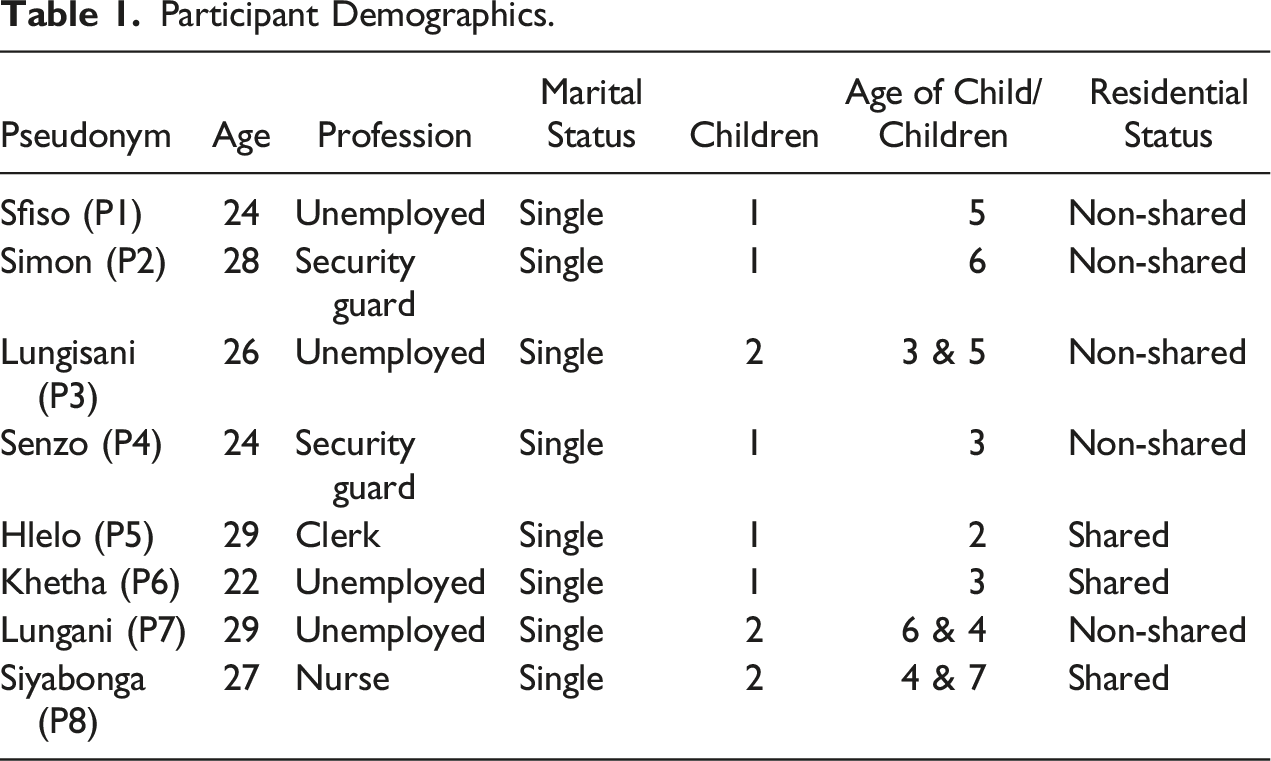
Participant Demographics.
Data Collection
The director of the NGO was contacted regarding the research project and the need for participants. As a result, an administrative assistant of the NGO was delegated to be involved in the recruitment and to liaise between the research team and the participants. A meeting between the team and the participants was organised by the assistant with the aim of introducing the researcher and the study to the participants. Thereafter, one semi-structured interview with each participant was conducted in the office space of the organisation. The semi-structured nature of the interviews allowed for spontaneous and flexible descriptions and narratives of the participants lived experiences. After the interviews were analysed, a set of similar themes were identified and presented to a focus group (Krueger & Casey, 2014) consisting of six of the original eight participants for further in-depth discussion and elaboration. Because of the socially constructed nature of the concept under exploration in attempting to explore deeper nuances, it was critical for us to use a focus group discussion to gather additional data.
Data Analysis
Thematic analysis (Braun & Clarke, 2008) was used as a method for uncovering a collection of themes. The six phases of analysis presented by Braun and Clark (2006) were followed to find repeated patterns of meaning: (a) familiarisation with data; (b) transcription of verbal data; (c) generating initial codes; (d) searching for themes; (e) reviewing themes; and (f) defining and naming themes. This type of analysis created a synthesis of themes based on individual experience and the broader social context. This was further accounted for by the themes that emerged from the focus group discussions. First, in familiarising ourselves with the data, we listened to the recordings of the interviews. This helped to gain an understanding of the data and to become acquainted with them. Second, we engaged in the transcription process of the collected data. In this regard, the process of transcribing was relatively easy because one of the researchers is fluent in IsiZulu. This made the process even more interesting because of the richness of content that was beautifully expressed in a language that both the participants and the researcher understood. When the inductive process of analysis started, initial codes were created based on the transcribed data. This resulted in seven open codes. Themes and subthemes were identified from the emerging codes. This process was not linear; themes were reviewed, renamed and refined according to the accurate reflection of the data set. This resulted in five main themes that were identified deductively through the lens of the family systems theory (Bowen, 1978).
Results
Five themes emerged from the data collection: (a) financial insecurity; (b) (un)expectancy and psychological distress; (c) shared responsibility; (d) cultural dynamics; and (e) a renewed sense of self-meaning.
Financial (In)Security
Fathers strongly established their fatherhood identity based on the traditional narrative of a breadwinner. This perception was echoed amongst all the participants of the study and led to the shared perception that strong financial muscle is a significant determinant in the success of fatherhood. Having a child is difficult because as a father, it is my responsibility to provide. If my child requests something to me as her father and I’m not able to afford, it’s painful. (Sfiso)
Siyabonga shares this view of the need to sacrifice for the sake of the child: You see, when the child has arrived, you know that there’s someone who is depended on you. You obviously will need to go and find anything that will help you to ensure that the child does not suffer. Rather, it can be you who suffers as the father so that the child can get everything they need. (Siyabonga)
It was evident that being a young father in the highly volatile economical milieu of South Africa was an obstacle to these young fathers. I tried to study and the child was also growing up. After a while, I could no longer strike balance. The tuition was too expensive and on the other hand, the child had his own costly needs. I ended up dropping out of college. I could no longer continue with college. Instead, I continued raising the child. (Senzo) I can say that currently, I’m challenged in my journey of fatherhood since I am no longer employed and cannot afford things for the children. I cannot accomplish my dreams as I wanted to give my children love but I am now unable to do that because I am unemployed. (Lungani)
One of the fathers provided some perspective on financial instability and the link to absent fathering. The reality is that we as young fathers are known for being absent. When a father does not have money and [is] not able to meet the financial need, he may feel defeated and distance himself. On the outside that is negligent; however, from a men’s and fathers’ perspective, it’s not. Rather, it’s surrendering to defeat. (Sfiso)
(Un)Expectancy and Psychological Distress
There was consistency throughout the data set that participants became fathers unexpectedly. These young fathers were overwhelmed with shock, confusion and denial. There were various reasons for this emotional and psychological turmoil, the main one being that most young fathers were nurturing different dreams at the time. I had plans before that which needed to change when the pregnancy situation occurred. So I realised that if I was planning to study now, I had to study whilst working. Sometimes, it’s hard as there are those things, I wish I could have achieved before becoming a father but now, it’s no longer possible. (Simon)
It emerged that the young fathers were reticent about informing their family about the unplanned impregnation. It was apparent that this was a major concern for the participants because they were still dependent on parents and family members for support and care in all aspects. There was fear related to the fact that being a father means that I am getting into another stage of life and I am no longer regarded as a child at home anymore. (Simon)
Khetha introduced a more emotionally layered perspective in his experience: At times, I would just think about foreseeable expenses. At home, they constantly reminded me that I’ve impregnated someone. This carried [a] negative connotation. Hence, I felt a sense of shame in being a father at an early stage, so I started thinking that I have embarrassed my family. (Khetha)
Shared Responsibility
The study found the repeated theme amongst all participants of extended family members playing a role in the raising of children, thus influencing their experiences of fatherhood. Participants also shared how elders in the family would assume responsibility for teaching, disciplining and guiding the children and the fathers themselves. Some fathers indicated that they relied on the extended family members to pass down certain teachings to their children. This is how an African child is brought up; we were raised by grandparents, aunts, and uncles. Everyone has a role to play in raising a child because the child belongs to the family, but it doesn’t mean that the father is removed from that responsibility. The father is still the one who is the biological parent to the child so he will be the leader. However, the family will support and lead along the father. (Khetha)
In agreeing with other participants, Simon shared a broader perspective: It is part of our culture that a child belongs to the whole family and, therefore, the family will also partake in raising the child. However, a family is not forced to do so but is showing Ubuntu that as Africans, children are raised within the homestead not just the father only. (Simon)
Senzo reflected on his childhood experience with his father: I can say that my father had a big influence on my fatherhood journey. He always wanted the best for me. In my childhood years, when I came back home from playing to find him eating, I would sit next to him and he would offer me food, stating that he wants me to eat and grow to becoming a man. (Senzo)
Extended family members regard raising a child as their responsibility and not merely as assisting the father. The following verbatim quotation articulates this phenomenon: We are not only speaking the financial aspect but the family also contribute their teachings and knowledge in shaping the child. My aunts have taught my girl child how she must carry herself as a girl growing up in the village. They also guide her on things like hygiene. So you can see that as a father, I am not alone in this journey; my family make it possible to play fatherhood role. (Simon)
Cultural Dynamics
It emerged in this study that fathers rely on the knowledge of culture to make sense of who they are as fathers whilst using the same scripts to understand and navigate fatherhood. Being a father firstly means that I am no longer a boy. I may be young in terms of age but I can no longer be counted amongst the boys. I am now a parent, and there’s someone whom I’m responsible for. (Khetha)
The preservation of culture amongst the young black fathers appeared to be critical. These fathers are seemingly rooted in culture and exude pride. All the participants echoed the importance of culture in their fatherhood journey. It is important for the child to know their roots. In the end, if the child is only academically educated, they will throw away all that they need to know. Hence, it is important for them to know all those things. (Lungani)
Similarly, Sfiso stated: It’s important for the child to know their roots. If we were raised by certain customs, my generation should also follow in those customs. (Sfiso, 1, p. 4, para. 58)
The young fathers believed that their way of parenting was influenced by how they were parented, and this was based on their culture. The notion of customs as highlighted in the quotation below includes spiritual connectedness to supernatural beings as a way of preserving culture. It is important for the child to be known by the ancestors according to our Zulu culture. When we perform cultural ceremonies, we are connecting the living and the dead. This connection seeks to create harmony and protection between the child and elders of the clan. It further seeks to root the child in their culture. (Lungisani)
It emerged in this study that the cultural practice of paying ‘damages’ to the family of the child’s mother is prioritised amongst black African fathers. However, this practice is a burden to young fathers because they are often unable to settle this payment. As a father, I need to ensure that I have paid for the child in terms of my culture. It’s against my culture to live with my child without paying inhlawulo first. I believe that one becomes a trusted member of the community as well as [part of] the maternal family of the child as soon as inhlawulo is paid. They look at you as a person who is truthful and who still follows culture. (Hlelo)
Khetha similarly stated: I need to make sure that I have paid for the child in terms of my culture. I cannot live with my child without paying the damages first. (Khetha)
Conversely, Lungani introduced a different ritual: You see the insertion of isiphandla is another form of cultural ritual equally important as the payment of damages. When the child gets isiphandla that means they are culturally eligible to use their father’s surname. (Lungani)
Renewed Sense of Self and New Meaning
Amid the doubt and frustration, the young fathers somehow found a sense of meaning and purpose in becoming fathers. The person you have brought into this world will see themselves safe under the guidance of a father. Fathers are protectors of their families even if they are young. But when you are a father, you need to do things that other adults do; it is important to protect your family and your children as a father. (Lungisani)
Sfiso agreed and shared his perspective: To be a father is like being a leader; it is like having power. There is now someone that you will teach about life and all those things. (Sfiso)
Some fathers alluded to a sense of maturity after becoming a father. This possibly entailed a change in their perception of the world and their surroundings. Given the major transition in becoming a father, a change in perspective is inevitable.
Siyabonga elaborated on his experience: Eventually, you forgive yourself for being ignorant and find ways to move on because you convince yourself that it’s part of growth and part of life. One cannot be ready for everything in life, including being a father. At times, we do things carelessly, but now as a father, I must be attentive in whatever I am doing. I need to analyse it first and see how good it is or how badly it may affect the person next to me. (Siyabonga)
Hlelo agreed with Siyabonga and stated, Yes, its new chapter, new journey to the stage of adulthood regardless of my age. By that I mean age is nothing but a number. I have learnt that actions that one takes in fulfilling their role of being the father will determine how matured they are. I am now motivated to work hard because I’m working towards raising a human being—my son who will grow up and become a man. (Hlelo)
Senzo concurred: I agree. It’s an opportunity to change one’s way of living. As a young person, there are behaviours that one still hung up to such as spending time with the boys, drinking, and partying. When a child arrives, you realise that a new meaning to life has arrived and, therefore, my ways of living will change to accommodate the new life. (Senzo)
The following extracts may be likened to the ‘new father’ phenomenon. Senzo highlighted the significance of spending quality time and investing in the attachment to attain emotional connectedness in the father-child dyad. Lungisani and Simon shared unique perspectives rarely shared in young fatherhood literature. It is very important to spend time with my child because this is when we get a chance to connect. This is where your child gets to know and understand the type of person that you are and what is it that you want for the child. (Senzo) I would advise that fathers need to get close to their children. The children need to stop wondering [and] looking all sides [and] not seeing where their fathers are at. In the end, these fathers will need their children and maybe at that time, the children would not be interested in that relationship. (Lungisani) In my view, it is wrong to treat the boy and the girl child differently, as emphasised by culture. The role that can be played by modern fathers is to ensure that we do not use culture to disempower our children ’cause of their gender. For example, in the olden days, women were not allowed to study but now, you find that it is the woman who keeps the household standing. Therefore, a boy and girl child should be treated the same. They must be supported equally; there should not be talks of the boy child being a priority more than the girl. (Simon)
Discussion
The Financial Component Remains Central
It emerged in this study that most young fathers perceive the lack of financial stability as equivalent to the lack of capacity to be a good father. The repetitive pattern of financial insecurity was highlighted by all participants, indicating the shared view of the importance of finances in maintaining their role as provider. However, the participants expressed difficulty in maintaining this role because of a general poor financial standing. As stated before, this was exacerbated by several factors, some of which were carried over from the historical injustice into the 21st century. It is, however, not surprising that these young men struggled in this aspect since most of them were still pursuing their education. As a result, training advancement and securing employment were the dominant aspects of the father-as-financial provider discourse (Enderstein & Boonzaier, 2015). It was evident that the traditional narrative of fathers as providers was entrenched in the minds of young and new fathers. These young fathers found themselves weighed down by this dominant stereotype that still dictates the meaning of fatherhood. As a result, this study found that poor financial status limits the father’s self-perceived efficiency in the child’s life.
When probing the underlying reasons that push men to relinquish their role, these fathers indicated that the abandonment of the role is an act of defence against the sense of humiliation and emasculation of men. Ramphele (2002) reflected on this phenomenon, stating that abandonment by fathers is often provoked by their inability to endure the affliction of being providers. Similarly, Hunter (2006) notes that the failure of fathers to undertake social and financial responsibility for their families led to the desertion of children. This is in agreement with Mkhize (2006) who states that the affliction of failure becomes unbearable for those who lack the ability to generate earnings as illiterate and inexperienced labourers. The discussion from the focus group re-iterated the internal pain of withstanding a weakening sense of self as a result of failing to live up to the dominant identity of a breadwinner. In his findings, Mkhize (2006) notes that the sense of manhood is lost as a result of weak financial muscle. This relates to the statement of Bowen (1978) regarding the nuclear family emotional system that the emotional pattern is a replica of the past generation. When this is broadened to societal level, it can be stated that the crisis and distress associated with financial limitation has trickled down to the younger generation. What young fathers are experiencing in this journey of fatherhood is not new; it reflects how previous generations experienced the state of being a father (Lesejane, 2006).
One can gather from Bowen (1978) that the historical replica will predict the same pattern for the next generation. The crisis associated with the financial provision aspect of parenthood is likely to be entrenched and lifelong. This is due to poor generational wealth in black communities of low socio-economic status. In fatherhood, finances have been regarded as the key determinant of success in the role. Research in South Africa and Rwanda found that the low number of men involved in maternal, newborn and child health is associated with the wider shared view that pregnancy and child rearing are exclusively women’s issues (Van den Berg et al., 2015). It emerged in this study and is important to highlight how young fathers were overwhelmed by the glorified ‘provider’ identity, which proved to be a factor in boosting their masculine identity.
When Parenting is Not Planned
Unexpected and unplanned parenting introduces unique challenges to an already challenging task (Kavanaugh et al., 2017). Literature on this topic suggests that this realisation often finds its way into the unconscious concerns of men, resulting in heightened levels of anxiety, tension, guilt and apprehension. In a study of young fatherhood in the South African context, Chili and Maharaj (2015) similarly noted that the young fathers were not prepared for fatherhood and that most of the pregnancies were not planned. When considering the family systems theory, Bowen (1978) suggests the concept of chronic anxiety. He posits that chronic anxiety, which is a reaction to a stressful situation, is passed down through generations. If the concept is broadened and applied within the systemic history of black fatherhood in the South African context, this could suggest that there is a generational link of chronic anxiety encapsulated within that history. When the imminent responsibility of raising a child against the background of poor resources and low socio-economic status is considered, the occurrence of psychological distress such as chronic anxiety is inevitable. Bowen (1978) further states that society parallels chronic anxiety of families and subsequently regresses to a lower level of functioning. The overwhelming emotions generated by the inexpectancy experienced by both parents inevitably affect the child. Bowen (1978) stipulates that in the emotional processes, intergenerational projection also applies. The process of intergenerational projection predicts an occurrence of anxiety and stress in the next generation as a result of an unresolved crisis.
When a Village Steps Up …
The role of family in fatherhood cannot be undervalued in black society (Mkhize, 2006). Young fathers and their children form part of the larger system and are dependent on this system for survival. This collective approach to fatherhood reflects African communism in many other areas of social life. Mkhize (2006) states that sub-Saharan societies are inclined towards collectivism, which involves an extended family system. The extended family system endorses collective fatherhood where the responsibility to raise and support a child does not solely rely on the biological father but extends to other male members of the family such as brothers, uncles and grandfathers (Mkhize, 2006). There is much contributed by the family apart from materialistic items, and elders are trusted to enforce discipline, teaching and grooming of the child. The concept of interdependence and interconnectedness of the family systems theory reflects this communal approach. It was evident in the findings of this study that no part of the family system could function separately. The intertwined relationship between fatherhood and familial involvement was vital in how young fathers perceived and understood their role. The engagement of family lessened the pressure and burden of raising a child. It was clear that the family as a support system formed part of the rich perception of young fatherhood. Mkhize (2006) asserts that child rearing is the collective responsibility of the extended family. When considering interdependence, the family systems theory (Bowen, 1978) emphasises that individuals cannot be understood outside the existing context of family and culture.
This interdependence automatically weaves in the concept of the emotional unit of the family systems theory (Michael, 2000); for example, when one family member feels overwhelmed, isolated and out of control, the family can accommodate that individual to reduce the tension. This was apparent in the present study as fathers highlighted how the family absorbed their anxiety and fear by undertaking the role of parenting alongside them. In fact, Mkhize (2006) highlights that in the extended family system, the responsibility to nurture and support children is not an exclusive task of the biological parents. The members of the extended family are expected to take active responsibility for the well-being of their relative’s children. Bowen (1978) refers to this as triangulation, the balancing effect of the emotional process in the emotional well-being of fathers.
Culture as Navigator Into Fatherhood
When considering intergenerational cultural practices and their influence on parenting, it can be ascertained that fatherhood is rooted within a systemic ideology that is entrenched in culture. Marsiglio (2008) states that fatherhood is a cultural illustration displayed through different socio-cultural processes rooted in a larger ecological context. The findings of this study strongly reflected this phenomenon in that young black fathers cited culture as a fundamental foundation in which the practice of fatherhood is embedded. Participants highlighted culture as the basis of their wisdom. It was evident that culture had an impetus in sharpening the understanding and the practice of fatherhood even amongst young black fathers. Bowen (1978) refers to a multi-generational transmission process as a process in which patterns and themes from previous generations are passed down to a new generation by the elders. In addition, there is an underlying cultural identity that fathers embrace and lead by, which is linked to a sense of connectedness to the supernatural power, the family and the community. When considering Bowen (1978), the higher connection is not particularly related to family processes such as fusion (Bell et al., 2001; Chung & Gale, 2006; Neff et al., 2008). Instead, high connectedness stimulates a healthy identity, a sense of belonging, and family development.
As fundamental as culture was deemed to be, it was also evident that it was being used as an instrument to enforce stringent principles in fatherhood. The cultural practice of inhlawulo weighed heavily on the young fathers who were still financially unstable. The probability of fathers failing to settle this payment was high and as a result, this restricted the execution of their role. Hauari and Hollingworth (2009) likewise state that fatherhood is mainly influenced by cultural background. In their study, Swartz et al. (2013) also found that the involvement of black fathers in the lives of their children was hampered by cultural expectation. Similarly, Nduna and Jewkes (2011) found that the default in inhlawulo and the persistence regarding its payment may result in detrimental effects on the child. The findings of the current study illustrated that the young fathers’ approach to parenting was similar to that of their fathers (and members of their family). Most of the fathers in this study reported not being present in the daily interactions with their children due to the same factors that had resulted in the separation with their own biological fathers. Ratele et al. (2012) stipulate that man’s historical and modern stance as a caregiver needs to be considered against the background of South Africa’s history of supremacy, oppression and violence, particularly against African families, women and men. Contrary to the belief that young fathers are irresponsible, studies have shown that most fathers are in fact involved and committed to their roles (Swartz et al., 2013).
The New Me
It is inevitable that becoming a father means losing certain freedoms and the sense of youth. In the present study, this was reported by some of the participants who stated that as soon as they became fathers, they could no longer engage in the carefree activities of youth. This is in agreement with the findings of Chili and Maharaj (2015), which demonstrated that children had tremendous influence on the behaviour of their fathers who seemed to be more responsible and who ceased their careless habits. Despite the overwhelming and unexpected experience of fatherhood, the current study found that a sense of pride exuded from these young men when becoming a father. It was an awakening filled with meaning and purpose. Participants described the experience as being ‘a leader to someone’. All participants echoed this thought and stated that becoming a father not only gave a sense of meaning to their lives but also boosted their masculinity. Van den Berg et al. (2015) state that fatherhood enhances the health and well-being of men. Fatherhood emphasises that they had reached the stage of manhood and could procreate. Similarly, Morrell (2006) concludes that fatherhood is an integral element in the construction of masculinity. Irrespective of the hardships, the findings of this study reflected that fatherhood resulted in the growth of ego and affirmed manhood, thus increasing confidence. Furthermore, this study demonstrated that fathers lead by their masculine identity, cementing their position of authority and power. When considering the core concept of Bowen’s theory and the differentiation of self, it can be argued that a sense of individuality was reflected in the emerging masculine identity. The ability to withstand hardship, criticism, and systemic conflict reflected a well-differentiated self.
Conclusion and Implications for Practice
The findings in the current study yielded that amongst the young black fathers, financial stability was a significant determinant in the success of fatherhood. This possibly confirmed that the traditional narrative of fathers as ‘breadwinners’ was still intact. This aspect tended to supersede all other critical factors such as emotional and psychological well-being. These findings are consistent with those indicated in the literature in South Africa, which cite the significance of financial stability in accessing and maintaining involvement in fatherhood. An additional factor that proved to be dominant amongst all young fathers was the unexpectedness of having a child. Young fathers found themselves on an unplanned journey of fatherhood through unforeseen impregnation. This unplanned impregnation weighed heavily on these young men from a financial and emotional point of view. Their unpreparedness carried a negative internal experience that led to poor self-esteem, insecurity, anxiety and ambivalence.
The theme of family involvement in fatherhood came through strongly and was echoed by all participants in the study. In the black community, fatherhood is a shared experience amongst the father and the extended family members. Fathers reported how vital the family is in easing their burden. In addition, family members were also highlighted as nurturers, carers and disciplinarians in child upbringing. The fusion and emotional differentiation process that existed between fathers and family is an indication of a healthy and stabilised fatherhood process. Lastly, the findings reflected that becoming a father had a positive impact on the masculine identity. It fed on the sense of pride in the ability to procreate. It was a symbol of manhood resulting in the transition from a boy to a man and father.
Social advocates, including psychology clinicians, should promote healthy parenting in their respective fields of practice. Considering that clinicians engage with fathers from different backgrounds, there is a need for the investment of time and resources to deepen the understanding of these lived experiences of fathers and the impact that fatherhood has on the lives of children. On a practical level, this implies that institutions of public health should promote initiatives for healthy parenting, even on a small scale. Moreover, role models should be established through programmes as interventions to promote a wider scope of men’s experiences of fatherhood whilst promoting the psychological well-being of children. The promotion of an alternative conceptualisation of fatherhood could potentially reduce the pressure amongst young fathers. In this way, there is the likelihood that fathers would be appreciated and recognised beyond the provider notion. Future initiatives could be supported by the findings of this study for a renewed fatherhood conceptualisation.
Footnotes
Declaration of Conflicting Interests
The author(s) declared no potential conflicts of interest with respect to the research, authorship, and/or publication of this article.
Funding
The author(s) received no financial support for the research, authorship, and/or publication of this article.
Ethical Approval
All procedures performed in this study (involving human participants) were in accordance with the ethical standards of the institutional research committee.
Informed Consent
Informed consent was obtained from all individual participants included in the study.
