




Abstract
Drawing on Elias’s work on established-outsider figurations, stigmatisation and the civilising process, this study explores the narratives of women, who are mothers of children under the age of 18 years old, in one female prison in England, United Kingdom. We conducted 31 in-depth interviews as well as three focus groups with 26 different women, exploring their experiences of being an imprisoned mother as well as staying in contact with their children from prison. Moreover, we interviewed 15 members of staff. Our findings highlight the stigmatised ‘outsider’ nature that is ascribed to mothers in prison which is reinforced by the prison environment and figurations between mothers and prison staff. By highlighting the stigmatised and outsider positioning of mothers in prison, this research has significance for practice and policy. Improving support for imprisoned mothers and the development of non-stigmatising, more inclusive, compassionate institutions and compassionate responses are thus required.
Introduction
Dominant discourses of motherhood emphasise the idea of the ‘good mother’ with motherhood being likened to a ‘moral identity’ (Katz, 1975; McMahon, 1995). The good mother in western thought is represented as one who is ‘self-abnegating, domestic, preternaturally attuned to her children’s needs’ (Ladd-Taylor & Umansky, 1998: 6) with a focus which is ‘wholly child centred, emotionally involving, and time-consuming’ (Hays, 1996: 1194). Kristeva (1980:304) highlights how motherhood is ‘where nature confronts culture’ with socio-cultural expectations being a powerful influence on how mothers’ mother and how they view themselves as meeting these expectations. By not performing and conforming to motherhood norms, mothers risk shame, rejection and stigma and may be subject to enhanced surveillance as professional anxiety may position them as a risk to the health and development of their child (Walkerdine et al., 2001).
Imprisoned mothers face significant stigma, shame and surveillance, which is often internalised, in relation to their motherhood as ‘breaking the law’ violates hegemonic socio-cultural expectations of gender as well as idealised notions of the ‘good mother’ (Chesney-Lind & Pasko, 2013; Arditti, 2012); with Corston stating that ‘to become a prisoner is almost by definition to become a bad mother’ (Corston, 2007:20). Maternal identity, however, is not just impacted by the stigma of imprisonment but is also compromised by the prison environment which often makes it difficult for mothers to fulfil their mothering obligations and roles (Arditti, 2012; Kennedy et al., 2020) with many mothers having to re-negotiate their mothering identity whilst imprisoned and separated from their children (Easterling et al., 2019). This includes having to redefine their position as mothers because they may no longer have primary caregiver responsibilities or decision-making roles as these may have shifted to those who are looking after their children. Further reinforcing the belief that they are not ‘good mothers’ as others are having to care for their children (Enos, 2001). This uncertainty about their maternal identity and their role in their children’s life can be seen as one of ambiguous loss (Boss, 1999) with many mothers fearful that they will be forgotten or replaced (Baldwin, 2017) as well as experiencing loss of power in relation to maternal identity and being able to support their children (Granja et al., 2015). Even so, research has shown that many mothers still maintain and put emphasis on their mothering identities even whilst it is subject to negotiation, stigma and extreme stress; and make significant efforts to mother from prison (Easterling & Feldmeyer, 2017; Enos, 2001) with many continuing to run their home and support their children from prison (Corston, 2007).
The stigmatising impact of imprisonment on maternal identity and the subsequent renegotiation of mothering identity, however, is often undertaken with little or no support within the prison environment. Kennedy et al. (2020: 9) have highlighted how an understanding of maternal identity is ‘absent from the prison experience, {with} their ability to be mothers…actively attacked by the structures and policies of the correctional system’. Whilst others have shown that a focus on maternal identity is often missing from prison interventions, such as substance abuse programmes (Jbara, 2012; Luke, 2002) and prison groups with the consequence of few opportunities for mothers to talk about being a parent (Kennedy et al., 2020; Baldwin, 2017). This can result in mothers having to deal with emotional difficulties related to parenting, ambiguous loss, stigma and shame, and the difficulties of caring for their children whilst in prison with no support (Enos, 2001) or compassion, impacting not only the women’s wellbeing, but also children’s wellbeing (Baldwin, 2017; Aiello & McCorkel, 2018).
The prison regime including physical space and the dynamics between prison staff and mothers also impact on contact between mothers and children with prison visits being described as a bittersweet experience (Codd, 2008). Prison visits are often characterised as restrictive in relation to timings, physical contact, mothers being unable to leave their seat and a focus on surveillance during visiting times (Hutton, 2016; Lockwood et al., 2021; Booth, 2018). As a result, prison visits can exacerbate feelings of shame, guilt, loss and stigma (Carlen, 1985; Enos, 2001) leading to many women preferring that children do not visit them whilst in prison (Baldwin, 2017). This is compounded as staying in contact with their children through prison visits may also be taken out the women’s hands with the children’s resident caregivers deciding whether visiting prisons is an appropriate place for children (Tasca, 2016; Travis et al., 2005).
Elias: Stigma, Established-Outsider Figurations and the Civilising Process
Previous work which has focused on the experiences of mothers who are imprisoned has highlighted the stigmatised nature of their motherhood as an important factor in their experiences of mothering and staying in contact with their children (Celinska & Siegel, 2010; Aiello & McQueeney, 2016). This work on stigma and mothering from prison has often used the work of Goffman (1963; 1959) to theorise the findings (for example, Easterling & Feldmeyer, 2017). Elias’s work is less well known but is said to have not only influenced Goffman’s work (Quilley & Loyal 2004) but is also insightful in offering what could be called a more in-depth sociological ‘central theory’ which goes beyond the micro-sociology of Goffman’s dramaturgical approach (Quilley & Loyal, 2004; Scrambler, 2020). By utilising the sociology of Elias, we offer an alternative understanding of the stigmatisation of women who are mothering from prison.
For Elias (2000), self-restraint over violence, impulses and drives, is a key element in the ‘modern’ civilising process with shame becoming the dominant form of emotion and dominant form of social control in western societies which is inculcated in children through the socialisation process becoming part of the social habitus (Scheff, 2004). Through the social habitus we internalise normative ideas of what it is to be ‘civilised’, for example, the exercise of self-restraint within that society (such as obeying the law or maintaining a ‘moral’ identity of a ‘good’ mother) which in turn supports individuals and groups to manage, control and regulate their own behaviour within the boundaries of what is seen as acceptable or moral. However, of importance in Elias’s theory is that social life is not just made up of individuals, but of ‘figurations’ – interdependent relations between people and groups which bind them together (van Krieken, 1998; Quilley & Loyal, 2004). These interdependent relationships could be within and between families, within schools, between groups within society as well as relationships within prisons between prisoners and staff. This interconnectedness means that individuals know themselves and are judged by and judge themselves in relation to others; this can be seen in Elias’s use of pronouns where individuals know themselves as ‘I’ in relation to people who are called ‘they’ or ‘we’ (Elias, 1970).
Elias’ focus on long-term established-outsider figurations is of importance in understanding how stigma and stigmatisation occurs (Elias & Scotson, 1994). Power differentials, for Elias are key and ‘one group can effectively stigmatise another only as long as it is well established in positions of power from which the stigmatized [outsider] group is excluded’ (Elias & Scotson, 1994, p. xx). This ‘power inferiority’ is then conflated with ‘human inferiority’ (Elias & Scotson, 1994) in mainstream collective habitus resulting in disidentification processes where the dominant mainstream community views itself as superior and avoids, rejects or ignores the ‘imagined’ outsider, who is represented as uncivilised, shamed and inferior. Established-outsider figurations are evident, in western thought, in relation to both constructions of ‘good’ motherhood which are supported by established ‘civilising’ guidance and discourses on good parenting, parenting interventions and fear of being shamed as a mother, as well as in relation to those who are criminalised; with Pratt (2004:215) arguing that prisoners are one of the ‘extreme outsider groups in modern society’. Disidentification processes are also evident with those seen as breaking the law or not conforming to ideals of motherhood being rejected and stigmatised. Stigmatisation is, thus, a by-product of these interdependent (unequal) power relations which can lead to the exclusion, shaming and blaming of ‘outsiders’ and at the same time strengthen the ‘superior’ position and cohesion of the ‘established’ (Scrambler, 2020).
Of note, for Elias, is that the ‘they-image’, for example, being associated with an outsider group or status, often overshadows the individual person (the ‘I-image) (Quilley & Loyal, 2004) which results in outsider status becoming internalised as part of a person’s individual personality structure (the ‘I’ image). This internationalisation thus results in those who are positioned as outsiders being more likely to experience shame and view themselves as inferior and of lessor worth. However, this does not mean that those who are stigmatised as outsiders cannot resist stigma, but this resistance may be influenced by the power differential between those who are stigmatised (outsiders) and those who stigmatise (established).
Methodology
In this research we explored, using an Eliasian lens focused on the civilising process, stigmatisation and established-outsider relationships, how mothers who are imprisoned spoke about their experiences of mothering from prison, staying in contact with their children, and their identity as a mother. Qualitative interviews were thus the method of choice to facilitate an in-depth understanding of experiences.
Setting, Recruitment and Sample
Sample Demographics Mothers: One to One Interviews (n=31)
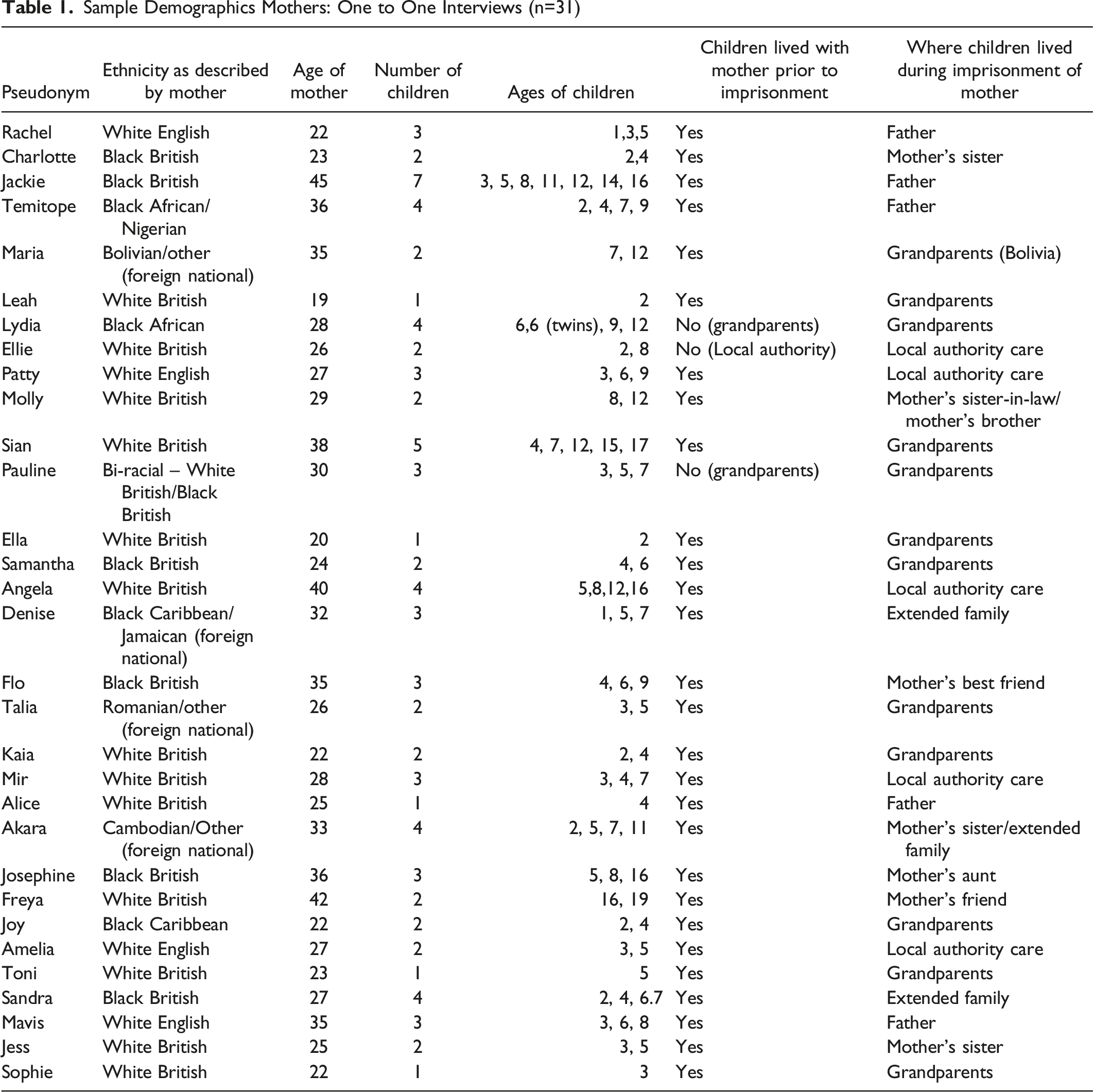
In relation to ethnicity for the one to one interviews, approximately 55% (n = 17) of the women identified as white British/English, 32% (n = 10) as black British, black African or black Caribbean and 13% (n = 4) as mixed ethnicity/other. Of the women interviewed in the one to one interviews, four were foreign nationals. 10% (n = 3 ) of the women did not live with their children prior to imprisonment. The women’s ages ranged from 19 to 45 and high levels of vulnerability were apparent in this group including mental health issues, self-harm, drug and alcohol use, domestic violence, and poverty (Corsten, 2007; Prison Reform Trust, 2021). Questions about why the women were in prison were not asked. The sample for the one-to-one interviews is depicted in the following table. Ethnicity and other demographic characteristics were not asked for the focus group but all mothers who took part in the focus groups had at least one child under the age of 18 years old.
Research Methods
Mothers were informed that the research was about eliciting their perspectives and experiences of mothering from prison and staying in contact with their children. The one-to-one interviews started with a general question ‘tell me about your experiences of being a mother in prison’. The female researcher followed the narratives of the mothers about their experiences of mothering from prison asking questions when required and supporting the mother’s telling of their experiences. This was an emotive subject for many of the participants and opportunities were frequently given to stop the interview if the participant wished. Compassion was a key element throughout the interviews and Baldwin (2021:181) highlights the importance of ‘an honourable mindfulness’ with Quinlan et al. (2022:172) stressing that an ‘Ethic of Empathy’ is key during interviews with vulnerable women. No participants withdrew from the interviews and interviews lasted from 1 hour to almost 3 hours. Many participants stated that the interview was ‘an opportunity for me to tell my story’ and ‘a chance to talk about my children’. Women were interviewed in a private room on their prison landing and in the prison chaplaincy room.
The focus groups started with a general statement ‘In these group discussions I want to hear about how prisons support mothers to stay in contact with their children and about how prisons support children visiting their mothers. I would love to hear your thoughts'. In addition to the interviews and focus groups with mothers, 15 prison officers of all grades, support staff and visiting centre staff were also interviewed to understand their perspectives on mothering from prison and keeping in contact with children. Moreover, the researcher, with the approval of the Governor and Assistant Governor, spent time in all areas of the prison which facilitated visiting with children including the visiting room, the room for family visits, the children’s room, the visiting centre and the area in the prison where visitors were processed including security checks. This was to understand and situate the women’s narratives and was an opportunity to understand the visiting process. The researcher did not participate as a volunteer in these settings and her role, as a researcher who was observing process, was clearly stated. No recordings were allowed by the prison and thus extensive shorthand notes were taken and written up fully immediately after the interviews.
Analysis
The extensive shorthand notes from the interviews and focus groups were transcribed and the texts were read several times to get an overall feel for the narratives. Codes were generated inductively, by hand, through a process of iterative initial open-coding of each line of the interviews (Charmaz, 2014). Focused coding was then undertaken whereby we combined initial codes to make analytical sense and the texts were then reanalysed in relation to these new focused codes (Charmaz, 2014). Both researchers carried out the coding independently and negotiated and agreed the final coding. Whilst one researcher carried out the interviews, both researchers collaborated in the analysis and write up of the study.
Ethics
Ethical approval was given by the University of Plymouth and the Ministry of Justice National Research Council to carry out the research in the prison. Approval to access the female prison was given by the Governor and the Assistant Governor. A written consent form and information sheet was given to all women, and this was read out to all the women at the beginning of the interviews to support literacy. Women, who took part in the research, signed a consent form. Our key ethical issues were the importance of maintaining confidentiality throughout the interviews and analysis processes; how to support the women through any distress when retelling or recounting their stories and that the women were clear they had a right to withdraw from engagement at any time they wished and did not have to take part if they did not want to (Bryman, 2012). Confidentiality in relation to focus groups can often be problematic and thus the aim of the focus groups was to talk generally about visiting and staying in contact with children; with the one-to-one interviews focusing more on personal private experiences. This was explained to all women. Another key ethical issue was support after the interview as we did not want to ‘leave participants, with resurfaced feelings and potentially difficult emotions that they must quash after the interview’ (Baldwin, 2021:180). Appropriate staff, who were deemed to be understanding and who were trusted by the women, were available for support, on request, after the interviews and focus groups had taken place. All women were informed of how to go about seeking support if needed and how to contact the researcher through a trusted, named person at their setting if they had any questions after the interviews or wished to withdraw their data from the study. The women and Assistant Governor were consulted about who the best person for this role would be; this was to ensure the women felt empowered to seek support. This is a key area for researchers to consider as support in institutions such as prisons may be problematic, and women may be left with poor or no support.
Findings
In this section we explore our findings through an Eliasian theoretical lens focusing on stigma, outsider status and the civilising process. We utilise verbatim quotes to support an understanding of the impact of outsider status and stigma on maternal identity and experiences. Pseudonyms are used throughout.
Outsider Status and Stigmatised Maternal Identity
The impact of a stigmatised ‘outsider’ maternal identity arose in all narratives and women spoke about their experiences of being stigmatised because of their imprisonment (not conforming to the established law) which impacted on how they were viewed as mothers (not conforming to established discourses of the ‘good’ and ‘moral’ mother). The women spoke about how mothers were expected to be ‘good mums’ and ‘shouldn’t be in prison’ which resulted in them being viewed as an ‘outcast’ or being ‘less than human’ with many seeing their identity as a prisoner leading to them being ‘written off’ as a mother. Angela stated ‘people think we are scum….what kind of mother does this and leaves her children like this’.
This ‘outsider’ status in relation to ‘established’ norms, and discourses of ‘civilised’ behaviour and the resulting stigmatisation of their motherhood also impacted on their relationships with their children and families with previous research highlighting how the impact of women’s imprisonment on children and families is a significant source of shame and guilt for mothers (Easterling & Feldmeyer, 2017). Sian said: They (children) are ashamed of me….their friends know ….he said to me ‘they have proper mothers……mothers who are not in prison’…he said that to me to hurt me and I understand that as he is hurting….they are all hurting so he wanted to hurt me, and it did hurt me… I feel ashamed of what I have done to them.
This was also the case in relation to some of the mothers’ relationships with family members who were looking after their children and some women spoke about how their imprisonment meant that they had been ‘rejected by family’ or were no longer seen by their family ‘as a fit mother’. Joy stated: My parents think I am like the…. worst person…the rejection from my family and the shame of putting my children through this is rammed down my throat at any opportunity by my family and I feel that it is now being used against me to take my children away from me…I have always had a difficult relationship with my mother and now she is using this against me …she doesn’t think I am a mother.
Thus, established-outsider figurations in relation to normative discourses of motherhood and criminalisation impacted upon mothering identity with the ‘we-image’ of good motherhood being seen as not compatible with imprisonment (Arditti, 2012). Instead, imprisoned mothers within these established-outsider discourses were defined by an outsider ‘they-image’. This stigmatisation and ‘othering’ of their motherhood not only impacted on relationships with their family and their children, but also undermined their confidence in their own mothering identity and ability. As Elias (1970) stated, the stigma attached to outsider groups also becomes part of individual internalised personality structures with those who are perceived as outsiders, not only being more likely to be stigmatised, but also being more likely to experience shame and see themselves as inferior (Quilley & Loyal, 2004). Sandra stated: they are right I have failed as a mother; I am in here and they are out there……mothers should be there for their children….they should put their children first…. so, I am not a great mother…I feel not good about it, and it has made me doubt myself as a mother.
However, this was not the case for all mothers, and some rejected the notion they were ‘bad’ mothers by showing how they conformed to the ‘established’ or dominant narrative of being a good mother. Easterling & Feldmeyer (2017) highlight in their research how some women strived to find evidence they are good mothers in the face of their imprisonment. The importance of love and their love for their child was raised by many women in our sample as an important factor in their mothering and was used as evidence of being a ‘good’ mother. Jackie stressed how her children were her world and how she loved being a mother. She stated: My children are everything to me …..I loved being a mother….it was all I ever wanted……..I loved doing things with them, having cuddles with them and just being with them. It is hard for people, I think, to understand that mothers in prison can love their children and be good mothers and love being a mother….I was their mother, that was who I was and now I am someone who is in prison…..I am not just a mother….I am low…a low person. I think this is something that people don’t see that you can be a good mother and love your children and do something wrong at the same time
Many women, thus, felt that their love for their children was not focused upon in relation to their mothering identity; rather it was their imprisonment per se that defined whether they were a good mother or not. Thus, power relationship between established-outsider figurations meant that that even when mothers did try to resist stigmatisation of their mothering, this was often ignored by those in established positions. Talia stated: I am a really good mother….but I am not treated as one. I have never been in prison before and never had any issues with social services or anyone but me being in here means that they (professionals and society) don’t see me in this way (good mother), and I will never be able to escape that….I love and care for my children, but this is not focused upon …..regardless of what I do or say they will always treat me…because of what I have done…. as someone who cannot look after …or hurt….or be a risk to their children.
Outsider Status, Prison Visiting and Family Days
The prison environment in relation to visiting was also of importance in reinforcing mother’s outsider status which impacted on their mothering identity as well as their mothering behaviour ‘stopping us from being proper mothers’. Moran (2012) has shown previously how the organisation, management and spatial dimensions of prisons not only impacts on the prisoner’s emotions, but also those of their visitors with visits often being seen as a ‘bittersweet experience’ (Codd, 2008). Oppressive and restrictive visiting spaces where mothers were unable to move from their seat and unable to physically comfort their children served as reminders they were not ‘normal mothers’ and Booth (2020: 33) has argued there are ‘disparities between policy rhetoric’ which puts emphasis on the importance of maintaining quality family ties through contact with children and families and what occurs on the ground. Pauline explains: my little boy tries to make me get up and my 7-year-old makes excuses cos she knows I can’t get up, it just makes me so ashamed that my daughters knows these things, what do they think (prison staff) I am going to do…they think I cannot be trusted and that makes me feel helpless as a mother
Restrictions, therefore, reinforced maternal feelings of shame, stigma and guilt leading to a ‘false family experience’ (Lockwood et al., 2021; Lockwood, 2018) as well as reinforcing the ‘outsider’ they-image of not being good enough mothers, who could not be trusted.
Moreover, the prison regime and uniformed security checks for children who were visiting were also highlighted as a source of stress for the mothers as well as being disempowering confirming their outsider positioning. Flo explains: They wear uniform…why? To show authority and they are in high power – you are in prison….we are human beings you are not….don’t frighten our kids…. the prison officers should not be in uniform it scares the kids.
Prison officers, however, who undertook the visiting security checks viewed the wearing of uniforms differently and said it was ‘necessary for security’ or was an opportunity for children to see that prison officers in uniform were ‘friendly and approachable’. This, however, was not how many of the mothers viewed it and the stigma attached to the mothers’ imprisonment, therefore, was felt to be extended to family members (Easterling & Feldmeyer, 2017) with this often resulting in mothers preferring that their children did not visit (Brookes, 2020). A mother in the focus group said: I have told my mother not to bring the children here and not to come herself, I am not putting them through all this… they have not done anything wrong but they will have to deal with all this ….and I don’t want my babies or my mother to be treated like they don’t matter…I just don’t want it so I would prefer it if they stayed away
Guilt was also evident with mothers feeling ‘ashamed of myself as a mother’ that they had put their children through the security checks, for example, which further reinforced for some mothers that they were ‘not good mothers’ or were ‘not proper mothers’ who ‘were unable to protect their children’. Mavis explained: My children came once to see me and never again….it was just awful for them…the whole experience was just traumatic, they were just so quiet and kind of shell-shocked, their faces… all the colour had gone from their faces and I went back to my cell afterwards thinking never again…I am not doing that again to them…it made me feel sad that they had experienced this…I had done this to them
Family contact days are often held up as being more conducive to maintaining family relationships offering a more family friendly environment (Hutton, 2016; Dixey & Woodall, 2012). However, for some women they were often a source of stress and/or surveillance as opposed to an opportunity to confirm their relationship with their child. Jane said: you go from not seeing your child to then seeing them and everyone is watching, seeing how you are with them and there is very little for them to do and you don’t know what to say…… and you feel bad because you should have something to say…you are their mother and then by the time you feel comfortable, they go. They must feel that you don’t love them.
Mothers in the focus groups also reiterated this point stating that ‘there is no outside space, and we are stuck in this hall for the whole day……….it is very stressful’. Whilst others highlighted that there was an enclosed outside space which could be accessed through the doors of the hall and that it ‘would be great to have a picnic outside in summer’. However, the women in the focus group stated that this would not happen as they were not trusted as mothers to do the best for their children with security always being the focus. This was confirmed by a prison officer who stated there were security and risk issues in letting the women access the outside area as ‘drugs could be thrown over the wall’ and that they did ‘not have enough staff to properly supervise them’. Thus, for some the restrictions that existed even within family days reinforced the outsider positioning of the women as mothers who were not to be trusted; with some women finding the days stressful and unnatural, increasing feelings of guilt about not being able to engage, as ‘normal mothers’, with their children.
Some mothers also spoke about how family days were used as a ‘weapon’ to maintain good behaviour and mothers who ‘played up’ would find that they were no longer able to take part in family days. Samantha explained that she had looked forward to seeing her children for weeks but: had lost it with someone… and I was punished by not being able to see my children…my mental health went down after that… I kept on thinking that I was not good enough to be their mother and that I had let them down.
Mothering identity and fear of losing contact with children, thus, was used as a form of social control within prisons (Aiello, 2016) and mothers who did not show behavioural restraint, an important part of the civilising process, were denied the opportunity to be part of the ‘we-group’ of mothers who were able to take part in family days which further reinforced their outsider status and ‘they-image’ as ‘bad mothers’.
Outsider Status: Mothering and Relationships with Prison Staff
Imprisonment is characterised by power relationships between prisoners and staff which women must negotiate and are subject to. These established (prison staff) and outsider (imprisoned women) figurations have the potential to further stigmatise and thus impact on maternal identity and women’s experiences of mothering reinforcing marginalised outsider statuses (Carlen, 1985) as well as having emotional impacts (Baldwin, 2018). Many women, for example, mentioned that prison staff were not interested in them as mothers (Baldwin, 2018) but rather saw them ‘only as prisoners’ to be managed. This indifference to their motherhood meant that emotional support and compassionate responses were rarely evident; with little opportunity for mothers to discuss the impact of prison on them as mothers and their relationships with their children (Baldwin, 2018). Moreover, maternal worries about their children were often not a priority and women felt they were left to deal with these painful emotionally charged feelings on their own. Jess stated: They are just not interested in us as mothers, my children were really suffering because of me being in here and this made me really depressed because I could not do anything about it. No-one spoke to me about it, and no-one cared and when I tried to raise it (to prison officers) they kinda of put the blame on me and that if I hadn’t done what I did then my children would not be suffering….it seemed to me that they just thought it was payback time
Previous research has also found that the stigma attached to imprisoned mothers can result in them being viewed as ‘mothers who didn’t deserve to have kids’ (Baldwin, 2018:53) with prison officers positioning the women as ‘unworthy’ and thus unworthy of support. This weaponizing of stigma (Scrambler, 2020) as well as the established-outsider figurations within the prison environment resulted in some prison staff attributing blame to mothers, further positioning them as outsiders which enabled them to avoid responsibility for supporting them. A mother in the focus group stated: They talk about family ties, but it is all bullshit….they don’t do anything to help us maintain relationships with our children…if anything they do the opposite…there is no support for the women here and some are barely coping…. they think we are rubbish…that we have no feelings……that we don’t care…that all we care about is ourselves…. they won’t support us as they want us to fail as then it confirms what they think about us.
Whilst Molly said: It had a massive impact on him me coming here….he was so angry at me and at everyone and he still is……… but then I hear that he is crying and misses me and I don’t know how to deal with this….it would be good to talk this through with someone as I want to know what I should do…I don’t want to make it worse but there is no-one to talk it through with and the staff are too busy or not interested. I am at my wit’s end worrying about it all the time and beating myself up about it, but no-one cares.
This apparent blaming of women and lack of interest in their emotional wellbeing could be seen as further punishing the mothers increasing their emotional toll and internalisation of failure, outsider status and moral inferiority (Carlen & Worrall 2004; Chesney-Lind, 2017; Baldwin, 2018).
However, this was not always the case with some of the more senior members of the prison staff being said to show empathy and compassion for the mother’s situation. Freya said: My daughter who is 15 was self-harming and threatening suicide and one of the Governors arranged a special visit between my daughter and me. She (the Governor) was very nice to me, and it made me cry that she would help me like this.
However, this level of support was not seen as being the norm and support depended either on the individual staff member and their own personal views or depended on the perceived severity of what was going on at home. For most mothers who had not reached a particular threshold for crisis point, there appeared to be very little emotional support to help with being separated from their children and trying to mother from prison as well as a lack of opportunity in safe spaces to talk about being a mother (Baldwin, 2018). This has also been found to be the case in the literature on parenting interventions within prisons, which are often heralded as being an opportunity for mothers to focus on their mothering but have been critiqued as out of context with mothers unable to practice their mothering because of separation from their children (Johnston, 1995). This has led to some researchers suggesting that parenting interventions should focus on supporting mothers with dealing with the stress of mothering from prison and the ambiguous loss and emotional fallout that occurs as well as an opportunity to challenge dominant discourses of motherhood that positions these women as ‘bad mothers’ (Loper & Tuerk, 2011; Aiello, 2016). Moreover, parenting support should also include a focus on mothers who are foreign nationals and have limited contact with their children as well as mothers whose children are looked after by the state as they are often left to deal with painful emotions on their own. Patty said: They say I don’t have a bond (with my children), but I would like to have a bond…but how can I have a bond when they won’t let me see my kids…they (social workers) have made up their mind that I am not good enough….that I am a bad mother….it is destroying me and I am just keeping it all inside my head…… I would like to talk to someone about it as it is doing my head in … I am scared I will not get my children back when I am released.
Discussion
In this research, we used Elias’ work on established-outsider figurations, stigmatisation and the civilising process to explore how imprisoned mothers experience mothering from prison and staying in contact with their children. As Pratt (2004:215) has stated, prisoners are one of the ‘extreme outsider groups in modern society’ which leads to moral indifference to their fate and to their pain by the established including the public. We would argue that this is especially the case for mothers in prison who are not only outsiders because of their imprisonment but are further positioned as outsiders in relation to established norms of the ‘moral’ and ‘good’ mother. Our research shows that these discourses influence not only the figurative relationships between prison staff and mothers, resulting in a lack of compassionate support for their mothering including being treated with indifference, but also impacted on the physical space of the prison including mothers experiences of visits and trying to maintain contact and relationships with their children.
Stigma for Elias is a product of power relationships which exists within established-outsider figurations and Scrambler (2020) has highlighted how stigma can be ‘weaponised’ resulting in individuals, who are positioned as outsiders, being held personally responsible for their situation absolving the established including organisations and governments from taking any collective responsibility for helping or supporting them. Our research indicates that this is evident within the prison system whereby the outsider positioning of mothers leads to established ‘moral entrepreneurs’ (Becker, 1963), such as professionals and prison staff, often reinforcing maternal stigma and blame (Hutton, 2016). Moreover, it can be seen in what Elias (2000) calls processes of ‘decivilisation’ whereby ‘civilised processes’ such as compassionate responses to vulnerable mothers including opportunities to be supported in relation to their mothering and feelings of ambiguous loss are absent and instead mothers are punished and stigmatised twice once for their ‘crime’ and secondly for being a mother.
Previous research has highlighted the importance of compassionate and positive relationships including safe spaces (Stewart, 2015; Baldwin, 2018) within the prison environment which can be used to support mothers to overcome feelings of stigma and shame with some authors showing that this is of the utmost importance in relation to crime desistance (Rutter & Barr 2021), improving women’s mental health and wellbeing (Harper & Arias 2004; Tangney & Dearing 2002) and supporting mothers with their mothering identity and relationships with their children (Kennedy et al., 2020). Our research supports the need for ‘compassionate institutions’ as well as compassionate responses to the imprisonment of mothers (Baldwin, 2018). Compassionate responses would include non-custodial sentencing for women and where this was not possible compassionate institutions. The latter would focus upon improving training for prison staff in areas such as bias, anti-oppressive practice, the impact of stigmatisation and how to support women to mother from prison. It would include improved family visits and the maintenance of relationships as well as sensitively supporting mothers in dealing with maternal emotions such as ambiguous loss, guilt and shame. A ‘civilised’ response to imprisonment would not include the further stigmatisation of vulnerable mothers which reinforces outsider mothering status but instead would be an opportunity to support women to increase their confidence in their mothering, to provide supportive and appropriate interventions, and to maintain relationships with their children.
Footnotes
Acknowledgments
We thank all the participants who gave up their time to tell us about their experiences.
Declaration of Conflicting Interests
The author(s) declared no potential conflicts of interest with respect to the research, authorship, and/or publication of this article.
Funding
The author(s) disclosed receipt of the following financial support for the research, authorship, and/or publication of this article: This work was supported by an internal grant from the University of Plymouth, United Kingdom. No grant number.
