



Abstract
The current study examined how state anxiety is related to social support (formal and informal), work–family conflict, and level of happiness among married mothers and single mothers by choice (SMBC) during the first lockdown of the Covid-19 crisis. The uniqueness of the present study lies in its comparison of married mothers and SMBC, whereas previous studies examined differences between single mothers, who are usually divorced, and married mothers. Moreover, the present research is the first to combine all relevant variables in one coherent study. A sample of 386 SMBC and 293 married mothers filled out a closed online questionnaire sent through social networks. The study findings show negative correlations between the level of social support, level of happiness, and type of support (friends, family, and significant others) and the level of state anxiety. Most women did not turn to formal sources of support such as aid and welfare agencies. Finally, a positive correlation was found between state anxiety and work–family conflict.
Keywords
Introduction
Although the crises Israel has historically faced are typically characterized as security crises (for example, wars), the novel coronavirus has exposed Israel to a global health, economic, and social crisis. This crisis began in January 2020 with the outbreak of the coronavirus (Covid-19), which was defined by the World Health Organization (2020) as a pandemic and arrived in Israel in early March 2020. To deal with the pandemic, Israeli residents were forced to enter social isolation (lockdown) at very short notice. Social isolation included severe restrictions on freedom of movement; closure of workplaces, educational institutions, and places of entertainment; and a ban on gatherings in public places and social and family gatherings. This new situation brought many stressful situations and state anxiety (SA; Özdin & Bayrak Özdin, 2020). Considering this, the present study examined how SA was related to social support, work–family conflict (WFC), and level of happiness during the first lockdown among married mothers and single mothers by choice (SMBC) in light of the uniqueness of the latter family unit. Moreover, the present study examined differences in these variables between these two groups.
The findings of the study contribute on three levels: First, they contribute to the existing knowledge base about SMBC and married mothers in general and during crises. Second, this research examined social support using tools that summarize the context of receiving assistance and support, some of which were developed for present study. Third, they contribute to the field of counseling, accompaniment, and guidance of welfare mechanisms in Israeli society.
Theoretical Background
SA, in both crisis and routine situations, has been extensively researched in various contexts of life. For example, studies have explored the relationship between SA and social support (Hynan et al., 2015), WFC (Field, 2002), and happiness (Silva & Figueiredo-Braga, 2018). Despite the rich research in the field, there is a lack of empirical research on how these variables converge in a coherent study. Therefore, the present study examined SA and the factors that explain it in a unique crisis, Covid-19, among both married mothers and SMBC, who constitute a unique population.
SMBC are defined as women who chose to raise their children outside of marriage or an alternative permanent marital framework (Mattess, 1997). These mothers are also defined as “nest builders” because they built a nest and are now ready to raise their children (Albeck & Bar, 1993). For the most part, these are women in their late 30s who seek to fulfill their motherhood even though they are not in a relationship (Anderson & Stewart, 1995; Bock, 2000; Segal-Engelchin, 2000).
According to the Rashi Foundation (n.d.), about 150,000 SMBC-led families live in Israel. Moreover, according to the Central Bureau of Statistics (as cited by the Rashi Foundation, n.d.), this population increases consistently each year and in 2016 alone, 7,015 SMBC were added. Given that this family setting is becoming more common, a study comparing the two family types (married vs. single mothers) would be intriguing, particularly during a crisis (Oring, 2007).
Perceived Social Support
Studies focusing on perceived social support span a wide range of disciplines. In general, the various definitions refer to behaviors or perceptions of receiving support from various sources, such as family, friends, coworkers, organizations, and more (French et al., 2018). In the present study, social support is defined as the exchange of resources between at least two people; is perceived by the giver and recipient as a resource designed to increase the recipient’s well-being and quality of life (Hobfoll, 2002); and can be informative, emotional (Gleason & Iida, 2015; House & Kahn, 1985), and instrumental (e.g., help with childcare, housework, and finances; Chasson, 2017). Perceived social support is a person’s belief that they are loved, valued, and integrated in an interpersonal social network of connections and mutual commitment (Chasson, 2017; Cobb, 1976; Ford et al., 2007).
Studies have shown a negative correlation between social support in situations of stress and mental distress. That is, the higher the social support, the lower the feelings of distress and stress (Hung & Chung, 2001; Luo, 2006). In addition, other studies have shown that social support is a protective factor in dealing with stress, anxiety, and depression. For example, social support reduces levels of anxiety and depression among women during and after pregnancy. Finally, social support has been found to be correlated with better disease recovery and life expectancy (Duman & Kocak, 2013; T. H. Kim et al., 2014).
Social support features three main layers. The first layer refers to practical social support related to actions people take to help others. The second layer refers to the existing relationships between individuals and significant people in their environment. The third layer refers to perceived social support, which is described as a cognitive assessment that an individual makes regarding their relationships with others (Hobfoll, 2002). Because the social support system is based on interpersonal interactions that include emotional responses, appreciation, information provision, and instrumental assistance, it may be a significant resource in dealing with stressful situations (Caplan, 1974; Ford et al., 2007; Liebman et al., 2005; Wilcox & Vernberg, 1985). More recent literature in the field has addressed online support and how it reduces feelings of SA (Hynan et al., 2015). It is important to note that the current study did not focus on social networks but referred to them as an additional platform for social support to which women could turn (Hynan et al., 2015).
Social support among SMBC has received research attention in Israel as well, with studies focused mainly on their feelings in the social context (Oring, 2007), their self-image (Albeck & Bar, 1993), differences in social support between married and single women (Avrech-Bar et al., 2011), quality of life (Segal-Engelchin & Wozner, 2005), and the transition to parenthood (Chasson, 2017). To the best of our knowledge, empirical and theoretical knowledge has not addressed the need for SMBC to receive social support during Covid-19, nor have studies examined how these supports may affect their sense of SA. Studies comparing married mothers to single mothers (not necessarily SMBC) found that single mothers reported lower perceived social support, social involvement, and encounters with friends and family (Cairney et al., 2003).
Finally, the literature on motherhood during Covid-19 has discussed several issues. For example, a recent study found that closing schools and daycare centers during the crisis mainly affected women because the burden of caring for their children primarily falls on them (Alon et al., 2020). Moreover, among the most affected populations were SMBC, because they had little potential for access to other sources of childcare. These difficulties were caused by social isolation orders and limited possibilities of continuing to work during the crisis. Moreover, during Covid-19, the requirement to respond to increased care obligations as a result of reduced employment was particularly difficult for single mothers, who already face an increased risk of poverty (Blaskó et al., 2020). Finally, in the absence of an orderly plan by the authorities to support and maintain contact with the SMBC population (via phone calls, emails, and text messages), these women found it difficult to contact the “outside world” during the pandemic and thus, receive the support they need (Choi et al., 2020). This claim was supported by a study in South Korea that addressed unmarried women in general. The findings showed that these mothers had difficulty caring for their children. However, the authors did not have accurate data on SMBC (Choi et al., 2020). Considering these data, the present study attempted to bridge this theoretical and research gap.
State Anxiety
Anxiety is defined as an organic response, characterized by increased apprehension and follow-up in situations of unclear danger or potential threats to personal integrity. However, the study of anxiety has revealed two separate and complementary concepts: SA and trait anxiety (Leal et al., 2017). SA reflects a response to a situation perceived as negative by an individual at a given moment and is accompanied by feelings of stress, apprehension, nervousness, and worry. In contrast, trait anxiety is more stable and associated with personality trait because it persists over time and in different situations (Blanchard et al., 2011; Leal et al., 2017; Spielberger et al., 1983); includes emotional, physiological, and cognitive aspects (Blanchard et al., 2011; Monat et al., 1972); and is derived from conscious and unconscious sources (Immanuel, 2003).
The research literature among mothers with general anxiety and SA is very extensive but usually focuses on pregnancy or crises around childcare such as surgery, serious illness, and mental disability (Bhattacharjee & Banerjee, 2016; Scrimin et al., 2009; Weiler, 1999). SA has also been investigated in the context of Covid-19, with studies showing how background variables such as nationality, occupation, marital status, age, and education are related to anxiety (e.g., Nkire et al., 2021). However, there has been no consistency in these studies regarding the correlation between age and education and SA. Many studies suggested an association between age and SA both in routine states (e.g., Gojowy et al., 2011) and during the Covid-19 crisis (Solomou & Constantinidou, 2020). Studies also suggested differences in SA between single and married mothers. In contrast, other studies examining the relationship between these variables showed that age is not related to SA in general (Brown & Roose, 2011; Shamir-Balderman & Shamir, 2022) or in situations with potential for SA such as pregnancy, treatment of children with disabilities, hospitalization, and more (e.g., Kirby, 2015; S. Wang et al., 2020).
Similarly, studies have indicated a lack of correlation between education and SA (e.g., Razavian et al., 2018). Despite the lack of uniformity in findings and given the multiplicity of studies showing the opposite picture, evidence suggests that single mothers are more likely to report higher stress than married mothers (Cairney et al., 2003)—for example, SMBC might report lower mental health and quality of life than married mothers. It can be assumed that differences exist in levels of SA between married mothers and SMBC, who differ in background characteristics. In addition, an Israeli study examining differences in SA and self-efficacy found that divorced women experienced higher levels of SA than separated women (Dreman et al., 1990). However, studies have not explored the correlation between background variables and SA during a socioeconomic crisis, such as Covid-19, nor have they compared SMBC and married mothers globally or in Israel. The current study sought to bridge this gap as well.
Happiness
Happiness is an experience that combines pleasure (emotional dimension) and meaning (cognitive dimension; Seligman, 2002) and has been extensively researched in the context of life satisfaction (Ahuvia et al., 2015; Myers & Diener, 1995; Ryff & Singer, 2008; Tay et al., 2015). Moreover, Diener (1984) argued that happiness has three general definitions. The first, which is also the most widely accepted, treats happiness as satisfaction with life (Joshanloo et al., 2016). The second definition refers to external criteria in accordance with social norms. The third defines happiness as a positive feeling. The present study adopted the definition of Seligman (2002), who argued that happiness has three dimensions: emotional, cognitive, and temporal. That is, happiness is a positive emotion directed at the present moment, may last for a long time, and is often perceived as the “other side” of anxiety (Eysenck, 1994).
Various studies addressed two main groups of variables related to happiness: The first group focuses on personality traits (Eysenck, 1994), whereas the second addresses environmental variables, that is, demographics (Diener & Suh, 1997; Hills & Argyle, 2002; Seligman, 2002; Tay et al., 2015). Regarding the latter, correlations were found between education level, social status, and income level and happiness. Income level allows coverage of basic living expenses such as housing and food. Therefore, in crises, the level of income, which is perceived as a basic need, would be expected to explain the level of SA. Additional studies have shown correlations between happiness and work-related variables such as quality of life, overall satisfaction, job satisfaction, and WFC (Carpentier et al., 2012; Shamir-Balderman, 2018; Simsek et al., 2011).
Family structure also contributes to feelings of happiness. Demo and Acock (1996) examined three dimensions of maternal well-being (personal happiness, self-esteem, and depression) across four family structures (married for the first time, remarried, divorced, and single). The study revealed small but significant differences among family structures. That is, mothers in their first marriage enjoyed the highest welfare, remarried mothers enjoyed almost as much, and divorced and single mothers had the lowest welfare. Moreover, SMBC were found to be less happy compared to single women without children. However, these two groups both tend to report that they are “not so happy” (Ifcher & Zarghamee, 2014). Finally, the correlation between happiness and SA has been extensively researched (e.g., Chinnes, 2019), with evidence suggesting that the lower the national happiness level, the higher the SA. Therefore, this relationship is expected to exist at the individual level. Given this evidence, it can be assumed that SMBC will report a lower level of happiness compared to married mothers, an issue that does not appear to have been studied.
Work–Family Conflict
In the last four decades, the number of women participating in the labor market in all industrialized countries, including Israel, has been steadily rising. The composition of the female workforce is also constantly changing in terms of age, marital status, and area of employment, and many employed women are mothers of infants and young children (Aharon, 2006; Cohen & Bianchi, 1999; Crompton, 1997; Katzenstein & Shechtman, 2003; Stayer, 2005). As a result, many studies dealt with the correlation between family and work and how these two domains are reflected in an individual’s life (Basile & Beauregard, 2016; Berkowsky, 2013; Burke & Greenglass, 1987; Diener & Suh, 1997; Pangil & Isa, 2015;I. A. Wang et al., 2017).
WFC is defined as a form of conflict between roles or areas wherein the requirements of each are inconsistent with the other (Burke & Greenglass, 1987; Cooke & Rousseau, 1984; Greenhaus & Beutell, 1985). This is expressed in feelings of dissatisfaction, tension, and anxiety that result from the stress experienced because one area, which is perceived as demanding, makes it difficult to function in the other area. Another manifestation of WFC is the behavior of the individual in these situations such that they are physically or mentally absent from one area because they are unable to manage their time adequately in both areas. Finally, this conflict is defined as a two-way experience because expectations from the family sphere may interfere with work, and vice versa (Frone et al., 1992; Greenhaus & Beutell, 1985). Moreover, because each domain requires both emotional and physical involvement, it is conceivable that they will be in competition (Stayer, 2005). Hence, WFC may increase feelings of stress, guilt, anger, or resentment over the need to fulfill household chores and workplace demands (Tietze, 2002; Watson, 2000).
The research literature regarding WFC usually focuses on married couples or SMBC in general (Ajala, 2017; Namayandeh et al., 2011; Sultana, 2012). Studies have shown that families in which both spouses work have a lower sense of domestic conflict compared to single-parent families (e.g., Ahmad & Ngah, 2011; Wallis & Price, 2003; Westrupp et al., 2016). However, studies only examined general differences between single and married parents (among women and men alike; Duxbury et al., 1994).
Covid-19 brought unprecedented changes, with many families moving to a model of remote work during lockdown periods and the boundaries between home and work almost disappearing. This situation provided fertile ground for the possibility of greater WFC compared to routine situations. Although both spouses may experience WFC, these feelings are more likely to be stronger among women because childcare and various homework tasks typically fall on their shoulders (Milliken et al., 2020). A recent study in the United States among single mothers showed that they experienced a high level of stress in relation to WFC caused by diverse demands in the home and work domains competing for their attention. That is, the lack of boundaries between home and work directly and negatively affected their output, and they expressed anxiety about the expected consequences for their continued employment (Hertz et al., 2021). Although comprehensive, the study combined SMBC with other single mothers (presumably those who didn’t choose to be a single parent). The assumption underlying the present study is that when a partner is present, stresses and anxieties are perceived differently. Therefore, this study focused on SMBC only (and not single parents who are separated or divorced).
The research hypotheses were as follows: 1. Background variables (marital status, income age, education, and organizational rank) are positively related to SA. 2. A positive relationship will be found between (a) WFC and SA; and (b) happiness and types of social support (family, friends, and significant others) and SA. 3. Significant unique contributions to SA will be found among the background variables, types of support, happiness, and WFC, but happiness will have the highest unique contribution. 4. SA levels will be higher among SMBC compared to married women. 5. The perception of social support will be higher for all types of support among SMBC compared to married mothers. 6. SMBC will report higher WFC compared to married mothers. 7. SMBC will report lower happiness compared to married mothers.
Method
Differences between Two Groups of Mothers in Research Variables.
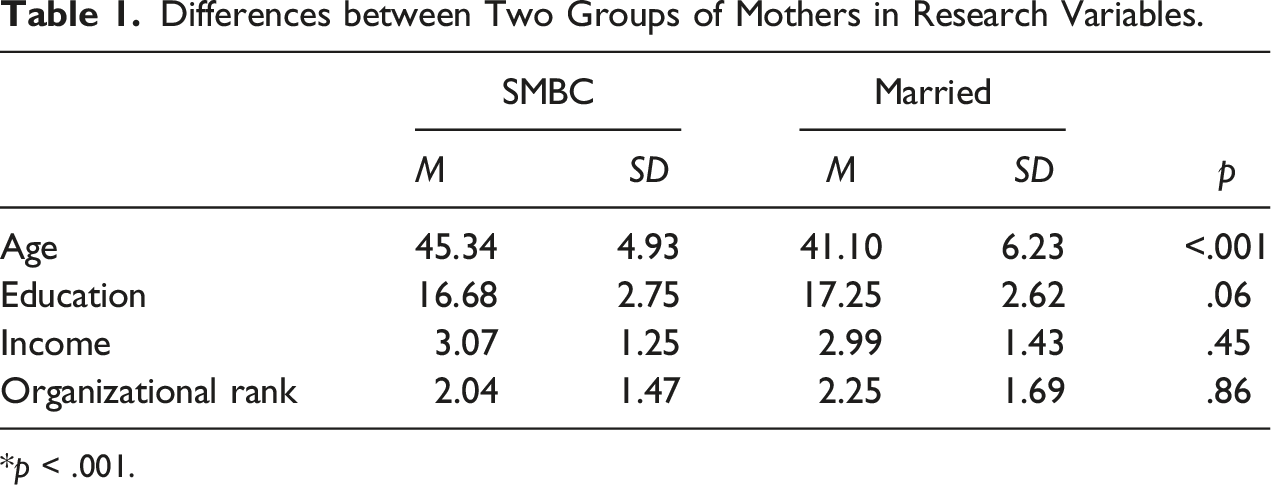
*p < .001.
Measurements
State Anxiety
This variable was assessed by the State Trait Anxiety Inventory (Spielberger et al., 1983). This scale consists of 12 items assessing SA, half of which are positively worded, as perceived by women (e.g., “I feel calm”; I feel satisfied”). The women were asked to indicate their agreement on a 7-point scale (1 = strongly disagree to 7 = strongly agree). The positively worded statements were reversed, such that a high score indicated high SA (Cronbach’s α = .93).
Perceived Social Support
This variable was measured by the Scale of Perceived Social Support (Ziment et al., 1988) as translated by Statman (1995). The scale consists of 12 items divided into three dimensions of informal social support: friends, family, and significant others. The women were asked to indicate their agreement on a 7-point scale (1 = strongly disagree to 7 = strongly agree; Cronbach’s α = .93).
Family Support
This variable assessed the level of assistance and support these women received from their immediate family. The index includes four items (e.g., “My family is really trying to help me”). A high score indicates high family support (Cronbach’s α = .90).
Friend Support
This measure assessed the level of assistance and support these women received from their immediate social environment. The index includes four items (e.g., “I have friends I can share problems with”). A high score indicates high social support (Cronbach’s α = .93).
Significant Other Support
This measure assessed the level of assistance and support these women received from significant others. The index includes four items (e.g., “There is a person close to me who is there when I need them”). A high score indicates high significant other support (Cronbach’s α = .86).
Applying for Formal Support
This variable was based on a questionnaire that examines additional aspects of social support (Shamir-Balderman & Shamir, 2022). The questionnaire features six items presenting different types of support: Facebook groups, family, friends, educational counseling, psychological counseling, social workers, and mental health help centers. The women were asked to indicate their agreement on a 5-point Likert scale (1 = did not help at all to 5 = helped very much; 9 = did not seek help). Because each item examined seeking help from a specific source, it was not possible to calculate the alpha coefficient for this index.
Happiness
A common tool for examining this variable is the Oxford Happiness Inventory (Argyle et al., 1995). The inventory includes 29 items, each offering four options. This study used the scale developed by Hills and Argyle (2002), a valid and reliable abbreviated measure (Oxford Happiness Questionnaire) that includes eight items (e.g., “I am satisfied with the way my life is conducted”). The questionnaire has been translated into Hebrew, then translated back into English by two independent evaluators (Shamir-Balderman, 2018). Participants rated their answers on a 7-point Likert scale (1 = strongly disagree to 7 = strongly agree). A high score indicates a high level of happiness (Cronbach’s α = .82).
Work–Family Conflict
This scale consisted of 18 items. The first part was taken from a questionnaire developed by Gutek et al. (1991) that consists of 14 items (e.g., “At work, I am so busy that I do not have time to deal with personal matters”; “My job requires time that I prefer to spend with my family”). The participants rated their answers on a 7-point Likert scale (1 = strongly disagree to 7 = strongly agree). Cinamon and Rich (2002) conducted a factor analysis showing two dimensions: work-to-family conflict and family-to-work conflict. Because high correlations were found between the two indexes and they were merged into one index, this study adopted this approach. In the second part, four items from a questionnaire developed by Carlson et al. (2006) were used to measure positive aspects of WFC using items such as: “My involvement in my family makes me feel happier and it helps me be a better worker.” A high score of the total measurement indicates a high level of WFC (Cronbach’s α = .88).
Demographics
Items measured personal characteristics such as age, number of children, education (1 = mandatory to 7 = PhD), income (1 = very below average to 5 = very above average), employment during and before the Covid-19 pandemic, organizational rank, and organizational sector.
Research Process
Data collection was conducted using the snowball method among SMBC (who maintained a household without a spouse) and married mothers in Israel, who filled out an online self-report questionnaire. First, the researchers asked mothers from their immediate social environment (friends or colleagues) to participate in the study and share the questionnaire among other mothers they knew. The questionnaire was sent via two apps: WhatsApp and Facebook. To distribute the questionnaires through these groups, the researchers contacted the principal operators of Facebook groups for women and asked for their permission to publish a post calling for mothers to participate in the study and distribute the questionnaire. After receiving approval, the post was uploaded, including an explanation of the research and a promise to maintain confidentiality according to the rules of ethics. In addition, the online questionnaire required respondents to answer a mandatory item before proceeding with the survey: “I express my informed consent to participate in the study and am aware of my right to leave at any time without explaining.” The study received the approval of the ethics committee [blinded for review].
Results
The data show that these women reported a medium-high level of happiness (M = 4.81, SD = 1.07). They also experienced moderate levels of SA (M = 3.48, SD = 1.30) and WFC (M = 3.26, SD = 1.01). Regarding their requests for social support or assistance, the data show these mothers reported a high level of support from significant others (M = 5.59, SD = 1.26), friends (M = 5.37, SD = 1.40), and family (M = 5.65, SD = 1.46). In addition, 475 mothers (70%) sought help from their immediate circle of assistance, that is, family. On the other hand, only 107 women (16%) turned to Facebook groups for support and assistance and 207 (30%) sought psychological help from social workers, psychologists, or call centers. When asked to what extent these various sources aided them, 433 mothers (91%) reported that turning to family helped them moderately to very much. In contrast, 200 mothers (29%) who turned to Facebook or social workers reported that these resources helped them moderately to very much.
Correlation between Background Characteristics and SA
To examine the correlation between the personal characteristics of all mothers in the sample and SA, Pearson and chi-square tests were performed. Findings show a significant negative correlation between income and SA (r = −.147, p < .001). Hence, the lower the income level, the higher the level of SA. In addition, a negative and significant correlation was found between organizational rank and SA (r = −.102, p < .01). Finally, a significant correlation was found between marital status and SA (χ2 [136] = 172, p < .05). In contrast, no significant correlations were found between mothers’ age or education and SA.
Correlations between Social Support, Happiness, and WFC and SA
Correlations and Descriptive Statistics for Research Variables across the Sample.
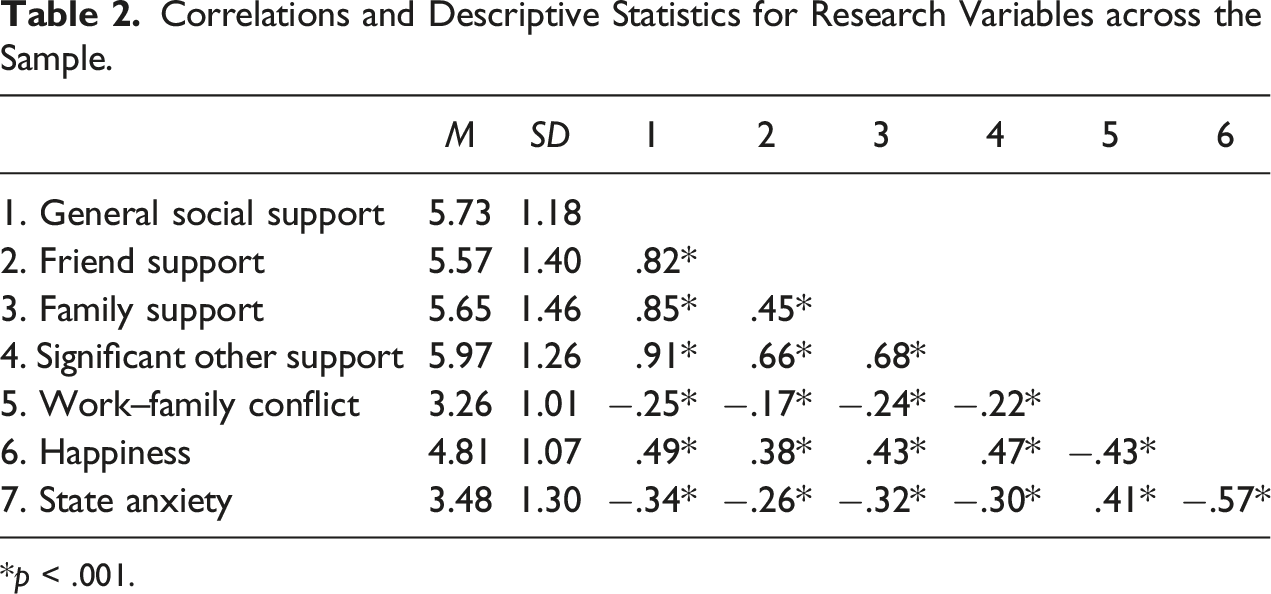
*p < .001.
Regression Model Predicting the Contribution of Background Variables, Happiness, WFC, and Types of Support to SA
Hierarchical Regression Analysis to Examine State Anxiety by the Research Variables.
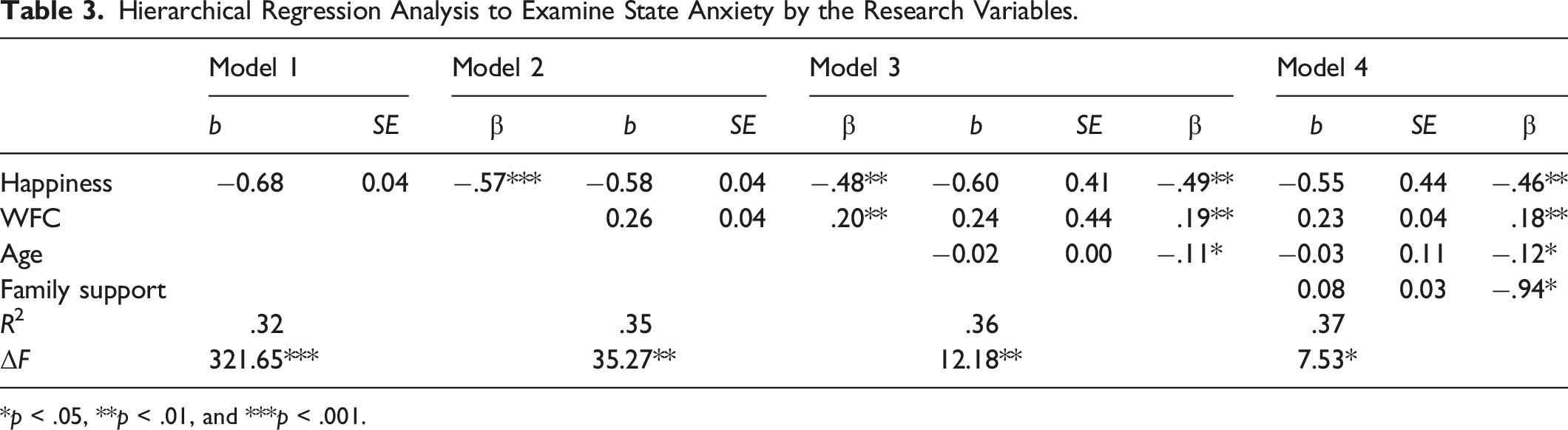
*p < .05, **p < .01, and ***p < .001.
Differences between the Two Study Groups
Differences between Two Groups of Mothers in Research Variables.
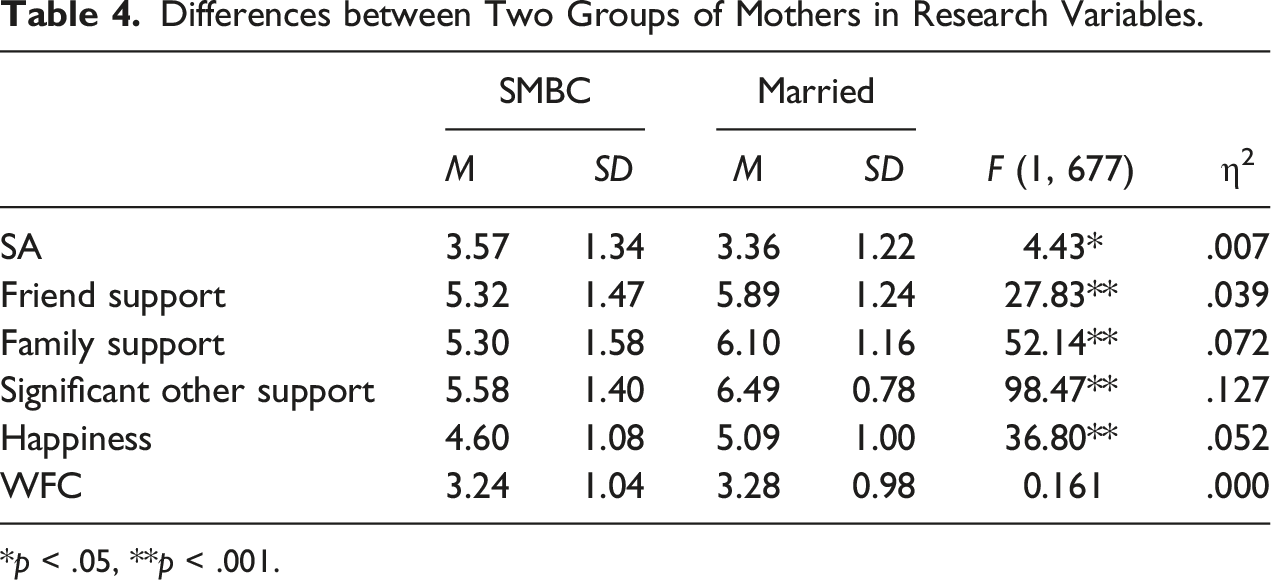
*p < .05, **p < .001.
These findings confirmed the hypotheses that the SA level of married women would be lower than that of SMBC and that the level of social support and happiness of married mothers would be higher compared to SMBC. In contrast, the hypothesis that WFC would be higher among SMBC compared to married mothers was not confirmed.
Discussion
Differences in family and parenting patterns have gained increased theoretical, empirical, and practical attention in recent years. However, as noted in the literature review, these differences have not been explored in the context of dealing with crises in general or a global crisis such as Covid-19. Moreover, studies have not compared how different groups of mothers cope with SA and what factors might explain any differences. Therefore, this study examined how personal factors, happiness, WFC, and perceived social support are related to SA among married mothers and SMBC. The present study also explored differences between these two groups in these study variables.
Personal Background Characteristics and SA
Examining the correlation between personal background characteristics among these mothers showed that income level and organizational rank were negatively associated with SA. That is, the higher their economic situation and organizational rank, the lower their level of SA. The results are consistent with a recent study at the beginning of the Covid-19 crisis that showed a negative correlation between economic status and SA (Kazan et al., 2021). Because about two thirds of mothers earned an income above the national average and worked in public organizations, which are perceived as more stable, they did not experience increased SA during the Covid-19 crisis. This may be explained by the knowledge that their job is not dependent on economic fluctuations and they did not fear layoffs or the closure of their workplace.
Contrary to expectations, the findings indicate that the mothers’ age and education level were not related to SA. This supports previous studies that found no association between age and SA in both routine situations (Brown & Roose, 2011) and crises (e.g., Kirby, 2015; S. Wang et al., 2020). In the present study, the average maternal age was about 40, and it is possible that these were mature women capable of coping with life challenges and crises, which enabled them to cope with the Covid-19 more optimally. Similarly, the findings of the present study are consistent with other research reporting a lack of association between education and SA (e.g., Razavian et al., 2018).
Happiness, WFC, Social Support, and SA among Married Mothers and SMBC
The findings of the present study confirm the hypothesis that a negative correlation exists between happiness and SA. That is, the higher the level of happiness, the lower the level of SA. Moreover, married mothers reported a higher level of happiness and a lower level of SA compared to SMBC. This finding is consistent with previous studies that have shown differences in SA among SMBC compared to married mothers (Cairney et al., 2003). However, recent studies have examined single women in general and have not focused on SMBC. It is likely that SMBC, who lack any additional support in caring for their child, will experience heightened SA during a crisis like Covid-19.
SA, like happiness, involves dynamic emotions (Quoidbach et al., 2009; Seligman, 2002) and is time dependent (Seligman, 2002). Therefore, a possible explanation for this finding lies in the possibility that the sudden lockdown translated into SA and affected the level of happiness reported by these women. However, anxiety and happiness are also defined in the literature as personality traits (Diener & Seligman, 2002; Eysenck, 1994), and the tendency to feel happy can differ based on innate character traits. Because this research focused only on SA, future studies should explore differences between SA and trait anxiety regarding their effects on happiness.
The findings of the present study further reinforce the correlation between WFC and SA; indeed, supporting the hypothesis, this study found a positive and significant correlation between these two variables. Rosenbaum and Cohen (1999) argued that expectations regarding the mothers’ role (family stress) and workplace responsibilities (work stress) are relevant explanations for the correlation between SA and WFC in routine situations. That is, WFC is often expressed in stress and anxiety (Greenhaus & Beutell, 1985). If mothers experience conflict between these two requirements in routine times, it makes sense that this conflict continued and perhaps even intensified during the lockdown, when many mothers had to work at home.
The lack of separation between the private (home) and public (workplace) spheres made it difficult for them to invest the time required to perform their best work. Therefore, they experienced high WFC, which led to an increase in SA. The study findings show no differences between the two study groups in WFC. Perhaps the explanation for this lies in the possibility that their job requirements remained the same, even though their work moved to the private space. Moreover, a recent study among married couples who worked from home together during the lockdown found that mothers stayed with the children at home, whereas the men went to their office and continued their work almost as usual. Therefore, the sense of conflict did not constitute a difference between married mothers and SMBC during the critical hours of work because they both had to care for their children and hence, could not devote full attention to the demands of their work. In contrast, many men who continued to work at the office (or from a room at home without interruption) did not have to face these challenges (Waismel-Manor et al., 2021).
Examination of correlations in the two sample groups showed a significant negative correlation between the general social support index and SA. That is, the broader the social support, the lower the SA level. Moreover, the hypothesis regarding negative and significant correlations between types of support (family, friends, and significant others) and the level of SA in general was also confirmed. Finally, the regression findings showed that friends’ support had the strongest association with reduced SA. Perhaps their peer group is the most significant and available type of support because they share the same complex situations and difficulties. In other words, although they had family support, these mothers tended to turn to their peer group or other close friends. Regarding differences between the two groups, married mothers reported higher social support in each type of support compared to SMBC. This finding is consistent with studies conducted during routine periods that examined differences between single (divorced) and married mothers and found that single mothers reported lower levels of perceived social support and encounters with friends and family (Benzeval, 1998; G. E. Kim & Kim, 2020). A possible explanation for this finding is that married mothers have a larger social circle because they also enjoy their partner’s social network.
Research Limitations, Contributions, and Further Research
Despite its uniqueness, the present study has limitations. First, it was based on self-report questionnaires at one point in time, that is, during the first lockdown. A longitudinal study that considers subsequent lockdowns could show a broader picture and determine whether SA remained stable or changed. Because these were self-report questionnaires, there may have been some bias in answers to sensitive and personal questions. In-depth interviews could provide a deeper picture of these women’s experiences during the Covid-19 crisis in general and their perceptions of SA.
Second, the study was based on a snowball sample because SMBC are a unique group, which affected the study design. Although this method of research is becoming more common in academic research, the use of the internet and snowball sampling for recruitment may have harmed the representativeness of the sample. Although this method is acceptable when the population has specific characteristics, it is worth repeating the study using probabilistic sampling methods. Of note, however, the findings are consistent with similar studies among SMBC or mothers in general based on representative samples. In addition, the present sample was large enough that it is likely that the sample size outweighed the potential problematic nature of snowball sampling.
Despite these limitations, the main contribution of the present study is its apparent status as the first to compare these two groups of mothers. In this way, the study shed light on the issue of SA among mothers in general, regardless of whether they belong to one group or another, but also highlighted the differences between SMBC and married mothers.
Methodologically, this study was based on a large and diverse sample in terms of background variables, providing a broad picture of the characteristics of these women. Second, previous studies (Hobfoll, 2002; Hung & Chung, 2001; Luo, 2006) focused on informal social support (family, friends, and significant others), whereas the current study relied on a new tool developed for previous research (Shamir-Balderman & Shamir, 2022) that examined additional aspects of social support and welfare services (receiving assistance from formal sources such as social workers, education counselors, welfare ministries, etc.).
From a practical perspective, the findings of the study lead to the obvious conclusion that welfare agencies, including local authorities, should develop a database on SMBC, formulate contingency plans and intervention policies, and address the needs of sensitive and vulnerable populations during emergencies. In contrast to married mothers, who have wider support circles, SMBC represents a sensitive population because in each area of informal support, they receive a lesser response and have more diluted social capital.
Footnotes
Declaration of Conflicting Interests
The author(s) declared no potential conflicts of interest with respect to the research, authorship, and/or publication of this article.
Funding
The author(s) received no financial support for the research, authorship, and/or publication of this article.
