



Abstract
Studies in the United Kingdom have shown distinctions in intergenerational co-residency between UK-born and foreign-born individuals, however, little research has examined how factors such as immigrant incorporation, economic adaptation, and kin availability shape household formation patterns among immigrants. This paper uses data from the UK Household Longitudinal Study (2009–2010) to explore differences in the likelihood of UK-born and foreign-born working-aged adults to co-reside with at least one parent, highlighting distinctions by life stage (age) at migration and gender. Results show that, regardless of life stage at migration, foreign-born women and men are less likely to co-reside with parents than UK-born, however, intergenerational co-residency is high among some second-generation immigrant groups, particularly UK-born Indian, Pakistani, and Bangladeshi individuals. These findings challenge cultural assumptions about household formation patterns and point to the need for additional research on how economic inequality, kin availability, and gender norms shape immigrant household composition.
Keywords
Introduction
Shared living arrangements between adult children and their parents, referred to as adult child/parent co-residency, intergenerational co-residency, or extended households, can represent a type of family adaptation strategy in the face of constrained resources, which may manifest through housing assistance, childcare by grandparents, care for aging parents by adult children, household labor, or other forms of economic, social, or emotional support (Antonucci et al., 2011; Glick & Van Hook, 2011; Keene & Batson, 2010). Studies in the UK have shown marked differences in intergenerational co-residency between individuals who were born in the UK (“UK-born”) and those born outside the UK (“foreign-born” or “immigrants”) (Chan & Ermisch, 2015), (this distinction is henceforth referred to as “nativity status”). However, most research has examined nativity status as a “control” variable, without examining nuanced patterns of intergenerational co-residency among immigrants, including by age at migration, which is known to shape the structural incorporation and assimilation patterns of immigrants (Aslund et al., 2009; Gubernskaya, 2014). Given demographic shifts in population aging and increased longevity coupled with delayed marriage and lengthier transitions to adulthood, describing patterns of intergenerational co-residency is crucial for understanding the role of the family as a safety net for both working-aged adults and aging individuals, particularly for marginalized groups such as immigrants who face additional social, economic, and cultural barriers to family well-being.
Using data from the first wave (2009–2010) of the UK Household Longitudinal Study (UKHLS), also known as “Understanding Society,” this paper aims to fill gaps in the literature on migration and family by exploring nativity differences in intergenerational co-residency, defined as working-aged adults living with at least one parent, highlighting differences by life stage (age) at migration and gender. I find that among both women and men, immigrants are, with few exceptions, less likely to co-reside with parents than UK-born adults, regardless of life stage at migration. However, Indian and Pakistani/Bangladeshi women and men are more likely to co-reside with parents than White British women and men, which is largely driven by high intergenerational co-residency patterns among UK-born Indian and Pakistani/Bangladeshi individuals. These findings challenge cultural assumptions about household formation and suggest the importance of theories on economic and family adaptation strategy and kin availability in explaining household composition among immigrants and their descendants living in the UK.
Background
Significance and Direction of Intergenerational Support
Research shows that intergenerational support, including household co-residency, tends to serve a specific directional flow, rather than provide equal benefits for all parties (Choi, 2003; Kahn et al., 2013; Smits et al., 2010). This directional flow may be upward, such as ageing parents seeking health and social support from their adult children, or downward, through adult children seeking financial or childcare-related assistance from their parents (Keene & Batson, 2010). Downward support is found to be more common in wealthier countries with relatively higher social support systems, as pension systems and other public support may help to improve the economic well-being of older individuals, while increased cost and duration of higher education coupled with competitive job markets often prolong the need for parental support during the transition to adulthood, despite a cultural preference for independent living (Aquilino, 1990; Choi, 2003; Furstenberg et al., 2015; Grundy, 2005; Kahn et al., 2013; Smits et al., 2010; Ward & Spitze, 1992). In England and Wales, for example, intergenerational households have become increasingly indicative of downward transfers of support, suggesting the importance of intergenerational co-residency for adult children seeking economic or other support (Grundy, 2000).
From the perspective of adult children seeking support from parents (downward support) in the UK and other Western contexts, studies have shown that marital status, specifically being never married or divorced, is among the strongest predictors of intergenerational co-residency (Aquilino, 1990; Cohen & Casper, 2002; Grundy, 2000; Smits et al., 2010; Sweet & Bumpass, 1987). Considering patterns of delayed union formation in the UK, adult children may remain dependent on their parents for longer durations while unpartnered, increasing the prevalence of intergenerational households (Furstenberg et al., 2015). As departure from the parental home is often considered a marker in the transition to adulthood (Furstenberg et al., 2004; Roberts et al., 2016; White, 1994), the relationship between adult child/parent co-residency and other markers such as family formation and labor force participation are important for understanding young adults’ social and economic incorporation.
On the other hand, in many immigrant-sending countries to the UK, social and cultural norms around multigenerational living are more common, with intergenerational support tending to flow upward as adult children care for their aging parents, particularly in the absence of government support systems for aging adults (Aboderin & Hoffman, 2015; Albertini et al., 2019; Croll, 2006; Zimmer & Dayton, 2005). Research suggests these patterns of upward intergenerational support may continue following migration to European countries where downward support predominates. For example, Bordone & de Valk (2016) studied patterns of intergenerational support among migrant and non-migrant populations living in North, Central, and Southern Europe, and found that downward support was consistently lower for all immigrant groups except those with Northwestern or Southern European origin, suggesting upward intergenerational support remains common for immigrant groups from non-Western countries.
Household Composition in Immigrant-Origin Countries
The migration and settlement histories of immigrants in the UK provide a rich context for studying family and household composition. Britain began recruiting migrants in response to post-war labor shortages, and as migrant networks grew, the UK became increasingly ethnically diverse (Castles & Miller, 1998; Jivraj & Simpson, 2015). Individuals from Caribbean countries, particularly Jamaica, were among the first to migrate, followed by South Asian and African immigrants. Family reunification and refugees made up the bulk of post-industrial migration among South Asians (Peach, 1998). Much of the recent migration streams from Africa to the UK, such as from Nigeria and South Africa, has consisted of highly-educated labor migrants such as health care professionals (Connell et al., 2007; Eastwood et al., 2005).
Throughout much of South Asia, extended family households are common, not only as a means for adult children to provide support and care for aging parents but for parents to assist adult children as they pursue education, transition to full-time employment, start families, and form independent households (Croll, 2006). Intergenerational households in India are often comprised of aging parents and their adult son(s) (Self, 2012), in part because men marry later than women and remain in the parental home for longer, while women marry younger and are more likely to reside with their husband’s kin (Esteve & Reher, 2021). And while rapid urbanization and out-migration of younger adults has prompted a decline in intergenerational households in India (Nayak & Behera, 2014; Samanta et al., 2015), the overall prevalence of nuclear households has increased only modestly (Breton, 2019), suggesting the persistence of intergenerational household as strategy to maintain economic well-being and family care. Similarly, in both Pakistan and Bangladesh, there is little government support for elder care, and the family, particularly adult sons, play a crucial role in caring for aging individuals (Bongaarts & Zimmer, 2002; Cain, 1986; Khan & Leeson, 2006).
Similarly, in many countries in Africa, families represent a key social institution in which older people are cared for in the absence government support (Aboderin & Hoffman, 2015). One study examining living arrangements of older adults in 24 African countries found that nearly 60% of older adults, primarily women, live in extended households (Zimmer & Dayton, 2005). In Nigeria, a major immigrant-sending country to the UK, the absence of a formal social security system leads to elders relying on adult children, in particular daughters, for aging-related care (Eboiyehi, 2010; Okoye, 2012). Patterns of intergenerational co-residency and care in Nigeria have been substantially altered in recent years by urbanization and rural-to-urban-migration, as well as the HIV/AIDS epidemic, which have left many older adults without adult children available with whom to co-reside (Eke, 2004). In South Africa, another common country-of-origin for Black African immigrants in the UK, institutionalized racial segregation during Apartheid shaped patterns of family care and co-residency. For example, many older Black South Africans were largely barred from participation in the formal labor sector, which impacts access to retirement benefits and other resources for aging well-being (Moore & Seekings, 2019; Wachipa, 2006). Long-term care benefits were largely designed for White South Africans, with the expectation that aging Black South Africans would be cared for by their families (Lombard & Kruger, 2009). Thus, the lack of government infrastructure and support necessitated multigenerational households for health and economic well-being. A study published shortly before the end of Apartheid found that over 90% of older Black South African adults resided in multigenerational households, compared to only 17% of White South Africans (Moller, 1993). Like in Nigeria, patterns of intergenerational co-residency in South Africa have been disrupted in recent years by urbanization and the HIV/AIDS epidemic (Lombard & Kruger, 2009).
Among many Afro-Caribbean countries, including Jamaica, households were commonly headed by women, often with two or three generations of women living together with young children, and grandparents, particularly grandmothers, having an integral role in childrearing (Foner, 1978; Putnam, 2008; Solien de González, 1965). Extended households in Afro-Caribbean countries may reflect a response to structural constraints such as economic hardship, unemployment, and the splitting up of families as individuals—particularly men—migrate for work (Forsythe-Brown et al., 2017; Putnam, 2008). In Barbados, like in Jamaica, families are a critical institution for the well-being of both working-aged adults and elders, despite a relatively stronger system of institutional support for older adults (Quashie, 2015). Despite a relatively stronger welfare system, challenges in the housing market led to a sustained need for multigenerational households (Downes, 2001).
Theories Surrounding Migration and Household Composition
As immigrant-origin populations in the UK continue to grow and settle, intergenerational relations, including household co-residency, have important implications for the social and economic incorporation and well-being of immigrants. Theories around immigrant incorporation, economic and family adaptation, and kin availability lead to varying expectations about the likelihood of extended family households among immigrants and their descendants. Theories on immigrant incorporation and assimilation posit that, over time, migrants will adopt attitudes and behaviors that more closely resemble those in the majority group (Gordon, 1964). Under immigrant incorporation theory, those who are more assimilated to UK culture, including immigrants who migrated as children and second-generation immigrants, will exhibit relatively low levels of adult child/parent co-residency, similar to the majority White British population, while immigrants who arrived in adulthood and are less assimilated to UK culture will show higher levels of adult child/parent co-residency, resembling household patterns in their sending countries. On the other hand, theories on economic and family adaptation strategy posit that family support is essential for the socioeconomic integration of immigrants, including those who have lived in the destination country for longer and second-generation immigrants (Albertini et al., 2019). According to theories on economic and family adaptation, intergenerational co-residency may represent a strategy for the social and economic well-being and upward mobility of immigrant populations across generations and over time, particularly for groups who experience systemic nativism, racism, and discrimination in their social and economic lives, resulting in a continuation of intergenerational households regardless of acculturation.
Of course, kin networks and availability play a crucial role in the ability to form intergenerational households. Migration is most common among working-aged adults, and not all members of a family will migrate. Thus, those who migrate as adults may reside in households that are differently composed than in their sending countries, or than would be preferred for social, economic, or cultural reasons, simply because of limited kin availability in the destination country (Van Hook & Glick, 2007). On the other hand, UK-born individuals from immigrant families and those who migrate with their families as children may be more likely to co-reside with parents, being more likely to have parents living in the destination country. Studies have supported theories of kin availability in explaining household composition patterns among immigrants. One cross-national study comparing Austria, Belgium, France, Germany, and the Netherlands found that foreign-born adults were less likely to co-reside with parents compared to native-born adults, but that second-generation immigrant adults (native-born with both parents foreign-born) were more likely to co-reside with parents than native-born individuals with native-born parents (de Valk & Bordone, 2019). This study suggests migration itself may disrupt household formation patterns and lower the propensity for adult child/parent co-residency among immigrants due to lack of available kin, rather than as an indicator of acculturation or preference. Another study in the United States found that older immigrants who migrated above age 50 were more likely to reside with their adult children than older adults in their respective origin countries, suggesting the importance of family reunification and kin availability for intergenerational co-residence (Gubernskaya & Tang, 2017).
Study Purpose and Hypotheses
This paper contributes to the literature on migration and family by exploring nativity differences in adult child/parent co-residency and highlighting distinctions by life stage (age) at migration and gender. I examine the extent to which immigrant incorporation theory, theories on economic and family adaptation, and theories on kin availability explain the household formation patterns of immigrants living in the UK. Life stage at migration provides a useful mechanism for testing these three theories. According to life course theory (Elder & Johnson, 2003), migration shapes family and household patterns differently depending on at what age, or at what stage in the life course, migration occurs. Age at migration approximates both years of exposure to the destination country and to the origin country, which may shape cultural preferences and opportunities for socioeconomic incorporation following migration (Aslund et al., 2009; Gubernskaya, 2014). Specifically, individuals who migrate to the UK at older ages have fewer years of experience with local labor markets, education systems, and health care systems, and may have less English language acquisition and fewer social ties than those who migrate at younger ages, which likely increases family dependency (Choi, 2006; Reyes & Hardy, 2013; Treas & Mazumdar, 2002). On the other hand, individuals who migrate in childhood are often indistinguishable in adulthood from the native-born across various socioeconomic and family-related domains, as younger individuals are more easily able to assimilate to new cultural and social environments (Adsera et al., 2012; Angel et al., 1999). Using life stage at migration to approximate levels of acculturation or incorporation, under immigrant incorporation theory, I expect that adult immigrants who migrated to the UK in childhood will exhibit similar household compositional patterns to the UK-born, while those who migrated in adulthood will be more likely to reside in intergenerational homes, resembling co-residency patterns in origin countries (H1). On the other hand, if intergenerational co-residency serves as a form of economic and family adaptation regardless of acculturation, I expect to see high rates of adult child/parent co-residency among immigrants regardless of life stage at migration or immigrant generation (H2). If kin availability is a driving factor of immigrant household patterns, I expect that those who migrated in childhood and second or higher generation immigrants will have higher rates of intergenerational co-residency, while those who migrated in adulthood will show lower patterns, as individuals who migrate in childhood are more likely to have arrived with their parents through family migration, and therefore have parents living in the UK with whom to co-reside, as are UK-born individuals from immigrant-origin families, while adult migrants are more likely to have migrated for employment reasons, without the older parent generation (H3).
Data and Methods
Data and Sample
Data for this study came from the first wave (2009–2010) of the UK Household Longitudinal Study (UKHLS) (University of Essex, 2020), also known as “Understanding Society.” The UKHLS is a nationally representative household panel study that collects annual survey data on demographic, social, and economic topics such as family formation, household composition, employment, education, and migration. The survey began in 2009 and sampled approximately 30,000 households, and all households are contacted and surveyed annually through continuous data collection (Institute for Social and Economic Research, 2020). I used data from the individual-level module, where each household member age 16 or older are asked to complete an individual questionnaire. I used cross-sectional individual-level weights to allow the data to be representative of the UK population.
While intergenerational living arrangements can be studied from the perspective of the parent generation or the adult child generation, this analysis is focused on the latter, as studies have shown that intergenerational co-residency in the UK is increasingly reflective of adult children seeking economic support from parents (Grundy, 2000). I first restrict the sample to include only working-aged adults ages 25–65, to eliminate younger adults who might be pursuing or planning to pursue higher education, or in the process of early transitions to full-time employment, and thus disproportionately likely to co-reside with parents, while still capturing individuals with young children, as many groups, particularly immigrant-origin groups, are likely to begin childbearing at younger ages (Wilson, 2020).
I then restrict the sample to include only racial/ethnic groups with sufficient sample sizes for analysis, specifically to White British, Indian (including British Indian), Pakistani/Bangladeshi (including British Pakistani and British Bangladeshi), Black African (including Black British), and Black Caribbean (including Black British) individuals. While Pakistani and Bangladeshi individuals represent distinct ethnic groups with distinct migration backgrounds, their respective sample sizes were too small to be used as individual ethnic groups for this analysis. And as research shows similar patterns of incorporation in the UK among Pakistani and Bangladeshi individuals that differs from other South Asian groups, particularly with regards to marriage, household formation, and labor force participation (Berrington, 1994; Chan & Ermisch, 2015; Dale et al., 2006; Khoudja & Platt, 2018), combining Pakistani and Bangladeshi individuals into one group can be reasonably justified for this analysis. While race and ethnicity refer to two related yet distinct social constructs, I refer to “racial/ethnic” groups in this paper to reflect the stratification of respondents in the data into a combination of both racial and ethnic groups. Race reflects a socially constructed system of stratification, often based on skin color, while ethnicity incorporates other social, cultural, regional, and language similarities (Ford & Harawa 2010; Morning 2009). The UKHLS data groups individuals with British, English, Scottish, Welsh, or Northern Irish ethnic identity and who identify as “White” into one category, which I refer to as “White British,” since Black British and Asian British individuals were grouped into separate ethnic categories in the data. This distinction in the data between White British and other British respondents (Black British or Asian British) is a form of racialization. Thus, I refer to the ethnic categories provided by the UKHLS as race/ethnicity, as they reflect a racialized stratification of ethnicity. Individuals who identified as mixed ethnicity or “any other” Asian, Black, or White ethnicity were excluded from the sample, as their sample sizes were too small for meaningful analysis. In addition, a small percentage of White British individuals were born abroad (2.6%), and as foreign-born White British individuals likely have very different experiences of socioeconomic incorporation upon arrival in the UK than non-White British foreign-born individuals, I excluded these individuals from the sample. However, I conducted a robustness check including foreign-born White British individuals in the sample, to ensure their exclusion does not lead to biased results.
The sample was further restricted to only include individuals who were employed (including self-employed or on maternity leave), unemployed, or out of the labor force (defined as family care or home). Individuals who listed their labor force status as full-time student, long-term sick or disabled, retired, or “other” were excluded. Proxy interviews, or questionnaires completed by another member of the household on behalf of a respondent who was unable to participate, were also excluded, as not all survey questions relevant to this analysis were asked of proxies. Finally, a small number of individuals with missing data on nativity status, age at migration (if foreign-born), marital status, education, or labor force status were excluded. The final sample consisted of 24,494 individuals, including 13,771 women and 10,723 men.
Model Specification
The dependent variable is living in an intergenerational household, defined dichotomously (yes/no) as a working-aged adult (ages 25–65) living with at least one parent (natural, step, or adoptive parent). The main predictor variable is life stage at migration, which includes four categories: UK-born, foreign-born who migrated in childhood (ages 0–15), foreign-born who migrated in young adulthood (ages 16–29), and foreign-born who migrated in later adulthood (ages 30 and above).
I examined a number of sociodemographic, economic, and family measures as well. Racial/ethnic stratification includes five categories: White British, Indian, Pakistani/Bangladeshi, Black African, and Black Caribbean. Age is included as a continuous measure, ranging from 25 to 65. Education distinguishes between individuals with a college degree or beyond and individuals with less than a college degree, including those who completed A-level exams and other pre-bachelor certifications. Labor force status includes employed (self-employed, full-time or part-time paid employment, and maternity leave), unemployed, and out of the labor force (family care or home). Marital status distinguishes between those who are currently married or cohabiting with a partner and those who are not. Children in the household is measured using two dichotomous variables, one indicating the presence of any young child (under age 5) in the household and another indicating the presence of any older child (ages 5–15) in the household. Variables for children in the household were split into younger and older as those with young children may be more likely to temporarily co-reside with their parents before their children reach school-age for childcare assistance. These measures include only children for whom the respondent was a parent of (natural, step, or adoptive parent). Children above age 16 were not considered, as age 16 marks the end of compulsory schooling in much of the UK, and thus the financial and other responsibilities of parents to children over 16 is unclear.
Analytical Strategy
The aim of this analysis is to explore cross-sectional differences by nativity status in the likelihood of working-aged adults living with at least one parent, paying particular attention to immigrants’ life stage (age) at migration, and to gender differences. I first present descriptive statistics for women and men separately, examining the distribution of intergenerational co-residency and sociodemographic, economic, and family measures across life stage at migration. Next, I ran logistic regression models examining the likelihood of living in an intergenerational household across life stage at migration, with UK-born adults as the reference group (Model 1). I then include racial/ethnic stratification, age, education, and labor force status (Model 2), and finally marital status and children in the household in the model (Model 3). These models were run separately for women and men. Finally, I descriptively examine the intersection of life stage at migration and racial/ethnic stratification among the sub-sample of women and men living in an intergenerational household (N = 1,107, including 484 women and 623 men). Means and percentages in each descriptive table as well as all logistic regression models were weighted using cross-sectional individual-level weights.
Results
Descriptive Results
Descriptive Characteristics of Women Ages 25–65 by Life Stage at Migration (N = 13,771).
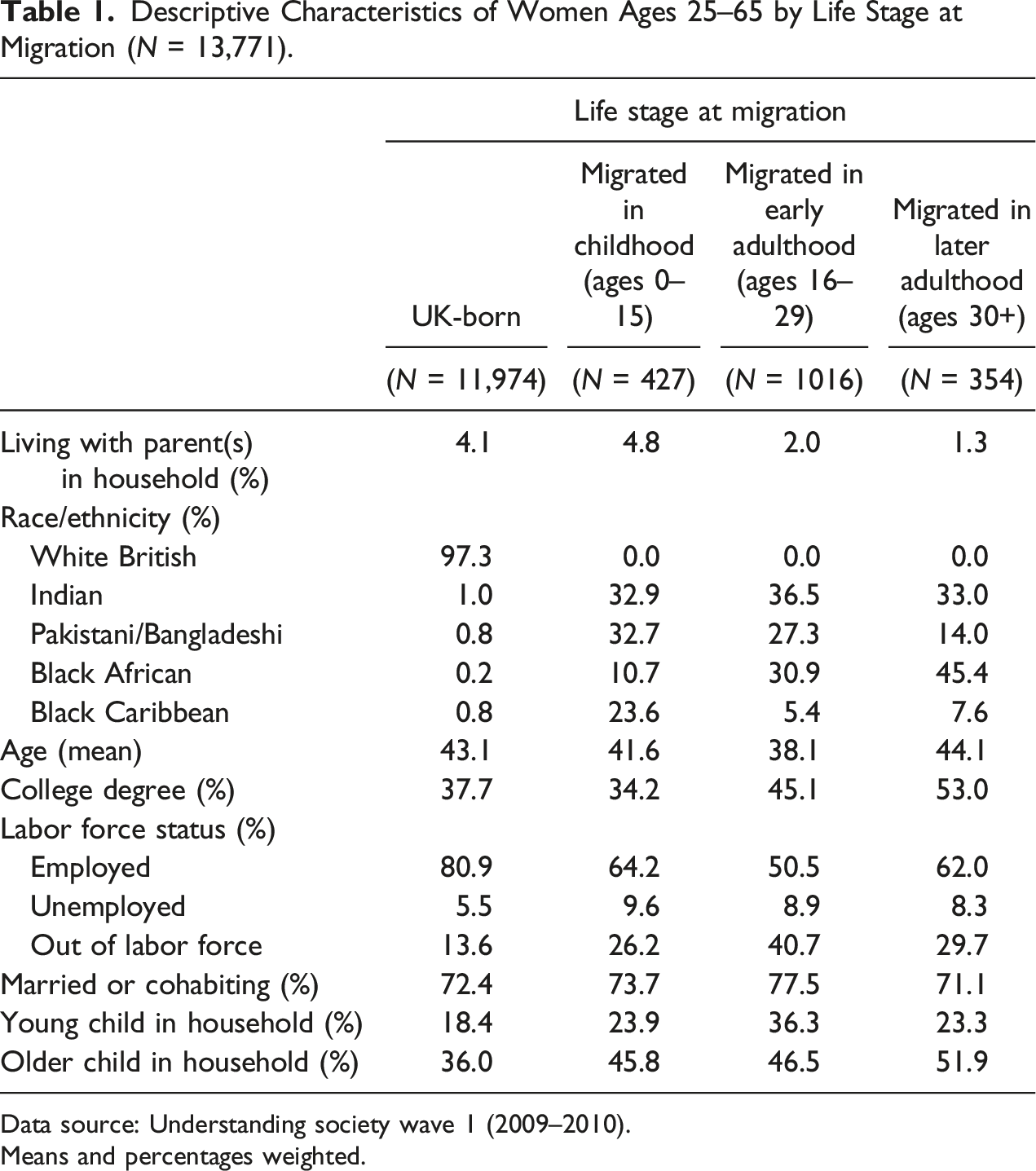
Data source: Understanding society wave 1 (2009–2010).
Means and percentages weighted.
Descriptive Characteristics of Men Ages 25–65 by Life Stage at Migration (N = 10,723).
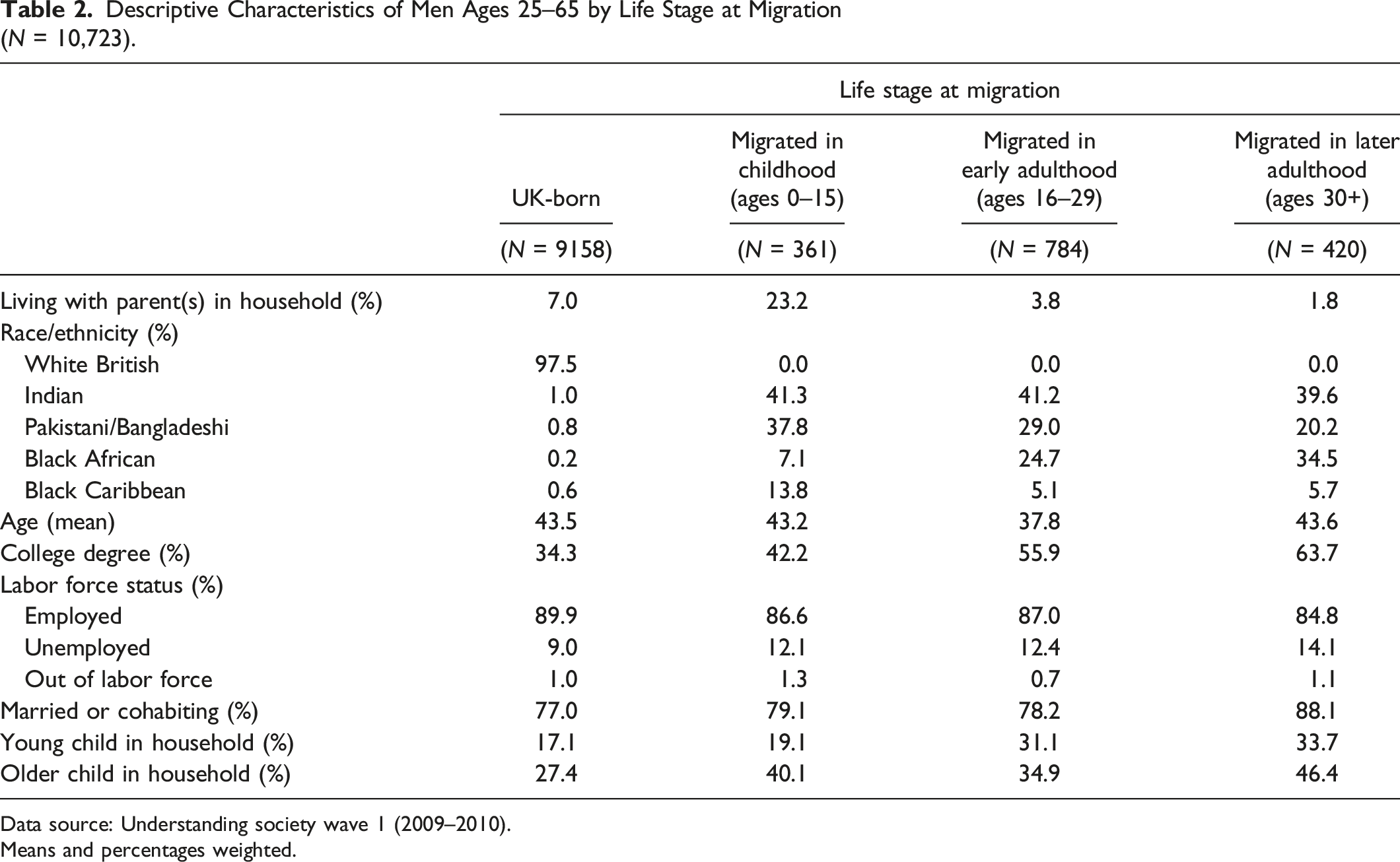
Data source: Understanding society wave 1 (2009–2010).
Means and percentages weighted.
Analytical Models
Average Marginal Effects for Logistic Regression Predicting Adult Child/Parent Co-Residency Among Women Ages 25–65 (N = 13,771).
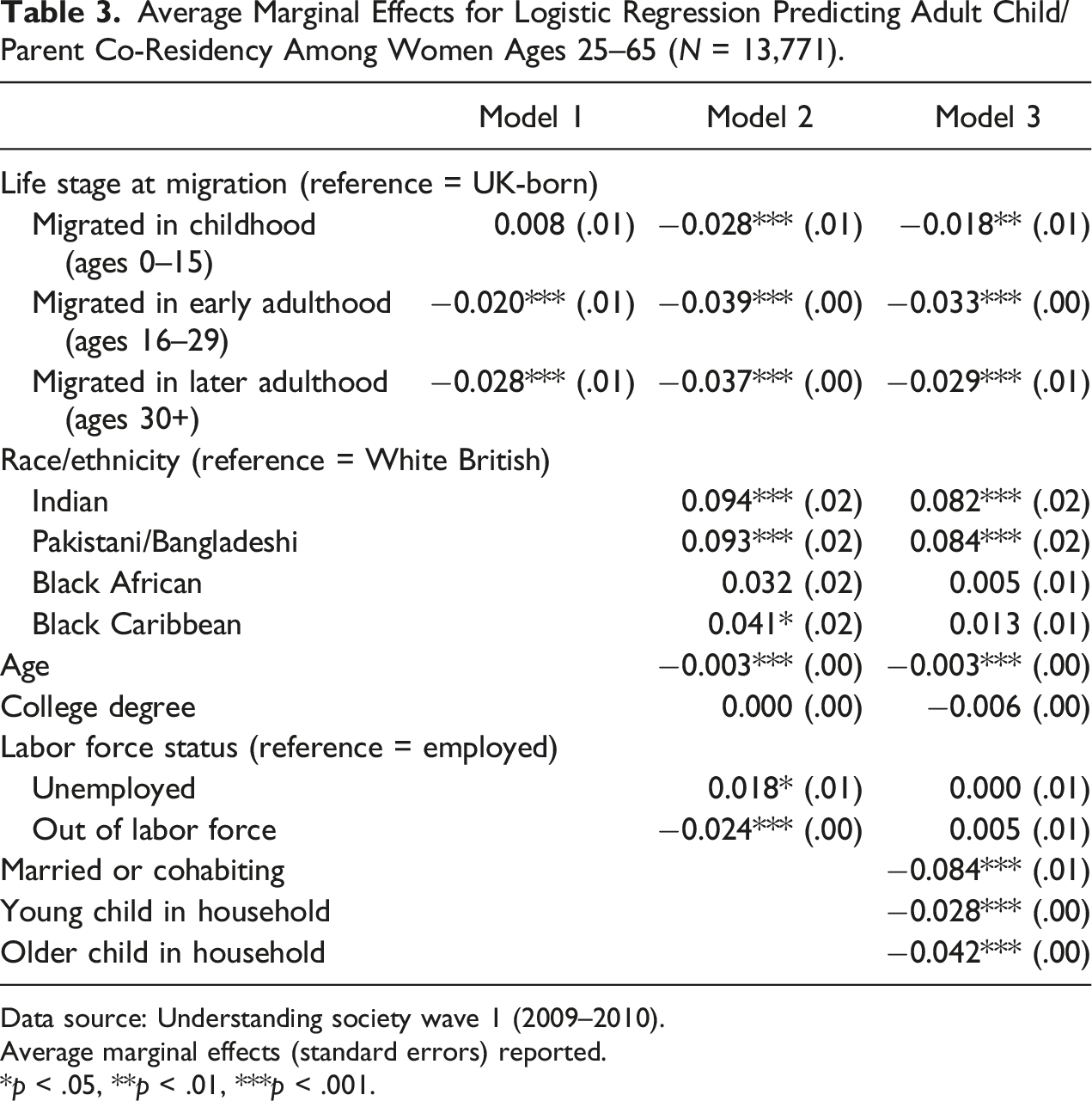
Data source: Understanding society wave 1 (2009–2010).
Average marginal effects (standard errors) reported.
*p < .05, **p < .01, ***p < .001.
In addition, model 2 shows that Indian and Pakistani/Bangladeshi women were about 9% points more likely to co-reside with parents than White British women, and Black Caribbean women were about 4 percentage points more likely to co-reside with parents than White British women when accounting for sociodemographic and economic measures. When family measures were included in model 3, the gap in co-residency between Indian and Pakistani/Bangladeshi women compared to White British women dropped to around 8 percentage points each, while the differences between Black Caribbean and White British women became insignificant. Women’s age, education, and labor force status were either minimally or insignificantly associated with intergenerational co-residency. Women who were married or cohabiting with a partner were 8 percentage points less likely to co-reside with parents than women who were unpartnered, and women with young or older children in the household were 3 and 4% points less likely to co-reside with parents than women without young or older children, respectively.
Average Marginal Effects for Logistic Regression Predicting Adult Child/Parent Co-Residency Among Men Ages 25–65 (N = 10,723).
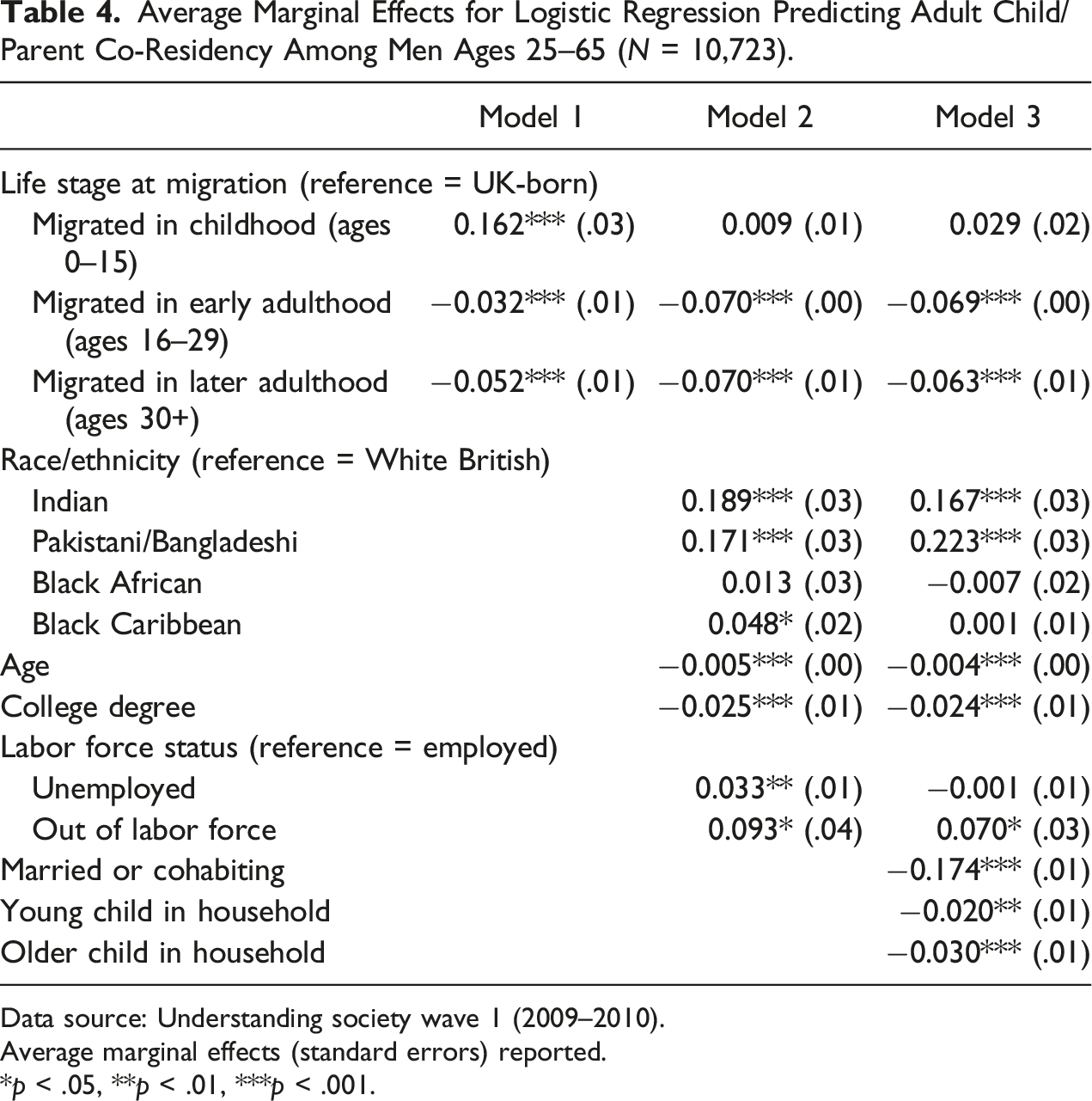
Data source: Understanding society wave 1 (2009–2010).
Average marginal effects (standard errors) reported.
*p < .05, **p < .01, ***p < .001.
In addition, model 2 shows that Indian and Pakistani/Bangladeshi men were about 19 and 17% points more likely to co-reside with parents than White British men, and Black Caribbean men were about 5 percentage points more likely to co-reside with parents than White British men, controlling for sociodemographic and economic measures. When family measures were included in model 3, Indian and Pakistani/Bangladeshi men remained significantly more likely to co-reside with parents compared to White British men (17 and 22 percentage points higher, respectively), while the difference between Black Caribbean and White British men became insignificant. Men’s age was only minimally associated with adult child/parent co-residency, and men with a college degree were about 2% points less likely to co-reside with parents than men without a college degree. Being out of the labor force was associated with a 7% point increase in the likelihood of adult child/parent co-residency in the full model among men (model 3). Married or cohabiting men showed a 17% point decrease in the likelihood of intergenerational co-residency compared to unpartnered men, and men with young or older children were 2 and 3% points less likely, respectively, to co-reside with parents compared to men without children.
Intersections by Life Stage at Migration and Race/Ethnicity Among Co-Residing Adults
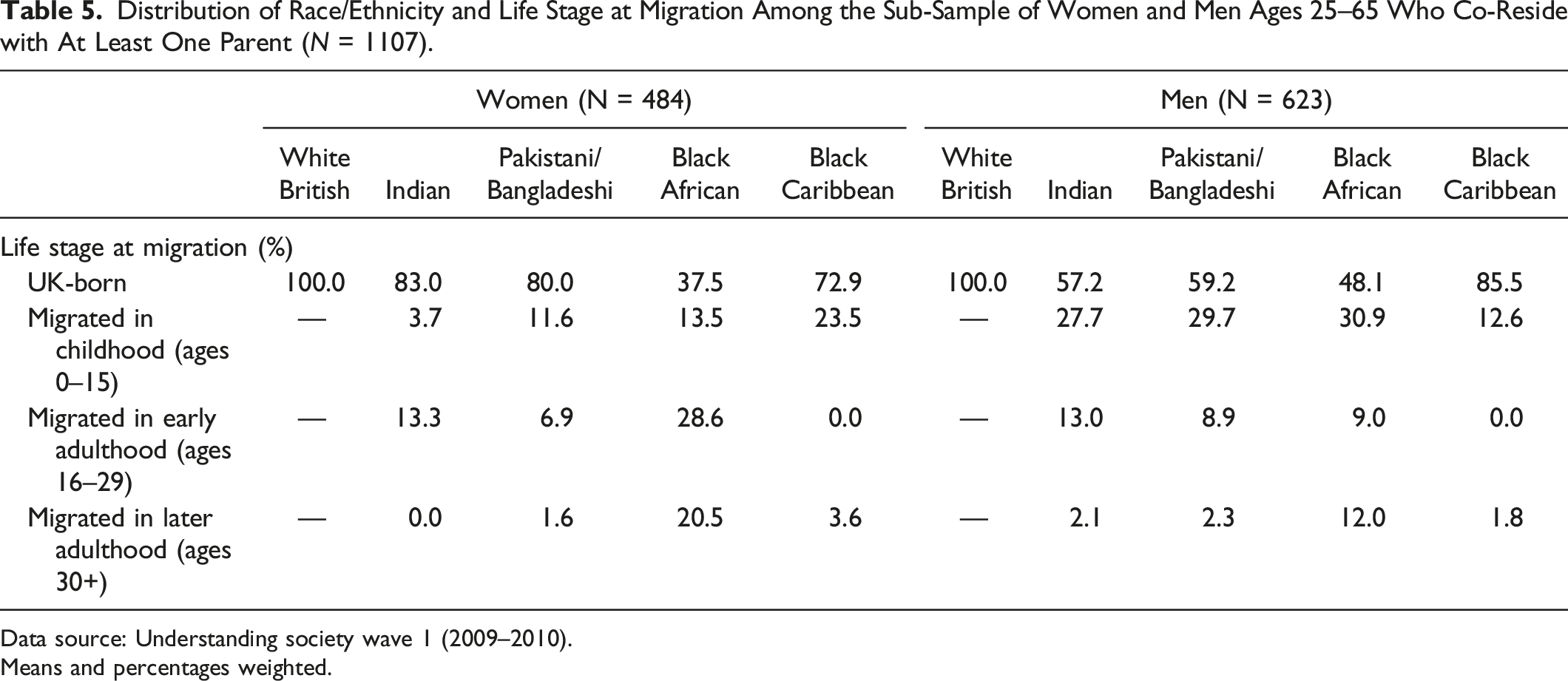
Distribution of Race/Ethnicity and Life Stage at Migration Among the Sub-Sample of Women and Men Ages 25–65 Who Co-Reside with At Least One Parent (N = 1107).
Data source: Understanding society wave 1 (2009–2010).
Means and percentages weighted.
Robustness Check
Foreign-born White British women and men were excluded from this analysis, as they represent only a small proportion of the White British sample (2.6%) and likely have distinct experiences of socioeconomic incorporation upon arrival in the UK compared to foreign-born non-White British individuals. Nevertheless, I ran all analyses including foreign-born White British individuals in the sample as a robustness check (data not shown). The results changed very little when foreign-born White British individuals were included. The lower likelihood of women and men who migrated in early and later adulthood to co-reside with parents compared to UK-born women and men were identical in the two samples, as was the insignificant difference in adult child/parent co-residency patterns between men who migrated in childhood and UK-born men. Furthermore, the higher likelihood of Indian and Pakistani/Bangladeshi women and men to co-reside with parents compared to White British women and men remained, even with the inclusion of foreign-born White British individuals in the sample (data not shown). The only difference between the sample that included foreign-born White British individuals and the sample that did not was, when foreign-born White British individuals were excluded, women who migrated in childhood were significantly less likely to co-reside with parents than UK-born women (Table 3), however, when foreign-born White British women were included, this difference became statistically insignificant (data not shown).
Discussion
This paper contributes to the literature on migration and family by exploring nativity differences in intergenerational co-residency among working-aged adults living in the United Kingdom. I explore theories around immigrant incorporation, economic and family adaptation, and kin availability to understand patterns of adult child/parent co-residency among immigrants and their descendants, using life stage (age) at migration as a proxy for acculturation. Contrary to immigrant incorporation theory (H1), I found that, with few exceptions, immigrant women and men were significantly less likely to co-reside with parents than UK-born women and men, regardless of acculturation (as measured by age at migration). In fact, while Indian and Pakistani/Bangladeshi women and men were more likely to co-reside with parents than White British women and men, descriptive results showed this was largely driven by intergenerational co-residency among UK-born Indian and Pakistani/Bangladeshi individuals. As UK-born South Asian individuals are likely more acculturated than their foreign-born ethnic counterparts, this finding runs counter to expectations under immigrant incorporation theory, challenging notions that household formation decisions among immigrants and ethnic minorities are predominantly cultural. These results can be interpreted alongside prior research showing persistent labor market inequalities among many South Asian groups in the UK (Dale et al., 2006; Khoudja & Platt, 2018; Longhi, 2020), suggesting UK-born South Asians, who are more likely to have parents living in the UK as well, may be more likely to reside in intergenerational households as a family economic strategy (H2). Finally, that foreign-born individuals, particularly those who migrated in early or later adulthood, are less likely to co-reside with parents than UK-born individuals, may be due to lack of available kin in the UK (H3), as many adult immigrants migrate for employment reasons, without the accompaniment of their parents. Furthermore, UK-born Indian and Pakistani/Bangladeshi individuals showed relatively high rates of adult child/parent co-residency, consistent with theories on kin availability. Taken together, these findings challenge cultural assumptions about household formation, suggesting acculturation may not be the driving force behind household composition among immigrant populations in the UK, and highlights how structural barriers such as kin availability and economic inequality may shape household formation decisions among immigrants and ethnic minorities, consistent with findings in other contexts (Gubernskaya & Tang, 2017; Massey et al., 1993; Van Hook & Glick, 2007).
Additionally, this study shows salient gender differences in adult child/parent co-residency among both foreign-born and UK-born individuals. Descriptive tables show that men across each life stage at migration (UK-born, migrated in childhood, migrated in adulthood, migrated in later life) had higher proportions of adult child/parent co-residence than women, with the gap particularly large between men and women who migrated in childhood. That working-aged men appear more likely to reside in intergenerational household compared to women is consistent with broader patterns seen in the UK and in many South Asian immigrant-sending countries, but not necessarily in immigrant-sending countries in Africa and the Caribbean, where women often reside in multigenerational households and care for elders. Marital status and children in the household had similar effects on the likelihood of adult child/parent co-residency for UK-born and foreign-born women and men. When accounting for sociodemographic and family measures, economic measures were important predictors of intergenerational co-residency for men but not for women, with a college degree being negatively associated with intergenerational co-residency, and labor market inactivity being positively associated with intergenerational co-residency for men. Sample size constraints prevented direct testing of interactions by life stage at migration, racial/ethnic stratification, and gender, but given descriptive differences in household formation patterns across these three social strata, future research must carefully consider how gender expectations and structural sexism in migration patterns, education, and the labor market might impact household formation among foreign-born and second-generation immigrants.
This study has a number of limitations which should be addressed in future research. For example, I was unable to directly discern between intergenerational households where co-residency was primarily for the benefit of the adult child or the aging parent. Furthermore, while life stage at migration is a strong proxy for sociocultural incorporation and kin availability, direct measurements of preferences for intergenerational co-residency, as well as information on parents’ country of residence would help to directly test theories in immigrant incorporation and kin availability. Finally, while the focus of this analysis was from the perspective of the adult child, future research could examine adult child/parent co-residency from the perspective of the aging parent, or examine other forms of household extension such as co-residence with siblings, cousins, aunts/uncles, or grandparents, which may be particularly salient for immigrants, as kin availability constraints may lead to alternative forms of household extension (Van Hook & Glick, 2007). Despite these limitations, this analysis contributes to the literature on migration and family by describing differences in patterns of adult child/parent co-residency by life stage at migration and gender, providing nuance to our understanding of immigrant household formation strategies, and underscoring the need for more research on the gendered patterns of migration and household formation.
Footnotes
Acknowledgments
I am grateful to Chenoa Flippen, Pilar Gonalons-Pons, Emilio Parrado, and Melissa Wilde for their guidance and mentorship with this study. I also thank Sneha Mani for data assistance and Rebecca Schut for comments on an earlier draft.
Declaration of Conflicting Interests
The author(s) declared no potential conflicts of interest with respect to the research, authorship, and/or publication of this article.
Funding
The author(s) disclosed receipt of the following financial support for the research, authorship, and/or publication of this article: This research received support from the Population Research Training Grant (NIH T32 HD007242) awarded to the Population Studies Center at the University of Pennsylvania by the National Institutes of Health’s (NIH)’s Eunice Kennedy Shriver National Institute of Child Health and Human Development.
