



Abstract
Although online dating tools have become increasingly diverse over the decades, little is known about the search strategies of individuals or their choices of using certain dating platforms. Based on interviews with 29 heterosexual, highly-educated daters conducted in Shanghai, we examine their strategies for finding a partner online. Online daters can be categorized into three distinct dating types depending on their mating goals and mate preferences: dating, xiangqin (matchmaking), and mixed. We investigated the underlying gendered factors that drove them to specific dating types and guided their choices of online dating platforms. Despite the heterogeneity in dating types, online dating exhibited homophily effects, which may reinforce social inequality in China’s marriage market. While existing research often contrasted online dating with “traditional venues” and used online dating to symbolize modernity, we illustrate the subtlety between xiangqin and dating, thereby challenging the widely-used dichotomy of traditionality and modernity in conceptualizing family-related behaviors.
Introduction
Online dating has become increasingly popular with the development of technology and the commercialization of intimacy (Sautter et al., 2010; Xia et al., 2013). It has profoundly changed the dating landscape, as the Internet allows daters to identify an expanded pool of potential partners that they would not otherwise meet via traditional venues (e.g., through family or friends, at school, or in the workplace; Rosenfeld & Thomas, 2012). In Western countries, online dating has become one of the major ways for singles to meet potential partners (Rosenfeld, Thomas, & Hausen, 2019; Schmitz, 2016). The increased use of online dating makes it an exciting research area for understanding mate-selection strategies and processes during the Internet era (Sassler & Lichter, 2020).
Despite a growing body of literature on online dating (for reviews, see Finkel, Eastwick, Karney, Reis, & Sprecher, 2012; Sassler & Lichter, 2020), little is known about online daters’ search strategies, such as how they choose among different dating platforms and how those choices are related to their mating goals and mate preferences. Scholars call for a more nuanced examination of individuals’ online dating experiences using qualitative methods as well as research that uncovers the complexity, diversity, and inequality in online dating processes (Sassler & Lichter, 2020; Sautter et al., 2010).
To fill the research gaps, we examine men’s and women’s strategies for finding a partner online, based on interviews with 29 heterosexual, highly-educated online daters conducted in 2017 in Shanghai, China. We acknowledge that our focus on highly-educated online daters limits the scope of this study and prevents us from examining mate-selection preferences and processes across the full socioeconomic spectrum. This focus is nevertheless highly pertinent during the Internet era in China. The online dating population is more educated than the general population (Xia et al., 2014). Moreover, with the rapid expansion of higher education in China (Yeung, 2013), college graduates are far from a homogeneous group. It is therefore increasingly important to understand heterogeneity in family behavior within the highly-educated population (Gerber & Cheung, 2008; Xiao & Qian, 2020).
Our paper has three contributions. First, existing research predominantly has contrasted online dating with traditional venues and used online dating to symbolize modernity and freedom of choice (Wang & Lu, 2007; Schmitz, 2016), but we find that great heterogeneity exists even within highly-educated online daters. While prior research on family change has often adopted a dichotomous view that contrasts traditional behavior with modern behavior (Thornton, 2001), we challenge this view by demonstrating how the boundaries between traditional and modern behaviors can be blurred and complicated during the Internet era in contemporary China. For example, our findings suggest that many highly-educated online daters use online dating, a seemingly modern way of searching for a partner, to fulfill their traditional expectations about marriage and gendered family roles. Therefore, we reveal the often-overlooked diversity among online daters and uncover the complexity of intimate life that stands “between tradition and modernity” in China (Ji, 2015, p. 1057).
Second, although the literature on online dating is growing (Sassler & Lichter, 2020), it remains unclear how online daters strategize to find potential partners who meet their mating goals and mate preferences. In other words, the role of individual preferences and strategies in mate selection remains understudied in the context of online dating. In addressing this question, we highlight the complex interaction between individuals’ preferences and the dating opportunities offered by new technologies, thereby advancing the theoretical understanding of mate selection.
Third, while gendered preferences for potential partners are well established (Fiore, 2004; Qian, Shen, & Cai, 2022), whether the search process is gendered remains an open question. Indeed, scant attention has been paid to men’s decision-making processes in dating. Our research examines both men and women and reveals that mate selection in China remains a highly gendered process during the Internet era. Moreover, our study illuminates how gendered processes in mate selection are sustained despite the rise of dating technologies and the decline of third-party (such as parental) control.
Changing Practices of Dating and Courtship in China
The conjugal relationship in Western societies has gone from “yoke mates to soul mates” (Coontz, 2006, p. 145). Marriage based on romantic love has become a universal trend (Jankowiak & Paladino, 2008). Intimacy in China has gone through similar transformations: the goal of marriage was just to make a mundane living together (dahuo guo rizi), but now people increasingly stress affection and feelings (ganjue) in relationships (Zheng, 2017). In contrast to today’s young adults, ganjue hardly appeared as an important mate selection criterion in their parents’ generation (Xu, 2000). The change of emphasis to intimate life reflects Chinese young adults’ increased agency in their pursuit of love (Zheng, 2017). Young adults today consider “true love” as containing both expressing one’s romantic feelings and demonstrating a commitment through marriage (Jankowiak & Moore, 2012; Farrer, 2014).
The practices of intimacy in China are characterized by universal marriage and universal childbirth within marriage (Qian & Knoester, 2015). Marriage matchmaking remains an entrenched practice in China across generations (Wang, 2017). Tangible characteristics that were considered significant in traditional arranged marriages remain important in online dating, as many sites/apps ask users to report their annual income, educational level, and homeownership (Zheng, 2017).
Gender differences in mate preferences are well documented: men prefer young and physically attractive women while women tend to look for men with high income and education (Fiore, 2004). Such gendered preferences are not only seen in traditional dating but also prevalent in the online setting (Hitsch, Hortaçsu, & Ariely, 2010). In addition, those gendered preferences exist in both advanced economies and developing countries like China (Qian, Shen, & Cai, 2022; Xia et al., 2013).
In China, while men’s political status, physical health, and reliable personality were the prime factors in women’s mating considerations from the Mao era to the 1980s (Xu, 2000), men’s physical attractiveness is now important for women who are empowered by their rising socioeconomic status (Zheng, 2017). In addition, as young men face growing difficulties in acquiring economic capital that is considered a prerequisite for marriage (Kam, 2015), urban women increasingly prefer marrying financially capable men (Yu & Xie, 2015). In contrast to shifts in women’s mate preferences, men continue to emphasize women’s physical attractiveness when evaluating potential partners (Xia et al., 2013). Prior research on mate selection in urban China has focused mainly on women (Ji, 2015; To, 2013), but little attention has been paid to men’s dating preferences or experiences. Our research fills this gap.
Diverse Platforms and Multiple Goals in Online Dating
Both online platforms and users’ purposes of using them are heterogeneous. Concerning dating purposes, even one person may have multiple reasons for using dating platforms (Palmer, 2020). Some users may use dating apps for hookups and casual sex, but they also allow space for developing long-term committed relationships (Lundquist & Curington, 2019; Hobbs, Owen, & Gerber, 2017).
Since the first dating site (Match.com) was launched in 1995, online dating platforms have proliferated (Finkel et al., 2012). More recently, smartphones have opened up new spatio-temporal possibilities for Internet dating in two ways. First, location-aware apps allow users to match in their immediate areas. Second, smartphones are portable, making dating accessible everywhere and anytime. Dating sites have gradually added phone app versions to make their services available on smartphones. Meeting through apps was responsible for at least half of the growth in couples meeting online from 2010 to 2017 (Rosenfeld et al., 2019).
Various dating platforms have been created because businesses try to accommodate online daters’ specific needs and cater to specific populations (Finkel et al., 2012). Dating platforms are designed to target groups of different racial/ethnic identities (e.g., BlackPeopleMeet.com), religious affiliations (e.g., LoveHabibi for Muslim dating), or sexual orientations (e.g., Grindr for gays and Lesdo for lesbians). Thus, contrary to the once-dominant view of online dating that “the internet promotes diversity rather than sameness” (Schwartz, 2013, p. 458), homogamous matching emerges as the main online dating outcome, including educational homophily (Skopek, Schulz, & Blossfeld, 2011), income homophily (Yu & Hertog, 2018), racial and ethnic homophily (Lin & Lundquist, 2013; Anderson, Goel, Huber, Malhotra, & Watts, 2014), and religious homophily (Jackson et al., 2015), among others.
Xiangqin and Dating: A Conceptual Framework
In China, matchmaking (xiangqin) and dating (yuehui) are the two predominant ideologies that guide partner-search processes. Xiangqin refers to finding a marriageable partner via arranged matches, with marriage as the end goal (Ji, 2015; To, 2013). Xiangqin is predicated on traditional culture, in which romantic love is not constructed as an indispensable component of marriage. In contrast, dating involves romantic love, emphasizes individual agency, and reflects declining parental control over children’s mate choice (Yan, 2003). The increase in dating results from burgeoning capitalism, the growing market economy, and rising individualism (Yan, 2003). Dating has gained popularity among urbanites as they increasingly endorse and emphasize the idea of romantic love in pursuit of a partner (Ngai, 2005; Yan, 2003).
In this article, xiangqin and dating are differentiated in two dimensions. First, they differ in individuals’ purpose for using online dating platforms. Xiangqin is a process ideally directly leading to marriage. Marriage is an end goal of xiangqin and romantic love is not necessarily involved. By contrast, dating emphasizes romantic love; marriage is a fortunate byproduct of romantic love, not an end in itself. Second, individuals embrace xiangqin or dating ideologies with different attitudes toward intimate relationships, which we elaborate on below.
Melton and Thomas (1976, pp. 509–510) conceptualized family role responsibilities through their instrumental and expressive family functions. Instrumental functions refer to “role behaviors designed to maintain the basic physical and social integrity of the family unit,” whereas expressive functions “serve to foster harmonious interpersonal relationships and emotional well-being among family members.” In the Chinese context, instrumental functions can include providing access to housing, cars, hukou, economic security, etc., while expressive functions can refer to achieving ganjue, romantic love, mutual understanding, etc. Note that hukou refers to household registration, which determines a person’s life opportunities and access to benefits such as children’s education and eligibility for property purchase (Qian, Cheng, & Qian, 2020). It is therefore considered an important characteristic that could potentially fulfill instrumental functions.
The concepts of instrumental and expressive family functions help to explain the differences between xiangqin and dating. Xiangqin underscores instrumental functions in a conjugal relationship whereas dating emphasizes expressive functions in an intimate relationship. In China, many young people prefer finding a partner by dating rather than matchmaking or xiangqin, but the traditional style of xiangqin (e.g., meeting through arranged matches, prioritizing men’s financial capability, or women’s homemaking skills) is still popular (Zheng, 2013). It is worth noting that similar to dating, xiangqin here refers to a form of courtship before marriage, which differs from how “xiangqin” is usually construed in rural China. It is still common for two rural families to arrange matches for unmarried children, after which marriage may follow despite the two spouses knowing little about each other (Shen, 2019).
Considering that the use of “matchmaking” and “dating” apps is usually interchangeable in the West, which does not connote the subtle differences between xiangqin and dating (Ward, 2017; Paraschakis & Nilsson, 2020), we use “xiangqin” instead of “matchmaking” in this article to stress its differences from “dating.” Given that the connotation of yuehui is similar to that of dating in Western contexts, for ease of understanding, we use “dating” rather than “yuehui” in the article.
The differentiation between xiangqin and dating is also reflected in the marketing of online dating platforms. For example, Jiayuan.com (2020), a dating website, claims to be a “serious website for marriage and love.” In this case, “serious” implies that the platform intends to attract daters whose end goal is marriage; moreover, “marriage” is put before “love,” implying that daters’ priority is to get married. Likewise, another dating website Zhenai.com (2020) markets itself as a “matchmaking and marriage-oriented site,” which again highlights “marriage” as the ultimate dating goal. Both platforms are commonly referred to as xiangqin sites or websites for marriage and love (hunlian wangzhan) in the Chinese language.
By contrast, location-based networking tools without a web version, such as Momo and Tantan, are more often recognized as platforms for casual meetups and have the reputation for romantic meetups or hookups (Xu & Wu, 2019). Given that they claim themselves as “social apps” (shejiao ruanjian in Chinese), their market positioning does not necessarily include an end goal for marriage (Mu, 2014). These social apps are similar to dating apps in the West and are mainly used to facilitate the search for romantic encounters that may or may not lead to serious relationships (Illouz, 2012). The differentiations within online platforms and dating goals will be further explained in the results section.
Methodology
Shanghai is an ideal city for studying online dating for three reasons. First, the proportion of unmarried adults at prime marriage age in Shanghai is among the highest of all Chinese cities (Ji & Yeung, 2014). Considering that the vast majority of people would marry by 35–59 years of age (Yeung & Hu, 2016), the demand for partner search is high. Second, 74% of residents (nearly 18 million) in Shanghai are Internet users (Tencent United Security Laboratory, 2017). Internet users are predominantly young people under 39 years old, and nearly 99% of Internet users use smartphones to surf online (CNNIC, 2019). The prevalence of smartphone-based Internet access lays the foundation for people to look for partners through dating sites or apps. Third, online dating may be less stigmatized in metropolitan cities such as Shanghai and thus people might be more likely to search for potential partners online.
We conducted face-to-face interviews to uncover the subtlety and complexity of online daters’ mate-selection preferences and strategies. We recruited potential participants through personal connections and from WeChat and Weibo (the most popular social media platforms in China). We used purposeful sampling to recruit participants (Merriam & Tisdell, 2015). The selection criteria included: 20-45 years of age; residing in Shanghai; and having online dating experience. Anonymity was noted in the recruitment advertisement and reiterated before each interview. Every participant read and signed a consent form before the interview. The study was approved by the research ethics board at the second author’s institution.
Participants’ Demographic Characteristics at the Time of Interview.
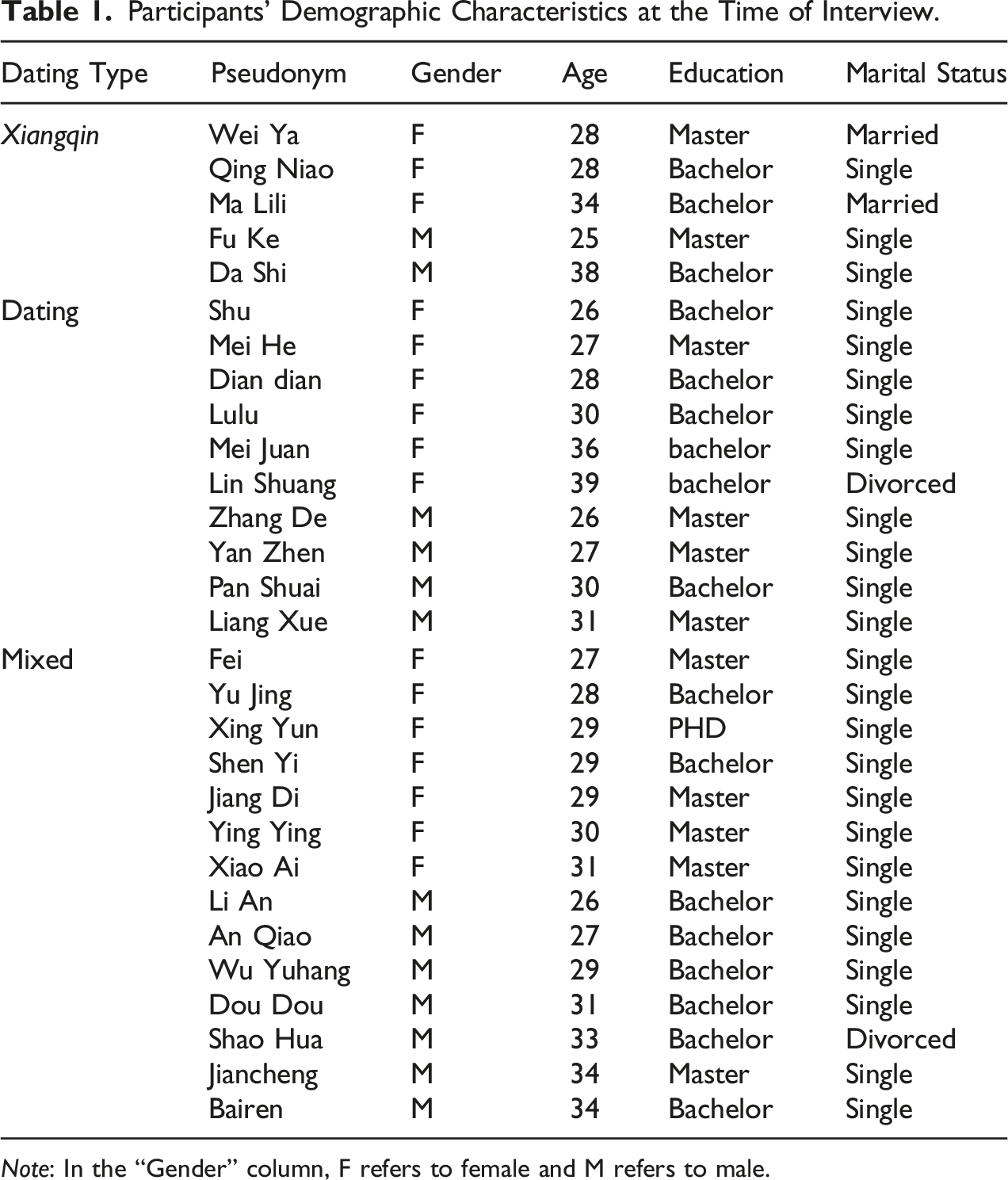
Note: In the “Gender” column, F refers to female and M refers to male.
In addition to online daters, we also interviewed a matchmaker working for a xiangqin site in Shanghai and a co-founder of a popular dating app in Beijing. Interviewing people working in the dating industry enriched our knowledge about online dating from a different perspective. We asked the matchmaker about the operation of their offline services, including how they approached clients, what kind of services they provided, etc. The co-founder of the dating app provided information regarding the characteristics of the app users, and the design of its user interface, among others.
Data Analysis
We audio-recorded all the interviews and hired research assistants to transcribe them. We double-checked each of the transcripts. Assisted by NVivo, a qualitative data processing software, we used thematic analysis to look for repetition, similarities, and differences, and ultimately identify themes (Ryan & Bernard, 2003). The first author primarily coded: 1) different typologies of the online dating platforms; 2) typologies of participants’ mate preferences and associated search mechanisms; and 3) daters’ perceptions of love and marriage. Inter-coder verification was used to assess the analysis and interpretation of the data, ensuring that both authors agreed upon the coding framework (Lavrakas, 2008). Both authors agreed that these themes and interpretations were consistent with the original data and believed that the mechanisms of search were faithfully represented.
Results: Search Patterns and Typology of Online Platforms
Search Patterns in Online Dating.
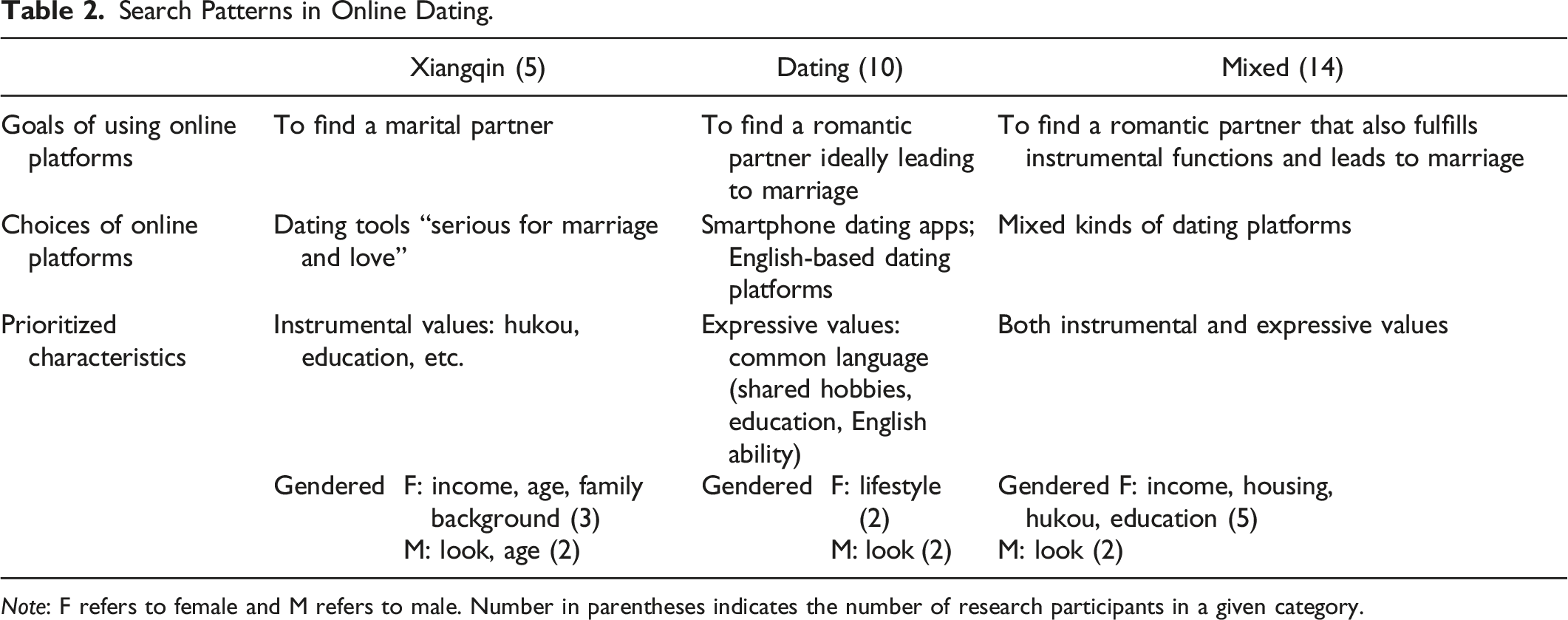
Note: F refers to female and M refers to male. Number in parentheses indicates the number of research participants in a given category.
Typology of the Online Platforms.
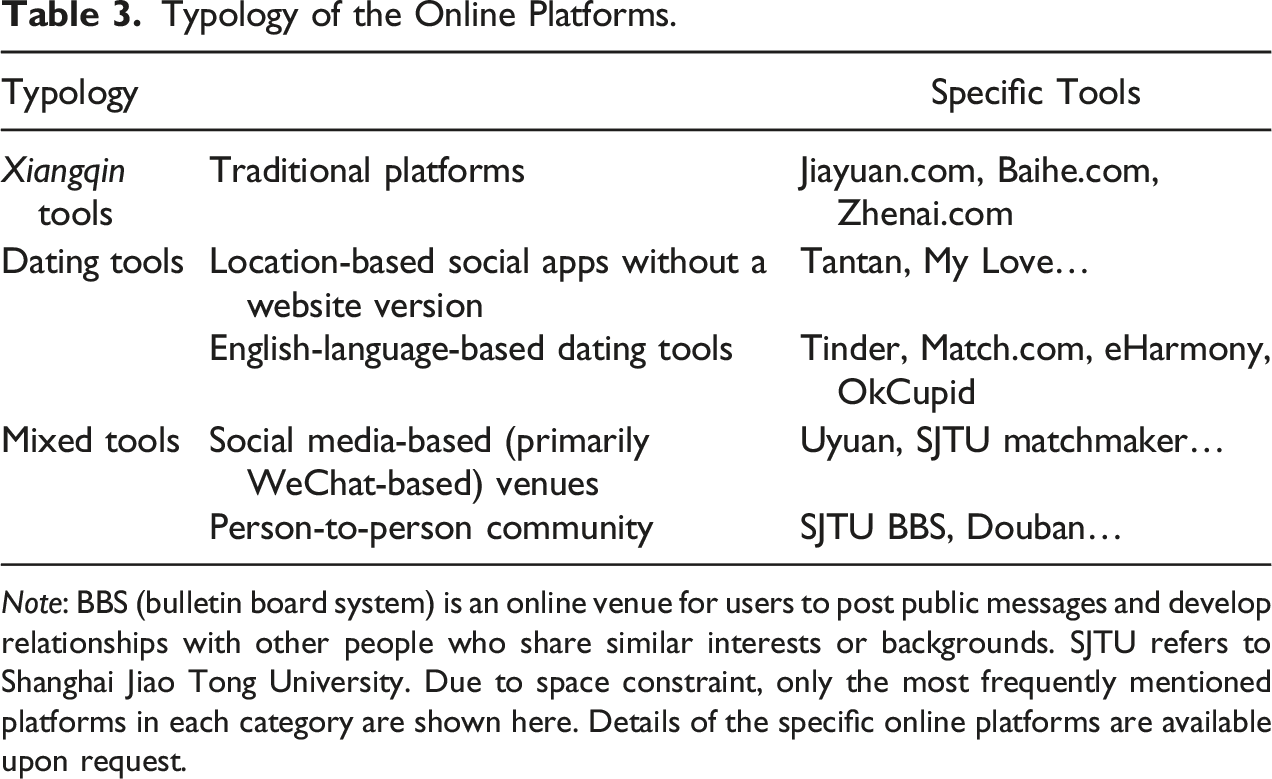
Note: BBS (bulletin board system) is an online venue for users to post public messages and develop relationships with other people who share similar interests or backgrounds. SJTU refers to Shanghai Jiao Tong University. Due to space constraint, only the most frequently mentioned platforms in each category are shown here. Details of the specific online platforms are available upon request.
In the category of mixed tools, WeChat is a Chinese multi-purpose messaging, social media, and mobile payment app developed by Tencent. It was first released in 2011, and became one of the world’s most popular mobile apps in 2018, with over one billion monthly active users (mostly in China) (Tencent, 2020). As a powerful app, WeChat provides new business models of online dating. WeChat-based venues include WeChat groups, public accounts (gongzhong hao), and WeChat innate function “People Nearby.” Under its “public account” function, subscribed customers are able to receive news and notifications about dating activities from account owners. Some public accounts mainly arrange and coordinate services that encourage users to meet at offline events, so that they could charge entrance fees.
Based on our findings, the differentiated choices between xiangqin and dating are reflected in online platforms. These platforms are tailored to meet the expectations of daters with different goals. Individuals with different perceptions toward marriage and love would use tailored tools to meet their specific expectations for intimate relationships. As mentioned earlier, xiangqin as a traditional Chinese courtship practice still persists in contemporary China (Zheng, 2013). Participants who highlighted instrumental values were more likely to use xiangqin tools, such as Jiayuan.com, Baihe.com, and Zhenai.com. Our participants who stressed partners’ expressive values mainly used dating tools. Mixed tools may be used for the purposes of dating, xiangqin, or something in between. To serve their dating purposes and preferred mate characteristics, daters may shift between different tools to find the most suitable person. Many of the participants had experimented with a wide range of online platforms, but they usually stuck to one or two as the one(s) they primarily used. Although some of the platforms are not intentionally designed for dating purposes (e.g., Douban, a social networking website that allows users to share their opinions on books, films, etc.), we categorize them as xiangqin/dating/mixed tools because our participants used them to look for a partner. In the following sections, we focus on the most common themes from the categories of xiangqin, dating, and mixed. It is notable that some themes such as personality, family background, and education were mentioned by participants of different categories in their dating goals.
Results: The Xiangqin Category
Participants in the xiangqin category were marriage-oriented. They intended to find suitable partners to maintain the basic physical and social integrity of the family (Melton & Thomas, 1976). Therefore, mate selection processes in the xiangqin category were more instrumental. Participants’ partner selection strategies included using xiangqin tools such as Jiayuan.com, Baihe.com, and Zhenai.com. The choice of traditional xiangqin platforms suggests daters’ urge to get married, reflected in Mei He’s recount. After getting a master’s degree in England, Mei He (female, 27) started working in Shanghai. She first used Baihe.com, but she soon found it unsuitable for her. She thought that men on Baihe.com were too traditional. As she recounted: The men I met on Baihe.com were pretty straightforward. They told me how many brothers and sisters they had and what their parents did for work, things like that. I feel it’s difficult to absorb information like this. Some of them were in a rush… They wanted to get married within a year… I prefer chic chatting when I meet a stranger.
The men that Mei He encountered on Baihe.com reflected the characteristics of users that traditional xiangqin platforms are more likely to attract: prioritizing daters’ instrumental values and aiming for marriage outright. Daters in the xiangqin category emphasized hukou, education, and family background of potential partners. Gender differences were salient in the instrumentalist approach in mate selection. Women valued potential daters’ financial ability while men valued women’s looks. The fact that women put more emphasis on potential daters’ financial ability and men on potential partners’ appearance is not new. But what remains unclear is how people strategize to find potential partners who meet their criteria. Our interview materials provide detailed accounts of online daters’ strategies.
Some women used personalized services provided by xiangqin sites to find potential partners with high financial ability. According to the participants and the matchmaker we interviewed, the service was expensive with a starting price of 9000 yuan for half a year’s membership, while the average monthly disposable income was 4916 yuan in 2017 (Shanghai Bureau of Statistics, 2018). Moreover, the service only promised matches with three potential daters within six months.
Qing Niao (female, 28) opted for Jiayuan.com and Baihe.com, two sites known as serious xiangqin platforms for marriage and love. She explained: I think they fit me well because I aim for marriage and men on the websites aim for marriage too. Unlike Momo or Tantan that has a reputation for casual relationships, Baihe.com and Jiayuan.com are more likely used for the purpose of xiangqin and marriage. Their orientation is quite clear.
After Qing Niao registered on the two xiangqin websites, she received phone calls from both and finally chose Baihe.com’s dating services. Once daters register on xiangqin platforms, matchmakers working for the platforms will probably call them to ask if they are interested in personalized face-to-face dating services. Those who are interested may arrange an appointment to meet the matchmakers. In this case, online and offline dating services are integrated to provide well-rounded services for daters.
According to both online daters and the matchmaker we interviewed, men needed to provide verified documents to prove their identity and socioeconomic status, including an ID card, a housing deed, and income proof, whereas women needed to provide an ID card and their educational diploma. The verification process is similar to the process adopted by marriage-oriented online dating agencies in Japan (Yu & Hertog, 2018). In this sense, the boundary between online and offline dating becomes blurry, and seemingly modern dating technologies are used to fulfill the traditional function of matchmaking.
Women who used the service expected it to be an efficient way to find a financially capable and marriageable partner because matchmakers had done the initial screening for them. As Qing Niao recounted: The most thrilling thing they told me when they promoted the dating service to me was: our service is pricy. But those men who are willing to pay for it are looking for a serious relationship leading to marriage, plus they have high financial ability. Because a man has to have a monthly income of 10,000 or above in order to purchase the service, he won’t use the service if his salary is only 3,000 or 5,000. He has to reach a certain level of financial ability. I feel that was the most effective selling point to me. I think that service fits me.
Qing Niao regarded using the matchmaking service as an efficient way to find a financially capable man with serious attitudes toward marriage. Her account reflected the prevalent view that men’s socioeconomic status is key to their marriageability (Kam, 2015; Yu & Xie, 2015). As elaborated by Ma Lili (female, 34): I think men’s income is vital. I mean, we, Chinese women, want to marry up. A marriage can be considered a good marriage only if your situation can be improved through it… A woman values a man for his ability and social status.
Some daters like Ma Lili who wanted to find a spouse used WeChat groups and BBS to meet their goals. She told us, “…the men that my parents introduced belong to their social status. Daters online would be more diverse.” In her search for someone of higher social status than her, she joined a WeChat group to “know [her] position in the marriage market.” She narrated her strategies for finding a partner: Dozens of men were in the group. I checked their profiles one by one, sent friend requests, chatted with them on WeChat and then asked out the men I deemed suitable to meet in person. In the process I found that most of them didn’t give me a thought, not that I didn’t appreciate them, which was surprising to me…I made a table to analyze these men’s age, background, strength, and weakness…perhaps my age is a concern for them. It’s difficult for me to find high-quality (youxiu de) men who are local Shanghainese, so I set my goal to focus on men without a Shanghai hukou, but with high quality (suzhi).
Considering that “high-quality” men with local hukou were unlikely to choose her, Ma Lili set a more realistic goal by searching among migrants. A person without a Shanghai hukou faces institutional barriers to purchasing a property in Shanghai. Therefore, Shanghai hukou is a valuable attribute in the local marriage market and plays an important role in shaping mate selection (Qian & Qian, 2017).
Finally, Ma Lili dated and married a man with a master’s degree from a European university, with a good salary and a good job but without a Shanghai hukou. She viewed him as “suitable for marriage” and their marriage as reciprocal. He was allowed to buy a property in Shanghai after they got married. He purchased a property and put her name on the deed. Ma Lili expressed that their relationship involved resource exchange because her husband valued her good looks and Shanghai hukou and she valued his economic status. She had the perception that men prioritized women’s good looks on top of other characteristics in their partner search. She expressed: “Women’s appearance is vital. If you are good-looking, a man won’t mind even if your family background, financial conditions or other conditions (tiao jian) are not outstanding.” Although an increasing number of women value men’s physical attractiveness, still men stress potential partners’ looks and women value men’s financial capability (Fiore, 2004; Hitsch et al., 2010; Xia et al., 2013).
Both Qing Niao and Ma Lili were from a working-class family background. Their prioritization of potential partners’ economic status might have been related to their family background. Marriage was a relatively easy way for them to achieve upward social mobility. Both of them demonstrated personalized and creative strategies in the partner-search process, which reflected individualism and autonomy. Importantly, unlike conventional matchmaking, all of the participants in the xiangqin category considered dating a prerequisite for marriage.
Both women and men use strategies to meet their gendered expectations for Mr/Miss Right, as demonstrated in Da Shi’s case. One of Da Shi’s (male, 38) relatives met his wife through Jiayuan.com, which motivated him to use xiangqin tools. Da Shi used both online and face-to-face xiangqin services at Zhenai.com. After encountering frustrating experiences in relationships, he preferred to find a good-looking partner: I used to prefer Shanghainese women with similar family background, good-looking, good personality and common language, a soul mate. But now only one criterion remains unchanged: good-looking. I no longer care about anything else. I expect her to be good-looking so that my future child’s good looks are secured.
Da Shi’s narratives suggest that dating preferences and types may change over time, and his dating type seemed to have changed from the mixed to xiangqin category. At the time of the interview, he stressed his potential wife’s looks from a biogenetic perspective. He was concerned about the looks of his future offspring and felt that common language and romantic love were not a must in marriage.
Similar to Qing Niao, Da Shi used a xiangqin website’s matchmaking services. He recounted: “The salesperson showed me some wonderful women’s profiles, drop-dead gorgeous with good family background. She told me: ‘you just need to spend thousands of yuan for lifelong happiness. That’s worth the value!’” Then Da Shi paid 30,000 yuan for half a year’s service, which promised to arrange dates with eight women for him.
Age preferences in assortative mating tend to vary by gender (England & McClintock, 2009; Qian, Shen, & Cai, 2022). Our findings also show that men preferred someone younger than them while women preferred a partner older than them. Most participants set up specific age ranges when looking for partners online. When using online platforms, they usually filtered potential partners according to age. When using offline services affiliated with the online dating platforms, they specified their preferred age ranges to matchmakers. For instance, both Da Shi and Qing Niao used personalized services provided by xiangqin websites. Da Shi asked the matchmaker to find him a woman who was younger than him by 10 years or less. Qing Niao requested to find a man who was older than her by six years or less. Because the online daters actively used various strategies to maximize the chance of realizing their age preferences, the stated age preferences for potential partners likely reinforce the traditional age hypergamy pattern where women marry a man older than themselves (Qian & Qian, 2014).
Results: The Dating Category
Social apps and English-based dating tools were the most frequently used tools among the ten participants in the dating category. Eight of them were looking for a romantic relationship leading to marriage. Unlike daters in the xiangqin category who emphasized instrumental attributes in potential partners, participants in the dating category valued expressive functions in relationships.
Most saliently, participants in the dating category valued common language. Based on our findings, common language refers to similar educational background and shared hobbies, which echoes Zheng’s (2017) finding that young people in contemporary China emphasize mutual understanding and shared values, interests, and lifestyles in mate selection. Choice of online platform is related to dating goals and mate preferences, as exemplified by Mei He’s shift from one online platform to another.
As she was unable to find a date using Baihe.com, Mei He started using Tinder based on recommendations from a friend who had also studied overseas. Mei He recounted: Men I met on Tinder are different from those I met on Baihe.com… On Tinder not everyone aims for xiangqin. Some people just want to make friends. I’m more comfortable with Tinder… People on Tinder are more interesting… Tinder will highlight your company, first connection, second connection, and you can edit some personalized information. It’s not like Baihe.com, prioritizing age and income…
“Not everyone aims for xiangqin” implies that xiangqin is directly associated with a marriage-oriented relationship in which instrumental values such as age and income are highlighted. Mei He’s detailed accounts demonstrate that Baihe.com and Tinder are different online platforms that attract relatively different users. Baihe.com represents traditional dating websites with a strong emphasis on xiangqin. On the other hand, Tinder, although reputed for hookups and casual sex in the West (van Hooff, 2020; Lundquist & Curington, 2019), is used by some users in China to find romantic and committed partners. Mei He’s shift from Baihe.com to Tinder reflects that her purpose for using online platforms was to make friends with whom she might develop a romantic relationship rather than to meet someone as a potential marriageable partner.
Some of the participants who graduated from top universities perceived similar educational background as the foundation of common language. Therefore, they prioritized educational attainment in the partner-selection process. Both well-educated female and male participants preferred potential partners with a similar educational background. No gender difference was evident in this respect. Participants used various strategies to meet this criterion, including searching through BBS affiliated with top universities and WeChat dating account HIMMR claiming to be exclusively for graduates of top universities. Yan Zhen (male, 27), who graduated from a top university in China, considered HIMMR, where he met women who shared common language, as the only online platform suitable for him. He did not have similar dating experiences on other platforms, and he explained why: “I don’t mean to be offensive. But chatting with people who graduated from an ordinary university is indeed a bit more difficult. Educational background makes the difference.” The use of exclusive online platforms echoes Illouz’s (2007) argument that technology encourages an increased refinement of tastes, as users are unlikely to aim for a match who is out of their league.
Similar to Yan Zhen, Pan Shuai (male, 30) got his bachelor’s degree from an elite university in China. His mate preference can be summarized into “three goods,” a good university, a good job, and good-looking, with education prioritized over the other two criteria. He wanted to find someone who had graduated from a top university in China. When asked if a woman who did not have a degree from a top ten university was acceptable to him, he answered: It is acceptable if she is extremely good in other ways. It is not black or white. But generally speaking, I have this sort of preference…I expect my partner to be knowledgeable and intelligent, so that we will share a lot in common and have more effective communication… It is not something like that you like basketball and I like bungee, or you like going to pubs and I like singing...not these sorts of interests, but it is more intellectual (jingshen cengmian), reflecting a person’s “quality.” At least we need to have common language.
Studies on educational assortative mating have found that people prefer partners with similar educational achievement (Schwartz, 2013). A college degree holder prefers a partner with the same educational level (Skopek et al., 2011), but few studies have examined the specific degree preferences that elite school graduates have for their partners. Elites' dating preferences have been reported in the media in the US and in China, but are rarely recorded in the scholarly literature (for the few exceptions, see Arum, Roksa, & Budig, 2008; Xiao & Qian, 2020). We find that elite school graduates prefer educational homogamy because they stress similar ways of thinking and intellectual connections in intimate relationships, as stated by Mei He and Pan Shuai.
In addition, participants with overseas study experiences preferred potential partners with similar background, at least at the initial stage of their partner search. Both Mei He and Ying Ying (female, 30) had overseas study or work experience. They preferred English-speaking men or those with overseas experiences. In order to find such men, they used dating tools such as Tinder and OkCupid and attended dating events for overseas returnees (haigui in Chinese). Tinder functioned as a filter to exclude men who did not meet Mei He’s criteria. Interviewer: …Your self-introduction is written in English on Tinder, which excludes those… Mei He: Who don’t know English…Actually I care about [potential partners’] English capability. So I think my chance of finding a partner via Tinder would be higher [than via Baihe.com].
Scholars have found that individuals’ strategies in online dating include setting up selection criteria in personal profiles that exclude undesirable daters (Žakelj, Kocon, Švab, & Kuhar, 2015), which was observed in Mei He’s case. Her overseas study experiences, possibly related to her middle-class family background, have a great impact on her dating preferences and selection of online platforms. She filled in her profile in English, which was a strategy of exclusion. Although participants like Mei He and Pan Shuai emphasized expressive values in potential partners, their dating preferences could result in homogamous matching in relation to socioeconomic status, similar to the historical patterns of assortative mating documented in China (Croll, 1981).
In addition to similar educational background and English-speaking capacity, having shared hobbies was also considered vital to finding “common language.” Daters like Dian Dian (female, 28) used Tantan, in hopes of finding a partner with similar tastes in music. Similar to Tinder, Tantan stresses profile photo, age, location, horoscope, hobbies, and occupation in its interface. Dian Dian recounted: “I’m not sure if I’m too weird, I put a high value on hobbies such as music and movies, so I detailed these in my profile.” She found a foreign boyfriend who shared her taste in music.
Gender plays a role in mate selection for participants in the dating category. Even for women and men who opted for the same dating apps in the dating category, the underlying reasons for their choices are based on their gender-differentiated preferences. For example, although emerging dating tools such as Tantan highlight daters’ profile photos, women tend to focus on potential partners’ lifestyles indicated by the photos while men tend to focus on women’s appearance. When asked “Would you swipe left if you come across someone whose appearance is ‘unpleasant’ to you?”, Dian Dian answered: It’s not about appearance. I would check what kind of photos he chose to post. I focus more on the ways in which men dress than their appearance…Gradually I came to know how to evaluate what kind of person he is according to the tags and lifestyles indicated by the photos he has posted.
As for men who put more emphasis on potential daters’ looks, they used Tantan because its interface highlighted profile photos. As Yan Zhen explained: [I] prioritize appearance if I look for a short-term partner; if it is for long-term, then [I’ll look at] more indicators. But still appearance is the break-through point. From this perspective, Tantan has the most user-friendly interface. Better than Jiayuan.com and Momo.
Unlike Da Shi in the xiangqin category who emphasized good looks for biogenetic concerns, men in the dating category linked good looks with “chemistry.” For example, Pan Shuai placed good looks as the third most important mate criterion because of his emphasis on “chemistry:” “You have to have chemistry. That’s very important. It can be assessed by profile photos.” Stressing chemistry implies an emphasis on romantic feelings and physical attraction, which shows that he was concerned more about the relationship itself rather than his future offspring’s looks. Participants in the dating category stressed expressive values, but they also had preferences for criteria such as age and personality. Those other criteria, however, became secondary and flexible as long as the criterion of common language was met. For example, Dian Dian found out that the man who shared her taste in music was much older than what she preferred. But she fell in love and ignored the age preferences that she had previously set. As she recounted: “We’ve been together purely because I like him and he likes me,” whereas the unmet criterion of age can be a deal breaker for participants in the xiangqin category.
Results: The Mixed Category
The mixed category had 14 participants. Daters in this category emphasized both materiality and common language, rendering the complexity of their search mechanisms. They tended to use various online tools to meet their dating goals.
Wu Yuhang (male, 29) preferred women younger than himself and wanted to find his future wife among doctors, school teachers, and public servants (gongwu yuan). He subscribed to SJTU matchmaker via a WeChat service account and attended offline events twice a month. Some WeChat-based commercial dating platforms such as UYuan and SJTU matchmaker organize paid meetup events regularly. Wu Yuhang told the researcher: SJTU matchmaker will release attendees’ demographic information in advance, including their hukou status, age and occupation. Even if only three or four women meet my requirements, I am happy to spend the money and time on it. I will go straight to find these women and talk to them.
But unlike daters in the xiangqin category, Wu Yuhang also valued romantic love in relationships. When asked if he thought love is a must in marriage, he gave a definitive “yes.”
The gendered preferences that women value men’s financial capability and men value women’s physical attractiveness were also evident in the mixed category. Shen Yi (female, 29) was representative of women in the mixed category. She narrated: As for xiangqin, first, he has to meet my financial requirement. For example, if the men I come across have a flat but don’t have a car, it is acceptable because I don’t have to worry about buying a house. This [having a marital house] is my baseline. Their jobs must be OK if they have a condo. Then it comes with common language, like talking about movies that we recently watched and exchanging views with each other, just to see if we could have something to talk about.
Many Chinese women prioritize homeownership in potential partners given soaring housing prices in major cities. Having a marital property is not only indicative of wealth but also used by some women to evaluate men’s love and commitment (Zheng, 2020). Emphasizing both expressive and instrumental values in relationships may render a relatively long period of search, as shown in Yuexuan’s case (male, 34). He had met over 100 women but was still single at the time of the interview.
Daters in the mixed category expressed specific preferences for hukou. We find that even those with a local Shanghai hukou had varied preferences for potential partners’ hukou and migration history. The underlying reason might be the search for common language. Specifically, among those with a Shanghai hukou, there were subtle differences in dating preferences between those who were ascribed to a Shanghai hukou (local-born Shanghainese) and those who achieved a Shanghai hukou later in life through, for example, talent programs (new Shanghainese). Local-born Shanghainese usually preferred a partner who was also locally born, whereas “new Shanghainese” tended to prefer someone with a Shanghai hukou but not born in Shanghai. The pattern of hukou homogamy whereby men and women tend to marry within their own hukou category has also been identified by Zhou (2019).
To fulfill their mate preferences for hukou statuses, participants’ search strategies included attending themed speed-dating sessions arranged for people with different hukou statuses. For example, Doudou (male, 31), a local-born man, attended the “310” dating events specifically designed for Shanghainese, organized by Uyuan (a WeChat public account). “310” is the assigned initial numbers of resident identity cards (shenfen zheng) for people born in Shanghai. Doudou expressed: I used to have a relationship with a woman who is not a Shanghainese. We had all sorts of differences. We don’t suit each other. After that, I realized that I should opt for Shanghainese…and my parents expect me to have a Shanghainese wife.
For new Shanghainese, they either did not have specific preferences regarding hukou or preferred “non-local-born daters.” Contrary to Qing Niao’s preference for local men, Ying Ying (female, 30) used the matchmaking services provided by Jiayuan.com to deliberately seek non-locals. I prefer to find a non-Shanghainese, older than me, having higher income than me if he is not a public servant… I feel that perhaps I don’t have common language with Shanghainese. If his family speaks the Shanghainese dialect at home, I would feel stressed. I don’t want to learn this dialect. I feel that two non-Shanghainese working in Shanghai would have more common language.
Both native-born Shanghainese and new Shanghainese in the mixed category drew a linkage between hukou and common language, which reflects their emphasis on expressive values although hukou is often thought to indicate instrumental values. The linkage also provides a perspective for explaining the prevalence of hukou homogamy. The participants used the strategy of “self-elimination” to exclude certain opportunities and achieve homophily (Kalmijn, 1994, p. 424).
Conclusion and Discussion
Previous research predominantly uses online dating to symbolize modernity and freedom of choice, and contrasts online dating with “traditional venues” such as meeting through family or friends (Rosenfeld & Thomas, 2012; Schmitz, 2016; Wang & Lu, 2007). The current study, however, reveals that there is vast heterogeneity within online daters and diversity among dating platforms. Despite our focus on highly-educated online daters, those daters are far from homogeneous. The online daters we interviewed can be categorized into three distinct dating types—dating, xiangqin (matchmaking), and mixed—depending on their mating goals and mate preferences. Within each category, we find gender differences in preferred mate characteristics. Importantly, individuals with different perceptions toward marriage and love would use tailored tools to meet their specific relationship expectations.
On the one hand, we find a low proportion of daters in the xiangqin category, probably due to our focus on highly-educated online daters in Shanghai who would be more likely than less-educated people in rural areas to stress romantic love and expressive values in relationships (Shen, 2019). On the other hand, although our sample consisted of research participants who were relatively similar and advantaged in educational attainment (i.e., highly-educated online daters), they still exhibited diverse views and practices of mate selection. This study highlights that in light of the mass expansion of higher education (Yeung, 2013), college graduates are a rapidly growing group in terms of not only its sheer size but also its within-group heterogeneity (Gerber & Cheung, 2008). This study thus advances understanding of the diversity and complexity of marriage and family behaviors within the highly-educated population in contemporary China.
As Thornton (2001, p. 454) defines: By modern family I mean the aspects of family identified by generations of earlier scholars as modern, including the existence of many nonfamily institutions, individualism, nuclear households, marriages arranged by mature couples, youthful autonomy, courtship preceding marriage, and a high valuation of women.
The flip side of those aspects of family is usually referred to as traditional. Our research, however, challenges this dichotomous view of “modern” versus “traditional” behaviors related to intimacy and family. In the online dating setting, the boundaries between modern and traditional behaviors are especially complicated and oftentimes blurred. On the one hand, it is not uncommon for the highly-educated participants to emphasize instrumental values in mate selection. On the other hand, individual agency and courtship preceding marriage are evident among them. In other words, our participants were actively pursuing certain values (e.g., instrumental or expressive), not because of parental control over or intervention with their intimate life. Instead, online daters adopted mate-selection strategies primarily out of their own preferences and through their self-directed efforts. Therefore, although daters in the xiangqin category underscored instrumental values in evaluating potential partners, it is too simplistic to classify those daters as traditional.
Meanwhile, some of the participants’ mating decisions reflect neoliberal logic that highlights choices and individualism. On the surface, those criteria and associated behaviors appear modern, but what individuals pursued was far from the pure relationship as proposed by Giddens (1992) in conceptualizing modernity and the transformation of intimacy. Although participants in the dating category stressed future partners’ expressive values and emphasized the importance of romantic love, rational cost-benefit calculations based on tangible characteristics were evident in shaping their decision-making. In this sense, love was not blind, nor did it help to erase or cross salient social boundaries as defined by education, hukou, and other tangible characteristics. As a result, the choices of participants in the dating categories showed high levels of homogamous matching, which was not so much different from historical patterns of assortative mating documented in China (Croll, 1981). Thus, it would be too simplistic to classify online dating app users in the dating categories as modern.
Moreover, the conceptualization of search strategies is even more complicated if we take into account the third category: rather than falling into either of the two extreme categories, most of our participants belonged to the mixed category where they could not be strictly classified into either the xiangqin or dating category. Online daters in this category simultaneously embraced and adopted multiple schemas of mate-selection preferences and practices. Thus, the dichotomy of modern versus tradition falls short of characterizing many online daters who stand somewhere in between.
Our research has limitations. First, our research focuses only on well-educated young adults in Shanghai. As we have explained above, this focus has its own merits in light of the higher education expansion in China and the educational composition of online daters. Future research is encouraged to expand the focus to include participants of other socioeconomic statuses and in different geographical locations. The conceptual framework developed in our article may shed light on these studies. Second, four out of the five participants in the xiangqin category were from working-class family backgrounds whereas more than half of the participants in the dating category had middle-class parents. Parental socioeconomic status may shape individuals’ dating preferences. More evidence is needed before definitive conclusions can be reached. Third, although our interviews suggest that dating preferences and dating types might change over time, the associations between age and dating types are unclear. Future research may explore mechanisms of search over the life course.
In the article, we have shown complex interactions between individual mate preferences (sugar-coated by choices) and marriage market opportunities (mediated through new technologies). Choice is usually suggestive of openness, tolerance, and acceptance of others, while ignoring the fact that decisions are made to reproduce and reinforce social norms which are innately patriarchal, classist, etc. (Thwaites, 2017). Indeed, “choice is actually a more conservative and less emancipatory concept than would be hoped” (Thwaites, 2019, p. 18). Although online daters’ preferences and strategies are heterogeneous, the Internet exhibits homophily effects: the participants’ partner search is both motivated and constrained by their previously held preferences, which in turn channels them to find someone similar to themselves. Our findings echo the argument of Schmitz (2016) that homogamy is witnessed in online dating, suggesting that social inequality may continue to be reproduced through dating and marriage.
To conclude, this study contributes to the current literature on online dating by revealing the diversity of online platforms and the complexity of search mechanisms among highly-educated daters. It unpacks the relationships between dating goals, choices of apps, and mate-selection preferences and strategies. It also illustrates the subtlety between xiangqin and dating, thereby challenging the widely-used dichotomy of traditionality and modernity in conceptualizing family-related behaviors. Overall, the gendered processes of mate selection are reproduced and sustained during the Internet era. Even in Shanghai, one of the most Westernized cities in China, online dating functions in ways that are not necessarily in contrast to traditional matchmaking. Even without the strong influence of third parties, online dating facilitated by new technologies may continue to reinforce the existing social inequality and gender divide in China’s marriage market.
Footnotes
Acknowledgments
Yue Qian acknowledges funding support from the University of British Columbia through the Hampton Fund Research Grant—New Faculty Award. Yang Shen acknowledges funding support from the National Natural Science Foundation of China (Grant No. 72204158). Any opinions, findings, and conclusions expressed in this article are those of the authors and do not necessarily reflect the views of the funder or others.
Declaration of Conflicting Interests
The author(s) declared no potential conflicts of interest with respect to the research, authorship, and/or publication of this article.
Funding
The author(s) disclosed receipt of the following financial support for the research, authorship, and/or publication of this article: This work was supported by the National Natural Science Foundation of China; Grant No. 72204158 and 10.13039/501100005247; University of British Columbia; Hampton Fund Research Grant—New Faculty Award.
