




Abstract
Family stress theories posit that individual family members are positioned to adapt to external stressors differently and that these differences can strain family systems. Analyzing in-depth interviews with a diverse sample of migrant mothers in Costa Rica, we investigate how families adjust to the stressors of international displacement. Three stages of family stress adjustment emerged from our analysis: (1) parents’ prioritization of safety, (2) parents’ and children’s grappling with new legal, economic, and social circumstances, and (3) parents’ protracted uncertainty in one or more of these realms concomitant with children’s feeling resettled. A fourth stage of (4) convergent parent and child resettling also emerged, but only among select families who enjoyed stable financial or emotional support from extended kin or local institutions in Costa Rica. Parents’ perceptions of their security, and social, economic, and legal circumstances contributed to the progression between stages of stress adjustment.
A large body of research examines how migration shapes family life, including its implications for family structure (Chae, Hayford, & Agadjanian, 2016; Glick, 2010; Nobles, 2013), familial roles, and responsibilities (Nobles, 2011; Van, Hook, & Glick, 2020), and family member health and wellbeing (Donato & Duncan, 2011; Nobles, 2013). Although vast, most of this research is based on families where migration is primarily motivated by potential socioeconomic gains (for a review, see Van Hook & Glick, 2020). In contrast, considerably less is known about the family dynamics of asylum-seekers and other internationally displaced migrant families who relocate abroad to escape pervasive threats to their survival.
“Migrants in need of international protection” (MNP), including asylum-seekers, refugees, and other internationally displaced populations in “refugee-like situations” (United Nations, 2017; United Nations High Commission on Refugees, 2018) more than doubled as a global population in the 2010s, and today, represent a growing fraction of all international migrants globally (UN, 2017). These migrants’ family dynamics should be shaped by many migration-related experiences, including the threats motivating their departure (Bookey, 2013; Davenport, Moore, & Poe, 2003; Vos et al., 2021); uncertainty about different members’ asylum status (Biehl, 2015; Griffiths, 2014; Menjívar, 2006; Merry, Pelaez, & Edwards, 2017); an inability to return to their country of origin (FitzGerald & Arar, 2018); and a lack of social or institutional support (Arar, 2016; Collyer, 2005). All such experiences are salient to the inner-workings of families. Here, we focus on the fact that each is a major source of stress and that individual family members are positioned to experience and respond to stressors in different ways (Malia, 2006; Walker, 1985).
According to family stress theory and its derivatives (Boss, 2004; McCubbin & Patterson, 1983; Walker, 1985), external stressors impact families by creating chasms between various members’ priorities, preoccupations, and plans (Broderick, 1993). At their core, family stress theories conceptualize families as a system—one that consists of individual members and the relationships between them—and family stress as a process that family systems undergo in response to externally imposed stressors (Hill, 1949; Koos, 1946; Peek, Morrissey, & Marlatt, 2011). This process takes place when each family member perceives the same stressor through a unique lens and adapts to it with a distinct set of resources (Malia, 2006; Walker, 1985). In periods of extreme stress, families may enter into “crisis” in which their routine activities and roles become upended until they find a new equilibrium (McCubbin et al., 1980; Peek et al., 2011). Moreover, when multiple stressors simultaneously compound, families may experience multiple undulations in their functioning prior to reaching equilibrium—a phenomenon that family psychologists refer to as the “Double ABCX model” (McCubbin & Patterson, 1983).
In this study, we explore the overlapping stressors stemming from international displacement, examine how these stressors create chasms between MNP parents and children, and explore the resultant parent–child dynamic across different phases of the family stress adjustment process. To do so, we analyze highly detailed, in-depth interview data collected among a diverse sample of MNP mothers who recently relocated to Costa Rica from elsewhere in Latin America. Much like the United States, Costa Rica has experienced a substantial uptick in its MNP population over the last 5 years, as the economic, political, and security situations of its regional neighbors have devolved (Freier & Parent, 2019; Huhn & Warnecke-Berger, 2017; UNHCR, 2020).
Together, our analyses broaden the scope of existing literature in three key ways. First, we unearth a trajectory of family stress adjustment that is common across MNP families from diverse national and socioeconomic origins who represent a range of precipitating threats. Second, our analysis elucidates the social, economic, and legal stressors that characterize each phase of family stress adjustment among MNP families. Third, comparing across phases, we highlight how various external stressors and parents’ and children’s reactions to them affect MNP parent–child relationships.
Background
Stressors of International Displacement
Although only a handful of studies have applied family stress and crisis frameworks to understanding how displacement affects MNP families (Al Gharaibeh & O’Sullivan, 2021; Hackbarth et al., 2012; Peek et al., 2011; Vos et al., 2021), a much larger body of work details the specific stressors of displacement and explores how these stressors impact adults, children, and parent–child relationships separately. First, MNP are inordinately exposed to trauma and report much lower levels of wellbeing than other populations. For instance, in Switzerland, refugee adults suffer from PTSD at a rate two times higher than among labor migrants and six times higher than among Swiss residents (Heeren et al., 2014); and in Britain, refugee children suffer from psychological disturbances at a rate three times higher than the national average (Fazel & Stein, 2003). MNPs’ high rates of PTSD and other mental health issues reflect the threats and trauma exposures motivating their departure, such as violence and war (Arenliu et al., 2020; Fazel, Reed, Panter-Brick, & Stein, 2012; Perera et al., 2013), and the threats and traumas they experience in-transit, such as rape, extortion, and family separation (Arenliu et al., 2020). While these experiences can be traumatic for both parents and children (Dow, 2011), the psychological and behavioral consequences of trauma differ by age, owing to the fact that children are still socioemotionally developing (Elsayed, Song, Myatt, & Tyler, 2019). These developmental differences, combined with divergent roles and responsibilities within the family, can lead parents and children to react to threats and traumas differently (Björn, Gustafsson, Sydsjö, & Berterö, 2013).
Second, families often experience stress related to their legal status after arrival. Proceedings for asylum and other types of permanent residency can leave families in legal limbo for months or years (Li, Liddell, Nickerson, & 2016; Stewart et al., 2015). Temporary visas that must continually be renewed also place MNP families in a position of “liminal legality” (Menjívar, 2006). MNP families’ possibility of eventual asylum denial or temporary status revocation exacerbates parents’ concerns about future access to housing, financial assistance, employment, and other vital resources (Morgan, Melluish, & Welham, 2017), which makes it difficult to plan for their families’ future (Atwell, Gifford, & McDonald-Wilmsen, 2009).
Third, many MNP initially experience economic insecurity and downward economic mobility after relocating abroad. This economic degradation stems from their forced abandonment of economic, human, and social capital in their country of origin (Ashbourne, Atalla, Al Jamal, & Baobaid, 2021), as well barriers to securing steady income in their new location. Such barriers can include the absence of a work permit, rejection of professional credentials acquired in their country of origin, and discrimination in the labor market, among others (Betancourt et al., 2015). Experiencing economic insecurity strains MNP family systems by affecting familial expenditure, time use, roles, and conflict (Arenliu et al., 2020; Goodman, Vesely, Letiecq, & Cleaveland, 2017; Muruthi & Lewis, 2017).
Fourth, MNP also contend with social stressors like atrophied social networks and acculturation (Dow, 2011; Stewart et al., 2015). Adult MNP in particular struggle to develop social ties because of discrimination, shame, unfamiliarity with their new cultural context, and distrust of strangers (Arar, 2016; Phillimore, 2011). Children, in contrast, tend to adapt more quickly and have an easier time building social networks than their parents do (Morantz, Rousseau, & Heymann, 2012). Children’s quicker acculturation may lead them to feel resettled in the receiving context (Björn et al., 2013), even when their parents do not (Peek et al., 2011). Divergence in parents’ and children’s acculturation and resettlement can further contribute to role ambiguity and conflict within MNP families (Ashbourne et al., 2021; McCleary, Shannon, Wieling, & Becher, 2020; Samuel, 2009; Weine et al., 2004).
Study Context: Displaced Latin Americans in Costa Rica
Costa Rica is a small Central American country with a population of approximately five million people (Instituto Nacional de Estadística y Censos de Costa Rica, 2021). Its political stability, lack of military, and relatively hospitable immigration policies have historically made it an ideal destination for MNP fleeing violence, persecution, and conflict in the region (Walker Gates, 2019). With the exception of Nicaraguans and a few other nationalities, foreigners typically do not need a visa to enter the country, though they do need a passport that is valid for at least 6 months after arrival (DGMERCR, 2021). The detention of immigrants with irregular status is legally permissible in Costa Rica but detention is rare. Moreover, Costa Rica has only one detention center with capacity for up to 50 people and asylum-seekers are typically not detained or deported if their case is denied (Global Detention Project, 2020). Those denied asylum may appeal or apply for an alternative legal immigration status, such as an employer-sponsored work visa (Walker Gates, 2019).
Costa Rica has a long history of welcoming refugees and asylum seekers from other Latin American countries, and at different points in time, has received influxes of MNP from Nicaragua, Colombia, Cuba, and Chile (Gamboa, 2008). Up until about 6 years ago, however, the overall number of new MNP entering Costa Rica on an annual basis remained low (UNHCR, 2021). Political conflict, gang violence, and economic and political turmoil in other Latin American countries have recently led to a major shift (UNHCR, 2019a, 2019b)—the number of newly arrived MNP increased more than twelve-fold between 2016 and 2019 (UNHCR, 2021a). Thus, although the immigration policy environment in Costa Rica is more hospitable than in most other countries, the Costa Rican government and international aid agencies in the country have recently become overwhelmed. This has resulted in shortages of resources and substantially longer wait times—sometimes several years—for asylum requests to be submitted and processed, inadvertently delaying applicants’ work permits and access to public healthcare (UNHCR, 2019b).
Data and Methods
Our sample includes 33 MNP mothers who had migrated to Costa Rica within the previous five years. All except for one were currently residing with one or more children. With institutional review board approval both in the United States and in Costa Rica, women were recruited from the Central Valley, where the capital city of San José is located, and from a town along the Costa Rican-Nicaraguan border. To purposively recruit a sample of MNP representing a diversity of family arrangements, nationalities, educational backgrounds, and time in-country, the study team worked closely with a well-established, local NGO known as Fundación Mujer. A point-person at Fundación Mujer disseminated information about the study to eligible women by distributing informational flyers and reading information directly from the flyers to potential participants, either in-person or over the phone. All participants were recruited and interviewed between January and March 2020.
Sample Characteristics.
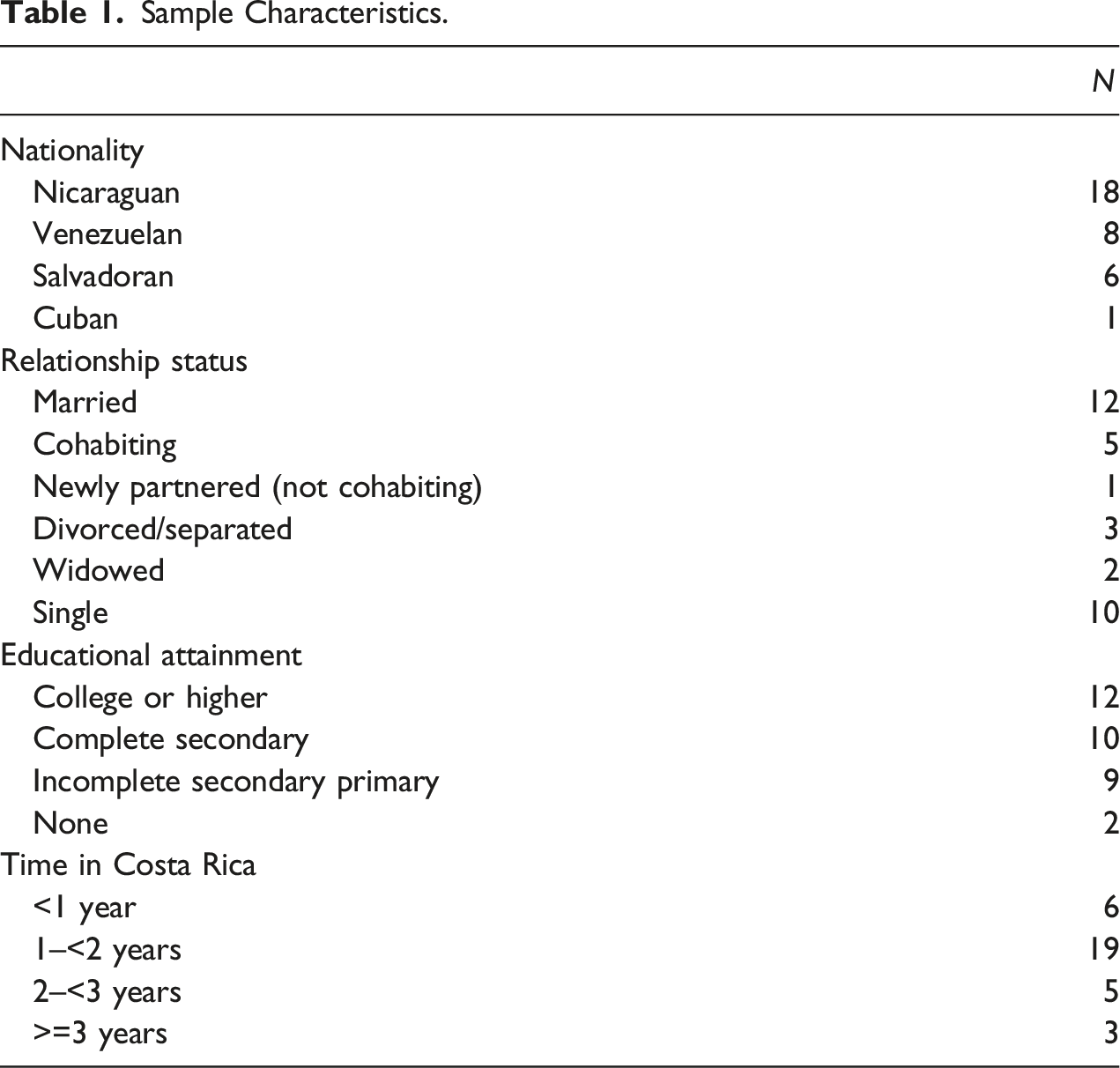
Interviews were conducted face-to-face by two study team members. These interviews lasted between 1.5 and 2.5 hours each and took place in a private room at one of Fundación Mujer’s locations in San José or on the Nicaraguan border. Fundación Mujer was chosen for the interview location because participants knew and trusted the organization; the organization has extensive security protocols in place, which ensured participants’ safety; and some participants resided in crowded or insecure living conditions that did not lend themselves to privacy. With participants’ consent, interviews were audio recorded, transcribed, and redacted to remove potentially identifying information. To ensure their confidentiality, participants were assigned pseudonyms for record-keeping purposes. We refer to these pseudonyms when presenting our results below.
Interviews were based on an interview guide that was designed to study how the experience of international displacement, including precipitating events, travel, resettlement, and social, economic, and/or legal incorporation into Costa Rican society affected family life and individual family member wellbeing. This guide was structured as a life history, with an emphasis on family dynamics and interpersonal relationships at different points in time. The order in which questions were asked, however, was shaped by the flow and direction of individual interviews. This flexibility created space for new topics to emerge organically. Participants were asked open-ended questions about their life pre-departure, including questions about their childhood and family of origin; relationship history with the father(s) of their children; day-to-day life and wellbeing before and during the events that precipitated their departure; and why and how they left their country of origin. Afterward, women were asked about their families’ journey to Costa Rica; their biggest priorities and stressors upon arrival and how those priorities and stressors had evolved over time; what their current day-to-day life was like; emotional, behavioral, and health-related changes they noticed in themselves or in family members since arriving; and how women’s relationships with different family members had evolved over the course of migration.
These questions directly lent themselves to uncovering how families adjusted to stressors over time by revealing points of agreement and discord between the experiences and sentiments of different family members, as perceived by the mothers we interviewed. When all interviews had been conducted and transcribed, three team members (one of whom conducted the interviews) iteratively coded and analyzed the transcripts to construct thematic codes that yielded theoretical and analytical insights (Charmaz, 2006). While the overarching topic of inquiry—the evolution of family dynamics and wellbeing across the arc of international displacement—was preestablished by an open-ended interview guide, the codes and subcodes arose from the content of the interviews.
As a first step, we read through and took notes on all transcripts. To develop a bird’s-eye view of the data, we discussed each transcript as a group and organized our notes into spreadsheets pertaining to pre-departure, departure and travel, post-arrival personal and family, and post-arrival incorporation themes. These spreadsheets helped unearth the main subthemes characterizing, leading up to, and resulting from displacement. After identifying and agreeing upon the major themes in our data, as a second step, we carefully coded transcripts, identifying passages that were relevant to these themes using QSR International NVivo 12. During this stage, we met regularly to compare our analyses and to ensure intercoder reliability (Miles & Michael Huberman, 1984). After all transcripts were coded for these broader themes, we then analyzed the passages within each one to develop more nuanced subcodes, for instance, refining a broad category like social support into smaller categories like familial, friend, and institutional support. As a last analytic step, we explored similarities and differences across phases of adjustment and across women that did and did not eventually resolve to remain in Costa Rica.
Results
Phase One: Parents’ Prioritization of Safety
Our analysis revealed four stages of family adjustment (Figure 1). The first occurs in the country of origin. During this phase, parents perceive a grave threat to their families and take steps to protect their and their children’s physical and mental wellbeing within their country of origin. However, as parents’ precautions prove insufficient, they turn to migration as an alternative means of protecting their families, often without their children’s knowledge or input. Chronology of family adjustment to international displacement.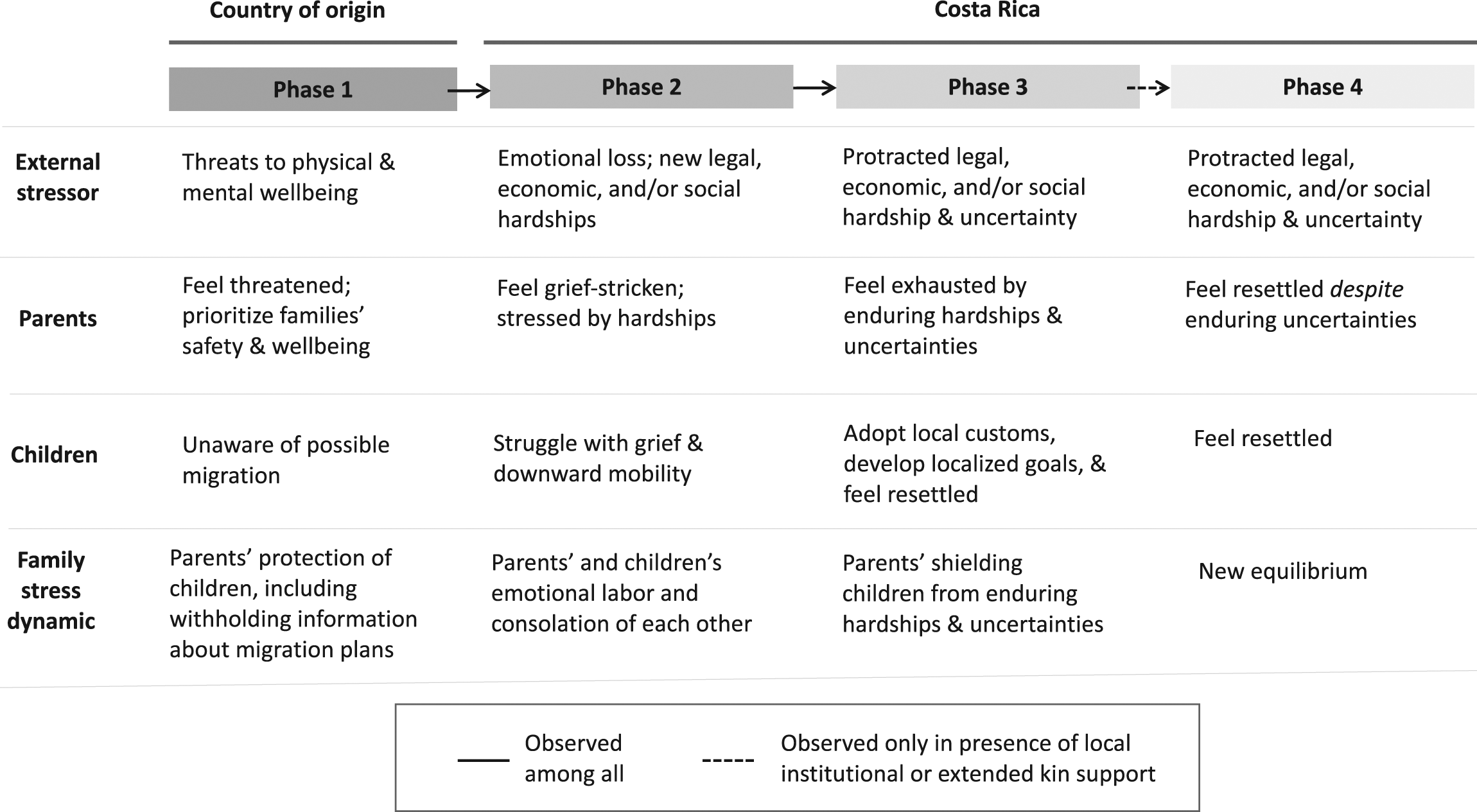
Thirty-two of the thirty-three mothers we interviewed left their countries of origin because of imminent threats to their survival. Only one mother came for seasonal work and then stayed because she no longer felt safe returning to Nicaragua and her boyfriend feared that he would be expected to participate in government-led violence upon his return. Figure 2 conveys the range and frequency of threats motivating women and their families to migrate (or in one case remain) abroad. Because some women experienced multiple types of threats, such as political persecution and economic deprivation, the numbers in this figure sum to more than the number of total participants. The most common threat, described by 19 women, was political persecution, meaning situations in which they or someone they lived with in their country of origin experienced death threats; police surveillance and intimidation; kidnapping; and/or placement on a government “wanted” list. At the time of their departure, these women feared that if they did not leave their country soon—in a matter of days—they or their loved ones would be killed. Imminent threats to survival precipitating migration to Costa Rica.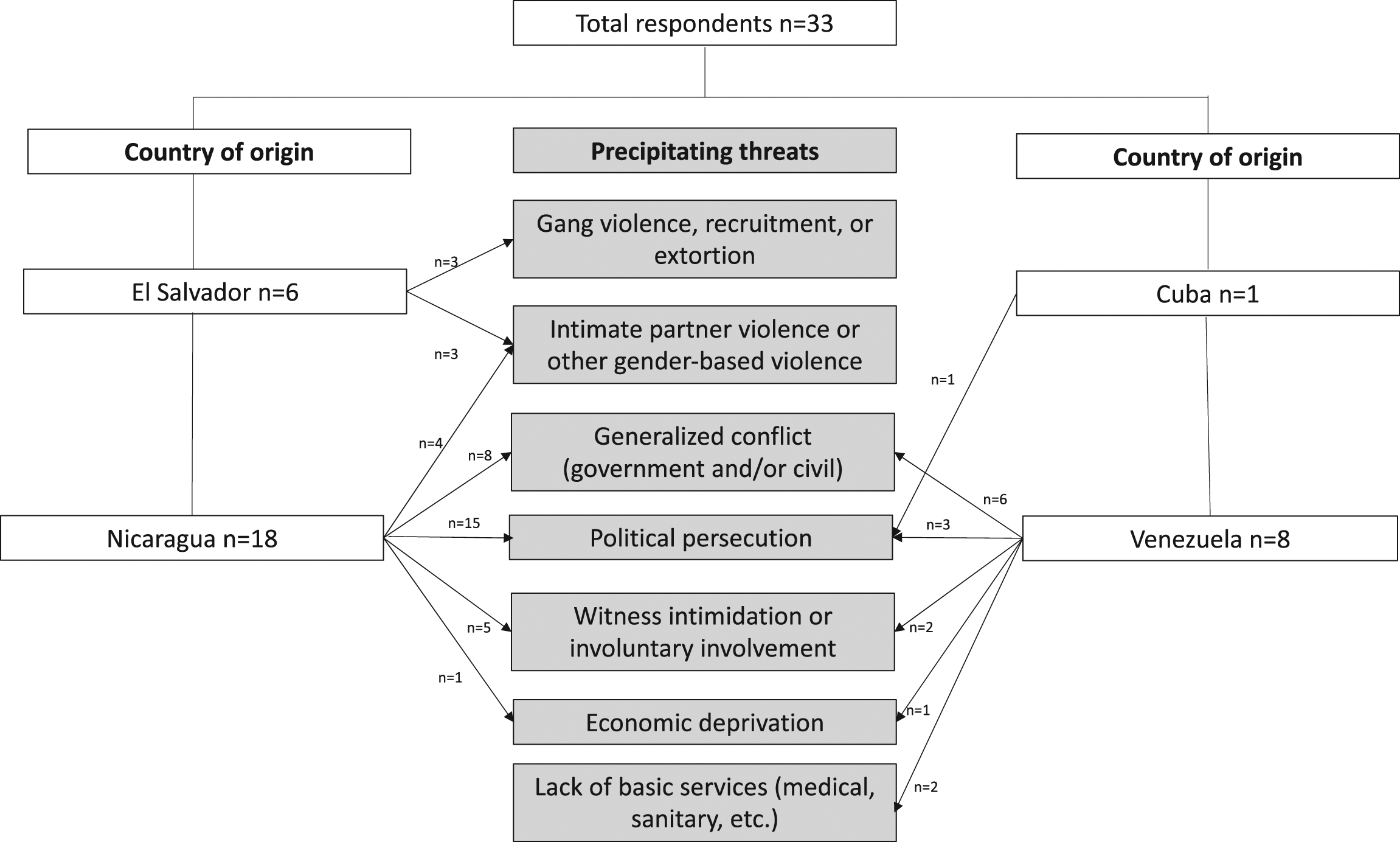
The second most common threat, detailed by 14 women, was generalized violence. In contrast to political persecution, generalized violence was not directly targeted at women and their families. Rather, these families lived in neighborhoods or regions that became dangerous because of pervasive and frequent military or gang violence. Women living amidst generalized conflict feared that they or someone they loved would accidentally be killed or severely injured just going about their daily lives. Consequently, they restricted their and their children’s movement outside the home, and in some cases, even limited their children’s movement within the home, keeping them away from windows or making them sleep under beds. These women worried that even if they successfully protected their children from physical harm, they could not fully protect them from psychological harm, which further contributed to their decision to leave. Emilia from El Salvador, for example, monitored her son’s friendships and movement outside the home to ensure he did not cross paths with gang members, but the ever-present threats framed their entire way of living so she decided to leave: “It’s incredible what one lives through in El Salvador, it’s incredible. My house, bullets have entered my house, hit the roof…there are bullet holes in the side door, also a wall….we’ve encountered bullets in the sink where we wash…I am not going to wait until something happens to my son. No, ‘enough,’ I said, ‘I have to do something. I have to leave.’”
Beyond these two most prominent threats, seven women moved abroad after they or their spouse became witness to or involuntarily involved in a crime, such as corporate fraud or political intimidation of others. This threat operated similarly to political persecution in that it led women to feel that their families became direct targets of violence. In all seven instances, the crime involved a government or military official, leading women to surmise that there was no domestic institution they could trust to petition for help. A fourth threat was gender-based violence, including stalking, vengeance rape, and intimate partner violence. None of the seven women in this category believed that the government or social network in their country of origin could successfully protect them from future harm. Women who experienced such violence also worried about the safety of their children.
Three women from El Salvador moved to Costa Rica to escape gang extortion or recruitment. Both had received death threats against them and their children and correspondingly believed that their families’ lives were in imminent danger. Like mothers living amidst generalized violence, when mothers felt threatened by gangs, they greatly restricted and closely monitored their children’s whereabouts both within and outside the home. Two others moved abroad, from Nicaragua and Venezuela, because of the extreme economic deprivation that accompanied political crises, which made it “more difficult to eat with each passing day,” as Isabela, a 32-year-old mother explained. Finally, two women relocated to Costa Rica because they were unable to access basic essential services in Venezuela. Both had a child with a chronic medical condition and felt that the lack of medical services directly jeopardized their children’s health and development.
As parents worried about their and their children’s wellbeing and made plans for their imminent departure, children were largely kept in the dark about these plans. Whenever possible, women also attempted to shield their children from the potential psychological harms of understanding the threats their family faced. The only exceptional cases to this were when children themselves witnessed generalized violence or their father abusing their mother, or when adolescent children participated in political protests. Even in these cases, however, parents largely opted not to share how or why they would travel with their children until it was time to leave. This decision, too, was reflective of parents’ prioritization of their families’ safety and wellbeing—fearing their children would not understand, would feel scared, or would compromise their plans.
Once parents made the decision to migrate, they quickly took action—gathering essential items, selling their belongings, and making travel arrangements. However, because of a range of logistical, legal, and economic obstacles, departure was staggered in approximately one-quarter of cases (n = 8), with at least one or more parent or child remaining behind for several weeks or months. This separation was painful and frightening for women and their children alike, even in cases where children did not fully understand what was happening. Once abroad, however, women experienced tremendous relief. For women who arrived in Costa Rica with or following their children, this sense of relief began almost immediately. For women and/or children who arrived prior to others, relief came upon parent–child reunification.
Phase Two: Parents’ and Children’s Grappling with New Circumstances
The second phase occurs shortly after arriving to Costa Rica, at which point relief gives way to the strife of harsh new circumstances (Figure 1). Among many external stressors, mothers grappled with the asylum-seeking process, which was bureaucratic and protracted, though less so along the Nicaraguan border. In the capital, San José, mothers waited in long lines for an initial interview for a visa as a solicante, a temporary status granted to asylum seekers awaiting their asylum interviews. Waiting for an asylum interview usually took years because of the recent inundation of asylum-seekers. In the meantime, families’ status as solicitantes conferred them benefits like work permits and public healthcare. Nevertheless, after receiving the visa, virtually all women remained confused about which services they were eligible for and how to procure them, and sometimes were denied services that they should have been able to access. For instance, one woman’s petition to enroll her eligible child in school was initially denied, while another lamented having to take her daughter to the hospital for a medical emergency, fearing she would have to pay out of pocket, even though, in both cases, women were legally entitled to these public services.
Many women were equally confused about what evidence was needed to qualify for asylum. In some cases, women did not have any such evidence. Celestina, for instance, explained that “since I wasn’t planning to leave [El Salvador]…I didn’t save a single document.” Celestina worried about how this would affect her case given conflicting information she received from her attorney and the state immigration officers. Multiple mothers found themselves in similar situations because they didn’t know that they could apply for asylum until they arrived in Costa Rica, and thus hadn’t planned for this eventuality. As Emilia exclaimed, “I have met many women, many women, not just women, families, families, whole families who have been denied refuge, who cannot return to El Salvador.” Emilia and three others had already been denied asylum and were amidst an appeal process that extended their legal benefits as solicitantes until the appeal interview. However, these women worried that if their appeal or that of their adult children was denied, they would be forced to make tough decisions about remaining without a work permit or relocating elsewhere and facing the possibility of family separation.
With respect to social stressors, parents and children experienced profound grief once it settled in that they would not be returning to their country of origin. Every mother we interviewed described missing friends, family, and/or specific cultural customs. Many also described people and comforts their children missed, such as grandparents, pets, or specific foods. This grief was exacerbated by the asylum application process, which prohibited them from returning to their countries of origin. It was further aggravated by discrimination that parents and children confronted. More than half of interviewees (n = 18) described a time when they or a loved one felt discriminated against in Costa Rica. Most experienced this discrimination as verbal hostilities on public transportation or on the street, though some felt discriminated against in the labor and/or housing market. In a small number of cases, children experienced verbal discrimination from school peers.
Mothers also struggled with a lack of local social, emotional, or financial support. Six told us they knew no one in Costa Rica upon arrival. Another six had only weak social ties (e.g., a friend of a friend). Although twelve referenced close friendships or extended kin in Costa Rica upon arrival, few of these preexisting ties were in good standing at the time of interview. Women typically attributed this erosion of their preexisting ties to their own hardships and financial instability, which they perceived as straining their relationships. For most, the lack of an established, reliable social network left them feeling lonely, socially isolated, and vulnerable in Costa Rica.
Families contended with new economic stressors as well. In particular, mothers and their spouses struggled to find stable employment because of discrimination, a lack of social capital, and high unemployment rates. Their resultant economic fragility was made worse by the fact that no families owned valuable assets in Costa Rica, such as a home, property, or farm animals. Without assets, and without a dependable social network, most did not have a reliable economic safety net to fall back on, nor could most access credit. Consequently, families that had previously enjoyed a middle- or upper-class lifestyle in their country of origin experienced substantial downward mobility, while families that had previously been poor found themselves even more economically vulnerable than before.
Downward mobility impacted both parents and children. For example, Yuli, a mother from Nicaragua, tearfully recounted moments in which her 4-year-old asked to be taken to the beach or to have ice cream—prior luxuries that they could no longer afford. Likewise, Noa poignantly described the guilt she felt that she could not afford to buy her youngest daughter her required school supplies. In contrast, Noa had been able to provide an upper-middle class lifestyle for her older daughters when they were growing up in Venezuela. Meanwhile, Celestina, a mother who fled El Salvador to escape gender-based violence, recounted her downward mobility from rural poverty in El Salvador to periodic bouts of homeless in Costa Rica.
These hardships imposed additional strain on parent–child relationships. For instance, mothers had to simultaneously console their stressed, confused, and grief-stricken children while struggling with their own grief and uncertainty. In some cases, caretaking became reciprocal, with children tending to their mothers’ emotional wellbeing. For example, Beatrice’s toddler told her “not to cry.” Celestina and Constanza’s children consoled their mothers by promising that they were happy and safe and offering to pray for them. While mothers found support in their children’s endearing reactions, they also expressed feeling guilty and knew, based on their children’s crying and other behavioral indications, that their children felt deeply unsettled.
Phase Three: Parents’ Protracted Uncertainty and Children’s Divergent Adaptation
The third phase consists of divergent sentiments among parents and children and emerges approximately a year after arrival. In this phase, parents continue to stress about their families’ protracted legal, social, and/or economic instability, while children begin to adapt and settle in to their new surroundings (Figure 1). Children’s adaptation at this stage, however, is fostered by parents’ efforts to shield them from their worries and uncertainty about the future.
Twenty-seven mothers we interviewed had been in Costa Rica for longer than a year (Table 1). When asked where they envisioned themselves 5 years in the future, 20 of these 27 women were unsure whether they would still be in Costa Rica. This was partly attributable to their enduring legal stress: The immigration status of all but three mothers who had been in the country for more than a year remained pending, as was the status of their minor children. Being in legal limbo left mothers feeling unsettled. As Noa put it: “I see Costa Rica as a country that defends human rights, but the time one spends as a solicitante is lost time and a time that emotionally drains you. You are stressed because you don’t know what to do. If you don’t have money then how can you change your migration status? Tell me, if they take away your work permit, how do you work?”
Being granted asylum, however, did not always result in mothers envisioning themselves and their families staying in Costa Rica permanently. Lorena, a mother who had been granted asylum, was unsure whether she would stay because her adult son had recently missed his interview, leading his asylum case to be denied. She further struggled to find stable employment, as did the others who had received asylum. This left most wondering how long they could afford to remain in Costa Rica. Likewise, nearly all mothers still awaiting an asylum or appeal determination faced perpetual economic insecurity. They too expressed uncertainty about staying in Costa Rica if it meant facing hunger, homelessness, or other extreme hardships. At the same time, none had specific plans for returning to their country of origin or relocating elsewhere, reaffirming their sense of limbo.
Mothers’ long-term legal and economic uncertainty post-arrival was often compounded by the fact that most still had not developed meaningful friendships in Costa Rica, leaving them with few people to turn to in moments of acute stress. The reasons for mothers’ ongoing social isolation were many, ranging from difficulties trusting new people, to feeling ashamed of the traumas and hardships they had endured, to their precarious status in Costa Rica and their erratic work schedules, and, for many, their continuing household labor and childcare demands.
In contrast to mothers’ depictions of themselves as uncertain, unsettled, and often lonely 1–3 years post-arrival, they described their children as happy, safe, and relaxed; as having adjusted to their new circumstances and wanting to stay (Figure 1). From their perspective, their children had developed new friendships and routines, and even adopted Costa Rican customs like local lingo and dances, primarily through their school integration. Schools also enabled children to envision themselves in Costa Rica in the future, with exciting upcoming events like field trips and school dances as well as the development of longer-term goals like completing a grade.
At the same time, children’s resilience and ability to quickly adapt to life in Costa Rica despite their many hardships, reflected parents’ efforts to shield them from their worries. Just as parents withheld information about threats to their families’ safety prior to departure, most continued to do so once in Costa Rica. As Andrea explained: “We don’t tell them. Well, they know that there isn’t food, they know that there isn’t food, but we don’t tell it to them like that because they would become stressed or they would feel under pressure or something.” Shielding children from stress, however, was tiresome and in and of itself often became an intense source of stress for women. Remarkably, all 27 mothers who had been in Costa Rica for more than a year recounted moments in which they cried alone, ruminated silently, or intentionally withheld their sorrows, worries, or frustrations from their children. Doing so, however, left them feeling “alone,” “ugly,” “frustrated,” or “misunderstood” in these moments.
Phase Four: Parental Resolution and Resettling
Approximately one-fourth of families reached a fourth phase by the time of interview (n = 8), in which parents’ sentiments converged with their children’s (Figure 1). Mothers in this phase not only wanted to stay in Costa Rica indefinitely, but articulated concrete plans for themselves and their children and did not hesitate when asked where they envisioned themselves in the future. Their resolve to remain in Costa Rica paralleled the descriptions of their children’s sentiments.
Notably, only one mother in this phase had received asylum. Two others had birthed children in Costa Rica, which created alternative legal pathways to remaining in the country. That the remaining women in this fourth, unified phase were unsure of their future immigration status suggests that mothers’ feeling resettled did not hinge on this status. This interpretation is bolstered by the fact that two other women who had received asylum and one other who had born a child in Costa Rica remained in the third, protracted uncertainty phase at the time of interview.
What distinguished families who had reached this fourth phase from those who had not was their connection to a stable source of social, emotional, and/or financial support in Costa Rica. For four of the mothers who felt resettled, this support came from kin—parents, in-laws, adult children, and siblings. In all four cases, women lived with these extended family members, with whom they shared familial responsibilities like childcare. This sharing of responsibilities afforded women a more flexible schedule that enabled them to work for pay outside the home or to search for remunerated work. It also provided women with a non-spousal emotional anchor, someone with whom they could share their difficult experiences. For example, Augustina experienced severe postpartum depression in her first months in Costa Rica. After a suicide attempt and hospitalization, her husband brought her younger sister from their country of origin to provide emotional support. Following Augustina’s recovery, her sister remained in Costa Rica to help with childcare and with Augustina’s new in-home business. Meanwhile, Natalia felt anchored both by her live-in mother and by her Costa Rican boyfriend, who eagerly adopted the role of father to Natalia’s baby from a prior relationship. Like Natalia, Alma, a mother from Nicaragua, felt anchored by a close friendship she made in Costa Rica. Natalia and Alma were the only two women we spoke to who had developed lasting, stable friendships or partnerships since arriving to Costa Rica.
Three mothers in the fourth phase were anchored by local institutions. One, Inez, was heavily supported by a church that provided her with psychological counseling to cope with PTSD, formal employment, and a rent-free apartment. Another, Beatrice, relied heavily on an NGO that provided her with a monthly financial subsidy, psychological counseling, and a caseworker whom she met with weekly and could call upon in times of crisis, including, as she told us, in the middle of the night when she had nightmares. Finally, Isabela felt supported by a local organization that provided specialized services to families like hers with autistic children.
Thus, unlike mothers in the second or third phases at the time of interview, mothers in the fourth phase received consistent social, emotional, and/or financial support from an institution or a person other than their spouse in Costa Rica. The nature and stability of the support they received, together, left these mothers feeling anchored. Although many in the second or third phases also participated in NGO support groups and social programs, and sometimes received NGO subsidies or material gifts like school supplies, the socioemotional and economic support they received was irregular. Moreover, although several mothers in the third phase made acquaintances through NGOs, churches, and their neighborhoods, they described these relationships as superficial rather than supportive, or had received only momentary support. Similarly, among mothers still in the second or third phases that did have extended kin in Costa Rica, their connections to these family members were tenuous. For example, some had parents, siblings, or in-laws that they had not seen in more than a decade. Others had siblings or parents whom they initially moved in with after arriving to Costa Rica, but over time, these relationships had eroded under the stress of women and their families’ perpetual hardships. Under this intense strain, their extended kin grew resentful and living together had become untenable, forcing women and their families to seek new housing arrangements and sources of emotional and financial support.
Discussion
Motivated by changing trends in the underlying causes of migration and a continued paucity of information about the family dynamics of migrant families who move abroad to evade an immediate threat to their survival, we investigated how MNP families adjust to the stressors of international displacement. On the whole, our analysis of in-depth interviews with MNP mothers in Costa Rica provided an inductive account of the phases of family stress adjustment to international displacement; highlighted the external conditions characteristic of each phase; and described how the family stress dynamic evolved across them.
Across a diversity of demographic backgrounds and threat histories emerged a prototypical process of MNP family stress adjustment that consisted of three to four phases. As the Double ABCX model of family stress suggests, the MNP families of the mothers we interviewed experienced a “rollercoaster” in which parents and children went in and out of periods of disequilibrium. In the first phase, parents prioritized their families’ safety above all else, while children remained largely unaware of their imminent departure. Then, in the second phase, both parents and children struggled with grief and together faced new challenges. Met with ongoing difficulties even after a year, in the third phase, parents continued to feel unsettled as their children began to envision a future for themselves in Costa Rica. Families that enjoyed stable financial or emotional support from extended kin or an institution in Costa Rica eventually entered a fourth phase in which parents converged with their children and began to feel resettled despite their ongoing struggles, which sometimes included ongoing uncertainty about their legal status. It is unclear whether or how MNP families without steady support from extended kin or a local institution eventually reach a new equilibrium and/or decide to remain in Costa Rica indefinitely.
Whereas a large body of literature documents the legal, economic, and social stressors of displacement for individuals, these findings highlight how such stressors reverberate within the family system. As we show, social circumstances that become untenable because they directly and immediately jeopardize a person’s wellbeing propel parents to move their families abroad. Once abroad, parents and children initially coalesce around their shared challenges, including downward economic mobility and separation from extended family in their country of origin. Children’s social incorporation through schools, and parents seemingly unending uncertainties about asylum and difficulties finding stable income, lead families to enter a new stage in which parents’ and children’s sentiments about resettling do not align. What enables some families to move beyond this within-family discordance is the existence of stable extra-household social and economic support, highlighting the need for host country governments to more readily provide economic benefits to MNP families and interventions that can help cultivate social support systems.
These findings illuminate how parents’ and children’s distinct positions within and outside the family affect how they experience and adapt to the stressors of displacement in ways that impact their interpersonal dynamics. For instance, in the first phase, when parents decide to leave their country of origin, they make this decision in their role as parents, whose socially ascribed responsibility is to safeguard their children’s mental and physical wellbeing. Relating to their role as protector, when possible, parents psychologically shield their children from understanding the full extent of the threats that they face and exclude them from discussions about leaving. Similarly, when MNP parents contend with a new set of worries about how to provide for and protect their families in Costa Rica, in the third phase, they continue to withhold their worries from their children. This worry withholding, in turn, enables children to find comfort in their new surroundings. In this way, it paradoxically contributes to the divergence between parents’ and children’s stress adjustment.
Together, these findings have important implications for future research. In particular, they call for further investigations of how international displacement shapes family life. Whereas much has been written about the familial consequences of economic migration, little is understood about the inner-workings of families that have moved abroad to evade an immediate threat to their survival. Our results, which underscore the distinct progression of parents’ and children’s adjustment to international displacement, indicate that parent–child disjunctures resulting from displacement impact caregiving, emotion work, attachment, and interpersonal conflict in MNP families.
Our study, however, is limited by the fact that no men or children were interviewed. Our conclusions about family adjustment processes among internationally displaced Latin American MNP thus primarily reflect how mothers and their children jointly adjust to the stressors of displacement. An additional limitation is our reliance on retrospective accounts of women’s family histories. To the extent that trauma and stress may affect women’s memories, and/or make some women uncomfortable disclosing the full details of certain experiences, our description may not reflect the entirety of hardships and uncertainties MNP women and their families face. Finally, our results rely on mothers’ perceptions of their and their nuclear family members’ experiences and sentiments. While mothers’ perceptions may not be objective, they have real life consequences for their interactions with other family members, the ebb and flow of family conflict and caregiving, and individual members’ emotional wellbeing.
Overall, the results of our analysis point to three common phases of familial adjustment among Latin American MNP and further reveal a fourth phase for some but not all MNP families. What distinguished these latter families from others was not their legal status but rather the presence of a non-nuclear support system—a person or institution who provided mothers with emotional and/or financial support that lent them a sense of stability, despite their ongoing uncertainties. Taken together, these findings highlight that family adjustment to international displacement is a dynamic process in which parents and children progress along distinct trajectories, owing to their distinct social positions within and outside the family. Because mothers and children adjust to forced migration differently, their needs and priorities do not always align. Each members’ experiences of social support, or lack thereof, as well as parents’ perceptions of their physical safety and economic and legal circumstances contribute to families’ progression between phases.
Footnotes
Acknowledgments
The content is solely the responsibility of the authors and does not necessarily represent the official views of the National Institutes of Health. The authors are indebted to the study’s participants for so graciously sharing their intimate experiences with us and to Fundación Mujer for their instrumental role in the recruitment process. The authors would also like to thank Robert Crosnoe, Luis Zayas, and Alex Weinreb for their highly instructive comments on this study’s development and design.
Declaration of Conflicting Interests
The author(s) declared no potential conflicts of interest with respect to the research, authorship, and/or publication of this article.
Funding
The author(s) disclosed receipt of the following financial support for the research, authorship, and/or publication of this article: This research was made possible with funding from a grant from the National Institute for Child Health and Human Development (K01HD099313, PI Weitzman) and with a population center grant from the National Institute for Child Health and Human Development to the Population Research Center at the University of Texas at Austin (P2CHD042849).
