




Abstract
The present study developed the revised version of the Parent-Adolescent Conflict Issues Checklist (PACIC) by completing the judgment stage of systemic content validity. In the first study, to examine the necessity and relevance of each item, 40 experts were selected through a purposeful method. After the judgment stage, 92 items were reduced to 47 items and 13 factors. In the second study, to assess the confirmatory factor analysis, adolescent girls and boys aged 12–18 years completed the checklist (N = 1350, mean age 15.4 years, girls 50.1%); also, the Youth Self-Report Scale (YSR), Adolescents' Perceived Family Collective Efficacy Scale (EFCP/A), and the Conflict Behavior Questionnaire (CBQ) were applied to assess concurrent validity, and to establish convergent validity, respectively. The obtained results supported the reconstructed model, and the items went well with the specified factors. The study achieved concurrent and convergent validity. The Cronbach’s alpha coefficients between 0.78 and 0.86 showed that this instrument has excellent internal consistency; moreover, PACIC-R has measurement invariance across gender; thus, PACIC-R can be applied to assess the issues of parent-adolescent conflict and the challenges of families as well.
Keywords
One of the stages in the family life cycle is the stage of “families with adolescents” (McGoldrick et al., 2014), in which the structure of the family undergoes some changes due to autonomy, independence, and the acquisition of power by the adolescents (Robin & Foster, 2002; Tran & Raffaelli, 2020). Adolescents' conflict with their parents is the most critical example of achieving independence, autonomy, and individuality, turning parent-adolescent conflicts into a vital feature and challenge of this stage (Brown, 2016; Micucci, 2009; Robin & Foster, 2002). Research also shows that, in these families, parent-adolescent relationships are worse than it was in the previous period. And families experience the most stress during this stage (Graber et al., 2018; Moed et al., 2015).
Parent-adolescent conflicts are more destructive than constructive (Rinaldi & Howe, 2003; Weymouth et al., 2016). As research shows, in addition to high levels of parent-adolescent conflict, including a variety of negative social consequences, such as substance abuse and consumption of alcohol (Chaplin et al., 2012; Liu et al., 2019), a variety of adverse psychological effects such as decreased well-being, low self-esteem and youths' internalized and externalized behavioral problems are also associated (Brown, 2016; Gonzales et al., 2018; Juang et al., 2012; Koh & Rueter, 2011; Mokhtarnia, Zadeh, Mohammadi, et al., 2016; Weymouth et al., 2016). Parent-adolescent conflicts are associated with negative interactions and conflicts in subsystems of marital and sibling (Bush et al., 2013; Mokhtarnia et al., 2017a).
These explanations indicate how essential it is to investigate and measure parent-adolescent conflicts. To this end, to assess parent-adolescent conflict, the Parent-Child Conflict Tactics Scales (CTSPC), the Conflict Behavior Questionnaire (CBQ), and the Issues Checklist (IC) are developed. These instruments assess different concepts and psychological constructs of parent-adolescent conflict. The CTSPC focuses on assessing child injuries and measures physical and mental violence (Straus et al., 1998). In other words, it focuses on evaluating parent-child violence. The CBQ measures negative relationships experienced and dissatisfaction of parent-adolescent relationships (Prinz et al., 1979); As a result, CBQ focuses on parent-adolescent negative communication. In addition to these two instruments, the IC is also used to assess parent-adolescent conflict (Robin & Foster, 2002), which focuses on parent-adolescent conflict issues.
Focusing on assessing parent-adolescent conflict issues is essential for several reasons: First, there are overt and covert parent-adolescent conflicts (e.g., defiance, autonomy, freedom-seeking, power-seeking, and self-assertiveness) over life issues (Barkley & Robin, 2008; Chen-Gaddini, 2012; Micucci, 2009), in other words, life issues are the cause and stimulus of conflicts (Riesch et al., 2000; Robin & Foster, 2002). Research has shown that if parents consider their children’s educational issues as their legal authority, they discuss them more with adolescents (Chen-Gaddini, 2012; Robin & Foster, 2002). Parents also try to set restrictions for their adolescents through life issues to control adolescents (Brown, 2016; Robin & Foster, 2002). Secondly, in family therapy theories, issues of the parents-adolescents conflict for therapeutic interventions have been considered. In the family-behavioral systems approach, in the first step for training problem-solving communication, parent-adolescent conflict issues are rank-ordered, then issues with relatively low-conflict intensity are selected to start problem-solving training. However, in structured family therapy, important issues such as lying and substance use take priority over unimportant issues such as appearance (Cloud & Townsend, 2017). Therefore, therapeutic interventions can be different for each important and unimportant issue (Clarke et al., 1999; Durrant et al., 2014). Also, in structured family therapy, issues such as messing up the house are interpreted as irresponsible adolescents, and specific strategies for intervention and treatment are considered (Cloud & Townsend, 2017; Tran & Raffaelli, 2020); it seems necessary to identify the major and frequent conflict issues to increase the quality of the parent-adolescent relationship (Renk et al., 2005). In the dialectical behavior therapy approach, training sessions for solving educational issues, nutritional behaviors, and high-risk behaviors of adolescents are provided for parents (Harvey & Rathbone, 2015). In some research, selecting a sample based on the parent-adolescent problem is essential in terms of severity and frequency of conflict issues (Dong et al., 2020; Renk et al., 2005). Third, parent-adolescent conflict issues depend on age, gender, culture, and time (Arkan et al., 2020; Juang et al., 2018; Renk et al., 2005; Skinner & McHale, 2016); for example, some parent-adolescent issues are resolved over time without intervention. Or most conflicts over food, clothing, and educational issues related through early adolescence (Juang et al., 2018; Renk et al., 2005); Therefore, awareness of these issues can affect the ability of therapists and researchers (Renk et al., 2005). Fourth, most definitions of parent-adolescent conflict focus on life issues and everyday family matters (Clarke et al., 1999; Juang et al., 2018; Robin & Foster, 2002). For example, Robin and Koepke (1986) stated that: “parent-adolescent conflict refers to predominantly verbal arguments between teenagers and their parents concerning a variety of specific issues such as curfew, chores, peers, and school” (Robin & Koepke, 1986, p. 87). Finally, parent-adolescent conflict issues can be a sign of mental pathology or family dysfunction (Gonzales et al., 2018; Mokhtarnia et al., 2017a).
The IC was first introduced by Robin (1975) to rank parent-adolescent conflict issues concerning communication and teaching problem-solving skills. But its psychometric properties have not been reported (Robin, 1975, 1979; Robin & Foster, 2002). Barkley et al. (2001) also stated that there is no evidence of internal consistency for IC. Only validity has shown the average agreement of 68% between parents and adolescents parent-adolescent conflict issues that existed in 2 weeks (Barkley et al., 2001). Concerning the validity of IC, Significant correlations have also been found between scores on the scale and direct observations of parent-adolescent interaction and scales assessing dissatisfaction in child-rearing (Barkley et al., 2001). In recent studies that have used this instrument, authors have referred to the sources without writing their validity and reliability or have used quotations. The validity of this instrument is not found by referring to these articles. On the other hand, the issues raised in IC are related to the previous generation of adolescents, while there is a possibility of changes in matters associated with parent-adolescent conflicts due to the “intergenerational” gap (Clarke et al., 1999; Gonzales et al., 2018; Juang et al., 2018; Renk et al., 2005).
In Iran, Asadi Younesi et al. (2012) collected the issues of parent-adolescent conflicts in several steps through literature review and interviews with adolescents and parents; as a result, they developed an instrument called “Parent-Adolescent Conflict issues checklist” with 92 items and obtained 14 factors by Exploratory Factor Analysis (EFA) (Asadi Younesi et al., 2012). The existence of many items due to the lack of using systemic content validity and elimination of essential items has led to the lengthening of the PACIC, which also limited the internal validity of the research (Mokhtarnia, Mohammadi, et al., 2016). On the other hand, it seems necessary to update the parent-adolescent conflict issues in PACIC for the use of researchers and therapists; For example, Cloud and Townsend (2017) emphasize essential topics such as alcohol and drug as the most critical parent-adolescent issues (Cloud & Townsend, 2017). However, PACIC does not have such items for assessing the parent-adolescent relationship. Therefore, the present study seeks to revise and modify the PACIC to develop and examine its psychometric properties.
Method
Participants
Mean, SD, Standard Factor Analysis (SFA), and Content Validity Index.
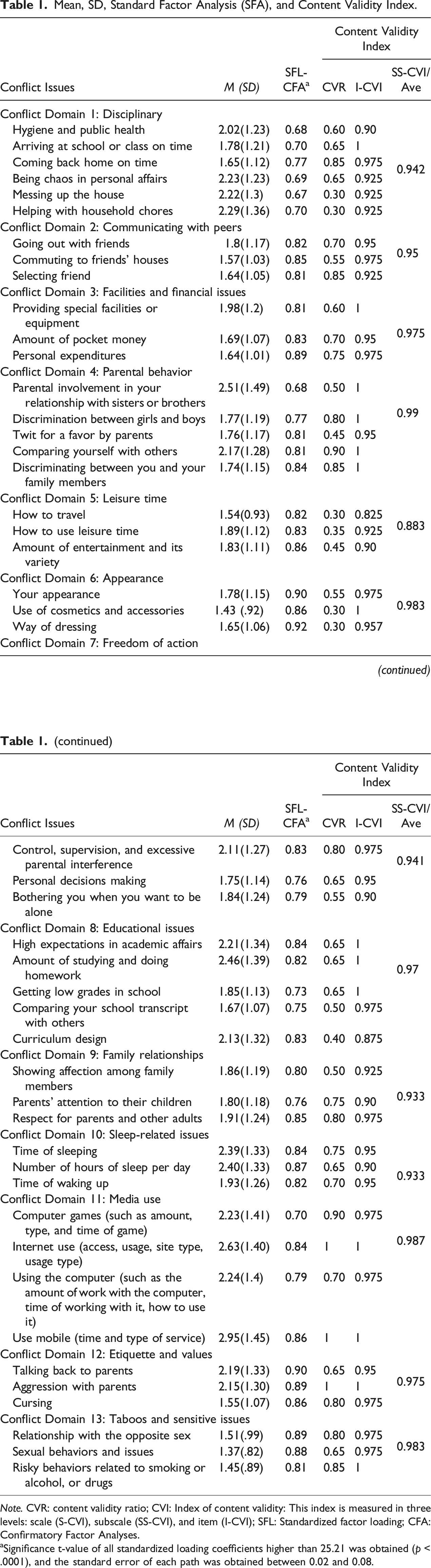
Note. CVR: content validity ratio; CVI: Index of content validity: This index is measured in three levels: scale (S-CVI), subscale (SS-CVI), and item (I-CVI); SFL: Standardized factor loading; CFA: Confirmatory Factor Analyses.
aSignificance t-value of all standardized loading coefficients higher than 25.21 was obtained (p < .0001), and the standard error of each path was obtained between 0.02 and 0.08.
In the second study, according to Kline’s (2014) approach, more sample selection was used for Confirmatory Factor Analyses (CFA) to estimate the sample size; In general, 1350 adolescents between 12 and 18 years old who were selected by cluster sampling from Tehran participated in this study. For CFA and Cronbach’s alpha coefficients PACIC-R, a complete sample (N = 1350) was used. However, the convergent validity of 544 adolescents and the concurrent validity of 600 adolescents were considered. The participants' age in the present study ranged from 12 to 18 years (M = 15.4, SD = 1.63), 16-year-old adolescents had the highest number (n = 283), and 12-year-old adolescents had the lowest number of research samples (n = 67), and 49.9% of participants were boys (n = 673); Also, families with two children made up 45.9% of the research sample (n = 620)
Procedures
The present study is one of the study phases under the title of Identification of the Parent-Adolescent Conflict Perception Process Model, confirmed by the university’s study ethics committee. The selection of faculty specialists and adolescent therapists started from the Family Research Institute of Shahid Beheshti University, and then other faculty members and therapists were introduced by them. Adolescent therapists had to have at least 5 years of clinical experience working with adolescents and at least a master’s degree. Besides having the above two criteria, school counselors were required to provide clinical services to adolescents in education-related clinics. For assessing the content validity, two methods were used: qualitative judgment and the quantitative rating; moreover, content and face evaluation of items and factors, literature reviews, and applying the experts’ recommendations were performed by qualitative judgment method. Follow-up of views and implementation of judgment by the research team prepared the PACIC to estimate the Content Validity Ratio (CVR) and then Content Validity Index (CVI). Items were added in the qualitative judgment and eliminated in the quantitative rate. The final version PACIC-R can be seen in Table 1.
After obtaining permission from the Education Department of Tehran Province in the second study, 12 schools were selected by cluster sampling. School principals were informed to randomly select a class from each grade level to send an online questionnaire. The ethical principles of confidentiality, informed consent, and obtaining parental permission to complete the checklist were set out in the checklist before the adolescents responded. Adolescents who lived apart from their parents in any situation (divorce, immigration, and parental death) were excluded from the study. A total of 1350 students participated in the study, including 43% of all adolescents for whom a questionnaire was sent. It is noteworthy that the Iranian education program in Tehran province due to the COVID-19 pandemic was held in virtual classes in the “Shad” program.
Measure
Parent-Adolescent Conflict Issue Checklist (PACIC)
This checklist was designed in Iran by Asadi Younesi (2012) to measure the frequency and intensity of parent-adolescent conflict among adolescents aged 11 to 18. PACIC has 92 items that consist of two versions of frequency and intensity conflict. The conflict frequency (number of conflict issues between parents and adolescents) is measured on a 5-point Likert scale (1 = rarely to 5 = always). Also, the conflict intensity, which refers to conflict in the feelings and emotions, is scored similarly to the conflict frequency (1 = calm to 5 = angry). The high score in each conflict domain indicates the high conflict frequency or intensity between adolescents and parents. In the present study, versions of conflict frequency have been used. Through EFA, 14 factors of the Order and Cleanliness, Disciplinary, Communication with Peers, Parental Behavior, Time Leisure, Appearance, Freedom of Action, Educational Issues, Family Relationships, Food and Sleep-Related issues, Facilities, and Financial Issues, Media Use, Etiquette and Values, Taboo and Sensitive Issues have been obtained. These 14 factors explain 45% of the total variance of the PACIC.
Cronbach’s alpha coefficients and test-retest reproducibility have been used to examine the internal and external validity of PACIC (Cronbach’s α were 0.53–0.86 for factors and test-retest coefficients were 0.68–0.79). The convergent validity of the conflict domains of PACIC except for Taboo and Sensitive issues are supported by a significant positive correlation with the CBQ. Also, the discriminant validity of the PACIC was examined by comparing the scores of two groups of students (first group: no problem, second group: problematic), and the results showed that the observed difference between the two groups of problematic (M = 94.78, SD = 53.667) and non-problematic (M = 70.95, SD = 51.187) families in parent-adolescent conflict issues was statistically significant (t = −4.227, n = 195, p < .0001). In the present study, the PACIC was used to assess systematic content validity. Domains and issues of the revised checklist are translated into English which can be seen in Table 1.
Youth Self-Report Scale (YSR)
The YSR assesses the emotional-behavioral problems of adolescents aged 11–18 years (Achenback & Rescorla, 2001). This instrument consists of the eight syndromes of Anxious/Depressed, Withdrawn/Depressed, Somatic Complaints, Social Problems, Thought Problems, Attention Problems, Rule-Breaking Behavior, Aggressive Behavior. Internalization, externalization, and total problems also are obtained by combining these scales. All of the112 YSR items are graded on a three-point scale (0 = never, 1 = sometimes, 2 = often). Minaee (2006) translated the Achenbach system forms into Persian and standardized and adapted them for Iranian adolescents. The results of construct validity using CFA supported the eight-factor structure in Iran. Convergent validity also has been reported as acceptable with the Rutter Child Behavior Questionnaire and the Eysenck Personality Questionnaire by Minaee (2006). Cronbach’s alpha for the eight-syndrome structure, respectively 0.83, 0.85, 0.78, 0.79, 0.66, 0.78, 0.64, and 0.89 were obtained (Habibi Asgarabad et al., 2009). In the present study, this scale was used to evaluate criterion-based validity.
Adolescents’ Perceived Family Collective Efficacy Scale (EFCP/A)
A 20-item scale was developed by Caprara et al. (2004) to measure family members' beliefs on the family’s ability and capability as an integrated system for performing essential activities (Caprara et al., 2004). One of the items in this scale is “Prevent family disagreements from turning into heated arguments.” Following the recommendations of Bandura, all items were rated on a 7-point Likert scale (1 = Not well at all, to 7 = Very well). The psychometric properties of the EFCP/A have been studied in Iran. EFA has shown two factors of Family Cohesion and Adaptation. Also, CFA on the data of the following study confirmed the results of EFA. Discriminant validity has been supported by comparing effective families and non-effective families. Its Cronbach’s alpha coefficient was 0.92 (N = 817), and the test-retest reproducibility during 2 weeks for 80 adolescents was 0.83 (Panaghi et al., 2016). In the present study, this scale was used to evaluate criterion-based validity.
Conflict Behavior Questionnaire (CBQ)
The short version of CBQ (20 items) by Robin and Foster (2002), with true/false ratings, was developed to assess adolescents' perceptions of conflicts with parents. Construct validity has been obtained by the differentiation between clinical and non-clinical families. This questionnaire has been translated in Iran by Asadi Younesi (2012), and its convergent validity has been reported with PACIC. High CBQ scores were correlated significantly with an increased risk of psychiatric disorders (Arkan et al., 2020). Cronbach’s alpha coefficient of this instrument was .82 (Asadi Younesi et al., 2012).
Data Analysis
Lawshe (1975)’s method was employed to calculate CVR and CVI. CFA was used to evaluate the validity of the construct and to confirm the experts' judgment. Multi-Group Confirmatory Factor Analyses (MGCFA) were used to assess Measurement Invariance (MI); also, the Diagonally Weighted Least Squares (DWLS) method in LISREL 9.1(Li, 2016) was used to establish the statistical fit of the model. In the present study, SPSS 21 software was used for other analyses.
Result
At the judgment stage, the experts made some suggestions about changing the appearance of sentences and phrases. After making the changes, experts evaluated the necessity and the relevance of the items, taking into account the related factors. The results of the quantitative rating are presented in Table 1.
Following the experts' suggestion, disciplinary and order/cleanliness were placed in a domain called Disciplinary, which together constituted 16 items of these two domains. After applying their opinion over items called necessity and relevance, the disciplinary domain was reduced to have six items, and items such as “keeping shoes and clothes clean” and “putting clothes in order” were excluded. Following Lawshe’s (1975) recommendation on the panel of 40 experts, items with a CVR value of less than 0.29 were excluded from the structure.
In the domain of Parental Behavior, the “Control, supervision, and excessive parental interference” and “Bothering you when you want to be alone.” Items were suggested by the experts to be included in the domain of Freedom of Action. The results of I-CVI also showed that wherever I-CVI > 0.79, these items are related to the domain of freedom of action (Zamanzadeh et al., 2014). Also, an item was eliminated from Parental Behavior in the process of quantitative rating.
No items were removed from the domain of Leisure Time in the judgment phase. In the original version of the checklist, the Food and Sleep factors were in the same domain. In quantitative rating, five items related to food Issues were removed from this domain, and only the items related to sleep issues formed a domain with this name. Two items were excluded from the Etiquette and values domain. In the Taboos and Sensitive issue domains, the item called “risky behaviors related to smoking or alcohol or drugs” was added. Five other items also were eliminated from this domain.
Regarding the domains of Communication with Peers, Facilities and Financial Issues, Appearance, Freedom of Action, Educational Issues, Media Use, and Family Relationships, four, five, three, six, two, one, and two items were eliminated, respectively. Consequently, 46 items were eliminated in the judgment stage, and one item was added. PACIC was reduced to 47 items and 13 Domains. According to the data in Table 1, the S-CVI index was 0.955, which indicates the excellent content validity of PACIC-R after the changes; S-CVI/Ave ≥ 0.9 has excellent content validity (Shi et al., 2012).
After the judgment stage, 30 adolescents were asked to evaluate the formal validity of the instrument in terms of clarity, consistency of style, formatting, and comprehensibility. The results showed that each item’s Face Validity Index (FVI) was between 0.833 and 1. The S-FVI/Ave for the overall scale was 0.94 as well.
Factor Analysis and Gender Invariance
The results of fitting the model showed that the Satorra–Bentler chi-square test with a value of 2843.15 was significant at the level of 0.001. Given that chi-square is very sensitive for large sample size, it should be interpreted with the degree of freedom; therefore, the value of this index was obtained by considering the degree of freedom with the value of 951 in the fitted model of 2.98, which is less than three and indicates a good fit of the model. The results of other fit indices considering the critical values (CFI > 0.95, RMSEA and SRMR < 0.05, NNFI and NFI > 0.95) showed that the model has a good fit with the present data.
Fit Indices for Models and Testing for Gender Measurement Invariance (MI).
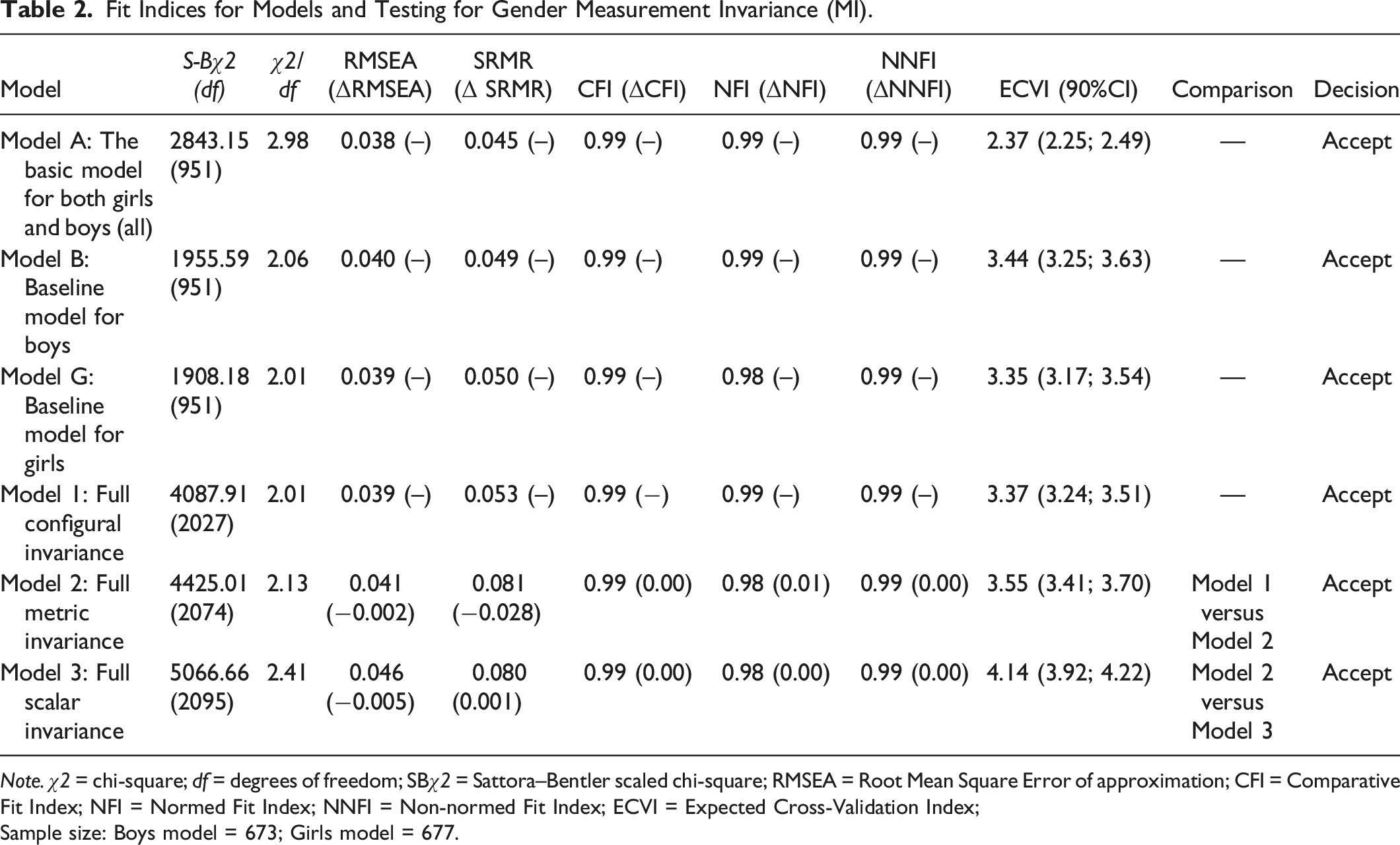
Note. χ2 = chi-square; df = degrees of freedom; SBχ2 = Sattora–Bentler scaled chi-square; RMSEA = Root Mean Square Error of approximation; CFI = Comparative Fit Index; NFI = Normed Fit Index; NNFI = Non-normed Fit Index; ECVI = Expected Cross-Validation Index;
Sample size: Boys model = 673; Girls model = 677.
MGCFA was also used to examine the MI; According to Fan and Sivo’s recommendation (2009), the indicators based on relative changes (Δ) and Cutoff Value of ΔRMSEA and ΔCFI < 0.02, ΔSRMR < 0.03, ΔNFI < 0.035, and ΔNNFI < 0.02 were used to evaluate the MI. These indicators, except for ΔSRMR, are not sensitive to the sample at all due to this critical value, and the results can be trusted (Chen, 2007; Fan & Sivo, 2009). The overall results indicated that the proposed structure and the viability of constraining the factor loading are the same across the groups; the latent means also can be significantly compared between the groups (see Table 2). Consequently, the MI of the PACIC-R was accepted.
Criterion and Construct Validity
Mean, Standard Deviation, Cronbach’s Alpha, and Correlations Among Main Study Variables.
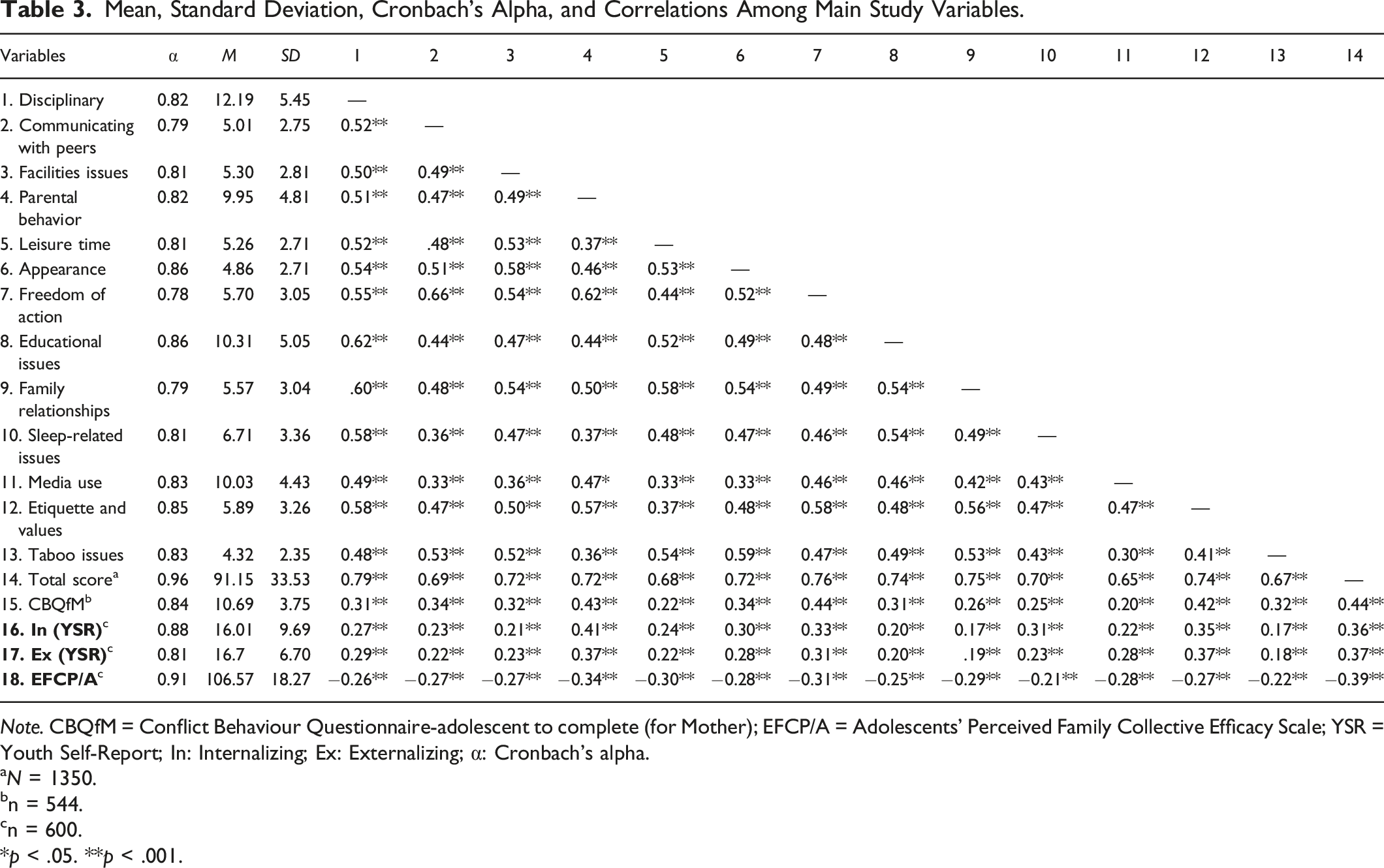
Note. CBQfM = Conflict Behaviour Questionnaire-adolescent to complete (for Mother); EFCP/A = Adolescents’ Perceived Family Collective Efficacy Scale; YSR = Youth Self-Report; In: Internalizing; Ex: Externalizing; α: Cronbach’s alpha.
aN = 1350.
bn = 544.
cn = 600.
*p < .05. **p < .001.
CBQ was used to examine the convergent validity PACIC-R, this type of construct validity is used to correct the shortcomings and problems of content and criterion validity (Grimm & Yarnold, 2000); The results of Pearson correlation showed that the factors and total score of the PACIC-R with the CBQ were significant (see Table 3).
Another method used in construct validity is to estimate the degree of internal consistency by correlating the instrument’s components with the total score (Groth-Marnat, 2009). As shown in Table 3, the correlation between the dimensions of the conflict and the total score between 0.65 and 0.81 is obtained.
Internal Consistency
The results of internal consistency with Cronbach’s alpha coefficients method are presented in Table 3. Cronbach’s alpha values were obtained between 0.78 and 0.96. Due to the small number of items in each factor, these values of alpha coefficients are considered excellent.
Discussion
In the area of parent-adolescent conflict, there are fewer validated instruments to assess adolescent families’ challenges; Also, disagreement measuring over life issues, such as PACIC with the instruments of violence, abuse, or hostility, such as CTSPC and CBQ differs at least in terms of spectral conflict in parent-adolescent relationships. The PACIQ can play an important role in examining disagreements, and the results obtained may be different from the results obtained measuring other areas of conflict. Therefore, by expanding the instruments of parent-adolescent conflict areas, it is possible to gain a greater understanding of adolescents and family challenges and even define the concept and type of conflict in parent-adolescent relationships (Weymouth et al., 2016).
Also, the present study developed a revised version focusing on systemic content validity, providing psychometric support for the use of PACIC-R for adolescents. In particular, the results of the present study showed that the PACIC-R has excellent content validity. The results of CFA indicated that the identified 47 items by experts were included in their related factors. Therefore CFA supported the experts’ judgment. The MI of the results also showed that the effect of the checklist items did not affect the girl and boy groups, and the revised instrument could have the same application for these groups. Despite the small number of items per factor, the results showed internal consistency for all of the conflict domains. The convergence and criterion validity of the PACIC-R were evaluated as well. The high relationship between checklist factors and the total score indicates the internal consistency of the PACIC-R and demonstrates the construct validity as well. Finally, the present findings of the present study show that PACIC-R can be used to assess family conflict issues and challenges.
The PACIC was changed through performing the content validity in the judgment stage, and it was reduced from 92 items to 47. In the judgment stage, the experts made suggestions such as changes in the movement, clarity, necessity, and relevancy of items for each factor, and the results of CFA also confirmed the expert judgment. These results show the importance of systematic content validity in instrument development. Some analysts in behavioral sciences believe that the CFA is a method for content validity examination (Grimm & Yarnold, 2000). Content validity is the essential method of a validity study, and the present study results also showed that the content validity of PACIC-R is excellent.
This study also showed that conflict issues are in 13 conflict domains. In the literature review, measuring the parent-adolescent conflict domains is necessary (Clarke et al., 1999; Riesch et al., 2000). Clarke et al. (1999) identified six domains of conflict with the term Types of Conflict to examine family conflicts and recommend nurses to consider the type of conflict while working with families to provide suggestions and solutions. They concluded that if parents consider their children’s domain of educational issues as their legal authority, they will discuss it more with the adolescent. This finding shows that the thoughts of parents influence the specific dimension of conflict issues, or according to Brown (2016), parents in parenting should be stricter on value issues than on their children’s appearance issues; therefore, categorizing the issues in parent-adolescent relationships seemed necessary, which this research responded to by development and validation of PACIC-R.
It is noteworthy that in some studies, to examine the issues of parent-adolescent conflict, the terms “Content of Conflict,” “Topic of Conflict,” “Types of Conflict,” “Domain of Conflict,” “Daily Conflict,” “Sources of Conflict,” and “Common Problems” has been used (Arkan et al., 2020; Clarke et al., 1999; Odudu et al., 2020; Riesch et al., 2000; Robin & Foster, 2002). According to the behavioral-family systems approach and the rich literature review, the term Conflict Issues was used for the topics of parent-adolescent conflict, and the term Conflict Domain was used for several common conflict issues in the present study. With this explanation, the PACIC-R consists of 47 conflict issues and 13 conflict domains.
Internal consistency of the original checklist (92 items) in the research by Asadi Younesi et al. (2012) with Cronbach’s alpha coefficients in factors of Leisure Times, Media Use, Values, Discipline, Taboos, and Sensitive Issues between 0.53 and 0.66 was reported, while in the present study, Cronbach’s alpha coefficients of these factors were obtained between 0.81 and 0.85 after revising the checklist. This finding also highlights the importance of systematic content validity. Excluding irrelevant and unnecessary items in the judgment stage, the internal consistency of the factors has increased.
Criterion validity is the second central approach to validity after content validity, which is determined by comparing test scores with performance on an outside measure (Groth-Marnat, 2009); The YSR and EFCP/A were used to evaluate the concurrent validity. As mentioned earlier, parent-adolescent conflicts affect adolescent behavioral problems (Brown, 2016; Gonzales et al., 2018; Juang et al., 2012; Koh & Rueter, 2011; Li & Warner, 2015; Liu et al., 2019). This finding indicates that the revised checklist can explain adolescent behavioral problems. Also, to evaluate the effect of parent-adolescent conflicts on family functioning, EFCP/A was used as concurrent validity. Conflicts within family subsystems are Family Development Dysfunctions that occur in the family life cycle. The most crucial feature of conflicts in one subsystem is that they affect it in another subsystem, and the functioning of the family as a whole is involved (Mokhtarnia et al., 2017a; Panaghi et al., 2016). As mentioned earlier, PACIC-R assesses the frequency of disagreements about issues; And the mere existence of disagreement over issues does not indicate family dysfunction or behavioral problems in adolescents; Therefore, this instrument does not measure the harmful dimensions of the parent-adolescent relationship, such as violence. Consequently, the value of unexplained variance in criterion variables with some conflict dimensions is expected.
The correlation coefficients of PACIC-R factors with YSR and EFCP/A showed that some issues of parent-adolescent conflict such as parental behavior, values, and freedom of action are more related to behavior problems and family function. It seems that according to the structural family therapy approach, parent-adolescent issues can be prioritized, and each topic and issue has a different contribution to the occurrence of behavioral problems and family functioning (Brown, 2016; Clarke et al., 1999; Durrant et al., 2014; Harvey & Rathbone, 2015).
CBQ was used to measure parent-adolescent relationship dissatisfaction in many studies. The high relationship between this questionnaire and PACIC-R showed that the revised instrument has acceptable convergent validity. Reviewing items of the CBQ indicates that the instrument focuses on the parent-adolescent relationship. However, the PACIC-R focuses on the frequency of disagreements of issues. Therefore, some unexplained variance of the questionnaire CBQ with PACIC-R is expected.
Research data were collected during the COVID-19 pandemic; the data will likely be affected by these conditions. Moreover, although this study includes a large selection of sample size, it is a reflection of Iranian culture and collectivist ethnicity; This is especially important when the development of this instrument and its revised version is done in the context and under the influence of this culture, and the dimensions of Values and Taboos are more affected by the cultural context than other issues (Asadi Younesi et al., 2012; Mokhtarnia, Mohammadi, et al., 2016). Therefore, this research provides an opportunity to introduce this instrument to other researchers to be implemented in different cultures and compare its results; Also, parents, contrary to adolescents’ opinion, underestimate their problems with adolescents (Clarke et al., 1999). And on the other hand, research shows that they do not understand the difference in identifying the issues. (Riesch et al., 2003); Therefore, it is suggested that this test be validated on the parent group. Therefore, the implementation of this instrument, regardless of its validity in the parent group, should be done with caution.
Footnotes
Acknowledgments
The authors would like to thank Dr. Asadi Younesi, the original creator of the Checklist of the Parent-Adolescent Issues, for providing the instrument and encouraging us to revise it.
Declaration of Conflicting Interests
The author(s) declared no potential conflicts of interest with respect to the research, authorship, and/or publication of this article.
Funding
The author(s) received no financial support for the research, authorship, and/or publication of this article.
