



Abstract
Theories of minority stress contagion suggest that the consequences of racial discrimination may extend beyond the individual to impact close others. We empirically test direct and spillover associations between racialized stress and marital support and strain among mid-life and older Black spouses. We use actor-partner interdependence models to analyze dyadic data from 280 different-sex, married Black couples from the 2014 and 2016 Health and Retirement Study who completed the psychosocial leave-behind module. We find significant actor effects for husbands’ racial discrimination on their own marital support and strain, while wives’ racial discrimination is positively associated with their own marital strain. We find no evidence of partner effects nor significant gender differences in the association between racial discrimination and marital quality. The findings highlight pathways by which racial discrimination affects the marriage quality of Black men and women in mid- to late-life.
Introduction
Marital quality is an important indicator of a person’s experiences within their marriage, one of the most important social relationships that people report. Defined as a global evaluation of marriage across several dimensions, including marital support and strain, marital quality is associated with relationship stability and dissolution (Karney & Bradbury, 1995), global happiness (Spanier & Lewis, 1980), life satisfaction (Carr, Freedman, Cornman, & Schwarz, 2014), and subjective health (Robles, Slatcher, Trombello, & McGinn, 2014; Umberson, Williams, Powers, Liu, & Needham, 2006). Relationship quality, however, varies widely by race-ethnicity (Raley, Sweeney, & Wondra, 2015). Compared with non-Hispanic Whites, Black Americans are less likely to marry, but also report poorer marital quality and higher rates of marital instability when they do (Raley et al., 2015). Most family scholarship on the state of Black families utilizes race-comparative analyses, with little attention given to the unique structures and dynamics within Black families. Such work often paints Black families as deficient, while ignoring the unique challenges Black families face as well as the resources they possess to deal with such challenges. Structural racism and its resulting social, political, and economic strain are key explanations for these divergent family patterns and shape the nature and quality of Black Americans’ romantic relationships (Broman, 1993; Bulanda & Brown, 2007; Hopson & Hopson, 1995; Raley et al., 2015).
Even scholars who focus on understanding Black families’ experiences, however, give limited empirical attention to understanding how interpersonal experiences of racial discrimination affect marital support and strain across partners within Black couples. Researchers often examine the association between an individual’s exposure to discrimination and their own reports of marital quality (Hearne, Talbert, & Hope, 2020; Rina & McHale, 2010), but ignore how such experiences might impact their partner’s perception of the marital relationship. Because the lives of marital partners are intimately interconnected, discrimination directed towards one partner (and not just toward oneself) may also harm the other partner (Gee, Walsemann, & Brondolo, 2012; Van Lange & Rusbult, 2012). Further, the way racial discrimination crosses over to affect one’s spouse may be gendered (Cowdery et al., 2009; Westman & Vinokur, 1998; Stokes, 2017). Black men’s experiences with discrimination may incite their wives to do emotion work to bolster their husbands’ sense of power within the relationship (Cowdery et al., 2009). This extra work may color women’s perceptions of their marriage. However, as this emotion work often goes unreciprocated, in part because Black women’s experiences with discrimination may be less visible to couples (Cowdery et al., 2009), discrimination against Black women may not impact how their husbands rate their marriage.
Guided by theoretical concepts from models on race-based stress in Black families (Carroll, 1998; LeBlanc, Frost, & Wright, 2015), life course theory (Elder, Johnson, & Crosnoe, 2003; Settersten, 2015), and “his/her” marriage frameworks (Bernard, 1976; Stokes, 2017), this paper explores the dyadic experiences of interpersonal racial discrimination and marital quality using couple-level data from Health and Retirement Survey (HRS). Specifically, we investigate whether experiences of interpersonal racial discrimination shapes one’s own as well as their partner’s perceptions of the marital support and strain, and whether the discrimination-marital quality relationship varies significantly by gender, using a nationally representative sample of Black mid-life and older adult married couples. Findings shed light on how racialized stressors shape the individual and relational health of Black marriages. Study limitations are identified and several fruitful directions for further investigation are proposed.
Background
Marriage is a unique social context in which partners become embedded in each other’s lives and share a joint history of opportunities and challenges (Lang, 2001). The quality of a marriage, which includes distinct positive and negative aspects, including support and strain (Fincham & Rogge, 2010), is associated with a host of outcomes. Positive marital quality has been linked to relationship stability, whereas negative marital quality increases the risk of relationship dissolution (Karney & Bradbury, 1995). High-quality marriages are also associated with general happiness (Spanier & Lewis, 1980), overall life satisfaction (Carr et al., 2014), and better physical and mental health (Hsieh & Hawkley, 2018; Robles et al., 2014; Umberson et al., 2006). Research and theory also suggest marital quality, including strain and support, follow a dynamic trajectory that changes across the life course (Bookwala, 2012; Orbuch, House, Mero, & Webster, 1996; Umberson et al., 2005), specifically following a U-shape with a dip in middle age among Black couples (Adelmann, Chadwick, & Baeger, 1996). Chronic and acute stressors that challenge marital quality as well as the barriers and resources to manage such stress may also change as couples enter middle and older ages (Elder, George, & Shanahan, 1996). Research finds, however, that marriage stability and quality is lower among Black adults at all stages of marriage compared to their white married counterparts (Adelmann et al., 1996; Raley et al., 2015). The enduring dynamics of race, including racism and discrimination, across the life course (Gee et al., 2012) as well as other structural, cultural, and individual factors may contribute to disparate racial marital dynamics even into middle and late adulthood (Bookwala, 2012; Raley et al., 2015). However, little attention has been given to these complex relationships among mid-life and older Black couples.
Racism and discrimination are chronic stressors that shape the life chances of Black Americans. Among Black adults, 51% report experiencing discrimination or unfair treatment because of their race in their lifetime (Robert Wood Johnson Foundation, 2017). Such reports also appear to be higher among men and those with higher incomes and educational attainment (Hirsh & Lyons, 2010; Robert Wood Johnson, 2017). The constant exposure and risk of exposure to interpersonal racism increases physical and psychological distress among Black men and women leading to greater mental and physical morbidity and mortality (Phelan & Link, 2015). Recent research also points to the role of discrimination in shaping the nature of Black romantic relationships (Murry et al., 2002; see also Chambers & Kravitz, 2011). Several theoretical and conceptual frameworks have been developed to understand the endemic nature of racism in the US and its consequences, including the mundane extreme environmental stress (M.E.E.S; Carroll, 1998) and minority stress (Meyer & Frost, 2013; LeBlanc et al., 2015) models, in which race-related stress is positioned as a common experience that impacts individual and relational wellbeing among Black Americans. Within these frameworks, sociohistorical and structural processes expose Black individuals to unique social stressors, including stigma, discrimination, and the management of a stigmatized identity, that may directly and indirectly impact family life (Carroll, 1998). For example, racial discrimination results in disproportionate economic disadvantage, including greater unemployment and suppressed wages, among Black families, which has been linked to poor relationship quality (Bryant et al., 2010). Experiences of discrimination may also deplete the emotional and social resources needed to support, manage, and sustain romantic relationships (Lavner et al., 2018). Perceptions of racial discrimination and one’s subsequent reactions to such treatment are also likely to change as individual’s age (Kessler, Mickelson, & Williams, 1999; Brody et al., 2006). Precisely how responses to interpersonal racial discrimination change throughout the life course is not well documented (see Feagin, 1995 for an exception). However, a theoretical piece by Chambers and Kravitz (2011) examined the nexus between structural and psychosocial factors on low marriage rates among Black adults found vulnerability, or the reluctance to show vulnerability due to a history of racism and betrayal, is a salient factor that deters Black adults from marriage. Other research points to lack of trust and forgiveness stemming from a long history of racism and discrimination that may also shape the course of Black relationships (Allen & Olson, 2001; Chambers & Kravitz, 2011).
Yet, racial discrimination is not solely an individual-level phenomenon. Life course theory presses us to examine linked-lives (Elder et al., 2003); that is, the ways in which our life course is interdependent with that of socially relevant others and how the experiences of others within our social network also shape our experiences, and vice versa (Van Lange & Rusbult, 2012; Settersten, 2015). This may be particularly important when considering the influence of racial discrimination on the wellbeing of Black couples. The theory of “minority stress contagion” (LeBlanc et al., 2015) suggests that race-related stress faced by one partner impacts an intimate other through stress crossover or the inter-individual transmission of stress (Westman & Vinokur, 1998). Take, for example, the experience of racial microaggressions in the workplace, in which seemingly innocuous comments, that often appear to be compliments or genuinely expressed questions (e.g., “You’re so articulate”), are actually unintentional expressions of bias and/or racism (Williams, 2020). Such encounters may be processed in various ways—by oneself, with a partner/spouse, and/or with close friends—and may affect marital relationship and family dynamics. Qualitative research finds such race-based stressors are a commonly shared experience within Black marriages (Marks et al., 2008). Consequently, Black partners may be asked to engage in adaptive behaviors to help manage their partner’s stress (e.g., translate, negotiate, validate, absorb, or protect) that may either erode or strengthen relational health (Bagley, Angel, Dilworth-Anderson, Liu, & Schinke, 1995; Clavél, Cutrona, & Russel, 2017; Jean & Feagin, 1998; McNeil Smith, Williamson, Branch, & Fincham, 2020). Several recent studies also point to discrimination crossover as impacting the health and family outcomes of minoritized individuals (Clavel et al., 2017; Lavner, Barton, Bryant, & Beach, 2018; McNeil Smith et al. 2020). However, much of this work either (a) focuses on physical and mental health instead of relationship outcomes; (b) relies on small-scale, regional samples of young, newly married couples to examine relational health; or (c) examines different familial relationships (i.e., parent-child relationships). Thus, less is known about how these processes may impact the marital quality of older adults in more established relationships.
Additionally, although theory points to key gender differences in the impact of discrimination on partners (i.e., differences between husbands and wives), empirical investigation on the gendered nature of these associations has been limited. The theory of “his” and “her” marriages (Bernard, 1976; Simon, 2002; Stokes, 2017) suggests that men and women occupy different roles in a relationship and women do much of the work (e.g., emotional work, prosocial strategies, togetherness, and communication) to maintain marital quality in their relationships (Erickson, 2005; Weigel & Ballard-Reisch, 1999). Although the literature on marital maintenance behaviors is largely centered around the experiences of White marriages and White women, Black women are also more likely to carry the burden of emotional labor in marriages (Duncombe & Marsden, 1995; Strazdins & Broom, 2004).
Research examining gender differences among Black Americans on the salience of marital happiness finds that Black women (but not men) report marital happiness as more important than work satisfaction as a predictor of their global happiness (Glenn & Weaver, 1981). Moreover, some work has shown a significant association between gender and marital happiness among Black Americans (Bryant, Taylor, Lincoln, Chatters, & Jackson, 2008; Corra, Carter, Carter, & Knox, 2009), and important gender differences in the meaning of marriage among Black adults. Black women may feel the need to protect their husbands from the effects of discrimination by “hold[ing] back her own power in the relationship to make [her husband] feel like he has the power, if not in society, at least in their relationship” (Cowdery et al., 2009, p. 32). McNeil et al. (2014) also found that among Black couples, wives’ social support protected husbands from the negative effects of racial discrimination on mental health; however, social support from husbands was not a protective factor for wives.
Cultural prescriptions to be “the strong Black woman,” may also exact a tremendous cost, as Black women are left to carry the burdens of race and racism for the entire family, while rendering invisible their suffering (Beauboeuf-Lafontant, 2007; Johnson & Loscocco, 2015). Black men are also impacted by various forms of institutional discrimination—criminal justice, housing, and employment—that challenge relational stability and health (Crockett, Grier, & Williams, 2003; Taylor, Miller, Mouzon, Keith, & Chatters, 2018). Such challenges may interfere with Black men’s ability to carry out responsibilities that are culturally regarded as part of being a “man,” including being able to financially provide for their families (Williams, Neighbors, & Jackson, 2003; Wheaton, Thomas, Roman, & Abdou, 2018). Still, research finds greater role flexibility and more egalitarianism among Black couples (Beckett & Smith, 1981; Kane, 2000) as well as other distinct cultural norms and values on the meaning of gender and family (Johnson & Loscocco, 2015). Therefore, spousal experiences of discrimination may not vary across Black men and women like we would expect based on research on gender roles in White marriages.
In light of research pointing to the association between race and marital quality, the role of racial discrimination in shaping relationships among Black married couples, and how this association may vary at the insertion of race and gender, we offer the following hypotheses:
One’s own experiences of interpersonal racial discrimination will be inversely associated with one’s own marital support and positively associated with one’s own marital strain;
One’s own experiences of interpersonal racial discrimination will be inversely associated with their spouses’ marital support and positively associated with their spouses’ marital strain;
The association between racial discrimination and marital support and strain will vary by gender.
Data
We used dyadic data from the Health and Retirement Study (HRS), a nationally representative, longitudinal study of U.S. adults over age 50. Since 1992, the HRS has conducted core interviews with age-eligible respondents and their spouses approximately every 2 years with the most recent data available from 2016. Beginning in 2006, the HRS collected data on psychosocial characteristics using the self-administered, Leave-Behind questionnaire (LB). The LB obtains information about participants’ evaluations of their life circumstances, including experiences of discrimination and relationship quality, subjective wellbeing, and lifestyle. A random half-sample of households received the LB in 2006, 2010, and 2014; the second half-sample received the LB in 2008, 2012, and 2016. A new sub-sample of individuals born between 1954 and 1959 (i.e., Mid Baby Boomer (MBB)) was added in 2010. The MBB cohort included a race-ethnic minority oversample to boost the size of the minority samples in those cohorts. To take advantage of these minority oversamples, we restrict our analysis to age and cohort eligible different-sex, married couples, in which both partners self-identified as Black and/or African American and who completed the 2014 or 2016 LB. Of the 645 eligible respondents, 85 respondents were lost due to missing spousal information, proxy reports, and/or missing data weights; therefore, the final analytic sample for this study comprises 280 couples (n = 560).
Measures
Marital Quality
Marital quality was assessed across two dimensions: support and strain. Marital support was measured using 3-items, including: (1) How much do they (spouse) really understand the way you feel about things? (2) How much can you rely on them (spouse) if you have a serious problem? (3) How much can you talk to them (spouse) if you need to talk about your worries? Marital strain was assessed by asking the following four questions: (1) How often do they (spouse) make too many demands on you? (2) How much do they (spouse) criticize you? (3) How much do they let you down when you are counting on them? (4) How much do they get on your nerves? Responses for these questions range from 1 = “A lot” to 4 = “Not at all.” All items were reverse coded and summed so that higher numbers reflect greater marital support and strain. Partners rated their marital support and strain independently of one another, and the scale was set to missing if participants were missing more than one item on the marital support scale or more than two items on the marital strain scale (Cohen, 2004; Uchino, 2009). The Cronbach’s alphas for marital support and strain were each 0.79.
Interpersonal Discrimination
Interpersonal discrimination, or experiences of unfair treatment, was assessed with six items adapted from the Everyday Discrimination Scale (Williams, Yu, Jackson, & Anderson, 1997). Respondents were asked how often the following things happened: (1) treated with less courtesy or respect than other people, (2) received poorer service than other people at restaurants or stores, (3) people act if you are not smart, (4) people act as if they are afraid of you, (5) felt threatened or harassed, (6) received poorer service or treatment than other people from doctors or hospitals. At the end of the scale, a single item asked respondents to attribute the reason or reasons—that is, ancestry or national origin, gender, race, age, religion, weight, physical disability, other aspect of physical appearance, sexual orientation, financial status, or other—for the experiences if they reported any discrimination. We used this information to classify respondents into three mutually exclusive categories: (a) no discrimination, (b) discrimination with a racial attribution (an attribution of ancestry or national origin or race), and (c) discrimination with a nonracial attribution exclusively. “No discrimination” serves as the referent category. Similar methods for measuring racial discrimination have been used elsewhere (Chae, Lincoln, & Jackson, 2011).
Covariates
We controlled for respondents’ characteristics, including age, education, labor force participation, and number of doctor-diagnosed health conditions, as these may all be associated with marital quality. Age was assessed in years. Education was categorized as less than high school (referent), high school diploma/GED, some college, or a college degree or higher. Employment status was dichotomized into 1 = not working versus 0 = working. Finally, we include a continuous measure of the number of doctor-diagnosed physical and mental health conditions in our models.
Analytical Strategy
We estimated the cross-spousal association between interpersonal discrimination and marital support and marital strain using the Actor-Partner Interdependence Model (APIM). The APIM estimates the association between an individual’s (i.e., actor’s) characteristics and their spouse’s (i.e., partner’s) outcomes after accounting for the relationship among the actor’s characteristics and outcomes (i.e., bidirectional effects in interpersonal relationships). This dyadic method of analysis estimates a partner’s experiences of interpersonal discrimination and their association with each partner’s marital quality simultaneously, while correcting for potential biases from nonindependence between members of an intimate relationship. Given the complexity of the APIMs, our analysis uses cross-sectional data to examine how each spouse’s report of discrimination is associated with both spouses’ reports of marital quality. See Figure 1. Full-information maximum likelihood (FIML) was used to handle item-level missing data. We use post-hoc Wald tests to identify gender differences in the relationships between discrimination and marital support and strain. Data management and descriptive statistics were conducted using Stata version 16/SE. Canceptual model: Actor-partner interdependence model of discrimination and marital quality.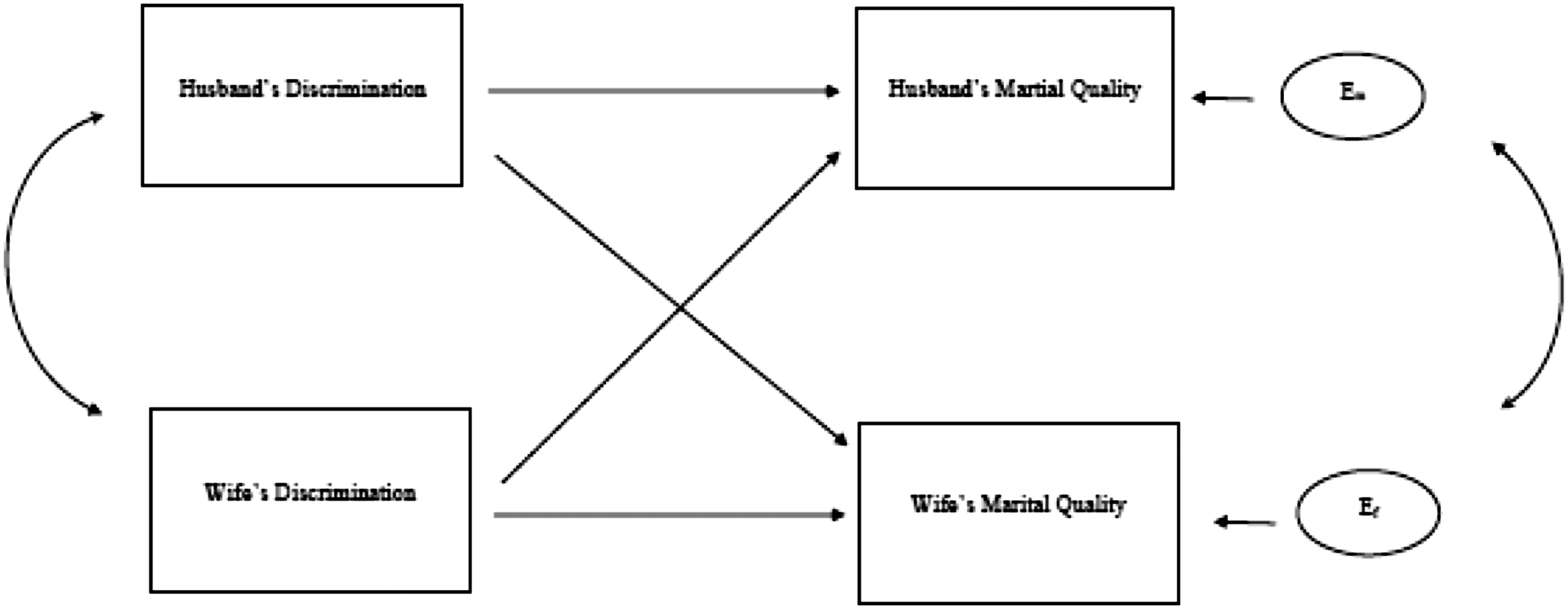
Results
Sample Characteristics of HRS Black Married Older Adults (n = 560).
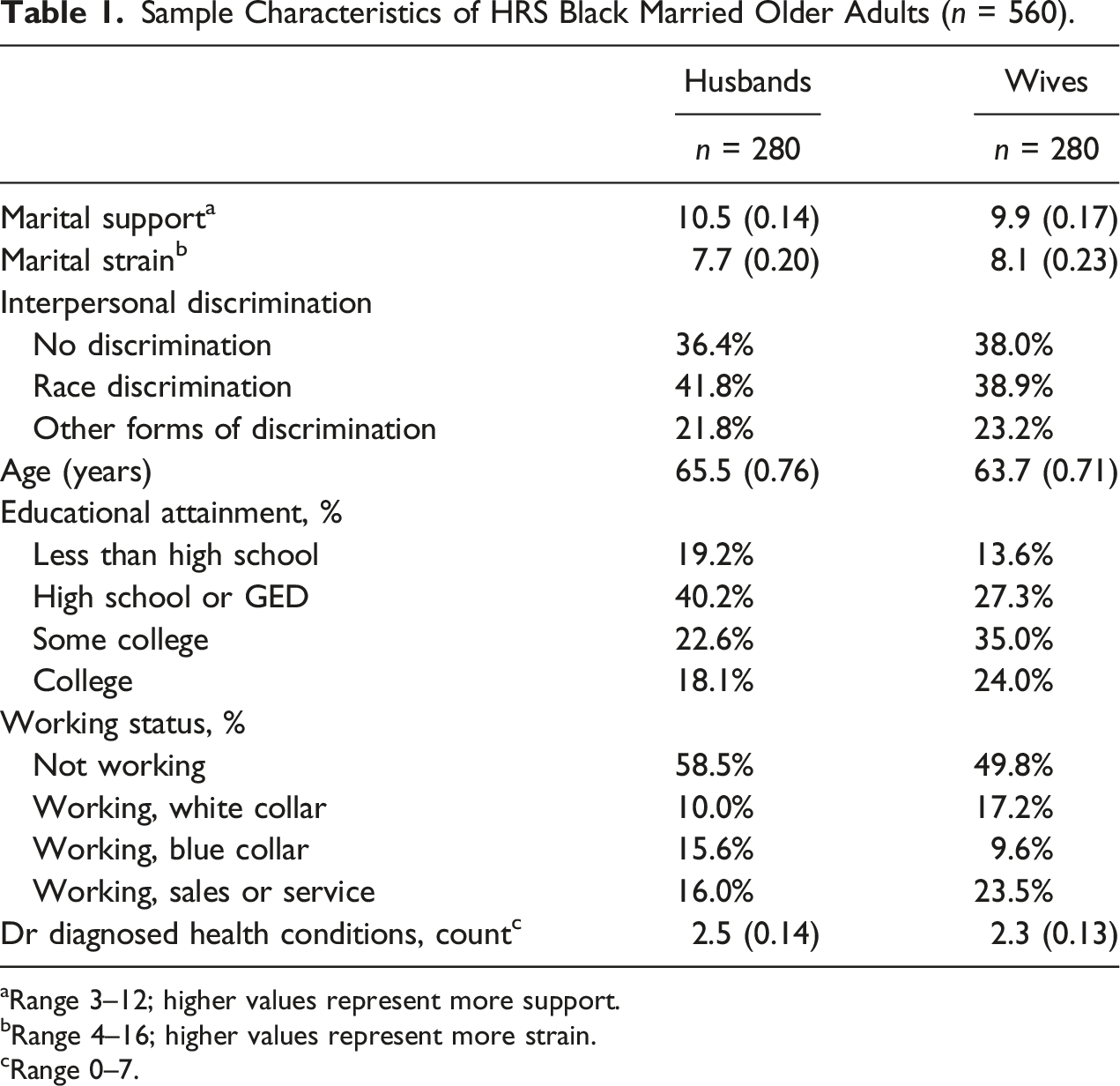
aRange 3–12; higher values represent more support.
bRange 4–16; higher values represent more strain.
cRange 0–7.
Weighted Estimates From APIMs Predicting Marital Support and Marital Strain among Black Married Couples in the 2014/16 Leave-Behind HRS Sample (n = 280).
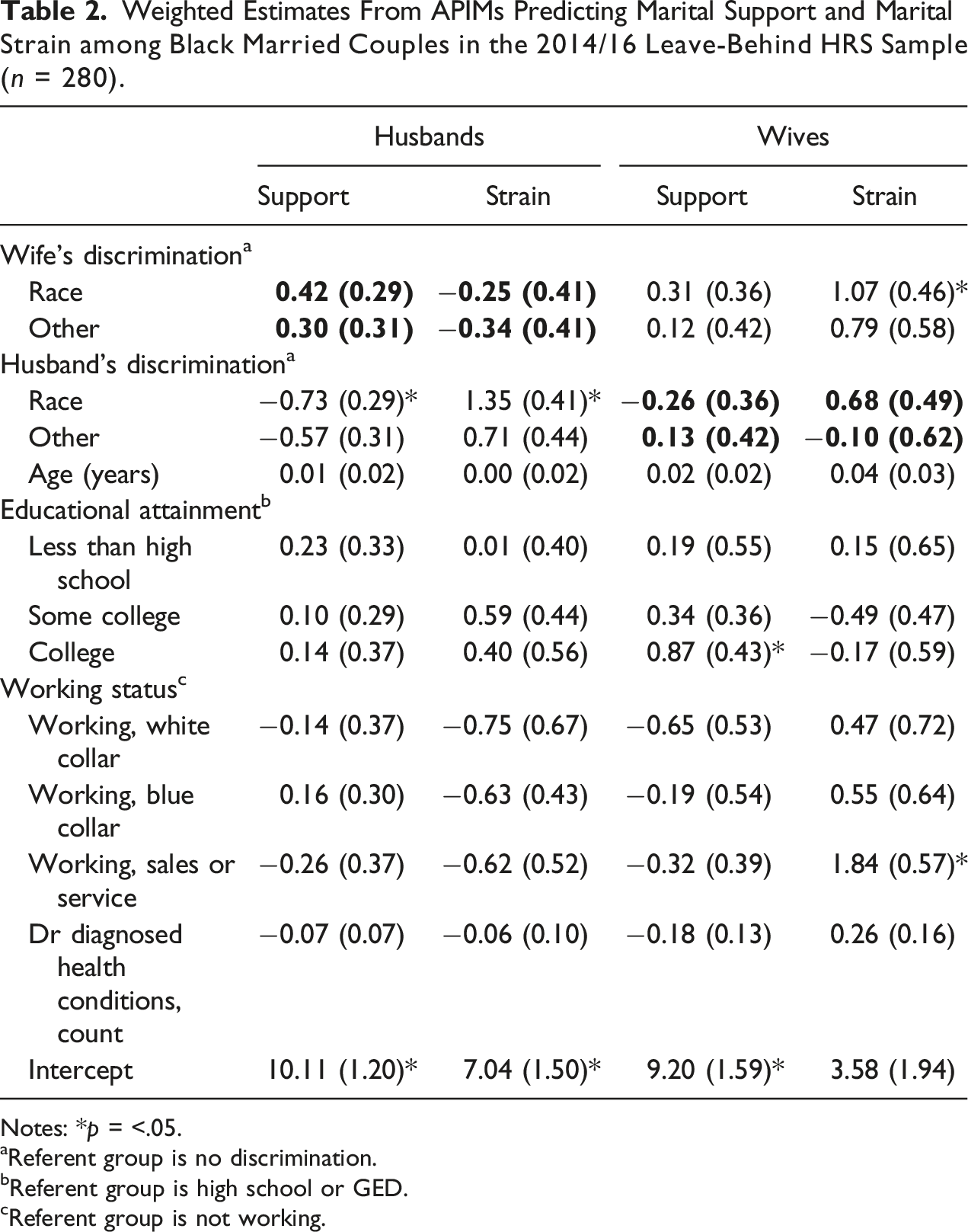
Notes: *p = <.05.
aReferent group is no discrimination.
bReferent group is high school or GED.
cReferent group is not working.
We find no support for H2 on partner effects. Husbands’ and wives’ reports of racial discrimination had no significant association with their partners’ reported marital support or strain. Additionally, using Wald tests we examined whether the impact of interpersonal discrimination on marital strain was more harmful for husbands than wives. We found no support for H3; spousal discrimination on marital support and strain did not vary by gender of partner.
Discussion
Racial discrimination is a salient stressor linked to poorer outcomes across several life domains, including intimate relationships (Carroll, 1998; LeBlance et al., 2015; Hearne et al., 2020). Yet, the relationship between interpersonal discrimination, particularly racial discrimination, and marital quality among Black couples has often been overlooked. Using a dyadic approach, this study was guided by three hypotheses that examined the relationship between one’s own and one’s spouse’s racial discrimination on marital support and strain among mid-life and older, different-sex married Black couples, and if the relationship varied by gender. Our findings suggest that one’s own experiences of racial discrimination specifically are inversely associated with one’s own perceptions of marital quality, particularly for Black men. Surprisingly, we found no support for the hypothesized impact of partner’s racial discrimination on their spouse’s marital support and strain. Additionally, we found that the associations between spousal discrimination and marital quality did not vary by gender.
Overall, our findings contribute to a growing body of work that suggests racial discrimination is a key determinant in individual and relational wellbeing of Black adults (Hearne et al., 2020; LeBlanc et al., 2015). Theoretical and conceptual frameworks on race-related stress suggest that discrimination impacts family life both directly and indirectly through such processes as stress proliferation (i.e., the tendency for stressors to beget stressors) and stress spillover (i.e., one life domain interfering with another life domain) (Westman & Vinokur, 1998). Within such frameworks racial discrimination proves detrimental to the relationship by increasing partners’ negative affect (e.g., anger, helplessness, fear, frustration) or by triggering coping responses that harm marital intimacy, including avoidance and passivity (Karney & Bradbury, 1995). Our results provide partial support for our first hypothesis. Racial discrimination does indeed increase marital strain for both husbands and wives, but also lower perceptions of marital support among Black men only. Research suggests that Black women are more likely to seek social support in the face of racial discrimination than Black men (Swim, Hyers, Cohen, Fitzgerald, & Bylsma, 2003), which may explain why women do not report lower marital support when they face discrimination. Restrictive gender role expectations rooted in race and age-related priorities, may explain why men report lower support in the face of discrimination (Barbee et al., 1993; Griffith & Cornish, 2018).
Our second hypothesis tested if partners’ reports of racial discrimination are linked to their spouse’s marital support and strain. We find no evidence to support this hypothesis among our sample of mid-life and older Black married couples. Although theories of linked-lives (Elder et al., 2003; Settersten, 2015) and minority stress contagion (LeBlanc et al., 2015) suggest partner’s racialized stress may crossover into the lives of intimate others, relatively little empirical research has examined the association between racial discrimination and relationship functioning at the couple-level. Results from a small, but growing, body of work also report inconsistent findings (Clavél et al., 2017; Lavner et al., 2018), which may, in part, be due to important cohort differences and/or life course stage of the couple. Many of these studies are limited to young, newly married couples as opposed to the marriages of older and mid-life couples in our analyses.
There are several important reasons we may not find partner effects of racial discrimination on marital support and strain. First, although over a third of the men and women in our sample report experiencing any racial discrimination, they also report modest frequency of discrimination overall. In ancillary analysis (available upon request), reports of any interpersonal discrimination were quite modest, averaging 0.8 for husbands and 0.6 for wives on a scale from 0 to 5 (i.e., “less than once a year”). A vast body of research has documented the changing nature of racism and discrimination in the US since the passage of civil rights in the 1960s. Older cohorts of Black Americans, who grew up during the Jim Crow era in which overt forms of racial discrimination and segregation were both legal and culturally normative, may perceive the nature and consequence of racial discrimination differently than younger cohorts who grew up in a more “color-blind” society (Bonilla-Silva, 2017). Research finds older Black Americans report lower levels of racial discrimination compared to younger Black adults (Wheaton et al., 2018). Other work points to discrimination having a weaker impact on the health of older Black adults in environments in which racism and discrimination was the “status quo” (Kim et al., 2017). Secondly, marital communication is shaped by a combination of life stage and cohort influences, with some evidence that older and mid-life adults exhibiting far less (effective) communication than their younger, more newly married peers (Zietlow & Sillars, 1988), and such differences may be compounded by race. Older Black adults may have coped with experiences of racial discrimination by hiding or avoiding their vulnerabilities in order to preserve face in their intimate relationship (Brondolo, Brady ver Halen, Pencille, Beatty, & Contrada, 2009; Chambers & Kravitz, 2011). Lastly, older Black adults who experienced racial discrimination as a normal part of everyday life (Carroll, 1998) may have turned to their marital partner as a place of safe harbor to receive and express empathy, compassion, and support in the face of racialized stress, thereby preventing these negative experiences from eroding their marital quality. Qualitative work on enduring Black marriages points to both of these truths. Married Black couples often discuss the unique challenges and strains of Black family life, including racial discrimination, but also report turning to and relying heavily on their spouse to overcome such challenges (Marks et al., 2008; Phill, Wilmoth, & Marks, 2012). Importantly, the average length of marriage for our sample of Black couples was 32 years and over 90% had been married for at least 10 years (data not shown in tables). Our results, coupled with previous work (Jean & Feagin, 1998; Marks et al., 2008; McNeil Smith et al., 2020) suggest that the nature of Black marriages may be to offer unique forms of racism-specific support that preserves marital quality in the face of race-based stress. Further investigation into these complex problems, specifically among mid-life and older Black couples remains warranted.
The third hypothesis of the current study was to determine if the dyadic relationship between discrimination and marital
Limitations of the present study should be noted. First, the data from the present study are cross-sectional and future research should use dyadic panel data to assess causality. Second, our sample only included different-sex, married couples. Examining these associations among same-sex couples in various life stages as well as couples within other (nonmarried) relationship contexts would be an important direction for future work. The relationship quality of such couples may be especially vulnerable in light of the stressors that result from intersecting marginalized identities. Lastly, while the measure of individual interpersonal discrimination is important, the experience and consequence of racism and discrimination for Black Americans may take on a myriad of forms,—that is, systemic racism, vicarious racism, and vigilance—and future approaches sensitive to these other dimensions of discrimination, and how they are shared between partners, are needed.
Despite these limitations, the present study makes several contributions to the literature and highlights important directions for future research. First, this study empirically examines older minoritized adults within a dyadic context to test theoretical claims of minority stress contagion. Second, this study contributes to the growing literature on racial discrimination as a salient factor for both individual and relational wellbeing. Although the present study found no partner effects on marital quality, there were significant individual effects of racial discrimination on marital quality. Personal exposure to racial discrimination increases one’s own perceptions of marital strain which poses a challenge to Black mid-life and older adults’ marriages. Future studies should extend this line of research by investigating other forms of race-based stress between partners, the specific pathways linking stress to relationship outcomes, including vulnerabilities within individual spouses and interactive and adaptive processes between the spouses, as well as the important psychosocial and cultural specific mechanisms that may protect minoritized couples in the face of race-based stress.
Footnotes
Declaration of Conflicting Interests
The author(s) declared no potential conflicts of interest with respect to the research, authorship, and/or publication of this article.
Funding
The author(s) disclosed receipt of the following financial support for the research, authorship, and/or publication of this article: This work was supported by ASPIRE-II: Integration Program through the Office of the Vice President for Research at the University of South Carolina.
