




Abstract
Social attitudes toward marriage and motherhood have shifted away from the traditional norms of universal marriage and childbearing. While the second demographic transition theory stresses the importance of education in bringing ideational changes behind low fertility and low marriage rates, a causal link between college education and attitudinal change has not been studied much. To fill this literature gap, this study demonstrates the enduring impact of college education on women’s family attitudes using South Korea’s policy shock, which offered people the opportunity to attend college in the 1980s. This study finds that college education in the 1980s encouraged women to have non-traditional attitudes toward marriage and motherhood. Women who attended college via the graduation quota program reported that marriage and giving birth at a young age were not necessary more than women without the opportunity. We constructed a composite index of family formulation which showed the same result.
Introduction
Although there is mounting evidence that women’s education affects their decisions on marriage and childbearing, so far very little research has turned its eyes toward education’s effects on women’s long-term values and life orientations. Some evidence has pointed to women’s attitudinal changes towards family formulation following industrialization and access to mass education (Lesthaeghe & Surkyn, 1988), yet showing a causal pathway between higher education and women’s attitudes faces challenges.
First, the relationship between higher education and women’s attitudes has endogeneity embedded, in the sense that women with pre-existing liberal attitudes might be more likely to pursue tertiary education. Second, readjustments in the value system in response to the socioeconomic environment require a time lag (Inglehart, 2000), hence a study from a short-term angle may not be able to capture the impact precisely. To address this literature gap, this study aims to investigate a causal link between women’s higher education and their values in their mid-40s, taking advantage of a natural experiment in South Korea in 1981 which allowed enhanced access to tertiary education.
Women’s educational attainment has been considered an important factor explaining late marriage and non-marriage in East Asia, with many studies reporting a positive correlation between women’s college education and non-marriage (Jones, 2007; Jones & Gubhaju, 2009; Jung & Jung, 2021). This could stem from various causes, such as women’s economic independence from husbands followed by their own educational attainment (Becker, 1973), or delays in entering the marriage market due to more years spent in the education system (Ikamari, 2005), or young women’s aspirations for a higher standard of living and a well-planned marriage (Amin & Al-Bassusi, 2004), or a shift in values and life orientations (called the second demographic transition) redefining marriage as a life choice and pursuing individuation, secularization, gender egalitarianism, and higher consumption over marriage (Lesthaeghe, 2014; Surkyn & Lesthaeghe, 2004).
Despite the rich literature on the role of educational attainment in delaying women from getting married or even preventing them from having ever married, far less attention has been paid to people’s norms and how education may play a role in changing societal norms. Studies showed that women’s attitudes toward marriage and family formulation are almost universal regardless of the context. For example, studies in Singapore reported that 85 percent of Singaporean singles had shown a general desire to marry in the 2000s (Jones et al., 2012); and even in Japan, where marriage rates and birth rates plummeted to their lowest levels, 86 percent of single men and 89 percent of single women expressed their intention to marry at some point (Raymo et al., 2015; 2021). Regarding the pronounced gap between this widely prevailing marriage intention and the actual low marriage rates, Raymo et al. (2021) suggested two pathways, which are (1) failing to actualize their marriage intentions or desires due to external factors, such as the partner’s situation, or their own economic difficulties, family obligations, or bad luck, and (2) vaguely assuming marriage at some point yet investing comparatively little in romantic relationships. Especially singles who were “drifting,” showing less effort in a search for a partner with their weaker desire of marriage, were prevalent among low-educated groups, ending up with their having a lesser probability of getting married.
Only a few studies have examined the shifts of family norms which possibly explain the reason behind the demographic changes toward late or non-marriage and low fertility rates in many developed countries (Lesthaeghe, 2014; Lesthaeghe & Surkyn, 2002; Surkyn & Lesthaeghe, 2004). According to theories, social norms change over time, either through socialization or through the replacement of an old cohort with a new cohort who has comparatively more liberal ideas (Inglehart, 2000; Lesthaeghe, 2014; Lesthaeghe & Surkyn, 1988; 2002; Surkyn & Lesthaeghe, 2004). Having said that, the direction of societal norms in the family formulation has not yet gained a consensus. A study in South Korea revealed that women’s attitudes toward family formulation became more traditional as they aged (Kim & Cheung, 2015), but another study suggested a contrasting finding that Korea is moving towards more liberal norms in family, with a growing emphasis on independence and the increasing social acceptability of premarital sex and cohabitation (Jones et al., 2012). Further, the mechanism to explain this changing family norm is still a black box. It could have been a natural aging process that involves life events such as their marriage, divorce, their children’s marriage, and so forth as suggested by the life course perspective (Baxter et al., 2015; Kim & Cheung, 2015), or could have been found in an education system that allowed individuals to be exposed to more liberal western norms (Abidogun, 2007; Moghadam, 2002).
To expand the understanding of the literature on women’s attitudes toward family formulation driven by education, this study empirically analyzes the long-term causal relationship between college education and women’s attitudes toward marriage and childbearing. A rigorous causal analysis is undertaken using a natural experiment in South Korea when it was a developing country. The graduation quota program was implemented in South Korean universities in 1981, immediately after political turmoil, to increase the number of persons admitted to college; this benefitted women greatly. Methodologically, this study constructs an instrumental variable (IV) based on birth year to determine whether women in later birth cohorts were more likely to be impacted by the expansion of college admission than earlier birth cohorts.
Our study found that college education in the 1980s in South Korea contributed to liberalizing women’s norms on marriage and motherhood. Women in their mid-40s who were exposed to the quota policy and received a college education were more likely to agree that marriage and early childbearing are not essential than those who did not receive a college education, which echoes the liberalizing trend of family and marriage-related norms in Western countries (Cunningham et al., 2005; Gubernskaya, 2010; Thornton & Young-DeMarco, 2001; Trent & South, 1992).
This study proceeds as follows. The next section includes theories and previous studies. The third section covers the institutional and historical background of the graduation quota program in South Korea. The fourth section explains the data and provides descriptive statistics. The fifth section presents the statistical models, and the sixth section delivers empirical results. The results and their implications are discussed in the final section.
Literature Review
Women’s education can delay marriage (Isen & Stevenson, 2010). Economic theory explains this through women’s labor market participation and there being less perceived merit to marriage. Tertiary education increases women’s participation in the job market to varying degrees depending on the country’s development level or gender roles (Cameron et al., 2001). Women’s economic independence reduces the benefits of marriage, as it is hard for women to balance work and family and they do not need to depend on the spouse financially, resulting in their decision to postpone or avoid marriage (Becker, 1973; Raymo & Iwasawa, 2005; Tsuya & Mason, 1995).
Apart from economic independence, education also affects people’s ideology toward family planning. The second demographic transition theory stresses the rise of individualistic values to explain the fertility decline since 1960 (Lesthaeghe & Meekers, 1987; Surkyn & Lesthaeghe, 2004; Van de Kaa, 2002). With increasing education levels (especially among females) and wealth in Western societies, people have turned their eyes to higher-order needs, which are more existential and expressive (Lesthaeghe, 2014; Maslow & Frager, 1987). Individual autonomy and self–realization have become a priority even in marriage, and career and education are central to family planning (Gubernskaya, 2010). The second demographic transition in Western countries has been followed by ideational changes in developing countries. Schooling in developing countries can be interpreted as Westernization (Moghadam, 2002), supporting girls’ taking a more individualistic stance on gender roles than the household’s or community’s rules (Abidogun, 2007). Education for women can delay their transition to adulthood and marital life, as girls in school are not considered ready to marry and give birth (Blossfeld & Huinink, 1991).
Little scholarly attention has been given to family norms, although they largely affect their actual choices (Uecker et al., 2021; Wesolowski, 2020). For example, women with traditional attitudes toward marriage are more likely to get married and marry earlier (Sassler & Schoen, 1999). Another study found that women with egalitarian gender role attitudes were less likely to intend to have a child, and indeed less likely to have a child than traditional women (Kaufman, 2000). In Western countries, especially in the U.S., this traditional norm toward marriage and childbearing has been declining (Gubernskaya, 2010; Kaufman, 2000; Kraaykamp, 2012; Thornton & Young-DeMarco, 2001), with some studies arguing that lower fertility and recent changes in family structure are due to people’s ideational changes (Lesthaeghe, 2014; Lesthaeghe & Surkyn, 2002; Surkyn & Lesthaeghe, 2004). Nevertheless, education and gender role attitudes are underexplored in research for understanding why there are different rates of fertility and marriage between people with a college education versus people without a college education. For instance, Pessin (2018) found that a higher prevalence of egalitarian gender norms anticipated a decline in marriage formulation for women without a college degree, whereas for college-educated women, gender egalitarianism was positively associated with marriage and family formulation. A growing number of studies are paying attention to gender norms in East Asia, but the changing dynamics in their desires for marriage and family in East Asia are still underexplored.
The socialization theory finds the fundamental reason for liberalizing family-related attitudes in generational replacement over time and education is changing values in different generations. The cohort replacement hypothesis states that societal attitudes alter as older generations are replaced by younger cohorts who are less likely to hold traditional norms (Cotter et al., 2011; Kim & Cheung, 2015). The norm that everyone needs to marry and give birth might be relevant for the older generation, but not for the younger generation.
However, attitudes can change even within a generation regardless of aggregate-level generation replacement changes in social attitudes, whether it be through schooling that creates, manipulates, and transmits cultural symbols between generations (Lesthaeghe & Surkyn, 1988), or through their own experiences entering marriage and parenthood (Baxter et al., 2015; Kim & Cheung, 2015). For example, Kim and Cheung (2015) found that South Korean women became more traditional toward family formulation as they aged and women agreed that marriage, childbearing, and motherhood were a must after experiencing them. In this paper, we argue that college education in their 20s could affect women’s attitudes toward family formulation in their mid-40s.
While many studies have shed light on how education has delayed marriage and childbirth, it is not known how college education itself impacts women’s attitudes toward marriage and motherhood. Does college education merely delay women’s marriage and childbearing, or does it change women’s fundamental attitudes toward family formulation? This question is important for understanding the trends in marriage delay and low fertility in the transition from a less-educated to a highly educated society and people’s fundamental ideational changes. This study intends to fill this gap in the literature and provide causal evidence to encourage active discussion and research on this topic.
Graduation Quota Program in South Korea
The graduation quota program was launched in July 1980 under President Doo-hwan Chun’s regime. In November 1979, President Chung Hee Park was assassinated by the Korean CIA director, Jae–Gyu Kim. Shortly after in December 1979, the former government led by President Park was taken over by General Chun’s military coup. This General Chun’s military regime grabbed the leadership, taking advantage of the absence of a national leader and the chaotic situation; their super-constitutional legislative body later proposed socio-economic reform, with the graduation quota program as its main pillar.
The government claimed that the quality of college education had deteriorated, and academic competition would bring better outcomes and better-quality students. In the 1970s, the demand for college education was very high, and students competed fiercely for college entrance, often repeating college entrance exams two or three years to enroll in their preferred university. However, this high fever toward college entrance did not link to academic performance after entering college. Many college students seemed to think that everything would be guaranteed, even with little academic effort, after entering university.
President Chun’s government stated that implementing the graduation quota program would increase the quality of tertiary education by receiving more students in the admission stage but raising the graduation bar. The government mandated that all universities in South Korea, both public and private, increase the number of admitted students by 30 percent in 1981 and a further 50 percent from the previous year’s admission level from 1982 onwards (World Bank. n.d.).
Initially, the program was designed to graduate fewer students than those enrolled to promote competition in college, rather than to increase the number of college graduates necessarily. However, colleges could not always expel students based on their poor academic grades. Expelling students who failed an exam generated resistance from students, resulting in a lack of enforcement by the central government and universities (Kang, 1986). As a consequence, people having a college degree greatly increased in the 1980s.
Despite universities being given more discretion to decide admission levels from 1985 onwards, the national undergraduate student ratio continued to rise in the 1980s and 1990s. As a result, the graduation quota program played a significant role in increasing the number of persons with a college degree in South Korea. The increase in total college enrollments can be found in the published statistics by the UNESCO Institute for Statistics (2020): consistent with our study, college enrollment rates for females increased substantially in the early 1980s.
In the 1980s, many students applied for college admission two or three years in a row. Newspaper articles at the time reported that around 40 percent of students applying for college in 1981 were repeat applicants who were more than 19 years old, the college-entering age in South Korea. 1 We assume that the program affected people who enrolled at university in 1981 and afterward (mostly born in 1962 and afterward) and had some spillover effects for students who enrolled at university in 1979 and 1980 (mostly born in 1960 and 1961). We will account for this spillover effect for different birth cohorts in our IV analysis.
Data
Our study uses the first wave of the Korean longitudinal survey of women and families (KLoWF), collected in 2007. This study focuses on women only, as the data do not include men’s attitudes. To the best of our knowledge, there are no data covering men’s attitudes in South Korea, despite the significance of the subject. KLoWF is released by the Korean Women’s Development Institute every other year (since 2007) and is publicly accessible. The survey includes women from 19 to 64 years. Basic demographic information about their husbands is also included by asking married women about their husbands and marital relationships. The data represents the whole country, tracking around 10,000 women selected by clustering sampling from the Population and Household Census in South Korea.
The KLoWF is suitable in our study to illustrate the relationship between women’s education and their attitudes toward marriage and childbearing. The data contain women’s daily life, family life, and economic activities, normative perceptions on family formulations, youth experiences, and basic demographic variables such as education, age, and marital status.
The questionnaire in the first wave provides three statements on women’s attitudes to the family formulation: “Marriage is not a must,” “Getting married early is not a must,” and “Giving birth at younger ages is not a must.” Respondents report the extent to which they agree with the statement on a four-point scale, ranging from 1 (strongly disagree) to 4 (strongly agree). Thus, the higher the value, the less traditional their attitudes toward marriage and childbearing. We averaged the three items for a composite scale (composite attitudinal index toward family formulation), ranging from 1 to 4 (see Kim & Cheung, 2015).
Descriptive statistics of the analysis sample (N = 1897).
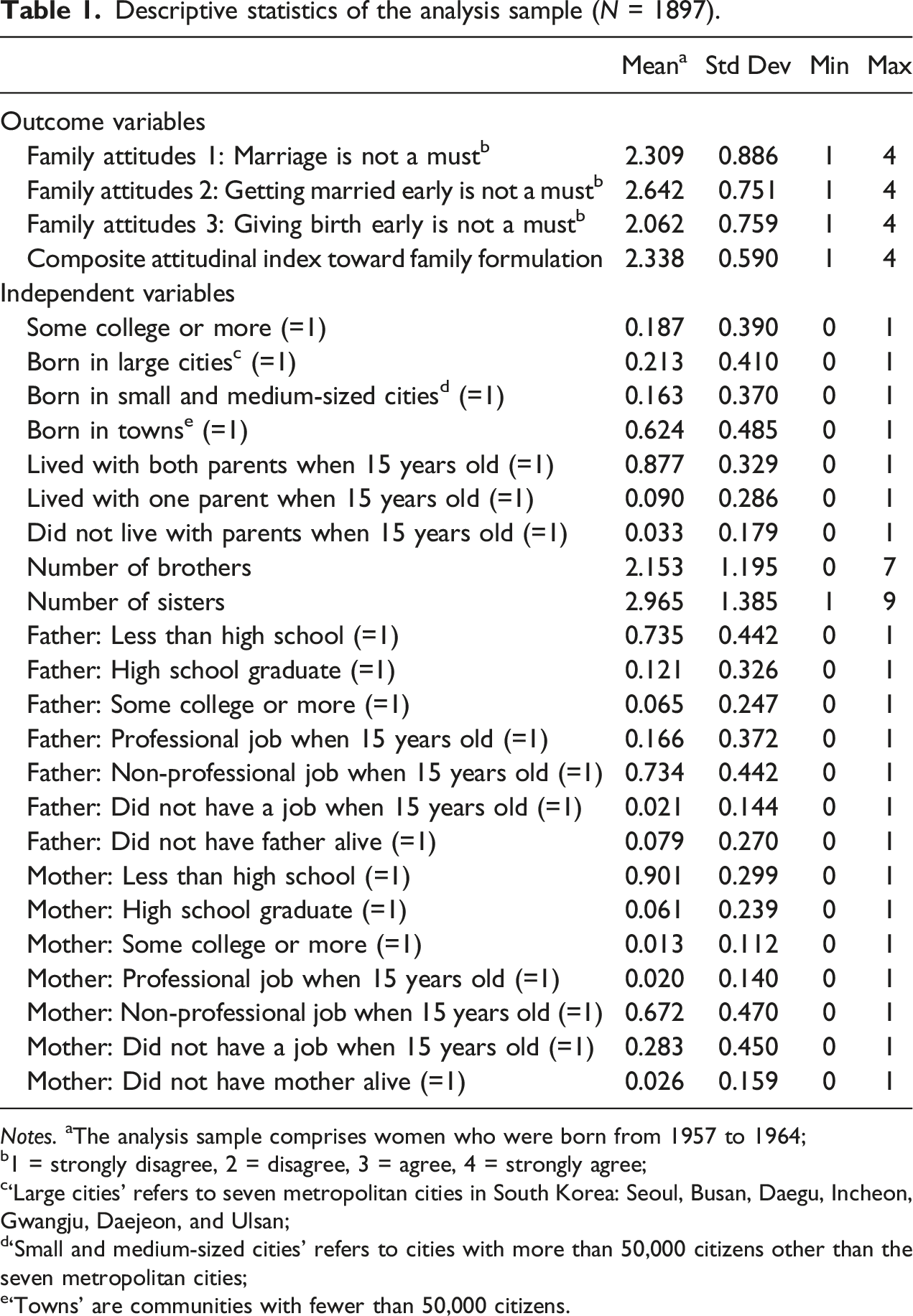
Notes. aThe analysis sample comprises women who were born from 1957 to 1964;
b1 = strongly disagree, 2 = disagree, 3 = agree, 4 = strongly agree;
c‘Large cities’ refers to seven metropolitan cities in South Korea: Seoul, Busan, Daegu, Incheon, Gwangju, Daejeon, and Ulsan;
d‘Small and medium-sized cities’ refers to cities with more than 50,000 citizens other than the seven metropolitan cities;
e‘Towns’ are communities with fewer than 50,000 citizens.
Our treatment variable, a dummy variable for college attendance (some college or more), shows that 18.7 percent of women from cohorts born 1957-1964 in our analytic sample attended college. The remaining independent variables include birthplace, cohabitation with parents at age 15, number of siblings, father and mother’s education, employment status of parents when the women were 15 years old, and a dummy variable to indicate whether their mother or father is not alive. Most of the women were born in small towns (62.4 percent), lived with both parents at age 15 (87.7 percent), and have about two brothers and three sisters, on average. Most of their parents did not finish high school and had a non-professional job when the respondents were 15 years old.
College education rates by birth cohort (N = 1897).
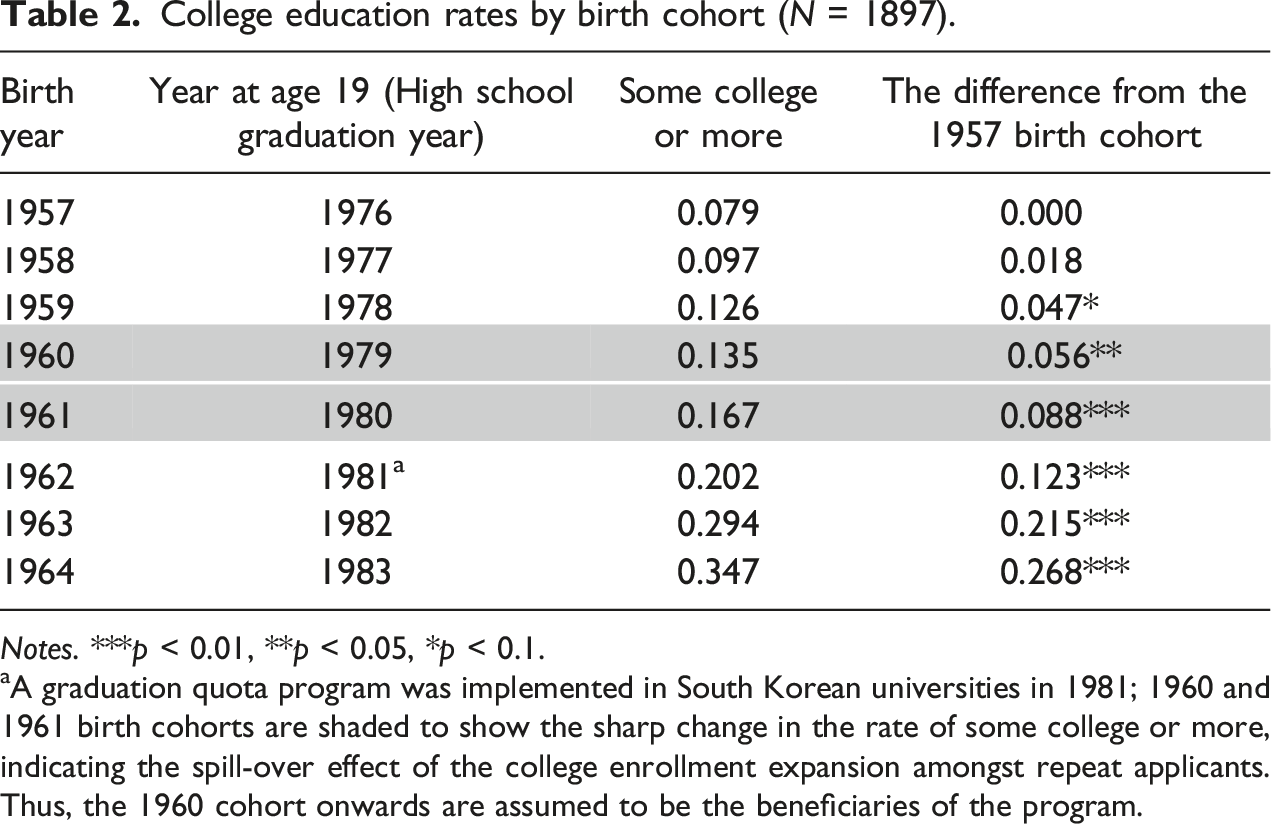
Notes. ***p < 0.01, **p < 0.05, *p < 0.1.
aA graduation quota program was implemented in South Korean universities in 1981; 1960 and 1961 birth cohorts are shaded to show the sharp change in the rate of some college or more, indicating the spill-over effect of the college enrollment expansion amongst repeat applicants. Thus, the 1960 cohort onwards are assumed to be the beneficiaries of the program.
As the graduation quota program was implemented in 1981, the cohort directly affected by the policy was born in 1962 (aged 19 entering college in 1981). However, we note a rising trend of college education rates among earlier cohorts by one or two years (highlighted), which seems to be related to the increased number of re-applicants who waited one or more years after high school graduation before being admitted to college. Thus, the highlighted cohorts captured the spillover effect of the policy amongst re-applicants: the 1960 and 1961 birth cohorts increased college education by 5.6 and 8.8 percentage points, relative to the oldest cohort in our analysis (p < .05). The 1962 birth cohort onwards increased college education by more than 10 percentage points, relative to the oldest cohort.
Composite attitudinal index toward family formulation by birth cohorts (N = 1897).
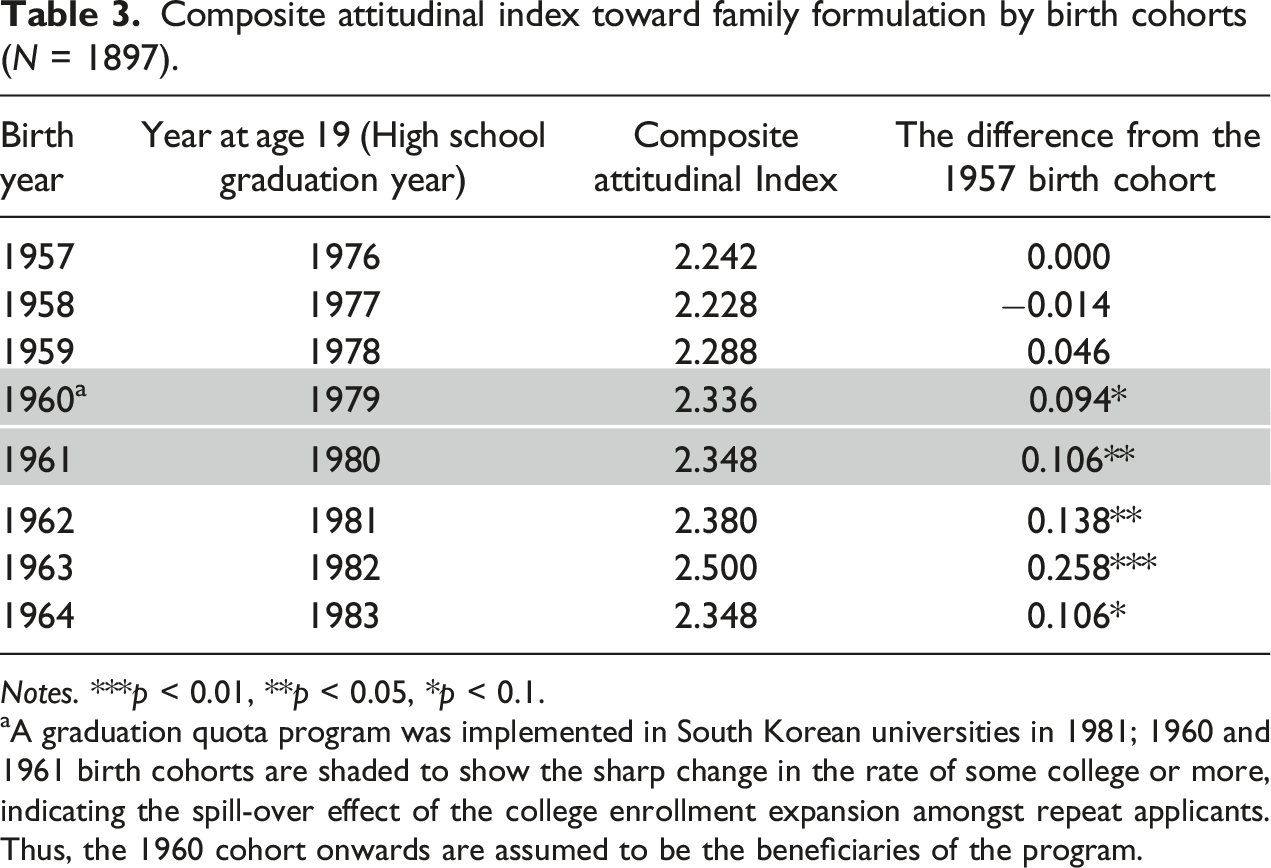
Notes. ***p < 0.01, **p < 0.05, *p < 0.1.
aA graduation quota program was implemented in South Korean universities in 1981; 1960 and 1961 birth cohorts are shaded to show the sharp change in the rate of some college or more, indicating the spill-over effect of the college enrollment expansion amongst repeat applicants. Thus, the 1960 cohort onwards are assumed to be the beneficiaries of the program.
Statistical Model
This study takes advantage of a natural experiment, with the sudden expansion of college admission implemented in 1981 by the military coup regime in South Korea, to estimate the impact of women’s college education on their attitudes toward family formation. 3 Methodologically, it constructs an instrumental variable (IV) for the main treatment variable—women’s college education. The binary IV is 1 for women who were more likely to be exposed to the college admission expansion, being high school graduating age during the policy expansion (aged 19 from 1979 to 1983 or born from 1960 to 1964), and 0 for those who were less likely to be affected by the policy intervention, having graduated before the policy change (aged 19 from 1976 to 1978 or born from 1957 to 1959). This IV covers eight birth cohorts in total before and after the program, with consideration of the trade-off between endogeneity (when the cohorts compared are too different) and efficiency (if we analyze too small a sample size).
Two assumptions are made for a valid IV analysis: (1) the IV (birth cohort dummy) is highly correlated with the treatment variable (college education), and (2) the IV is not included in the outcome equation, called the exclusion restriction assumption. The first assumption is testable using the first-stage regression in the two-stage least squares estimation. The second assumption is not testable (Angrist, 1991; Murnane & Willett, 2010). Therefore, we discuss possible violations of the exclusion restriction assumption in the discussion and conclusion section.
Our IV estimates are for the Local Average Treatment Effect (LATE) for women prompted to attend college due to the graduation quota program, as the policy impact is likely to vary among women (Angrist et al., 1996; Card, 1999; Heckman et al., 1999). Thus, the monotonicity assumption is made for the consistent IV estimates for the LATE (Angrist et al., 1996). Accordingly, women are induced by the graduation quota program in one direction; that is, we assume that there are no women who do not go to college with the policy but go to college without the policy. In other words, there are only three types of women; those that always go to college regardless of the policy, those that always do not go to college regardless of the policy, and those who do go to college only with the policy. This assumption appears to be valid since women in the birth cohorts of our analysis went to college for their advantage in society.
Our IV analysis using the two-stage least squares (2SLS) estimation is specified as follows
Thus, the coefficient of college attendance (
For the 2SLS estimation with the binary IV for college education, the first–stage equation is constructed as follows
Empirical Results
First-stage regression results.
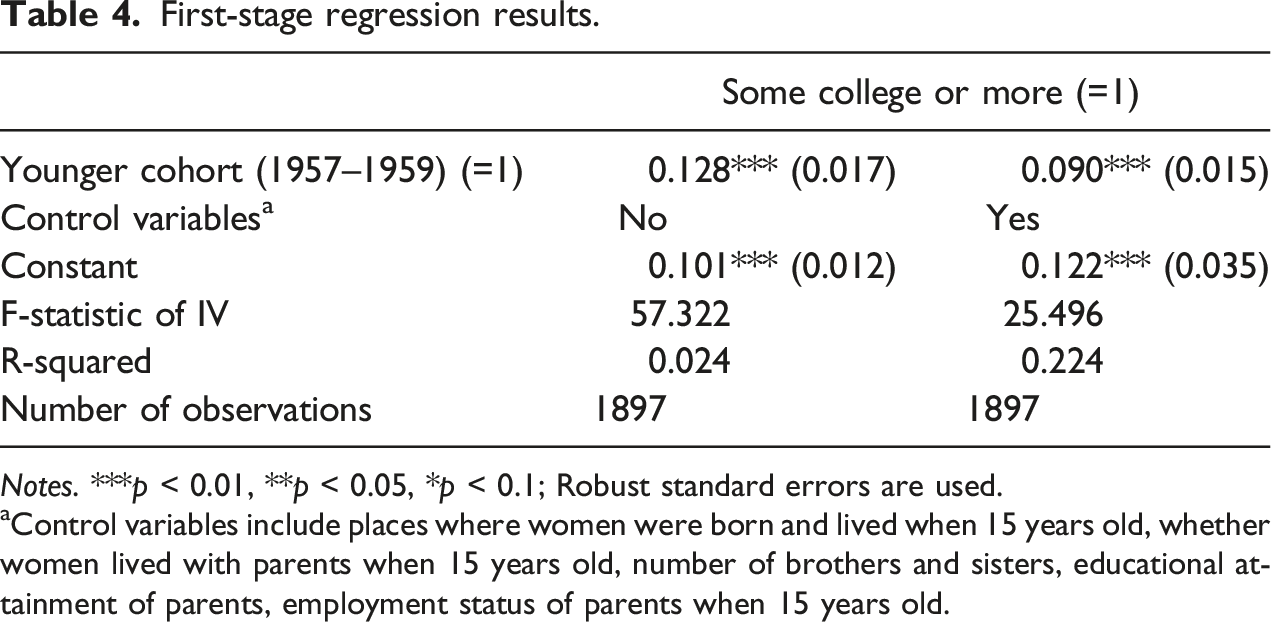
Notes. ***p < 0.01, **p < 0.05, *p < 0.1; Robust standard errors are used.
aControl variables include places where women were born and lived when 15 years old, whether women lived with parents when 15 years old, number of brothers and sisters, educational attainment of parents, employment status of parents when 15 years old.
Estimated impact of college education on attitudes toward family formulation (N = 1897).
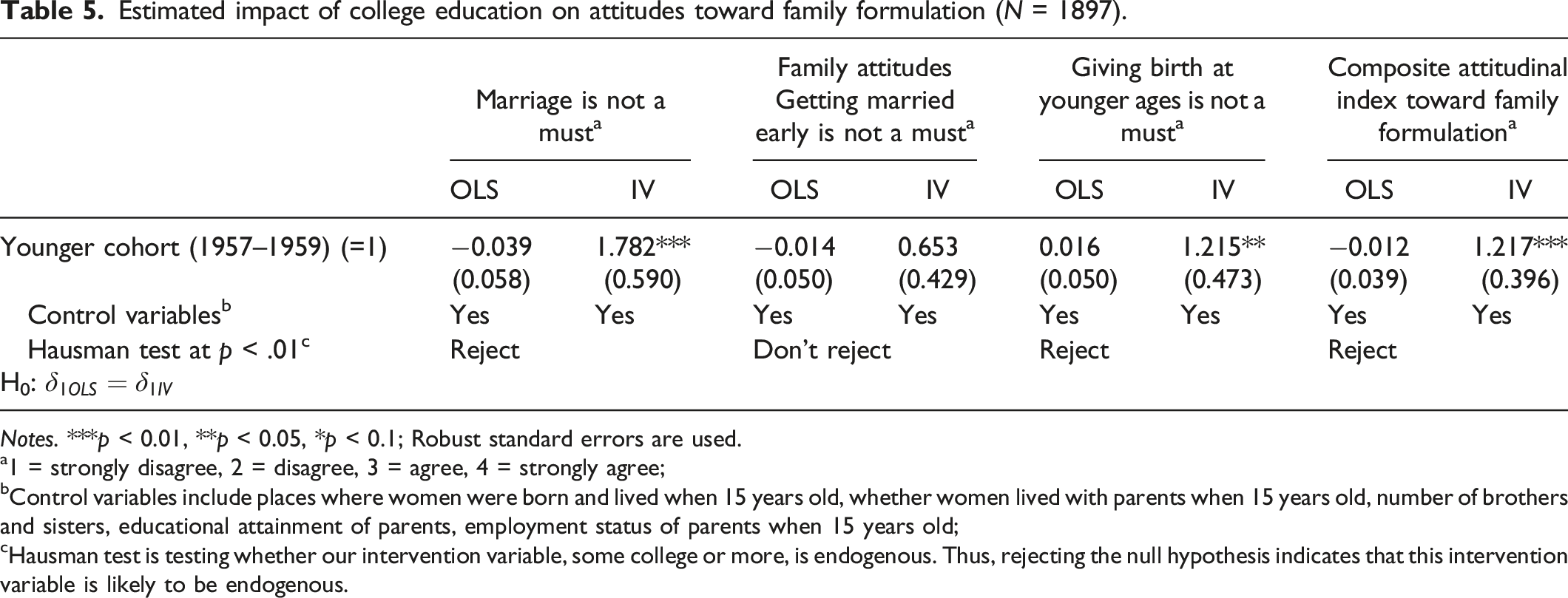
Notes. ***p < 0.01, **p < 0.05, *p < 0.1; Robust standard errors are used.
a1 = strongly disagree, 2 = disagree, 3 = agree, 4 = strongly agree;
bControl variables include places where women were born and lived when 15 years old, whether women lived with parents when 15 years old, number of brothers and sisters, educational attainment of parents, employment status of parents when 15 years old;
cHausman test is testing whether our intervention variable, some college or more, is endogenous. Thus, rejecting the null hypothesis indicates that this intervention variable is likely to be endogenous.
The Hausman test shows whether the OLS estimate is statistically different from the IV estimate at p < .01. If it is, the intervention variable (some college or more) is endogenous. In our case, the test suggests that attending college is likely to be endogenous for the attitudinal variables, except for the second column. Thus, the IV estimate is a better method to estimate the true impact of college attendance than the OLS estimate. Given the difference between the IV and OLS estimates, we find the bias direction of the OLS estimate negative. Assuming that parents holding more conservative family ideology (filial piety, traditional kinship norms, and patriarchy) have more resources to invest in their children’s education in South Korea’s context 6 and that women’s ideology is also largely influenced by the parents’ ideology, the OLS estimate might appear smaller than the true parameter (negatively biased).
Discussion and Conclusion
Social attitudes toward marriage and children have shifted away from the traditional norms of universal marriage and childbearing. The trend toward non-traditional values of marriage and children is evident in Western countries (Gubernskaya, 2010) and, even in conservative Asian countries, we observe marriage delays and an awareness that marriage is no longer a financial necessity for women and can have considerable downsides (Williams & Guest, 2005).
Gender, marital status, education, employment and work hours, urbanity, stratification, and religiosity have all been associated with less traditional perspectives on marriage and children (Fuwa, 2014; Gubernskaya, 2010; Surkyn & Lesthaeghe, 2004). While the second demographic transition theory (Lesthaeghe, 2014) stresses the importance of education, its endogenous nature makes it hard to determine a causal link with attitudinal changes. This study aims to fill this literature gap using South Korea’s policy shock, which offered women the opportunity to attend college in the 1980s and analyzes the enduring impact of college education on women’s family ideologies.
This study finds that college education in the 1980s encouraged the liberalization of women’s attitudes toward marriage and motherhood in their mid-40s. Specifically, women who were encouraged to attend college through the graduation quota program were more likely to report that marriage and giving birth at younger ages were not necessary when compared with those who were not given the opportunity. Similarly, the composite index of family formulation showed that women with a college education had less traditional family attitudes than women without a college education.
Some may have raised a sample selection issue that women who wanted to go to college in the first place would be more liberal in their views towards marriage and childbearing, and especially the women who had attempted to get into college prior to the regime and policy change were likely to hold a more liberal view. To investigate this possibility, we compared women from the spillover birth years (born in 1960 and 1961) versus women who were born after (1962 onwards) in their university attendance, and their subsequent marriage/childbearing attitudes in 2007. Accounting for different college attendance rates between spillover cohorts and post-policy cohorts, we found that post-policy cohorts are rather slightly more liberal than spillover cohorts with the difference being marginal and statistically insignificant. Thus, we can rule out the possibility that spill-over cohorts might have biased our regression results.
This study’s findings contribute to the literature by showing a direct link between college education and women’s attitudes toward family formulation in South Korea. Changing family-related attitudes of women toward less traditional values in South Korea is aligned with findings from Western countries, especially the U.S. (Cunningham et al., 2005; Gubernskaya, 2010; Kaufman, 2000; Thornton & Young-DeMarco, 2001; Trent & South, 1992). Women’s college education plays a significant role in changing attitudes to non-traditional ones, as predicted by the second demographic transition theory. Our study will complement the finding of Jung & Jung (2022), by providing the mechanism to explain the causal relationship between women’s higher education and their non-marriage and reduced childbearing. Also, this finding will emphasize the changing nature of gender norms in life course theory. Not only do family-related attitudes change over time through aging (Kim & Cheung, 2015), they can also change by education earlier in life.
Our study has several caveats to discuss. First, if the exclusion restriction of the IV is violated, the estimated impact of college education on women’s family-related attitudes will be biased. In other words, being younger could be correlated with unobserved characteristics in the outcome equation, such as being less traditional in their social attitudes and norms. As a result, the IV estimate could be overestimated in our analysis. However, the age difference among women in our analysis is small, and Table 3 indicates that the composite attitudinal index is not considerably different among older cohort women born in 1957–1959 who were not likely to be exposed to the graduation quota program. Thus, it appears that any estimation bias driven by the violation of the exclusion restriction is minor. Secondly, we need to be cautious in generalizing our findings to other countries and times. The advancement of women’s education through the graduation quota program and the socio-economic experiences in the 1980s and 1990s in South Korea should be considered when applying our findings to other contexts.
Thirdly, our study does not analyze male family attitudes since our dataset only contains attitudinal information about women. A future study is needed on male attitudinal changes and expected gender differences. Fourth, instead of averaging the three ideological items for the overall attitudinal index toward family formulation, we create another composite index to measure the women’s overall attitude, following the common practice of using factor analysis for a composite index. The result is not reported in this paper, as the structure of variables for our paper is not complicated or multi-layered enough to require factor analysis. However, the result remains consistent in our OLS and IV analyses.
Some may be concerned whether there was a dramatic shift in demographic characteristics (including family backgrounds and innate ability) between women who were aged 19 in the pre-program period and women who were aged 19 in the post-program period, leading to a bias in our IV estimates. We explored this possibility using South Korean census data (e.g., population in 1975 and 1980, households in 1975 and 1980, population trends by administrative divisions in 1975 and 1980 7 ). To the best of our knowledge, there were no significant differences in family size, wealth, fertility, or other important aspects between these cohorts that could have influenced their decision to attend college, which was reconfirmed in our sample. Plus, the analytic cohorts were born 3–4 years apart (in 1957–1959 and 1960–1964), and such adjacent birth cohorts were less likely to face dramatically different family attitudes.
Despite the caveats, our study is one of the first studies to examine the enduring impact of college education on women’s family ideologies in their later life. This empirical evidence provides an insight into the role of college education in people’s ideational changes and understanding marriage delay and fertility decline. Interestingly, the government’s wide policy change was the driving force to have brought both women’s widespread higher education and attitudinal change. Now, it is commonly known that South Korea is one of the countries in East Asia to have gone through enormous changes in women’s demographic characteristics, but this study gives particular attention to their value systems and ideational changes. Understanding the attitudes of highly educated women, which accounts for most Korean women now, will be important when it comes to designing new fertility policies. This encourages more discussion and future studies on the education and family ideologies of men and women.
Footnotes
Acknowledgments
Haeil Jung acknowledges that this study has been supported by a Korea University Grant (K2107691). Haeil Jung also notes the support of the Ministry of Education of the Republic of Korea and the National Research Foundation of Korea (NRF-2016S1A3A2924956).
Declaration of Conflicting Interests
The author(s) declared no potential conflicts of interest with respect to the research, authorship, and/or publication of this article.
Funding
The author(s) disclosed receipt of the following financial support for the research, authorship, and/or publication of this article: This work was supported by the Korea University Grant (K2107691) and the Ministry of Education of the Republic of Korea and the National Research Foundation of Korea (NRF-2016S1A3A2924956).
