



Abstract
In an era of rapid aging and shrinking family sizes, only children have gradually become the main providers of old-age support. China offers a unique opportunity to investigate old-age support provision in one-child families due to its strict family planning policies. Using four-wave panel data from the China Health and Retirement Longitudinal Study, we ask whether old-age support in one-child families is more or less motivated by parental investments than in multi-child families. Results show a coexistence of fairness maintenance thesis and singleton compensation thesis: children’s returns to parents in one-child families are weakly motivated by their parents’ large-sum investments, but strongly motivated by parental daily transfers. In one-child families, sons are more obliged to provide old-age support in return for parental transfers than are daughters. The policy implications for old-age support provision in an aging society with a declining family size are also discussed.
Introduction
The world has entered a period of rapid and dramatic population aging, which has raised the burden of old-age support in many parts of the world (Lutz et al., 2008; Harper, 2014). At the same time, the global average number of children is expected to decline from 1.9 per household in 1980 to 1.0 per household in 2020 (Khadaroo & MacCallum, 2021). Decreases in fertility and improvements in medical services have changed the family structure, specifically, more living generations and fewer children to provide old-age support. In particular, the shrinking family size has resulted in an interesting and unprecedented phenomenon across the world: children in one-child families (also referred to as singletons) have gradually become the main providers of old-age support to their aging parents.
Despite the rise in singletons as the main old-age caregivers, little empirical attention has been paid to whether the provision of old-age support in one-child families may be different. Singleton children grow up in families that are different from multi-child families in terms of the socialization process and parenting styles (Khadaroo & MacCallum, 2021). Singleton children attract the greatest attention from their parents and receive more resources since they face no competitors for family resource investment (Chen & Jordan, 2018). Parents’ monetary assistance may be viewed as a form of investment that could yield some security in their old age (Becker, 1974). We ask whether the norm of realizing security through investments may change as singleton children gradually become the main caregivers.
This research focuses on the provision of old-age support in one-child families. In particular, we are interested in the heterogeneous effect of parental investment on old-age support, namely, whether old-age support in one-child families is more or less motivated by parental transfers than in multi-child families. The answer to this question may help us understand the old-age support provision in an aging society where only children are the main caregivers. We suggest two reasons that China is a uniquely ideal case to examine such research questions.
First, the decades-long birth control policy in China has resulted in a substantial proportion of one-child families. The Chinese central government launched the one-child policy in the early 1980s to control the size of population, although it loosened the policy considerably in 2015. Figure 1 shows that since the 1960s, the fertility rate in China dropped much faster than it did in other middle-income countries. The one-child policy enhanced the already low fertility rate and resulted in around 150 million one-child families as of 2015 (Wang et al., 2016). Fertility rate in China and elsewhere, 1960–2018.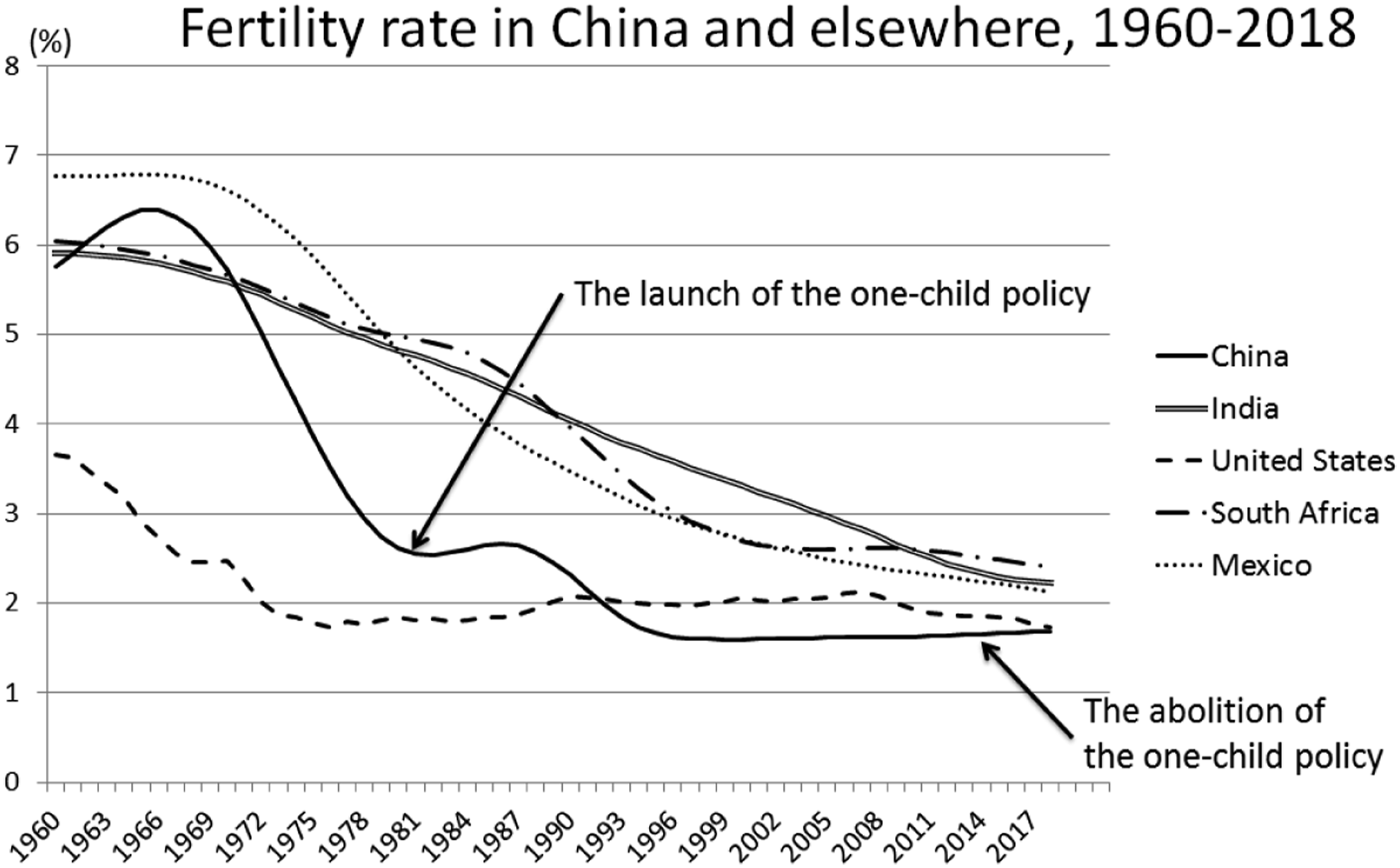
The most recent census in China, in 2020, reveals that the average household size shrank from 3.09 in 2010 to 2.62 in 2020, and the number of small households with only one or two persons has increased rapidly. At present, parents of the first-generation of singletons (that is, those born in the early 1980s) are now in their sixties or older. The burden of old-age support provision for the parents of singletons is going to be a serious social problem.
Second, the filial piety norm in Chinese culture emphasizes the role of children in providing old-age support. Filial piety is one of the Thirteen Classics of the Confucian tradition dating back to the fourth century BC and is even written into the Chinese Constitution (Chen & Fang, 2021). 1 Unlike Western countries, where formal social care is more developed and is often provided by the government and private enterprises, the long-term care system in China relies heavily on informal care provided by family members. Hu (2019) projects that the demand for informal care will increase from 41.3 million people in 2015 to 82.6 million people in 2035. Even though China is developing its public insurance system, such as through its Basic Old Age Insurance, the Resident Pension Scheme, and the New Rural Pension Scheme, pensions serve as a supplement rather than a substitute for family support for China’s aging population due to the low standard of its public insurance system, particularly among rural aging populations (Chen & Fang, 2021; Lin, 2019).
Taking China as an example, this research discusses the provision of old-age support among singletons in an era of shrinking family size and aging population. In particular, we derive the “fairness maintenance thesis” and “singleton compensation thesis” to discuss how old-age support is motivated by parental investments differently in one-child families than in multi-child families. We also ask how gender matters in old-age support in one-child families.
Literature Review and Hypotheses
Intergenerational Support: Models, Motives, and Old-age Support
Intergenerational support is a crucial topic in family studies. Researchers from different fields have come up with many theoretical models and motives to explain intergenerational exchanges (Lee et al., 1994). We first draw on the power and bargaining model, the mutual aid model, and the corporate group model, and discuss intergenerational old-age support in families with different numbers of children under each model.
Power and Bargaining Model
The power and bargaining model emphasizes the motive of power in intergenerational relationships and regards intergenerational transfers as a struggle for family resources (Pezzin et al., 2015). Under this model, parents with greater socioeconomic status tend to receive more support from their adult children (Lillard & Willis, 1997). Regarding the provision of old-age support by only children, Phillips and Feng (2015) discovered that aging parents of singleton children were less likely to receive support, or may receive lower levels of support from their children than do parents in multi-child families. Since singleton children receive more family investments and are more likely to achieve high social status, the opportunity cost for old-age support provision increases for singleton children, so they provide less old-age support to their parents (Ho, 2019). However, Shi (2008) attributed the difference in old-age support provision in one-child and multi-child families to the parents’ and children’s socioeconomic factors. In other words, power rather than the number of children explains adult children’s old-age support for their aging parents.
Mutual Aid Model
The mutual aid model highlights the functional unity of the family and specifies that intergenerational transfers are isomorphic with the needs and resources of each generation (Schoeni, 1997). Altruism is the motive for intergenerational support in the mutual aid model. Children care about the well-being of their aging parents and value their transfers to their parents due to the warm-glow motive (Andreoni, 1990). This model predicts that intergenerational support is altruistically motivated, with the giver not expecting support in return. Elderly parents who are in need, that is, those who are in poor health or experiencing financial difficulties, are more likely to receive support and care from their adult children (Grundy, 2005; Sun, 2002). Under this model, old-age support is part of a public good shared among altruistic children, so children with more siblings would provide lower transfers to parents (Cornes et al., 2012). In contrast, altruistic singleton children would provide more old-age support when their parents are in need.
Corporate Group Model
The corporate group model suggests that two generations in an extended family might function as a corporate group (Becker & Tomes, 1979). The motive in the corporate group model is reciprocity, which is also referred to as the exchange approach (Liu et al., 2020). Reciprocity suggests that giving leads to an obligation to reciprocate and intergenerational support is rooted in a reciprocal structure, so parents who have provided more transfers to their children should receive more old-age intergenerational support. Gouldner (1960) regarded reciprocity as a universal norm that “defines certain actions and obligations as repayments for the benefits received” (p. 170).
Scholars have corroborated the existence of long-term reciprocity for intergenerational transfers: receiving financial help in the past has a positive effect on a child’s current behavior in providing assistance (Henretta et al., 1997; Silverstein et al., 2002). Leopold and Raab (2011) argued that reciprocity also existed in short-term intergenerational relationships, as aging parents provided financial transfers to those children who supported them with time transfers of help and care. To address the reciprocity in one-child and multi-child families, Chen and Jordan (2018) discovered that adult children in families with different numbers of children did not differ in their support provision to elderly parents, even though children in one-child families received more early-life family investments.
Although the three models are crucial to explain the intergenerational relationships, we should not ignore the role of social norms in old-age support provision. Intergenerational support may be affected by various social norms, particularly the filial piety norm. The filial piety norm requires adult children to provide care and assistance to their elderly parents. It frames intergenerational relations as part of family cohesion. By emphasizing individuals’ obligations to the family, the filial piety norm is consistent with intergenerational solidarity theory, which holds family members together as an entity (Bengtson & Roberts, 1991; Lowenstein, 2007). Empirical evidence has corroborated the filial responsibility of old-age support provision in Western and Chinese societies (Ikkink et al., 1999; Lin & Yi, 2011). The filial piety norm plays an even stronger role in one-child families because only children become more aware of their filial responsibilities since they have no siblings to share in the caring for their aging parents. Singleton children feel especially responsible for their parents’ happiness (Deustch, 2006) and feel high levels of obligation to provide help to their aging parents (Zhan, 2004).
How do we understand old-age support provision when singleton children become the main caregivers? This research asks whether the old-age support in one-child families is more or less motivated by parental transfers than in multi-child families, and we expect the corporate group model to be more relevant as it directly hypothesizes that parents who have provided more transfers to children should receive more returns. The corporate group model is also widely supported in explaining the reciprocal and frequent intergenerational transfers in Chinese families (Cong & Silverstein, 2011; Lee et al., 1994). Nevertheless, social norms are also crucial in predicting caregiving intentions and old-age support in China among the one-child generation (Deustch, 2006; Warmenhoven et al., 2018). Therefore, this research derives two competing theses to discuss old-age support in one-child families and does so by incorporating the corporate group model and social norm approach.
Fairness Maintenance Thesis
Singleton children are the sole providers of old-age support, whereas children with siblings can divide the responsibility for providing old-age care to their aging parents. We hypothesize that the “fairness maintenance thesis” may explain how old-age support differs in one-child families and multi-child families. As is suggested by the reciprocity motive, in the past, adult children provided old-age support in return for parental investments. Nevertheless, intergenerational exchanges between parents and children are part of family cohesion, according to the intergenerational solidarity theory. To avoid conflicts within the family, children with siblings evolve the tendency to maintain fairness when providing returns to their aging parents. A fair strategy for adult children in multi-child families is to strive for equivalence between parental transfers and returns to parents. For instance, parental housing assistance in multi-child families is likely to trigger greater financial returns since those who receive the assistance find it necessary to justify having been “more responsible” and “more deserving” than their siblings to “win” their parents’ help (Heath, 2018).
In contrast, children in one-child families do not have to compete with siblings for family resources when they are young, nor do these children feel a sense of urgency to “win” parental inputs when they are growing up. Researchers have discovered that singleton children receive more early-life family investments compared with children with siblings, yet such parental transfers do not directly lead to greater old-age support in one-child families (Chen & Jordan, 2018). Therefore, we hypothesize that children in one-child families feel less obliged to provide old-age support to their parents even if they have received past investments from their parents. In other words, old-age support provided by singleton children is less likely to be associated with parental investments than is the old-age support provided by children in multi-child families. We thus generate Hypothesis 1: In one-child families, the effect of parental transfers on returns to parents is weaker than in multi-child families.
Singleton Compensation Thesis
In one-child families, the family structure shifts, from one that is pyramid-shaped, with few old persons at the top and many young children at the base of the pyramid, to one that resembles a beanpole, with more of a balance between the proportion of older people and children (Bengtson, 2001). Researchers argue that people tend to compensate for a lack of extensive family ties by intensifying their emotional exchange through existing family ties (Moore & Komter, 2012). To extend this theory, the shrinking supply of children is likely to result in compensation in the form of returns to parents, referred to as the “decreased supply compensation thesis.” We adapt this thesis to the “singleton compensation thesis,” as we focus on old-age support in one-child families. As is suggested by the “decreased supply compensation thesis,” the singleton compensation thesis hypothesizes that children with no siblings are more likely to visit their parents, provide instrumental support, and engage in emotional exchange with their parents (Moore & Komter, 2012; Wolf et al. 1997; Spitze & Logan 1991).
In addition, the one-child policy has led to greater involvement in nurturing the only child in a family (Short et al., 2001), so singleton children may naturally develop a more intimate relationship with their parents. Single-child families are usually more child-centered (Khadaroo & MacCallum, 2021). Deutsch (2006) found that the children in one-child families are positively associated with intentions to provide caregiving to aging parents, and Zhan (2004) discovered that singleton children showed a significantly greater sense of obligation toward the future care of their parents. Due to the strong and intimate parent–child relationships, we hypothesize that adult children in one-child families may provide more reciprocal returns in response to their parents’ transfers. We thus derive Hypothesis 2: In one-child families, the effect of parental transfers on returns to parents is stronger than in multi-child families.
Sons in One-Child Families
We have derived the “fairness maintenance thesis” and “singleton compensation thesis” to explain how intergenerational old-age support may differ in one-child and multi-child families. We now turn to the topic of the gendered intergenerational support in one-child families. The social norm approach is important in theories of intergenerational exchanges. Filial piety is a guiding principle in Chinese societies and specifies that adult children should support their elderly parents (Whyte, 2004). In terms of the gender-specific expectations of children’s filial behaviors, the patrilineal tradition of the Chinese family results in greater expectations of sons to provide old-age care to their parents (Sun, 2002), which also explains the long-held preference for sons in Chinese family culture.
However, there are contradictory results relevant to the gender differences in intergenerational exchanges in one-child families. On one hand, researchers have discovered that child centeredness in one-child families applies to both sons and daughters (Chow & Zhao, 1996). Similar to singleton sons, singleton daughters inherit the family wealth and take care of their aging parents because they have no brothers to compete with for family resources, but also no one to share in the caring for their aging parents (Deutsch, 2006). On the other hand, some argue that the gendered pattern of intergenerational support still exists in one-child families: singleton sons provide more financial returns and also receive more financial assistance (Chen & Jordan, 2018). The patrilineal tradition in one-child families may still persist: parents of singleton sons tend to have greater expectations of the support they will receive in their old age than parents of singleton daughters.
While the previous studies are compelling, researchers mainly investigated the net returns by sons and daughters. We are interested in how intergenerational old-age support is motivated by parental transfers in one-child families, so we may ask further how gender matters in intergenerational exchanges in one-child families. Due to the patrilineal tradition, we hypothesize that sons provide returns as an obligation, while daughters provide returns to parents on a more voluntary basis regardless of how much their parents have provided to them. In other words, daughters tend to develop an intimate and spontaneous relationship with their parents and regard their returns to their parents as a reflection of their love. This phenomenon is likely to be strengthened in one-child families because daughters are more capable of providing voluntary returns due to their higher economic status (Short et al., 2001). Therefore, we hypothesize that in one-child families, intergenerational old-age support is more likely to be associated with parental investments among sons than daughters. We thus derive Hypothesis 3: In singleton-son families, the effect of parental transfers on returns is stronger than in singleton-daughter families.
Data and Measurements
Data
The data used in this study are from the China Health and Retirement Longitudinal Study (CHARLS), a four-wave survey (2011, 2013, 2015, and 2018). CHARLS is a nationally representative longitudinal survey of non-institutionalized adults in China aged 45 years and older and their spouses. CHARLS 2018 is the latest survey that was released. 2 The aim of CHARLS is to examine the health and economic impact of the rapidly aging population in China, so it provides a unique opportunity to study old-age support provision in Chinese society. The official elderly population is defined as people aged 65 and over. We focus on those at 65 and over in our analysis sample because the need for old-age support among middle-aged parents is relatively low. We also eliminate from our sample parents with no children.
CHARLS collected information on every respondent aged 45 years and older in a household. Thus, the number of participants in CHARLS in a household may vary. When we restrict our sample to those aged 65 years and older, our sample ends up at 23350 respondents. Among the 23350 respondents, 9932 are from households in which only one respondent participated in CHARLS, and 13418 are from 6709 households where two respondents were surveyed. Table A1 in the Appendix presents the details. We start from the full sample in the analysis and try two subsamples for robustness checks.
Measures
Dependent Variables
The analytic outcome variables are old-age support from children to their parents. In China, old-age support usually takes the form of financial returns and emotional returns (Chen & Fang, 2021). This research thus considers these two types to be consistent with the previous literature. We will also discuss the role of coresidence in intergenerational relationships in the final section. Our research focuses on the differences in old-age support motivated by parental transfers in one-child families and multi-child families, so we will estimate old-age support per child within each family to make the intergenerational transfers comparable.
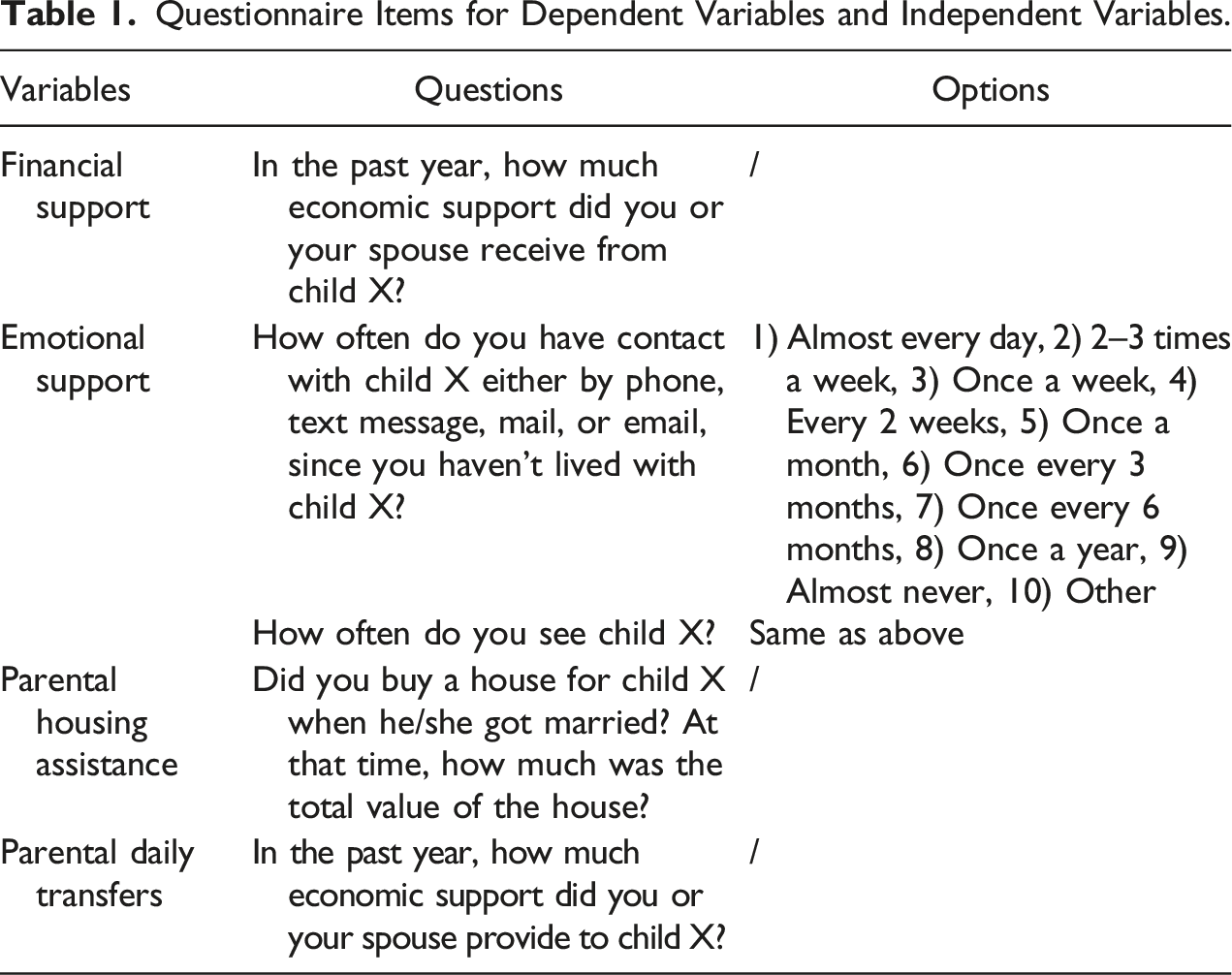
Questionnaire Items for Dependent Variables and Independent Variables.
Descriptive Statistics.
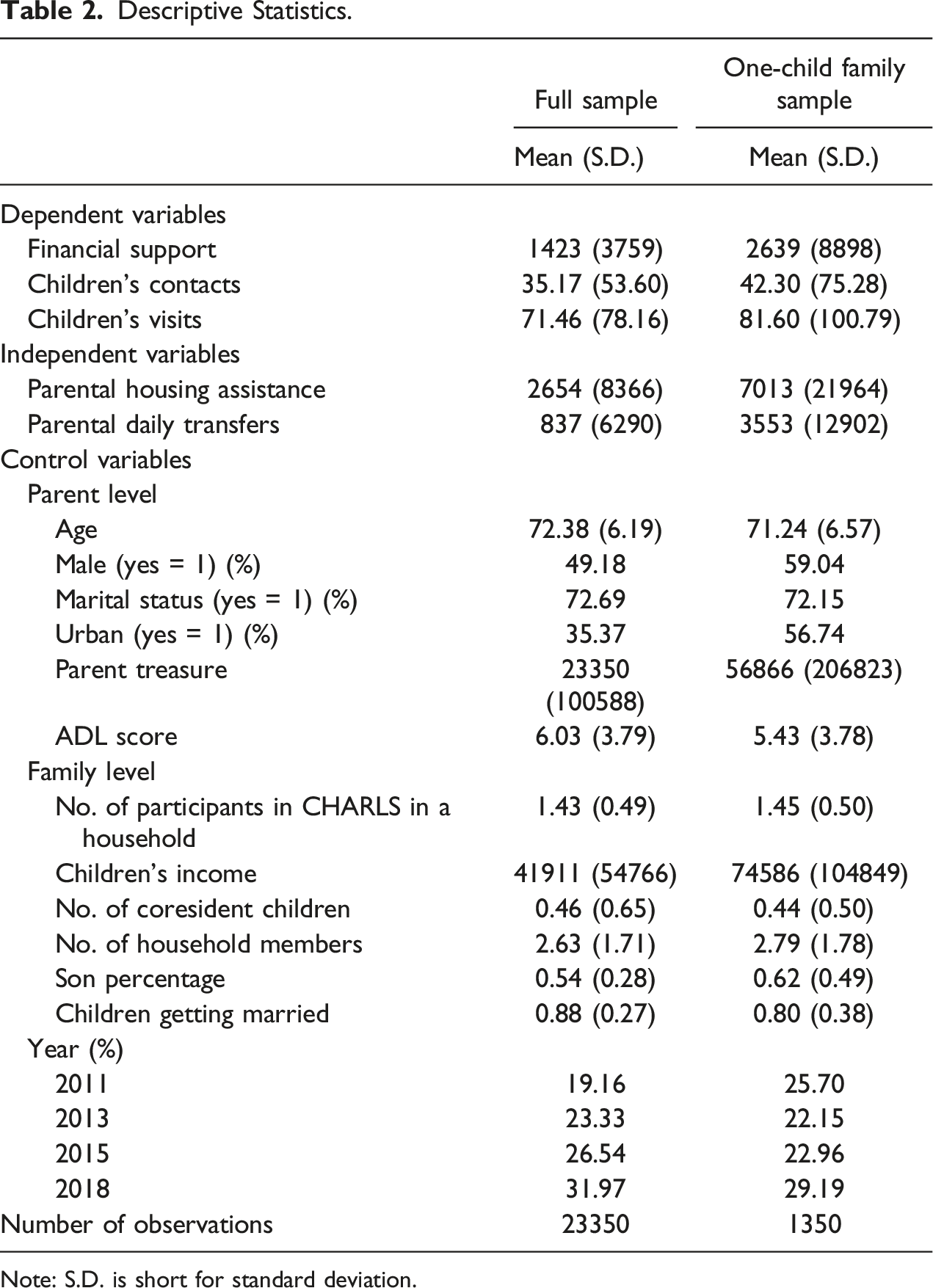
Note: S.D. is short for standard deviation.
Independent Variables
The independent variables are the parental transfers to children. We consider two types of investments: (a) parental housing assistance and (b) parental daily transfers. These investments could be provided even if parents and children did not live near or with each other. Table 2 presents the question on two independent variables.
Parental housing assistance belongs to large-sum one-time transfers to adult children. Long-term reciprocity suggests that earlier parental transfers exert a positive effect on adult children’s later support. In the Chinese context, parental housing assistance is a typical early parental investment because homeownership is often regarded as a prerequisite for marriage (Hu & Wang, 2019). Nevertheless, high housing prices in the post-2000s indicate serious housing unaffordability, especially for young people who typically have low income and wealth. Therefore, parents find it necessary to provide housing assistance to their children who have just entered the job market and have difficulty affording their own houses (Chen et al., 2010; Li & Shin, 2013). Parental daily transfers refer to concurrent intergenerational exchanges. These transfers are irregular, and the amount of the parental daily transfers may vary substantially. Short-term reciprocity suggests that adult children provide intergenerational support in response to their parents’ daily transfers (Leopold & Raab, 2011).
We wonder how parental housing assistance and parental daily transfers may motivate old-age support differently in one-child and multi-child families. We generate the two independent variables by calculating the average monetary values of parental housing assistance or parental daily transfers per child in a family.
Control Variables
We added control variables at the parent level and family level, which are likely to confound the relationships between parental transfers and children’s old-age support. Parent-level controls include being a male (yes/no), having urban residence (yes/no), the respondent’s age in years, his/her marital status (married/single or divorced, widowed or separated), and health conditions based on the activities of daily living scores. Family-level controls include the number of participants in CHARLS in a household, parental household assets, the number of people in the household, the number of coresident children, the percentage with a son (0–100%), the percentage with children who are getting married (0–100%), and the children’s average income. All family-level control variables are continuous variables.
Parental household assets and children’s average income indicate the power relationships between aging parents and adult children, while age, marital status, and health conditions indicate the need for old-age support. These are crucial determinants in the power and bargaining model and the mutual aid model. In our analysis, we control for the motive of power and need, in order to focus on the motive of reciprocity.
Research Findings
We present the descriptive statistics on dependent variables, independent variables, and control variables in Table 2. We use the full sample to discuss old-age support provision in one-child and multi-child families, and restrict it to the one-child family sample to test the role of gender in singleton families.
Intergenerational Transfers: The Coexistence of Two Theses
This section discusses how old-age support is motivated by parental transfers differently in one-child and multi-child families. We pool CHARLS 2011, 2013, 2015, and 2018 and employ the family-level longitudinal regression models. We use family-level analysis to avoid missing values in panel studies, which is common in demographic research (Cunningham et al. 2013). The Hausman test (p < 0.001) implies that the fixed-effects model is the more appropriate specification (Hausman, 1978; Wooldridge, 2002). Therefore, we use the fixed-effect model to investigate how old-age support is motivated by parental investment differently in one-child versus multi-child families. We obtain a robust standard error clustered by family in our regression models.
Fixed-Effect Model of Old-Age Support on Parental Housing Assistance.
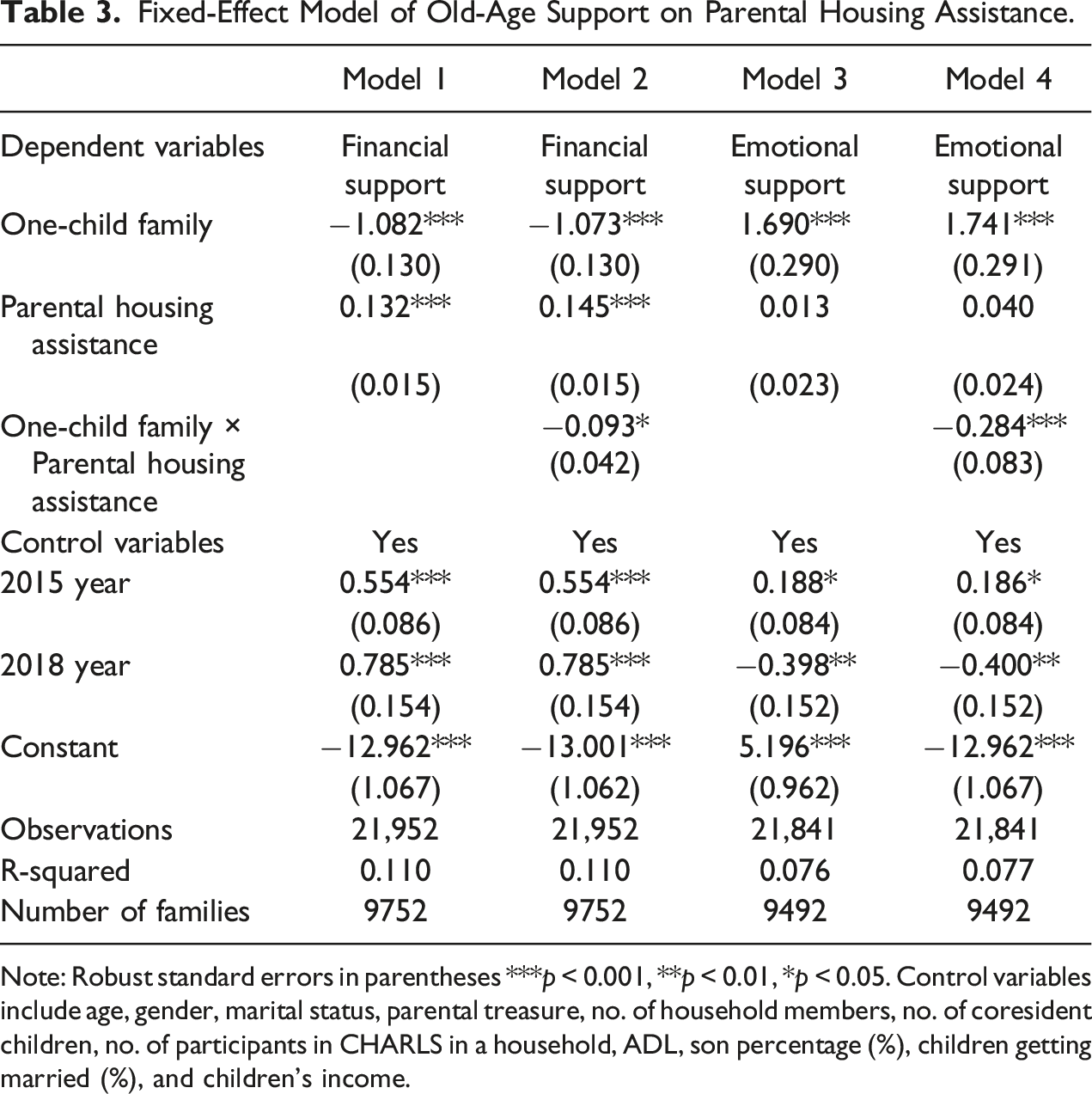
Note: Robust standard errors in parentheses ***p < 0.001, **p < 0.01, *p < 0.05. Control variables include age, gender, marital status, parental treasure, no. of household members, no. of coresident children, no. of participants in CHARLS in a household, ADL, son percentage (%), children getting married (%), and children’s income.
Fixed-Effect Model of Old-Age Support on Parental Daily Transfers.
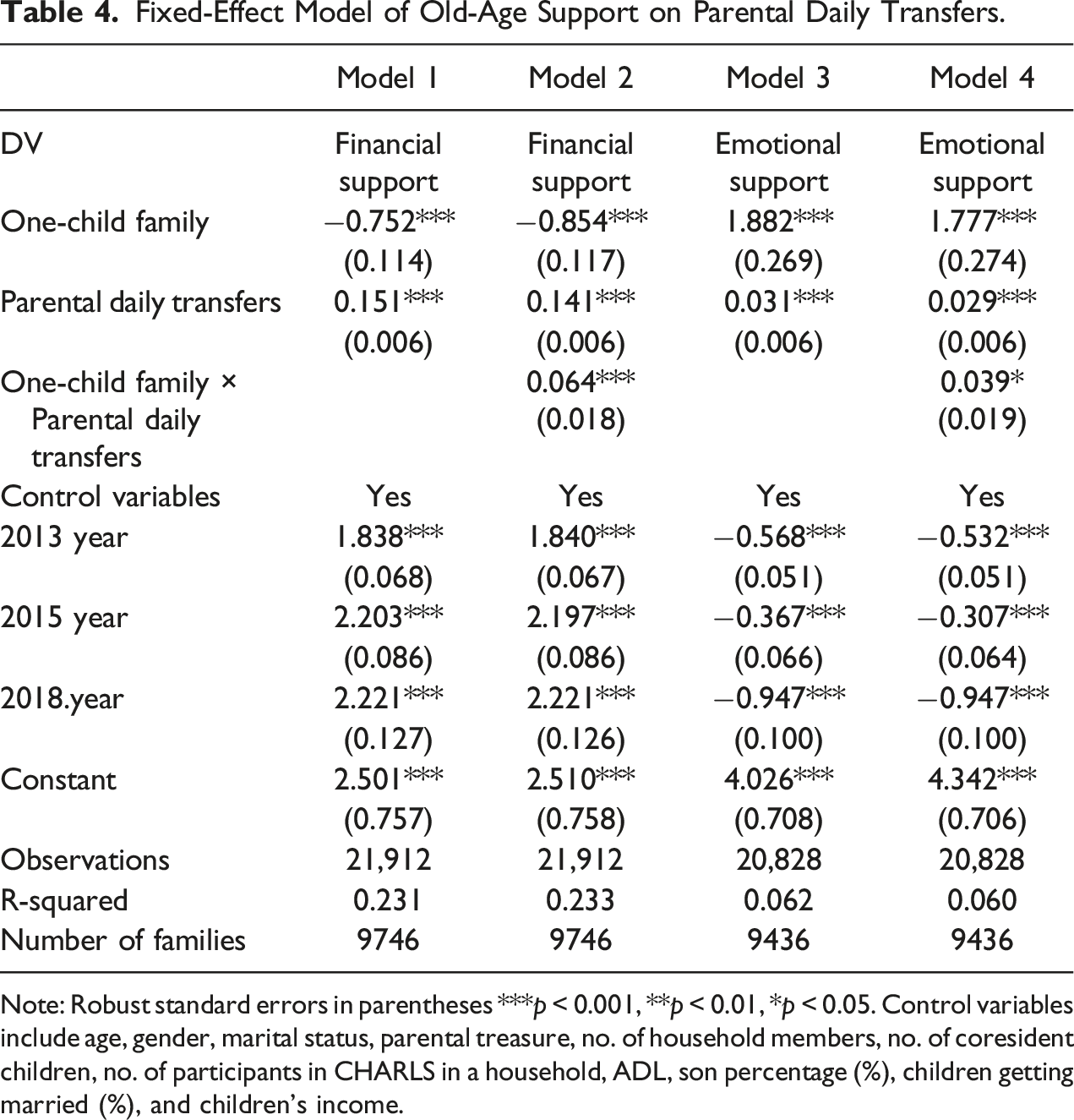
Note: Robust standard errors in parentheses ***p < 0.001, **p < 0.01, *p < 0.05. Control variables include age, gender, marital status, parental treasure, no. of household members, no. of coresident children, no. of participants in CHARLS in a household, ADL, son percentage (%), children getting married (%), and children’s income.
Tables 3 and 4 show that parental inputs significantly trigger financial support from children to their old-age parents, as the coefficient of parental housing assistance is 0.132 at a significance level of 0.001, and the coefficient of parental daily transfers is 0.151 at a significance level of 0.001. This is in line with the reciprocal corporate group model. The main effect of being in a one-child family is that singleton children provide less financial support but more emotional support to their parents than do children from multi-child families.
To investigate the differences in one-child and multi-child families, we first focus on the interactive terms in Models 2 and 4 in Table 3. The interactive terms between parental housing assistance and being a one-child family are negative for two kinds of old-age support, though at different levels of significance (p = 0.05 for financial support, p = 0.001 for emotional support). Therefore, old-age support in one-child families is less likely to be motivated by parental housing assistance than in multi-child families, thus corroborating the fairness maintenance thesis. Among adult children who receive large sums of parental housing assistance, singleton children are less motivated than children with siblings to provide monetary transfers, pay visits or contact (when they do not live with their parents), or coreside with their aging parents.
The fairness maintenance thesis suggests that children with siblings are obliged to provide more old-age support to maintain family solidarity after they have received parental investments. Our findings in Table 3 corroborate this thesis: old-age support provision motivated by parental housing assistance is smaller in one-child families than in multi-child families. We use Figure 2 to facilitate the discussion. Figure 1 shows the predictive margin of financial support to parents (drawn from Model 2, Table 3). We can see that financial support to parents is not sensitive to the increase in parental housing assistance because the line for one-child families is relatively flat. On the other hand, the positive effect is much more salient for multi-child families. An increase of parental housing assistance will result in a remarkable rise in financial support among multi-child families. Predictive margins of financial support on parental housing assistance.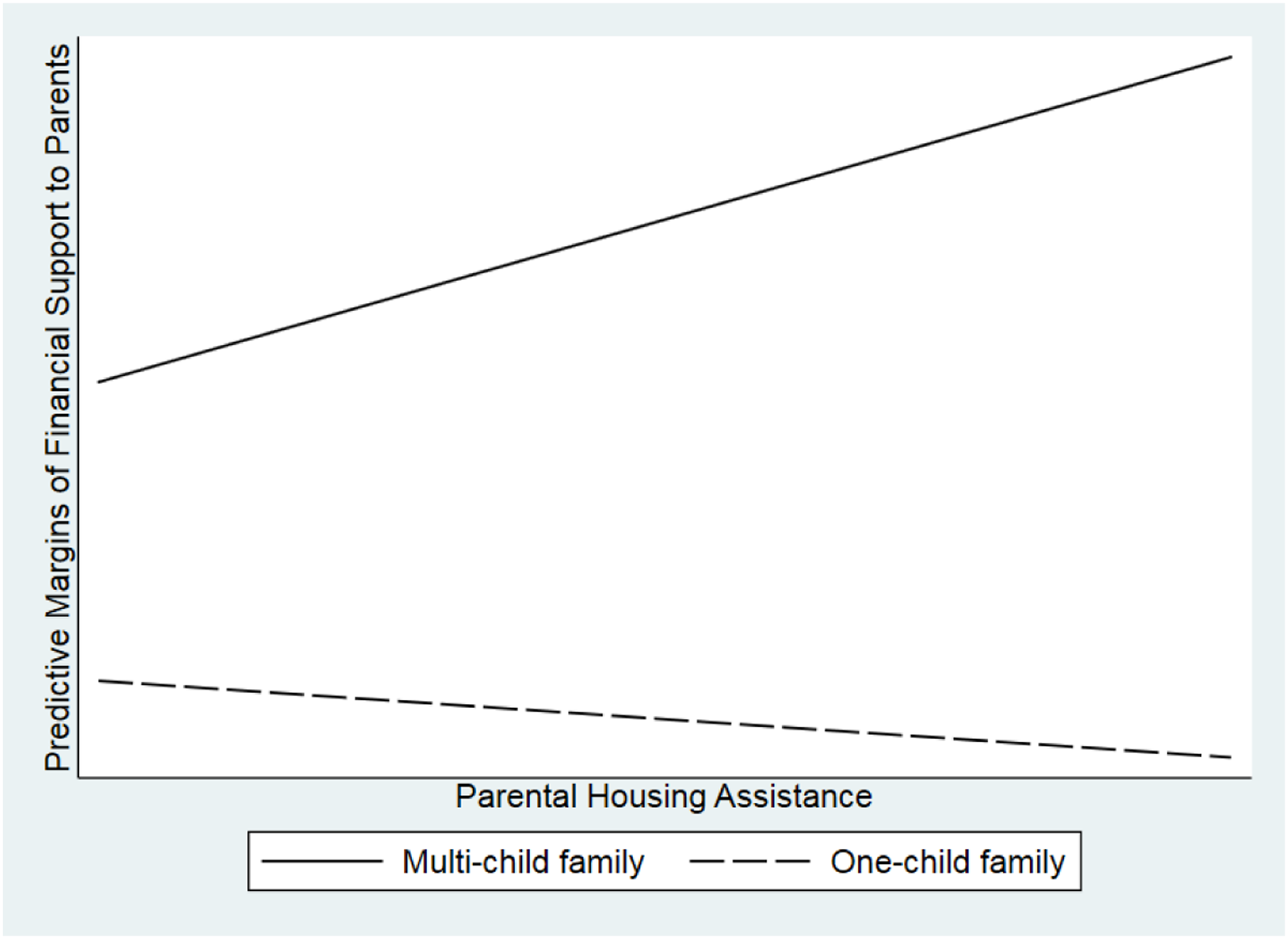
We have hypothesized that the family serves as a corporate group wherein parental investment is supposed to maximize lifelong benefits, and parents have the expectation of returns by their children when they have invested time, care, and money in them (Morgan & King, 2001). Our results seem to support the fairness maintenance thesis when adult children provide old-age support in response to large-sum one-time parental inputs. The forms of this large-sum parental assistance are diverse and include purchasing a house or car for their children, furnishing their children’s homes, and providing household goods upon marriage (Xiao, 2001). Singleton children receive more housing assistance than their counterparts in multi-child families (Table 3). However, the effect of large-sum transfers on financial and emotional support from singleton children is smaller because singletons do not need to justify deserving the transfers. Therefore, we have corroborated the existence of the fairness maintenance thesis, particularly for parental large-sum monetary assistance.
Unlike parental large-sum assistance, parental daily transfers refer to concurrent financial assistance from parents to children. The timing and amount of parental daily transfers may vary, but usually daily transfers are in small amounts. Parental daily transfers can be a useful tool to enhance the intergenerational bonds, and parents may anticipate their children’s reciprocal returns in exchange for their transfers. The interactive terms between parental daily transfers and being a one-child family in Models 2 and 4, Table 4 are positive for two types of old-age support (the coefficient is 0.064 at a significance level of 0.001 for financial support and 0.039 at a significance level of 0.05 for emotional support).
These findings suggest that adult children in one-child families are more likely to provide old-age support when they have received parental daily transfers. Figure 3 illustrates this relationship (drawn from Model 2, Table 4): the provision of financial support is positively motivated by parental daily transfers in one-child and multi-child families, yet the positive effect is more salient for one-child families. An increase of parental daily transfers will result in a greater rise in financial old-age support in one-child families. Predictive margins of financial support on parental daily transfers.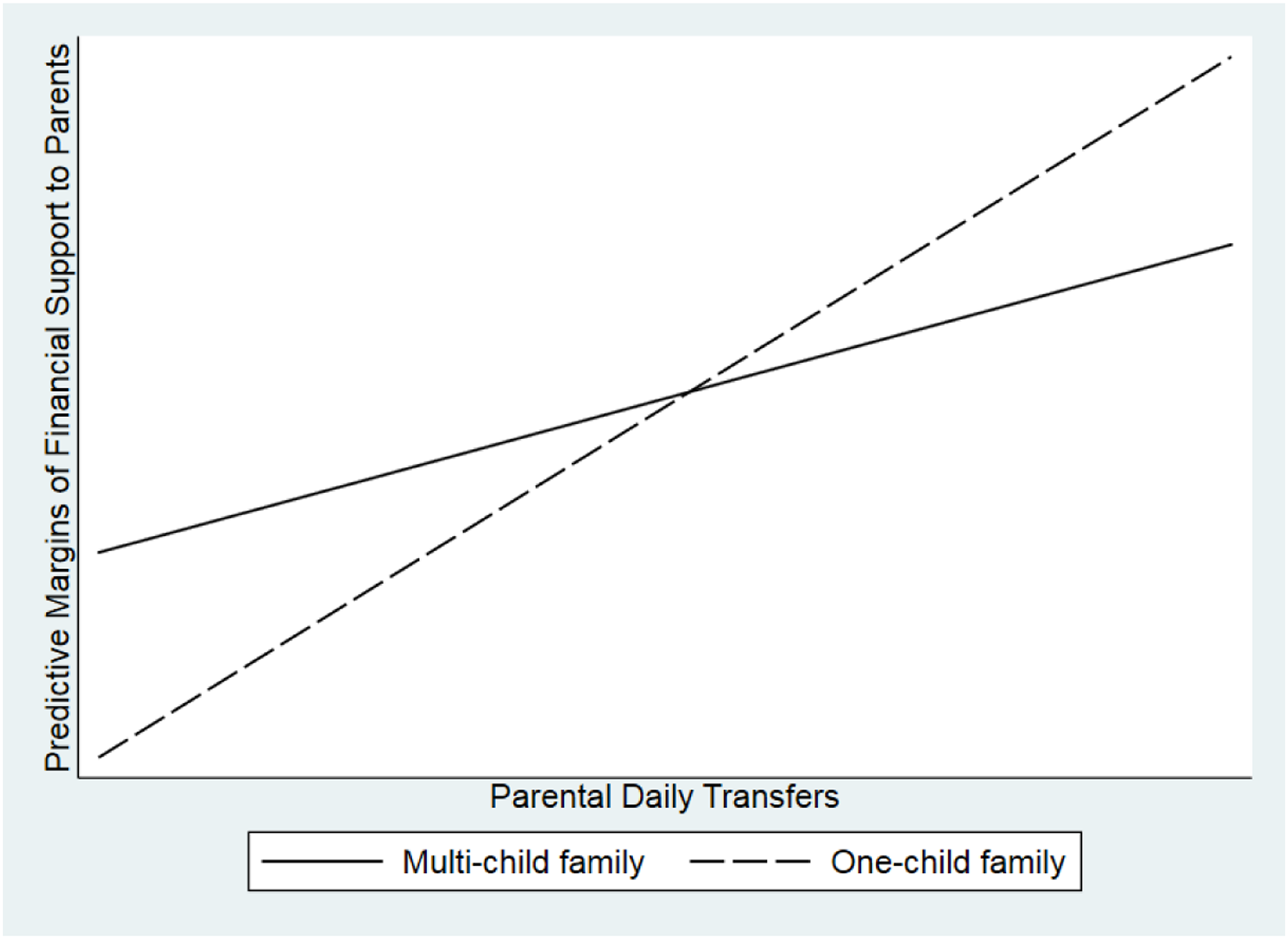
The finding described above is consistent with the singleton compensation thesis: adult children in one-child families are likely to provide more reciprocal old-age support as returns for their parents’ irregular monetary transfers. The singleton compensation thesis suggests that single children intensify their daily exchanges with their aging parents as compensation for having limited family ties. Since no siblings could share old-age support provision in one-child families, adult singleton children feel obliged to provide old-age support to their aging parents. Among adult children who receive parental irregular monetary transfers, singletons tend to provide more financial returns and pay more visits to aging parents due to the enhanced intergenerational bonds. We corroborate the existence of the singleton compensation thesis in the reciprocal intergenerational old-age support provision, particularly for parental irregular monetary transfers.
To discuss old-age support in return for parental investments, we discover the coexistence of fairness maintenance and singleton compensation in one-child families. Singleton children are less likely to be motivated by parental large-sum investments, but they tend to provide more old-age support in return for parental daily and irregular transfers. The tendency to provide returns for parental daily transfers rather than for large investments is a shift of the reciprocal intergenerational exchange as only children become the main caregivers.
One-Child Families: Does A Child’s Gender Matter?
Intergenerational exchanges in one-child families are undergoing a transition: old-age support is more likely to be motivated by parental daily transfers than by large-sum investments. We ask further how gender matters in intergenerational exchanges within one-child families as only children gradually become the main providers of old-age support.
Random-Effect Model of Old-Age Support on Parental Housing Assistance for One-Child Families.
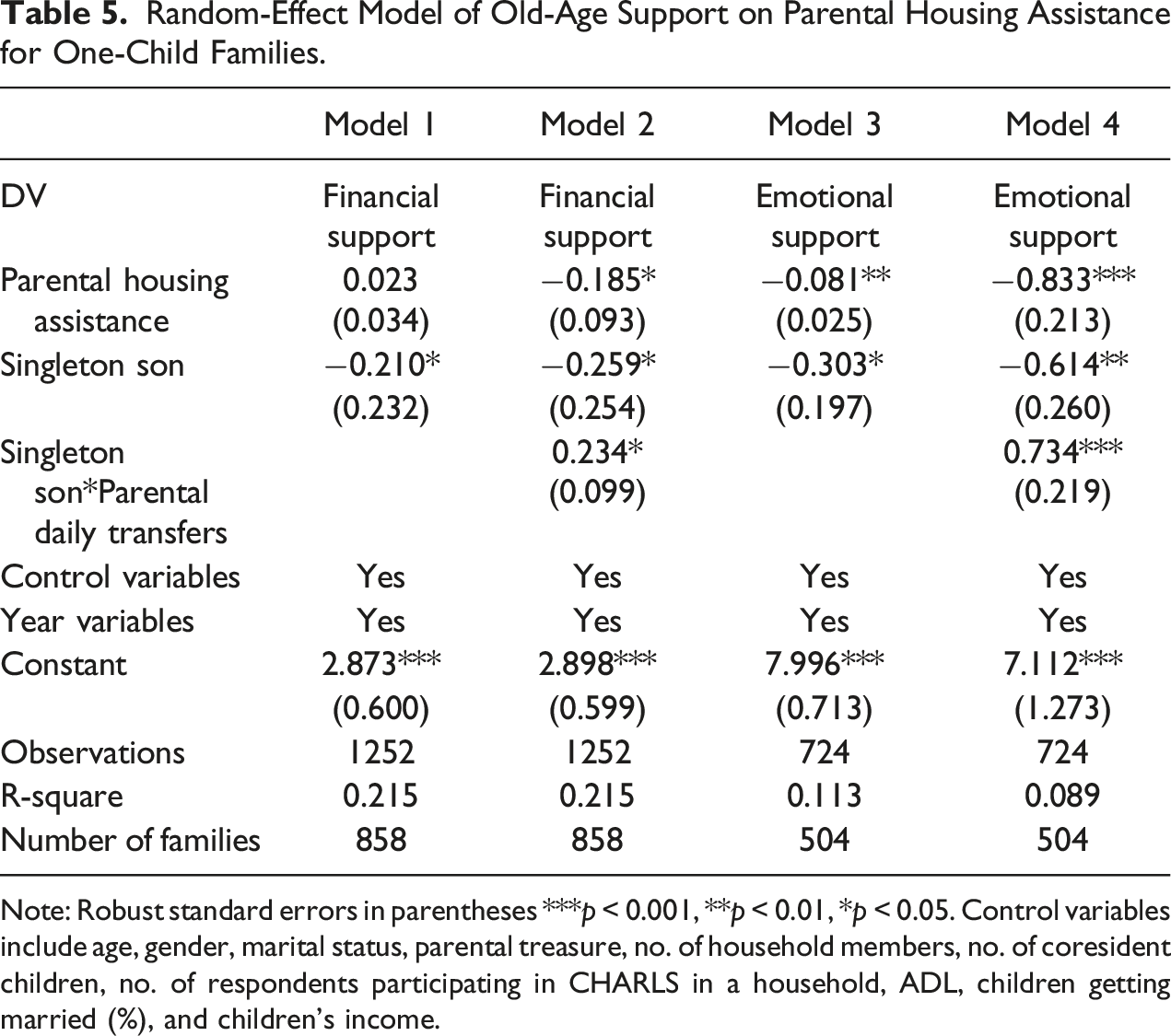
Note: Robust standard errors in parentheses ***p < 0.001, **p < 0.01, *p < 0.05. Control variables include age, gender, marital status, parental treasure, no. of household members, no. of coresident children, no. of respondents participating in CHARLS in a household, ADL, children getting married (%), and children’s income.
Table 5 shows that the main effect of parental inputs on financial returns and emotional returns is positive and significant. In line with reciprocal intergenerational exchange, financial and emotional old-age support is motivated by parental transfers within one-child families. The interactive terms between singleton sons and parental inputs are positive (the coefficient is 0.234 at a significance level of 0.05 for financial support, the coefficient is 0.734 at a significance level of 0.001). Thus, singleton sons are more likely to provide financial assistance, pay visits, and contact their parents as a return for their parents’ inputs. Our results reveal that the gender difference exists in the intergenerational transfers of one-child families: singleton sons tend to provide more old-age support in return for parental transfers (Hypothesis 3). 3
Even though there are contradictory results on whether the patrilineal tradition persists in one-child families, our findings suggest that the reciprocal intergenerational transfers provide new insights into this discussion. When singleton sons receive parental inputs, they provide more returns and take greater responsibility for old-age support for their parents. It is worth noting that the main effect of the “singleton son” in Models 1 and 3 is negative (the coefficient is −0.210 at a significance level of 0.05, the coefficient is −0.303 at a significance level of 0.05). Thus, singleton sons provide slightly fewer returns to aged parents than singleton daughters, yet the difference in association between parental transfers and returns is stark. The persistence of the patrilineal tradition mainly reflects how these sons’ old-age support is responsive to parental transfers. Sons are obliged to provide returns to parents when they have received parental transfers, yet singleton daughters may provide returns in a more spontaneous way regardless of whether their parents have provided them transfers.
Robustness Check
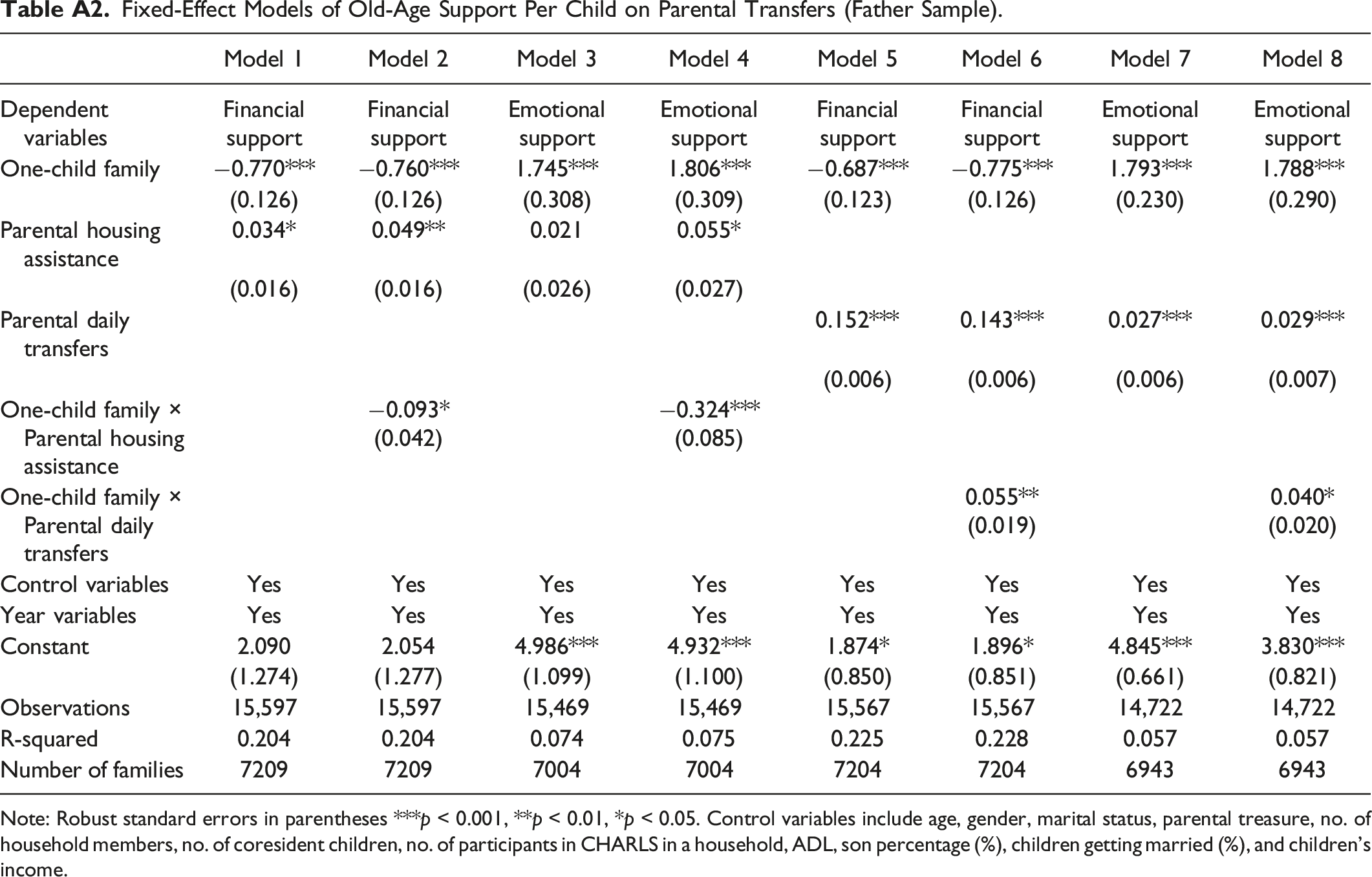
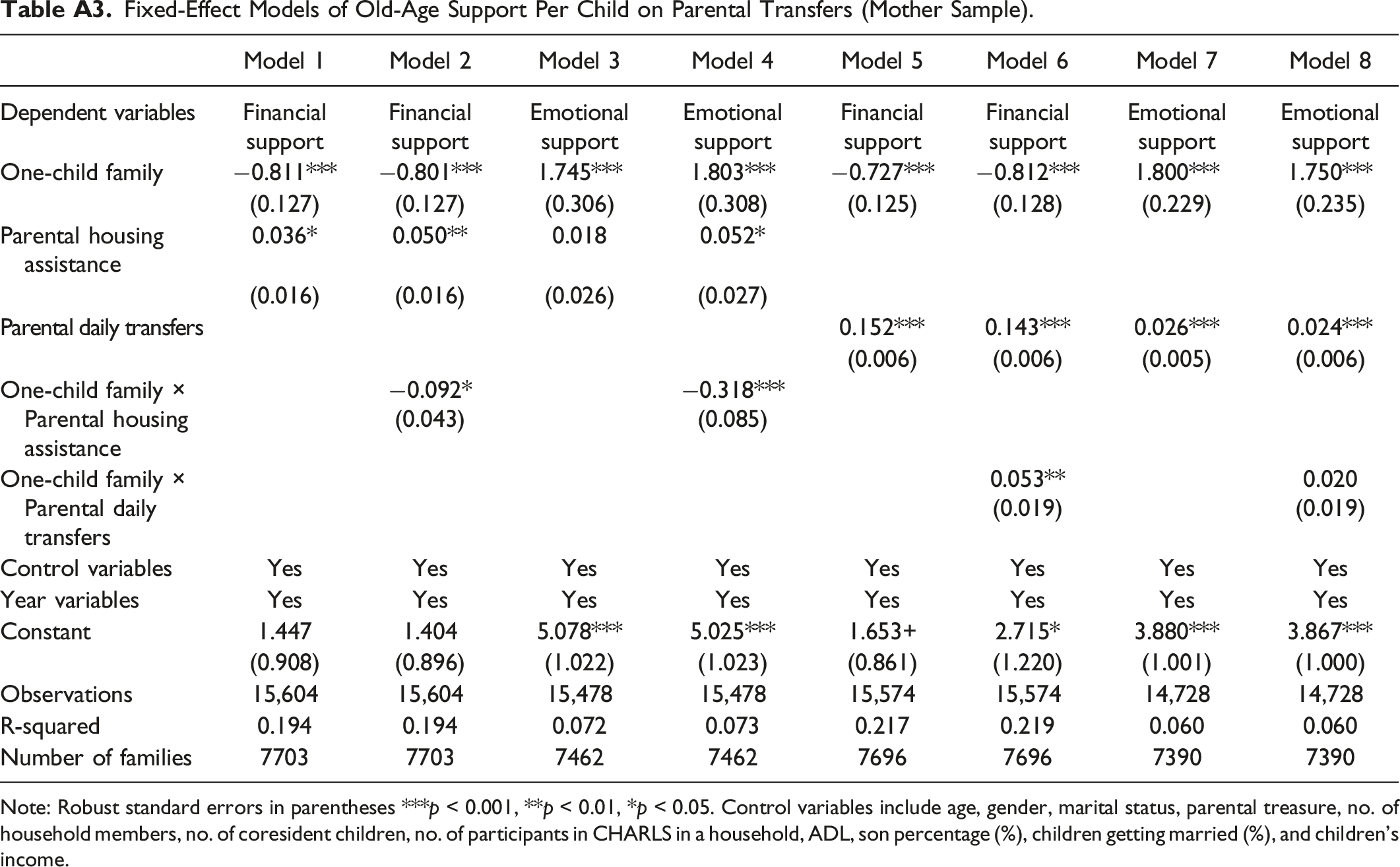
This subsection presents two robustness tests that have been conducted in this study. Both aging fathers and mothers participated in the survey in more than half of the households, whereas only one parent participated in the rest of the families. We use full sample in the previous analysis. To avoid sample selection, we now treat fathers and mothers separately if both parents in a family were surveyed, and the details of the two new samples are presented in Table A1 in the Appendix. Based on the father sample and mother sample, we use fixed-effects regression models and obtained the robust standard error clustered by family in Table A2 and Table A3 in the Appendix. 4
The results show that parental transfers significantly motivate old-age support, as seen in Tables 3 and 4. Singleton children provide less old-age support in return for parental large-sum assistance than do those in multi-child families (the interactive terms for financial support are −0.093 and −0.092 at a significance level of 0.05 for the father and mother samples, respectively; the interactive terms for emotional support are −0.324 and −0.318 at a significance level of 0.001 for the father and mother samples, respectively). Also, adults in one-child families are more responsive to parental daily transfers (the interactive terms for financial support are 0.055 and 0.053 at a significance level of 0.01 for the father and mother samples, respectively; the interactive terms for emotional support are 0.04 at a significance level of 0.001 and 0.020 for the father and mother samples, respectively). These findings are consistent with the results in Tables 3 and 4.
This finding is not surprising because we discover in our analysis that mothers and fathers actually provide the exact same information on parental large-sum transfers and emotional support. Only three families reported different levels of parental daily transfers, and six families reported different levels of financial old-age support. Indeed, it is empirically difficult to disentangle whether it is the mother or father who provides any form of transfers and whether children provide old-age support to either their mothers or fathers. Therefore, our research findings are not sensitive to the sample selection for father, mother, or both when both parents in a household participated in CHARLS.
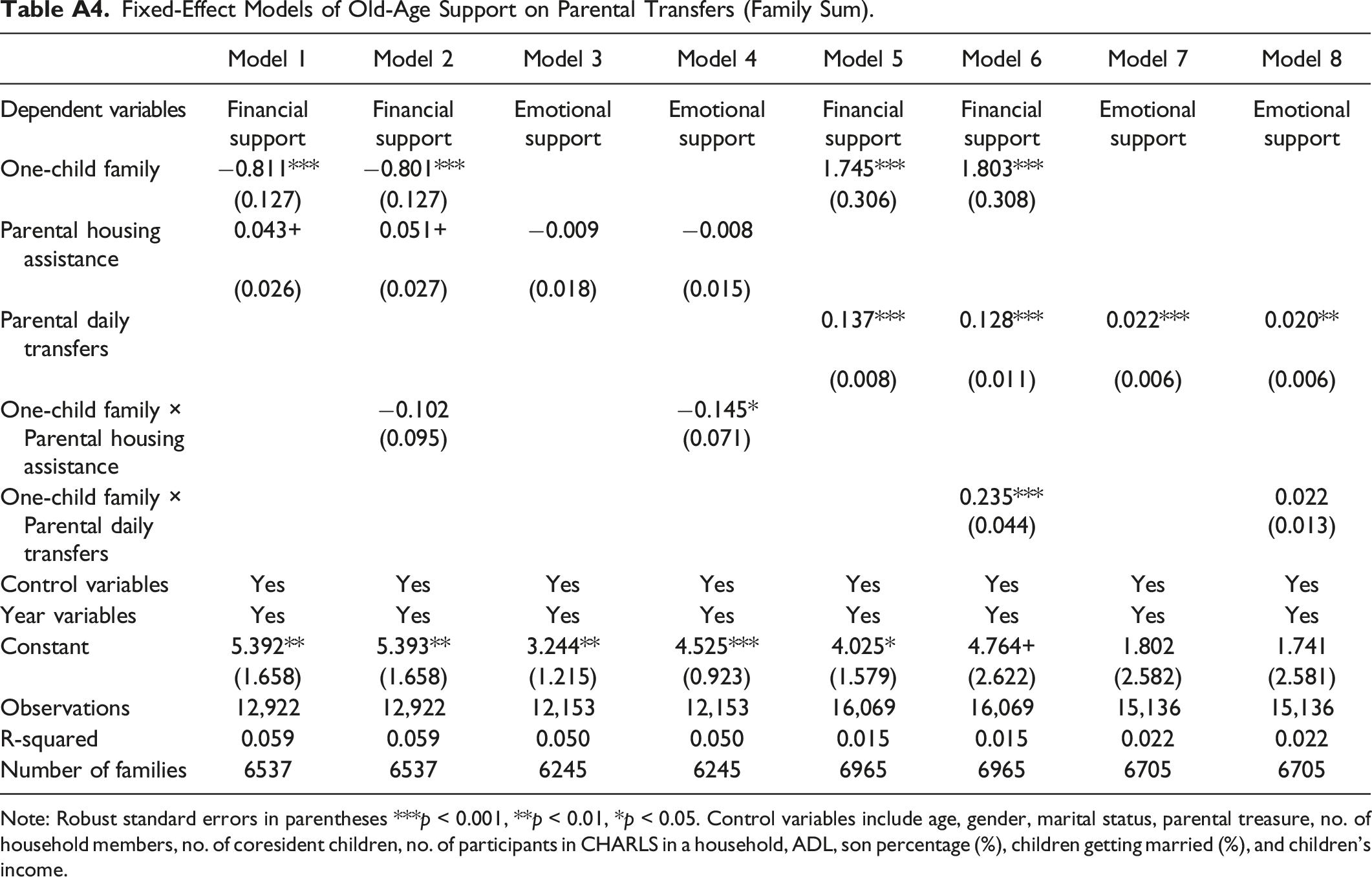
Second, we use the sum of parental transfers and old-age support within each family to test our hypothesis. To make one-child and multi-child families comparable in this regard, we estimate parental transfers and old-age support per child in each family. We then use the sum to conduct the robustness check in case there is heterogeneity between children. Table A4 in the Appendix shows that children in one-child families are less likely to be motivated by parental housing assistance (
Conclusion and Discussion
The world has entered an era of aging populations and shrinking family sizes. Against this backdrop, singleton children are gradually becoming the main caregivers for their aging parents. This research discusses the provision of intergenerational support in one-child families, particularly how old-age support is motivated by parental inputs. We discover a coexistence of the fairness maintenance thesis and the singleton compensation thesis in intergenerational transfers in one-child families. As is suggested by the fairness maintenance thesis, children’s returns to parents in one-child families are weakly motivated by their parents’ large-sum investments. Even though the large-sum investments are significantly larger in one-child families than in multi-child families (Table 3), the considerable investments do not necessarily translate into returns by children. Instead, children in one-child families are more responsive to parental daily monetary transfers to show their filial piety, thus corroborating the singleton compensation thesis. We also show the persistence of patrilineal norms in one-child families: singleton sons are more obliged to provide old-age support in return for parental transfers than are singleton daughters.
This study contributes to the literature in several ways. First, this study adds to our knowledge of the consequences of the one-child policy and highlights implications for China and other countries in the design of their family planning policies. Strict family planning policies in China have led to multiple negative outcomes, including a rapidly aging population (Cai & Feng, 2021), a labor shortage in urban areas (Zhang, 2017), less trusting and more risk-averse children (Cameron et al., 2013), and more depression symptoms among aging parents (Chen & Fang, 2021). This article suggests that aging parents in one-child families receive fewer financial returns, and their large-sum investments are less likely to motivate old-age support. The fertility rate in China remains low, even though the Chinese state loosened the family planning policies in 2015. The long-lasting challenge of old-age support among singletons may suggest government-subsidized and private-sector social security programs to supplement family-based support in the near future.
Second, this study contributes to the literature on intergenerational exchanges. The social norm of intergenerational transfers has certainly changed in the era of children being born into one-child families and becoming the dominant caregivers. This finding indicates that the corporate group model plays a relatively diminishing role in one-child families. More and more parents of single children adapt to the shifting norm by treating large investments in children as an obligation and reducing their expectations of returns from their children. In other words, the large-sum transfers from parents to children have changed from being based on reciprocity to maximize the family’s interest to being based on a sense of obligation and love between parents and children. The declining fertility rate in China due to the one-child policy has unintentionally contributed to this shift of the social norm in intergenerational transfers. Evidence from China may also point to implications for other countries with diminishing family sizes and growing aging populations.
East Asian societies regard coresidence as an important mechanism through which old-age support is maintained (Nauck & Ren, 2018; Yasuda et al., 2011). We discuss the role of coresidence in intergenerational relationships. We define coresidence as a dummy variable: 1 refers to “any of the adult children living with the parents,” and 0 refers to “no children living with the parents.” Contrary to the corporate group model, our data shows that coresidence is negatively motivated by either parental housing assistance or parental daily transfers.
This is not an anomaly because previous researchers produced inconsistent findings on the role of coresidence in intergenerational transfers (Moor & Komter, 2012). In China, coresidence is associated with both the needs of parents and the adult children (Yasuda et al., 2011; Zhang, Gu, & Luo, 2014). When adult children live with their aging parents to help the latter with their daily activities, coresidence could be considered a type of instrumental support (Chen & Jordan, 2018; Chen & Silverstein, 2000; Ho, 2019). This is particularly common in rural areas, where informal care is the dominant form of long-term social care. Yet when adult children coreside with their parents because their aging parents take care of their grandchildren, or because the aging parents are the homeowner, coresidence can be seen as a type of parental investment (Cunningham et al., 2013; Zhang, 2004). Some researchers also argue that coresidence in China has little to do with intergenerational transfers, but is driven by the bequest motive (Yin, 2010). Therefore, we find it difficult to distinguish parental investment from children’s old-age support when coresidence occurs.
In addition, the data shows that coresidence status does not differ significantly between one-child and multi-child families. Even if we restrict our focus to older age groups (e.g., those aged 80 years and older), when coresidence is more likely to be driven by parental need (Yasuda et al., 2011; Zhang et al., 2014), the difference is still not significant. That being said, the coresidence of parents with their adult children is indistinguishable between one-child and multi-child families. 5 Hence, coresidence may not be a good indicator to study whether old-age support in one-child families is more motivated or less motivated by parental transfers than in multi-child families.
This study has several limitations that are worth noting. First, our analysis corroborates that old-age support is motivated by parental investment differently in one-child and multi-child families. Yet identifying the causal effect of parental investment on old-age support remains a matter for further discussion. 6 Future studies may elaborate on the causal relationship between parental investment and old-age support with multi-wave panel data.
Second, the measurements of parental investment and old-age support are not perfect. We use parental housing assistance to estimate parental large-sum investments, but there are other measures that are worth discussing, such as purchasing a car for children, furnishing the children’s homes, and providing household goods upon marriage (Xiao, 2001). Also, there may be additional parental investments and forms of returns that are not observed in the data. For instance, health investments are one crucial parental transfer that varies across different family settings (Liang & Gibson, 2018), yet CHARLS does not provide relevant information on this type of investment. Future studies may develop better measurements to expand the discussion on forms of parental investment and children’s returns in one-child families.
Footnotes
Acknowledgements
The authors are indebted to Dr. Rebecca Yiqing Gan for her valuable comments on earlier versions of this paper.
Declaration of Conflicting Interests
The author(s) declared no potential conflicts of interest with respect to the research, authorship, and/or publication of this article.
Funding
The author(s) disclosed receipt of the following financial support for the research, authorship, and/or publication of this article: This work was supported by the National Social Science Fund of China “The identification and prevention of the impoverishment risk in urban families” (19BSH055).

Notes
Appendix
Clustering Nature of the Sample (aged 65 years and older). Fixed-Effect Models of Old-Age Support Per Child on Parental Transfers (Father Sample). Note: Robust standard errors in parentheses ***p < 0.001, **p < 0.01, *p < 0.05. Control variables include age, gender, marital status, parental treasure, no. of household members, no. of coresident children, no. of participants in CHARLS in a household, ADL, son percentage (%), children getting married (%), and children’s income. Fixed-Effect Models of Old-Age Support Per Child on Parental Transfers (Mother Sample). Note: Robust standard errors in parentheses ***p < 0.001, **p < 0.01, *p < 0.05. Control variables include age, gender, marital status, parental treasure, no. of household members, no. of coresident children, no. of participants in CHARLS in a household, ADL, son percentage (%), children getting married (%), and children’s income. Fixed-Effect Models of Old-Age Support on Parental Transfers (Family Sum). Note: Robust standard errors in parentheses ***p < 0.001, **p < 0.01, *p < 0.05. Control variables include age, gender, marital status, parental treasure, no. of household members, no. of coresident children, no. of participants in CHARLS in a household, ADL, son percentage (%), children getting married (%), and children’s income.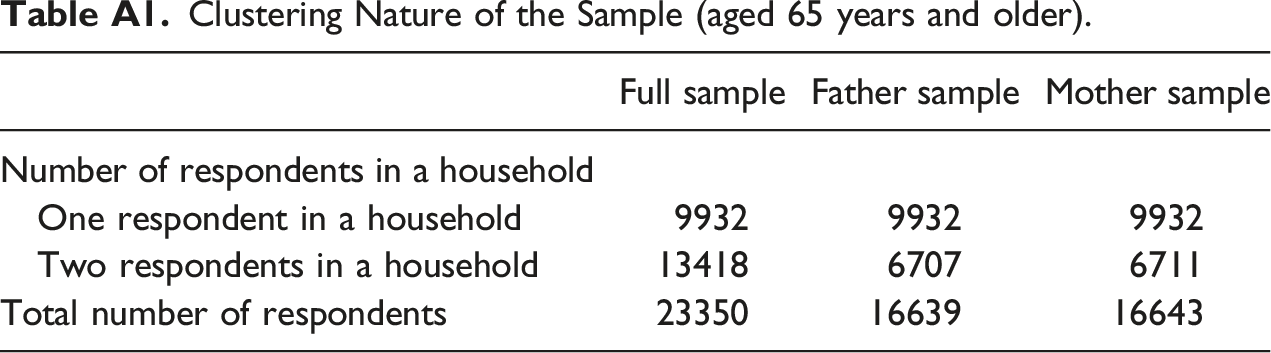
Full sample
Father sample
Mother sample
Number of respondents in a household
One respondent in a household
9932
9932
9932
Two respondents in a household
13418
6707
6711
Total number of respondents
23350
16639
16643
Model 1
Model 2
Model 3
Model 4
Model 5
Model 6
Model 7
Model 8
Dependent variables
Financial support
Financial support
Emotional support
Emotional support
Financial support
Financial support
Emotional support
Emotional support
One-child family
−0.770***
−0.760***
1.745***
1.806***
−0.687***
−0.775***
1.793***
1.788***
(0.126)
(0.126)
(0.308)
(0.309)
(0.123)
(0.126)
(0.230)
(0.290)
Parental housing assistance
0.034*
0.049**
0.021
0.055*
(0.016)
(0.016)
(0.026)
(0.027)
Parental daily transfers
0.152***
0.143***
0.027***
0.029***
(0.006)
(0.006)
(0.006)
(0.007)
One-child family × Parental housing assistance
−0.093*
−0.324***
(0.042)
(0.085)
One-child family × Parental daily transfers
0.055**
0.040*
(0.019)
(0.020)
Control variables
Yes
Yes
Yes
Yes
Yes
Yes
Yes
Yes
Year variables
Yes
Yes
Yes
Yes
Yes
Yes
Yes
Yes
Constant
2.090
2.054
4.986***
4.932***
1.874*
1.896*
4.845***
3.830***
(1.274)
(1.277)
(1.099)
(1.100)
(0.850)
(0.851)
(0.661)
(0.821)
Observations
15,597
15,597
15,469
15,469
15,567
15,567
14,722
14,722
R-squared
0.204
0.204
0.074
0.075
0.225
0.228
0.057
0.057
Number of families
7209
7209
7004
7004
7204
7204
6943
6943
Model 1
Model 2
Model 3
Model 4
Model 5
Model 6
Model 7
Model 8
Dependent variables
Financial support
Financial support
Emotional support
Emotional support
Financial support
Financial support
Emotional support
Emotional support
One-child family
−0.811***
−0.801***
1.745***
1.803***
−0.727***
−0.812***
1.800***
1.750***
(0.127)
(0.127)
(0.306)
(0.308)
(0.125)
(0.128)
(0.229)
(0.235)
Parental housing assistance
0.036*
0.050**
0.018
0.052*
(0.016)
(0.016)
(0.026)
(0.027)
Parental daily transfers
0.152***
0.143***
0.026***
0.024***
(0.006)
(0.006)
(0.005)
(0.006)
One-child family × Parental housing assistance
−0.092*
−0.318***
(0.043)
(0.085)
One-child family × Parental daily transfers
0.053**
0.020
(0.019)
(0.019)
Control variables
Yes
Yes
Yes
Yes
Yes
Yes
Yes
Yes
Year variables
Yes
Yes
Yes
Yes
Yes
Yes
Yes
Yes
Constant
1.447
1.404
5.078***
5.025***
1.653+
2.715*
3.880***
3.867***
(0.908)
(0.896)
(1.022)
(1.023)
(0.861)
(1.220)
(1.001)
(1.000)
Observations
15,604
15,604
15,478
15,478
15,574
15,574
14,728
14,728
R-squared
0.194
0.194
0.072
0.073
0.217
0.219
0.060
0.060
Number of families
7703
7703
7462
7462
7696
7696
7390
7390
Model 1
Model 2
Model 3
Model 4
Model 5
Model 6
Model 7
Model 8
Dependent variables
Financial support
Financial support
Emotional support
Emotional support
Financial support
Financial support
Emotional support
Emotional support
One-child family
−0.811***
−0.801***
1.745***
1.803***
(0.127)
(0.127)
(0.306)
(0.308)
Parental housing assistance
0.043+
0.051+
−0.009
−0.008
(0.026)
(0.027)
(0.018)
(0.015)
Parental daily transfers
0.137***
0.128***
0.022***
0.020**
(0.008)
(0.011)
(0.006)
(0.006)
One-child family × Parental housing assistance
−0.102
−0.145*
(0.095)
(0.071)
One-child family × Parental daily transfers
0.235***
0.022
(0.044)
(0.013)
Control variables
Yes
Yes
Yes
Yes
Yes
Yes
Yes
Yes
Year variables
Yes
Yes
Yes
Yes
Yes
Yes
Yes
Yes
Constant
5.392**
5.393**
3.244**
4.525***
4.025*
4.764+
1.802
1.741
(1.658)
(1.658)
(1.215)
(0.923)
(1.579)
(2.622)
(2.582)
(2.581)
Observations
12,922
12,922
12,153
12,153
16,069
16,069
15,136
15,136
R-squared
0.059
0.059
0.050
0.050
0.015
0.015
0.022
0.022
Number of families
6537
6537
6245
6245
6965
6965
6705
6705