



Abstract
This paper examines the motivations and contexts for China’s highly educated, financially independent single urban women to willingly participate in parental matchmaking. Based on the analysis of two rounds of in-depth interviews with 25 never-married women in Shanghai, Shenzhen and Guangzhou, we find that their participation in parental matchmaking is best understood as an intergenerational alliance formed to mitigate perceived insecurities. Neo-familism, state-endorsed stigmatization and discriminatory polices explain why parents and daughters both prioritize socio-economic security in mate selection. However, the benefits of this inter-generational collaboration are doubtful and asymmetrical, more beneficial to parents than daughters. We contribute to the literature by specifying how state-promoted discourses, neo-familism and women’s lived experiences explain their participation in parental matchmaking.
Introduction
Parental matchmaking, where parents assume key roles in their children’s search for a spouse, has gained increasing public visibility in China (Pettier, 2016), resulting in research on the phenomena of ‘marriage corners’ in urban parks (where parents congregate with their unwed children’s bios in search of a good match) and matchmaking television shows involving both parents and children (e.g. ‘Chinese style matchmaking’) (Pettier, 2020; 2022; Sun, 2012; Zhang & Sun, 2014). As we will show, modern Chinese parental matchmaking includes parents actively searching for and arranging for dates for their children, and is widely used in major cities. Modern parental matchmaking is not simply a ‘continuation of ancient traditions’ that compromise children’s choices and freedom (Pettier, 2020). Existing studies on parental matchmaking mostly centre on the parents’ rather than children’s experiences (Pettier, 2020; Sun, 2012). We decide to examine China’s highly educated, financially independent single urban women who willingly participate in parental matchmaking, because they are under the greatest societal pressure to marry, but compared to less-educated working class women, also better positioned to not have to rely on marriage. We argue that two salient conditions – neo-familism and state-endorsed stigmatization – shape single women’s experiences differently than that of men, particularly those from rural areas (see Attané et al., 2013). In this paper, we aim at identifying: (1) These women’s motivations for agreeing to participate in parental matchmaking, and (2) the societal and individual contexts underlying these motivations. Based on the analysis of two rounds of in-depth interviews with 25 never-married women in Shanghai, Shenzhen and Guangzhou, we find that their participation in parental matchmaking is best understood as an intergenerational alliance formed to mitigate perceived risks. However, as the benefits of this collaboration are doubtful and asymmetrical, daughters’ participation can be seen as a reflexive assessment of their situations as much as a practical means to find a partner. We contribute to the literature by specifying how state-promoted discourses constitute parental matchmaking as intergenerational collaborative strategy, the adoption of which is motivated by women’s lived experiences of discrimination.
Parental Matchmaking and Neo-Familism in China
In pre-revolutionary China, marriage partners were selected based on ‘parent’s orders and matchmakers’ words’. After the establishment of the Republic of China in 1912, ‘customary marriages’ under Qing Dynasty law were replaced by the new Marriage Law that legitimized the freedom to choose one’s own spouse. During the New Cultural Movement (1915–1923), opposition to parental control over mate selection symbolized modernization and women’s liberation (Wang, 1999). The establishment of the People’s Republic of China in 1949 saw the rise of collectivism, and danwei (production units) began to play a key role in matchmaking. But when economic reforms began in the late 1970s and the influence of danwei in private lives began to reduce, so has this practice. However, the demand for matchmaking has not visibly decreased in today’s China. Parents’ objection to children dating before completing their education and long working-hours mean that young adults have limited opportunities to meet potential partners (Pettier, 2020). Dating apps are considered risky and marriage agencies untrustworthy, suspected of capitalizing on people’s desire for marriage without finding compatible matches for clients (Pettier, 2019). The ‘supply’ of parental matchmaking has not reduced either, primarily because traditional values such as parental ownership of children (Cheung, 1972) and the parental duty to see that children marry (Miao, 2006) are still deeply rooted.
In short, parental matchmaking has not abated – demand and supply for it still exist. Specifically, scholars have suggested that trans-generational anxiety under economic reform contributes to the revival of parental matchmaking (Zhang & Sun, 2014). Economic reforms since the late 1970s have significantly reduced state-provided social security (Giles, Park & Cai, 2006), which strengthens marriage and the family as safety nets, as resources amongst family members can be pooled, shared and redistributed (Huang et al., 2012; 2017). Yan (2018) conceptualizes this revived centrality of the family in an increasingly individualized China as ‘neo-familism’, caused by state-initiated societal individualization and economic privatization. For example, the one-child policy has deepened interdependence between parents and children, as they become increasingly reliant on mutual emotional, social and financial support. While traditional familism prioritizes one-sided family interests and patriarchal authority, neo-familism celebrates parent-child bonding and solidarity although internal tensions can still exist. An example would be parents’ who go behind their children’s backs to matchmaking corners, which may seem like traditional parental control, but in fact reflects parents’ anxieties more than actual power over their children (Pettier, 2019; Pimental, 2000). In today’s highly competitive and precarious China, it is argued that neo-familism has become a key coping strategy for Chinese individuals (Yan, 2012; 2018).
Given a tight urban housing market, the constitutional responsibility to care for elderly parents and dual-earner couples’ need for childcare, the family continues to be an important social unit. Under neo-familism, however, this ‘intergenerational symbiosis’ continues to prescribe a clear gendered division of labour (Ji, 2015; Gaetano, 2014; Huang et al., 2012; Jeffreys, 2006). As women (rather than men) are still expected to undertake domestic and reproductive duties, parents tend to prioritize financial standing when considering potential matches for their daughters (Huang et al., 2017; To, 2013). In the following section, we discuss why well-educated and financially independent daughters may share this view with their parents.
Background and Research on China’s Single Women
Scholars have identified three previous ‘waves’ of singlehood in China – in the 1950s, 1970s and early 1990s – caused, respectively, by spikes in divorces and economic reform that led to marriage delays (Wang, 2006). The current ‘fourth wave’ is characterized by a much higher percentage of well-educated urban women in the 28 to 38 age group (Zhang, 2003). Chinese women’s gross higher education enrolment ratio rose from 2010’s 27.9% to 2020’s 54.4% (National Bureau of Statistics, 2021), resulting in improvements in social status and economic independence. Although the expectation that they must marry by a certain age remains (Wang & Abbott, 2013), the proportion of never married women aged 15 and above increased from 8.3% in 2000 to 14.4% in 2019 (China Statistical Yearbook 2020), and mean age of women’s first marriage rose from 23.89 in 2010 to 26.30 in 2020 (Chen and Zhang, 2022); in a cosmopolitan city like Shanghai, the corresponding age is even higher, at 29.09 (People.cn, 2021). Higher education increases urban men’s likelihood to marry, but decreases that of women’s, particularly for the over 30s (Qian & Qian, 2014).
Prolonged singlehood is also rising amongst working-class rural-urban migrant women who delay marriage to capitalize on a labour market that favours youth (Hanser, 2005). Due to the intersection of prolonged sex imbalance and birth control policies implemented since the 1980s, the poorest rural men are most prone to be excluded from the marriage market (Attané et al., 2013). Nevertheless, it is highly educated single women who have attracted the most social concern, despite not being as seriously affected by the marriage squeeze as low-income rural men (Hvistendahl, 2011; Jiang & Sanchez-Barricarte, 2012).
The literature on today’s Chinese single women include research on the marriage squeeze (Jiang, et al., 2016), the constraints, strategies and subjectivities of single urban women (Giu, 2020; Ji, 2015; To, 2013; Wang & Abbott, 2013), their representation in the mass media (Gong et al., 2017; Ji, 2017; Yu, 2021), their stigmatization in relation to China’s socio-economic and political development (Fincher, 2014), their mate selection strategies (To, 2013), and single rural-urban migrant women’s situations (Ip, 2017). Most studies adopt a cultural framing and theorize single women as being ‘caught’ between traditional and modern values. To (2013), for example, finds that her sample of 50 well-educated single Chinese women held traditional marriage views like their parents’, which contradicted their identity as ‘modern career women’. This ‘modern versus traditional’ framing is also adopted in Jia and Ma’s (2015) study of 30 well-educated single women in Shanghai, who valued their careers while subscribing to traditional values about gender and marriage. Ji’s analyses use a cultural framework where ‘the dramatic clash of tradition and modernity’ in the ‘uneasy mosaic’ that characterizes today’s China to analyze their struggles (Ji, 2015:1070).
Comparatively little has been said about the role of social and economic contexts, such as how marketization, the consumer revolution (Xie, 2011) and other macro-level institutional conditions affect single women. Fincher (2014) is a notable exception that examines how the state-engineered category of ‘leftover women’ worked alongside patriarchal norms to systematically disadvantage women in marriage and wealth accumulation. Ip’s (2017) study of rural-urban migrant women also provides a nuanced analysis by situating her informants’ agency against the backdrop of state socio-economic policies. She analyzed how young women moved to the cities to capitalize on the demand for young workers while female entrepreneurs delay marriage because of their economic independence. Both studies reveal single women as the paradoxical social ‘problem’ that the state simultaneously created and seeks to eliminate.
State Endorsed Stigmatization
Women’s singlehood is regarded in today’s China as ‘inefficient, meaningless and shameful’ (Fang, 2016), encapsulated in the label ‘leftover women’ – introduced by the All China Women’s Federation (‘the Federation’) to describe highly educated single women above the ideal marriage age (i.e. 27). The Federation remains the official leader in women’s liberation since 1949. Following a Marxist ideology, it had strived to liberate women through labour participation and education (Ji, 2015). Since the late 1970s, state-driven economic and societal reforms have resulted in its endorsement of discriminatory and pro-family discourses that legitimize state and family intervention in women’s lives, for example, by attributing women’s singlehood to their ‘pickiness’ (Zhou, 2010), whilst promoting individualization and the family to boost national development (Yan, 2018). Revived state support for Confucian teachings that emphasize strong family governance for the nation-state’s interests (e.g. ‘family nation same structure’ – jiaguo tonggou) further legitimizes parental involvement in children’s mate selection (Hu, 2016). In 2013, President Xi Jinping announced that the Federation’s work is to develop women’s virtuous role in the family: ‘Women must self-consciously shoulder the responsibility of respecting the old and loving the young, educating children… so that they grow up to be useful to the nation and its people’ (Xinhuanet.com, 2013). Against this background, advocacy and discourses that celebrate single women as strong and independent struggle to gain wider support in China (Cai, 2017:77).
Chinese women’s high educational attainment and economic independence are liabilities in the marriage market (Gaetano, 2014; Pettier, 2020). Although single men outnumber single women in cities like Shanghai, Beijing and in the Guangdong province, the marriage gradient (i.e. the pattern of women ‘marrying up’ and men ‘marrying down’ with regards to socio-economic status and age) (Goodwin et al., 2009) resulted in the marriage squeeze of well-educated, high-income women above normative age of first marriage (Lasswell & Lasswell, 1991; Zhao, 2008). Apart from stigmatization spearheaded by the Federation, single women’s needs have also been neglected in social policy. Rapid economic development heightens the importance of socio-economic achievement and educational qualifications (Zhang, 2003), but social welfare reforms in recent years have focused on poverty reduction and the rural poor (Zhu & Walker, 2018) , while concerns of well-educated single women and their parents’ – that is, the maintenance of their quality of living, particularly in old age – are not addressed.
Specific Contexts Faced by China’s Never-married, Well-educated Urban Women
Culturalist conceptual frameworks used in the literature on China’s single women enable us to move beyond the negative portrayals of single women as picky, selfish and unrealistic, but place less emphasis on the role of other actors (e.g. parents) and structural factors (e.g. state policies). Extra-individual and extra-cultural contexts including increasing gender inequality, housing and fertility policies may also affect single women’s participation in parental matchmaking. Chinese women’s rising socio-economic status comes with a widening gender pay gap (Qing, 2019). China’s ranking has dropped from 100 in World Gender Gap Report in 2017 to 103 in 2018, with women’s earning at 64% of men’s in comparable positions. Real estate is an important means of wealth accumulation in China, but only 6.9% of urban women own property compared to 21.8% of men (Song, 2019). China’s urban property market is tightly controlled and housing policies are pro-family. In Shanghai, for example, a policy launched in 2014 prohibits single persons without Shanghai household registration from purchasing housing; singles with Shanghai household registration can only buy one property, whereas married couples can purchase a second one (Shanghai Housing Provident Fund, 2018; Shanghai City Government, 2018). China’s fertility policies have had dramatic impacts on families (Croll et al., 1985; Fong, 2016) but their effects on single women are rarely discussed. The one-child policy (1979–2015) heightened parents’ stakes in their only child’s marriage. The ‘open to two children’ policy implemented in 2015 and the ‘three-child policy’ launched in 2021 allow women to have more births without penalty, but more births mean more periods of maternity leave and increased childcare obligations (Li, 2017), both of which work against women (but not men) in the labour market. These policies may have rendered economic security – even for well-educated women – more important than ever. In short, the gendered aspects of mate selection, neo-familism, state discourses, policies and the labour market mean that women face greater uncertainties in maintaining and improving their socio-economic status than men, more likely to push them towards marriage as a means to mitigate these uncertainties. As Chinese parents generally prioritize socio-economic status of sons-in-law, this may coincide with some daughters’ interests, leading them to find parental matchmaking acceptable.
Research Questions, Theoretical Framework and Methodology
Our research questions are as follows: How are we to understand well-educated urban women’s participation in parental matchmaking in this context? Why do some participate and others not? By ‘participation’, we refer to the acceptance of parents’ involvement in finding a mate, including communicating and meeting men introduced through their parents. Based on the literature reviewed above, our theoretical framework conceptualizes women’s participation in parental matchmaking as a strategic, intergenerational collaborative response to an environment that hampers single women’s ability to envisage a secure future despite their high education and economic independence. Traditional familism explains the intergenerational socialization of gender role attitudes which predispose women to accept parental matchmaking, but under neo-familism, this disposition may or may not translate into women’s participation in parental matchmaking, depending on perception and management of risks. Also, neo-familism means that daughters’ preferences are respected although parents’ traditional expectations and intervention are still influential, especially if daughters and parents mutually rely on each other. In short, although our framework references the literature on parental matchmaking and neo-familism, unlike previous studies which emphasize culturalist explanations, we also take into account women’s lived experiences of gender inequality.
Informants’ socio-demographic background (N = 25).
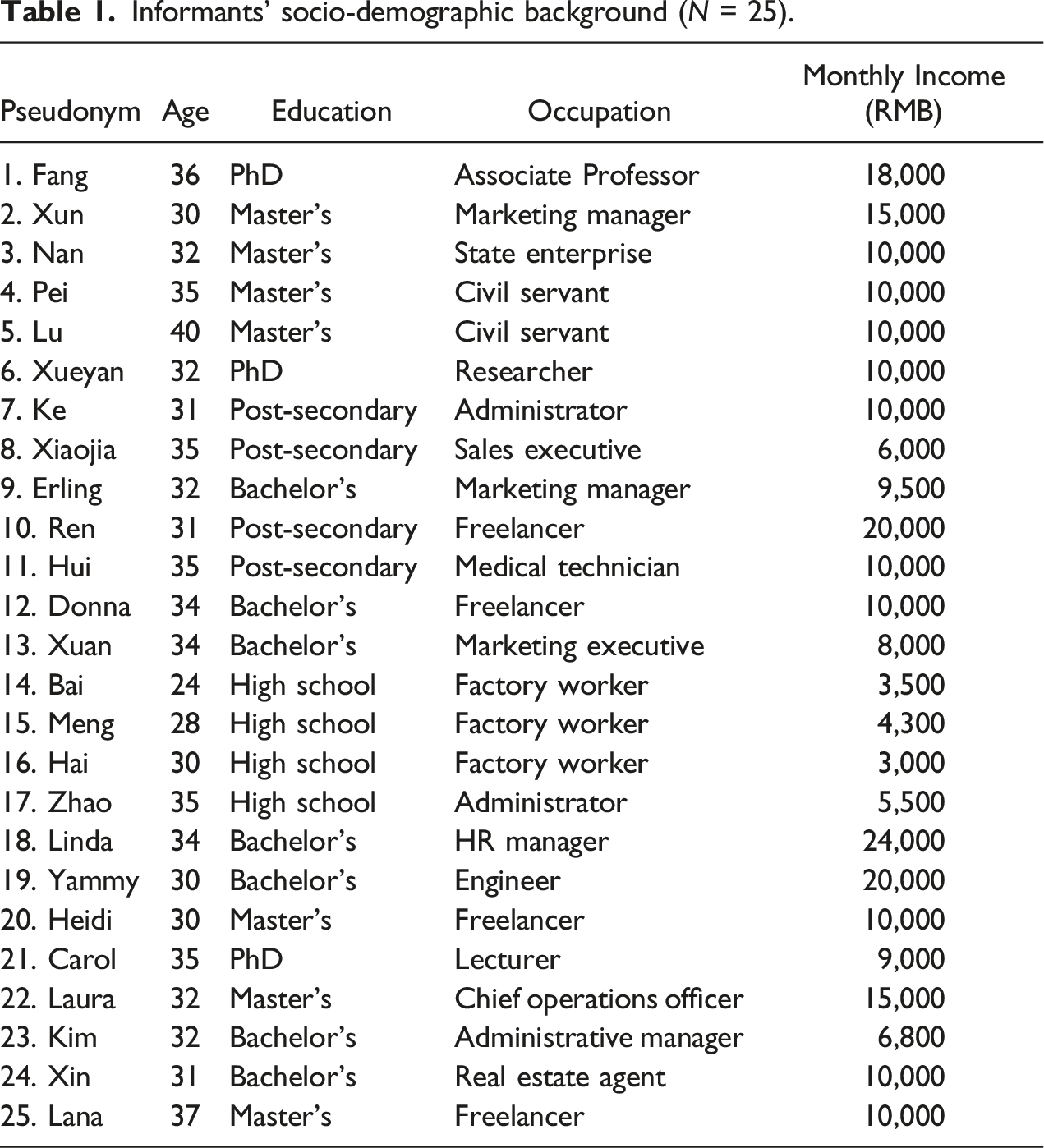
Two semi-structured in-depth interviews were conducted with each informant. Before the first interview, informants completed a 14-item questionnaire on their socio-demographic background, relationship status and views. The researcher then began the interview by inviting them to elaborate on these responses. Direct prompting was kept to a minimum. A 2-week gap between the first and the second interviews aimed to give informants time to reflect on their situations, given the stigmatization of singlehood. At the second interview, we invited them to talk about their lives as singles, especially regarding intergenerational interactions (e.g. their participation in parental matchmaking), future life plans and themes that have emerged from the first interview. Interviews took place in cafes, restaurants and other public venues, lasted one to two hours each and were audio-recorded and transcribed verbatim. Following the grounded theory approach (Strauss and Corbin, 1990), data was thematically coded and analyzed using the software Nvivo. In conjunction with our theoretical framework, we adopted a feminist analytical strategy that pays attention to women’s agency, power relations and practices (Ackerly, 2020; Andersen, 2005). Initial coding, guided by the two research questions and the theoretical framework, generated categories such as ‘parental pressure’, ‘economic insecurity’, ‘traditional gender norms’ and ‘work satisfaction’. Sub-codes relating to informants’ motivations and practices relating to parental matchmaking were developed in the second stage. Through an ongoing reflexive process, we identified ‘intergenerational alliance’ in relation to other key themes such as ‘workplace and policy discrimination’, ‘family socialization’, ‘spatial and social distance’ and ‘pacifying parents’ insecurities’.
Findings
Matchmaking methods used by the informants (N = 25).
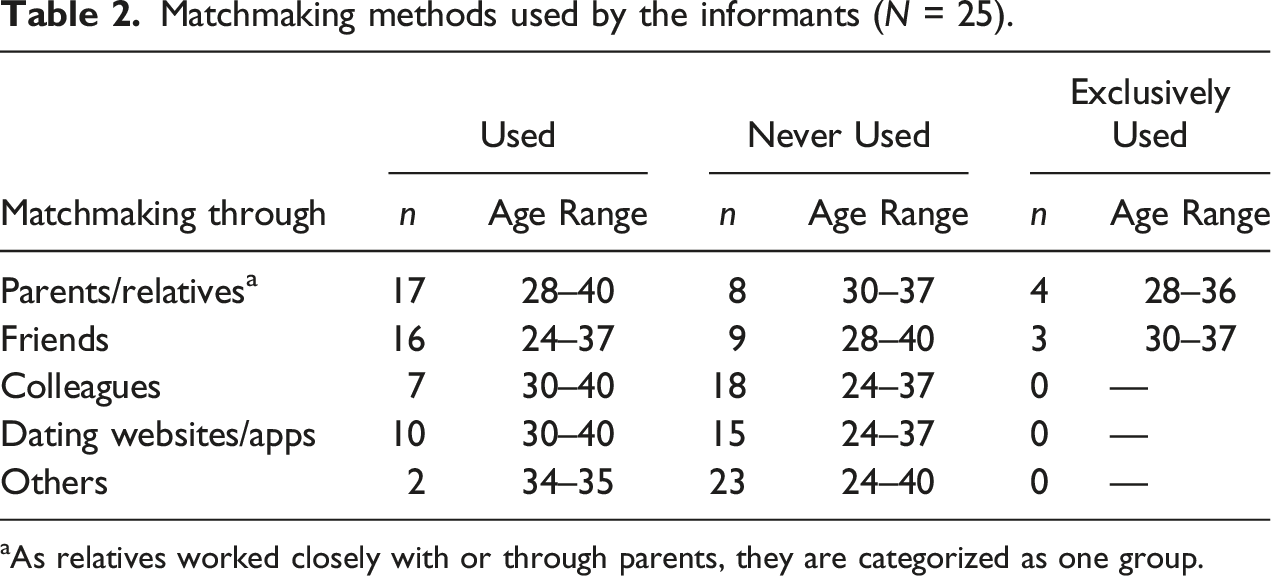
aAs relatives worked closely with or through parents, they are categorized as one group.
The marriage gradient as ‘family wisdom’ and the race against time
All informants accepted the marriage gradient and other gendered prescriptions about the family as inculcated by their parents (e.g. men prefer women younger and lower in social status than themselves). Hui associated her views with her mother’s teachings as she explained why she participated in parental matchmaking: When my mother asks me to attend matchmaking activities, I go. I’ve even been to the ones in the park... my mother always says to me: ‘Have children when you are young!’ I am often affected by my mom’s thinking. I’m now 35 years old, people say the best age to have children is before 30. (Hui, 35, post-secondary, medical technician).
Matchmaking corners in city parks are mostly used by parents (Pettier, 2020), but as Hui believed she had no right to choose because of her age, she accepted her mother’s suggestions: I feel that I don’t have much market value; after 30 years old it is not you who choose others, but others who choose you. When others hear that I am so old, they lose interest (Hui, 35, post-secondary, medical technician).
Similarly, Xun thought parental matchmaking would ‘lower her status’ but accepted it because of her age: … if I were three or four years younger, I would not [participate] so easily, [I] would feel that matchmaking lowers my status. But ... I still am not married with kids at 30. 25 is the best age to marry. Maybe when you reach 30, those [who are interested in you]… their quality decreases... [Matchmaking] maybe is a way to meet people, maybe you will meet your future other half (Xun, 30, master’s, marketing manager).
Ideal ages for marriage and childbirth – at 25 and 30, respectively – were largely unquestioned amongst our informants. They described parental teachings about marriage as normative and authoritative, confirming the power of familism. Why were parents keen to be involved? Although we did not directly probe informants about their parents’ perception of their situation, there is evidence that their parents were worried about their daughters’ future. A few informants’ parents have financially helped them get a head start on the property ladder when they were younger, while others told their daughters that life as a single would be socio-economically difficult. Such indirect evidence suggests that parents’ experiences of market-oriented transformation, marked by increasing societal competition and characteristics of a risk society (Sun, 2012), may have reinforced their conviction that the family is the only reliable backup for socio-economic security (Yan, 2010; 2013). Our informants themselves are clearly worried about their socio-economic security if they were to remain single, as we will see in the following section.
Marriage in response to perceived economic insecurity and the role of parents
Dual earner families are supposed to reduce marriage as an exchange between the partners (Rosenfeld, 2005), but this is not how our informants envisaged marriage. Erling’s monthly income (RMB 9500) was on the low side in our sample, and she worried about her ability to maintain her living standard as a single: My rent is quite high, and my expenses are high. If I have my other half, then he can help share these expenses... I have always thought that women ‘make money to buy flowers for their hair’, I don’t make money to shoulder the whole family’s burden... my family have always had this tradition, that [...] I help you take good care of the family, you work hard outside (Erling, 32, bachelor’s, marketing manager).
Erling’s belief in the traditional gendered division of labour interacts with her anxieties about socio-economic security, leading her to welcome parental matchmaking. But income level may not be the most important factor. Xun, quoted below, who earned considerably more (RMB 15,000),
2
also believed that her husband should earn more than her to justify her sacrifices in the marriage: If you find someone who is worse off than you, then you’ll feel he drags down your living standard... and you still have to bear his child, and there’ll be many things that you can’t do. You still have to take care of him, serve him, sacrifice a lot of your own time, basically sacrificing your own youth (Xun, 30, master’s, internet marketing strategist).
This intergenerationally acquired expectation to perform domestic labour in exchange for economic security valorizes domestic roles, ‘marrying up’ and curtails career ambitions (Corell, 2004), as expressed by Hui: My character is to seek stability, I don’t like to work hard; ordinary life is fine. I will do what is appropriate for that age in my life. I am traditional in my thinking. I don’t want to be a strong woman. I feel that women must marry, I want someone to share the good, someone to share the burden (Hui, 36, post-secondary, medical technician).
The expectation that husbands should be the main financial providers while they attend to domesticity corresponds to recent research findings that Chinese working women continue to perform the bulk of domestic work at home. Moreover, their time spent on caregiving decreases initially and then increases even as their individual income rises (He et al., 2018). As our informants’ gender norms converge with Chinese parents’ preference for daughters to ‘marry up’ (Croll & Croll, 1981), potential matches screened by parents would have been assessed as financially dependable, fitting their expectations.
For women like Pei, who distrusted dating apps and matchmaking agencies, parental matchmaking was a safe and socially respectable way to find a partner despite its obvious limitations: After I started working, my contact range is on the narrow side, so I try my best to contact potential partners... [Marriage-oriented matchmaking] is the other way around... That is, two strangers marry with the aim to establish an intimate relationship. It seems like matchmaking can expand your dating range, but success rate is not very high (Pei, 35, master’s, civil servant).
Parents cannot screen for emotional connection and romance, which Pei valued, but the two do not contradict. As Pettier noted, Chinese adult children’s ‘understanding of love does not rest solely on individual feelings but also considers wider social and material dimensions’ (Pettier, 2022), that is, the romantic sentiments they hoped for are materialistically grounded. This explains why parental involvement is still welcomed. Perceived insecurity about their socio-economic future intensified the preference for men who can provide financially – a view shared with their parents. In the next section, we will see that their actual experiences in the workplace and social policy also push them towards accepting parental matchmaking.
Workplace and policy discrimination
Informants’ internalized gender family norms were corroborated by their lived experiences, confirming the burdens of singlehood, gravitating them towards welcoming parents as allies in their search for partners. Pei has a stable civil service job but her salary increments were limited without a promotion. She explained how married women were preferred in promotions because their role as mothers testifies their multi-tasking and management abilities. Changing jobs at her age was deemed difficult as well: At my age when you attend an interview, people will think: ‘Will you come here and then get married? You will want to have kids, so you may not stay’. Others will think in a year of two, for sure you will marry and have kids, and will not stay for long... I used to feel that men and women are very equal, but after I started work, I feel that China is in essence still a patriarchal society. If a man performs like me at work, he will be promoted faster than me, or will have more opportunities. (Pei, 35, master’s, civil servant)
Gender norms inculcated by Pei's parents were validated by her workplace experience, where she repeatedly found that marriage and fertility mattered more than abilities. Employers expect women to marry and yet worry that marriage will affect their work commitment. However, not marrying does not dispel these expectations nor increase women’s career opportunities. According to population census data, the labour force participation rate of China’s urban women aged 20 to 59 in 1990 was 77.5%; in 2010 this had reduced to 60.8%. This and the widening gender pay gap may be a result of the marriage gradient and workplace discrimination, both pushing women to marry and to leave the labour market afterwards.
Like Pei, Xiaojia believed that changing jobs could not advance her career because employers saw single women her age as bad investment. In her struggle to achieve economic security in a discriminatory environment, she pre-emptively developed a freelance sales career in preparation for the eventuality of marriage, or not: [In the future] I might turn to do freelance or become my own boss. I now already have a part-time job as a sales rep, later I won’t need to answer to whoever about getting married or not. Whether I have kids, whether I get married, I can still do [the work], even though the income may not be so stable. (Xiaojia, 35, post-secondary, sales)
As she talked about this future, a sense of exhilaration accompanied her anticipation of the freedom from workplace discrimination, even if this is at the expense of stability.
Apart from workplace discrimination, China’s single women also face policy discrimination. Lu’s experience, quoted below, in trying to capitalize on state housing policy to secure her future as a single person has left her economically and emotionally scarred. Being an only child from a middle-class family, her parents had paid for her first apartment, a small walk-up on the sixth floor: My first apartment was bought by my parents, but it was very small. They said: ‘You are a girl, you will marry, this apartment is like a transitional place, like a hostel’. They felt that I should keep the provident fund and loans, so that when I marry, I can use them to buy a bigger place with my husband. (Lu, 40, master’s, civil servant)
Lu was referring to China’s Housing Provident Fund, to which both employers and employees mandatorily contribute and can be used for housing-related expenses including down payment, renovation and mortgage repayments. The loans she mentioned were part of Shanghai’s Housing Improvement Policy, launched in 2014, which offers preferential loan terms for Shanghai residents. In 2015, she planned to sell her small apartment and apply to the Housing Improvement Policy to buy a larger unit on a lower floor, which would be easier for her to grow old in: I was okay [with money] when the policy first launched... At the time I had my eyes on an apartment that was 1.5 million. I had 500K. I planned to pay the down payment and then borrow one million [at preferential rate]. After I sold my apartment, I could have paid back that loan. I wouldn’t need to borrow more money and I could switch to an apartment double the size of my old one. (Lu, 40, master’s, civil servant)
All this planning was in vain when she discovered that singles were not eligible for the scheme. As a single, she could only purchase a second apartment at preferential rate after she has sold her first one – exposing her to the risks of a volatile market. Shortly after she sold her apartment, new policies were launched to stimulate the property market, causing prices to rise rapidly. At this point, she had already signed a preliminary purchase agreement for a bigger apartment, but the seller forfeited the agreement at a loss of RMB100,000 because prices were skyrocketing. As she had already sold her old apartment, she had no choice but to make an offer for another apartment which was outside of her budget, in a less desirable district: But in the process, the property prices soared. I could only take out a private loan, with a 30-year mortgage. If it wasn’t because of this policy, I could have gotten a more comfortable apartment, and would be debt free. (Lu, 40, master’s, civil servant)
The 30-year mortgage shattered her hopes of becoming self-sufficient without a husband; it also made her intensely aware of how singles were second class citizens: I feel that Shanghai [government policy] wants to encourage families. If you are newly married, you can buy two apartments, regardless of whether you have bought property before. I feel that this is too big a form of discrimination for us singles. (Lu, 40, master’s, civil servant)
Upgrading to a bigger apartment on preferential loan terms was her way to remain self-sufficient in retirement as a single, but the 30-year private mortgage has made it impossible for her to save. Inadequate old age social security – even for a civil servant like her – has prompted her to search for retirement homes at age 40: With my present income, my future pension cannot afford the more comfortable [elderly] homes. I saw a state-run home, it is a model one, very good environment. If you don’t need medical care, around RMB4,500 per month, excluding meals. Basically, I will have to use all my pension to pay for it. But what if you are sick? Then prices go up. If you are paralyzed, the care you need will push the costs up to around RMB10,000. That’s excluding the medical bills. Think about this, if I don’t have children, basically I will have to live on my pension. And this elderly home, my pension cannot cover it. I can only sell my apartment to pay for my old age. But if this apartment I live in now fails to maintain its value at my old age, what to do? Because I bought my apartment in a hurry, the building is quite old, it was built in 80s. I wasn’t happy with it, but there is nothing I could do. (Lu, 40, master’s, civil servant)
The inadequacy of state social security makes home ownership an important means to manage singlehood in old age. Anxiety resulting from the double discrimination of gender and marital status prompted Lu to plan ahead, but her experience has been nothing short of traumatic. Excessive anxiety led Lu to resort to the family and children as a reliable source for elder support, just as her parents did. However, this outcome depends on the parent-child relationship and children’s financial capacity, both of which are unpredictable: Raise children to let them to take care of you in your old age? What if they don’t want to fulfill the filial obligations? What if they cannot take care of themselves? No one can guarantee. (Lu, 40, master’s, civil servant)
In her second interview, Lu continued to talk about how the housing policy has trapped her in a bad situation. This experience may have contributed to her eager participation in parental matchmaking, so as to achieve hoped-for security through marriage and family.
Informants’ experiences of discrimination fuelled pessimism about a husbandless future, making parents welcomed partners in their search for security in this race against time. Although parents invested in their daughters’ education and were proud of their achievements, their role was not complete until daughters ‘settle down’. Therefore, informants’ wish to marry and parents’ wish to matchmake were both bound by traditional family values and gender norms. Nevertheless, differences from traditional familism are evident. Firstly, women saw it as a way to meet potential partners with few obligations attached; that is, parents may identify suitable men and arrange dates but cannot mandate who they marry. Secondly, the current Chinese social context has resulted in their self-interest coinciding with that of their parents’. Under perceived financial and social risks, they are bound together as an ‘intergenerational alliance’.
Saying ‘no’ to parental matchmaking: Spatial and social distance
We find that co-residence with parents does not necessarily mean greater acceptance of parental matchmaking. Nine informants lived with their parents but only four of them participated in parental matchmaking, while 12 of the 16 who lived apart from their parents have done so. Parents living in hometowns faced greater pressure from relatives to answer for their daughters’ unwed status, increasing their motivation for greater involvement. However, living apart from their daughters also meant that they were less able to access suitable matches. Lana is such a case: Even if my parents want me to marry soon, it makes no difference that they are stressed. They can only remind me every now and then. Because there isn’t much they can do. They don’t know many people [where I live]. (Lana, 37, master’s, freelancer)
Her parents wanted to get involved but could not, while some women deliberately reduced contact with their parents to avoid conflicts over matchmaking. After Carol completed her PhD abroad, she accepted a job in Shanghai: Of course I’m glad [I] didn’t stay in my hometown, otherwise there will be tremendous pressure… these few years, I didn’t want to call home, because I felt uneasy, I didn’t want [marriage and matchmaking] to come up. I thought, just let me be, I felt rebellious. More recently, there is some reconciliation [with my parents]. (Carol, 35, PhD, Lecturer)
Much like Carol’s experience, Kim’s rejection of matchmaking jointly arranged by her parents and her aunt led to soured relations: My aunt introduced [men] to me… I gave her my QQ [instant messaging app] account but I didn’t add her. She couldn’t force me to chat to him. Then it kind of stopped… now she doesn’t [arrange matchmaking activities], I’m not so close to my relatives now... we had a falling out, so we are not in contact now. (Kim, 32, bachelor’s, administrative manager)
The falling out meant that Kim and her parents stopped attended family gatherings, greatly reducing the pressure.
Pacifying parents’ insecurities
If anxiety over financial security prompted women to participate in parental matchmaking, then taking that future into their own hands allowed them to lessen the urgency to marry. Carol said: Say, if I have financial ability, I can buy or rent an apartment, live better. I don’t need to use marriage to raise my financial ability to get more security.(Carol, 35, PhD, lecturer)
Informants who rejected parental matchmaking tend to associate financial security with work satisfaction. Xin prided herself on her ability at work and felt that some women fared worse because of their lower ability rather than their age or single status. She thought this was why some women were keen to get married, as this was indeed her own thinking before: It is related to my growing up. Maybe at the beginning my ability was not very high, I wasn’t very confident. So, I wanted to look up to and rely on another person. But now I don’t. I want to be his equal. I look for a partner to communicate with, not to listen to his orders. (Xin, 31, bachelor’s, real estate agent)
Xin’s mate selection criteria changed as she developed confidence and grew in self-assurance. Like the female migrant entrepreneurs in Ip’s study of Shanghai’s beauty industry (Ip, 2017), women who were confident in their abilities wanted not just economic support but confluent love – something that parents cannot help with.
A husband might lessen women’s economic burden of supporting ageing parents, especially when social security is inadequate (Jeffreys, 2006). Carol addressed her parents’ anxieties by targeting their specific worries: My parents saw their friends or peers enjoying taking care of their grandchildren in a big house. This is a normal picture of elderly life in China. I have no husband and no child. But I can create a similar family life for them, such as buying a big house or taking them to hospital when they are ill. I can provide a satisfactory living standard for my parents… [I say to them]: ‘You two don’t have to worry, your daughter’s job is good, life is happy even though she is single’. (Carol, 35, PhD, lecturer)
Over time, Carol managed to convince her parents that marriage cannot be rushed: I felt that there was room to challenge my parents’ thinking. At first they were certainly very upset [that I am still unmarried], like the family is falling apart. But after the painful period, we were able to respect one another… they began to understand, if you can’t find a suitable boyfriend, why marry? (Carol, 35, PhD, lecturer)
If distance from extended family enabled some women to avoid parental matchmaking, then focusing on their careers, planning for their own futures and aligning their parents’ values with their own have enabled others to say no to parental intervention. Parents’ urge to intervene can be softened if daughters could pacify their anxieties strategically.
Conclusion
Historically, parental involvement in children’s marriages symbolizes the bonding between two families through the exchange of resources and obligations. Today, parental matchmaking is often viewed as a socially regressive and patriarchal practice (Huang, 2017). To (2013: 15), for instance, sees it as evidence of filial control over daughters’ mate selection and marriage timing. However, most women in our sample continue to willingly participate in it. By considering China’s wider social context and women’ss own experiences of discrimination, we argue for the alternative view that parental matchmaking is an (asymmetrical) alliance between parents and daughters which is simultaneously collaborative and regulated by patriarchal values that have resurged in post reform China, such as the gendered division of household labour and gendered ageism, which legitimize marriage and family as a response to increasing uncertainties. Firstly, most of our informants saw parental matchmaking as one of several means to find a partner. Parents shared their concerns about future socio-economic security and would screen for financially dependable men, making parental matchmaking acceptable (albeit not ideal). Secondly, family socialization that normalizes the marriage gradient and prioritizes women’s family roles are confirmed by informants’ direct observations and experiences of workplace and policy discrimination (Gui, 2020). Thirdly, inter-generational collaboration is supported by the state ideology of ‘family nation same structure’ (Hu, 2016) which emphasizes paternalism as their structural commonality. In short, the context for the prevalence and acceptance of parental matchmaking includes a powerful, state-endorsed discourse that single women’s value in both marriage and the job market necessarily deteriorates over time. ‘Re-entering’ the family after gaining financial independence by forming an alliance with parents became a means for our informants to cope with anxieties about their singlehood, stemming from the fears of downward social mobility because of inadequate social security.
There are reasons to believe that this alliance benefits parents more than daughters. Successful parental matchmaking may create further obligations for daughters to prioritize their parents’ interests over their own, but not vice versa. Women who marry through parental matchmaking may find it more difficult to exit an unsatisfactory marriage, as divorce may also affect the material and emotional well-being of their parents. Indeed, there is evidence that successful parental matchmaking may come at the expense of marital satisfaction. Xu and Whyte (1990) found that Chinese women who chose their own partners reported higher marriage quality than those who had an arranged marriage. A more recent study based on data from 3900 urban Chinese couples found that those whose marriages involved parental matchmaking reported higher couples’ income but lower marital harmony (Huang et al., 2012).
To conclude, our findings add nuance to the existing literature on China’s single women. Parental intervention in daughters’ mate selection is not simply a source of intergenerational conflict or socialized internalization of gendered ageism, but also a consequence of structural gender inequalities that shape single women’s anxieties about socio-economic security. It is therefore not primarily the shame of the ‘leftover’ label that motivates single Chinese women to accept parental matchmaking. They exercise agency through cooperating with parents, given the socio-cultural, practical and experiential constraints which have rendered marriage a proxy for socio-economic security. Informants who rejected parental matchmaking are a minority and were more likely to express their distaste for it, but their desire to marry was no less evident than those who participated in it; the difference is that they have one less means to achieve this goal, and they must do more to manage their parents’ expectations and their own future.
The paradox is that in a competitive, risky and harsh environment, the desire for romantic love is heightened because it offers transcendental refuge through a unique, private and spiritual connection between just the lovers (Lindholm, 1998). Indeed, our informants crave emotional intimacy alongside their need for socio-economic anxieties to be soothed, but they could not afford to disregard material factors. However, we also learn that those who rejected parental matchmaking have jobs that are financially and psychologically rewarding, and they have the patience, emotional and communication skills to manage their parents’ anxieties. In short, these women relied on their own resources to maintain their autonomy. Although neo-familism supports interdependence between parents and children, given the enormity of the state machinery and familism that it supports, China’s single women – and their parents – are pushed further to seek solace and security through their own means.
Footnotes
Declaration of conflicting interests
The author(s) declared no potential conflicts of interest with respect to the research, authorship, and/or publication of this article.
Funding
The author(s) disclosed receipt of the following financial support for the research, authorship, and/or publication of this article: This research was funding by a General Research Fund from the Hong Kong Research Grants Council (Grant code: LU 13602417)
