



Abstract
Despite a dramatic increase in Asian-White biracial individuals in the US, there is still a lack of research on this population. Using phenomenology, the purpose of this study was to delve into the lived experiences of Asian-White interracial couples and their experiences raising their biracial children. A total of 10 couples participated, and they reported on their perception of their children’s racial/ethnic identity, their children’s understanding of race, the types of racial and cultural socialization practices in which they engaged, cultural differences within their family, and differential treatment based on their children’s appearance.
Keywords
Since the U.S. Supreme Court ruled in Loving v. Virginia (1967) that prohibiting interracial marriage was unconstitutional, the number of interracial marriages in the United States has rapidly increased (Gaines, Clark, & Afful, 2015; Rockquemore, 1998). While only 3% of all new marriages in 1967 were between interracial couples, the number grew to almost 17% by 2015 (Pew Research Center, 2017a). Additionally, the number of biracial individuals in the United States is increasing. Whereas only 5% of the newborn population in 1980 was multiracial, in 2015 it was 15% (Pew Research Center, 2017b). Gaither et al. (2014) claimed that among Americans under the age of 18, the biracial population—those who are born to two monoracial parents belonging to two different racial groups—has increased by 46% since 2000, which means that biracial children are the fastest growing youth group in the nation. Furthermore, the biracial population in the United States is projected to be tripled by the year 2060 (Pew Research Center, 2015).
In the U.S., there are over 20 million people of Asian descent, and this number is still growing (Pew Research Center, 2017c). The Asian population in the U.S. increased more than 70% between the years 2000 and 2015, indicating that Asian is the fastest growing ethnic group in the nation and is projected to surpass Hispanics by 2055. According to Passel, Wang, & Taylor (2010), over 70% of Asians who are interracially married chose a White partner. Thus, a significant portion of this rapidly increasing number of interracial marriages represents marriages between Asians and Whites specifically. As a result, the number of Asian-White biracial children is also projected to rise in the future. In fact, the Asian-White biracial population had already increased by almost 80% from 2000 to 2010, marking a new record of 1.6 million in the nation (Chong & Kuo, 2015). Because the current paper highlights the unique dynamics of Asian-White biracial children, the terminology of ‘biracial’ refers to the ones who are born to a monoracial Asian parent and a monoracial White parent.
Racial/Ethnic Socialization and Identity Development
Parental racial/ethnic socialization is defined as the transmission of messages from parents to children about issues of race and ethnicity (Atkin & Yoo, 2021). According to Ingram and Chaudhary (2014), the way children choose their self-identity including racial/ethnic identity, as well as how comfortable they feel with that identity, greatly depends on the way in which their parents provide socialization experiences. The types of messages children receive from their parents about different racial and ethnic groups, cultural knowledge about their in-group, racial discrimination and inequality become foundational information to construct their own racial/ethnic identity.
Development of racial/ethnic identity can be a complex process for individuals of multiracial/multiethnic descent, because they simultaneously belong to multiple racial/ethnic groups. The concept of identity integration looks at the extent to which two different social identities are perceived as compatible or in opposition to each other (Benet-Martinez & Haritatos, 2005). Cheng and Lee (2009) applied this concept to multiracial identity integration (MII), which comprises two components: racial distance (the extent to which the two or more racial identities are perceived as separated) and racial conflict (the extent to which the racial identities represent values and norms that are contradictory). Lower levels of distance and conflict correspond to higher levels of MII. In addition, positive multiracial experiences will lead to higher MII, and in general, higher levels of identity integration are associated with more positive outcomes, including academic and professional achievement, positive social relationships, and better mental health.
Racial/Ethnic Socialization of Biracial Children
With an increasing number of biracial births in the United States, research on biracial children as well as parents’ racial/ethnic socialization practices of these children is needed. Previous research has focused mainly on racial/ethnic socialization of monoracial children, although a growing body of research on biracial children of Black American and White descent has emerged (Csizmadia, Rollins, & Kaneakua, 2014; Hughes et al., 2006). Atkin and Yoo (2019) emphasized the great need for more studies on multiracial identity development and the familial racial-ethnic socialization of multiracial children due to their unique experiences.
Common themes in the racial/ethnic socialization literature includes cultural socialization, preparation for bias, promotion of mistrust, egalitarianism, and silence about race (Hughes et al., 2006). Hughes et al. categorized these themes into two opposite parenting approaches: including race as an important aspect in the child’s development, and overlooking it as a way to avoid difficult conversation or conflict. In addition, Atkin, Jackson, White, & Tran (2021) identified nine themes of racial-ethnic socialization of multiracial youth: cultural socialization, racial identity socialization, preparation for bias, colorblind socialization, diversity appreciation, race conscious socialization, exposure to diversity, negative socialization, and silent socialization.
Multiracial children may be exposed to monoracism, which is a form of discrimination towards individuals who do not fit into a monoracial category (Johnston & Nadal, 2010). This includes denial of one or more of their racial/ethnic backgrounds or pressure to identify with one group. Monoracial parents are less likely to relate to these experiences and thus may be unaware of some of the challenges their multiracial children may face (Atkin & Jackson, 2021). In particular, monoracial White parents are more likely to deny race or subscribe to a colorblind approach when raising biracial children (Stone & Dolbin-MacNab, 2017). Although this approach is well-intended, it certainly does not reflect the current society, as racism and discrimination are prevalent in the form of both individual racism and institutionalized racism. Vittrup (2018) found that about 70% of White mothers used a colorblind approach with their children, with reasons being that race had not presented itself as an issue, they teach their children to treat everyone the same, or that the child is too young to talk about race. Those mothers who were having conversations about race were engaged only when the child initiated. In some cases, mothers believed that their child was colorblind and hence did not think it was necessary to bring up the topic. Racial socialization is a critical part of parenting (Stone & Dolbin-MacNab, 2017). Nonetheless, many parents with a majority identity do not engage enough with racial socialization in comparison to parents of other racial/ethnic groups (Stone & Dolbin-MacNab, 2017; Vittrup, 2018).
Cultural Socialization
According to Hughes et al. (2006), cultural socialization is especially significant in assisting biracial children’s racial-ethnic identity development, and it may occur via various types of activities including celebrating cultural holidays or events, exposing children to culturally relevant music, books, or stories.
For multicultural households in the U.S. where more than one language is being spoken, family members’ use of a non-English language in the house can guide biracial children’s racial identity (Brunsma, 2005; Davenport, 2016). For Asian-White biracial children, speaking an Asian language provides a strong cultural and ethnic attachment to the minority race. According to Kim (2016), biracial individuals may feel a need to “prove their insider status” (p. 49). Also, while facing racial discrimination and stereotypes from the majority group, biracial individuals may feel that knowing the Asian language will make them feel more connected to the Asian community. Davis and Moore (2014) stated that the preservation of “American identity” is often associated with ‘English Only’ movements, which are organized around white privilege and power, whereas strong ethnic pride is usually associated with being able to speak one’s ethnic language (Arredondo, Rosado, & Satterfield, 2016; Kim, 2016). However, Araujo-Dawson and Quiros (2014) also noted that some parents encourage their biracial children to speak English in order for their children to experience less racism or discrimination.
Integrating cultural activities in social relationships and socializing with peers from the same racial/ethnic group also influences the development of a biracial identity. While racial fluidity provides more freedom for biracial children to be able to blend into both of their ancestral groups, Gaither (2015) stated that when family members prime the racial identification of the biracial child, the child is more likely to identify with that particular racial group. Thus, the way they interact with their family and other social groups, and the kinds of messages they receive from their social environment in regards to their racial/ethnic identity, will influence how biracial children view themselves.
Atkin et al. (2021) found that multiracial youth whose parents engaged in cultural socialization, such as exposing them to language, food, traditional dance, clothing, media, and holidays from their heritage cultures, helped them feel more connected to these cultures. Similarly, in their study of 93 Hmong American adolescents, Supple, Dunbar, Kiang, & Stein (2018) found that parents’ cultural socialization was related to knowledge, group activities, and ethnic behaviors that allowed the adolescents to better connect with their heritage. On the other hand, when the adolescents perceived that acculturation gaps were high, the intergenerational conflict was high as well, and this led to lower willingness to accept their ethnic affirmation.
Generally, cultural socialization is associated with racial/ethnic pride and cultural appreciation, and providing cultural experiences for biracial children can foster healthy identity development, which has a positive influence on their psychological and social well-being (Rockquemore & Laszloffy, 2005).
Open Communication about Race
A recurring theme in the literature on racial identity development for biracial children is the importance for parents to have open communication with their children about race (Rockquemore & Laszloffy, 2005; Rollins & Hunter, 2013). Some multicultural households do not talk about race because it is painful or uncomfortable, or simply because the parents do not know how to approach the topic (Gaither, 2015). When there is lack of open communication in the home environment, biracial children may experience frustration, behavior problems, lower academic achievement, lower self-esteem, and feelings of social exclusion (Gaither, 2015; Rollins & Hunter, 2013). Without proper racial socialization from the family, biracial children are more likely to be receptive of ideological racism, institutional racism, and individual racism from the social environment and the media (Rockquemore & Laszloffy, 2005).
Research shows that biracial children whose parents initiate open communication about race are less likely to experience an identity crisis or feel confused (Gaither, 2015; Hughes et al., 2006; Rollins & Hunter, 2013). The more open the parents are in discussing race with their biracial child, the easier the child’s racial identity exploration becomes (Rockquemore & Laszloffy, 2005). Parents who engage in open communication about race also send positive messages to their biracial child, which increases racial awareness and decreases racial ambiguity (Rollins & Hunter, 2013), as a biracial child is more likely to face unique challenges to find their identity (Ferguson, 2016).
Proactive, Reactive, and Passive Racial/Ethnic Socialization
As mentioned above, parents engage in a wide variety of racial-ethnic socialization practices. Equally important is the frequency with which they occur as well as the antecedents and outcomes related to various strategies. Proactive socialization refers to intentional messaging and activities that teach children about their racial/ethnic heritage, prepare them for potential discriminatory experiences, and teach them to appreciate diversity among others. This type of socialization is generally related to more positive identity development, better ability to cope with discrimination, better academic outcomes, better cross-racial relationships, and less racial bias (Huguley, Wang, Vasquez, & Guo, 2019; Perry, Skinner-Dorkenoo, Abaied, Waters, & Osnaya, 2021; Umaña-Taylor & Hill, 2020). Reactive socialization is less intentional, and it is more likely to occur as a result of a discriminatory experience (after the fact) or the child asking questions. Finally, passive socialization refers to color-mute strategies (Pahlke, Bigler, & Suizzo, 2012; Vittrup, 2018) or the lack of any socialization related to race (Rollins & Hunter, 2013). A passive approach to racial-ethnic socialization is likely to provide very few messages regarding discrimination awareness and cultural pluralism, and moderate messages regarding promotion of equality (Atkin & Yoo, 2021), and as such, this approach does very little to prepare biracial and multiracial youth for discriminatory experiences related to their racial/ethnic heritage (Rollins & Hunter, 2013).
As the type of racial socialization in the home environment plays a significant role in guiding biracial children’s racial/ethnic identity development, maintaining the balance of providing proactive racial socialization and introducing cultural practices in a non-forceful way will guide biracial children to have a positive experience in discovering their racial/ethnic identity. (Rockquemore & Laszloffy, 2005; Supple et al., 2018).
The Present Study
The rapidly growing number of Asian individuals and Asian-White biracial children in the U.S. calls for attention to the important factors for these children’s racial/ethnic identity development. Because parents are children’s first teachers in life, and their socialization practices influence the children’s identity development, it is essential to explore how parents perceive and are engaged in their biracial children’s racial/ethnic identity development trajectories.
Given the dearth of research on racial/ethnic socialization practices within Asian-White interracial families, the current study investigated socialization practices and considerations within these families. The research question was: What are the monoracial parents’ lived experiences in guiding their Asian-White biracial children’s racial/ethnic identity?
A phenomenological qualitative study design was used in order to obtain in-depth information from the parents about their experiences. Specifically, phenomenological inquiry is used to uncover the lived experiences of participants, such as how they perceive, describe, feel, and make sense of their experiences (Patton, 2002). Furthermore, the goal of phenomenology is to find commonalities among participants as they experience the phenomenon (Creswell & Creswell, 2018). Due to the ethnic and cultural diversity of the entire Asian continent, the current study focused on couples in which one of the parents was of East Asian descent (i.e., China, Hong Kong, Japan, Korea, and Taiwan).
Method
Participants
Participant Information.
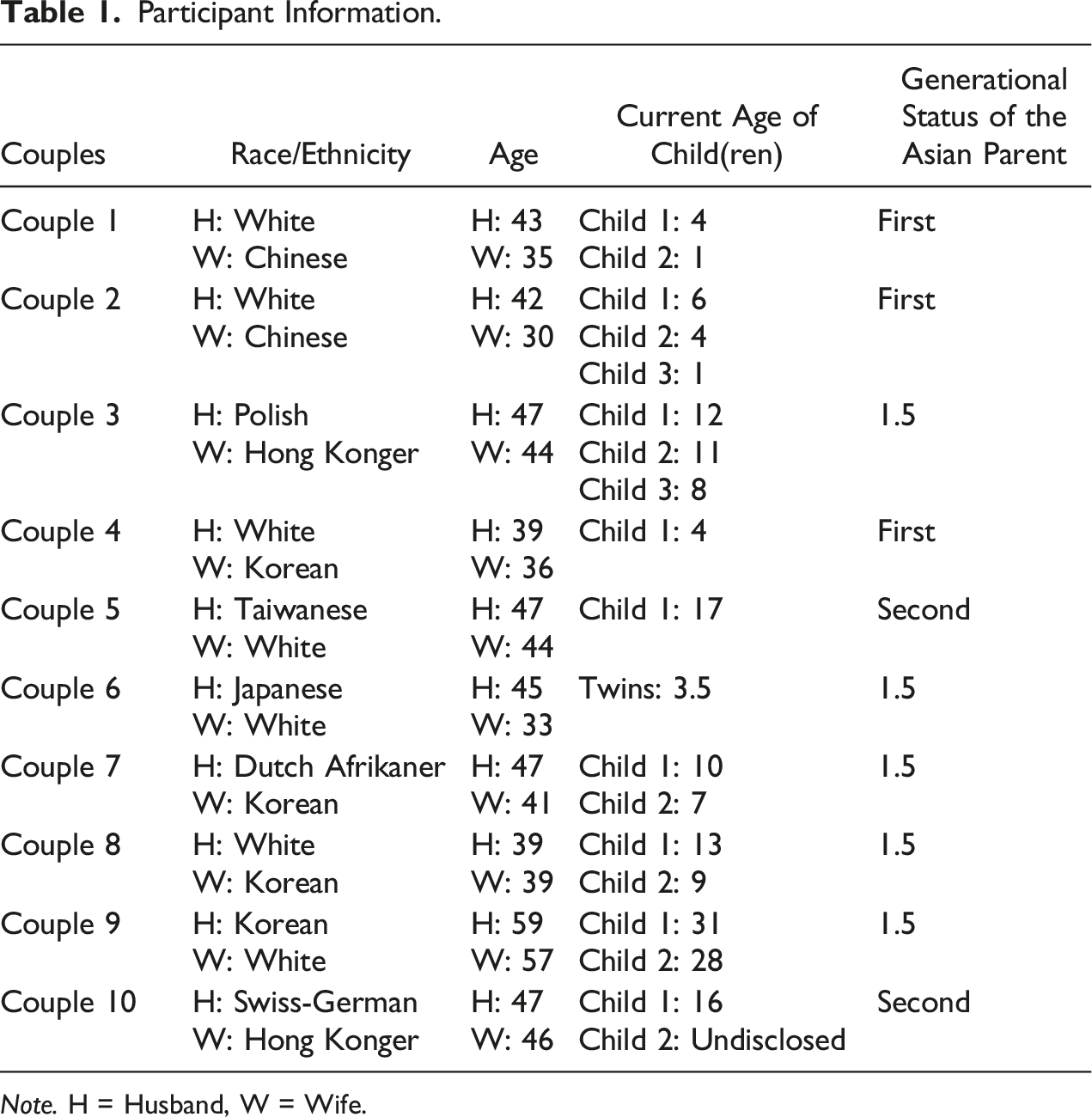
Note. H = Husband, W = Wife.
Data Collection Instruments
Demographic Questionnaire
All participants completed a demographic questionnaire, indicating their age, marital status (first, second, or third marriage), income, and whether they have children from a previous marriage.
Zoom Interview
Each couple participated in an interview via Zoom (due to the Coronavirus pandemic at the time, in-person interviews were not possible). Both spouses were interviewed at the same time in order to capture the dynamic between them. The interview was in a semi-structured format, and participants were asked about their own racial/ethnic identity, their child(ren)’s racial/ethnic identity, which racial/ethnic or cultural socialization practices they engage in at home, and any issues they have experienced while raising their biracial child(ren). Participants were encouraged to freely discuss relevant topics, and follow-up questions were asked as needed for clarification and elaboration.
Field Notes
Field notes were taken during and after each interview. The field notes included keywords, any significant facial expressions or vocal tones with contexts, as well as personal thoughts and reactions during and after each interview.
Procedure
Upon approval by the university’s institutional review board, recruitment flyers were posted on social media, and participants were further recruited via word-of-mouth and snowball sampling. Interested participants were screened for eligibility, and the online interview was scheduled. Prior to the interview, participants signed an informed consent form electronically and submitted the demographic questionnaire via email. Each interview was audio recorded and lasted approximately 1 hour.
Data Analysis
Each interview was transcribed and reviewed for accuracy. All names of participants and their children were removed from the transcriptions prior to data analysis. The data were then analyzed using thematic analysis (Braun & Clarke, 2006). Each transcript was read multiple times, and the six steps of thematic analysis were followed, including familiarization with the data, generation of initial codes, searching for themes, reviewing themes, defining and naming themes, and the production of the final report. Triangulation was done by comparing the findings of the collected data with existing literature as well as relevant theories. Finally, member checking was used by sharing some of the data transcripts and interpretation with participants who had previously agreed to be contacted for this purpose.
Results
Themes and Subthemes.
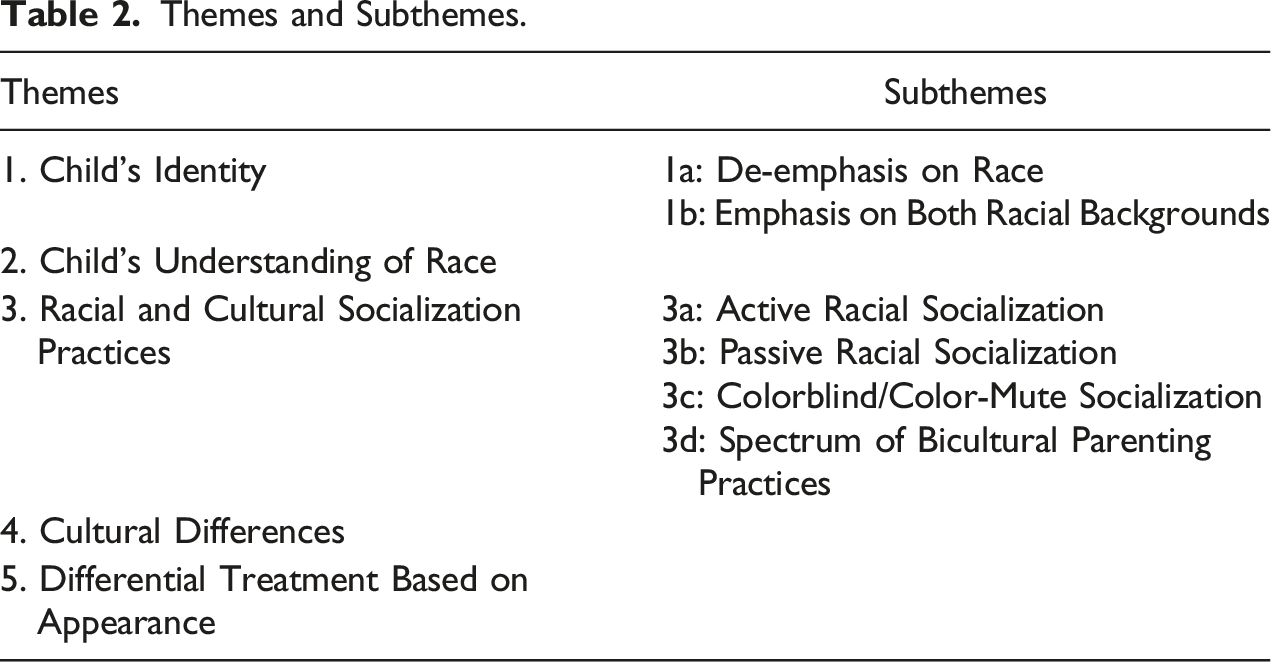
Theme 1: Child’s Identity
Parents were asked how they identify their children and how the children identify themselves, and there was variation to which extent they emphasized the racial/ethnic identity of their child. Most of the couples (n = 7) indicated that they identify their children as biracial and would indicate both racial backgrounds on demographic forms. One couple mainly identified the child as Asian, and a few couples seemed to struggle with the identification, either individually or between the two. One Asian mother of three children ages 12, 11, and 8 said that when she has to state her child’s race on an official form, her answer “depends”: The question always irritates me because you have to pick one, and there’s that one to pick. And so…so…they’re not necess…I don’t consider them Asian American, but they’re not European American, and so there’s… I think that there’s… yeah, so it’s complicated (laughs). I think sometimes which box I check depends on what kind of mood I’m in (laughs). Because they’re not white only, but they’re not necessarily Asian. And so I find it difficult to pick one of them, and there are times when you pick the one that, you know, depending on the situation, what might be more applicable or more relevant.
This mother’s response demonstrates the uncertainty and doubt elicited by the norms of a monocentric society (Atkin & Jackson, 2021) where many demographic forms only give one choice selection for race or ethnicity. A White father of 3 children between the ages of 1 and 6 was especially bothered by it. While his Asian wife identified their children as “mixed,” he was mostly reluctant to put a label on his children’s racial/ethnic identity: I’d probably [take] a culturally blind standpoint. I have problems with it. I think more so than she does in that. I feel like even though my daughter’s skin is white, they have the right to accept whichever culture that they want…. I feel like it’s a hindrance. If someone wants to put my child in a box, I find that offensive.
Subtheme 1a: De-emphasis on Race
Similar to the White father above, several parents indicated that they do not emphasize their child’s racial background. To these parents, the fact that their child is Asian-White biracial is a part that makes up who they are; however, they did not see it as the central identity. Rather, they saw their child as an individual with a unique personality who is able to explore the world unbound to their racial/ethnic background. Six of the couples stated that their children are aware of their biracial identity but do not think too much of it, and it is not something that is often discussed in their everyday life. We have clearly defined Texas as a very multicultural place. So we are not raising our children to be American. We are raising them to be Texan. We are raising our kids to be Texans, unapologetically…. We have a Chinese TV subscription that the kids still watch cartoons on… they watch American cartoons… uhm, I think that our goal isn’t anything about culture, though. It’s about language. (White father of children ages 6, 4, and 1) I think there’s definitely more emphasis on Judeo-Christian values. And then race comes after that. (White father of children ages 12, 11, and 8) I guess they are just into kid stuff and she’ll say “Mommy, I’m a princess.” Or like the other day, she said “I’m a superhero.” And she really wanted me to tie a blanket around her neck like a cape kind of thing. They’re just little girls, more into little kids stuff like colors and dolls, you know. (White mother of 3-year-old twins)
Interestingly, more of these comments about de-emphasizing race came from the White parents in each couple. One of the Asian mothers mentioned that she perceives a conflict between Christianity and her Asian background at times. She explained that some Chinese traditions are rooted in Buddhism and ancestor worship, which she feels is contrary to Christianity, so they choose not to partake in those traditions. Thus, for these families, it appears that their choice to de-emphasize race is in order to raise their children with a focus on mainstream, or majority culture, American values.
Subtheme 1b: Emphasis on Both Racial Backgrounds
Most parents emphasized both of their children’s heritage backgrounds, although they varied in the extent to which they focused on the national identity or racial group as a whole. Some parents identified their children as “Asian and Caucasian,” “White and Asian,” or “Half Caucasian, half Asian.” Others identified them specifically as “Japanese American,” “Chinese American,” “Half Polish, half Chinese,” and “A mix of Chinese and English.” One white mother said she often had to emphasize her daughter’s Japanese heritage because other people would identify her as white: They’re biracial, and I want people to know that even though they look a certain way, they’re still Japanese. And some people will look at them and get confused, like “Oh, they look white, blue eyes, but they have that slant, you know,” so I’m like, “Well, because they’re Japanese!” I want to explain that, like, they’re not just white or Japanese.
Theme 2: Child’s Understanding of Race
While discussing their children’s identity and their own parenting practices, parents also reported on their children’s understanding of race. Parents with younger children (ages 3–6) perceived their children to have limited understanding of race related concepts, whereas parents with older children (7 and older) were better able to share stories related to their children’s level of understanding. He hasn’t noticed and I don’t think it really has registered just yet. Just last year, he had a little thing from his school where there was a picture of a very generic white background, black outline of a face. And it was him learning colors, saying my eyes are whatever color, my hair is whatever color. And he literally just wrote down what the actual color was on the paper, which was white. His face was white because the paper was white. (Asian mother of 4-year-old) So [child’s name] has been learning to identify. She had a really insensitive assignment in middle school, which is one of the first times I think she really identified something as not cool. Her social studies teacher wanted them to do research on their families. European Middle Ages’ family crest. Well, that left all the Black kids in the family and she would say, “All the Asian kids looked at each other like this is a stupid assignment.” (White mother of child now age 17)
Hughes et al. (2006) reported that a child’s age is often a determinant for parents to decide when to engage their children in race related conversations. Parents of young children are less likely to engage in such discussions, but as older children may encounter more racial injustice, they are more likely to reach out to their parents to discuss race related issues. However, cultural context and previous experiences may also influence children’s understanding of race. For example, one couple consisted of a woman of Korean descent who grew up in South Africa and a white Afrikaner man, and they lived in the UK during the first part of their son’s life, so he identified as being a mix of those cultures: My son describes himself as mostly British. So I think he thinks of himself as partly British, partly American, partly South African, and partly Korean. It’s not really a racial description…He just sees himself as someone who is not from here. And so I don’t think race ever really entered as a thing… And we did talk about Black Lives Matter. And I think that what’s happening and the racial problems, as far as he knows, race is more like American white and American Blacks having some kind of issues. Something political, but nothing that every single person inherently possesses.
Theme 3: Racial and Cultural Socialization Practices
Parents were asked if they discussed racial socialization practices prior to the birth of their children, and the majority (n = 8) said they had not. Several said it was because they did not think about it at the time or were not worried about it We didn’t think it was going to be a concern. And it also falls into tradition stuff, like we didn’t even talk about that either, because we’re just raising them as, like, normal kids basically. (White mother of 3-year-old twins)
Two couples indicated that they did discuss racial/ethnic socialization prior to their children being born, but it was mostly in relation to language and culture, such as teaching their children the Asian language and exposing them to certain Asian cultural practices.
In terms of their current practices, parents reported examples of both active and passive racial socialization practices, as well as more specific bicultural parenting practices, in which they emphasized either Asian or American culture or a mix of both.
Subtheme 3a: Active Racial Socialization Practices
Several parents engaged in active racial socialization, in which they emphasized the importance of social justice and acknowledging race-based discrimination. But this socialization practice was mainly mentioned in families of teenagers. When I was growing up, Asians were so deferential, and they didn’t want to create fuss. The advice was just to ignore that. And then I found that I actually helped the other person off the hook. When someone makes a racist comment towards me, mostly I just don’t want to feel bad about myself, so I push back on that comment immediately. If people would make racial comments and I heard them, I would turn around and go back to them and confront them, and the kids would be with me. I did that like three times with [daughter]. And [wife] does very similar things. I think the most important thing we try to show them is the pride of being Asian-American and also the strategy and how not to suffer the psychological downside of being a minority in America. In addition, because I'm involved in Asian-American stuff, I've been slowly communicating to them about discrimination against Asian-Americans in the law. (Asian father of child who is now 17) I think it's important that they learn not only about discrimination at Asian- Americans, but about discrimination in America in general and about the struggles of people of color in our culture across the board. And that the struggle is also their struggle and that they have a role both in experiencing that, but also working against it. (White mother of child who is now 17) When the whole Black Lives Matter movement happened and George Floyd was killed in Minneapolis, we tried to explain to our children the perspective. We did not think they understood how in some ways a Black community would feel oppressed by a white community in positions of authority. So we watch certain movies and then talk about it and have them underline where the Black man was imprisoned for a murder that he never committed. And the reason why a Black person would run away even when confronted by police, and they may not be guilty. Why they would be fearful and present a certain way. I don't think they understand. Even though they are biracial, I don't think they've ever experienced the prejudice that maybe a Black person has. And for them to understand that perspective, we feel like we need to actually have those conversations. (Asian mother of children ages 16 and younger/undisclosed age)
Subtheme 3b: Passive Racial Socialization Practices
Other parents reported more passive forms of racial socialization, and they would only talk about race if the topic emerged from time to time. This was especially a common subtheme among parents of younger children. These couples appeared to recognize and respect cultural diversity; however, they were less likely to actively discuss race related topics. For some, it appeared to be based on their perceptions of their children’s limited understanding of race. We have had very limited discussion about Black Lives Matter because it's all over the news, and we're trying to teach our kids to be sensitive, but only what they can take. We understand that kids don't see color right now, at least not the way we see color. (White father of children ages 6, 4, and 1) I know there's a video about that where the teacher is gonna bring it up and they’re gonna have more questions, especially with the Black Lives Matter movement. I of course want them to be more educated and more aware about that. But it's just going to have to be like, I'm going to take it a step at a time. Right now, they're just little kids. And I want them to enjoy being a child for a little bit. (White mother of twin girls age 3)
Subtheme 3c: Colorblind/Color-Mute Socialization
A few families indicated that they choose not to talk to their children about race or race related issues for various reasons. I don’t know that we actually say the racial portion of it. We more or less just try to talk to him about treating everyone with respect, just in general. We try to be very broad, just to make him a good person more than anything and just be able to carry on a conversation with anybody, be able to say ‘hi’ to anybody. So basically, just treat everybody as a friend, as a person, you know. Just someone that’s relatable and not “That person is a Black person, that person is a Hispanic person, that person is the Asian, that person’s a white,” you know, not kind of see any of that. (White father of 4-year-old child) We really didn’t [talk about race]. It just was not an issue. I guess maybe if they had been Black we might. But I just… it was not a negative issue. There were very few Asians in our community, and most of them were doctors and upper professional people, so that was a positive in society. So there wasn’t any negative issues, as far as I know. (White mother whose children are now adult) In our family, we’re much more faith based. So thinking about, like, how does God see people? And so what does God do? And God loves everybody. And that kind of thing is kind of more about how we frame those conversations. (Asian mother of three children ages 8–12)
Subtheme 3d: Spectrum of Bicultural Parenting Practices
It was clear from the interviews that there were vast differences in the magnitude of bicultural practices within the home. This encompassed the extent to which parents chose to integrate both Asian and American mainstream culture in their home. Three categories (high, medium, and low Asian culture socialization) emerged. Asian culture socialization practices included Asian language learning, enjoying ethnic food, connecting their child with Asian peers, giving their child an Asian name, and teaching their child about Asian culture, history, and customs.
High Level of Asian Culture Socialization
Only one couple was categorized as falling on the high end of Asian culture socialization. The daily activities for their children were heavily centered around Asian practices (e.g., language learning, engaging with other Asian family friends). I would say we lean more toward the Asian, and the feeling is like we’re surrounded by the United States and so that we have to make more of an effort to like really maintain the Asian aspect of our culture. You know, linguistic ability and cultural fluency. So for instance my wife, every day at 3 in the afternoon, there’s an online Chinese reading group where it’s like a group of Chinese moms and their kids get together and read poetry and stuff. We live in the U.S., so [child] is going to be naturally be acculturated—it’s not like she’s not gonna know about pizza and hamburger and baseball games, right? But if we don’t make an effort to maintain the Asian-ness, that’s not something she’d naturally, organically pick up. And we want her to be able to feel comfortable to go back to China, if we wanted to move back to China. [Husband turns his camera to a blackboard with Chinese letters written on it] These are some stuff around the house, and my wife really makes a great effort to represent Chinese culture around the house and practice writing. (White father of children ages 4 and 1)
Medium Level of Asian Culture Socialization
Six out of 10 couples fell into the category of incorporating a mix of both Asian and mainstream culture in their household. The Asian parent of these couples were either a 1.5 generation (born in a different country but arrived in the US as children or teenagers; Chan, 2017), or second generation Asian American. This is an interesting finding because the 1.5 and second generation Asian Americans are more likely to be detached from Asian cultural practices as they are more assimilated into the mainstream American culture (Chan, 2017), and yet, they were still including Asian cultural practices on a moderate level. The participants shared that they usually incorporate the combination of Asian and mainstream culture because they based their practices on their own upbringing. Parents also made decisions on which Asian practices to keep or follow based on what they liked. The selective bicultural practices derived from how familiar the parents themselves were with Asian culture, as the Asian parents on the middle of the spectrum were fairly familiar with both Asian and mainstream culture. For a few couples, the reason to include both cultures was so that the children were exposed to cultural diversity, which was not the experience the White spouses had. Generally, the parents appreciated the concept of cultural diversity and they were encouraging their children to experience different parts of the world, including Asian culture. So we do a very Americanized version of sweeping the grave. You know, Lunar New Year, we do a very Americanized version of the Loon Festival. We get a lot of Chinese food. I think we are still pretty conscious of teaching our kids about how to advocate and represent ourselves as minority. (Asian father of child who is now 17) I see mostly mainstream American themes. But the holidays, you know, of course New Year’s Day, that was all Korean. And Mom and Dad both celebrated their 60th birthday. That was very much a Korean thing. And we would cook Korean at least once or twice during the week and it wasn’t a conscious that we were going to eat Korean twice a week. We had Santa Claus and the Easter Bunny…and Christmas was a big deal. You couldn’t quite assume why we had to do all that. It was like “Well, because I was raised with those things, they need to have that.” (Asian father of two now-adult children)
Low Level of Asian Culture Socialization
Couples who did not incorporate a lot of Asian culture in their child rearing did so mainly because they themselves were not very familiar with Asian culture and mostly engaged with the mainstream culture. We teach some Japanese stuff sometimes, with chopsticks and being polite at the table. I want to say there is a bit of both in there, but it’s not anything customized like really traditional Japanese. It’s just what we can at the moment, it’s Americanized Japanese, basically. (White mother of 3-year-old twins) Yeah, we initially thought that we might teach them Korean as well. But when it became clear that actually they had enough trouble learning English, we thought that there was no point. Like, we wouldn’t want to make their lives more complicated by doing that. (White father of children ages 10 and 7) Definitely more mainstream, because that’s how I was raised. They don’t speak Korean. I feel like they’re learning more about Korea and its culture through Taekwondo, which is almost better because they’re more receptive to learn from somebody else than their parents. (Asian mother of three children ages 8–13)
Theme 4: Cultural Differences
Throughout the interviews, several incidents were brought up as indicative of some of the cultural differences between the Asian culture and American mainstream culture. The most common misunderstandings seemed to happen between the white spouse and the Asian in-laws. In China when you have a baby, they have this concept of 40 days after the baby is born, you don't even leave the house. So when my mom came to visit, it was like a week after the baby was born. My wife was just staying in the bedroom. And from my mom's point of view, she feels like my wife is being rude—hiding and avoiding my mom when it's just in China, you would just have people waiting on you hand and foot and you wouldn't even get out of your bed for the first couple weeks. So that caused some friction, actually. (White father of children ages 4 and 1)
Postpartum care is culturally significant to Asian mothers (Song, Chae, Ko, Yang, & Kim, 2020), and a Chinese tradition is for the mother to stay confined while minimizing physical movement and activities and following strict dietary regime (Tien, 2004). However, in this case the White husband’s mother perceived it as being rude and avoidant. For another couple, the conflict with the mother-in-law was in regards to disciplining the children: [Wife]’s mother, who lived with us for a short period of time, always spanks the children. Um, it has caused major problem. She doesn't do her schooling by not beating them. The worst it ever got…[Wife] and her mom got in a very verbal altercation and her mother wanted to make it physical, and this is America and no one is allowed to hit my wife. My mother in law grabbed my oldest daughter by the arm and held her, spun in the air by her arm, and the arm had been dislocated trying to take a coat off. You can't hit my wife, you really can't hurt my children. And I removed my child from her grasp and she picked up something in an attempt to attack me, which is even dumber. She kept hitting until she figured out that assaulting me is not a smart idea. And I separated my wife and children from her and didn’t let her back in the house until she was so hurt that she was left on the ground crying for an extended period of time. (White father of three children aged 1–6)
Even though authoritative parenting is encouraged in the U.S. for its positive developmental outcomes for children, Ang and Goh (2006) pointed out that parental control and child obedience to parents are viewed as desirable and responsible parenting. Thus, these cultural differences in parenting perspectives can lead to conflicts between parents and within families if they are not discussed prior to having children.
At times, cultural differences led to misunderstandings or conflict between the spouses due to differing expectations for their children. Several of the Asian parents expressed that they were more concerned with their children’s academic progress, while their White spouses expressed they were less worried about grades. Schools are so incredibly important. The current generation in China, test scores mean everything. So in China they have a test called the gaokao, which decides which school you can get into. And so [wife] thinks that translates here, like, she thinks if your kids go to a good school here, they get to go to Harvard. And I keep telling her if your kids go to a bad school but they are the best students, they get to go to Harvard. (White father of children ages 1–6) He had to work so hard when he came here to learn English and to study so hard that getting A’s was the thing. He hardly ever got a B and he couldn't understand why our kids did not have that drive. He was almost blaming me because the kids didn't have that drive. And it's like “Well, you know, they are their own people. They have to find that from the inside themselves.” And he thought we should be able to force that on them because that’s Korean culture. (White mother of two children who are now adult)
Even though the couples themselves did not have much trouble understanding each other, some couples expressed that the language differences worked as a barrier for their child to communicate with the Asian side of the family. Because they are all in Korea, I’m the only one here. So [son] does not get to spend time with my parents as much and when I do call them, he doesn’t speak the language just yet. I do wonder if he spoke Korean then they would actually be able to have conversations. (Asian mother of 4-year-old child) My parents are very sad that kids can’t speak Korean, which is not my problem (laughs). I’m not gonna spend an extra hour or two everyday trying to teach them Korean. I can’t make myself. (Asian mother of two children ages 10 and 7)
These concerns are not uncommon among interracial couples who speak different native languages. Greif and Saviet (2020) found that language differences are often perceived by interracial couples as a barrier to maintain a deep relationship with their in-laws.
Theme 5: Differential Treatment Based on Appearance
Several parents reported that their children have faced differential treatment or comments based on the child’s appearance. While the comments might not have been intended as negative, they were highlighting the children as being different due to their appearance. When we were in China for [older daughter]’s first year and a half of life, something that I worried about a little was that people fetishize foreigners a bit. All these sayings “Oh, mixed-race children are better looking than normal children.” On one hand, it’s a nice thing but I don’t want her to internalize that too much. Someone could be saying while looking at her “Oh, mixed children are so beautiful.” (White father of two children ages 4 and 1) When we were in Southeast Asia and then we were all in Vietnam together, the people in those countries just were very warm and friendly, but it was like a Justin Bieber concert when they walked somewhere, and young girls would grab them and sit them down and have their photos taken with them. And adults would do the same thing, and they would just come up and take selfies. We were like "What's going on?" And it was because they were biracial. Everyone was interested like, "Oh, this is your son, your wife is Asian." Or they would see the two of us and be like “Oh this is what your child looks like. This is what a biracial child looks like." I mean, they weren't treated like humans. They were treated like [objects of affection]. (White father of three children ages 8–12) When we had our oldest son, he was at a daycare in one end of town that was socioeconomically less. He was known as the white kid because all the other kids were Hispanic and Black. But then when we moved him to a different school that was more affluent, he was the Asian kid because the other school was more white. So it was interesting. That was when our oldest was 1–2 years old, he was really young. This was my first experience as a parent and seeing how my kid, who is the same kid, is being viewed differently depending on the setting that he was in. (Asian mother of three children ages 8–12)
Discussion
The current study revealed insights into Asian-White interracial couples’ perceptions and experiences with raising their biracial children. Parents reported on how they perceive their children’s identity, how they approach racial and cultural socialization of their children, and the experiences they have faced due to cultural differences and appearances.
Almost all of the parents readily identified their children as biracial, but they varied in the extent to which they emphasized racial/ethnic background as being an important part of their children’s identity. Some placed importance on the children’s multiple heritages and ensuring that the children would embrace Asian culture and language as much as the mainstream white American culture, whereas others intentionally chose not to focus on race, and some put more emphasis on other values, such as religion or regional affiliation.
Research shows that children as young as age 3 have some fundamental understanding of race, including the ability to recognize their own race and that of others, and some are showing marginal preference for their own race (Hirschfeld, 2008; Winkler, 2009). By age 5, children show preference for higher status groups, and this peaks around ages 6–7. However, parents of young children in the current study perceived their children as not yet being able to comprehend the concept of race, and they felt their children were too young to introduce the topic. Many parents also indicated that their children’s biracial identity was not an important subject in their household. This is similar to research on White families raising monoracial white children. For example, Vittrup (2018) found that White parents did not perceive race to be an emerging issue in their family, their children were too young to discuss race, and they would only discuss it if their children initiated the conversations. Thus, the reason the parents believe their children are not yet thinking of race could be simply because there is no conversation initiated by their children. In other words, parents are prone to believe that conversations about race and racial socialization are not necessary until their children are “old enough” or demonstrate their interest in the subject.
Parents of children over the age of 7 recognized that their children had an understanding of race and their own racial/ethnic identity, and most indicated that their children identified themselves as biracial. Whether the children strongly identified themselves as Asian or not, the parents of the children all agreed on the importance of education on racial diversity. However, most of the couples reported that they had not discussed racial/ethnic socialization strategies prior to the birth of their children, mainly because they were not worried about it or simply did not think about it. This is in stark contrast to Black families who tend to be acutely aware of the potential bias and discrimination their children may experience and therefore understand the need to actively discuss this with their children, as well as engage in strategies to instill racial and cultural pride in their children (Hughes et al., 2006; Miller & Vittrup, 2020). Only four of the couples in this study reported having intentional conversations about race and actively engaging in racial/ethnic socialization, and it mainly occurred in families of teenagers. The conversations they reported on were about privilege, racism, and the Black Lives Matter. However, none of them mentioned conversations or socialization strategies related to multiracial identity and experiences. This is not unexpected in light of previous research showing a lack of awareness among monoracial parents in regards to the unique experiences multiracial children may face (Jackson, Wolven, & Crudup, 2019). However, it highlights the importance of further educating parents of biracial and multiracial children of the challenges they may experience when growing up in a monocentric society (Atkin & Jackson, 2021).
Some parents indicated they were engaging in more passive racial/ethnic socialization. They talked about race and racial issues when the topic was brought up; however, no initiating gestures were made prior to such concerns. This is similar to findings from research on White families, where a majority of parents take a colorblind or color-mute approach and refrain from active discussions about race (Pahlke et al., 2012; Vittrup, 2018; Zucker & Patterson, 2018). In fact, several parents in the present study—especially those with younger children—indicated that they avoided discussing race with their children. However, it is important for parents of biracial children to develop awareness of the fact that engaging in active racial/ethnic socialization provides healthy pathways for biracial youths to develop their own racial/ethnic identity (Rockquemore & Laszloffy (2005). Providing emotional support and cultural tools is important not only to fight against racism, but also to develop resilience and racial/ethnic pride (Hughes et al., 2006; Ingram & Chaudhary, 2014).
Several parents emphasized the importance of cultural socialization and teaching their children about their Asian heritage while simultaneously raising them in the context of mainstream American culture. However, the level of bicultural socialization practices varied greatly among the participants. Only one couple indicated that they engaged in a high level of Asian culture socialization. They had plenty of cultural resources and a social network that enabled them to educate their children about Asian heritage. According to Campbell, Popli, Nuevo-Chiquero, & Ratcliffe (2019), when parents engage in active socialization with Asian culture, their child is more likely to later self-identify as Asian. On the other hand, some of the Asian parents, especially those who identified themselves as 1.5 or second generation, indicated they did not have enough Asian cultural context to socialize their children within that culture. Therefore, these parents only included very limited forms of cultural socialization, such as taking them to Taekwondo classes or teaching them “Americanized Japanese” customs. In this case, the low level of bicultural socialization is more likely to lead the biracial children to identify as the majority group (Campbell et al., 2019).
The majority of the participants engaged in medium levels of Asian culture socialization. They were combining both Asian and mainstream/majority American cultural practices. Participants’ reasons for this approach included opportunities to learn about a different culture other than the mainstream culture and wanting to promote positive racial/ethnic association. Overall, the couples were integrating both cultures in a way that fit the family’s social context and situation, such as teaching the children basic Korean phrases, enrolling them in Chinese language school, and exposing them to foods from the Asian parent’s native country. The blended practices of Asian and American cultures in the household are likely to allow the biracial children to comfortably experience both cultures.
Several participants shared interesting stories about cultural differences that had led to conflicts within their home. For some, the conflicts were with their in-laws, such as disagreements over child discipline and misunderstandings about postpartum care norms. Conflicts with in-laws are not unique to interracial couples (Leslie & Young, 2015); however, this type of conflict was based on cultural misunderstandings and thus can create unique issues for interracial couples. The way in which couples handle such conflicts with in-laws could influence both the family dynamics and the relationships between the children and their grandparents.
Differences in cultural backgrounds led to conflicts between spouses as well, especially in terms of expectations for their children’s academic performance, with some of the Asian parents indicating a strong preference and expectation for their children to be academically successful, whereas their White spouses seemed less concerned with this. And while it did not pose a conflict between the couples themselves, several indicated that their children’s inability to speak the Asian parent’s native language presented a barrier for their relationship with the Asian grandparents. It is also important to recognize that the ability to speak an ethnic language may be an important factor for biracial individuals to acknowledge their racial/ethnic heritage (Arredondo et al., 2016; Hughes et al., 2006). Thus, being able to speak an Asian language can be an indicator for Asian-White biracial children to be accepted by the Asian community and the biracial individuals’ self-efficacy to identify as Asians.
Phenotypical characteristics of biracial children often influence how the biracial individuals are seen and judged by others (Chen, Kteily, & Ho, 2019; Renn, 2008), and several parents in this study indicated that their children had experienced differential treatment or comments based on their appearance, such as being singled out, objectified, or identified by others as White or Hispanic. Chen et al. (2019) stated that Asian-White biracial individuals (as opposed to Black-White biracial individuals) have more phenotypical overlap, which allows them to “pass” as White. This may present a challenge for Asian-White biracial individuals who are often questioned for the authenticity of their identity as Asian. However, Atkin and Jackson (2021) found that multiracial youth whose parents provide connection support were better able to cope with group membership discrimination, thus emphasizing the importance of parental engagement and awareness of the unique experiences of multiracial individuals.
Implications
As the number of Asian-White biracial individuals is rapidly increasing in the United States, a deeper understanding is needed to better serve this understudied community (Chong & Kuo, 2015). The current findings highlight the importance of continuous effort to promote cultural diversity, color-conscious education in lieu of a colorblind approach, and racial awareness in the home environment, as parents are the primary agents of racial socialization (Brunsma, 2005; Supple et al., 2018).
Research has shown that White parents are more likely to take a colorblind or color-mute approach to racial socialization (Pahlke et al., 2012; Vittrup, 2018; Zucker & Patterson, 2018), and several Asian-White interracial couples in the current study appeared to do the same, especially those with younger children. While well-intended, colorblind messages do not reflect the reality of racial minorities who experience racism and discrimination, and thus, this approach can leave children unprepared for such experiences. This is especially the case for multiracial youth growing up in a monocentric society. On the other hand, a color-conscious approach, in which parents discuss discrimination and inequality and expose children to other cultures, acknowledges the unequal dynamics among racial groups on both an individual and societal level (Killian & Khanna, 2019; Vittrup, 2018). In other words, color-conscious parents are more likely to take a proactive approach to racial socialization, whereas colorblind and color-mute parents tend to take a reactive or even silent approach when the topic of race emerges. Ultimately, frequent and positive communication about race between biracial children and their parents is associated with biracial children’s stronger sense of self-esteem, higher rates of academic achievement, and lower rates of disciplinary problems (Atkin & Jackson, 2021; Rockquemore & Laszloffy, 2005).
In addition, professionals such as family life educators, family advocates, therapists, social workers, and teachers may need additional professional development training to effectively serve multiracial families and children in a way that recognizes their multiracial experiences and unique backgrounds.
Limitations and Directions for Future Research
The current study looked at Asian-White interracial couples, focusing on those with a parent from an East Asian background. The Asian continent is very large, comprises more than 45 countries, and is thus both ethnically and culturally diverse. Therefore, the results may not represent families and biracial children of other Asian heritage. Similarly, results may not apply to interracial families and biracial children of other racial and cultural heritage, and future research should further explore the racial socialization practices of other racial and cultural intersections to discover overarching similarities and differences.
Because there is a dearth of research on Asian-White interracial families, this study was conducted with a qualitative phenomenological approach in order to gain deeper insights into their experiences and perspectives. Future research would benefit from a quantitative approach, which would allow for group comparisons and discovery of trends and commonalities. In addition, longitudinal research looking at developmental trajectories for biracial children’s racial/ethnic identity development could help identify social and environmental influences, including the impact of specific parental racial/ethnic socialization practices.
Conclusion
Positive racial/ethnic socialization practices are important for biracial children’s racial/ethnic identity development. However, it appears that within Asian-White interracial families, intentional practices are somewhat limited, despite many of them having experienced differential treatment and cultural misunderstandings. Greater awareness of the importance of intentional socialization practices is needed to ensure a healthy developmental trajectory for this growing population of Asian-White biracial children.
Footnotes
Declaration of Conflicting Interests
The author(s) declared no potential conflicts of interest with respect to the research, authorship, and/or publication of this article.
Funding
The author(s) received no financial support for the research, authorship, and/or publication of this article.
