




Abstract
The central theoretical assumption is that work-to-family conflicts are having a direct impact on parental self-efficacy, and thus, play an important role within the parent-child relationship. This study examines relationships between work-family conflicts and parental self-efficacy, taking into account two potential moderators: gender and cultural differences between East and West Germany. We analyze data on 1746 employed mothers and fathers from three waves of the Pairfam study (2013, 2015, 2017), using cross-lagged panel models. The findings suggest that gender and cultural background moderate the relationship between work-family conflicts and parental self-efficacy, provided that the risk of reverse causality bias is not ignored. The findings show that work-to-family conflicts are associated with lower levels of parental self-efficacy for women, especially in West Germany. Future research can serve to illustrate how relationships between work-to-family conflicts and parental self-efficacy affect children’s well-being and parent-child relationships.
Introduction
The parental role cannot be overrated in the context of implementing a fruitful environment for raising children and is therefore taken very seriously by legal guardians. As one factor, research indicates that the beliefs in the effectiveness of own behavior to ensure good nurture—so-called parental self-efficacy (PSE)—is correlated with parental and child well-being, positive parent-child interactions, and a wide range of child outcomes such as behavior problems (Albanese, Russo, & Geller, 2019; Jones & Prinz, 2005). Besides personal characteristics, time and energy resources determine to what extent the parental role can be successfully fulfilled. For most people, work demands limit those resources in private life. Several long-term trends like the growing female workforce participation engender increasing conflicts between the role at work and at home (Eurofound, 2017). Those interrole conflicts have been established as work-family conflicts, which describe both the interference of work demands into family life (work-to-family conflicts: WFC) and the interference of family demands into work-life (family-to-work conflicts: FWC) (Greenhaus & Beutell, 1985). However, conflicts between the two life spheres occur more often in the work-to-family direction (cf. Eurofound, 2017). Additionally, conflicts that interfere with private life contain a higher conflict potential regarding the perception of parental obligations. Although the relationship of WFC with PSE could be an important link regarding the question, how parents’ compatibility problems affect children’s well-being (Hess & Pollmann-Schult, 2020) or parent–child relationships (Vieira, Matias, Ferreira, Lopez, & Matos, 2016), surprisingly has been addressed by few studies (Crnic & Ross, 2018).
Our study is one of the first that analyzes the influence of WFC on PSE over time (Cinamon, Weisel, & Tzuk, 2007; Vieira, Matias, Lopez, & Matos, 2016 for cross-sectional analyses), using longitudinal panel data derived from the German Family Panel (pairfam, years 2013–2017). Leant on parenting norms (Forbes, Donovan, & Lamar, 2020; S. Williams, 2008) and the work-care culture perspective (Kremer, 2007), we investigate the role of gender and cultural background differentiating between former East and West Germany. The study addresses the following questions: To what extent does WFC affect PSE? Are there gender differences that can be interpreted in light of gender-specific parenting styles and norms? Are there regional differences due to historical differences between East and West Germany regarding cultural perceptions of maternal workforce participation and childcare outside the family?
Parental Self-Efficacy and Work-to-Family Conflicts
PSE is the belief of parents in their ability to care for their children and guide them to 1 day being successful adults themselves (Ardelt & Eccles, 2001; Bandura, 1997). It is associated with and predicted by general self-efficacy (Murdock, 2013). Therefore, the construct is linked to general beliefs of own competencies as well as psychological functioning and self-esteem to have situations under control (Jones & Prinz, 2005). As PSE refers to the specific role of a parent, family environmental factors as well as own experiences regarding parental tasks may strongly influence the belief in one’s parenting abilities (Murdock, 2013). Environmental factors include conventional socioeconomic circumstances, which are also related to parenting competence (Jones & Prinz, 2005).
Besides family environmental factors and experiences, stress spill over from work to family and can cause stress or strain in the family domain as well. This spillover effect can play a major role within the parent–child relationship and can have a direct impact on PSE (Cinamon et al., 2007). Referring to the initial works of Greenhaus and Beutell (1985) and Voydanoff’s conceptual model of the work-family interface (Voydanoff, 2008) job demands and constraints may restrict time and energy resources that are needed to fulfill family role responsibilities (Moen & Yu, 2000). The parent role is especially vulnerable to spillover of stress experienced in the work domain because both the care and upbringing of a child and the development of a positive parent–child relationship are resource-intensive. For example, missing a children’s school play (Cinamon et al., 2007, p. 80), highlights that children’s timetables cannot be easily adjusted to work demands and bringing work stress home is likely to negatively influence the parent–child interaction (Schulz, Cowan, Cowan, & Brennan, 2004). Mothers’ and fathers’ perception of time- and strain-based WFC may leave them unable to meet their own expectations as a parent or at least increase fear of failing to live up to their parenting expectations. We illustrate the assumed relationship in Figure 1 which lends on Bakker et al.’s work-family conflict-crossover model (2008, p. 902). Hypothesized link between job demands, WFC and PSE.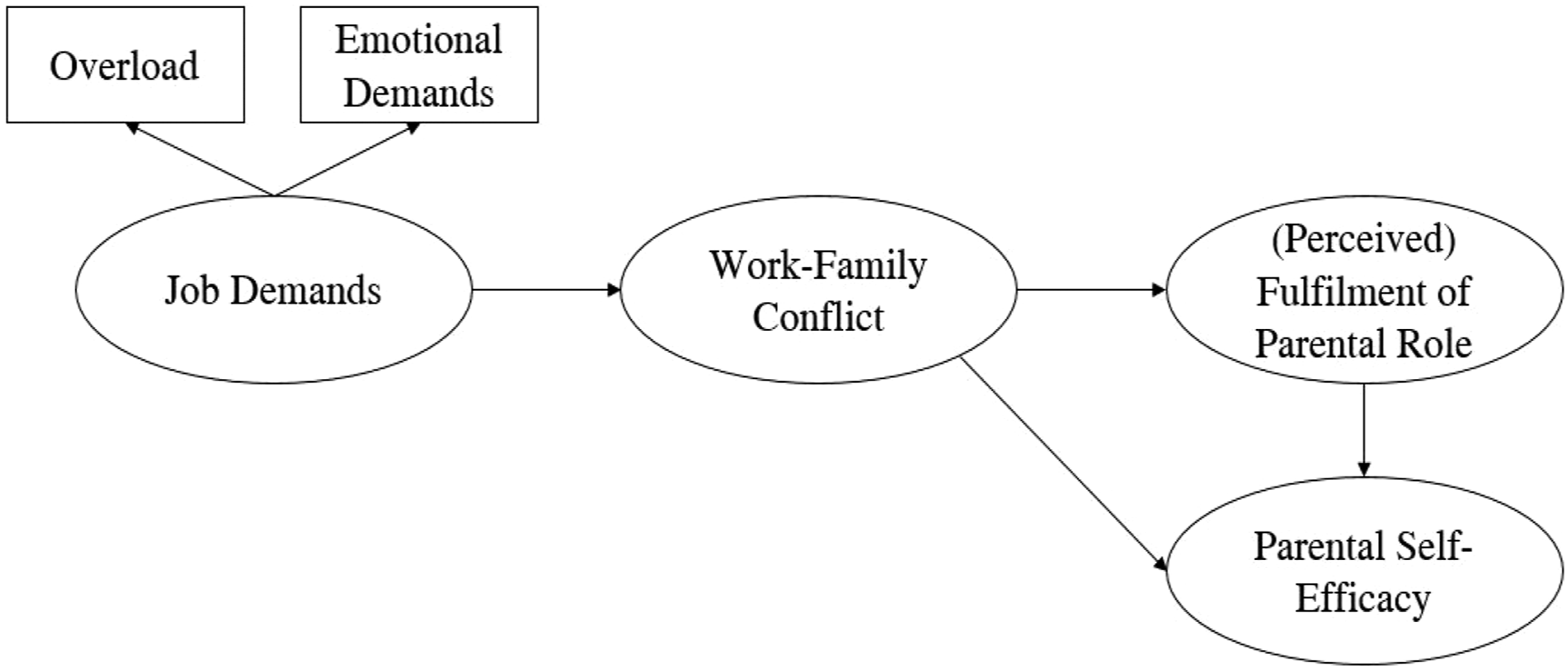
However, the causal relation between WFC and PSE could also go (at least partly) in the opposite direction. One rationale behind this is a feedback mechanism. It is theoretically plausible that WFC will weaken PSE and as a reaction to this experience parents with lower efficacy may subsequently report more WFC. Some parents may also anticipate WFC due to, for instance, lacking parenting experience or supervisor support, and this expectation may already weaken their PSE. Additionally, some results show that self-efficacy is related to the experience of strain due to work stress (Siu, Spector, Cooper, & Lu, 2005) and women’s self-efficacy in a particular work or family role was found to decrease role-related stress (Erdwins, Buffardi, Casper, & O’Brien, 2001). Therefore, one can assume that the level of (parental) self-efficacy affects the level of current and future WFC. In contrast, Beauregard (2006) did not find any effect of self-efficacy on work–home interference. Also, literature on job-related self-efficacy does not yield clear evidence regarding its effect on the stress–strain relationship (Sonnentag & Frese, 2003) and effects seem to depend on the within-person stability of self-efficacy (Peng, Schaubroeck, & Xie, 2015). With this in mind, empirical analysis should address potential effects of reverse causality.
Although not much research is done on the relationship between WFC and PSE explicitly, some findings reveal a general interrelatedness. Negative correlations between PSE and WFC were found among Israeli working adults (Cinamon et al., 2007). Findings from a sample of Portuguese dual-earner couples reveal a significant negative effect of WFC on parenting confidence of both, mothers and fathers (Vieira, Matias, Lopez, & Matos, 2016). In general, WFC is assigned a negative role for the family domain (Carlson & Kacmar, 2000), but empirical tests of effects from work-related stress on the parenting role remain scarce (Crnic & Ross, 2018, p. 278).
Some research has been done on related constructs. Role stressors of both, family and work roles, were identified as direct antecedents of WFC (Michel, Kotrba, Mitchelson, Clark, & Baltes, 2011), while parenting stress is closely linked to PSE (Bloomfield & Kendall, 2012). Time strain appears as a major stressor for the parenting role, especially for full-time employed mothers (Milkie, Nomaguchi, & Schieman, 2019; Milkie, Raley, & Bianchi, 2009). Congruently, a majority of parents report spending too little time with their children (Nomaguchi, Milkie, & Bianchi, 2005). Based on the theory and prior research discussed above, it can be assumed: H1: Parents who experience work-to-family conflicts are more likely to score low on parental self-efficacy.
However, this may not hold to the same extent for men and women in West and East Germany. Theoretically, PSE is also determined by the ecological context and, more particularly, gender and the cultural background can be expected to influence the parenting experience (Bronfenbrenner & Morris, 2006). Findings of Murdock (2013), for example, show that experiences with different child and parental behaviors have divergent effects on maternal and paternal PSE.
Gendered Demands on Parents
When analyzing the relationship between WFC and PSE, gender differences in societal expectations towards mothers and fathers have to be taken into account. The female parental role still seems to be shaped by what Hays (1996) initially called intensive mothering (Forbes et al., 2020). Intensive mothering describes the belief that mothers have to be the central caregivers and devote the most time and energy resources on offspring (Hays, 1996). This belief is strongly connected to the traditional role of a housewife, but in-depth interviews show that even employed mothers, who partly outsource child care, make use of this role belief (Christopher, 2012). The father’s role, instead, has changed in the last decades. Lamb (2000) described a role shift from the one-dimensional task as the breadwinner to a father that gets more involved in nurturing activities and family life (see also Milkie & Denny, 2014). Men who value familial obligations over their careers were allocated to being new fathers (see Marsiglio, Amato, Day, & Lamb, 2000), even though fathers themselves do not refer to this term (S. Williams, 2008).
The changing role of fatherhood is supported by empirical evidence for an increase in fathers’ time with their children (Dotti Sani & Treas, 2016). Nevertheless, in Germany time spend on childcare is far from being equally distributed. Women still take the lion’s share of child care (Craig & Mullan, 2011) and fathers’ increasing time with children mainly takes place on weekends (Neilson & Stanfors, 2014). Regarding the compatibility of work and family life, parenting norms do not force men but women to reduce their working time when children are under school age or even beyond and debates about so-called “Rabenmütter” (literally “raven mothers”) do not occur in the contexts of fathers (Boling, 2015, p. 219). Congruently and in contrast to mothers’ behavior, the vast majority of men do not reduce their workforce participation after becoming fathers (cf. Bünning, 2020; Keller & Haustein, 2013). Norms of masculinity seem to adhere to male full-time employment and a deviation is still penalized, even in more egalitarian countries like Sweden (Larsson & Björk, 2017).
These gender differences in workforce participation and time for child care have to be mentioned when we consider that slightly more men than women report a desire to spend more time with the offspring (Milkie et al., 2019; Nomaguchi et al., 2005). The difference, indeed, disappears after controlling for work hours. Further, the finding that time strain as one central expression of WFC has a stronger impact on mothers’ well-being (Nomaguchi et al., 2005) is taken into question by current findings since some studies do not find any interaction effects between gender and not having enough time with children on well-being (Milkie et al., 2019). However, these similarities between mothers and fathers exist on very different preconditions regarding workforce participation and couples’ division of child care. Men’s desires for a stronger involvement in family time (also Dermott & Miller, 2015) rarely lead to any scale back in work hours or demands.
While both, female and male parenting norms shape the parents’ desire to have more (quality) time with children, the double standard of an adequate effort towards the offspring might influence the effect of WFC on PSE. Findings indicate that men’s work stress causes stronger reactions of the female partner than vice versa (Brummelhuis, Haar, & van der Lippe, 2010), which can be interpreted as a higher acceptance of WFC for men than for women. Due to masculine norms of workforce participation (J. Williams, 2001) WFC is less of a concern for fathers, while for women the motto applies: family first. When females' WFC harms the familial role fulfillment, this can easily turn to a feeling of guilt for mothers (Guendouzi, 2006). In summary, it can be assumed H2: The influence of work-to-family conflicts on parental self-efficacy is stronger among women than men.
East and West: Two Different Cultural Backgrounds
Germany shows strong regional differences regarding parental workforce participation and parenting norms between East and West Germany. The diverging parenting norms mainly stem from a contrasting political agenda. The socialistic German Democratic Republic (GDR) propagated a model in which childcare responsibilities lie fully with the state and after a short period of maternity protection, mothers returned to full-time employment. In contrast, in the old Federal Republic of Germany (FRG) most couples, who could afford it, followed a male breadwinner—female housekeeper model after getting married or the birth of the first child (Schmitt & Trappe, 2010).
In contrast to other countries like the US, the differences between population groups (Nomaguchi & Milkie, 2018), therefore, do not unfold by parenting values. Rather, the divide finds its expression in the question if childcare should take place in or outside the family. Although the reunification of Germany took place three decades ago, egalitarian gender roles are still more widespread in regions of the former GDR (Bauernschuster & Rainer, 2012) and the belief that a pre-school age child suffers from a working mother is more widespread in West Germany (Schober & Stahl, 2014)
In line with the diverging cultural ideals, the development of childcare facilities, the utilization of day nurseries, and the claim to the welfare state are still path-dependent (Schober & Stahl, 2016). An assimilation process can be found in both directions with growing numbers of housekeeping women in eastern regions and an increasing number of working mothers in Western Germany. A part-time return to the labor force after the birth of a child becomes more prevalent in whole Germany, but women in Eastern Germany return to their jobs faster and work longer hours on average (Keller & Haustein, 2013).
The work-care cultures (Kremer, 2007) do not only moderate the behavior of parents but also shape an idea of good and sufficient parenthood. Therefore, working mothers contravene stronger against this idea in West Germany, where norms of intensive mothering are historically more prevalent (Ostner, 1993; Trappe, 1995). This means that working mothers experiencing WFC might have a stronger feeling of deviation from the parental ideal in Western Germany and it is likely that these conflicts have a stronger negative impact on PSE in Western than in Eastern Germany. For fathers, however, the relationship would be reversed because the male breadwinner model is more strongly rooted in West Germany than in East Germany (Grunow, 2013). However, the higher workforce participation of mothers in the GDR did not lead to an equal distribution of house and care work in couple relationships, and today there are no substantial regional differences in the opinion that a father should be both nurturer and breadwinner (Hofmeister & Baur, 2015). H3a: The influence of work-to-family conflicts on parental self-efficacy is stronger among mothers in West than in East Germany. H3b: There is no difference in the influence of work-to-family conflicts on parental self-efficacy between fathers from East and West Germany. Descriptive Statistics for women (N = 840) and men (N = 906). Note. Source: pairfam, waves 6, 8, 10. Own calculations. We present means and within-standard deviations for all variables.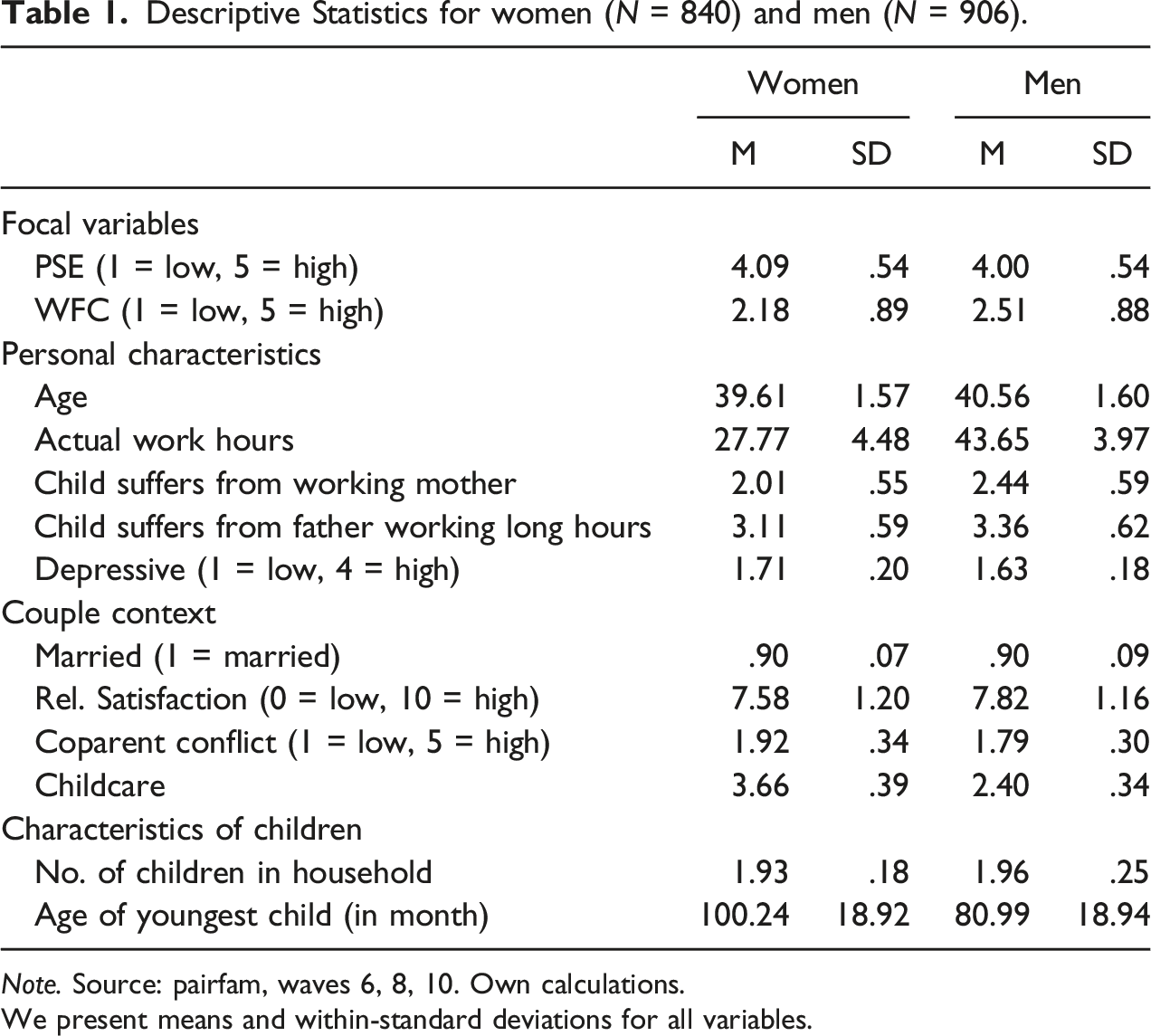
Data and Method
Data
Empirical analyses are based on longitudinal data provided by the pairfam study (2013, 2015, 2017) (Brüderl et al., 2018). Yearly follow-up interviews are conducted with respondents (anchor persons) who were exclusively drawn from the birth cohorts 1971–1973, 1981–1983, or 1991–1993. The partners of the anchor persons are also interviewed via separate questionnaires. The survey provides, amongst others, a wealth of information on relationship histories and dynamics, the occurrence of conflict and its resolution strategies, as well as on beliefs of personal efficacy.
The analytic sample is restricted to persons in a heterosexual couple relationship, living together with at least one child under 18 years at all three time points. Additionally, we excluded parents who state that a third person/institution is mainly responsible for childcare as well as persons who changed the partner during the observed period. Cases were drawn from both anchor and partner respondents. Persons from the same couple relationship are treated independently.
Our estimation method allows us to handle missing values using full-information maximum likelihood (FIML). Full-information maximum likelihood estimates the most likely covariance and standard errors for observations with missing values on single variables. The results are less biased than those from classical methods like listwise deletion and are comparable to results obtained by using multiple imputation (Johnson & Young, 2011). We, therefore, only exclude 22 observation units with missing values on at least one included variable at all time-points (∼1.24%). Our final sample of analysis consists out of n = 1746 parents.
Measures
The scale assessing PSE uses four items, which contain specific statements to parental task efficacy (cf. Coleman & Karraker, 2000) related to one’s children. The items were presented in the survey years 2013/14, 2015/16, and 2017/18 (Thönnissen, Wilhelm, Alt, Reim, & Walper, 2020). Using a 5-point Likert response format ranging from 1 (not at all) to 5 (absolutely) the items responded to were as follows: “I can meet the needs of my child/children very well,” “I can put into practice what I want to pursue in child care and parenting,” “It’s in my own hand how I get along in childcare and parenting,” and “I feel helpless in parenting and caring for my child/children” (reverse-scored). These items are summed together to form an index, which varies between 1 = low PSE and 5 = high PSE and has a Cronbach’s alpha of .706.
Work-to-family conflicts are assessed by four items addressing time- and strain-based conflicts (Thönnissen et al., 2020). Time-based conflicts are measured by the two items: “Because of my workload in my job, vocational training, or university education, my personal life suffers,” and “My work prevents me from doing things with my friends, partner, and family more than I’d like.” Strain-based conflicts are measured by “Even when I am doing something with my friends, partner, or family, I must often think about work” and “After the stress of work, I find it difficult to relax at home and/or to enjoy my free time with others.” These items were also presented in the survey years 2013/14, 2015/16, and 2017/18, again using a 5-point Likert response format ranging from 1 (not at all) to 5 (absolutely). The WFC index varies between 1 = low and 5 = high and has a Cronbach’s alpha of .784.
Gender was measured binary (0 = male, 1 = female). Regional differences were measured by the current place of residence in Germany (0 = west, 1 = east). A better measure would be the region where one was born/grew up as we want to investigate the impact of the cultural background of mothers and fathers. However, the data source does not provide this information. We treat region as a time-invariant variable using only the place of residence at the first observation point. Only a few respondents migrate from East to West Germany or vice versa in our observation period (
The models control for a set of variables that could influence the effect of WFC on PSE. The selection is made according to Belsky’s process model for the determinants of parenting behaviours (Belsky, 1984), which is widely supported by empirical tests (Taraban & Shaw, 2018). The personal characteristics of a parent are captured by the respondent’s age, actual work hours per week, the gender ideology regarding the belief that maternal and paternal workforce participation are harmful to children’s well-being (1 = completely disagree, 5 = completely agree) 1 , and the report of depressive syndromes (1 = low, 4 = high) 2 . The couple context is measured by changes in the marital status (0 = no, 1 = yes), the relationship satisfaction (0 = very unsatisfied, 10 = very satisfied), the division of childcare (1 = completely my partner, 3 = equally, 5 = completely me) as well as the level of co-parenting conflict (1 = low, 5 = high). Finally, we account for two characteristics of the children: number of children currently living in the household and the age of the youngest child in the household. Descriptives of all variables can be found in Table 1.
Analytical Strategy
We estimate cross-lagged panel models with fixed effects (FE) via structural equation modeling to identify changes in PSE in dependency on WFC. Fixed effects models eliminate all time-invariant factors (i.e., between-person variability) by estimating coefficients only based on intra-individual changes (within-person variability). Additionally, the FE approach avoids biased estimates due to unobserved time-invariant confounders (Hill, Davis, Roos, & French, 2020). The cross-lagged variant of FE models has the advantage over conventional FE models in that it offers protection against bias from potential reverse causality (Leszczensky & Wolbring, 2019). This is necessary, because—as we discussed above—self-efficacy might have an impact on the experience of work stress as a major antecedent of WFC (cf. Bakker et al., 2008). The models do this by adding a lagged effect of both, the dependent and independent variables to the model. In contrast to cross-lagged FE models, other conventional FE models with lagged effects or lagged first-difference models are sensitive to the correct specification of temporal lags and potentially provide biased estimates (Vaisey & Miles, 2017), which we cannot ensure with our data of 2-year gaps between each observation. A further advantage of the cross-lagged panel model is that time-invariant measures can be included. We use the user-written command xtdpdml for multi-level structural equation models (Roodman, 2009) as it showed less biased and more efficient estimates than the method of generalized moments (Allison, Williams, & Moral-Benito, 2017). Parental self-efficacy is then predicted by the following equation
Results
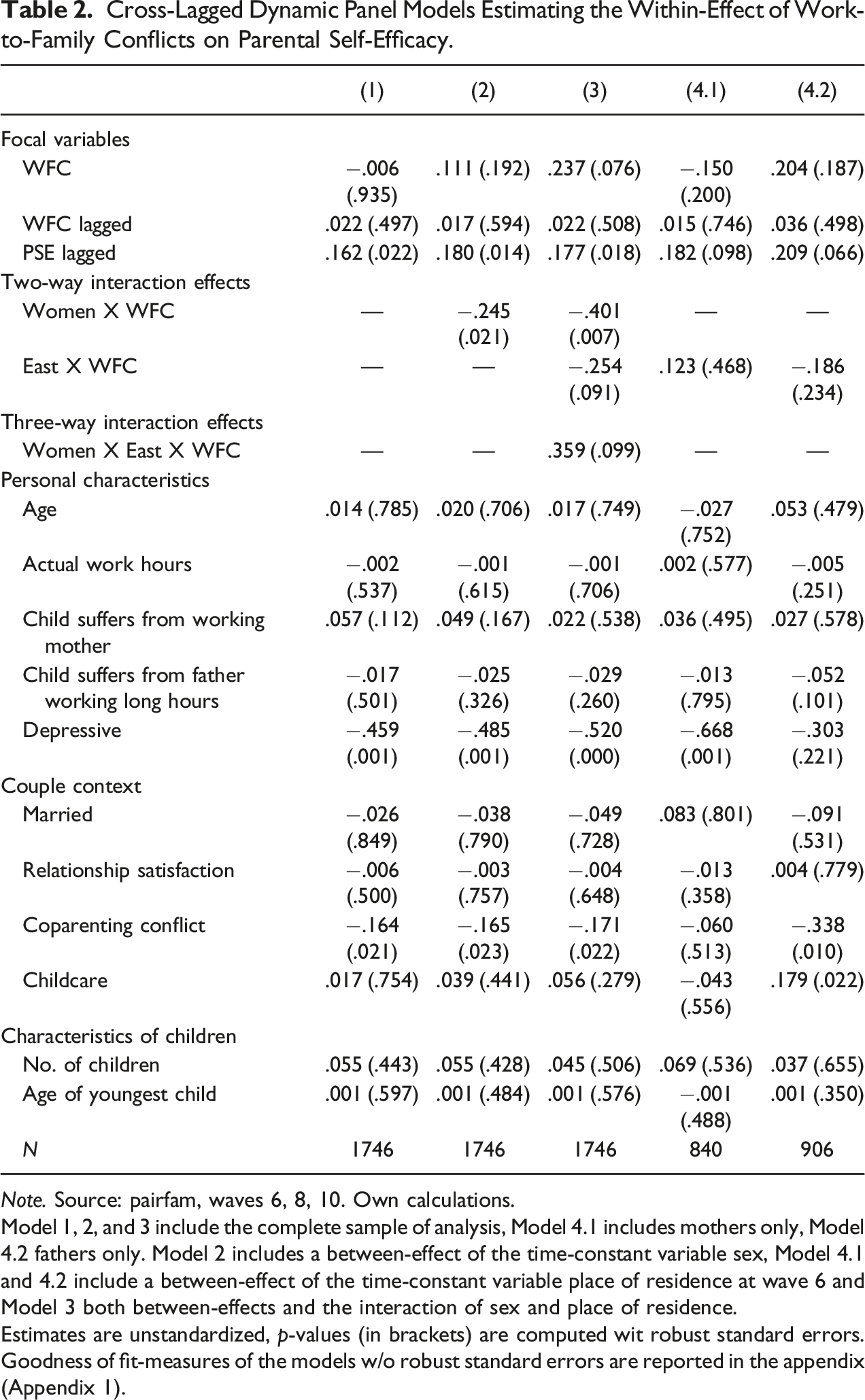
Cross-Lagged Dynamic Panel Models Estimating the Within-Effect of Work-to-Family Conflicts on Parental Self-Efficacy.
Note. Source: pairfam, waves 6, 8, 10. Own calculations.
Model 1, 2, and 3 include the complete sample of analysis, Model 4.1 includes mothers only, Model 4.2 fathers only. Model 2 includes a between-effect of the time-constant variable sex, Model 4.1 and 4.2 include a between-effect of the time-constant variable place of residence at wave 6 and Model 3 both between-effects and the interaction of sex and place of residence.
Estimates are unstandardized, p-values (in brackets) are computed wit robust standard errors.
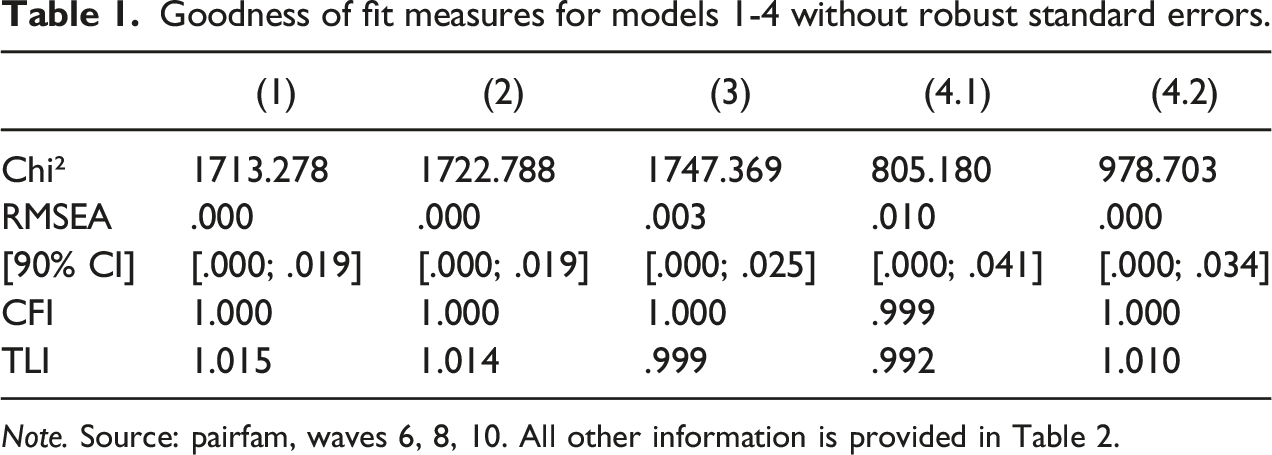
Goodness of fit-measures of the models w/o robust standard errors are reported in the appendix (Appendix 1).
In contrast to hypothesis 1, changes in WFC do not account for any changes in PSE (Model 1 in Table 2). While this could be expected for the lagged effect (ß = .022, p = .497) because of the 2-year measurement, the missing effect of direct temporal proximity (ß = −.006, p = .935) reveals that hypothesis H1 cannot be confirmed. As expected, the autocorrelation effect of changes in PSE is significant and positive (ß = .162, p = .022).
Next, we examine the interaction effect between WFC and being female (Model 2 in Table 2). In line with hypothesis H2, the effect of changes in WFC differs significantly between mothers and fathers in the way that an increase of mothers’ WFC lowers PSE (ß = −.245, p = .021). Again, the baseline effect of WFC (ß = .111, p = .192) as well as the lagged baseline effect (ß = .017; p = .594) do not reach a sufficient significance level, while changes in PSE 2 years ago have a positive effect on the changes of PSE (ß = .180, p = .014). Regarding the control variables, only the predetermined estimates of changes in coparenting conflict (Model 1: ß = −.164, p = .021; Model 2: ß = −.165, p = .023) and changes in the level of depressive symptoms (Model 1: ß = −.459, p = .001; Model 2: ß = −.485, p = .001) show significant effects on changes in PSE.
Last, we include a three-way interaction between WFC, being female, and living in East Germany (Model 3 in Table 2) and additionally estimate separate models for mothers and fathers including an interaction effect between WFC and living in East Germany (Model 4.1 (mothers) and Model 4.2 (fathers) in Table 2). Our theoretical framework assumes that negative effects of changes in WFC on changes in PSE are stronger for mothers in West than in East Germany (H3a), while there appear to be no regional differences for fathers (H3b). Although the interaction effect for mothers is positive in East Germany (ß = .123), the difference does not reach a sufficient significance level (p = .468). Therefore, hypothesis H3a cannot be confirmed. The negative baseline effect of changes in WFC remains insignificant, too (ß = −.150, p = .200) (Model 4.1 in Table 2). The model restricted to fathers shows that both the baseline effect (ß = .204, p = .187) and the interaction effect between changes in WFC and living in East Germany (ß = −.186, p = .234) do not reach a sufficient level of significance (Model 4.2 in Table 2). Although the estimates have to be treated with great caution, it is noticeable that the signs of the baseline and interaction effects contrary in opposite directions for mothers and fathers.
Goodness of fit measures for models 1-4 without robust standard errors.
Note. Source: pairfam, waves 6, 8, 10. All other information is provided in Table 2.
Discussion
The goal of this study was to examine how WFC impact PSE. Our assumptions draw on research on the negative spillover from work to family (Voydanoff, 2008). Additionally, we presented theoretical considerations on gender differences regarding parenting norms (Boling, 2015; Hays, 1996) with particular attention on gender role differences between East and West Germany (Kremer, 2007; Schober & Stahl, 2014). For the empirical analysis, we used cross-lagged panel models to account for potential bias from reversed causality which is also discussed theoretically.
We expected that WFC decrease PSE as parents struggle to fulfill parental role demands. The results of our empirical analyses, however, reveal only limited support to this assumption. Changes in WFC do not decrease PSE in general (Hypothesis H1). Instead, mothers and fathers in East and West Germany differ regarding the impact WFC have on PSE. PSE tends to decline as mothers in West Germany experience WFC, while this effect is negative but small for mothers in East Germany and nonexistent for fathers in East Germany. Furthermore, a striking, and somewhat puzzling finding is the positive influence of WFC on fathers in West Germany. Although the findings have to be treated with caution because not all estimates are found to be highly significant, this indicates that gender norms and historically developed local structures still shape the relationship between parental and work roles.
As we assumed, an increase of WFC leads to a stronger decrease of PSE for mothers than for fathers (Hypothesis H2). On the one hand, this supports findings from the US that norms of intensive mothering are still prevalent among mothers (Forbes et al., 2020), even if they are employed to a decent amount of hours per week (Christopher, 2012). That this relationship, however, is weaker for mothers from East Germany, supports assumptions of the work care culture perspective (Kremer, 2007). While policies and norms in West Germany urged mothers into a housewife role, mothers in East Germany before reunification were supposed to return to full-time employment. An additional aspect that also has its roots in different ideological framing of motherhood and employment in the FRG and GDR can be that female breadwinners are more prevalent in East Germany. Therefore, what is called traditional gender roles are less common in areas of the former GDR (Nitsche & Grunow, 2018) and the perception of being an effective and good parent might be less incompatible with high job demands.
On the other hand, the non-existence of an effect of WFC on PSE for fathers from East Germany can be considered by taking into account that also in the GDR some policies allocated the primary caregiver role to the mother and that “the policies of the GDR thus maintained men’s outsider status regarding housework and primary childcare” (Hofmeister & Baur, 2015, p. 244). This is underlined by findings, that today also in East Germany women perform the majority of childcare (Hofäcker, Stoilova, & Riebling, 2013). What we did not assume is the difference in the impact of WFC on PSE of East and West German men (Hypothesis 3b). Especially the finding that WFC have a positive effect on West German fathers is somehow unexpected as WFC are per definition seen as negatively related to the fulfillment of family roles. A possible explanation could be the strong Western German commitment towards the male breadwinner model (Grunow, 2013), as a result of which fathers’ WFC may be an expression of fulfilling the father role by doing everything to provide economic resources for the family. This, however, might be not enough to explain this phenomenon.
Finally, as compared to East Germany, the gender difference in influence of WFC is particularly visible in West Germany. Gender and region seem to play parts, both alone and in combination, and this holds true even after controlling for gender ideology and various other personal characteristics as well as context variables. Still, the mechanisms by which WFC lower PSE in gender-specific ways in East and West Germany remain unclear.
This study has several limitations and we need to be cautious in generalizing our findings. In terms of the estimation model, characteristics of children included refer only to age and number of children. Other characteristics of children, such as child health or behaviour problems of children are likely to be associated with PSE. There is also a need to control for other context dimensions, such as coparenting support, and to find a measure better suited for grasping regional differences between East and West Germany. The data also do not permit exploration of different time lags. The conducted fixed-effects models partly deal with the limitation of the data because they partial out the effects of time-invariant variables. However, we cannot control for changes in e.g. children’s behavioural problems that potentially affect both, WFC and PSE. The data also do not permit exploration of different time lags and potential short-term effects between WFC and the parental role, therefore, remain unexplored (McDaniel et al., 2018). We thus believe that the interplay of WFC and PSE more extensive research. Opportunities could arise from the availability of more sophisticated data like the FReDA project – the follow-up project of the pairfam study – which provides six-monthly follow up interviews with respondents on the topic of family life. Thematically, future research could focus on the impact of complex family compositions and relationships with adult children. Additionally, the in-depth analysis of PSE of fathers could be beneficial as new parents come from a generation in which high expectations towards gender equality in parenting and demands of the work domain make compatibility problems even more emerge.
Footnotes
Declaration of Conflicting Interests
The author(s) declared no potential conflicts of interest with respect to the research, authorship, and/or publication of this article.
Funding
The author(s) received no financial support for the research, authorship, and/or publication of this article.
