



Abstract
Longitudinal psychological research on family outcomes provides crucial information about families in a changing society, but an evidence synthesis for Austria is currently lacking. Therefore, we aim to summarize psychological longitudinal research on family-related outcomes in Austria using a scoping review approach. Adhering to PRISMA guidelines, we searched five scientific databases (PsycInfo, PSYNDEX, Pubmed, Scopus, and Web of Science) and conducted manual searches to identify additional grey literature. Ten sources reporting on six data collection efforts between 1991 and 2015 were identified. Most samples consisted of heterosexual nuclear families, while research on more diverse family types is needed. Methods were primarily quantitative with conventional designs, but noteworthy exceptions exist. Comprehensive longitudinal data collection efforts across child development are lacking for the new millennium. State-of-the-art research implementing a triangulation of methods, designs, and perspectives that incorporate diverse family types is needed to draw accurate conclusions about the changing family landscape in Austria.
The family is the most important life domain for contemporary Austrian youth (Institut für Jugendkulturforschung 2019) and adults (BKA/FFJI; Bundeskanzleramt – Sektion für Frauen, Familie, Jugend und Integration 2021), and has even gained in importance as a core value in the lives of Austrians over the years (BKA/FFJI, 2021). This is not surprising, since families are considered to be among the most important environments to psychological (Repetti, Taylor, & Seeman, 2002), physical (Chen, Brody, & Miller, 2017; Mollborn & Lawrence, 2018), and social (Parke, 2004) development across the lifespan and serve as a natural and fundamental group unit of society (United Nations, 1948). Thus, families constitute crucial leverage points for effective policy making in Austria, promoting parent and child well-being, fostering stable family relationships, and ensuring access to education, as well as gender and social equality (BKA/FFJI, 2021).
However, while effective policy making undoubtedly hinges on evidence-based measures, the relevant evidence base in Austria is currently lacking an exhaustive synthesis in some domains. While census data or labor market statistics provide important information about structural determinants of family members’ economic and educational well-being in a changing society (e.g., BKA/FFJI, 2021), their mental well-being and family relationship qualities across the lifespan can be best understood from a psychological perspective. The objective of this scoping review is therefore to provide an overview of longitudinal psychological family studies in Austria. We proceed by outlining three crucial points in this regard, including (1) the importance of psychological family research in general, (2) the value of longitudinal studies in this domain in particular, and (3) the need of a nuanced, country-specific research synthesis for Austria.
First, why is psychological family research important? The family is not a static institution but one that is dynamically reworked and reshaped in multiple and complex ways (Goldberg, 2010). Research can no longer rely on the traditional definition of the family as a nuclear form consisting of biological, heterosexual, and married parents. Variations in terms of parental sexual orientation, gender identity, marital status, and number of parents raise questions concerning an appropriate definition of the family. In this review, we refer to Schneewind (2019) who defines families as biologically, socially, or legally related entities that comprise at least two generations and pursue specific purposes (e.g., sharing a household, raising a child etc.). According to this broad definition, the biologically, socially, or legally determined family structure is constitutive for a societally recognized concept of family; thus, it does not necessarily depend on kinship, sexual orientation of parents (or their gender composition as a couple), or their civil status, but rather on the function it serves.
The family represents the primary place of socialization in children’s lives and a crucial context for their well-being. Hence, children are fundamentally dependent on family functioning in their development, for better or worse (Repetti et al., 2002). For instance, a vast corpus of research has demonstrated that domestic violence (Vu, Jouriles, McDonald, & Rosenfield, 2016), destructive interparental conflict (Cummings & Davies, 2010), parental divorce (Auersperg, Vlasak, Ponocny, & Barth, 2019), dysfunctional parenting (Stack, Serbin, Enns, Ruttle, & Barrieau, 2010), and mental health problems of parents (van Santvoort et al., 2015) belong to the strongest risk factors for child maladjustment. Conversely, the family is also a primary source of support and a key factor contributing to individual and relational resilience (Walsh, 2002). Stable family relationships, mutual family support, a warm family climate, positive parenting, and secure parent–child attachments are among the most significant long-term protective factors for child development (Buehler, 2020). Moreover, effects between family members are assumed to be bidirectional, that is, they may also travel from children to the parents. Accordingly, children’s well-being and behaviors have in turn an impact on the parents’ well-being and the quality of their relationship (e.g., Zemp, Milek, Davies, & Bodenmann, 2016).
In this regard, the family systems theory (FST; Cox & Paley, 2003; Kerig, 2016) is a widely adopted approach within the family psychology literature. FST describes the family as a holistic system consisting of interacting, mutually interdependent subsystems; thus, behaviors and emotions of family members are inextricably interconnected. Therefore, dyadic family interactions (e.g., in the interparental relationship) indirectly affect other members or relations (e.g., the parent–child or sibling relationships) in the family (Erel & Burman, 1995; Zemp et al., 2021). Given the complex interconnections of family relationships and their meaning for family members’ well-being, sophisticated research of reciprocal family processes and dynamics is needed. Family psychology traditionally aimed to fill this gap, by providing insights into process-oriented explanations of family functioning and how best to prevent adjustment problems of family members and to promote a healthy family environment (e.g., Cummings, Faircloth, Mitchell, Cummings, & Schermerhorn, 2008; Davies, Parry, Bascoe, Cichetti, & Cummings, 2020; Zemp, Johnson, & Bodenmann, 2018). In several ways, family psychology can be regarded as a unique discipline with its focus on intrafamilial processes and the dynamic interchanges between relations in the family system (Parke, 2017). However, solutions to the challenges contemporary families face need the scientific cooperation between different disciplines. That is, families can only be fully understood through an integrative perspective, drawing on not only psychology but also sociology, economy, medicine, and legal sciences, among others. An ongoing task for scholars is to make better use of the cross-disciplinary potential in this field. It is obvious that, by doing so, we can make remarkable progress in our collective efforts to better understand family processes, dynamics, and functioning.
Second, why are longitudinal designs particularly important for psychological family research? Family relationships are generally long-lasting—if not the longest-lasting relationships—across the lifespan, but their nature and role change dynamically depending on parents’ and children’s developmental stages and tasks (Cowan & Hetherington, 1991; Thomas, Liu, & Umberson, 2017). Individual development takes place over time within families (Cox & Paley, 2003). Furthermore, as family forms and roles are—allied to societal developments—under constant change (Harris, Charles, & Davies, 2006), longitudinal research can provide insights into new intergenerational dynamics and map changes over time appropriately. Thus, family research needs to take this inherent temporal aspect into account. Experimental designs might prove difficult or unethical for research on family influences, making longitudinal studies the next best design allowing for testing temporal antecedents and consequences of and long-term changes in cognitions, behaviors, or affective states of all family members. Longitudinal research is thus a promising approach in investigating directionality and causality of associations between and development processes of family phenomena. For family psychologists in particular, longitudinal studies are the method of choice to examine long-term risk and protective factors in health and development of children and their parents, and findings can aid in designing evidence-based, effective early prevention and intervention measures in family policy and practice (e.g., Cowan, Cowan, & Knox, 2010; Michaelson, Pilato, & Davidson, 2021).
Third, why is a synthesis of psychological family studies needed for the Austrian context? The Austrian family landscape has changed considerably in recent decades. While mixed-gender (i.e., commonly termed “heterosexual”) couples with children continue to be the predominant family form, other family forms such as single-parent families, stepfamilies, or same-gender parent families are growing substantially (BKA/FFJI, 2021). Given their non-traditional family structure, these emerging family types face unique psychosocial vulnerabilities (see, e.g., Siegel, Assenmacher, Meuwly, & Zemp, 2021; Sweeney, 2010) that may vary considerably from one country to the next due to differing (family) political contexts. Scholars have long called for an international and culturally sensitive perspective within family psychological research (e.g., Parke, 2017). The pertinent research to date stems mainly from the US or the UK, which cannot be generalized to other European countries without further ado. Even within German-speaking countries, crucial structural factors in family policy such as parental leave, custody arrangements following a divorce, external child care infrastructure and uptake (e.g., Blum, 2013), or access to legal relationship recognition for same-gender parent families differ markedly (ILGA-Europe, 2021). For example, Austria legalized access to reproductive technologies for female same-gender couples in 2015 (Österreichischer Nationalrat, 2015) and access to adoption for same-gender couples in 2013 (second-parent adoption; Österreichischer Nationalrat, 2013) and 2016 (joint adoption; Österreichischer Verfassungsgerichtshof, 2014). Germany implemented similar regulations in 2005 (second-parent adoption; Deutscher Bundestag, 2004) and 2017 (joint adoption; Deutscher Bundestag, 2017), but fails to legally recognize a co-mother of a child conceived via artificial insemination from birth up to this date (November, 2021). In Switzerland, second-parent adoption was legalized in 2018 (Bundesversammlung der Schweizerischen Eidgenossenschaft, 2017), but joint adoption and access to reproductive technologies for female same-gender couples hinge on the legalization of same-sex marriage (legalized through a referendum in September 2021, coming into effect in July, 2022; Schweizerische Bundeskanzlei, 2021). As legally secured relationships between family members impact family members’ emotional and financial well-being in profound ways (see Siegel et al., 2021, for a review), studies on same-gender parent families from Germany or Switzerland cannot be used to draw inferences about same-gender parent families in Austria for this period. As this example shows, although similarities certainly exist, even conclusions based on German or Swiss data may be biased in some domains, with important implications for policy and practice.
Taken together, we deem a research synthesis of longitudinal psychological family studies with an exclusive focus on Austria reasonable and highly relevant as a means to evidence-based policy and practice for this country. Therefore, the aim of this review was to compile existing research on longitudinal family studies concerning family-related psychological outcomes in Austria. To this end, we carried out a scoping review as a useful tool in the arsenal of evidence synthesis approaches to summarize a body of literature and detect gaps of knowledge (Munn et al., 2018). We reviewed grey and published literature of Austrian longitudinal psychological family studies, making it possible to provide an overview of relevant studies in the field, identify gaps in the pertinent research, and guide future research endeavors in Austria. In this vein, we were particularly interested in the following domains: Timespan of data collection, assessed population(s) and outcomes, as well as methodological (e.g., mode of measurement, qualitative vs. quantitative approaches) and study design aspects.
Method
Protocol, adherence to review guidelines, and registration
The study and its protocol were conceptualized according to the most recent PRISMA guidelines (Page et al., 2021), the PRISMA extension for Scoping Reviews (PRISMA-ScR; Tricco et al., 2018), as well as the PRISMA-P guidelines for systematic review protocols (Shamseer et al., 2015). The study protocol was registered prospectively on the Open Science Framework (OSF) on March 31, 2021 and amended during the course of the eligibility screening due to further methodological considerations on May 12, 2021 (https://osf.io/8yshr/).
Eligibility criteria
Publication type
Both grey and published literature (peer-reviewed journal articles, book chapters, dissertations, research reports, and conference presentations) were eligible for inclusion. Master theses and books were not eligible for inclusion.
Study type
Studies had to be original, empirical quantitative, qualitative, or mixed-methods studies using a longitudinal design (i.e., with least two measurement points), including diary studies. Non-empirical works (e.g., letters to the editor and methodological papers) or cross-sectional studies (including repeated cross-sectional designs) were excluded. Studies on the transition to parenthood (TTP) with one measurement point before and one after the child’s birth were excluded from this scoping review, as TTP represents a unique phase during the formation of a family (Mitnick, Heyman, & Slep, 2009). Studies with a TTP component were eligible for inclusion if at least one additional measurement point after the TTP period was reported.
Population
Study participants had to be members of a family, which we defined as consisting of two generations (i.e., the parent and the child generation; Schneewind, 2019). Studies focusing on couples without children, studies that did not indicate the couples’ parental status, or studies focusing on the grandparent generation only were excluded from the review. All family forms regardless of kinship, sexual orientation, or gender identity of parents (i.e., nuclear biological families, divorced or separated families, single-parent families, stepfamilies, adoptive families, and same-gender parent families) were included. Children (i.e., the child generation) had to be under the age of 18 years at the first measurement point (sample mean or median).
Concept
Studies were eligible for inclusion if family-related psychological outcomes of at least one family member in a very broad sense were assessed, including measures of the parental relationship, parent–child relationship or attachment, sibling relationship, family interactions, parenting, coparenting, and parental stress. No exclusion criteria with regard to the type of method (e.g., questionnaires, interviews, observational data, and physiological measures) or type of rater (e.g., parents, children, and teachers) were set.
Context
Studies were eligible if more than half of the sample (>50%) lived in Austria or if separate results for an Austrian subsample were reported.
Information Sources and Systematic Literature Search
To identify eligible studies, five scientific databases (PsycInfo, PSYNDEX, Pubmed, Scopus, and Web of Science) were searched on April 12 and 13, 2021, using multiple combinations of both free and controlled search terms related to three sets of keywords: (1) families, (2) longitudinal studies, and (3) Austria. Verbatim keywords and detailed search strings for all databases are provided in Appendices A1 and A2 of the study protocol; https://osf.io/8yshr/). For each database, we executed several search runs using different combinations of filters and controlled vocabularies. For the databases Scopus, Web of Science, and PSYNDEX, searches were run twice to locate studies conducted in Austria: The first time by including the keyword “Austria*” and the second time by omitting this keyword and limiting search results to studies from authors with an Austrian affiliation (Web of Science and Scopus) or by setting the population location filter to Austria (PSYNDEX) instead. This was done to retrieve eligible studies conducted in Austria that did not mention country of data collection in titles or abstracts. Additionally, search results in these databases were limited by disciplines (Web of Science: Psychology, Psychiatry, Family Studies, Social Science, and other; Scopus: Psychology and Social Sciences), since preliminary literature searches yielded a large share of ineligible records from the medical sciences (e.g., assessing pediatric surgery outcomes in a pre–post-design). In a related vein, we performed an additional search in the databases PsycInfo and PSYNDEX by omitting free-text keywords related to longitudinal studies and setting methodology-related database filters instead. Additionally, Google and Google Scholar (first 200 hits each) were searched for further eligible studies not to be found via traditional database search. Furthermore, we manually searched publication lists of eminent Austrian researchers in the field (i.e., Brigitte Rollett, Harald Werneck, and Ulrike Zartler) that we identified via our database search. Deduplication of search results was done using Endnote (Bramer, Giustini, de Jonge, Holland, & Behuis, 2016).
Selection of Sources of Evidence and Data Charting Process
After deduplication, the first author [LF] checked the titles and abstracts of retrieved records against the pre-specified eligibility criteria. If eligibility could not be determined based on titles and abstracts, the full text was obtained and screened. Ambiguous cases with regard to eligibility were resolved within the research team. All relevant data items (see below) were coded by the first author [LF] using a standardized Microsoft Excel spreadsheet that was piloted by the two first authors [LF, MS] on a subset of eligible studies. To ensure best practice, data extraction was validated by the second first author [MS] or the third author [ASF]. Discrepancies were resolved through discussion within the research team.
Data Items and Synthesis of Results
Both key publication characteristics as well as detailed sample and outcome information from eligible studies were coded. Data items extracted on the publication level included the type of publication (peer-reviewed article, dissertation, book chapter, research report, conference paper, or other) and the year of publication. Data items on the study level included the study type (quantitative, qualitative, or mixed methods), location of data collection (i.e., country/countries, state(s), city/cities), years of data collection, overall timespan covered, number of measurement points, state of data collection (ongoing, completed, or unclear [by March 2021]), and type of longitudinal design (conventional or intensive [at least one measurement point per day over at least three days]). Sample-related data items included the assessed population (parent, child, or both), age and gender of parents (mixed-gender couples, same-gender couples, both mixed- and same-gender couples; as well as gender composition within the sample) and children, and family type (nuclear biological families, single-parent families, families with separated or divorced parents, stepfamilies, mixed, or other). If only one generation (e.g., children) was assessed, descriptive information for the other generation (e.g., parents) was coded if relevant information was reported within the study. The concept-related characteristics coded included the assessed family-related outcomes and their mode of measurement (questionnaire, interview, observational assessment, physiological or neuroimaging measures, or other), and raters (parent, child, researcher, or other). Results were synthesized narratively and via tabulation according to relevant thematic, methodological, and population-specific characteristics.
Data Availability and Supplementary Materials
The final coding sheet as well as all other supplementary materials (S1 to S5) is stored in a repository on the Open Science Framework (OSF; https://osf.io/8yshr/?view_only=4658a742e0cd4c0e812ad4f1068d42f8).
Results
Selection of Sources of Evidence
A detailed overview of the selection process is shown in OSF-Supplement S1. After deduplication, 1027 records were identified from database searches. During the screening of the titles and abstracts 923 citations were excluded, leaving 104 full-text articles to be retrieved and assessed for eligibility. Of those full texts, 14 could not be retrieved. Of the 90 remaining sources, 82 articles were excluded due to the following reasons: 42 papers assessed no relevant family-related outcomes, 24 did not include Austrian data, and seven did not use a longitudinal study design. Additionally, nine articles were excluded due to other reasons (e.g., articles written in a language other than German or English). In sum, eight eligible articles remained from database searches. Furthermore, a total of four records were retrieved by manual searches of publication lists as well as Google and Google Scholar searches, yielding two additional eligible publications. In sum, ten studies were included in the final sample. References of articles excluded after full-text assessment and references of articles that could not be retrieved are provided in OSF-Supplement S2.
Characteristics of Sources of Evidence
Extracted study characteristics are listed in Table 1 and OSF-Supplement S3. The full coding sheet is provided in OSF-Supplement S4. Sample sizes ranged from 22 to 5000 participants. In most sources (k = 7), sample sizes ranged from 22 to 350, whereas two studies reported on larger samples (N > 500). These were the Austrian results of the Generations & Gender Survey 1 (GGS; Buber-Ennser, Neuwirth, & Testa, 2013; Nparents = 5000), and a mixed-methods study on the impact of school social work (Sixt, 2015; Nparents = 535; Nchildren = 563). Studies were published between 1997 and 2019 (Mdn = 2014), starting data collection between 1991 and 2016. The time frame of data collection ranged from two weeks (Piskernik & Ahnert, 2019) to 18 years (Werneck, Eder, Yanagida, & Rollett, 2014), with 2–31 measurement points per study.
Study characteristics.
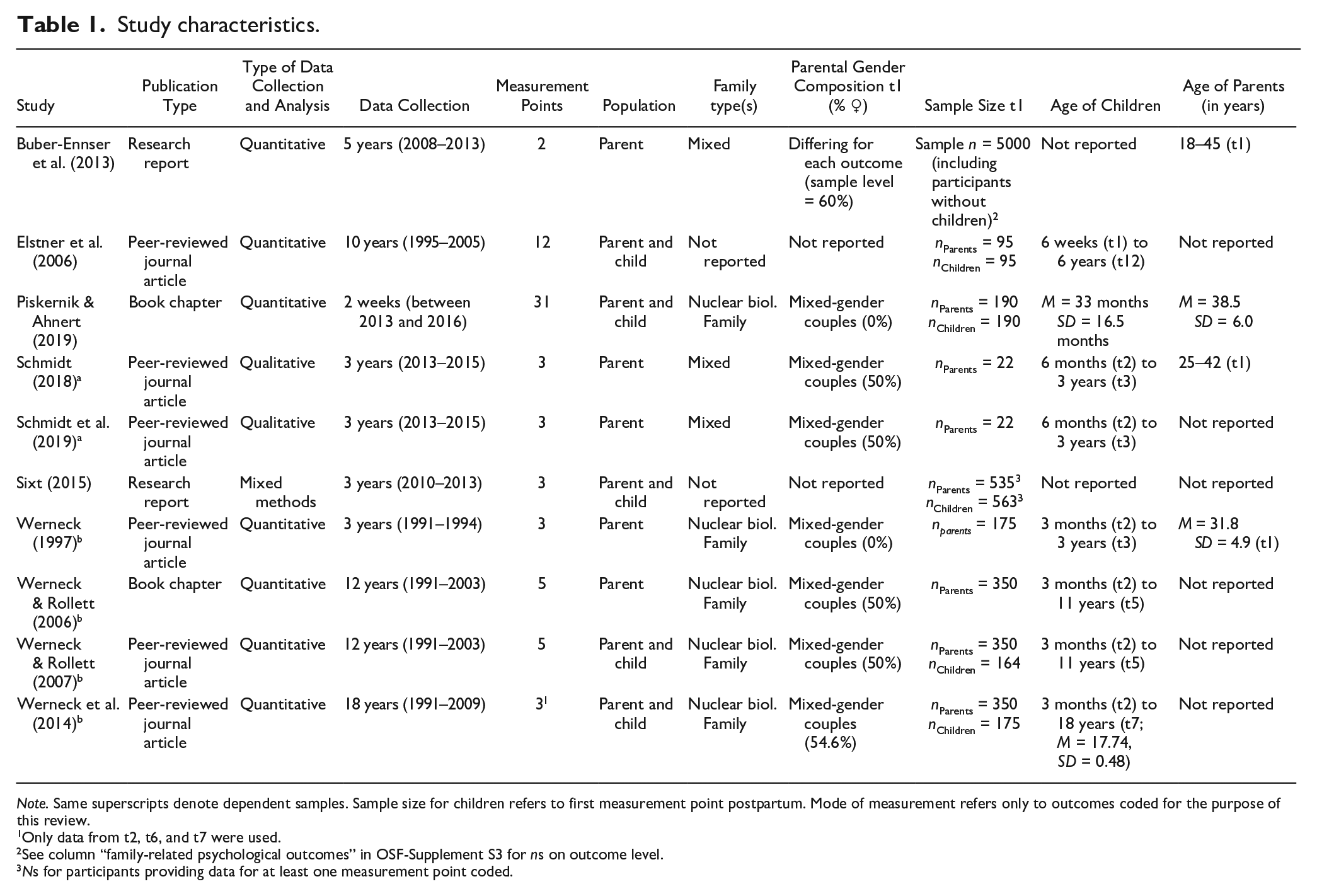
Note. Same superscripts denote dependent samples. Sample size for children refers to first measurement point postpartum. Mode of measurement refers only to outcomes coded for the purpose of this review.
Only data from t2, t6, and t7 were used.
See column “family-related psychological outcomes” in OSF-Supplement S3 for ns on outcome level.
Ns for participants providing data for at least one measurement point coded.
Most of the included works (k = 6) were peer-reviewed journal articles, and two sources each were book chapters (k = 2) or research reports (k = 2), respectively. Over two thirds of the sources were quantitative studies (k = 7), while the remaining third used a qualitative (k = 2) or a mixed-methods design (k = 1). An equal proportion of studies (k = 5 each) assessed the parent generation or both the parent and child generations, respectively.
In studies that reported on the parents’ age at t1 (k = 4), two provided mean ages of 31.8 years (Werneck, 1997) and 38.5 years (Piskernik & Ahnert, 2019), and two provided age ranges of 18–45 years (Buber-Ennser et al., 2013) and 25–42 years (Schmidt, 2018), respectively. The children’s age ranged from six weeks at t1 postpartum (Elstner, Fiala-Preinsperger, & Berger, 2006) to 17.74 years at the last measurement point (Werneck et al., 2014). In the remaining cases, the ages of either the parents (k = 6) or children (k = 2) were not reported.
Synthesis of Results
An overview of important study characteristics is depicted in Figure 1. In all, four and two studies, respectively, reported results from the same sample. Four studies reported on the “Familien im Längsschnitt” (FIL) study (Werneck, 1997; Werneck & Rollett, 2006, 2007; Werneck et al., 2014), which was an extensive longitudinal family study conducted over the course of 18 years. In the FIL-project, both family-related outcomes (e.g., parent–child relationships and child attachment to parents) and characteristics of the interparental relationship (e.g., separation or divorce) were assessed, starting from the third trimester of pregnancy until the children reached adulthood. Two studies were part of a larger research project on the transition to parenthood in Austria between 2013 and 2015, including interview data from 22 parents over several measurement points (Schmidt, 2018; Schmidt, Rieder, & Zartler, 2019). According to our eligibility criteria, these studies were eligible for inclusion because at least one additional measurement point after the TTP period was reported (applies to Schmidt, 2018; Schmidt et al., 2019; Werneck, 1997).
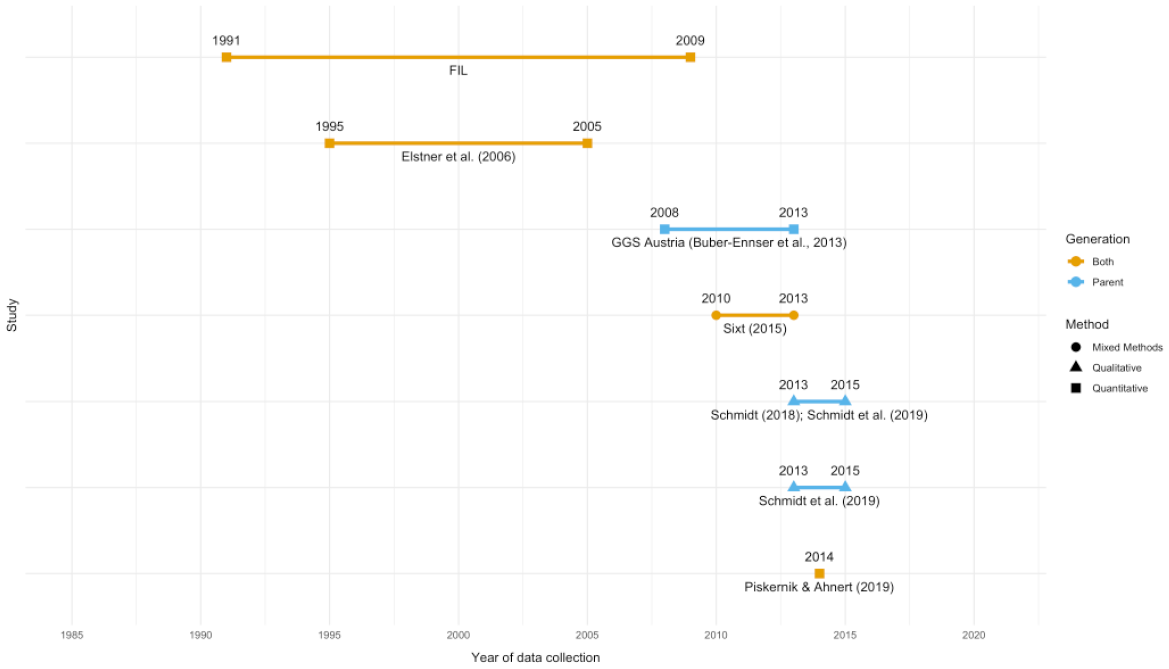
Timeline of longitudinal studies assessing family-related psychological outcomes in Austria (1991–2015). Note. Data and R code to reproduce the figure are available in OSF-Supplements S4 and S5. FIL (“Familien im Längsschnitt”) includes: Werneck (1997); Werneck & Rollett (2006, 2007); Werneck et al. (2014).
The remaining studies reported on individual samples. This included the Austrian report of the international Generations & Gender Survey (GGS; Buber-Ennser et al., 2013), which comprised population-representative Austrian data on various family-related and relationship outcomes. Two studies reported on a longitudinal developmental follow-up program for children of substance-dependent mothers (Elstner et al., 2006) and the impact of school social work on various child-, parent-, and teacher-focused outcomes (Sixt, 2015), respectively. Finally, another study examined fathers’ engagement with their children using an experience sampling approach (Piskernik & Ahnert, 2019).
Concerning assessed family-related psychological outcomes, seven studies examined intergenerational outcomes. These include parenting behaviors, parenting stress, and parent–child relationships, interactions, and activities (Elstner et al., 2006; Piskernik & Ahnert, 2019; Schmidt et al. 2019; Werneck & Rollett, 2007; Werneck et al., 2014); parent–child attachment (Piskernik & Ahnert, 2019; Werneck & Rollett, 2007); global assessments of the family situation and climate (Elstner et al., 2006; Sixt, 2015; Werneck, 1997; Werneck & Rollett, 2007); and father–child contact after separation (Buber-Ennser et al., 2013). Six studies also examined outcomes related to the parental relationship (or marital) quality and intended or actual separation (Buber-Ennser et al., 2013; Piskernik & Ahnert, 2019; Werneck, 1997; Werneck & Rollett, 2006, 2007; Werneck et al., 2014). Three studies also examined outcomes regarding division of (childcare) labor (Buber-Ennser et al., 2013; Schmidt, 2018; Werneck & Rollett, 2006).
Most studies (k = 9) used a conventional longitudinal study design, while one study (Piskernik & Ahnert, 2019) implemented an intensive longitudinal design (i.e., defined here as at least one measurement point per day over at least three days) using an experience sampling procedure. Number of measurement points ranged from two to five in most studies (k = 8). Two outliers included 12 measurement points over the course of six years (Elstner et al., 2006), and 31 measurement points over the course of two weeks (Piskernik & Ahnert, 2019). Questionnaires were the most common mode of measurement for family-related outcomes (k = 6), followed by interviews (k = 2). Two studies used a combination of an observational assessment (for parent–child attachment) and questionnaires (for other family-related outcomes; Piskernik & Ahnert, 2019), and a combination of observational and clinician ratings (Elstner et al., 2006), respectively. Quantitative outcomes were assessed by different raters over the studies, including self-assessments of parents (k = 3) or parents and children (k = 3), researchers and clinicians (k = 1), as well as parents and clinicians (k = 1). Most (k = 5) of the studies’ sampling frames included nuclear biological families (at t1) only. In three studies, various (i.e., mixed) family types were examined. This is an umbrella category for studies that included several family types, such as nuclear biological families, families with divorced or separated parents, single parents, or stepfamilies. In the remaining cases, the family type was not reported (k = 2; Elstner et al., 2006; Sixt, 2015). No study focused exclusively on divorced or separated families, stepfamilies, or single parents.
Regarding the parental gender composition (i.e., mixed-gender couples or same-gender couples; as well as proportion of fathers vs. mothers in the sample), mostly mixed-gender couples with an about equal share of mothers and fathers (range mothers: 50%–60%) were assessed (k = 6). Two studies focused on fathers only (Piskernik & Ahnert, 2019; Werneck, 1997) and in the GGS (Buber-Ennser et al., 2013), one outcome was also assessed for (single) fathers only. No information on the gender composition was given in the remaining two studies (Elstner et al., 2006; Sixt, 2015). In Elstner et al. (2006), this lack of information was due to the examined population comprising an unknown number of (unspecified) relatives alongside biological and foster mothers. In Sixt (2015) no information on the parental gender composition was reported, but a large share of mixed-gender parental couples can be assumed due to the sampling frame (schools). Of note, same-gender parent families were not included in any of the studies examined.
Discussion
In this scoping review, we aimed to summarize pertinent research on longitudinal psychological family studies conducted in Austria. In all, ten longitudinal studies published between 1997 and 2019, reporting on six different data collection efforts (see Figure 1), and stemming from both peer-reviewed and grey literature sources were included. We discuss main findings and implications for future research with regard to population, design, and methodology of these studies below.
By far the most comprehensive longitudinal study on family-related outcomes in Austria to date remains the “Familien im Längsschnitt” (FIL) project (for an overview, see Werneck & Rollett, 2016). With data collection beginning in the early 90s, this study followed expecting parents in heterosexual relationships and their (biological) children until they reached adulthood (end of data collection: 2015). The FIL study thus contributed greatly to a deeper understanding of Austrian family life in the 1990s and early 2000s, including developmental trajectories of personality and temperament, parent–child attachment, aspects of parental and family relationship changes, parental roles, school transitioning, as well as predictors of and development following parental separation. To the best of our knowledge, there is currently no research endeavor in Austria that is comparable to the FIL in terms of sampling frame and (prospectively) covered timespan. In fact, the covered timespans of longitudinal studies included in our review seem to be inversely related to the year of data collection, with the FIL study being the earliest but also the longest running study. This is noteworthy, as the index children in the FIL study are now beginning to reach their 30s and thus possibly transitioning into parenting roles themselves. However, despite the publication of more recently completed longitudinal studies, comparably extensive data from children born in the 2010s as well as their parents is currently lacking.
The Austrian longitudinal family studies within our review have primarily used the heterosexual, nuclear family as their sampling frame. This includes the traditional dyad of mother and father as well as the triad with the child. With the notable exception of Schmidt (2018) and Schmidt et al. (2019), single parent families, families with divorced or separated parents, or stepfamilies were only assessed incidentally, namely, if the parents’ separation had occurred during data collection (e.g., Werneck & Rollett, 2006). This predominance of nuclear families found within our review does not reflect the current makeup of the Austrian population (BKA/FFJI, 2021). For example, about 13% of all Austrian families were headed by single-parents in 2018 (BKA/FFJI, 2021) and further 9% constituted a patchwork family (i.e., a family type in which both parents bring in children from previous couple relationships into a new relationship; Statistik Austria, 2021a). Thus, over one in five Austrian families are characterized by a more diverse composition than a nuclear biological two-parent family system, and consequently experience unique vulnerabilities owing to their family structure (e.g., elevated daily stress in general, insufficient legal recognition; Sweeney, 2010). These challenges many contemporary family forms are faced with emphasize the great need of research in this field in Austria.
In a similar vein, it should be noted that only mixed-gender parental couples (i.e., couples consisting of a mother and a father) were included in studies within our review. Thus, longitudinal evidence on family-related outcomes in same-gender couples in Austria is currently absent. This is critical, as the legalization of adoption for same-gender couples in 2013/2016 and in-vitro fertilization for female same-gender couples in 2016 possibly led to an upsurge in families headed by same-gender parental couples. Given their unique vulnerabilities (e.g., minority stress, discrimination, and adverse (socio-)legal climate; Siegel et al., 2021) in a shifting society, future research is urgently needed to elucidate risk and resilience related to parenting and family life in this population over time.
Regarding study design, only one study in our review used an intensive longitudinal design (Piskernik & Ahnert, 2019). While conventionally designed longitudinal studies with assessments months apart can provide developmental projections, intensive designs allow for a more fine-grained picture of day-to-day family dynamics (related to parenting, conflict patterns, or joint activity schedules, for instance). Given the predominance of conventional designs within studies included in this review, Austrian psychological family research would benefit from studies with more nuanced timeframes (see below). Moreover, only this study (Piskernik & Ahnert, 2019) and one other (Elstner et al., 2006) implemented behavioral observation. In all other studies, family-related outcomes were primarily assessed using questionnaires. Given the inherent limitations of the exclusive use of self-reports (e.g., subjectivity, limited validity, social desirability bias, and common method variance), this circumstance can be regarded as another limitation of the Austrian research in this field.
Additionally, current longitudinal family research in Austria relies primarily on quantitative designs. Only two studies used qualitative in-depth interviews for data collection (Schmidt, 2018; Schmidt et al., 2019) and one study used a mixed-methods approach with a combination of quantitative and qualitative measurement instruments (Sixt, 2015). By providing meaning and context, qualitative methods in family research represent a valuable supplement to quantitative findings. As exemplified in Schmidt (2018) and Schmidt et al. (2019) in their investigations on gendered aspects of parental care work, insights gained from qualitative (or mixed methods) studies are crucial in relating research findings to policy making (e.g., regarding childcare allowances and infrastructure) through an understanding of how families themselves conceptualize the issues at hand. It would therefore be advisable for future research to consider a broader array of methodologies in their study designs.
Studies within our review used parents as the primary source of raters. As a result, child outcomes were most often only indirectly examined through their parents’ perspectives. Little data in the included studies stemmed from children directly (i.e., in the form of self-reports or interviews conducted with the child). Although traditional research has mainly relied on proxy-reports (by parents, teachers, or others) when evaluating children, the child’s unique lens is now widely recognized and assessments are increasingly deemed incomplete unless the children’s input is considered. Therefore, the inclusion of the child’s perspective is imperative and strongly recommended in family research (Michaelson et al., 2021). Additionally, no study incorporated siblings’ perspectives, even though a majority of Austrian youth (78%) has at least one sibling (Kaindl & Schipfer, 2020). According to FST, families are regarded as an organized unit and subsystems within this system are inextricably interconnected (Cox & Paley, 2003). Therefore, a holistic view in family research requires the joint consideration of multiple family relationships in the same study (Chen et al., 2017). Having said that, it is important to note that many of the issues discussed above are not limited to research conducted in Austria. Rather, these concerns have been raised by scholars in the field of (longitudinal) family psychology research in general (Zemp et al., 2021; Bodenmann, 2016; Parke, 2017), and Austria seems to be no exception in this regard.
Future Directions
Taken together, we can conclude from our scoping review that there is much to be done for Austrian scholars in the field of family research. First, while the FIL project represents an indispensable endeavor in longitudinal Austrian psychological family research, more recent studies of similar scope are currently missing. As outlined above, family concepts, roles, and policies have changed considerably in the past decade. It is thus advisable to follow families of children born in 2010 and later over an equally long timespan to update conceptions about their current situation and characteristics.
Second and relatedly, more research on family-related outcomes in diverse family forms is needed to clarify whether the results from traditional family research on predominantly nuclear biological families can be applied to them. These novel findings could be utilized to derive both similarities and differences in family-related outcomes across different family forms and thus serve as crucial leverage points for applied interventions. For example and as mentioned above, it is likely that more same-gender couples are now assuming parenting responsibilities, following important legal developments in the past years (e.g., foster-parenting, adoption, and in-vitro-fertilization; Österreichischer Verfassungsgerichtshof, 2013, 2014). Longitudinal research from the US-American context spanning several decades (see Gartrell, 2021; Goldberg & Allen, 2020, for reviews) has revealed how not only stigmatization owing to a marginalized family structure but also family pride and resiliency have shaped developmental and parental outcomes for same-gender parent families over the years. Similar research is needed in the Austrian context to elucidate societal and individual drivers and barriers to a conducive environment for child development in this population. Furthermore, applied research about risk and resilience factors of being part of a diverse family should ensue in order to generate inclusive and specialized prevention efforts for parents and children. In addition, research on predictors of prejudicial or stigmatizing behaviors and attitudes in the general population should follow to eliminate marginalization and harassment of members of diverse families.
Third, about 27% of Austrian youth (<15 years) have a migration background (Statistik Austria, 2021b). No study found within our review reported sample characteristics related to ethnicity or migration history of either parents or children. This is an important lacuna, as vulnerabilities (e.g., higher risk of poverty or social marginalization, BKA/FFJI, 2021) for this population have been documented in the Austrian context. Importantly, research should assume an intersectional perspective (e.g., Bowleg, 2012) when investigating these family types. That is, experiences, vulnerabilities, and strengths of individual family members and family systems should be understood as emerging from intersecting identities, rather than focusing on single identity dimensions (e.g., ethnicity or sexual orientation).
Fourth, future research should diverge from exclusively quantitative study designs with two measurement points in order to gather a more comprehensive understanding of the family-related outcomes in question. For example, the implementation of a randomized-controlled longitudinal study in order to develop and evaluate family-focused prevention programs or of a mixed-methods approach, combining both quantitative and qualitative data, would allow for more reliable, informative results. Additionally, the inclusion of child self-rating data or, more generally, multiple family members in a multi-rater approach would be valuable in relating individual perspectives to each other and to family-level outcomes.
Limitations
Some limitations of this scoping review should be considered. First, studies focusing solely on child-related outcomes (i.e., only the child generation was assessed on individual outcomes) were excluded from this review, as our goal was to examine the scope of longitudinal studies on family-related (i.e., interpersonal) outcomes. Similarly, studies were excluded if they only examined outcomes related to individual well-being of parents. Moreover, we set disciplinary filters during the database search (Scopus and Web of Science) to limit our results to studies from psychology or other social sciences. This could have resulted in the omission of possibly relevant studies from studies that were indexed as stemming from a different discipline (e.g., medical sciences). Last, it is also possible that due to the exclusion of studies focusing on the transition to parenthood period, relevant work was excluded from this scoping review.
Conclusion
In this scoping review, we summarized psychological longitudinal research on family-related outcomes in Austria. Ten sources were analyzed on sample, design, and outcome characteristics. A focus on heterosexual, biological families and on parental perspectives was evident. Moreover, quantitative study designs and measures based on self-report were primarily implemented. It is time to advance research on diverse family types and to include the children’s own perspectives, as this is the only way to draw accurate conclusions about the changing family landscape in Austria.
Footnotes
Acknowledgements

Declaration of Conflicting Interests
The author(s) declared no potential conflicts of interest with respect to the research, authorship, and/or publication of this article.
Funding
The author(s) received no financial support for the research, authorship, and/or publication of this article.