




Abstract
Processes of intergenerational transmission can have long-lasting negative consequences for children, thereby perpetuating or exacerbating existing social and health inequalities within society. The present study investigates the intergenerational transmission of life satisfaction between parents and their adolescent children. Based on cross-sectional data from the German Socio-Economic Panel Study (SOEP), multilevel linear regression models were estimated for 4,154 adolescents at the age of 17 years, and their parents. The statistical analysis provided evidence for the intergenerational transmission of life satisfaction between parents and their children, as parents’ levels of life satisfaction were positively and significantly related to levels of life satisfaction in adolescents. Furthermore, mothers’ and fathers’ supportive parenting partially mediated this relationship, with higher levels of supportive parenting contributing to increased levels of adolescent life satisfaction. However, the results of the analysis revealed no significant differences between same-sex and opposite-sex parent–child dyads in the intergenerational transmission of life satisfaction.
Keywords
Introduction
Previous research has repeatedly shown that life satisfaction is closely related to the overall well-being of adolescents, and that it is an important predictor of mental health problems (see Proctor et al., 2009 for an overview). While high levels of life satisfaction in adolescents are known to function as protective factors against the development of aggressive and delinquent behaviors (Huebner et al., 2006), low levels of life satisfaction have been linked to several undesirable outcomes. Although undesirable experiences (e.g., sexual abuse) and harmful behaviors (e.g., substance abuse) may cause adolescents’ life satisfaction to deteriorate, previous research has also provided evidence that low levels of adolescent life satisfaction contribute to higher risks of substance abuse (Zullig et al., 2001); internalizing and externalizing behaviors (Lyons et al., 2014); and violent behaviors like physical fighting, sexual abuse, and carrying weapons (Proctor, 2014).
Although adolescence is a period in life that is characterized by numerous important transitions—such as the increasing relevance of peers (Ben-Zur, 2003)—the family of origin continues to play a key role in adolescent health and well-being (see Hank & Steinbach, 2018 for an overview). Characteristics of the parent–child relationship, like parental warmth, parental involvement, and levels of parental support, have been repeatedly shown to be particularly important for the development and maintenance of life satisfaction in both children and adolescents (Ben-Zur, 2003; Proctor, 2014; Suldo & Huebner, 2004). However, there is some evidence that the influence of parents on their children is not limited to the quality of the parent–child relationship. Indeed, some scholars have suggested that parents’ subjective well-being can affect the well-being of their children both directly and indirectly through processes of intergenerational transmission (Clair, 2012). Nonetheless, empirical studies on the intergenerational transmission of life satisfaction from parents to their children are still scarce, and the findings of the few existing studies on this topic are contradictory, especially with regard to the role of the parents and the children’s gender. This is unfortunate, given that processes of intergenerational transmission can have long-lasting negative consequences for children when parents transmit their specific disadvantages to the younger generation, and particularly when these disadvantages are hard to compensate for in later life. This includes the intergenerational transmission of life satisfaction, as levels of life satisfaction appear to be relatively stable over time (Fujita & Diener, 2005). Thus, processes of intergenerational transmission have the potential to perpetuate or even exacerbate existing social and health inequalities within society (Mustillo et al., 2004).
Against this background, the present study contributes to research on processes of intergenerational transmission by investigating the intergenerational transmission of life satisfaction between parents and their adolescent children. Based on cross-sectional data from the German Socio-Economic Panel Study (SOEP), multilevel linear regression models are estimated for 4,154 adolescents at the age of 17 years, and their parents. The purpose of the statistical analysis is threefold. The first objective is to investigate whether there is a significant relationship between levels of life satisfaction in parents and their adolescent children that can be linked to processes of intergenerational transmission. The second objective is to determine whether the supportive parenting of mothers and fathers mediates this relationship. As previous research has suggested that transmission processes may also depend on given gender constellations of parents and children (Clair, 2012; Dobewall et al., 2019; Headey et al., 2014; Powdthavee & Vignoles, 2008), the third objective is to uncover potential differences between same-sex and opposite-sex parent–child dyads in the intergenerational transmission of life satisfaction.
Background and Hypotheses
According to Andrews and Withey (1976), subjective well-being is a multidimensional construct that consists of three components: positive affect, negative affect, and life satisfaction (see also Diener et al., 1985). Both positive and negative affect can be summarized under the term affective well-being, and these concepts generally refer to relatively short-lived and fluctuating emotional states such as happiness, anxiety, or sadness (Diener et al., 1999; Proctor, 2014). In contrast, life satisfaction is the cognitive and stable dimension of subjective well-being (Diener, 1984; Eid & Diener, 2004; Lucas, 2008; Proctor, 2014) that can be measured either as an individual’s cognitive judgment, appraisal, or endorsement of his/her overall quality of life (global life satisfaction); or as an individual’s satisfaction with specific life domains, such as employment or health (domain-specific life satisfaction) (Diener et al., 1999; Eid & Diener, 2004; Hall, 2014; Hills et al., 2014). Because an individual’s evaluation of his/her life depends to a large extent “upon a comparison of one’s circumstances with what is thought to be an appropriate standard” (Diener et al., 1985, p. 71), both global and domain-specific life satisfaction are highly subjective concepts that differ considerably from more objective indicators of well-being, like marital status or income.
Intergenerational transmission, which is one aspect of the larger concept of intergenerational relations, can be described as the “movement, passage, or exchange of some good or service between one generation and another” (Martin-Matthews & Kobayashi, 2002, p. 923, emphasis in original). Processes of intergenerational transmission involve not only the transmission of material goods but also the passing on of values, attitudes, and behavioral patterns between different family members (Martin-Matthews & Kobayashi, 2002). When examining the intergenerational transmission of life satisfaction from parents to their adolescent children, both environmental and genetic factors need to be considered. Cultural transmission is one specific form of intergenerational transmission that may be defined as the “acquisition of behaviors, attitudes, or technologies through imprinting, conditioning, imitation, active teaching and learning, or combinations of these” (Cavalli-Sforza et al., 1982, p. 19). Based on this definition, cultural transmission encompasses not only parents’ conscious and intentional efforts to teach their children through, for example, instructions or feedback (socialization), but also implicit and unintentional learning processes (enculturation). Consequently, cultural transmission is the result of both intended and unintended interactions taking place between parents and their children, and it always requires some form of social learning (Schönpflug, 2001).
According to social learning theory (Bandura, 1977), individuals acquire specific behaviors and personality traits by observing and by interacting with available role models. Parent–child relationships are generally the most important relationships in an individual’s life (Pomerantz & Thompson, 2008). During childhood and adolescence, parents function as their children’s primary socialization agents (Barber et al., 1992), and through the close and intimate relationships that are typical within families, children are extensively exposed to their parents’ behavior and personality traits. Thus, children have numerous opportunities to use their mother and their father as role models for their own behavior and personalities (Ben-Zur, 2003; Cavalli-Sforza et al., 1982; Schönpflug, 2001). Moreover, since childhood and adolescence are life stages in which individuals are particularly receptive to transmission processes, social learning during childhood and adolescence may be expected to lead to non-coincidental levels of homogeneity between parents and children. Because previous research has demonstrated that stable characteristics are powerful and reliable predictors of life satisfaction (Stubbe et al., 2005), the intergenerational transmission of life satisfaction from parents to their children occurs when parents pass on to their children specific characteristics and dispositions that are associated with high or low levels of life satisfaction. Such processes include, for example, the transmission of personal control and emotional reactions, positive and optimistic attitudes, as well as social skills and behavioral patterns that are important for the establishment and maintenance of satisfying personal relationships (see for example Gilman & Huebner, 2006).
Although the findings on this topic have not been consistent, some behavioral–genetic research has indicated that genetic transmission may explain between 40% and 50% of all inter-individual differences in subjective well-being (Lucas, 2008; Maddux, 2016; Nes et al., 2010). Especially for long-term indicators of well-being—such as global life satisfaction—genetic heritability seems to be highly relevant. There is also evidence that genetic transmission can affect an individual’s subjective well-being both directly and indirectly. A person’s genes may, for instance, have an indirect effect on his/her subjective well-being by restricting behavioral or environmental choices and by influencing personality traits, including extroversion, agreeableness, and neuroticism (Clair, 2012; Lucas, 2008; Maddux, 2016). Taking these previous findings into account, the first hypothesis of the present study is that levels of life satisfaction in parents are related to levels of life satisfaction in their adolescent children (H1).
Furthermore, adolescent life satisfaction is associated with a variety of familial factors that are crucial for children’s and adolescents’ overall development, including family structure, the quality of the parent–child attachment, parenting practices, and levels of parental support (Ben-Zur, 2003; Proctor, 2014). According to Amato (1990), supportive parents “express interest in children’s activities, talk with them a good deal, take them on outings or play games with them, provide help with everyday problems and schoolwork, express enthusiasm and praise over their accomplishments, and show affection and love” (Amato, 1990, p. 613). Because a family consists of individuals who are closely related to one another and who care for each other (Westman & Vinokur, 1998), parents usually take a substantial interest in their children’s happiness and tend to actively promote their children’s well-being. As subjective well-being is generally “associated with higher social capital and involvement, better psychological functioning” (Dobewall et al., 2019, p. 956), parents with high levels of life satisfaction should be better at establishing and maintaining positive relationships with their children compared to parents with low levels of life satisfaction and are more likely to succeed in promoting their children’s well-being by providing their children with support (Dobewall et al., 2019). Thus, it appears that parents’ levels of life satisfaction greatly affect the parent–child relationship and, particularly, the parents’ ability to provide parental support, which, in turn, affects levels of life satisfaction in their children. This assumption has been corroborated by previous research showing that perceived parental support from both the mother and the father was a significant predictor of adolescent life satisfaction (Young et al., 1995). Therefore, the present study examines whether supportive parenting—defined as “a style of childrearing based on warmth, love, constructive communication, and a generally positive way of interacting in the parent-child relationship” (Richter et al., 2017, p. 70)—mediates the association between parental and adolescent life satisfaction. Accordingly, the second hypothesis states that supportive parenting mediates the intergenerational transmission of life satisfaction between parents and adolescents (H2).
Another factor that should be considered when investigating the intergenerational transmission of life satisfaction from parents to children relates to the varying influences that same-sex and opposite-sex parents may have on transmission processes. Several theoretical approaches—including social learning theory and developmental psychology—have highlighted the greater relevance of same-sex role models for children’s development. These theories pointed out that children tend to model their own behavior and personality primarily on same-sex models, while rejecting models of the opposite sex. One potential explanation for this tendency is that children and adolescents perceive same-sex models as more similar to themselves in terms of their interests and attributes (Downey & Powell, 1993; Mischel, 1970; Slaby & Frey, 1975; Starrels, 1992; Vieth & Trull, 1999). Based on these theoretical considerations, it is reasonable to assume that a child’s same-sex parent plays the predominant role in the intergenerational transmission of life satisfaction. Hence, this study’s third hypothesis is that the intergenerational transmission of life satisfaction is stronger in same-sex parent–child dyads than in opposite-sex parent–child dyads (H3).
Empirical findings on the intergenerational transmission of life satisfaction from parents to their children are still scarce, and the few existing studies have generally been inconclusive and inconsistent in their conclusions. On the one hand, some empirical studies failed to find significant associations between levels of life satisfaction in parents and their offspring, and instead reported major differences in the subjective well-being of parents and children (Casas et al., 2007, 2008). On the other hand, previous research has found strong correlations between levels of life satisfaction among parents and their children (Clair, 2012; Dobewall et al., 2019; Headey et al., 2014). In addition, several recent studies have provided evidence for the assumption that there are significant gender differences in the intergenerational transmission of life satisfaction, although their conclusions differed. For instance, research indicated that fathers have a greater influence on their children’s life satisfaction compared to mothers (Clair, 2012), whereas other studies have suggested that mothers’ life satisfaction is a better predictor of their children’s levels of life satisfaction, and that fathers influence their children only indirectly through, for example, their satisfaction at work (Dobewall et al., 2019) and their values and behaviors (Headey et al., 2014). Therefore, it can be concluded that so far, no clear picture of the intergenerational transmission of life satisfaction has emerged.
Data and Methods
The present study uses data from the German SOEP, an annual household panel that began in 1984 as a representative cross-section of the adult population of Germany living in private households (Wagner et al., 2007). This analysis draws on information from two different SOEP questionnaires. The first is the youth questionnaire, which was incorporated into SOEP in 2000 and is administered to all adolescents living in a selected household when they reach the age of 17 years. The youth questionnaire gathers information about adolescents’ relationships with other family members, their schooling, as well as their general living conditions. The second is the individual questionnaire, which is aimed at all adult members of a selected household, as well as all adults who left the household at some point in the past. This questionnaire collects information about a variety of topics, including the respondents’ occupational status, their attitudes and values, and different dimensions of well-being.
One major advantage of the SOEP youth questionnaire is that it contains a number of variables that have proven to be relevant for adolescent well-being, including parents’ engagement in supportive parenting. However, as each adolescent completed the youth questionnaire only once during their participation in SOEP, the present study is based on cross-sectional data. The item measuring the adolescents’ life satisfaction was integrated into the youth questionnaire in 2006. Therefore, the pooled sample of respondents included 4,346 adolescents who could be matched to their parents and who provided an assessment of their life satisfaction between 2006 and 2017. However, adolescents were excluded from the sample if they were not sharing a household with at least one of their parents at the time of the respective survey wave (n = 117). Accordingly, both nuclear families and post-separation families were considered in the analysis. To eliminate implausible cases, adolescent respondents were excluded from the sample if their parents were not at least 15 years older than their participating children (n = 21), and the sample was limited to parents up to the age of 65 years (n = 54). All missing values on the independent variables and the control variables were replaced by means of multiple imputation. Consequently, the final analytical sample consisted of 4,154 parent–child triads. In total, these triads included 4,154 adolescents, as well as 2,993 different mothers and 2,994 different fathers. Discrepancies in the numbers of mothers and fathers can be explained by the fact that some of the parents had more than one 17-year-old child who filled out the SOEP youth questionnaire during the aforementioned time period.
To examine the association between the life satisfaction of parents and their adolescent children, and to take the hierarchical structure of the data into account, the present study employed a multilevel modeling approach, with adolescents at the first level and their families (i.e., unique combinations of mothers and fathers, n = 2,998) at the second level. This approach was used to ensure that potential dependencies of the observations were adequately accounted for.
Measures
Dependent and Independent Variables
Both the dependent variable—the adolescent’s self-rated life satisfaction—and the two independent variables—the mother’s and the father’s self-rated life satisfaction—were measured using SOEP’s global 11-point rating of life satisfaction. Due to its widespread use and its high face validity, this item is well suited for assessing an individual’s life satisfaction (Richter et al., 2017). The question is identical in both the youth and the individual questionnaires: “How satisfied are you with your life, all things considered?” The response categories for this item ranged from 0 = “completely dissatisfied” to 10 = “completely satisfied.”
Mediator Variables
To measure how often the parents engaged in supportive parenting, the study used the Supportive Parenting Scale (SPS) developed by Simons et al. (1992): “Do your parents talk to you about things you do or experience?”; “Do your parents bring up things that bother or worry you?”; “Do your parents ask you for your opinion before they decide something that affects you?”; “Do your parents express their opinion when you do something that they like or approve of?”; “Are you and your parents able to find a solution together to problems you have with each other?”; “Do your parents give you the impression that they really trust you?”; “Do your parents ask for your opinion before they make decisions on family matters or issues?”; “Do your parents give you an explanation for their decisions?”; and “Do your parents show you that they really love you?” Because SPS is part of the youth questionnaire, the collected information is based on the children’s assessments of the level of support they receive from their parents. The nine items that had response categories ranging from 1 = “never” to 5 = “very often” were combined to respective mean scales for mothers and fathers, with higher scores indicating higher levels of supportive parenting (Cronbach’s α for mothers = 0.82, Cronbach’s α for fathers = 0.89).
Control Variables
To determine an adolescent’s gender, each participating adolescent was identified as either 0 = “female” or 1 = “male.” Information on an adolescent’s school attendance was collected by the question: “Do you still attend school?” Based on their answers, adolescents were divided into two groups: 0 = “not attending school” and 1 = “attending school.” To assess an adolescent’s living conditions with respect to his/her parents, the analysis used the question: “Do your father and your mother live in this household?” Based on their responses, adolescents were divided into three groups: 0 = “living with both parents,” 1 = “living only with father,” and 2 = “living only with mother.” Whether an interviewed adolescent had siblings was indicated by whether he or she belonged to one of two groups: 0 = “no siblings” and 1 = “siblings.” The two variables mother’s age and father’s age were used to measure the parents’ respective ages at the time the survey was conducted. Finally, to assess the parents’ highest educational level, the analysis used information from the Comparative Analysis of Social Mobility in Industrial Nations (CASMIN) classification of education. Based on this classification, mothers and fathers were divided into three groups: 1 = “low educational level,” 2 = “medium educational level,” and 3 = “high educational level.” The descriptive results for all variables are displayed in Tables 1 and 2.
Descriptive Sample Statistics for Adolescents: Percentages or Means (Standard Deviations).
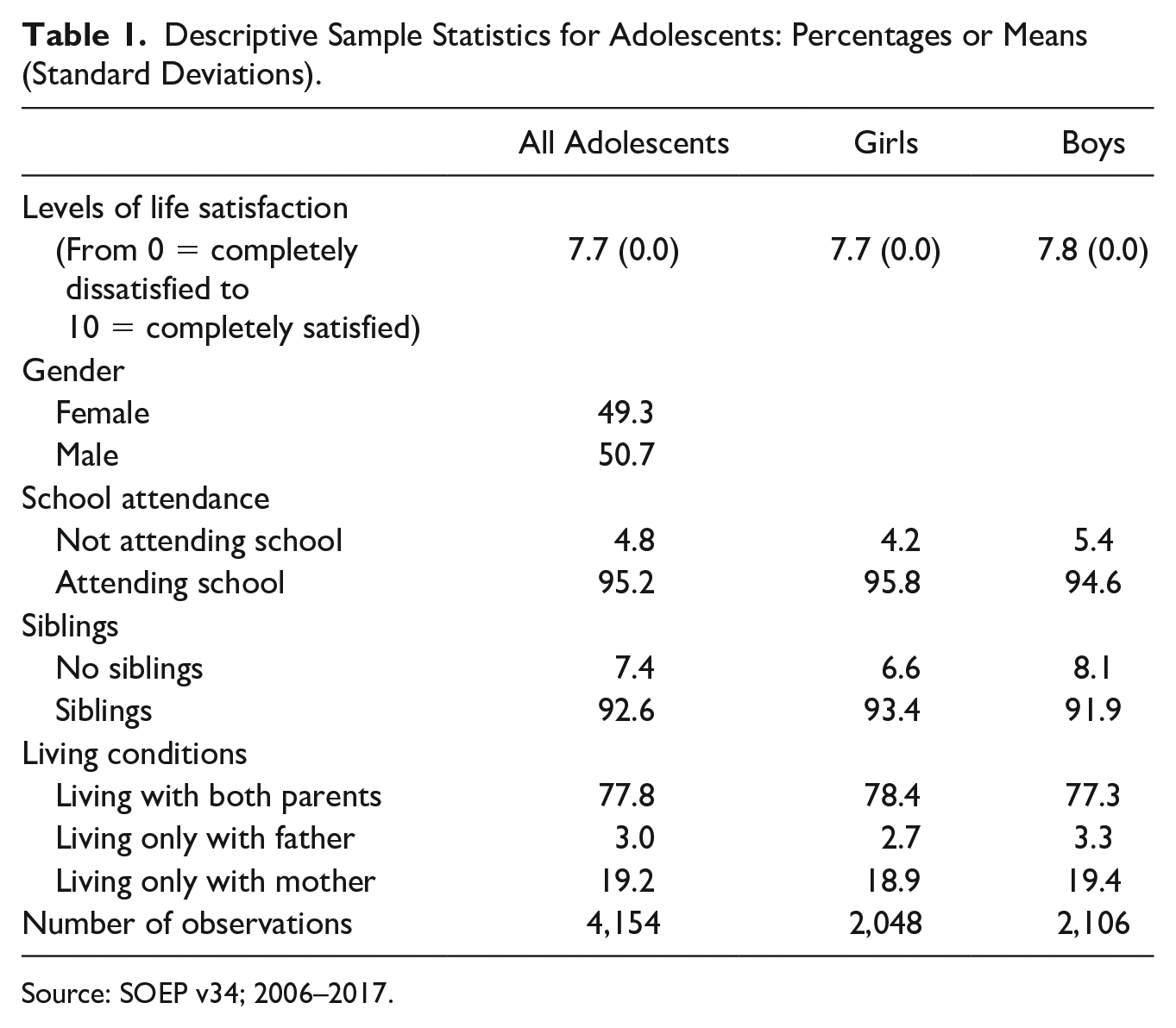
Source: SOEP v34; 2006–2017.
Descriptive Sample Statistics for Parents: Percentages or Means (Standard Deviations).
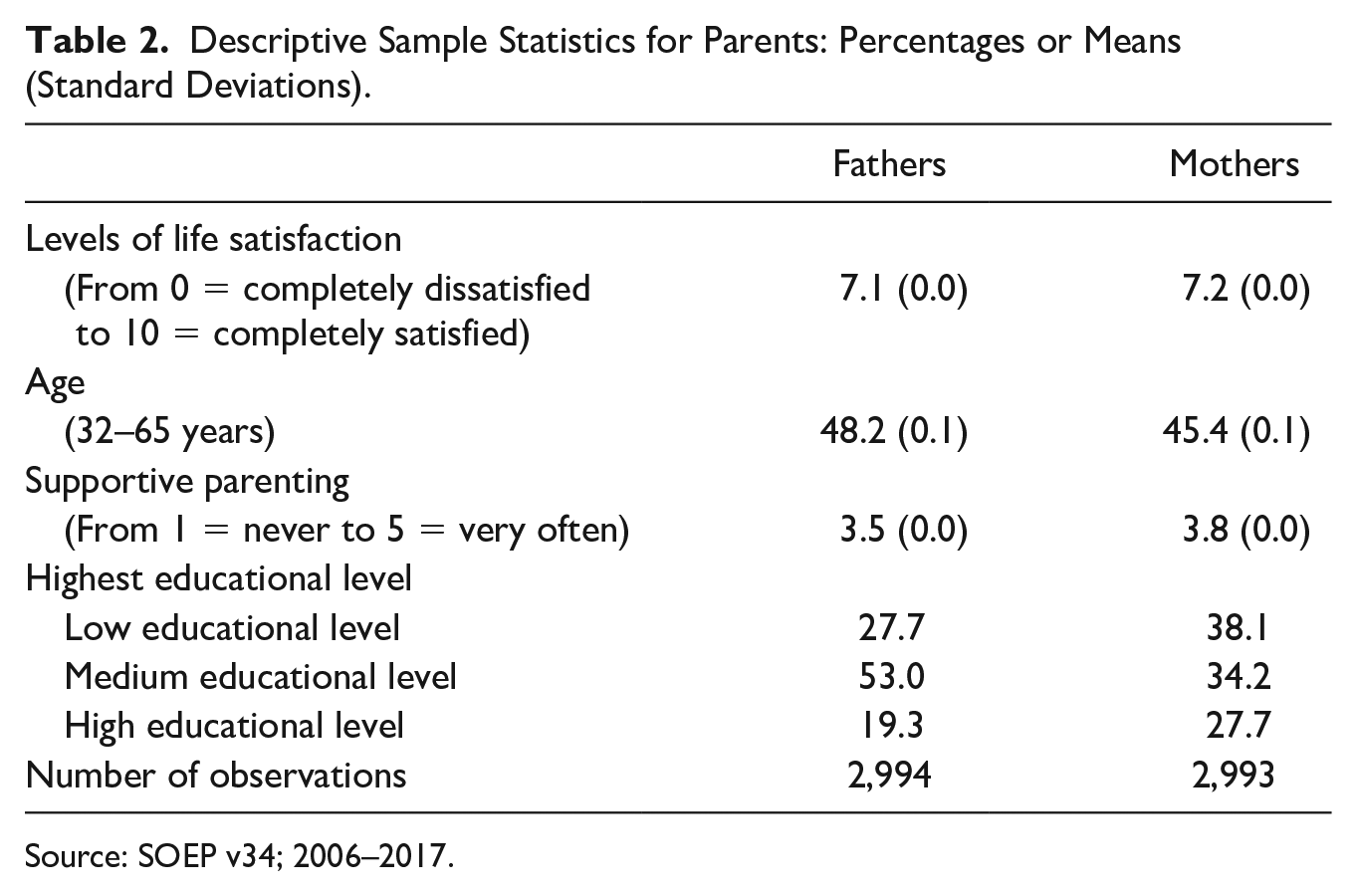
Source: SOEP v34; 2006–2017.
Results
To test this study’s hypotheses, stepwise multilevel mixed-effects linear regression models were estimated. The results are presented in Table 3. The first model shows the correlation between parents’ and adolescents’ life satisfaction (model 1); the second model includes the supportive parenting of mothers and fathers (model 2); the third model adds all socio-demographic and family-related control variables to the regression (model 3); and the final model displays two interaction terms for mother–child and father–child dyads to investigate differences between same-sex and opposite-sex parent–child dyads (model 4).
Multilevel Regression Models: The Determinants of Adolescents’ Life Satisfaction (Unstandardized Regression Coefficients).
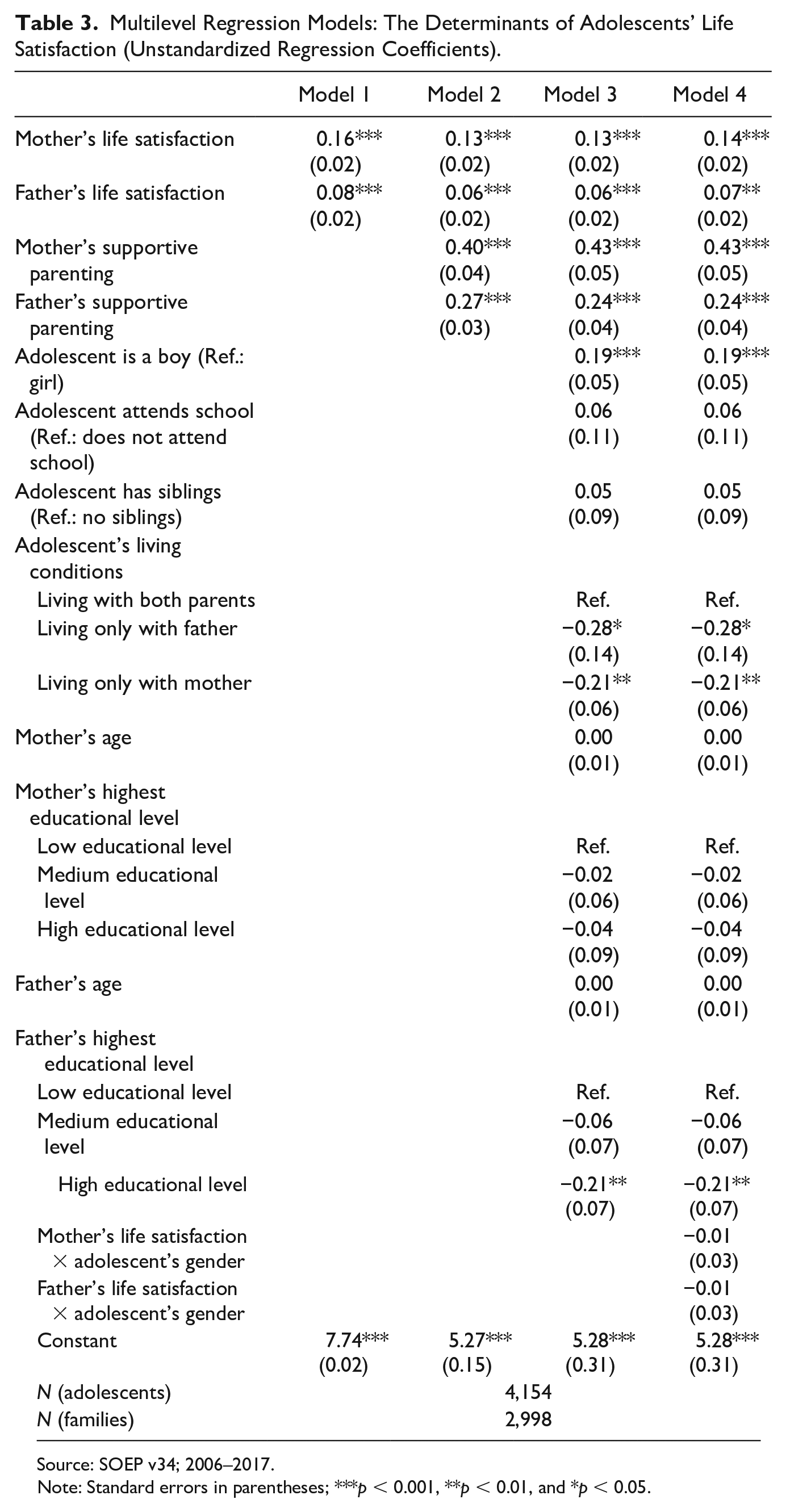
Source: SOEP v34; 2006–2017.
Note: Standard errors in parentheses; ***p < 0.001, **p < 0.01, and *p < 0.05.
Parents’ and Adolescents’ Life Satisfaction
The results in model 1 suggest a positive and significant association between levels of life satisfaction in parents and their adolescent children (B = 0.16; p < 0.001 for mothers; B = 0.08; p < 0.001 for fathers). Although the effect sizes decreased slightly after adding the socio-demographic and family-related control variables to the regression, the relationship remained highly significant (B = 0.13; p < 0.001 for mothers; B = 0.06; p < 0.001 for fathers). However, as the regression coefficients for mothers’ and fathers’ life satisfaction were relatively small, the results point to comparatively weak relationships between the life satisfaction of parents and their adolescent children. Nevertheless, these findings provide general support for the intergenerational transmission of life satisfaction between parents and adolescents. Hence, the first hypothesis, which stated that levels of life satisfaction in parents are related to levels of life satisfaction in their adolescent children (H1), was confirmed.
Supportive Parenting
To control for mediating factors in the intergenerational transmission of life satisfaction from parents to their adolescent children, both mothers’ and fathers’ supportive parenting was considered. In the first step, the multivariate analysis shows that mothers’ and fathers’ levels of supportive parenting were positively and highly significantly related to their children’s life satisfaction (B = 0.43; p < 0.001 for mothers; B = 0.24; p < 0.001 for fathers): the more parents succeeded in maintaining warm and loving relationships with their children, and the more they engaged in constructive and positive communications, the higher their children’s life satisfaction. To determine whether supportive parenting mediated the relationship between levels of life satisfaction in parents and adolescents, separate mediation analyses were carried out for mothers and fathers. The results of the seemingly unrelated regressions (sureg) showed that both mothers’ and fathers’ supportive parenting partially mediated the transmission of life satisfaction. The indirect effect for mothers was 0.02 (z = 5.94; p < 0.001), with 12.3% of the total effect of mothers’ life satisfaction mediated by their supportive parenting, whereas the indirect effect for fathers was 0.01 (z = 5.08; p < 0.001), with 19.1% of the total effect of fathers’ life satisfaction mediated by their use of supportive parenting. Consequently, the second hypothesis, which stated that supportive parenting mediates the intergenerational transmission of life satisfaction between parents and their adolescent children (H2), was likewise confirmed.
Same-Sex and Opposite-Sex Parent–Child Dyads
The interaction terms in model 3 were estimated by, respectively, multiplying the variables for mothers’ and fathers’ life satisfaction with their children’s gender, which made it possible to compare transmission processes in same-sex and opposite-sex parent–child dyads. As both regression coefficients were small and insignificant (B = ‒0.01 for both mothers and fathers), the results of the analysis suggest that there were no significant differences in the intergenerational transmission of life satisfaction between mother–daughter and mother–son dyads or between father–son and father–daughter dyads. Consequently, the third hypothesis, which stated that the intergenerational transmission of life satisfaction is stronger in same-sex parent–child dyads than in opposite-sex parent–child dyads (H3), had to be rejected.
Control Variables
With respect to the socio-demographic and family-related control variables, the results indicate that there were significant gender differences, as 17-year-old boys reported higher levels of life satisfaction compared to girls of the same age (B = 0.19; p < 0.001). Furthermore, adolescents who were living with both of their parents displayed significantly higher levels of life satisfaction compared to adolescents who were living with either only with their mother (B = ‒0.21; p < 0.01) or only with their father (B = ‒0.28; p < 0.05). Moreover, there was a negative and significant relationship between fathers’ educational attainment and their children’s life satisfaction, as adolescents with a highly educated father reported lower levels of life satisfaction compared to adolescents with a less educated father (B = ‒0.21; p < 0.01). Although this finding may seem counterintuitive at first, highly educated fathers may have been engaged in demanding and time-consuming employment, which negatively affected their children’s life satisfaction. Finally, no significant associations were found between adolescents’ life satisfaction and their school attendance, the existence of siblings, the ages of their mother and their father, or their mother’s highest educational level.
Discussion
The purpose of the present study was threefold: to investigate the intergenerational transmission of life satisfaction between parents and their adolescent children, to determine whether mothers’ and fathers’ supportive parenting mediates this relationship, and to consider potential differences between same-sex and opposite-sex parent–child dyads in the intergenerational transmission of life satisfaction. The results of the multivariate analysis have provided moderate evidence for the intergenerational transmission of life satisfaction between parents and their children, as both mothers’ and fathers’ levels of life satisfaction were positively and highly significantly related to levels of life satisfaction in their offspring. Furthermore, the results showed that both mothers’ and fathers’ supportive parenting partially mediated this relationship, with higher levels of supportive parenting contributing to increased levels of life satisfaction in adolescents. Finally, a comparison of same-sex and opposite-sex parent–child dyads revealed that the association between the life satisfaction of parents and adolescents did not depend on gender constellations, and that life satisfaction in parents exerted similar levels of influence on both their same-sex and their opposite-sex children. Taking all of these findings into account, the first and the second hypotheses of this study were confirmed: levels of life satisfaction in parents were related to levels of life satisfaction in their adolescent children and supportive parenting (partially) mediated the intergenerational transmission of life satisfaction between parents and their adolescent children. However, the third hypothesis, which stated that the intergenerational transmission of life satisfaction is stronger in same-sex parent–child dyads than in opposite-sex parent–child dyads, had to be rejected.
The findings of the present study are in line with the results of some previous studies. For example, this study corroborates the findings of Clair (2012) who uncovered a positive and significant association between parental and adolescent life satisfaction. Moreover, the present study’s insights into the mediating role of mothers’ and fathers’ supportive parenting on the intergenerational transmission of life satisfaction confirm the findings of Headey et al. (2014) who concluded that levels of life satisfaction are also indirectly transmitted from parents to their children through the transmission of values and behavioral choices that are associated with life satisfaction. Considering that the present study has shown that only between 12% and 19% of the relationship between parents’ and adolescents’ life satisfaction can be explained by parents’ engagement in supportive parenting, the results do not contradict the findings of previous research that suggested that a predisposition for low or high levels of life satisfaction may be indirectly transmitted from parents to children through numerous mechanisms, including the genetic transmission of personality traits (Clair, 2012; Lucas, 2008; Maddux, 2016).
The present study has a number of strengths, including its use of data from a well-established and large panel study with high case numbers that collected information on the self-reported life satisfaction of both adolescents and their parents. Furthermore, by including both mothers and fathers in the analysis, potential gender differences in the intergenerational transmission of life satisfaction could be investigated. Moreover, the statistical analysis included several variables that have been shown to be relevant for adolescent life satisfaction in the past (e.g., mothers’ and fathers’ supportive parenting). However, this study also has some limitations. First, determining the causal relationship between parental and adolescent life satisfaction is not possible when using cross-sectional data. Moreover, although social learning theory and previous research have provided extensive evidence that the transmission of life satisfaction is primarily directed from parents to their children, other studies have suggested that processes of intergenerational transmission are a two-way exchange (Martin-Matthews & Kobayashi, 2002). Second, as SOEP does not provide information on the genetic relationship between parents and their children, the multivariate analysis was not able to separate the effects of cultural transmission from the effects of genetic inheritance. However, based on the findings of earlier studies and theoretical considerations, it is plausible to assume that both genetic and cultural transmission contribute to similarities in life satisfaction between parents and their children. Third, because the analytical sample consisted exclusively of 17-year-old adolescents who were living with at least one of their parents, this study could not determine whether similarities in life satisfaction between parents and their children persist over the long term, or are mostly transient, as addressing this question would require a longitudinal analysis. However, similar analyses with children of other age groups may yield very different results, given that adult children living in their own households may be less strongly influenced by their parents and more strongly influenced by important others, including partners, friends, and colleagues. As a result, future studies on the topic of intergenerational transmission should include children from a wider age range.
To summarize, this work provided moderate evidence for the intergenerational transmission of life satisfaction between parents and their adolescent children by showing that parents transmit their levels of life satisfaction to their adolescent children both directly and indirectly. Although levels of life satisfaction in parents were shown to be only weakly related to levels of life satisfaction in adolescents, the findings of the present study are concerning because they indicate that a person’s life satisfaction is partially determined by the life satisfaction of his or her parents. Given that life satisfaction appears to be relatively stable over time (Fujita & Diener, 2005), and given its considerable relevance for a person’s health and well-being (Proctor et al., 2009), the findings of the present study may inform future investigations into the development and maintenance of subjective well-being.
Moreover, the findings of this study also have practical relevance. For example, they can be used in designing or improving intervention programs aimed at children who are at an elevated risk of experiencing poor levels of life satisfaction. Despite the evidence that a person’s subjective well-being appears to be strongly influenced by inherited predispositions, previous research has found that the set point for life satisfaction can be influenced to a certain degree by environmental factors (Fujita & Diener, 2005). Thus, to improve the well-being of children and adolescents and to reduce social and health-related inequalities on a societal level, researchers or practitioners designing intervention programs need to consider the importance of the parent–child relationship while also reflecting on the independent effect of parental life satisfaction on the overall well-being of their children. Accordingly, effective intervention programs should be designed in a way that encourages parents to engage actively in forms of parenting, which have been shown to increase the well-being of children or are tailored to a given child’s individual needs. A special aim of these programs should be to identify and assist parents with low levels of life satisfaction, given that the present study has demonstrated that this group is less likely to engage in supportive parenting compared to parents with high levels of life satisfaction. Intervention programs may help raising awareness in parents about the importance of certain parenting styles and guide them in developing and engaging in more positive and supportive parenting styles, thus enhancing their children’s well-being. Furthermore, such approaches should be supplemented by interventions directed at the children and the parents themselves, for instance, programs that focus on other important determinants of life satisfaction, including the children’s and the parents’ attitudes, social skills, and behavioral patterns that are related to the establishment and maintenance of high life satisfaction.
Footnotes
Declaration of Conflicting Interests
The author declared no potential conflicts of interest with respect to the research, authorship, and/or publication of this article.
Funding
The author received no financial support for the research, authorship, and/or publication of this article.
