




Abstract
The different dimensions of parenthood—for example, biological relatedness, child-rearing, co-residence—are disconnected in increasingly many families as the result of upward trends in separation and repartnering. By studying stepparents’ claiming (i.e., stepparents perceiving their adult stepchildren as their own), this study provides insight into how people define kinship and adds a new dimension to knowledge about stepfamilies. Using the Ouders en Kinderen in Nederland (OKiN) survey data, this study (a) provides nationally representative estimates of how Dutch stepmothers and -fathers (N = 3,327) perceive their adult stepchildren and (b) shows how the context (i.e., co-residence, duration, timing, marriage) and relations to biological children relate to stepparents’ claiming. The more similar the context is to “traditional” parent–child relations, the more stepparents claim their stepchildren. As opposed to the expectation that relations to one’s own biological children would serve as an important reference, having biological children from either a previous or current relationship has little explanatory power.
The parent–child relation is often considered the fundamental kinship tie (Rossi & Rossi, 1990): Once a parent, always a parent. Yet, with an increase in parental separation and repartnering, Western societies have witnessed an increase in the diversity of parent–child ties (Thomson, 2014). When starting a new union, it has become more likely that one or both partners already have children from a previous union, forming a stepfamily. Possibly, joint children are being born within these stepfamilies, leading to an even more complex network of biological, residential, and legal ties. As a result, the different dimensions of parenthood—such as biological relatedness, child-rearing, living in one household, and parental authority—are disconnected in an increasing number of families. This raises the question of how we define a “real” parent–child tie.
Both sociological (e.g., Rossi & Rossi, 1990) and evolutionary (e.g., Buss, 2016) approaches to kinship imply that there is a hierarchy in parent–child ties, with the biological tie as its standard marker. Genetic relatedness—and the evolutionary drive for survival of the own genes—would lie at the core of the existence of norms and obligations concerning parent–child relations. In contrast, motives in stepparent–stepchild relations are less clear as they are defined by (impermanent) social relations rather than genes. This ambiguity has been conceptualized as the “incomplete institutionalization” of remarriage and the stepfamily—in contrast to the well-established intact, first marriage family (Cherlin, 1978).
The diversity in stepparent–stepchild ties in terms of context (e.g., timing of repartnering, the presence of siblings) combined with the absence of a clear normative framework comes with a large variety in how stepparents perceive their stepchildren (Fine et al., 1998). A number of qualitative studies have asked parents and children to what extent they consider the relation to their stepparent/stepchild like a relation to a “real” or “own” parent/child, dubbed “claiming” (e.g., Blyaert et al., 2016; Marsiglio, 2004). The variations in these perceptions, and the patterns underlying them, could provide insight into how people develop and define parent–child relations. For example, the experience of having lived with the stepchild might form an important requirement for experiencing a parent-like relationship. In addition, if stepparents perceive stepchildren as their “real” children, the norms, expectations, and obligations they attach to these steprelations are probably more parent-like than if they consider their stepchildren distant or even non-kin. For example, they might feel stronger responsibilities to offer support if their stepchildren experience financial hardship. In that sense, the meaning stepparents give to the relations to their stepchildren informs us about the level of (potential) solidarity in stepfamilies.
Although the existing (mainly qualitative) literature provides important insights into stepparents’ experiences, the small, select samples that have been used thus far lend themselves neither for any population-level estimations of the prevalence of stepparents’ claiming nor for disentangling the patterns underlying it. Quantitative studies focus mainly on the instrumental role stepparents may have in children’s lives (e.g., in terms of parental resources or involvement in childcare) rather than the experience or perception of that role.
The current study fills this gap using data of the Ouders en Kinderen in Nederland (OKiN) survey (Parents and Children in the Netherlands; Kalmijn et al., 2018). These data contain a large sample of stepparents (N = 3,327) reporting on the relations to their adult stepchildren, including, in contrast to previous studies on this topic, both stepmothers and stepfathers. The aim of this study is twofold: (a) It is the first to provide nationally representative estimates of how stepparents perceive their adult stepchildren. (b) It sheds light on the determinants of stepparents’ claiming, considering two types of explanations. First, the dimensions of parenthood that have been found to be important to parent–child ties—co-residence, duration, and parental partnership (Kalmijn et al., 2019)—could be considered crucial in the absence of a biological tie. Having been part of the stepchild’s youth and upbringing (e.g., the first day of school, family dinners) might foster parent-like feelings, whereas the permanence signaled by marriage to the biological parent of the stepchild creates a secure context to develop such feelings. Second, when stepparents indicate to perceive their stepchildren as their own children, an important question is what their frame of reference is. The OKiN survey assessed parents’ relations to biological children from previous partnerships and relations to the stepchildren and biological children from their current partnership. This allows me to study the role of relations to biological children in how parents perceive their stepchildren.
In contrast to most existing work on this topic—focusing primarily on parents with minor stepchildren—I study adult parent–child relations (children aged 18–50 years). Obviously, relations with younger, dependent children involve all kinds of dynamics that relations with adult children do not involve. Whereas relations with young children involve questions of authority and care, relations with independent, adult children involve less engagement and may be viewed as more voluntary. At the same time, the way parents relate to their (step)children is not just based on the present but also to a large extent on their joint past (Rossi & Rossi, 1990). Shared time and experiences, especially the early years of the child’s life, are pivotal in shaping the parent–child relations (Ainsworth, 1989). Having already lived through this critical period, adult parent–child relations provide the opportunity to study how the context in the younger years of the stepparent–stepchild tie determines its meaning later in life.
Theory and Hypotheses
Stepparents’ “Claiming”
Using in-depth interviews with stepfathers, Marsiglio (2004) introduced the phenomenon of stepparents’ claiming as “a state of mind and relationship orientation” (p. 23) in which parents see their stepchildren as though they were their own. Among stepfathers, a distinction can be made between stepfathers who express a “father-like” identity from seemingly similar expressions of friendship or mentorship (Blyaert et al., 2016; Marsiglio, 2004). The same distinction was made by stepmothers who describe their role as caring, providing, friend, or mentor—a “mothering role”—but not a mother (Erera-Weatherley, 1996; Svare et al., 2004; Weaver & Coleman, 2005). In that sense, claiming carries an indication of kinship (Blyaert et al., 2016; Ganong et al., 2018), which involves certain norms and obligations that go beyond feelings of affection. For some stepparents, this would even be a reason not to perceive their stepchildren as their own, as they would consider the children’s biological parents to have unique (formal and informal) rights and responsibilities (Blyaert et al., 2016). Therefore, the first part of the following section deals with how different contextual dimensions of the stepparent–stepchild relation might foster exactly these “parent-like” feelings rather than just a close relationship. The second part considers how the actual experience of being a biological parent links to claiming stepchildren.
Contextual Dimensions of the Stepparent–Stepchild Relation
Research on intergenerational relationships shows that time is a crucial factor in the relation between parent and child. Building on notions of exchange and reciprocity (Silverstein et al., 2002) as well as attachment theory (Ainsworth, 1989), the idea is that sharing time provides the opportunity to develop a strong bond: Not only in terms of attachment and closeness, but also by establishing the ongoing exchange that characterizes parent–child ties and lies at the core of the normative framework of rights and responsibilities of parents and children (Van Houdt et al., 2018). For example, if parents have been involved in taking their stepchild to bed, listening to whatever occupies the stepchild, or other experiences that are part of parenting a child, they might develop a level of attachment that they identify as a parent-like feeling. At the same time, having made these investments in the well-being of the stepchild and having been involved in these parental activities might foster rights and obligations that go beyond closeness, for example, being in the position to correct and punish the stepchild (Blyaert et al., 2016; Svare et al., 2004) or, later in life, calling upon the stepchild when help is needed.
When thinking about stepparents sharing time with their stepchildren, one could consider the duration of the relationship between the stepparent and the stepchild’s biological parent as an indicator for the time since the stepparent entered the child’s life. On top of that, co-residence indicates the intensity of this shared time. Not only will co-residence amplify the absolute amount of shared time, but it will also entail many more shared activities (such as having dinner together, being involved in the child’s upbringing) than stepparenting at a distance would entail. In addition, the timing of the stepparent’s entering affects the nature of the shared time: Young children require more intensive parenting activities than older children. Therefore, having been part of the upbringing of the child from early onward possibly creates stronger parent-like feelings than stepping in at a later stage of the child’s development (Marsiglio, 2004; Svare et al., 2004; Weaver & Coleman, 2005).
H1: The longer the duration of the union between the stepparent and their partner, the more strongly stepparents perceive stepchildren as their own.
H2: Stepparents who lived with their stepchildren perceive their stepchildren more strongly as their own than do those who did not live with them.
H3: The younger stepchildren were at the start of the union between the stepparent and their partner, the more strongly stepparents perceive their stepchildren as their own.
Given the absence of a biological tie, stepparent–stepchild relations face a higher level of uncertainty than biological parent–child relations as they are defined only by (impermanent) social ties (Cherlin, 2004). Marriage, involving legal as well as social obligations, signals more certainty about the sustainability of stepties than the lower commitment of unmarried cohabitation (Cherlin, 2004; Perelli-Harris et al., 2014). This higher level of certainty conveyed by the commitment to the partner might foster stronger feelings of “we-ness” and belonging to the new stepfamily (Marsiglio, 2004). At the same time, stepparents who have stronger parental feelings toward their stepchildren might select themselves into marriage. Either way, I expect that stepparenthood in the context of marriage fosters stronger feelings of kinship, and therefore, stepparents’ claiming, than in the context of cohabitation.
H4: Married stepparents more strongly perceive their stepchildren as their own than unmarried cohabiting stepparents.
Biological Children
An important question when considering stepparents’ perceptions of stepchildren as their “own” is what their frame of reference is. As has been argued in previous studies (Blyaert et al., 2016; Marsiglio, 2004), relations to own children might serve as a benchmark when thinking about a “real” parent–child relation, which stepparents without biological children do not have. This might result in different interpretations of the statement “like my own children” and, consequently, different levels of claiming. In the age and cohort of the stepparents I study (i.e., aged 60 years on average, born between the 1950s and the 1970s), childlessness is relatively uncommon: In the Netherlands, approximately 18% of the women of these cohorts remained childless (Sobotka, 2017). This is a heterogeneous group, as some might be “involuntarily” childless (e.g., for biological reasons, not having found the right partner), whereas others are “voluntarily” childless (Kreyenfeld & Konietzka, 2017). Although I cannot distinguish between these different groups in this study, it is important to keep this diversity in mind when thinking about the comparison to stepparents with biological children.
In general, if stepparents have biological children, they have a clear point of reference: The question whether they perceive their stepchildren as their own carries the implicit comparison between the relation to their stepchildren and the relation to their biological children. For stepparents who do not have biological children, the point of reference is more abstract, as they do not have a firsthand experience of being a parent. This could result in lower levels of claiming among stepparents without biological children in two ways. First, it could be that stepparents without their own biological children are more reluctant to state that they perceive their stepchildren as their own because they consider themselves unable to make such a comparison. Second, having a direct comparison (i.e., biological children) might make it more difficult to deny parent-like feelings toward stepchildren, as it implies a certain hierarchy in which the biological children are placed above the stepchildren. In couples that have put effort in making a harmonious unit out of their combined families, differentiating between different “sets” of children might be a taboo. As stepparents without their own children do not have to consider such sentiments, they might be less reluctant to state that they do not perceive their stepchildren as their own.
It is, theoretically and empirically, important to distinguish biological children who were born in a previous union from those born in the current union as this might provide insight into the possible mechanisms at work. They differ in timing (the first were born before the tie between the stepparent and child tie was established, the latter after) and degree of relatedness to the stepchildren (the first are the stepchildren’s stepsiblings, whereas the latter are their half-siblings).
Stepparents who have biological children from a previous union might feel more uncomfortable with stating that their stepchildren are like their own children because they feel it would demote their biological children (Church, 1999; Weaver & Coleman, 2005). One could argue that such feelings of loyalty conflict are most prominent when it concerns children from a previous union: They were part of the parents’ life before the stepchildren, and parents might fear to signal that they have taken their place. As biological children born in the stepfamily came when the relation between the parent and the stepchildren was already established, such a sentiment seems less likely.
As biological children born in the stepfamily came, by definition, after the stepchildren, one could think in terms of selection into the decision to have another child. Stepparents without children of their own might consider stepchildren substitutive to biological children (Svare et al., 2004), which could suggest that they perceive stepchildren more as their own than stepparents who do have biological children. The literature on having a common child in a stepfamily—a so-called cementing child (Ivanova & Balbo, 2019; Stewart, 2005)—suggests that parents in those families consider their family more “complete” with a common biological child. This suggests that stepparents who had a common child with their partner did not consider their stepchildren good substitutes for biological children. In other words, stepparents who do not perceive their stepchildren as their own might select themselves into having a biological child in the stepfamily.
In sum, based on the literature, different predictions can be made. The biological children as reference argument predicts a positive effect of biological children on stepparents’ claiming in general. In contrast, the loyalty toward biological children predicts a negative effect of biological children born in a previous union specifically. The stepchildren as substitutes argument predicts a negative (selection) effect of having biological children born in the stepfamily.
H5a: Stepparents who have biological children perceive their stepchildren more strongly as their own than stepparents without biological children.
H5b: Stepparents with biological children born in a previous union perceive their stepchildren less strongly as their own than stepparents without biological children born in a previous union.
H5c: Stepparents with biological children born in the stepfamily perceive their stepchildren less strongly as their own than stepparents without biological children born in the stepfamily.
Method
Data
I analyzed data from the OKiN (Kalmijn et al., 2018) survey. This data collection was approved by the Ethics Advisor and the European Research Council officer assigned to the project (ERC grant agreement no. 669334). The survey (conducted between June 2016 and January 2017) was based on a stratified random sample, drawn from the Dutch population registers, of adult and independently living persons born in the Netherlands between 1971 and 1991 (aged 25–45 years). It contains a large oversample (75%) of persons who grew up with separated (including both former marital and cohabiting unions) or widowed parents, as well as an oversample of persons who grew up with a stepparent. These sampling strata were defined by the registered residence address of the child at the age of 15 years and the biological parents and possible new partners. These children (anchors) as well as their parents and possible stepparents (alters) were approached with response rates of respectively 62% and 38%. The fieldwork was done by Statistics Netherlands (CBS) by means of web-based questionnaires, followed by face-to-face interviews (anchors) or paper-and-pencil questionnaires (alters) in case of initial nonresponse. In contrast to most multi-actor surveys, participation of the alter respondent was not conditional upon participation of the anchor respondent. The fact that the child sample was approached independently from the parent sample eliminates the child’s willingness to provide access to the parent as a source of selectivity (Kalmijn et al., 2018). The present study was based on the alter data.
Given the focus on stepparents’ claiming, the analyses were restricted to respondents who reported stepchildren (defined as biological children of the respondent’s current partner born in a previous union). Given the survey’s focus on young and middle-aged children, I excluded respondents who reported on stepchildren outside the range of 18–50 years of age (352 cases). In addition, I excluded respondents who reported being in a non-cohabiting (living apart together [LAT]) union (155 cases), ending with a final sample of 3,327 stepparents.
Measures
The survey assessed respondents’ different “sets” of children in separate modules, starting with children born in the current union, followed by the current partners’ children born in a previous union (i.e., stepchildren), and ending with children born in previous unions of the respondent. Each of these modules consisted of questions referring to the set of children in general, and questions that were child specific. These child-specific questions were repeated for up to two children (per set of children). If the respondent reported more than two children, the questionnaire was programmed to select children—on the basis of their dates of birth as reported by the respondent—above the age of 18 years. If more than two, a random selection was made. If less than two, the oldest children below 18 years were selected.
The dependent variable, stepparents’ claiming, was measured with a general question, referring to all the respondent’s stepchildren. Respondents indicated to what extent they agreed with the statement “I regard my stepchildren as my own children” on a scale from 1 (fully disagree) to 5 (fully agree).
To examine how relations to biological children relate to stepparents’ claiming, I constructed a categorical measure that distinguishes those without biological children (reference category) from those with (a) biological children born in a previous union only, (b) biological children born in the stepfamily only, and (c) both biological children born in a previous union and in the stepfamily.
Duration of the union was based on the year of the start of the union reported by the respondent, counting the number of years up to the interview. Based on this duration and the stepchildren’s dates of birth as reported by the respondent, I constructed a measure of the age of the youngest stepchild at the start of the union. To allow for the nonlinearity of the relation and to prevent multicollinearity with duration of the union, this measure was categorized: 0–9 years (reference category), 10–18 years, 19–28 years, and 28 years or older. Furthermore, the child-specific questions assessed whether the stepchild lived with the respondent and at what ages. Given the high level of confounding between duration of co-residence and age of the stepchild at the start of the union and/or duration of the union, I constructed a dichotomous indicator for co-residence that distinguishes respondents who lived with at least one of their stepchildren from those who did not (reference category). Lastly, a dichotomous measure for union status distinguishes married from unmarried cohabiting respondents (reference category).
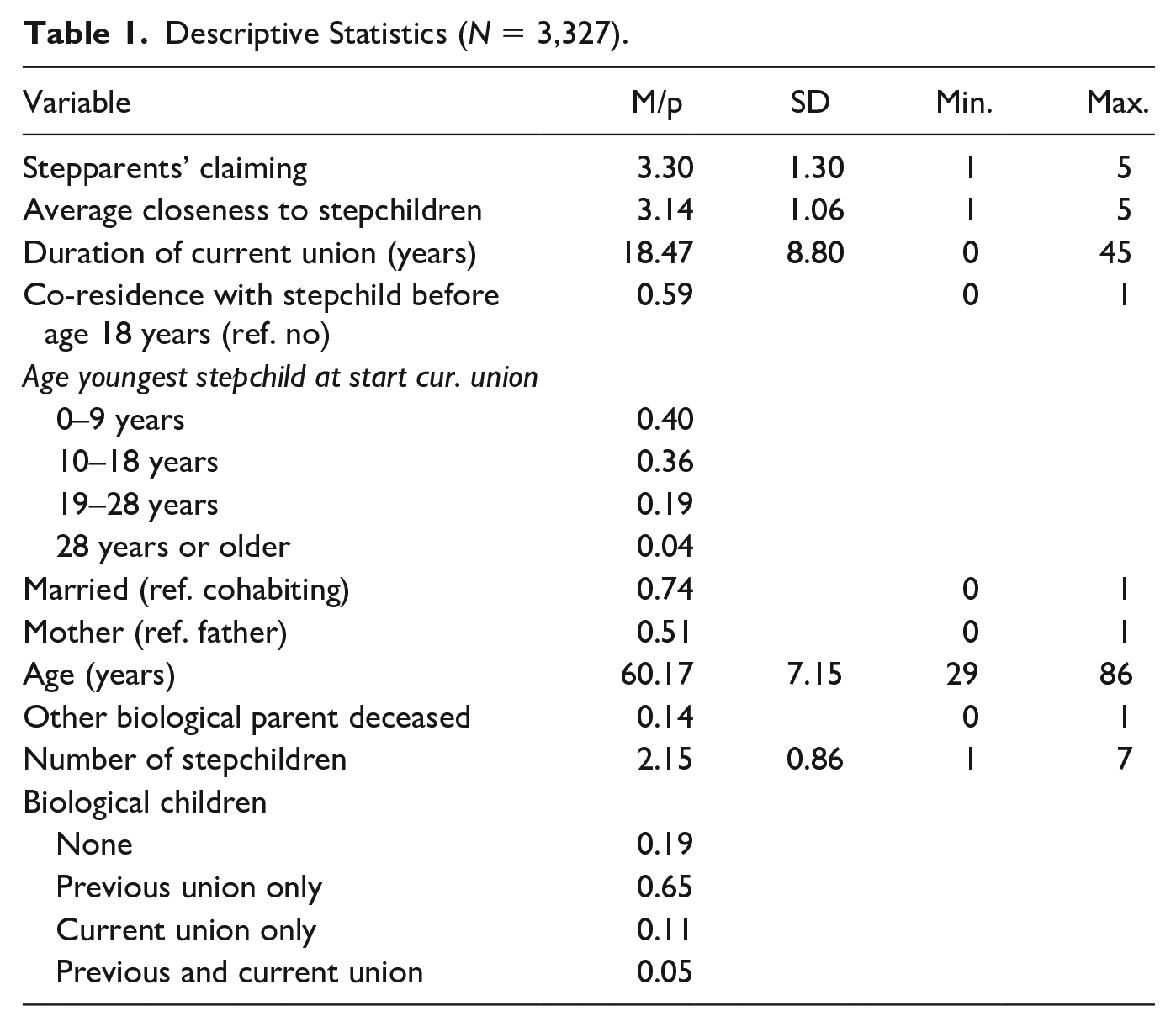
The models were controlled for the stepparent’s age, sex, whether the other biological parent of the stepchildren (the current partner’s ex-partner) was still alive or not, the number of stepchildren, and the level of closeness to the stepchildren. To measure closeness, the question “How close is your relation with [name child] currently?” was used, which could be answered on a scale from 1 (not close at all) to 5 (very close). As this question was child specific, I used the average of the stepchildren reported on (if more than one). Table 1 shows the descriptive statistics of all variables included in the analyses.
Descriptive Statistics (N = 3,327).
Analytical Strategy
The first part of the analyses was aimed at describing stepparents’ claiming. The description of the prevalence of stepparents’ claiming provides a frame of reference and gives a first image of how the phenomenon is spread over different types of stepparent–stepchild relations.
In the second part of the analyses, the hypotheses were tested. I estimated ordinary least squares (OLS) regression models to predict stepparents’ claiming. The first step of the model explores how the structural conditions of the stepparent–stepchild relation that would supposedly lead to a more parent-like experience (duration, timing, co-residence, and union status) relate to stepparents’ claiming (H1–H4). The second step of the model explores the role of having biological children, distinguishing stepparents with biological children born in a previous union, born in the current union, both, or neither (H5).
Results
Descriptive Results
The average value of stepparents’ claiming (Table 1) corresponded with an answer between “neutral” and “agree” in reaction to the statement “I regard my stepchildren as my own children,” although there was quite some variation. Figures 1–3 display the percentage of stepparents who indicated to “agree” or “fully agree” with the statement “I consider my stepchildren as my own children.” Figure 1 shows that stepfathers claimed more often than stepmothers (70% vs. 35% on average). It indicates that although part of this difference could be explained by the fact that stepparents who lived with their stepchildren were more likely to claim than stepparents who did not, a gender difference remained. Figure 2 shows that, as expected, the age of the stepchild at which the stepparent entered their life made a large difference when it comes to claiming: The younger the children at entering, the more likely stepparents perceived the stepchildren as their own, especially when it comes to stepfathers. The numbers split by whether or not stepparents have biological children (Figure 3) did not reveal any clear-cut patterns.
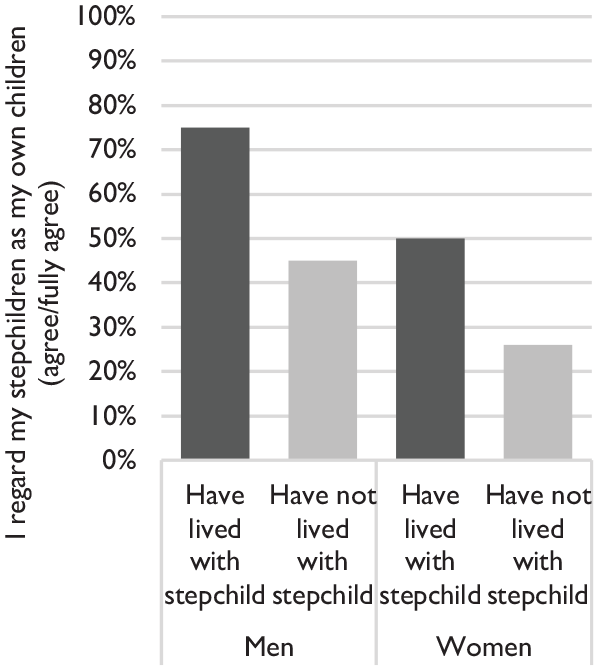
Stepparents’ claiming by gender and co-residence (N = 3,327).
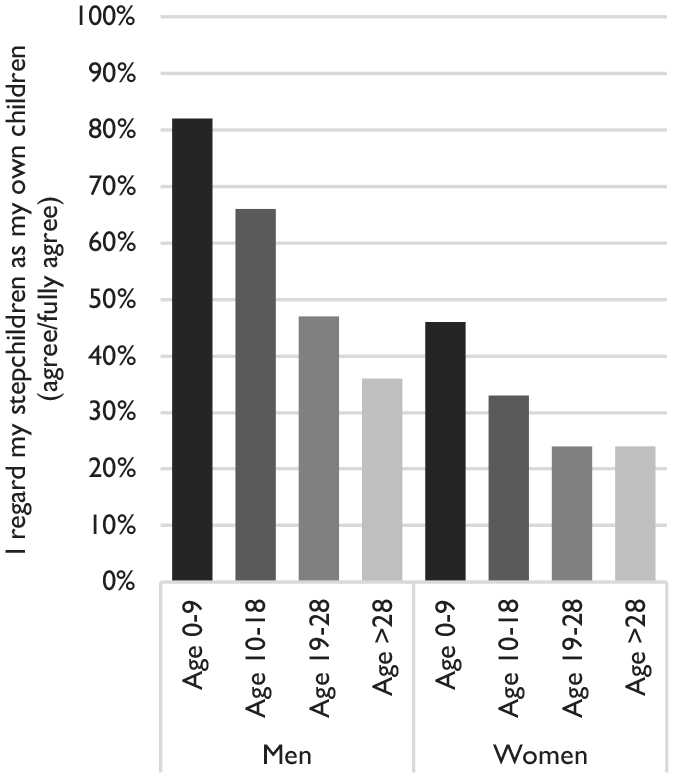
Stepparents’ claiming by gender and age youngest stepchild at union start (N = 3,327).
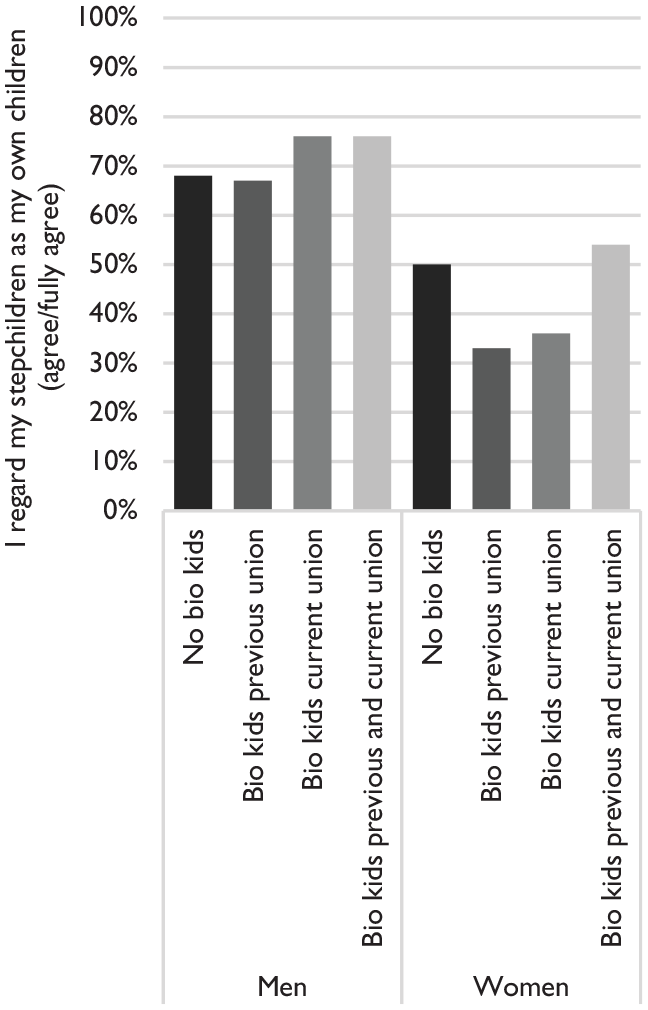
Stepparents’ claiming by gender and types of biological children (N = 3,327).
Explanatory Results
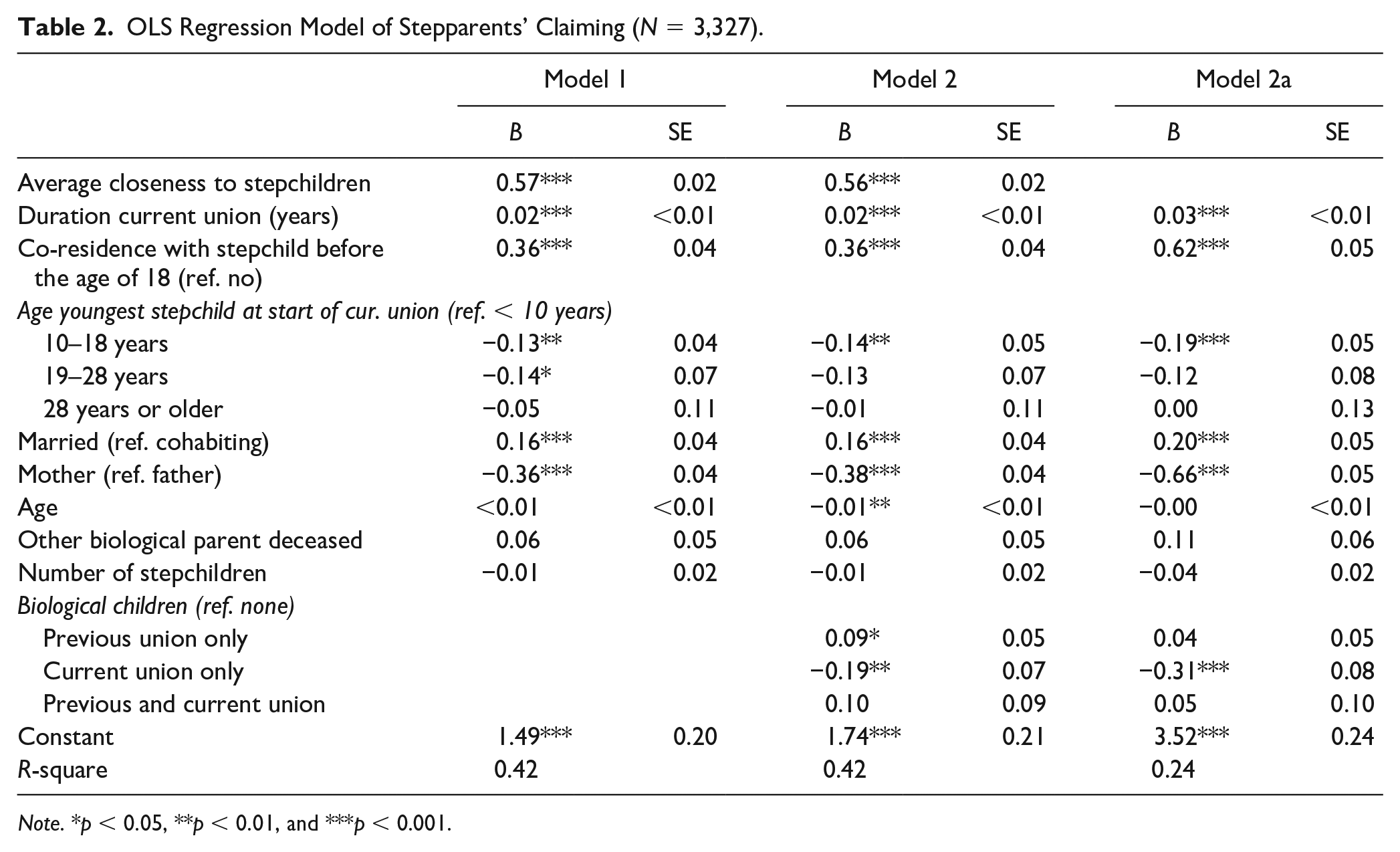
Table 2 shows the (unstandardized) estimates of the OLS regression model, explaining the level to which stepparents perceive their stepchildren as their own children. Starting with model 1, the variables included in the model explained about 42% of the variance in stepparents’ claiming. The estimates provided support for the first four hypotheses. In line with hypothesis 1, the level of claiming increased with the duration of the union between the stepparent and their partner. The effect of co-residence showed that, in support of hypothesis 2, stepparents perceived their stepchildren more strongly as their own children if the stepchildren lived with them before turning 18 years. The comparison between the different age groups (aged below 10 years as reference group) supported hypothesis 3: Stepparents claimed their stepchildren more strongly if they entered their current union when the stepchildren were still young children (aged below 10 years), than if they were already in their teenage or adolescent years. The relatively small (and, for the oldest age groups, even statistically insignificant) differences could be explained by the fact that a large part of this variation is captured by union duration. In support of hypothesis 4, married stepparents perceived their stepchildren more as their own children than cohabiting stepparents. Furthermore, in line with the descriptive findings, it showed that mothers perceived stepchildren less as their own than fathers. Age of the parent, whether or not the stepchildren’s other biological parent is deceased, and the number of stepchildren did not seem to play a role in claiming. As expected, closeness was positively associated with claiming.
OLS Regression Model of Stepparents’ Claiming (N = 3,327).
Note. *p < 0.05, **p < 0.01, and ***p < 0.001.
Model 2 showed that, as opposed to hypothesis 5b, parents who have biological children only from a previous union perceived their stepchildren more as their own children than parents without any biological children. The opposite holds for parents who have only biological children born in their current union who, in line with hypothesis 5c, claimed their stepchildren less strongly than parents without any biological children. Looking at the group of parents who have both types of biological children, these two effects seemed to cancel each other out, as their tendency to claim their stepchildren did not significantly differ from parents without any biological children. Although the effects of having children born in either a previous or current union were statistically significant, the effects were small and as the change in R-square showed, added virtually no explained variance.
Additional Analyses
The main analyses controlled for the level of closeness between respondents and their stepchildren in order to study the effects on the feelings of kinship net feelings of affection. Yet, because the two concepts overlap theoretically and empirically (r = 0.57), model 2a (Table 2) displays the explanatory model (model 2) excluding closeness to show how closeness intervenes in the effects of the independent variables on claiming. The comparison with model 2 showed that, of the 42% of the variance in claiming explained, about 18% was explained by closeness. Comparing the estimates over the models, all effects seemed only partly mediated/confounded by closeness (as reflected by their slightly larger beta value in model 2a). Yet overall, the differences were not that large. Closeness seemed to have the most remarkable role in the effect of co-residence, stepparent’s gender, and having biological children born in either a previous or current union. Almost half of the positive effect of having lived with the stepchildren was explained by closeness. The same holds for the difference between stepmothers and stepfathers. Lastly, closeness seemed to (partly) suppress the difference between stepparents without biological children and stepparents with children born in a previous union, whereas it (partly) mediated/confounded the difference with stepparents with children born in the current union. Stepparents with biological children were less close to their stepchildren, which reduced the extent to which they perceived them as their own. When controlling for closeness, this negative, indirect effect was cancelled out and only the direct effect remained (which was a positive effect if the children were born in a previous union, and negative if they were born in the current union).
Given the finding that stepfathers tended to perceive stepchildren more as their own than stepmothers, I estimated the models separately for mothers and fathers to explore the differences in effects. The results (not displayed) showed small differences in effect size but, overall, similar patterns. The only remarkable difference (p = 0.033) is that the difference between stepparents with biological children born in the current union only and other stepparents only applied to mothers, not to fathers. Furthermore, to get insight into the role of the relations to biological children, I examined to what extent the effects of biological children depended upon the closeness to these children. More specifically, I split up the indicators for having biological children from a previous union or a current union in three groups: (a) Parents without this type of children, (b) parents who reported to be close to the children of this type (an average of 3 or higher on the closeness indicator), and (c) parents who reported not to be close to the children of this type (an average below 3 on the closeness indicator). These analyses did not reveal any differences along the lines of closeness to biological children.
Discussion
This study is the first to provide a systematic descriptive and explanatory view on how stepparents perceive their adult stepchildren. By doing so, it not only adds a new dimension to the literature on cohesion in complex families but also provides insight into what we perceive as a “real” parent–child relation. The descriptive results showed that stepparents quite commonly perceive their stepchildren as their own children. Yet, there is a lot of variation along the lines of the duration, timing, and context of the stepparent–stepchild relation. Despite the expectation that relations to own, biological children would serve as an important reference, having biological children from either a previous or current relationship seemed to have little explanatory power. Altogether, these findings suggest that when we ask stepparents to evaluate to what extent they perceive their stepchildren as their own, they seem to do this in light of a certain general archetype of a parent–child relation, rather than in reference to their personal experiences as a parent to their own children.
Building on the literature, I argued that sharing time together, especially during the child’s younger years, would allow for establishing parent-like feelings—not only in terms of attachment (Ainsworth, 1989) but also because it fosters the ongoing exchange that characterizes parent–child relations (Silverstein et al., 2002). In line with this idea, the findings showed that the longer the union with the biological parent of the stepchildren has been and if the stepchildren lived with the stepparent, the stepchildren were more strongly perceived as own children. Although the stepchildren’s young age at the start of the union also involved higher levels of stepparents’ claiming, duration of the union seemed to be more important. In other words, time is more important than timing. Furthermore, stepchildren were more strongly perceived as own children in the context of a marital than a cohabiting union. This suggests that the commitment to the partner relation (as signaled by marriage) is associated with stronger feelings of kinship or “we-ness” (Marsiglio, 2004) with the children of the partner. The finding that time and context affected the level of claiming net of closeness showed that perceiving stepchildren as one’s own goes beyond feelings of affection. Although closeness is certainly an important factor, the experiences as a stepparent call upon sentiments that are classified as “parent-like,” which are more than just feeling close to the stepchildren. This reflects the qualitative literature on this topic in which stepparents describe the idea that parenthood involves certain (formal or informal) rights and responsibilities (Blyaert et al., 2016).
This study acknowledged the multiple (parental) roles of stepparents because the experience of having biological children could be expected to be interdependent with the perception of the relation to stepchildren. Unexpectedly, having biological children added little to the explanation of the level of stepparents’ claiming. Nevertheless, the distinction between biological children born in a previous union and those born in the stepfamily led to some interesting findings: Stepparents who have children only from a previous union claimed most strongly, whereas stepparents with children born only in the stepfamily (the stepchildren’s half-siblings) claimed least strongly. Stepparents without biological children were in between, together with the stepparents with both types of biological children for whom the effects in opposite directions seemed to cancel each other out. There are several conclusions to draw from these findings with regard to the theory. First, there is no general “effect” of having biological children when stepparents are being asked to compare the relations to their stepchildren to “real” or “own” parent–child relations. Apparently, stepparents without biological children take a certain point of reference without having the firsthand experience. Second, stepparents are not kept by feelings of loyalty to their biological children from awarding their stepchildren the same label. Instead, a possible explanation for the findings is that if stepparents are in a union in which both partners have only children of their own, they might have the desire to re-create a non-separated family structure (Svare et al., 2004). In this context, making a distinction between “my” and “your” children could evoke feelings of unease. Third, the literature on “cementing-children” (Ivanova & Balbo, 2019; Stewart, 2005) seems to be reflected in the finding that stepparents with children born in the stepfamily perceived their stepchildren as their own the least: Stepparents who do not perceive their stepchildren as substitutes to children of their own seem to select themselves into the decision of having a common child with their partner.
An interesting, unanticipated finding is that stepfathers more strongly perceived their stepchildren as their own than stepmothers, even taking into account that children have more often lived in their stepfathers’ than their stepmothers’ household. Qualitative studies that involved mothers as well as fathers suggested a similar pattern, and they point at the different gender roles at play (Erera-Weatherley, 1996; Svare et al., 2004): Whereas stepfathers define their father role primarily in terms of providing and authority, stepmothers mention the expectations of mothers as nurturers with an active, involved role in the stepchildren’s lives. This might suggest that the conditions of being a “real” parent are more easily met in stepfathers’ than stepmothers’ views. A related explanation comes from the literature on father’s “swapping” families, which is concerned with parents’ post-divorce involvement with (step)children (Manning & Smock, 2000): Whereas the mother’s role is strongly connected to the biological tie and having carried the child (Braverman, 1989), the father role is more defined in terms of social involvement.
There are a number of limitations in the current study that can be improved upon in future research. First, the data only provided a general measure of claiming, which forced me to aggregate the analyses to the set of children rather than analyze the relations to the stepchildren dyadically. It is unclear how this could have affected the results, but most likely, this design involves more statistical noise than child-specific analyses would have involved. Therefore, the observed effects can be expected to be underestimations rather than overestimations. Yet, having child-specific measures would provide a cleaner view on the mechanisms involved and allow for more detailed analyses, for example, studying in more detail what kind of stepparent–stepchild relationships (e.g., low/high conflict, frequency of contact) are associated with those considered more “own.”
Second, this study considered the parent’s perspective, not the child’s. Fine et al. (1998) interviewed parents and children in 40 stepfamilies about the stepparent’s role and found that parents assumed an active parental role, while children more often assumed a more distant role, describing the stepparent as a friend. This suggests that stepchildren have different perceptions of the level of kinship with their stepparents and, maybe, define “real” parent–child relations differently. To gain more insight into these differences, it would be interesting to apply the current study’s analytical framework to children’s perception or, even, take a dyadic view in which we try to explain discrepant views.
Third, the analyzed sample included only relations to the children of the respondent’s current partner. Yet, in thinking about how we define parent–child relations, it would be interesting to see to what extent the importance of time and co-residence works beyond the intact stepfamily. In other words, to what extent do stepparents see “former” stepchildren (i.e., the children of their ex-partner) as their own children, despite the fact that they are technically no longer their stepchildren? Answering this question would inform us how sustainable and/or dynamic feelings of kinship are, and it would provide more insight into the boundaries of social parenting.
To conclude, I get back to the notion of increasing diversity in parent–child ties. A widespread concern is that the decline of the “traditional,” first marriage, two-parent family, would mean erosion of family solidarity (e.g., Daatland, 2007). This study shows that also nonstandard family ties can carry feelings of kinship or even parenthood, which goes beyond children’s dependent years and legal custody. This suggests that these stepparents experience a certain sense of responsibility for their stepchildren, which might, for example, foster emotional, practical, and financial support to stepchildren (Van Houdt et al., 2020). At the same time, these feelings show to be conditional upon the context of the stepparent–stepchild tie. This suggests that not only studying family ties but also developing family policies require a high level of customization in order to capture more complex family realities.
Footnotes
Declaration of Conflicting Interests
The author declared no potential conflicts of interest with respect to the research, authorship, and/or publication of this article.
Funding
The author disclosed receipt of the following financial support for the research, authorship, and/or publication of this article: This work was supported by the European Research Council under the European Union’s Horizon 2020 research and innovation programme (grant agreement number 669334).
