




Abstract
Feelings of alienation with parents and peers can lead to psychological distress, possibly because such feelings are stressful. Supportive siblings are known to foster mental health in youth, but research in emerging adulthood is limited. We hypothesized supportive sibling climate as a protective factor in the risks that stress from parent and peer alienation poses to psychological distress among emerging adults. A proposed moderated-mediation model was tested, across three samples, using latent moderated mediation structural equation modeling. Results indicated that parental and peer alienation were associated with more psychological distress, and stress partially mediated the link between parental (but not peer) alienation and psychological distress in two samples. However, a supportive sibling climate was not protective as it did not moderate the links among alienation, stress, and psychological distress. In sum, siblings seem beneficial, but perhaps it is not sufficient to protect emerging adults’ mental health against stress from parent and peer alienation.
Despite the decline in family size over the past 50 years in more economically developed societies, siblings are quite common in most families (McHale et al., 2013). In Canada, 80% of children and youth have at least a brother or sister (Statistics Canada, 2011), and this ubiquity of siblings is comparable in the United States (McHale et al., 2013). Emerging adulthood is a time of increased autonomy and independence from family. However, the literature on close relationships in emerging adulthood has focused more on parent and peer relationships, while siblings have been largely understudied (McHale et al., 2013; Milevsky et al., 2014). Although parent and peer relationships are crucial, sibling relationships are also important interpersonal relations at the core of an emerging adult’s social network.
Siblings play a variety of roles during development, serving as companions, educators, confidantes, and role models (Cicirelli, 1985). The increased contact among siblings throughout childhood and adolescence can contribute to a history of shared experiences, mutual understanding, and positive adjustment (Branje et al., 2004; McHale et al., 2013). Specifically, among young adults, sibling relationships display less conflicts, increased autonomy in their interactions, and are described as being more positive relative to earlier stages of development, namely childhood and adolescence (Aquilino, 2006; Scharf et al., 2005; Stocker et al., 1997). Where sibling relationships are supportive, young adults report better mental health (e.g., less depression) and greater well-being (Guan & Fuligni, 2016; Milevsky, 2005; Sherman et al., 2006). This appears to be consistent with developmental evidence for the protective role of siblings in childhood and adolescence (Branje et al., 2004; Gass et al., 2007). However, given the improved quality of sibling relationships in emerging adulthood, the mechanisms by which these relationships potentially impact mental health might become even stronger. With no recognized theoretical model specific to sibling relationships, current sibling research is informed by established developmental and social psychological theories. Most relevant to this study is the concept of social support and its associated theoretical models as an analytical framework to study the value of sibling support for mental health.
Social Support from Siblings as a Protective, Compensatory, or Promotive Factor
Outside of sibling relationships, the relation between the social support from relationships and mental and physical health is well established (Gariepy et al., 2016; Thoits, 2011). Social support is a multidimensional concept that refers to tangible and intangible resources, which are (in fact, or at least perceived to be) available in interpersonal relationships (Cohen & Wills, 1985; Cohen et al., 2000). In general, social support is associated with improved mental health through three mechanisms: (a) a main effect of support on mental health, regardless of levels of risk or stress (ST); (b) a main effect of support on mental health in the presence of risk; and (c) a buffering effect of support in the presence of risk (Cohen & Wills, 1985; Cohen et al., 2000; Gariepy et al., 2016). These three mechanisms can be further adapted to the study of siblings by using a developmental psychopathology approach, which involves identifying not only risk factors associated with negative outcomes but also the underlying promotive and protective processes that can attenuate the effect of a risk factor on individual functioning (Cicchetti & Rogosch, 2002). This approach can be informative to identify the multiple paths in which siblings can influence mental health in emerging adulthood.
Hence, in the context of sibling relationships, these three social support mechanisms, within a developmental psychopathology framework, can be organized into three models of how sibling support may impact psychological distress (PD). The first, which is our hypothesized model, is a protective model in which sibling support has a buffering effect, in that it alters or reduces the magnitude of the effect of risk exposure on a negative outcome (Rutter, 1985; Zimmerman, 2013). The second, which is an alternative model, is a compensatory model in which sibling support has an independent and counteractive effect on a negative outcome in the context of risk exposure. The third, which is also an alternative model, is a promotive model, in which sibling support in itself is a promotive factor that directly reduces a negative outcome, namely PD (Zimmerman, 2013).
From these conceptual models, there is evidence of sibling support as either a compensatory factor or a promotive factor; however, the protective model has yet to be tested. More specifically, to the best of our knowledge, there is no prior research on the moderating effect of sibling support on ST and PD in emerging adulthood. It is understood that supportive sibling relationships are associated with decreased PD, with and without the presence of risk, among emerging adults (e.g., less depression; Milevsky, 2005; Sherman et al., 2006), suggesting both the compensatory and promotive effects of siblings. The protective model of sibling support, although untested, has sound theoretical support from the ST-buffering hypothesis, which postulates that social support should be protective by buffering two pathways: (a) by moderating the effect of risk exposure on ST and (b) by moderating the effect of ST on PD (Cohen & Wills, 1985; Cohen et al., 2000).
Parent and Peer Alienation as Risk for Psychological Distress
Emerging adults can be exposed to multiple sources of ST related to their academics, finances, employment, and relationships, which can all compromise their mental health (Arnett, 2007). In particular, their interpersonal relationships can be disrupted by life events and role transitions (Tanner & Arnett, 2009). Young adults experience more intense and enduring challenges in their interpersonal relationships than older adults (Birditt et al., 2005).
More specifically, experiences of alienation with parents and peers are particularly problematic because it can consist of emotional withdrawal, characterized by a sense of anger, feeling misunderstood, not being able to confide one’s feelings, and a sense of detachment (Armsden & Greenberg, 1987). When relationships with parents and peers are affected by feelings of alienation, emerging adults may experience more symptoms of depression and anxiety (Eberhart & Hammen, 2006; Hoeve et al., 2012; Leondari & Kiosseoglou, 2000; Raudino et al., 2013). In this study, parental alienation (PA) and peer alienation (PE) will be considered as potential risk factors of PD (depression and anxiety symptoms) in emerging adults. Therefore, we posit a mediation model of risk in which feelings of alienation with parents and peers may increase ST, which, in turn, may increase PD (depression and anxiety). Using this mediated risk model, we first examine sibling support as a protective factor that should moderate the links within this model.
The Present Study: Supportive Sibling Climate as a Protective Factor
In this study, sibling climate is a general approach to understanding the overall quality of interactions as experienced across all siblings. We will use this approach to measure supportive sibling relationships for three reasons. First, sibling relationships exist in a broader network, and the climate describes the varying positive (i.e., support) and negative (i.e., conflict) experiences across multiple siblings. Second, according to family systems theory, siblings are a relational subsystem that influences (and is influenced by) other sibling dyads (Cox & Paley, 1997). As such, the study of sibling climate (SC) can consider the overall dynamics of sibling interactions in the same family. Third, research on siblings has often focused on specific dyads; however, the study of SC allows for a more inclusive look at support as experienced across all siblings.
Our main objective is to test a hypothesized protective model in which a supportive SC is a protective factor against the risk that ST from feelings of alienation with parents and peers poses for increasing PD in emerging adults. As shown in Figure 1, the moderated-mediation model, first, posits that ST will mediate the links from PA and PE to PD. Furthermore, grounded in the ST-buffering hypothesis, the model also posits that a supportive SC will moderate the links between PA and PE and ST, between ST and PD, as well as between PA and PE and PD. We will test this moderated-mediation model across three independent samples, for the sake of replication. It is important to note that unlike most prior studies, this study relies on a more advanced latent moderated structural equation modeling technique that is very rigorous for the estimation of interaction effects (Marsh et al., 2013). Furthermore, the results from our study can also inform two alternative models of supportive SC. In the compensatory model, siblings contribute additively to less PD when accounting for risk, while, in the promotive model, siblings are simply linked with less PD when not accounting for risk factors.
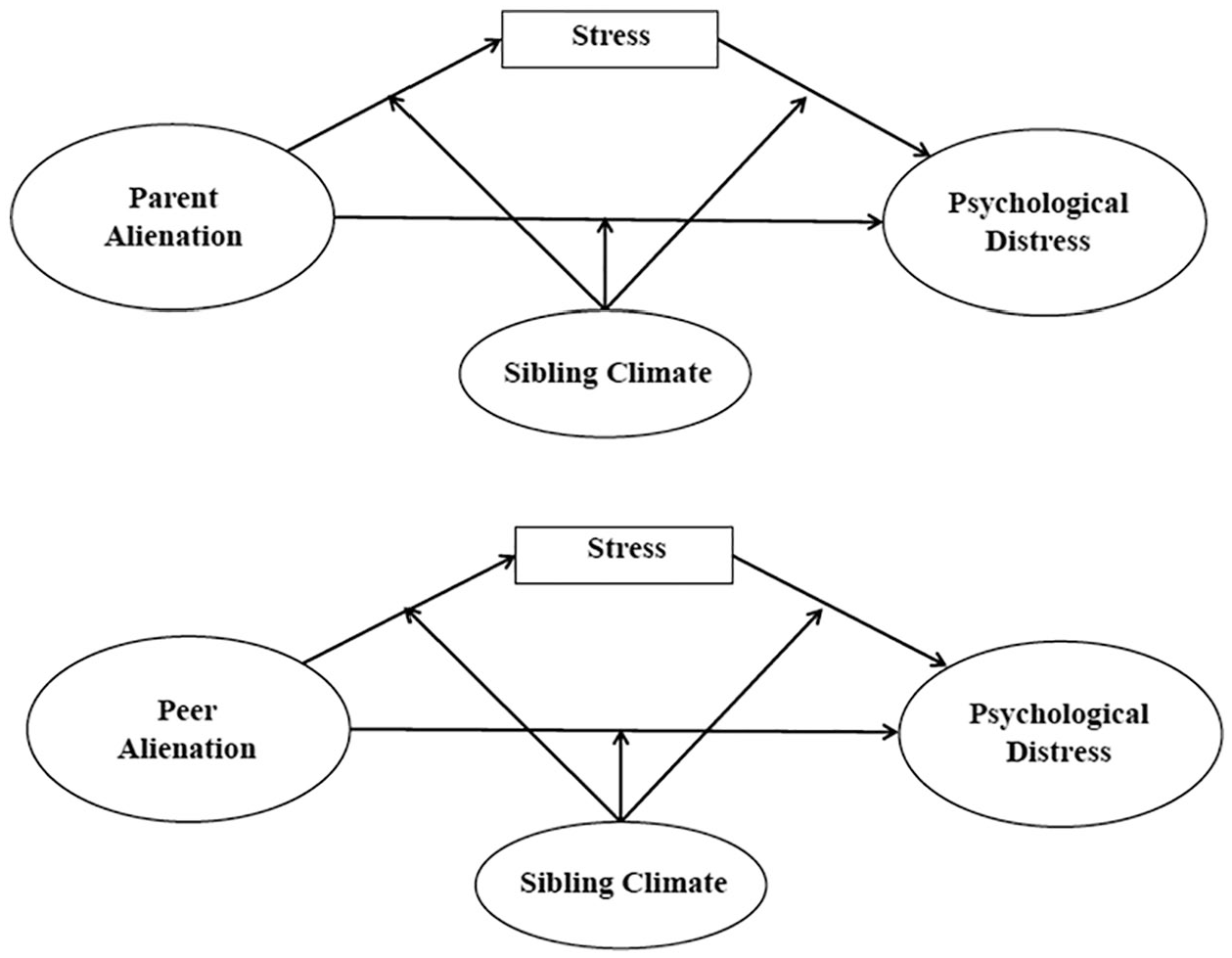
The hypothesized moderated-mediation model.
Methods
This cross-sectional study consists of three independent samples. Participants were recruited using a participant pool of undergraduate students at a Canadian university. Data collection was conducted through an online survey on PsychData.com. Ethical approval was granted by the Research Ethics Board at the authors’ university. Participants provided informed consent and were compensated with a point toward their final grade in an undergraduate course.
In terms of data preparation, three steps were taken to prepare the raw data for analysis across the three independent samples. These steps were to identify and exclude: (a) survey entries with duplicate and invalid participant identifiers; (b) entries that were missing over 40% of the online survey and the ST measure (mediator); and (c) entries that did not meet the inclusion criteria of having a sibling and being under the age of 25 years. Missing values (less than 5%) were replaced using Full Information Maximum Likelihood (FIML) with Mplus. Multivariate outliers were identified using Mahalanobis distances.
Participants
Sample 1
The raw data consisted of 470 entries, 61 entries were removed due to duplicates and invalid participant identifiers, and nine entries were missing almost half the survey and were excluded. Due to a technical issue, an additional 76 entries did not report their age and were excluded. After these preliminary steps, the first sample consisted of 324 undergraduate students. Based on the inclusion criteria, seven entries were excluded because they had no siblings and four because they were over the age of 25 years. The resulting sample was 313 students (87% females). Due to a technical issue, the exact age was recorded for 250 participants (Mean age = 18.9 years), while an age range of 18–25 years was recorded for the other 60 participants. Three multivariate outliers were identified and excluded (N = 310). In terms of ethnic diversity, this sample consisted of 65% Whites, 11% Blacks, 14% East and South Asians, and 13% with other ethnic identities. In terms of siblings, 46% had only one sibling, while 31% had two siblings, and 23% had three or more siblings.
Sample 2
The raw data consisted of 383 entries, 94 entries were removed due to duplicates and invalid participant identifiers, and 10 entries were removed due to missing almost half the online questionnaire. These initial steps resulted in a second sample of 279 undergraduate students. Based on the inclusion criteria, 8 participants were excluded because they had no siblings and 10 because they were older than 25 years. The resulting sample consisted of 261 undergraduate students (Mean age = 18.5 years; 94% females). Two multivariate outliers were identified and excluded (N = 259). In terms of ethnic diversity, this sample consists of 69% Whites, 6% Blacks, 18% East and South Asians, and 12% with other ethnic identities. In terms of siblings, 55% had only one sibling, 27% had two siblings, and 18% had three or more siblings.
Sample 3
The raw data consisted of 519 entries, 77 entries were removed due to duplicates and invalid participant identifiers, and 5 entries were missing almost half the survey. These initial steps resulted in a third sample consisting of 437 undergraduate students. Based on the inclusion criteria, 9 participants were excluded because they had no siblings and 11 because they were over the age of 25 years. The resulting sample consisted of 417 students (mean age= 19 years; 88% females). One multivariate outlier was identified and excluded (N = 416). In terms of ethnic diversity, this sample consists of 62% Whites, 10% Blacks, 19% East and South Asians, and 15% with other ethnic identities. In terms of siblings, 49% had only one sibling, 31% had two siblings, and 20% had three or more siblings.
Measures
Parental and peer alienation
Feelings of alienation with parents and peers were assessed by the alienation subscale of the Inventory of Parent and Peer Attachment (IPPA; Armsden & Greenberg, 1987). The IPPA assesses young peoples’ positive and negative affective and cognitive perceptions of parent and peer relationships with three subscales: trust, communication, and alienation. Participants rated the degree to which each statement was true of each relationship using a five-point scale (from 1 = never true to 5 = always true). Although participants completed the IPPA, given the objective of this study, we used only items from the alienation subscale. More specifically, we selected four respective items for both PA and PE. These items were selected because (a) they captured the presence feelings of detachment and anger as opposed to the absence of these feeling, and (b) they specifically mentioned parents or peers rather than general experiences of alienation. The selected four items were comparable in wording and content in both the parent and peer measures. The internal consistency for the parental alienation (PA) items was acceptable across samples 1 (α = 0.77), 2 (α = 0.78), and 3 (α = 0.77), as were the PE items across samples 1 (α = 0.68), 2 (α = 0.64), and 3 (α = 0.67).
Supportive sibling climate
Supportive sibling relationships were measured at a general level (i.e., across all siblings for each participant), using an adaptation of the Network Relationship Inventory—Short Form (NRI; Furman & Buhrmester, 2009). Only 5 items of this 13-item inventory were used to assess a range of supportive relationship characteristics. We selected these five items because they capture support and closeness in the sibling relationship rather than general relationship quality or negative characteristics of the SC. Participants rated on a four-point scale (from 0 = never to 3 = always) how often a series of characteristics reflect their relationships with their siblings in general. The internal consistency was satisfying across samples 1 (α = 0.81), 2 (α = 0.78), and 3 (α = 0.82).
Stress
The ST thermometer was used to assess perceived levels of ST (Kowalski & Crocker, 2001). Participants were asked to report how much ST they generally experienced with a scale from 0 (no stress) to 100 (most ST ever experienced). This measure has been used in studies with emerging adults (Gaudreau et al., 2010; Kaiseler et al., 2009).
Psychological distress
The Kessler Psychological Distress Scale (K10+; Kessler et al., 2003) provided a measure of depression and anxiety symptoms. This measure asks participants to rate how often they experienced a list of depressive and anxiety symptoms, using a five-point Likert-type scale. Participants completed the 10-item version of the scale. However, only the shorter six-item version was used to test the model for this study because the four other items were known to be potentially redundant. This shorter six-item version is well established with good reliability and validity as a measure of PD (Brooks et al., 2006; Kessler et al., 2003). The internal consistency for this measure was comparably good across samples 1 (α = 0.85), 2 (α = 0.85), and 3 (α = 0.87).
Plan of Analysis
We tested the hypothesized moderated-mediation model with Mplus Version 8 (Muthén & Muthén, 2017), using latent moderated-mediation structural equation modeling (LMMS; Klein & Moosbrugger, 2000), which is a strong technique for the estimation and interpretation of indirect and interaction effects (Marsh et al., 2013) and a robust maximum likelihood estimator (MLR) to ensure that the standard errors are robust. The main effect mediation and separate moderation models were tested and compared as nested models to assess which one better fitted the data. Standard fit indices were used to compare alternative null and main effect models that did not include a moderation. These include the chi-square (χ2) difference test, the root mean square error of approximation (RMSEA < 0.08), Comparative Fit Index (CFI > 0.90), and Standardized Root Mean Square Residual (SRMR < 0.08; Kline, 2010). Given that these fit indices are not available for the LMMS approach, alternative models that include moderation effects were compared using the scaled loglikelihood and a robust chi-square (χ2) difference test using the loglikelihood, and the scaling correction values for the nested, more restrictive, and comparison, less restrictive with the interaction term, models.
The moderated-mediation model posits that PA and PE (X) increase PD (Y) through an indirect effect via ST (M). The model also posits that supportive SC moderates (attenuates) the links between PA and PEs and ST, between ST and PD, as well as between PA and PE and PD. In other words, there can be a moderation of the path from X to M, referred to as a first-stage moderation and/or the path from M to Y, referred to as a second-stage, as well as a moderation of the path from X to Y, referred to as a direct effect moderation. A moderated mediation occurs when the conditional indirect effect significantly varies, depending on the levels of the moderator (Marsh et al., 2013).
Results
Preliminary Analyses
The measurement model tested the factorial structure of the 20 items of this study, using a confirmatory factor analysis (CFA) with robust MLR. Across the three samples, PA, PE, SC, and PD were latent variables and ST an observed variable. As we will detail below, CFA models provided acceptable fit and all indicator loadings were significant for the four latent variables and the factors loadings ranged from 0.50 to 0.80. In Sample 1, the measurement model had reasonable fit to the data, (MLR) χ2= 322.59, p < 0.001, CFI = 0.914, SRMR = 0.054, root mean square error of approximation (RMSEA) = 0.057, RMSEA 90% confidence interval (CI) = [0.048, .066]. In Sample 2, the measurement model had good fit to the data, (MLR) χ2= 270.93, p < 0.001, CFI = 0.925, SRMR = 0.053, RMSEA = 0.051, RMSEA 90% (CI) = [0.041, 0.062]. In Sample 3, the measurement model also had good fit to the data, (MLR) χ2 = 350.09, p < 0.001, CFI = 0.927, SRMR = 0.046, RMSEA = 0.053, RMSEA 90% (CI) = [0.046, 0.061].
Bivariate Correlations among the Latent Variables and Stress
Table 1 presents the correlations, means, and standard deviations of all study variables across the three samples. Both PA and PE were associated with more PD (mostly large effect sizes) and more ST across all samples (small to medium effect sizes). A supportive SC was negatively related to both PA and PE across all samples (small to medium effect sizes). Supportive SC was consistently unrelated to ST across all samples, while it was related to less PD in samples 1 and 3 (small effect sizes). As expected, ST and PD were linked across all samples (medium to large effect sizes).
Means, Standard Deviations, and Correlations between the Latent Variables, Parent Alienation (PA), Peer Alienation (PE), Sibling Climate (SC), Stress (ST), and Psychological Distress (PD) in the CFA Model for Each Sample.
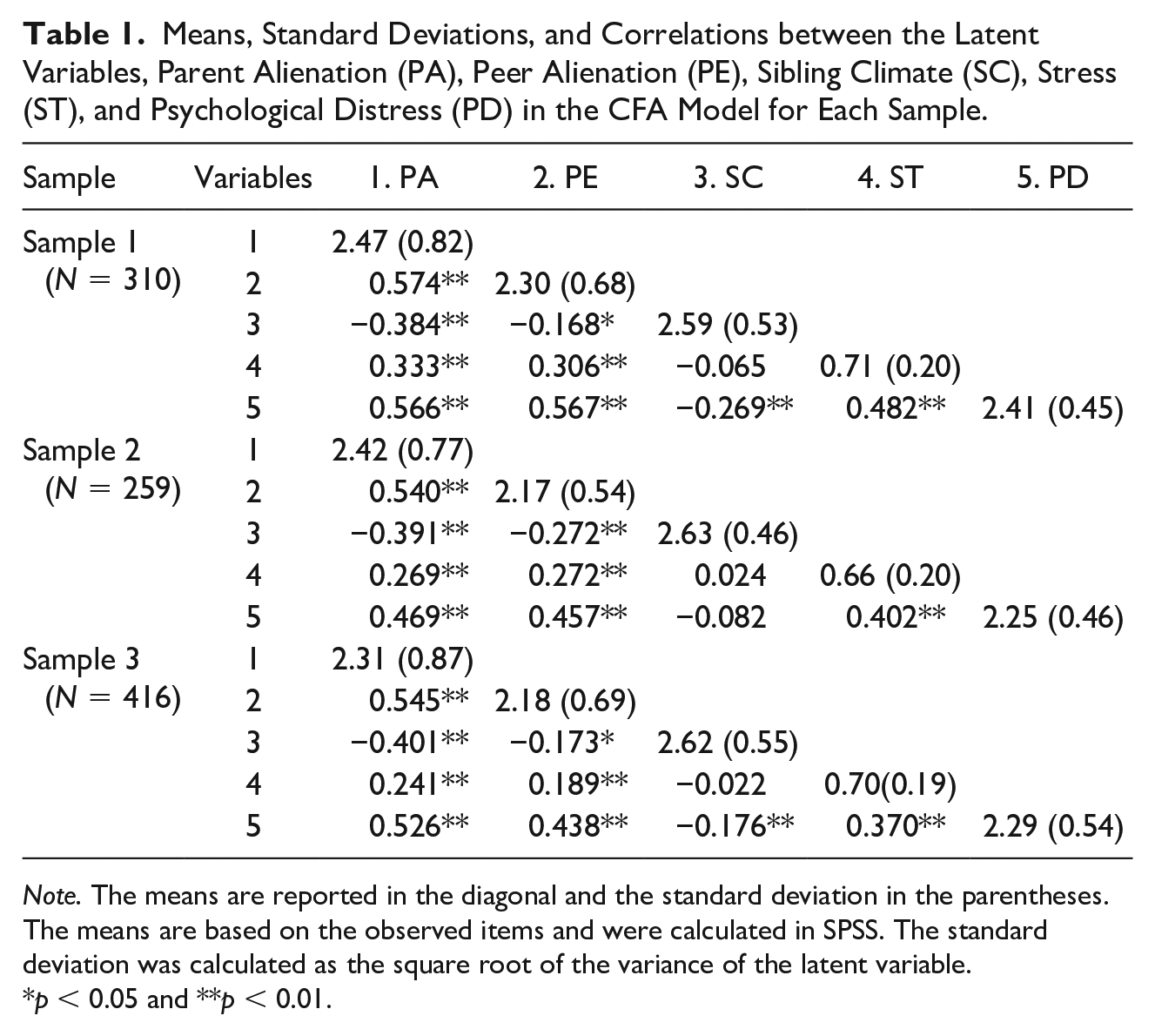
Note. The means are reported in the diagonal and the standard deviation in the parentheses. The means are based on the observed items and were calculated in SPSS. The standard deviation was calculated as the square root of the variance of the latent variable.
p < 0.05 and **p < 0.01.
Testing the Latent Mediation Models
Table 2 presents the fit indices and the parameter estimates for the mediation models. In Sample 1, the mediation model had acceptable fit. In this model, ST mediated the association between PA and PD (indirect effect = 0.043, p = 0.008), suggesting a partial mediation, as both the indirect effect and the direct effect (0.135, p = 0.027) were significant. However, ST did not mediate the path between PE and PD (indirect effect = 0.033, p = 0.076), while there was a direct effect of PE on PD (direct effect = 0.212, p = 0.001).
Fit Indices for Null, Main, and Interaction Models Across the Three Samples.
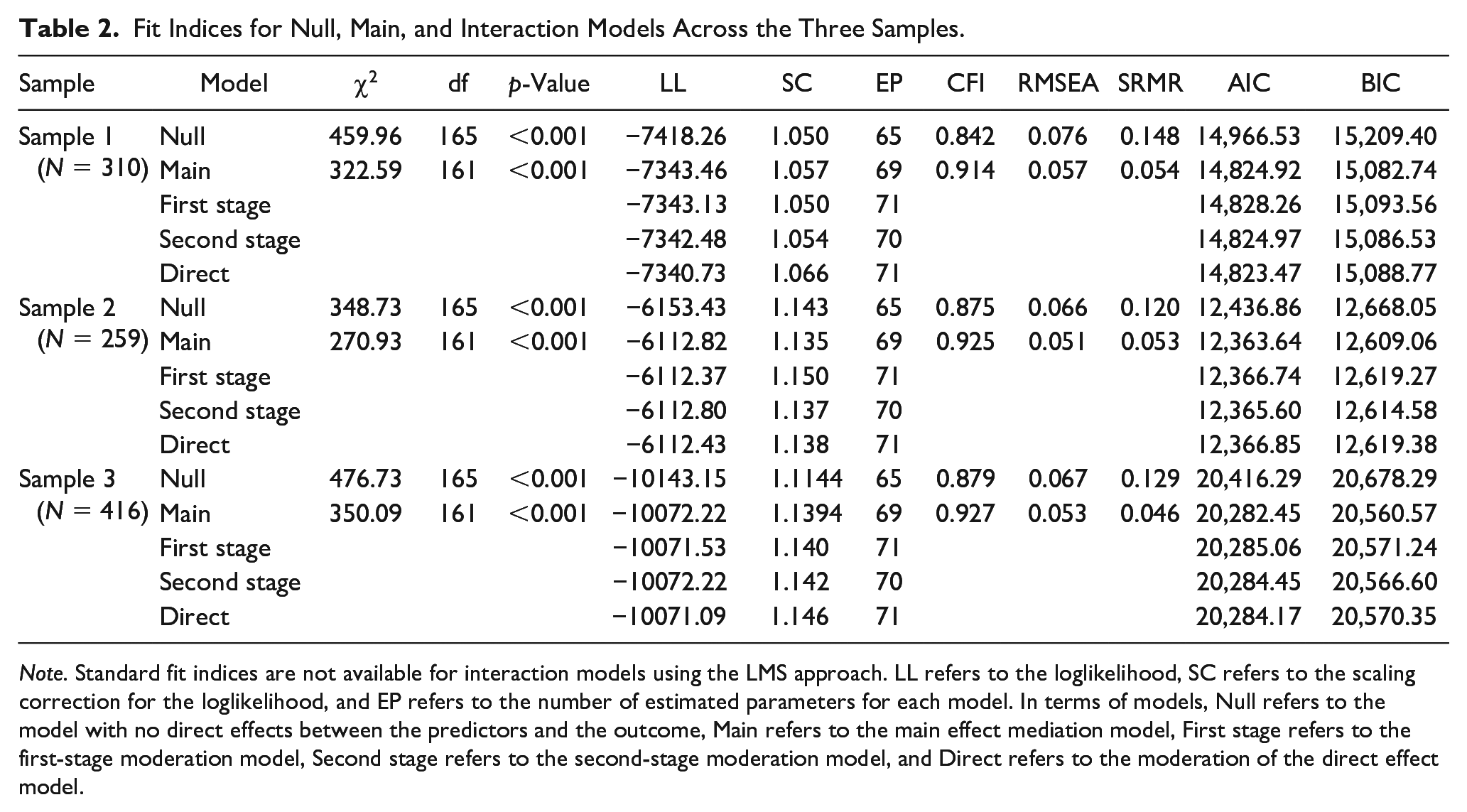
Note. Standard fit indices are not available for interaction models using the LMS approach. LL refers to the loglikelihood, SC refers to the scaling correction for the loglikelihood, and EP refers to the number of estimated parameters for each model. In terms of models, Null refers to the model with no direct effects between the predictors and the outcome, Main refers to the main effect mediation model, First stage refers to the first-stage moderation model, Second stage refers to the second-stage moderation model, and Direct refers to the moderation of the direct effect model.
In Sample 2, the mediation model also had acceptable fit. In this model, ST did not mediate the association between PA and PD (indirect effect = 0.034, p = 0.070) nor between PE and PD (indirect effect = 0.041, p = 0.142). Nonetheless, the direct effects for PA (0.182, p = 0.004) and for PE (0.216, p = 0.041) on PD were significant.
In Sample 3, the mediation model also had acceptable fit. In this model, ST partially mediated the association between PA and PD as both the indirect effect (0.036, p = 0.013) and the direct effect (0.228, p < 0.001) were significant. However, ST did not mediate the path between PE and PD (indirect effect = 0.015, p = 0.316), as there was only a direct effect (0.154, p = 0.032).
Testing the Latent Moderated-Mediation Models
To evaluate the presence of a moderation and the fit of the interactive latent models, several nested models were tested and compared. The first model is a null model where the effect between the predictors (PE, PA, SC, and ST) and the outcome (PD) are constraint to 0, such that there was no predictive relationship modelled. The second model is the main effect mediation model where the effect of the predictors (PE, PA, SC, and ST) on the outcome (PD) are estimated but not the interaction term. The last three models incorporate the interaction terms, the first-stage (PA × SC and PE × SC), second-stage (ST × SC), and direct effect (PA × SC and PE × SC) moderation, to test whether the addition of these parameters will improve the model fit. The chi-square difference test will be used to evaluate the change in the scaled loglikelihood between the nested model with fewer degrees of freedom and the comparison model (Satorra & Bentler, 2010). A significant change in chi-square implies there is an interaction, and additional parameter (the interaction terms) improves the fit. In this case, further simple slope calculations are necessary to identify the specific conditional effects at varying levels of the moderator. Table 3 presents standardized coefficients for the mediation model and the unstandardized coefficients for interaction effects.
The Standardized Coefficients for the Main Effect Model of the Predictors Parent Alienation (PA), Peer Alienation (PE), and Sibling Climate (SC) on the Stress (ST) and Psychological Distress (PD) as well as the Unstandardized Coefficients for the First-Stage and Direct Interaction Effects (PA × SC and PE × SC) on Stress and Psychological Distress as well as the Second-Stage Interaction Effect (ST × SC) on Psychological Distress (PD). These Coefficients are Provided for Each Sample.
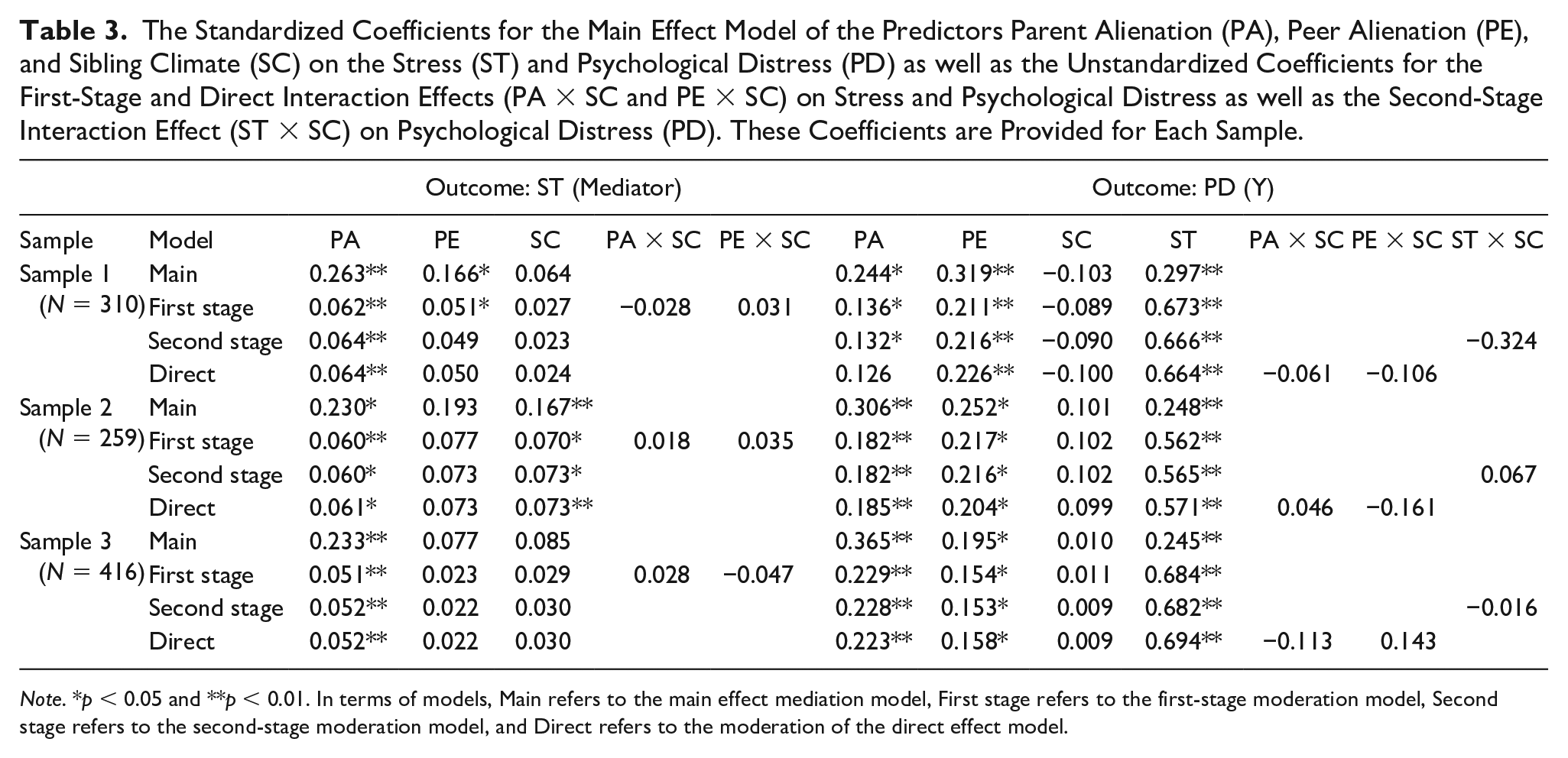
Note. *p < 0.05 and **p < 0.01. In terms of models, Main refers to the main effect mediation model, First stage refers to the first-stage moderation model, Second stage refers to the second-stage moderation model, and Direct refers to the moderation of the direct effect model.
In Sample 1, the null model (PA PE SC ST ON PD @0) with 65 estimated parameters had a loglikelihood of −7,418.26 and a scaling correction of 1.050. The residual variance for PD was 0.193. The main effect mediation model (69 estimated parameters) illustrated a loglikelihood of −7343.46 (scaling correction 1.057). For this model, the residual variance for PD is 0.104, suggesting that the addition of the main effects of PA, PE, and ST explains 49% of the variance in PD. The addition of the main effects resulted in a significant change (χ2 = 127.78, df = 4, p < 0.001). Therefore, the mediation model with four additional parameters better fits the data than the null model. The first stage moderation model (71 estimated parameters) had a log likelihood of −7,343.13 (scaling correction 1.050), the second-stage model (70 estimated parameters) had a log likelihood of −7,342.48 (scaling correction 1.054), and the direct moderation model (71 estimated parameters) had a log likelihood of −7,340.73 (scaling correction 1.066). Using the robust chi-square difference test, the addition of the interaction term in the first stage (χ2 = 0.816, df = 2), second stage (χ2 = 2.31, df = 1), and direct effect (χ2 = 3.966, df = 2) models resulted in a nonsignificant change.
In Sample 2, the null model (65 estimated parameters) had a log likelihood of −6,153.43 (scaling correction 1.1429). The residual variance for PD was 0.205. The main effect mediation model (69 estimated parameters) illustrated a log likelihood of −6,112.82 (scaling correction 1.135). The residual variance for PD is 0.138 in the mediation model, suggesting that the addition of the main effects of PA, PE, and ST explains 35% of the variance in PD. In comparison to the null model, the addition of the main effects resulted in a significant change in χ2 = 80.543, df = 4, and p < 0.001, confirming that the mediation model better fits the data. The first-stage moderation model (71 estimated parameters) had a log likelihood of −6,112.37 (scaling correction 1.050), the second-stage model (70 estimated parameters) had a log likelihood of −6,112.80 (scaling correction 1.137), and the direct moderation model (71 estimated parameters) had a log likelihood of −6,112.43 (scaling correction 1.138). In comparison to the main effect mediation model, using the robust chi-square difference test, the addition of the interaction term in the first stage (χ2 = 0.54, df = 2), second stage (χ2 = 0.03, df = 1), and direct effect (χ2 = 0.63, df = 2) models resulted in a nonsignificant change.
In Sample 3, the null model (65 estimated parameters) had a log likelihood of −10,143.15 (scaling correction 1.1144). The residual variance for PD was 0.291. The main effect mediation model (69 estimated parameters) illustrated a log likelihood of −10,072.22 (scaling correction 1.1394). The residual variance for PD is 0.188, suggesting that the addition of PA, PE, and ST explains 34% of the variance in PD. The addition of these main effects resulted in a significant change (χ2 = 91.771, df = 4, p <0.001). The first-stage moderation model (71 estimated parameters) had a log likelihood of −10,071.53 (scaling correction 1.040), the second-stage model (70 estimated parameters) had a log likelihood of −10,072.22 (scaling correction 1.142), and the direct moderation model (71 estimated parameters) had a log likelihood of −10,071.09 (scaling correction 1.146). The addition of the interaction term in the first stage (χ2 = 1.19, df = 2), second stage (χ2 = 0.00, df = 1), and direct effect (χ2 = 1.65, df = 2) models resulted in a nonsignificant change in comparison to the mediation model.
In sum, there are two key results across the three sample. First, the change in chi-square between the null model and the mediation model consistently illustrates the mediation model, with less degrees of freedom, is a better fit to the data. Second, the change in chi-square between the mediation models and moderated-mediation models were not significant. This consistently implies that SC yielded no moderation effects on the mediation model. Hence, the mediation model was a better fit to the data and was the most parsimonious model.
Discussion
Research suggests sibling interactions have developmental, clinical, and cultural implications on development and mental health (McHale et al., 2013). The main objective of this study was to test a hypothesized moderated-mediation model in which a supportive SC is a protective factor against the risk that ST from feelings of alienation with parents and peers poses to PD in emerging adults. Furthermore, our analyses also allowed to examine two alternative models: a compensatory and promotive factor model.
A Supportive Sibling Climate May Not Be Sufficiently Protective
First, in terms of potential risk factors, we found that PA and PE were both associated with more PD across all samples. This was expected and in accordance with previous empirical findings, indicating that feelings of alienation in relationships with parents and peers may represent risk factors that are linked to an increase in PD (Raudino et al., 2013). This is also in line with interpersonal theories according to which relational issues can contribute to depression (Eberhart & Hammen, 2006; Hames et al., 2013). That being said, conversely, it is also possible that for some individuals, preexisting levels of PD may have also contributed to feelings of alienation in their relationships. Indeed, studies suggest that depression and anxiety symptoms can gradually disrupt and erode the quality of relationships despite close ones trying to be supportive, at least initially (Hames et al., 2013; Pettit et al., 2011).
Second, although cross-sectional, findings in two samples bring preliminary evidence that ST can partially mediate the link between feelings of alienation with parents and PD. This was expected and supports the theorized mediating role of ST in the link between impaired interpersonal relationships and PD (Eberhart & Hammen, 2006). This finding is interesting as it teases out that ST may be a mechanism that explains how feelings of alienation vis-à-vis parents may lead to depression and anxiety symptoms. This finding is compatible with work, indicating that interpersonal problems are stressful (Darling et al., 2007), as well as with studies showing that perceived ST can lead to more depression and anxiety symptoms in general (Hammen, 2005; Liu & Alloy, 2010; Riggs & Han, 2006; Schulenberg et al., 2004).
Third, contrary to our expectation, results across all samples have also shown that ST did not mediate the link between PE and PD. This is intriguing because peers are still very important in emerging adulthood (Arnett, 2007; Chow et al., 2012). In fact, it is during emerging adulthood that social networks become the largest during human development (Wrzus et al., 2013). As such, feelings of alienation with peers were related to ST at a bivariate level; however, in the mediation model of two of our samples, feelings of alienation with peers were not related to ST once feelings of alienation with parents was accounted for. Two possible explanations can be proposed for future research. First, PE may not be as consequential as PA because emerging adults have more independence from and flexibility with their friendships. For instance, young adults can make new friends, but they cannot (or rarely) find new parents. After all, the significance of attachment between people and their parents can last a lifetime (Mikulincer & Shaver, 2007), which is why difficulties in this relationship might be cumulative, lingering, and thereby particularly problematic. Second, the association between PE and PD might be better explained by other mediators. For example, it is possible that PE could lower self-esteem, which, in turn, would increase PD. Indeed, PE has been found to be associated with lower self-esteem (Laible et al., 2004), while lower self-esteem is known to be related to more depression and anxiety (Sowislo & Orth, 2013).
Lastly, contrary to our hypothesized protective model, results across the three samples indicated that supportive SC did not moderate the links among PA and PE, ST, and PD. Hence, support from siblings did not buffer the two hypothesized pathways based on the ST-buffering hypothesis, namely (a) the negative effect of stressful experiences (PA and PE) on ST or (b) the negative effect of stress on PD. Prior studies with emerging adults have shown that social support from family can have a ST-buffering effect against depression (Lee & Dik, 2017; Raffaelli et al., 2013); however, this is not the case for supportive siblings in our three samples. There could be two reasons for this. First, rather than an overall climate of support from siblings, it might be that receiving support from one sibling in particular might be protective against PA, PE, or ST. Second, perhaps this study did not find a protective effect of supportive SC because—unlike previous studies—it used LMMS, which is a much more sophisticated and rigorous statistical technique (Marsh et al., 2013). In sum, if siblings do provide support during emerging adulthood, then our study suggests that it is not sufficiently protective against the risks that PA and PE pose to PD.
Can a Supportive Sibling Climate Still Compensate for Risks to Mental Health?
A supportive SC is probably not a compensatory factor vis-à-vis the risks of feelings of alienation, as our findings across all samples indicated that once PA and PE were considered, a SC climate did not predict less PD. That said, the compensatory effect of sibling support has generated mixed findings across previous studies. Some studies suggest that siblings probably have some beneficial and compensatory effects for mental health (less depression) in the context of low support from parents and peers (Milevsky, 2005). On the other hand, a study of young adults failed to find a compensatory effect of harmonious (high warmth, low conflict) sibling relationships when considering low-involved friendships (low warmth, low conflict; Sherman et al., 2006).
Nevertheless, looking back at those prior mixed findings, the feelings of alienation examined in our study may be more deleterious than the perceived lack of social support in prior studies. As such, in our study, siblings might have been ineffective to compensate for feelings of alienation from parents and peers because it is too severe of a risk, whereas, as suggested in prior studies, siblings may sometimes be efficacious to compensate for the risk incumbent to lack of support or warmth from parents and peers. meaning] In sum, future studies on the role of siblings for mental health should routinely control for other family and interpersonal relationships—notably with parents and friends—to avoid overestimating the potential role of siblings in emerging adulthood.
Can a Supportive Sibling Climate Still Promote Mental Health?
A supportive SC is probably beneficial in itself and is perhaps even a promotive factor for mental health. Our findings indicated that—at least as per the simple bivariate interrelations in two out of three samples—experiencing a supportive SC is related to less PD in emerging adulthood. Of course, given the cross-sectional nature of our data, it is not possible to exclude that perhaps it is mental health (less PD) that predicts more sibling support. Nevertheless, our promotive interpretation is consistent with prior longitudinal evidence, suggesting that yearly increases in sibling support are related to decreases in depressive symptoms in emerging adulthood (Guan & Fuligni, 2016).
However, our findings also revealed complexities in understanding support from siblings as a promotive factor in emerging adulthood. Although SC was not related to ST at a bivariate level, notably, in the mediation model of one of our samples, participants who reported experiencing a more supportive SC also reported being more stressed. Rather than indicating that supportive siblings can also be stressful, this finding may suggest that these young people who were more stressed actually solicited and, in turn, perceived more support from their siblings. Of course, longitudinal data would be necessary to examine the directionality of this link conclusively. In all cases, it is important to reiterate that although bivariate relationships suggest that supportive SC might be a promotive factor, this possible promotive effect disappears when risk factors (PA and PE) are considered.
Limitations
There are methodological limitations that must be considered when appraising the implications of our findings. First, the cross-sectional design did not allow to test a longitudinal sequence for the moderated-mediation model. Second, our conceptualization of risk in parental and peer relationships was specific to feelings of alienation, which, of course, does not capture other possible sources of difficulties (e.g., conflicts) that can be experienced in these relationships. Third, the data were entirely based on self-report measures that provide only the subjective perspective of one actor in the family system and peer social network. Fourth, as previously mentioned, our measure of supportive SC might have been too broad to capture some potential protective effects from a given supportive sibling relationship. Fifth, the measure of ST was also general and could have been more specific to ST experienced from parental and peer relationships.
Conclusion
In sum, our main results indicate that although experiencing a supportive SC is probably beneficial, it does not seem to be sufficient to act as a potential protective factor against ST from PA and PE in emerging adulthood. In particular, this study underscores that emerging adults who feel PA also experience more PD and that the co-occurrence between both issues could be partially explained by an increase in ST. As it turns out, this study also highlights that parental relationships probably maintain an enduring impact during emerging adulthood. This observation is in line with the notion that although young adults are increasingly autonomous, the quality of relationships with their parents still matters (Guan & Fuligni, 2016; Mattanah et al., 2011).
Footnotes
Author’s Note
This study is part of the doctoral thesis of the first author at the School of Psychology of the University of Ottawa.
Declaration of Conflicting Interests
The author(s) declared no potential conflicts of interest with respect to the research, authorship, and/or publication of this article.
Funding
The author(s) received no financial support for the research, authorship, and/or publication of this article.
