




Abstract
Globally, the average number of children per household is expected to drop to 1.0 by 2020. Single-child families are increasingly the norm, with nearly half of British families classified as single-child. Despite this, research on only-children and their families is scant. Using a convergent mixed-methods design, this study explores parenting of adolescents in British single-child families. Single-child (31 adolescents, 47 mothers, 25 fathers) and multiple-children families (46 adolescents, 76 mothers, 31 fathers) completed online surveys. In-depth interviews were also conducted with 15 only-child families and 15 multiple-child families. All adolescents were aged 11 years to 14 years. Surveys did not find any differences in parenting between one-child and multiple-children families. However, interview data found single-child families were more child-centered, reporting higher overprotective and pushy parenting, but less authoritative and authoritarian parenting. Findings challenge negative stereotyping of single-child families and provide an in-depth insight into the experiences of adolescent only-children and their parents.
Across the world, the average number of children is expected to drop to 1.0 per household in 2020 compared to 1.9 per household in 1980 (Euromonitor International, 2014). A British survey found 3,590,000 single-child families out of 7,926,000 families with dependent children (i.e. 45.3% are only children; Office for National Statistics [ONS], 2015). This phenomenon of shrinking families is seen as becoming the norm (Saner, 2018). Despite this rise in single-child families, little empirical attention has been paid to how singletons are parented in comparison to children with siblings. The family systems theory views the family as an organized system that functions as a “whole” to better understand family interaction while also considering the “parts” that are inter-connected and influence the system (Bavelas & Segal, 1982). This implies that sibling relationships (or their absence) can influence the parent-child relationship and vice-versa. Early research on only-children concentrated on studying how the absence of siblings could impact on their development (Falbo & Polit, 1986). Other studies investigated qualities that differentiate only children from other children or explored the underlying socialization practices but not parenting styles and practices.
Parenting in Single-child Families
Historically, parents of only-children have been portrayed as giving too much attention and spoiling the child, creating a common perception that one-child families engage in inadequate parenting (Thompson, 1974). However, viewing the one-child household as far from ideal may be a product of negative stereotyping rather than empirical evidence (Mancillas, 2006). Parenting styles refer to behaviors, attitudes, and values that influence parent-child interactions (Mussen, 1983), including authoritarian, authoritative, permissive, and neglectful parenting (Baumrind, 1966; Lamborn et al., 1991). In addition, parenting practices include behaviors such as parental involvement; parental monitoring; and parental goals, values, and aspirations (Spera, 2005). Both parenting styles and practices can influence developmental outcomes, particularly in adolescence (Sheldon, 2015), and may differ between single and multiple child families.
One particularly relevant parenting dimension is overprotection; labelled as “helicopter parenting”, “bulldozer parenting,” and “chauffeur parenting” (Hancock et al., 2014, p. 1). Overprotection is associated with excessive intrusion and meddling in the child’s activities and relationships (McFarlane et al., 1995) and is conceptualized as a form of psychological control putting emotional pressure on the child (Soenens & Vansteenkiste, 2010). The main objective of overprotective parents is to keep their child as safe and secure as possible (Brussoni & Olsen, 2013). So, are parents of an only child more prone to overprotect? Child-centeredness may also be prevalent in only-child families. Parents who adopt a child-centered approach are very sensitive to the developmental needs of their child and show respect towards their child, giving them plenty of opportunities to exercise freedom of choice (Cannella & Viruru, 2004). Over the last 50 years, there has been a shift from traditional parenting values to the inclusion of child-centeredness (Ivan et al., 2015). However, the attributes of child-centered parenting have not yet been operationalized (Hoffman, 2013) and there is no currently validated assessment.
There are only a few studies on parenting in one-child families from Europe and North America. Kloepper et al. (1981) found that some only-children (aged 16–18 years) were granted more autonomy than non-only children. Another study found that parents of only children aged less than 5 years were significantly more overprotective (Richards & Goodman, 1996). A study of American mothers challenged the stereotypical belief that parents of only-children hold higher expectations than parents with more than one child, finding no significant differences between mothers of one child, two children, and multiple children (Bush-Glenn, 1990). Nonetheless, findings are inconclusive, and Sorensen (2006, p. 39) referred to “parental enmeshment” in single-child families where only-children can be burdened since their achievements symbolize parental achievement.
In China, parenting research has focused on single-child families, due to the previously enforced one-child policy. These findings cannot be completely generalized but are informative in light of the lack of research elsewhere. Ngan-ling Chow and Zhao (1996) found that parents of young only-children scored higher on child-centeredness, spent more time with their child, and were more concerned about their child than parents with multiple children, Mothers, but not fathers, of an only-child had more expectations for their child. Although it is commonly postulated that only-children will have more influence on family decision-making, this was not seen in Chinese single child families (Flurry & Veeck, 2009). In relation to parenting style, Chinese parents of only-children mostly adopt an authoritative style, with parenting practices that are child-centered, egalitarian, and give children freedom of choice (Lu & Chang, 2013). One of the few non-Chinese studies on parenting found that U.S. singletons were no different to first-borns on measures of behavioral control, parental involvement, and parental investment (Clarfield, 1999), challenging the assumption that singletons usually have stronger relationships with their parents (Dittrich, 2005).
The Current Study
The aim of this study was to address the following question: How do the parenting styles and practices used in single-child families with adolescent children compare to those in multiple children families? The perspective of both parents on their parenting as well as the adolescent’s own perspective were explored. Whilst some past studies have explored the perspective of adults as only children (Fletcher, 2014; Garcia, 2010), self-reports from adolescent only-children are rare. Adolescents are often considered the best informants regarding family climate and parenting practices (Noller & Callan, 1990), and research on only children needs to tap into their subjective experiences (Mancillas, 2006). A mixed-methods approach was taken as it has the sensitivity to develop a more comprehensive understanding of complex topics that are reliant on the interaction of different perspectives (Gelo et al., 2008). An embedded design with a two-phase approach incorporated a qualitative section (semi-structured interviews) that could support the quantitative (online survey) findings (Creswell & Clark, 2017). All target adolescent children were 11–14 years old.
Methods
Participants
Several recruitment methods were used including online ads, distribution of flyers, and Qualtrics. As the study involved the participation of whole families (mothers, fathers and adolescents), all were recruited using convenience and snowballing sampling strategies.
Online surveys
For one-child families, 31 adolescents, 47 mothers, and 25 fathers completed the online surveys. For multiple-child families, 46 adolescents, 76 mothers, and 31 fathers participated. The adolescent, mother and father were not necessarily from the same family. Demographic details of adolescent survey participants by family type are provided in Table 1.
Demographic Characteristics of Adolescents by Family Type.
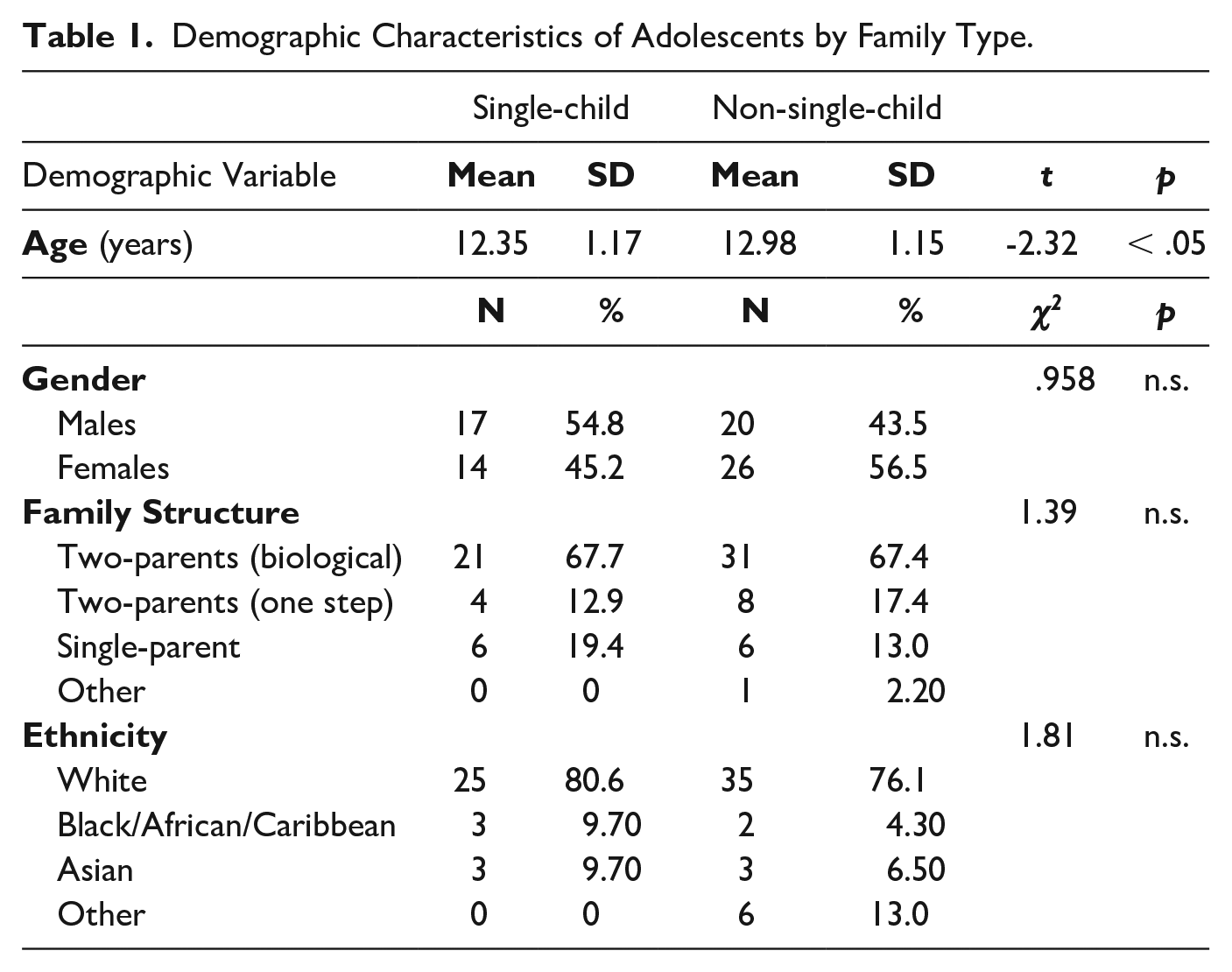
There were no differences between the two family types for child gender, family structure, and ethnicity, but child age did differ and so was included in later analyses. Regarding participating parents’ self-reports, no differences were found between one-child and multiple-children families for any demographic variables. Power analysis was conducted using GPower 3. With an alpha of .05 and power of 0.80, the anticipated sample size was approximately 26 participants (t-tests) and a total sample size of 52 participants (one-way ANOVAs). Our proposed sample size of at least 25 participants (t-tests) in one group and 56 participants (one-way ANOVAs) across groups (e.g. fathers in both groups) was adequate.
Family interviews
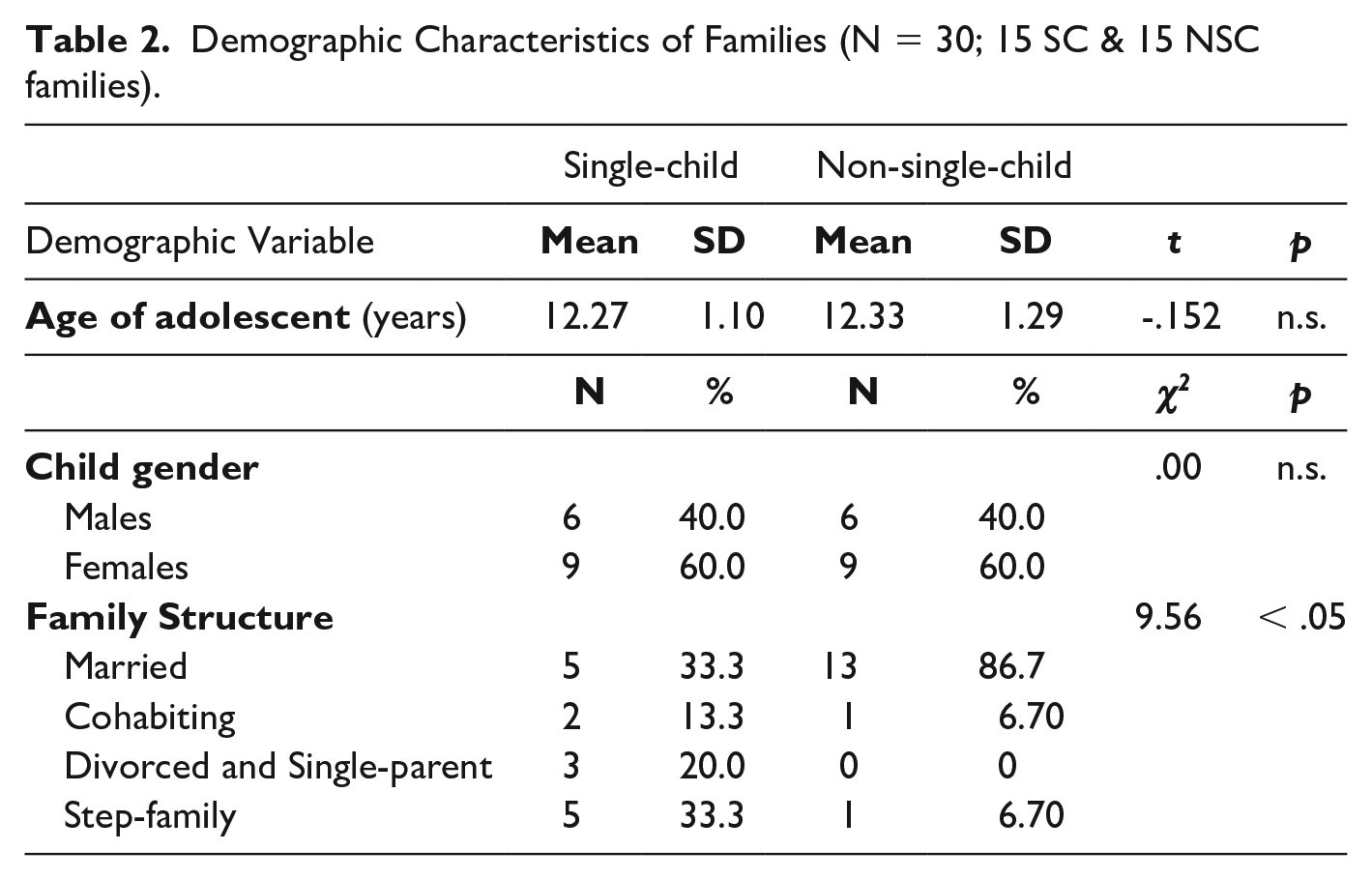
Seventy-six participants, from 15 single-child (15 adolescents, 13 mothers, 8 fathers) and 15 multiple-children families (15 adolescents, 13 mothers, 12 fathers) were interviewed. Families came from across the United Kingdom but mostly London, the West Midlands, Newcastle, and Cambridge (see Table 2 for demographic details). No differences were found between groups for child age or gender. However, more of the single child families were divorced or step families, so family structure was carefully considered when interpreting qualitative findings.
Demographic Characteristics of Families (N = 30; 15 SC & 15 NSC families).
Materials
Online survey questionnaires
Parental measures
Mothers and fathers completed the Parenting Styles and Dimensions Questionnaire–Short Version (PSDQ; Robinson et al., 2001), an instrument identifying three parenting styles: authoritarian, authoritative, and permissive. Cronbach’s alphas for the three subscales are (Robinson et al., 2001): .86 (authoritative), .82 (authoritarian), and .64 (permissive). Parents also completed the Parents of Adolescents Separation Anxiety Scale (PASAS; Hock et al., 2001) assessing their feelings pertaining to separation from their adolescent children. It has two subscales: Anxiety about Adolescent Distancing (AAD; α = .88) and Comfort with Secure Base Role (CSBR; α =.81).
Adolescent measures
Adolescents completed the Parental Authority Questionnaire (PAQ; Buri, 1991), measuring adolescent views on parents’ specific parenting style. This gives subscales of authoritarian (α =.85 for mothers and .87 for fathers), authoritative (α =.82 for mothers and .85 for fathers), and permissive (α =.75 for mothers and .74 for fathers). The Child–Parent Relationship Test (ChiP-C; Titze & Lehmkuhl, 2010; Titze et al., 2010) was used to investigate the adolescent’s relationship to each parent (separately for mother and father), resulting in six subscales: α =.79 for the resource scales (cohesion, identification, and autonomy) and α =.82 for the risk scales (conflict, rejection/indifference, and overprotection).
Semi-structured interviews
Adolescents were interviewed separately from their parents to get closer to their self-constructed reality. Joint parent interviews were conducted, allowing both the mother and the father to “chip in” enhances the quality of the data. Conducting dual parent interviews also allows couples to engage in mediation and negotiation to create one collaborative account that better taps into the dynamics of family relations (Valentine, 1999). For both adolescent and parent interviews, 15 open-ended questions were developed. Questions to adolescents probed into their experience of being parented (e.g. “if your mum/dad knows that you like something and want to have it what does she/he do or say about it?”). For parental interviews, questions aimed to tap into parenting styles, parenting practices, child-centered parenting, and overprotection in line with the existing literature on only-children and their parental relationships.
Procedure
Ethical approval was granted by the Department of Psychology Research Ethics Committee at the University of Warwick. Surveys were set up online using Qualtrics software platform. Parents were provided with an informed consent form to confirm their own participation and give permission for their adolescent to take part. Adolescents were presented with an assent form. Each survey took approximately 20–40 minutes. Parents were given the option to leave their email if they wished to take part in the family interview. Most interviews were conducted in the homes of the participants, although a few families were interviewed at the university. After giving informed consent/assent, the adolescent was interviewed first (average duration 30–40 minutes) followed by the joint interview of the parents (average duration 40–45 minutes). All interviews were audio-recorded with the permission of the participants.
Data Analysis
Parallel analysis, also known as “merged” analysis (Curry & Nunez-Smith, 2015) was implemented. The quantitative and qualitative datasets were analyzed independently, findings from each dataset compared with each other, and conclusions, or “meta-inferences” made that incorporated comparison of findings from both data sets.
Survey data
All statistical analyses used SPSS (version 22.0). Exploratory factor analysis using the Maximum Likelihood method and Varimax rotation was conducted on the parenting variables across the three participant groups to reduce them to a smaller set of latent variables. The total sample sizes were relatively small (123 mothers, 56 fathers, and 77 adolescents). However, EFA has no adequate sample size for its use (Costello & Osborne, 2005). Maximum likelihood was chosen as the factor extraction method and Varimax with Kaiser normalization as the rotation method as factor loadings clustered better around more distinct factors than other methods. The Kaiser-Meyer-Olkin (KMO) measure of sampling adequacy, Bartlett’s test of sphericity, eigen-values, and scree plots were considered. T-tests and one-way ANOVAs compared parenting (positive and negative) on categorical demographic variables (including family type). Simple linear regression was conducted to identify the best predictors of positive and negative parenting.
Interview data
Interview recordings were transcribed orthographically, then coded and analyzed on NVivo software (version 11.0) using Interpretative Thematic Analysis, transforming participants’ responses into themes that are closely identified, described, analyzed, and reported within the data (Braun & Clarke, 2006). This allows the representation of the participant’s own perspective through his or her account of experiences, beliefs, and perceptions (Park et al., 2004), with the researcher mainly motivated to “tell an interpretative story about the data” (Clarke & Braun, 2014, p. 1). The six-phase approach to thematic analysis (Braun & Clarke, 2006) was followed: (a) familiarization with the data; (b) generating initial codes; (c) searching for themes; (d) reviewing potential themes; (e) defining and naming themes; and (f) producing the report. Semantic rather than latent themes were identified, and an inductive analysis was conducted with no influence of any pre-existing coding frame or the researcher’s own pre-conceived ideas (Braun & Clarke, 2006).
Results
Survey Data Analysis
Factor analysis
Parental reports
EFA was run on seven parenting variables for both mothers’ and fathers’ self-reports. This yielded two factors (eigenvalues > 1; combined explained variance = 52.47 % of the variance for mothers and 46.19 % of the variance for fathers). High factor scores indicate a higher level of negative parenting (factor 1: PASAS-Anxiety, PSDQ-Authoritarian and PSDQ-Permissive) and positive parenting (factor 2: PASAS–Comfort and PSDQ-Authoritative). Guided by Kahn (2006), these two factors were retained in accordance with the established theory of positive and negative parenting as distinct and two ends of a continuum (Table 3). The suitability of factor analysis was confirmed by the KMO value of 0.64 and 0.60 for mothers and fathers, respectively, and Bartlett’s test of sphericity (χ2 [21] = 213.15, p < .001 for mothers; χ2 [21] = 123.72, p < .001 for fathers).
Factor Loadings Based on Maximum Likelihood Analysis for Five Parenting Subscales.
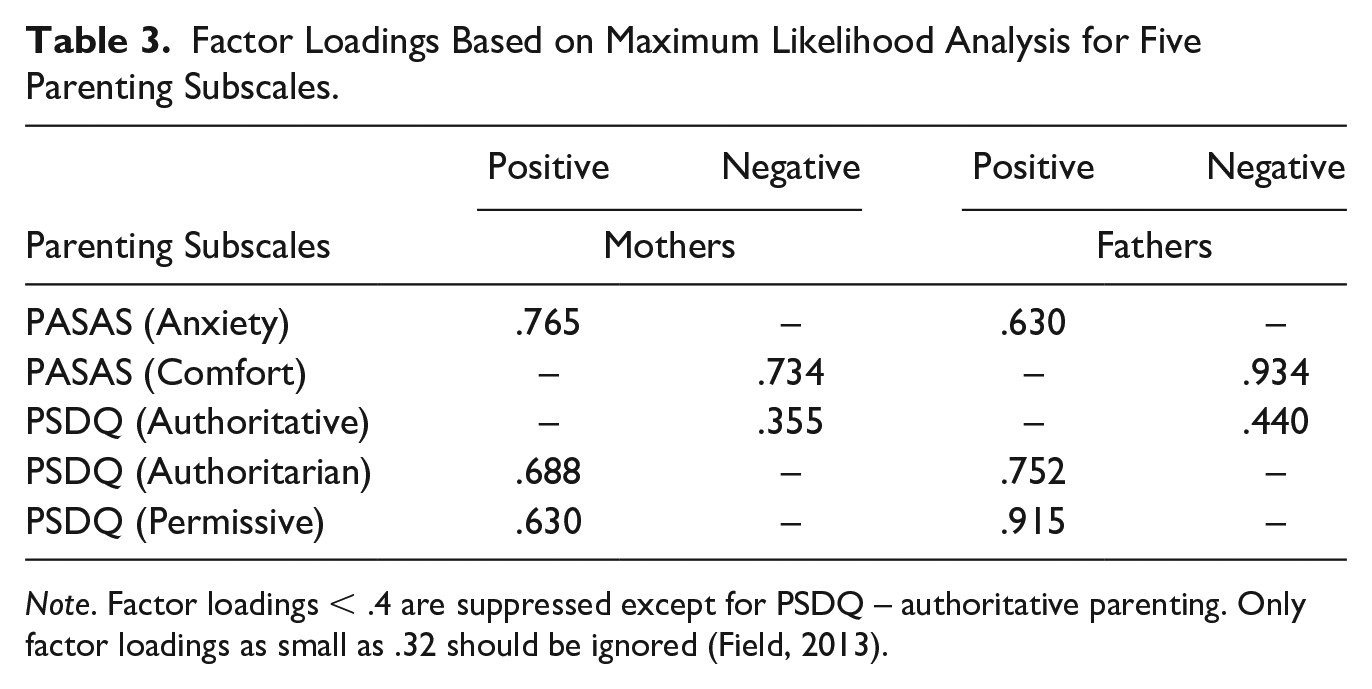
Note. Factor loadings < .4 are suppressed except for PSDQ – authoritative parenting. Only factor loadings as small as .32 should be ignored (Field, 2013).
Adolescents’ reports
Mothers’ and fathers’ parenting
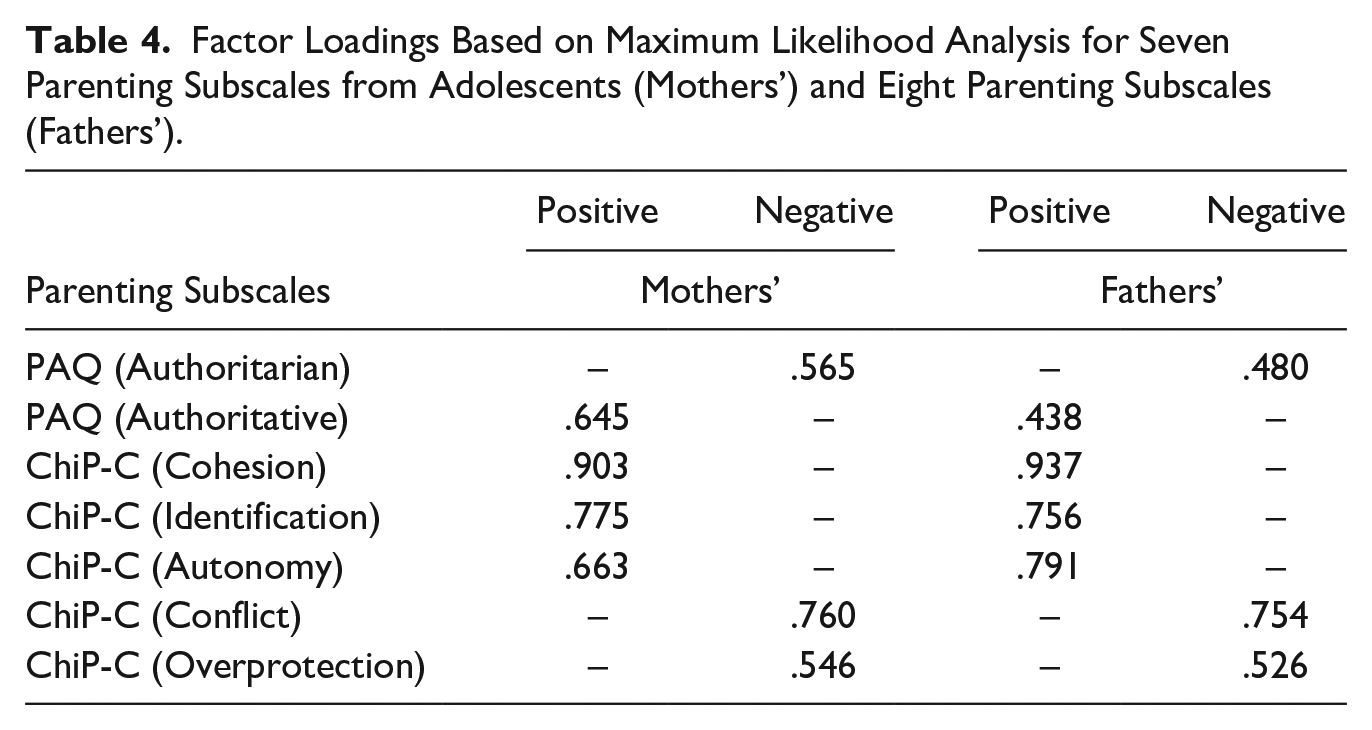
EFA was undertaken on nine parenting variables from the adolescent’s report resulting in two factors (eigenvalues >1; combined explained variance = 61.48 % of the variance for mothers and 55.00 % of the variance for fathers). As for parents’ self-reports, these were positive parenting (factor 1: PAQ–Authoritative, ChiP-C–Cohesion, ChiP-C–Identification and ChiP-C–Autonomy) and negative parenting (factor 2: PAQ–Authoritarian, ChiP-C–Conflict and ChiP-C–Overprotection-mothers, and ChiP-C–Rejection/Indifference-fathers). Two variables for mothers’ parenting (PAQ–Permissive and ChiP-C–Rejection/Indifference) and one variable for fathers’ parenting (PAQ–Permissive) were eliminated as not contributing to a simple factor structure (Table 4). The suitability of factor analysis was confirmed based on the KMO value of 0.74 and 0.67 for mothers’ and fathers’ parenting, respectively, and Bartlett’s test of sphericity (χ2 [36] = 287.90, p < .001 for mothers’ parenting and χ2 [36] = 314.08, p < .001 for fathers’ parenting).
Factor Loadings Based on Maximum Likelihood Analysis for Seven Parenting Subscales from Adolescents (Mothers’) and Eight Parenting Subscales (Fathers’).
Relationship between Positive and Negative Parenting and Number of Children
Positive parenting for both mothers’ (t(109) = 1.03, p > .05) and fathers’ (t(53) = .78, p > .05) self-reports did not differ by family type, and nor did negative parenting for both mothers’ (t(74.7) = 1.40, p > .05) and fathers’ (t(53) = .11, p > .05) self-reports. From adolescents’ reports, there was also no significant effect of family type on mothers’ positive and negative parenting (t(53.5) = -.22, p > .05) and (t(69) = -.38, p > .05) or fathers’ positive parenting, (t(69) = -.83, p > .05). However, there was a significant effect of family type on fathers’ negative parenting (t(69) = 2.52, p < .05), with adolescent only-children rating themselves as experiencing more negative parenting from fathers (M = .28, SD = .89) than adolescent non-only children (M = -.22, SD = .78).
What Are the Predictors of Parenting?
A simple linear regression model was created to establish whether family type is a significant predictor of parenting. Demographic variables were included, following the practice of researchers who avoid oversimplified models and advocate for more control of variables regardless of significance (Sweet & Grace-Martin, 2012). The model comprised the following variables: family type, parent’s age, child’s age, child’s gender, family structure, ethnicity, and parent’s educational qualification. Bootstrapping was used to ensure reliability even when assumptions are violated (Field, 2016). The confidence intervals are for the unstandardized beta and based on a 1,000 bootstrap samples.
Positive Parenting
Parents’ self-reports
With both maternal and paternal positive parenting as dependent variables, the regression models were not significant (F(7,103) = .919, p = .50), R2 = .059 and (F(7,47) = 1.74, p = .12), with an R2 = .205 respectively.
Adolescents’ reports
With perceived positive parenting from mothers as the dependent variable, the regression model fitted significantly (F(5,65) = 3.58, p < .01), R2 = .216. Family type was not a significant predictor (see Table 5), however two demographic variables were: child gender (β = .364, t = 3.28, p < .01), such that being female was predictive of more positive parenting and of ethnicity (β = .261, t = 2.38, p < .05), such that the White ethnic background was predictive of more positive parenting. The best predictor was child gender. With perceived paternal positive parenting as the dependent variable, the regression model also fitted significantly (F(5,65) = 3.83, p < .01), R2 = .228. Family type was again not a significant predictor (Table 5). Two demographic variables explained 22.8% of the variance; family structure (β = .343, t = 3.06, p < .01) such that intact families was predictive of more positive parenting, and ethnicity (β = .288, t = 2.64, p < .05) such that the White ethnic background was predictive of more positive parenting. The best predictor was family structure.
Linear Regression Predicting Positive Parenting from Mothers and Fathers (N = 71).
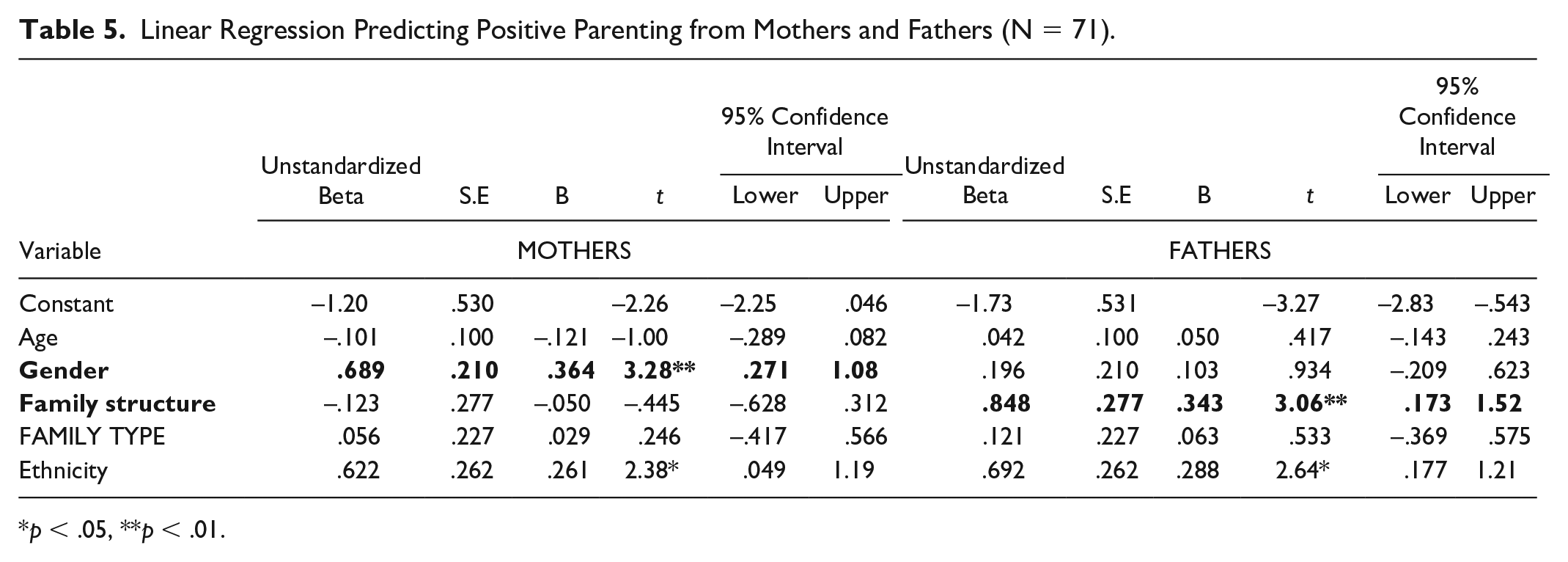
p < .05, **p < .01.
Negative parenting
Parents’ self-reports
With both maternal and paternal negative parenting as dependent variables, the regression equations were not significant (F(7,103) = 1.90, p = .08), R2 = .114 and (F(7,47) = 1.13, p = .36), R2 = .144 respectively.
Adolescents’ reports
With perceived negative parenting from mothers and fathers as dependent variables, the regression equations were not significant (F(5,65) = .230, p = .95), R2 = .017 and F(5,65) = 2.69, p < .05), R2 = .172 respectively.
Family Interview Data Analysis
What are adolescents’ and parents’ perceptions of parenting?
Five themes common to both groups were identified: authoritative parenting; authoritarian parenting; child-centered parenting; parenting practices, and overprotection.
THEME 1: Authoritative parenting
More than half of the non-only children related to their parents as being rather flexible with them whilst also ensuring that they followed the rules. Similar perceptions were reported by only a few only-children. Thus, authoritative parenting was common to both family types but less prevalent in single-child families from the adolescent’s perspective.
I can usually do like. . .like when I was back I was allowed on computer but I…. I’m not allowed to watch TV like anytime in the day. (Male single-child)
Authoritative parenting was also reported by parents in both single-child and non-single child families. They were all very clear about the importance of setting “boundaries” while simultaneously being easy-going and flexible towards the child to meet their needs. However, in single-child families, this parenting style was adopted by less than half of the mothers and was not identified amongst any of the fathers. By contrast, the use of authoritative parenting in non-single-child families cut across both parents.
THEME 2: Authoritarian parenting
Some form of authoritarian parenting was adopted in both family types, although more prevalent in non-single child families. In some of the single-child families, mothers and fathers took the role of a disciplinarian to regulate behaviors—“NO, in this house this is the rule! We follow this”. They were quite “strict” towards the child when they felt it necessary.
In the non-single child families, this parenting style was shown more by mothers than fathers.
THEME 3: Child-centered parenting
Most adolescents in both groups felt that their needs and interests were valued by their parents. Some only-children reported that their mothers “always makes sure that I’m happy,” displayed a lot of understanding towards them and often praised them. This was the case for fewer non-onlies. In the majority of both family types, both parents aspired for their child to be happy above all. A few parents of single children were also prepared to put their child first regardless of any negative effect on their own happiness. This was not seen in the non-single child families.
When my husband and I are having conversation. . .she’s always got some reason to, um, interrupt. It’s like “I’m here as well” [. . .] she NEEDS one of our attention, which is good, we give her a lot of attention, but we’ve got used to having conversation once she’s gone to bed (laughs). (Mother of single female)
A high level of parental investment to meet the specific needs of the child was reported by some mothers in the single-child families but by no parents of multiple children.
He’s our only child so he is gona get. . .mostly what he needs. (Mother of single male)
Almost all only-children reported enjoying quite a lot of freedom in where they went and what they did, and this was backed up by parental reports. One only-child explained that she enjoyed even more freedom explicitly as a result of being an only-child with no siblings to “worry about.” Freedom of choice also seemed to be part and parcel of their experience of being parented; parents usually respected their privacy such that “she does not really get involved in stuff like I don’t want her to get involved.” Freedom of choice was implemented by mothers of single children much more than fathers. Similarly, almost all the non-only children enjoyed quite a lot of freedom, as also reported by their parents. In sharp contrast with an only-child, one child with siblings did report less freedom of movement as a result of having a sibling.
Nearly half of the adolescent only-children felt they had quite a lot of say in family decision-making: “But then I said, ‘I didn’t want it to change’ and then, she didn’t change it!.” Nearly half of the parents from single-child families felt they promoted shared decision-making; but they also set some boundaries on the extent of the child’s influence as “it’s a family house rather than parent-child.” Most non-only children and their parents also reported engaging in shared family-decision making although the parents reported mostly being in charge.
THEME 4: Parenting practices
Parenting practices in the form of parental involvement reflected the amount of time parents spent with their adolescent including the extent to which they participated in the child’s activities. A sharp contrast between only-children and non-only children was observed. Almost all the only-children reported that they spent a considerable amount of time with their parents; watching TV, sports, studying, playing games or simply just “doing stuff together”. They viewed spending time with their parents as normal. The majority thought that their mother especially was highly involved in their activities and viewed this as a form of support and encouragement. The parents agreed that they were highly involved in their child’s activities with considerable amount of time spent together. Maternal engagement in single-child families was particularly noteworthy, with the majority enthusiastically involved in their child’s school matters, and active in facilitating their hobbies and interests.
I was very much involved in everything which she was doing because she was really competing at a professional level [. . .] and she had all these competitions during the weekends so I was going to each of those and all her competitions [. . .] I knew the club. . .trying to help out so I was EXTREMELY involved. (Mother of single female)
Mothers were more involved than fathers, but the majority of fathers of single children still showed a high level of paternal engagement. Contrastingly, in almost all non-single child families, parental involvement was seen as low by adolescents. Some reported spending time “occasionally” with their mother and the majority only “occasionally” spent time with their father. Parents of non-single children disagreed, with more than half reporting high parental involvement. However, high parental involvement was conceptualized as family time rather than individual time with their adolescent. Like the single-child families, fathers were recognized by all as less involved than mothers.
THEME 5: Overprotection
Feeling overprotected was only reported by the single children, with almost half identifying this. Overprotective behaviors involved parental over-involvement in the child’s activities, constant monitoring of their whereabouts, child feeling somewhat “controlled” by the parents, and parents being overly concerned about them.
My parents are VERY VERY VERY protective of me. All of my friends are allowed the whole of [name of town] I am not allowed past my next-door neighbour’s house! (Female single-child)
For a few adolescents, parents’ overprotectiveness was seen as a sign of affection. However, for others it was less desirable and even described as a form of “obsession.”
He shows his affection BY BEING OVERPROTECTIVE like going to all my matches and stuff but I don’t particularly see that as affection. (Male single-child)
Most parents of an adolescent only-child were conscious of themselves as very, if not overly protective of their child, sometimes to the point of “overpowering.” These parents aspired to maintain control although without the intention to “suffocate” their child.
I just think that’s my baby. . .and there’s like people climbing on top of each other (laughs) he’s gonna get hurt! (laughing) [. . .] so I can’t watch him. . .and I say “do you want me to come and watch?” and he says I’d put him off because he knows that I’m worrying at the side lines. (Mother of single-male)
Being overprotective was mainly seen as the outcome of having only one child: [. . .] We may need to sort of think about giving her a bit more freedom. . .but I think sometimes when you have only got one, everything is a bit more heightened. Because you haven’t got another one to look to and learn from. (Parents of single-female)
Contrastingly, overprotective parenting in non-single child families was reported by less than half of the parents, was restricted to mothers only, and stemmed from very specific reasons. For example, in some families, parents were overprotective because the child was seen as vulnerable following past poor health. For others, overprotectiveness was associated with their own personality, for example, being a “control freak”.
THEME 6: Parental permissiveness in single-child families
Some only-children perceived both their parents as being quite flexible and lenient with them. One made an interesting comparison with one of his friends with siblings.
Let’s just use [friend] as an example. His dad is quite strict cause when I was calling him once his dad came in there and he yelled at him because [. . .] If you were an only-child I think he would be a bit less. . .less angry at him. (Male single-child)
Many mothers also perceived themselves in this way. They were sometimes caught up in an internal conflict over how to find a balance between being “tolerant” and “strict,” with one describing her parenting as: “mid-way to a bit too easy going to be honest”. In some cases, mothers felt their only-child seemed to expect their mother being lenient.
I think once I told her to go to her bedroom recently and she was like shocked “you can’t tell me to do that” and then I was more shocked (laughs) of her and then I’m “yes I can, I’m your parent” [. . .] she doesn’t understand that I’ve got that authority. (Mother of female single-child)
THEME 7: Pushy parents in single-child families
A few parents reported being somewhat “pushy” with their only child, although this was seen as being in their best interests. Again, these parents seemed to be somewhat conflicted whereby they were very keen on providing freedom of choice to their child whilst also trying to influence these choices. This perhaps suggests that these parents see their only child as a reflection of their own aspired self.
So yeah, but so we both learned the piano together but that’s less his interest, it’s more me pushing him to do it because I think he’ll enjoy having it. (Mother of male single-child)
THEME 8: Pampering parenting style in single-child families
Half of the only-children felt they were very privileged including on a materialistic level, reporting that they often ended up having what they asked for. Furthermore, they enjoyed better access to various opportunities such as a good school and expensive holidays. They were aware of being “spoilt” and openly related this to their only-child status.
[. . .] Being an only child, I guess there’s a bit more freedom. Because you know, they can buy you whatever you want, BUT not like spoiling or anything, just like if you want it or you wish for it, they can save up for it. (Female single-child)
Across the majority of single-child families, parents perceived their child as being pampered. Pampering was not limited to the parents as providers but extended to making sure that the adolescent had an easy life. Although many were aware that they “give in a bit more than other parents,” this was rationalized because they did not have other children to “spoil”.
I don’t think we spoil him but I think he. . .if there’s not a good reason to say no, we don’t just say no if that makes sense [. . .] and because it’s just one child, it’s not like you have to buy say five of them and therefore becomes too expensive. (Mother of male single-child)
Discussion
This mixed-methods study aimed to explore the parenting styles and practices used in single-child families in comparison to those in multiple children families. A triangulation approach is used to integrate and discuss key findings from survey and interview data. Survey data revealed that there was no difference between single-child and multiple children families on positive and negative parenting, suggesting that adolescents without siblings are not parented differently from those with a sibling (Johnson, 2014; Russell, 2013). This challenges existing negative stereotypes of parenting in single-child families (Mancillas, 2006), and supports other research (Clarfield, 1999) suggesting that there are no differences between family types on these broad parenting constructs. In contrast, interview findings successfully captured some more subtle differences in parenting styles as well as practices between family types.
The authoritative parenting style was less prevalent in single-child families, where parents tend to be more lenient. However, this may be due to the one-child family sample having more varied family structures, since authoritative parenting is more characteristic of intact two-parent families (Chan & Koo, 2011). Authoritarian parenting characterized the multiple more than the one-child families, in line with previous findings of less implementation of an authoritarian parenting style in Chinese one-child families (Lu & Chang, 2013). Some single-child parents did report being pushy, contradicting some speculation in popular media—“perhaps it’s going too far to say that parents of only children are more likely to be pushy or to seem pushy” (Hines, 2013, p.1). Some only-children and their mothers also reported parental permissiveness, reflecting previous evidence that permissive parenting is more likely in single-child families (Liu, 2010). In relation to parenting practices, only-children reported spending considerable time with their parents one-on-one while in non-single child families, time was mostly spent as a family and, some parents with multiple children raised concerns about not being able to spend individual time with their adolescent. Time investment in a child has been recognized as a form of positive parenting (Wall, 2010) with a beneficial effect on child development (Monna & Gauthier, 2008), so parenting in one-child families could entail positive outcomes for children.
Are single-child families as child-centered as anticipated? In line with past research on child-centered parenting (Cannella & Viruru, 2004), both groups prioritized the needs of their child, respected their autonomy and granted them freedom of choice. However, some mothers of only-children showed higher parental investment and were prepared to prioritize their child’s happiness over their own. Although child-centeredness has been attributed to western parenting ideals generally (Eurochild, 2010), these findings suggest it is more prominent in families with just one child. Another aspect of child-centered parenting, allowing child input in family decision-making (Oryan & Gastil, 2013), was also more common for only-children. This implies the one-child family is less hierarchical since many parents of multiple children reported being themselves in charge of family decisions.
“Lay persons generally believe that parents of only children are inclined to overindulge and pamper their offspring” (Mottus et al., 2008, p. 1047). Interview findings revealed that the adolescent only-children were indeed more indulged. They were pampered, especially on a materialistic level, supporting some public perceptions on only-children. In China, only-children have been labelled as “little emperors” (Cassandra, 2001). Is this also the case for British only-children to a degree? This warrants further empirical attention including using validated quantitative measures of pampering parenting style.
Only the singletons reported being overprotected by their parents, in line with previous research (Richards & Goodman, 1996). Factor analysis of adolescent reports identified overprotection as a component of negative parenting. Overprotective parental behaviors include parental over-involvement, close monitoring and control, and parental over-concern. Some only-children did experience this as negative, and it is known that overprotecting children can cause them anxiety (Laurin et al., 2015). Most of the mothers with an adolescent only-child justified their overprotection in the context of having just the one child (Brussoni & Olsen, 2013). Research on overprotectiveness in one-child families could help increase understanding of helicopter parenting more generally (Wuyts et al., 2017). Importantly, these differences might not be captured using quantitative measures.
Across several parenting dimensions, mothers more than fathers were found to play a determining role, especially in one-child families. For example, overprotective parenting was much more prominent amongst mothers than fathers and, freedom of choice was granted by mothers more than fathers; as also found by Holmbeck et al. (2002) and Saldinger et al. (2004). Furthermore, only-children perceived their mother to be more involved with them than their father. Based on parental perceptions, fathers were found to be less involved than mothers in both family types despite growing research pointing towards a gradual increase in paternal involvement especially in intact families (Cabrera et al., 2000).
The current study is the first to examine one-child families by looking at the whole family, in line with a growing interest in studying early adolescents in family research (Putnick et al., 2010). Additionally, parenting research based on mothers’ self-reports is widespread, whilst the inclusion of fathers is not (Symeou & Georgiou, 2017). The mixed-method approach meant that the lived parenting experiences and the adolescents’ experience of being parented in single-child families were more intricately revealed from family interviews than family surveys. As a result of the recruitment process proving to be much more challenging than anticipated, the overall quantitative sample size was smaller than initially planned, reducing power and generalizability, although statistical power was still adequate. Most participants were born in the United Kingdom and were mainly White and middle class. Hence, they do not reflect the demographic profile of the British population, so cultural differences in parenting could not be explored, and future research should address this.
In line with family systems theory (Bowen, 1975), overall findings reflect an existing interrelationship between parents and only-children, mainly in the form of minimal parent-adolescent discrepancies when reporting their experiences. With a lack of empirical evidence, UK parents of only-children are relying on discussion forums and websites such as Mumsnet and Netmums to seek information. The current findings provide reassurance to parents who are concerned about having only one child in light of existing negative stereotypes of single-child families; in a nutshell, minimum significant differences in parenting of singletons and children with sibling/s. Nonetheless, there is evidence for certain assumptions whereby parents of an adolescent only-child were found to be more overprotective and indulgent, although there is no evidence here that this had a negative impact on the child. This type of parenting has increased over the years (Ungar, 2009) especially in high SES families (Patton, 2012), which often are the ones with only one child. Parents of adolescent only-children may benefit from advice to better cope with overprotection as a parenting practice common to this family type. There is a need for more qualitative research on only-children; this “may in fact serve as something of a corrective to the prevalence of stereotypes” (Fletcher, 2014, p. 51).
Conclusions
Recently a lot of attention has been paid to the importance of the number of children in families in parenting research, but there is not one parenting style common to single-child families. Although there were some differences in parenting between single-child and multiple-children families, overall, there were equally many similarities. Despite mostly portraying a reassuringly positive picture of single-child families, it remains a difficult decision for families to decide whether to have just one child. That said, these findings also seem to raise a new question for families of tomorrow: could it not be just as good to have one child to enjoy the experience of parenthood while also having more “me-time”?
Footnotes
Acknowledgments
The authors would like to thank all the families (parents and adolescents) for their time and willingness to participate in this research study. A very special thanks to all the research assistants (Steffi Taylor, Olugbemi Moronfolu, Athirah Che Azizuddin, Emily Wong, Sophie Porter, Natasha Kumar, Silvia Petria and Aimee Singleton) who helped with the recruitment of families and data transcription.
Authors’ Note
Both authors contributed in undertaking this study and the write-up of the manuscript. There are no known conflicts of interest associated with this publication. This paper has not been published and is not under consideration for publication elsewhere.
Declaration of Conflicting Interests
The author(s) declared no potential conflicts of interest with respect to the research, authorship, and/or publication of this article.
Funding
The author(s) disclosed receipt of the following financial support for the research, authorship, and/or publication of this article: The first author was supported by a PhD studentship from the Warwick Department of Psychology; no other funding was received.
