



Abstract
This research provides a qualitative narrative inquiry into the experiences of academic mothers from a Southwestern Ontario university campus. Analysis of the semi-structured interviews and focus groups reveal six key themes regarding the nexus between motherhood and academia: (1) intersection of work and family; (2) embodied experiences of pregnancy; (3) mentoring and networking opportunities; (4) inconsistencies between institutional and program policies; (5) departmental support; and (6) an overall level of satisfaction in being a mother during graduate studies. These key findings are discussed and highlight some of the challenges associated with balancing motherhood, graduate studies, and family life. Issues related to maternal well-being, gender equity, diversity, and inclusion within academia are also discussed and shed light on the experiences of this increasing, yet largely overlooked demographic on Canadian university campuses.
Introduction
Over the past 30 years, the demographic composition of Canadian higher education has changed dramatically (Catalyst, 2021; Statistics Canada, 2016). Reflecting broader shifts in gender relations, family formations, and women’s increasing participation in the labor market, women’s representation in academia at the faculty and graduate student levels have climbed steadily (Statistics Canada, 2016). Within the Canadian context, the rate of women graduating from doctoral programs was just over 50% in the 2004–2005 academic year (Statistics Canada, 2011). In 2016, women accounted for slightly over half of young Canadians aged 25 to 34 with an earned doctorate and the majority of young graduates with an earned doctorate in many fields (Statistics Canada, 2016). However, upon the completion of graduate studies in Canada, there is greater movement of women into part-time precarious positions (Catalyst, 2021; Valian, 2009). Further, advancement into top-tier academic positions is slower for women than for men, women are paid less money than men at the same rank, and women receive fewer national awards and prizes (Catalyst, 2021; Valian, 2009). This lack of parity also becomes more pronounced for women of color (Kobayashi, 2009) and Indigenous women in the academy (Lavallée, 2020; Minthorn, 2018; Minthorn & Shotton, 2018).
In addition to the demographic composition of graduate students on Canadian university campuses over the last decade, enrollment demographics in graduate programs within Canada have also undergone a noticeable transformation. The influx of non-traditional graduate students represents a change on university campuses that has been on the rise over the past decade (Brown & Nichols, 2012). According to (Brown & Nichols, 2012),non-traditional graduate students are defined as “an adult who is pursuing a higher degree part-time while working full-time, or one who returns to school full or part-time after a significant break or interruption, while maintaining responsibilities such as employment, family, and other obligations of adult life” (p. 11). Representing a unique subset of graduate students, non-traditional graduate students also include pregnant and parenting graduate students. Although this subset of non-traditional graduate students includes fathers, this article will focus exclusively on the complex experiences of graduate student and faculty mothers within the context of family and academia and intends to place mothers within the larger academic landscape. Given the physical demands of motherhood and gendered expectations of motherhood, the steady increase of women and mothers into graduate programs warrants a closer examination of their experiences at the graduate and faculty levels within academia.
To capture the essence of mothers’ lived experiences during graduate school, this research explores narratives of motherhood, family, and academia across three temporal scopes which include past and present reflections on academic experiences among two groups of academic women. Higher educational institutions and women’s gendered experiences within these institutions are in constant temporal transition. Just as individuals’ lives are embedded within larger narratives as social science inquiries, the institutions and practices within them are contextualized within a longer-term sociohistorical narrative. Therefore, an event is not something that is seen as happening in one specific moment, but as something that is an expression of something happening over time. Thus, any event or occurrence has a past, present, and implied future (Clandinin & Connelly, 2000).
The temporal scopes within this study included reflections on current and past graduate school experiences. Through dialogic discussions of motherhood, family, and academia, this article explores both lived experiences, as well as the literature which suggests that motherhood affects the trajectory of women’s academic careers (Acker & Armenti, 2004; Goulden et al., 2009; Haworth, 2004; Mason & Goulden, 2004; O’Reilly, 2002), attrition rates (Lynch, 2008), and category of appointment (Field & Jones, 2016) in ways that fatherhood simply does not. For example, “motherhood penalties” and “marriage and fatherhood premia” are consistently documented in the literature and demonstrate that work and family processes are ubiquitously intertwined (Aisenbrey & Fasang, 2018; Correll et al., 2007; Killewald & Gough, 2013). Central to this literature is the importance of social location and how these aspects of identity intersect to shape the experiences of mothers in academia.
Despite the increase in non-traditional graduate students and women in faculty positions, (Brown & Nichols, 2012), the structure and process of higher education has remained largely unchanged and research on this unique group of graduate students remains relatively scant. Situating the experiences of graduate student and faculty mothers within the conversation of higher education is pertinent and has the potential change the culture to being much more gender inclusive and equitable. However, the scarcity of research on the experiences of graduate student mothers within a Canadian context highlights the marginalization of graduate student mothers and demonstrates the indifference for women’s experiences and contributions in academia. This research aims to address these omissions by exploring the complex experiences of this relatively under-researched group of women, while simultaneously addressing gender relations, equity, diversity, and inclusion within academia.
Review of the Literature
This literature review will begin with an exploration into the commonly cited implications of motherhood on women’s careers and academic trajectories, as well as a discussion of the societal and institutional barriers that impede upon the success of graduate student mothers. A discussion of key concepts pertaining to motherhood will be addressed to support the nexus between motherhood and academia and the ways in which systems operate to support the notion of an “idealized student” (Springer et al., 2009, p. 436). This deconstruction of inequities and barriers embedded within the fabric of higher educational institutions is essential to the conversation of motherhood and academia and demonstrates how underlying structures and ideologies work to disadvantage women in academia (Acker & Armenti, 2004).
Central to the discussion of motherhood and academia is the idea that motherhood affects the trajectory of women’s academic success in distinctive ways. Comprising a large source of these setbacks are the societal barriers that mothers often face as a result of their maternal status, also referred to as the “motherhood penalty” (Correll et al., 2007, p.1298). Further, the time demands required within academia along with the unattainable and normalized societal expectations placed upon mothers continue to place academic mothers in an either-or-proposition (Springer et al., 2009).
For women who are pursuing motherhood while completing graduate studies or a newly appointed tenure track position, their maternal status often becomes inaccurately tantamount with their commitment to academia (Rosewell, 2021).Contrary to the perception of academic fathers, academic mothers may be perceived as less committed to academia and less interested in completing their graduate program, which is in direct opposition to the perception of new fathers (Williams, 2005); (Rosewell, 2021). To offset these perceptions of their commitment and potential, many mothers find themselves grappling with meeting idealized notions of being a “good” student and “good” mother, particularly mothers of color (Anaya, 2003; Benitez Hemens et al., 2020) and Indigenous mothers who often face double discrimination in the academy. Specific to Indigenous motherhood in the academy, are the ways in which culture and place impacts mothering, scholarship, loss, and other complexities embedded in one's identity (Minthorn et al., 2022). As a result, graduate student mothers manage their conduct in terms of the dominantcultural conceptions of what it means to be a “good” student and “good” mother (Lynch, 2008), often resulting in increased stress and pressure within each of these roles.
While managing their conduct in terms of the dominant cultural conceptions of ideal worker/student norms and ideologies, graduate student mothers often find themselves working around the clock in attempt to achieve success in each role (Acker & Armenti, 2004). In light of socialization processes and prevailing gender stereotypes, graduate student mothers often find themselves taking up a “second shift,” and find themselves doing both housework and mothering roles after a full day of work or school in these instances (Hochschild, 2003). This juggling act places mothers at a greater disadvantage when balancing workplace demands and common academic-related stressors such as pressure during pre-tenure years, low entry pay scales, and long working/preparation hours may affect the ability to simultaneously manage work and caregiving responsibilities. These challenges may affect women’s abilities to effectively manage the intersection of work and family and often lead to heightened levels of emotional labor while managing the resulting dissonance (Ciciolla & Luthar, 2019; Hochschild, 2003; Rosewell, 2021).
Given the historical context of higher education, it is imperative to consider how these gender norms govern graduate student mothers’ behaviors and the expectations of gender performativity. Mothers often face the expectation to be the primary caregiver of their children, and therefore face related expectations of what it means to be an ideal mother. These expectations are often portrayed as conflicting with ideal student norms and norms within the academy, which suggest that children are a distraction from success, particularly for women (Drago, 2007; (Somerville, 2000) Ward & Wolf-Wendel, 2017). The influx of women in adjunct and sessional positions also places women in a position of precarity more often than men and highlight the relationship between academia and family formation.
In the 2018-2019 academic year, women represented 41% of full-time teaching staff at Canadian universities (Catalyst, 2021). In the same academic year, women only made up 28% of full professors and 55% of positions below assistant professor including sessional instructor positions or adjunct faculty (Catalyst, 2021). Further, women of color comprise a mere 12% of positions in Canadian academia (Kobayashi, 2009). The precarious nature of women’s employment in Canadian universities points to the role of family status in women “choosing” various career paths (Murgia & Poggio, 2019; Ward & Wolf-Wendel, 2017, p. 491). According to Ward and Wolf-Wendel (2017), the employment of women in non-tenure track positions and lower tier institutions is often explained in part by women’s parental and marital status, as well as the rigorous demands of both motherhood and academic life. Additionally, on campus resources have a determining influence on women’s decisions to return from maternity leave and pursue various academic pathways (Mason et al., 2013; Reyes, 2019). Despite equity, diversity, and inclusion initiatives, the lack of adequate resources often contributes to an overall stigmatization of motherhood on campus and reinforces an underlying message of unbelonging (McCutcheon & Morrison, 2016).
A review of the challenges faced by graduate student mothers highlights the societal and institutional barriers that may impede upon mothers’ overall experiences in graduate programs. These barriers also underline the gendered sociohistorical legacy of academia and exposes the otherwise quiet or hidden preference for whom campuses are ideally intended for. It is also worth noting that these experiences existed prior to the COVID-19 pandemic, and have only since intensified the well-documented challenges academic mothers face (see, for example, Almanssori & Hillier, 2020; Fulweiler et al., 2021; Jaber & Cordeiro, 2021; Vomvoridi-Ivanovic & Ward, 2021; YFile, 2020). This research provides a closer examination of the experiences of academic at a Southwestern Ontario university campus and suggests that bringing forth these pre-pandemic experiences can assist in the development of more effective policies and practices that align with institutional commitments to equity, diversity, and inclusion.
Positionality
A significant feature of feminist research on family relationships includes the reflexive practice of locating oneself in relation to the research (England, 2008; Wise & Stanley, 2006). In order to ensure transparency and accountability in this study’s narratives, I situate myself in relation to this research. As a white, middle-class, cis-gender, able-bodied woman and mother who occupies spaces in historically privileged contexts, I acknowledge that although certain aspects of my social location present structural and institutional challenges, I have benefited from multiple systems of privilege based on race, class, ableism, and sexuality. As a former PhD student who was a first-time mother for the majority of my doctoral studies, the intersection of motherhood and academia is a deeply personal, embodied, and lived experience. Although I received unwavering support from my advisor, dissertation committee, and faculty, my identity as a pregnant woman on campus provoked the commonly referenced feeling of being a cultural outsider (Brown & Nichols, 2012). These feelings of unbelonging, which were ever present due to my identity as a first-generation university student, became intensified once my pregnancy became visible. These feelings inspired me to further explore others’ experiences in addition to my own. Thus, my positionality has consciously and unconsciously shaped the focus of my research and interactions with the women in this study.
Theoretical Framework
This research utilizes a feminist theoretical framework to explore the relationship between negotiations of motherhood, family, and academia. According to Allen & Jaramillo-Sierra, 2015, feminist perspectives of family relations begin with a critique of the “idealized template of the White, middle class, heterosexually married couple and their dependent children” (p. 93). Feminist perspectives on parenting also take family diversity and complexity as its starting point (Allen & Jaramillo-Sierra, 2015). A feminist theory of gender and family relations as it relates to motherhood is also interested in and examines the intersectionality of social class, race, sexuality, ableism and other social justice factors which help complexify and challenge motherhood (Allen & Jaramillo-Sierra, 2015). For example, demonstrating the persistent and significant discrimination towards working class mothers, (Gillies, 2006) discusses how how sanctioned models of parental involvement in education demand an emotional investment that makes considerably more sense to middle class mothers (p. 281). Similarly, Verduzco Baker (2012) describes how motherhood is often driven by the power and ubiquity of dominant discourses of motherhood, which shape the way society understands these mothers as individuals, citizens and parents. By analyzing how working-class mothers negotiate dominant discourses of motherhood as they construct understandings of themselves as mothers, Verduzco Baker (2012) makes visible the discursive dynamics through which working class mothers continue to be positioned as bad mothers. A broad feminist theoretical perspective also provides the opportunity to explore larger questions of social justice, while simultaneously addressing the intersectional matrixes of inequities that are intertwined in the institution of motherhood.
Feminist theories offer insights into the social construction of motherhood (O’Reilly, 2004). Research informed by feminist theories fosters empowerment, liberation, and emancipation for women and other marginalized groups and is consistent with the broader aims of gender justice (Hesse-Biber & Leavy, 2007). Drawing attention to the dialectics of oppression and privilege, feminist perspectives on family and motherhood actively aim to change disempowering conditions and institutions (Allen, 2000). A theoretical lens informed by feminist theories also views gender and motherhood as a social, historical, and cultural construct (Butler, 1990; Takseva, 2019). Idealizations and notions of motherhood are seen as social constructions, manufactured through relations of power, and built through sociohistorical, political, and economic processes and are undergirded in power and hierarchies (Haslanger, 1995). Always context dependent, gender norms and identities are enacted, negotiated and performed within the context they occur. According to O’Reilly (2004): Motherhood is primarily not a natural or biological function; rather, it is specifically and fundamentally a cultural practice that is continuously redesigned in response to changing economic and societal factors. As a cultural construction, its meaning varies with time and place; there is no essential or universal experience of motherhood (p. 5).
Thus, socially constructed gender norms are historically variable and are not natural, unchanging, or universal by-products of the ability to biologically reproduce (Apple & Goulden, 1997). For example, a shift in what it means to be a mother has occurred throughout time due to socially constructed gender norms (Arendell, 2000). By focusing on research that is conducted through the inclusion of women and these social constructs, women’s lived experiences have become a central component of feminist theoretical research (Hesse-Biber, 2013). This research positions the experiences of mothers at the forefront of inquiry and provides an exploration into their experiences in the academy.
Participants
Summary of Participant Demographic Information.
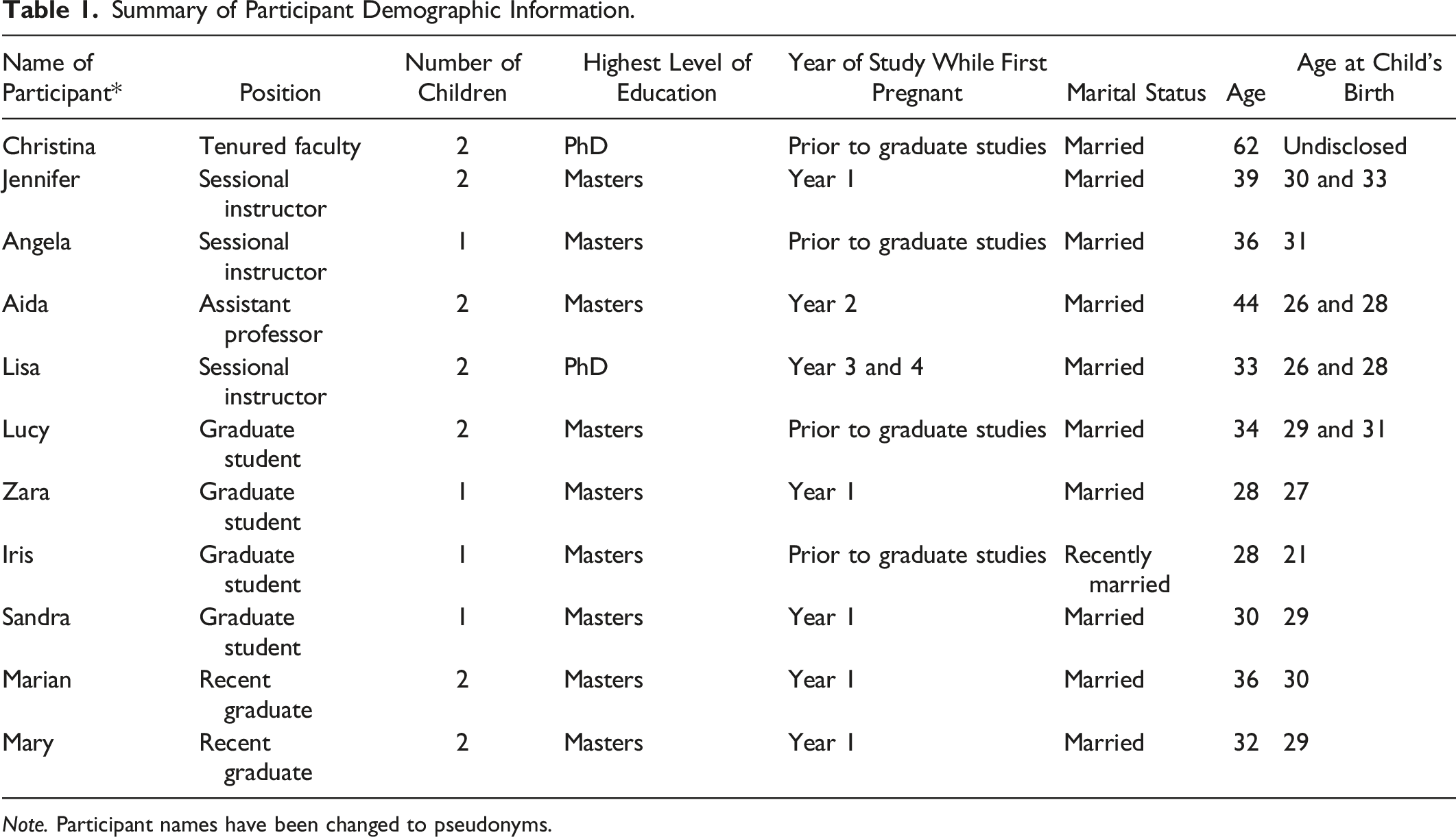
Note. Participant names have been changed to pseudonyms.
Methods and Methodology
Qualitative data were derived from semi-structured interviews and focus group sessions with graduate student and faculty mothers. As a method to understand experience, this research employed narrative inquiry to explore the lived experiences of graduate student and faculty mothers. More specifically, this study’s use of narrative inquiry provided “a way of thinking about experience” (Clandinin, 2007; Connelly & Clandinin, 2006, p. 375). Narrative inquiry is a “profoundly relational form of inquiry since researcher and participants are always in the midst of living and telling their stories” (Clandinin, 2007, p. 17). Further, narrative inquiry is a way to endeavor into the understanding of experience through “collaboration between researcher and participants, over time, in a place or series of places, and in social interaction with milieus” (Clandinin & Connelly, 2000, p. 20). Complimentary to this study’s theoretical framework, narrative inquiry provided the opportunity to represent the participants’ experiences in a more detailed manner, and in their own terms (Hesse-Biber & Leavy, 2007).
In alignment with the theoretical framework and overall aims of this study, semi-structured interviews and focus groups were utilized to gather women’s stories of motherhood, mothering, and academia. Consistent with narrative research methods, the semi-structured interviews began by asking participants to share their stories by either responding to the semi-structured interview questions, through engaging in conversation or dialog, or by telling stories initiated by various artifacts which they brought to the interview. The interviews lasted approximately one hour, and the questions focused on their relationship between academia, family life, motherhood, and professional goals. In doing so, these methods recognized the notion of “experience” as central to feminist activism and structured conscious raising methods (DeVault & Gross, 2007). In addition to the semi-structured interviews, voluntary follow-up focus groups were also conducted with participants.
Upon conclusion of the semi-structured interviews, participants were invited to participate in a voluntary follow-up focus group session. The focus groups were approximately 1.5 hours in duration and expanded the existing dialog derived from the semi-structured interviews. All graduate student mothers were assigned to the graduate student focus group and all tenured, adjunct, or sessional instructors were assigned to a separate focus group. Divergent grouping allowed for uncensored disclosures of experiences without fear of retribution. The utilization of focus groups to complement the semi-structured interviews is a method that aligned well with the aims of feminist research and goals of qualitative research analysis (Hesse-Biber & Leavy, 2007), while simultaneously providing the opportunity to gather further information on any shared experiences that may deepen and extend the established themes from the semi-structured interviews (Krueger & Casey, 2009). Inviting graduate student mothers to share their experiences also provided an opportunity to establish informal support networks among the participants, which as the results will indicate, was a desired feature of their graduate school experience that was consistently lacking in their overall experiences.
Data Analysis
Following the semi-structured interviews, the interview data was transcribed and analyzed. Member checking was conducted to ensure the accuracy of the participants’ stories. A deductive category application (Mayring, 2000) helped identify the relationships among variables, thereby assisting with an initial coding scheme or relationships between codes. Common themes were then organized and a total of six key themes were developed through qualitative content analysis. Research that utilizes qualitative content analysis focuses on “the characteristics of language as communication with attention to the content or contextual meaning of the text” (Hsieh & Shannon, 2005, p. 1278).
A directed approach to thematic content analysis (Creswell, 2008) was utilized for this particular study given the existing knowledge of academic mothers’ experiences. Data analysis for the focus group sessions were analyzed comparatively to the data derived from the semi-structured interview and through the “note-expansion” approach (Bertrand et al., 1992, p. 202) whereby “the reporter listens to the tape in order to clarify certain issues or to confirm that all the main points are included in the notes” (p. 202). Following the conclusion of this approach, the notes and transcriptions were analyzed inductively for major themes and points that were discussed and coded and categorized into pre-existing themes from the semi-structured interviews or their own category, where applicable. Narratives are presented in the results as vignettes (Ely et al., 1997) with pseudonyms, and encapsulate the overall experience of the participant.
Results
Findings from this study build and expand the existing the literature which suggests that motherhood and systemic and institutional barriers attenuate the overall experiences of graduate student and faculty mothers. Data collected from the semi-structured interviews and focus groups generated six key themes concerning motherhood and academia. These key themes include: (1) intersection of work and family; (2) embodied experiences of pregnancy; (3) mentoring and networking opportunities; (4) inconsistency between institutional and program policies; (5) departmental support; and (6) an overall level of satisfaction in being a mother during graduate studies.
The Intersection of Work and Family
Concerning the intersection of work and family, many of the mothers cited the presence of a “second shift” (Hochschild, 2003), and at times, a third and fourth shift. According to Mason & Goulden, 2004, the problem with the second shift is that it forces mothers to make decisions that ultimately affect their career paths and trajectory of their careers. In an attempt to offset the demands of the intersection of work and family, this theme had five additional sub-themes which emerged during analysis. These sub-themes included: (1) strategic planning and time management; (2) conditional and circumstantial flexibility (3) sacrificing personal desires for the sake of their family and child(ren); (4) maternal guilt; and (5) a strong reliance on support from immediate family members, such as their parents, siblings, and close friends.
Many of the mothers noted the importance of developing strategic planning and time management skills to maintain the tasks that were present on any given day. Describing their planning as the often-unseen element of family management, this invisible load of motherhood was continuously weaved through each of the narratives. The need to strictly manage their time emanated from notions of work–family balance and the fear of falling behind in their studies due to unexpected familial circumstances (e.g., illness or events). In turn, flexibility or lack thereof in academia, was one of the more complex findings given the perceived differences in availability between the two groups of women. While tenured faculty members cited a large degree of flexibility inherent within their positions, sessional and adjunct instructors feared negative student evaluations, an inability to cancel classes due to familial circumstances, and an overall degree of angst in the knowledge that if a family emergency were to arise, they would not be able to effectively manage it. This was evident when Lisa, sessional instructor and mother of two children, described what would transpire if one of children should become ill: I have no idea what I will do when I have a sick child this year. I really don’t. I admit that freely. I have no plan. My husband can’t cancel work. I can’t cancel class. They’re coming with one of us. They’d have to be in the hospital for me to cancel class. My employment is precarious, and I can’t afford it. I just can’t afford it. I can’t afford a student complaint. I can’t afford cancelling a class for an ill family member because of what that could do for student complaints or reputation. There’s too much at stake.
Narratives involving emergency family scenarios often defaulted to mothers having to negotiate time off despite the fact that it was far more difficult for them to obtain it. These challenges and perceptions of mothers having to take time off are examples of how society rewards fathers and mothers differently while tending to familial obligations (Williams, 2005). It also speaks to the disproportionate responsibilities of planning and the emotional labour invovled in doing so, which tends to fall on the shoulders of mothers. The social costs of tending to familial matters are communicated through unspoken messages within academic departments that may play a crucial role in creating women’s reluctance in doing so (Williams, 2005; 2010). The precarious nature of sessional positions was a key feature in determining the stakes of canceling a class for family obligations, which ultimately made it very difficult to strategically plan for last minute family emergencies.
The notion of sacrifice was also common for the mothers in this study, particularly for the women who recently completed a Masters degree. When discussing next steps in their careers, many of the mothers were quick to reject the idea of pursuing a doctoral degree based primarily on their husband’s attitudes towards them doing so, as well as the spoken need for their family’s respite from their engagement with graduate studies. This need for family respite was evident For Jennifer, a recent Masters graduate and mother of two children, who shared her desire to pursue a doctoral degree in her field of study: …my husband, as I mentioned, had a hard time with this grind and I took so long. I took six years, so I needed a break. But more so, I needed to give my family a break. I’m very interested in continuing and going into a PhD at some point, but I need to give my family a bit of a break.
Providing time away from graduate studies for both themselves and their families was a common expression and one that was rooted in the emotional tolls graduate studies placed on them and their families. Given the overall lack of academic flexibility for many of the mothers in this study, as well as the heightened emotional and invisible loads of motherhood, it is not surprising that many of the women also faced intensified and chronic feelings of guilt.
Many mothers in this study found themselves at the core of cultural norms and expectations between both motherhood and academia. The women in this study were well aware of this quandary when they transgressed expectations and cultural norms, ultimately facing scrutiny and judgment from family members, marital partners, and friends. Mothers consistently face remarks that dictate how they should be raising her child(ren), a function of the dominant discourse in society (Miller, 2007). The constant grappling between ideal student and good mother norms ultimately led to a sense of guilt which often infiltrated the participants’ everyday lives. The normalization of the ideal student was expressed as an embodied experience among the pregnant women in this study and one that rendered them as feeling “normal” when their pregnancy went undetected.
Embodied Experiences of Pregnancy
Pregnancy as an embodied experience is a relatively undertheorized topic of research among feminist scholarship, particularly within the context of academia. The embodiment of pregnancy is commonly experienced in terms of changes in sensuality, shape, and the occupation of social space (Bailey, 2001; Davidson, 2010; Draper, 2003; Longhurst, 2001). According to Bailey (2001) these bodily changes are observed by the woman herself and by others around her once the pregnancy begins to “show” (p. 110). The manifestations of these bodily changes are seen as a resource on which women can negotiate their social positioning, as well as a means by which they may feel reduced to their biology and thereby operate as a form of social control. Longhurst, 2001; Longhurst & Johnston, 2005, for instance, revealed that during pregnancy women often feel obliged to change the spaces they occupy in society, hiding their (potentially) “leaking bodies” from the public eye (p. 84). This was a common sentiment expressed by the pregnant mothers in this research and one that lead to feelings of stigmatization when referencing their location within an academic context. For example, Zara describes the refrain she felt in disclosing her pregnancy to professors and classmates. She also references the great discomfort in feelings of nauseousness while she attended classes: Actually, I didn’t tell many people. I just told my friends and my supervisor. I’m a GA and I didn’t tell any professors or classmates, just my friends. So, they didn’t notice, and I just felt normal. In the first trimester, I felt nauseous and it’s terrible to have that in classes.
The socialized normalization of the ideal student inherent in Zara’s response often contributes to a mind/body duality that threatens a “split” in one’s own identity. According to (Longhurst, 2001), pregnant women: Constantly threaten to expel matter from inside—to seep and leak—they may vomit (morning sickness), cry (the construction of pregnant women as overly emotional), need to urinate more frequently, produce colostrum which may leak from their breasts, have a “show” appear, have their “water break,” and sweat with the effort of carrying the extra weight of their body. But perhaps, even more than these leakages, they constantly “threaten” to split their oneself into two or more (p. 84).
Bailey (2001) also claims that the bodily changes are often not reflected in the self-identity of pregnant women, which is constructed separately from their pregnant embodiment. This reluctance and resistance to link the embodiment of pregnancy to the changes in identity are part of the fear of being denied social roles and opportunities and being reduced to simply “a body” (Bailey, 2001). This undercurrent of hesitation in disclosure and fear of being reduced to a body and subsequently denied social roles was echoed in Angela’s narrative as she described the experience of telling her advisor she was pregnant: “Well, I let my advisor know right away because she had all these plans for me, and I thought she maybe wouldn’t want to give me those opportunities if I was going to be tied down.”
Analysis of the women’s accounts demonstrate that both gender and pregnancy is embodied. Within social contexts, the privileging of particular versions of femininity at different parts of a woman’s life cycle raises the question of the extent to which social control determines the shifts that women may make between different forms of body usage (Connell, 1995). Connell (1995) suggests that there is no one version of femininity that is hegemonic. However, an emphasized femininity among women is given the most ideological and cultural support in contemporary society (Connell, 1995). Within an academic context, this ideological and culturally supported version of femininity often finds itself in direct opposition to ideal student and worker norms that inundate the academy, and in turn, the social identity of graduate student mothers and faculty. These expectations and norms set many mothers up to fail and often limit their engagement in on-campus activities and networking opportunities.
Mentoring and Networking
Many of the women in this study had a positive relationship with their immediate faculty advisor. Naming them their strongest mentor in their graduate program experience, the women commonly attributed their success in their program to their academic supervisor’s understanding, compassion, and empathy for the demands in their own personal life. Support and strong mentoring from faculty is attributed to both overall levels of satisfaction in student programs, as well as higher retention rates among graduate students (Kovach et al., 2009; Shelton, 2003). This was a unique finding and one that challenges the literature on motherhood and mentoring. For example, according to (Jakubiec, 2015), challenges associated with being a graduate student included lack of quality mentoring and funding opportunities.
In this study, positive relationships with their academic supervisor often led to greater satisfaction and success in their graduate studies. While many of the women did in fact have positive relationships with their faculty supervisors, it was important to the mothers that their academic abilities or competancies were not undermined . They also made clear the importance of having a mutual understanding of family demands with their academic supervisor. In doing so, their academic potential and abilities were not undermined, and their perceptions of balance were maintained. Reflecting the notion of fatherhood premia, when men academic supervisors in this study were described as being supportive, it was attributed to their role as a father and a mutual understanding of the demands of parenthood in general. When discussing their experiences with men faculty who were fathers, their overall perceptions of support increased. This reflects the common occurrence for men to be viewed more favorably in both their personal and professional lives when their identity as a father become apparent (Mason & Goulden, 2004).
In comparison to the common positive experience many of the women had with both men and women academic supervisors, there was one instance of horizontal violence (Freire, 2007) between a graduate student mother and her graduate assistant supervisor. Reflecting a power dynamic, Jennifer was told that she should not attempt to take on more roles than her graduate supervisor: “you’re a student, you’re a teacher, you’re a mother, and a wife… you cannot be all of those [roles]. I’m a mother and a professor, you can’t be four things because I’m two…” Horizontal violence (Freire, 2007) can also become evident through competition between women coworkers, an inability of to view one another as team members, suspicions as to how fellow women colleagues earned positions of power, reluctance to speak out about discriminatory practices, and generational conflicts with younger women leaders (Jones, 2004).
In comparison to the positive experiences with faculty and mentoring, many of the mothers felt increased pressure and stress due to reduced opportunities in networking. Increased levels of stress caused by the inability to network were attributed to finances, time constraints, and childcare conflicts. These concerns about the potential impact of being unable to attend committee meetings and out-of-town conferences are a common cause of trepidation for academic mothers (Hirikata & Daniluk, 2009). Experiences of mentoring and networking highlighted the need for greater institutional and program policies, continued faculty training, increased financial support, and childcare availability to both graduate student and faculty mothers.
Inconsistencies Between Institutional and Program Policies
Discussions concerning inconsistencies between institutional and program policies indicated that the level and type of institutional support(s) varied widely and fell short in their adequacy to support mothers in academia. Within this research, there was a strong opinion from each of the mothers regarding the lack of support during maternity leave and a lack of supportive policies for mothers while on maternity leave often causing the women to forego their maternity leaves from graduate studies and paid positions on campus. The lack of support felt by the mothers raised particular concern given the association between graduate school success and supportive policies and programs (Bair & Haworth, 2004; Lovitts, 2001). This lack of support often manifested as surrendered maternity leaves shortly after giving birth and/or a sense of urgency and obligation in accepting a sessional contract.
Fear of missing a sessional job posting was a constant theme among the sessional and adjunct faculty. Here, Lisa describes how the unpredictable nature of her position determined her return to campus for sessional instructing: It was a maternity leave from the program, but I didn’t take maternity leave from sessional instructing. I was already a sessional here and I was in the hospital having her for one of the classes and I was back the next week and my son… the students were on practicum and I didn’t miss [classes]… I don’t think I missed any classes with him actually. That’s just kind of how it had to go. . . I believe that our collective agreement says five weeks for sessional instructors; however, when you have precarious employment, it’s not in your best interest to take those up.
The nature of Lisa’s precarity in employment reflects the undue pressure to return to work for fear of missed opportunities, as well as the reinforcement of how the ideal worker is expected to function. The mothers also cited a lack of structural support on campus including an absence of lactation rooms, unsafe walkways after snowfalls, difficulty navigating walkways and hallways with a stroller, extensive on-campus childcare waitlists and unreturned inquiries, and a general lack of information regarding on-campus supports for mothers. These experiences warrant further discussion and a response by institutional leadership to better support academic mothers.
An Overall Level of Satisfaction and Fulfillment in Being a Graduate Student Mother
Despite the challenges that many of the women in this study faced, an overall level of satisfaction surfaced in each of their narratives. Citing increased opportunities to engage in child-related activities as a respite from their academic obligations often lead to a decrease in stress levels and opportunities to participate in activities that promoted feelings of happiness. The mothers in this study were also aware that their academic pursuits were being observed by their children and therefore, they felt they were a strong role model of success and perseverance for their child(ren). Describing their child(ren) as their primary source of inspiration, being a role model and participating in academic conversations was also seen a “gift” by Christina: It’s like a gift to go to classes. I loved going to classes and having the discussions, and I loved that people were so different and came at things differently than I did and so intellectually! It was a gift! You’re also a great role model for your children. They see you reading books.
Worth noting is that this statement serves as a reminder of the intersecting matrixes of inequities among various groups of mothers. Without the recognition that “good” mother discourses are cloaked in a highly unattainable degree of privilege (Verduzco Baker, 2012), this statement was a strong reminder of the privilege that graduate education is historically rooted in. Social class privilege inherent in this message highlights the access to various resources that marginalized mothers may not have and in turn, inaccurately render them as bad mothers (Verduzco Baker, 2012).
Discussion
This study focused on the lived experiences of Ontario graduate student and faculty mothers. To the author’s knowledge, this is the first pre-pandemic study that qualitatively examines the experiences of graduate student and faculty mothers within Ontario. This study unearths a variety of key findings that are pertinent to understanding the experiences of graduate student mothers, an increasing subset of the non-traditional graduate student population. The findings of this study highlight a variety of ways in which the academy and families can support and sustain academic mothers during their academic journeys, particularly as campuses establish a post-pandemic “new normal.”
Regarding the intersection of work and family, the experiences within the women’s domestic spheres also demonstrate the ongoing inequities of domestic labor. Since the time of this 2019 study, disproportionate divisions of unpaid domestic labor and invisible loads of motherhood have been amplified and exposed (see for example, Flaherty, 2020; Minello et al., 2021; Oxfam Canada, 2020; YFile, 2020). This is significant as men’s greater involvement in the home and in parenting leads to broader gender equity and reduced work–family conflict (Williams, 2000). The effects of these disproportionate demands on women’s academic trajectories were evident in this study and serve as a reminder of how higher educational institutions reinforce notions of the ideal student and worker (Flaherty, 2020) and the need for more men to participate equally in the domestic sphere. As such, this study serves as a precursor to understanding the extraordinary demands placed on mothers which have only become exacerbated since the onset of the COVID-19 pandemic.
Examining the structural and institutional supports on campus, this study has several implications for policy makers, faculty members, academic supervisors, and academic administrators. The inconsistencies and inadequacies of institutional and structural supports contributed to a decreased sense of belonging and comfortability on campus and reinforced their experiences of being excluded and regarded as outsiders. The scarcity of Canadian literature on the topic of motherhood and academia also speaks to the hidden preference for Eurocentric student representations (i.e., white, able-bodied men). This lack of representation, both in the literature and statistical data, served as the foundation for a broader exploration into academic motherhood within a Southwestern Ontario context.
Conclusion
This study contributes to the literature which suggests that the barriers and challenges academic mothers encounter are deeply rooted in systems of oppression which heavily rely on the unpaid labor of women. The women in this study cited disproportionate divisions of domestic labor, the invisible load of motherhood, and conflicting notions of an ideal student and an ideal mother. These underlying factors created angst for the women in this study as they attempted to effectively manage the intersection of work and family. Embodied experiences of pregnancy was another element that spoke to the unique experiences of academic mothers and overall culture of academia. Further, while all graduate students surely benefit from mentoring and networking opportunities, the women’s perceived availability and commitment to academia inhibited their opportunities to engage in both formal and informal networking opportunities. Inconsistencies between institutional and program policies also placed many of the mothers in a predicament that resulted in foregoing maternity leaves and enduring policies that spoke to the underlying preference of women as primary caregivers. Many mothers praised their advisors as an immense source of support; however, an experience of horizontal violence also occurred between one of the participants and her supervisor. This study also highlighted many instances where maternal mental health was brought to the forefront of the discussions. Whether through a lack of leisure time to engage in self-care, sacrificing personal desires, increased personal and financial stress, and personal and emotional challenges, the mental health of academic mothers is an area that would benefit from further research. The mental health of academic mothers has since only become exacerbated by COVID-19 pandemic and warrants further attention and resource allocation.
Despite these challenges, there was an overall level of satisfaction in being a mother during the completion of their graduate studies. Citing their role as a mother as one that provided respite from their other role as a graduate student, mothers in this study were able to remove themselves from their studies to engage in enjoyable activities with their family. The experiences shared in this study influence the success rate of mothers in graduate programs, which has further implications for equity, diversity, and inclusion initiatives on university campuses. Since the onset of the pandemic, the experiences of academic mothers have only intensified which necessitates increased attention and research on the past and present lived experiences of graduate student mothers. Further discussion of the well-being of mothers in academia must continue to address the challenges that remain ahead as university campuses establish a “new normal” and restore their commitments to advancing improved equity, diversity, and inclusion policies and practices.
Footnotes
Declaration of Conflicting Interests
The author(s) declared no potential conflicts of interest with respect to the research, authorship, and/or publication of this article.
Funding
The author(s) received no financial support for the research, authorship, and/or publication of this article.
