



Abstract
For Canadian families experiencing social vulnerability, challenges of living with low income, parental mental illness, addiction, and/or lack of social support are frequently intergenerational. US two-generation programs demonstrate positive effects on child and parent well-being; Canadian two-generation programs are rare, with CUPS (formerly Calgary Urban Project Society) the Canadian exemplar. In this cross-sectional, concurrent, triangulation mixed methods study, we used Maslow’s Hierarchy as a framework. We explored experiences of parents and adolescents at CUPS through written answers on questionnaires (39 parents and 55 adolescents), measuring attitudes toward child maltreatment (44 parent/adolescent dyads), and ACE scores (48 parent/adolescent dyads). Experiences encompassed movement toward resiliency and intergenerational shifts in risk for child maltreatment, including use of corporal punishment, and lower ACE scores in adolescents than parents. Effective early childhood interventions for families experiencing vulnerability must focus on intergenerational approaches, emphasize social support systems, breaking cycles of adversity, and lifelong movement toward resiliency.
Keywords
Introduction
For Canadian families experiencing social vulnerability, living with challenges of low income, parental mental illness, addiction, and/or lack of social support is complex and frequently intergenerational. Living with low income in Canada requires consideration of socio-economic status (SES), or an individual’s position in society due to interacting factors such as income, education, occupation, literacy, and cultural characteristics (Blishen et al., 1987). Low income is defined as earning half of Canada’s low-income cut-off, or when a family spends 20% more of its yearly budget on food, shelter, and clothing than the average family (Statistics Canada, 2011–2012). Parental mental illness, addiction, and/or lack of social support present additional challenges, and are listed among other adverse childhood experiences (ACEs), presenting potential for lifelong physical and/or mental health difficulties (Felitti et al., 1998, 2019; Murphy et al., 2014). US two-generation preschool programs positively affect child and parent well-being in families living with low income (Bradley et al., 2010; Campbell et al., 2012; Chase-Lansdale & Brooks-Gunn, 2014; Chase-Lansdale et al., 2019; Karoly et al., 2005; Schweinhart et al., 2005; Shonkoff & Fisher, 2013). Canadian two-generation preschool programs are rare, with CUPS (formerly Calgary Urban Project Society) the Canadian exemplar (Shonkoff & Fisher, 2013; Wilson-Simmons et al., 2017). The purpose of CUPS two-generation preschool program is to improve early childhood development and school readiness through strengthening children’s environmental resources, providing access to center-based early learning, and increasing parental psychosocial resources. There is a gap in the literature on effects of Canadian two-generation preschool programs in late adolescence, and a gap in the literature regarding intergenerational risk for child maltreatment and ACEs. Our longitudinal study of CUPS' two-generation preschool program for families experiencing social vulnerability has demonstrated movement toward resiliency in families with children after age 10 years (Benzies & Mychasiuk, 2009; Ginn et al., 2017a). In this current cross-sectional study, we explored parent and late adolescents age 15–19 years (https://www.unicef.org/sowc2011/pdfs/Early-and-late-adolescence.pdf.) attitudes toward child maltreatment.
Purpose
The purpose of our mixed methods study was to explore parent and late adolescent attitudes toward child maltreatment and adverse childhood experiences following a two-generation preschool program for families experiencing social vulnerability.
Qualitative Questions
1. What were parental perceptions of their experiences at CUPS? 2. What were late adolescents’ perceptions of their experiences at CUPS?
Quantitative Questions
1. What is the relationship between parental and late adolescents’ attitudes toward child maltreatment? 2. What is the relationship between parental and late adolescents’ adverse childhood experiences?
Mixed Methods Questions
1. How did parental and late adolescent perceptions of their experiences at CUPS affect intergenerational attitudes toward child maltreatment, and movement toward resiliency?
Philosophical and Theoretical Grounding
We grounded our study in a multi-perspective philosophical and theoretical approach using classical (Deweyian) pragmatism (Biesta, 2010; Cooley, 1909/1956; Dewey, 1997/1910 1910; Johnson et al., 2016; Peirce, 1905), and Maslow’s Theory of Human Motivation and Hierarchy of Needs (Maslow, 1943, 1970). In exploring attrition in our longitudinal research (Ginn et al., 2017b), Maslow’s Hierarchy provided a fitting theoretical framework (Maslow, 1943, 1970); reaching higher levels involves looking beyond oneself and focusing on others (Maslow, 1971). Maslow focused on individuals becoming self-actualized, with effects of environmental conditions on this process evident in his theories, influenced substantially by his time in with the Blackfoot Nation in Siksika the summer of 1938 (Brown, 2014). According to Maslow, human motivation occurs through varying needs: (a) immediate physiological needs, such as hunger, health, and income; (b) safety needs, such as safe housing, security, stability, and absence of family violence; (c) belongingness and love needs, such as affectionate relationships and social support; (d) esteem needs, such as self-respect, self-esteem, independence, confidence, achievement, and mastery; and (e) self-actualization, such as self-fulfillment, character expression, personal growth, and helping others. Maslow’s Hierarchy identifies how fundamental needs take precedence over higher-level pursuits; if a need has been consistently met, tolerance for short periods of unmet need increases (Maslow, 1943). However, ongoing deprivation decreases tolerance for periods of unmet need; Maslow (1943) described a type of resilience in those who had basic needs satisfied in early life and increased mental health challenges in those with unmet needs. Movement toward resiliency in families experiencing social vulnerability can be understood using our Stepping Stones to Resiliency theory emphasizing our shared humanness and struggle (Ginn et al., 2019). Using a multi-perspective philosophical and theoretical mixed methods approach contributed to the potential for increased equity and movement toward resiliency for families experiencing social vulnerability. By integrating quantitative and qualitative factors affecting families in our study within Maslow’s Hierarchy, we endeavored to improve our understanding of the role of CUPS two-generation preschool program and intergenerational attitudes toward child maltreatment in families experiencing social vulnerability.
Methods
Study Design
We used a cross-sectional, concurrent, triangulation mixed methods design (Creswell & Clark, 2007), with parallel, separate analysis to identify experiences and outcomes of families with late adolescents following a two-generation preschool program at CUPS. Triangulation is sometimes described as convergence, interface, or integration combining theories, data, methods, researchers, and analysis within mixed methods to create clear and more complete insight into findings (Jick, 1979; Lingard et al., 2008; Thurmond, 2001; Westhues et al., 2008; Williamson, 2004). This study was approved by the University of Calgary Conjoint Ethics Review Board (CHREB REB 16-0765). We used the Fetters and Molina-Azorin (2019) checklist of mixed methods research in reporting our study.
Two-Generation Preschool Program
CUPS (a non-profit community organization in Calgary, AB, Canada, an urban center >1.3 million people) engages with >11,000 individuals and families living with low income each year in novel approaches to resiliency (https://www.cupscalgary.com/). Objectives of CUPS two-generation program, One World Child Development Center, included improving early childhood development and school readiness through strengthening children’s environment, providing access to center-based early learning, and increasing parental psychosocial resources (Benzies et al., 2011, 2014; Mughal et al., 2015). Families were referred to the program through community agencies. Eligibility for CUPS' programs included living with low income and one or more risk factors such as parent mental illness, addiction, or lack of social support. Components of the program included (a) center-based preschool and kindergarten education; (b) bussing for parents and children; (c) nutritious snacks and meals; (d) health and developmental screening and intervention by on-site professionals, including nurses, social workers, psychologists, and doctors; (e) parent education programming; and (f) home visits by teachers and social workers (Benzies et al., 2011; Benzies and Mychasiuk, 2009). Access to these professionals was provided at no cost not just for children enrolled in the program, but for the whole family. Children attended 4 days per week for 5 hours per day from September until June; one parent (or kin caregiver) per family attended a 6-week parenting education program and volunteered for varying activities such as bus duty. Families were eligible for the longitudinal study if they attended the CUPS program for a minimum of 3 months between 2002 and 2008.
Measures
Procedures
This study was part of a longitudinal study of families who attended the CUPS two-generation preschool program; for this follow-up in late adolescence, we included only cross-sectional data. If families who consented to participate were unreachable, we searched for participant names on Facebook (Mychasiuk & Benzies, 2012). We sent an initial message through the internal messaging system inquiring whether the individual had participated in CUPS. If so, we invited the participant to add the CUPS study as a friend to their Facebook page (Mychasiuk & Benzies, 2012). Registered and student nurses were trained as research assistants and collected data during home visits. Each parent and adolescent received a $40 CDN gift card as a thank you for participation.
Data Analysis
Qualitative and quantitative data were analyzed independently using a concurrent triangulation mixed methods design (Creswell & Clark, 2007). Using Maslow’s Hierarchy as a framework, CG and KB read, reviewed, and analyzed parent and adolescent qualitative data from long answer and written comments on questionnaires and evaluation forms. Throughout the analysis, themes emerged which fit directly into Maslow’s Hierarchy. Quantitative data were analyzed using IBM SPSS Statistics for Windows, version 26.0, Amonk, NY: IBM Corp. in the case of more than one late adolescent per family, parent scores were duplicated for each child. Means and SDs and frequencies and percentages were calculated to describe characteristics of the samples and scale scores. Paired t-tests were used to compare parent and adolescent sten scores on each AAPI-2 dimension, and parent and adolescent ACE scores. Triangulation of qualitative and quantitative data occurred through combining themes generated from Maslow’s Hierarchy with ACE questionnaire items, creating clearer insight into intergenerational attitudes toward child maltreatment and resiliency.
Results
Sample
Socio-Demographic Characteristics of Parents and Adolescents.
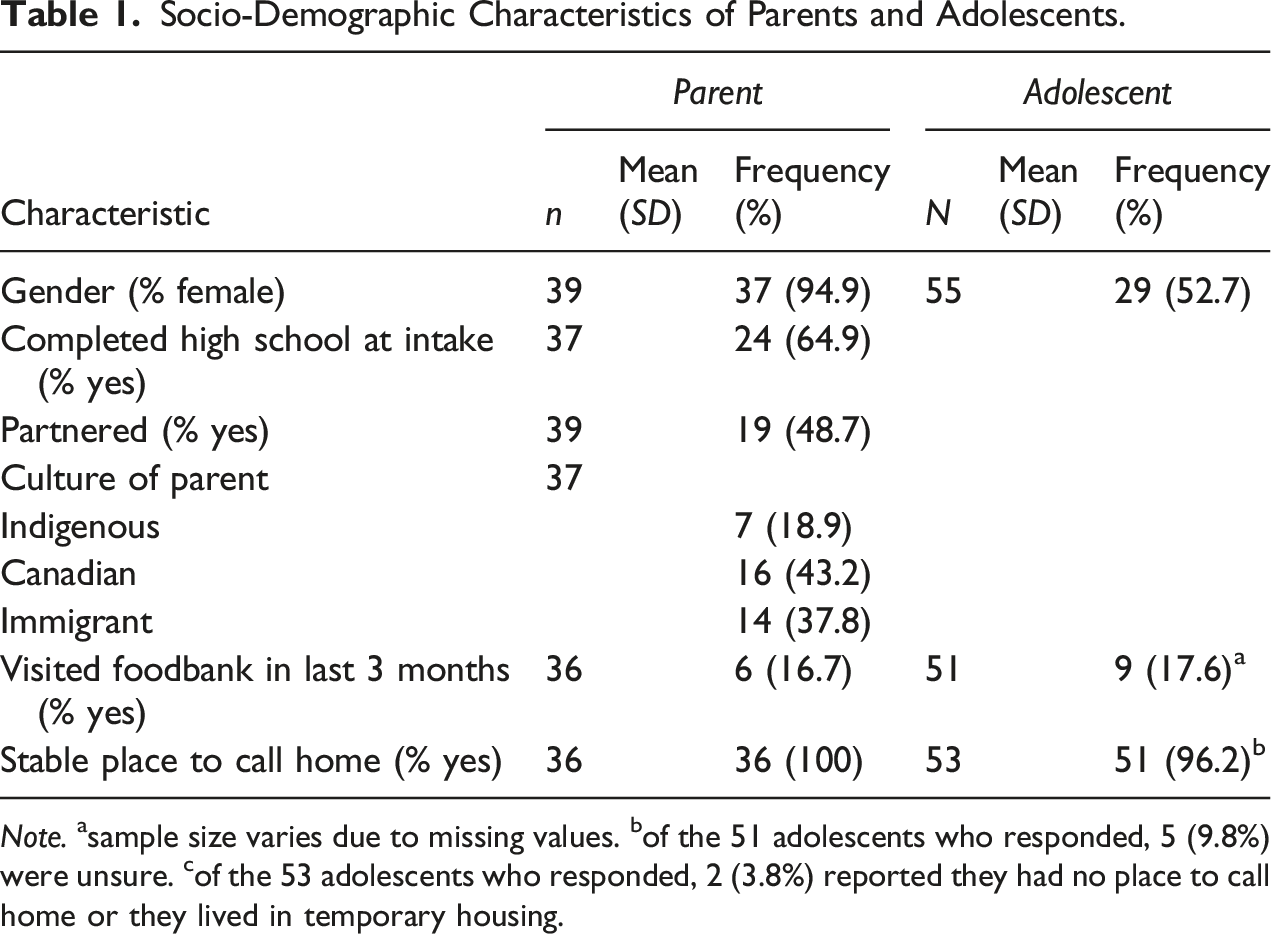
Note. asample size varies due to missing values. bof the 51 adolescents who responded, 5 (9.8%) were unsure. cof the 53 adolescents who responded, 2 (3.8%) reported they had no place to call home or they lived in temporary housing.
Qualitative Findings
Physiological needs
According to (Maslow, 1943, 1970), human motivation occurs through a spectrum of needs, the most basic being immediate physiological needs, such as hunger, health, and income. Parents recalled the place of consistency in daily routines learned at CUPS, reaching beyond effects of education. One parent wrote about role-modeling for her children through “healthy eating classes, cooking, and making time to exercise my body and showing my kids with example” (71). Others wrote learning to “focus on her daily needs/development in good ways” (3), and “knowing the different stages of children development make me to apply in my family” (38). Another parent recalled:
Having an opportunity to have my son in a preschool program to help him learn things. I was trying to fix my life and at times did not have patience to teach him the little things. Like washing properly, serving himself, helping me. (20)
Adolescents wrote about learning routines “eating times and sleeping times helped me as well as playing times” (30), being outdoors at CUPS “played an important part in my health” (58). Two adolescents recalled the place of food, “food donations and the special events during the time at CUPS. The most important part was that it was either free or a really low amount which really helped us at that time” (70); CUPS “gave us little bits of money to help us pay for food” (65). Managing daily physiological needs took precedence over other pursuits, and it was difficult for families to move forward in life until these essentials for living were regularly in place.
Safety Needs
The need for safety, according to (Maslow, 1943, 1970), includes safe housing, security, stability, and the absence of family violence. This need for safety overlaps with physiological needs, “helping in his early development because we are a high-risk family and [CUPS] involvement stopped child welfare from being involved” (68). One parent wrote about their child being “confident to enjoy the actual love and freedom to play as a pre-schooler” (12). Adolescents wrote about safety in different ways, from experiences in family shelters to foster care. One of the adolescents who had been in foster care wrote at CUPS, “always felt safe—helped me learn to put out a good welcome to people and I learned to trust people who really cared” (43). Another adolescent described advantages of the two-generation focus of CUPS, “having gone to a school that allowed me to spend more time with my family” (12). Another wrote “teachers were caring and always cared about our well-being” (57).
Belongingness and Love Needs
Belongingness and love needs, according to (Maslow, 1943, 1970), include affectionate relationships with family and other people, a feeling of belonging to a group or family, and possessing social support. This belonging and love was linked with safety, “the feeling of having a family, a place where I could go and they always listen and help in any way they could” (43), another recalled “being supported as a young mother” (14). Other parents recalled “teaching me parenting and I took some courses that helped me to build a strong happy family” (58). Another parent wrote, “when the staff show a genuine interest in your child, you remember that” (98). Building friendships and being part of a community included CUPS “taking close care for the kid and very close to him in any way” (82), and “it helped my children out a lot to learn how to build friendship and to be more open” (91). Another parent wrote about the effect of community outings, “connected with people and always participated or involved with the community were moms and kids” (82); “the community outings helped me feel happy and part of the community” (68). CUPS provided parents opportunity for volunteering, training, and employment leading to opportunities such as “working for CUPS as a kitchen manager…parenting programs helped me navigate proper parenting with frustrations of being a single parent I was able to do it with less frustrations” (20).
Adolescents recalled field trips, camping, and experiences such as holiday celebrations that drew together their individual families, and other families together in community, “Christmas events and reunions kept us connected with the school and our family” (57). Another wrote:
Looking back at my time at CUPS the events that made the biggest difference to me and my family today would be the events like camping, Christmas events, because when I look back at the pictures that we took there were good memories that brought us together. (58)
One adolescent wrote about “events including team building classes, swim lessons, etc. influenced my engagement in my household (getting along with my siblings), swim lessons helped me overcome my fear of water” (61). Another described CUPS “made sure I was always well-supported. It was the most positive aspect of my childhood. They provided the stability I needed during the most difficult part of my life” (37). One adolescent wrote: “Since I was only a kid when I got to Canada, CUPS helped to open up more and build friendships” (91). Adolescents wrote CUPS “kept us connected” (57), and “I made plenty of friends who I continue to talk to this day” (68). One adolescent wrote “good memories brought us closer” (58), and another described “learning about other families and I am not alone in my struggles” (89).
Esteem Needs
According to (Maslow, 1943, 1970), esteem needs included self-respect, self-esteem, independence, confidence, and a desire for achievement and mastery. One parent described how their time at CUPS influenced current involvement in activities such as “plays, concerts, parent-teacher interviews, volunteering, dance, sports, singing, resource teacher meetings I phone and arrange” (12). Another parent wrote about having “regular meetings to check on my daughter’s education” (102), and yet another, about “learning to make better choices for my family” (89). Being treated “very nice and they respect us” (47) was also noted.
One parent wrote about “the way the kids had a comradery” (86). Parents noted increased independence in their children, and in themselves, “I learn to make time for my kids and make time for myself to be more independent” (71). Another noted CUPS helped “build self-confidence, self-worth, anything is possible. Anyone can overcome anything, circumstances, low self-esteem” (65). Parents engaged in learning through formal education, through CUPS, and through their children. “I had a chance to study because CUPS would take care of my children. And my children would build friendships with other kids” (91). Another wrote, “The teaching program was great as he was able to teach me what he was learning. It also helped him when he entered elementary school as far as learning and social skills” (20). One parent described how CUPS “helped me find strength to leave abusive relationship for good” (76).
One adolescent recalled learning “social skills that help me make friends. I also learned a lot of ways to build and further relationships” (68). One adolescent recalled “learning how to effectively communicate with other children and being able to get along with a variety of other students. Also, simply the love and affection we were shown by the staff made our young selves more confident” (3). Another wrote “being part of the environment at CUPS pushed (encouraged) me to try new things and has influenced me to be a part of different activities” (59). Another adolescent recalled, “being able to do the things I loved as a child boosted self-confidence. I was always encouraged, motivated, and inspired by teachers and daily events” (61). “During my time at CUPS I was able to develop social skills that helped me become more confident and made it easier for me to work with others” (59). And finally, one adolescent wrote: “I am happy with my life and the people in it” (89).
Self-Actualization
According to (Maslow, 1970), self-actualization is driven by growth motivation, whereas the lower Maslow’s Hierarchy levels are driven by needs. Adequate economic, familial, and educational environmental conditions are necessary to support humans in achieving higher levels (Maslow, 1970). However, in our research, overlap between physiological, safety, belongingness and love, and esteem needs were evident, as were self-actualization descriptions by participants of self-fulfillment, character expression, personal growth, and helping others. Parents described processes of “learning to live with your family, friends” (82). Having children at CUPS involved volunteering for duties at CUPS, “help to fix and organize classes for the kindergarten and to prepare food for the children” (91). This volunteering has been ongoing for some parents, and for some, has turned into employment at CUPS. One mother wrote “how all my children benefitted through CUPS and I have confidence and experience from working for CUPS for over 12 years” (12). Another wrote about “all the support and finding what our family needed to succeed, not just education” (107). One parent wrote “just made me happier…it gave me a better look at life” (75), and yet another, “a good foundation that all things are possible” (65).
One adolescent described “meeting new people, learning English, going around the city and learning different things, also the teachers that taught me, helped me discover who I am” (35); contributing to “health and happiness they taught us healthy lifestyles, and healthy foods, and for happiness they taught me how to smile everywhere” (35). CUPS “gave me the drive to try new things” (65), and “exposure to different types of people with different backgrounds. This opened my eyes and helped me realize how similar people are. Skin color and ethnicity did not matter” (20). Another adolescent wrote, “when I was first joined, I only knew how to speak Punjabi. So, learning how to speak English allowed me to become an effective communicator for our family” (3).
Long-term effects of CUPS on current life circumstances and happiness included, “It was the camping trips with my family and the Christmas party that was the biggest difference in my happiness today” (58), and another wrote, “meeting new people, learning English, going around the city and learning different things, also the teachers that taught me, helped me discover who I am” (35). One adolescent wrote CUPS “helped me become a better person artistically…art helped me understand emotion” (22), another wrote, CUPS “helped me find my way and helped me find art” (71).
Quantitative Results
Means, Standard Deviations, Proportions at Risk, and Paired t-tests for Dimensions of the Adult-Adolescent Parenting Inventory Sten Scores, and Adverse Childhood Experiences Questionnaire for Parents and Adolescents.
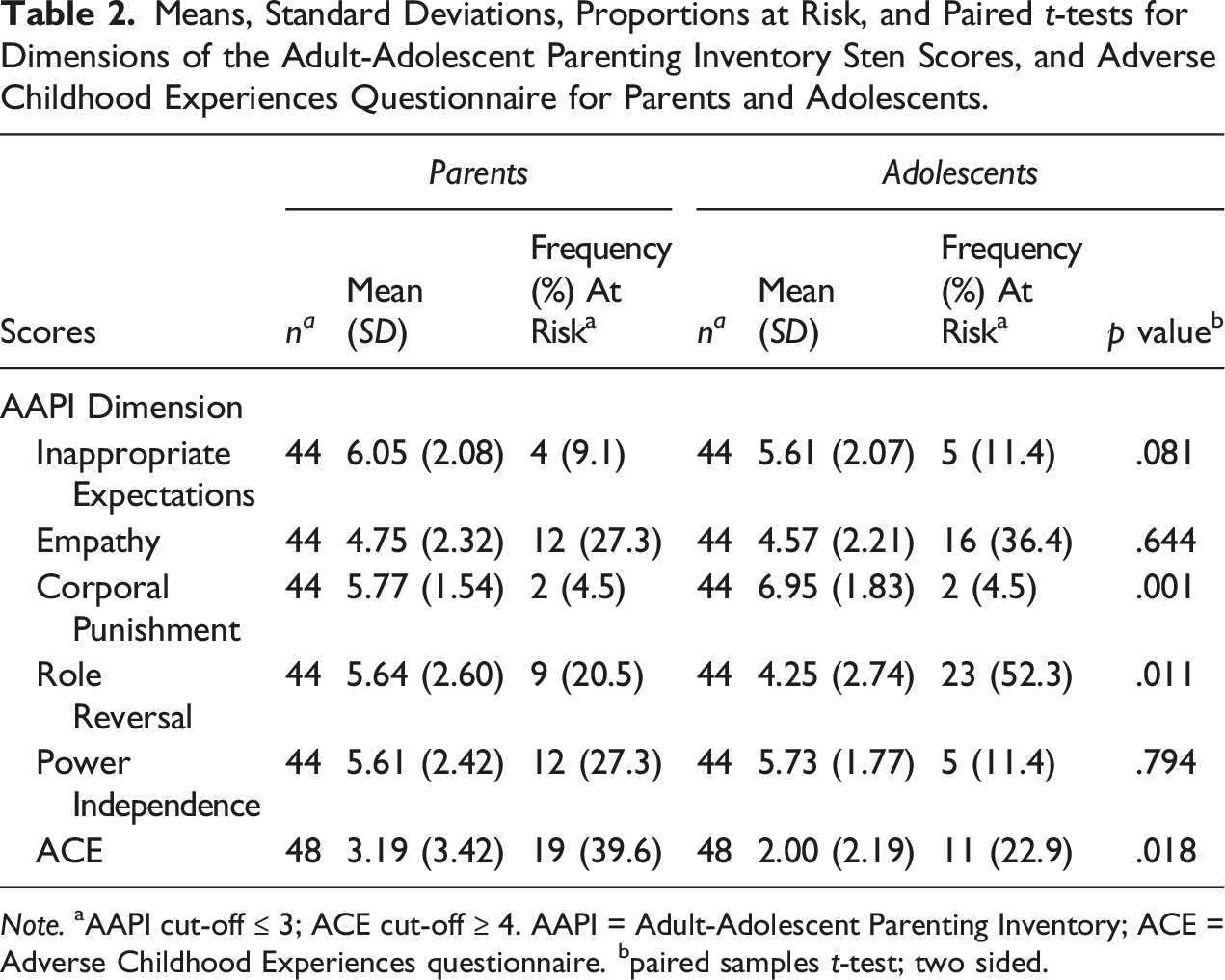
Note. aAAPI cut-off ≤ 3; ACE cut-off ≥ 4. AAPI = Adult-Adolescent Parenting Inventory; ACE = Adverse Childhood Experiences questionnaire. bpaired samples t-test; two sided.
Discussion
In this cross-sectional, concurrent triangulation mixed methods study of socially vulnerable parents and late adolescents who participated in CUPS two-generation preschool program, we explored intergenerational risk for child maltreatment and adversity, and movement toward resiliency. With the qualitative analysis we found that physiological, safety, belongness and love, esteem, and self-actualization were evident in an overlapping manner. As daily physiological needs were more readily met in small yet meaningful ways, families were able to focus on safety, more secure housing, and safer family and community environments, developing trusting relationships, and gaining children back from foster care. Belongingness and love expanded for families through having a safe, welcoming place to go for help with parenting, where parents and adolescents could build friendships, connecting with others. For parents and adolescents, esteem-building occurred through learning healthy ways of communicating, overcoming obstacles through increased opportunities for independence in decision-making, becoming stronger and more determined. Self-actualization included learning to live in new ways with family/friends, volunteering, developing music, art, and outdoor activity skills, contributing to having a positive outlook on life. Throughout the literature, risk factors for child maltreatment include: the burden of increased stresses from living with low income; having experienced severe maltreatment as a child; intimate partner violence in the home; certain psychological and neurodevelopmental factors (parental and child); and a lack of social support (van IJzendoorn et al., 2020). However, protective factors, which can decrease the risk of child maltreatment include: having a social support network; nurturing stable and safe relationships, and high levels of maternal warmth (van IJzendoorn et al., 2020). We found that families in our study described the risk factors in their lives for child maltreatment, yet also opportunities for experiencing and developing protective factors originating in what they learned and experienced throughout their time at CUPS.
We explored the relationship between parental and late adolescent attitudes toward child maltreatment in addition to parental and adolescent adverse childhood experiences. Although parents and adolescents all demonstrated moderate risk for child maltreatment, adolescent’s scores for belief in the use of corporal punishment demonstrated lower risk than parent scores. Adolescent’s scores for role reversal were indicative of the belief in their responsibility to care for their parents and siblings. In addition, adolescents’ mean ACE scores were significantly lower than parental ACEs. Our research identified positive intergenerational shifts in risk for child maltreatment and ACE scores in families experiencing social vulnerability. Morris et al. (2021) reported an association between parental ACE scores and harsh attitudes toward parenting, with those experiencing higher ACE scores at higher risk for child maltreatment. However, cumulative protective and compensatory experiences including unconditional love from a parent or primary caregiver, having a best friend, being part of a social group, volunteering in the community, and having the support of an adult outside the immediate family such as a teacher, coach, or mentor were related to more nurturing attitudes despite higher ACEs. In our study, parental and adolescent perceptions of experiences at CUPS included descriptions of cumulative protective and compensatory experiences as described by Morris et al. (2021). These cumulative and protective compensatory experiences were potential contributors to our study’s results of lower adolescent than parental ACE scores. In addition, Morris et al. (2021) identified a higher family income was linked to more nurturing parenting attitudes. Heckman and Corbin (2016, p. 346) described the “Matthew Effect,” (equal treatment of children with different environments and skills favors more positive outcomes for those in advantaged environments), and “Dynamic Complementarity,” (early intervention is economically and socially productive for children experiencing vulnerability, as it becomes harder to remediate deficits in skills as children age). Creating more equitable environments for children is ideal, however, for greatest effectiveness, enrichment of early life environments must be followed by enrichment of later life environments (Heckman & Corbin, 2016). Environments begin prenatally, favoring those most advantaged, and include financial resources, peer and social norms, social policies and regulations along with health, cognitive, personality, character, motivation, and aspiration skills (Heckman & Corbin, 2016). Environmental influences, along with cumulative protective and compensatory experiences fit within Maslow’s Hierarchy, including physiological and safety needs (a home that is clean and safe with enough food to eat, a home with routines and rules that are clear and fairly administered, and regular involvement in organized sports or other physical activity), belongingness and love needs (caregiver who loves them unconditionally, at least one best friend, an adult they can trust and count on), esteem needs (regular opportunities to help others, an engaging hobby), and self-actualization (school providing resources and academic experiences, active membership in at least one civic group).
In a systematic review and meta-analysis (Petruccelli et al., 2019), non-white race/ethnicity, low education, and low SES were significantly associated with reporting an ACE, compared to not reporting an ACE. Reporting a single ACE was associated with being an adult victim of violence, illicit drug use, and behavior problems (Petruccelli et al., 2019). The higher the ACE score, the higher the negative psychosocial/behavioural health outcome was reported including: tobacco use, alcohol misuse, depressed mood, risky sexual behavior, illicit drug use, suicide attempt, poor diet, poor health/quality of life, psychological distress, and panic/anxiety (Petruccelli et al., 2019). The higher the ACE score, the higher the negative medical health outcome was reported including: respiratory disease, sleep problems, ischemic heart disease, gastrointestinal disease, somatic pain/headache, hypertension, stroke, fracture, memory impairment (Petruccelli et al., 2019). There is a cumulative effect of ACEs, therefore strategies for prevention are essential; ACE interventions are varied, including resiliency promotion, and parenting interventions, however, there are currently no straightforward solutions (Petruccelli et al., 2019). Petruccelli et al. (2019) noted the importance of early screening and the need for further research validating ACE screening for children. We concur, in our study, we were unable to find a psychometric assessment of the ACE-Q Teen SR (Bucci et al., 2015) we administered to adolescents.
We explored how parental and late adolescent perceptions of experiences at CUPS affected intergenerational attitudes toward child maltreatment and/or movement toward resiliency. Integration of qualitative findings and quantitative results using Maslow’s Hierarchy as a framework revealed multiple processes in progression from living to meet physiological needs to living in a more psychologically healthy (self-actualized) way (Figure 1). Benzies and Mychasiuk (2009) identified individual, family, and community protective factors in resiliency. Individual protective factors include an internal locus of control, emotional regulation, belief systems, self-efficacy, effective coping skills, education and training, health, temperament, and gender. Family protective factors include family structure, intimate partner relationship stability, cohesion, supportive parent-child interaction, stimulating environment, social support, family of origin influences, and adequate income and housing (Benzies & Mychasiuk, 2009). Additionally, Benzies and Mychasiuk (2009) noted the intergenerational effects of protective factors fostering resiliency. In the ever-expanding and evolving resiliency research, understanding how to reduce adverse effects of trauma exposure while maximizing positive effects of adversity exposure will require increased understanding of individual physiological and psychological factors in addition to the accompanying social determinants of health (Denckla et al., 2020). Our findings suggest that early childhood interventions for families experiencing social vulnerability must focus on environmental influences identified by Maslow and Heckman and Corbin (2016), in an intergenerational and wholistic manner. Our study is the first of its kind to assess intergenerational effects of a two-generation preschool in adolescence on risk for child maltreatment and ACEs. Limitations include a small sample of a Canadian single two-generation early intervention program therefore, results may not be generalizable. In addition, further investigation of Maslow’s acculturation of Blackfoot Nation philosophy is warranted (Feigenbaum & Smith, 2019). Parent and adolescent perceptions in relation to Maslow’s Hierarchy of needs and ACE questionnaire Items.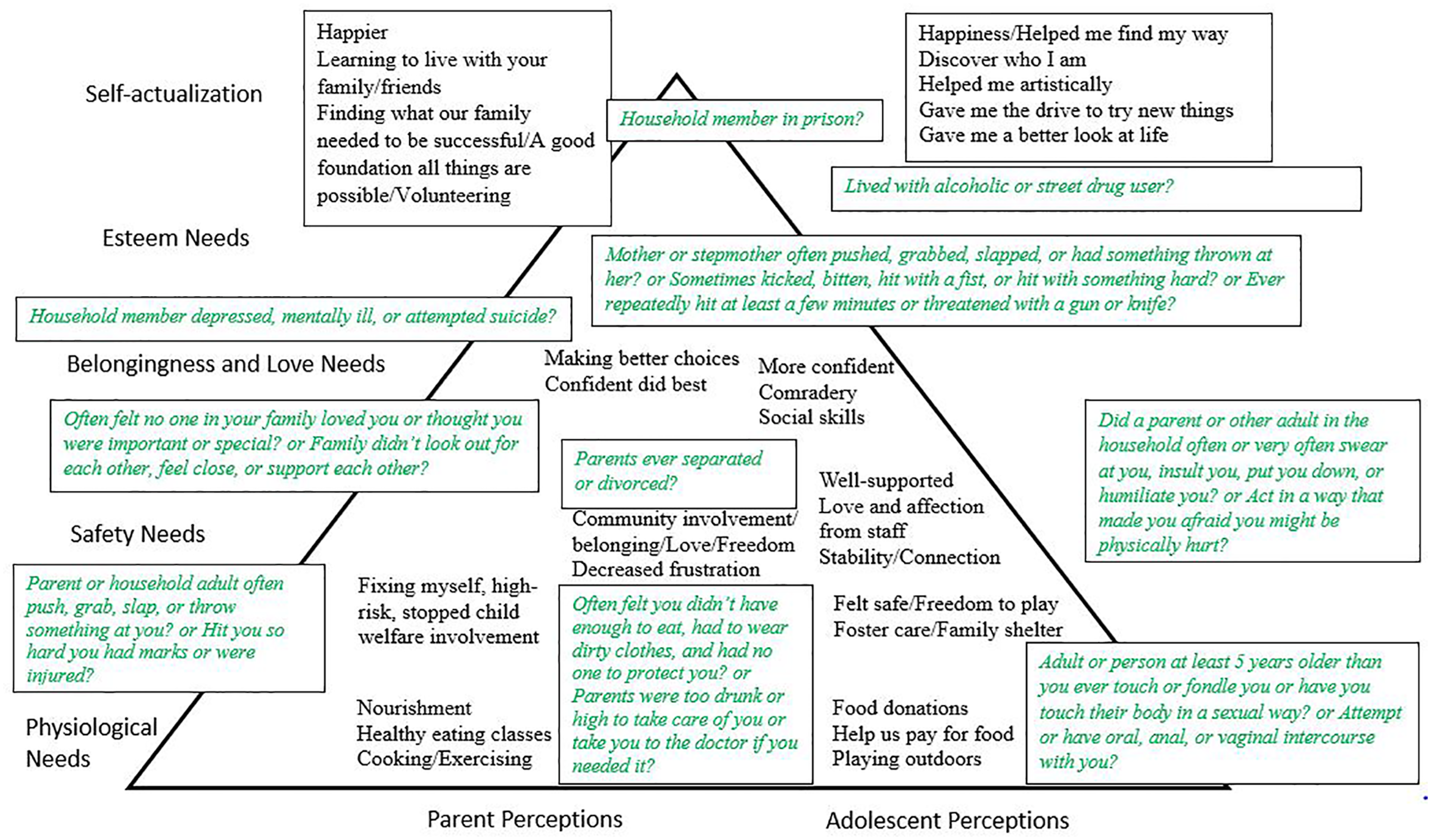
Conclusions
It is difficult to measure the effects of two-generation programs over time, particularly once children become adolescents. Additionally, it is challenging to capture intergenerational effects of two-generation preschool programs. We discovered parent and adolescent perceptions of early parenting/childhood experiences within a supportive and nurturing environment were not forgotten. This suggests a preventative aspect to the services. Future use of the child protective services will decrease. Effects of the preceding experiences were long-lasting and far-reaching, overlapping within and across Maslow’s Hierarchy over time. Attitudes toward parenting demonstrated a positive intergenerational shift, as did the occurrence/prevention of adverse childhood experiences. Although parents and adolescents scored at moderate risk for child maltreatment, adolescents were at lower risk for use of corporal punishment, possessing lower ACE scores. Early childhood interventions for families experiencing social vulnerability, must focus on development of ongoing supportive social support systems, with positive environmental influences in an intergenerational manner. Attention to the components of Maslow’s Hierarchy can positively influence movement toward resiliency. Movement toward resiliency is not easily understood, involves struggle, and is a continuous, lifelong process invoking breaking intergenerational cycles of adversity.
Footnotes
Acknowledgments
Thank you to the children, caregivers, and staff at CUPS, and Carlene Donnelly, Executive Director.
Author Contributions
Carla Ginn, Robert Perry, and Karen Benzies conceptualized the cross-sectional study.Carla Ginn and Karen Benzies coded qualitative data, Karen Benzies completed quantitative analysis, and together Carla Ginn and Karen Benzies integrated qualitative findings and quantitative data.All authors read and approved the final manuscript for submission.
Declaration of Conflicting Interests
The author(s) declared no potential conflicts of interest with respect to the research, authorship, and/or publication of this article.
Funding
The author(s) disclosed receipt of the following financial support for the research, authorship, and/or publication of this article: This research was funded by the Max Bell Foundation.
