



Abstract
Identifying conditions under which parents thrive is a key concern of family research. Prior research often focused on mothers’ well-being in single life domains, yet it is more likely to be shaped by stressors that stem directly from the parenting role and related stressors emerging from spillover processes into other domains. We therefore examine how stressors concerning mothers’ subjective, relational, and financial well-being accumulate and combine within subgroups of mothers and whether the likelihood to belong to these multidimensional subgroups varies by family structure. Using representative German data (N = 11,242), latent class analysis revealed four distinct subgroups of maternal well-being with varying exposure to financial, psychological, and relational stressors. Regression models showed that particularly single mothers were at risk to belong to the most vulnerable group with exposure to multiple stressors. Findings are discussed in light of persisting disparities among post-separation families despite demographic trends toward growing family diversity.
Introduction
The well-being of parents across the life course has long been a key concern of family sociology and related social sciences for two mains reasons (e.g., Nomaguchi & Milkie, 2020; Umberson, Pudrovska, & Reczek, 2010). First, parenthood is a major social role of adulthood for those who become parents and is marked by ever-changing expectations, challenges, and rewards depending on children’s age, needs, and other circumstances related to the family sphere (Bengtson & Allen, 2009; Thomas, Liu, & Umberson, 2017), which can shape parents’ well-being. Second, parental well-being has direct and widespread implications for the quality of relationships within families, as well as the well-being of other family members and children especially (e.g., Mikolajczak, Gross, & Roskam, 2019; Newland, 2015; Williams, 2018). Prior studies on parental well-being often focused on indicators in single life domains, such as parental stress and life satisfaction (Guzzo, Hemez, Anderson, Manning, & Brown, 2019; Pollmann-Schult, 2014), or group comparisons (e.g., between parents and childless individuals; Leopold & Kalmijn, 2016; Umberson et al., 2010). Yet the well-being of parents is likely to be shaped by stressors that stem directly from one’s role as a parent, as well as subsequent, secondary stressors spilling over into other life domains (Nomaguchi & Milkie, 2020; Pearlin, 2010).
To fill this gap, our study uses a broader, multidimensional definition of well-being that considers stressors concerning parents’ subjective (e.g., mental health; Diener, Scollon, & Lucas, 2009), relational (e.g., conflicts and role strain), and financial well-being (e.g., household income). We first aim to identify exploratory, yet prototypical and homogenous constellations of stressors across life domains that inform parents’ well-being in the family sphere. To detect these constellations and to form a typology of parental well-being, we use latent class analysis (LCA), which is a statistical method that is uniquely suited to model how multidimensional stressors accumulate and combine within otherwise unobservable subgroups of the population (Collins & Lanza, 2009; Schoon & Melis, 2019). Because a large body of research documented well-being disparities between parents in post-separation families compared to those in two-parent families (e.g., Cooper, McLanahan, Meadows, & Brooks‐Gunn, 2009; Dziak, Janzen, & Muhajarine, 2010; Raley & Sweeney, 2020), the second aim of our study examines whether the likelihood of belonging to certain subgroups of parental well-being varies systematically by family structure. Given that mothers still assume a larger share of (child)care-related duties in families (Schoppe-Sullivan & Fagan, 2020), and that the vast majority of single-parent households are female-headed (Bernardi, Mortelmans, & Larenza, 2018), our study focuses on mothers’ well-being specifically.
Mothers’ Well-Being as Constellations of Stressors
Mothers play a pivotal role in families because they tend to organize family members’ schedules (e.g., planning children’s play dates or extracurricular activities) and spend more time with their children as well as childcare-related tasks compared to fathers (e.g., Daminger, 2019; Nomaguchi & Milkie, 2020), even though the gender gap is starting to shrink (Schoppe-Sullivan & Fagan, 2020). In turn, mothers’ well-being is both influenced by family-level factors (e.g., social support or perceived role strain) and consequential for the well-being of other family members. The latter point is particularly rooted in theoretical constructs such as the linked lives principle of the life course perspective (Elder & Shanahan, 2006; Settersten, 2015), which highlights the interconnectedness and social influence among family members across the life course (Thomas et al., 2017). For example, Choi and Becher (2019) showed that maternal depression was linked to an increased likelihood of child behavioral problems through mothers’ use of harsher parenting practices.
To gain a deeper understanding of factors that contribute to maternal well-being across different life domains specifically, we draw on stress process frameworks (e.g., Pearlin, 2010). At their core, these postulate that the stress process that undermines well-being is shaped by the presence of stressors, which can range from disruptive events to chronic or daily conditions as sources of stress (Almeida, 2005; Bliese, Edwards, & Sonnentag, 2017; Dohrenwend, 2006). Individuals availability and deployment of personal, social, economic, or other types of resources can offset or counteract stressors and therefore buffer or strengthen well-being (Almeida, 2005; Nomaguchi & Milkie, 2020). However, one important hallmark of stress process frameworks is that the occurrence of one (primary) stressor can give rise to a range of secondary stressors through the process of stress proliferation (Pearlin, 2010). This means that individuals’ exposure to one stressor can trigger a series of gradual risks within the same or other life domains that unfold subsequently and, in turn, magnify its detrimental effect on well-being.
With regard to mothers’ well-being, we focus on the salience and linkages between stressors in three important domains related to the family sphere: psychological distress, economic hardship, as well as one's parental role and relationship strain. Each of these stressors has shown to diminish health and well-being (for an overview, see Nomaguchi & Milkie, 2020; Umberson & Thomeer, 2020). For example, economic hardship—particularly subjective feelings of material deprivation—contributes to disparities in well-being (Mishra & Carleton, 2015). This stressor, however, can also generate other stressors in the family sphere that diminish maternal well-being further. For instance, mothers’ exposure to economic hardship can, in turn, increase their risk to suffer from psychological distress, which has subsequently been linked to higher levels of marital conflicts (for an overview, see Masarik & Conger, 2017). Additionally, low-income mothers tend to report higher time constraints for the family (e.g., because of multiple jobs or challenging job schedules; Cooper & Pugh, 2020), which can also increase their parental role strain and stress (Hecht, 2007).
Disparities in Maternal Well-Being by Family Structure
The landscape of families and living arrangements with and without children has changed rapidly in Germany similar to the trends in many other Western nations over the last decades (e.g., Kreyenfeld, Konietzka, & Heintz-Martin, 2016; Mortelmans, 2020; Raley & Sweeney, 2020). Steady increases in divorce rates and non-marital childbirth across many European countries have, among other reasons, led to growing numbers of single-parent households, who tend to be female-headed, and stepfamilies (Bernardi et al., 2018; Härkönen, 2014). For example, crude divorce rates have risen in Germany from 1.3 per 1000 inhabitants in 1970 to 1.8 per 1000 inhabitants in 2019, which mirrors the current European average (Eurostat, 2021). A large body of research documented persisting social and socio-economic disparities between post-separation families and those without experiences of union dissolution (e.g., Burstrom et al., 2010; Guzzo et al., 2019; Wickrama et al., 2006) despite these demographic changes.
For example, being a single mother is still a strong predictor of a higher poverty risk and financial strain, as well as more fragmented work histories (e.g., Chzhen & Bradshaw, 2012; Heintz-Martin & Langmeyer, 2020; Millar & Ridge, 2009). Such risks can have detrimental effects on mothers’ mental and physical well-being in post-separation families (Burstrom et al., 2010; Pollmann-Schult, 2018; Wickrama et al., 2006) for at least two reasons. First, the experience of union dissolution itself represents a major stressor or (at least a temporary) crisis that has direct and lasting effects on maternal well-being (Amato, 2010; Thoits, 2010). Second, experiencing union dissolution proliferates into other life domains by increasing mothers’ exposure to other secondary stressors (Pearlin, 2010; Thoits, 2010), such as shouldering sole parenting responsibilities, losing emotional support, or having continuing conflict with the other parent (e.g., Cooper et al., 2009; Dunn, O'Connor, & Cheng, 2005; Lamela, Figueiredo, Bastos, & Feinberg, 2016). Mothers in stepfamilies further suffer from higher levels of parental stress and, at times, less close-knit step-relationships (Guzzo et al., 2019; Raley & Sweeney, 2020; Smith, 2008), which can be attributed to heightened role conflicts and strains among these mothers (Hecht, 2007). Taken together, exposure to these additional stressors can widen gaps in maternal well-being between mothers in post-separation and two-parent families.
Against this backdrop, our study aims to gain exploratory insights into a multidimensional view of maternal well-being by considering stressors that stem both directly from mothers’ parenting role (i.e., parental stress) and other most central stressors that emerge from stress proliferation into related life domains (i.e., psychological distress, financial strain and economic deprivation, time pressure, and relationship conflict; Nomaguchi & Milkie, 2020). We address two main research questions. First, we ask whether different stressors that affect mothers’ well-being in families cumulate across life domains and how they combine within prototypical subgroups of maternal well-being. Second, we ask whether the risk of belonging to certain subgroups of maternal well-being varies systematically by family structure because of long-standing disparities in the exposure to series of stressors between mothers in post-separation and two-parent families.
Method
Data
Data stemmed from the second installment of the representative, cross-sectional survey “Growing up in Germany,” which was launched between 2013 and 2015 (Walper, Bien, & Rauschenbach, 2015). It is one of the largest surveys of children, youth, young adults, and their parents in Germany and covers a wide range of topics for different age groups (e.g., childcare arrangements, the division of household chores, or youth participation) and from different perspectives (e.g., child vs. parent report). For that purpose, the target sample consisted of children, youth, and young adults aged 0–32 years. The sample was drawn randomly from a nationwide German population register and participants were then contacted by a professional interviewer. Standardized, telephone-assisted interviews were conducted with target persons drawn from the population register from age 9 upward. For minors, the primary caretaker—usually the mother—was interviewed for parts (from age 9–17) or the whole survey (below age 9). The full sample included 22,424 respondents and we restricted our analytic sample to mothers with at least one minor (aged 0–17 years) in the household (N = 11,242).
Variables
Indicators of Well-Being
We used seven indicators covering mothers’ well-being in the domains of subjective well-being, relationship quality, time pressure, parental stress, and economic well-being (e.g., Nomaguchi & Milkie, 2020): (1) Psychological distress was assessed using the WHO-5 scale (Topp, Østergaard, Søndergaard, & Bech, 2015). Mothers were instructed to rate how often they felt the following emotions during the last 2 weeks on a scale from 1 (at no time) to 6 (all of the time): cheerful and in good spirits; calm and relaxed; active and vigorous; woke up fresh and rested; daily life filled with things that interested me. They were also asked to rate how often they had (2) conflicts with their partner and whether there were (3) tensions in the family on a scale from 1 (always) to 4 (never). Furthermore, mothers were asked how much (4) time they had for their family during a regular week (1 = too much; 2 = right amount; and 3 = too little). (5) Parental stress was also assessed by asking mothers to rate whether they felt overwhelmed with their parental duties on a scale from 1 (fully agree) to 6 (do not agree at all). (6) Families’ objective economic deprivation was measured with a binary variable indicating whether the equalized monthly net household income based on modified OECD equivalence weights was below the poverty line or not (0 = no; 1 = yes). The poverty threshold is set by the European Union at 60% of the median needs-adjusted equivalence income, which translated into an amount of 925 Euros per month. Lastly, to assess (7) families’ subjective financial strain, which has shown to be a robust indicator of financial need (Arber, Fenn, & Meadows, 2014), mothers rated two statements related to their perceived financial situations on a scale from 1 (fully agree) to 6 (do not agree at all): “We often have to pass on something because of our finances” and “In our family, money is often sparse.” Note that we recoded all indicators in a way that higher values corresponded to more negative ratings (e.g., higher levels of psychological distress) in all of our statistical models. An overview of correlations between all well-being indicators is presented in the supplemental online appendix (see Tables A1 and A2).
Predictors of Well-Being
Descriptive Sample Statistics by Family Structure.
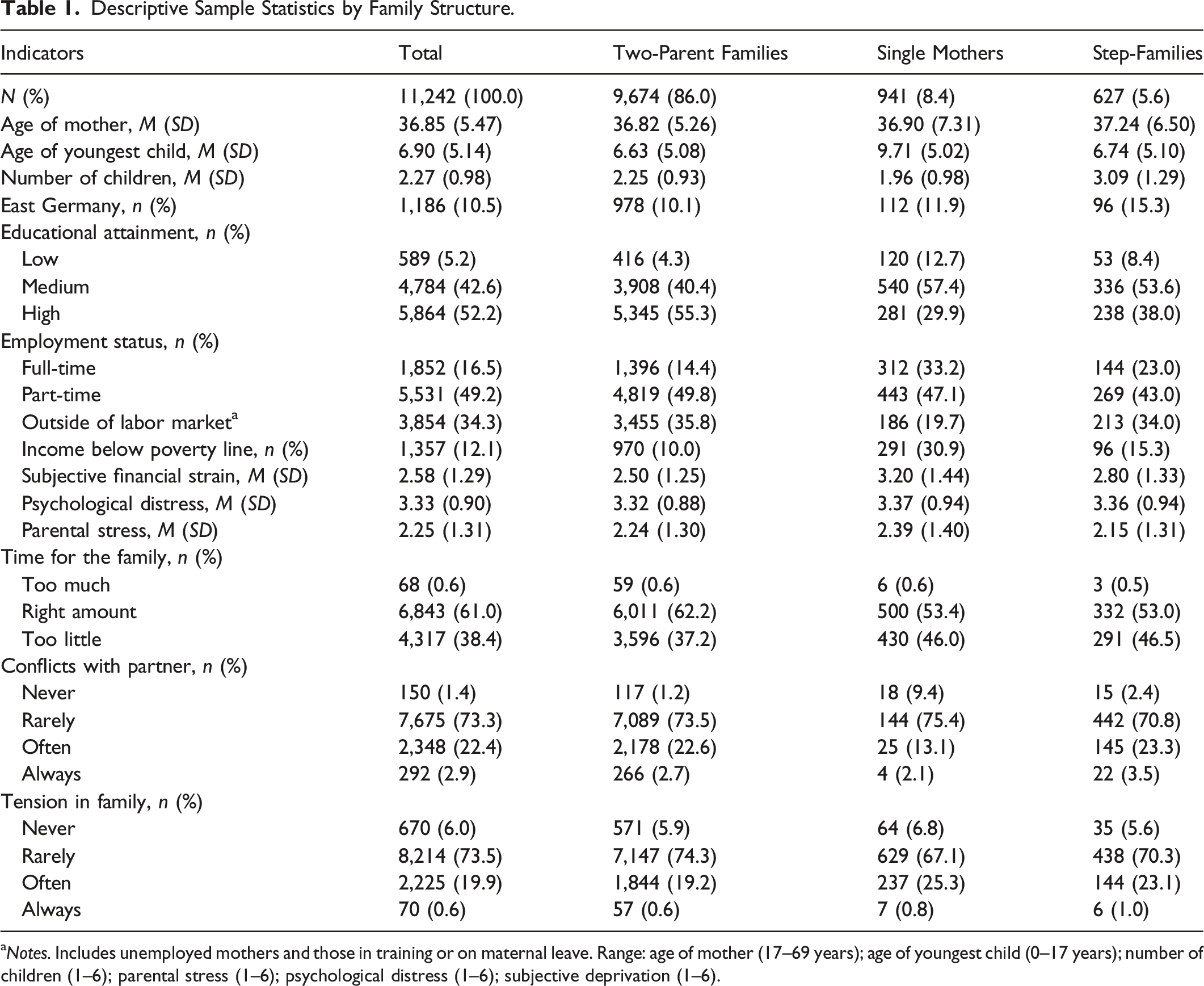
aNotes. Includes unemployed mothers and those in training or on maternal leave. Range: age of mother (17–69 years); age of youngest child (0–17 years); number of children (1–6); parental stress (1–6); psychological distress (1–6); subjective deprivation (1–6).
We further had sociodemographic information on mothers’ age (in years); educational attainment based on the Comparative Analysis of Social Mobility in Industrial Nations index (1 = low to 3 = high; Brauns, Scherer, & Steinmann, 2003); employment status (1 = outside of the labor market, i.e., if unemployed, in training, or on maternal leave; 2 = part-time employed; and 3 = full-time employed); the age of the youngest child in the household (in years); the number of children in the household; and region of residence (0 = West Germany and 1 = East Germany).
Analytical Strategy
To address our first research question, we used LCA (Collins & Lanza, 2009), which is a quantitative and person-centered approach to identify prototypical and homogenous constellations of stressors across different life domains that combine within and shape mothers’ well-being in families. The core principle of LCA, which belongs to the group of mixture models, is to classify individuals into otherwise unobservable subgroups (so-called latent classes) based on their similarities and differences in their response patterns instead of relations among outcome and predictor variables (e.g., as in ordinary regression models). Because the grouping variable of interest (i.e., the latent class membership) is not directly observable, it is indicated by a set of observed (here: binary, categorical, and continuous) variables.
Analyses were conducted in two main steps. First, we fitted a series of nested LCA models by entering all of the individual items of our well-being indicators into the model (see Figure A1 in the online appendix for a graphical illustration of the estimated latent class models) and increasing the number of latent classes gradually from one to up to six. To avoid receiving inaccurate parameter estimates due to local likelihood maxima in the iterative estimation process, we increased the number of random sets of start values and checked the replicability of the best log likelihood value (Geiser, 2010). We then compared the absolute and relative model fit indices (e.g., AIC and BIC, entropy, and likelihood ratio tests), class counts, as well as the interpretability of results, across all nested models to determine the appropriate number of latent classes (Maysn, 2013).
Second, we used respondents’ most likely latent class membership as the outcome variable in stepwise multinomial regression models to answer the second research question on whether the likelihood to experience certain constellations of stressors varied systematically by family structure. To ease interpretation and allow comparability across nested models, we report discrete differences in average marginal effects (AME) of the regression models (Long, 2015). AME represent the average impact of the independent variable on the likelihood of each outcome category (i.e., belonging to each respective latent class in our case). For continuous variables, the table shows average discrete change in the predicted probabilities for a one-unit increase in the predictor and, for categorical variables, it represents average differences in predicted probabilities for pairs of levels of the predictor.
Results
Latent Class Model Selection
Goodness of Fit Statistics for Latent Class Models (N = 11,242).
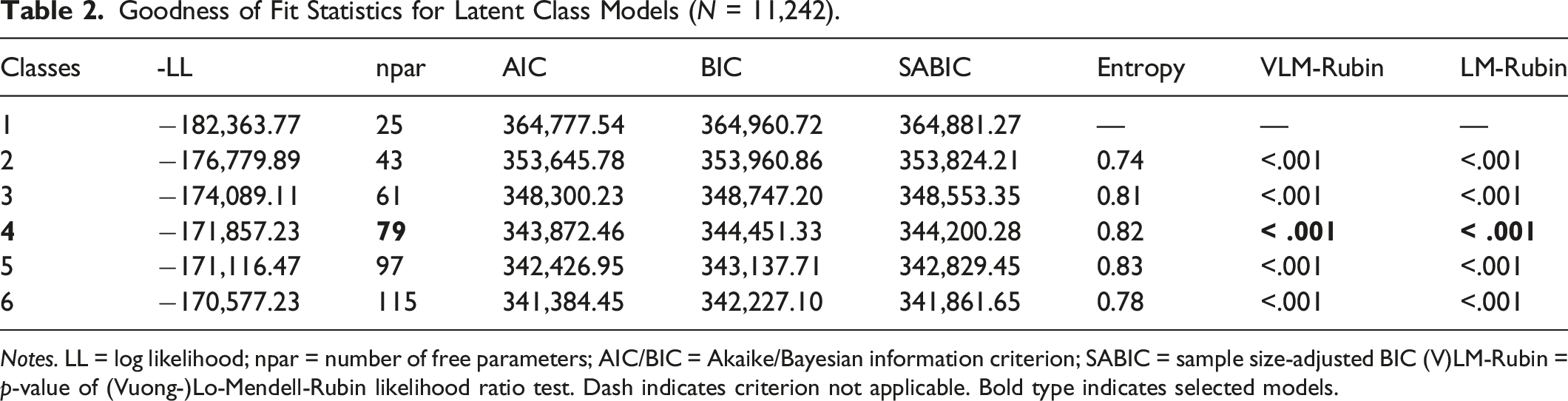
Notes. LL = log likelihood; npar = number of free parameters; AIC/BIC = Akaike/Bayesian information criterion; SABIC = sample size-adjusted BIC (V)LM-Rubin = p-value of (Vuong-)Lo-Mendell-Rubin likelihood ratio test. Dash indicates criterion not applicable. Bold type indicates selected models.
Description of Latent Classes
Figure 1 shows the response patterns of the continuous (mean scores in gray) and the categorical variables (likelihood for each response category in black) for the latent classes. At first glance, the response patterns seemed to be somewhat similar across classes—particularly for the categorical variables. Yet differences in the level of endorsements across classes revealed some interesting differences. For example, we found two classes with relatively little economic deprivation (Classes 1 and 3) and two classes with a considerably larger share of economically deprived families (Classes 2 and 4). Response patterns of the continuous (in gray) and categorical (in black) variables of the four-class solution (N = 11,242). (1) Psychological distress; (2) Subjective financial strain; (3) Parental stress; (4) Time for family; (5) Conflicts with partner; (6) Tension in family; (7) Income below poverty line.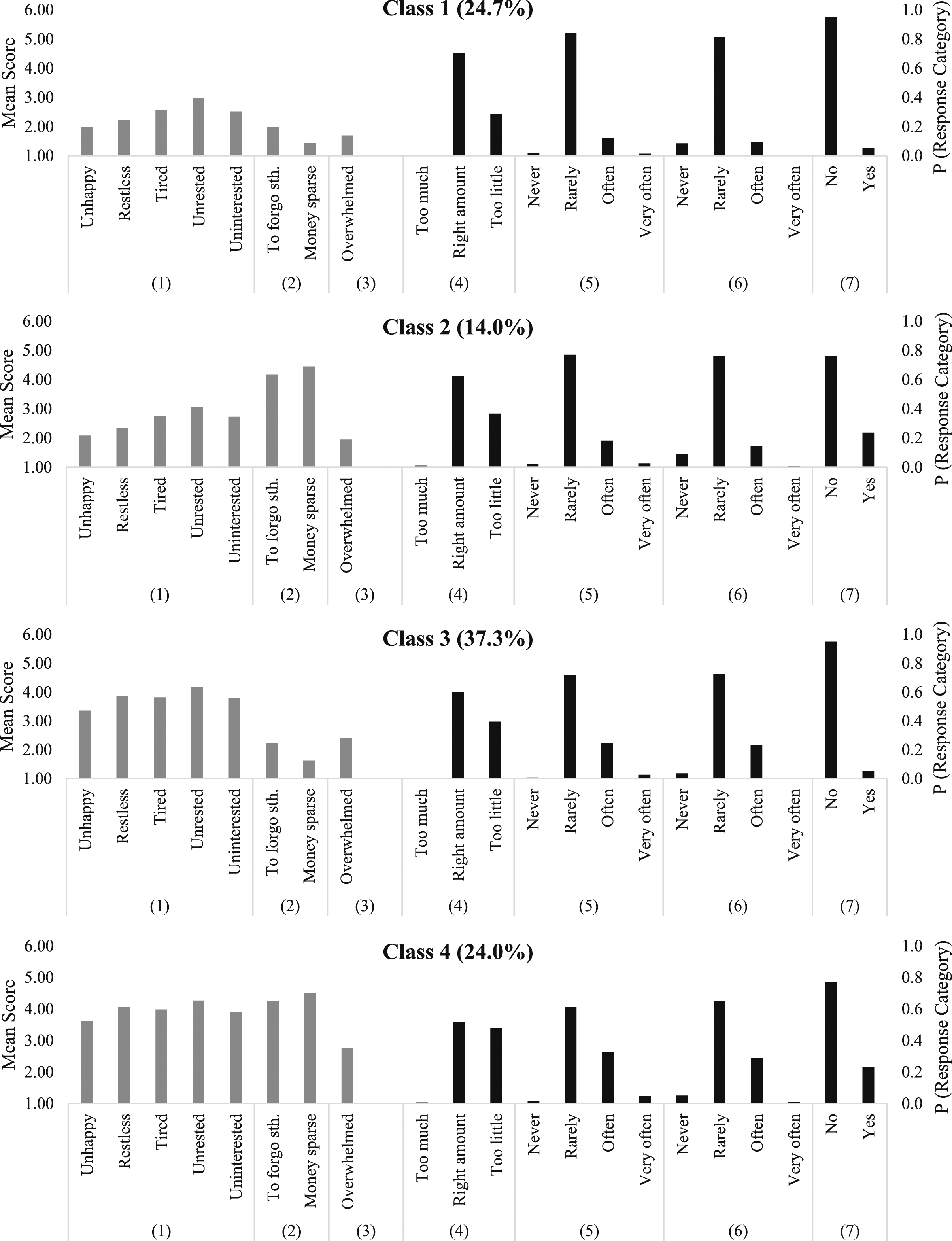
We labeled Class 1, containing 24.7% of the sample, low levels of stressors because this class showed relatively low indorsements on all indicators (e.g., subjective financial strain or parental stress), in addition to the rather low likelihood of being economically deprived. The majority of mothers in this group was further highly likely to report having only few conflicts with their partners or tensions in the family, as well as enough time for their family. In Class 3 labeled not financially but psychologically burdened, which consisted of 37.3% of the sample, the share of economically deprived households below the poverty line was rather small and endorsements of subjective financial strain were low as well. Mothers grouped into Class 3, however, showed higher endorsements of the indicators related to psychological distress and parental stress compared to those in Class 1. They were also more likely to report having too little time for their family, as well as more frequent conflicts with their partners, and tensions in the family in contrast to Class 1.
Class 2, containing 14.0% of the sample, was labeled not psychologically but financially burdened because the likelihood to experience subjective financial strain and to be economically deprived (i.e., household income below the poverty line) was considerably higher in this class compared to Classes 1 and 3. Yet similar to Class 1, mothers in this class reported having about the right amount of time for their family, rarely any conflict with their partners, and tensions in their family. Levels of psychological distress and parental stress were also low. In Class 4 (24.0% of the sample), labeled high levels of stressors, mothers were also more likely to feel financially strained and to be economically deprived compared to Classes 1 and 3, and showed high endorsements on all other indicators (e.g., parental stress and too little time for the family) compared to the other classes.
Results of the Multinomial Regression Models
Average Marginal Effects for Multinomial Regression Models Predicting Class Membership.
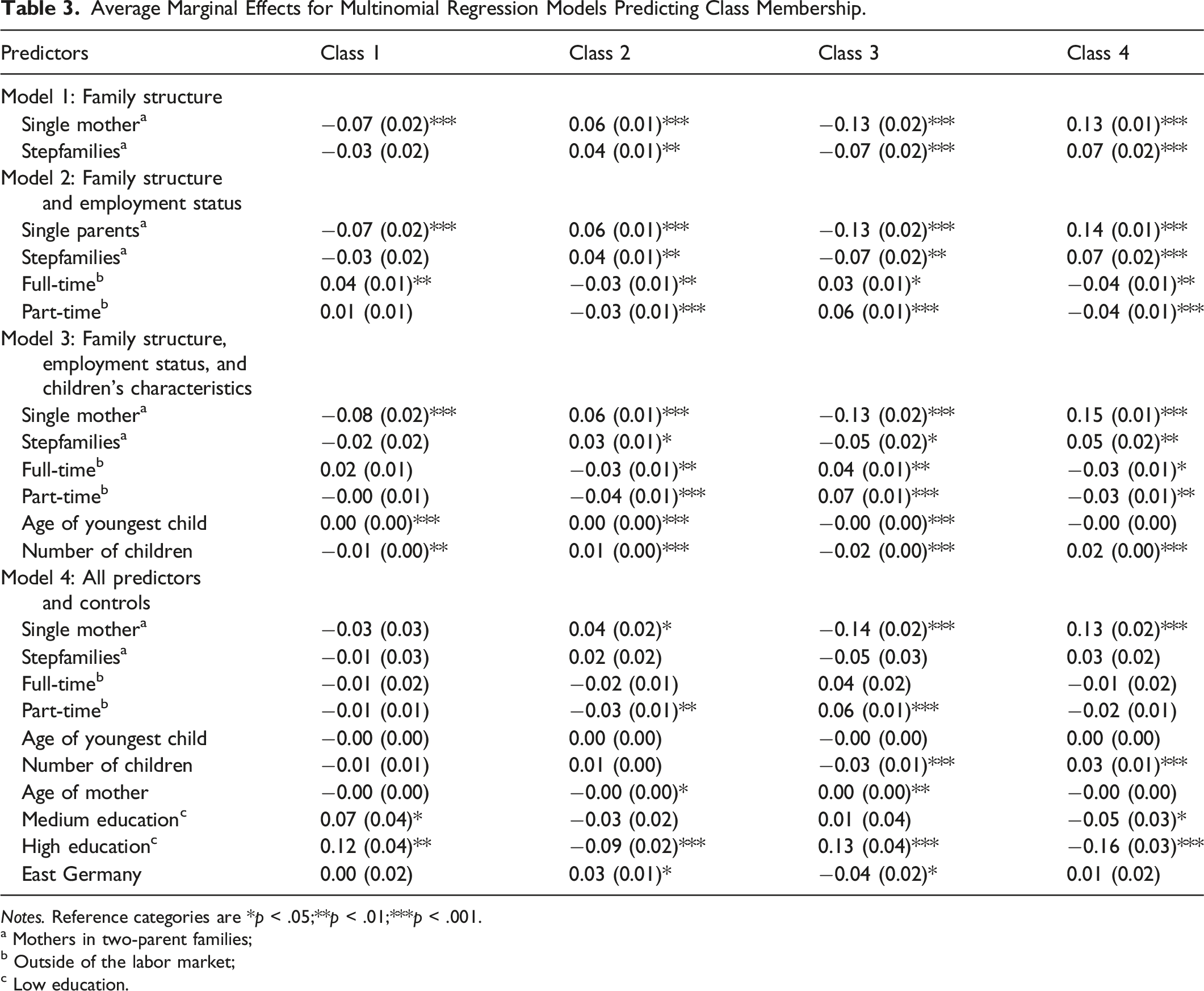
Notes. Reference categories are *p < .05;**p < .01;***p < .001.
a Mothers in two-parent families;
b Outside of the labor market;
c Low education.
Step 3 further added children’s characteristics (i.e., age of the youngest child and number of children in the household) as controls to the model. Results remained unchanged for family structure and mothers’ employment status (except for the likelihood to belong to Class 1 among full-time employed mothers compared to those who were outside of the labor market). Lastly, we added mothers’ sociodemographic characteristics (e.g., age, educational attainment, and study region) as controls in the full model (see also Figure A2 in the online appendix for a graphical illustration of the results of the final model). Prior differences between mothers in stepfamilies compared to those in two-parent families were no longer significant. Single mothers were still more likely to be grouped into Classes 2 and 4, but only less likely to belong to Class 3 compared to mothers in two-parent mothers. Furthermore, mothers with higher levels of education were more likely to belong to the less economically deprived Classes 1 and 3, as well as less likely to belong to the economically and partly psychologically burdened Classes 2 and 4 compared to mothers with low levels of education. This was also partly true for mothers with medium compared to those with low levels of education (i.e., higher chance to belong to Class 1 and lower chance to belong to Class 4). Mothers’ employment status was no longer significant in the final model except for the lower likelihood to belong to Class 2 and the higher chance to belong to Class 3 among part-time employed mothers compared to those who were outside of the labor market.
Robustness Checks of the Latent Class Results
To probe the robustness of our final latent class solution, we replicated the latent class models in different subsamples to check whether a consistent number of classes and class patterns can be reproduced (Maysn, 2013; see online appendix for more information on model fit and response patterns of the extracted solutions). We first estimated latent class models separately for mothers in two-parent and those in post-separation families (i.e., single mothers and stepfamilies) and, second, for three equally sized random subsamples (each N = 3747). Model fit indices for all subsamples supported the selection of the four-class solution, particularly among mothers in post-separation families and those in two out of three random subsamples (see Table A3 and A4). For these subsamples, p-values for both likelihood ratio tests of the five-class solution started to increase (i.e., indicating that the five-class solution did not fit significantly better than the four-class solution). Response patterns of the categorical and continuous class indicators across the subsamples were quite similar to our findings reported for the full analytic sample (see Figure A3 to A7).
Discussion
This study contributes to growing yet still sparse literature on a broader, multidimensional approach to studying mothers’ well-being in families, which has important implications for the well-being of other family members because of the intertwined nature of relationships within families (e.g., Newland, 2015; Settersten, 2015; Thomas et al., 2017). We drew from stress process frameworks (e.g., Pearlin, 2010; Thoits, 2010) to conceptualize how stressors that pertain directly from mothers’ parenting role, and those that emerge through stress proliferation in domains most central to the family sphere, jointly shape maternal well-being (Nomaguchi & Milkie, 2020). Relatedly, prior research documented severe disparities between mothers in post-separation compared to those in two-parent families on single dimensions of well-being (e.g., health and economic deprivation; Burstrom et al., 2010; Heintz-Martin & Langmeyer, 2020), despite demographic shifts in the increased prevalence of post-separation families (e.g., Härkönen, 2014; Raley & Sweeney, 2020). Yet it is unclear whether and how stressors across different domains combine within subgroups of mothers also vary systematically by family structure. We addressed these important issues by extracting prototypical and distinct subgroups of maternal well-being classes using person-centered LCA (Collins & Lanza, 2009) and subsequently examining linkages between the derived latent classes and family structure.
Our analyses revealed four distinct subgroups of maternal well-being that varied in their exposure to psychological, financial, and relational stressors. Two observations concerning the nature of these subgroups stand out specifically. First, only about one-quarter of mothers in our sample were likely to belong to Class 1 with relatively low ratings on all of the stressors compared to the vast majority of mothers in classes with exposure to stressors on few (i.e., Classes 2 and 3) or multiple domains (i.e., Class 4). This is particularly striking because highly educated individuals were overrepresented in our sample (e.g., only about 5% of mothers reported having lower levels of schooling) and educational attainment has shown to be a strong protective factor against exposures to stressors and subsequent well-being detriments (e.g., Almeida, 2005; Thoits, 2010). Second, two classes showed similarly high levels of subjective financial strain and economic deprivation (Classes 2 and 4), yet ratings on other relational and psychological stressors (e.g., parental stress and psychological distress) were considerably lower in Class 2. This is why mothers in this class seemed to show more resilient responses in light of financial stressors compared to the highly burdened Class 4 with high ratings on multiple stressors. Other studies attributed resilient responses to stressors, such as financial strain, with higher levels of family cohesion, larger networks offering social support, or the establishment of more efficient problem-solving strategies (e.g., Greeff & Van Der Merwe, 2004; Orthner, Jones‐Sanpei, & Williamson, 2004; Prime, Wade, & Browne, 2020). Note that this class, containing roughly 14% of the sample, was the smallest of our four derived classes, which is consistent with recent findings stating that resiliency in light of major life stressors is more the exception rather than the rule (Infurna & Luthar, 2016).
Furthermore, we did find that family structure was associated with membership in our well-being classes. Even after adjusting for sociodemographic characteristics, single mothers were still more likely to belong to Class 4 with high levels of stressors, and less likely to fall into Class 3 with higher ratings on parental stress and psychological distress in the absence of financial strain, compared to mothers in two-parent families. These results are in line with prior research on increased poverty risks among post-separation families (Chzhen & Bradshaw, 2012), which then trigger the accumulation of other stressors across life domains among these disadvantaged families (Bernardi et al., 2018; Cooper et al., 2009; Pearlin, 2010). Prior studies also showed that family structure-related disparities in maternal well-being are stronger in countries with welfare states that have less support for non-traditional family constellations (Burstrom et al., 2010; Pollmann-Schult, 2018), such as in Germany. Because our study was set in Germany, unique characteristics of its welfare state may, at least in part, explain our findings. For example, Germany still operates under the male-breadwinner model that actively discourages both parents to work through taxation which leaves little fiscal benefit for dual-earners and promotes a more traditional two-parent norm (Grunow et al., 2018; Thévenon, 2011). Financial support for all families regardless of financial need is above the OECD average, while leave entitlements with no strong incentives for paternal involvement and public childcare provision are average compared to other OECD countries. This could indicate that accumulated stressors in our domains for mothers in post-separation families, and single mothers specifically, stem from lacking institutional support for mothers’ family–work reconciliation (Reimann, Marx, & Diewald, 2019). Mothers in post-separation families, who are already more penalized by more fragmented work histories (Millar & Ridge, 2009), may therefore opt for part- rather than full-time employment, which is related to income cuts and could, in turn, elevate their poverty risk and exposure to secondary stressors further.
Limitations and Conclusion
Our study has several limitations. First, our results are based on cross-sectional data that offer only a single snapshot of mothers’ social, emotional, and economic situation. It is possible, for example, that the reported net household earnings vary substantially over time (e.g., in light of seasonal employment and temporary spells of un- or underemployment). More fine-grained longitudinal data collection monitoring key indicators of well-being would be helpful to check and secure the plausibility of the response patterns. Relatedly, we cannot make any causal claims about the link between our extracted well-being classes and family structure due to the cross-sectional nature of our data. Second, we focused on examining stressors in domains that are most central to mothers’ well-being in the family sphere (i.e., finances, mental health, and relationships; Nomaguchi & Milkie, 2020). Considering intersections with other life domains, such as stressors related to the workforce, was beyond the scope of our study. It is nevertheless likely that because rates of maternal labor market participation rose considerably over the last decades, work-related stressors spill over into the family domain and vice versa (e.g., Cooklin et al., 2015). Other domains future studies should consider are also mothers’ involvement with regard to caregiver duties for older relatives, which has shown to diminish well-being as well (Thomas et al., 2017). Lastly, we used LCA in a largely exploratory manner in terms of determining the adequate number of latent classes based on careful considerations of model fit, model parsimony, class counts, and the interpretability of solutions (e.g., Maysn, 2013). However, deriving the expected number of classes theoretically may be just as important for future studies on typologies of maternal well-being (Wang & Bodner, 2007).
Despite such limitations, our study contributes to the literature on maternal well-being in families by examining constellations of stressors across interwoven domains that accumulate and combine within subgroups of mothers. Our results highlight that almost a quarter of mothers in our sample were likely to belong to the most vulnerable group with the highest load of stressors, and that among this group, single mothers were overrepresented. Identifying these high-risk groups is particularly relevant in order to create and allocate institutional support that allows mothers to thrive, which, in turn, also strengthens the well-being of other family members and children particularly (e.g., Newland, 2015). Future studies will need to unpack whether and how the well-being of mothers in these high risks groups is either further depleted or how resiliency can be promoted in light of unforeseeable socio-historic events, such as the COVID-19 pandemic (Prime et al., 2020). Based on our results, we conclude that social disparities between families with and without experiences of union dissolution remain highly salient, despite shifting demographic trends toward growing diversity in family constellations. These insights on constellations of stressors that accumulated among risk groups call for an investigation of institutional settings in Germany that uphold and foster disparities in maternal well-being by family structure.
Supplemental Material
sj-pdf-1-jfi-10.1177_0192513X211048479 – Supplemental Material for Mothers’ Well-Being in Families and Family Structure: Examining Constellations of Stressors Across Life Domains
Supplemental Material, sj-pdf-1-jfi-10.1177_0192513X211048479 for Mothers’ Well-Being in Families and Family Structure: Examining Constellations of Stressors Across Life Domains by Claudia Recksiedler, Janine Bernhardt and Valerie Heintz-Martin in Journal of Family Issues
Footnotes
Declaration of conflicting interests
The author(s) declared no potential conflicts of interest with respect to the research, authorship, and/or publication of this article.
Funding
The author(s) received no financial support for the research, authorship, and/or publication of this article.

Supplemental Material
Supplemental material for this article is available online.
References
Supplementary Material
Please find the following supplemental material available below.
For Open Access articles published under a Creative Commons License, all supplemental material carries the same license as the article it is associated with.
For non-Open Access articles published, all supplemental material carries a non-exclusive license, and permission requests for re-use of supplemental material or any part of supplemental material shall be sent directly to the copyright owner as specified in the copyright notice associated with the article.
