




Abstract
In the current article, we analyze the impact of intermarriage on the wages of immigrant women in Italy. Using a sample of married immigrant women from a randomly selected sample, representative of families with foreigners in Italy, we estimate Ordinary Least Squares and we address self-selection into employment, while simultaneously accounting for intermarriage endogeneity with the combined method. The results reveal 9 percentage points higher earnings for intermarried immigrant women. However, this vanishes once we add other characteristics, as well as when we account for endogeneity and selection into employment, separately and simultaneously. We conclude that although immigrant women who marry natives have higher wages, this is due to their observable and unobservable characteristics.
Keywords
Introduction
Over recent years, developed economies have been increasingly affected by the growing inflow and number of immigrants. Hence, efficient integration of immigrants is one of the priorities of host societies and a major concern for the European Union. There are various ways in which immigrants can integrate in a host society, including intermarriage. Intermarriage is a partnership between individuals from different ethnic or religious backgrounds, such as between a native and an immigrant. The intermarriage rate is a two-way indicator of social integration. On the one hand, it indicates the acceptance of the immigrant population by the host society; on the other hand, it demonstrates the level of immigrants’ acceptance of the native population (among others, see Alba & Golden, 1986; Dribe & Lundh, 2008; Dribe & Nystedt, 2009; Furtado & Song, 2014; Furtado & Theodoropoulos, 2009; Gevrek, 2009; Kantarevic, 2004; Nekby, 2010). However, intermarriage does not solely indicate the degree of integration. It might also provide an effective environment for the integration of the immigrant spouse (Dribe & Lundh, 2008; Furtado & Theodoropoulos, 2009; Gevrek, 2009; Kantarevic, 2004; Nottmeyer, 2010).
According to Eurostat, between 2008 and 2010, around 5 percent of the native women in Europe formed mixed marriages with immigrants, whereas more than one-third of immigrant women formed mixed marriages with natives. The percentage for intermarriage among immigrant women is higher in Italy than in other European countries: for example, 28.6 percent in Germany and 36.7 percent in France compared with 39.2 percent in Italy in the same period. Moreover, in Italy, the intermarriage rate for immigrant women is nearly five times that for immigrant men: In 2010, there were 14,215 intermarriages for immigrant women while only 2954 immigrant men intermarried (ISTAT, 2020).
Existing literature details several channels through which intermarriage favors the integration of immigrants. One channel concerns the information that native spouses share with their immigrant partner about local culture and language (Meng & Gregory, 2005; Meng & Meurs, 2009). Another channel is the native spouse’s local social networks, which can be useful to integrate their partner in different domains of the host country (Furtado & Theodoropoulos, 2009). Last, and of interest for this article, is the channel comprising information about local job market opportunities. Combined with networks and language proficiency, this increases the likelihood of finding a job and obtaining better pay for immigrants who intermarry.
Several studies have explored the relationship between intermarriage and labor market outcomes such as wages, though with inconsistent findings. Some studies support the selection hypothesis, concluding that intermarried immigrants have higher earnings because they are positively selected (Dribe & Lundh, 2008; Kantarevic, 2004; Nottmeyer, 2010), while other studies support the productivity hypothesis, where intermarriage itself has a positive effect on integration (Gevrek, 2009; Meng & Gregory, 2005; Meng & Meurs, 2009). The results may vary due to the different stock of immigrants; however, the number of studies that address the issue of an intermarriage wage premium among women—accounting simultaneously for selection into employment and selection into intermarriage—is limited (for an exception, see Meng & Meurs, 2009). From a geographical perspective, literature dealing with an intermarriage wage premium has focused on Northern and Western European countries, such as Sweden (Dribe & Lundh, 2008; Dribe & Nystedt, 2009; Nekby, 2010), the Netherlands (Gevrek, 2009), Germany (Nottmeyer, 2010), and France (Meng & Meurs, 2009); or other continents, including the U.S. (Furtado & Song, 2014; Kantarevic, 2004) and Australia (Meng & Gregory, 2005).
Despite the aforementioned empirical evidence, we can identify some aspects of intermarriage and labor market integration that remain unexplored. First, although literature focusing on an intermarriage premium among immigrant women is scarce, there is a trend toward the feminization of migration, indicating the growing number of women who migrate compared with men (Bettio, Simonazzi, & Villa, 2006; Ruyssen & Salomone, 2018). This clearly shows that a focus on women is required, especially in countries where the feminization of migration is strong, such as Italy—where according to ISTAT, in 2012, 56 percent of immigrants over the age of 18 years were women.
Second, an important argument for analyzing the wage premium among women is that women have a very specific form of labor market participation, as they generally have lower rates of employment and lower salaries (OECD, 2008). Exploring the intermarriage premium among immigrant women is theoretically and methodologically highly relevant, because immigrant women’s earnings are potentially subject to a double or triple penalty. These penalties may, however, be counterbalanced by a positive labor market effect of intermarriage. Further, analyzing data for women is important because marriage affects the labor market outcomes of women differently than those of men (Becker, 1973). Therefore, assessing the effect of the type of marriage (mixed or endogamous) on the labor market outcomes of women will help in terms of understanding and potentially improving the position of married immigrant women in the labor market.
Third, we observe that the topic of an intermarriage wage premium has received less research attention in Southern European countries than in other parts of the world, despite the fact that the geographical position of these countries makes them more accessible to immigration, especially from African countries. Southern European countries have been attracting and receiving immigrants over many decades, beginning earlier than the 1980s, as they are part of the Southern European migration path. This has been one of the most used routes to access Europe over past decades, particularly for illegal immigrants (Kassar & Dourgnon, 2014; Reyneri, 2001; Sutcliffe, 2006).
The current article aims to deal with the aforementioned gaps by addressing the question: to what extent does intermarriage affect the earnings of married immigrant women in Italy? Concretely, the article contributes to existing literature in three ways. First, it studies the integration of immigrant women and the effect that the type of marriage has on their labor market outcomes. As previously stated, women have a disadvantaged position in their employment and wages compared with men (OECD, 2008), and have also been disregarded in research concerning an intermarriage premium. Second, immigrant women coming from outside the EU suffer disadvantages not only when compared with native and immigrant men but also with native women and immigrant women from within the EU (Raijman & Semyonov, 1997). Third, we analyze the situation of immigrant women in Italy, a country in Southern Europe where empirical studies on an intermarriage wage premium are rare (the closest one being for France: Meng & Meurs, 2009). Italy is an excellent country to study, as the number of its foreign-born population has grown in recent decades, reaching 4,052,081 in 2012 (7 percent of the total population). 1 Immigration in Italy is also highly feminized, as demonstrated by figures from ISTAT: in 2012, 56 percent of immigrants over 18 years old in Italy were women. As indicated earlier, the proportion of intermarried immigrant women in Italy compared with other European countries further illustrates the relevance of the issue in this country; particularly for women, since immigrant women in Italy are as much as five times more likely to intermarry than immigrant men (ISTAT).
Theoretical Framework
On arrival, the position of an immigrant in the labor market is disadvantaged because their human capital is devalued, as they might lack language proficiency, social networks, and recognized credentials (Dribe & Lundh, 2008). However, this situation may change during the process of integration, which implies an improvement in language proficiency and job searching strategies through better knowledge of the local labor market (Chiswick, 1978). It is hypothesized that intermarriage accelerates this process. There are several theories on how intermarriage affects labor market integration and the outcomes: the productivity theory, the social theory, the self-selection theory, and the family investment theory.
The productivity theory suggests that immigrants in a union with a native-born spouse integrate faster than immigrants in a union with another immigrant (Basu, 2015; Gevrek, 2009; Kantarevic, 2004), because spouses play an integral role in human capital accumulation (Benham, 1974). A native spouse boosts linguistic adjustment and provides knowledge of the local labor market, access to social networks, and insights into important structures (Gevrek, 2009; Nottmeyer, 2010). In addition, the spouse can explain local customs, norms, and peculiarities (Meng & Gregory, 2005). Intermarriage may also signal greater adaptability and attachment to the receiving country and could act as an incentive to improve language skills and to invest in local human capital (Basu, 2015).
The self-selection theory stipulates that the relationship between intermarriage and labor market integration is spurious, because immigrants in a union with a native are a selected subsample of the entire population of immigrants in a union or partnership. People in this subsample possess highly valued labor market skills, which are also highly valued in the host country’s native marriage market (Kantarevic, 2004; Meng & Gregory, 2005). These can include local language proficiency, knowledge of customs, social skills, and even physical attractiveness (Kantarevic, 2004).
The social theory emphasizes the importance of social capital for the labor market integration of immigrants (Aguilera, 2005). According to this theory, immigrants are disadvantaged because the members of their community comprise a network that is less informed about the labor market relative to natives, in terms of job positions and job searching procedures. Intermarriage gives access to native networks able to provide key information about the job market; information that immigrant networks lack. Further, recommendations from a native might also give more confidence to a potential employer in the hiring process (Furtado & Theodoropoulos, 2009).
According to the family investment theory (Baker & Benjamin, 1997; Blau, Kahn, Moriarty, & Souza, 2003; Worswick, 1999), the integration of immigrant women might differ depending on their family structure (mixed or endogamous). Immigrants are assumed to be credit constrained, so in order to invest in human capital or to wait to find a job with a higher salary, the husband in a purely immigrant family would rely on the wife, who would opt for dead-end jobs, long working hours, and high earnings during the first years of stay in the host country. In a second stage, women would decrease their working hours as their husbands integrate in the host country’s labor market.
Existing Empirical Evidence
Empirical evidence concerning an intermarriage wage premium is relatively recent and often focuses on male immigrants (Gevrek, 2009; Kantarevic, 2004). Even though some studies include women in addition to men, the issue of self-selection into employment for women is often not taken into account (Basu, 2015; Elwert & Tegunimataka, 2016; Meng & Gregory, 2005; Nekby, 2010; Nottmeyer, 2010). To the best of our knowledge, only one piece of research considers self-selection into employment of women in the earnings equation (Meng & Meurs, 2009).
It is hypothesized that intermarriage affects earnings positively (Meng & Gregory, 2005; Meng & Meurs, 2009). However, intermarried immigrants are likely to be a selected subsample from the population of married immigrants. Since intermarried and endogamously married couples are different in many observable variables, they are also likely to be different in terms of non-observables that could be correlated to earnings. Therefore, it is vital to consider intermarriage not only as exogenous but also as an endogenous variable in the earnings equation.
Existing studies employ diverse methodologies, as the main obstacles to finding a relationship between earnings and intermarriage are the endogeneity of intermarriage and the sample selection into employment, particularly in the case of women (Gevrek, 2009; Kantarevic, 2004; Nekby, 2010; Nottmeyer, 2010). To take into account endogeneity in intermarriage, we find two main methodological approaches, which depend strongly on the type of dataset used. Studies that use instrumental variable methods are performed on cross-sectional data (e.g., Gevrek, 2009; Kantarevic, 2004; Meng & Gregory, 2005; Meng & Meurs, 2009), while other studies use fixed-effects methodologies when panel data are available (Elwert & Tegunimataka, 2016; Nekby, 2010; Nottmeyer, 2010).
The results produced by the abovementioned studies vary significantly, and there is no consensus on whether intermarriage has a positive, negative, or null effect on earnings. A positive correlation between earnings and intermarriage is frequently found when looking at the raw premium; however, when selection into intermarriage or endogeneity of intermarriage is controlled for, the results diverge among the different studies. Meng and Gregory (2005), Meng and Meurs (2009), Gevrek (2009), and Dribe and Nystedt (2009) find a positive effect of intermarriage on earnings, indicating that intermarriage favors integration through an increase in earnings—a result that supports the productivity theory. However, the studies by Kantarevic (2004) on immigrant men and Nekby (2010) on immigrant men and women both support the selection theory, which stipulates that immigrants are positively selected into marriage. We can interpret this as intermarried immigrants having higher earnings because of their own unobservable characteristics. Interestingly, Bevelander and Irastorza (2014), Basu (2015), and Nottmeyer (2010) find that immigrant women suffer an intermarriage penalty in their earnings, which may support the family investment theory. The inconsistent results of the above studies may be due to the different stock of immigrants in the respective host countries (Kantarevic, 2004), or to whether intermarriage is defined as a legal status change or a simpler cohabitation (Bevelander & Irastorza, 2014).
Existing evidence shows that with regard to the effect of intermarriage on being employed and on the intensity of employment, intermarried women are negatively selected into intermarriage, as their unobservable characteristics are negatively related to employment. However, intermarriage benefits them, and they have on average a 40 percent higher likelihood of finding a job. There is no relationship between intermarriage and average weekly hours worked. This shows that there is little variation in working hours between intermarried and endogamously married immigrant women when they are employed.
Hypothesis
Given the existing findings that argue in favor of the productivity theory, we hypothesize that intermarriage in Italy will have a positive effect on earnings, and once we correct for self-selection bias, these effects may increase, supporting the productivity hypothesis.
Data and Descriptive Statistics
The data used for the analysis come from the Survey of Living Conditions of Families with Foreigners (Condizionii di Vita delle Famiglie con Stranieri). The survey contains information on the socio-economic position of foreign families living in Italy; the full sample contains 6014 households and 15,036 individuals, surveyed in 2008. The sample was randomly selected and representative of immigrant families living in Italy. The sample for our analysis contains immigrant women between the ages of 18 and 65 in a partnership (either married or cohabiting) with a native Italian or with another immigrant.
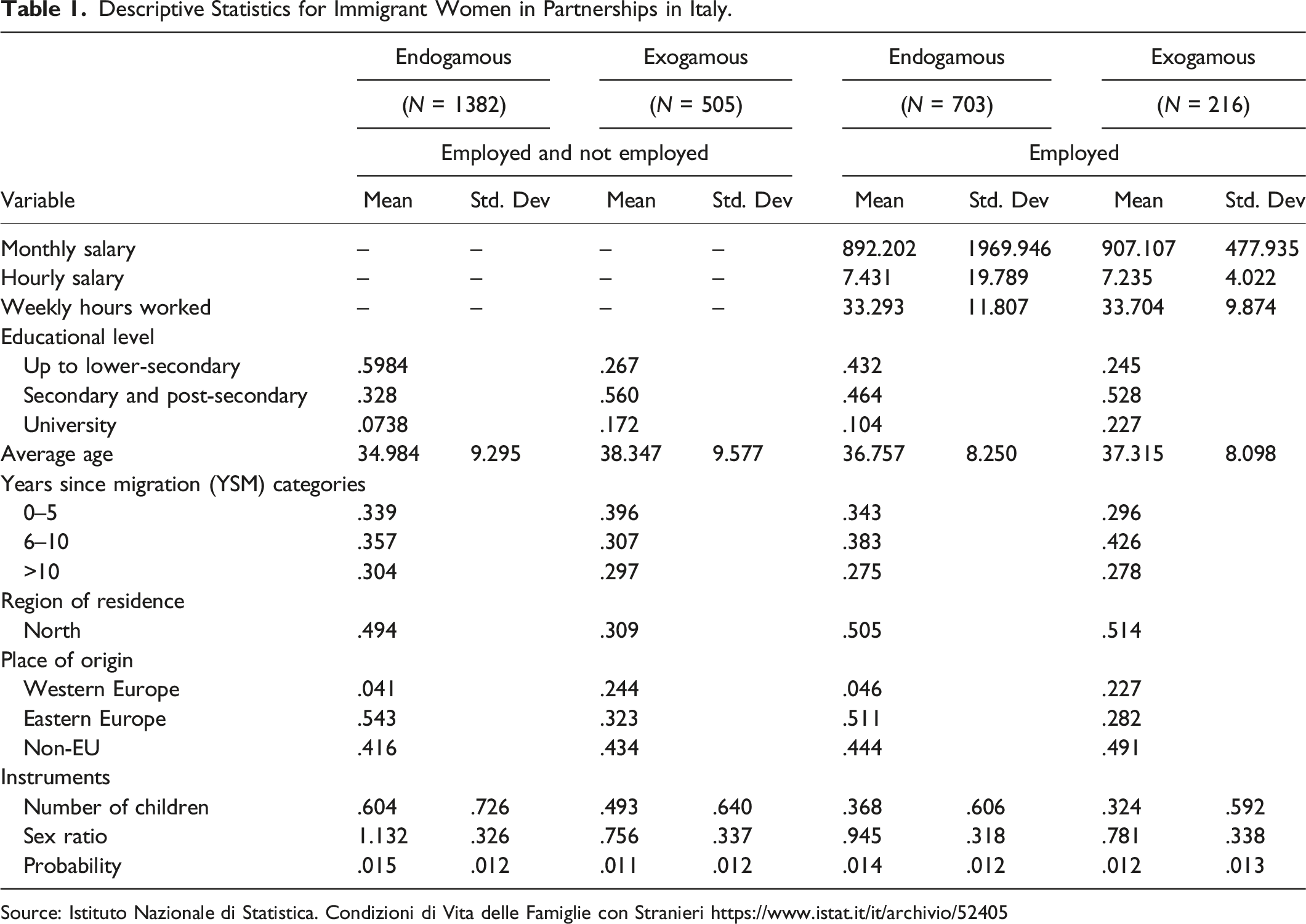
Descriptive Statistics for Immigrant Women in Partnerships in Italy.
Source: Istituto Nazionale di Statistica. Condizioni di Vita delle Famiglie con Stranieri https://www.istat.it/it/archivio/52405
The number of women in the full sample who are not employed is more than double the number who are. The proportion of those who are intermarried is 26 percent in the full sample and 23 percent for the subsample who are employed. Women in a union with another immigrant have slightly higher average monthly salary (nearly 2 percent greater), and they work nearly half an hour more per week on average. Women in a union with another immigrant tend to have considerably lower education levels than those in a mixed union in both samples. Women in both types of union have spent similar amount of time in Italy and also live in the wealthiest part of the country (the north), with the exception of those in the full sample who are intermarried (30 percent of them live in the north compared with nearly 50 percent in all the other cases).
The proportion of women from a non-European country is more than 40 percent in each category of type of marriage of both samples (employed and), whereas it is almost 50 percent of the intermarried women in the sample of the employed. The proportion of women from an Eastern European country varies depending on the type of marriage, being around 30 percent of those in a union with a native Italian and exceeding the 50 percent of those in a union with another immigrant in both samples.
The instruments probability and sex ratio reflect the expected correlation, being higher for women who are in a union with another immigrant than for women in a union with a native Italian.
Analytical Strategy
Econometric Framework
In order to estimate the effect of intermarriage on earnings, we use the Mincer equation of earnings (Mincer, 1974)
When estimating the intermarriage premium, there is a potential threat termed the endogeneity of intermarriage. Intermarriage is not a random event, and it occurs in part due to unobservables that can be correlated with the dependent variable. In fact, unobservable variables that are valued in the marriage market may also be valued in the labor market. Some examples of this include ambition, physical appearance, communication skills, and knowledge of local customs (Kantarevic, 2004). Therefore, estimating the earnings equation without taking into account the potential endogeneity of intermarriage could bias the ordinary least squares (OLS) estimates. An additional issue concerns selection into employment, as we do not observe the potential salary of those who are not working and they remain excluded from the analysis, potentially leading to a positive selection of the sample. A third challenge is dealing with selection into employment and endogeneity of intermarriage simultaneously. We approach these issues in the steps described as follows.
The first step described in the literature when estimating the intermarriage premium with cross-sectional data is to estimate an OLS regression, which delivers the raw premium (Gevrek, 2009; Meng & Gregory, 2005; Meng & Meurs, 2009).
The second step is to correct for the endogeneity of intermarriage. This step analyzes whether intermarried people are positively or negatively selected into intermarriage. In other words, if the unobservables are positively or negatively correlated to the endogenous variable (intermarriage) and to the outcome (the logarithm of hourly earnings). This requires a method that accounts for the endogeneity of intermarriage, and in this case, we use instrumental variables (IV) estimation (Meng & Gregory, 2005; Meng & Meurs, 2009).
The third step in the analysis deals with the sample selection or selection into employment. If the reason for selection into employment is unobserved and correlated with the logarithm of hourly earnings, this would bias the estimates. When estimating the intermarriage premium, only individuals with a salary enter the analysis, as zeros and missing values are automatically excluded. This implies that the sample may be positively selected, as those in employment may tend to have higher earnings than the potential earnings of those who are not employed. In order to correct for the sample selection, we use Heckman sample correction (Heckman, 1979). This method relies on available information from the dependent variables and the instrument to compute an indicator of selection and to correct for the sample selection.
As we face two potential sources of bias, correcting for only one could still lead to biased estimations. Therefore, the fourth step in the analysis is to simultaneously use the methodology that corrects for the endogeneity of intermarriage together with the one that accounts for selection into employment. This approach consists of estimating the selection into employment, obtaining the Inverse Mills Ratio (IMR) and including it in the instrumental variables estimation (Wooldridge, 2010).
Variables Description
The dependent variable
The logarithm of hourly wages was obtained using information on the reported net monthly earnings and information about the average weekly working hours. A proxy of worked monthly hours was created by multiplying the average weekly hours by four. Then, the monthly earnings were divided by the proxy of monthly hours worked and the logarithm was applied.
Hourly earnings are used because they take into account differences in hours worked that might vary among individuals; since part time work is relatively common among women, we use hourly earnings. If someone is missing information on the hours worked and still declared a monthly salary, they are left out of the regression. Observations equaling zero or missing values are also omitted from the analyses. Since there is a low level of reporting working hours for the self-employed, only those who work as dependent employees are considered.
Due to the above-specified empirical pragmatic arguments, the sample analyzed in the present article refers mainly to the subpopulation of women who reported monthly salaries and average working hours.
The independent variables
The traditional variables included in the equation of earnings are education (edu) and work experience, where age is used as a proxy. Because of the functional form, it also includes the quadratic term of age (age2) (Mincer, 1974).
The categories of the original variable for education in the dataset were overly complex, as some categories were only descriptive and defined different streams of the same level of education. A variable indicating the level of education was created by aggregating the information into three categories: the first includes individuals with education up to lower-secondary level, the second is those with up to post-secondary education, and third for those with a university degree. The three categories allow us to retain enough observations in each category.
Intermarriage is treated as a dichotomic variable, equaling 1 when an immigrant woman is in a (cohabiting or married) union with a native Italian and 0 in a similar union with another immigrant. 2 A migrant is defined for our purposes as a person born abroad (definition based on the country of origin). The data also contain information on citizenship; however, this information can be biased, because Italian law grants citizenship for people with Italian ancestors, so many people born outside the country may nevertheless hold Italian citizenship.
Years since migration is divided into three categories. The first comprises individuals who have spent up to five years in Italy, the second category includes those who have spent from six to ten years, and the third, individuals who have spent more than ten years in the country.
We also add a variable controlling for the region of residence. It equals 1 when a woman lives in the northern regions of the country and 0 otherwise.
To control for place of origin, we grouped countries into three main interpretable categories: Western European, Eastern European, and non-European. Some countries may be erroneously included in the non-European category, such as Former Yugoslavia or Croatia, since in 2008 they were not yet in the European Union. However, in proportion, most of the observations are from the identified largest minorities. 3
The instruments
The number of dependent children under six years old is used as an instrument in the Heckman selection correction. The number of dependent children has an effect on the employment of women, as children under six years old do not have to compulsorily attend school, meaning they are demanding in terms of their mother’s time (Heckman, 1979). However, the number of dependent children is unlikely to affect the hourly earnings of women in employment.
The instruments commonly used in the literature to deal with the endogeneity of intermarriage are sex ratio and the probability of meeting someone from the same place of origin (Gevrek, 2009; Meng & Gregory, 2005; Meng & Meurs, 2009). These instruments partly reflect the three main factors that affect the decision to marry: individual preferences, the influence of third parties, and the marriage market constraints (Kalmijn, 1998).
The sex ratio instrument reflects the marriage market constraints, as it captures the competition for a spouse of the same ethnicity in the marriage market. A higher ratio indicates less competition for meeting someone of the same place of origin. Therefore, we expect the sex ratio to affect intermarriage negatively.
The second instrument refers to the likelihood of meeting a partner from the same place of origin, and is given by the ratio of total immigrants of the opposite sex from the same place of origin relative to the entire population of the opposite sex (Gevrek, 2009). This instrument relates to two factors: first, the influence of third parties, where a larger number of members from the same nationality over the whole population might indicate more influence of third parties in the marriage decision 4 ; second, a marriage market constraint, where the likelihood of meeting someone of the same ethnicity is expected to have a negative effect on the probability of intermarrying.
In order to be valid instruments, each variable should respect two assumptions. First, it should be correlated with the endogenous variable, intermarriage, and second, it should not be correlated with the dependent variable, logarithm of hourly earnings. The sex ratio respects the first assumption, since the competition in the local marriage market is likely to affect the intermarrying decision negatively. Moreover, the sex ratio in a given region could affect earnings if men and women from the same ethnicity were competing for similar jobs. However, occupations are highly segregated by gender in Italy (Di Belgiojoso & Ortensi, 2015; Labadie Jackson, 2008; Strozza, Paterno, Bernardi, & Gabrielli, 2009); therefore, sex ratio is not likely to affect hourly earnings and it appears to be an appropriate instrument for the intermarriage variable.
The likelihood of meeting a partner from the same place of origin respects the first condition, since it negatively affects intermarriage. Moreover, in a similar way to the sex ratio instrument, because occupational segregation by gender is highly evident—particularly in Italy (Di Belgiojoso & Ortensi, 2015; Labadie Jackson, 2008; Strozza et al., 2009)—the ratio of men from the same place of origin as an immigrant woman to the total number of men is not likely to affect the hourly wages of women.
The IMR is used as the instrument for the selection into employment in the combined method, which accounts for endogeneity of intermarriage and sample selection simultaneously.
Results
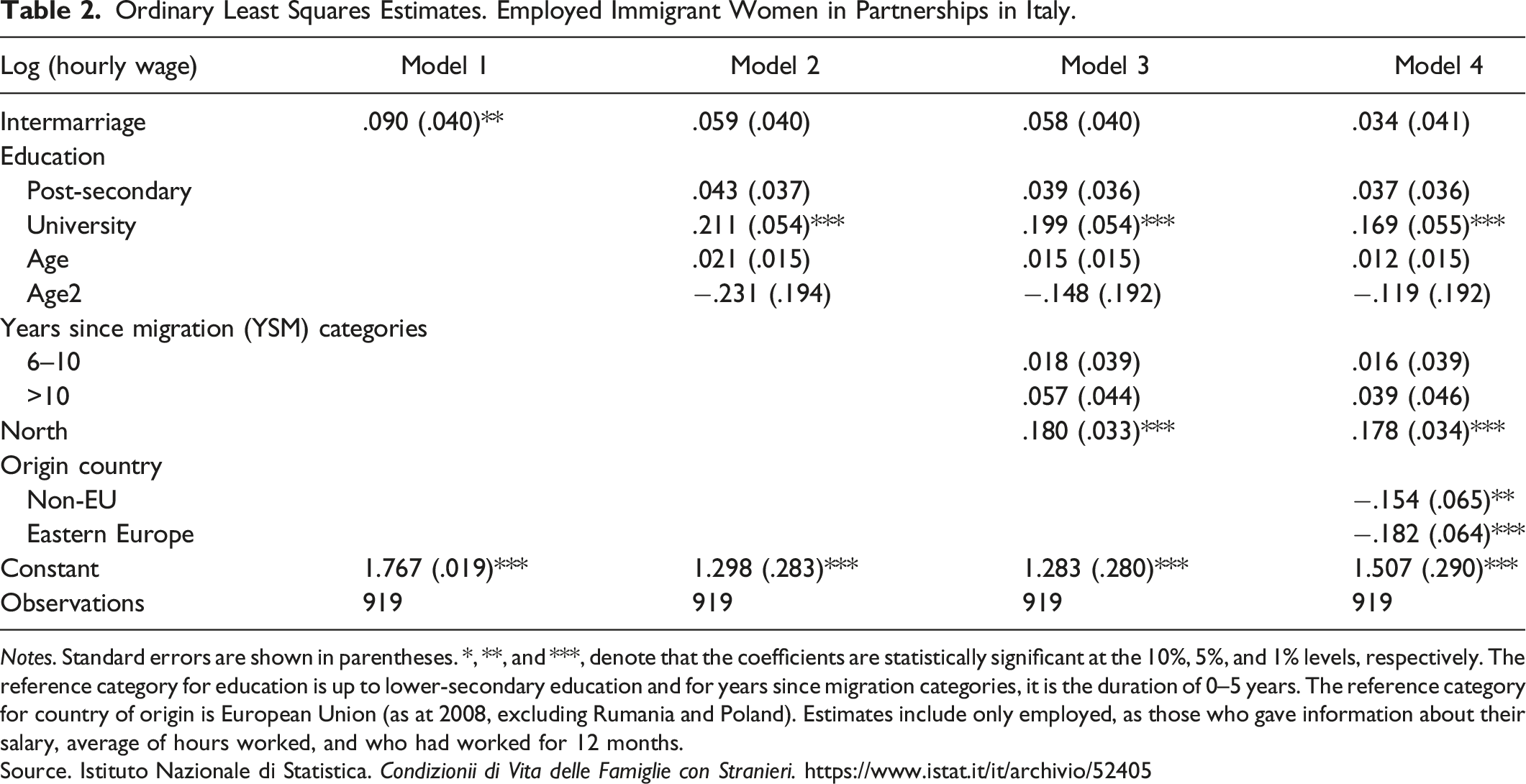
Ordinary Least Squares Estimates. Employed Immigrant Women in Partnerships in Italy.
Notes. Standard errors are shown in parentheses. *, **, and ***, denote that the coefficients are statistically significant at the 10%, 5%, and 1% levels, respectively. The reference category for education is up to lower-secondary education and for years since migration categories, it is the duration of 0–5 years. The reference category for country of origin is European Union (as at 2008, excluding Rumania and Poland). Estimates include only employed, as those who gave information about their salary, average of hours worked, and who had worked for 12 months.
Source. Istituto Nazionale di Statistica. Condizionii di Vita delle Famiglie con Stranieri. https://www.istat.it/it/archivio/52405
However, once the Mincerian variables, education and experience, are added in the second model, the intermarriage premium decreases and it loses significance (+5.9). In the third column, we can see that adding variables such as the year since migration and region of residence does not affect the intermarriage coefficient considerably (+5.8). The variables have the expected sign; however, only the region of residence and university education are strongly significant. Last, in the fourth column when we add the control for country of origin, we observe that coming from a non-EU country has a strong and significant penalty of 15 percentage points compared with coming from a Western European country, while coming from an Eastern European country has a penalty of 18 percentage points. With the inclusion of the country of origin, the coefficient of intermarriage decreases further (+.34), while all the other variables decrease by a small amount.
In the following exercises, the variable intermarriage is treated as endogenous, and we introduce two instruments to correct for the endogeneity (available upon request). We estimate three models, with each having a different set of instruments. The coefficient of intermarriage does not seem to have an effect on earnings in any of the models. However, the instruments do not appear to be particularly strong for capturing intermarriage, in fact there only a sufficiently large F-statistic (13.442) when the sex ratio is used alone, in the second model. Even though the sign of the rest of the variables is as expected, they appear as non-significant, with the exception of residing in the north (+17.7) in the second and third model (results available upon request).
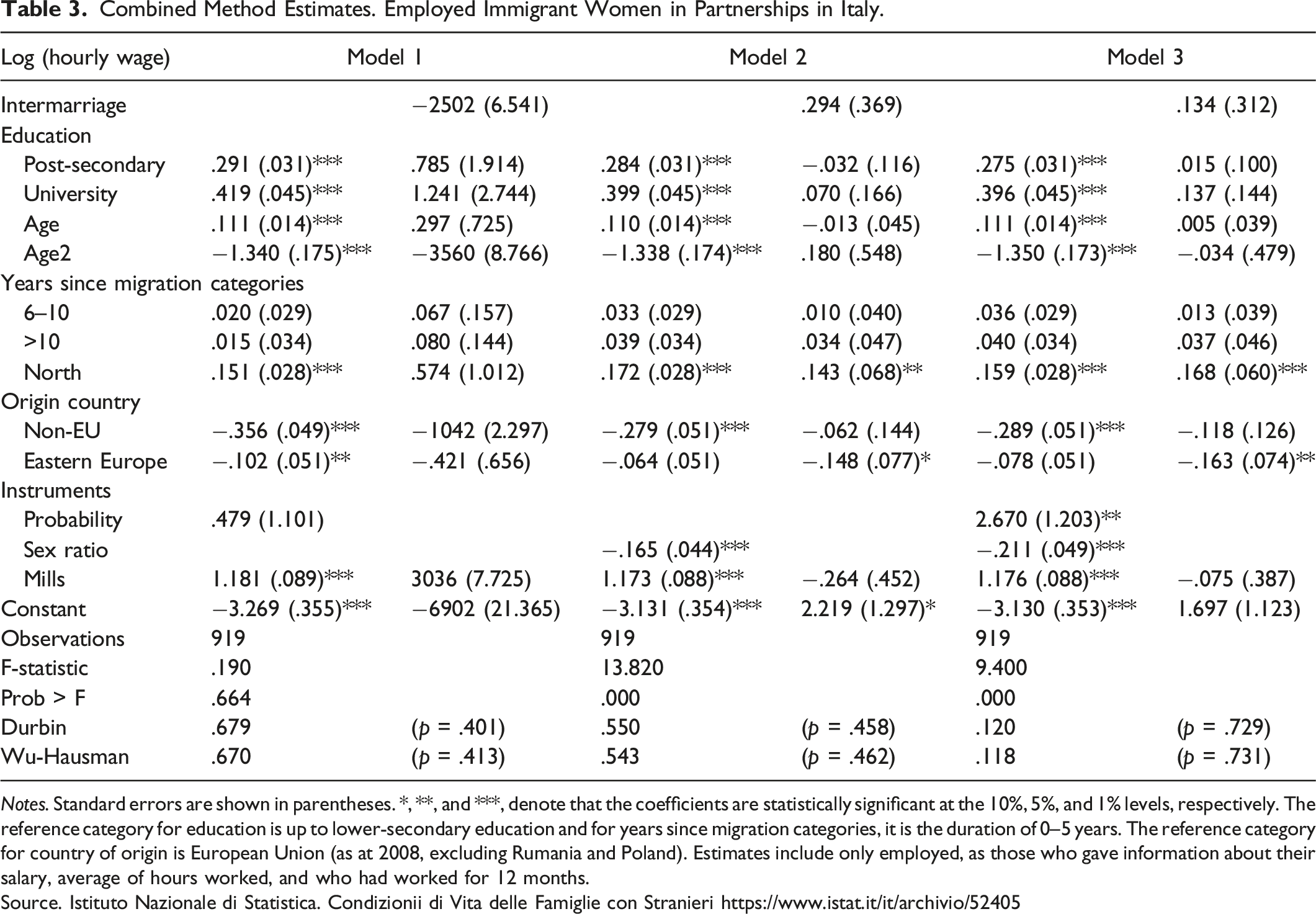
Combined Method Estimates. Employed Immigrant Women in Partnerships in Italy.
Notes. Standard errors are shown in parentheses. *, **, and ***, denote that the coefficients are statistically significant at the 10%, 5%, and 1% levels, respectively. The reference category for education is up to lower-secondary education and for years since migration categories, it is the duration of 0–5 years. The reference category for country of origin is European Union (as at 2008, excluding Rumania and Poland). Estimates include only employed, as those who gave information about their salary, average of hours worked, and who had worked for 12 months.
Source. Istituto Nazionale di Statistica. Condizionii di Vita delle Famiglie con Stranieri https://www.istat.it/it/archivio/52405
Based on the results from the OLS estimations, our hypothesis is not supported, and the estimations with correction for self-selection into employment and into intermarriage confirm this finding.
Conclusions
In the current article, we investigate the impact of intermarriage on the wages of immigrant women in Italy. Specifically, we examine the effect of intermarriage on the wages of intermarried immigrant women compared with their endogamously married counterparts. As analyzing the wage premium of intermarriage among female immigrants is methodologically challenging due to two sources of possible selection bias (self-selection into intermarriage and self-selection into employment), we use several approaches to deal with selectivity, including techniques that simultaneously account for intermarriage endogeneity and employment selection bias.
Our analyses involved some limitations, such as insufficient cases to carry out heterogeneity analyses for different subgroups of immigrant women. In addition, information on Italian language proficiency is not available, nor are data concerning the time of marriage. Further, the fact that there are many more intermarried women than intermarried men means there are not enough observations to run reliable analyses including intermarried male immigrants. Despite these limitations, we arrived at the following results. The raw intermarriage premium shows that hourly earnings are 9 percentage points higher for immigrant women in a union with a native Italian, compared with those of immigrant women in a union with another immigrant. This means that among the analyzed immigrant women, those who live in a couple with a native have wages 9 percent higher than those whose spouse is also an immigrant. However, the wage premium disappears when other sets of controls are added in the model. The intermarriage effect is not significant when we consider intermarriage as endogenous or when we take into account self-selection into employment. The difference in earnings between intermarried and endogamously married immigrant women is thus due to the characteristics of each group.
From the above evidence produced in the different estimations, we conclude that there is no strong effect of intermarriage on the hourly wages of immigrant women. This implies that immigrant women married to or cohabiting with a native do not show significantly different wages compared with women married to or cohabitating with an immigrant man. The tentative explanations for our findings can relate to the situation in Italy. Existing research would suggest that there may not be a substantial difference between intermarried and endogamously married immigrant women in their position in the labor market, as they may compete for similar jobs with similar levels of pay. For example, data show that most immigrant women work in similar economy sectors (Andall, 1992; Ballarino & Panicchella, 2018; Bettio et al., 2006). Another study on the intermarriage premium related to employment (Authors) stipulates that intermarriage has a positive effect on being employed, which could imply that intermarried women can indeed benefit from their spouse’s contacts and language skills, and the support of their spouse with regard to accessing the labor market. However, the same article claims that once they enter the labor market, there is no difference between intermarried and endogamously married women in terms of the number of hours worked. Hence, they are little different in terms of the intensity of employment. A similar explanation may hold with regard to their remuneration. Other studies (Serret & Vitali, 2015; Vignoli et al., 2017) show that in Italy, men in lower social strata tend to marry immigrant women. This would imply that intermarried immigrant women could benefit from their spouse’s network; however, this would lead them only to lower paid jobs. The intermarriage premium could also be balanced out by the extra motivation of endogamously married immigrant women to succeed in the labor market, once they enter it. This argument is in line with Baker and Benjamin (1997), since immigrant women with a native spouse do not face the same need to perform a borrowing function for their families as their counterparts with immigrant husbands.
In order to improve the reliability of the estimation, a richer dataset with more information about language proficiency and union formation, and with a higher number of observations, would be required. It would also be interesting to extend the study to other Southern European countries with a similar pool of migrants, for example, Spain, in order to verify the external validity of our findings.
Footnotes
Acknowledgments
The authors thank Philipe Van Kerm, Louis Chauvel, Anthony Lepinteur, Delia Furtado, Efi Adamopoulou, and Jeffrey Wooldridge for their comments, suggestions, and support in this project.
Declaration of Conflicting Interests
The author(s) declared no potential conflicts of interest with respect to the research, authorship, and/or publication of this article.
Funding
The author(s) disclosed receipt of the following financial support for the research, authorship, and/or publication of this article: This work was supported by the Fonds National de la Recherche [grant number PRIDE15/10949242]
