



Abstract
The variety of measurement methods used in fathering research to assess fathers’ involvement makes it difficult to summarize what we know about paternal involvement and its correlates and antecedents. Aiming to shed light on the potential consequences of using different measures of paternal involvement, this study examined: (a) the associations among three measures of father participation in parental activities, namely self- and mother-reported questionnaires and a father-completed time diary, and (b) their respective associations with a well-documented predictor of father involvement, i.e., parenting alliance. The sample included 80 parental couples with a 6-month-old child. Although moderate associations were found among measures of father involvement, only the maternal and paternal questionnaires were associated with parenting alliance. These results suggest that time diaries and questionnaires tap into different aspects of father involvement that can have distinct correlates and determinants. Better acknowledgment of the diverging results attributable to the use of different measurement approaches of father involvement is needed.
An increasing body of research suggests that paternal involvement is beneficial for child development (Kim & Hill, 2015; Lamb, 2010; Lamb & Lewis, 2013; McWayne, Downer, Campos, & Harris., 2013; Pleck, 2012; Sarkadi, Kristiansson, Oberklai, & Bremberg, 2008; Volling et al., 2019). Thus, the identification of the factors that can promote such involvement is important. Several factors have been found associated with father involvement (Kuo, Volling, & Gonzalez, 2018; Lamb, Pleck, Charnov, & Levine, 1987; Macon, Tamis-LeMonda, Cabrera, & McFadden, 2017; Planalp, Braungart-Rieker, Lickenbrock, & Zentall, 2013; Pleck & Masciadrelli, 2004). However, studies in this field are often characterized by diverging results. Therefore, it is difficult to summarize what is known in this domain. Despite its intuitive meaning, the conceptualization and measurement of paternal involvement vary across studies (Dubeau, Devault, & Paquette, 2018; Fan & Chen, 2001; Garfield, Fisher, Barretto, Rutsohn, & Isacco, 2019; Taylor, Fredericks, Janisse, & Cousino, 2019), leading to conflicting results and hindering the possibility of reaching consensus that is necessary for developing evidence-based intervention programs and/or social policy.
In fathering research, commonly used measures of father involvement include the frequency of participation in parental activities, as reported in questionnaires by mothers or fathers (Kwok & Li, 2015; Roggman, Fitzgerald, Bradley, & Raikes, 2002; Singley et al., 2018), and the amount of time spent in parental activities, as reported in time diaries (Brown, Mangelsdorf, & Neff, 2012; Cano, Perales, & Baxter, 2019; Goodman, Lusby, Thompson, Newport, & Stowe, 2014). Across studies, researchers use self- or mother-reported questionnaires and time diaries interchangeably to obtain a global index of father involvement; these different measures of involvement might produce different patterns of relations between father involvement and other constructs of interest. As researchers typically use only one measure of father involvement, the degree of discrepancy in study findings that is attributable to methodological differences in fathering research remains unknown. In the present study, we examined for the first time the associations among different measures of father involvement (i.e., self- and mother-reported questionnaires and a father-completed time diary) and whether these measures produce different results when examining the relation between father involvement and one of its best-documented predictors, namely parenting alliance.
Measures of Paternal Involvement
According to some authors, the divergence in measures of paternal involvement reflects the difficulty for researchers to capture the complexity of this construct (Roggman et al., 2002) and its multidimensional nature (Schoppe-Sullivan, McBride, & Ho, 2004). Over the past few decades, fathers’ involvement has been conceptualized in many ways (see Day & Lamb, 2004 and Pleck, 2010, for more). Thus, different methods of measurement were created and are employed in fathering research (Cabrera, 2020; Day & Lamb, 2004; Hawkins et al., 2002; Pleck, 2010; Roggman et al., 2002), but also in pediatric and developmental research (Castro et al., 2015; Fan & Chen, 2001; Rollè et al., 2019; Taylor et al., 2019). While the importance of measuring the quality of the fathers’ involvement and its multiple dimensions is increasingly recognized (Cabrera, Volling, & Barr, 2018; Pleck, 2010, 2012), most studies still rely on global indicators of the amount of father involvement (Pleck, 2012; Rollè et al., 2019). Indeed, the most dominant measures of father involvement include frequency of participation in parental activities such as child care and play as reported by fathers themselves or mothers in questionnaires, and the amount of time that fathers spend performing routine physical child care or playing with their child, as reported in time diaries (Pleck, 2012). While being used interchangeably in research to assess father involvement, these measures have distinct strengths and limitations.
In self-reported questionnaires, fathers are usually asked to report their frequency of participation in a variety of parental activities (including bathing, feeding, and playing) on a Likert scale that often varies from never to every day (Kwok & Li, 2015; Paquette, Bolt, Turcotte, Dubeau, & Bouchard, 2000; Singley et al., 2018). Questionnaires targeting fathers’ participation in parental activities are concise, quick, easy to administer, and non-expensive (Kan & Pudney, 2008; Pleck, 2010). Thus, they became the most popular measurement method to capture father involvement in empirical research. However, the risk of a father to over- or underestimate his involvement is higher when using a self-reported questionnaire (Bernaud, 2014). For instance, fathers might be involved in parental activities that are not listed in the questionnaire, leading to an underestimation of their involvement (Robinson, 2002). Moreover, social desirability and subjective bias might lead to an overestimation of father involvement (Bernaud, 2014). In line with this, some studies have found significant discrepancies between father- and mother-reported father involvement as measured by the same questionnaire (Charles et al., 2018; Coley & Morris, 2002; Dubeau, Paquette, & Devault, 2009; Hernandez & Coley, 2007; Mikelson, 2008). Thus, father involvement scores gathered with questionnaires might reflect subjective bias.
In contrast to questionnaires, time diaries measure the amount of time the father devotes to parental- or child-related activities, such as feeding or playing. Time diaries provide a chronology of events, most often from midnight on the target day to midnight the following day, lessening recall and social desirability biases (Kan & Pudney, 2008; Riley, 1985; Robinson, 1985; Robinson & Godbey, 1999; Wical & Doherty, 2005). In general, a workday and/or non-workday is recorded. For the target days, fathers are asked to write down or recount their activity in detail (for each 15- or 30-minute interval) (Wical & Doherty, 2005). In contrast to questionnaires, parental- or child-related activities reported by fathers in a time diary are not restricted to predetermined researcher choices. Fathers can use their own words to describe their activities and daily routine. Although more accurate, time diaries are more laborious, costly, and time-consuming than self-reported questionnaires. Thus, they are less popular, but still frequently employed in fathering research (Altintas, 2015; Brown, Mangelsdorf, & Neff, 2012; Brown et al., 2018; Brown, McBride, Bost, & Shin, 2011; Cano, Perales, & Baxter, 2019; Doherty, Erickson, & LaRossa, 2006; Goodman et al., 2014; Lee & Doherty, 2007). A recent systematic review (Diniz, Brandão, Monteiro, & Veríssimo, 2021) indicated that although questionnaires were the most common measure of father involvement (84.9%), a significant number of studies used other measures of this construct, notably time diaries (8.1%).
In sum, the various types of measures used to capture father involvement make it difficult to summarize what we know about father involvement. Although questionnaires and time diaries have distinctive (and appealing) characteristics that might lead to unique estimates of individual differences in father involvement, they are used interchangeably in research. Given that they have never been examined in relation to each other, it is difficult to determine if both tap into the same construct. To our knowledge, no study has used both types of measures simultaneously. It is possible that questionnaires and time diaries measure different aspects of father involvement that are not associated with or predicted by the same factors. Differents results were notably found in previous studies of the associations between father involvement and parenting alliance depending on the method used to assess paternal involvement.
Father Involvement and Parenting Alliance
Theory and research suggest that a strong coparenting relationship (i.e., parenting alliance) may foster fathers’ involvement with their children (Fagan, 2014; Fagan & Lee, 2012; Futris & Schoppe-Sullivan, 2007; Kwok & Li, 2015; Pudasainee-Kapri & Razza, 2015; Schoppe-Sullivan, Brown, Cannon, Mangelsdorf, & Sokolowski, 2008; Singley et al., 2018). Abidin and Brunner (1995) define parenting alliance as the degree of commitment and cooperation between the parents in child-rearing. Many studies have found significant links between parenting alliance as perceived by fathers and both parents’ reports of paternal involvement during preschool years: the greater the alliance was between the parents, the more fathers and mothers reported father involvement (Fagan, 2014; Fagan, & Lee, 2012; Kwok & Li, 2015; Schoppe-Sullivan et al., 2008; Singley et al., 2018). However, all of the previous studies that reported a significant relation between these two constructs relied on questionnaires to assess father involvement. The sole study that examined this association using a time diary found that parenting alliance was not significantly associated with fathers’ involvement with their preschool-aged children (McBride & Rane, 1998). Thus, studies of the association between parenting alliance and father involvement have yielded conflicting results that might be explained by methodological issues, as captured in the types of measures used to assess paternal involvement. However, the fact that paternal involvement is multifaceted (Schoppe-Sullivan et al., 2004) also raises the possibility that different aspects of involvement are captured by different measurement approaches, such as questionnaires and time diaries. Importantly, parenting alliance might be differentially related to these different aspects of father involvement, thus leading to disparate findings. While questionnaires usually target the frequency of participation in parental daily activities, time diaries capture the amount of time spent engaging in these activities. These aspects of father involvement might be related differentially to parenting alliance, but their unique association with parenting alliance has never been examined in the same study using both measurement approaches. Therefore, it is not yet possible to determine if the divergences observed across studies regarding the associations between these constructs are due to the use of different measurement approaches of father involvement. The present study re-examined this relation by using both types of measures of father involvement: a questionnaire (completed by both mothers and fathers) and a time diary.
The Present Study
The goal of this study was to examine in one sample: (a) the links among three different measures of father involvement, namely self- and mother-reported questionnaires and a father-completed time diary capturing fathers’ participation in parental activities, and (b) their respective associations with parenting alliance as perceived by fathers and mothers. Including both father and mother reports of father involvement and parenting alliance allowed to also examine the consistency of results across informants.
Method
Participants and Procedure
Eighty-six middle-class father–mother dyads (intact dual-earner families) living in a Canadian area participated in this study. All couples had a 6-month-old infant (M = 6.88 months, SD = 1.26, 51% boys) at the time of data collection. Families were recruited from lists of fathers applying for Provincial Parental Insurance Plan benefits provided by the Ministry of Employment and Social Solidarity. Criteria for participation were: living with the infant and his/her mother at the time of recruitment, full-term pregnancy, and the absence of any known physical or mental disability or severe developmental delay in the infant. Fathers were contacted via a letter sent to their home that was followed by a phone call. Among the 300 fathers contacted by phone, 86 agreed to participate in the study with the mother of their infant. Participating fathers were between 25 and 44 years old (M = 33.31, SD = 4.30) and mothers between 25 and 49 years old (M = 33, SD = 4.34). Fathers had between 9 and 27 years of education (M = 17.43, SD = 3.30) and mothers between 11 and 28 years (M = 17.31, SD = 2.72). Most parents were Caucasian (89%) and all had full-time jobs. Fathers’ average annual income was $57,552 (SD = $21,506, ranging between $20,000 CDN and $120,000 CDN) and mothers’ average annual income was $46,619 (SD = $20,934, ranging from $20 000 to $125,000).
Families were met once at their homes by the research team. During the home visit, fathers completed a time diary interview protocol to assess their involvement in child care. Fathers and mothers were then invited to independently complete an online questionnaire measuring father involvement and parenting alliance.
Measures
Father Involvement
To measure fathers’ participation in child-rearing and parental activities, a time diary interview protocol and a questionnaire completed by mothers and fathers were used.
Time Diary
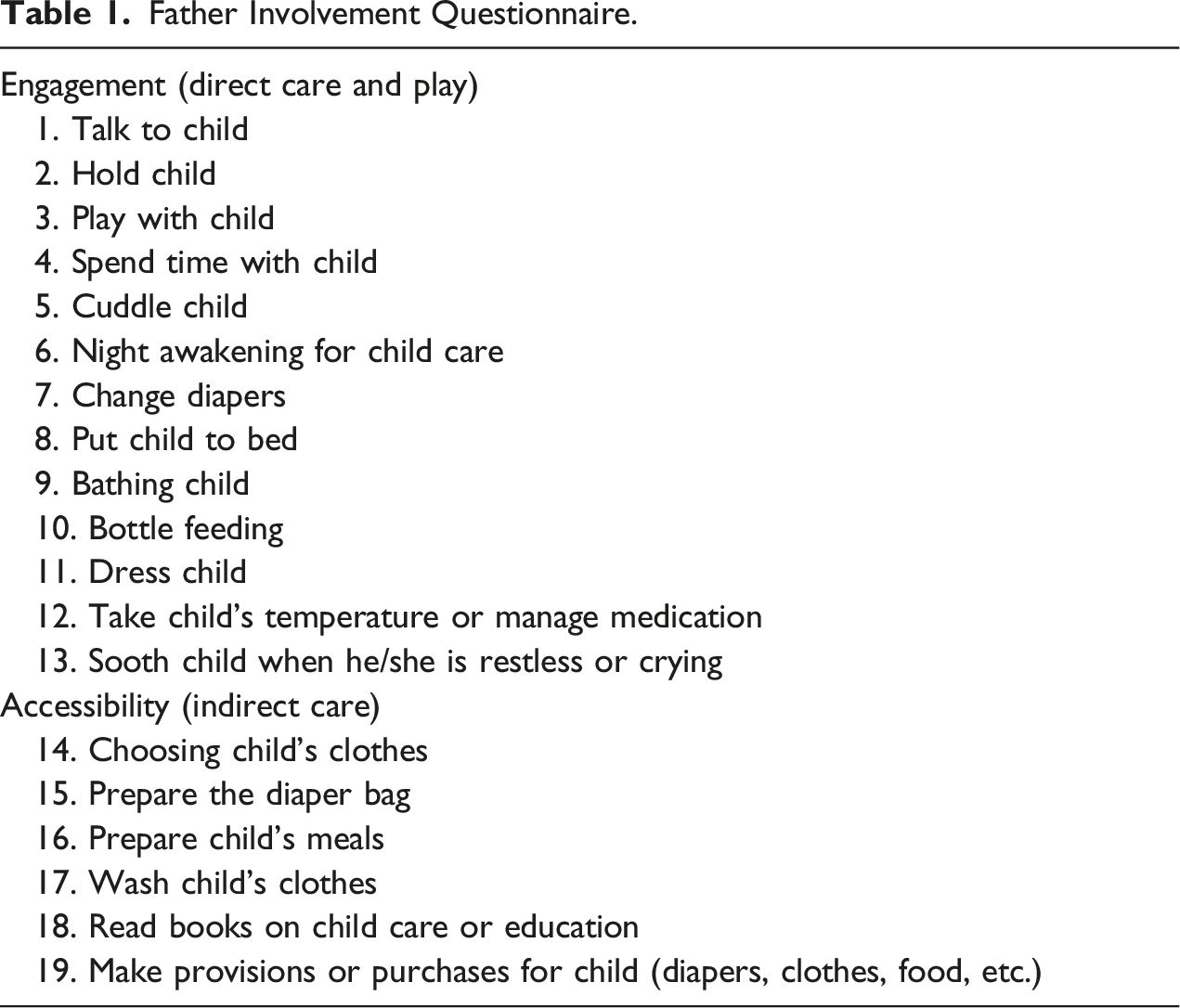
The time diary interview was developed by our research team based on similar interview protocols (Goodman et al., 2014; McBride & Mills, 1993; Reimer, 2017; Yeung, Sandberg, Davis-Kean, & Hofferth, 2001). Data were collected for a typical/normal 7-day week. During the interview, fathers were asked to describe in detail and in their own words their activity for each 30-minute interval of a typical/normal 7-day week. A forced-recall technique was used, which means that fathers were encouraged, using clarification questions and prompts by the interviewer, to elaborate on the exact length and nature of activities. Prompts and cues used with the forced-recall procedure facilitated the fathers detailed description of their usual, daily activities. The diary consisted of a 24-hour timeline on which interviewers indicated, for each half-hour of the 7 days, whether fathers were involved or not in a parental activity. Each 30-min interval was categorized/coded by the interviewer as (1) involvement in parental activities reflecting engagement (direct care or play) or accessibility (indirect care), or (0) no involvement at all. Engagement consisted of activities in which both the father and the child are directly engaged (e.g., bathing, feeding, and playing). Accessibility encompassed activities in which the father is available to the child or is doing something for the child, but not directly engaged with him/her (e.g., supervising him/her while cooking, washing the child’s clothes). A global involvement score was computed as the average number of hours per day of engagement and accessibility. Interviews were coded by trained research assistants. Time diary interview protocols, such as the one used in the present study, have been widely used in the father involvement literature (Diniz et al., 2021) and are considered well-validated assessments of father involvement (Brown et al., 2018; Wical & Doherty, 2005).
Father Involvement Questionnaire
Father Involvement Questionnaire.
Parenting Alliance
The Parenting Alliance Inventory (PAI; Abidin & Brunner, 1995) was used to assess the overall quality and strength of the coparenting relationship. This 20-item questionnaire assesses parents’ agreement over child-rearing, joint investment, as well as mutual respect and shared values about child-rearing. Mothers and fathers responded separately on a Likert scale ranging from strongly disagree (1) to strongly agree (5), with higher scores indicating stronger perceived coparenting alliance (Kwok & Li, 2015). In the present study, internal consistency was excellent for fathers (α = .91) and mothers (α = .91).
Analytic Plan
To address the research questions, correlations were performed (a) among measures of father involvement, i.e., the self- and mother-reported questionnaires and the time diary, and (b) between these measures and parenting alliance as perceived by fathers and mothers. Four linear regression analyses predicting the different indicators of father involvement from parenting alliance as perceived by fathers and mothers (separately) were performed next. Sociodemographic factors (child sex as well as fathers’ education, working hours, and income) usually associated with father involvement or parenting alliance were controlled for in the regressions by entering them in the first block of the equations.
Results
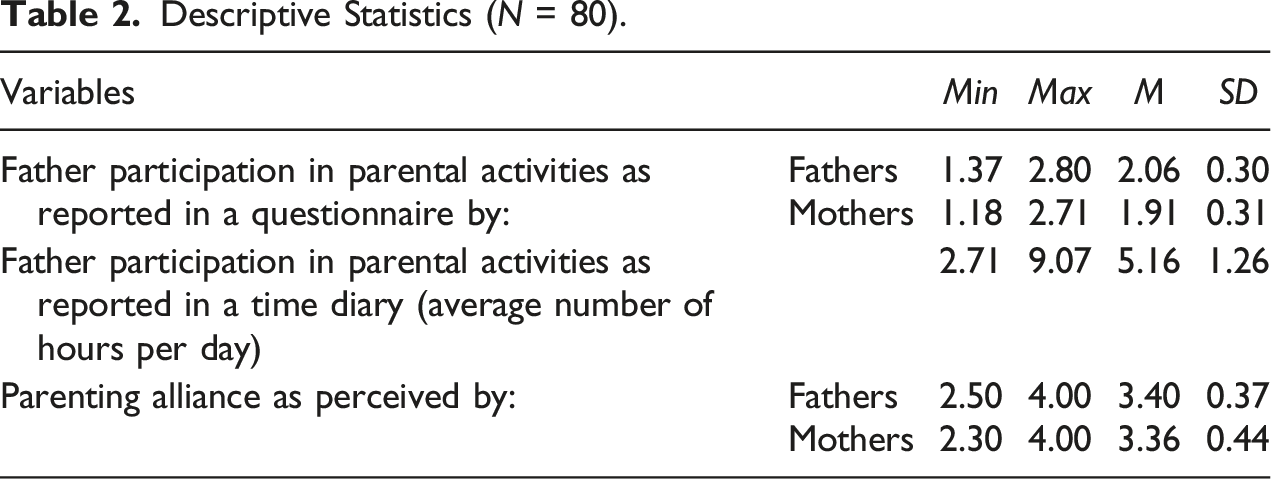
Descriptive Statistics (N = 80).
Correlations among measures of father involvement and sociodemographic variables.
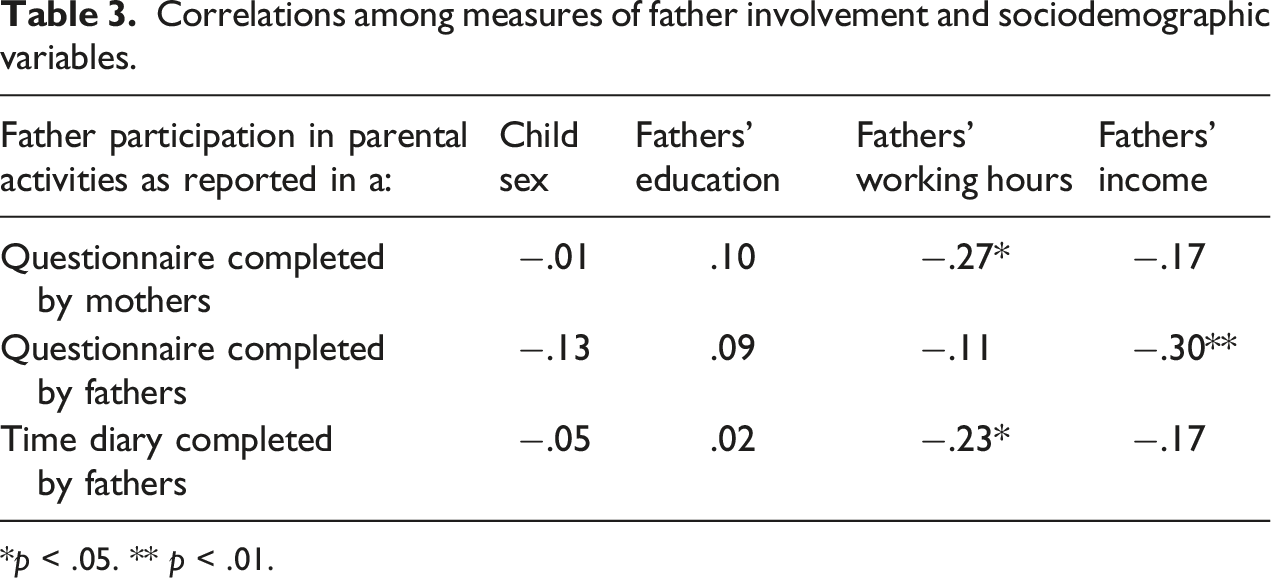
*p < .05. ** p < .01.
Correlations among measures of father involvement and parenting alliance.
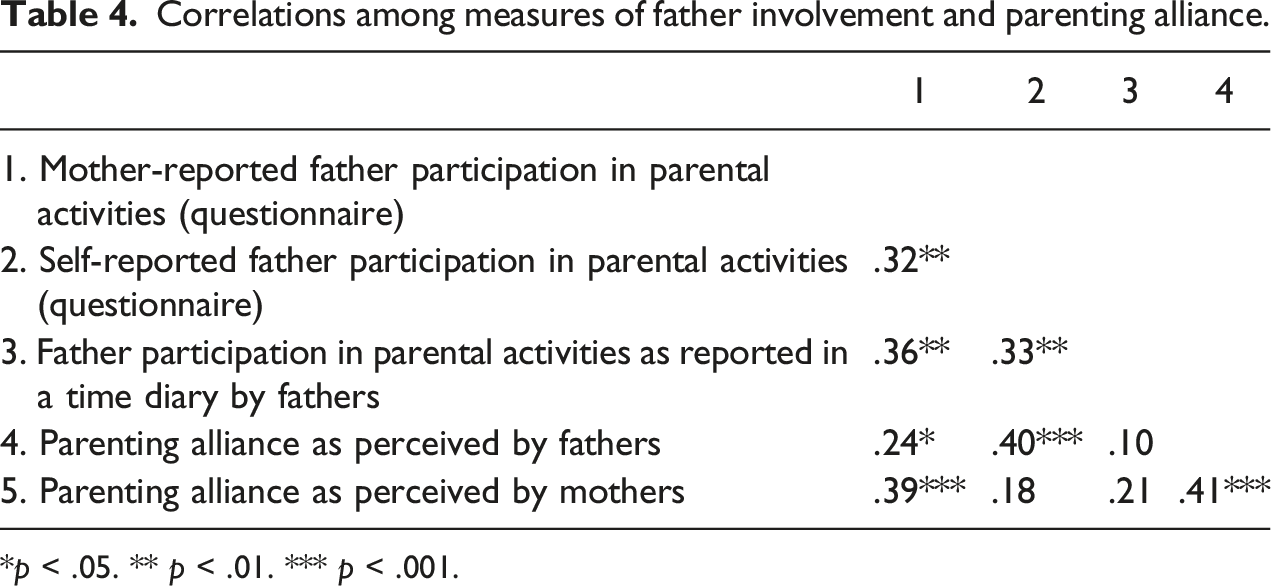
*p < .05. ** p < .01. *** p < .001.
Correlations were also performed to examine the links between measures of father involvement and parenting alliance as perceived by fathers and mothers. Parenting alliance and father involvement as reported by fathers (r = .39, p = .00) and mothers (r = .40, p = .00) were moderately associated, but mother- and father-reported parenting alliance was not associated with father involvement as reported in the time diary.
Parenting alliance as a predictor of father involvement measured with a father-completed time diary and self- and mother-reported questionnaires.
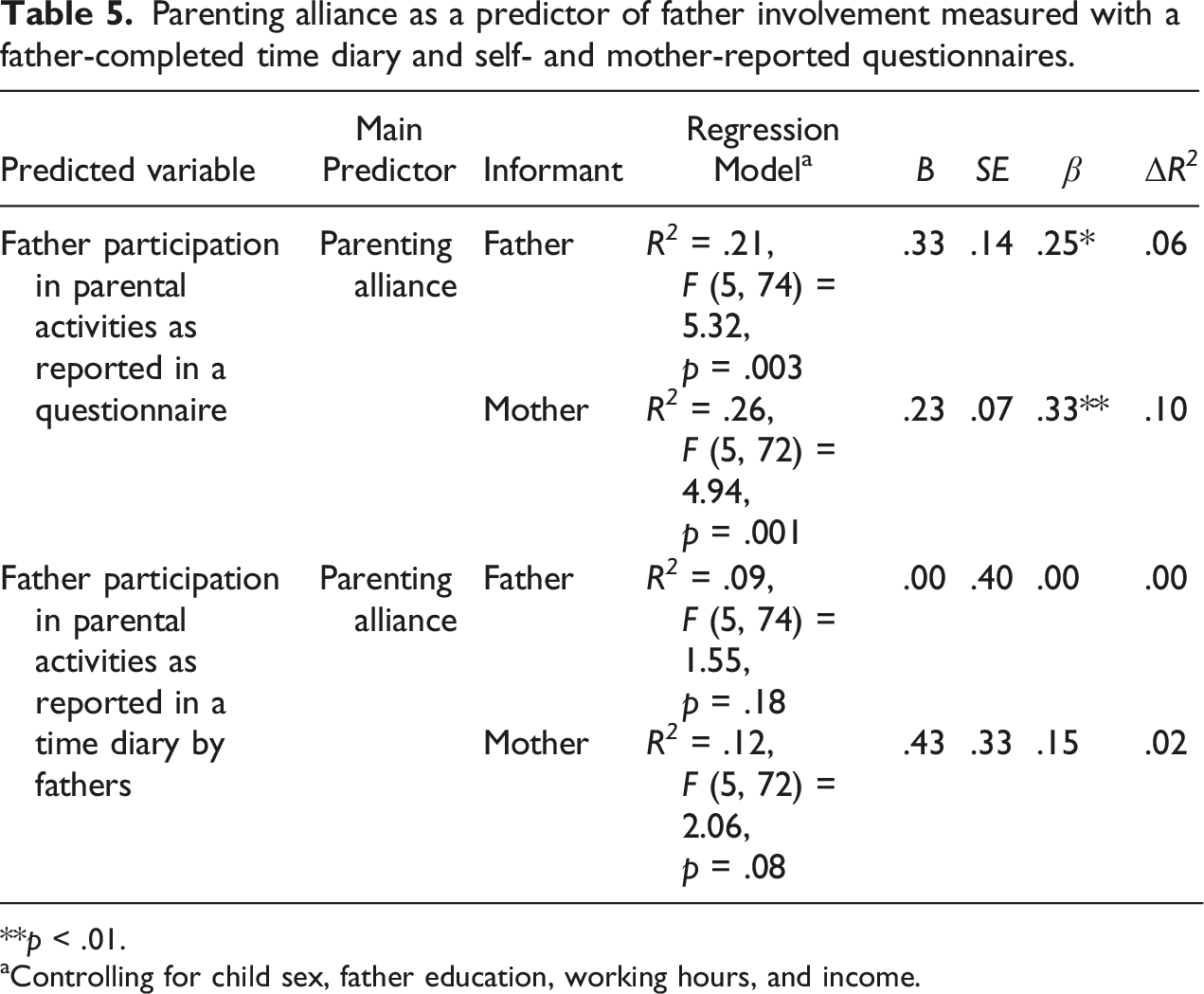
**p < .01.
aControlling for child sex, father education, working hours, and income.
Discussion
This study examined for the first time (a) the links among three different measures of father involvement, namely self- and mother-reported questionnaires and a father-completed time diary, as well as (b) the respective associations between these measures and a known predictor of father involvement, i.e., parenting alliance.
Regarding the first objective of the study, the results indicated that paternal involvement scores obtained through mother or father questionnaires and a time diary are significantly but moderately associated. Thus, the shared portion of variance among measures indicates that the fathers participating more frequently in parental activities also spend more time being involved in those parental activities. However, the moderately unshared portion of variance among these same measures also indicate that some fathers who are perceived as frequently involved in parental activities or who report being frequently involved do not spend a lot of time engaged in parental activities. The moderate associations observed suggest that questionnaires and time diaries target different aspects or dimensions of father involvement that are related, but not identical. Therefore, as expected, questionnaires and time diaries do not tap into the same underlying construct and should not be used interchangeably to assess fathers’ involvement. While the questionnaire captures the frequency of participation in parental daily activities, the time diary measures the length of involvement in these activities (temporal involvement). Two fathers can be involved every day in parental activities, but one can spend more time engaged in these activities than the other (for example, playing for 15 minutes a day compared to 1 hour a day). The time diary takes into account the temporal length of involvement in parental activities, while questionnaires targeting the frequency of participation in parental activities do not. This difference might explain the discrepant results obtained in previous studies with regards to the link between parenting alliance and father involvement.
In line with this, the results of the present study showed that a stronger parenting alliance as perceived by fathers or mothers was associated with higher amounts of fathers’ participation in daily parenting activities as reported in a questionnaire by fathers and/or mothers, but not as assessed with a time diary. Fathers and mothers who perceived a stronger parental alliance with their partner reported more paternal involvement in daily parenting activities, but fathers who had a stronger alliance with their partners were not found to spend more time engaging in parental activities as reported in a time diary compared to fathers with a weaker parenting alliance. Thus, the results stemming from both father and mother questionnaires support the existence of an association between parenting alliance and father involvement, whereas results from the time diary do not. This is consistent with the results of previous studies using a single measure of father involvement. While studies using questionnaires found significant associations between parenting alliance and father involvement (Fagan, 2014; Fagan & Palkovitz, 2019; Jia & Schoppe-Sullivan, 2011; Kwok & Li, 2015; Pudasainee-Kapri & Razza, 2015; Singley et al., 2018; Volling et al., 2019), the only study that used a time diary did not find a significant link between these constructs (McBride & Rane, 1998). Thus, the association between paternal involvement and parenting alliance varies according to the paternal involvement measure approach. This discrepancy could be explained by the fact that questionnaires and time diaries tap into different aspects of paternal involvement that are not influenced by the same factors.
While having a good alliance with the mother might encourage fathers to participate frequently in daily parental activities, other factors might motivate them to spend more time with their child, such as the child’s temperament. Some studies have, for example, found that fathers spend more time with their child when he/she has an “easy” temperament characterized by high sociability and positive emotions (Manlove & Vernon-Feagans, 2002; McBride, Schoppe, & Rane, 2004). Other studies suggest that a difficult/challenging child temperament, characterized by irritability and negative emotions, could undermine fathers’ desire to spend time with their child (Brown et al., 2011; Popp, Spinrad, & Smith, 2008). Fathers who do not spend a lot of time with their temperamentally demanding children could, however, still be involved in daily parental activities to maintain a good alliance with the mother. However, this has never been investigated.
Fathers’ work schedule might also be a stronger predictor of their temporal involvement than parenting alliance. The number of hours spent at work during the day limits the amount of time that parents can spend with their children (Bonney, Kelley, & Levant, 1999; Brown et al., 2011; Yeung et al., 2001). However, although fathers who work a lot might not have a lot of time to spend with their children, they might still be involved every day in parental activities. In line with this, in the present study, all fathers worked full-time and their number of working hours was negatively associated with their parental involvement as reported in the time diary (r = −.23, p < .05), but not as measured by the questionnaire (r = −.11, p = .35). Parents who have a good parenting alliance may work together to develop efficient strategies that promote the father’s participation in daily parenting activities despite limited time to do so. However, future research is needed to identify the respective predictors of fathers’ amount of time spent involved in parental activities as reported in a time diary and fathers’ frequency of participation in parental activities as reported in a questionnaire.
Including both father and mother reports of paternal involvement and parenting alliance allowed us to examine the consistency of results across informants. Associations between self- and mother-reported father involvement and parenting alliance were significant and similar in magnitude, supporting the robustness of the association between these constructs. In contrast, the time diary was not related to parenting alliance reported by either mother or father, suggesting an absence of relation between parenting alliance and fathers’ time spent in parental activities.
The current study has some limitations that are important to consider. First, the sample size is small (N = 80) and not representative of the population (middle-class, intact biparental families), which limits the generalization of the results to families with other demographic characteristics (divorced parents or families facing socioeconomic adversity). Moreover, like much of the research using fathers’ reports, our response rate was low, leading to concerns over nonresponse bias and generalizability. Fathers who participated might plausibly be more involved (or concerned) with their children. Thus, the views of less engaged fathers might not be well represented in this research. Furthermore, while including the most commonly used measures in research to capture the amount of father involvement, the present study did not take into account all existing measures of paternal involvement. Other types of measures, such as observational assessments and child reports, may provide additional insights. It is also important to keep in mind that the relations found in this study may not indicate causal processes. Only experimental studies, for instance, demonstrating that fathers’ participation in parental daily activities is increased by an intervention targeting parenting alliance, could establish a causal relation between parenting alliance and paternal involvement. Such studies could help establish the importance of promoting parenting alliance to foster fathers’ participation in parental activities. Despite these limitations, this study, which relied on more than one measure of father involvement and used a multi-informant approach, significantly contributes to the methodological and conceptual debates concerning the measurement and reporting of father involvement. This study is the first to shed light on the diverging results attributable to the use of different assessment methods of father involvement.
Conclusion
Considering the increasing number of studies showing the importance of father involvement for child well-being and healthy development (Lamb, 2010; Lamb & Lewis, 2013; McWayne et al., 2013; Pleck, 2012; Sarkadi et al., 2008; Yan, Schoppe-Sullivan, & Kamp Dush, 2018), one fundamental question for researchers and policymakers is how one can promote such involvement. The elaboration and implementation of intervention programs or social policies that can efficiently promote father involvement largely depend on a thorough understanding of the predictors and facets of father involvement. Predictors of father involvement are investigated using different measures of involvement, and studies rarely include more than one. The present study was the first step toward a better understanding of the consequences of using different measures of father involvement and future research also using multiple measures of father involvement are needed to shed further light on the various consequences of method divergences in fathering research.
The results of the present study suggest that using different measures of father involvement might lead to conflicting results. Thus, using only one measure of father involvement may generate misleading conclusions. Researchers planning to examine associations between paternal involvement and some potential determinants should use multiple measures of paternal involvement and carefully document their methodological choices. A better understanding of the consequences of our methodological choices will ultimately provide a more accurate picture of the factors that promote or hinder paternal involvement and its various facets. This picture is necessary to build consensus and develop appropriate intervention programs aiming to promote fathers’ involvement with their children. The results of the present study also highlight the relevance of measuring different aspects of paternal involvement when trying to identify potential predictors. Studies that are undertaken to include assessments of both frequency of participation in parental activities as measured by questionnaires and temporal involvement as measured by time diaries may lead to a better understanding of how the quantity of father involvement matters to children, but also of how the different facets of father involvement might be promoted.
Footnotes
Acknowledgments
The authors wish to express their gratitude to Catherine Levesque, Alexane Baribeau-Lambert, Olivier Aubuchon, Samuel Dallaire, and Amélie Bolduc-Mohktar for help with data collection. Special thanks go to the participating families of the project who generously opened their homes to us.
Declaration of Conflicting Interests
The author(s) declared no potential conflicts of interest with respect to the research, authorship, and/or publication of this article.
Funding
The author(s) disclosed receipt of the following financial support for the research, authorship, and/or publication of this article: This research was supported by grants from the Fonds de Recherche du Québec–Société et Culture [2016-NP-188926]. Financial support was also provided to Chantal Cyr and Célia Matte-Gagné by the Canada Research Chairs Program.
