



Abstract
Love is desired at any age and has many meanings. Formulating new partner relationships later in life includes love as a motivation. However, experiences of love as a concept within such relationships have yet to be examined. Such an investigation could contribute to further understanding the meaning of love within new relationships formulated later in life. Thirty-eight semi-structured, qualitative interviews with older adults (19 couples) who entered a new relationship at old age after widowhood or divorce following a long-term marriage were conducted and transcribed verbatim. Dyadic interview analysis methodology was used. Unique experiences of love were identified: (1) Kinds of love: (a) pleasant love—not heated, (b) parental love—deep and quiet, and (c) sibling love; (2) phases of love: (a) being in love, (b) partial love, and (c) falling out of love yet caring. The discussion addresses late-life repartnering love as exclusive and as shifting from passion to compassion.
Introduction
Love is much desired at any age and has many meanings and forms. It has been extensively studied among younger adults, yet its meaning among older adults and particularly in new partner relationships formulated later in life has scarcely been studied. Such relationships have been studied as a phenomenon throughout the last two decades (e.g., Benson & Coleman, 2016; Bildtgård & Öberg, 2019; Brown, Bulanda, & Lee, 2012; Bulcroft, 2019; Davidson, 2002; Kim, Xu, Cruz, Saito, & Østbye, 2021; Koren, 2011, 2014, 2015, 2016; Koren & Ayalon, 2019; 2020; Teresa, Moor, & Sailor, 2018; Samanta, & Varghese, 2019; Spalter, 2010). Although love has previously been identified as a main motivation for initiating a new partner relationship later in life (Davidson, 2002), publications that have addressed love (e.g., Bildtgård & Öberg, 2019; Bulcroft, 2019; Kim et al., 2021; Samanta, & Varghese, 2019) have not focused on how participants define and experience love in their relationship. For instance, in a study conducted in a more traditional cultural context, love was investigated as a relationship that contradicts the cultural norm (Samanta & Varghese, 2019). On the other hand, Bildtgård’s and Öberg’s book (2019) on intimacy and aging in a more modern cultural context addressed love as the background for sex in a chapter on sex in an ideology of love. The aim of this article is to place love at the foreground and examine in-depth experiences of love and their meaning as a concept in such relationships from an individual and dyadic perspective within a cultural context located between tradition and modernity.
Late-life repartnering is a phenomenon that develops among functionally independent older adults along with the increase in life expectancy. It is more common in societies living by individualist values than in societies living by collectivist values (Bildtgård & Öberg, 2019). In contrast to lifelong marital relationships, whose primary motivation is raising a family (Koren, 2011), late-life repartnering is motivated mainly by love, loneliness, companionship, and enjoying life as long as possible (Davidson, 2002; Koren, 2015). This coincides with modern values of partner relationships, which are motivated primarily by love, in contrast to traditional values in which love is expected to develop over time within arranged marriages based on social considerations (Bildtgård & Öberg, 2019; Samanta & Varghese, 2019).
In this study, the phenomenon refers to older widowed and divorced adults who have entered a relationship at retirement age or older after a long-term marital relationship and raising a family. They either live apart together (Benson & Coleman, 2016), cohabitate, or are remarried (Brown et al, 2012). Previous findings addressed social (e.g., Koren & Eisikovits, 2011; Spalter, 2010), psychosocial (e.g., Bildtgård & Öberg, 2019), and psychological aspects (e.g., Davidson, 2002; Koren, 2014; Teresa et al., 2018). The sociocultural aspects referred to accounts given for repartnering within a society culturally located between tradition and modernity (Koren & Eisikovits, 2011) and to repartnering as social capital (Spalter, 2010). Psychosocial aspects included the effect of changing family values on the intimate nature of repartnering relationships in late modern societies (Bildtgård & Öberg, 2019). Psychological aspects referred to interplays between physical and emotional dimensions in late-life repartnering relationships (Koren, 2014). Furthermore, women who formed committed romantic love relationships in late life were found to negate the physical and emotional effects of loneliness due to bereavement or their single status (Teresa et al., 2018), whereas repartnering served to fulfill the basic need for love (Davidson, 2002). What love is and means within different types of relationships, cultures, and ages is briefly addressed in the next section.
Love is a concept used by lay persons in everyday life (Gonzaga, Keltner, Londahl, & Smith, 2001). It has a wide range of layman and theoretical definitions. However, most would agree that love in human relationships is an act of giving by responding to the needs and well-being of the other (Fromm, 1956), for the sake of the other (Hegi & Bergner, 2010) and self. A love relationship is a mature union of two individuals becoming one yet remaining two (Fromm, 1956) through overcoming loneliness while preserving the “self” (Aron, Aron, & Smollan, 1992), accompanied by knowledge of oneself (reflectivity) (Fromm, 1956).
Kinds of love: Love is a complex concept perceived as an art form (Fromm, 1956), a drive, a myth (Lamy, 2016), a story (Sternberg, 1996), an emotion (Gonzaga, et al., 2001), a style (Lee, 1977), a type (Sternberg, 1986), a prototype (Fehr, 1994) and a basic human need (Davidson, 2002). Love has many forms in close adult relationships, including brotherly love, motherly/maternal love (Fehr, 1994; Fromm, 1956), parental love, sibling love, familial love, sisterly love, friendship love (Fehr, 1994), companionate love (Fehr & Broughton, 2001), compassionate love (Fehr, Harasymchuk, & Sprecher, 2014), attachment love, nurturant love (Shiota, Neufeld, Yeung, Moser, & Perea, 2011), altruistic love (Hegi & Bergner, 2010; Lee, 1977), platonic love, committed love, affection love, infatuation love, puppy love, sexual love (Fehr, 1994), erotic love (Fromm, 1956), passionate love (Fehr, 1994), and romantic love (Fehr, 1994; Lee, 1977; Sternberg, 1986, 1996; Tomlinson & Aron, 2013). Features of some overlap with features of others but not necessarily with all the features of the others. The following compares definitions relevant to this article.
Brotherly love is the most basic kind of love because it refers to love for all human beings. It is a love between equals, yet it can be achieved by having compassion through caring and protecting the helpless (Fromm, 1956). In this aspect, it coincides with compassionate love (Fehr et al., 2014). Motherly love (Fromm, 1956), attachment love (Shiota et al., 2011), and compassionate love (Fehr et al., 2014) also share components: They all refer to caring for those more helpless than oneself, imply emotional engagement to enhance human flourishing, and center on the well-being of the other (Fromm, 1956). In addition, motherly love (Fromm, 1956) and nurturant love (Shiota et al., 2011) are unconditional (Fromm, 1956) and characterized by a responsibility to care for the other’s physical and emotional needs (Fehr et al., 2014; Fromm, 1956). Altruistic love is a duty to love without expectation of reciprocity, guided by reason more than by emotion and also known as Agape, one of Lee’s (1977) six love styles. All these forms of love can be considered companionate love, conceptualized as a deep, affectional bond based on trust, respect, caring, honesty, and commitment (Fehr & Broughton, 2001), not necessarily restricted to one person.
Erotic or romantic love, however, are commonly perceived as exclusive toward one person (Fromm, 1956) and conceptualized as passionate love characterized by intense emotions, physiological arousal, and strong sexual attraction (Fehr & Broughton, 2001). Some romantic love classifications are an exception. For example, Lee’s (1977) love style Ludus refers to playful, permissive, and pluralistic love not involving jealousy. Some distinguish between sexual desire as related to reproduction and romantic love as related to commitment (e.g., Gonzaga, Turner, Keltner, Campos, & Altemus, 2006). Some classifications of romantic love refer to an individual approach such as Lee’s (1977) love styles, and Sternberg’s (1986) triangular theory of love, a taxonomy of eight kinds of love that are a combination of three components: intimacy, passion, and a decision to make a commitment (for details, see Sternberg, 1986). Others add a dyadic approach (Vedes et al., 2016), including love as a story (Sternberg, 1996). Lee (1977) distinguishes between six types of intimate adult affiliation validated by empirical findings. Agape and Ludus were presented above (for details, see Lee, 1977). Triangular theory (Sternberg, 1986) describes a present state of a relationship, whereas love as a story explains the process a relationship went through and where it might be in the future (Sternberg, 1996).
Love: Universality and cultural diversity: Western and Eastern cultures differ regarding emotional complexity. For example, in Asian cultures, experiencing love and anger or contempt is possible simultaneously, whereas in Western cultures this is not likely (Shiota, Campos, Gonzaga, Keltner, & Peng, 2010). When addressing universality and cultural diversity, there is a distinction between what romantic love is (Karandashev, 2017) and what its importance is to marital relationships (Dion & Dion, 1996). Romantic love is universal, yet its cultural aspects are a result of social conditions (de Munck et al., 2016). Cross-cultural consensus regarding romantic love includes intrusive thinking, happiness, passion, altruism (Jankowiak, Shen, Yao, Wang, & Volsche, 2015; de Munck, Korotayev, de Munck, & Khaltourina, 2011), improved well-being of partners (de Munck et al., 2011), and self-fulfillment (Jankowiak, et al., 2015). However, Northern American cultures perceive friendship and comfort love as critical features of romantic love, whereas Eastern European cultures perceive it as something temporary (de Munck et al., 2011). Romantic love is valued less in traditional cultures, where kinship networks reinforce marital relationships (Simmons, vom Kolke & Shimizu, 1986), and is perceived less important for marriage (Dion & Dion, 1996) to succeed.
Love in old age: Love is experienced throughout the life cycle as requiring commitment, care, responsibility, respect, trust, enjoyment, and a sense of togetherness, yet does not require youth (Langer, 2012). However, the passionate, bodily, sexual component of love between partners (Fromm, 1956; Sternberg, 1986) contradicts the social perception of the aging body and therefore is perceived as inappropriate (Bildtgård & Öberg, 2019; Langer, 2012). Despite this, romantic love is practiced in old age (Bildtgård & Öberg, 2019), yet differently. Older persons in a sexual relationship emphasize a compassionate love (Rauer, Sabey & Jensen, 2014) of giving rather than receiving (Fromm, 1956; Gewirtz-Meydan & Ayalon, 2018). New partner relationships entered by older adults were found to be motivated by the need for love. However, love as a concept within such relationships is yet to be studied. The aim of this study is to investigate experiences of love and their meaning as a concept in such relationships from the individual and dyadic perspectives. Research questions: (1) What is the meaning of love in late-life repartnering and, (2) How is it experienced as an individual and as part of a dyad?
Method
Data were drawn from a larger phenomenology study conducted in Israel on the meaning of late-life repartnering from a dyadic point of view intended to capture participants’ “lived-experience” of the phenomenon (Smith et al., 2009). The author who conducted the study is an expert in family gerontology and specifically in late-life repartnering.
Participants, Recruitment, and Data Collection
Purposeful sampling (Lincoln & Guba, 1985) was used according to the following criteria: older adults who entered a late-life repartnering relationship at retirement age or older after widowhood or divorce from a long-term marital relationship. For older cohorts in Israel, raising a family is considered the normative life course path for married couples. Therefore, having adult children and grandchildren was included as a criterion. Both partners had to agree to participate because of the dyadic nature of the study and be functionally independent physically and cognitively to be able to be interviewed separately. The sample included 19 functionally independent couples (38 participants) aged 66–92 (men aged 70–92; women aged 66–88) from a mid/high socioeconomic status. Two couples were remarried, 10 cohabitating and seven LAT. Length of repartnered relationship at time of study participation ranged from 1 to 13 years (See Table 2 in supplementary material). Participants were either widowed (n = 32) after long-term marriages that lasted between 27 to 65 years or divorced (n = 6) after long-term marriages that lasted between 20 to 31 years. All participants were Jewish, 26 were secular, eight were traditional, and four were religious.
Participants were recruited through professionals working with older persons in communities throughout the country, such as neighborhood clubs, and through informal networks including the author’s colleagues and friends. After potential participants were identified and gave permission to contact them, the author contacted each of the partners by phone to explain the study and its dyadic purpose. When both partners agreed to participate, the author scheduled a separate interview with each partner. For ethical reasons, each participant received information on the purpose of the study and signed a letter of consent that included an explanation that data would be used for research purposes only and that confidentiality would be preserved by changing identifying details.
Data were collected using a semi-structured interview guide that included main issues related to the partner relationship, perceptions of old age, life course experience, and personal development. Love was an issue that came up in most of the interviews (35 out of 38) when asking about the partner relationship in general and in the context of old age. Probing questions were asked such as: “When you say ‘love’ what do you mean?” and, “What is the difference between love now and love when you were young?” Interviews were conducted at the participants’ homes, lasted 1.5–2.5 hours, and were recorded and transcribed verbatim. Each partner was interviewed separately, and each interview was analyzed individually and as part of a dyad.
Analysis
A computer software program, Atlas.ti. 5.0 (2005) was used for organizing and coding data. Coding was conducted by the author. Data were analyzed using the dyadic interview analysis method (Eisikovits & Koren, 2010) which comprises the following procedures: The initial steps for dyadic interview analysis include the same procedures for data analysis as most major qualitative interview methods (e.g., Braun & Clarke, 2006). Analysis began with reading and re-reading an interview of one partner while writing notes to become familiarized with the data and continued with initial coding of the data by identifying units of meaning and giving titles that reflect their essence. Ideas that came up were written alongside the codes. The same procedure was repeated for the interview of the second partner. After initial analysis was conducted on 16 dyads (32 interviews), codes were rearranged into themes and sub-themes for the entire project. To ensure saturation, three more dyads (6 participants) were interviewed, and their data analyzed; thus, in total, 19 couples (38 interviews) were analyzed. Love was brought up by 33 out of 38 participants (see also the introduction in the Results section). Subsequently, the data on the meaning of love were arranged for analysis on two levels, individual and dyadic, resulting in two themes.
The individual level refers to in-depth analysis of quotes of each partner separately as follows: Each quote of one of the partners was analyzed in depth by combining between the content of the quote and its structure (linguistics, grammar, and metaphors) (Smith et al., 2009) to derive an interpretation grounded in the data. This was repeated with the quotes of the other partner.
The dyadic level refers to examining contrasts and overlaps between quotes of partners (of a dyad) related to text and subtext and to the descriptions and interpretations the partners provided in each theme and sub-theme (Eisikovits & Koren, 2010) (see the Results section). Thus, themes and sub-themes were determined by the content and structure of the quotes relating to love. Each sub-theme is illustrated by a dyad, chosen based on content and language richness (for quotes from all 33 participants who addressed “love,” see the supplementary material). Furthermore, in qualitative research, “the ‘keyness’ of a theme is not necessarily dependent on quantifiable measures but rather on whether it captures something important in relation to the overall research question.” (Braun & Clarke, 2006; p. 82), as illustrated in the Results section.
Trustworthiness was achieved in several ways (Lincoln & Guba, 1985): (1) By dyadic analysis of a partner’s perspective in relation to the perspective of his/her partner (Eisikovits & Koren, 2010); (2) data collection continued after saturation was achieved to further guarantee saturation; (3) the author discussed data analysis and findings with her peers and asked for their opinion by going over parts of the data; (4) the findings include rich quotes and in-depth analysis presenting the complexity of the phenomenon examined; and (5) all the relevant quotes from the data are presented in the supplementary material (see Table 3), enabling the reader to examine their relevance to the themes and sub-themes.
According to the ethical rules of the state of Israel at the time this study was conducted (2004–2008), research of this sort did not require the supervision of an ethics committee. However, the materials were recently (December 2019) submitted to the head of our faculty’s ethics committee for retroactive examination and were found to coincide with ethical rules of research. For preserving confidentiality, couples are labeled 1–19.
Results
Theme distribution (n = 38).
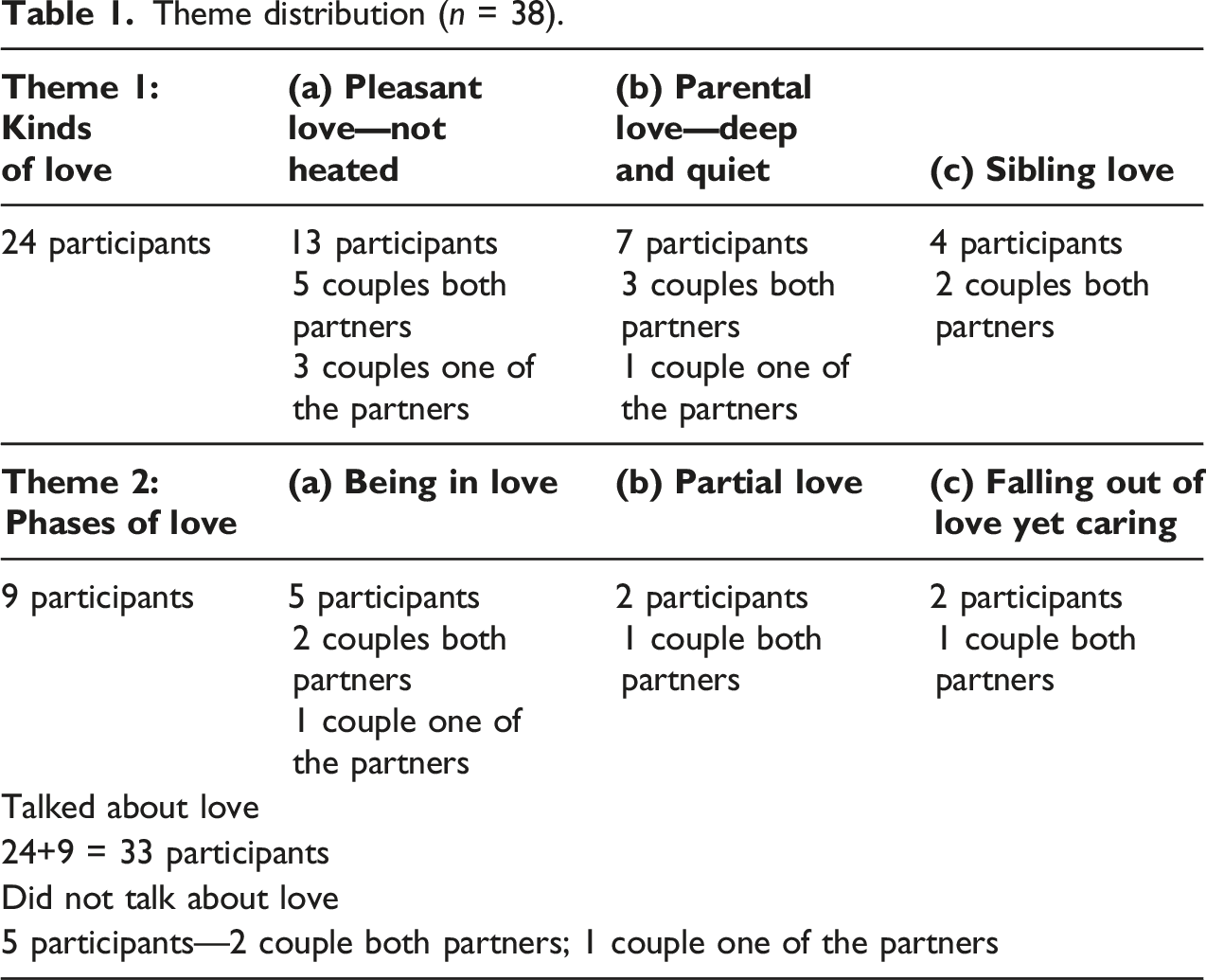
Among three couples, partners were classified differently (see supplementary material Table 3). Diversity among partners within a dyad could be related to how they experienced their lifelong marital relationship. Very few did not talk about love. The couples who talked about love were repartnered 1–10 years. The couples that did not were repartnered 2–12 years. The couple in which only one partner talked about love was repartnered 13 years. Thus, relationship length does not seem to be related to not talking about love.
Kinds of love
Includes love as “feeling good,” experienced within the three sub-themes (see also supplementary Table 3).
Pleasant love—not heated
A common experience of love among the late-life repartnered is love as pleasant—not heated. The following illustrates this by comparing love in late-life repartnering with love at younger ages by Woman8:
Love at 20 is of course different than love at 70, physically, because it’s not ‘heated’ anymore, but there’s a different love, a very, very, very, very pleasant love, very pleasant. First, love is to know you have someone by your side you can rely on. I completely rely on him, also on my husband, I was lucky in life, simply lucky that I fell upon men who are very much gentlemen, my husband was a complete gentleman. [. . .] What interests me is love, and there is. It’s respect, that I’m respected, that what I do is appreciated, that it’s not taken for granted (Woman8, age 71, cohabitation 8 years).
Late-life love is compared with love among the young. Although Woman8 supplies a rich list of what late-life love contains, she begins with what it lacks. The hot, romantic, passionate love that is lacking is replaced by a very pleasant love. Repeating “very” several times emphasizes that such a love is significant despite what it lacks. Comparing her current repartner love with her husband’s love indicates that love in her current intimate relationship is more than a heated romantic passion. All other elements, including someone to rely on, respect, appreciation, and not being taken for granted existed then and now. The difference is in physical desire. Whereas love at 20 is heated passion, love at 70 is very pleasant. Referring to luck perhaps indicates that the experience of love is not something planned or guaranteed and may occur regardless of age.
Her partner’s perspective on pleasant love follows.
Man8:
Look it’s pleasant that someone is by your side in bed, someone you love. I don’t hate her, I’m not crazy for her but I live okay with her and I’m willing to go to the ends of the earth for her, or like they say “to the edge of my abilities.” There is no problem with that at all, but real love, the first love, doesn’t exist. Love means you are willing to cut off your hand for someone else, to give, to make him feel good, but here, you are willing, there is this boundary - the endlessness - no more exists, that is it exists but with limited guarantee, it’s no longer completely real like it used to be. [. . .] real love, it’s not like with my first wife, may she rest in peace, because with her it was real (Man8, age 78, cohabitation, 8 years).
Man8 contrasts pleasant love with real love. Late-life repartnering love for him is reduced to pleasant love. His definition of pleasant love is defined mainly by what it is not: It is not real love. Whereas real love has no boundaries, pleasant love is limited, located between not hating and not being crazy over someone. Hate is usually juxtaposed to love; thus, “I don’t hate her” might suggest the intensity of his love for her. Using crazy to define love is a metaphor usually used to describe something insanely out of the ordinary. Thus, his pleasant love is ordinary. Although he is: “willing to go to the ends of the earth for her or like they say ‘to the edge of my abilities’” he does not state that he is willing to do beyond his abilities—that no longer exists. Realizing his current love is more “pleasant” than “real” and coming to terms with this realization, his opening statement that “it’s pleasant that someone is by your side in bed” might possibly be understood as willing to compromise for a “pleasant love.”
Both partners use “pleasant” to describe their love and both contrast their current love with the love they had in their lifelong marital relationship. Woman8 stays in the relationship for commitment despite low physical passion, whereas Man8 stays despite his disappointment regarding woman8’s commitment and perhaps might be staying because of physical desire.
Parental love, deep and quiet: “I love him like I love my children”
Parental love is another form of love in late-life repartnering. The following is described by Woman3 as a different kind of love, a deep and quiet love: This connection, it’s a different kind of love, how can I explain it to you, I love him like I love my children, I want to protect him, I want to protect him, I’m willing to do everything so he’ll feel good, yes it’s not a love of passion and excitement, it’s a quiet, deep love (Malka, Woman3, age 66 cohabitation, 6 years).
The different kind of love is described as: “I love him like I love my children”, a metaphor for parental love that is characterized by a willingness to protect the other and do anything to make him feel good, yet it lacks passion and excitement. “I want to protect him” is mentioned twice, which might indicate its precedents over the other functions of parental love. Parental love for children is not necessarily exclusive; parents can simultaneously love more than one child. However, parental love for a partner is exclusive. Such exclusiveness is illustrated in her partner’s perspective.
Man3:
I think friendship says it all, as much as is possible to love, to be a faithful husband, to be, to help as much as possible, I try, that is, if I see that she doesn’t feel well I try to help her. On the weekend to prepare breakfast, let her rest, those kinds of things, it fills the content [of the relationship] (Man3, age 77, cohabitation 6 years).
Love is described as friendship along with being a faithful husband. Being faithful as a husband is exclusivity. Hence, this love can be interpreted as an exclusive friendship. Furthermore, preparing breakfast is usually the woman’s role in a gender-role based relationship, which characterizes this couple’s relationship. Both partners define their love relationship in a similar way. Both emphasize a willingness to help the other and that such willingness characterizes their partner relationship. Each partner receives from the other what he considers to be love, which is security, devotion, caregiving, friendship, and companionship.
Sibling love: “a unity like between brother and sister”
Illustrated by Woman2: Woman2: I’ll tell you, it’s not love, it’s not love that we love each other, we appreciate each other, I know where I stand, I know my age and I’m very satisfied to have such a friend, but it’s not love. Interviewer: What’s love? Woman2: Love I think is when I was young, it’s something completely different, but I appreciate our unity, it’s a unity like between brother and sister, it’s a unity of understanding one another, we can tell each other what we want, each of us has his privacy. [. . .] Interviewer: What’s the uniqueness of your relationship with him as a man. Woman2: Whenever he comes in to pick me up he gives me a kiss [. . .] it’s a very close unity, very, very close, we always go hand in hand, always (Woman2, age 84, LAT 5 years).
Woman2 begins with a statement of what their relationship is not: “It’s not love”, adding that “it’s not love that we love each other”, thus hinting at a different kind of love distinct from the common romantic love, which she links to her age, “I know my age” and “Love I think is when I was young, it’s something completely different.” She expresses the conventional age perception of experiencing love and goes along with it, finding the advantages it has to offer in the form of friendship. She is satisfied and appreciates the kind of love she is experiencing. She defines it as “a unity like between brother and sister” that includes mutual understanding and someone to share experiences with while preserving each other’s privacy. However, the way she describes their relationship could fit any close friendship between two people, not necessarily those in a LAT relationship. An answer to the uniqueness of their relationship as a partner relationship was provided after a specific question was asked, leaving little doubt to its nature. Their sibling love includes intimacy expressed in private: “Whenever he comes in to pick me up, he gives me a kiss” and in public: “We always go hand in hand, always.” The addition of “it’s a very close unity, very, very close” strengthens the exclusive, romantic nature of their sibling love.
Her partner, Man2, adds to their relationship experiences as follows:
Interviewer: What does being with her provide you with?
Man2: Love, love to one another and that we know one another’s character, I bring her flowers. [. . .].
Interviewer: You said love, what is love for you?
Man2: Love in late life repartnering, it’s good love, good love.
Interviewer: What makes it good?
Man2: That we are at times together, sit together and talk, kiss sometimes, yes, we kiss each other, I never left without a kiss, she also doesn’t go without a kiss, that’s love (Man2, age 86, LAT 5 years).
Man2 directly defines their relationship as love. Both times he defines love, he begins with their emotional intimacy: “We know one another’s character” and “We at times sit together and talk.” Both times he continues with the romantic aspects of their relationship: “I bring her flowers” and “kiss sometimes.” The part referring to kissing indicates how the romantic relationship gradually developed. From a general statement of “kiss sometimes” it became “we kiss each other.” The next step moves from kissing sometimes toward a mutual “never leaving without a kiss.” Beginning with “I never left without a kiss” and continuing with “she also doesn’t go without a kiss” may indicate that he was the one who initiated the process and established it, with his partner going along with him, which is what then can finalize into “that’s love”, the mutuality.
Man2 defines the relationship straightforwardly as love, whereas Woman2’s reference, is more complex. It is important for her to convey that she acts her age. Thus, she defines their love: “like between brother and sister”. What differentiates it from biological sibling love is the physical closeness. Both partners include physical closeness as part of their intimate relationship; however, they do so only after a process of probing by the interviewer. This might indicate it as secondary to their emotional intimate closeness.
Phases of love
This theme illustrates different degrees of love, from full love to partial or not at all. It includes three different experiences: (a) loving and being in love like never before; (b) partial love, meaning partners feel love toward each other but only sometimes; and (c) although falling out of love, partners still care for one another.
Loving and being in love: “No one ever loved me like this”
The first sub-theme illustrates the experience of loving and being in love, which is an exception to the other kinds of love presented in the first theme. Man6 and Woman6 both illustrate the same essential experience. Both quotes are presented and then analyzed dyadically.
Man6:
Interviewer: How do you feel toward her? What emotions do you have toward her?
Man6: I have feelings, what can I say, that in my entire life, and I had a good life with my wife and children, but not as much as I have now with her. [. . .] many times, I didn’t feel, and maybe she too, [my wife], didn’t feel we had this special love.
Interviewer: What is love?
Man6: Love is very simply that you love the person, you love the person, you could say – oh today I’ll tell her I’ll do this and that, it comes naturally, that’s it (Man6, age 86, LAT, 2 years).
Woman6:
And I love him very, very much and he loves me like no one ever loved me like this, ever, it’s not because my husband didn’t love me, he didn’t know how to show it, he [my husband] was a completely different person, he [my partner] is an optimist. [. . .] What can I say, that in my lifetime I didn’t experience such a relationship, because, I also explained this, his children said to me: “what happened to father that he is so much in love? With mother whom he lived with so nicely, he wasn’t like this”. I told them: “I don’t think it’s love, I think it’s a completely different kind of love”, and it is expressed in that there is no commitment of raising children and problems of providing for the family, you know - life, things we all went through, like wars, army, children, everything, now what’s left is just to enjoy the good, and we do that (Woman6, age 73, LAT, 2 years).
Both partners experience love, like never before. They both compare their current love to the love they experienced in their lifelong marital relationships. Although they both have a much better and intense experience of love in their late-life repartnering relationship, they feel the need to reduce it out of respect to their deceased spouses. Man6 achieves this by claiming that his and his former wife’s feelings toward each other were mutual: “Many times, I didn’t feel, and maybe she too, [my wife], didn’t feel we had this special love.” Woman6 achieves this by justifying her former husband: “It’s not because my husband didn’t love me, he didn’t know how to show it.” By using these tactics, both partners ease the difference between their current and former love relationships. Woman6 adds another way for justifying the experience of love to her partner’s children: “There is no commitment of raising children and problems of providing for the family.” The expression of a very similar experience of loving and being in love by both partners strengthens its meaning.
Partial love: “Love sometimes”
The next two sub-themes are both in contrast to the first sub-theme presented above. Whereas the former sub-theme illustrated loving and being in love, the following sub-theme illustrates different experiences of partial love by Woman5: Woman5: Our relationship is very good, I feel, from his side, lots of love and warmth toward me, and more than that I don’t care actually - my egotism. Interviewer: How do you feel toward him? Woman5: With me it changes. I wrote him once a birthday greeting and signed: ‘love sometimes’. That might hurt, so later I corrected it because I decided I couldn’t give it to him like that, but that’s what I felt, it came out spontaneously. Interviewer: How do you explain this? Woman5: I don’t know, sometimes I have this attack of warmth toward him and sometimes I don’t even want the relationship – is this exaggerated to say it this way? [. . .] I wouldn’t call it the love of my life but good, as something good (Woman5, age 75, LAT, 2.5 years)
The partial love: “love sometimes” expresses ambivalence toward love that for her is experienced as “I have this attack of warmth toward him and sometimes I don’t even want the relationship.” She is convinced that partial love is one-sided because she feels “lots of love and warmth” from her partner toward her, in contrast to what she feels toward him “love sometimes.” She begins with claiming: “I don’t actually care” that the love is one-sided and perceives her feeling as egotism. At the end of the quote, she feels she has perhaps exaggerated in the way she presented the situation and concludes it’s not the love of her life, yet it is something good.
Man5:
I think there is—I don’t like to say this—love. Anyway, there is this attraction and mutual fondness and willingness to be together, do things together and share impressions and experiences, and it doesn’t matter whether we travel somewhere or go out here. [. . .] the attraction is mutual and the willingness to be together at least part of the time (Man5, age 81, LAT 2.5 years)
The partial aspect of love is related to time spent together. Man5 is reluctant to use the word “love,” replacing it with “mutual fondness and willingness to be together.” Love is further reduced by adding “at least part of the time” to the mutual attraction and willingness. Man5 refers the experience to both of them, although it is not clear whether it is his experience only or also his partners’, thus creating ambiguity.
Each partner expresses partial love differently. Whereas Woman5 presents a one-sided experience, convinced the partiality is from her side only, Man5 creates the impression that they both experience partial love.
Falling out of love yet caring:
In contrast to loving and being in love, this last sub-theme illustrates falling out of love.
Woman19:
A lot of negative things I didn’t see before caused the turning point. A bit of blindness. I’d say that I didn’t see. He has a lot of esthetic problems that bother me; not everyone is bothered by them, I see it and it bothers me, and that’s one of the things but it’s not the reason. The reason is somehow I can’t explain it I guess I fell out of love. Yet I think I’m a decent person and didn’t want . . . because now his mental state is worse, not because of me at all, I don’t feel like, I don’t want to, I don’t have the heart to break it off. I told him I have a dilemma. I want to break up but I’m not sure. First, I won’t have a partner, this kind of status, and second, we’re friends, he’s my friend and I know that I’ll cause him and me a lot of pain and difficulties. [. . .] I feel responsibility toward him for example, last night at 1:30AM his daughter, lives with him, she needed a place to live, called me to ask if I knew where he was, he didn’t come home, and this is unusual. I knew exactly where he went – to a lecture at the hospital, she phoned and found out he didn’t feel well and went to the emergency room and was then released. But I was all upset, I didn’t sleep all night till she called me back. [. . .] Look, I’d be satisfied at my age to have a friend to go out with, talk to, have a meal together at times, but I know that in a relationship between a man and a woman there usually is – either it deteriorates, or it develops into an intimate physical relationship which I think I am no longer seeking (Woman19, age 81, LAT 8 years).
To fall out of love, one must first fall in love. The narrative begins by describing things that irritate her with her partner. The addition of “a bit of blindness; I’d say that I didn’t see” coincides with the common notion that love is blind. Thus disillusioned, she realizes her partner’s disadvantages, a common indication of falling out of love. She perceives herself as a decent person and therefore will not abandon him, despite falling out of love. Claiming to be a decent person becomes trustworthy due to her reflectivity that remaining in the relationship is not only out of altruistic motives of being a decent person, but also because a partner relationship adds to her status. Furthermore, she states that this status is her first motive, whereas friendship comes second. Toward the end of her narrative, she describes an incident that illustrates her care and responsibility toward her partner, thus indicating that her late-life repartnering relationship is more than being in love and continues despite falling out of love and despite no longer being physically attracted to him, as demonstrated in the last part of the quote, which she links to her age.
Man19:
Interviewer: What attracted you to her?
Man19: I don’t know, I’d say the power of habit, slowly, slowly. The initiative was more hers, the emotional initiative. Going to a restaurant to eat together was perhaps mine, but the initiative to find a relationship was much more hers. [. . .] I went along with it. Let’s say, I told her already, if it no longer suits you tell me, I don’t want to force myself on you. It’s not a relationship with expectations, therefore it’s much easier, I have no expectations. [. . .] Physical intimacy – there is no longer. I feel the lack, by the way. I miss the physical intimacy (Man19, age 80, LAT, 8 years).
The narrative illustrates not being in love to begin with. This is expressed in several ways: First, he says it is “the power of habit” and adding “slowly, slowly” without a continuation, might indicate that he did not fall in love. Then he claims that “The initiative was more hers, the emotional initiative” and continues: “I went along with it”, indicating he was passive in the past and is passive in the present. Before concluding that he has no expectations from the relationship, he shifts the responsibility toward his partner stating: “If it no longer suits you tell me”, expecting her to initiate a possible breakup. “I don’t want to force myself on you” hints that he has physical attraction and desire for her, which was once mutual but is no longer so. The difference between the two experiences is that Woman19 fell out of passionate love but remains with compassionate love toward her partner, whereas Man19 was never in love with Woman19 yet enjoyed a physical intimacy with her until she fell out of love.
Discussion
The findings reveal unique kinds of love and their meaning among mating partners in late-life repartnering relationships, such as pleasant love, parental love, and sibling love. Although such kinds of love have been mentioned in the theoretical and empirical literature on love in general (Fehr, 1994), they have not been mentioned in the context of older adult intimate/romantic partner relationships. The findings also reveal different degrees of love from full love to partial or not at all, referred to as “phases of love.” The findings show that for most couples, the man and woman have a similar perception of love, which coincides with Fehr’s and Broughton’s (2001) results emphasizing the characteristics of dyadic experiences. The discussion refers to late-life repartnering love as exclusive and as shifting from passion to compassion.
Exclusive love
One of the main characteristics interpreted across themes is that love was found to be exclusive. This contrasts with previous findings indicating that new late-life romantic relationships among older Australians aged 60+ are not necessarily based on monogamy (Malta & Farquharson, 2014). Love for one’s children and love between sister and brother are not referred to as exclusive in the theoretical literature (e.g., Fromm, 1956). However, when such love is experienced among partners in late-life repartnering relationship, it becomes exclusive toward one another.
Exclusivity in late-life repartnering pleasant love was found to be preserved by commitment, encompassing commitment and passion, which resembles Fatuous love in terms of love as a triangle (Sternberg, 1986), although the role of intimacy is unclear. The uniqueness is that exclusivity remains despite falling out of love in late-life repartnering. This is expressed by not ending the relationship. The compassionate part of the relationship remains and is practiced by the partner. Furthermore, remaining in the relationship contributed to preserving a social status of being in a partner relationship, which is considered a higher status than being single (Samanta, & Varghese, 2019). This could be compared to empty love, which includes commitment but lacks passion and intimacy (Sternberg, 1986), combined with altruistic love, Agape (Lee, 1977) yet not identical to Agape (Fehr et al., 2014). A different study found that the love style Agape has a positive effect on dyadic coping and relationship satisfaction (Vedes et al., 2016). However, our findings indicate that falling out of love in late-life repartnering due to lack of intimacy and passion has a negative effect on relationship satisfaction, despite its altruistic characteristics.
From passionate to compassionate love
Shifting from passionate to compassionate love was identified across themes. The experience of being in love is the exception, in contrast to other kinds of love identified among older adults who entered a new relationship later in life in this study. This might be related to length of relationship: When the relationship is new, the couple is in their honeymoon phase of being in love. Perhaps, as time passes, the initial excitement is reduced (Bildtgård & Öberg, 2019).
Pleasant love (not heated) possibly expresses love without sexuality. The parental love described as deep and quiet emphasizes mutual caring and security with companionship. Deep and quiet are metaphors. Deep indicating intimacy, whereas quiet, although not directly mentioned, could indicate the quiet nature of body closeness in old age as opposed to stormy, and/or as opposed to noisy, that is, wanting to keep the passionate aspect of the relationship discrete. Perhaps because passion is less accepted as normative in old age in less modern societies (Bildtgård & Öberg, 2019), such as in the current study, which is located between tradition and modernity (Koren & Eisikovits, 2011). In such cultural contexts, although sexuality does not disappear in old age (Määttä, 2011), its significance changes (Gewirtz-Meydan & Ayalon, 2018). The findings of this study indicate that late-life repartnering love in some cases resembles a combination between compassionate love (Fehr et al., 2014), which includes intimacy and commitment without passion (Sternberg, 1986), and Lee’s (1977) Storage love style, which is a slowly developing affectionate companionship with gradual self-disclosure and long-term commitment expectations. However, studies conducted in more modern Western cultures found a change of attitude, indicating more liberal sexual values enabling late-life repartners to reveal a passionate partner relationship experience beyond compassion (Bildtgård & Öberg, 2019).
The sibling kind of love in late-life repartnering resembles love among biological adult siblings by emphasizing the union of caring about one another (van Volkom, 2006). However, distinct from love between biological adult siblings, among late-life repartners it also includes bodily closeness, expressed by hugging and kissing each other, although the bodily union is secondary in its importance. Thus, despite bodily closeness, love is more about compassion (Fehr et al., 2014) than passion (e.g., Sternberg, 1986), coinciding with the theme “from lust to love” found in Gewirtz-Meydan’s and Ayalon’s study (2018) conducted in the same cultural context as the current study. Thus, perhaps pleasant love—not heated, parental love, and sibling love are socially acceptable ways that represent appropriate age-relevant modesty through which to convey experiences of love in this cultural context located between tradition and modernity.
Finally, partial love in late-life repartnering is experienced as such in the context of time spent together and temporarily losing passion, while maintaining compassion and returning to passion. This coincides with love as an emotion (Gonzaga et al., 2006) and with the existential, phenomenological, emotional cycle in which love cannot constantly be felt. Instead, love is felt when the individual is in an existential, emotional “up” state (van Deurzen, 2010) within the love relationship. When perceiving partial love as shifting between passion and compassion, it resembles the perception of romantic love as a combination between longing for union with the other (passion), and affection for another with whom life is intertwined (compassion) (Tomlinson & Aron, 2013).
Limitations, future research, and implications
The findings indicate unique experiences and meanings of love in late-life repartnering based on a large qualitative interview sample of 19 couples (38 participants). However, the knowledge revealed from these findings is limited, as it is unclear whether the uniqueness is due to old age or to repartnering. Therefore, a future study comparing between love in late-life repartnering and love in lifelong marital relationships in old age could assist in further understanding the unique experiences found in this study. Despite this limitation, the unique experiences of “pleasant love—not heated,” “parental love—deep and quiet,” and “sibling love” found in this study could add to the knowledge of old age because usually new relationships are characterized by passion. However, although these relationships are new by beginning in old age, it was found that passion has a secondary role. Furthermore, exclusivity was found to have an important role in characterizing romantic love in late-life repartnering despite passion having a lesser role. As such, the findings add an innovative way of perceiving romantic love in old age.
Most partners within a couple were found to have similar experiences of love, an issue that could be further investigated to understand its mechanism. Phases of love were identified, yet further in-depth qualitative investigation of dyadic love is required in order to derive a developmental trajectory of love unique to later life based on a theoretical model grounded in the data. Such a model could contribute to the study of love in developmental family psychology.
Increasing life expectancy does not always coincide with maintaining health and independent physical and cognitive functionality (Rauer et al, 2014), resulting in the need for caregiving. Exclusivity and staying in a love relationship despite shifting from passion to compassion could be further investigated to examine what happens to the love relationship when health and functionality deteriorate, and informal caregiving is required. Such knowledge has potential to assist formulating health policies for individuals, families, and society.
Conclusions
This study focused on the meaning of the concept of love based on partners’ individual and dyadic experiences within new partner relationships entered later in life in Israel, culturally located between tradition and modernity. Accordingly, the experiences of love highlighted compassion over passion yet emphasized exclusivity. From a naturalistic, ontological, and epistemological view (Lincoln & Guba, 1985), attitudes toward romantic love in old age are culturally co-constructed by participants and the researcher and therefore multi-faceted. This is especially apparent when comparing these findings to findings in more modern Western cultures such as Sweden (Bildtgård & Öberg, 2019) on one side and Eastern Asian cultures such as India (Samanta, & Varghese, 2019) on the other. Samples in each country represent the normative life course within the cultural contexts they live in. The Swedish sample included participants that, before entering a new partner relationship later in life, had experienced more than one marital relationship, whereas the Israeli and Indian samples were characterized by participants who had experienced one lifelong marital relationship. Whereas participants in the Swedish study openly talked about love as the background for sex beyond compassion (Bildtgård & Öberg, 2019), new love in later life in the Indian study was examined as a sociocultural concept linked to modernization processes (Samanta & Varghese, 2019). In this Israeli study, participants emphasized the exclusivity of romantic love entered later in life despite a shift from passion to compassion. Cultural differences may explain the different ways love is referred to in each study, coinciding with the naturalist ontology and epistemology.
Supplemental Material
sj-pdf-1-jfi-10.1177_0192513X211031520 – Supplemental Material for Dyadic Experiences of Love in Late-Life Repartnering Relationships
Supplemental Material, sj-pdf-1-jfi-10.1177_0192513X211031520 for Dyadic Experiences of Love in Late-Life Repartnering Relationships by Chaya Koren in Journal of Family Issues
Footnotes
Declaration of Conflicting Interests
The author(s) declared no potential conflicts of interest with respect to the research, authorship, and/or publication of this article.
Funding
The author(s) received no financial support for the research, authorship, and/or publication of this article.

Supplemental Material
Supplemental material for this article is available online.
References
Supplementary Material
Please find the following supplemental material available below.
For Open Access articles published under a Creative Commons License, all supplemental material carries the same license as the article it is associated with.
For non-Open Access articles published, all supplemental material carries a non-exclusive license, and permission requests for re-use of supplemental material or any part of supplemental material shall be sent directly to the copyright owner as specified in the copyright notice associated with the article.
