



Abstract
Most parents want their children to succeed well. For some parents, however, children’s successes are strongly related to beliefs about their own self-worth; a concept known as parental child-invested contingent self-esteem, which has shown links to negative parenting practices (e.g., psychological control). Less is known about associations with aspects of the parent–child relationship that are particularly relevant among families with immigrant backgrounds. We examine the associations with acculturation-related conflicts in a sample of 180 Latino parents of children in 6th to 12th grade. Results showed that higher levels of parental child-invested contingent self-esteem was significantly linked to higher levels of acculturation conflicts, but this link was especially strong if the parent reported that their child was unresponsive to their corrections. When parents base their self-worth on their child’s successes and the child acts in ways that are not in line with parents’ expectations, parents report more acculturation-related conflicts.
Keywords
Introduction
Most parents have expectations on their children to achieve well in different situations, such as school, and will perceive this as an important part of being successful in life. For some parents, however, their children’s achievements might be strongly, and somewhat problematically, connected to their own achievements and feelings of worth. Parents scoring high on child-invested contingent self-esteem believe that their children’s successes or failures reflect their own self-worth. Such beliefs are related to negative parenting practices (Grolnick, Price, Beiswenger, & Sauck, 2007; Ng, Pomerantz, & Deng, 2014; Wuyts, Chen, Vansteenkiste, & Soenens, 2015) and decreased well-being in parents (Wuyts, Vansteensiste, Soenens, & Assor, 2015). Despite a growing interest in understanding how child-invested contingent self-esteem is linked to family functioning, a majority of the available studies have focused on parents from independent cultures (e.g., European American and Belgian). Limited knowledge is available on how parents’ child-invested contingent self-esteem plays a role in the family relations in families with immigrant backgrounds (e.g., Latino families)—first-generation or second-generation (or beyond) immigrant parents—who often parent their offspring in a social context which includes contrasting values and customs of heritage and mainstream cultures. To address this gap of knowledge, we extend previous research by examining child-invested contingent self-esteem among Latino parents and children in the United States. Specifically, we examine the extent to which child-invested contingent self-esteem plays a role in conflicts related to acculturation between parents and children (i.e., conflicts as a result of differences in cultural values).
Parental Child-Invested Contingent Self-esteem
Parents’ child-invested contingent self-esteem is defined as parents’ tendency to assess their self-worth based on their child’s successes and failures (Ng et al., 2014; Wuyts, Chen, et al., 2015; Wuyts, Vansteensiste et al., 2015). There have been recent empirical efforts to understand how this tendency influences parents’ psychological health and parent–child interactions. It has been argued that for parents with higher levels of child-invested contingent self-esteem, their feelings of self-worth peaks when their children succeed, and it decreases when the child fails (Ng et al., 2014, Ng, Pomerantz, Lam, & Deng, 2019). In other words, the child’s success can be seen as a way for these parents to prove his or her own worth as a person. Studies have shown that parental child-invested contingent self-esteem is related to parents’ use of psychological control (Grolnick et al., 2007; Ng et al., 2014; Wuyts, Chen, et al., 2015; Wuyts, Vansteensiste et al., 2015), negative reactions to the child’s failure (Otterpohl, Steffgen, Steinsmeier-Pelster, Brenning, & Soenens, 2019), and lower levels of promotion of extrinsic goals (Soenens, Wuyts, Vansteenkiste, Mageau, & Brenning, 2015). Hence, parents who base their worth on their children’s achievements tend to be more controlling, have less focus on the child’s goals, and react more negatively to the child’s failures. Parents, on the other hand, might be engaged in such parenting practices in order to optimize the child’s successes, but such behaviors often interfere with children’s development and are linked to negative child adjustment (Barber, Stolz, , Olsen, Collins, & Burchinal, 2005; for a review, see Scharf & Goldner, 2018).
Parental Child-Invested Contingent Self-Esteem Among Families With Immigrant Backgrounds
Parental child-invested contingent self-esteem is commonly observed among parents with a background from cultures where self is construed in relation to important others and social expectations (i.e., interdependent culture, Kağitçibasi, 1996; Markus & Kitayama, 1991). Studies comparing parents of adolescents in China to parents in the United States and Belgium have shown that Chinese parents’ feelings of worth are more contingent on children’s achievements than are European American and African American (Ng et al., 2014) and Belgian parents (Wuyts, Chen, et al., 2015). Importantly, such beliefs and feelings have also been found to result in use of negative parenting practices such as psychological control among Chinese parents to a greater extent than among European American and African American parents (e.g., Ng et al., 2014). However, no significant difference was observed in the magnitude of the association between child-invested contingent self-esteem and parenting behaviors among Chinese versus Belgian parents (e.g., Wuyts, Chen, et al., 2015). Together, these findings suggest that parents’ feelings of worth are more contingent on children’s accomplishments among parents from interdependent cultures, but these feelings result in more intrusive and controlling behaviors in both cultures.
Our focus in the present study is Latino parents living in the United States. Several features of Latino cultures (e.g., familism, respeto, and bien educado) might explain how child-invested contingent self-esteem operates in Latino families. In fact, some of the cultural values can heighten parents’ tendency to base their worth on their children’s achievements. Specifically, the cultural values of familism are highly endorsed in Latino culture despite the existence of within group heterogeneity (e.g., Calzada, Tamis-LeMonda, & Yoshikawa, 2012; Stein et al., 2014). Familism is defined as “a belief system [that] refers to feelings of loyalty, reciprocity, and solidarity toward members of the family, as well as to the notion of the family as an extension of self” (Cortes, 1995; p. 249). This core cultural value has implications for parents’ expectations of their children (Calzada et al., 2012), and relatedly their parental values and practices (Harwood et al., 2002). For example, it has been shown that parents of Mexican American children who adhere strongly to familism values tend to monitor their children (Romero & Ruiz, 2007; White, Zeiders, Gonzales, Tein, & Roosa, 2013) to display sensitivity for their needs and concerns to a greater extent (White et al., 2013). Additionally, Latino children tend to have stronger sense of family obligations (Fuligni, Tseng, & Lam, 1999) and responsibility to bring pride to family (Calzada et al., 2012) in comparison to children from other ethnic groups. In addition to familism, raising one’s child to be bien educado is also central elements of parenting in the Latino culture (Bridges et al., 2012). That is, parents tend to put emphasis on raising a child with good manners, who is respectful to others, and cooperate well with them (Leyendecker, Lamb, Harwood, & Schölmerich, 2002), partly due to their beliefs that children’s behaviors represent the entire family.
Even though these core cultural values often are found to be important protective factors for family processes and child development in Latino families (Hernández & Bámaca-Colber, 2016; Stein et al., 2014), some studies have highlighted that familism, for instance, may also result in enmeshed relationships within family and create stress both for parents and their children (e.g., Calzada et al., 2012). In line with this conceptual reasoning, one can argue that Latino parents’ conceptions of and experience of self are inseparable from those of their children. Thus, they may perceive their child’s success and failure as a reflection of their own self, as well as the family as a whole. To our knowledge, no study, however, has examined Latino parents’ feelings of worth as contingent on their children’s accomplishments. The present study aims to address this gap in knowledge.
The Link Between Child-Invested Contingent Self-Esteem and Acculturation-Related Conflicts in Families With Immigrant Backgrounds
Parents in families with immigrant backgrounds (i.e., both first generation and second generation and beyond) might feel pressure to adapt to what is considered good parenting in the country that they live in and at the same time wanting to retain some aspects from the culture of heritage. In general, children and adolescents often adopt the values and behaviors of the mainstream culture more so than their parents (e.g., Cheung, Chudek, & Heine, 2011; Lee, Choe, Kim, & Ngo, 2000), creating an acculturation gap between parents and children (for a review, see Telzer, 2010). Although an acculturation gap might not inevitably create acculturation-related conflicts (Telzer, 2010), in families where either the parent or the child perceives the gap as problematic, it might present challenges and conflicts with the child that can put pressure on parents in their parenting role. For example, if parents believe that their children should act in accordance with the heritage culture, they might be less supportive and put more pressure on the child if he or she attempts to adapt to the mainstream culture, which increases the risk for acculturation-related conflicts (Cordova, Ciofu, & Cervantes, 2014). For parents with immigrant backgrounds in the United States, they might experience clashes around culturally salient issues, such as respecting elders, having strong family ties, and being successful in school on the one hand (i.e., aspects often used to describe an interdependent culture) and emphasis on achieving personal goals and becoming increasingly independent on the other (i.e., aspects often used to describe an independent culture) (e.g., Rivera et al., 2008), which might influence children’s adjustment and well-being.
Studies have shown that acculturation-related conflicts between children and parents in families with immigrant backgrounds are linked to low family social cohesion (Lawton, Gerdes, & Kapke, 2018) and alienation in the parent–child relationship (Qin, 2006). Additionally, acculturation-related conflicts can interfere with the well-being of children. Specifically, children who experience high acculturation conflict at home are at risk of developing psychosocial problems, including depressive symptoms and low self-esteem (Huq, Stein, & Gonzalez, 2016; Hwang & Wood, 2009; Juang, Syed, Cookston, Wang, & Kim, 2012; Lawton et al., 2018). As acculturation-related conflicts often have negative implications for parents and children, it is of importance to understand the development of such conflicts. Most studies, however, have examined immigrant parents, and not second-generation (or beyond) immigrant parents. It is still possible, however, that acculturation conflicts continue to exist in these samples as a form of intergenerational influence. To study acculturation conflicts in second-generation (and beyond) immigrant parents might offer further understanding of the meaning and experiences of such conflicts for parenting over generations. In this study, we examine child-invested contingent self-esteem as a potential predictor of acculturation-related conflicts among Latino mothers and fathers living in the United States.
If children in families with immigrant backgrounds want to behave in accordance with an independent approach (which is in line with the mainstream American culture), and their parents want them to behave in accordance with values emphasizing interdependency, as they might believe that this reflects positively back on them as parents and on the family, their cultural values might clash and result in acculturation-related conflicts. Given the core cultural values in Latino families (e.g., familismo, respeto, and bien educado), if parents with immigrant backgrounds believe that their children’s achievements depict themselves and the family in a negative way, they might be more likely to put pressure on the child. Children’s reactions to parenting pressure might be explained in line with ideas of reactance theory (Brehm, 1966; Brehm & Brehm, 1981), which posits that people react negatively when they are restricted to act in a given way or forced to act in a way they do not want (e.g., Kakihara, Tilton-Weaver, Kerr, & Stattin, 2010; van Petegem, Soenens, Vansteenkiste, & Beyers, 2015). It is likely that children’s attempts to resist what their parents want them to do will result in conflicts in the parent–child relationship. Hence, from previous studies, it known that immigrant parents are more likely to base their self-worth on their children and that such beliefs are linked to more controlling behaviors among parents. Based on the negative feelings and feelings of intrusiveness that children often have in regard to parents’ controlling behaviors, it is expected that high levels of parental child-invested contingent self-esteem will be linked to higher levels of acculturation-related conflicts between parents and children.
The Role of Children’s Reactions to Parents’ Socialization Attempts
Although child-invested contingent self-esteem has, generally, been linked to more negative outcomes, there might be conditions under which it is especially negative for the parent–child relationship, and, thus, be related to especially high levels of acculturation-related conflicts. Arguments about such conditions might be built on ideas from the goodness-of-fit model (Thomas & Chess, 1977), which suggests that adaptive developmental outcomes occur when there is a match between the characteristics of the person and the demands of the context. Child characteristics might be more or less in line with the demands in different contexts, and problems of adapting to such demands, thus, might be seen as a result of a mismatch between the child’s characteristics and the setting. This theoretical perspective has been widely used to explain developmental trajectories of children with difficult temperament who are exposed to different settings (e.g., Lerner, 1993; Putnam, Sanson, & Rothbart, 2002). This model might also be adopted here to explain variations in acculturation-related conflicts between parents and children. According to this model, optimal parenting should occur when parents’ expectations of their child meet with child characteristics or behaviors. In contrast, as has been shown in previous research, when children act with disobedience or expressing difficult behaviors, parents often react negatively (e.g., Glatz, Stattin, & Kerr, 2011; Zvara, Sheppard, & Cox, 2018), which might be a result of the mismatch between parents’ expectations about appropriate behaviors and their child’s actual behavior.
As highlighted above, parents who have high expectations of the child’s success most likely will try to guide and correct the child’s behavior in directions that they think would increase chances for success. However, if the child has a need for autonomy and does not respond well to parents’ socialization attempts, such situation would be regarded as a mismatch between the child’s characteristics and the context and might hamper the quality of parent–children relationship—in our case increase the risk for acculturation-related conflicts.
The Current Study
In this study, we examine whether parents’ child-invested contingent self-esteem is linked to higher levels of acculturation-related conflicts. Acculturation conflicts have often been used as a predictor of child adjustment and parent–child relationship quality (e.g., Juang et al., 2012; Lawton et al., 2018), but have seldom been theorized as a consequence of other family and parent–child relationship processes. As done in this study, examining sources of acculturation-related conflicts, and why some immigrant parents and their children experience more conflicts, offers important insight into the experience and unique challenges that these parents face. This integrates child-invested contingent self-esteem into a cultural relevant model of parenting in immigrant families.
We use a sample of 180 Latino mothers and fathers of children in 6th to 12th grade. We focus on this group of parents, as Hispanic and Latino Americans are the largest ethnic minority in the United States (US Census Bureau, 2014), and, thus, constitute a relevant group for examinations of processes in families with immigrant backgrounds. Given emphasis on the family in Latino families and that the family is viewed as an extension of the self, this group is interesting in the study of parents’ child-invested contingent self-esteem and links to acculturation-related conflicts. Additionally, studies on parenting in Latino families have used very heterogenic samples, including Spanish speaking mothers from low-income families (e.g., Cabrera, Shannon, Mitchell, & West, 2009; Garcia Coll & Pachter, 2002). As a result, less is known about experiences with parenting and parent–child relationship (e.g., acculturation-related conflicts) among Latino fathers and Latino parents with higher income. Regarding Latino fathers, studies have shown that they are more involved in their children’s life and show more warmth than was traditionally argued (Cabrera et al., 2009, Cabrera, Hofferth, & Chae, 2011), which argues for the need to study fathering among Latino families. The sample used in this study includes mostly second-generation (or beyond) immigrant mothers and fathers from families with higher income; sample characteristics that have not been in focus in previous studies.
The study hypotheses are formulated based on two different theories. Drawn from ideas of the reactance theory (Brehm, 1966; Brehm & Brehm, 1981), we predict that (1) parents and children will experience more conflicts if parents have higher levels of child-invested contingent self-esteem. Additionally, we examine parents’ perceptions of their children’s unresponsiveness to socialization as a moderator for the link between child-invested contingent self-esteem and acculturation-related parent–child conflicts. In line with the premises of the goodness-of-fit model (Thomas & Chess, 1977), we propose that (2) parents’ perceptions of the child’s unresponsiveness to corrections constitute a condition under which parents’ tendency to base their self-worth on the behavior of their child will likely result in more conflicts than if parents perceive the child to be responsive to their corrections.
Method
Procedure and Participants
The sample for this study was derived from a larger project (N = 1077) including a nation-wide sample of parents collected in the United States in 2014. Parents were recruited through Qualtrics Panel, and they responded to questions through a secure Internet-based platform. Members of any of the partner panel providers of Qualtrics who qualified for the study (i.e., parents of children in 6th to 12th grade within one of the following ethnic groups: Caucasian, African American, Latino/American, and Asian American) received an invitation message through their membership portal. Upon providing informed consent, participants filled out the survey, which took approximately 40 minutes to complete. All study materials were available only in English. If parents had multiple children in the specified age range, they were asked in the beginning of the survey, randomly, to answer the questions about their youngest child, a middle child (for parents of three or more children), or oldest child. After the survey, parents were given a debriefing statement, which described the study’s purpose and thanked them for participating (for more details about the dataset, see Kiang, Glatz, & Buchanan, 2017). The project was approved by the Institutional Review Board at [blinded] (IRB protocol number 00021729).
For this specific study, we used a sample of 180 parents (28% mothers) who self-identified as Latino. Of the parents, 87% were born in the United States and 13% were born in a country outside of the United States. Hence, the sample consisted of a majority of second-generation (or beyond) immigrant parents. We refer to this sample as families with immigrant backgrounds. Among the parents, 109 (61%) were parents of boys and 71 (39%) were parents of girls. The majority of the participants reported on their biological child (85%), but some reported on their adoptive child or step-child. The children were in grade 6 (8%), grade 7 (19%), grade 8 (14%), grade 9 (8%), grade 10 (24%), grade 11 (7%), and grade 12 (20%). Concerning parent education, 1% had less than a high school education, 21% had a high school education only, 24% had some college or vocational education, 36% had a college degree only, and 18% had a graduate or professional degree. Yearly family income was distributed as follows: Less than $20,000 (9%), $20,000–$37,999 (18%), $38,000–61,999 (32%), $62,000–$101,000 (26%), and over $101,000 (15%). At the year of the data collection, the poverty threshold for a family of four (including two children) was $24,250 (US Census Bureau, 2014). This means that only a small percentage of the participating families fell below the poverty line.
To compare Latino parents on their level of child-invested contingent self-esteem with European American parents, we also included 721 parents (54% mothers) who self-identified as European American parents.
Measures
Parents’ child-invested contingent self-esteem
We used a measure of parents’ child-invested contingent self-esteem (Wuyts, Vansteensiste et al., 2015). This scale contains 15 items assessing the extent to which parents’ self-esteem is contingent on children’s achievement in general (three items: e.g., “How I feel about myself is often related to my child’s achievements”) as well as on the child’s successes (six items: e.g., “When my child succeeds, I feel good about myself”), and on the child’s failures (six items: e.g., “My child’s failure is also my failure”). The response options ranged from 1 (Not at all applicable) to 6 (Totally applicable). Four of the 15 items included in this measure were related to school achievement, the other 11 were about the child’s achievement in general. In previous studies, parents’ child-invested contingent self-esteem has been linked to achievement-oriented psychologically controlling parenting, even after controlling for child performance (Wuyts, Vansteensiste et al., 2015), suggesting criterion validity of this construct. We conducted an exploratory factor analysis to examine the factor structure of this scale in our sample. The result showed that 36% of the variance was explained by one factor, which is somewhat lower than results of previous studies (40%, Soenens et al., 2015; Wuyts, Vansteensiste et al., 2015). As a result of this analysis, we used parents’ reports of their child-invested contingent self-esteem as a one-factor construct in line with previous research (Soenens et al., 2015; Wuyts, Vansteensiste et al., 2015). Cronbach’s alpha for this scale was .91.
Acculturation-related conflicts
Parents reported on 10 statements from the Asian American Family Conflict Scale (Lee et al., 2000) to describe their relationship with their child, specifically focusing on how often they disagreed on certain aspects. Some of these aspects are specifically related to acculturation (e.g., respecting elders and sacrificing interest for the sake of the family), and others are of more general nature (e.g., telling the child what to do with his/her life and expecting good school performances). Prior work has largely focused on adolescents’ perceptions of conflict, but modifications to assess parents’ perceptions have been successful (Kim, 2011). This scale has been successfully adapted to measure family cultural conflict among first- and second-generation Latino families (e.g., Kiang et al., 2017, in which 86% were second-generation (or beyond) immigrants). Sample items read, “My child has done well at school, but my academic expectations always exceed his/her performance,” “I tell my child what to do with his/her life, but my child wants to make his/her own decisions,” “I want my child to sacrifice personal interest for the sake of the family, but he/she feels this is unfair,” and “I demand that my child always shows respect for elders, but my child believes in showing respect only if someone deserves it.” The response options ranged from 1 (Almost never) to 5 (Almost always). Cronbach’s alpha for this scale was .92.
Parents’ perceptions of child’s unresponsiveness to correction
Parents rated how the child normally responds to their attempts to influence his or her behavior (Kerr et al., 2008). This scale was used to measure the characteristic of the child in general, rather than specifically related to acculturation aspects. This scale has been used in previous studies to measure parents’ beliefs about their child’s reactions to their parenting practices and whether the child is open or responsive to their influence (Glatz et al., 2011; Glatz & Trifan, 2019). Parents responded to five statements on a Likert scale ranging from 1 (Does not apply at all) to 4 (Applies exactly): “Often does something after being told several times that it is not allowed,” “Often gets angry when he/she is rebuked,” “You often need to tell him/her several times when he/she has done something wrong to get him/her to stop,” “Although we reprimand him/her for a specific behavior he/she continues to do it,” and “Usually it is sufficient to scold him/her once to prevent him/her from doing something that is not allowed.” The response options ranged from 1 (Does not apply at all) to 4 (Applies exactly). Cronbach’s alpha for this scale was .83.
Independence of the Study Predictors
The child’s unresponsiveness to parental correction and acculturation-related conflicts both tap into parents’ perceptions of the child and interactions with the child. However, the items in the measure of the child’s unresponsiveness to parental correction concern general child behaviors, whereas the acculturation-related conflict items, to a great extent, tap into behaviors specific to the cultural domain. To examine if these two predictors were separate factors, we ran the following three confirmatory factor analysis (CFAs) models: (1) a single-factor model where all items from the two scales loaded onto one latent construct, (2) a two-factor orthogonal model (the two factors were treated as independent, with the correlation set at 0), and (3) a two-factor oblique model (the two factors are interrelated). The latter two models were nested, which allows comparison of model fit using a chi-square difference test. The single-factor model showed a poor fit, χ 2 (90) = 292.74, p < .001, Comparative Fit Index (CFI) = .86, Root Mean Square Error of Approximation (RMSEA) = .11, p < .001, Standardized Root Mean Square Residual (SRMR) = .07, and so did the orthogonal model, χ 2 (90) = 264.05, p < .001, CFI = .88, RMSEA = .10, p < .001, SRMR = .24. But, the third, oblique, model yielded acceptable fit, χ 2 (89) = 163.96, p < .001, CFI = .95, RMSEA = .07, p = .036, SRMR = .05. Comparison between the nested models showed that the oblique model produced a significantly better fit to the data than did the orthogonal model, χ 2 (1) = 100.09, p < .001. These analyses suggest that the study predictors were interrelated, but empirically distinct constructs.
Statistical Analyses
We used Mplus 7.11 (Muthén & Muthén, 1998) with the maximum likelihood estimator to examine the link between parents’ child-invested contingent self-esteem and their reports of acculturation conflicts. Additionally, we used parents’ perceptions of their child’s unresponsiveness to parental correction as a moderator, thus testing the idea that child-invested contingent self-esteem would be linked with higher levels of conflicts especially when parents believe that the child is not acting in line with their expectations and wishes. All variables in the analysis were observed variables. We centered the predictor and moderating variables (i.e., child-invested contingent self-esteem and child’s unresponsiveness to parental correction) prior to the construction of interaction term in order to reduce non-essential multicollinearity and to facilitate interpretation of the interaction term. The interaction term was used as an additional predictor of acculturation-related conflicts. For a potential significant interaction, we used one SD (SD) below and above the mean of the moderator to plot the interaction effect, and we examined (1) if the steepness of the two slopes was significantly different from zero and (2) if the steepness of the two slopes differed from each other (i.e., if one slope was significantly steeper than the other).
The following demographic variables were examined as potential covariates: Parents’ country of birth (born in the United States or not), child’s grade in school (grade 6 to grade 12), child’s gender, parents’ income (as a proxy for socioeconomic status), and parents’ relationship with the child (biological child vs. adoptive or step-child).
Results
Descriptive Statistics
As a baseline analysis and as previous studies have shown that parents with immigrant backgrounds report especially high levels of child-invested contingent self-esteem, we examined whether Latino parents differed from European American on this variable. Results showed that Latino parents reported significantly higher levels of child-invested contingent self-esteem (M = 4.41; SD = .96) than did European American parents (M = 4.22; SD = .91; t (899) = 2.39; p = .017).
Zero-Order Correlations Among Study Variables.
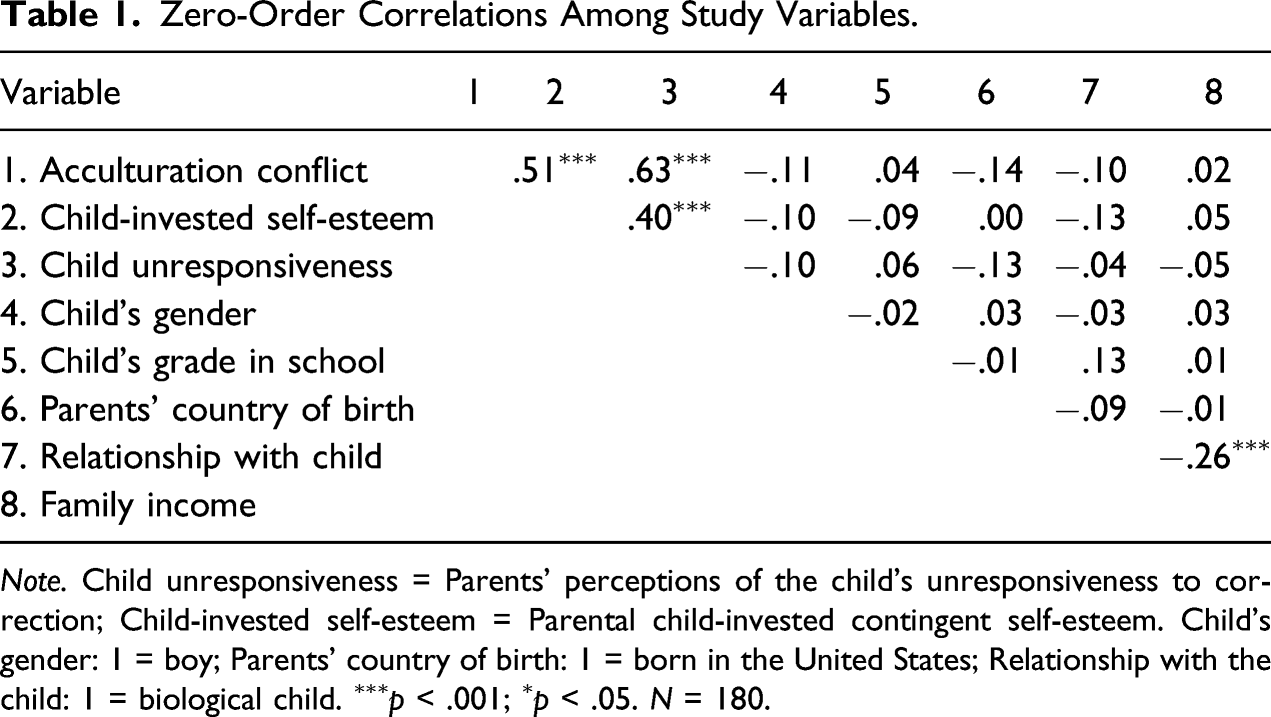
Note. Child unresponsiveness = Parents’ perceptions of the child’s unresponsiveness to correction; Child-invested self-esteem = Parental child-invested contingent self-esteem. Child’s gender: 1 = boy; Parents’ country of birth: 1 = born in the United States; Relationship with the child: 1 = biological child. ∗∗∗p < .001; ∗p < .05. N = 180.
Links Among Child-Invested Contingent Self-Esteem, Acculturation-Related Conflicts, and Child’s Unresponsiveness to Parental Correction
Regression Coefficients Predicting Level of Acculturation Conflict.
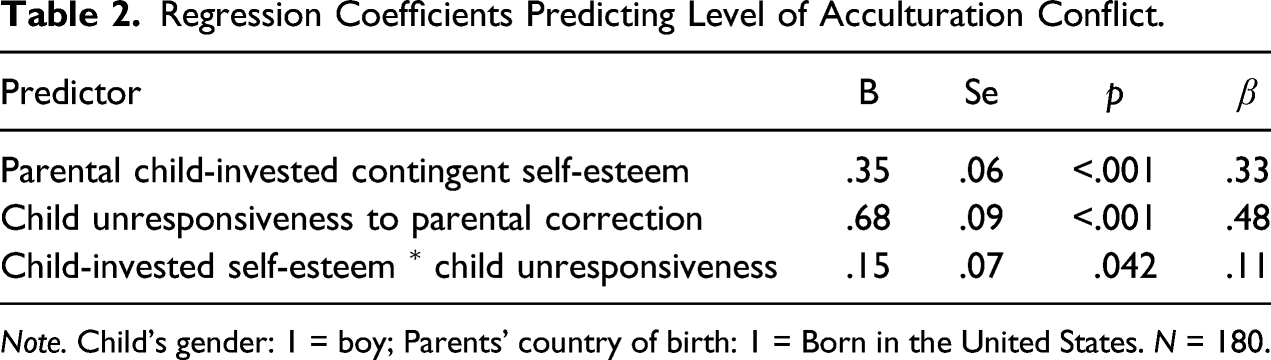
Note. Child’s gender: 1 = boy; Parents’ country of birth: 1 = Born in the United States. N = 180.
In the moderated-regression model, we examined main effects of child-invested contingent self-esteem and child’s unresponsiveness to parental correction, and we included the two-way interaction effect (with child-invested contingent self-esteem and the child’s unresponsiveness to parental correction) as a predictor. This model explained 49% of the variance in acculturation-related conflicts. Results showed that higher levels of parental child-invested contingent self-esteem was significantly linked to higher levels of acculturation conflicts reported by parents (β = .33; p < .001). So were parents’ reports of their child’s unresponsiveness to parental correction (β = .48; p < .001): Parents who believed that their child was unresponsive to their corrections reported more acculturation-related conflicts.
The two-way interaction between child-invested contingent self-esteem and children’s unresponsiveness to correction was a significant predictor of acculturation-related conflicts (β = .11; p = .042). In line with our expectation, the link between child-invested contingent self-esteem and conflicts was especially strong if the parent reported that their child was unresponsive to their corrections. A simple slope test showed that both slopes were significantly different from zero (B = .61 and .83, p < .001, for the slopes set at 1 SD above and below the mean on child’s unresponsiveness to their attempts to correct the child, respectively). Although both slopes were significantly different from zero, they differed significantly from each other in steepness, χ
2
Δ = 4.13 (1), p = .042 (see Figure 1). The slope set one SD above the mean of the moderator (i.e., parents who reported their child to be unresponsive to their corrections) was significantly steeper than the other slope. Hence, parents who reported that their self-esteem was dependent on their child’s achievement and who believed that their child was unresponsive to their attempts to correct their behavior reported higher levels of acculturation conflicts compared to parents who believed that their child normally respond to their corrections. Illustration of the significant two-way interaction with child-invested contingent self-esteem and parents’ perceptions of the child’s unresponsiveness to correction as a predictor of acculturation related conflicts. N = 180.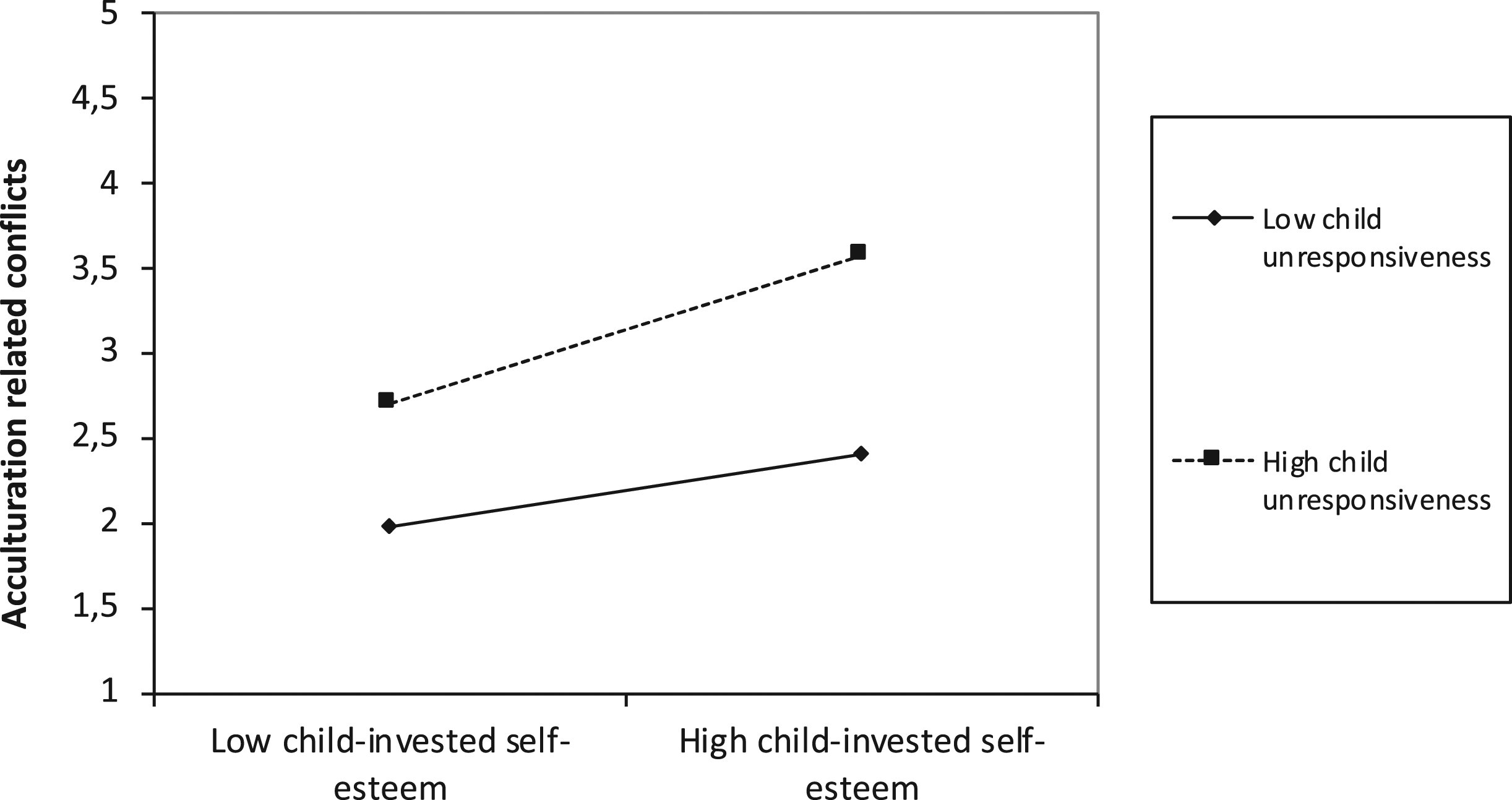
Discussion
In this study, we examined child-invested contingent self-esteem among parents in Latino families in the United States. The results showed that parents who perceive their children’s successes or failures as reflecting their own self-worth reported more acculturation-related conflicts, and this pattern was especially pronounced if their children did not act according to their wishes. Additionally, in line with previous studies (Ng et al., 2014; Wuyts, Chen, et al., 2015), we found that parents with a more interdependent cultural background (i.e., Latino parents) reported higher levels of child-invested contingent self-esteem than did parents with a more independent cultural background (i.e., European American parents). These results add to existing knowledge about the cultural importance of this concept.
Child-Invested Contingent Self-Esteem and Links to Contingent Self-Esteem
The main effect involving parental child-invested contingent self-esteem is in line with previous studies showing that parents’ beliefs that their children’s successes or failures reflect their own self-worth are associated with negative aspects of their parenting and the parent–child relationship (Grolnick et al., 2007; Ng et al., 2014; Wuyts, Chen, et al., 2015; Wuyts, Vansteensiste et al., 2015). The results in this study support a parental belief model describing the impact of parents’ beliefs about their parenting role (i.e., what they base their worth as parents on) for their parenting practices and relationship with their child (e.g., Sigel & McGillicuddy-De Lisi, 2002). This study adds theoretical understanding of parents’ perceptions about their children’s achievement as a source of self-evaluation in the parenting role and the impact of such self-evaluation for the parent–child relationship.
In addition to the extended knowledge about child-invested contingent self-esteem in general, the results of this study offer knowledge about how such parental perceptions can operate in families with immigrant backgrounds. Cultural models suggest that it is important to consider parenting in the light of the cultural context it is embedded in (García Coll et al., 1996). Child-invested contingent self-esteem as a concept must then be understood in the context of Latino families, including core cultural values (e.g., familism, resepto, bien educado). These values might to some extent heightened the existence of child-invested self-esteem and might also explain how such beliefs impact the parent–child relationship. In many Latino families, behaviors of the family members represent the family as a whole (i.e., familism and bien educado) (e.g., Calzada et al., 2012; Leyendecker et al., 2002). Based on this notion, it is possible that parents’ beliefs about the worth of the family as a whole is contingent on the child’s achievement, and not only their own perceived self-worth as parents. Hence, in Latino families, child-invested self-esteem might be understood on a family-level rather than on an individual parent-level.
If parents believe that the child’s success and failures impact how other persons view the family, it is likely that they will put pressure on the child to act in ways that put their family in a better light, for example, by acting in accordance with their cultural beliefs. It is important to note that this is probably not a problem in many Latino families, as children in Latino families often have strong sense of family obligations and want to act in ways that make their parents proud (Calzada et al., 2012; Fuligni et al., 1999), and thus, not result in negative outcomes (Telzer, 2010). In some families, however, this pressure might increase the risk for clashes between parents and children, and, in the end, increase the risk of conflicts. Our measure of acculturation-related conflicts was reported by parents, rather than by children that are normally seen in previous research. The results of this study capture parents’ perceptions of not being satisfied with the child’s behavior related to culture-specific behaviors but might also be an indication of parents’ beliefs that the child is not following their directions in general. This offers knowledge about parents’ beliefs and perceptions in Latino families. Having children’s reports, in addition to parents’ reports, might offer further understanding about child-invested contingent self-esteem and links to various parenting and child outcomes in families with immigrant backgrounds are needed.
The results of this study should also be discussed with the specific sample characteristics in mind. Most of the parents were second-generation immigrants and all could answer the survey in English. This might be an indicator of higher level of integration in the American society. As a result, parents in our sample might have experienced less acculturation-related conflicts with their children, as the acculturation gap between the child and the parent might be somewhat smaller than in other Latino sub-groups. However, the significant association found in this study is important. Even among parents who might experience fewer cultural clashes with their children in comparison with first-generation immigrant parents, their perceptions of the child’s successes and failures are associated with more parent–child conflicts about general aspects and aspects specifically related to culture. Although one could speculate, it is unknown if the results found in this study would also be found in a first-generation immigrant sample. Other aspects might be of importance among parents who themselves have migrated to another country. For example, parents who have migrated often move to another country with the hope of finding better life conditions for themselves and for their children. They often have high expectations from their offspring to succeed and may perceive their children’s success as a way to fulfill their initial hope (Li, 2004). For these parents, their children’s success and failures might be even more important for their self-worth and consequent actions, suggesting an even stronger association between child-invested contingent self-esteem and acculturation-related conflicts.
The Interaction Between Child-Invested Contingent Self-Esteem and Parents’ Perception of Child’s Unresponsiveness to Correction
We also found a significant main effect of parents’ perceptions of their child’s unresponsiveness to correction on acculturation-related conflicts. This result supports the understanding that children make a significant impact on their social interactions and environment (e.g., Bell, 1968; Sameroff, 1975). Specifically, how parents perceive their children’s responses to their socialization attempts is important for their relationship with the child, pointing to the active role of the child in the parent–child relationship.
In addition to the significant main effects, the results showed that child-invested contingent self-esteem was linked to especially high levels of acculturation-related conflicts when parents perceived their child to be unresponsiveness to their attempts to correct. This interaction effect suggests that under certain conditions, parents’ beliefs about their self-worth connected to the child’s successes are especially negative for the parent–child relationship. The combination of parental beliefs about their self-worth and their children’s characteristics speaks to a transactional model of parent–child dynamics (Sameroff, 1975), and supports the idea of a mismatch between parents’ expectations and their perception of child characteristics. Our hypothesis in this study was derived from the goodness-of-fit model (Thomas & Chess, 1977), which describes the impact of a match or mismatch between the child and his or her environment for the child’s adjustment. In cases of a mismatch, the child will experience less positive adjustment and development than if there is a match. Hence, under conditions of a mismatch—when parents’ self-esteem was dependent on the child’s achievement and they perceive the child to be unresponsive to their corrections—parents reported especially high levels of acculturation-related conflicts.
What needs to be noticed, however, is that the interaction effect was somewhat weak, although significant, and should be interpreted in accordance. Still this interaction effect informs about conditions under which the association between parents’ cognitive processes and the parent–child relationship is especially strong. When the child does not respond to parents’ desires and socialization attempts, it is possible that such situation might induce stress to parents. In fact, research suggests that certain child behaviors, such as externalizing problems and ADHD, result in more parental stress (e.g., Muñoz-Silva, Lago-Urbano, Sanchez-Garcia, & Carmona-Márquez, 2017), which in turn has shown to be linked to negative parenting practices (e.g., Le, Fredman, & Feinberg, 2017). In this sense, parents who base their self-worth on children’s successes, and their children do not follow their corrections and attempts, might feel especially stressed as they realize that their child’s behaviors will not put themselves in a positive manner. Such negative feelings might lead to conflict in parent–child interactions due to different reasons including cultural clashes. Future research should test this and other mechanisms that might bring understanding about why child-invested contingent self-esteem results in more acculturation-related conflicts, as well as other parenting and parent–child aspects.
Limitations and Future Directions
This study has some limitations that need to be mentioned. First, the data were cross-sectional, which limits the possibilities to examine processes over time and test for direction of influence. One unique aspect in this study is the examination of predictors of acculturation-related conflicts, rather than using this construct as a predictor of child adjustment or parenting practices. Because of the cross-sectional design, however, we cannot discard that the direction of influence might be the opposite: That acculturation-related conflicts predict an increase in parental child-invested contingent self-esteem. It is possible that when parents perceive their child to be unresponsive or experience conflicts in the relationship with their child, they might become more concerned about their children’s future and, thus, develop more fragile self-worth as a parent. The cross-sectional nature of these data is an important limitation to overcome in future research.
A second limitation concerns the sample size, as we used a somewhat small sample. This sample was representative of the ethnic composition of the US population (US Census, 2011), but it is possible that a larger sample would have produced different results. However, although the associations in this study have not been examined before, the link between child-invested contingent self-esteem and parent–child conflicts is in line with findings from a growing body of studies showing a link between this concept and parents’ psychological control (Grolnick et al., 2007; Ng et al., 2014; Wuyts, Chen, et al., 2015; Wuyts, Vansteensiste et al., 2015). Still, future research should examine this type of processes using a larger sample of Latino parents.
A third limitation is that we have probably not considered the full heterogeneity of Latino parents. It will be important for future studies to consider parents’ (or their own parents’ if second-generation immigrants) country of origin. We did not have this information and were, thus, not able to control or test for sub-group differences. Additionally, we did not have information about where participants lived. As enculturation pressure on second-generation immigrant parents might be greater in certain areas (e.g., in primarily Latinx areas), parents’ experiences of acculturation conflicts might differ, and so might the impact of their perceptions of children’s successes and failures. Further, the survey was only offered in English, which might have resulted in a sample bias. It is important to acknowledge that other results might have been found if we had used a more heterogenic sample of Latino parents. Finally, one interesting direction for future research is to examine the association between parents’ child-invested contingent self-esteem and parent–child conflicts in families currently living in Latin America. Given that child-invested contingent self-esteem might be more normative in Latin America than in the United States, its consequences for the parent–child relationship and child outcomes might not be as negative as was seen in the present study. This hypothesis is yet to be tested empirically.
A fourth limitation concerns a potential one-reporter bias, as all data were reported by parents. It is possible that parents who perceive their children’s successes or failures as reflecting their own self-worth are biased in their views of their child’s behavior. Hence, they might perceive their child as more unresponsive than he/she actually is. Such bias might have produced stronger associations than would have been found if we had used data reported by someone else. Additionally, these reports are based on parents’ beliefs about their child and might not necessarily reflect the child’s actual behaviors. Although perceptions are often a strong predictor of behaviors, and parent’s beliefs about the child’s behavior have shown to have an influence on parenting, over and above the child’s actual behaviors (Glatz & Buchanan, 2015) having objective reports (such as observations or another reporter than the child or parent) would present more un-biased reports. This was, unfortunately, not available for this study.
Fifth, some culturally salient aspects might have given more in-depth understanding about the processes and might have strengthened the results in this study. For example, parents’ pressure on children to act in line with values of the heritage culture (i.e., parental control in the acculturation context) and their attitudes about the importance of behaving according to an interdependent culture might have been useful mediators or moderators for the link between child-invested contingent self-esteem and acculturation-related conflicts. Unfortunately, these two aspects were not measured in the current study, and these mediations need to be examined in future research.
Strengths of the Study and Implications for Theory and Practice
Some specific aspects make the present study unique in comparison to previous research on parental child-invested self-esteem and research on acculturation-related conflicts between parents and children. First, we took on a broader family dynamic approach and we examined child-invested contingent self-esteem and its links to aspects of the parent–child relationship—that is, acculturation-related conflicts—rather than to parenting practices, such as psychological control. From an ecological perspective (Bronfenbrenner & Morris, 1998), the parent–child relationship constitutes an important developmental setting, and the results are, thus, important to understand the well-being and adjustment of children. Second, in comparison to previous research that most often have used acculturation-related conflicts as a predictor of child adjustment, we were interested in explaining the possible reasons for variations in the level of acculturation-related conflicts. By examining the link between parental child-invested contingent self-esteem and a culturally salient aspect—acculturation-related conflicts—in Latino families, we adapt a cultural model to the study of child-invested contingent self-esteem, which offers a theoretical understanding of parental child-invested contingent self-esteem and its links to a culturally salient aspect. Third, our sample consisted of both mothers and fathers with relatively high income than what is normally seen in the literature. Hence, our results can be generalized to a broader Latinx sample, offering knowledge about sub-groups that are normally not studied.
In addition to the theoretical implications of these results, they also have practical implications. Specifically, they speak to the importance of helping parents to have realistic expectations on their children’s successes and develop a more nuanced way of viewing their parenting role. Using other aspects, in addition to their child’s achievement, to base their self-worth on might be something to focus on in parenting interventions. This might be especially important in families where there is a mismatch between parental expectations and children’s behaviors as well as in Latino families in which there might exist a natural mismatch between two cultural models producing a setting with an increased risk of parent–child conflicts.
Footnotes
Declaration of Conflicting Interests
The author(s) declared no potential conflicts of interest with respect to the research, authorship, and/or publication of this article.
Funding
The author(s) disclosed receipt of the following financial support for the research, authorship, and/or publication of this article: This study was funded by the Swedish Research Council (grant number: 350–2012-283).
