



Abstract
This study based in Sweden explores family practices and family displays among young adults with a history of secure care, which limits and restricts contacts and therefore causes fundamental changes in relationships. Almost 10 years after institutional placement, narrations of 11 young adults and 11 nominated family members reveal ongoing struggles between imagined and lived realities of family. These struggles are revealed by memories and emotions evoked by the context of secure care and show how deeply the secure care penetrated their family lives. By using the metaphor of shadows, shadows of recalled horror of secure care (reflecting family displacement) and the pressure to make family work (reflecting restricting practices in secure care where only (birth) family were considered as family and relations of (natural) importance) are discerned. We call for more attention to the perversity of secure care arrangements, at both policy and institutional levels.
Introduction
What is family to you? This question was asked to young adults who had been placed in secure care about 8 years earlier. Secure care is the most intrusive and controlling intervention in the Swedish child welfare system, designed to protect children at risk of harming themselves or others. A placement in such setting implies spending an unspecified amount of time at a place with locked units, body searches, isolations, and 24-hour surveillance. Clearly, the effects of being placed into such institutions go far beyond the surrounding walls. Besides experiencing secure care as harmful and punitive, young people struggle with making sense of their placement and of themselves (Enell & Wilińska, 2021; Henriksen & Prieur, 2019; Vogel, 2018).
Placement in secure care signifies critical interventions in young people’s relations both inside and outside the institution, making this placement a special form of relational practice (Enell & Wilińska, 2021.). When young people enter secure care, they are separated from previous relations and at the same time introduced to new temporary relationships with peers residing in, and staff working at, the institution. Similarly, family members face the challenge of maintaining relationships when all forms of personal contact are severely curtailed by institutional restrictions. Institutional placement may therefore severely affect relations within a family by interrupting, breaking, and redefining the meaning of family and daily family practices. In this article, we explore how young adults with the lived experience of secure care and their family members talk about family relations and how they understand family.
The use of metaphors in research is customary, especially when the intent is to find ways of communicating difficult or emotionally challenging experiences (Carpenter, 2008). To help elucidate how secure care affects understandings of family and family practices, we use the metaphor of shadows. Shadows are always present but, depending on the object and how the light is cast, their shapes and sizes change, and they can become more and less visible. Shadows draw attention to the casting object, the source of light, and the surface on which they fall (Schilperoord & van Weelden, 2018). In this article, we approach family life as the surface on which institutional placement (because of its emotional and relational impacts) casts its shadows. The metaphor of shadows emphasizes the ways that the experiences of secure care may lurk through images of family and family life years after the placement.
Contextual Embeddedness of Family
The question “what is family to you?” appeals to one’s images and ideals about family life and the meaning of family. A person’s ideas about family often draw on normative values about how family life ‘should’ be lived, and on the perceived obligations that family members have for each other. These values are shaped by specific social and historical contexts (Smart, 2007), and their strengths are that they help us understand and measure our own family life, as well as form our everyday family practices and family displays. Family practices are actions oriented towards people defined as family members, and these actions have the goal of sustaining those particular relationships (Finch, 2007; Morgan, 2011). Family displays, on the other hand, are about conveying the special meaning of family and establishing “this is my family” to others; such actions are about distinguishing and “doing family” (Finch, 2007). A person’s need to display that their family relations are functional may be more urgent in times of ambiguity or change, such as when children move away from their family, or (as in this study) when a family is separated by a child’s placement in secure care.
Heaphy (2011) emphasized the socio-cultural embeddedness of family display and related it to power dimensions. Any form of family display is bounded by its situational context that not only determines the accepted practices of display but also places various demands on who can make such displays, and how these displays should be made. Similarly, family practices reflect unique groups of people exercising their relational bonds and are affected by the situational circumstances, which in turn are dependent on available resources and regulate family moralities and legitimacies. The study of family practice and family display is therefore as much a study of human relations and interdependencies at the micro level as it is a study of macro level norms, expectations, and moralities that surround relational lives. The more we learn about the family, the more we learn about the context in which family is practiced and displayed.
Because of this socio-cultural embeddedness, family membership cannot be separated from family practices (Morgan, 2011). Family membership may be re-defined if support or contact is offered or withdrawn, and such re-definition is also possible for members of “family of origin” (Becker & Charles, 2006). In other non-typical circumstances, such as when birth parents and foster parents are caring for the same children at the same time, the idea of family membership can be ambivalent and create conflict (Järvinen & Luckow, 2020). Specific normative expectations in everyday life also have implications for considerations regarding family practice. The language of family and its associated norms, like ideas of togetherness, belonging, and mutuality, constitute powerful discursive spaces that shape the sense of self and are therefore difficult to break, escape, or negotiate (McCarthy, 2012). For example, the stories of young people from “difficult” families (e.g., where the parents have substance abuse problems) demonstrate how difficult it is to be free from abusive relations, and how difficult it is to imagine life without a family of origin (Wilson, Cunningham-Burley, Bancroft, & Backett-Milburn, 2012).
Social norms about what constitutes (or does not constitute) a family present a severe challenge to those who cannot fulfill the family ideal. It has been demonstrated that family practices often occur against the backdrop of persistent ideals of nuclear families (Ribbens McCarthy, Edwards, & Gillies, 2000; Stoilova, Roseneil, Carter, Duncan, & Phillips, 2017). Similarly, young adults and the families of young adults with experiences of out-of-home care may also find it challenging to make their own situations fit into prevalent societal family ideals. In general, young people with experiences of out-of-home care tend to have more fluid and ambiguous understandings of family and family relations (Holland & Crowley, 2013; Parker & Mayock, 2019). A sense of discontinuity and a lack of security and embeddedness are features commonly found in family stories narrated by such young people (ibid). These young people display a great deal of creativity when problematizing the concept of family. In this way, they maintain the importance of family—in whatever shape and meaning it may come—in their own lives (Boddy, 2019; Gwenzi, 2020).
The Context of Secure Care in Sweden
Family imaginaries and practices are embedded in specific social and structural contexts, and for this study, the specific contexts are situated in Sweden and the Swedish child welfare system and secure care. As a state, Sweden offers a de-familialized framework, meaning individuals are not supposed to be reliant on family support (Nygren, Naujanienè, & Nygren, 2018). Within this framework, child welfare in Sweden has been categorized as a family service system where support of parent–child relationships and care for children are the primary focus (Freymond & Cameron, 2006). This focus is also meant to be maintained when children are placed in out-of-home care by child welfare authorities (Höjer & Sjöblom, 2010).
In Sweden, in-home services, non-compulsory forms of care and foster care are generally more common than compulsory care and residential care (Socialstyrelsen, 2020). Thus, the existing 22 state-run secure care institutions are remarkable for their compulsory character and use of far-reaching restrictive measures. Most of these institutions are rurally located and house 14–59 young persons up to the age of 21 (about 1100 children and youths are sent to one of these facilities each year). The legal grounds for placements and restrictions in secure care are that young persons are considered (by the child welfare authorities) to be a danger to themselves or others, and that they are in need of “rigorous supervision” (The Care of Young Persons (Special Provisions) Act 1990:52). About half of the placements are so-called “emergency placements,” meaning that the young people are immediately escorted to secure care and that court proceedings take place afterward. There are no time limits for placement in secure care (the average time spent in secure care is 5 months) or lower age limits (the average age is 16 years). A secure care placement should be terminated as soon as the child welfare authority determines that it is no longer necessary for the child’s well-being. In Swedish child welfare, only the most troubled young people are placed in secure care, and the placement usually does not help resolve the underlying problems (Vogel, 2012).
When children are in secure care, parental responsibilities are transferred to child welfare authorities and carried out at the secure care institutions. While in care, a young person’s contacts with family and friends are controlled and restricted. At the same time, legislation stipulates that a child’s need to have contact with their parents should as far as possible be fulfilled. Over the years, several efforts to include family work in conjunction with a child’s secure care placement have been made (Kesthely, 2006; Ponnert & Svensson, 2012). However, these efforts have not been very successful, and in the end, very few families have been involved. Although, the family relations both before and after the placement are not free from conflicts and struggles and may even be destructive (Andersson, 2018; Höjer & Sjöblom, 2010), family has often a crucial role in providing the needed social support after the secure care institution has been left (Harder, Knorth, & Kalverboer, 2011). The lack of family work and support that could aid young people in coping with the family complexities and/or learning how to distance oneself from destructive family relations is therefore troubling.
In this article, we apply a relational perspective on families (Morgan, 2011; Smart, 2007; Finch, 2007) and engage with the concept of family within the context of secure care to explore the ways in which such care affects families, their understanding of family, and their everyday family practices. As a relational context, placement in secure care can be seen as extreme because of its fundamental (if temporary) intervention in all other relational contexts (Enell & Wilińska, 2021.). During such placement, family contacts are greatly limited due to contact restrictions, and these often happen only at a (sometimes considerable) physical distance, while at the same time the family is faced with professionally-created distinctions between “proper” and “improper” family displays (Ursin, Oltedal, & Muñoz, 2017). Ursin et al. (2017) found that professionals considered attendance in therapy and parental programs, improved economy, and a nuclear family structure to be “proper” displays, while in contrast, family members valued “little things” like being physically reunited and socializing. For this reason, secure care challenges family life and family members by creating a unique moral context in which social imaginaries and ideals of family and family lives are revisited. “Doing family” during institutional placement is far from simple and depends on conditions that either enable or disable some forms of contact and family-related practices. Knowing how images of family life and family practices are affected by the experiences of secure care is essential for understanding the consequences of institutional placements for young people, their family members, and their family relationships. Having an improved understanding may offer new ways of supporting and working with these young people and their families.
Material and Methods
We present a follow-up study of young adults with experiences of secure care. In the previous study, the first author repeatedly (three times) interviewed 16 young persons (placed into secure care in autumn 2010 or spring 2011) during and after their institutional placement (Enell, 2016, 2017). In 2018 and 2019, these 16 young adults were contacted again via informational letters, phone, social media, and, in some cases, through their parents. After months of intense efforts at reaching out to the original participants, one person actively refused to participate in the research, one never responded, and three others could not be contacted (informational letters repeatedly came back with a “no addressee found” note). In the end, 11 young adults (six men and five women between 21 and 26 years old) agreed to participate in the new research project.
Young Adults, Their Family Members and Current Living Circumstances.
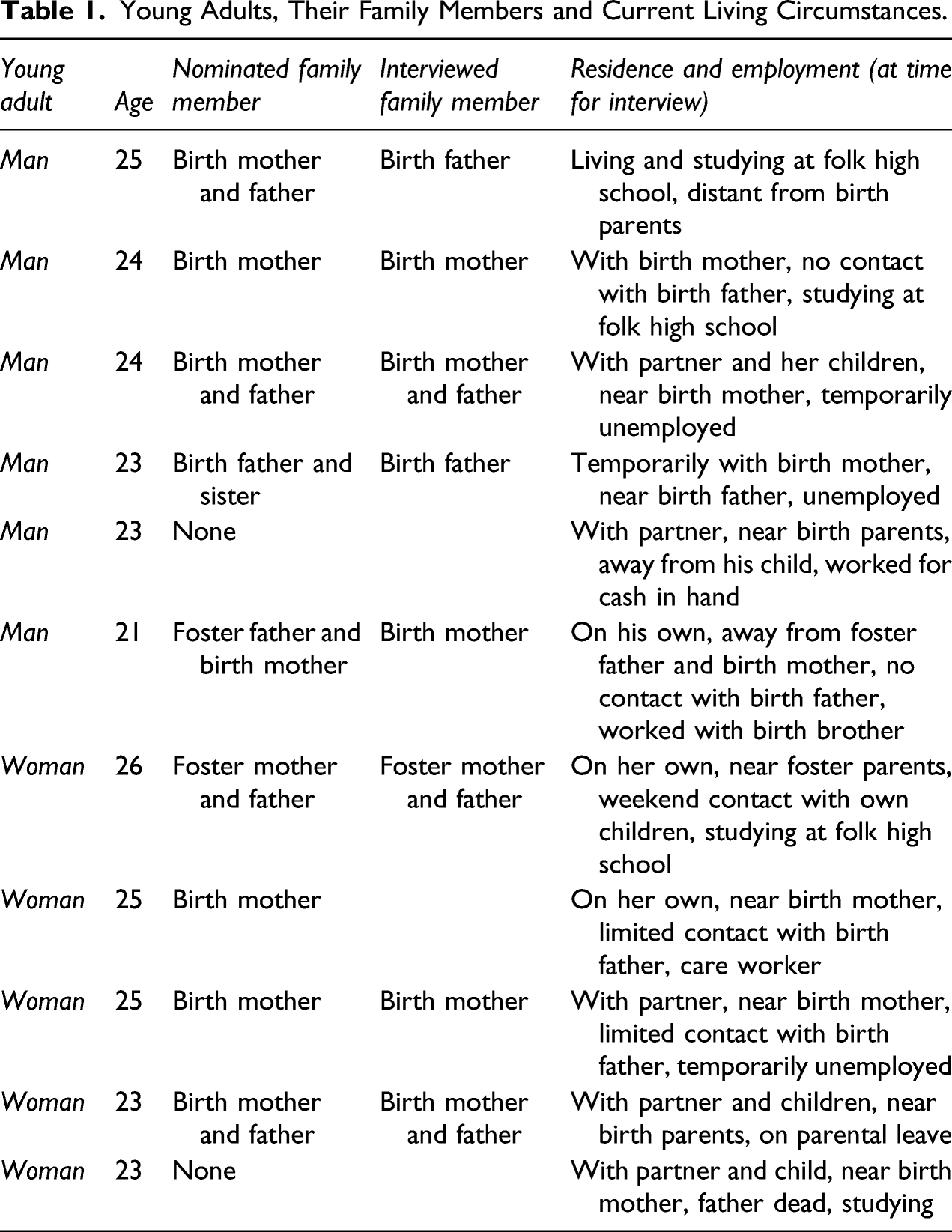
Most interviewees chose a neutral site for their interview, most often a conference room at a conference center close to where they lived. Three young adults and five family members asked to have their interviews at home. Two family members asked for interviews by phone and videoconference. The in-depth interviews were inspired by the teller-focused interview, a way of approaching complex issues that may be difficult to talk about with strangers (Hydén, 2014). Through a listener position, the interviewer seeks to support and encourage the teller in the telling. The interview builds on a dialectic understanding of how meaning is co-constructed by participants and of interviewing as a relational practice. This method, and the fact that the interviewer (first author) had met all young adults and most family members in the course of the previous study, provided a unique relational context that allowed us to explore potentially sensitive issues during the interviews. Key themes for the interviews were the meaning of family, contemporary family relation(s), family relation(s) at time of placement, and thoughts about the placement’s implications for contemporary family relationships. The interviews varied in length with the shortest lasting 40 minutes and the longest taking almost 3 hours. All interviews were recorded and transcribed verbatim with the consent of the interviewees. In order to respect the participants’ anonymity, all names are altered and information about how the young adults and the parents are connected is omitted. The study received research ethics approval from the regional research ethics board, Nr 2018/273-31.
This interview procedure (i.e., with some participants choosing other participants) meant that the young adults and their family members had differing abilities to define terms during the interviews. The young adults were free to define who they thought belonged to their family, but the family member that the young adult specified for an interview did not have the same freedom to define themselves. This differential provided a special frame and may have affected the way young adults and their family members shared their stories.
This study takes a narrative approach. Recognizing the social production of individual stories, we read their stories as socially and culturally produced discourses filtered through individual experiences and relationships embedded in specific contexts. We delve into the ways that various meanings of family and family practices reveal aspects of secure care, the ways these meanings interact with social imaginaries of family, and the consequences of these meanings for the everyday lives of these young people and their family members. The concepts of family practices (Morgan, 2011) and family display (Finch, 2007) serve as anchoring points shaping our interaction with and understanding of interview data.
Following a relational approach to personal lives, we considered memories, emotions, and context, which are essential for understanding personal life (Smart, 2007). We began by identifying sections of the interviews where family/family life/family positions were talked about. We specifically centered our attention on the types of meanings assigned to the family, emotions surrounding these stories, and family memories. We also noted temporal aspects in their stories, that is, if they referred to the time when they entered secure care, or to the time during or after secure care. In observing the ways that young adults and their family members made sense of family, drew boundaries between family and non-family, and positioned themselves in webs of relationships at different times in their lives, we not only gained insight into individual family trajectories but also saw how secure care cast shadows on family-related experiences and heard how those experiences were narrated.
Findings
The shadow metaphor is used to illustrate what we can learn about the context of secure care in Sweden by listening to the young adults and their family members’ stories about their family life. These stories are created at the intersection of individual family experiences, imagined family ideals, and societal as well as institutional expectations concerning family practices and displays. We found that shadows cast by placement in secure care revealed themselves in three different areas, namely emotional chaos, revised and negotiated family positions, and doings and undoings of family. Below, we present the variety of ways that secure care affected young peoples’ and their families’ understandings within these three broad areas of family life. Interestingly, these stories also revealed nuanced and complicated notions of temporality. Although the stories related to past experiences of institutional placement, when analyzed through the lens of family practices and family displays, the stories gave testimony to nonlinear concepts of time. Events both past and present were intertwined in stories that revealed various family practices and family displays. With an understanding of time and place as interdependent (Morgan, 2011), the intertwined stories reveal how secure care continues to influence family lives years after the actual institutional placement occurred. Just as time and place are fluid and not easy to grasp, so are shadows.
Emotional Chaos
One of the most prominent aspects of stories told by young adults and their parents about their experiences of family life during and after institutional placement was emotional chaos. These experiences and stories were marked by a wide range of emotions, and these emotions were strongly felt and changed at a rapid pace.
For parents, their stories of family life when their child was placed in secure care were stories of parenthood in crisis. Although several parents had asked for their child to be taken into care and were convinced that they had no other option, they expressed how they questioned their own parenting abilities and that they felt questioned by others. As one mother explained: […] when she [the daughter] was taken into care, you felt like the worst parent in the world… I mean, like you weren’t worth much. (Agneta, mother)
Secure care is seen as a last resort in child welfare, and this option emerges only when everything else has failed, including family. Thus, having a child placed in secure care brought a sense of personal failure that was magnified by social stigma surrounding institutional placement. The parents who themselves reached out to child welfare authorities for help and thereby asked for institutional placement for their own children emphasized situations that made them go against what is considered “good parenthood.” The feelings expressed of shame and lack of self-worth testify to the moral frame construing what parents should and should not do, and manifest parental responsibility as an unquestionable claim (Ribbens McCarthy et al., 2000).
We argue that these feelings of shame are related to the shadows of secure care that fall onto parents’ sense of self-worth. The overarching prism of parental failure when having children placed in the institution makes the secure care shadow persistent and visible in parents’ talk about their family. Interestingly, the impact of secure care does not fade away with time; rather, the shadow of secure care affects current self-images of parents and their parenting skills. Troubled images of self also triggered troubled thinking about one’s own position, and these thoughts were experienced as bearing a heavy emotional load: But we are still here, and surely that’s what… that’s what’s important in a way, no matter how awful it has been. So, to endure, that’s undervalued as a method I would say, to actually endure. Sometimes it’s only about that. I mean, you cannot do anything more than endure because you have no other choice. (Gunilla, mother)
Reflecting upon her experiences, Gunilla repeatedly used the word “endure” to explain her parenting position. The sense of powerlessness emerged as an overwhelming condition that affects all aspects of family life. “Endurance” indicated not only the inner strength to fight unfavorable circumstances but also indicated an ongoing struggle to find one’s own position in the shaken image of family life. Even years after the placement, the power of the emotional chaos of that time still comes forward when parents make sense of their own family positions and families.
This shadow of emotional chaos seem persist in parents’ troubled self-images. For some parents, doubts regarding own family positions had been accompanying them for years. For them, secure care might have magnified existing problems and concerns: I’m pretty much a failure with that part. What I consider to be a family, it’s a nuclear family. It actually is. But I screwed that up back when I was 18, my thoughts about family so to speak. (Linn, mother)
When admitting to being a failure, Linn used the present tense. To her, the experiences of parenthood in crisis seemed to constitute a permanent feature of her life as a mother. In this context, secure care was used as an example or rather evidence of failures that could neither be hidden nor fixed. In this highly emotional excerpt, Linn recalled her teenage pregnancy to emphasize that from the start, she was doomed to fail. Her perceived failure did not refer to the actual events, but rather the imagined family ideals that, when not reached, may have permanently damaged the way individuals related to others and engaged in family life.
Parental involvement and positions at the time of placement also received attention in stories told by young adults. Although they could describe strained and fragile relationships with their parents before the placement, they expressed very intense reactions to their parents’ involvements (or lack thereof) in the placement. Akin to the highly emotional tone in some parents’ stories, young adults whose parents initiated the placement expressed their anger and disrespect. Reflecting upon the placement, Rashid shared strong and ambivalent feelings when he found himself in secure care: When this happened, how I… I still love my mother. When I talked to her, I cried… The first time I got … I wailed and she wailed. But I told her that I hated her and stuff, but god… I knew in my heart I didn’t hate her, I just said shit ‘cuz I was angry as hell. […] I was angry about where she put me, that’s what I was angry at. But I still loved my mother, but I was still… it’s that, I surely said all those things to her ‘cuz I was afraid, [I] remember that I was afraid because I felt like I was in a prison. (Rashid, young man)
Feelings of fear and anger accompanying the institutional placement were also feelings of abandonment and rage with parents whose role was to protect their children. Vivid memories of crying and wailing as exemplified by Rashid were common in stories of young adults who struggled to understand their placement in secure care. As indicated, a great part of their displayed struggle was related to the disrupted and broken family images. Regardless of their previous situations and the quality of family relations prior to the placement, young adults narrating their experiences could not make sense of the situation because they could not make sense of the role their families took during the time of institutional placement. Rashid, for example, speaks both of anger and love to his mother in an attempt to recall the conflicting and overwhelming feelings that has since marked his experiences and memories of secure care. The shadow of these ambiguous feelings about their parents lurked in their talk about the placement, almost 10 years later. Still, after such a long time, several of the young adults told us that the strength of emotions they were experiencing made it difficult for them to talk about this ambiguity with their parents.
Secure care (a powerful, last-resort intervention that the young people had often been escorted to in haste) stands as an extraordinary context from which to consider questions about family and family life. We posit that, as an institutional practice, placement into secure care is highly emotional and affects relationships of both the confined youths and their families (Enell & Wilińska, 2021.). The emotional chaos accompanying this form of institutional placement is closely related to the disturbed family life and the images of what families should be about. In the social imaginary of family, parents are those who care for and protect their children; children, on the other hand, can rely on their parents. Secure care shows that this idea is not always the reality. In some cases, it shows that family is not enough; in other cases, it shows that family is the main source of problems. The emotional bearing of such ways of understanding family in the context of secure care cannot be underestimated. The voices of children and parents presented above demonstrate that vivid, strong, long-lasting emotions accompany placement and that these relate to how we look at families. The shadow of recalled horror of secure care is not only about the institutionalization, it is also about family displacement, and the shadow appears as emotions that both children and their families are left to manage many years afterward.
Revised and Negotiated Family Positions
Under these conditions of emotional and relational chaos for both family members and young people, relationships with family during the placement were expected to continue, now within the restrictions of a secure care setting (Enell & Wilińska, 2021.). One such restriction was that for the first weeks or months, the youths were not allowed to phone anyone in their private network except for their parents. Moreover, the number of calls and time allowed for them was limited. Some young people claimed (confirmed by parents) that they could only make one ten-minute long phone call and receive one ten-minute long phone call back each day. Another restriction concerned physical visits, which in some cases were limited to every third weekend. These circumstances were exacerbated by the (frequently remote) locations of the secure care institutions. For the most part, young peoples’ contacts with the outside world were restricted to contact with parents regardless of the quality of relationship or the existing family tensions.
The young adults experienced the forced separation and the highly restricted contact with family differently. Some found the restrictions very frustrating. Lisa, for example, said that despite previous conflicts, her mother was her first choice to call and she often used the two allocated phone calls each day to talk to her. As she remembers it, these phone calls were what kept her going. Later on in the placement, when Lisa was allowed to talk to people other than her parents, she explains that the limited number of phone calls each day forced her to choose if she would accept a phone call or save it for later in case her mother might call. Often, she prioritized calls from her mother. Eight years after the placement, she reflects: The fact that my and mum’s, mostly mum’s relationship, was based on me feeling bad, and this eroded our relationship so that even now we will never have a mother-daughter relationship because there is always something she has to help me with. It’s still a little bit of a dependency relationship. It’s been like that since [name of secure care unit], that I feel she is the only one I can trust when it comes to certain issues. So, she is the one who has to to help me. It tires her and it also makes us often have… not anymore, but we had many discussions and quarrels because of me thinking that she should help me while she maybe thought “yeah, but you need to learn yourself too.” (Lisa, young woman)
Lisa displayed her relationship with her mother as atypical compared to the ideal of a “proper” mother-daughter relationship. The way she was left to depend on her mother when she was at her most vulnerable provided her with an understanding of the relationship that was still present in her life. Her display that her well-being is dependent on her mother is to her a distinct and still-present shadow of secure care that hinders her self-expected change to a self-governing daughter with a more equal relationship to her mother.
Secure care as a difficult and highly emotional time could also mean that family ties and bonds would strengthen. This was something that young adults and parents from the same family could agree upon and it was something that happened to Nora and her mother. Nora, similarly to Rashid, was angry at her mother for putting her in secure care. After realizing that she was only allowed to have contact to her parents, Nora said; “well of course, they became very important to me because I was not allowed to have anything else.” The relations could also be strengthened in situations when both young people and their parents feel united against the overarching power of institutional placement. Having a common enemy could allow both parties to redefine their family relations and positions. Lisa’s example puts forward the perspective of a mother who, thanks to her resourcefulness, emerges as the most important person in Lisa’s life. It may be that Lisa’s mother had always acted like that, but perhaps it was the institutional placement that could have revealed the meaning and importance of her actions to Lisa.
While secure care might have triggered changes and re-definitions of family that resulted in more or better connection for some, for others, the path to increased understanding took more time and effort, as the following story illustrates:
Johan: When you stayed at [secure care unit] and [city] and so, there wasn’t much of family ‘cuz… you only had contact over the phone sometimes.
Interviewer: With …?
Johan: With your real parents. So there wasn’t much of a relationship. You lost a lot of relations then. But you still knew who they are, and you still know them, but you lose the connection you had. […] And you lose the contact to your brothers also… since you’re not home. You’re away, you’re far away from them. (Johan, young man)
In Johan’s family display above, he draws a distinction between knowing family and doing family. His woeful reflection is a vivid reminder of the importance of family practices to the way we experience families where the “little things” (Ursin et al. 2017), like being together, being in touch, and engaging in one another’s lives, make a difference. Family without contact and practice ceases to exist. Still, Johan used the categories of “parents” and “brothers” to name his family relations, although his final “far away” signifies great emotional distance that grew during residential care and when there were restrictions placed on relationships with others. However, Johan’s story is also about revised family relations after aging out-of-care. After years in various care arrangements, Johan resumed his contact with his mother and some of his siblings. You learn to value it because a family member can disappear like that [he snaps his fingers] and they are gone. (Johan, young man)
The way he made meaning of his family relationships can be understood of as a shadow of his time in care and the sudden relational changes placements brought into his life. The shadow of secure care in his story is a vivid reminder of family temporality and its limits.
The fragility of family relationships during institutional placement also affected the ways that young adults and their parents conceived of family. Young adults emphasized the importance of trust, support, and care. While by default they saw family as parents, they also created space for more open definitions of family based not on blood ties, but rather on the concrete practice and qualities of relations. Family to me. Well, I mean my whole family is not really my family in that way. For me, my family is those who, well, you would basically do anything for. Or that without them it feels very, very empty. It’s like a mainstay. […] And, I don’t quite feel that way about my mother, unfortunately. I would like to, but I don’t. (Nora, young woman)
The notion that families would do everything for their members and that family relations provide a sense of stability and safety was widespread among young adults. Those reflections often occurred against the backdrop of lived experiences of family life that did not quite match the picture. The evident struggle in Nora’s story can reflect any struggle in which one tries to free oneself from a family defined by birth. Thus, “My whole family is not really my family” is not only an expression of a complicated family situation, but above all else, an expression of a moral stance according to which, in order to qualify for “family,” one must deserve it. When family membership does not match family practice, that membership can be withdrawn (see Becker & Charles, 2006). The boundaries young adults drew around their families in terms of excluding some family members and including other people, such as friends or even pets, were not drawn with a light heart. Nora’s description of her feelings towards her biological mother evokes a sense of loss and disappointment, and offers testimony to the (culturally and socially determined) valuable position of biological parents no matter the circumstances.
Interviews with parents revealed much more limited possibilities for negotiating the concept of family. Although some of them shared their children’s more open definitions of family, none of the interviewed parents rejected their children nor refused to see them as part of their family—neither at time of, or after, secure care. To some, the experience of secure care forced them to prioritize their children. Linn, who previously described herself as a family failure, intended to end the damaging relationship to her partner at the time when her child was placed in secure care. However, the way secure care staff emphasized the importance of parental support to her child made her change her mind, and she stayed in the relationship. And I got that imprinted, how important we were. And that made me back off a bit, because [daughter’s name] still [comes] first. (Linn, mother)
Linn’s display of putting her child first and taking parental responsibility by sidestepping her own needs emerged as a secure care moral lesson of how to be a “good parent.” In terms of a secure care shadow, the moral lesson strengthened her perception of herself as a failure, and during the interview she talked about herself as an insufficient mother.
The experiences that the parents had gone through could also help them to admit that family life does not need to be perfect, or rather cannot be about perfection. And that you don’t have to, everything doesn’t have to be cheerful, you can be angry at each other, you can be sad too, but you still keep contact. […] I would never kick my kids out. I’ve put them into this world and then… well, it’s a lifelong commitment. (Agneta, mother)
Speaking from the position of family bearers, parents often shared their experiences of keeping things together and trying their best to make family happen. In accordance with the moral imperative of putting children first (Ribbens McCarthy et al., 2000), they placed responsibility for family life on themselves. Although experiences with secure care could allow them to reflect more freely on what families could look like, these experiences also placed a morally ingrained shadow on their parenting—that children should be their first priority.
The pressure to make family (read: birth family) work is evident in stories of both parents and young adults. There are signs of individuals, mainly young adults, creating new meanings and opening the idea of family to include people outside the traditional kin network, as well as signs that family is being thought of as a form of doing rather than as a fixed unit. Even so, such interpretations occur against the backdrop of firmly rooted ideas about the dominance of birth families. The notion of “birth family” is persistent, and young people are very reluctant to give it up (as also observed by e.g., Wilson et al., 2012). It is possible that the idea is so important that, in trying to display that a family is working, (birth) family members are driven to explore new ways of interacting and communicating (Finch, 2007). The pressure to make family work and a family’s revised communications can be understood as a secure care shadow: contacts to parents are accepted, but also the idea that (birth) family is important is reinforced.
Doing and Undoing Family
The post-secure care context of a family marked by emotional chaos and (in many cases) revised images of family also has consequences for immediate practices and actions that either maintain or dissolve various family relationships. As much as family display and the practices of “doing family” reveal a great deal about families in the context of secure care, the lack of display, or the undoing of family, may provide even more profound insights into family complexities. As Gabb (2011) points out, both visible and invisible family displays are equally relevant for learning about what family is about. Not surprisingly, in the analyzed stories, the “doing” dimension was found more often among interviewed parents, while the stories of undoing family were exclusively found among young adults. By undoing family in this context, we mean the process of redefining the normative assumptions and ideals about family life and distancing oneself from the overarching preeminence of family in the lives of individuals. In this, any attempts at undoing family are directed at both imagining and living life without a family as one of the most desired relational forms.
Typically, parents are held responsible for what families look like (Ribbens McCarthy et al., 2000). Secure care may therefore challenge the ability of parents to rise up to the demands of being a “good parent.” Family displays can thus become a useful strategy to fend off moral stigma following secure care, and to convey that their family relations are like those of “proper families” (cf. Ursin et al., 2017). In the following excerpt, Olle shows what he learned from his experiences with a child in secure care: Well, now we’ve got a different perspective on that too, but a family is basically that we can talk about everything. We can engage in what we do. We do not let anyone go the day without telling something that they have experienced, you have to at least talk a little bit to them about what they think. (Olle, father)
The importance of communication and of keeping an (indirect) eye on children can be read as a typical example of reproducing the parental ideal. For Olle, this description also indicated that having a daily talk increased in importance as a direct result of secure care experiences and he related that talk to difficulties in family relations, especially between parents and children. As he admits, he learned to do that because “you thought you lived well and had a nice life, but apparently [the daughter] did not feel well at all.” Thus, Olle’s way of doing family 9 years later is shadowed by his experience of secure care.
Talking, or “just talking” as some parents and young adults would say, became one of the most important ways of doing family. Stories of neither parents nor young adults included much about other types of activities—talking and calling each other was most often mentioned when explaining family practices during and after secure care. Sometimes, however, talking to each other indicted trouble, dependence, or fear: Now, when he calls so often, he calls just to talk… No, maybe he does not do that, not just to talk, there is always something he wants. But before, you knew,“right, something must have happened” when he called. But it’s not like that anymore. (Robert, father)
Robert’s comments give insights into the troubled side of communication in that they show how an apparently single practice (calling) may acquire various meanings even if the same persons are involved. What used to be a reason for worry has changed and is now an opportunity to keep in touch. However, “doing family” is not only about how and with whom but also when and where. Considerations of membership and practice that keep the concept of family alive (Morgan, 2011) also have spatial and temporal dimensions that may change or affect the meaning assigned to them, which is also reflected in Boddy (2019), who found that family memories and relationships over time could change and become both strained and supportive.
As much as keeping in touch was an important practice of displaying family in the post-secure care context, being on one’s own was the main strategy for “undoing family” among young adults. I don’t care much about family anymore, like I did when I was younger. I don’t because family is family, but you… I mean, they can still hurt you the most or… It’s like this… so, the most important thing for me is actually myself. (Tove, young woman)
Strained relations with parents coupled with experiences of secure care could turn young people inwards, searching for a better quality of life on their own without reference to family. Placing emphasis on oneself could therefore be seen as the extension of individualistic discourses (prevalent at secure care units) that, in the name of teaching responsibility, had gradually grown to a shadow of blaming and stigmatizing young people as the sources of all trouble (Enell & Wilińska, 2021.).
In her story, Tove gave also voice to the negative feelings and difficulties experienced in her relations to family. Recognizing the importance assigned to families, she therefore emphasized that the emotional damage caused by difficult family relations “hurt you the most.” These difficulties also mean that young people may have limited relational resources to help them move on and create new relations and families, as described in another interview:
Adam: Hmm. But then, I think it’s a lot because… I have not been with mum and dad since 2007. It’s been mainly about creating my own family.
Interviewer: Who counts as family to you these days?
Adam: These days. I don’t know. (Adam, young male adult)
Only a few of the young adults found it difficult or impossible to define current family relations. Adam’s story of “creating family” reflects his doing and undoing of family in a childhood that included multiple placements with foster families and in residential care settings. His response “I don’t know” implies ambiguous feelings about family relations and, as Holland and Crowley (2013) suggested in their study of young people leaving a care situation, the loss of having other people’s biographies intertwined with yours over a longer period of time.
To many of the young adults, the concept of family seemed to be reserved for parents, which became evident in the stories of young adults with children on their own. In their stories, they identified themselves as “children” to their parents rather than as parents to their children. Having children seem to have brought some of those young adults closer to their parents. When they were asked to name their family members, their own parents came first. Thus, not knowing who your family is must not be read literally as having no family relations, but can instead be understood as a persistent difficulty in coming to terms with non-functional relationships with parents. In the interview with Adam, he spoke about his siblings and his tattoo that says “family” to emphasize that he would always stand by his family. This ideal and morality of how to do family might reflect what he wished his family would have done for him while he struggled to create his own family.
The “I don’t know” can also be a reminder of the life stage that the interviewed young adults found themselves in. The young adults were in an age when many young people leave home and birth family. Leaving home is considered one of the most important transitions separating the period of youth and adulthood; however, it is a long process that depends on various structural, contextual, and relational aspects (Holdsworth & Morgan, 2005). Entering adulthood with experience of secure care, where some felt they were abandoned by their own parents and to blame for disturbing family life, might have made it easier to undo families, at least temporarily. To the parents of children entering adulthood, their parental responsibility and their moral obligation to protect and put their child first seem to be persistent, even in their child’s process of leaving the birth family.
Concluding Discussion
The main objective of this research was to shed light on family and family practices among young adults with a history of secure care and the family members of these young adults. Reflecting upon the various ways that secure care can affect families, we use the metaphor of shadows to provide an understanding of how secure care came forth in that family practices and displays of the young adults and their family members. In the three broad areas (emotional chaos; revised and negotiated family positions; and doing and undoing family) where secure care shadows revealed themselves, the shadows took different forms: some were distinct while others were more difficult to comprehend. Among the clearer shadows were the recalled horror of secure care (reflecting family displacement) and the pressure to make family work (reflecting the restricting practice of only considering (birth) parents as family and of (natural) importance to the young people).
We also found that, to a great extent, the stories narrated by young people and their parents were stories of family display in which interviewees emphasized how their families were and what those families meant to them. They talked much less about family practices and various doings of family, especially after the time of institutional placement. This finding implies a great deal of struggle about the meaning of family, mainly for the young adults but also for some of the parents. Recall Heaphy (2011) argument that contextual embeddedness restricts who can make family displays, and how. The identified shadows and the participants’ struggles may reflect various challenging situational contexts in their lives before, during, and after secure care. Below, we will argue that these shadows are bound to the situational context of secure care.
Analyzing the material with an active use of the concepts of family practices and displays allowed us to identify and reflect upon the norms, expectations, and moralities attached to the word “family.” One of these concerns is the “parent–child relationship” as conceived of by the young adults and their parents as the core of family life. The parents’ displays show that they have quite static and fixed understandings of what family is, and that undoing or redefining children as family members seems to be morally prohibited (see also Becker & Charles, 2006; Ribbens McCarthy et al., 2000). In contrast to the views expressed by parents, the young adults’ family displays were strongly linked to “doing” family; however, even so, the parents were present in the young adults’ stories. These young adults almost entirely referred to parents as family during their time in secure care, after leaving secure care, and when asked to nominate family members for this study. Siblings or significant others were seldom mentioned. The pervasive presence of parents in the narratives did not change whether parental relationships were tense, whether the youth had been in care for a long time and established new (family) relations, or even whether they had started a family on their own with a partner and child(ren). Previous research showed that those leaving care can experience significant fluidity in their families (see Holland & Crowley, 2013; Parker & Mayock, 2019); in contrast, most of these young adults did not experience the same ambiguities in their family relations.
Secure care’s severe relational limitations shook the fundamentals of life in general and family life in particular. In this emotional chaos, young people were left with their parents as the only persons available outside the institution for comfort and support. The parents also became their only relational and biographical link to life before secure care. We argue that parental involvement and responsibility exceeded all other relational considerations in the context of secure care, which gave and/or reinforced moral obligations for the parents to put children first, and gave and/or reinforced moral images for the young adults that family (i.e. parents) is there no matter what. This fixed ideal of the parent–child relationship binds the young people and their parents more tightly to a moral understanding of family as “parents” while at the same time it also restricts their practices. The shadow of relational restrictions and of only having contact with parents falls heavily on the young adults later in life. Their relation(s) to the parent(s) seem to be prioritized over (all) other relationships, no matter the strained these might be. The understanding of family in terms of parental support might also bring about distorted images of family that are difficult to live up to.
If we consider the context of secure care as a cultural script for “proper” family displays, the “birth family” seem to be considered of “natural” importance. Such essentialist scripts risk “making invisible alternative relational realities and possibilities” (Heaphy 2011, p. 37). Therefore, we argue that the context of secure care does not support young people’s embeddedness in relationships other than with parents. Nor does the institutional context support the idea of intertwined life biographies with relations other than parents. The young adults’ strategies of solitude and consequential undoing of family life could have been avoided if different types of relations had been embraced and supported during secure care. Moreover, such a script may impair an understanding of family as something relational, created and maintained through various practices (Morgan, 2011). Consequently, both parents and young adults shared stories of a struggle between their morally ingrained images of family and their (i.e., the young adults) experiences of family members failing to reach this ideal, or of being the one(s) (i.e., the parents) failing.
The title of this article contains a quote from one of the young adults, Nora, who stated “My whole family is not really my family.” This excerpt manifests both a persistence of culturally and socially shaped family norms that emphasize the parent–child relationship and that family membership is something that one has to qualify for through actions—one has to earn and deserve it. The emotions and feelings behind this phrase are probably recognizable to many who, in moments of anger, might attack idealized notions of family. However, here, the statement is grounded in a more permanent condition. The stories narrated by young adults and their parents are conditioned by the continual influence of secure care, embedded in the structural context of a family-oriented welfare model in a de-familialized welfare state. Together, these two forces create a structural tension between, on the one hand, welfare policies founded on the ideals of independence and direct contact between an individual and the state and, on the other hand, institutional practices emphasizing reliance on support from family. The apparent tensions between policies, practices, and everyday experiences are discerned in the difficulties of bringing together the imagined and lived realities of family, and these difficulties lead some young adults to conclude that their best course of action is to invest in themselves, not in (family) relations.
Discussing, or rather “troubling” the concept of family among young people with experiences of out-of-home care, Boddy (2019: p. 2249) stresses the importance of accounting for both ordinary and distinctive meanings of family. In this article, we begin from the ordinary meaning to arrive at distinctive meanings of family in order to draw attention to the permanent effect that secure care has on both young people and their parents. The shadowing of secure care on family practices and family displays serves as an ample reminder that the policies and institutions of child welfare may mark children and parents for life by intervening in the most precious features of human lives, namely, relations (Donati, 2011). With specific focus on family, our findings lead us to call for more attention to be paid to the perversity of secure care arrangements, at both policy and institutional levels, because these arrangements hinder young people and their families by impeding their resources and reducing their possibilities for either doing or undoing family.
Footnotes
Acknowledgments
The authors would like to thank all participating young adults and their family members for generously sharing their thoughts about family life.
Declaration of Conflicting Interests
The author(s) declared no potential conflicts of interest with respect to the research, authorship, and/or publication of this article.
Funding
The author(s) disclosed receipt of the following financial support for the research, authorship, and/or publication of this article: This article is financially supported by Swedish Research Council for Health, Working life and Welfare, dnr 2017-00261, STYA-2017/0003.
