



Abstract
Recent scholarship on families living in poverty has focused on immigrant and migrant families, legal and illegal. The element of citizenship has received relatively broad attention, as legal status has profound influence on the individual’s life chances. However, studies exploring relations between noncitizenship and poverty have not provided a comprehensive explanation of the mechanisms that deprive noncitizens of the possibility of accumulating sufficient material resources. The study offers a nuanced, comprehensive account of the process of economic deprivation, focusing on four main survival strategies with respect to noncitizen Palestinian families residing in Israel. Drawing on 24 qualitative in-depth interviews with adult family members, we apply the intersectionality approach to decipher mechanisms of exclusion at work in the everyday lives of illegal migrants, shaping their ability to attain material resources. Findings point to a need to adopt a transnational protection framework in order to allow economic and social inclusion of noncitizens.
Keywords
Families in Poverty and Noncitizenship: An Intersectional Perspective on Economic Exclusion
Poverty, in an overarching sense, is about the individual’s or specific population’s inability to attain sufficient material resources. As growing poverty has been a core social problem of our time, ample efforts have been made to understand the ramifications of life in poverty on families (e.g., Einat & Benjamin, 2016; Einat & Strier, 2018; Gazso, McDaniel & Waldron, 2016; Halpern-Meekin, 2019; Whitehead, 2018).
Within the vast literature on families who live in poverty, two main questions have received broad scholarly attention. The first focuses on the material aspect of economic deprivation, with the aim of understanding how people living in poverty succeed in accumulating material resources. Since Edin and Lein’s (1997) classic study, four survival strategies are considered the main possible breadwinning routes for poor families: labor market participation, social networks of support, organizational-based support, and state support. The second question focuses on the social aspect of economic deprivation, with the aim of understanding how poverty leads to social isolation (e.g., Lister, 2004).
Recent scholarship on families living in poverty pays increasing attention to migrant families—legal and illegal—mainly in response to the growing number of immigrants to the US and Europe. Within this literature, the element of citizenship has received considerable attention, as legal status has profound influence on the overall life chances of individuals (Amuedo-Dorantes, Arenas-Arroyo & Sevilla, 2018). More than a legal formula, citizenship is an increasingly salient social and cultural fact, a powerful instrument of social inclusion or exclusion (Walsdorf, Machado Escudero & Bermúdez, 2019), and hence a source of new forms of inequality (Faist, 2014). Scholars have argued that the disparities in life chances among immigrants are strongly connected to their available social protection. While social protection was traditionally a matter of the social rights provided by nation states to their citizens, in todays’ world “on a move” (Levitt, Viterna, Mueller, & Lloyd, 2017), there is a need to develop new frameworks to understand transnational social protection, that is, a framework examining how social rights are reorganized in response to massive immigration flows. Such protection might be provided not only by nation states but also by families, the market, NGOs and INGOs, and hosting states (Levitt et al., 2017).
The phenomenon of families who reside illegally and lack citizenship has been the subject of research in a broad range of academic fields. Since lack of citizenship frequently hinders proper breadwinning, family scholars have paid specific attention to the link between (legal and illegal) immigration and poverty (Borjas, 2016). Studies have explored possible routes to accumulate material resources among these populations and have demonstrated how poor families struggle to make ends meet but, despite considerable effort, remain in a state of economic distress (e.g., Enriquez, 2015).
However, the literature still fails to provide a comprehensive explanation of the specific factors which deprive noncitizens of the possibility of accumulating sufficient material resources. In this study, we aim to fill this lacuna by offering a nuanced, comprehensive account of the process of economic deprivation, focusing on the four main survival strategies for accumulating material resources. Drawing on the intersectionality perspective, we attempt to decipher several specific mechanisms of exclusion which are at work in the everyday life of illegal migrants and shape their ability to attain material resources. By linking the intersectionality perspective to the transnational social protection framework, we are able to demonstrate how limited access to public institutions of social protection increases the vulnerability of migrants who suffer multiple marginalities. We focus on the case of noncitizen Palestinian families who reside in Israel, drawing on 24 qualitative in-depth interviews with adult family members, supplemented by interviews with stakeholders involved with this population.
By revealing the mechanisms through which deprivation of citizenship rights influences the economic deprivation of noncitizen families, this study contributes not only to literature examining contemporary processes of social and economic exclusion of families living in poverty (e.g., Ali et al., 2018) but also to the growing discussion of economic and social difficulties of an ever-growing population of families of migrants and immigrants, both legal and illegal (e.g., Phoenix, 2019). These families, often struggling to escape poverty, wars, and other dangerous life conditions in their homelands, encounter various obstacles to economic and social relief in their host country embedded in their status as noncitizens. Beyond these theoretical contributions, highlighting the lived evidence of noncitizens provides evidence-based data on the barriers to poverty alleviation for noncitizen populations, which might facilitate design policies that can better address the needs of these populations.
Noncitizen Palestinians in Israel: Between Indigeneity and Illegality
Contemporary societies are characterized by more fluid definitions of citizenship than in the past. Global, economic, and political processes shape changing policies, which differentiate between citizens—who deserve the full range of protection embedded in their citizenship rights—and noncitizens (Levitt et al., 2017). Historically, nation states had a clear definition of citizenship, usually based on place of birth and residency. Today, different forms of immigration create situations in which populations leave the place that grants them citizenship and move to other countries or regions where they are not entitled to full citizenship rights and sometimes are even considered illegal. For example, such a situation occurs in contemporary internal migration in China, where rural migrants who move to urban areas are considered “noncitizens” and therefore are often exposed to practices of exclusion and oppression (Lui, 2018).
In the current study, processes of exclusion and particularly economic deprivation are examined in the unique case of Palestinian families, mostly formal citizens of the Palestinian Authority (Occupied Territories), who live within the borders of the Israeli Jewish state. Although these Palestinians can, on the one hand, be perceived as an indigenous population, they also went through an immigration process in which they moved to a state in which they not only lack citizenship or permanent status but are also considered foreign and often even dangerous.
After the 1967 war, marriages between Palestinians from the Palestinian Authority and Arab citizens of Israel became more common. Until the early 1990s, Israel allowed free passage between the territories, enabling residents of the Palestinian Authority to live with their spouses in Israel even without official status. Following the terrorist attacks of the early 1990s, Israel restricted freedom of movement among Palestinians from the territories who wished to live in Israel, requiring them to obtain the official status of “family reunification,” which granted them citizenship after certain delays and difficulties. In 2002, a law was enacted that prohibited Palestinian residents of the Palestinian Authority from receiving citizenship or permanent residence in Israel and restricted temporary permits to special cases. This virtually put a halt to “family reunification” as a path to citizenship. Instead, marrying an Israeli-Arab citizen entitled Palestinians to reside in Israel without citizenship, provided they received the requisite permit.
Alongside excluding immigration policies for Palestinians, there has been a rise in the number of noncitizen Palestinian residents over the last two decades (Shapira, 2015). Some move following marriage, as described above. Others come as day laborers, going back and forth between the Palestinian Authority and Israel, and eventually stay permanently in Israel. Still others reside in Israel because they believe their lives to be endangered if they return to the Palestinian Authority, either because of cooperation with the Israeli authorities, involvement in criminal acts, or for behavior that tarnished their family honor. These families suffer from dual discrimination; they are a “minority within a minority.” Not only do they belong to the general Arab population, which is a discriminated minority in the Jewish state of Israel (Amara & Schnell, 2004), but they hold citizenship from the Palestinian Authority and are thus discriminated against by Israeli Arabs, who usually have Israeli citizenship.
The majority of noncitizen Palestinians live in Israel illegally. While some have temporary or permanent permission to stay, only a few of those have work visas. Similar to illegal immigrants in other locations (Amuedo-Dorantes et al., 2018), illegal status prevents them from getting a driver’s license, registering for studies, or finding a steady job. They are not entitled to the social benefits available to citizens living in poverty and have only recently been allowed to obtain health insurance—at a high cost. If they are caught by police, they may be arrested or detained for a long time (Hasson, 2017). While no official numbers are available, professionals who work with these families estimate that, in most cases, they suffer from poverty. In the present study, we aim to understand the specific mechanisms that are at work in the everyday lives of noncitizen Palestinian families and shape their ability to attain material resources.
The Intersectionality Perspective on Noncitizenship and Legal Status
Intersectionality provides a theoretical framework allowing researchers to decipher how locations of social exclusion, including noncitizenship, are interwoven in economic deprivation and influence opportunities to accumulate material resources. This theoretical perspective refers to the interplay of social and cultural categories, such as race, class, and gender—the “big three”—in the design and construction of oppression and inequality (Crenshaw, 1989). Accordingly, social and cultural categories are interconnected in influencing the operation of social power systems (Brah & Phoenix, 2004). The intersectionality framework allows for visualization of the convergence of different types of discrimination as points of overlap. Moreover, it helps us understand and assess the impact of these converging identities on opportunities and access to rights, as well as to see how policies, programs, services, and laws that impact one aspect of people’s lives are inextricably linked to other aspects (Symington, 2004).
More than the intersection of the “big three,” scholars underscore the importance of citizenship and immigration status in shedding light on processes of marginalization and exclusion (Johnson, 1994; Romero, 2008). Highlighting the centrality of citizenship complements recent arguments that citizenship status is the key principle of stratification today (Castles, 2005; Harpaz, 2019) and the most important factor affecting one’s life chances—more than class, gender, or race (Milanovic, 2010). Legal status not only determines how long an individual can remain in the state but also under what conditions, doing what work, and what form of social and economic support they can receive (Brown, 2011). Moreover, lack of citizenship in and of itself renders unequal opportunities, vulnerability, and exploitation (Bauder, 2012). The ramifications of lack of citizenship for well-being and general life chances are highlighted in the transnational social protection framework (e.g., Levitt et al., 2017). Social protection, embedded in citizenship status, was originally established to help individuals and families cope with social risks arising in capitalist economies in domains such as employment, health, and education. As such, differential degrees of protection provided to those without citizenship status have a great impact on social inequalities (Faist, 2014).
Combining the interconnected statuses of citizenship status and legality, recent studies demonstrated that employing an intersectionality perspective could explain the complexities associated with “illegality” and highlight the oppressive experiences of marginalized groups (García, 2017). Most relevant to the present study is the intersection between poverty and citizenship and its interconnectedness with all other identities. While not all noncitizens suffer from poverty, they are often identified as a vulnerable population, and economic distress characterizes their experience as a group (Derose, Escarce & Lurie, 2007). More specifically, the literature which focuses on illegal immigrants has suggested that poverty is a fundamental factor in their life conditions (Amuedo-Dorantes et al., 2018; Martinez et al., 2015).
Economic Survival Strategies and Citizenship Status
Studies have revealed the crucial impact that the intersection of experienced migratory processes and lack of citizenship has on the overall life chances of asylum seekers, refugees, and undocumented workers, both as individuals and as groups (Castles, 2005; Shachar, 2009). Usually migrant populations have a variety of needs, such as food, housing, health and welfare, social security and education, requiring temporary assistance, and treatment and intervention by welfare, education, and health authorities (Lipman, 2006). An international survey of the lives of immigrants and stateless people shows that they are the most vulnerable, more likely to live in poverty and to have difficulty feeding themselves and their families (Bread for the World Institute, 2016). Such vulnerability is strongly related to the lesser extent of social protection, from various sources, available to them (Levitt et al., 2017). Moreover, the rate of poverty among the population of stateless immigrants is twice that of legal immigrants and the native population (Passel & Cohn, 2009).
While the relation between immigration, illegality, and poverty has been broadly acknowledged, we still lack understanding of the mechanisms that prevent migrant families from adequately providing for their dependents, as well as the interconnected barriers related to citizenship status. In this context, studies point to four main survival strategies adopted by people living in poverty, as well as the main barriers that block opportunities for these strategies to become useful and sufficient.
Labor market participation is the central survival strategy out of the four. However, there are numerous barriers to inclusion in the job market. Most important to the current topic of study is that people belonging to weakened populations are positioned at the bottom of the labor market, obtaining jobs which are usually low wage and unable to sufficiently meet family needs (Asaf, Lavee, & Strier, 2021; Collins & Mayer, 2010; Edin & Lein, 1997). This is especially true of illegal immigrants, who often have language barriers, relatively little education (Leach, 2014) and, most importantly, legal restrictions upon employment (Amuedo-Dorantes et al., 2018).
The second important survival strategy for low-income individuals consists of reliance on social networks (Edin & Lein, 1997). Specifically, research refers to support from relatives, friends, and neighbors, who provide various types of assistance, including financial support (cash or other material support), services such as transportation and childcare (Brewster & Padavic, 2002; Edin & Lein, 1997; Gerstel, 2011; Harknett & Knab, 2007), and mutual living arrangements (Whitehead, 2018). However, despite the centrality of social support to the economic survival of people in poverty, research also shows that, in many situations, such individuals do not appeal to relatives and friends for support (material or otherwise) out of fear of being criticized or judged for their economic difficulties (Domínguez & Watkins, 2003; McIntyre, Officer & Robinson, 2003; Nelson, 2005; Offer, 2012) and because of the stigmatization of dependency (Fraser & Gordon, 1994). As for immigrant families, a US study indicates that, for both legal and illegal immigrants, the support of extended family is crucial for preserving economic resources, specifically in terms of shared living arrangements with extended kin or friends (Leach, 2014). Nevertheless, the need to host new arrivals can intensify the burden on immigrant families and even negatively affect economic prospects (Leach, 2014).
The third survival strategy entails third-sector, organization-based (or “agency-based”) support, that is, assistance by social organizations whose declared goal is to aid the needy (Offer, 2010; Small & Gose, 2020). The importance of support from social agencies and local organizations has increased with the withdrawal of the welfare state in many Western societies over the last few decades, which has reduced state support for weakened populations (Allard & Small, 2013; Small, 2009). Here, too, there are barriers to use of this strategy, as private agencies and NGOs which are expected to replace state services have become overly burdened (Allard, 2009).
Finally, the fourth strategy of survival is the support of state institutions. Such support is directly related to citizenship status and is manifested in a wide range of social rights. While these rights enable economic survival for weakened populations and determine the general life chances of individuals, welfare reform in many Western countries has massively reduced the extent of social rights and social services, as well as the amount of state support to its citizens (Small, 2009). Consequently, the possibility of relying on the state for economic or other kinds of support has become virtually impossible. For weakened populations, whose possibility of achieving sufficient breadwinning and support from the labor market, social networks, and/or third-sector organizations is low, the meaning of the withdrawal of social rights is often increased hardship in vast life areas and deeper poverty (Kissane, 2012).
Welfare reform has particularly limited the eligibility of immigrant households to receive many types of aid (Borjas, 2016). For those without citizenship status, the situation is far worse. Those who are illegal are ineligible for the majority of social rights granted to citizens or legal immigrants (Borjas, 2016). Even those who are entitled to some rights suffer from exclusion and an inability to realize their rights; this massively impacts opportunities for economic survival and well-being among noncitizen individuals and families.
The findings of the broad literature cited above help explain why poverty alleviation is profoundly difficult using the main survival strategies. However, they offer less of an explanation for the specific barriers related to citizenship status. Moreover, research has provided only fragmented explanations of barriers to adequate breadwinning faced by illegal migrant families. This lacuna is puzzling given the growing waves of legal and illegal migrants and immigrants alike. By providing a comprehensive account of the processes of economic deprivation, we aim to fill this gap, drawing on the case of undocumented Palestinians living in Israel. We ask two questions: What specific mechanisms of exclusion are at work in the everyday lives of these illegal families? How do these mechanisms shape their ability to attain material resources via the four main survival strategies?
Method
Participants
This study draws on data from qualitative interviews with noncitizen Palestinians living in Israel. Based on theoretical sampling (Warren, 2002), the criteria for recruitment were noncitizen Palestinians residing in the state of Israel, holding temporary residence status or staying illegally, who are over the age of 18, and who experience material hardship. This decision was initially made to fit the theoretical logic of intersectionality and to allow us to examine the intersection of class with other marginalized axes. During the recruitment process, it became clear that the vast majority of noncitizen Palestinians suffer from material hardship and live in poverty, such that living as a noncitizen Palestinian in Israel is virtually equivalent to being poor. Indeed, all the interviewees defined themselves as living in poverty and suffering from social exclusion. Recruitment was carried out through convenience sampling (Etikan, Musa & Alkassim, 2016). To locate potential participants, we appealed to social workers and professionals from various public social organizations and nonprofit organizations. We also asked participants to refer us to others who might fit the criteria and be interested in participating in the study.
We conducted in-depth interviews with 24 individuals (11 women, 13 men) ages 20–50 (M = 38). Thirteen of the interviewees had no permits of any kind and hence resided in Israel illegally, while the remaining 11 held temporary or permanent residence permits. Of the 11 legal participants, only seven had work visas, and only three of the seven used them to work legally in jobs paid on the books.
Research Tools and Procedure
We conducted in-depth, semi-structured interviews with the noncitizens. The interview guide, developed especially for this research, covered five topics: family background; financial aspects such as income and expenses; concerns such as emotional and psychological well-being and survival routes; the labor market; friends and social networks and third-sector organization support; and interactions with state institutions. The interviews also explored moving to Israel, family life and relationships, as well as the challenges that stem from their citizenship status, such as issues with education, health insurance, social welfare, and housing.
Participants chose the location of the interview. Most interviews were conducted in the respondent’s home. All interviews were recorded, lasted one hour to an hour and a half, and were conducted in Arabic by an Israeli-Arab interviewer. All identifying information was deleted from the transcriptions, and all names are pseudonyms. The data were coded inductively to maintain the credibility of the research with a division into categories and sub-categories (Charmaz, 2014).
Findings: Mechanism Preventing the Resource Accumulation of Noncitizen Palestinians
To explain the mechanisms that prevent noncitizen Palestinians’ ability to accumulate economic resources, we focus on four main strategic routes: the labor market, state support, social networks, and third-sector organizations. We found that the intersection of ethnicity, nationality, gender, and class with lack of citizenship operates as a multiple exclusion mechanism, manifested in all breadwinning routes. Main findings are summarized in Figure 1. Barriers to resource accumulation of noncitizen Palestinians.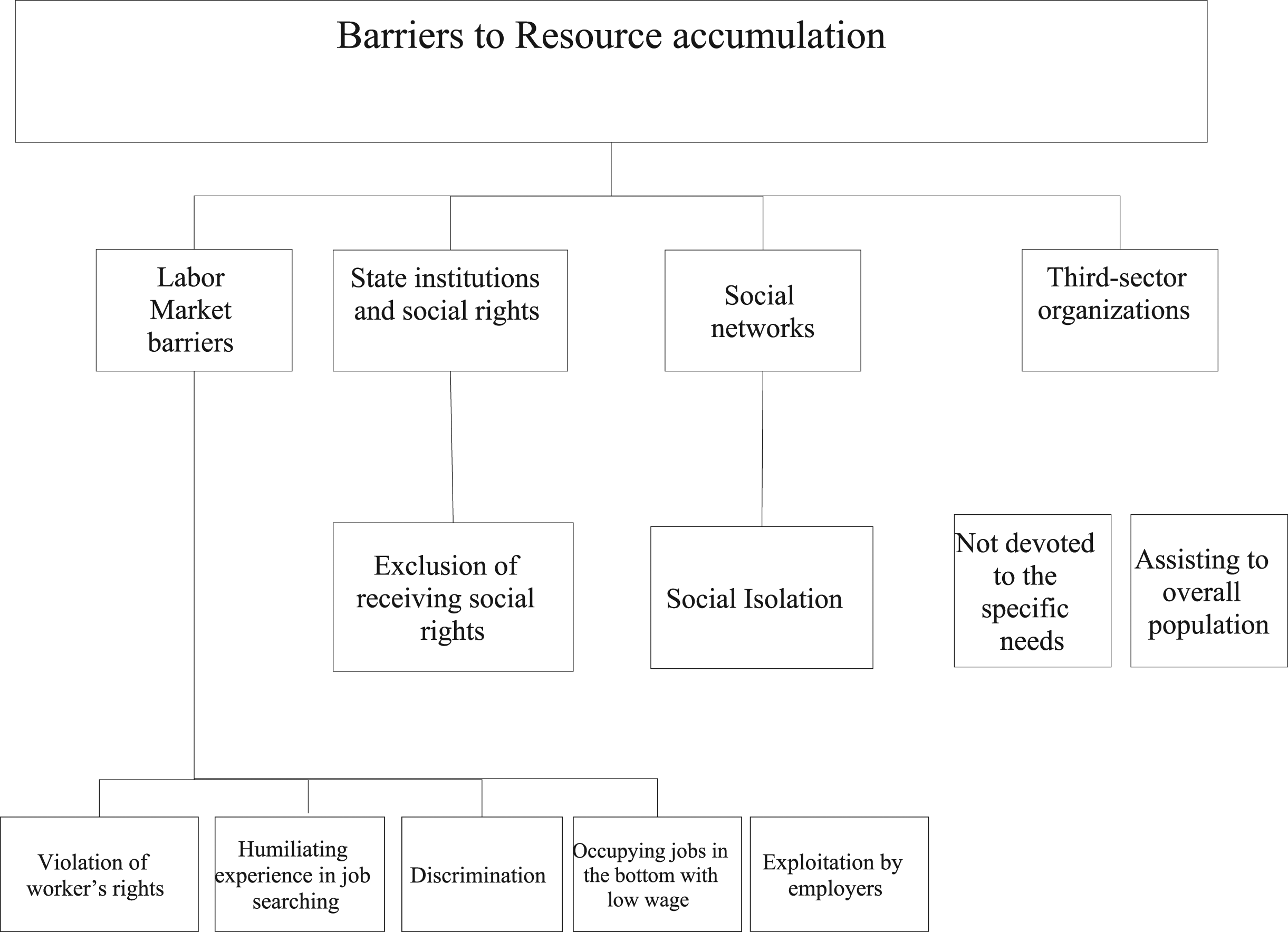
The Labor Market
The analysis revealed that, among poor Palestinians living in Israel, the intersection of lack of citizenship with their nationality, ethnicity, and class creates an exclusion mechanism for all, regardless of the legality of their residence and jobs. All participants shared an inability to adequately provide for their families through labor market participation. Nonetheless, illegality is the most salient barrier to survival via the labor market. For illegal Palestinians, whose Arab appearance exposes them to frequent random police interrogations on the street, the fear of arrest and deportation is immediate and substantial. Ahmed, who resides in Israel illegally (46, married father of 3), tells: I only ask for permission to stay so I can work. To feel free, not like I’m in jail. I don’t leave the house because I’m afraid of being caught and deported. I can’t be separated from my family…. I can’t even go to the grocery store.
However, even those willing to risk leaving the house find that employers refuse to hire illegal workers even for the lowest-paying jobs. Idham, who resides in Israel illegally (40, married father of 3), explains: I’m not working now. I swear, there are no available jobs, I was looking all over the city, in all the restaurants [to work as a dishwasher], but they all want [employees with] citizenship, want an ID, want to hire me with a pay stub [i.e., on the books]. They say that if I fall and something happens to me, they want me to be insured. So I live like this, no income at all, no available jobs, not even in construction.
Although Idham refers only to lack of citizenship as blocking his ability to work, the refusal of employers to hire him, like other illegal Palestinians, exposes the substantial discrimination of Palestinians in the (mostly Jewish) Israeli labor market. As in other Western Euro-centric countries, those who belong to the dominant, often white, population refuse to work in vast segments of the labor market, which are often characterized by being physically difficult or dirty (Sassen, 2009). Until a few years ago, these jobs were performed by illegal Palestinians, but the Palestinians have largely been replaced by Eritrean and South Sudanese refugees and asylum seekers, who arrived in Israel in large waves (Kalir, 2015). This is the case even though the vast majority of these refugees stay in the country illegally and lack work permits and insurance. Thus, it is reasonable to assume that employers’ refusal to hire illegal Palestinians is embedded more in their nationality and ethnicity and has less to do with a lack of the right permits.
Despite the barriers of illegality and discrimination, some study participants who reside illegally do succeed in finding a job. All of these work at the bottom of the labor market, with low wages and without workers’ rights. One crucial element of their employment is their inability to negotiate work conditions. Tarek, whose stay in Israel is illegal (38, married father of 3), describes his situation: The choices I can make in the workplace are very limited. I don’t have the opportunity to choose jobs, discuss conditions or payment, and I feel obligated to accept what the market offers so that I can have a job.
The narratives of participants indicate that, whether residing and working legally or illegally, they are exploited by employers, who know that such jobs are their only option. This is also salient in the story of Nidal, 38, a single father of an eight-year-old girl. Nidal lives in Israel with a permanent residence permit but without a work visa. He details his severe hardship in the labor market, working mainly in construction: I am paid per workday and my salary is very low. If I’m absent, I’m supposed to make up the hours I missed; I don’t have any paid leave. There’s no insurance or rights. If I’m sick, that’s my problem, I have no solution, I don’t get any money. I have to go to work when I’m sick, when my daughter is sick. In any case, I can’t get medical treatment because there’s no health insurance. I must never get sick.
Indeed, all participants with work visas describe discrimination against and exclusion of Palestinians that virtually blocks their ability to find a regular job in the Israeli labor market. Jumana, a 20-year-old single woman, who has been living in Israel since 2012 with her divorced mother and her four younger sisters, holds a temporary residence permit with a work visa. Having graduated high school in the Israeli educational system, Jumana speaks and behaves like any other Israeli young woman. Asked about her experience in the labor market, she describes at length her inability to find or “even dream of” a job that suits her abilities. Though she, like many other participants who have work visas, could potentially find a proper job, Jumana relates that employers keep closing the door in her face, refusing even to interview her: I can work here, but almost no place agrees to accept me, because they’re afraid. I went around the mall and tried to find a job [as a saleswoman in a store], but once they look at the visa, they refuse to hire me… They explained that they can’t take any risks.
Many others shared humiliating experiences while job hunting: “Searching for a job is a terrible experience, everyone just says ‘no’ and refuses to hire me”; “As Palestinians, people here always look at us in a bad way, and they prefer to hire any other people.” These examples expose the centrality of intersectionality within exclusion mechanisms: interviewees are “looked at in a bad way” not only because of their Arab ethnicity in a discriminatory Jewish labor market but also because of their Palestinian nationality. That is, relations of suspicion between the Israeli state and the Palestinian Authority are translated into employers’ distrust of Palestinian individuals and consequently their refusal to hire them.
In addition to the discrimination of individual employers, Israel’s labor laws discriminate against Palestinian workers. Although noncitizens with work visas can be legally employed and are supposed to be protected by law like any other worker, employers who hire Palestinians have to pay higher payroll taxes. Adal (38, married father of 3), who has a temporary residence permit and a work visa, explains: “When an employer hires me, I cost him more than a regular worker who is a citizen.” Thus, many employers prefer to pay Palestinians off the books to avoid the higher tax. Khalil (39, married father of 5), who holds a temporary residence permit and a work visa, describes the relation between his ethnic-nationality and citizenship status and his inability to be employed on the books or to negotiate work conditions: As a Palestinian, I’m very expensive to my employer, so he refuses to employ me on the books. If he wanted, he could hire someone else, a citizen, and not have the headache that my employment gives him. So I’m working for him with no pay stub, no insurance and no benefits, although my visa allows for regular employment. What can I do? It’s a relatively good job and it’s not like I have other options. It’s the same story with all employers.
Speaking of the implications of such bureaucratic barriers for his entire family’s material condition, Khalil states: Every time I go to renew my work visa at the Ministry of Interior, the procedure takes a really long time…sometimes three months, sometimes six. During this period my stay is illegal. I work with a lot of worries and distress, I’m afraid to get arrested. If I choose not to work while I wait for my visa, this has a drastic effect on my economic situation as I’m the only breadwinner in the family.
Jumana tells of a similar experience about having to renew her residence permit every year: My work depends directly on the permit to stay, and every delay affects me massively. The Ministry of Interior is always late in providing my extension, they are in no hurry to renew the visa and make it very difficult to apply for the extension. …In January I go to the Ministry in order to get it in June.
The Ministry of Interior is presented as a rigid bureaucracy, making it incredibly challenging for applicants trying to extend their work visas, which requires endless documentation and often entails long processing delays. Such delays not only prevent them from working legally but also suspend their driver’s licenses, which are attached to the work permit, and keep them from receiving health services and other benefits associated with their workplace.
Ibtisam (37, single mother of 4) describes her inability to find a steady job due to her temporary residence permit: When you have no permanent status, you are in a state of constant instability. I went through a period in which they deported me; for 5 months I was outside of Israel. I was forced to take my four boys with me, even though they have Israeli citizenship. Because they have no one in Israel but me, they came with me. It’s very difficult. I have to find a good place to work, but as long as I don’t have permanent status, I can’t find a good stable job. My kids will have to stay poor; I can’t extricate them from this horrible situation.
Ibtisam’s story demonstrates the convergence of multiple inferior locations: being a noncitizen Palestinian, single mother, and poor. In her present situation, she cannot earn enough to provide even the most basic family needs. Ibtisam clearly emphasizes how citizenship status, and the permanence it contains, is the most important element that could extricate her children from a lifetime in poverty. Her words are reminiscent of scholarly claims about the fundamental importance of rights embedded in citizenship status, and how they influence the life chances of those living in poverty, particularly immigrant populations (Benhabib, 2013; Shachar, 2009).
State Institutions and Social Rights
Levitt et al. (2017) maintain that individuals without legal status are particularly vulnerable because their access to public institutions of social protection is especially limited. Our findings reinforce this argument, demonstrating how deprivation of social rights operates as an exclusion mechanism in three main areas: welfare, health care, and housing. With respect to welfare and social services, these are provided to noncitizen Palestinians only when one parent in the family is an Israeli citizen or where there is concern for the welfare of the children or domestic violence. In all other instances, noncitizen Palestinians are left without state support.
Nidal (36, single father of 1, temporary residence permit, no work visa) explains: If I could, I would ask for welfare support, support in paying my bills. All are extremely high. But despite our very poor condition, we’re not eligible for any governmental help. If you don’t have citizenship, you pay full price on everything.
Similarly, Arin (35, married mother of 3 young girls, no permit) tells of how she tried to receive assistance from social services to cope with the family’s harsh economic conditions: I applied to the Social Services department several times, but I always get a negative response. They told me I can’t open a file in the department or receive any assistance, because no member of my family has legal status in the country. It’s possible only when one family member has [legal] status or in cases of domestic violence. Going hungry is not enough for them, I guess.
The problematic nature of this policy, which assists noncitizens with domestic violence but not with poverty, is particularly salient in the story of Amani (28, married mother of 2, no permit). On the one hand, she is married to an Israeli citizen and so is eligible for social benefits. On the other, she must live with her husband’s violence because, as a noncitizen herself, this is the only way she can avoid material deprivation: My husband has citizenship; my two daughters and I are not citizens. The fear of staying here alone paralyzes me and forces me to shut up and continue living with him. He beats me, screams, break things. He knows very well that I can’t go and complain about him, because then he will go to jail and I’ll be alone with my girls. We don’t have anyone here [in Israel], I’m all alone. The social worker told me that they can help me with the violence, but not with material assistance. I cannot live either way.
As a noncitizen Palestinian woman, Amani has to deal with the intersection of multiple oppressive positions. Not only is she poor and lacks citizenship rights, she is also in a dire condition due to her nationality and ethnicity. First, divorce is frowned upon in Arab society and therefore if she leaves her husband, she is unlikely to receive support from her family and friends. Second, like other immigrants, she is isolated from local social networks. Last, and even more importantly, the Israeli state often forbids visits from Israel to the Palestinian Authority and back, so she cannot rely on support from her previous networks. Having no social networks of support nor institutional assistance, she is forced to continue living with violence and in fear, with virtually no possibility of negotiating her life conditions.
The intersection of lack of material resources and lack of citizenship rights is also highly problematic in the domain of health care. While Israel entitles all residents, regardless of legal status, to receive medical attention in exchange for monthly fees, the research population still faces difficulties in this area. The main problem is the cost of health insurance. A common response of most interviewees who are not married to Israeli citizens when asked about health care was that they cannot afford insurance (about US$50 a month per person) and thus are forced to pay privately for medical treatment. Rimas (18, mother of 1, permanent residence permit with work visa) describes her inability to provide the necessary medical treatment for her baby due to the high cost and lack of state support: A few months ago my son needed medical treatment. I had to take him to the hospital and pay 3000 shekels [US$800] for the treatment. And that’s not all—now every time I have to take him for an examination, I pay it all privately. I don’t get any support from the government or anyone else, and now I don’t take him anymore because I can’t pay for it.
Finally, housing costs, which are a major burden for any low-income family, are particularly exorbitant for the research population due to the intersection between class and citizenship status. Noncitizen Palestinians are not eligible for public housing or rent assistance, even if they live in great poverty. All participants have to pay full price out of pocket for rent. Rental rates in Israel are known to be high and unregulated. We estimate that noncitizen Palestinians are forced to spend more than 50% of their income on housing. The words of Nidal (36, single father of 1, temporary permit, no work visa) are representative of the narratives of most participants: The largest expenditure is rent. Obviously rent assistance would be very helpful, but I’m not eligible for it. Rent is very high and I don’t get help from anyone. It’s very frustrating that anyone [with citizenship] can ask for help and receive assistance, even if their condition is much better than ours. We, the people with no citizenship, pay full price. We can have only what we can purchase with our money and most of it goes to pay rent. It’s tiring, you don’t even get a chance to breathe.
In sum, our analysis demonstrates how the deprivation of social rights operates as an exclusionary mechanism in respect to welfare, health care, and housing. This situation virtually prevents noncitizen Palestinians from using the survival strategy of state support, even if in some families one or more members have Israeli citizenship.
Social Networks
Unlike research on legal and illegal immigrants that points to broad support relations (Leach, 2014), our research population found this strategy virtually impossible to implement. Similar to other noncitizens and immigrants around the world (Espenshade, 1995), many of the interviewees’ families lack supportive social networks, such as relatives or friends, who can assist them in times of need. Indeed, we found that almost all noncitizen Palestinians who live in Israel, regardless of legal status, are isolated from familial, kinship, and peer networks. Usually, they move from the Palestinian Authority to Israel alone or only with spouse and children. Even those with family in Israel often do not receive support due to their relatives’ own hardships. This keeps noncitizen Palestinians from asking for help even when they suffer deep poverty, leaving them to struggle alone. Amani (28, single mother of 2, no permits) relates her experience of being isolated, having no support from social networks to help her cope with deep poverty: Even though [my relatives in Israel] know my devastating position, they won’t help. Everyone lives their lives, no one comes to visit, to ask how I’m doing.... Everyone lives alone, has their commitments, family and children. All are in the same position as me, all went through the same thing with the Interior Ministry, troubles getting visas. No one helps another.
Ibtisam (37, single mother of 4, no permits) tells a similar story: It’s a great misery to leave your country and move to a new place. Everyone denies you. No one wants to be your friend or help you. You have no rights and the people surrounding you remind you all the time that you’re a foreigner without rights.
The most immediate consequence of the inability to receive support via the survival strategy of social networks is greater poverty. However, the support of social networks is crucial in additional respects for the research population. For example, Nidal (36, single father of 1, temporary residence permit) tells about his isolation: I’m dying to live like a normal person. Right now I’m like a robot. I go to work, return home, that’s it. I have no family. I live here like nobody. If something happens to me, no one will know.
In addition to his negative emotional experience, being isolated also influences Nidal’s labor market participation. As shown earlier, when his daughter is sick, he has to miss work, as he is her sole caretaker. Unlike workers with citizenship status, Nidal is ineligible for child sickness leave and receives no pay for the missing workday. If he could rely on social networks for help, such as someone who could care for his daughter while he is at work, his material condition could be better.
Beyond optional support from networks in the family’s close surroundings, the literature on transnational families refers to reciprocal support relations between migrants and relatives in the home communities. The most obvious form of such support is remittances (mainly economic resources) sent by migrants to those remaining in the home country. In the current case of noncitizen Palestinians, however, their own impoverished position, embedded in the intersection of their marginalities, prevents them from becoming a source of economic support to their families in the Palestinian Authority. In fact, a fundamental survival strategy for this population could be “reverse remittances” from the home country to the immigrants, which has been found to significantly enhance the overall well-being of the latter (e.g., Mazzucato, 2011; Oeppen, 2013). However, given the general low economic condition of families in the Palestinian Authority, the option of the noncitizens receiving resources and services from relatives in the home community is mostly nonexistent. This situation is aggravated by the common perception among Palestinians that these migrants are collaborators with the Israeli government. Indeed, this perception of collaboration is also common within Israeli-Arab society, thereby tending to block the ability of Palestinian noncitizens to create and sustain new personal networks in Israel and to rely on them as sources of economic support.
Third-Sector Organizations
Given the exclusion mechanisms described above with regard to all other survival strategies, the importance of support from third-sector organizations becomes particularly critical. In light of the multiple marginalities of noncitizen Palestinians, third-sector organizations may be the only available route for material survival. The transnational social protection framework emphasizes that the social protection provided by NGOs and INGOs is crucial to the ability of immigrants to accumulate resources for survival (Levitt et al., 2017). Despite their importance, our interviewees revealed that few organizations offer assistance to noncitizen Palestinians in Israel. This is in contrast to the relatively high number of third-sector organizations in Israel that provide material support of various kinds to citizen families living in poverty, both Jewish and Arab. The organizations that do assist the research population do so as part of general assistance to poor populations. There is no organization specifically devoted to the needs embedded in the intersectional marginalities of noncitizen Palestinians. In other words, there is no agency to provide them with the crucial social protection which is unavailable by the routes described above.
The inability to rely on third-sector organizations is reflected in the story of Fatma (45, divorced mother of 2, and ex-husband was an Israeli citizen). Having only a temporary residence permit after living in Israel for 22 years, she is ineligible for any social rights that other single mothers can get, despite her deep economic distress. Fatma tells of her daily struggle to accumulate material resources: I barely manage to survive. I have no permanent income and no assistance from National Insurance. When I turned to the welfare department, they didn’t help. I survive only by relying on assistance from any charitable organization I can find: sometimes a Christian non-profit, sometimes the church, sometimes the synagogue. I ask for assistance from every organization that could help me financially.
Fatma’s story reflects her ongoing efforts, having no single place to turn to for material assistance. Yet, she is in a better state than others, who are not familiar with the possibilities of receiving occasional help from organizations. For example, Arin (35, married, mother of 3, no permits) explains how her foreignness blocks her ability even to search for support from third-sector organizations: There’s one organization that gives out food packages once a year during Ramadan, and that’s it. I’m not familiar with any other organizations that I can go to. Once I heard about a human rights organization. I went to look for their office, but couldn’t find it. I have a lot of problems with the language, my Hebrew is very poor.
The vast majority of third-sector organizations that assist noncitizen Palestinians (as part of assisting the overall poor population) distribute food packages, school supplies, and clothing. While such help is greatly needed for daily survival, more comprehensive support is required, particularly in light of the absence of other routes of survival.
Discussion
The primary objective of this study is to expose processes of economic deprivation in terms of mechanisms that block the ability of noncitizen Palestinian families in Israel from attaining material resources. Our findings supplement existing literature which has demonstrated how poor families struggle to make ends meet via the main survival strategies but, despite considerable effort, remain in a state of economic distress (Enriquez, 2015). The current analysis adds another layer to this literature by deciphering the mechanisms at work in the surroundings of illegal migrants, exacerbating more common barriers to resource accumulation among poor citizen populations and shaping unique barriers of deprivation and oppression. Specifically, by investigating the barriers attached to lack of citizenship, we were able to identify the roots of poverty and exclusion in the lives of noncitizen populations lacking social rights, as well as to explain how they are unable to empower themselves and improve their living conditions.
Focusing on the four common strategies through which vulnerable populations tend to deal with economic hardship, our analysis revealed that citizenship status intersects with other marginal locations and unfolds processes of economic deprivation, blocking the use of such strategies. In the labor market, we found that noncitizens face diminished occupational opportunities, multiple expressions of discrimination and deprivation during job searches, subpar work conditions, a total lack of employee rights, and abuse and exploitation by employers. In terms of support from Israeli state institutions, Palestinian noncitizens encounter a severe lack of social rights in multiple domains, including health care, social welfare, and housing. We also discovered a lack of assistance via social networks, pointing to a strong sense of loneliness and disengagement from familial, kinship, and peer networks, as well as an inability to rely on the support of networks from the home community, which research on transnational families has found to be crucial to migrants’ daily survival (Mazzucato, 2011; Oeppen, 2013). This contrasts with more traditional patterns of mutual support networks from the entire extended family in the general Palestinian population. Finally, in terms of third-sector organizations, the noncitizen population of Palestinians in Israel obtains little support, as a small number of NGOs offer very limited individual assistance.
A second main contribution of the study is to growing literature that applies the intersectionality perspective to illegal and migrant populations (García, 2017; Lui, 2018). Examining the intersection of noncitizenship and economic exclusion among Palestinians living in Israel, this study has shown how noncitizenship creates multiple barriers that contribute to a life of economic hardship. Relying on intersectionality as a theoretical framework, we were able not only to describe, reflect upon, and explain the barriers and difficulties faced by this excluded population but also to understand how the absence of citizenship status, combined with other marginal locations, almost inevitably leads to economic deprivation.
Utilization of the intersectionality perspective also allowed for a contribution to the field of transnational families and the importance of social protection. Scholars in this field have argued that the vulnerability of noncitizens is strongly linked to the degree of social protection allowed by states, the market, NGOs, and personal social ties. The key questions related to these varied possibilities of protection are as follows: which protections exist, who can access them, who is left out, and what are the new inequalities of access produced by these dynamics (Faist, 2014; Levitt et al., 2017). Our findings demonstrate that the intersectionality approach can facilitate our understanding of which populations require more protection. This perspective can yield important insights into crucial gaps in social protections, as well as how poverty is produced and reproduced for those who are less protected.
Beyond revealing the harsh ramifications of noncitizenship on individuals and families, the insights yielded here can inform both practice and policy in an effort to design programs that could facilitate the inclusion and social protection of these populations, not only for undocumented Palestinians living in Israel but for illegal immigrants in general. Indeed, our case is specific in time and space, highly embedded in the historical Israeli–Arab conflict. Nonetheless, the exclusion mechanisms exposed by our analysis might operate in similar ways in other locations. As the phenomenon of illegal populations expands due to stricter immigration policies (Amuedo-Dorantes et al., 2018), and as current understanding of the unique life characteristics and needs of such populations is highly limited (Walsdorf, Jordan, McGeorge, & Caughy, 2020), the nuanced intersectional analysis of the hardships embedded in illegal status may be relevant and useful for additional illegal populations.
Footnotes
Declaration of Conflicting Interests
The author(s) declared no potential conflicts of interest with respect to the research, authorship, and/or publication of this article.
Funding
The author(s) disclosed receipt of the following financial support for the research, authorship, and/or publication of this article: Sources Israel National Insurance Institute (Grant/Award Number: ‘15911’).
